
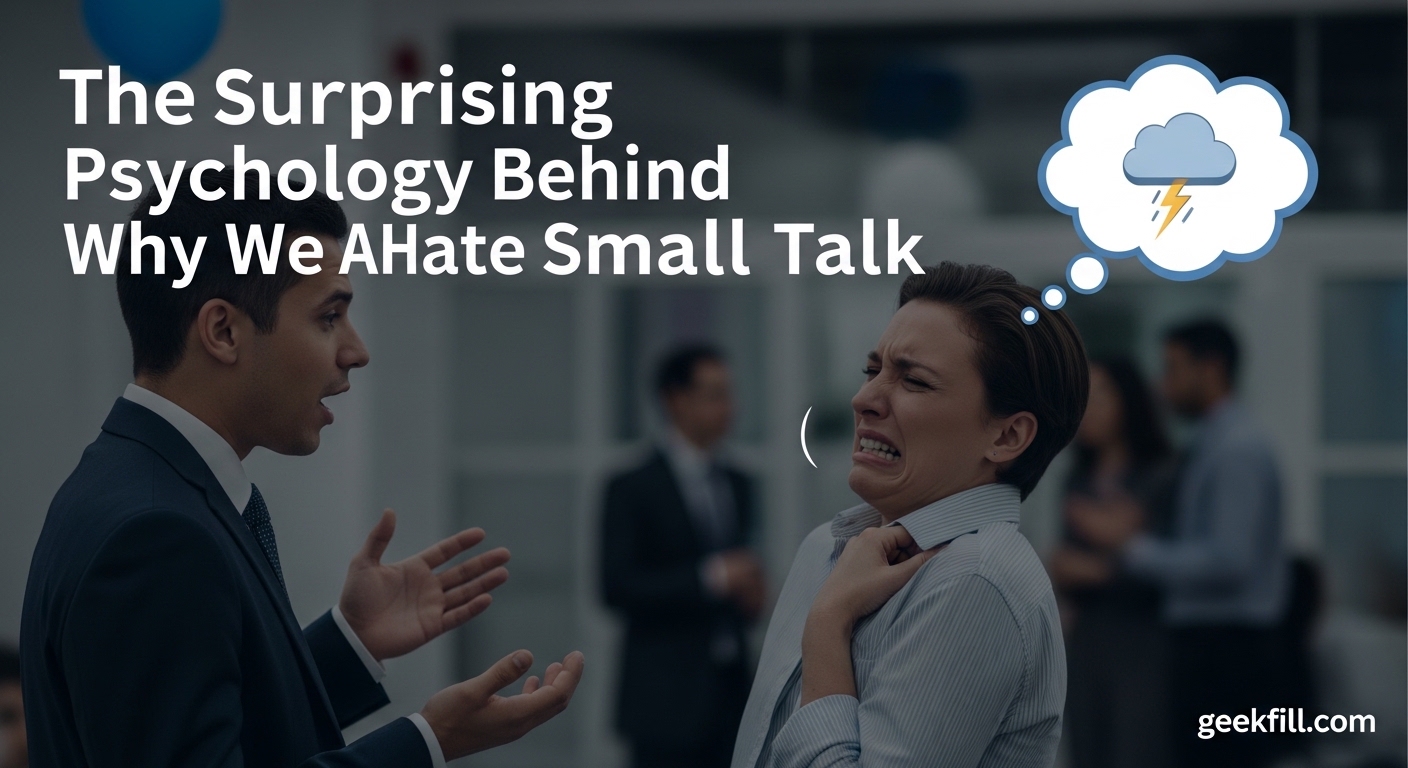
You’re standing in an elevator. The doors slide shut. Someone you vaguely recognize from the office steps in. Your heart rate picks up slightly. You stare at the floor numbers, hoping they’ll change faster, while your brain scrambles for something to say. The weather. The weekend. Anything to fill the silence that suddenly feels heavy and awkward.
If this scenario makes your stomach clench, you’re not alone. I used to think my aversion to small talk was a personal failing, some missing social chip that everyone else seemed to have installed. But after digging into the research, I discovered something surprising: hating small talk is not a flaw. It is a predictable neurological and psychological response that affects millions of people, and the reasons behind it are far more complex than simple shyness.
The psychology behind why we hate small talk reveals a fascinating collision between our brain’s threat detection systems, cultural programming, and the gap between what we think others want and what they actually need. Understanding these mechanisms does not just explain the discomfort. It offers a pathway through it.
Table of Contents
Why We Hate Small Talk: The Key Psychological Factors
Before diving into the research, here are the core psychological reasons why small talk feels so uncomfortable for so many people:
- Your brain processes social uncertainty like a physical threat, activating the same neural pathways as danger
- Neurodivergent brains, including those with introversion and autism, process surface-level conversation differently, creating genuine cognitive load
- Cultural and gender expectations create mismatched social rules that feel impossible to navigate
- We all suffer from “pluralistic ignorance,” collectively believing others enjoy small talk less than they actually do
- The performance aspect of self-monitoring drains mental energy rapidly
Why Does Small Talk Feel So Uncomfortable
Small talk triggers something deeper than simple awkwardness. Research from the Journal of Personality and Social Psychology shows that your brain treats social uncertainty much like it treats physical threats. When you face an unpredictable social interaction, your amygdala, the brain’s threat detection center, lights up with activity.
This is not metaphorical. Neuroimaging studies reveal that the same neural pathways activate during social rejection as during physical pain. Your brain literally experiences small talk anxiety as a potential threat to your social standing and belonging.
The problem compounds because small talk operates under ambiguous rules. How honest should you be when someone asks how your weekend was? Do they want the polished version or the truth about your anxiety and exhaustion? This uncertainty creates what psychologists call “self-monitoring,” a constant low-level performance where you watch yourself from outside, adjusting your words and expressions to match perceived expectations.
Self-monitoring is cognitively expensive. Every moment of casual conversation requires calculating responses, reading body language, and maintaining appropriate facial expressions. For some personalities, this constant adjustment feels like running mental software that demands significant processing power. The result is genuine exhaustion, not imagined discomfort.
Forum discussions reveal this pattern constantly. People describe small talk as feeling fake, superficial, or performative. They want genuine connection but find themselves trapped in scripts that feel hollow. One recurring sentiment stands out: small talk exhausts me because I am working hard to be someone I am not.
The Neuroscience of Social Threat Response
Understanding why small talk feels threatening requires looking at our evolutionary wiring. Humans survived by maintaining social bonds. Being cast out from the group meant death. Our brains evolved to prioritize social acceptance as a survival need, not a luxury.
Small talk exists in a gray zone of social interaction. It is not deep enough to build the connection our brains crave, but it is consequential enough that rejection or awkwardness could damage social standing. Your amygdala responds accordingly, keeping you in a low-grade alert state.
This threat response explains why small talk makes some people angry or anxious rather than merely bored. The emotion is defensive. Your brain is protecting you from potential social harm by keeping you hypervigilant. The problem is that modern small talk rarely carries the survival stakes your brain assumes.
Research also shows that people who hate small talk often score higher on measures of social anxiety and rejection sensitivity. Their brains are more attuned to potential negative evaluation, making every casual exchange feel higher stakes than it objectively is. This is not weakness. It is neurological wiring that can be understood and managed.
Neurodivergence and Small Talk Aversion
Not all brains process social interaction the same way. For neurodivergent individuals, including those on the autism spectrum and many introverts, small talk presents unique challenges that go beyond simple preference.
Introverts often describe small talk as draining because it operates in their weakness zone. Introversion is not about shyness or dislike of people. It is about energy sourcing. Introverts recharge through solitude and depth. Small talk requires breadth without depth, scattering attention across surface topics rather than diving into meaningful exchange. The cognitive style mismatch creates genuine exhaustion.
For individuals on the autism spectrum, small talk involves navigating unwritten rules that neurotypical people intuit but that feel like a foreign language. The scripts are unclear, the subtext ambiguous, the timing unpredictable. What neurotypical brains process automatically requires conscious effort and translation.
Neurodivergent individuals often prefer direct communication about meaningful topics because it reduces ambiguity. When conversation has purpose, the rules become clearer. Small talk lacks this clarity, making it cognitively demanding in ways that deep conversation simply is not.
Importantly, hating small talk is not the same as having poor social skills. Many people who struggle with casual conversation excel at deep dialogue, mentorship, or written communication. The difficulty is domain-specific, not global. Understanding this distinction helps reframe small talk challenges as neurological diversity rather than social deficiency.
Cultural and Gender Expectations Around Small Talk
How much small talk is expected varies dramatically across cultures. In some societies, brief transactional exchanges are normal and preferred. In others, extended relationship-building conversation before business is mandatory. These differences create genuine discomfort when cultural norms collide.
Someone from a culture that values directness may find American-style small talk baffling and wasteful. Why discuss weather when there is work to accomplish? Conversely, someone from a relationship-oriented culture may find brief exchanges cold and disrespectful. The discomfort is not personal preference but cultural programming.
Gender socialization also shapes small talk experiences. Research shows women are often socialized to perform more emotional labor in conversation, maintaining flow, asking questions, and keeping others comfortable. This invisible work adds cognitive load. Men may face different pressures around small talk, often expected to navigate certain topics while avoiding others deemed too personal.
These expectations create what feels like a rigged game. The rules are unwritten, vary by context, and shift based on who is in the room. No wonder many people feel they are performing rather than connecting. They are following scripts they never agreed to and may not even fully understand.
Research Findings: Why We Underestimate How Much We Enjoy Conversations
Here is the surprising twist in the psychology of small talk. Research consistently shows that we enjoy conversations far more than we predict we will. A study published in the Journal of Personality and Social Psychology surveyed over 1800 participants about their expectations for conversation versus their actual experience.
The results were striking. Before talking with strangers, participants predicted the interaction would be awkward and unenjoyable. Afterward, they reported significantly higher enjoyment than anticipated. The human connection mattered more than the topic. Even dull conversations provided mood boosts and a sense of belonging.
Psychologists call this pattern “pluralistic ignorance.” We all privately believe we dislike small talk more than others do, and we all publicly pretend to enjoy it more than we actually do. The result is a collective fiction where everyone assumes they are the odd one out. In reality, most people share similar reservations.
A fascinating study with London commuters illustrated this perfectly. Participants were asked to predict how they would feel if they talked to strangers on their train ride. Most predicted discomfort and awkwardness. When actually assigned to strike up conversations, participants reported significantly more positive experiences than expected. The simple human connection outweighed the awkwardness of initiation.
Researcher Nicholas Epley, who has studied conversation extensively, notes that people systematically underestimate others’ interest in connecting. We assume strangers do not want to talk to us. The reality is that most people welcome genuine human contact, even in brief encounters.
The Loneliness Epidemic and Small Talk Avoidance
The US Surgeon General declared loneliness an epidemic in 2026, with health consequences equivalent to smoking fifteen cigarettes daily. This matters for small talk because casual conversation is social glue. It builds the weak ties that research shows are crucial for community cohesion and individual wellbeing.
Strong ties are close friends and family. Weak ties are acquaintances, neighbors, baristas, coworkers you do not know well. Studies consistently find that weak ties provide significant mental health benefits. They offer belonging, community connection, and unexpected opportunities.
Small talk builds weak ties. When you avoid chatting with your neighbor or skip the break room conversation, you are not just avoiding discomfort. You are potentially severing connections that contribute to social fabric and personal health. The irony is painful: we avoid small talk because we feel disconnected, and our avoidance increases disconnection.
Researcher Elizabeth Trinh notes that brief positive exchanges with strangers provide measurable mood improvements. These micro-moments of connection accumulate. They create a sense of being seen and belonging to a community, even when the conversations remain surface-level.
How to Make Small Talk Less Painful
Understanding the psychology is useful, but practical strategies help in the moment. Here are approaches grounded in research and real-world experience.
The 20-Second Rule
What is the 20 second rule for small talk? The concept is simple but powerful. Commit to just twenty seconds of interaction. Tell yourself you only need to survive the initial awkwardness, which typically peaks early and declines rapidly. Most people find that once they push through the first moments, the conversation flows more naturally than expected.
This works because anxiety follows a predictable curve. The anticipation and opening moments create the highest stress. Once engaged, most people settle into the interaction. Setting a low bar of just twenty seconds lowers the activation energy required to start.
Find Genuine Curiosity
Reframe small talk as information gathering rather than performance. Can you find something genuinely interesting about this person or situation? Perhaps they have an unusual commute, an interesting accessory, or a perspective you have not encountered. Curiosity transforms the dynamic from performance to discovery.
Research shows that curious people have better conversations. They ask follow-up questions. They listen actively. The conversation becomes collaborative rather than competitive. Even brief exchanges become more rewarding when approached with genuine interest.
Shift From Performance to Connection
Instead of monitoring your own performance, focus on the other person. How are they feeling? Do they seem comfortable? What might they need in this moment? This shift reduces self-consciousness and creates genuine human contact.
The paradox of small talk anxiety is that focusing inward increases it. Focusing outward decreases it. When you stop performing and start connecting, the scripts matter less. Authentic human presence becomes more important than saying the right thing.
Develop Graceful Exit Strategies
Part of small talk anxiety is fear of being trapped. Having natural exit lines reduces this pressure. Simple phrases like “I should let you get back to work” or “It was nice catching up” signal closure without awkwardness. Knowing you can leave makes staying more comfortable.
Remember that most people share your ambivalence. They are not judging your small talk performance as harshly as you imagine. They are probably relieved someone else initiated and equally ready for the conversation to end naturally.
Frequently Asked Questions
What is the psychology behind people not liking small talk?
People dislike small talk because their brains process social uncertainty as a threat, activating the amygdala’s danger response. Additionally, the constant self-monitoring required to navigate ambiguous social rules creates genuine cognitive load and exhaustion. Neurodivergent individuals, including introverts and those on the autism spectrum, often find small talk particularly challenging because their brains process surface-level conversation differently.
What is the 20 second rule for small talk?
The 20-second rule suggests committing to just twenty seconds of small talk interaction. Anxiety typically peaks at the beginning of social encounters and decreases rapidly once engaged. By setting a low bar of just twenty seconds, people can push through the initial awkwardness and often find the conversation flows more naturally than expected.
What personality hates small talk?
Introverts and individuals on the autism spectrum most commonly report hating small talk. Introverts find it draining because they recharge through depth and solitude rather than breadth and social performance. Neurodivergent individuals often struggle with the unwritten rules and ambiguous scripts of surface-level conversation. However, research shows that most people privately dislike small talk more than they admit publicly.
Why do I hate small talk so much?
Your strong aversion to small talk likely stems from a combination of neurological threat response, personality factors, and past experiences. Your brain may be more sensitive to social evaluation, processing casual conversation as higher-stakes than it objectively is. If you are introverted or neurodivergent, small talk requires cognitive effort that feels exhausting rather than energizing. Cultural factors and gender socialization can also create mismatched expectations that make small talk feel performative and fake.
Conclusion: Reframing Small Talk as Human Connection
The surprising psychology behind why we all hate small talk reveals something hopeful. Your discomfort is not a personal failing. It is the result of predictable neurological, cultural, and psychological factors that affect millions of people. Understanding these mechanisms transforms small talk from an arbitrary social hurdle into an understandable human experience.
Research consistently shows that we enjoy connecting more than we predict. The key is reframing small talk not as performance but as brief human contact. It is not about saying the perfect thing. It is about showing up, being present, and acknowledging another person’s existence in a world that often feels isolating.
The next time you feel that elevator anxiety, remember: the other person probably feels it too. We are all navigating ambiguous rules and uncertain scripts together. Small talk may never become your favorite activity, but understanding why we hate small talk psychology offers a path through the discomfort to the genuine connection waiting on the other side.