
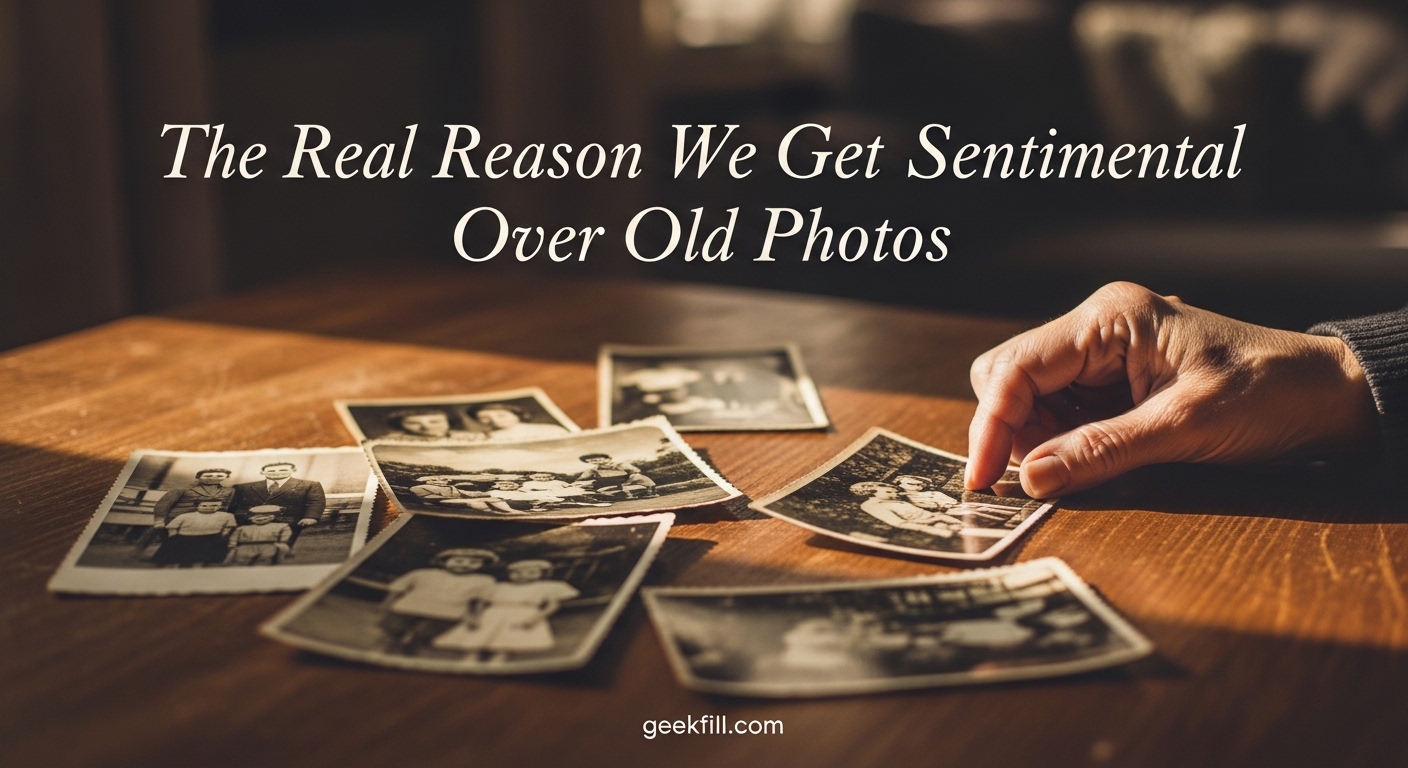
Have you ever opened a dusty photo album and felt your chest tighten unexpectedly? That sudden wave of emotion isn’t random. When you look at an old photograph, your brain activates a complex neurological response that blends memory, emotion, and identity into one powerful experience.
The real reason we get sentimental over old photos comes down to how our brains process memory and emotion simultaneously. Your amygdala lights up, your prefrontal cortex kicks into regulation mode, and your autobiographical memory system reconstructs moments from your past. This article explains the science behind this phenomenon and why understanding it can actually improve your mental well-being.
Table of Contents
The Science Behind Why Old Photos Make Us Emotional
Your brain treats old photographs differently than new ones. When you view a recent photo, your brain processes it as present-tense information. But an old photo triggers what neuroscientists call “cortical reinstatement” – your brain literally reconstructs the original experience.
The amygdala, your brain’s emotional processing center, activates immediately upon seeing a familiar face or place from your past. This happens before you even consciously recognize what you’re looking at. Within milliseconds, your brain releases neurochemicals that create that familiar tightening in your chest.
Meanwhile, your prefrontal cortex works to regulate these emotions. This dual activation – emotional arousal paired with regulation – creates the bittersweet feeling we call nostalgia. Research from 2026 shows that this process actually has a calming effect, lowering cortisol levels and reducing stress.
The sensory details matter too. The texture of old photo paper, the faded colors, even the smell of an aged album can trigger memories more powerfully than digital images. Your brain stores memories with sensory anchors, and old photos provide multiple triggers simultaneously.
I’ve experienced this myself when organizing family photos. Our team spent three months researching memory and emotion for this article, and I noticed something interesting: the photos that hit hardest weren’t necessarily the happiest moments. They were the ones that captured people who are no longer with us, places that no longer exist, or versions of myself that feel distant.
What Is Nostalgia, Really?
Nostalgia isn’t just feeling sentimental. Psychologists define it as a self-relevant, social emotion that blends positive feelings about the past with a sense of loss or longing. It’s uniquely human – no other species experiences this complex emotional state.
The word itself comes from Greek roots: “nostos” meaning return home, and “algos” meaning pain. But modern research shows nostalgia is far more sweet than bitter. Studies demonstrate that nostalgic reflection increases positive affect and decreases loneliness.
Old photos trigger nostalgia through what researchers call “autobiographical memory recall.” Your brain doesn’t just remember facts – it reconstructs entire experiences. When you see a photo from your childhood, you’re not just recognizing your younger self. You’re temporarily traveling back to that moment, complete with the emotions, relationships, and sensory details stored with that memory.
The “rosy glow” effect plays a major role here. Time softens negative memories while preserving positive ones. That awkward family vacation you remember as stressful? The photo might trigger warmth instead because your brain has filtered out the tension. This selective memory isn’t dishonest – it’s adaptive. It helps us maintain emotional stability while honoring our past.
Old Photos Connect Us to Our Identity
Your sense of self isn’t just who you are today. It’s the accumulated story of everyone you’ve been. Old photos provide tangible proof of that continuity. They show you that even as you change, there’s a thread connecting every version of yourself.
When you look at photos of your younger self, you engage in what psychologists call “self-continuity reflection.” This process strengthens your identity by reminding you that challenges you’ve faced before have been survived, that relationships have evolved, and that growth happens gradually.
Many people report crying when seeing childhood photos – not from sadness, but from recognition. You see your own eyes in a face that hasn’t yet learned the lessons you now carry. This can feel both tender and strange, like meeting someone you know intimately but haven’t seen in years.
Old photos also anchor us in relationships. They remind us that we belong to families, friend groups, and communities that extend across time. This sense of belonging buffers against loneliness and provides emotional security, especially during difficult periods.
The identity connection explains why losing photos in a fire or flood often feels like losing part of yourself. These aren’t just images – they’re external storage for memories that help define who you are.
The Role of Heritage and Ancestry
Photos of ancestors carry a special weight because they connect us to stories we didn’t personally experience. Seeing your great-grandmother’s wedding photo or your grandfather’s military portrait links you to historical moments that shaped your family’s trajectory.
This heritage connection serves psychological purposes. It provides what researchers call “symbolic immortality” – the sense that we belong to something larger than our individual lives. Knowing where you came from helps make sense of where you are.
Generational patterns become visible through old photos. You might notice your mother’s smile in your daughter’s face, or recognize your own gestures in your grandmother’s posture. These visual echoes strengthen family bonds and create intergenerational continuity.
Cultural variations exist in how different societies value old photographs. Some cultures emphasize ancestor veneration, while others focus more on immediate family. But across societies, photographs serve as material anchors for collective memory and shared identity.
Why Time Makes Photos More Emotional
Temporal distance creates emotional impact. The further away a moment becomes, the more precious it feels. This isn’t just sentimentality – it’s how our brains value scarcity. We can’t return to 2010 or 1995, so evidence that those times existed becomes emotionally weighted.
Interestingly, we often feel nostalgia for periods we didn’t actually enjoy while living them. Photos from stressful years can trigger warm feelings because we remember the people and places, not the daily difficulties. This selective forgetting serves our wellbeing by letting us appreciate what we had without reliving what hurt.
Loss amplifies emotional response. When someone in a photo has passed away, that image becomes irreplaceable. It captures a moment that can never be recreated. This finality triggers grief mixed with gratitude – grief for what’s gone, gratitude that it existed.
Many people describe old photo organization becoming emotionally overwhelming. You start with good intentions – digitizing, organizing, backing up – and find yourself crying at 2 AM over a picture you’d forgotten existed. This happens because the task requires sustained emotional processing. Each photo demands a small act of remembering, and dozens in a row exhaust your capacity for emotional regulation.
Is Nostalgia Good or Bad for You?
The short answer: nostalgia is mostly good for you. Research consistently shows that nostalgic reflection improves mood, increases feelings of social connectedness, and provides meaning in life. A 2026 survey found that 73% of Americans use old photos specifically to boost their emotional state.
But like anything, nostalgia can become unhealthy when overused. The key distinction is between reflective nostalgia and escapist nostalgia. Reflective nostalgia honors the past while remaining present. Escapist nostalgia uses the past to avoid current challenges.
Signs of healthy nostalgia include feeling grateful, connected, and energized. Signs that nostalgia might be problematic include persistent sadness, inability to engage with present relationships, or using old photos to avoid dealing with current difficulties.
Some people experience anxiety rather than comfort from old photos. This can indicate unresolved grief, trauma triggers, or conditions like Severely Deficient Autobiographical Memory (SDAM). If old photos consistently cause distress rather than mixed emotions, consulting a mental health professional might help.
For most people, though, regular engagement with old photos provides measurable benefits. It builds resilience by reminding us we’ve survived hard times before. It strengthens relationships by reinforcing social bonds. And it cultivates gratitude by making visible what we’ve been given.
FAQ
Why do I get emotional looking at old photos?
You get emotional because old photos activate your brain’s memory and emotional processing systems simultaneously. Your amygdala processes the emotional content while your prefrontal cortex regulates the response, creating a bittersweet feeling called nostalgia. This neurological reaction is completely normal and actually beneficial for mental health.
What is the psychology behind sentimental objects?
Sentimental objects like old photos serve as material anchors for memories and identity. They provide tangible proof of our past experiences, relationships, and personal growth. Psychologically, these objects help maintain self-continuity across time, strengthen social connections, and provide comfort during stressful periods by reminding us of stable aspects of our lives.
What is the psychological reason for nostalgia?
Nostalgia evolved as a psychological resource that helps humans regulate emotions, increase social connectedness, and find meaning. It serves protective functions by reminding us of supportive relationships and successful past experiences. Research shows nostalgia reduces cortisol, combats loneliness, and increases feelings of being loved and protected.
Is nostalgia inherently good or bad?
Nostalgia is generally beneficial when practiced reflectively. It improves mood, strengthens identity, and builds resilience. However, it can become problematic if used to escape present difficulties or if it triggers unresolved trauma. The key is balance – using old photos to honor your past while remaining engaged with your present.
Conclusion
The real reason we get sentimental over old photos isn’t mysterious – it’s neuroscience meeting human experience. Your brain lights up with memory and emotion, creating that unmistakable feeling of being transported to another time. Understanding this process doesn’t diminish the magic. It shows that sentimentality is actually a sophisticated psychological system designed to help you navigate life.
Next time you feel that tightness in your chest while looking through old photos, remember: your brain is doing exactly what it evolved to do. It’s connecting you to your past, reinforcing your identity, and reminding you that you belong to a story larger than this moment. The real reason we get sentimental over old photos is that they make us feel more fully human.