
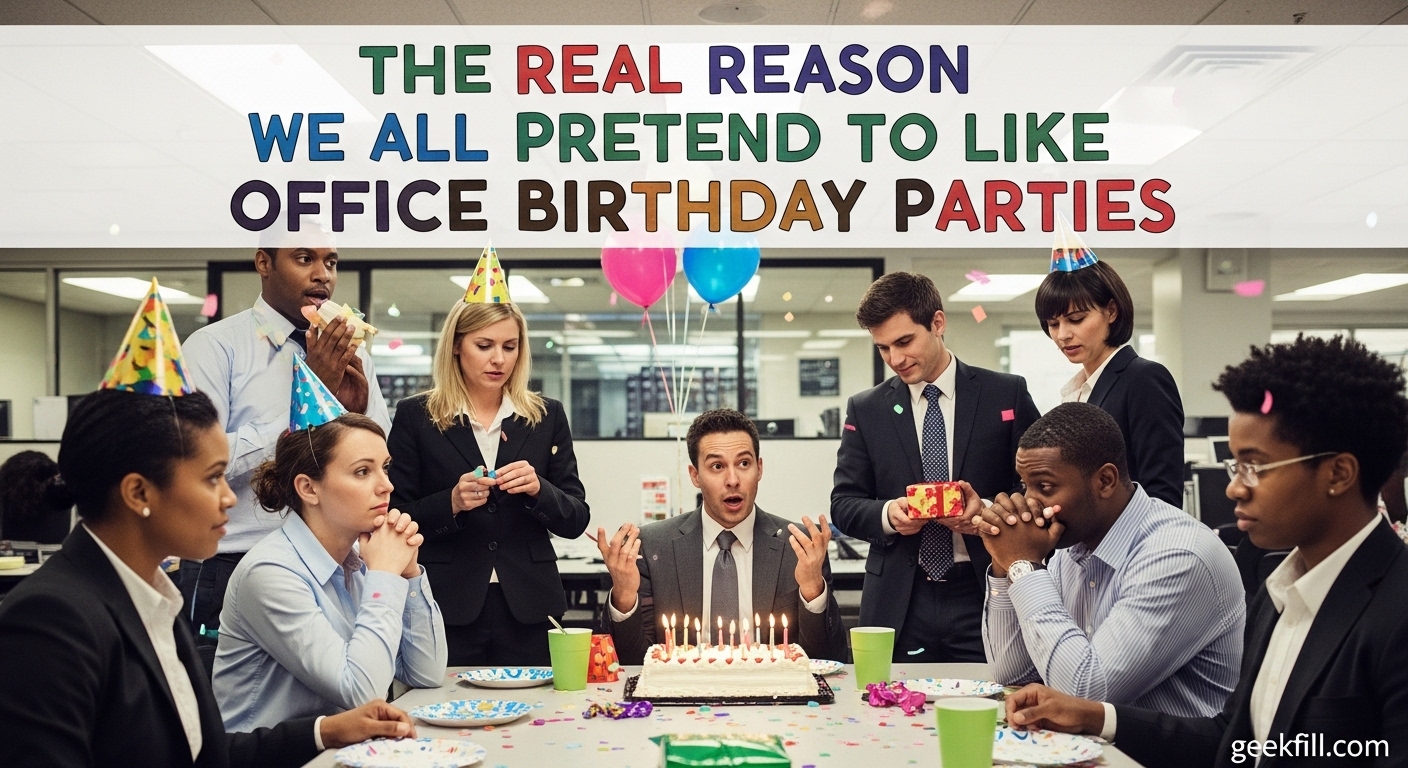
We have all been there. The fluorescent lights buzz overhead as someone wheels out a grocery-store cake with your coworker’s name spelled wrong in frosting. A chorus of off-key singing begins. You join in, wearing a smile that feels borrowed from someone else.
This is the office birthday party. Nobody seems to want to be there. Yet everyone pretends.
The real reason we all pretend to like office birthday parties comes down to something psychologists call social conformity. We perform enthusiasm to avoid standing out, to protect our professional image, and to maintain the unspoken social contract of the workplace. The fear of being labeled antisocial or “not a team player” keeps us clapping along even when we would rather be anywhere else.
In this guide, I will break down the psychology behind this strange ritual. You will learn why we feel obligated to participate, what is really happening in our brains during forced fun, and how to navigate these situations without sacrificing your authenticity or your relationships.
Table of Contents
Why Do We Pretend to Like Office Birthday Parties?
The short answer is that we are protecting ourselves from social judgment. When everyone around you is singing “Happy Birthday” with exaggerated enthusiasm, opting out makes you visible. And in workplace culture, visibility often equals vulnerability.
Social psychologists have studied this phenomenon for decades. Solomon Asch’s famous conformity experiments in the 1950s showed that people will give obviously wrong answers to simple questions if everyone else in the room does first. The pressure to conform is powerful enough to override our own perceptions. Now imagine that pressure in a setting where your paycheck and professional reputation hang in the balance.
We pretend because the cost of authenticity feels too high. Saying “I would rather not participate” requires explaining yourself, defending your position, and risking the label of being “not fun” or “hard to work with.” Most of us calculate that 15 minutes of awkward cake-eating is a small price to pay for social peace.
The Fear of Being Labeled Antisocial
Workplaces run on relationships. Even in remote-first companies, the ability to get along with colleagues directly impacts your projects, promotions, and daily happiness. When you decline a birthday celebration, you are not just skipping cake. You are making a statement about your relationship with the team.
At least, that is how it feels. In reality, most of your coworkers are probably just as relieved when parties get cancelled. But because nobody wants to be the first to admit it, we all maintain the fiction that these gatherings are meaningful morale boosters.
This creates what researchers call pluralistic ignorance. Everyone privately believes something different from what the group publicly accepts, but because nobody speaks up, we all assume we are the odd ones out. The result is a room full of people who would rather be checking email, all pretending to celebrate together.
The Psychology Behind Forced Celebration
To understand why office birthday parties feel so uncomfortable, we need to look at two psychological concepts: cognitive dissonance and self-presentation theory.
Cognitive dissonance occurs when our actions conflict with our beliefs. Your brain knows this party is not actually fun. Your body is standing in a circle eating mediocre cake. The mismatch creates mental discomfort. To resolve it, we either change our behavior (leave the party) or change our beliefs (convince ourselves this is enjoyable). Most of us choose the latter because leaving feels socially risky.
Self-presentation theory, developed by sociologist Erving Goffman, suggests we are all performers managing impressions. At work, we wear the costume of a “good colleague.” Part of that costume includes showing up for celebrations we do not care about. The performance becomes so automatic that we sometimes forget we are acting.
The Birthday Party Effect in Psychology
You may have heard of the “birthday effect” in psychology, though it refers to something slightly different. The term describes how our self-awareness increases on our birthdays, often leading to reflection about life choices and mortality.
In workplace settings, a different birthday effect takes hold. The birthday person feels obligated to act grateful for attention they may not have wanted. Colleagues feel obligated to provide that attention. Everyone is performing versions of themselves that do not quite match reality. The gap between genuine feelings and performed behavior is what creates the awkwardness we all sense but rarely name.
Why Performed Enthusiasm Feels So Exhausting
Emotional labor is the effort required to manage your feelings and expressions as part of your job. Flight attendants must smile through turbulence. Customer service reps must stay calm with angry callers. And office workers must act excited about birthday cake at 3 PM on a Tuesday.
This emotional labor is not just annoying. It is genuinely draining. Research shows that suppressing authentic emotions and replacing them with performed ones depletes our mental energy. By the time you get back to your desk after the party, you may feel more tired than if you had spent that time doing actual work.
Why Introverts Struggle Most with Office Parties
If you are an introvert, office birthday parties probably feel like a special kind of torture. It is not that you dislike your coworkers. It is that forced social interaction in a professional context drains your energy while providing none of the meaningful connection you actually value.
Introverts typically prefer one-on-one conversations to group gatherings. They need time alone to recharge. A surprise party in the break room offers the exact opposite: unexpected social stimulation, group dynamics, and no graceful exit strategy.
The Introvert’s Dilemma: Appearances vs. Energy
Many introverts develop what I call the “hover and smile” technique. You stand near the edge of the group. You smile at appropriate moments. You count down the minutes until you can return to your desk without seeming rude. It is a survival strategy, not a celebration.
The problem is that opting out carries professional risk. In many workplace cultures, visibility and participation are unconsciously linked to commitment and teamwork. The person who skips parties may be labeled as “not fitting in,” even if their work is excellent and their one-on-one relationships are strong.
This creates a painful choice for introverts: protect your energy and risk professional consequences, or sacrifice your energy to protect your reputation. Neither option feels fair.
Extroverts Are Not Immune Either
Here is a truth that might surprise you: even extroverts often find office birthday parties awkward. They may handle the social stimulation better, but that does not mean they enjoy forced fun. Many extroverts I have spoken with describe these parties as “performative” and “surface-level.” They want genuine connection too, not just organized fun.
The difference is that extroverts are more likely to reshape the experience into something tolerable. They might redirect conversations, crack jokes to cut tension, or turn the party into a networking opportunity. But that is still work. It is still emotional labor dressed up as celebration.
The Post-Pandemic Shift in Workplace Culture
Something changed when millions of workers spent 2026 working from home. We got used to controlling our social environments. We could mute ourselves during Zoom celebrations. We could step away from the screen without anyone knowing. We got comfortable with opting out.
Now that many offices have returned to in-person work, the old expectations are colliding with new habits. Employees who spent two years avoiding forced fun are being asked to resume the pretense. Many are resisting.
Why Gift Cards Are Replacing Cake
LinkedIn surveys and workplace trend reports show a clear shift: employees increasingly prefer gift cards or cash bonuses over traditional celebrations. This is not about being greedy. It is about respecting people’s time and preferences.
A gift card says “We appreciate you” without demanding performance. It does not require singing, hovering, or pretending to enjoy dry cake. It acknowledges the employee’s value without forcing them to demonstrate their gratitude through social participation.
Smart companies are noticing this preference. They are replacing mandatory party attendance with opt-in celebrations, smaller team lunches instead of all-hands gatherings, and personal acknowledgments instead of public performances.
The Rise of Authentic Workplace Culture
Post-pandemic workplace culture is slowly becoming more honest about what actually builds teams. Research consistently shows that forced fun does not create genuine bonds. Shared purpose, psychological safety, and voluntary connection do.
Teams that trust each other do not need cake to feel connected. They need clear communication, fair treatment, and the freedom to be themselves. When those elements are missing, no amount of birthday singing will fix the culture.
How to Navigate Office Celebrations Authentically
You do not have to keep pretending forever. There are ways to opt out or participate minimally without damaging your professional relationships. The key is being strategic and kind.
Scripts for Declining Politely
If you want to skip a party entirely, try these approaches:
The deadline excuse: “I have a deadline at 4 PM and need to stay focused. Happy birthday though, I will catch up with you later.” This frames your absence as work-related, not personal.
The brief appearance: Show up for five minutes, say sincere congratulations, and leave. Most people will not notice when you slip out.
The direct but kind approach: “I am not big on group celebrations, but I wanted you to know I appreciate working with you. Hope you have a great day.” This honors the person while being honest about your preferences.
Setting Boundaries Without Burning Bridges
The most effective strategy is consistency. If you skip every party, people will notice and may interpret it personally. If you attend briefly and participate selectively, your absence from specific events blends into a pattern of being “busy but supportive.”
Consider having a private conversation with your manager or close colleagues about your preferences. You do not need to apologize for being introverted or preferring focused work time. A simple “I show my appreciation through my work and one-on-one conversations rather than group events” can reframe how people interpret your choices.
Remember that authenticity does not mean announcing your discomfort at every turn. It means finding ways to honor your own needs while still respecting others. Sometimes that looks like staying for 10 minutes. Sometimes it looks like a handwritten note instead of a public celebration.
Frequently Asked Questions About Office Birthday Culture
What is the psychology behind people who do not care about their birthdays?
People who treat birthdays as ordinary days often have a secure sense of self-worth that does not require external validation. Psychologically, this can indicate high self-esteem, introversion, or simply different cultural values around aging and celebration. Some people also experience birthday depression or anxiety, making them prefer to avoid attention. In workplace settings, these individuals face particular pressure to perform gratitude for celebrations they never requested.
What is the birthday party effect?
In social psychology, the birthday party effect refers to increased self-awareness and reflection that occurs on one’s birthday. People often evaluate their life choices, relationships, and mortality. In workplace contexts, a different effect occurs where both the birthday person and their colleagues feel obligated to perform enthusiasm for celebrations that may feel inauthentic or unwanted. This creates social tension and emotional labor for everyone involved.
Should coworkers celebrate birthdays?
Whether coworkers should celebrate birthdays depends entirely on workplace culture and individual preferences. Celebrations work best when they are opt-in rather than mandatory, sincere rather than performative, and respectful of different personality types. Research suggests forced celebration does not improve morale or team bonding. Alternative approaches include gift cards, personal notes, or simply asking employees how they prefer to be acknowledged.
What is the psychology of people who treat their birthday like a normal day?
People who treat birthdays as normal days often display characteristics associated with low narcissism, high self-sufficiency, or introversion. They may view aging neutrally, dislike being the center of attention, or simply prioritize different forms of recognition. Psychologically, this response is healthy when it reflects genuine preference rather than fear or avoidance. In workplaces, respecting this preference requires moving away from one-size-fits-all celebration mandates.
Moving Toward Authentic Workplace Connections
The real reason we all pretend to like office birthday parties is not complicated. We want to belong. We want to protect our professional standing. And we are all caught in a collective fiction where nobody wants to be the first to admit the emperor has no clothes.
Understanding the psychology behind this pretense does not mean you have to keep playing along. It means you can make informed choices about when to participate, when to decline, and how to set boundaries that honor both your needs and your relationships.
Workplace culture is slowly evolving toward authenticity. Post-pandemic shifts, generational changes, and mounting evidence that forced fun does not work are all pushing companies to reconsider how they build teams. You are not broken for disliking office birthday parties. You are just ahead of the curve.
The next time you find yourself in that fluorescent-lit circle, singing off-key with a borrowed smile, remember: most people in that room feel exactly the same way. The question is not why we pretend. The question is how long we will keep doing it, and who will be brave enough to stop first.