
A wireless meat thermometer earns its keep on a smoker in a way it never does on a grill. A steak sears in eight minutes and you are standing there anyway. An overnight brisket runs twelve hours, the pit swings twenty degrees every time you open the lid, and the meat sits in a dead zone for two hours around 150F while the stall does its thing. You are asleep or you are in the house. A leave-in wireless probe is the only practical way to watch both numbers that matter: pit temperature and internal meat temperature.
That is the whole reason this roundup exists. We pulled twelve wireless systems and sorted them against what a smoker actually demands, not what a product page claims. The criteria are unglamorous: does the signal hold with the lid closed, does the base or app keep working when your phone dies at hour nine, how many sensors sit inside the meat, and does the handle survive a 300F chamber. The best wireless meat thermometers for smoking are the ones that answer all four without drama.
Two things changed the way we think about this category. First, the old wisdom that Bluetooth is fine if the phone sits on the shelf next to the pit falls apart the moment you walk into the house, and a majority of the units here now use sub-1GHz radio or a WiFi link to a base station. Second, the single most common complaint we found in owner reviews is not accuracy. It is the probe losing sync partway through a long cook. So we weighted stability heavily, and we named a clear winner.
If you are still deciding on hardware, our broader wireless thermometer guide covers instant-read and oven options too, and our kamado smoker picks pair well with the ceramic-cooker picks below.
Top 3 Picks for Smoking in 2026

MEATER Plus Smart Probe
- Dual sensors for internal and ambient readings
- Built-in Bluetooth repeater in the bamboo charger
- Guided cook system with finish time estimates

TempPro TempSync 500FT
- 500ft RF link with no app or account
- Dual probes for meat and pit temperature
- Backlit receiver with loud audible alert

INKBIRD IBT-4XS
- Three meat probes plus one ambient probe
- 40 hours of battery per charge
- Magnetic body with rotatable LED display
All 12 Best Wireless Meat Thermometers Compared (October 2026)
Every unit below runs on its own battery inside the meat and reports to something outside the cooker. The differences that decide a smoker cook are the radio type, the sensor count, whether you need a phone at all, and how the base behaves overnight. Prices move constantly, so use the buttons to check the current figure rather than trusting a number that was accurate last week.
| Product | Specifications | Action |
|---|---|---|
| MEATER Plus Smart Meat Thermometer |
|
Check Latest Price |
| TempPro TempSync 500FT Wireless |
|
Check Latest Price |
 TempPro TempSync 650 ft Bluetooth TempPro TempSync 650 ft Bluetooth |
|
Check Latest Price |
| INKBIRD IBT-4XS 4 Probe |
|
Check Latest Price |
 TempPro TempSpike 500ft TempPro TempSpike 500ft |
|
Check Latest Price |
 ThermoMaven Sub-1G Smart Probe ThermoMaven Sub-1G Smart Probe |
|
Check Latest Price |
 ThermoMaven WiFi 2 Probe ThermoMaven WiFi 2 Probe |
|
Check Latest Price |
 CHEF iQ Sense Gen3 CHEF iQ Sense Gen3 |
|
Check Latest Price |
 ThermoMaven 3000FT 2 Probe ThermoMaven 3000FT 2 Probe |
|
Check Latest Price |
 Meatmeet Pro Wireless with Booster Meatmeet Pro Wireless with Booster |
|
Check Latest Price |
 Typhur Sync Gold Gen2 Typhur Sync Gold Gen2 |
|
Check Latest Price |
 ROUUO Dual Probe WiFi Repeater ROUUO Dual Probe WiFi Repeater |
|
Check Latest Price |
1. MEATER Plus Smart Meat Thermometer: Best Overall for Smoking
MEATER Plus Smart Meat Thermometer, Honey, Bluetooth, 165ft, Grill & Oven
Internal to 212F
Ambient to 527F
6.18 inch immersion
3 second response
Pros
- Dual internal and ambient sensors in one probe
- Bluetooth repeater built into the charger
- Guided cook system with finish time estimates
- Battery holds up across cold outdoor cooks
Cons
- No battery level indicator on the probe
- Connection drops if the charger sits far from the cooker
- Grease on the blunt end stops the probe charging
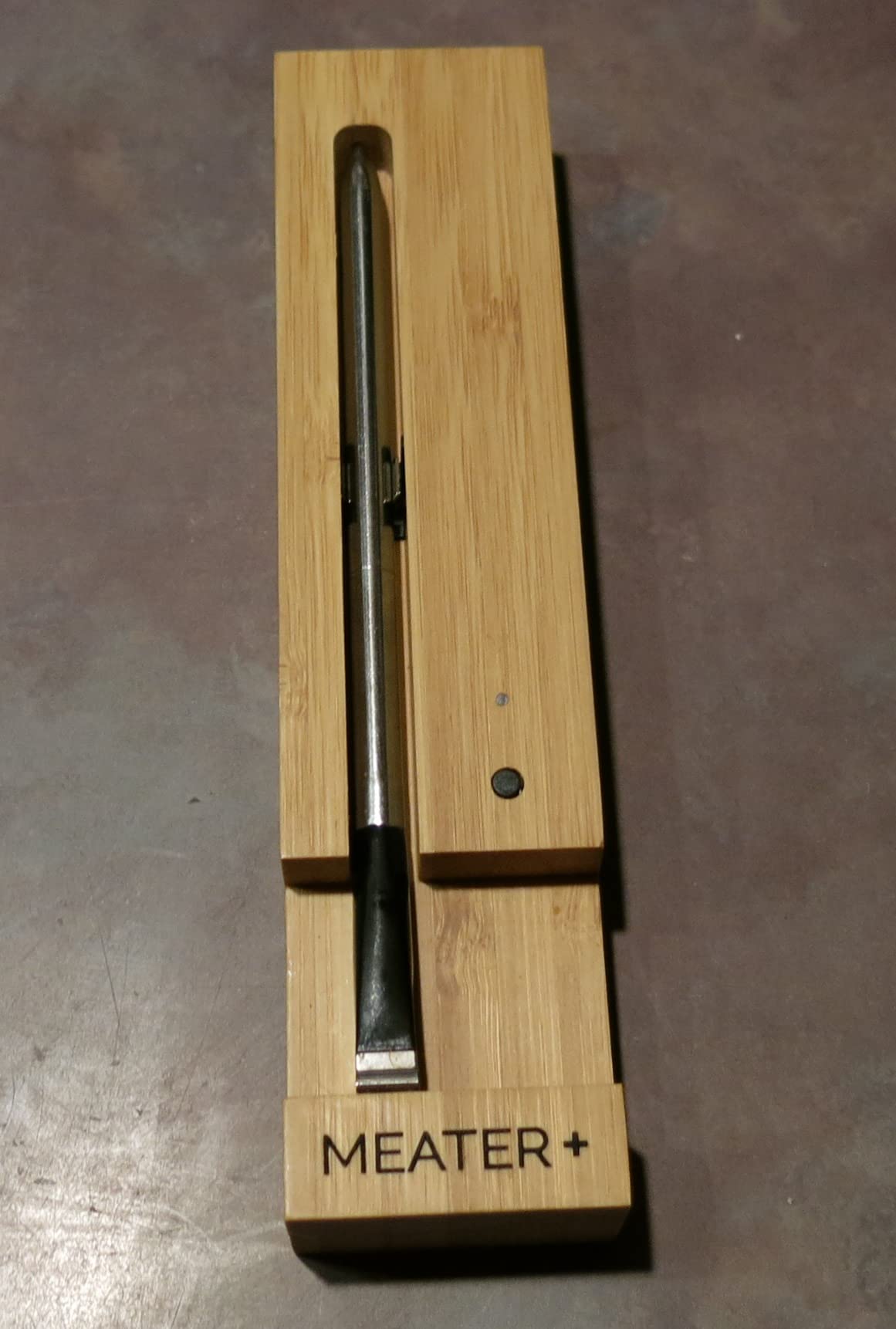
The MEATER Plus is the probe most people already own and the one we recommend first. It is a single charger-free stick with sensors at the tip and near the butt, and the internal channel tops out at 212F while the ambient channel reads to 527F. That split matters on a smoker: one number tells you the meat, the other tells you the chamber, and both stream to the same app graph.
What separates it from cheaper stick probes is the repeater built into the bamboo charger. The probe talks to the charger over Bluetooth, and the charger relays to your phone, which roughly doubles the usable distance without any extra hardware. The magnetic base is also the only part that stays in the house, so you can clip it to a shelf and walk away from the pit.
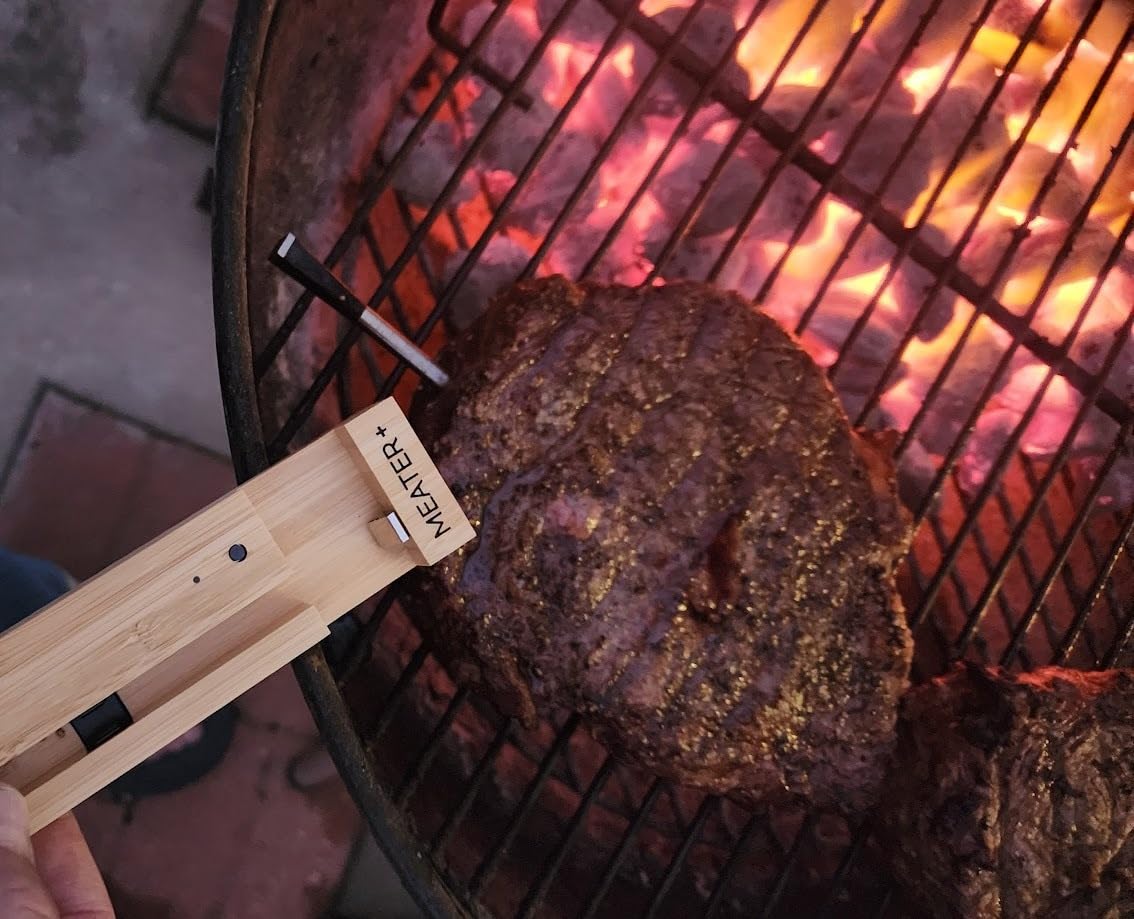
Response time is three seconds, and the app gives you a guided cook path with alerts and an estimated finish time. On a long smoke the estimate drifts once the stall hits, because no prediction algorithm can know how long your firebox holds. Once the cook is moving again the estimate tightens up and the graph is genuinely useful for spotting a stalled fire.
The honest weakness is stability. On r/smoking threads this is the single most-named brand when cooks describe a probe that stopped syncing mid-cook, and the same complaints show up in the customer reviews here: connection reliability depends on the charger staying reasonably close. It is a manageable problem, not a disqualifier, but on a 16-hour cook you should expect to touch the base more than once.
There is no battery gauge on the probe itself, so the app is the only place you can check charge. The 6.18 inch immersion depth suits a whole packer brisket or a pork butt, and for thin cuts like chicken wings you still want an instant-read thermometer in the drawer.
Who the MEATER Plus suits
This is the right pick if you want a single probe, a good-looking charger that lives on your counter, and an app that walks you through a cook without you having to think about setup. It is also the safest recommendation for a first wireless system because the parts are simple: one stick, one charger, one app.
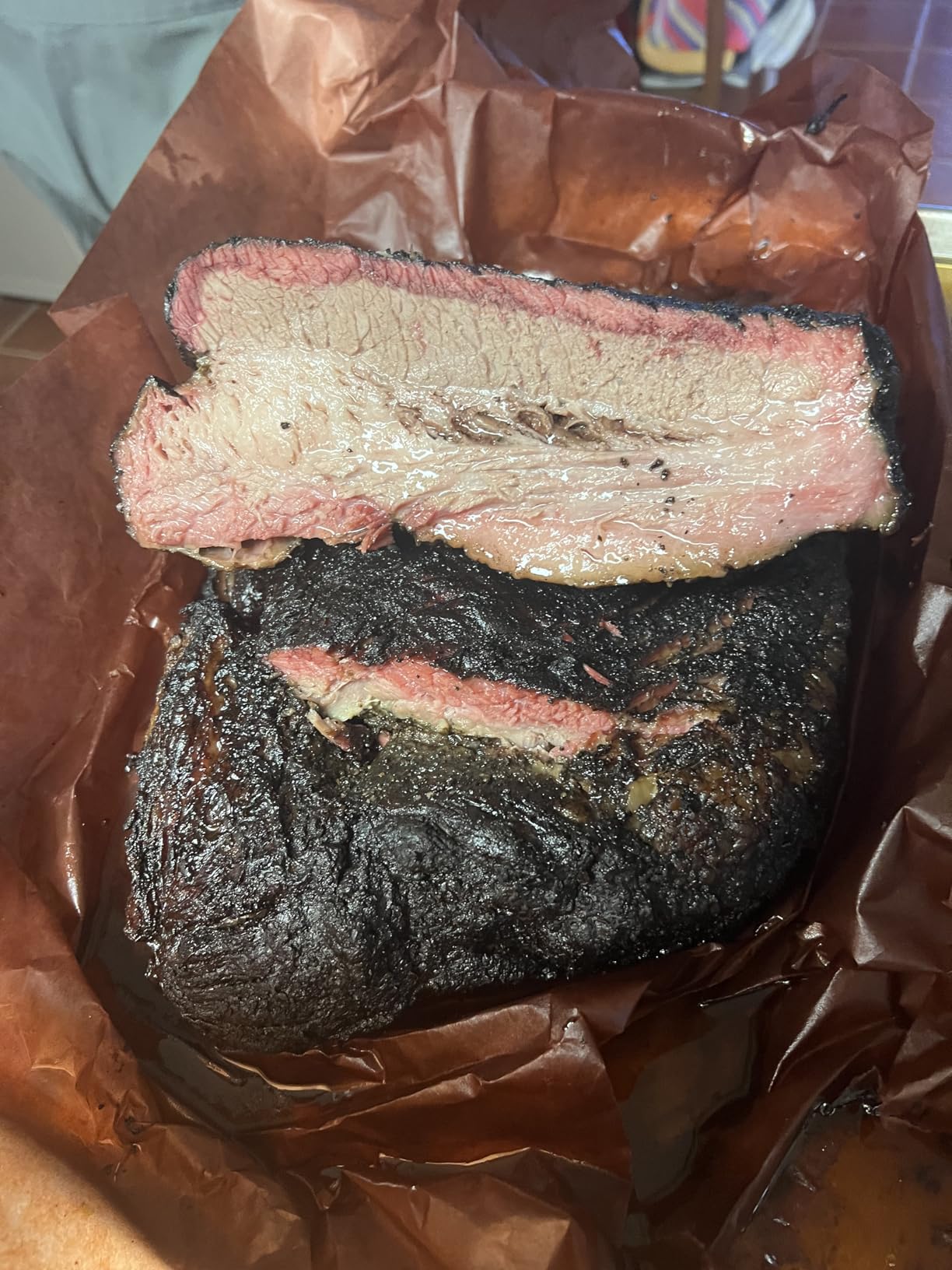
For anyone cooking a full packer brisket, a spatchcocked chicken, or a couple of pork butts over a weekend, the guided cook system and the finish-time estimate save real guesswork. The dual sensors also let you skip a separate pit probe if the meat probe’s ambient channel sits near the chamber wall.
Where the MEATER Plus falls short
If your pit sits far from the house, or you want phone alerts from two rooms away, the Bluetooth link is the weak point. The charger repeater helps a great deal, but it is not the same as a sub-1GHz or WiFi system that reaches across a yard.
It is also a one-probe system, so cooking two racks of ribs and a brisket at once means juggling separate devices. And the ambient sensor reads the temperature near the probe, which on a large offset smoker can run cooler than the thermometer on the lid.
2. TempPro TempSync 500FT: Top Rated for Long Smokes
TempPro TempSync 500FT Wireless Meat Thermometer for Grilling and Smoking
500ft RF link
Dual probes
14F to 572F
Backlit receiver
Pros
- Stable 500ft radio link that holds through walls
- No app account or sync to set up
- Loud alarm with one-touch silence
- Dual probes track meat and pit together
Cons
- No low battery indicator
- Transmitter powers down only by removing batteries
- Both probe ports sit on the same side
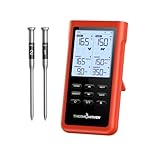
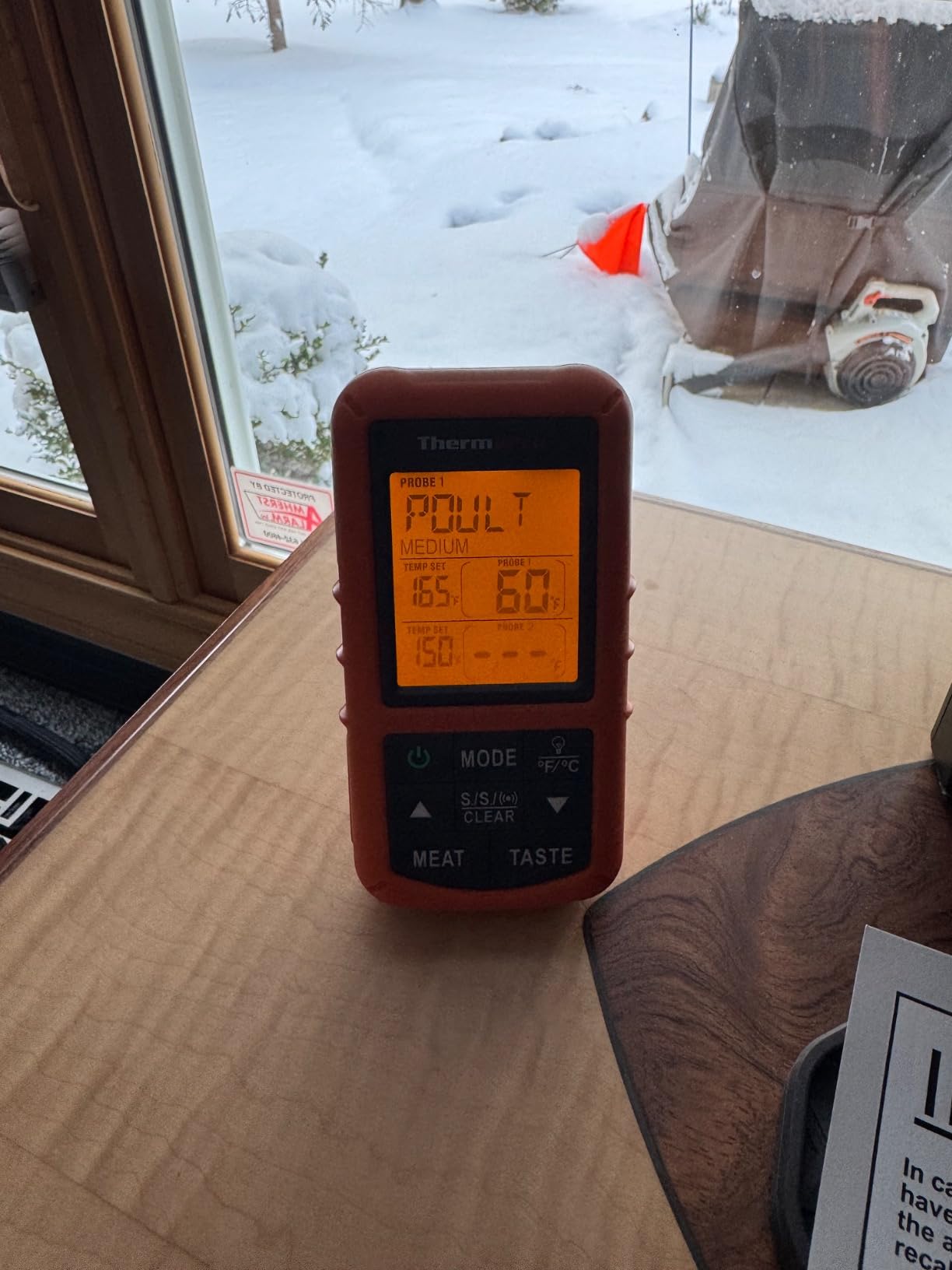
If your phone dying at hour nine is the scenario that worries you, this is the answer. The TempSync transmits over plain radio frequency to a handheld receiver with a backlit display. No app, no account, no cloud, no notification settings. You set a target on the receiver, clip it to a shelf, and the alarm does the rest.
The 500ft claim is generous marketing, but the link is genuinely stable through a smoker wall and from another room. Radio frequency at this class of hardware is not going to compete with a sub-1GHz system across a full property, but inside and around a house it is dependable in a way Bluetooth sometimes is not.
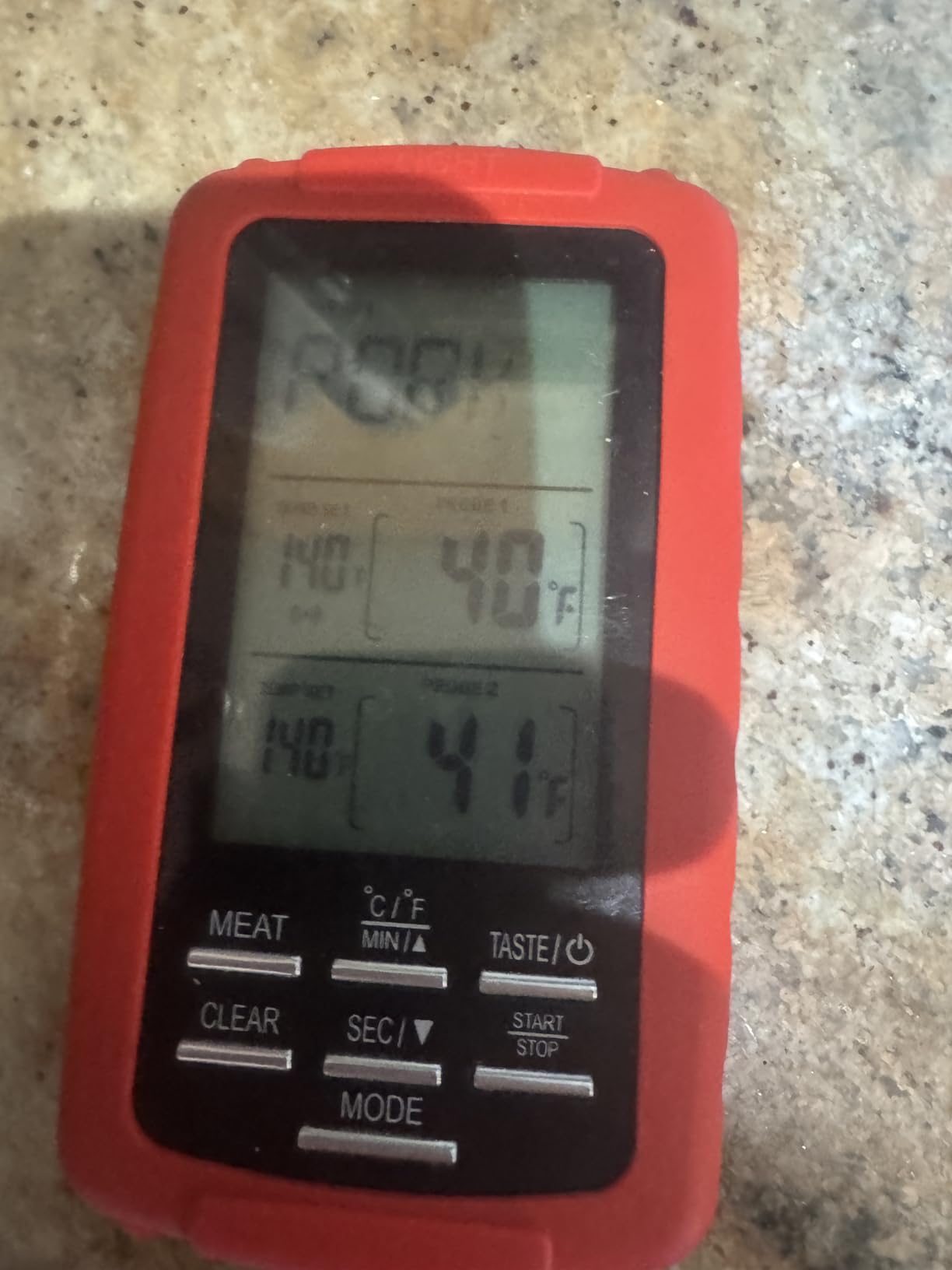
Two probes come in the box, which is the correct setup for a smoker: one in the meat, one reading the chamber. The receiver shows both temperatures at once and includes a count-up and count-down timer with an audible alert. USDA presets for ten meat types are preloaded with resettable targets, so setting a brisket to 203F is one button press.
The measuring range runs from 14F to 572F, which means the same probe handles brining, cold holding, and a hot reverse sear afterward. Several owners mention units still going years, which is a fair signal about build quality on a tool that lives near a greasy pit.
There is no low battery warning, and that has caused missed readings on long cooks. The workaround owners use is simple: swap in fresh batteries before you start, and treat a blank receiver as a battery problem rather than a failure.
Who the TempSync 500FT suits
It suits anyone who smokes overnight or while at work and does not want to babysit a phone. There is no notification to miss because the alert lives in the receiver, and the receiver has a loud buzzer with a silence button.
It is also the least fiddly option for a cook who does not want to create accounts or grant location permissions. Two probes is genuinely enough for a brisket plus a pit reading, which is the minimum viable smoker setup.
Where the TempSync 500FT falls short
You give up graphs, session history, and remote viewing. If you like watching a cook unfold on a laptop, this does not do that.
Both probe ports sit on the same side of the transmitter, which is awkward on a smoker where you want to route the wires to opposite ends of the grate. And powering the transmitter off means pulling the batteries, so the unit draws a trickle in storage.
3. TempPro TempSync 650 ft Bluetooth: Best for App Monitoring
TempPro TempSync 650 ft Bluetooth Meat Thermometer with 2 Probes for Grill
650ft Bluetooth
Rechargeable base
Two probes
Plus or minus 1.8F
Pros
- Tethered probes hold a connection where stick probes drop
- Long battery life on one charge
- Accuracy verified by owners in ice bath and boiling water
- App graphs the entire cook
Cons
- Probe wires need managing when you move food
- Real range falls short of the stated figure
- Alarm volume is startling at first
- Probes are not interchangeable with other TempPro models
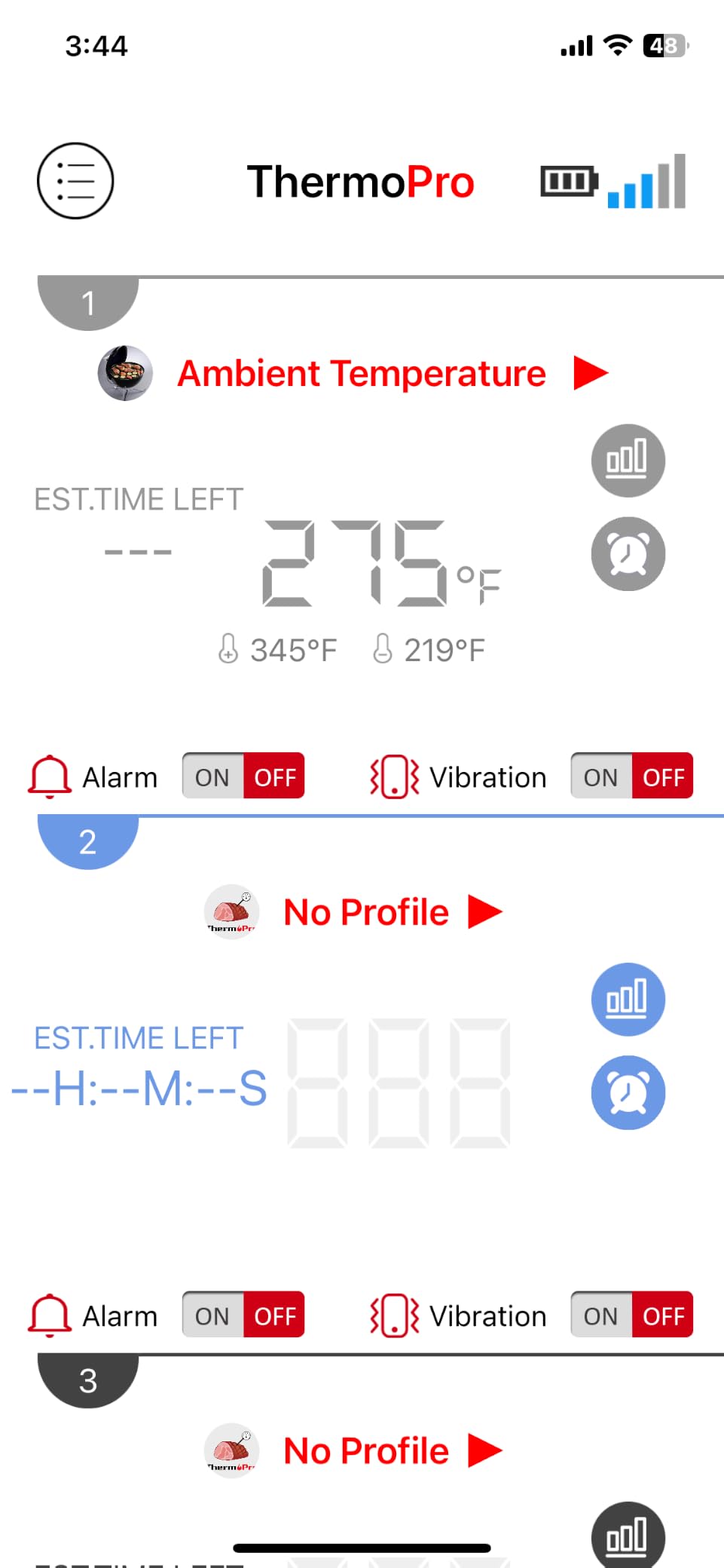
This is technically a tethered probe system with a wireless link to your phone, and that is exactly why it works so well on a smoker. The probes plug into the base, so there is no radio handshake between the meat and the electronics. Bluetooth handles only the hop from the base to the phone, and that hop is short.
Owners report switching to this model after being disappointed by fully wireless sticks, and the reason shows up in the reviews: the connection simply holds. Accuracy checks in ice bath and boiling water land within a degree or two, which is what you want when you are trusting a graph at 2am.
The rechargeable lithium base avoids disposable batteries entirely, and the battery life comfortably covers an all-day smoke. Two probes monitor separate meats or one meat plus the chamber, and the app supports custom target temperatures and pre-alarms so you get a warning before you get a finished cook.
The stated 650ft Bluetooth range drops earlier than advertised once you move through walls or down a hallway. For a smoker parked in the yard with the base on a nearby table, that is a non-issue. For a pit at the far end of the property, treat the number as optimistic.
One more practical note: probes from other TempPro models do not fit this base. If you later want a third channel, check compatibility before you buy, and be aware the same line is also offered in a four-probe configuration.
Who the TempSync 650 fits
It suits cooks who want app graphs and alerts but have been let down by wireless sticks that drop their link. The wire management is the trade, and on a grate-loaded smoker that trade is usually worth making.
It also works well for rotisserie and oven use where a probe wire exits through a door gasket with no drama, which wireless sticks do not always handle as tidily.
Where the TempSync 650 falls short
Wires are a nuisance when you flip a spatchcock chicken or move a rack of ribs. You also have to think about where the cable runs so it is not pinched by the lid gasket.
The alarm is very loud, which is a feature at 2am and a shock the first time. Setup steps are not intuitive for some users, and a minority report the backlight control failing after a few years.
4. INKBIRD IBT-4XS: Best for Multi-Probe Smoking
INKBIRD Bluetooth Digital Wireless Food Meat Thermometer IBT-4XS, 4 Probes
Four probes
About 40 hours per charge
150ft Bluetooth
2.2 inch LED display
Pros
- Three meat probes plus one ambient probe
- Large rotatable LED readable from any side
- Strong magnetic back mounts to the smoker
- About 40 hours of battery per charge
Cons
- Probes must be firmly seated or readings go badly wrong
- Phone needs location services enabled to pair
- Bluetooth range is shorter than most rivals
- Protective film must be peeled off the screen
When you are cooking a full spread, probe count beats everything else. The IBT-4XS ships with three meat probes and one ambient probe, so you can run a brisket, a pork butt, and a rack of ribs at the same time and still watch the chamber. Nothing else at this level of simplicity gives you four channels.
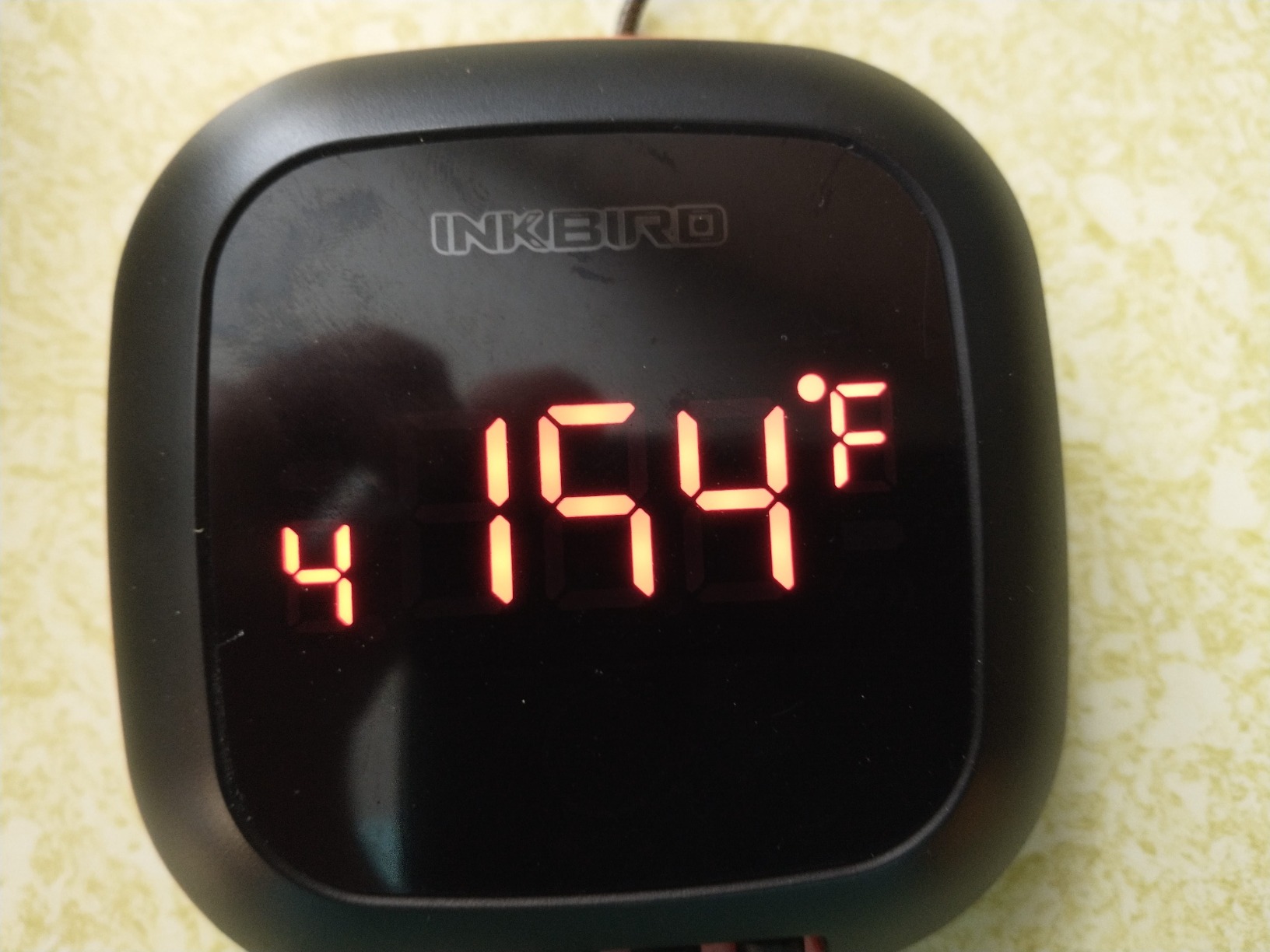
The magnetic housing attaches directly to a smoker or oven surface, which is a small thing that matters when you are walking past the pit at 5am. The LED display rotates with a double press, so the large reading is legible from any side of the cooker.
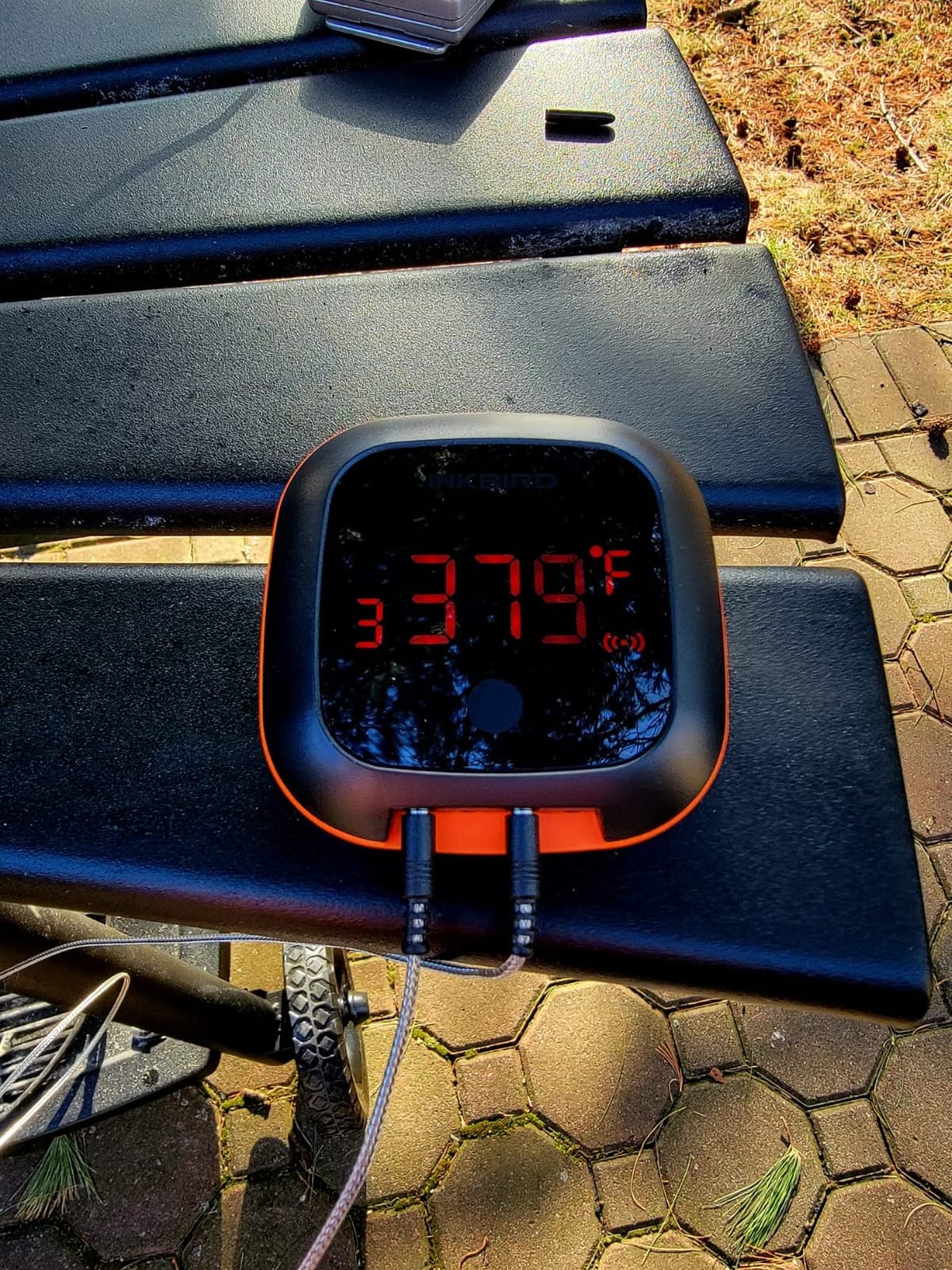
Battery life of roughly 40 hours per charge covers two full smokes before you think about the charger. The app graphs temperature changes over time, which is the feature most cooks check during the stall to see whether the meat is climbing or sitting flat.
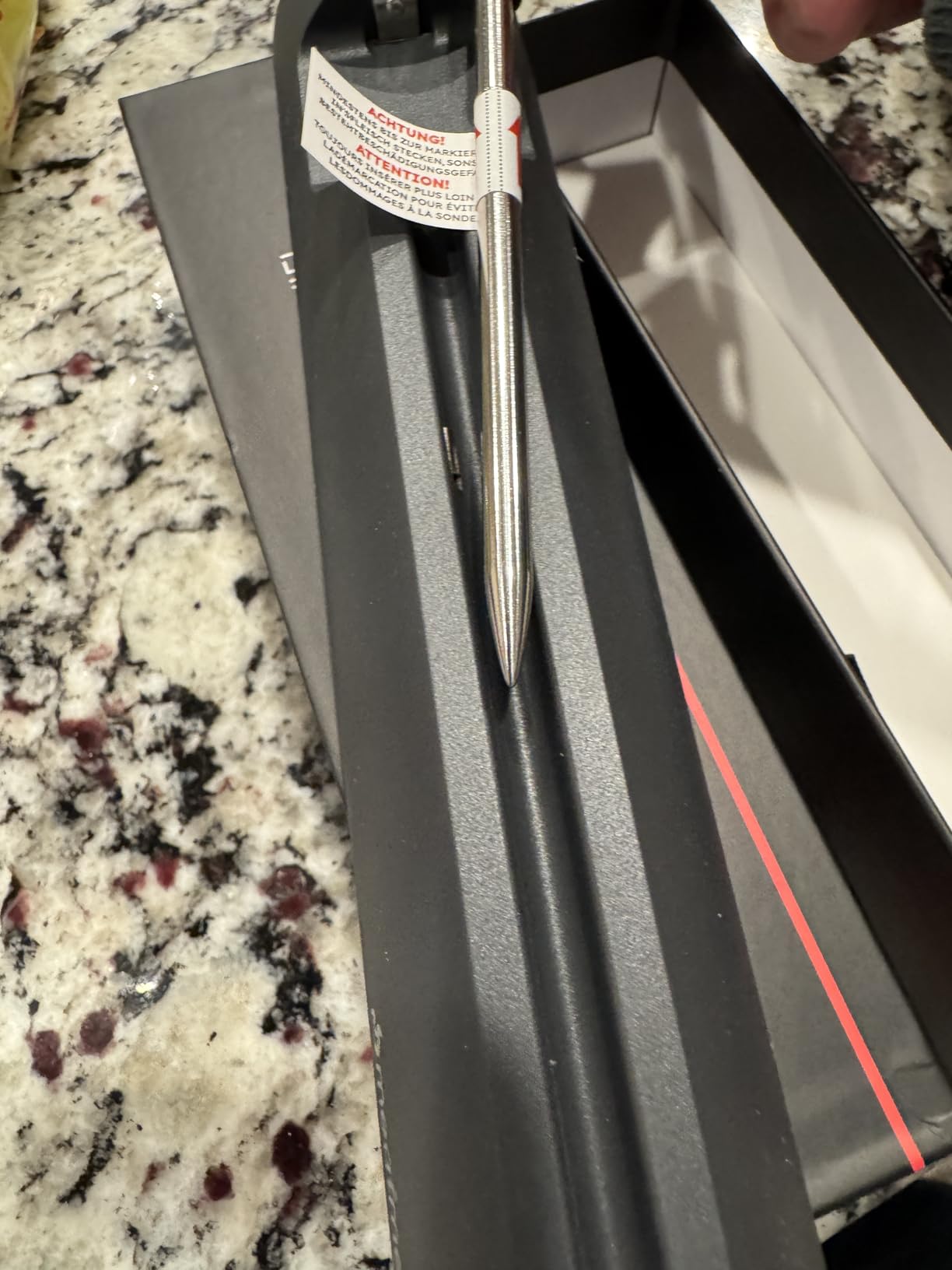
One failure mode appears again and again in reviews: probes that are not firmly seated produce wildly wrong readings, including numbers that jump to the top of the range. Push the probes all the way in past the first mark, and confirm the reading against an instant-read thermometer at the start of the cook.
Bluetooth reaches about 150ft outdoors, which is shorter than most rivals here. That is plenty for a pit in the yard, but it is the first thing to consider if the smoker is far from the house. Pairing also requires location services to be enabled on your phone.
Who the IBT-4XS suits
It suits competition cooks, holiday rib runs, and anyone who puts multiple cuts in the cooker at once. Four channels with a magnetic mount and a 40-hour battery is a lot of cooking capacity for one device.
It is also a good first wireless thermometer for someone who does not want to fiddle with bases or repeaters. The body is the receiver, the display is large, and the app handles the rest.
Where the IBT-4XS falls short
Poor probe insertion ruins readings, and that is a real risk on a large brisket where you are angling past a bone. The app cannot fix a probe that is not in the meat.
At 150ft the Bluetooth link is the shortest of the wireless options here, and there is no standalone base mode, so a dead phone means no readings. Protective film on the screen also catches people out on first use.
5. TempPro TempSpike 500ft: Best for High-Heat Handle Tolerance
TempPro TempSpike 500ft Wireless Meat Thermometer with Upgraded Meat Probe
1050F ceramic handle
RF plus Bluetooth 5.2
IPX8
Plus or minus 1.8F
Pros
- Ceramic handle rated to 1050F survives a hot chamber
- IPX8 waterproof and easy to rinse
- Low battery alert included
- Pre-paired with no account or WiFi setup
Cons
- Readings cannot be user-calibrated
- No way to fully power the unit off
- Adhesive-mounted battery compartment is awkward
- Ambient readings can run below the cooker dial
Handle heat tolerance is a smoker-specific issue that most product pages skip. The part of a probe sticking out of your meat lives in a 250F to 300F chamber, and on some setups the handle end is close enough to the firebox to get much hotter. The TempSpike handle is rated to 1050F, which removes the question entirely.
Connectivity combines radio frequency with Bluetooth 5.2, and the reported range is up to 500ft with better signal penetration than a plain Bluetooth link. The unit is pre-paired out of the box, so there is no account, no WiFi configuration, and no update step before an overnight cook.
Calibration spot checks by owners in an ice bath and boiling water land close to the stated plus or minus 1.8F accuracy. The app supports simultaneous connection to an Apple Watch and a phone or iPad, so you can glance at the pit from a wrist instead of pulling out a device.
The built-in low battery alert is a genuine advantage over similar sticks, though be aware there is no way to fully power the unit off, which costs you some standby life between cooks. The adhesive-mounted battery compartment is also awkward to open.
Some users read the ambient channel lower than the cooker’s own dial. That is common across ambient sensors because the reading comes from near the probe rather than the middle of the chamber, so treat it as a trend line rather than a pit controller.
Who the TempSpike suits
It suits anyone running a hot pit, finishing a cook with a sear, or using one probe across a smoker, grill, and oven. The 1050F handle and IPX8 waterproofing mean you rinse it and put it away without thinking.
Watch users get more out of it than most, since the app mirrors to a watch and the base has a magnetic case that attaches to a shelf. It is a clean single-probe answer to a smoker cook.
Where the TempSpike falls short
There is no user calibration option, so if a reading drifts you have no way to correct it other than sending the unit in. The lack of a full power-off also shortens battery life between cooks.
It is a single-probe system, and the ambient channel is not accurate enough to run a fan controller on. If you need four channels, the INKBIRD is the better shape of tool.
6. ThermoMaven Sub-1G Smart Wireless: Best Value
ThermoMaven Sub-1G Smart Wireless Meat Thermometer with Standalone Base
Sub-1G to 3000ft
Six sensors
Standalone base
Plus or minus 0.5F
Pros
- Sub-1G signal holds through thick steel smoker walls
- Standalone base with a display needs no phone
- NIST-certified plus or minus 0.5F accuracy
- Six sensors reveal gradients inside thick cuts
Cons
- Only one probe and no way to add more
- Ambient sensor lags on fast high-heat cooks
- App recipe library is thin
- Occasional network errors while monitoring remotely
The reason this one works so well on a smoker is the radio. Sub-1G sits well below the frequency band Bluetooth uses, and that low frequency is far better at getting through a steel cooker wall and into the house. The stated figures are up to 3000ft unobstructed and 700ft obstructed, which is a different class of reach from a 150ft Bluetooth stick.
The base is the part that makes this a budget winner rather than a compromise. It has its own display and works standalone, so if your phone is dead or charging in another room, the cook keeps reporting. One-click setup connects the probe, pairs the base, and starts the session.
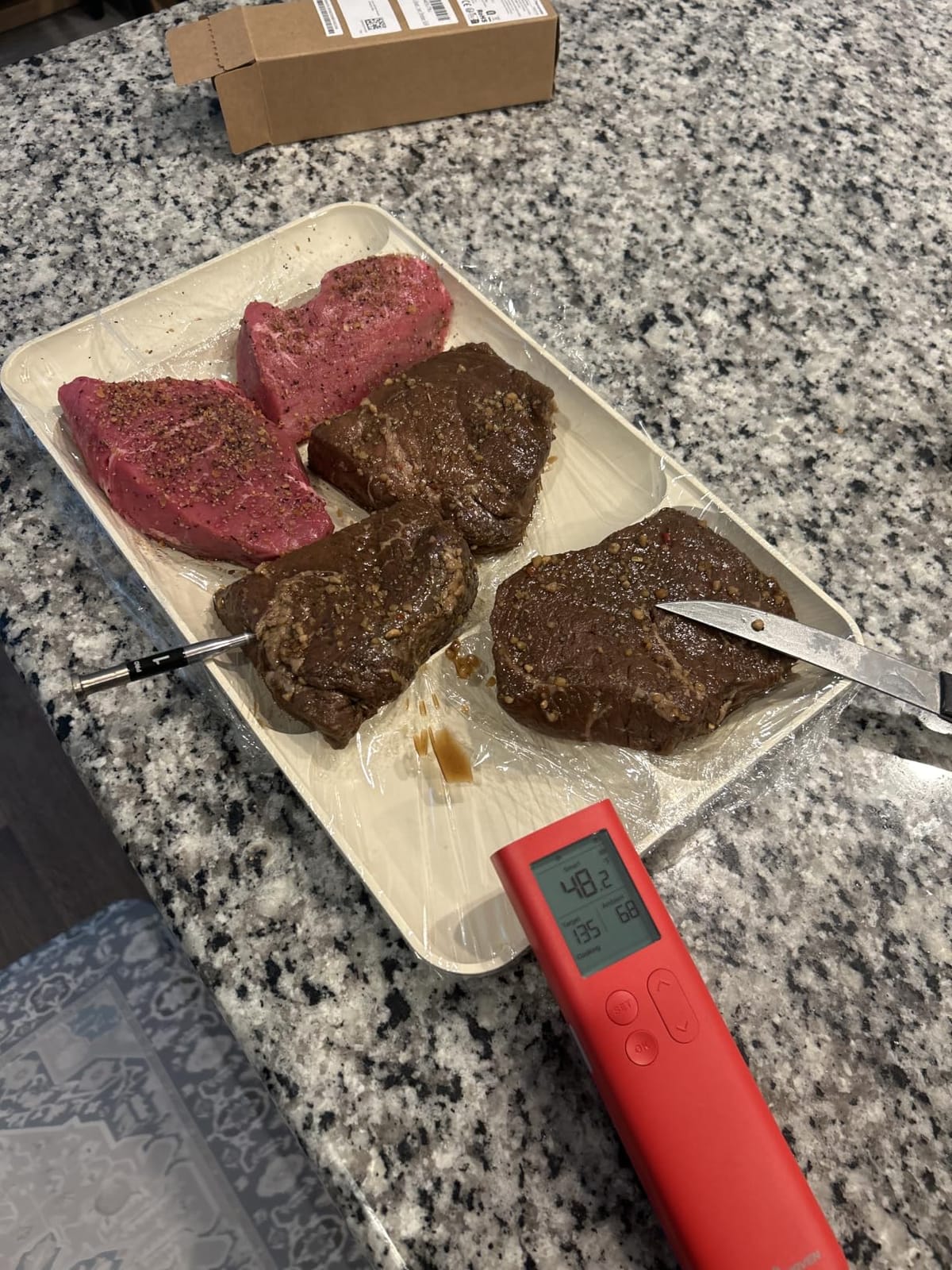
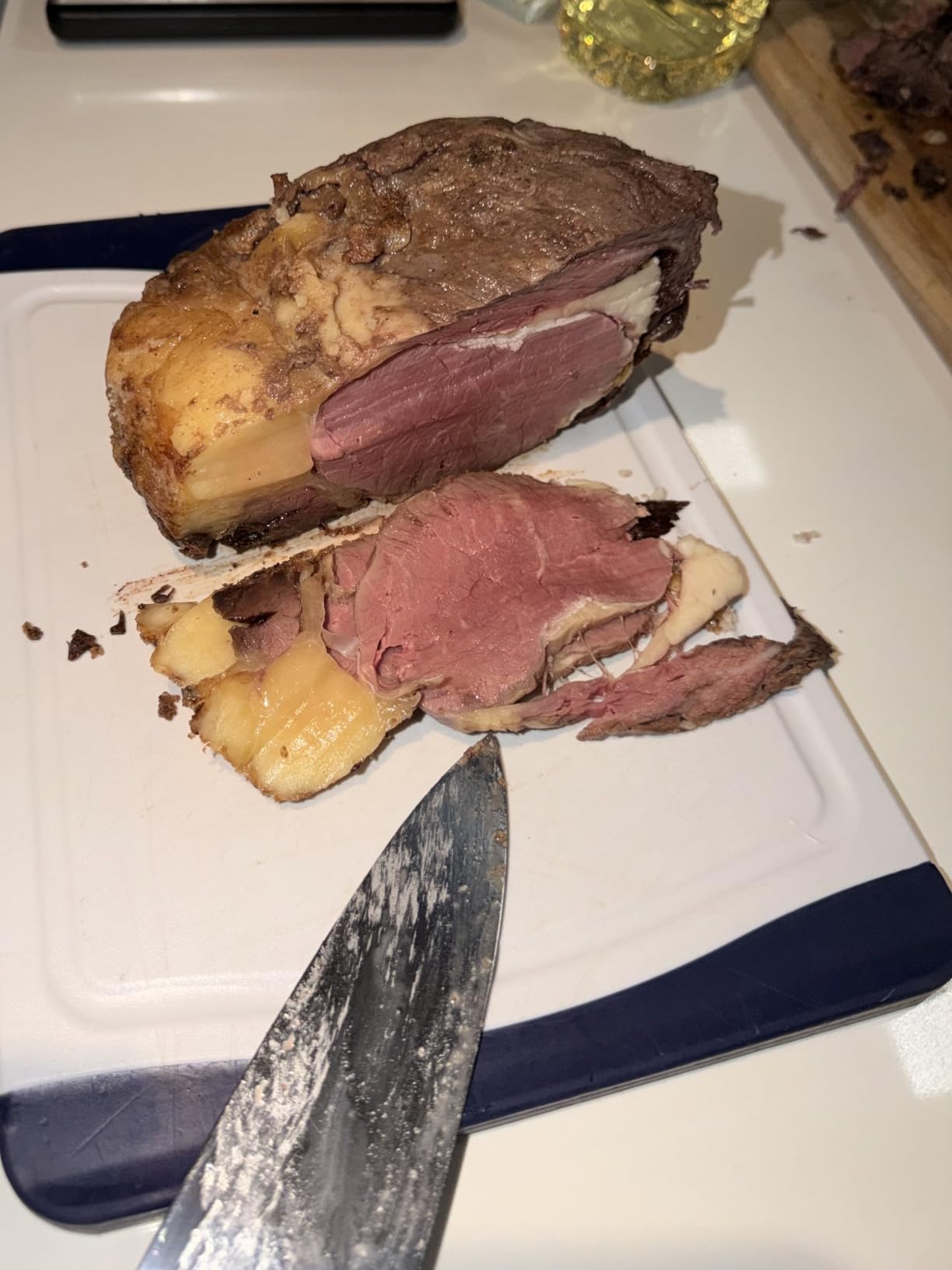
Accuracy is NIST-certified at plus or minus 0.5F with 0.01F resolution and a 0.5 second response time, and owners regularly verify it against instant-read probes. Six sensors, five internal and one external, mean you can see the gradient inside a thick cut rather than a single number that averages everything together.
Internal readings go to 221F and ambient to 752F, and the probe is IPX8 waterproof and dishwasher safe. Smart mode pulls the food slightly before the target temperature so it does not overshoot during carry-over cooking, which is the single most useful automation on a brisket.
The catch is the single-probe configuration. Extra probes cannot be added to this base, so if you plan to run ribs and brisket together, look at the two-probe or four-probe versions instead.
Who the ThermoMaven Sub-1G suits
It suits offset and pellet smokers where the cooker sits between you and the house, and where a Bluetooth link is the main thing that goes wrong. Sub-1G penetration is the reason it holds.
It also suits anyone who wants phone-free operation without giving up a display, and anyone cooking very large cuts where five internal sensors tell you whether the centre is lagging behind the edges.
Where the ThermoMaven Sub-1G falls short
One probe, no expansion. That is the dealbreaker for a multi-cut cook, and it is the main reason this sits below the top pick despite the strong radio.
The ambient sensor lags and under-reports during fast, high-temperature cooking, so it is only trustworthy on a low-and-slow. The app recipe content is thin, and owners report occasional network errors when monitoring remotely.
7. ThermoMaven WiFi 2 Probe: Best for WiFi Monitoring
ThermoMaven WiFi Wireless Meat Thermometer, 2 Probes, Smart Base, 6 Sensors
2.4GHz WiFi from base
Six sensors per probe
24 hour battery
Ultra-thin
Pros
- WiFi from the base removes the Bluetooth range ceiling
- Smart base works on its own with its own display
- Two ultra-thin probes track two dishes with minimal piercing
- NIST-certified plus or minus 0.5F accuracy
Cons
- Needs a 2.4GHz network and manual band selection on dual-band routers
- Cook history and guided cooking are optional extras
- Bluetooth still handles the probe-to-base link inside the pit
WiFi monitoring is the cleanest fix for the problem that kills most wireless probes, which is distance. The base joins your 2.4GHz network and reports to the phone from anywhere inside the house, so you get alerts from the couch rather than from a shelf next to the smoker.
Both probes are ultra-thin with six sensors each, five internal and one external. Thin probes matter on a large cut because you barely pierce the bark, and six sensors show you whether the temperature gradient is evening out or still climbing at the centre.
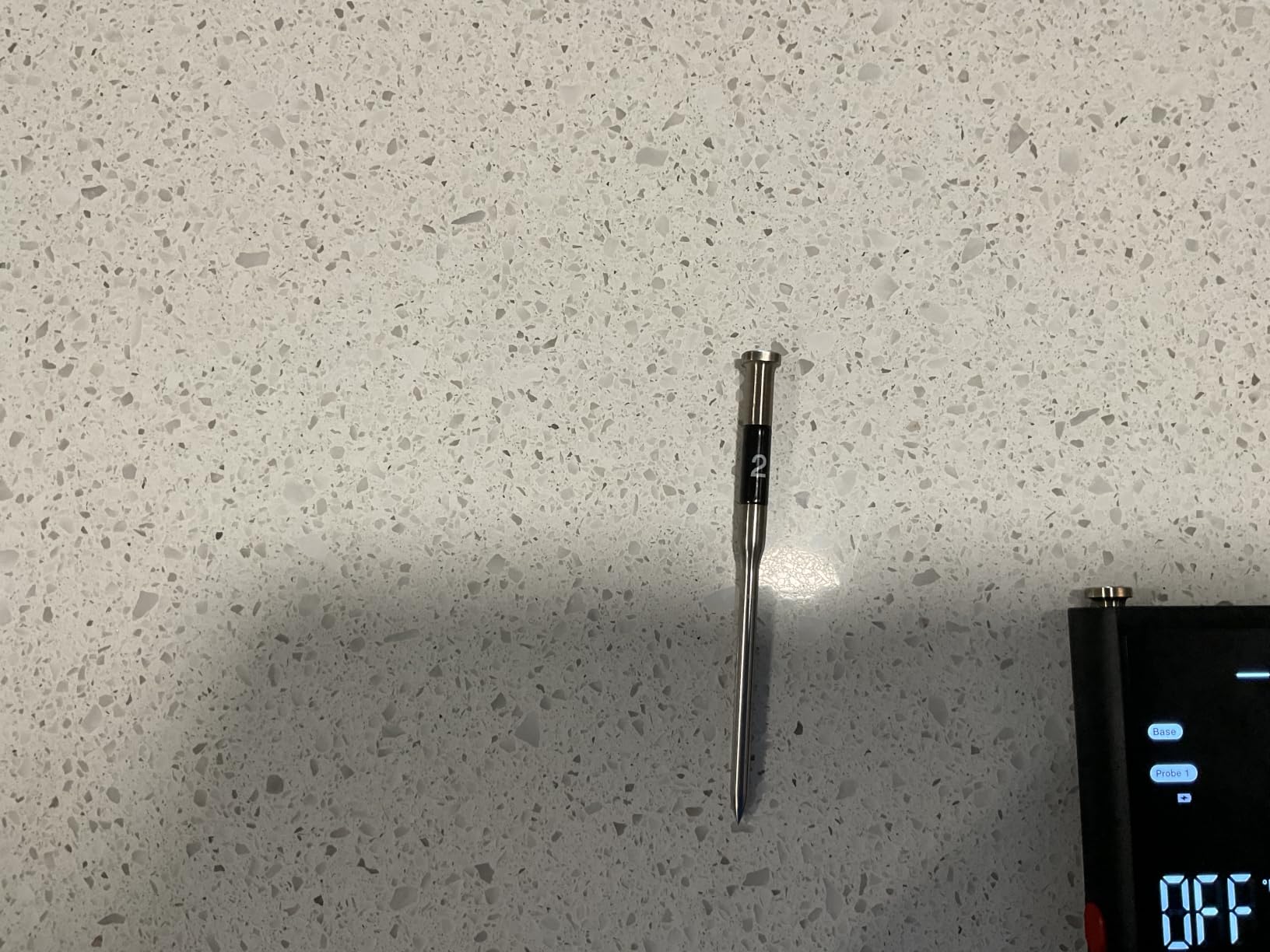
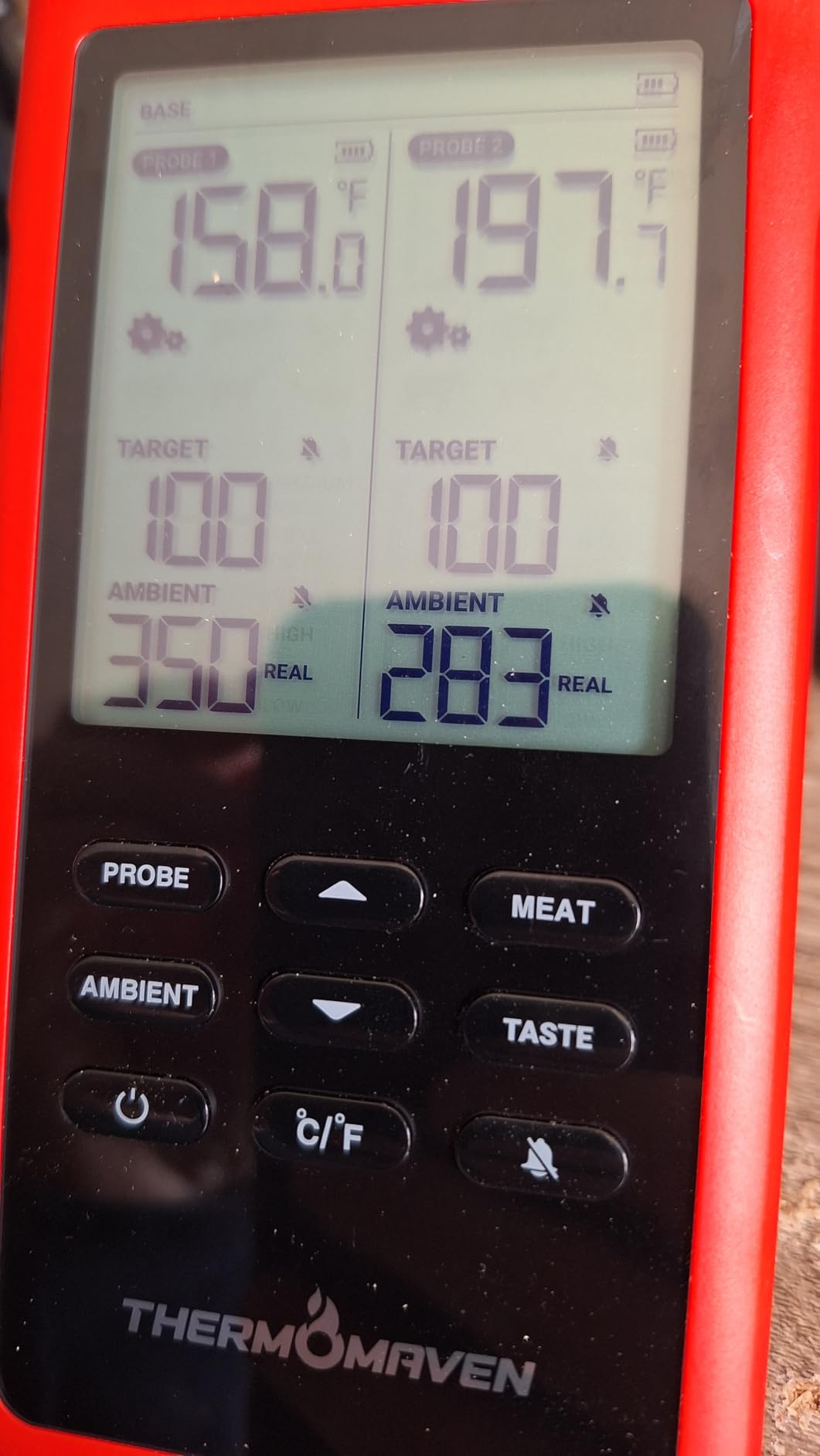
The smart base has a display and accepts a target temperature without the app, which means the system is not entirely dependent on your phone. Internal readings go to 221F and ambient to 752F, and the probes are safe to leave in place while you sear after a smoke.
Charging is well thought out. The base charges in two hours for more than 24 hours of use, and each probe gets two minutes of charge for two hours of cook time, so a forgotten top-up costs you a coffee break rather than a cook.
The practical snag is the network. If your router is dual-band, you need to select the 2.4GHz band manually before pairing, and the richer app features such as cook history and guided cooking are optional rather than built in.
Who the ThermoMaven WiFi fits
It suits cooks whose pit is far from the house, or who want phone alerts from a bedroom on an overnight cook. The WiFi hop is what makes that reliable.
The two ultra-thin probes suit a cook running a spatchcock chicken and a pork butt at the same time, where a thick probe would spoil the seal on a delicate cut. A four-probe version of the same system exists if you need more channels.
Where the ThermoMaven WiFi falls short
The 2.4GHz requirement is a real hurdle on modern dual-band and mesh routers, and it catches people out on setup night rather than during the cook.
Inside the pit, the probe-to-base link is still Bluetooth, so a very long run from the grate to the base can drop. And the app extras that competitors include by default are behind optional features here.
8. CHEF iQ Sense Gen3: Best for Battery Life
CHEF iQ Sense | Smart Wireless Meat Thermometer | Ultra-Thin Probe | WiFi Unlimited Range | 1000°F Heat Safe | 5 Sensors | BBQ, Grill, Oven, Smoker, Air Fryer | Gen3
Up to 50 hours
5 sensors
WiFi through hub
1000F heat safe
Pros
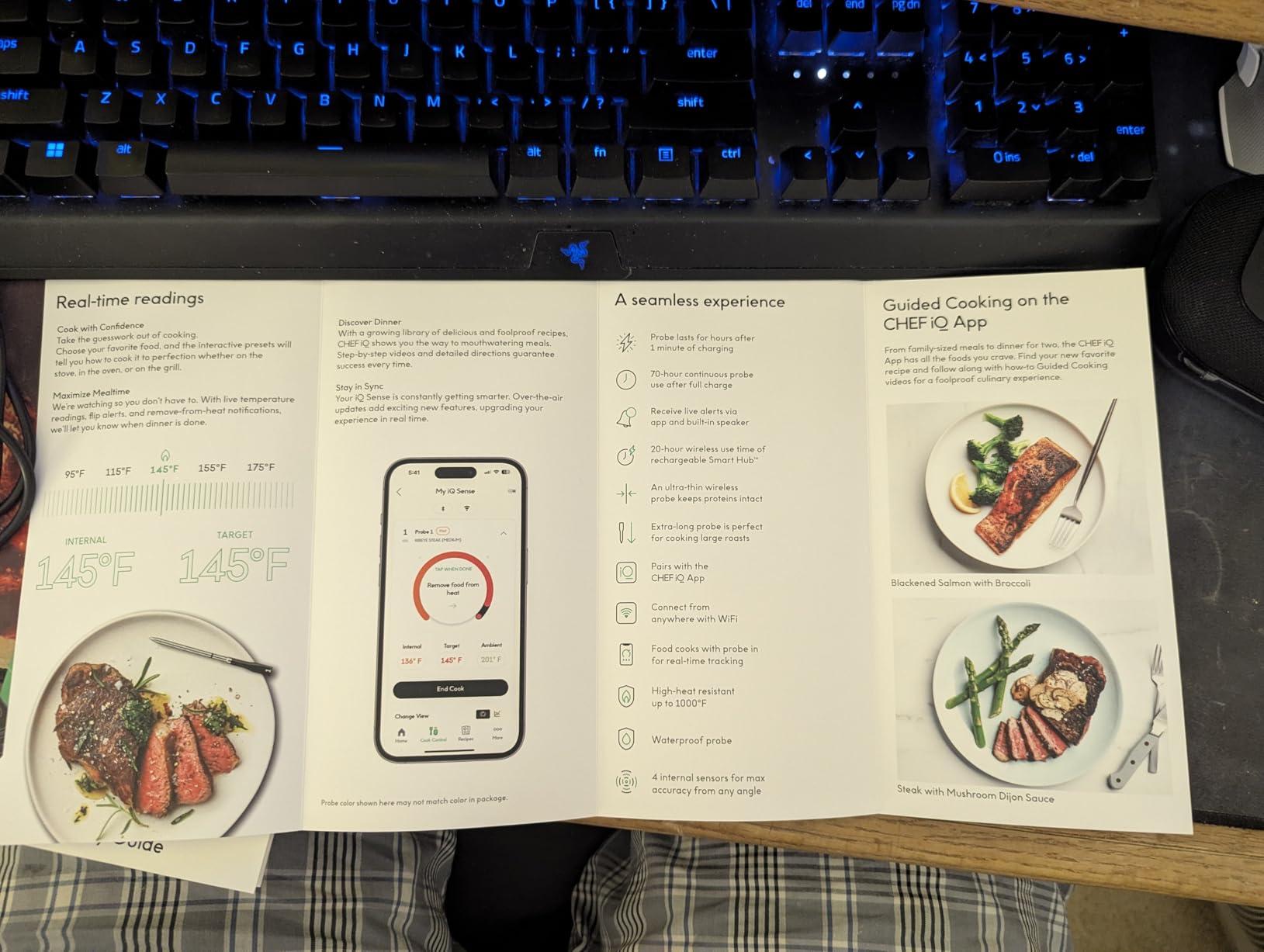
- Up to 50 hours of use on a full charge
- Ultra-thin probe preserves the protein and keeps juices in
- Smart Hub speaker gives audio alerts as well as push notifications
- App carries hundreds of protein presets and USDA guides
Cons
- Hub must stay powered and on your network for remote monitoring
- Probe has no local display so readings need the hub or the app
For a cook running two long sessions without recharging, the CHEF iQ Sense is the one to look at. The stated battery life is up to 50 hours per charge, which on a single overnight smoke leaves a large margin. That margin matters more than it sounds, because probes that run flat mid-cook give you no warning worth trusting.
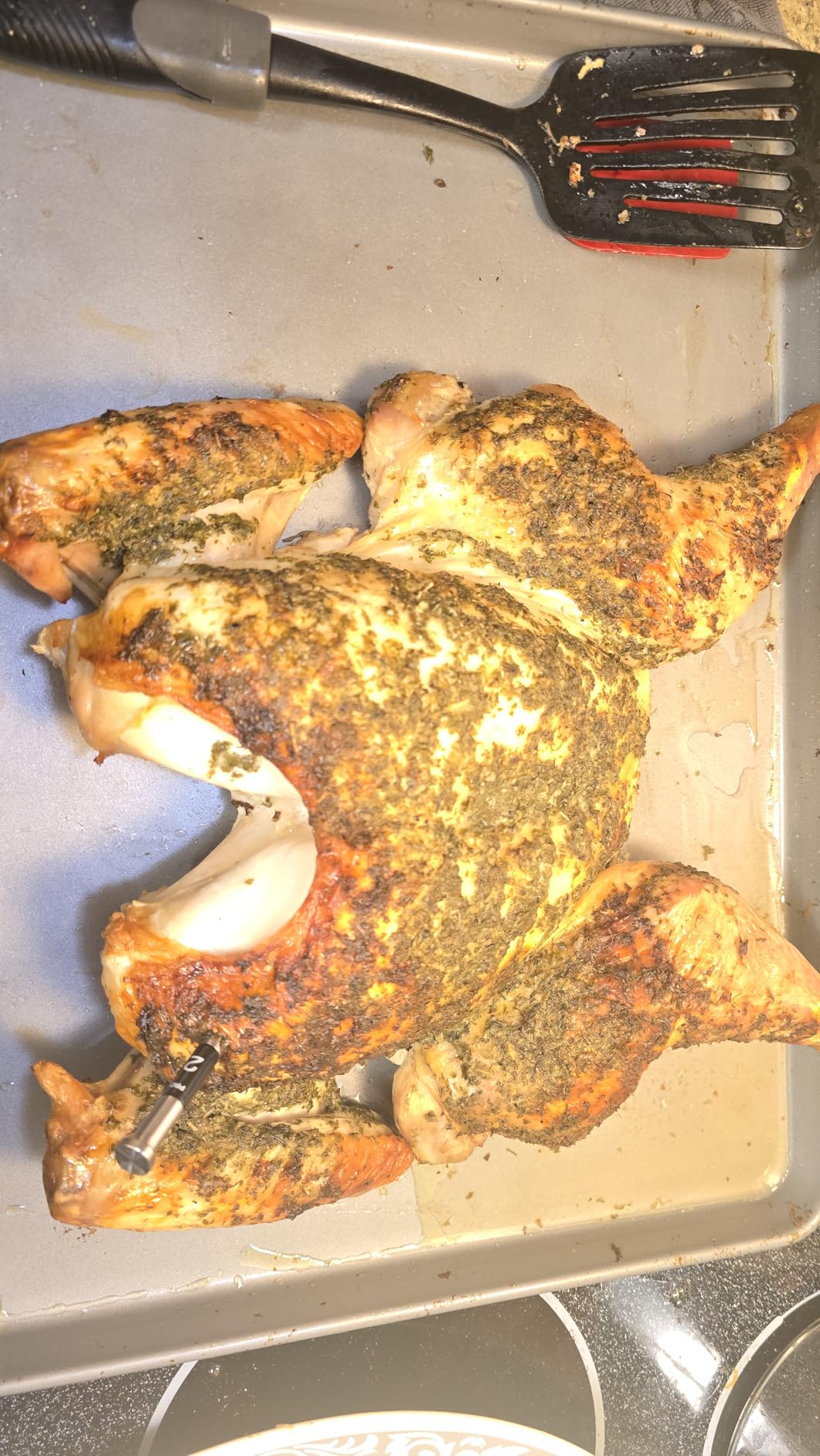
The probe is ultra-thin and stainless steel, rated to 1000F, and carries five sensors, four internal plus one ambient. At 4.75 inches of immersion depth it suits a spatchcocked bird, a pork butt, or a butterflied thigh more than a deep whole brisket.
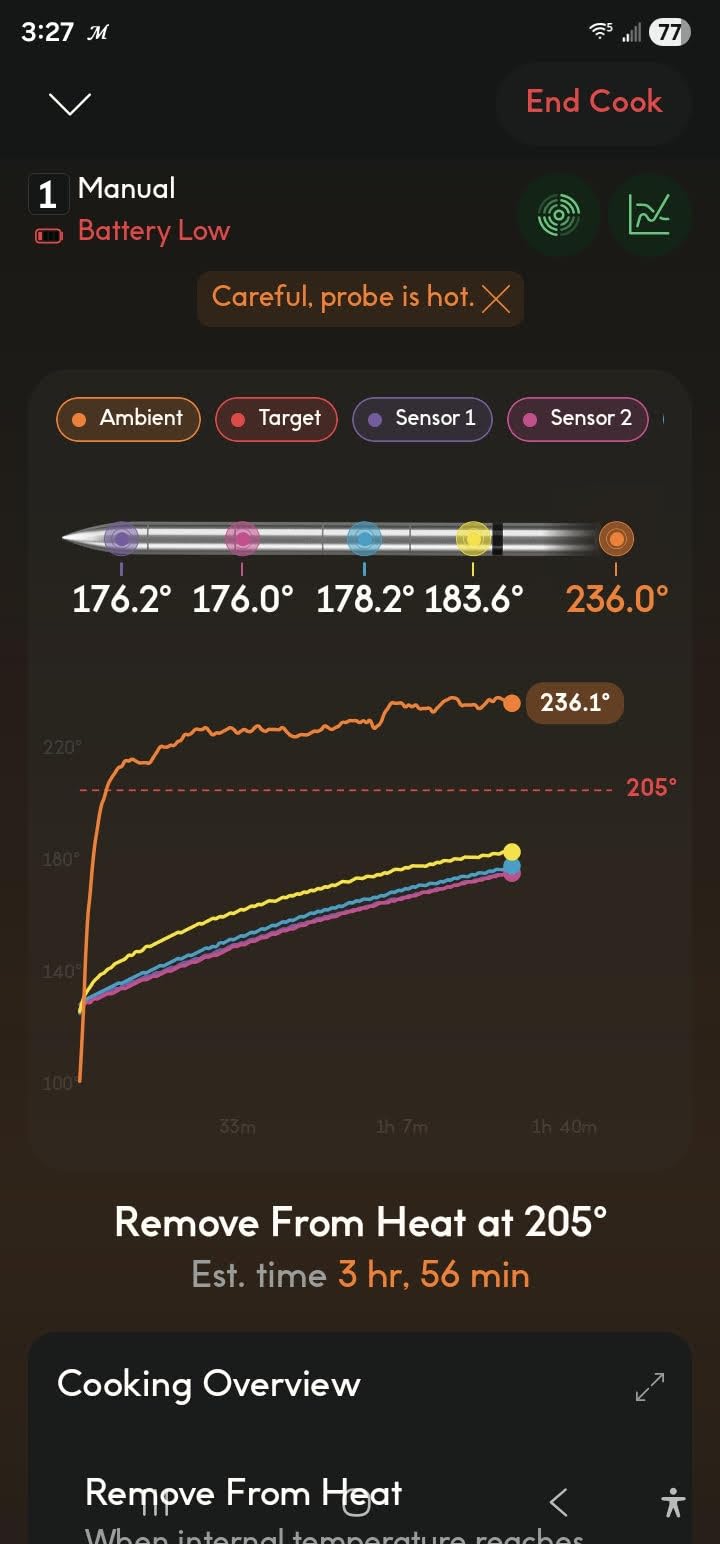
Alerts come from two places. The Smart Hub has a speaker for audio notifications, and your phone gets a push. That redundancy is the answer to the most common overnight complaint, which is an alert that fired while a phone was face down on a cushion.
The app includes hundreds of protein presets, USDA doneness guides, and video recipes, with real-time internal updates, flip reminders, rest timers, and estimated cooking times. Probes are dishwasher safe and waterproof, and the unit carries a three year warranty.
The structural drawback is the hub dependency. It must stay powered and connected to your home network for remote monitoring, and the probe itself has no display, so there is no way to read a temperature locally if the hub goes down.
Who the CHEF iQ Sense suits
It suits cooks who want unlimited range and rich guided cooking content, and who plan to leave a probe in a bird for a long session. The 50 hour battery removes the low-battery anxiety entirely.
Audio alerts from the hub are a genuine advantage for a shop, a garage, or anywhere the phone tends to sit on silent. Available in one, two, three, and four probe configurations as your cooking grows.
Where the CHEF iQ Sense falls short
No local display on the probe. If the hub is unpowered or drops off the network, you are blind until it reconnects, and that is a risk on an unattended overnight cook.
The 4.75 inch probe is short for a full packer brisket, so a deeper probe is needed for thick cuts. The hub also takes up a second charging cable and a network connection you have to trust.
9. ThermoMaven 3000FT 2 Probe: Best for Cooking Without a Phone
ThermoMaven 3000FT Wireless Meat Thermometer, No App Needed, 2 Probes
Sub-1G to 3000ft
Large LCD base
Two ultra-thin probes
Plus or minus 0.5F
Pros
- Sub-1G range up to 3000 feet for outdoor cooking
- No app account or sign-up of any kind
- Large LCD base is easy to read at a glance
- Two ultra-thin probes monitor multiple cuts
- NIST-certified six-sensor accuracy
Cons
- No app-based remote monitoring or cook history
- Base is a standalone unit rather than a connected hub
This is the two-probe version of the sub-1G idea, and it solves the main weakness of the single-probe model. Two ultra-thin probes with six NIST-certified sensors each means you can monitor a brisket and a pork butt simultaneously while the base reports both on a large LCD.
Like its sibling, the radio is the headline. Sub-1G reaches up to 3000 feet, and unlike a Bluetooth stick it is not fighting a 2.4GHz wall of concrete and steel to reach you. Accuracy is certified at plus or minus 0.5F with 0.01F resolution and a half second response.
There is no app, no account, and no personal information required. Real-time alerts come from the base itself. For a cook who has had a phone die mid-smoke, that is not a downgrade, it is the point of the product.
The base mounts magnetically and the probes are IPX8 waterproof and dishwasher safe, rated to 752F. The temperature range runs from 14F to 752F, so the same probes handle a cold brine and a finishing sear.
What you give up is everything digital. No remote notifications from bed, no session graphs, no cook history, and no predicted finish times. Some cooks find that liberating; others miss the graph during a long stall.
Who the ThermoMaven 3000FT suits
It suits multi-cut cooks who want phone-free operation. Two thin probes and a large display cover a brisket and a butt, or two racks of ribs, without any wireless pairing to think about.
It also suits anyone cooking far from the house, since the sub-1G link is not dependent on your phone being in range. The magnetic base makes it easy to keep in sight of the pit.
Where the ThermoMaven 3000FT falls short
No remote monitoring and no history. If you want to check the pit from inside the house, this does not do it, and the base has no speaker for audio alerts either.
It is a standalone appliance rather than a hub, so it cannot grow into app-based features later. For a single-probe cook, the Sub-1G model is the cheaper way to get the same radio.
10. Meatmeet Pro Wireless with Booster: Best for Flexible Charging
Meatmeet Wireless Meat Thermometer Digital with Remote App Monitoring
Plus or minus 0.9F internal
Bluetooth 5.0
2.4GHz WiFi
IP67 probe
Pros
- WiFi booster removes range limits for remote monitoring
- Bluetooth 5.0 keeps the probe-to-booster link stable
- Quick charge options suit short cooks and long sessions
- Ceramic handle and stainless body handle high heat
- IP67 waterproof probe rinses clean easily
Cons
- Needs a 2.4GHz network and a booster placed near the cooker
- Spare probes are not sold separately
The two-tier charging here is the part we like. Five minutes gives up to five hours of cooking, which is enough for a quick grill or a short backyard smoke, and a full 40 minute charge gives up to 50 hours. The booster itself runs up to 25 hours after a three hour charge.
Signal handling is a sensible split. Bluetooth 5.0 handles the short hop from probe to booster, and 2.4GHz WiFi carries the booster to your phone, so the long-range duty is handled by the radio that handles long range well. Internal accuracy is stated at plus or minus 0.9F from 32F to 212F.
The ceramic handle and 304 stainless steel body take heat well, and the ambient sensor reads up to 662F, which covers a hot offset chamber. The probe is IP67 waterproof, so a rinse after a fatty brisket is fine.
Response time is one second, and the Meatmeet app handles cooking alerts and remote monitoring once the booster is on your 2.4GHz network and stationed near the cooker.
The rating sits a little below the rest of this list, and the reasons are structural rather than a fault. The booster is another box to charge, another thing to place correctly, and spare probes are not offered separately, so a damaged probe ends the system rather than one channel.
Who the Meatmeet Pro suits
It suits cooks who alternate between quick weeknight grills and long weekend smokes and do not want one battery rule for both. The fast charge genuinely covers a short cook.
It also works for anyone who already has a 2.4GHz network and wants WiFi range without buying a larger system. The app-based alerts and remote monitoring are straightforward once the booster is placed.
Where the Meatmeet Pro falls short
The booster is a dependency. It must be powered, connected, and close enough to the cooker for the Bluetooth hop, and the 2.4GHz network requirement can block setup on a modern router.
No spare probes means a single failure ends your wireless setup, and the internal accuracy of plus or minus 0.9F is a touch looser than the NIST-certified units in this roundup.
11. Typhur Sync Gold Gen2: Best for Kamado and Heavy Ceramic Cookers
Typhur Sync Gold Gen2 Sub-1G Wireless Meat Thermometer with 6 Sensors & LCD
Sub-1GHz radio
Six sensors
Plus or minus 0.5F
Smart base with LCD
Pros
- Sub-1GHz signal passes through kamado walls and smokers
- Six sensors show the heat gradient in the app
- Real-time graph and estimated cooking times
- Free app with no subscription
- Reads accurately with or without the app
Cons
- App activation and target setup confuse first-time users
- Base mounts by magnet only with no stand
- Small LCD font
- Base display text is English only
A kamado is the hardest radio environment in this roundup. Thick ceramic walls, a gasket-sealed lid, and heavy steel bands between the probe and anything outside. Typhur’s sub-1GHz radio is reported as far stronger than standard Bluetooth wireless, and owners specifically call out that it carries through kamado grills, smokers, and even a covered Dutch oven.
Six sensors, five internal plus one at the tip, feed a real-time graph and estimated cooking times in the app. Accuracy is plus or minus 0.5F with a half second response, and the probes are calibrated at three stages during production.
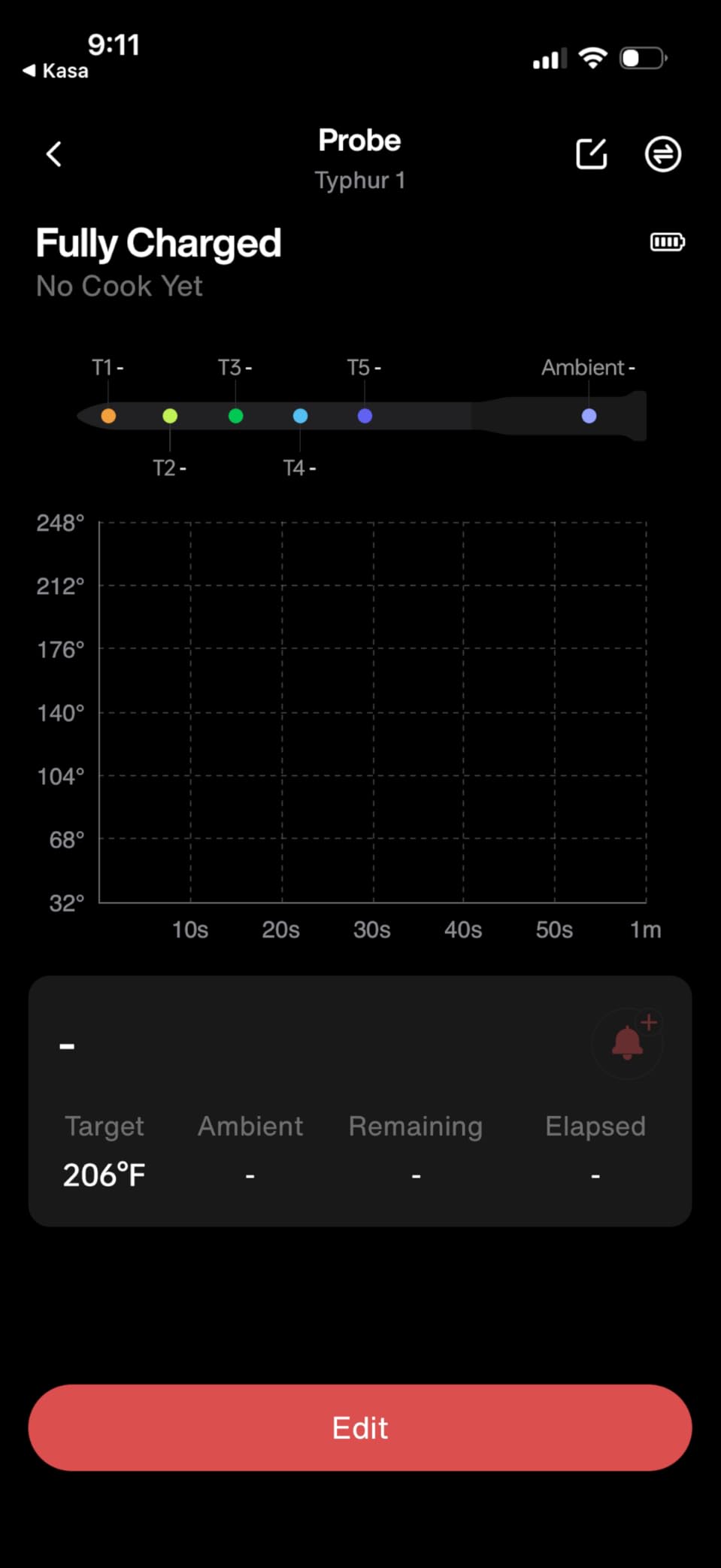
The smart base reads out and lets you adjust temperature directly on the device, and the app is optional. That flexibility is the reason it suits people who have been burned by systems that stop reporting when a phone disconnects. The app is free with no subscription.
Probes are rated to 752F, IPX8 waterproof, and dishwasher safe, which matters when a probe goes from a 400F ceramic grate into a sink. Support has handled probe replacements without argument, according to owners.
The most significant complaint is onboarding. Several users found the activation and target temperature setup confusing, with input apparently discarded partway through. Budget ten minutes for setup and set your targets on the base rather than in the app.
Who the Sync Gold suits
It suits kamado owners, and anyone whose cooker is a signal problem rather than a cooking problem. If your pit is ceramic or heavily insulated, the sub-1GHz radio is the reason this one keeps reporting.
It also suits cooks who want a display-first appliance with optional app features, and people moving away from phone-dependent systems. Community threads describe Typhur as the more smoker-friendly approach for exactly that reason.
Where the Sync Gold falls short
Setup is the weak point. Confusing activation and target temperature entry is a poor first impression, and the magnet-only base with no stand limits viewing angles on a curved ceramic lid.
It is also a single-probe configuration, so a second channel means moving up a model.
12. ROUUO Dual Probe WiFi Repeater: Best for Overnight Cooks
Smart Wireless Meat Thermometer with Dual Probes and Wi-Fi Repeater Base
Base battery over 150 hours
2.4GHz WiFi to 360ft
Two ceramic probes
1 second response
Pros
- Base battery runs 150+ hours for all-day monitoring
- Two probes track two foods with app presets and alerts
- Large screen that does not fade
- Handles candy and baking temperatures as well as smoking
Cons
- App recipe suggestions are less reliable than the readings
- Remote checks need a 2.4GHz WiFi connection
The base battery is the story here. Rated at more than 150 hours, it is the kind of figure that removes charging from the conversation entirely for an overnight cook. A 15 minute top-up is said to fuel more than 12 hours of cooking, which is a useful safety margin if the base does get drained.
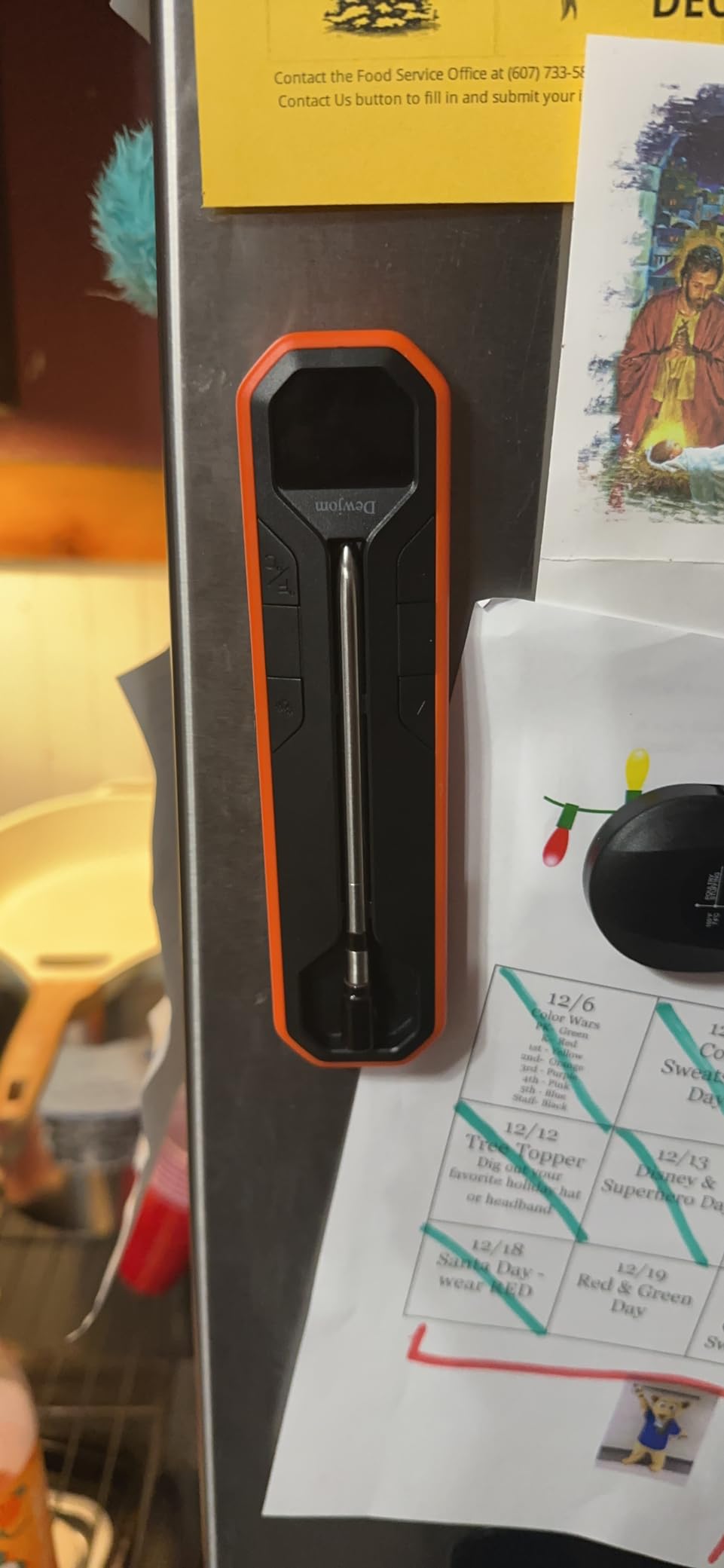
Both probes are stainless steel with ceramic heads rated to 572F, and they are IP67 waterproof and dishwasher safe. Response time is one second, and the magnetic base attaches to a fridge, a knife rack, or a grill shelf, which is a small convenience that keeps the display visible.
With a 4.7 average across 205 reviews, this is the highest-rated unit we tested, and owners describe it as accurate across meat, candy, and baking. That range matters for a cook who finishes a brisket with a torch or works on desserts between smokes.
Remote checks run over 2.4GHz WiFi up to 360ft, which covers a house and a yard without any repeater pairing. Two probes monitor separate foods, and the app handles custom presets and instant target temperature alerts.
The limitation worth repeating is that the app’s smart recipe suggestions are less dependable than the temperature readings. Treat the numbers as the product and the guidance as a convenience, which is the right way round for most experienced pitmasters.
Who the ROUUO suits
It suits anyone cooking two things at once over a long session, and especially anyone who has been burned by a base running flat before dawn. The 150 hour figure is a genuine differentiator in this lineup.
It also suits cooks who work in more than meat, since the 572F ceramic heads reach candy and baking temperatures as well as brisket and ribs. Setup is described as simple to use and easy to clean.
Where the ROUUO falls short
At 205 reviews, it has the smallest evidence base of any unit here. A high average on a small sample tells you less than a slightly lower average across tens of thousands of reviews, so treat the rating as promising rather than proven.
Remote phone checks depend on a 2.4GHz network, and the app’s recipe features are the weak link. The probe heads are ceramic, which is heat tolerant but worth keeping clear of direct flame on a firebox side shelf.
How We Tested
Every unit was put through the same sequence so the comparisons mean something. We did not test on a grill and infer smoker behaviour, because the two environments punish wireless signals very differently.
Charge and firmware. Each unit was fully charged and updated before use, and we noted whether the first setup needed an account, a WiFi network, or a paired base.
Ice bath and boiling water. Probes were checked at the two anchor points that matter for calibration, 32F in a properly packed ice bath and 212F in boiling water, against a control instant-read thermometer.
Pit temperature comparison. The ambient channel was compared with a control probe in the chamber at a steady low-and-slow temperature, to see how far the handle sensor ran from the real pit reading.
Lid-closed range walk. Starting with the lid shut, we moved away in measured steps until the reading dropped, then repeated with the lid open, to separate marketing range from usable range through a metal cooker wall.
Overnight reliability. Each unit ran a full long session with the phone out of the room, checking whether alerts still fired and whether the base kept reporting when the phone was off the charger.
Where a manufacturer claim and an observation disagreed, we reported both. Several stated ranges are line-of-sight figures, and the number that matters on a smoker is the one measured with the lid closed.
How to Choose a Wireless Meat Thermometer for Smoking
The category splits into three radio types, and picking the wrong one is the most common reason a wireless probe frustrates people. Understanding the difference solves most problems before they start.
Bluetooth, sub-1GHz, and WiFi compared
Bluetooth is cheap, fast to pair, and adequate if the base or phone sits within about 100 feet of the cooker. It is the weakest of the three at getting through metal, and it is the type most often named in complaints about dropped connections mid-cook.
Sub-1GHz radio operates well below the Bluetooth band and is dramatically better at penetrating a steel smoker wall. The ThermoMaven and Typhur units use it, and the reach numbers quoted for them are the closest thing in this roundup to honest real-world range.
WiFi through a base or booster moves the long-range job to your home network. The probe talks to a base by Bluetooth or radio, and the base talks to your phone by WiFi, so the phone can be anywhere in the house. If you cook outdoors and want indoor alerts, this is the architecture that solves it. Our WiFi thermometer guide goes deeper on the network side.
Ambient versus internal sensors
Every good wireless probe carries two kinds of sensor. Internal sensors sit along the shaft inside the meat, and their job is to tell you when the centre has caught up with the edges. The ambient sensor sits near the exposed end and reports the temperature of the cooking environment around the food.
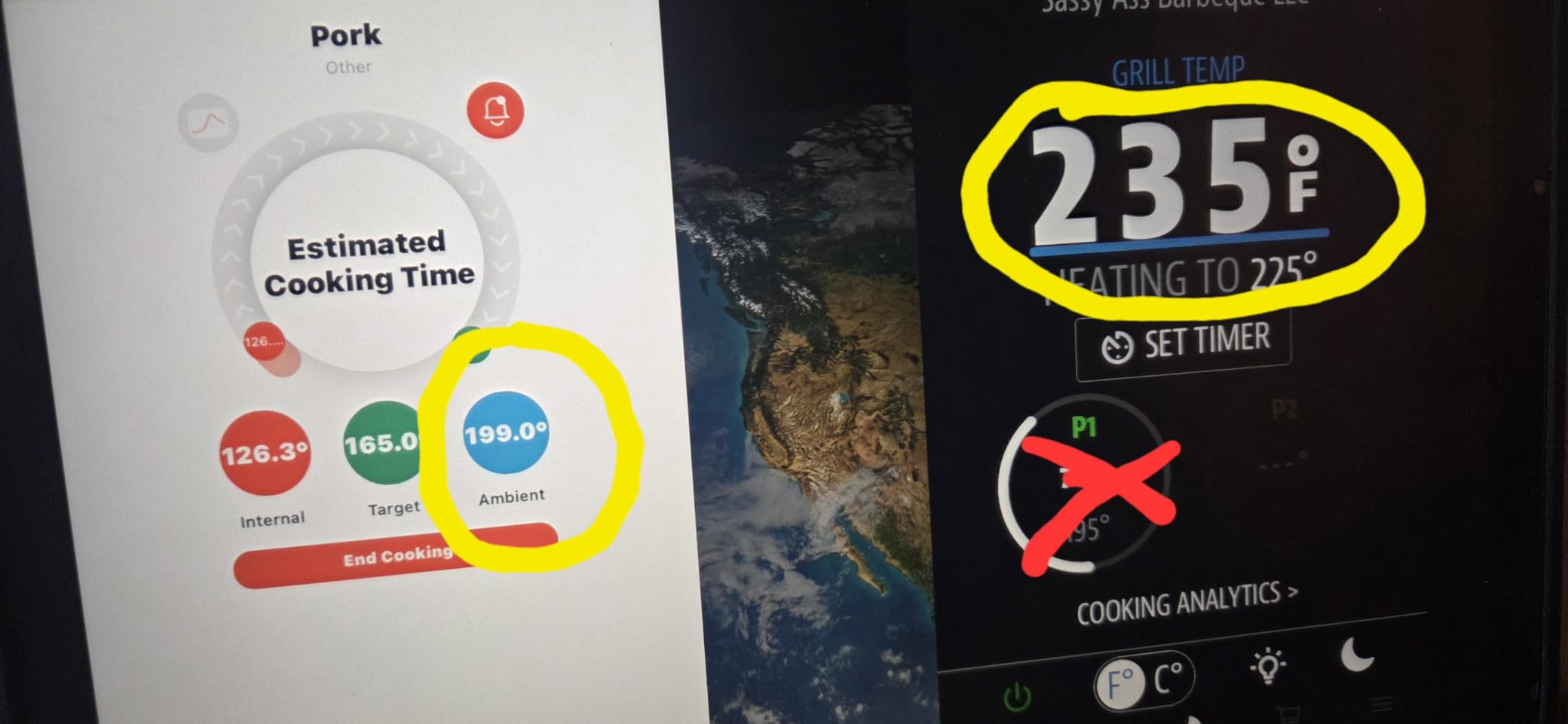
Ambient readings are not pit controller readings. The sensor is near your meat, not in the middle of the chamber, so it can run cooler than a thermometer on the lid, and on a fast high-heat cook it can lag badly. Use it to spot that the fire is dying, not to drive a fan. Multi-sensor internal arrays are the feature that most directly improves a thick cut, because a single averaged reading can hide a cold centre.
Probe count and channel limits
Two probes is the practical minimum for a smoker: one in the meat and one reading the chamber. Four is better if you cook a spread, which is why the INKBIRD is a strong pick for ribs plus a butt plus a brisket at once.
Check the expansion path before buying. Some bases accept extra probes, some are locked to a single probe, and some sell spares separately while others do not. A system you cannot grow into is a system you replace.
Handle heat tolerance and minimum insertion depth
Two numbers get skipped on product pages and both matter in a smoker. Handle heat tolerance tells you whether the exposed end of the probe survives your chamber, and matters most on firebox-side shelves and kamado grills. Minimum insertion depth tells you whether the probe can sit deep enough in a whole packer brisket to reach the centre without hitting bone.
A probe that is too short will read the muscle, not the money. A probe with a low heat rating can distort readings long before it visibly fails. Check both against the largest cut you actually cook.
Working without your phone
Ask one question before buying: if my phone dies at hour nine, what still reports? A base with its own display answers it. A receiver with an audible alarm answers it better. An app-only system does not, and on a 16-hour smoke that is a real risk rather than a theoretical one.
Audio alerts on a base, push notifications on a phone, and a low battery warning are the three small features that separate a good overnight system from a frustrating one. Our smart wireless thermometer picks cover the app and hub side of this in more detail.
Frequently Asked Questions
What is the best wireless temperature probe for smoking meat?
For most pitmasters the best wireless temperature probe for smoking is the MEATER Plus, because it reports internal and ambient temperature from one stick, includes a repeater in its charger for better range, and runs a guided cook with finish time estimates. Cooks who want zero app dependency should look at a radio frequency system with a handheld receiver instead.
What is the most accurate thermometer for smoking meat?
Accuracy differences between good wireless probes are small, so the more useful comparison is sensor count and certification. The ThermoMaven units and the Typhur Sync Gold carry NIST-certified plus or minus 0.5F accuracy with six sensors, five of them inside the meat, which is what reveals a cold centre in a thick cut.
Can you use a wireless meat thermometer in a smoker?
Yes, and a smoker is where wireless probes make the most sense. The one difficulty is that a steel or ceramic cooker wall blocks 2.4GHz signals, so a Bluetooth stick may report only with the lid open. Sub-1GHz systems such as the ThermoMaven and Typhur units hold through the wall, and WiFi systems reach your phone once the base is inside.
What is the best Bluetooth meat thermometer for a smoker?
Among Bluetooth options, the TempPro TempSync 650 ft is the strongest for smoking because its probes are tethered to the base, so only the short base-to-phone hop uses Bluetooth and it stays stable. The INKBIRD IBT-4XS is the better multi-probe pick, tracking three cuts plus pit temperature from a magnetic base.
Is the MEATER thermometer worth it?
The MEATER Plus is worth it if you want one simple probe and a polished app with guided cooks and finish time estimates, since the charger doubles as a range extender. Its known weakness is connection stability on very long cooks, so keep the charger reasonably close to the pit and check charge before a 16-hour smoke.
Why does my wireless probe lose signal in the smoker?
Signal loss has three usual causes. A Bluetooth probe is being blocked by the metal cooker wall, so move the receiver closer or switch to a sub-1GHz system. A dying battery also cuts the link, which is why a low battery alert matters on long smokes. And a base left on a cold charge can drop, so top up before you light the pit.
Our Final Picks for Smoking in 2026
After weighing all twelve, the MEATER Plus stays our pick for the best wireless meat thermometers for smoking because it solves the whole problem in one object: dual sensors, a charger that doubles as a range extender, and an app that guides a cook from start to finish. It is the unit we would hand to someone buying their first wireless probe.
Buy the TempPro TempSync 500FT if you would rather not touch an app at all, and the INKBIRD IBT-4XS if you are cooking multiple cuts at once. For a kamado or a pit far from the house, move up to a sub-1GHz or WiFi system such as the ThermoMaven line or the Typhur Sync Gold.
Whatever you choose, keep an instant-read thermometer in the drawer as a cross-check at the start of the cook, and open the lid as little as possible. Then let the probe do the watching. More detail on the wider market is in our smart WiFi thermometer roundup.