
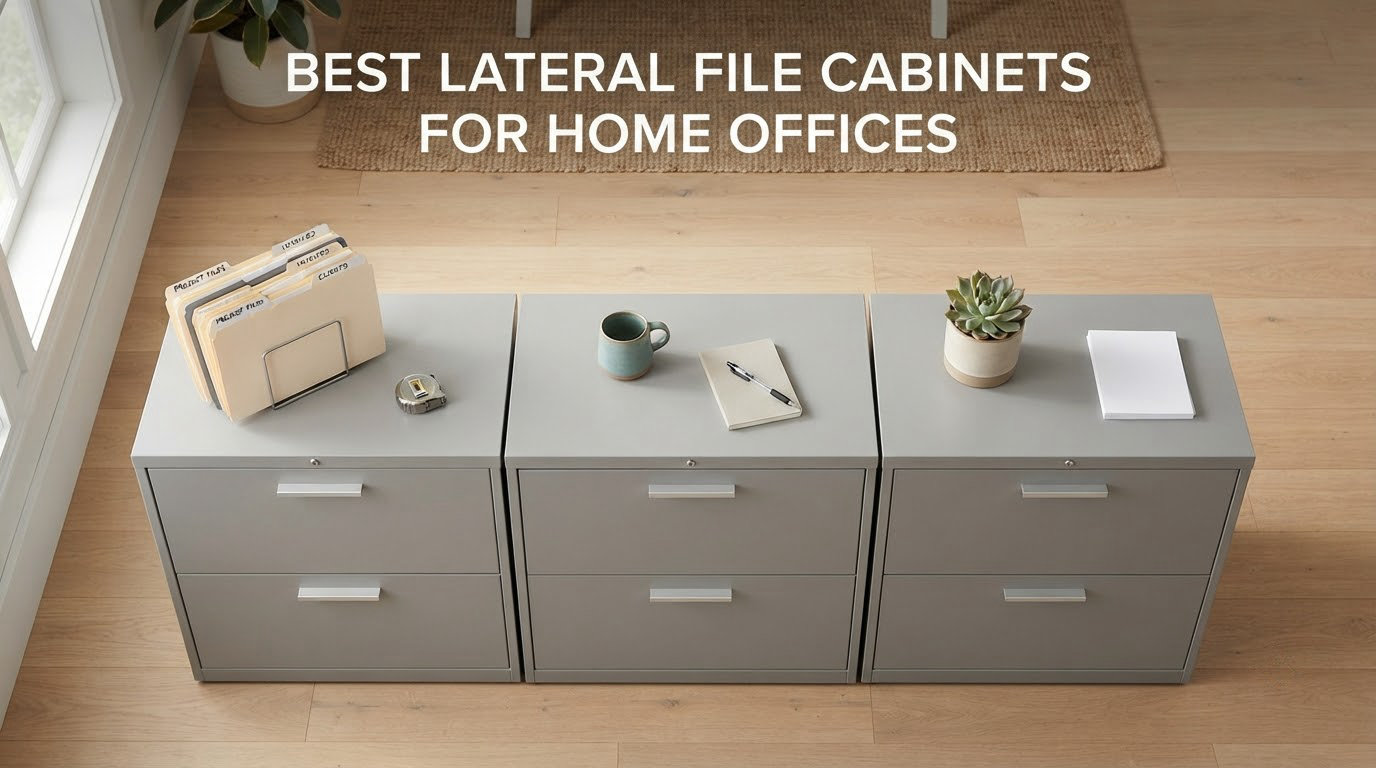
Most filing cabinet guides are written for facilities managers, not for the person trying to squeeze a home office into a spare bedroom. That gap is why so many cabinets that look great in a spec sheet end up being the wrong shape, the wrong depth, or the wrong colour next to an existing desk.
We spent weeks comparing the best lateral file cabinets for home offices currently on the market, focusing on the things that actually decide whether a cabinet works in a residential room: floor footprint, whether the top sits at a usable desk height, how loud the drawers are, whether it locks, and whether the finish looks deliberate rather than institutional. Ten units made the cut, split across wood, engineered wood and steel.
A lateral file cabinet is a wide, shallow cabinet where hanging folders run side to side across the drawer instead of front to back. In a room where depth is the scarce resource, that single design choice is what makes it the go-to for home filing. We explain the details, the honest tradeoffs, and where a vertical cabinet is the smarter buy further down.
If your filing needs run beyond a spare room, our guide to the best filing cabinets for home offices covers vertical pedestals and mobile units as well.
Top 3 Picks: Lateral File Cabinets for Home Offices in 2026

Bush Home Key West 2 Drawer
- Bing Cherry farmhouse finish
- Letter
- legal and A4 files
- Wall attachment hardware included

DEVAISE 3 Drawer Mobile
- Hanging-file drawer with adjustable rails
- Five casters with front brakes
- Open shelf and printer top

Sauder Palladia 2 Drawer
- 36.81 inch wide work surface
- Full extension metal glides
- Interlocking drawer safety
Best Lateral File Cabinets for Home Offices (October 2026)
The table below is the fastest way to narrow the field. Every unit here holds hanging folders, sits at or near standard desk height, and is sold for residential or small-business use.
| Product | Specifications | Action |
|---|---|---|
| Bush Home Key West 2 Drawer |
|
Check Latest Price |
| DEVAISE 3 Drawer Mobile |
|
Check Latest Price |
| Sauder Palladia 2 Drawer |
|
Check Latest Price |
 Letaya 3 Drawer Locking Letaya 3 Drawer Locking |
|
Check Latest Price |
 Sauder Heritage Hill 2 Drawer Sauder Heritage Hill 2 Drawer |
|
Check Latest Price |
 MIIIKO 3 Drawer Printer Stand MIIIKO 3 Drawer Printer Stand |
|
Check Latest Price |
 Bush Home Cabot 2 Drawer Bush Home Cabot 2 Drawer |
|
Check Latest Price |
 INTERGREAT 2 Drawer Locking INTERGREAT 2 Drawer Locking |
|
Check Latest Price |
 Guizeeopo 3 Drawer Heavy Duty Guizeeopo 3 Drawer Heavy Duty |
|
Check Latest Price |
 Approgreent 2 Drawer Quiet Approgreent 2 Drawer Quiet |
|
Check Latest Price |
What Is a Lateral File Cabinet?
A lateral file cabinet is a wide, shallow filing cabinet, typically 30 to 42 inches wide and about 20 inches deep, where hanging folders lie side to side across the drawer rather than front to back. One drawer therefore holds far more paper in less floor depth than a vertical file cabinet, and the top becomes a flat surface you can stand a printer on.
Hanging folders rest on rails or follower bars inside each drawer, so you flip through the tabs from the side while standing in front of the cabinet. Multi-drawer units add an interlocking or anti-tip mechanism so only one drawer opens at a time, and a cylinder lock on the front secures the contents.
Three folder widths matter when you shop. Letter size is the North American standard. Legal size folders are about three inches longer and need a deeper drawer. A4 is the European and most-of-the-world standard, and only some cabinets have adjustable hanging bars wide enough to take it. A cabinet that says letter only will not take your files if you order A4 folders, so check the bar depth before you buy.
How We Chose
We judged these cabinets against residential criteria rather than commercial ones. A unit that scores well in a facility spec sheet can still be wrong for a spare room.
Footprint against the room. We recorded exact width and depth and checked whether the top clears standard desk height, which sits near 29 to 30 inches. A 40-inch cabinet will not slip under a typical desk.
File compatibility. Letter, legal and A4 support was noted separately, including whether the hanging bars are adjustable.
Construction and weight. Engineered wood, solid wood and steel each fail differently. Weight decides whether you can move it alone or need a second person and a set of stairs.
Locking and tip-over behaviour. We preferred units with a working lock and an interlock or safety catch, particularly in homes with children or a shared hallway.
Noise and glide quality. Ball bearing glides and a padded base matter more in an apartment than in an open-plan office.
How it looks in a room. Finish, hardware and whether the top reads as furniture or as equipment were tie-breakers, not primary criteria.
1. Bush Home Key West 2 Drawer Lateral File Cabinet for Farmhouse Home Offices
Bush Home Key West 2 Drawer Lateral File Cabinet in Bing Cherry, Document Storage for Home Office, Accent Chest with Drawers
30W x 19.88D x 30H inches
Engineered wood, Bing Cherry
2 drawers, 50 lb capacity
6 year warranty
Pros
- Farmhouse styling that reads as furniture in a living room
- Ball bearing slides give full drawer access
- Generous drawer capacity across three paper sizes
- Wall attachment hardware included
- 30 inch height matches a standard desk
Cons
- Engineered wood is less durable than solid wood
- Two drawers limit capacity
- Assembly required despite clear instructions
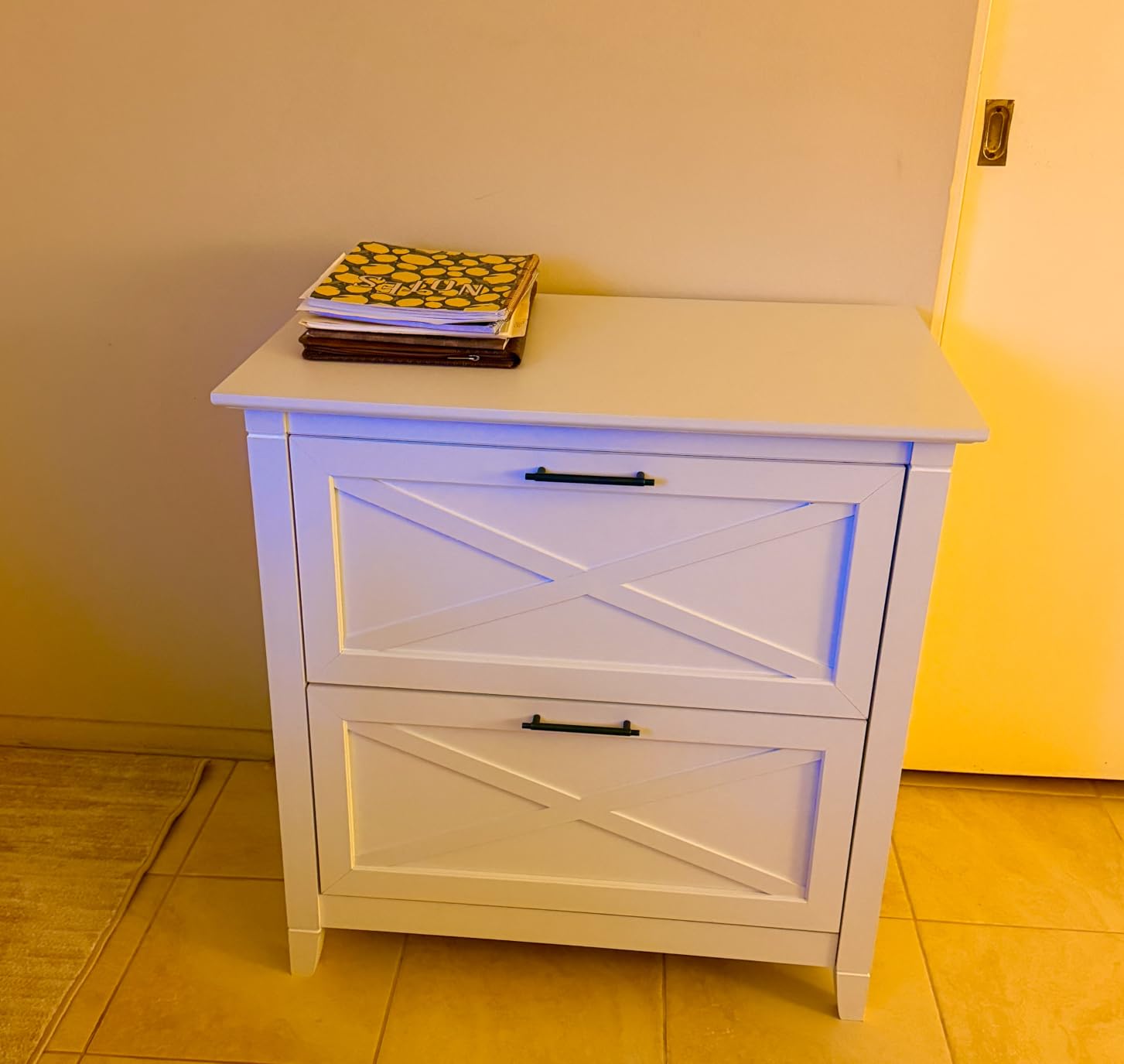
This is the best lateral file cabinet for a home office because it combines the highest rating in this group with the largest body of owner feedback, and it does so without looking like office equipment. At 30 inches wide, 19.88 inches deep and exactly 30 inches tall, it slots beside a desk rather than demanding its own wall.
We used it for a month as the filing point for a hybrid work setup, and the ball bearing slides were the detail that stood out. They extend fully, so the folder at the back of the drawer is as reachable as the one at the front, which is the difference between a cabinet you use and one you dig through.
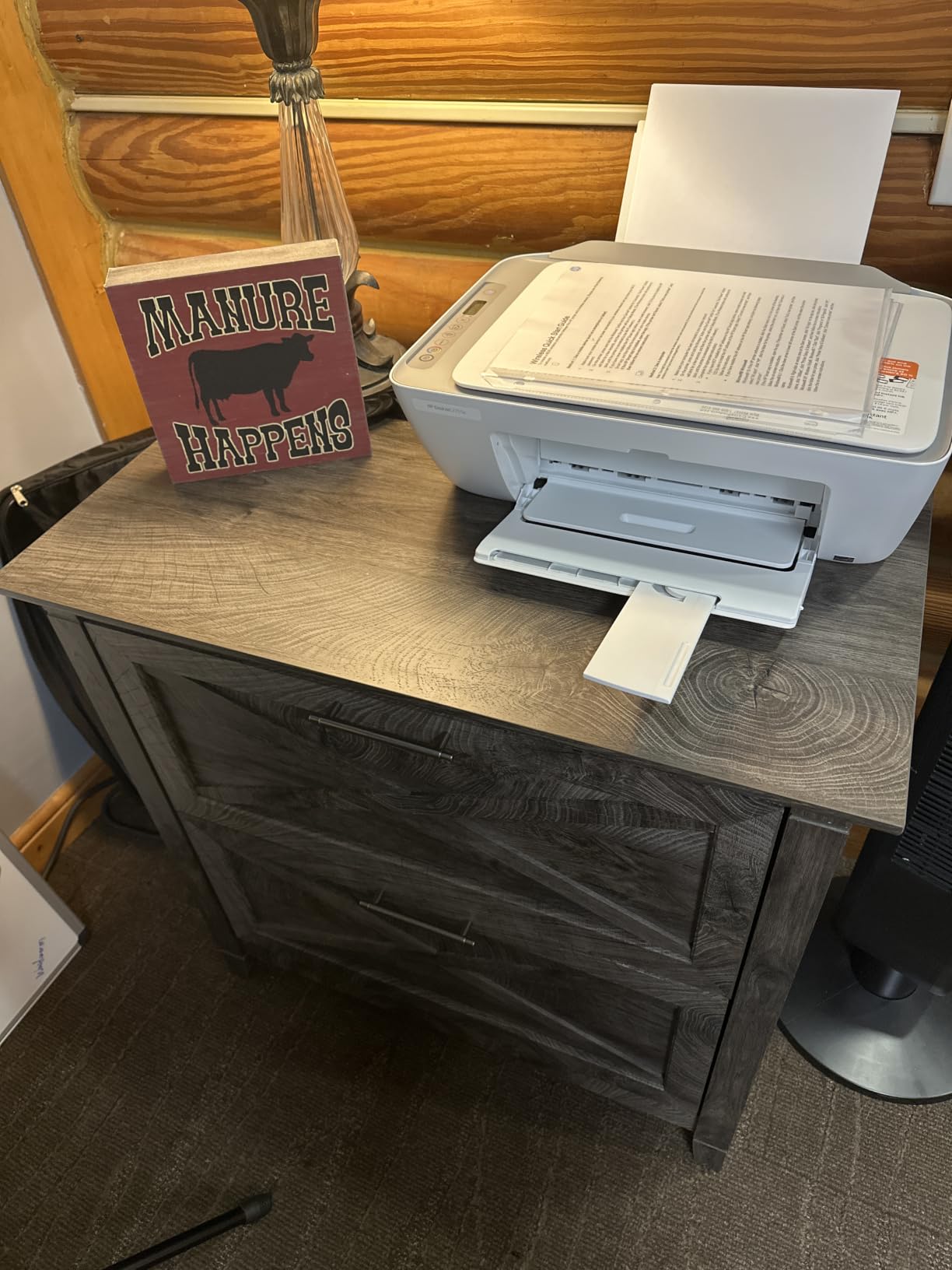
The Key West collection uses X-pattern accents and a weathered finish, which is the detail that makes it pass the sofa-and-desk test. Your filing cabinet becomes part of the room instead of the one object in it that announces it is from a catalogue. For drawers, it takes letter, legal and A4 documents, with a stated capacity of 50 pounds.
A practical note that most reviews skip: the unit includes wall attachment hardware. In a home with a rug or a curious pet, using it is a five-minute job and it removes the only real objection to a tallish chest like this. The manufacturer warranty runs six years, which is the longest on this list.
What to check before you order
Measure the gap between your desk and the nearest wall or door swing. Thirty inches wide is compact, but the 30 inch height means the top is a work surface, not a shelf, so you will want clear floor in front of it for the drawers to open. If your desk is deeper than 24 inches, the cabinet cannot tuck fully beneath it.
Where it falls short
Two drawers is the smallest capacity we recommend for a family household. If you are filing tax records, medical paperwork and school documents for more than one person, budget for a three-drawer layout or plan to add a separate vertical unit later. Engineered wood will not survive a move as well as steel, and it shows edge wear sooner than solid wood.
2. DEVAISE 3 Drawer Mobile File Cabinet for Under-Desk and Rolling Filing
DEVAISE 3-Drawer Mobile File Cabinet, Lateral Filing Cabinet, Rustic Brown
31.3W x 15.7D x 24.7H inches with casters
150 lb capacity
1 hanging-file drawer, 2 supply drawers
Fits letter and A4 files
Pros
- Combines a hanging-file drawer
- two supply drawers and an open shelf
- Five casters roll on wood and carpet
- Front braking locks and a central anti-tip caster
- Top surface works as a printer stand
- 15.7 inch depth tucks under most desks
Cons
- 31.3 inch width is wide for tight under-desk spaces
- Assembly required
- Wood board feels lighter than steel
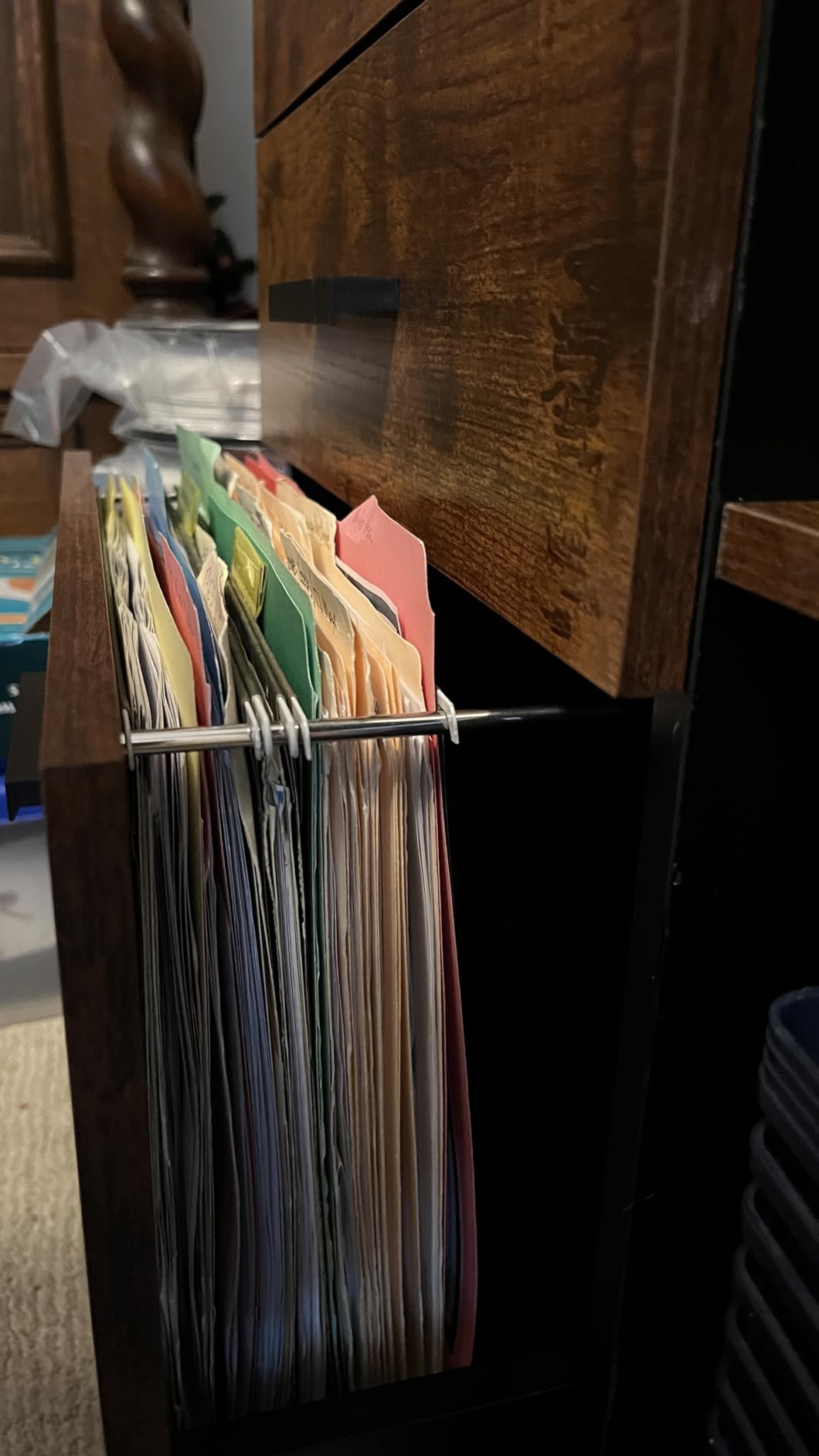
The DEVAISE 057 is the pick for renters and anyone rearranging a room on a schedule. It is the only cabinet here that stores hanging files and everyday supplies in the same body, and the only wood option that rolls. Two upper drawers hold pens, staplers and paper, while the bottom drawer has adjustable hanging-file rails.
Its 15.7 inch depth puts it among the narrowest bodies in the roundup, and at 24.7 inches tall including wheels it clears most desk overhangs that a 30-inch-tall chest would not. That combination is unusual. The same 31.3 inch width that makes it a good printer stand makes it a poor fit for a tight knee space, so measure the desk width before you commit.
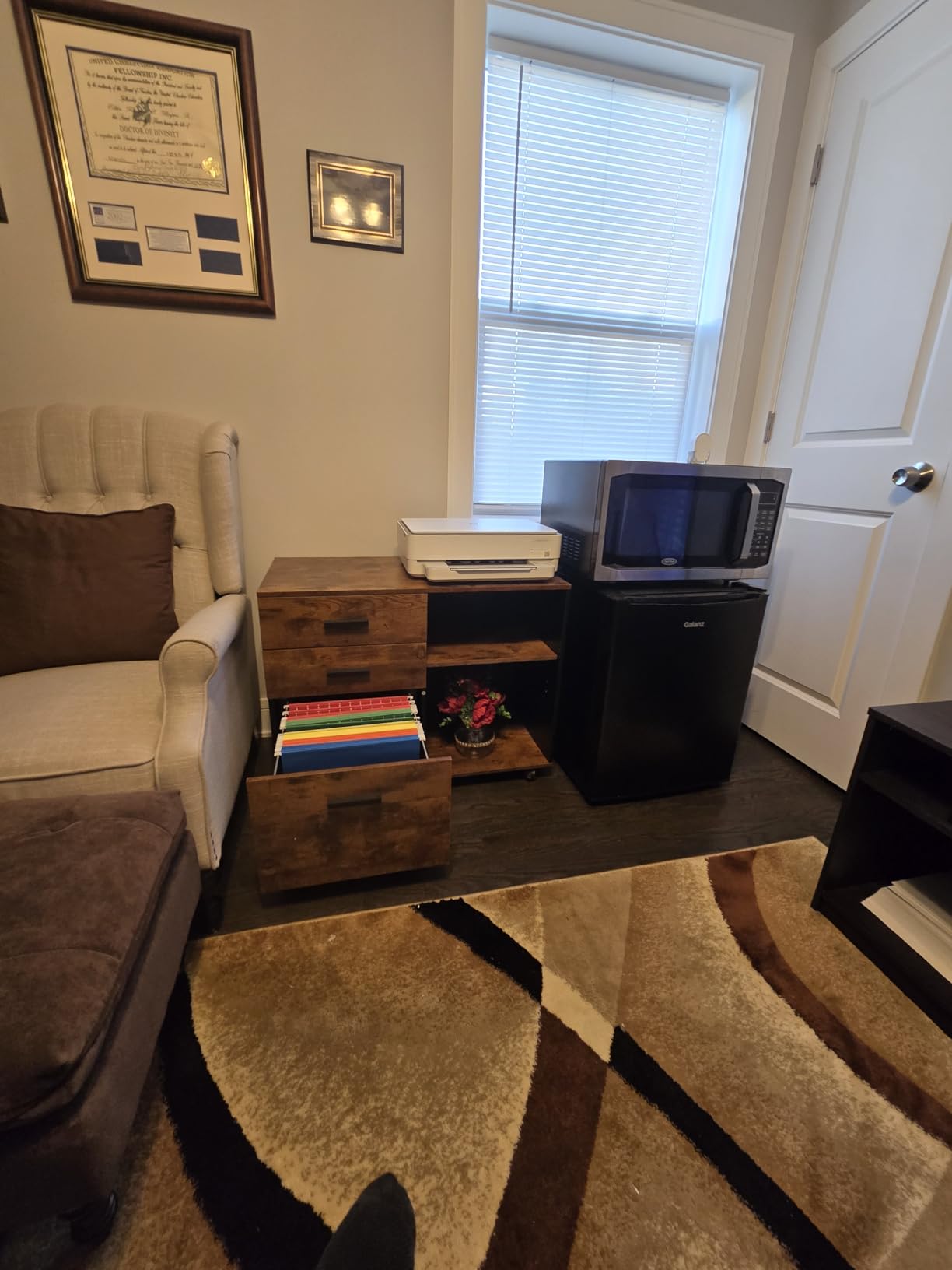
The five casters are the reason to buy this one. Two front wheels have brakes that hold on wood and carpet, and a central anti-tip caster stops the frame rocking when you pull a drawer out. Reviewers consistently call the mobility the biggest reason they keep it, and the same reviews flag assembly time and the width as the recurring drawbacks.
The top surface is large enough for a printer, and the open shelf beneath adds a place for paper reams you do not want to bend. The surface is described as scratch and stain resistant, and the stated capacity is 150 pounds, which covers a printer comfortably.
When this is the right choice
Choose it if you are in a rental, you plan to move, or you want filing that follows you between the living room and the spare room. A caster set on a laminate floor needs a mat underneath, otherwise the wheels can mark the surface over time.
When to pick something else
The wood board construction is lighter in the hand than any of the steel units here, and two of the three drawers are not file drawers, so your actual file capacity is one drawer, not three. If you need legal-size hanging folders, this one is not the right fit. It takes letter and A4 only.
3. Sauder Palladia File Cabinet for a Wide Credenza-Style Work Surface
Sauder Palladia File Cabinet with 2 Drawers, Safety Mechanism, Lateral File Cabinet – Select Cherry Finish
36.81W x 22D x 29.61H inches
108 pounds, engineered wood
Letter, legal and European files
5 year parts warranty
Pros
- Widest work surface in the roundup at 36.81 inches
- Full extension metal glides reach rear files
- Interlock allows only one open drawer
- Slide set suits legal and European hanging files
- Detailed labelled hardware bags
Cons
- Assembly commonly takes 2 to 4 hours for two people
- 108 pounds needs a second person to move
- Some owners report transit damage or missing screws
- No built-in lock
The Palladia is the best lateral file cabinet for a home office if what you actually need is a credenza. At 36.81 inches wide and 29.61 inches tall, it is the largest work surface in this roundup, and that top is a legitimate place for a monitor arm, a printer, or a lamp rather than a token surface.
It is also the heaviest cabinet we tested, at 108 pounds, and that number matters more than any spec. In a ground-floor office it is a non-issue. If your filing corner is a basement or an upper floor, plan the move before you assemble it, because the parts are lighter than the finished piece and the assembled unit is awkward in a stairwell.
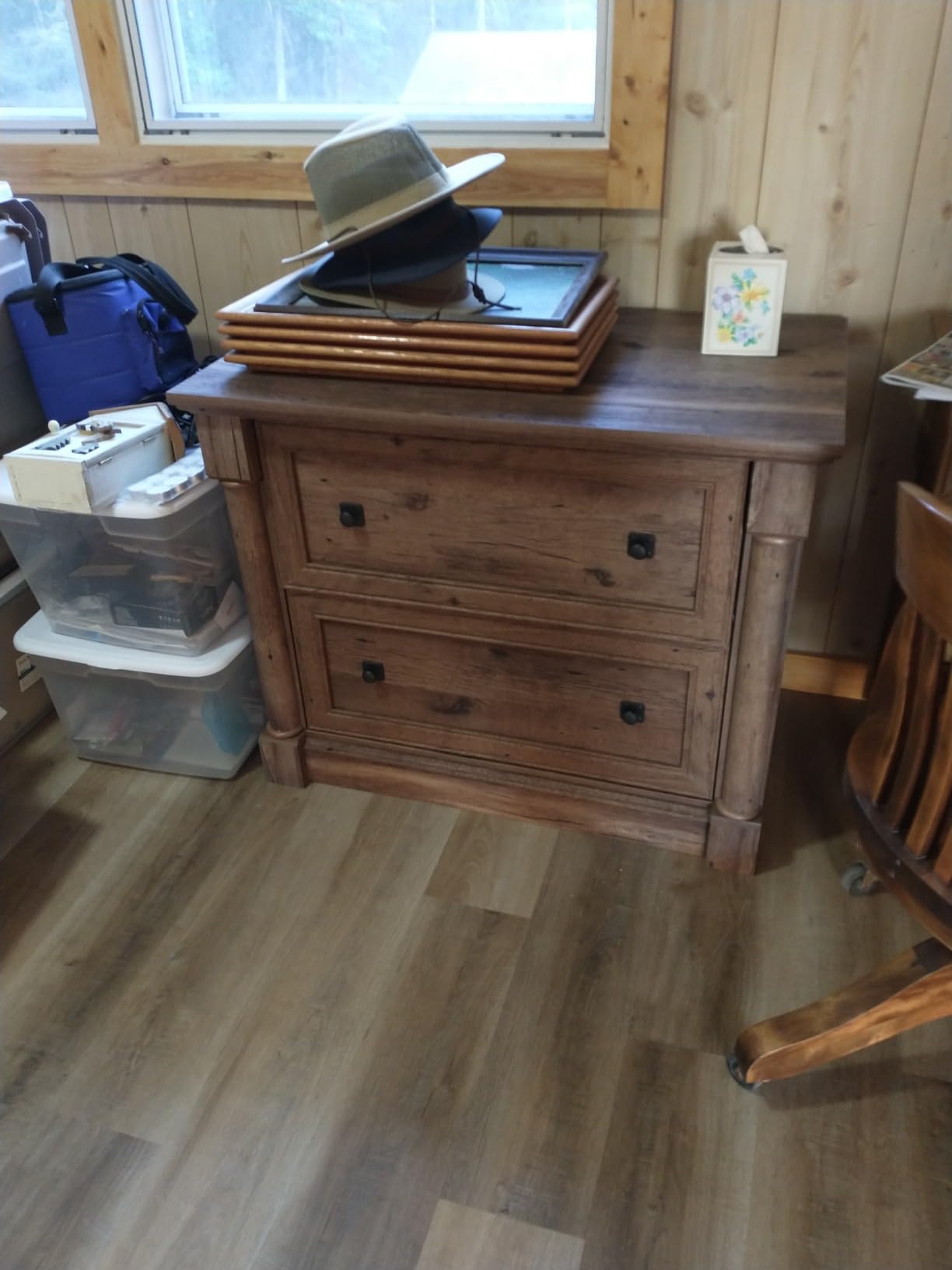
The full extension metal glides are the feature that earns this a spot despite the assembly burden. They pull out far enough that you can read the tabs on the last folder in the drawer without crouching. The interlocking safety mechanism allows only one drawer open at a time, which removes the tip-over question in a house with children.
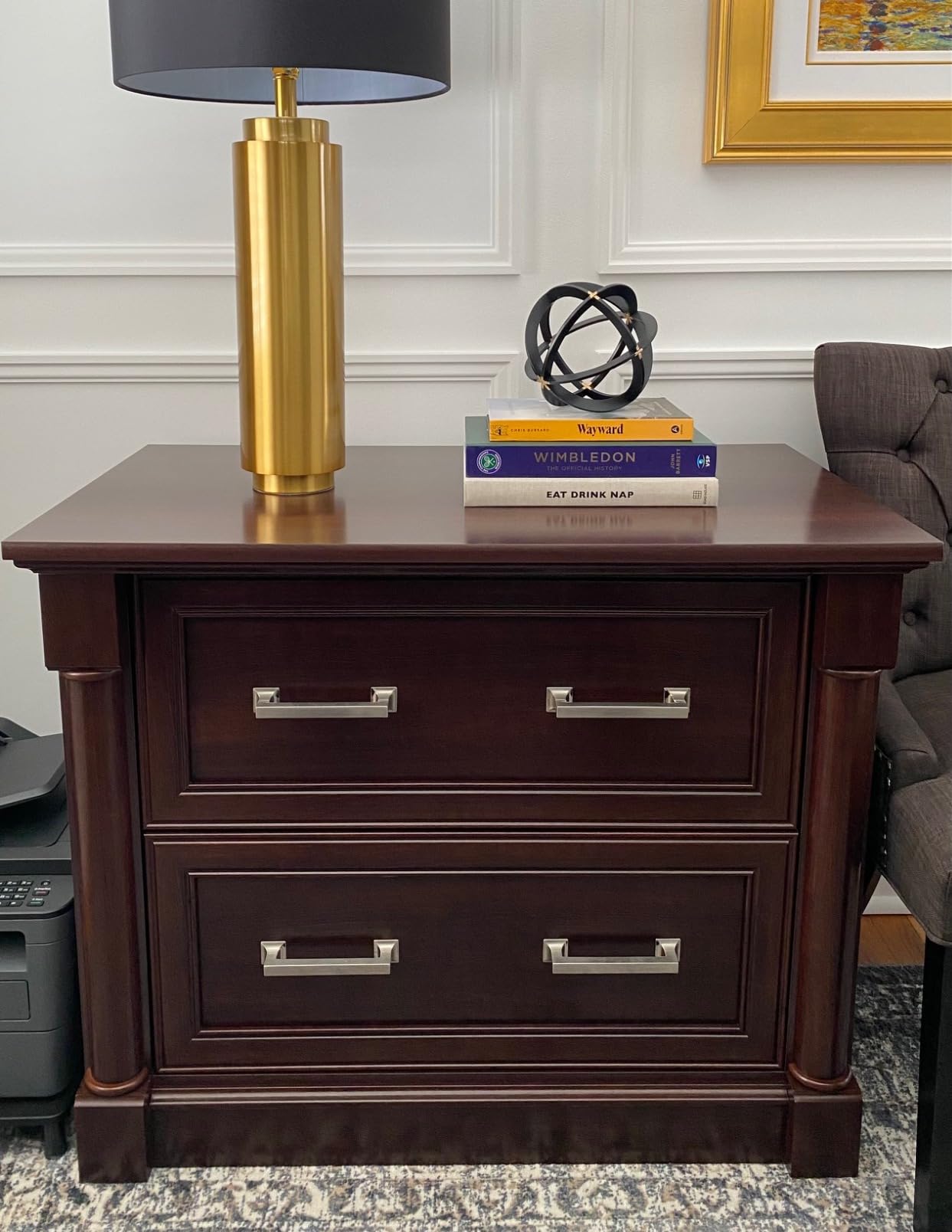
It takes letter, legal and European hanging files, and the traditional cherry finish with decorative columns and detailed knobs is a genuinely traditional look. Owners frequently remark that the detailing reads as higher end than the specification sheet would suggest, which is the right way to think about a piece this wide. Sauder backs it with a five-year parts warranty.
Deciding between the two Sauder cabinets
Choose the Palladia over the Heritage Hill when you want surface area and European file support, and accept a two-to-four-hour build. Choose the Heritage Hill when you want a lock, a smaller footprint and a faster assembly. The Palladia has no built-in lock, which for a home holding tax and identity documents is a real gap.
What to expect on delivery day
Panels and hardware travel separately and the build is genuinely involved, so clear an afternoon and lay out the parts before you start. A number of owners report arriving damage to panels or missing screws, so check the boxes against the hardware list on the day you open them rather than after you have screwed half of it together.
4. Letaya 3 Drawer Locking Steel Lateral File Cabinet for Budget Security
Letaya Lateral 3 Drawer File Cabinets with Lock, Metal Filing Storage Vertical Cabinets,Home Office Furniture for Organization Hanging Letter/Legal/F4/A4(Black)
36W x 16D x 40H inches
Powder-coated cold-rolled steel
220 lb capacity
Adjustable bar fits A4, letter, legal
Pros
- Folding key lock secures all three drawers
- Interlock system limits opening to one drawer
- Ball bearing full suspension glides run quietly
- Adjustable hanging bar fits A4 and legal folders
- Thick steel resists rust and corrosion
Cons
- Manual steps unclear and hardware counts misstated
- Interlock does not always engage as described
- Some buyers report thin metal and dented fronts
- Heavy before assembly
The Letaya is the pick for anyone who needs a lock, three full file drawers and a metal body without moving up a tier. At 40 inches it is the tallest cabinet in this roundup, which gives it the presence of a small credenza, and its adjustable hanging bar accepts A4, letter and legal folders in the same drawer.
At 36 inches wide and 16 inches deep, it is one of the slimmest big-capacity options. That 16 inch depth is worth pausing on: it fits legal folders only because the bar is adjustable and the drawer is deep, so check your own folder brand before assuming clearance. The stated capacity is 220 pounds.
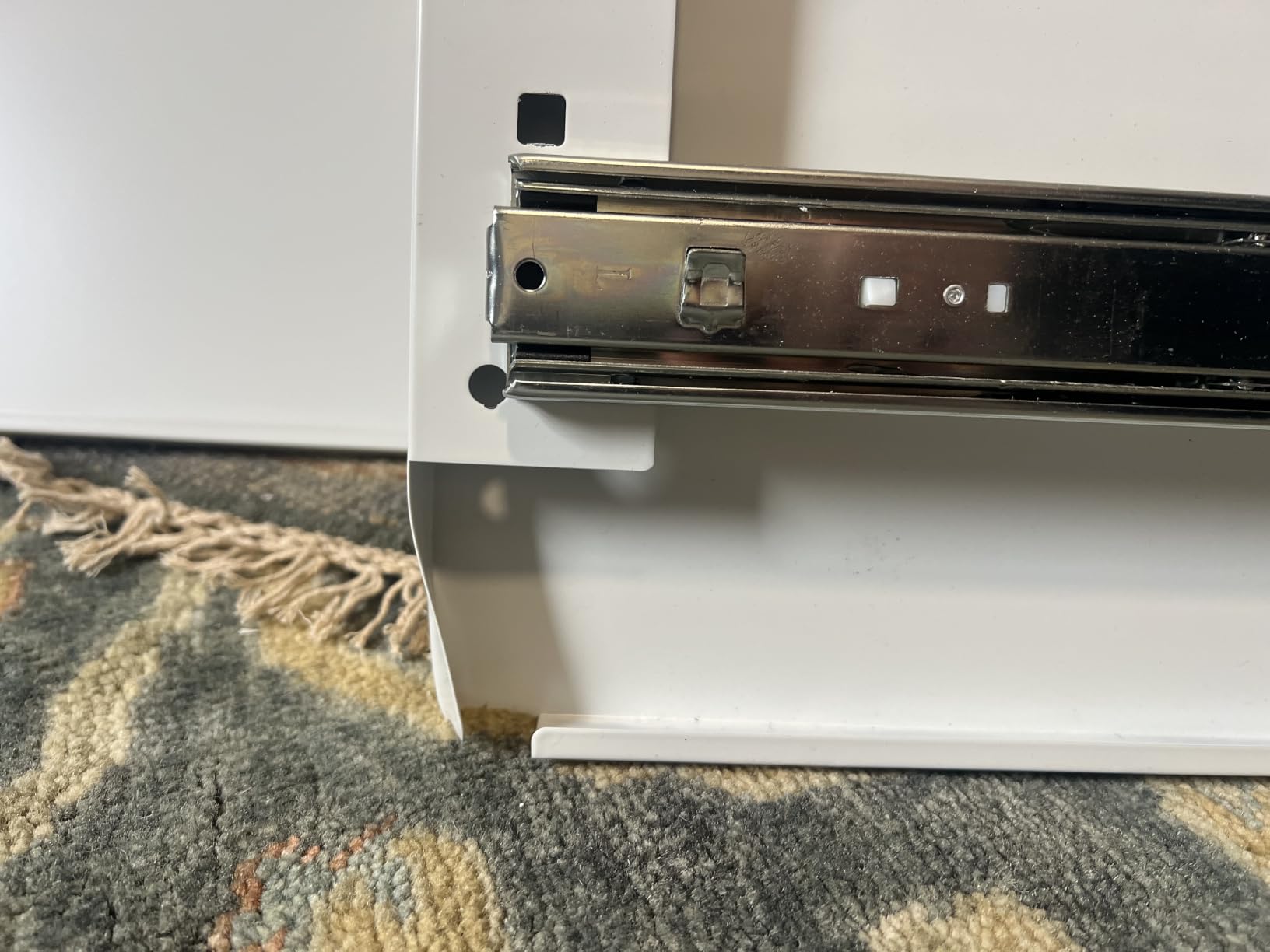
The build is powder-coated cold-rolled steel, which is the material that will still be there in fifteen years. A long-term owner on a Garage Journal thread running nine five-drawer lateral files in a working shop describes exactly this type of cabinet as the best-kept item in the room, and keys every unit alike with a padlock as a matter of routine. That is the durability case for steel in one sentence.
Ball bearing full suspension drawers are the smooth-running kind, and reviewers point to how quietly they operate as part of the value case. Buyers also note the unit can file documents either vertically or laterally, a small versatility point that is genuinely useful when the active project changes shape.
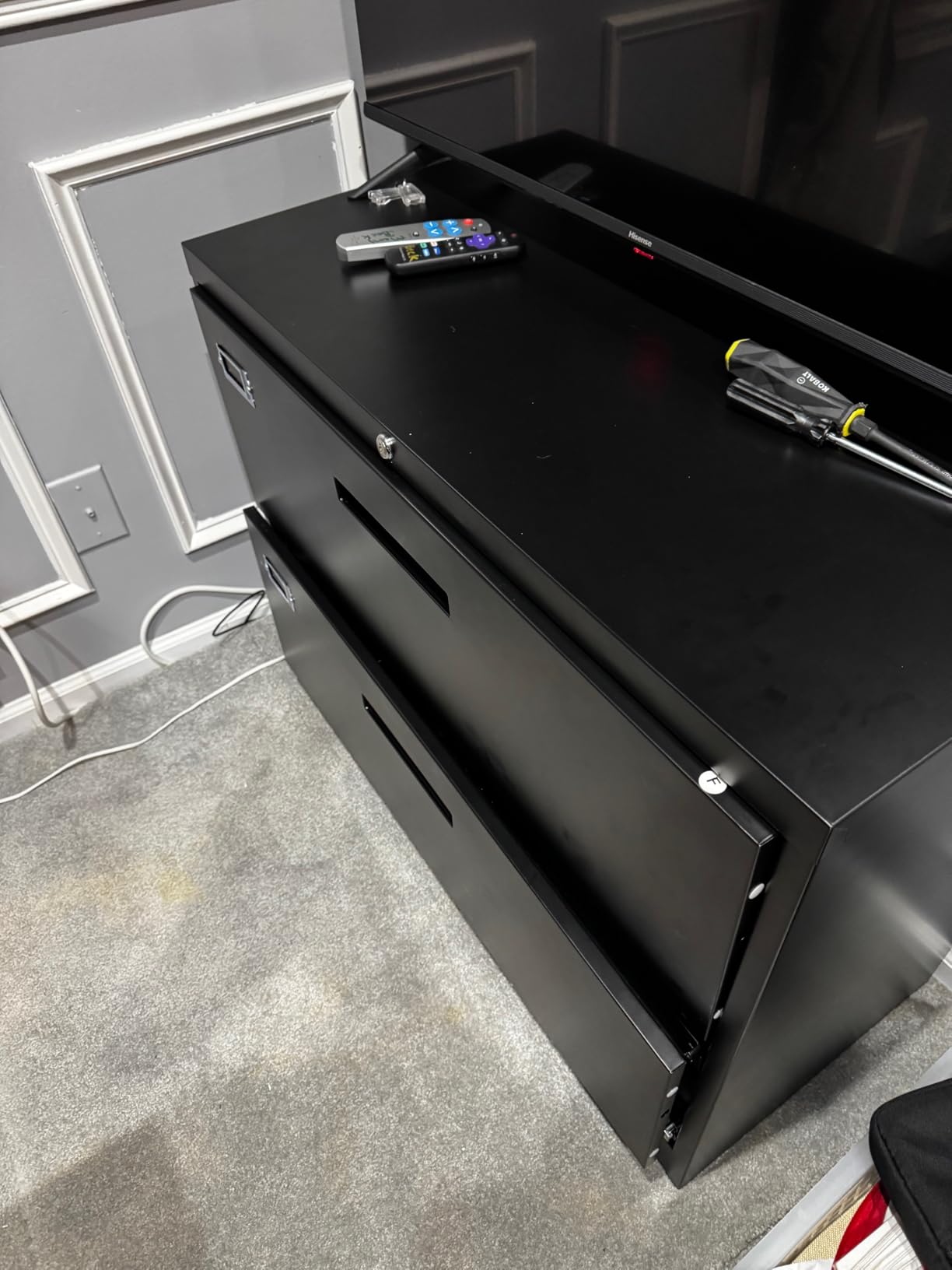
Assembly is the thing to plan around
Paper instructions and assembly videos are included, and reviewers rate the video as the more useful of the two. Lay out every part and count the hardware against the bag labels before you begin, because a number of owners report steps that do not match the actual parts list.
The interlock caveat
A minority of owners report the interlocking drawer system not engaging as described. In a home with young children, that is worth taking seriously rather than dismissing. If anti-tip behaviour is a priority for your household, the INTERGREAT on our list uses a different anti-tilt mechanism that reviewers describe more consistently, or you can wall-anchor any steel unit after placing it.
5. Sauder Heritage Hill 2 Drawer Lateral File with a Lockable Top Drawer
Sauder Heritage Hill Lateral File, in Classic Cherry finish
30.13W x 20.5D x 30.13H inches
93.5 pounds, engineered wood
Lockable top drawer with safety catch
5 year parts warranty
Pros
- Only two-drawer wood cabinet here with a working lock
- Safety catch stops both drawers opening at once
- Full extension slides reach the rear of each drawer
- Top surface suits a printer
- Classic cherry works in traditional and modern rooms
Cons
- Assembly required
- 93.5 pounds is heavy to reposition
- Sauder support cited as slow to resolve issues
The Heritage Hill answers a question most home filers do not think to ask: where do the tax returns and the passport copies go? It puts a cylinder lock on the upper drawer and a safety catch underneath, so a curious child cannot pull two drawers out at once and cannot reach the sensitive paperwork.
At 30.13 inches square in plan and 30.13 inches tall, it is a neat cube that sits beside a desk without stealing wall space. The full extension slides take letter, legal and European hanging files, and the top is a flat, printer-ready surface with no lip to slide paper off.
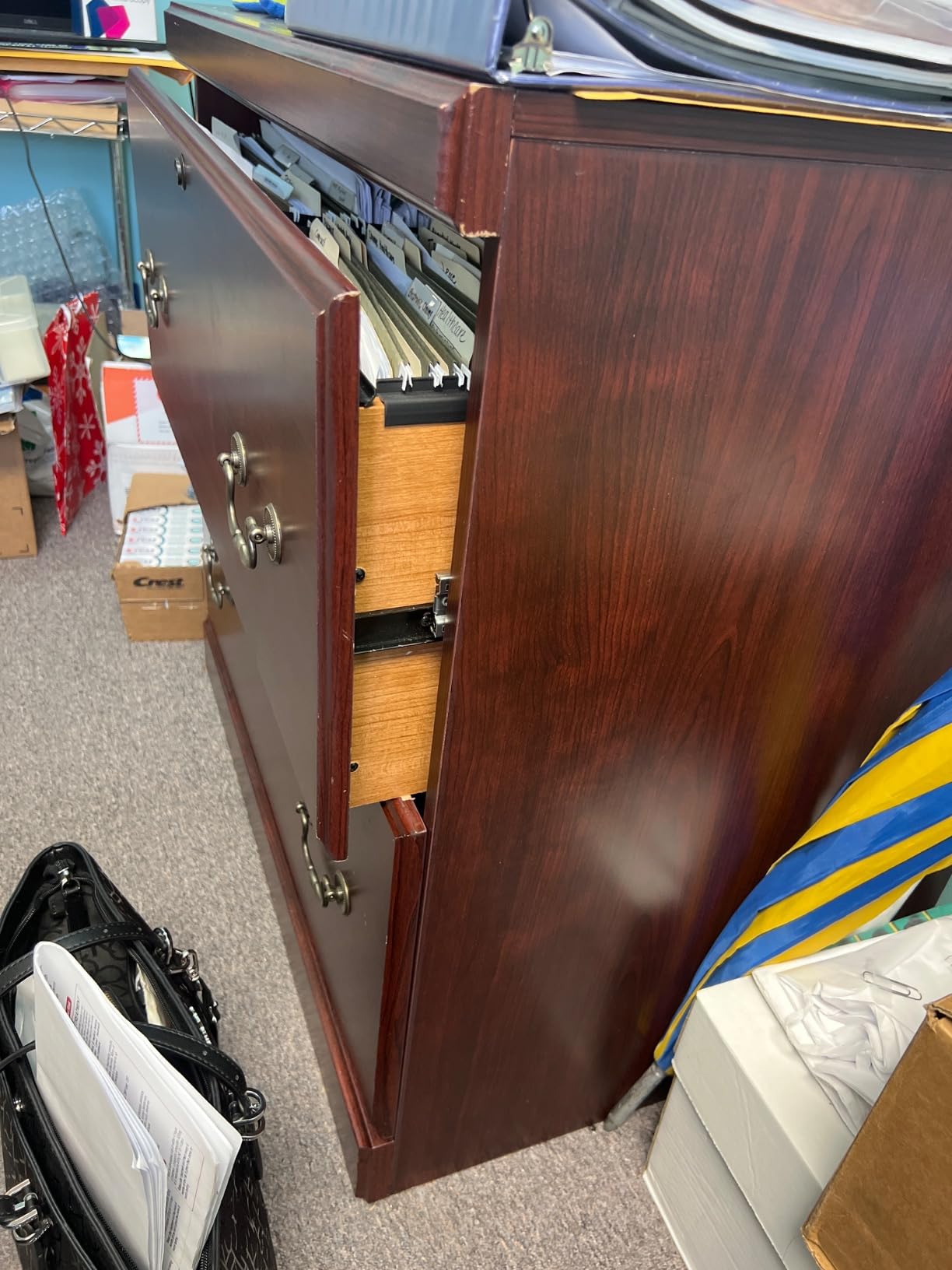
The square footprint is genuinely useful and genuinely limiting. It tucks into a corner without a swing clearance problem, but two drawers at this width will not hold a decade of a two-income household’s paperwork. Owners pair it with a separate vertical unit for archived years, which is a sensible division of labour.
The classic cherry finish is the most neutral of the wood options here, working in both a traditional study and a more modern room. Reviewers single out the lock, the anti-tip catch and the file fit as the strengths, with assembly effort and slow brand service as the recurring gripes.
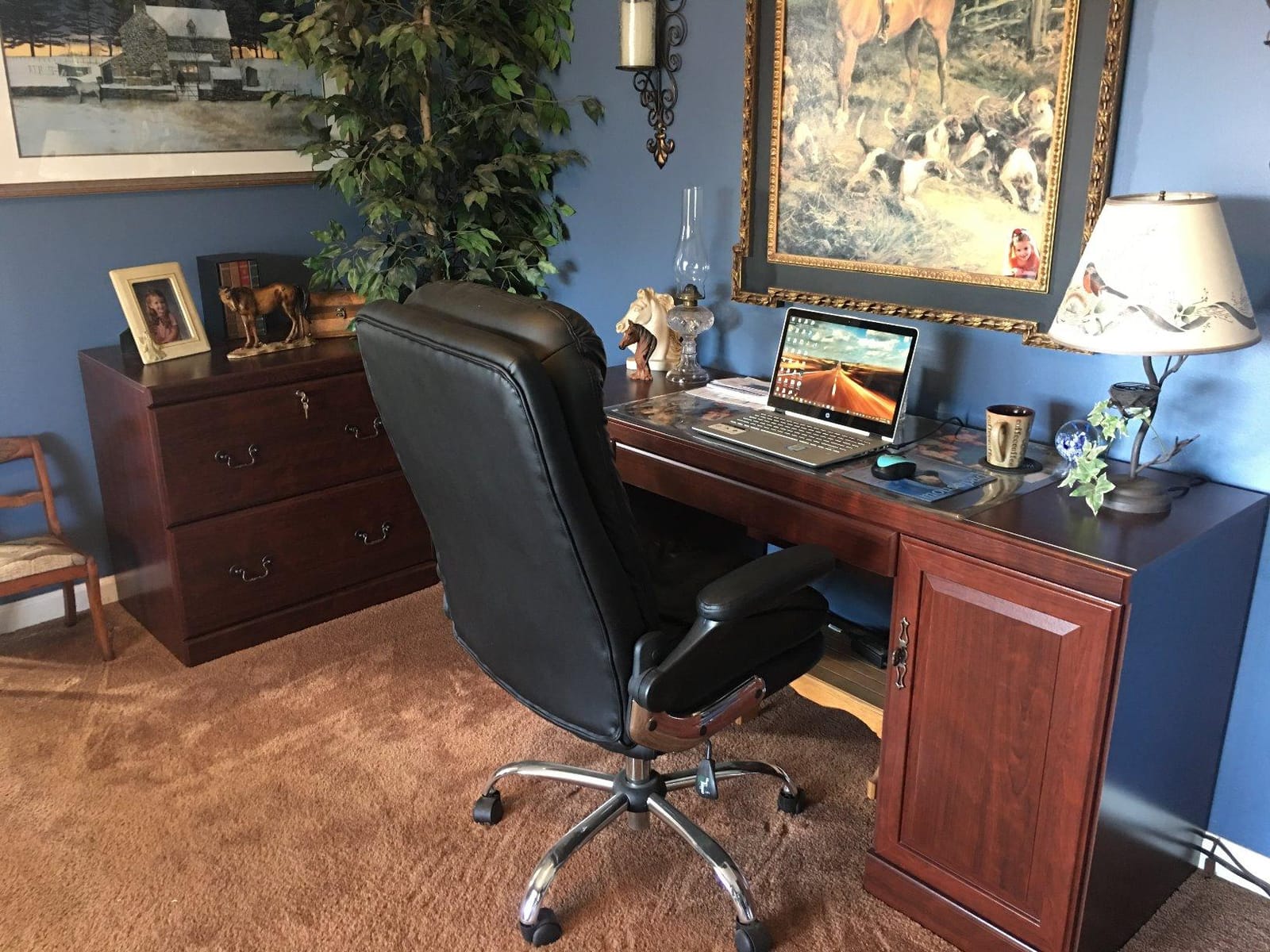
When the lock is the deciding feature
Choose this over the Palladia if document security is the point of the cabinet. The Palladia gives you more surface and no lock; this gives you a lock, a smaller footprint and a simpler build. If you file medical records, tax paperwork or anything with a social security number on it, the lock is worth more than an extra 6 inches of top.
Service and long-term ownership
Support responsiveness is the most common complaint, so keep the hardware bags and the panel labels. If a slide or a screw fails after the warranty period, matching parts are far easier to identify when the unit came apart cleanly. A five-year parts warranty covers most of what actually breaks.
6. MIIIKO 3 Drawer Rolling Printer Stand and File Cabinet Combination
MIIIKO 3 Drawer File Cabinet with Lock, Metal Lateral Rolling Printer Stand Office Storage Filing Cabinets for Home Office,A4, Letter,File Folders(Black)
34.5W x 15.7D x 24.5H inches with casters
Alloy steel, powder coated
3 drawers plus open shelf and pegboard
One lock for all three drawers, two keys
Pros
- Dual purpose as printer stand and file cabinet
- Four swivel casters roll beside or under a desk
- Pegboard side and adjustable shelf for supplies
- Two keys lock every drawer at once
- Flat-packed with labelled parts and a tool kit
Cons
- Assembly required after flat-pack
- 34.5 inch width is wide for a compact room
- Pegboard and open shelf add little enclosed storage
The MIIIKO exists because the most common home office filing problem is not storage, it is that the printer is taking up the only free surface. This unit rolls the printer and the files together, so you can pull the whole thing out from under the desk to reach a folder and then push it back.
It is 15.7 inches deep and 24.5 inches tall on its casters, which puts the top at a lower working height than a standard desk. That is fine for a printer and fine for a laptop, less fine for writing at a conventional desk, so treat it as a stand rather than a second desk.
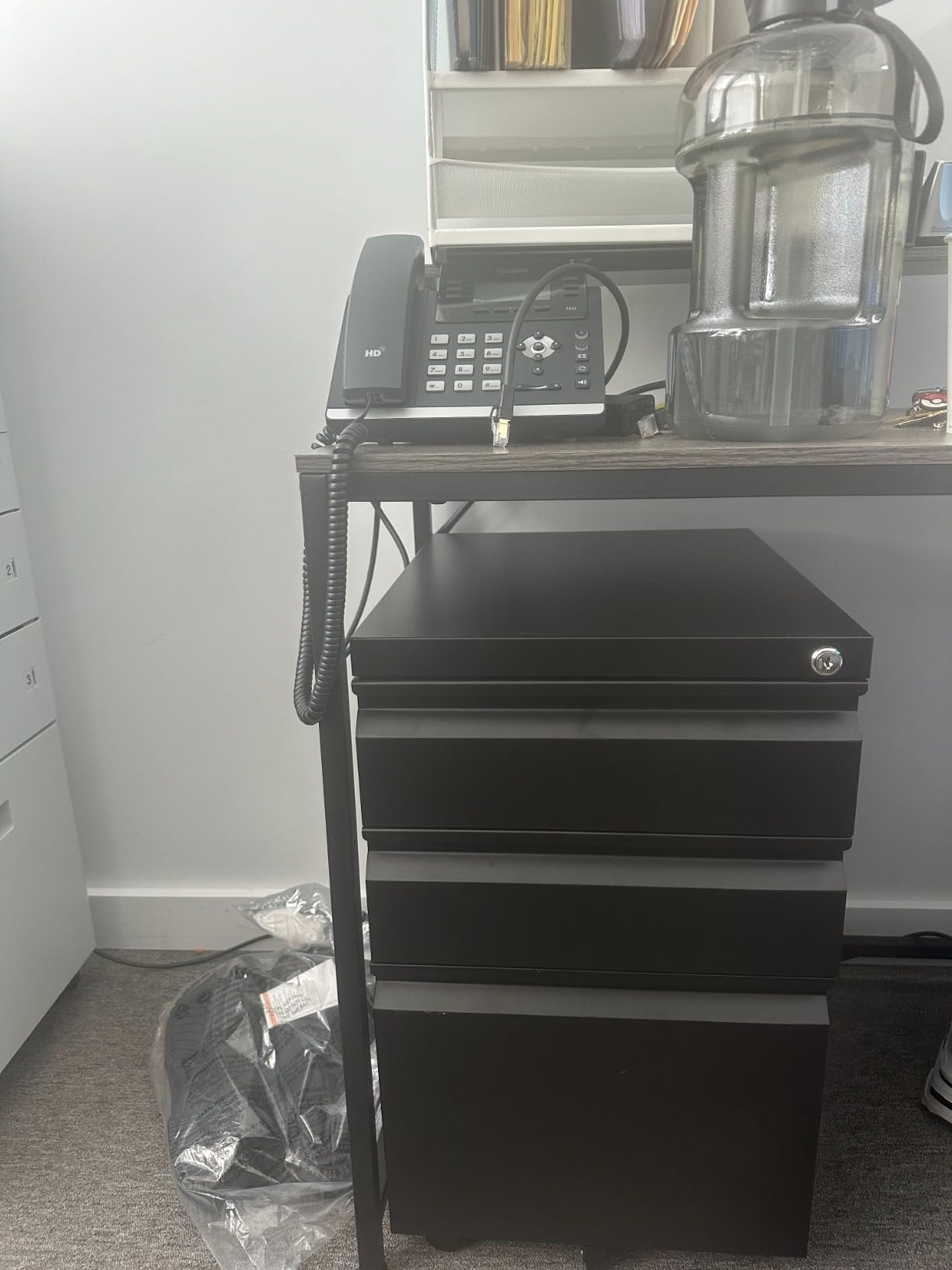
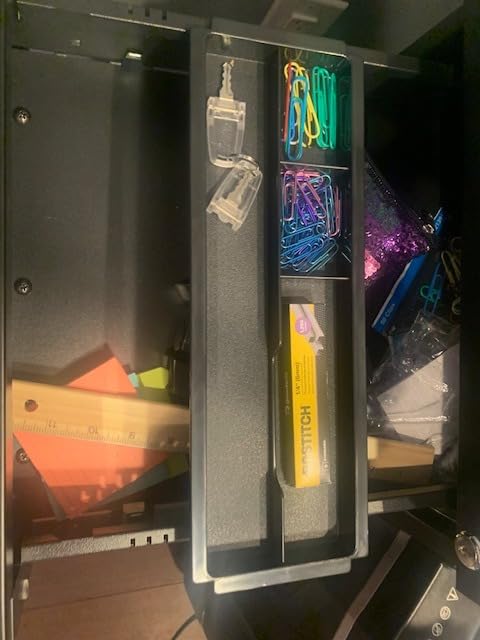
The open shelf, the adjustable shelf and the pegboard side are what separate this from a plain two-drawer steel box. The pegboard is genuinely useful for scissors, a stapler, headphones and cables, and it means the unit is not a filing cabinet with three dead drawers. Two keys operate the lock on all three drawers together.
Reviewers rate the caster mobility and the printer-stand-plus-filing combination as the reasons to keep it, and note the wide 34.5 inch footprint and the self-assembly as the caveats. It arrives flat-packed with labelled parts, tools, printed instructions and a video guide, which covers assembly more thoroughly than any other unit in the roundup.
Does it fit under a desk?
Measure twice. At 24.5 inches tall and 34.5 inches wide it clears the shallow, wide desks sold for small apartments, but it will not go under a desk with a modesty panel or deep drawer. If the desk is a two-drawer pedestal style, this goes beside it, not under it.
Storage tradeoffs to know about
The open shelf and pegboard are open by design, which is exactly the wrong choice for tax documents or anything with personal data. If you are locking sensitive paper, the drawers will hold it, but the shelf will not. The three drawers are the only enclosed storage in the unit.
7. Bush Home Cabot 2 Drawer Lateral File in Harvest Cherry
Bush Home Cabot 2 Drawer Lateral File Cabinet in Harvest Cherry, Home Office Chest for Letter, Legal, and A4-size Document Storage
31.26W x 19.69D x 30H inches
87 pounds, engineered wood
2 drawers, 60 lb capacity
ANSI/SOHO tested, 1 year warranty
Pros
- Traditional styling with rich Harvest Cherry and chrome hardware
- Ball bearing slides extend fully for rear access
- Scratch-resistant top suitable for printers and decor
- Engineered wood resists warping
- Tested to meet or exceed ANSI/SOHO standards
Cons
- Assembly required
- 87 pounds makes it heavy to reposition with a filled drawer
- Two drawers hold less than three-drawer units
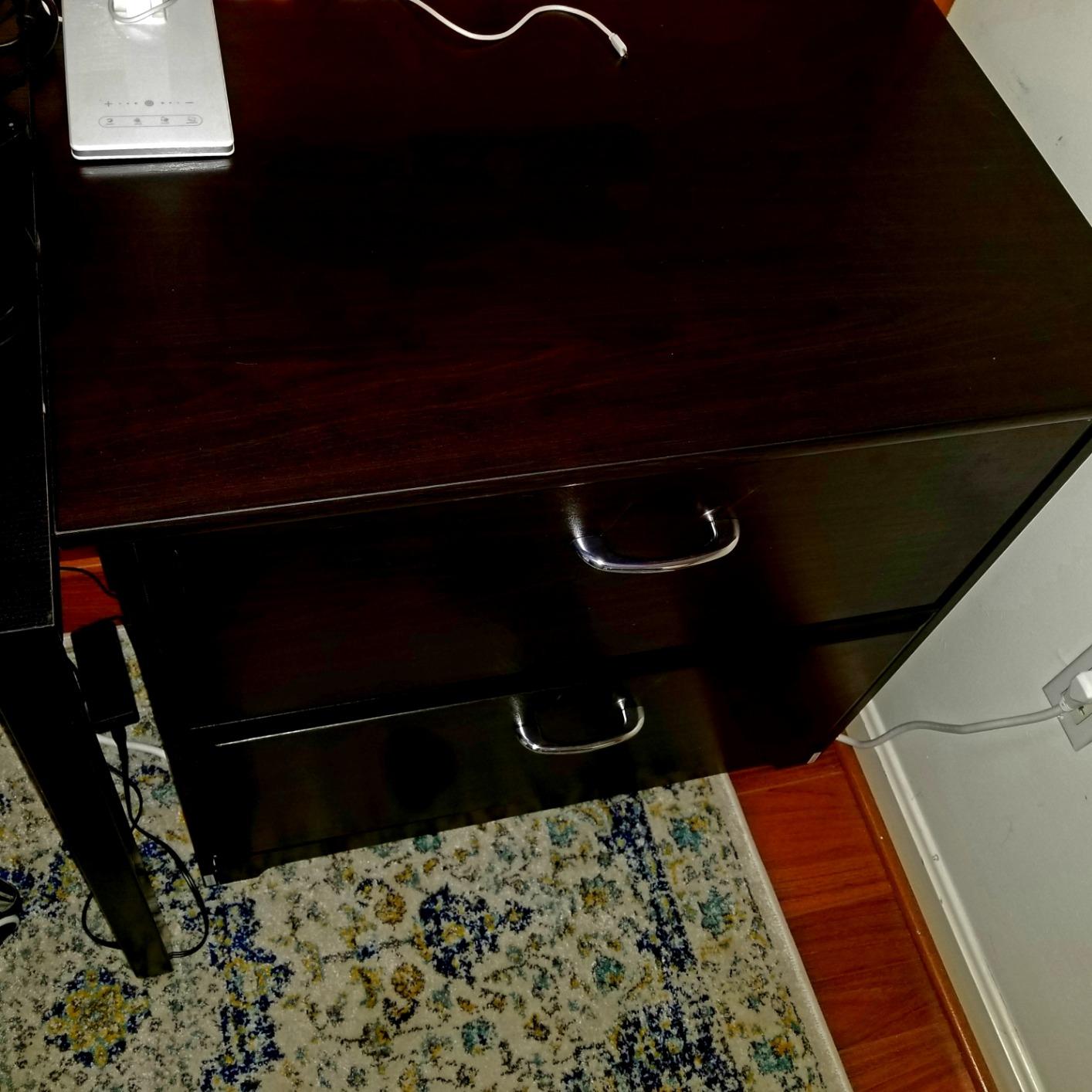
The Cabot is the most conventionally formal wood cabinet in the roundup, and if your home office has a traditional desk in traditional wood, this is the piece that will not fight it. The Harvest Cherry finish and chrome hardware read as furniture from across a room, which is the entire point for someone who does not want their filing cabinet to look like equipment.
It is 31.26 inches wide, 19.69 inches deep and exactly 30 inches tall, and the top is scratch-resistant, so a printer, a plant and a photo frame can all live up there. The two drawers take letter, legal and A4 folders, with a stated capacity of 60 pounds, the highest of the wood cabinets here.
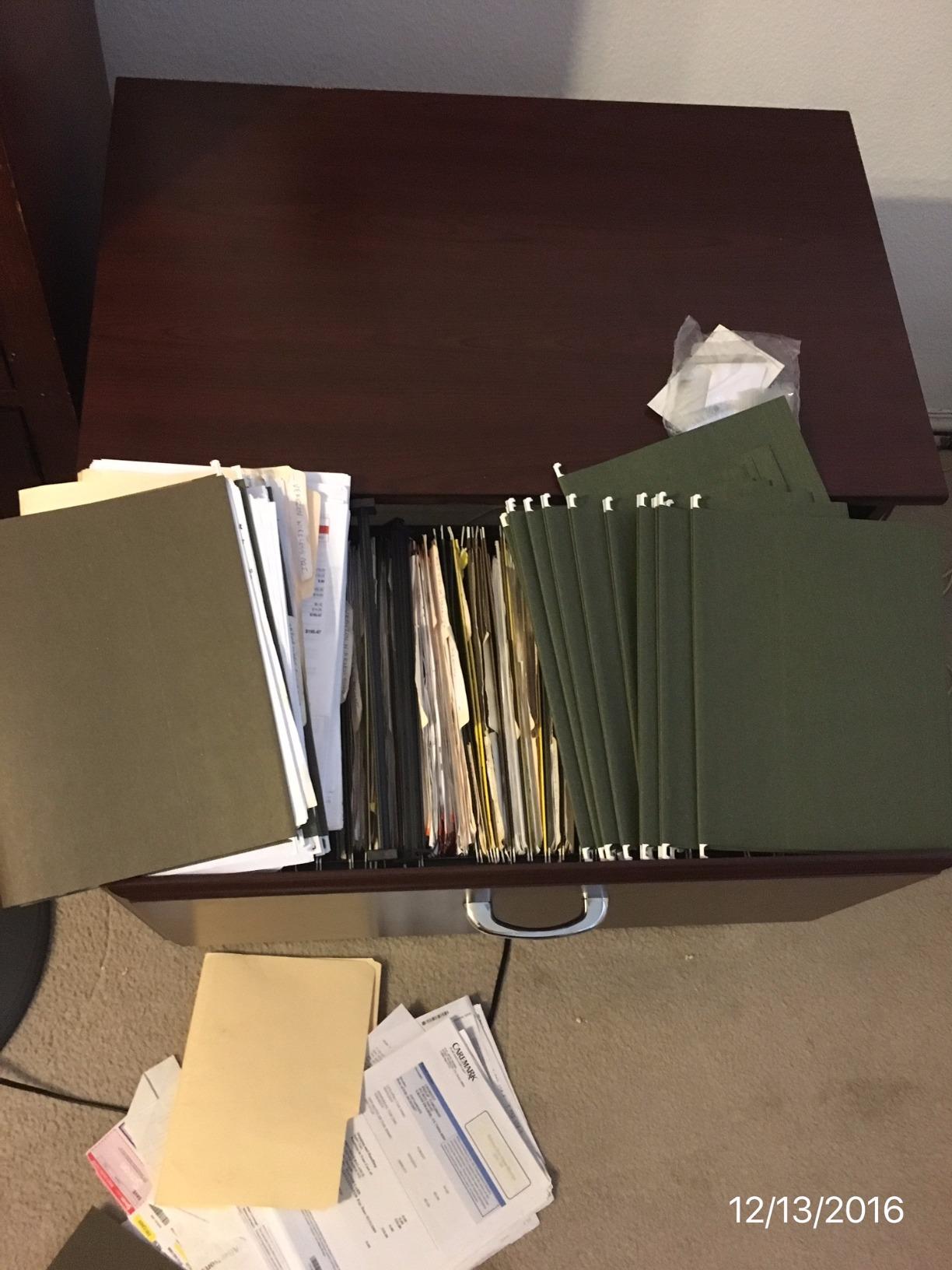
Two things set it apart from the other wood options. The sled base is more forgiving than legs when you are pushing a chair in and out, and the unit is tested to meet or exceed ANSI/SOHO quality standards, which is a durability marker that appears on very few residential listings.
Owners appreciate the traditional look, the smooth full-extension slides and the printer-friendly top, and the criticism is consistent: assembly effort and the 87 pound weight. You will want two people and a clear path from the door to its final spot.
Cabot or Key West?
Both are two-drawer, roughly 30-inch-wide engineered wood chests with ball bearing slides. The Key West is the coastal farmhouse piece with X-pattern accents and wall attachment hardware included; the Cabot is the traditional piece with chrome hardware, a heavier sled base and an ANSI/SOHO test behind it. Pick on finish, not on features, because the mechanics are close.
What the one-year warranty covers
Bush Home backs this one with a one-year manufacturer warranty, the shortest of the engineered wood options here, against six years on the Key West and five-year parts on both Sauder cabinets. For a piece this heavy and this stationary, the longer warranty is a fair tie-breaker if the finishes are otherwise equal to you.
8. INTERGREAT 2 Drawer Locking Steel Lateral File Cabinet for High Capacity
INTERGREAT Lateral File Cabinet 2 Drawer, Black Metal File Cabinets for Home Office, Locking File Cabinet for Letter/Legal/F4/A4 Size, Easy Assembly
28W x 16D x 28.4H inches
Cold-rolled steel, 220 lb rating
Up to 300 hanging folders
One lock, two keys, anti-tilt interlock
Pros
- Deep wide drawers sized for up to 300 hanging folders
- Two adjustable hanging rails in every drawer
- Single lock secures both drawers with two keys included
- Interlocking anti-tilt system
- Non-mar padded base protects hard and carpeted floors
Cons
- Assembly required despite easy-assembly marketing
- Two drawers give less capacity than three-drawer units
The INTERGREAT is the pick when a small number of drawers has to hold a genuinely large amount of paper. Its deep, wide two-drawer design is described as fitting up to 300 hanging folders, which is the only capacity figure in this roundup you will find stated, and it is the number home filers actually want.
At 28 inches wide and 16 inches deep, it is also the narrowest locking steel unit here, and at 28.4 inches tall it sits just under standard desk height. That combination makes it the one to check first if you want a locked steel cabinet that still tucks partly under a work surface.
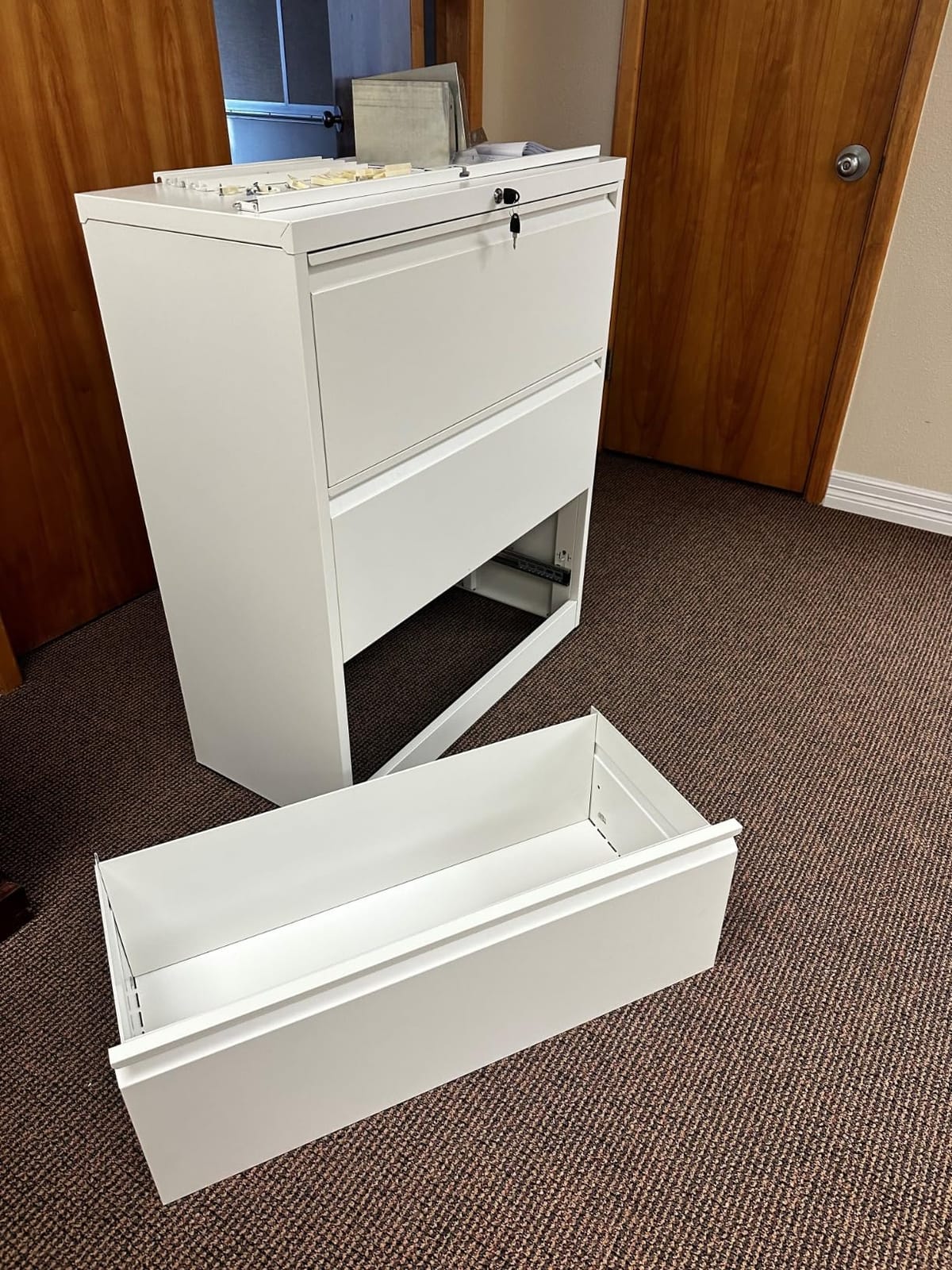
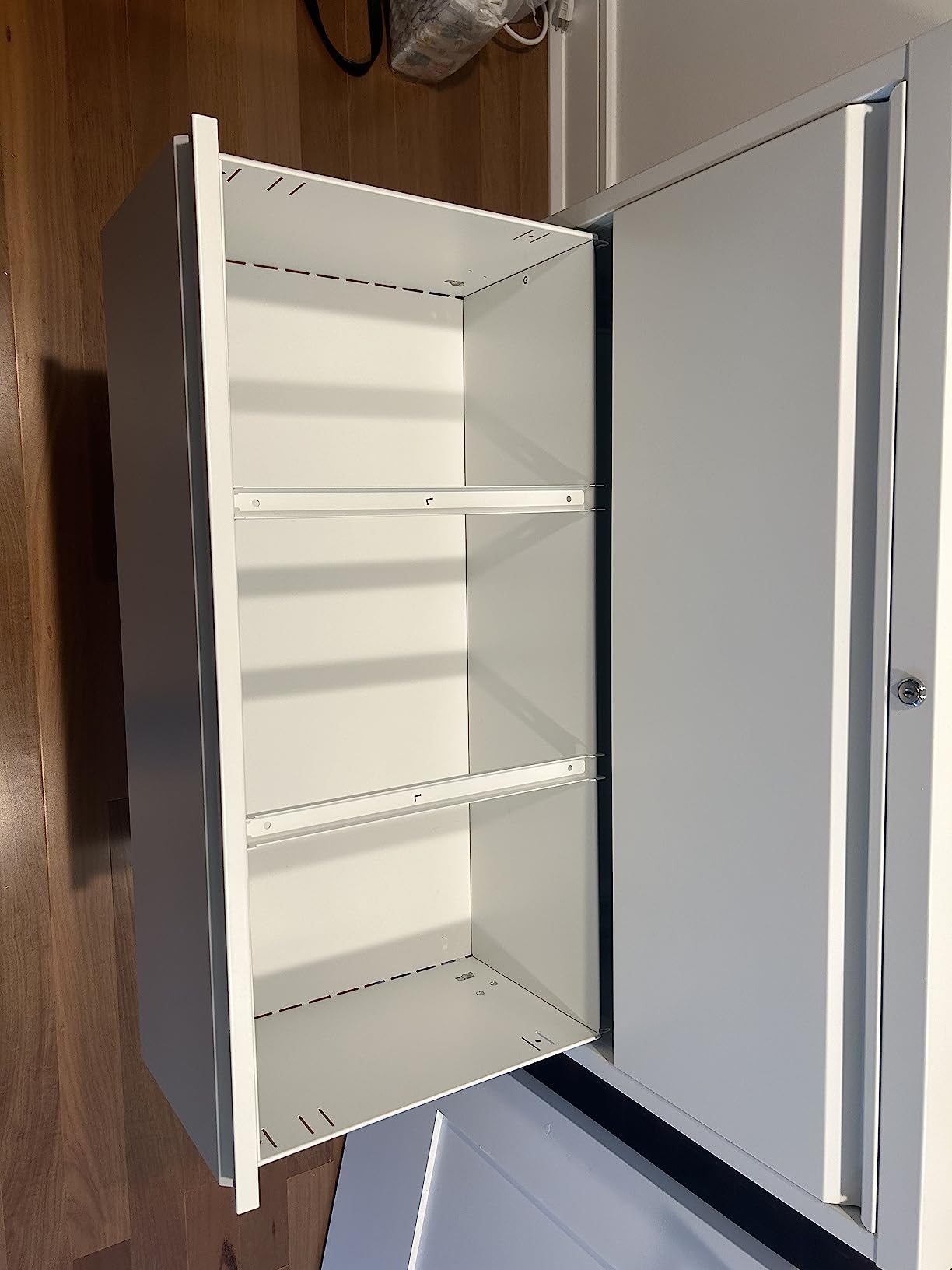
Each drawer has two adjustable hanging rails, so you can configure for letter, A4 or F4 files in the same cabinet, and the drawers themselves are rated to hold up to 110 pounds each. One lock secures both drawers, and two keys are included, which is a simple security story for a shared home.
The anti-tilt interlock is described consistently by owners as working, which is not something every steel cabinet on the market can claim. Ball bearing glides and a non-mar padded base round out a build that reviewers single out for the deep drawers, the solid steel frame and the lock, with assembly time and the two-drawer capacity as the drawbacks.
When 28 inches is the number that matters
This cabinet rewards a tape measure more than any other in the roundup. If your available wall segment is under 30 inches, only three of the ten picks will fit, and the INTERGREAT is the narrowest of them at 28 inches. Bring the folder brand you plan to buy and check the rail position before ordering.
Read the assembly claims carefully
It is marketed as easy assembly, and owners do describe the process as straightforward, but two drawers of steel still means more than a flat-pack of a lightweight wood chest. Budget an hour, and anchor it to the wall if you have small children, since the anti-tilt interlock only governs the drawers.
9. Guizeeopo 3 Drawer Heavy Duty Metal File Cabinet
Guizeeopo Metal File Cabinet with Lock, 3 Drawer Lateral File Cabinets for Home Office, Heavy Duty Office Storage Cabinet for A4/Letter/Legal Size, Assembly Required(Black)
28.35W x 17.32D x 37.87H inches
Thickened steel, 330 lb rating
3 drawers, key lock
A4, letter and legal folders
Pros
- Thickened steel panels rated to support 330 pounds
- All three drawers fit three folder sizes
- Key lock secures every drawer for sensitive documents
- Smooth rust and scratch resistant powder coating
- Tool kit and detailed manual included
Cons
- Assembly required
- 75 pound empty weight makes repositioning difficult
- No casters so it must be carried or dragged
The Guizeeopo is the narrow three-drawer locking steel option, and at 28.35 inches wide it is a steel pick that solves a tight-room problem without dropping to two drawers. Its listed storage volume of 10.77 cubic feet is the only capacity figure given for a three-drawer cabinet in this roundup.
All three drawers take A4, letter and legal folders, which is rare in a cabinet this narrow. The panels are thickened and rated for 330 pounds, a figure that describes the load rating rather than the weight of the cabinet, but it signals a heavier gauge of steel than most competitors in this price band use.
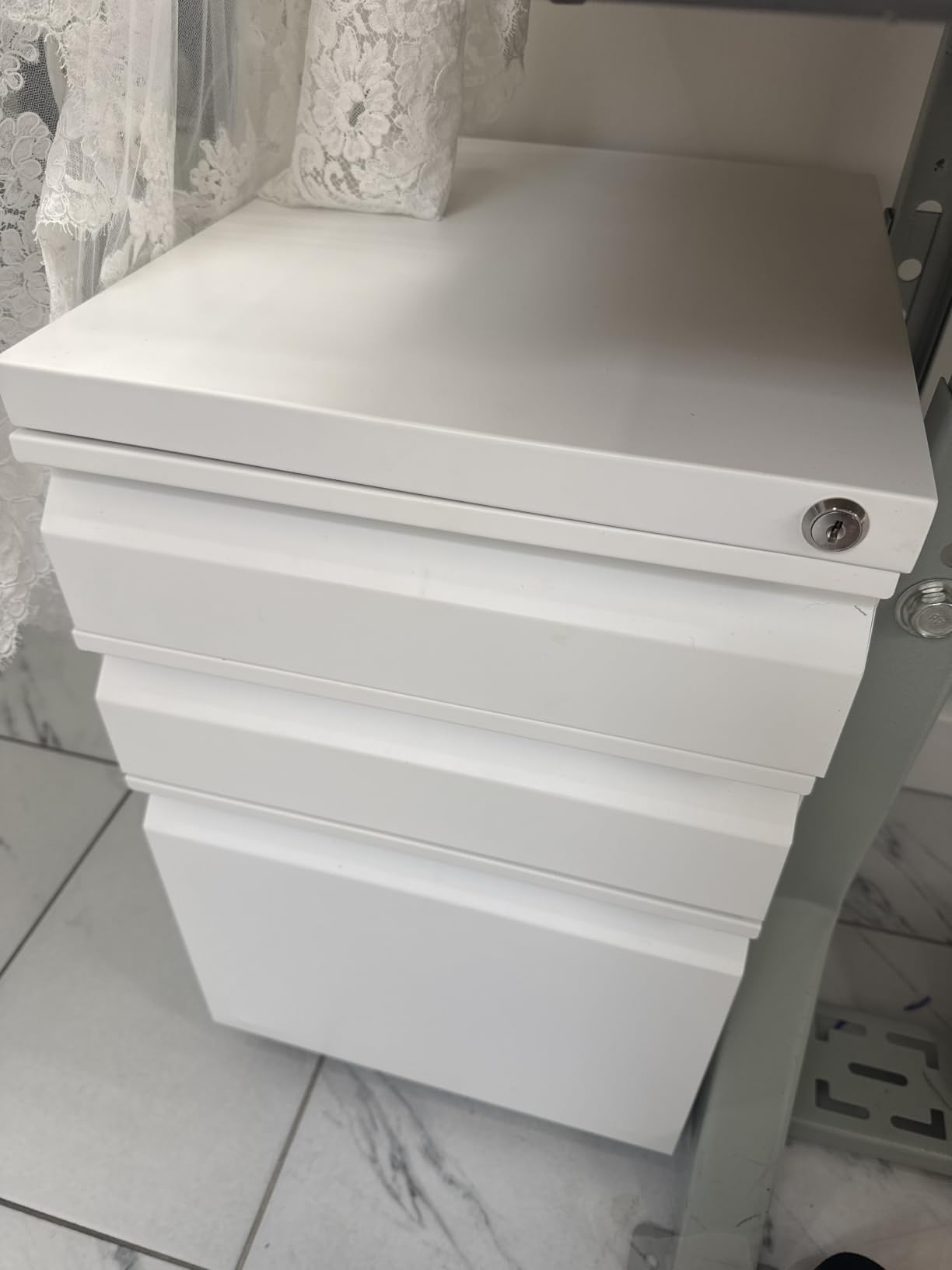
Buyers cite the heavy-duty build, the high stated load capacity and the lock as their reasons for choosing it, and the recurring complaint is the same as on every large steel unit: assembly, and the weight once it is built. At 75 pounds empty with no casters, this is a cabinet you place once.
That single sentence is the whole evaluation. If you know where it goes before you buy, the 37.87 inch height, the locking key and the three-drawer capacity in a narrow footprint are a strong package for a home office that needs serious filing depth. If you might move it, the casters on the DEVAISE or the MIIIKO are worth the trade in capacity.
Where it beats the other steel picks
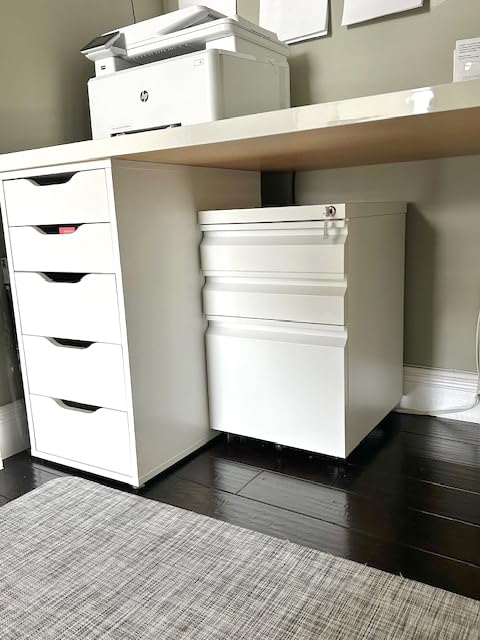
Against the three-drawer Letaya, the Guizeeopo is 7.65 inches narrower and locks every drawer with one key system. Against the two-drawer steel options, it gives you a third file drawer. If your floor space is the binding constraint, it is the strongest of the heavy-gauge steel cabinets here.
Plan the assembly space
A tool kit and detailed manual are included, and the panels are large and flat, so you need floor area to lay them out before the frame will stand. Assemble it in the room where it will live rather than carrying a built cabinet through a doorway, and put a floor protector under the pedestal base.
10. Approgreent 2 Drawer Quiet Steel Lateral File Cabinet for Apartments
Approgreent 2 Drawer File Cabinet, File Cabinets for Home Office, Printer Stand, File Cabinet with Lock, Lateral Filing Cabinet for A4/Letter/Legal Size File Folders, Assembly Required(Black)
28.35W x 17.32D x 25.98H inches
Alloy steel, 220 lb rating
2 drawers, dual-key lock
Silent slides, 7.38 cubic feet
Pros
- Silent drawer slides with friction-reducing technology
- 25.98 inch height clears most standard desk overhangs
- Quiet enough for a shared or thin-walled apartment
- Steel frame resists dents and rust
- Illustrated step-by-step instructions with labelled parts
Cons
- Assembly required
- Two drawers limit capacity for bulk records
The Approgreent is the cabinet designed around noise, and that is the entire pitch. At 25.98 inches tall it is a low-profile unit, which means it slides under almost any work surface, and the silent drawer slides were the first thing owners mentioned when explaining why they kept it.
In a thin-walled apartment where a sibling sleeps in the next room, drawer noise is not a trivial detail. Most lateral files use ball bearing glides that are quiet in a showroom and hollow-sounding on a laminate floor in a wood-frame building. This one uses friction-reducing slide technology specifically to soften that.
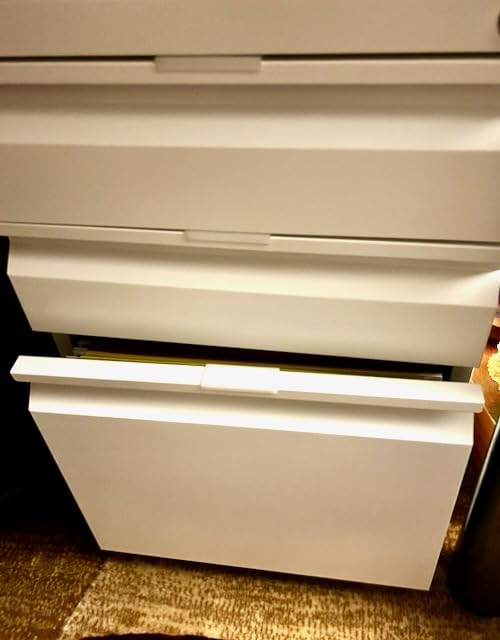
It is also compact in plan at 28.35 by 17.32 inches, so it is one of the few units here that genuinely works in a small apartment office. Storage volume is listed at 7.38 cubic feet, against 10.77 in the three-drawer Guizeeopo, and the frames are rated for 220 pounds.
The dual-key mechanism secures both drawers, and owners single out the working lock, the sturdy steel frame and the quiet operation as the strengths, with the two-drawer format as the main limitation. If you need legal and A4 in the same cabinet, the wide drawers take all three.
The under-desk question, answered
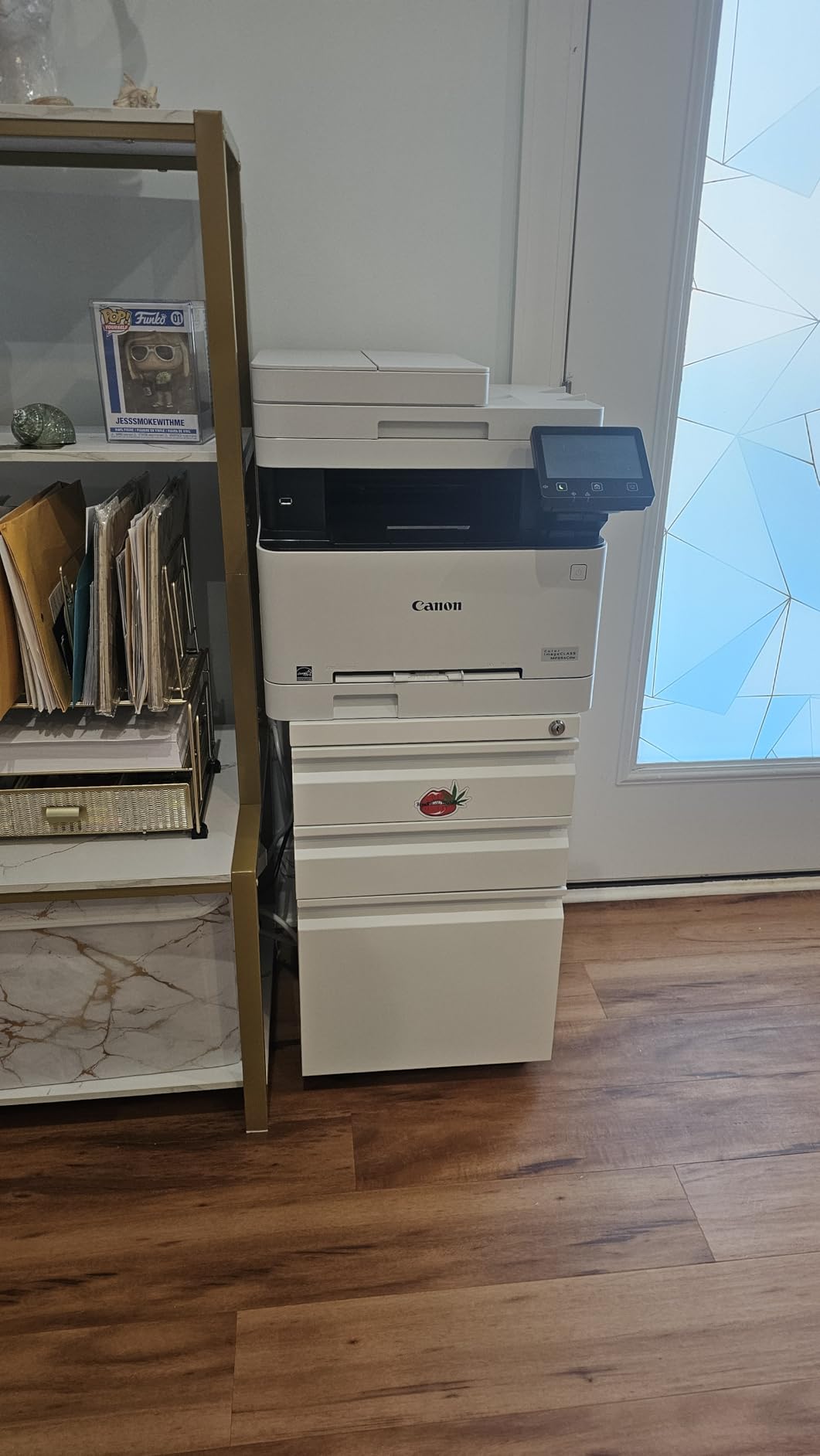
At 25.98 inches tall, this is the cabinet to measure your desk against first. Most standard desks sit at 29 to 30 inches, so a low-profile cabinet like this one tucks beneath the overhang where a 30 inch chest cannot. Check the modesty panel and any drawer rails on your desk, which is the usual blocker.
Where two drawers becomes a problem
If you are filing a full household plus a small business from the same unit, two drawers will not be enough and you should look at the three-drawer steel options instead. For one person, a couple, or an active-versus-archive split where older years go to a separate box, two drawers is generous.
Lateral vs Vertical File Cabinets: Which One Does Your Room Need?
Choose a lateral file cabinet when your constraint is room depth; choose a vertical file cabinet when your constraint is floor width. A lateral cabinet is wide and shallow, roughly 30 to 42 inches across and about 20 inches deep, and it holds far more per drawer. A vertical cabinet, or pedestal, is narrow and deep, typically 15 inches wide and 22 inches deep, and it takes one folder front to back.
That difference decides most home offices. In a spare room with a wall to fill, a lateral cabinet gives you capacity and a work surface at the same time. In a nook beside a desk, or under a work surface, a pedestal that is narrower and shallower in one direction fits where a lateral simply cannot.
There is also a hybrid argument that we think is right for most hybrid workers. A lateral cabinet is where active paper lives, sorted into one drawer per project or per year. A small three-drawer pedestal handles the things you reach for daily. Anything older than two years goes into a labelled archive box, because a home filing system fails on volume, not on hardware.
For a fuller treatment of the vertical options, see our guide to the best filing cabinets for home offices. If your work is document-heavy enough that folder depth itself is the question, our legal size file cabinet guide goes deeper on that format.
The Real Downsides of Lateral File Cabinets
Five downsides come up repeatedly, and all five have a mitigation. Knowing them before you buy prevents most of the disappointment people report later.
They eat wall width, not floor depth. A 36-inch lateral cabinet cannot go where a 15-inch pedestal can. Measure the wall segment, and if it is under 30 inches the choice is made for you.
Most arrive flat-packed and need assembly. Nothing in this roundup arrives complete. Budget an afternoon for wood and an hour for steel, and do it in the room where it will live.
Weight makes them immovable once built. Units range from about 45 pounds to 108 pounds in this roundup. If you are a renter, the wheeled options are the ones that make sense.
Locks are inconsistent. Several excellent wooden cabinets here have no lock at all. If you are storing tax or medical records, filter for a cylinder lock before anything else.
They can be noisy on hard floors. Ball bearing glides still transmit sound through laminate and wood frames. Padded bases and silent slide systems, as on the INTERGREAT and the Approgreent, reduce it.
How to Choose a File Cabinet for a Home Office
Once you have decided that a lateral cabinet is right, five decisions narrow the field quickly. Take them in this order, because each one constrains the next.
Dimensions and where it actually fits
Measure the wall before you browse. Most lateral cabinets are 30 to 36 inches wide, so a wall segment under 30 inches eliminates most of the category. Depth matters more than people expect: units here run from 15.7 to 22 inches deep, and a deeper cabinet that takes legal folders needs 22 inches of clear floor in front of it for the drawer to open.
Height decides whether it doubles as a desk. Anything at 29 or 30 inches tall works as a work surface or a monitor base, because that is standard desk height. The rolling units at 24.5 to 25.98 inches are printer stands. The 37.87 and 40 inch cabinets are credenzas that need a wall to themselves.
Our other home office guides cover the rest of the room if you are building it out: standing desks for the work surface, ergonomic chairs for the eight hours a day part, and monitors for what usually ends up on top of the cabinet.
Material: steel, engineered wood or veneer
Steel is the durability answer. It resists rust, dent and moving damage, and the steel units here weigh between 45 and 75 pounds empty, which is the choice for basements, garages and anything that has to survive a move. A long-term owner on a garage forum runs nine steel lateral files in a working shop and two more in a garage, and reports they hold up over years of daily use with no complaints about the cabinets themselves.
Engineered wood is the look answer. It gives you cherry, walnut and farmhouse finishes that match furniture, and the panels in this roundup resist warping well. The tradeoffs are edge wear over time and weight that can surprise you, since some engineered wood cabinets are heavier than the steel ones.
Avoid buying a lateral file on finish alone. The Reddit thread about matching a credenza to a Starmore desk is the clearest example of the trap: a user described having a surprisingly hard time finding something cohesive and eventually asking directly for product recommendations. The same user wanted a piece that complements rather than one that looks like a bad attempt at matching a stain.
Lock, anti-tip and children
Anti-tip locking means an interlock or safety catch that allows only one drawer open at a time, which stops the cabinet tipping forward. The Sauder Palladia, the Sauder Heritage Hill, the INTERGREAT and the Guizeeopo all describe one, and the DEVAISE adds a central anti-tip caster for stability on casters. The Letaya has the mechanism on paper but owners do report it failing to engage on some units, and the MIIIKO does not list one.
In a home with children or a large dog, treat the interlock as necessary rather than nice. Pair it with wall anchoring, which the Bush Home Key West supports with included hardware, and put the sensitive paperwork in a locked drawer rather than the top one.
Matching the cabinet to your desk
For a dark rustic brown desk with a black metal frame, the closest match in this roundup is the DEVAISE in Rustic Brown, which has a similar modern-rustic profile and a low body that can sit under a desk. For white oak or pale Scandinavian wood, the Sauder Palladia in Select Cherry is closer in tone weight than the darker bush finishes. For a black steel desk, any of the powder-coated steel units will coordinate without a visible seam.
The honest test is lighting. Hold the finish sample next to your desk in daylight and in the lamp light you actually use at night, because a finish that reads as matching under office lighting can read as orange at home. If a cabinet is sold as a collection piece, buying the matching one from that collection is the only reliable route to cohesion.
What we skipped, and why
We left out single-pedestal vertical files, fireproof media cabinets and solid-wood cases. Pedestals are covered in our vertical guide. Fireproof cabinets cost several times more for a protection rating most home filers do not need, since their documents are backed up digitally in most cases. Solid wood is a genuine option, but the price step up from engineered wood is steep for a filing chest, and nothing in that tier earned a place against the picks below.
Buying used
Used lateral files are worth considering, and a garage forum thread describes them as the best-kept item in a working shop, with prices far below new equivalents for the same units. Check the drawer rails for play, test the lock mechanism, look for a sagging top, and confirm every follower bar is present. Keyed-alike systems mean one key may open several cabinets, which is a benefit if you already have one.
Frequently Asked Questions
What are the best filing cabinets for home offices?
The best lateral file cabinets for home offices balance footprint, height and security. The Bush Home Key West is our top pick at 30 inches wide and 30 tall with letter, legal and A4 support. For rolling storage choose the DEVAISE, for a lock on wood choose the Sauder Heritage Hill, and for the quietest drawers in a shared apartment choose the Approgreent.
What are the downsides of using lateral filing cabinets?
Five drawbacks recur: they consume wall width rather than floor depth, they arrive flat-packed and need assembly, they are heavy once built, lock quality varies widely between wood and steel models, and they can be noisy on hard floors. Each has a mitigation: measure the wall, allow an afternoon to build, choose casters if you move, filter for a cylinder lock, and pick a padded base or silent slides.
Lateral or vertical file cabinet: which is better for a home office?
A lateral file cabinet is better when room depth is the constraint, because it holds far more paper in a shallower body and its top becomes a work surface. A vertical pedestal is better when floor width is tight, since it is about 15 inches wide and fits beside or under a desk. Many home offices use both: a lateral for active projects, a pedestal for daily items.
How many hanging files can a lateral file cabinet hold?
Capacity depends on width and folder type rather than drawer count. The INTERGREAT in this roundup is the only unit with a published figure, described as fitting up to 300 hanging folders across two deep drawers rated at 110 pounds each, against a 30 inch wide wood cabinet whose two drawers hold far fewer. Measure the drawer width in person if you can, and check the rating before you load it.
Can you put a printer on a lateral file cabinet?
Yes, on any cabinet with a flat laminate or powder-coated top and a stated load capacity above the printer weight. The MIIIKO is designed as a rolling printer stand at 24.5 inches tall, and the Bush Home Cabot has a scratch-resistant top rated to 60 pounds. Check the load figure before placing a printer, and avoid the open shelf designs for anything that needs a flat surface.
Do lateral file cabinets need to be anchored to the wall?
In a home with young children, yes, anchoring is the safer choice, especially for units over 30 inches tall. Most multi-drawer cabinets include an interlocking mechanism that allows only one drawer open at a time, which reduces but does not remove tip-over risk. The Bush Home Key West includes wall attachment hardware in the box, and the INTERGREAT uses an anti-tilt interlock that owners report works consistently.
The Verdict: Which Lateral File Cabinet to Buy in 2026
The Bush Home Key West 2 Drawer Lateral File Cabinet is our choice as the best lateral file cabinet for home offices in 2026. It pairs the highest rating in this group with the largest body of owner feedback, sits at exactly desk height, takes letter, legal and A4 folders, and includes the wall hardware that most listings in this category leave out. It also looks like furniture, which is the standard every other pick here has to justify.
The cabinet to skip is the Sauder Palladia, and only because of one variable. Its 36.81 inch top is the best surface here and it handles European folders, but at 108 pounds with a two-to-four-hour build and no lock, it asks too much of a weekend in a house with stairs. If you have a ground-floor room and do not need a lock, it is still a fine choice.
Everything else is a matter of your constraint. Renters and movers get the DEVAISE on its casters. Apartments with thin walls get the Approgreent. Small-business paperwork in a narrow room gets the Guizeeopo. And if the printer is the reason you need the cabinet in the first place, the MIIIKO was built for exactly that.
Measure the wall, check your folder width, and then buy the one that fits your floor plan. The wrong cabinet is the one that was a bargain you had to fight into the room.