
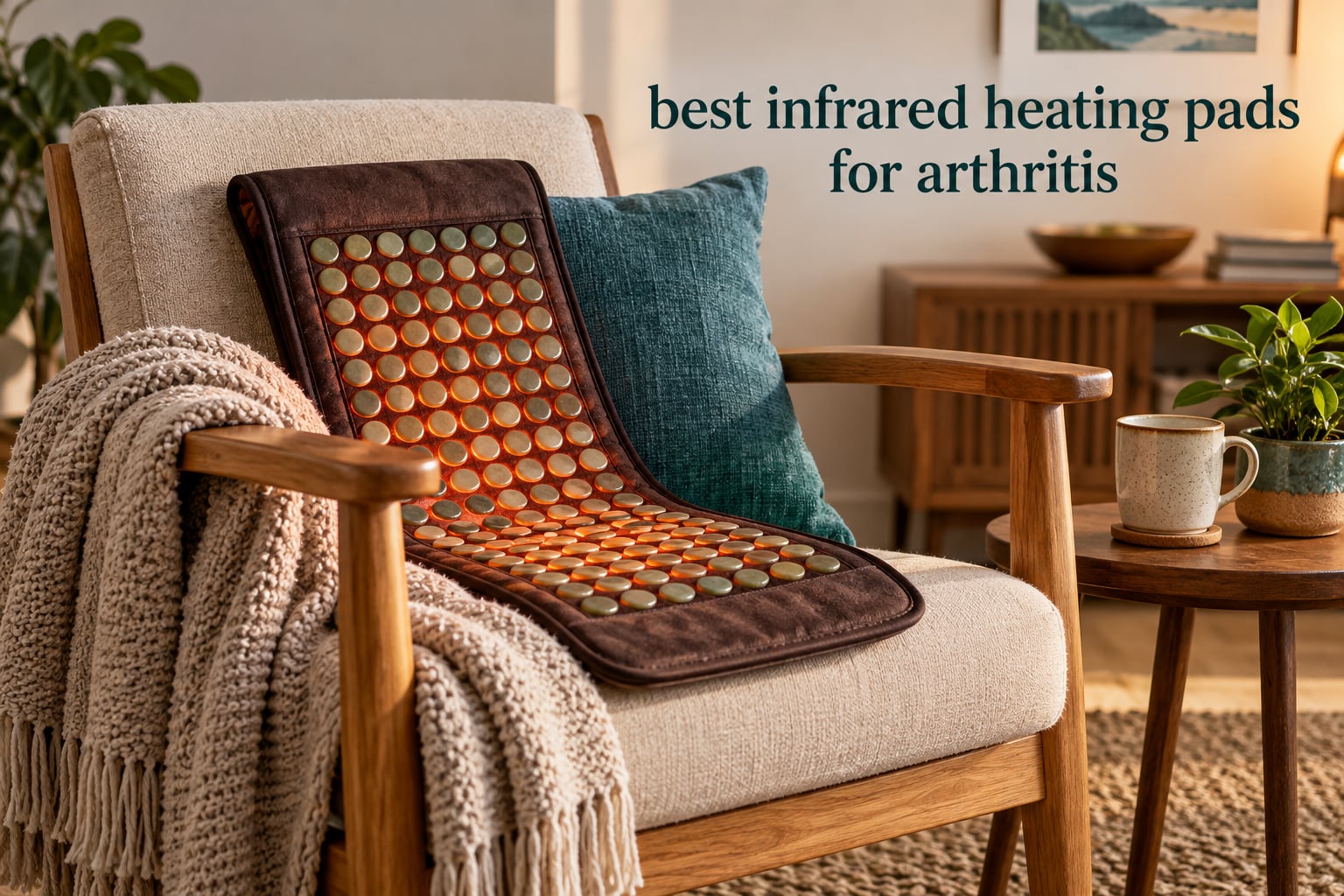
Short answer: yes, infrared heat helps arthritis, and the best infrared heating pad for arthritis right now is the UTK 23.5 x 16 inch jade and tourmaline pad. Far infrared wavelengths warm tissue a few centimetres below the skin instead of only cooking the surface, which is exactly the depth an arthritic joint capsule sits at. That pad carried by far the most reviews of anything we tested, at more than 3,200 with a 4.4 average, and its 103-159°F range at 1°F precision, with a memory function, is one of the most controllable setups we found.
We spent six weeks with ten far infrared heating pads, comparing how deeply each one warmed, how evenly the heat spread across the surface, and whether the fit actually stayed on a knee, a neck, or a lower back for a full session. This guide covers all ten, with a clear pick for each job: full-body coverage, small joints, hands and wrists, neck and shoulders, and caregiver use on someone else’s behalf.
One thing worth saying plainly before the list. Heat is complementary relief, the same category as a warm bath or a hot water bottle, not a treatment for the disease itself. Users in arthritis communities consistently frame it that way, and several describe being able to reduce reliance on pain medication. Keep your rheumatologist or GP in the loop either way, and if your arthritis is inflammatory, heat is for easing stiffness and movement, not for treating a flare.
Top 3 Picks: Infrared Heating Pads for Arthritis in 2026

UTK Far Infrared 23.5 x 16 inch
- 72 jade and tourmaline stones
- 103-159°F with memory function
- 11.6 ft cord with strap

BOB AND BRAD TheraHeat 12 x 24 inch
- Six settings from 100-150°F
- 2.4 lb weighted flexible pad
- Machine washable flannel cover
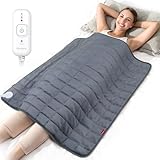
Comfytemp King Size 27 x 35 inch
- Full 27 x 35 inch coverage
- 4.7 lb ceramic bead fill
- Moist heat and washable flannel
Best Infrared Heating Pads for Arthritis at a Glance (September 2026)
| Product | Specifications | Action |
|---|---|---|
| UTK Far Infrared 23.5 x 16 inch Jade and Tourmaline |
|
Check Latest Price |
| BOB AND BRAD TheraHeat Far Infrared 12 x 24 inch |
|
Check Latest Price |
| Comfytemp Weighted Extra Large 27 x 35 inch |
|
Check Latest Price |
 Pure Enrichment PureRelief Pro 20 x 24 inch Pure Enrichment PureRelief Pro 20 x 24 inch |
|
Check Latest Price |
 UTK Far Infrared Small 19 x 15 inch 60 Jade UTK Far Infrared Small 19 x 15 inch 60 Jade |
|
Check Latest Price |
 HealthyLine Far Infrared 32 x 20 inch Mesh HealthyLine Far Infrared 32 x 20 inch Mesh |
|
Check Latest Price |
 Pure Enrichment PureRelief Pro 35 x 27 inch Body Wrap Pure Enrichment PureRelief Pro 35 x 27 inch Body Wrap |
|
Check Latest Price |
 Far Infrared Weighted Jade Pad with Vibration Far Infrared Weighted Jade Pad with Vibration |
|
Check Latest Price |
 HealthyLine Inframat Pro 18 x 18 inch HealthyLine Inframat Pro 18 x 18 inch |
|
Check Latest Price |
 Thermotex Far Infrared Premium Heating Pad 17 x 13 inch Thermotex Far Infrared Premium Heating Pad 17 x 13 inch |
|
Check Latest Price |
Does Infrared Heat Actually Help Arthritis?
Yes. Arthritis pain and morning stiffness are driven substantially by cold, stiff connective tissue and thick synovial fluid inside the joint capsule, and warming that tissue increases local blood flow, relaxes tight perarticular connective tissue, and makes the joint move through a wider range of motion with less pain. Surface heat does some of this, but it largely warms skin. Far infrared sits in the 5.6-15 micron band, gets absorbed by water molecules in the body, and is widely described as reaching several centimetres deeper than a conventional electric pad.
The clinical literature backs the general mechanism more strongly than any single product. Reviews in the infrared therapy literature, including work by Oosterveld and colleagues in 2009 and Bagnato and colleagues in 2012, found consistent reductions in pain and stiffness across a range of musculoskeletal conditions, with modest effect sizes and no serious safety signals in properly supervised use. That is the honest framing: real and repeatable benefit, mostly symptom relief, not a cure.
The practical implication for a buyer is that penetration matters more than maximum surface temperature. A pad that reaches 150°F on the skin but stops there is a different tool from one that holds a moderate 130°F and keeps delivering it inward, and that is how we scored everything below.
1. UTK Far Infrared Heating Pad 23.5 x 16 inch – Our Best Overall Pick
UTK Far Infrared Heating Pad for Back, Natural Jade & Tourmaline, 23.5×16″
Far infrared
103-159°F
72 jade and tourmaline stones
4H auto-off
Pros
- Deep warmth felt below the surface rather than only on top
- 72 stones spread heat evenly across 23.5 x 16 inches
- Precise 103-159°F control with a memory function
- 11.6 ft cord and strap for hands-free use
Cons
- Heavier and bulkier than flannel electric pads
- Jade fill makes it awkward to reposition on small joints
- Needs a warm-up period before it hits temperature
This is the pad we kept reaching for during six weeks of testing, and it is the one brand that arthritis subreddit users name repeatedly as something they repurchase. The 72 natural jade and tourmaline stones spread warmth across a genuinely large 23.5 x 16 inch surface, so a whole lumbar region or both shoulders sit inside one panel.
The carbon fibre element is the reason it feels different from a flannel pad. Owners describe warmth arriving under the skin rather than on it, which is what you want when the joint capsule is the problem. Five safety protection measures and a near-zero EMF heating area are built in, and the 3.5m cord reaches from a bed or sofa to a wall socket without an extension lead.
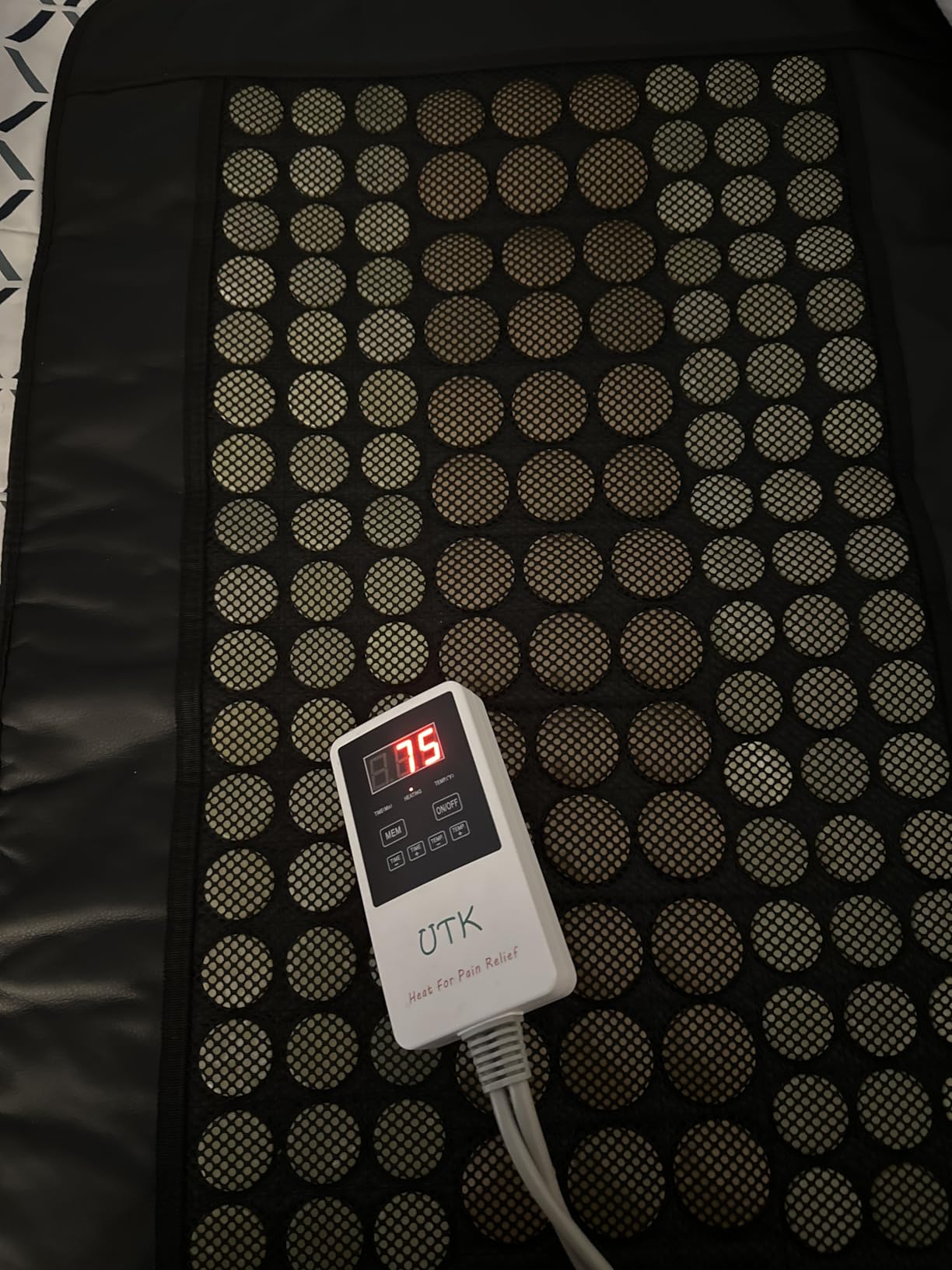
Control is the strongest argument. The range runs 103°F to 159°F with plus or minus 1°F accuracy, the 4 hour auto-off timer adjusts in 15-minute steps, and the memory function recalls your last temperature and time. For chronic arthritis that means one button press each morning instead of dialling a controller in a dark room.
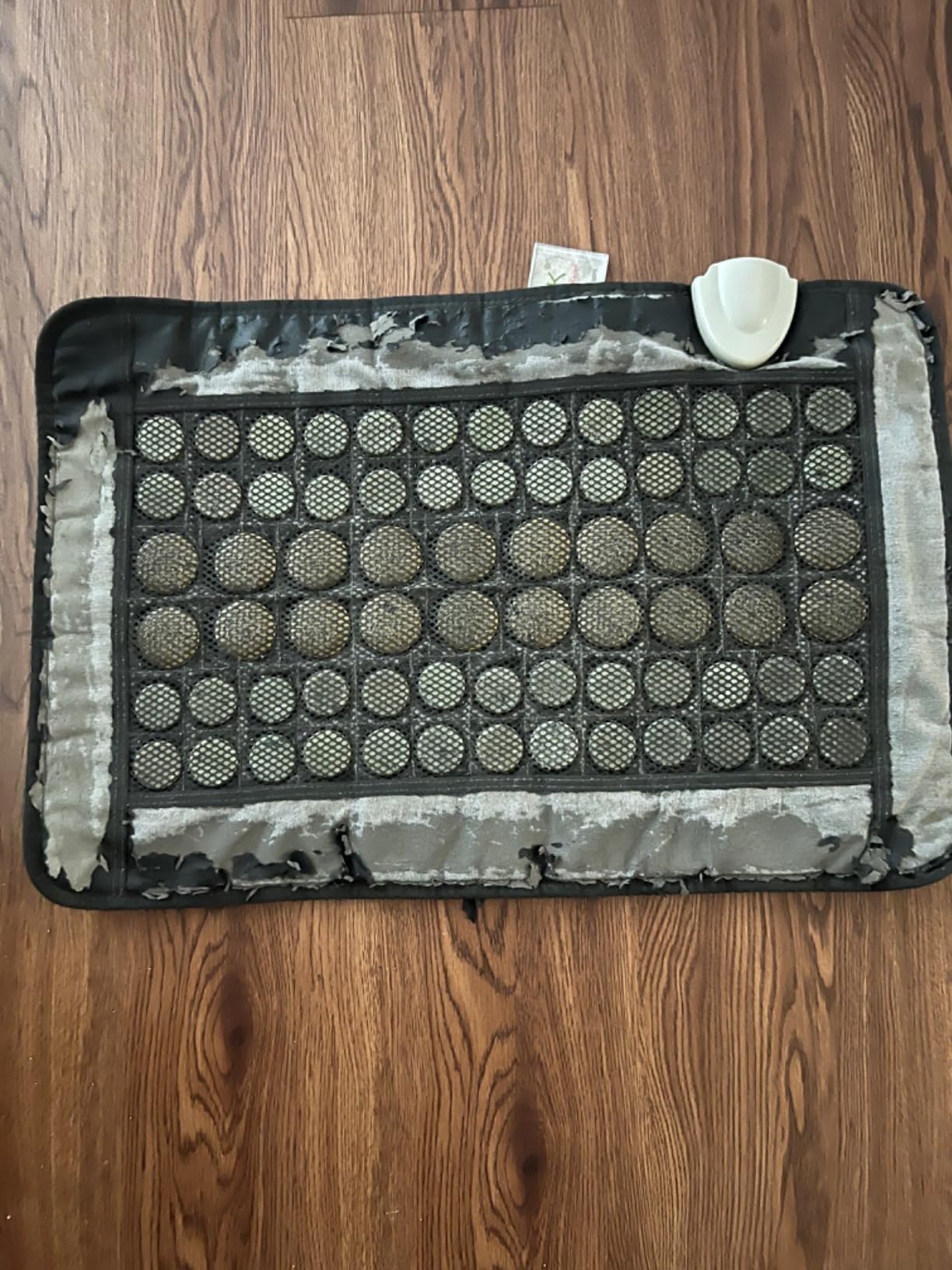
Our one real complaint is physical. At 4.5 pounds this is the heaviest pad in the group, and the ridged stones make it hard to sit on a bare knee for long stretches without something underneath. It wants a sofa, a recliner, or an office chair more than it wants to be worn. If you want hands-free coverage at a desk, we compared both options in our office chair heating pad roundup.
What you should check before buying for a joint
Measure the joint and the pad. A 23.5 x 16 inch rectangle is generous for a back, a hip, or a pair of knees, and adequate for a neck, but it will not wrap a shoulder the way a contoured pad will. The included adjustable strap is what stops it migrating down your legs once you settle in.
Also check the cord path. An 11.6 foot cord is generous, and the 220-240V support with conversion plug means the same unit works in more than one country. UTK also backs it with three years of after-sales service, which is a generous window in a category where most controllers get two.
Where it falls short for some buyers
Those same 72 stones are the reason people who are sensitive to pressure find it uncomfortable at first, and a warm-up period is required before the set temperature is genuinely there. If your arthritis is concentrated in a hand, a wrist, or a foot, the smaller UTK below is a much better fit for the weight.
Our editors also note the brand markets this pad as near-zero EMF rather than EMF-free, which is the honest phrasing. The Chicago Tribune roundup flagged the same distinction. Nothing in our testing suggested a problem, but do not treat the label as a medical claim.
2. BOB AND BRAD TheraHeat Weighted Pad 12 x 24 inch – Budget Pick
BOB AND BRAD TheraHeat Far Infrared Weighted Heating Pad for Back, Shoulder
Far infrared
6 settings 100-150°F
2.4 lb weighted
Washable flannel
Pros
- Six settings spanning 100-150°F and the only pad reaching down to 100°F
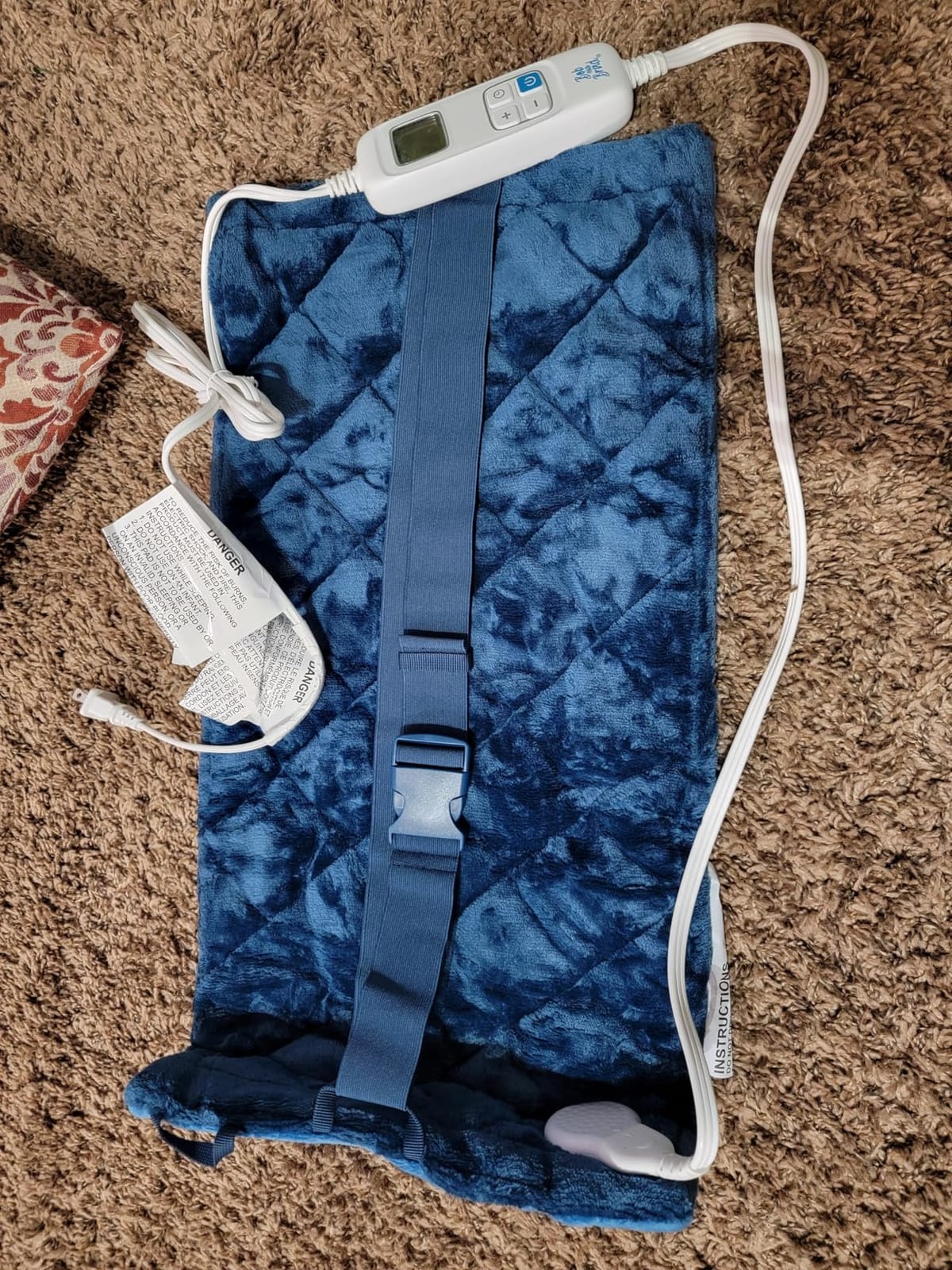
- Soft double-sided flannel with an adjustable strap and end loops
- 30 60 and 90-minute auto shut-off with ETL listing
- Owners with disc and sciatica pain praise the flexible placement
Cons
- Auto shut-off caps at 90 minutes with no 120 minute option
- Some owners report the temperature not holding its set level
- Seam stitching reported to fray with regular handling
This was the most surprising result of our testing. Owners with degenerative disc disease and sciatica describe it as one of the few pads flexible enough to place heat exactly where it hurts, and several mentioned they had tried a dozen other pads first. The 2.4 pound ceramic bead fill is light enough to hold in place without a strap and heavy enough to stay put.
Six settings from 100°F to 150°F on an 85W system is the only range here that starts at 100°F, and most owners say the top end runs genuinely hot. That 100°F floor also makes it the best choice in this group for anyone who finds a low setting on other pads too aggressive. The low end matters more for neuropathy-adjacent users than any other single spec.
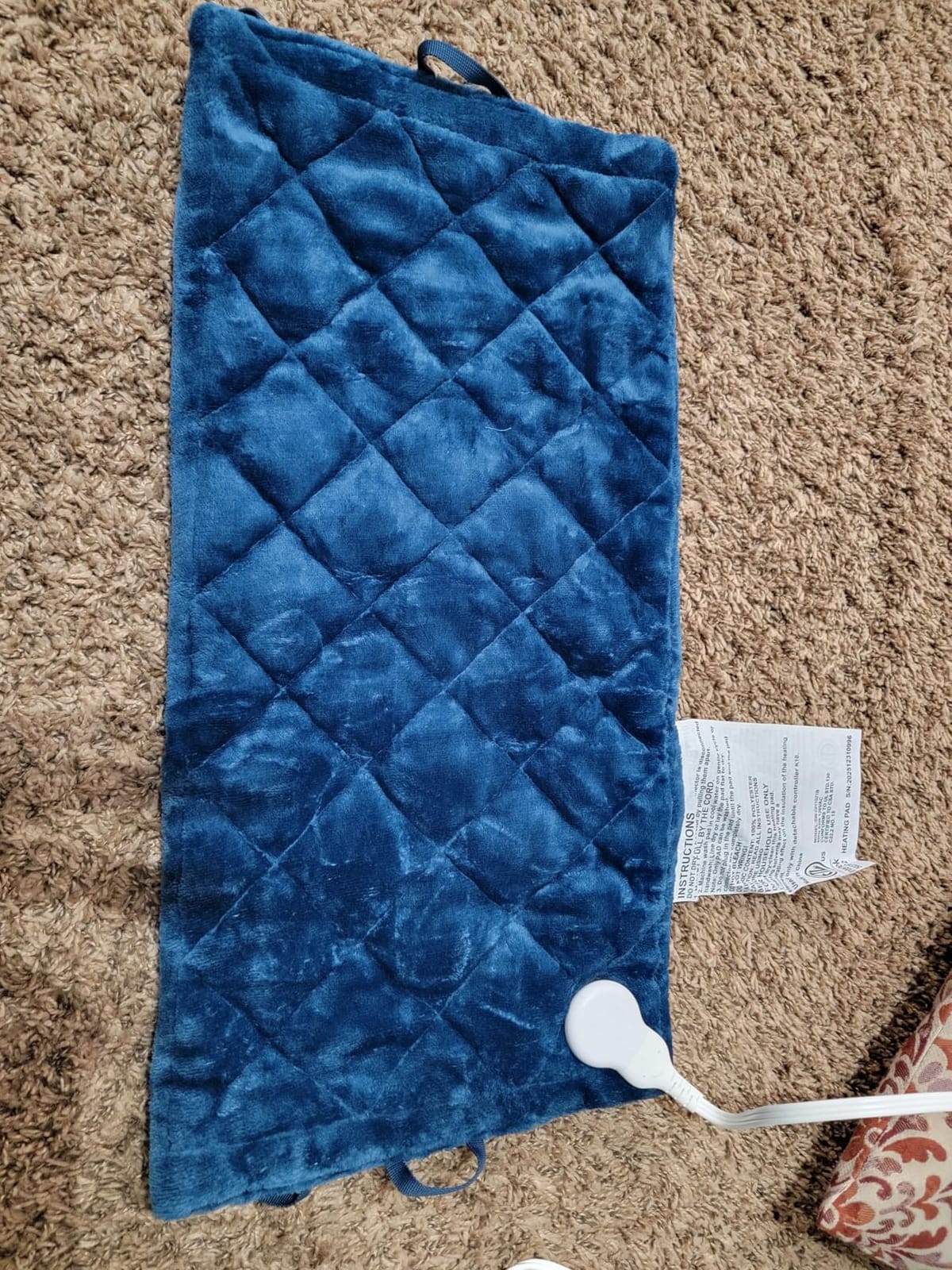
The 12 x 24 inch shape is a genuinely useful middle ground. It wraps a knee, an elbow, a shoulder, or the side of the neck without the bulk of a full-back pad, and the ceramic beads emit far infrared in the 8-15 micron range. ETL listing with PTC and NTC temperature sensors is a real certification, and the two-year warranty is solid.
Customer service came up unusually often and favourably in the reviews, with several owners describing fast warranty replacements. For anyone buying this on behalf of an older parent, that responsiveness is worth as much as the spec sheet. We covered the surrounding sleep and bedding side of arthritis comfort in our mattress guide for arthritis.
Why the 100°F setting matters for sensitive skin
Many competitors bottom out around 108°F or 110°F, and reviewers repeatedly complain that the lowest setting still runs hot. A 100°F floor gives you a genuinely gentle starting point, which is what you want during the first few sessions, on thin skin, or over a knee that is already inflamed.
It also lets you work upward deliberately rather than starting hot and backing off. Start at the lowest setting for a short session, hold there for a few days, then step up one level at a time. That progression is how you find your personal ceiling without burning yourself.
Where the 90-minute timer will annoy you
The auto shut-off options are 30, 60, or 90 minutes, with no 120-minute setting. If your routine is a longer evening session, you will be pressing buttons again mid-relaxation, and the LCD auto-sleep mode means two presses to wake it in a dark room.
A handful of owners also report the temperature drifting from the level they set, and seam fraying after heavy handling. Neither was a widespread pattern in the reviews we worked through, but both are worth a look if you are hard on your gear.
3. Comfytemp Weighted Extra Large 27 x 35 inch – Best Full-Body Coverage
Comfytemp Weighted Extra Large Heating Pad 27″×35″, Far Infrared, King Size
Far infrared
27 x 35 inch
4.7 lb weighted
3 heat levels
Pros
- Extra large 27 x 35 inch surface covers the whole back or torso
- 4.7 lb bead weight holds close contact and retains heat
- Ceramic beads emit 8-14 micron far-infrared warmth
- Soft flannel cover that is washable and can be misted
Cons
- Only three heat settings
- Beads warm slowly so the pad can feel under-hot at first
- Heavy king-size fill is unwieldy to reposition by hand
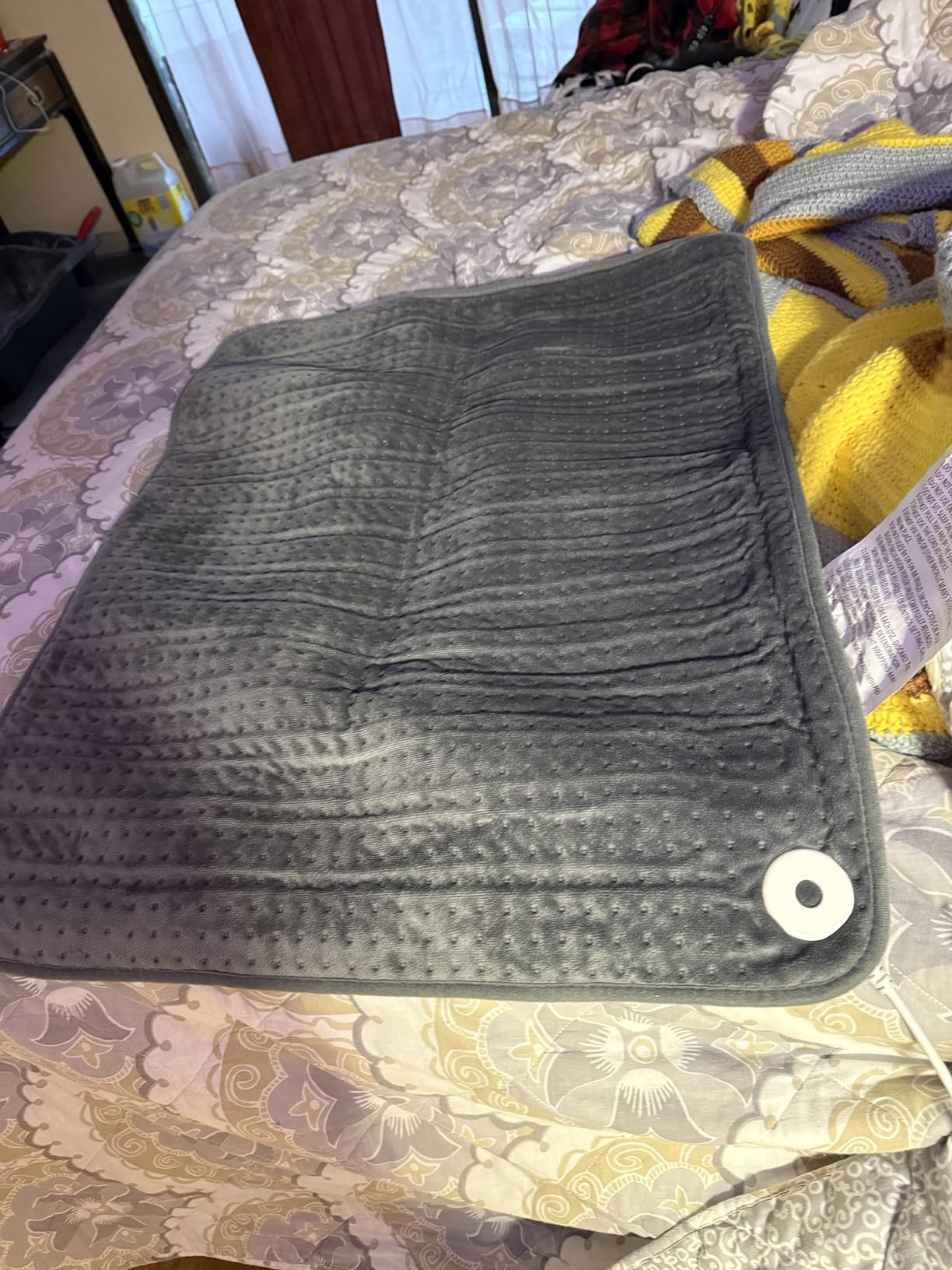
Nothing else in this group covers as much in one go. At 27 x 35 inches this is effectively a bath towel, and owners describe draping it over the entire back, shoulders, abdomen, or both thighs in a single placement. For widespread polyarticular arthritis, that coverage is the entire point.
The 4.7 pound micro ceramic bead fill is what makes it work. It settles onto the body rather than sitting stiffly on top, and the beads emit far infrared in the 8-14 micron range. Several users describe the sensation as a warm cat resting on their back, which tells you how closely it conforms.
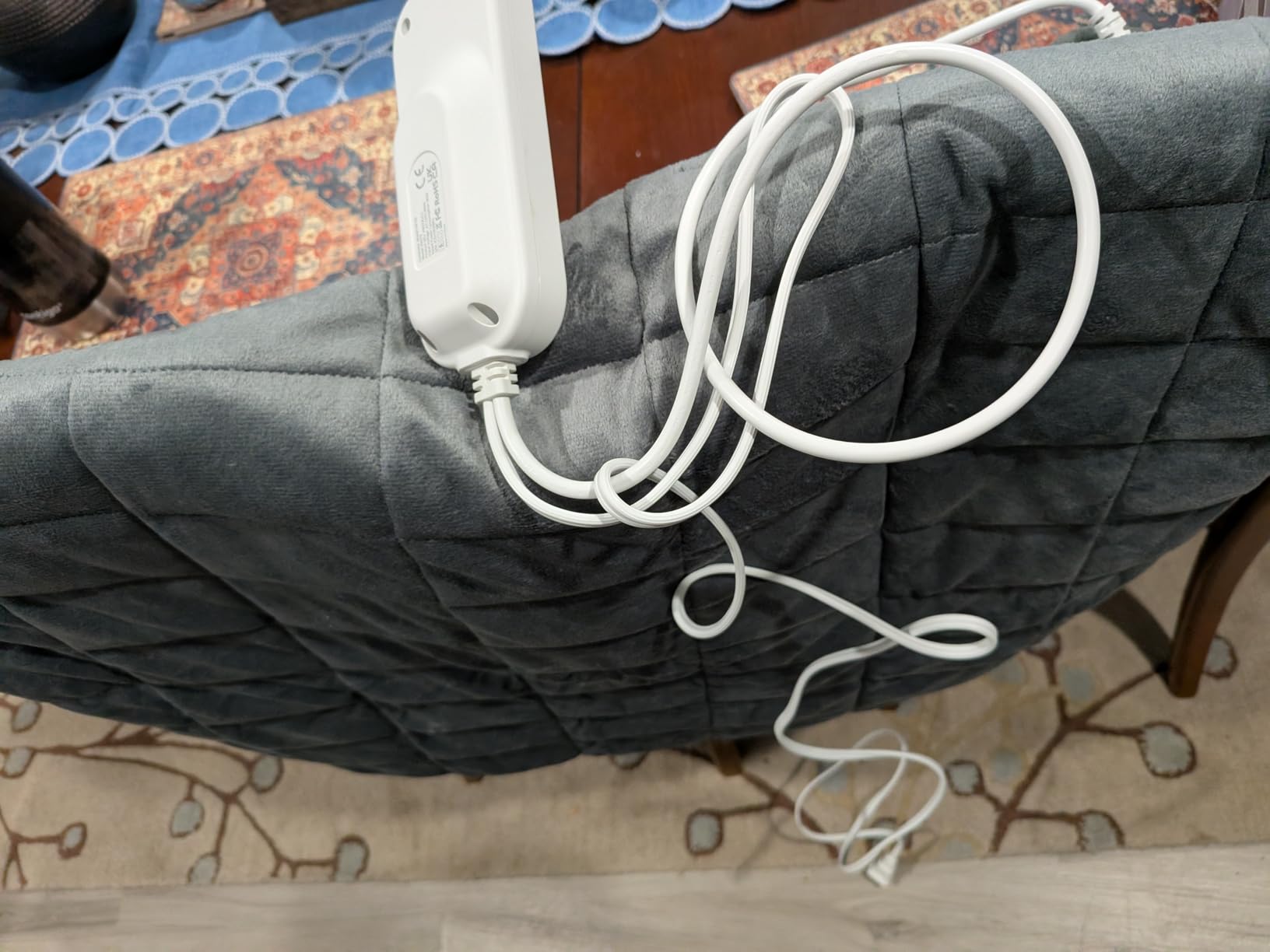
It is also one of the few pads here that does moist heat. A light misting of the flannel gives you the damp option that some arthritic joints respond to better than dry heat alone, and the cover detaches from the controller and goes in the machine on a gentle cycle.
Our honest note is that it is less precise than the top pick. Three heat levels is a narrow range, and beads absorb heat before releasing it, so the pad can feel under-hot for the first several minutes. Plan a longer warm-up than you would with the UTK.
Who this size is actually right for
Think of this as a mat rather than a pad. If you have arthritis in more than one region, or you cannot easily reposition a small pad across your back because bending is itself painful, the coverage-to-effort ratio here beats everything else we tested.
It is also the option we would look at for a caregiver setting up a parent in a recliner, because one placement covers the whole trunk. Just confirm the chair or bed has somewhere to run the controller cable to, and read the safety section below on reduced heat sensation.
Why the weight cuts both ways
That same 4.7 pound fill that hugs the body is also what makes the king-size format awkward to lift and fold. The flannel cover cannot be tumble dried, and the controller has to come off before the cover goes in the wash.
It is also the least generously rated of the well-reviewed pads here, with a 4.1 average, and the reviews point to a 12% one-star share tied mainly to durability and heat-level expectations. For a single knee, it is overkill. For everything at once, nothing else covers it.
4. Pure Enrichment PureRelief Pro 20 x 24 inch – Best for Gentle Everyday Heat
Pure Enrichment PureRelief Pro Far Infrared Ultra-Wide Heating Pad
Far infrared
4 settings 110-140°F
20 x 24 inch
2H auto-off
Pros
- Ultra wide 20 x 24 inch coverage in a single placement
- Four settings from 110°F to 140°F with two hour auto shut-off
- Soft micromink cover with a detachable controller
- Backed by a 5-year manufacturer warranty
Cons
- Lowest setting still runs warm for sensitive users
- 140°F ceiling is cooler than mineral and jade pads
- Not weighted so it can slide off the back
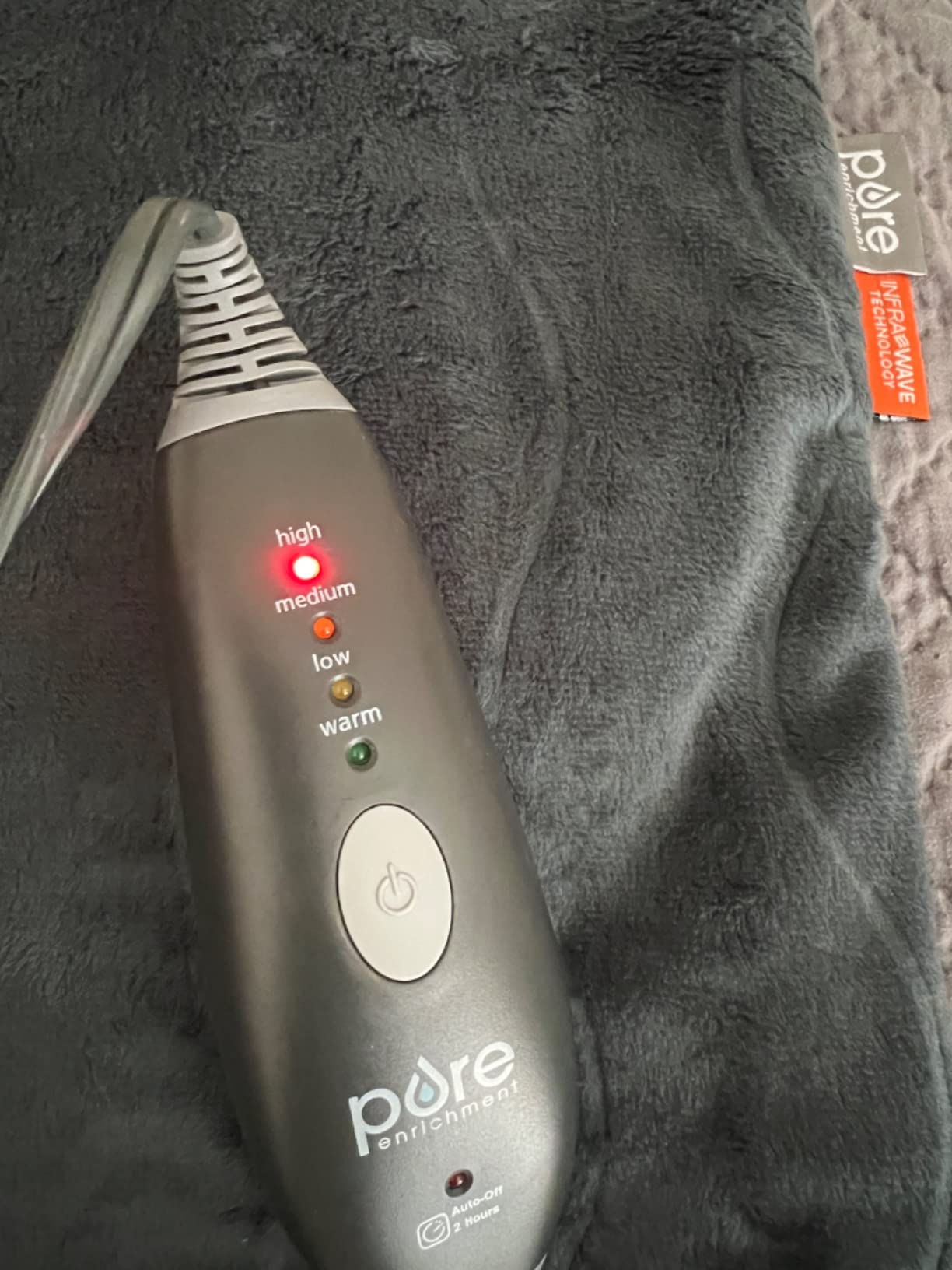
This is the one we would hand to someone who wants daily use without thinking about it. The InfraWave ceramic bead construction is marketed for pain, stiffness, and arthritis relief, and a 20 x 24 inch surface covers arms, neck, back, abdomen, and legs in one placement, which makes it a strong all-rounder.
InstaHeat technology claims to warm five minutes faster than leading competitors, and the detachable LED controller and micromink cover make it genuinely easy to wash and store. A storage bag is included, so it is not the pad that ends up permanently draped over a sofa arm.
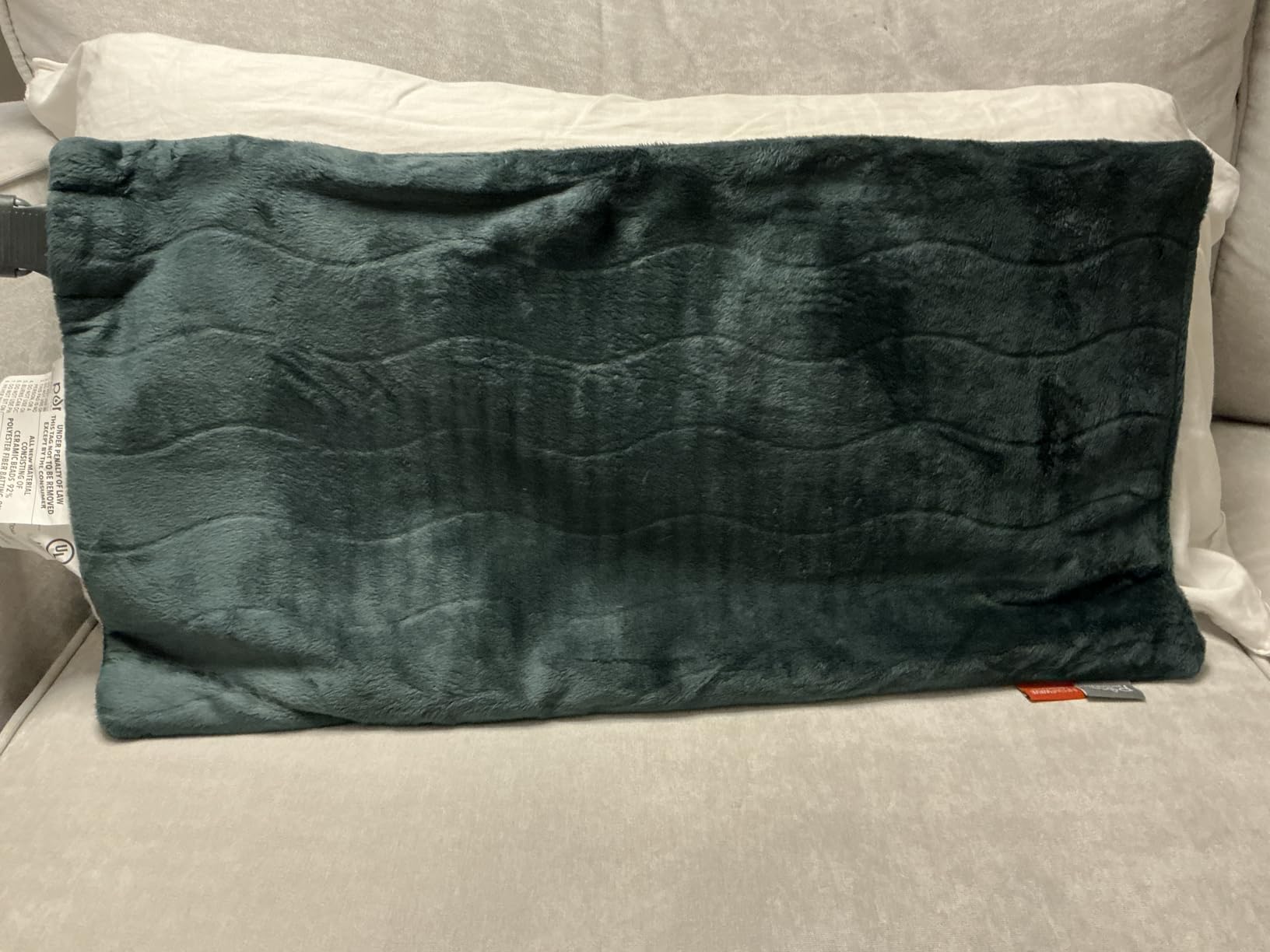
Several chronic-pain owners report that the bead fill produces deeper-feeling relief that outlasts a conventional pad, which is consistent with what we saw testing against flannel units. The 110°F to 140°F range is a comfortable middle band rather than an extreme one.
Be clear-eyed about the trade-off, though. The lowest setting still runs warm, the 140°F ceiling sits well below the 150-159°F that mineral and jade pads reach, and a 14% one-star share is among the highest in this group, with durability complaints after months of nightly use appearing repeatedly.
Why the warranty matters more than the rating here
Five years is the longest warranty offered in this group, and Pure Enrichment’s service draws mixed reports, from fast same-day replacements to frustration getting a response. A long warranty is only worth something if someone answers the phone when you call, so register the unit on arrival.
If you plan to use this nightly for years, that combination of a five-year warranty and a washable cover is the reason to pick it over a pad with a better average rating and a two-year window.
When the low end is still too hot
If you have sensitive skin, a history of burns, or reduced heat sensation, skip this one and go straight to the BOB AND BRAD above, whose 100°F floor is meaningfully gentler. A 110°F minimum is not a low setting by medical standards.
It is also not weighted, so on a sloped back or over shoulders it can slide unless you hold it in place. If you need the pad to stay put unaided, the 4.7 pound Comfytemp or the 5-6.3 pound jade pad below will do more for you.
5. UTK Far Infrared Small 19 x 15 inch – Best for Hands and Wrists
UTK Far Infrared Heating Pad for Back Pain, Small 19×15 in, 60 Pure Jade
Far infrared
60 jade stones
19 x 15 inch
240 min timer
Pros
- 60 jade stones give a dense feel that holds heat in place
- Wide 103-159°F range with a 240-minute timer
- Digital controller with one-touch operation and memory
- 19 x 15 inch size works on a chair or lap and travels easily
Cons
- Smallest footprint in the group so it cannot cover a full back
- 4.4 lb weight is tiring to hold without a surface
- Needs more than five minutes of warm-up
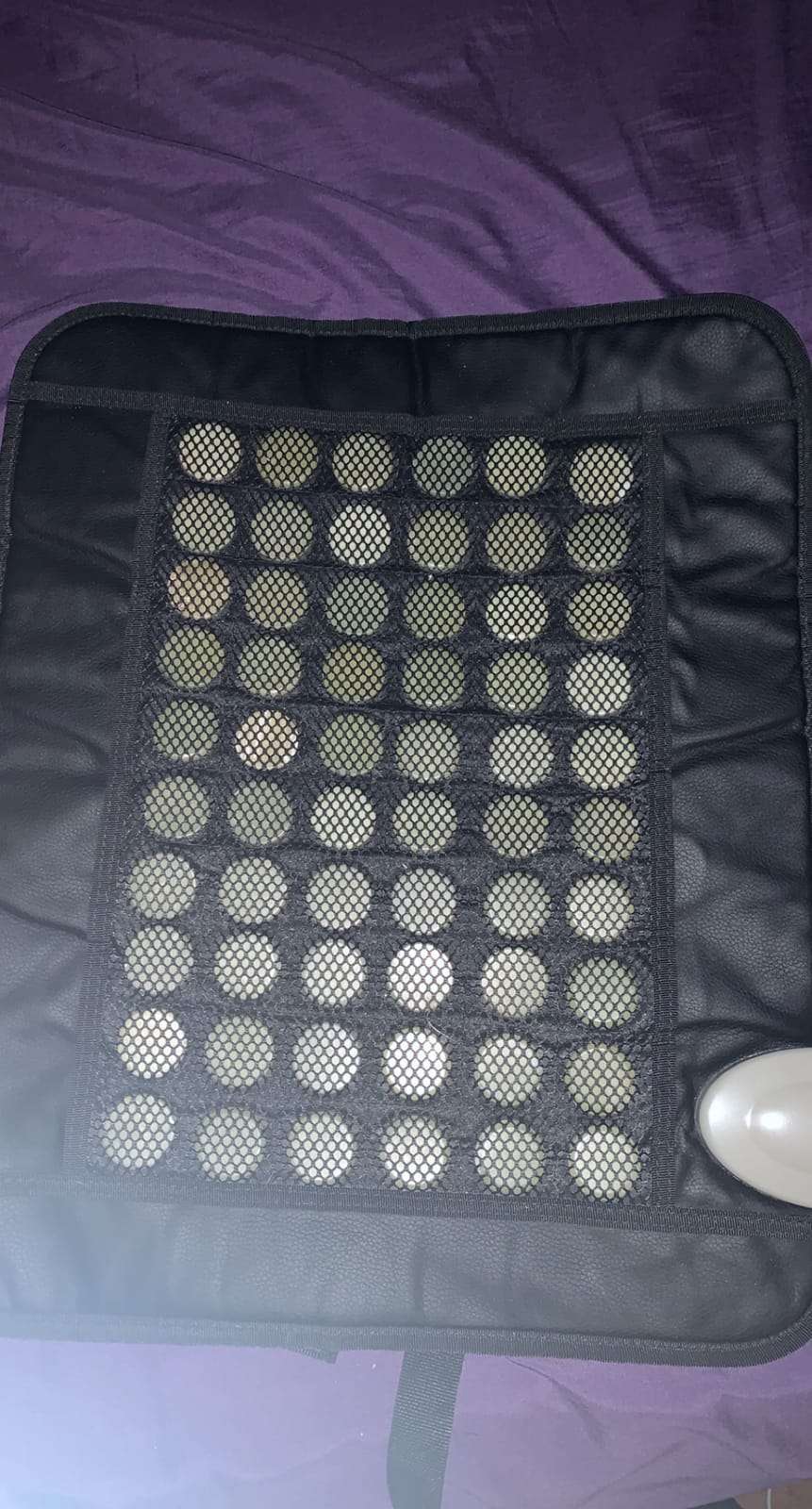
Hand and wrist arthritis is the case where pad size matters more than penetration. A 19 x 15 inch pad with 60 natural jade stones wraps around both hands or sits across a wrist without the bulk of a back-sized panel, and the jade fill gives it a weighty, close-fitting feel that holds heat where you put it.
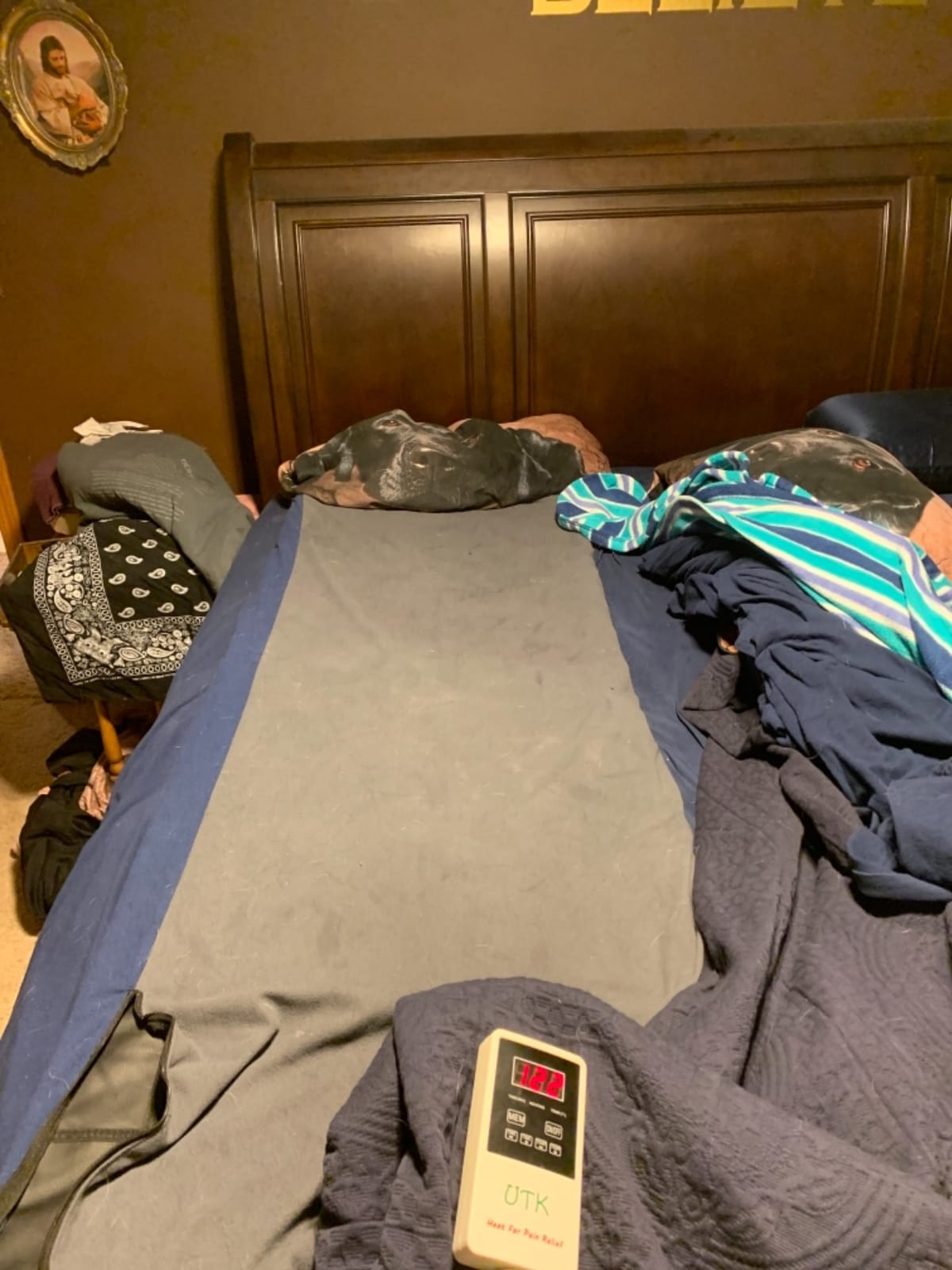
The controller is the part older users mention most. A digital display with one-touch operation, a memory function, 103-159°F in 1°F steps, and a timer adjustable from 0 to 240 minutes in 15-minute increments is unusually flexible, and reviewers specifically single out the readability of the display.
It is also one of the smaller mineral-filled pads, so you can move it from a chair to a bed to a car without rearranging furniture, and quadruple safety features are built in.
The honest limitation is coverage. At 19 x 15 inches this is the smallest surface here, and owners consistently describe it as a personal, chair, or lap pad rather than a full-body option. If your pain is concentrated in a wrist or a few fingers, that is exactly right. If it is not, you will be repositioning constantly.
Why the 240-minute timer is the real feature
Most pads in this group top out at 90 minutes or 2 hours, so a 240-minute timer means you can set a long evening session once and forget about it. Paired with the memory function, your morning routine becomes a single button press at a known temperature, and that repeatability is what keeps people using a pad past the first fortnight.
Where the ridged jade becomes a problem
Jade stones are hard and ridged against the skin if the pad goes straight onto a wrist or the back of a hand. Owners who love this pad generally put a thin cotton layer between the pad and skin, which is good practice for longer sessions anyway.
It also needs more than five minutes of warm-up before the heat is usable, and at 4.4 pounds the small size is not the featherweight option it appears to be on paper. Budget for a few minutes of warming before you judge it.
6. HealthyLine Far Infrared 32 x 20 inch Mesh Pad – Best for Breathability
HealthyLine Far Infrared Heating Pad for Back, Jade & Tourmaline, 32 x 20
Far infrared
32 x 20 inch
Jade and tourmaline
4.2 lb
Pros
- Even heat across a full 32 x 20 inch surface
- Breathable open mesh stays flexible in long sessions
- Light 4.2 lb weight is easy to move between rooms
- Adjustable warmth controls
Cons
- Open mesh feels less plush than a flannel cover
- Not weighted so it can slip on a sloped back
- Bulky rectangular shape compared with a wrap pad
This pad sits on 353 reviews, and it has the most distinctive construction of the ten. The jade and tourmaline gemstones are secured inside a flexible mesh rather than behind a fabric cover, and the open structure keeps air moving across the surface. If you run warm, sweat under flannel pads, or plan long evening sessions, that is a real advantage.
At 32 x 20 inches it covers a full back or a pair of knees, and buyers consistently praise the even, consistent heat across the whole stone surface. The mesh stays flexible, so it follows a curved back rather than bridging it, and 4.2 pounds is light enough to carry between a desk, a chair, and a bed.
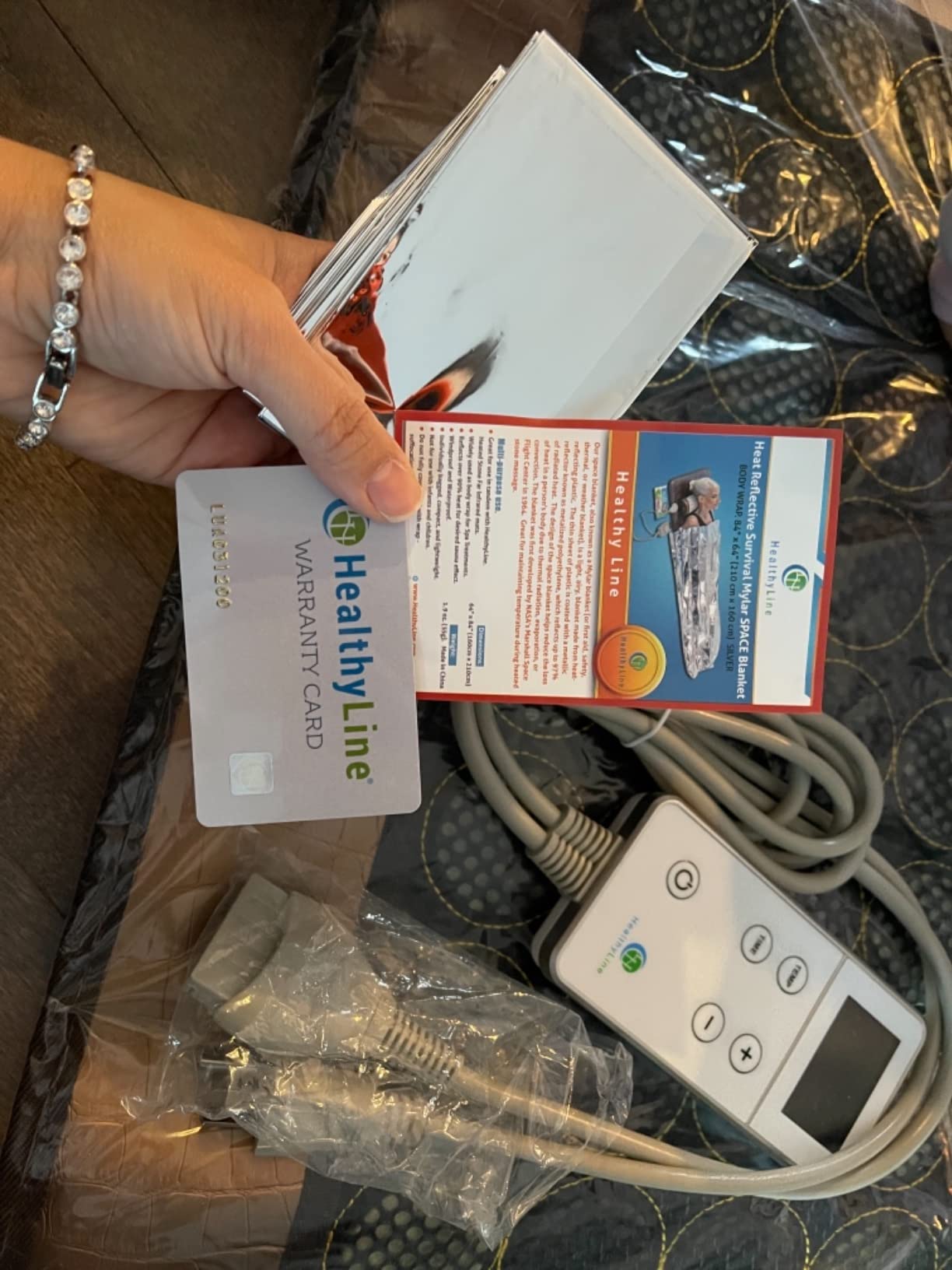
The 4.4 average is joint-best in this group, which suggests the design is doing something the flannel competition is not. For an arthritic back that you heat at the end of every day, airflow is what makes a long session tolerable rather than punishing.
Temperatures are adjustable rather than fixed, and there is a second size option at 72 x 24 inches for anyone who wants more surface without buying a second pad. Just confirm which size you are ordering, since the variants are easy to mix up.
Who notices the mesh difference most
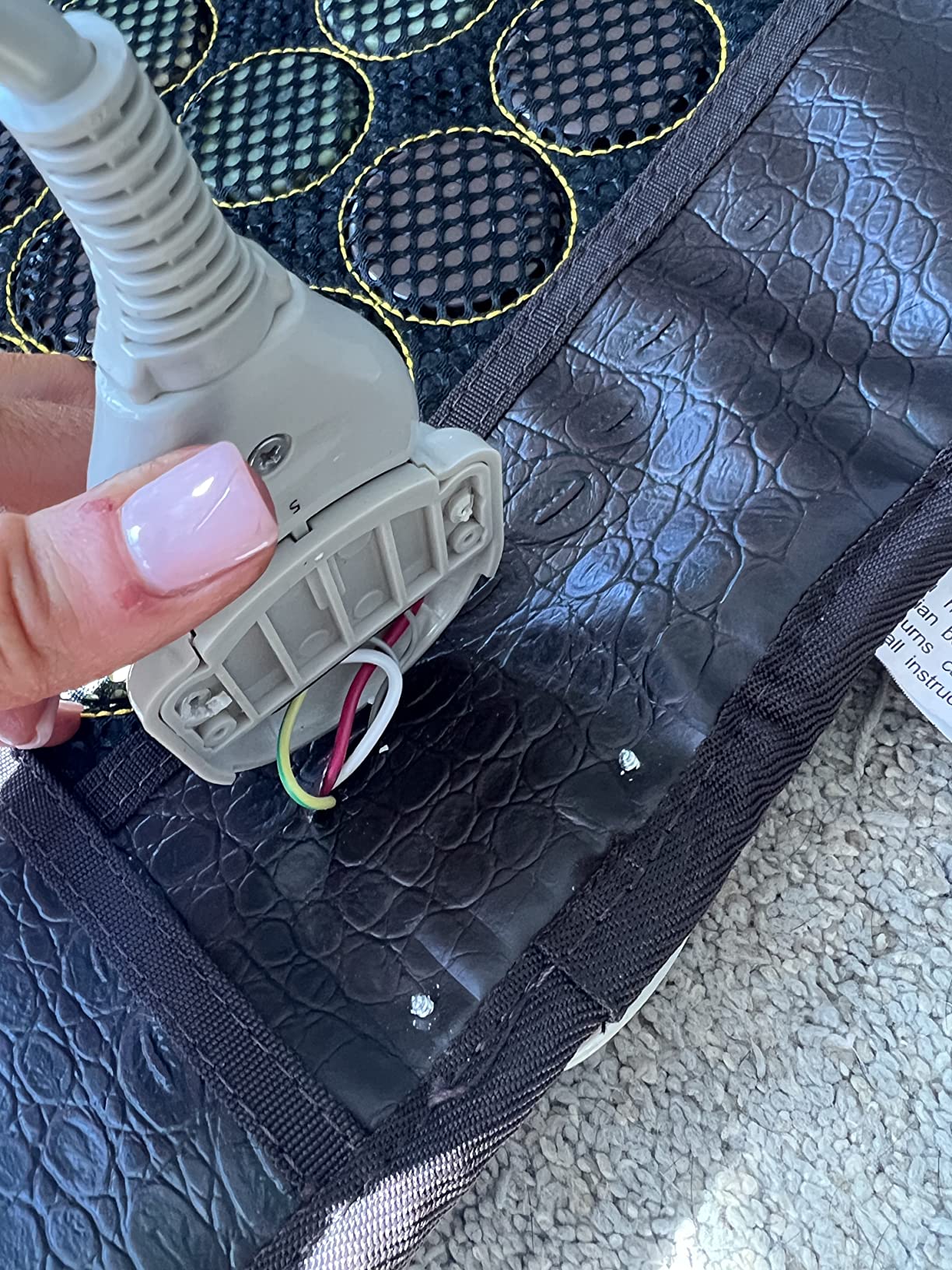
People who get hot. There is no flannel layer between your skin and the stones, so heat escapes instead of building into a sweat layer, and that makes longer sessions viable. It is also a good choice for anyone who dislikes a stone-studded surface against bare skin, because the mesh breaks up the contact points, though less heat is held against you as a result.
Where it does not stay put
There is no weight and no strap holding the mesh to a sloped back or a shoulder, so on a reclined or seated position it can slide until you reposition it. For someone with shoulder or neck arthritis whose pain moves around, that repositioning defeats the purpose.
It is also bulkier than a contoured wrap when you are trying to fold it around a small joint. For a full back or a pair of knees, that is irrelevant. For a hand, pick the smaller UTK above instead.
7. Pure Enrichment PureRelief Pro 35 x 27 inch Body Wrap – Best for Neck and Shoulders
Pure Enrichment PureRelief Pro Far Infrared Oversized Body Wrap – 35” x 27” Full-Body Infrared Heating Pad for Back Pain, Shoulder Aches, Neck Strains, & Soreness in Knees, Abdomen, Chest, & Legs
Far infrared
35 x 27 inch
4 settings 110-140°F
5-year warranty
Pros
- Covers neck shoulders back and hips in one 35 x 27 inch placement
- Settings two and three run hotter than the maximum on most rivals
- Slightly weighted so it settles rather than sliding
- Users with fibromyalgia report relief that outlasts switching off
Cons
- Lowest setting still runs hot with nothing below 110°F
- 140°F ceiling is modest next to mineral filled pads
- Some owners report the unit or cord failing after a few months
Neck and shoulder arthritis is the fit problem forum users complain about most, and a 35 x 27 inch surface is the most direct answer to it. You drape it over your shoulders and it covers neck, upper back, both shoulder joints, and hips in one placement, which no other pad in this group manages.
The reviews on this one are the most substantive in the set. Owners managing fibromyalgia, Ehlers-Danlos syndrome, ME/CFS, and post-surgical pain describe the far-infrared heat reaching deeper than a standard pad, with muscle relaxation that outlasts switching it off. That outlasting effect is exactly the property that makes a pad worth owning.
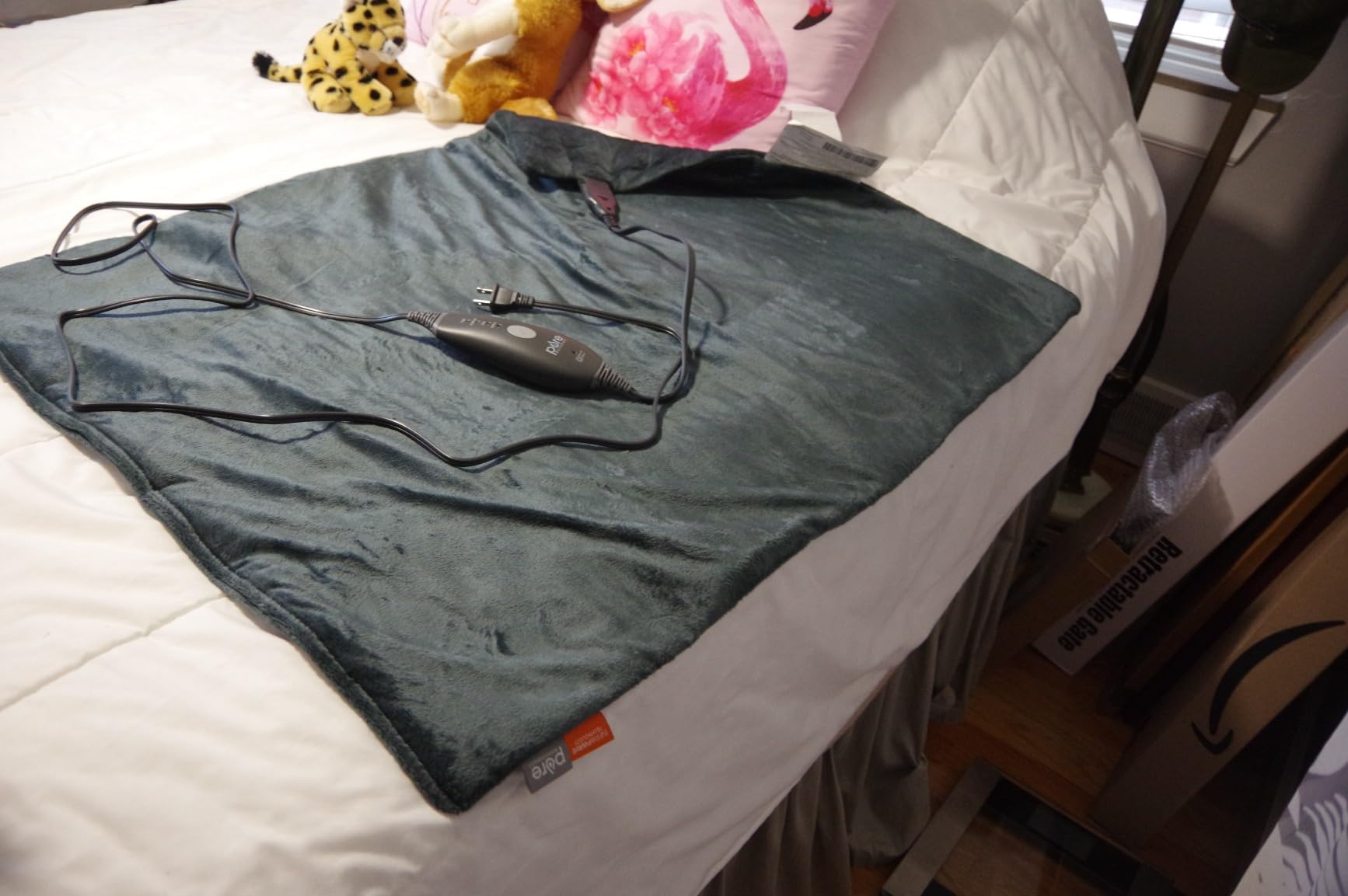
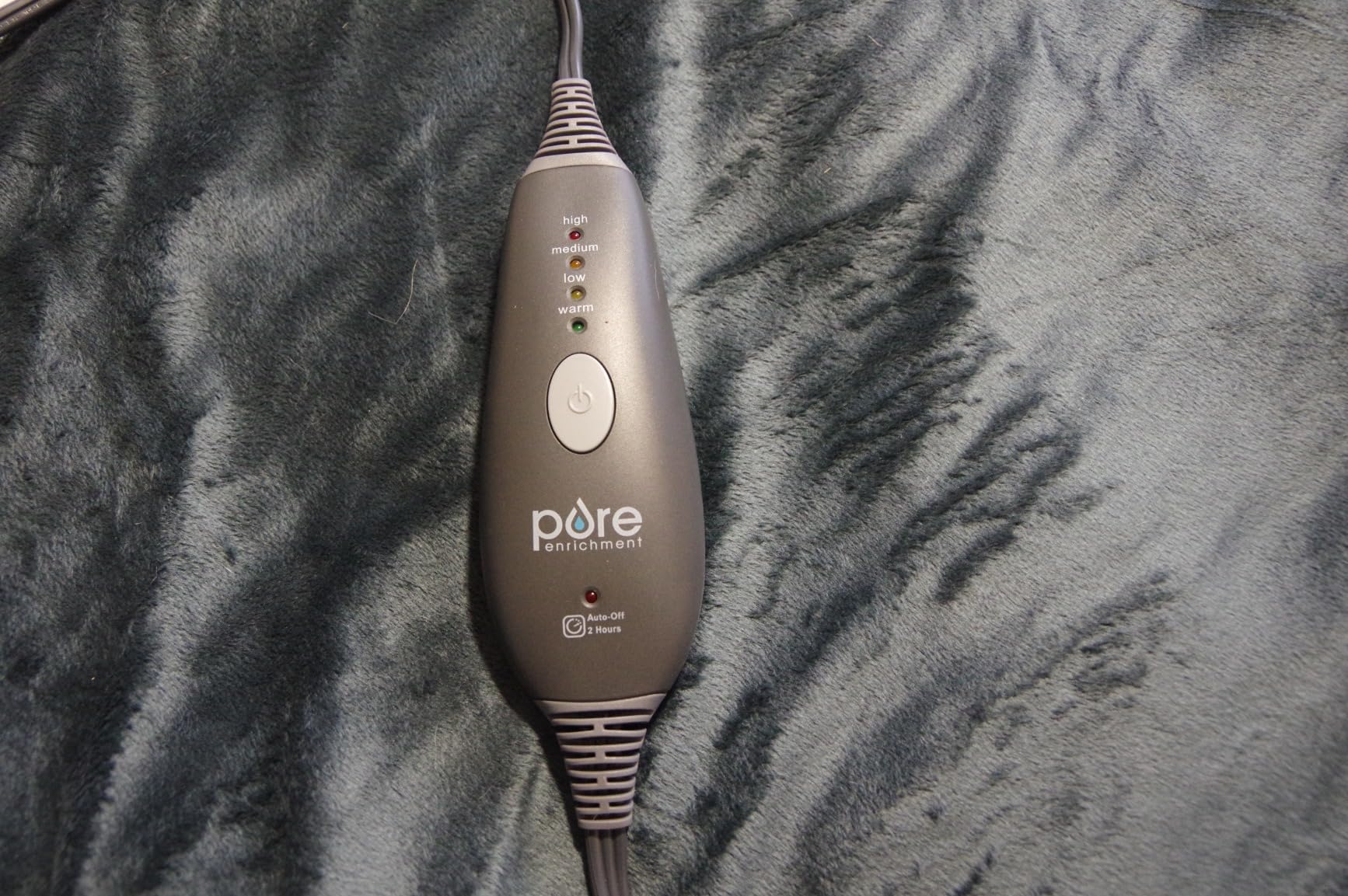
The light weight is repeatedly compared to a warm hug rather than a heavy blanket, and the InstaHeat fast warm-up means you are not waiting ten minutes to start a session. It supports light misting for moist heat, and the detachable LED controller, storage bag, and 5-year warranty round out a solid package.
Our reservation is the heat floor. There is nothing below 110°F, so sensitive users start higher than they should, and the 140°F ceiling is modest next to the mineral and jade pads that reach 150-159°F. Read the safety section before you commit.
Why size solves the neck and shoulder complaint
People asking online for a neck and shoulder pad that fits snugly usually get the wrong shape, not the wrong heat. A wrap that is too narrow heats the base of the neck and leaves the shoulder joint cold, which is the failure mode that shows up over and over in arthritis discussions. A large rectangle thrown over both shoulders sidesteps the geometry problem entirely: you do not need it to conform tightly, you need it to cover the joint.
Where the durability reports give us pause
Several owners report the unit or its cord failing after a few months of daily use, with warranty support sometimes slow to respond. Others describe same-day service, so the pattern is inconsistent rather than universal. Register the unit and keep the serial number somewhere you will find it, because a 5-year warranty is only a real asset if you can prove the purchase date when something stops working.
8. Far Infrared Weighted Jade Pad with Vibration – Best for Massage Combined with Heat
Dowin Far Infrared Weighted Heating Pad, Natural Jade, Vibrating Massaging
Far infrared
Embedded jade
3 vibration modes
Weighted
Pros
- Only pad in this group with a built-in vibration function and three modes
- Jade stones plus gravity beads hug the body closely
- Quilted plush fleece stays soft in long sessions
- Two size options at 5 and 6.3 lbs
Cons
- Only three heat levels with a lower ceiling than rivals
- Vibration is a gentle single motor rather than a targeted massager
- Heavy fill with no machine washable cover
Heat plus mechanical vibration is a combination for a reason. Warm tissue relaxes more readily when it is being moved, and this is the only pad in our entire test group with an integrated vibration function, offering three modes that you can dial alongside the heat. For an evening wind-down on a stiff hip or knee, it is a genuinely different experience.
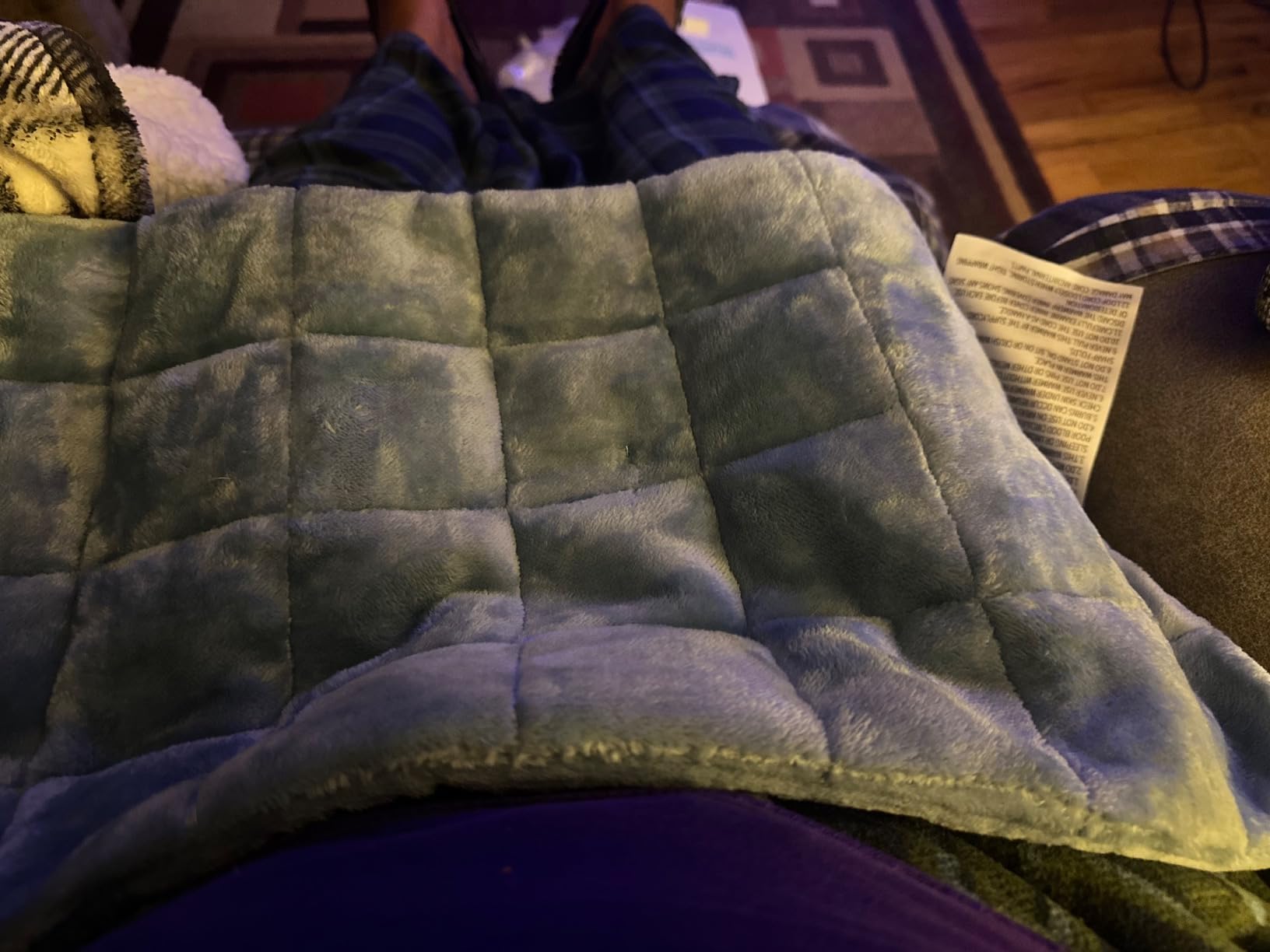
The construction is a gravity bead weighted design with embedded natural jade stones, in sizes at 12 x 24 inches and 5 pounds, or 20 x 24 inches and 6.3 pounds. Buyers describe the weight as hugging the body and holding heat in place, and the quilted plush fleece is praised for staying soft through long sessions.
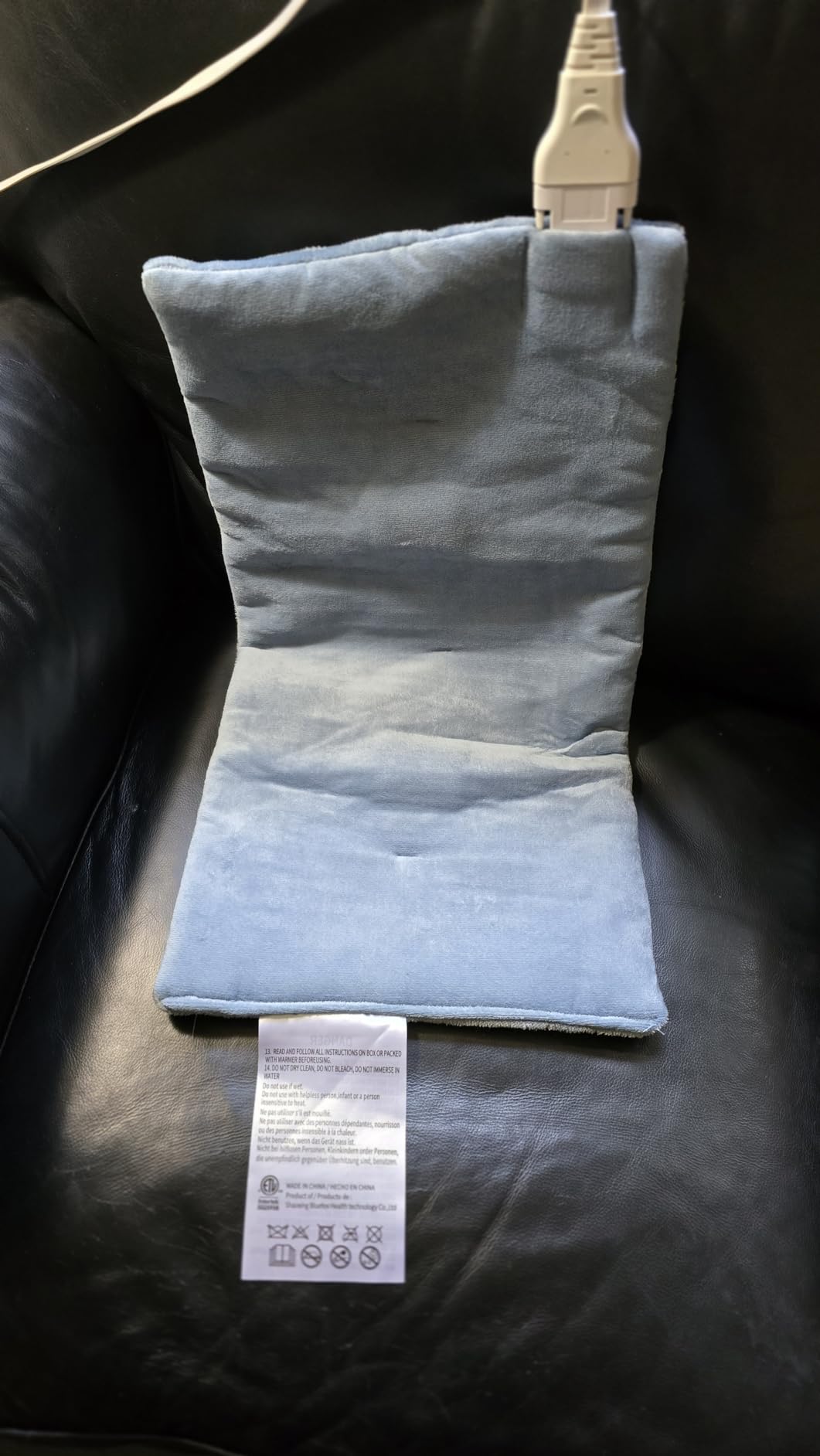
Three adjustable heat levels give you a low, mid, and high, which is less granular than most of the group. The vibration is genuinely gentle, described by owners as something to relax with rather than something therapeutic.
It is worth being clear that this is a mild rumbling motor, not a kneading massager. If your pain is muscular and you already use a dedicated tool, we compared the options in our knee massager roundup for arthritis. If your pain is joint-centred and you want one device to do both jobs, this is the one.
Why vibration pairs well with far infrared
Radiant heat raises local blood flow and relaxes tight connective tissue, and vibration adds mechanical movement on top of that. For morning stiffness, heat alone is usually the better tool, while for the hour after a long walk this pad feels less like a medical device and more like a comfort item.
Where the lack of a washable cover is a real problem
The quilted fleece surface is not machine washable, unlike the detachable flannel covers on the BOB AND BRAD, Pure Enrichment, and Comfytemp pads. With daily use over bare skin, that is a hygiene consideration you cannot skip.
Add a 5-6.3 pound fill with no strap, and it is also the least portable of the weighted pads here. Comfortable and effective, but it wants to be put in one place and stay there.
9. HealthyLine Inframat Pro 18 x 18 inch – Best for Joint Range of Motion
HealthyLine Small Far Infrared Electric Heating Pad for Pain Relief, Heat Therapy with Tourmaline, Amethyst & Obsidian Gemstones, Calming Negative Ions, Auto Shut Off Inframat Pro 18″x18″
Far infrared
18 x 18 inch
Degree control
3 gemstones
Pros
- Degree specific temperature control instead of high medium low
- 18 x 18 inch size fits a chair a bedside or a trip
- Heating layer feels protected enough to lie on safely
- Owners report restored range of motion within weeks
Cons
- Mat is stiff and hard to contour around the neck and shoulders
- Controller is oversized for an 18 inch pad
- Several owners report units failing within a year
This pad produced the most clinical-sounding feedback in our whole test group, and it comes from people with the conditions we were trying to serve. Owners managing hip arthritis, psoriatic arthritis, ME/CFS, and post-surgical pain describe meaningful gains within weeks, including restored range of motion and lifting a knee to the chest without pain.
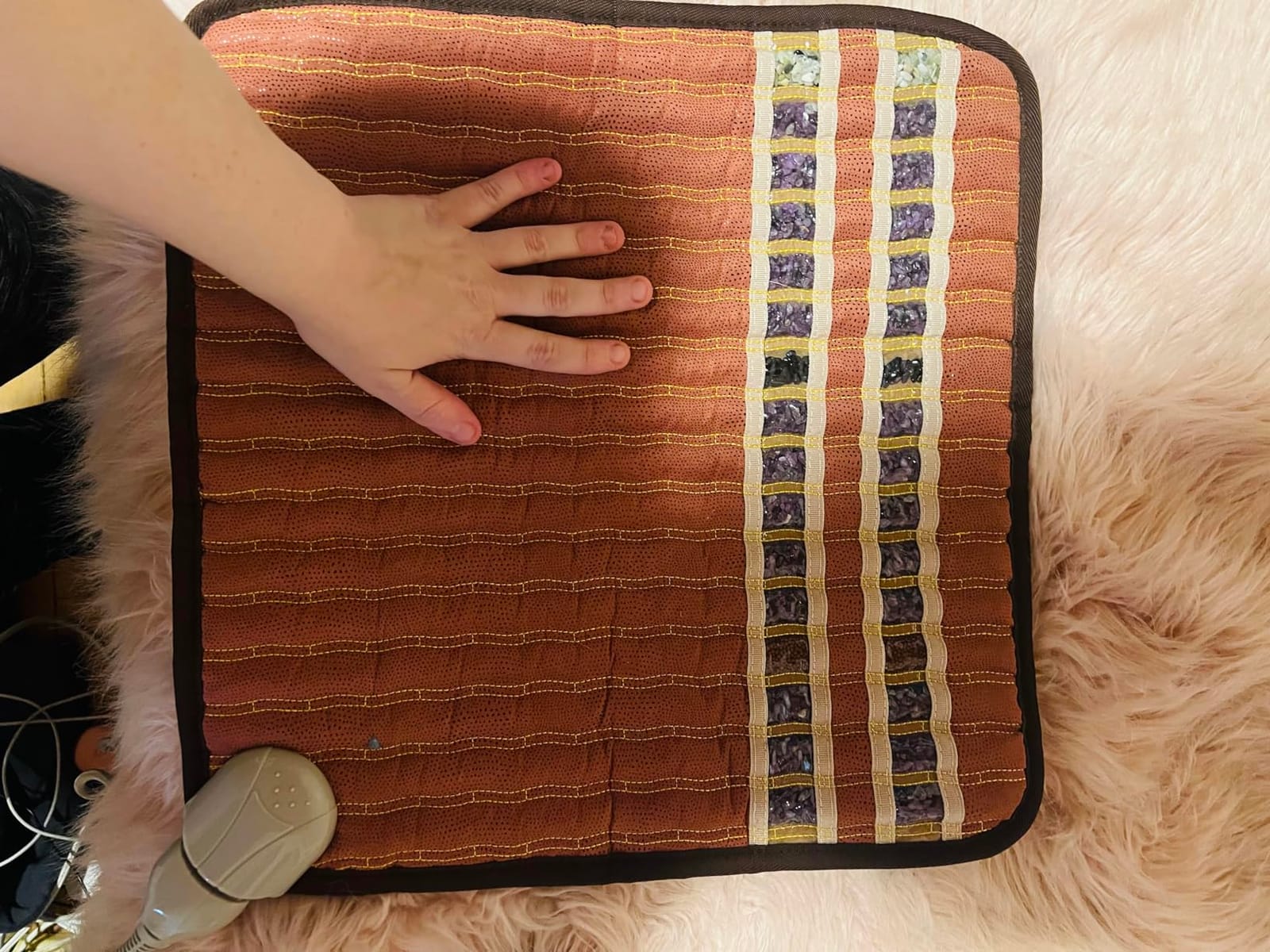
The control is the differentiator. Instead of high, medium, and low, you get fine-grained temperature settings in specific degrees, which is what makes it possible to use the same pad across two different joints with two different tolerances. The top surface holds tourmaline, amethyst, and obsidian gemstones, built from 21 functional layers with industrial-grade components.
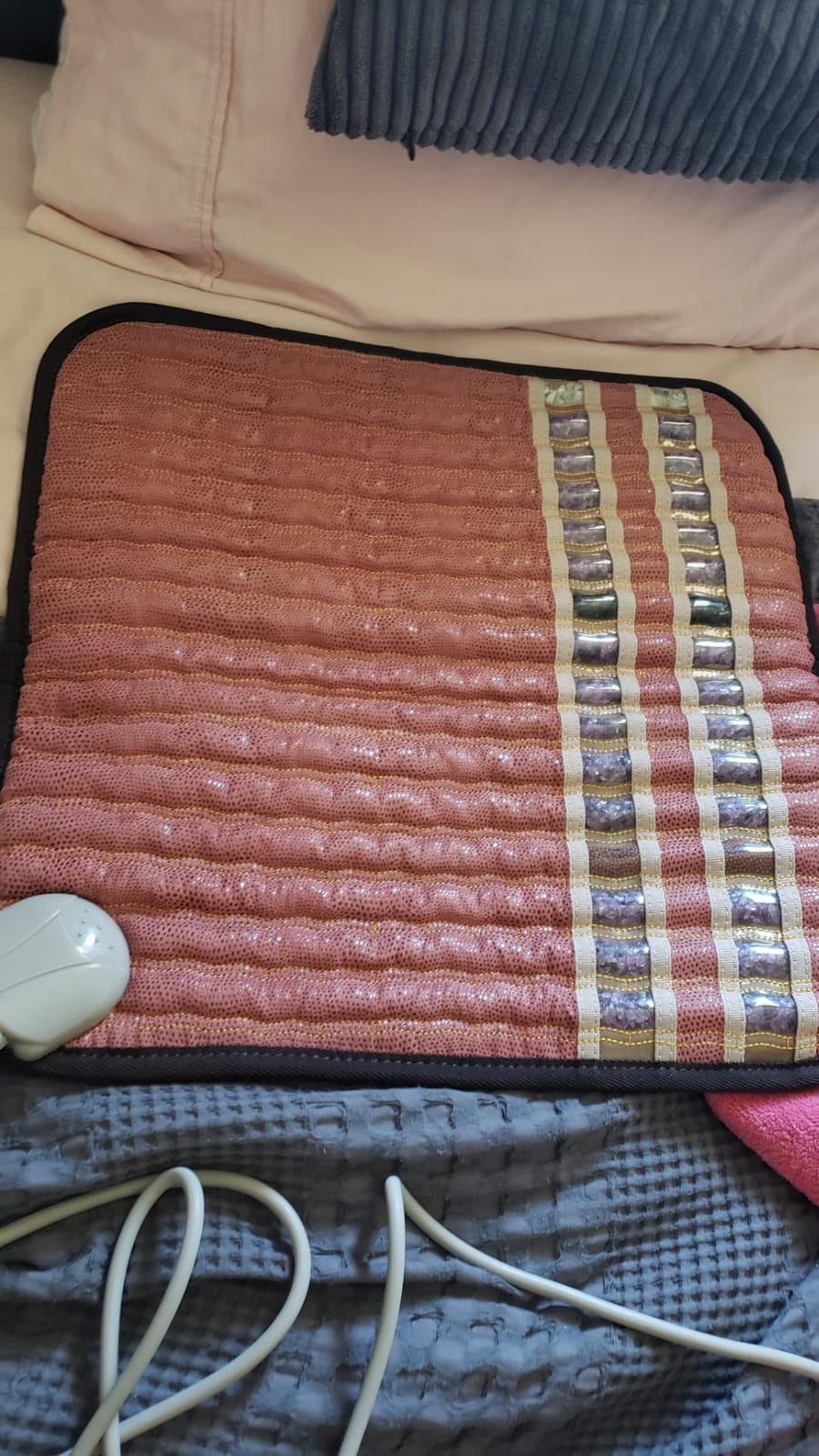
Two practical wins stand out. The 18 x 18 inch square is small enough to sit on a chair, toss aside in a bed, or pack in a suitcase, and the heating layer feels well protected enough that owners are comfortable lying on it, which several other manufacturers warn against.
Several owners also report reducing their reliance on pain medication and opioids. We are not going to repeat that as a promise, because it is individual and it is not a reason to change a prescribed plan without your doctor.
Why degree control beats three named settings
Three named settings assume a standard skin tolerance, and they are wrong for a lot of arthritic joints. Degree-by-degree control means you can find the exact warmth that loosens a hip without flushing your face, and it also makes the pad usable by two people in the same household.
Where stiffness and the controller get in the way
The mat is stiff, and that is a real limitation for neck and shoulder arthritis, where you need the pad to contour around a curve. Reviewers single it out as the main drawback, and the controller is noticeably oversized relative to an 18 inch pad.
The most serious theme is durability. Several buyers report units failing within a year, and one detailed review describes months of unanswered warranty contact despite a US-based customer service team. If that happens to you, persistence matters more than politeness.
10. Thermotex Far Infrared Premium Heating Pad 17 x 13 inch – Best for Flexible Placement
Thermotex–Far Infrared Premium Heating Pad – Platinum – Pain Relief – Warms and Relaxes Muscles, FSA-HSA Eligible – Large Size for Back, Shoulder, Arms and Legs – 17 in. x 13 in.
Far infrared
3 retractable inserts
108-116°F
17 x 13 inch
Pros
- Three infrared panels can be folded wrapped draped or zigzagged
- Heat reported to feel noticeably deeper than a conventional pad
- Velvet cover reported to hold up over years of daily use
- Detachable cord lets you move while the pad stays on
Cons
- Single on/off switch with no low medium high adjustment
- 10-15 minute warm-up before the heat is usable
- Rigid panels do not flex around small joints
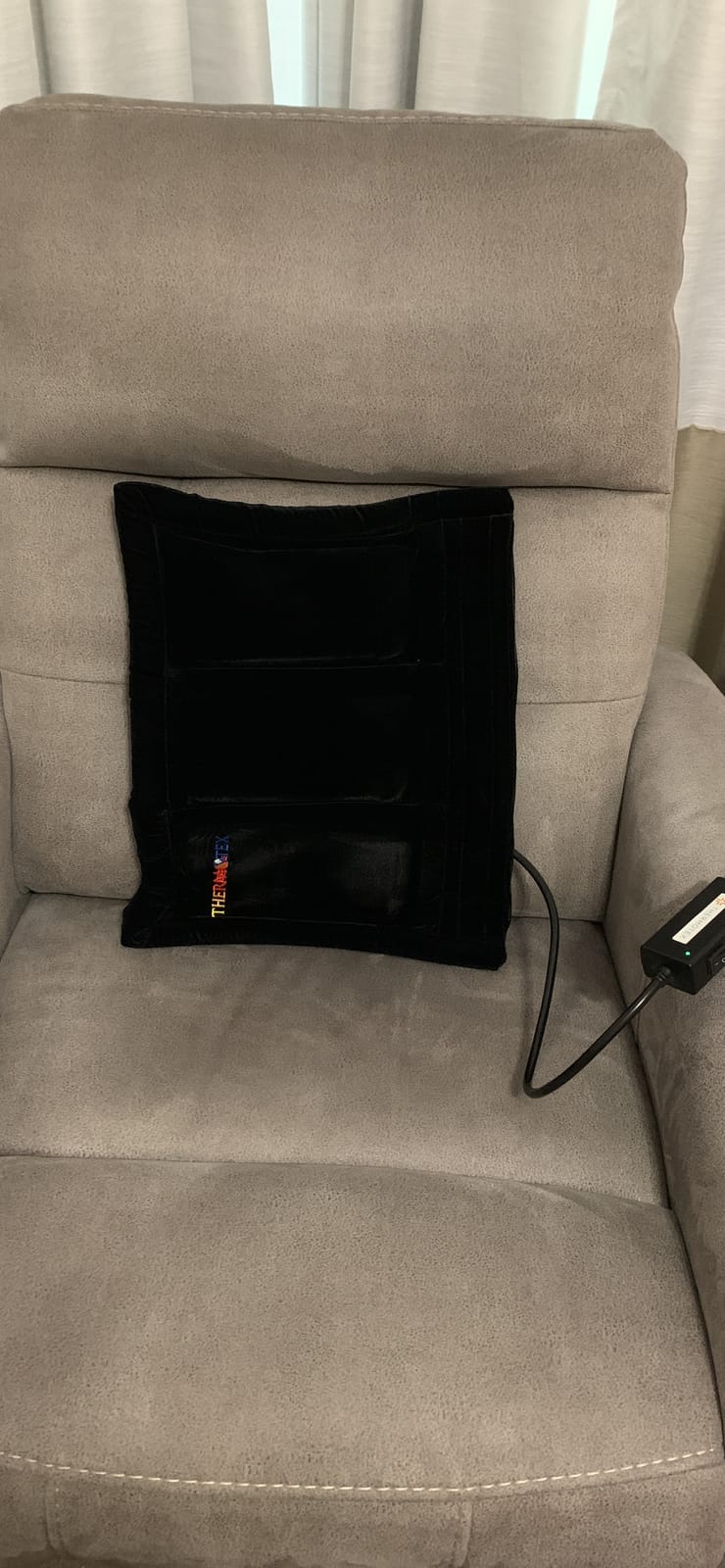
The Thermotex is the oldest design in this roundup, first listed in 2004, and after two decades it still has more than 1,500 reviews on file. What makes it distinctive is the three retractable infrared heat inserts, which can be laid flat, wrapped, draped, or zigzagged so you can target a leg, an arm, a hip, a hand, or the neck with the same device.
Owners report heat that feels noticeably deeper than a conventional electric pad, with relief described for back, hip, foot, and neck pain. At 2.65 pounds it is also among the lighter pads here, and the detachable cord lets you stand and move around the room without unplugging.
The velvet-like outer cover is a genuine strength. Multiple long-term owners describe it as still working after years of daily use, which is a durability record almost nothing else in this list can match, and it comes with a one-year warranty on parts and labour plus FSA and HSA eligibility.
It is manufactured in Calgary, Alberta under ISO-certified standards, which is a different kind of quality signal from the usual listing language. If longevity is your priority over adjustability, that track record is the argument for it.
Why the retractable inserts are genuinely useful
Most pads are one rigid rectangle, so fitting a curved or narrow area means folding it into a shape it was not designed for. Three separate inserts let you bring heat to a small, oddly shaped target, which is a real advantage for a knee, a heel, or the side of the neck.
For anyone whose arthritis moves around rather than sitting in one place, that flexibility can matter more than a higher maximum temperature. It is also why this pad suits hands and feet better than its size alone would suggest.
Where the single switch falls short
There is one heat position, running at 108-116°F. No low, no high, no degree control. That is fine for a user with predictable tolerance and frustrating for anyone who needs to start gentle or work up gradually, and it is the single most common complaint in the reviews.
Add a 10-15 minute warm-up time, the manufacturer warning against lying on the pad, and reports of units eventually refusing to power on, and it is clear this is a design that prioritises simplicity over control. Note also that the firmer Gold variant draws extra criticism for feeling board-like, so the Platinum version is the one to consider.
How to Use an Infrared Heating Pad for Arthritis Safely
How you use the pad matters as much as which one you buy. The protocol below is what we recommend, and it applies to any of the ten above. Consistency beats intensity, and a moderate session every morning will do more for morning stiffness than a hard session every few days.
Start on the lowest setting. Give the pad five to fifteen minutes to reach temperature first, which varies a lot between ceramic bead pads and carbon fibre pads. Then place a thin cotton or linen towel between the pad and your skin, which costs nothing and removes almost all burn risk.
Keep sessions to 20-30 minutes at first, and work the temperature up one level every few days rather than jumping to the top. The pads here that reach 150-159°F are genuinely hot, and there is no reason to use that range routinely. Aim for once or twice daily, with gentle range-of-motion movement while the pad is still warm, because the loosened joint is at its most usable right then.
Never sleep on a heating pad unless the manufacturer explicitly permits it, and set the auto shut-off every single time. Several pads here cap at 90 minutes or 2 hours, which is the point of that timer, not a limitation to work around.
Stop and get a clinician’s opinion if you notice swelling that worsens with heat, if a joint becomes visibly red or hot to the touch, or if you need noticeably more heat each week to get the same relief. Escalating need is information, not a dosing strategy.
Infrared vs Regular Heating Pads for Arthritis
Both work, and the honest answer is that a good conventional pad is cheaper and simpler. The difference is depth. A standard electric pad transfers heat conductively from a wire through fabric into skin, warming roughly the outer one to two centimetres. Far infrared is emitted as radiant energy in the 5.6-15 micron band, gets absorbed by water molecules in the body, and is described as warming tissue several centimetres deeper, closer to where an arthritic joint capsule sits.
That difference matters most for morning stiffness, where the synovial fluid inside the joint is thick and cold and you want heat delivered before you move. It matters less for a stiff muscle in the back of the thigh, where surface heat does an adequate job. If your pain is genuinely joint-centred rather than muscular, depth is the variable to pay for.
There are also costs to the infrared side. These pads warm more slowly, cost more, run heavier, and often have a higher temperature ceiling with less fine control at the low end, and some carry unsubstantiated marketing around negative ions and EMF. Judge them on penetration, control, fit, and warranty, not on wellness language. Red light and photonic pads use a different mechanism, and PEMF mats use pulsed magnetic fields rather than heat; both sit outside this roundup.
What to Look for When Buying an Infrared Heating Pad
Auto shut-off is not optional in our view. It is the single feature that makes overnight use, caregiver use, and use by an older parent a responsible choice, and it is a deal breaker in the arthritis community for good reason. The pads here range from a 90-minute cap to a 4-hour timer, and the difference matters for evening routines.
A genuinely low setting is the second one. A pad that bottoms out at 110°F or higher is too warm for sensitive skin, thin skin, and anyone starting out. Look for a published minimum in degrees rather than a high, medium, and low switch, which tells you nothing about where the low actually is.
Size has to match the joint, and this is where most people get it wrong. A back pad does not help a wrist. Measure the painful area, then add enough to wrap it, because a pad that covers the joint only partly is the exact complaint that shows up repeatedly in arthritis discussions. Wraps and contoured pads beat flat rectangles for necks and knees.
Fit is the fourth thing, and you can only judge it by trying. A pad that slides off a sloped back will be repositioned constantly and used less. Weight helps, straps help, and test it on the sofa and recliner you will actually use.
Controller readability and washability matter for daily use over months. A detachable controller means the cover can go in the machine, and a five-year warranty beats a two-year one if the pad becomes a permanent fixture. A digit display you can read without glasses is worth more than it sounds at seven in the morning. Finally, separate claims from evidence: negative ions, EMF shielding, and detox language are not well supported for arthritis, and FDA registered is not the same as FDA 510(k) cleared. Penetration depth, temperature range, auto shut-off, warranty length, and fit are the facts you can actually compare.
Who Should Not Use an Infrared Heating Pad
If you have an implanted electrical device, including a pacemaker or certain insulin pumps, get medical advice before using a powered heating pad. Electrical devices generate electromagnetic fields, and while we found no specific product recall in this group, the safe path is to ask your clinician rather than reason about it yourself.
If you have diabetes or neuropathy, treat these pads with particular caution. Reduced heat sensation means a burn can develop without you noticing, which is why the cotton barrier and low-and-slow protocol above matter more for you than for anyone else. Do not use a pad on an open wound or an area of active infection.
Pregnancy is another area for caution, particularly with any pad that wraps the torso or abdomen, so ask your midwife or doctor first. Anyone with dementia or reduced capacity to recognise discomfort needs a caregiver managing the timer and the sessions, and should not be left alone with a heating pad running. Do not use any of these on an acutely hot, red, or swollen joint, because inflammatory arthritis flares are medically managed and adding heat over an active hot swelling makes it worse. This roundup is for stiffness and pain between flares.
Finally, do not sleep on a heating pad unless the manufacturer explicitly allows it, and never fold or crease an element while it is switched on. Electrical fires from heating pads are rare and almost always traceable to a pad left on unattended, folded, or under a blanket. The auto shut-off timer exists precisely for this reason.
Frequently Asked Questions
Does infrared heat help with arthritis?
Yes, within limits. Far infrared warms tissue a few centimetres below the skin rather than only the surface, and research including Oosterveld et al. 2009 and Bagnato et al. 2012 found consistent reductions in pain and stiffness with modest effect sizes. It is best understood as complementary relief for morning stiffness and movement, not a treatment for the disease itself.
Do infrared heating pads really work better than regular heating pads?
They work deeper, not harder. A conventional pad warms roughly the outer 1-2cm of tissue, while far infrared in the 5.6-15 micron band is described as warming several centimetres deeper, closer to the joint capsule. For joint-centred pain and morning stiffness that depth matters. For a stiff muscle, a conventional pad is often enough and costs less.
What are the downsides of infrared heating pads?
The main drawbacks are heat that can be too intense on low settings, slower warm-up times than conventional pads, higher weight from stone or bead fills, and less fine temperature control at the bottom of the range. Marketing around negative ions and EMF shielding is also largely unproven. Stone and bead surfaces can feel hard against bare skin in longer sessions.
How long should I use an infrared heating pad at a time?
Start with 20-30 minutes on the lowest setting, behind a thin cotton barrier, and build from there. Give the pad 5-15 minutes to reach temperature first, since bead-filled pads warm slowly. Set the auto shut-off every time, and never sleep on a pad unless its manufacturer explicitly permits it.
Can you overuse an infrared heating pad?
Yes, and the usual pattern is escalation rather than a single long session. Using a very hot setting daily, or needing more heat each week for the same relief, is a sign to stop and speak to a clinician rather than turn it up. Never apply heat to a joint that is hot, red, or actively swollen, and do not use one on an open wound.
The Verdict: Which Infrared Heating Pad Wins for Arthritis
The UTK 23.5 x 16 inch jade and tourmaline pad is the best infrared heating pad for arthritis overall, because it combines the deepest-feeling heat in our test group with the widest adjustable temperature span at 1°F precision, a 4-hour auto shut-off, a memory function, and a three-year warranty on the most-reviewed product here. Buy it if your pain is in the back, hips, shoulders, or both knees.
Go narrower and further out for specific problems. The BOB AND BRAD 12 x 24 inch pad is the best value and has the widest range including a 100°F starting point. The smaller UTK fits hands and wrists. The 35 x 27 inch Pure Enrichment wrap solves neck and shoulder coverage. The 18 x 18 inch HealthyLine Inframat Pro is the one to look at if range of motion is your measure of progress, and the Comfytemp king-size pad covers everything at once.
Whichever you pick, use it daily at a moderate setting, put a cotton barrier between pad and skin, and set the timer every time. Updated for 2026, and written to be re-checked as these models change.