
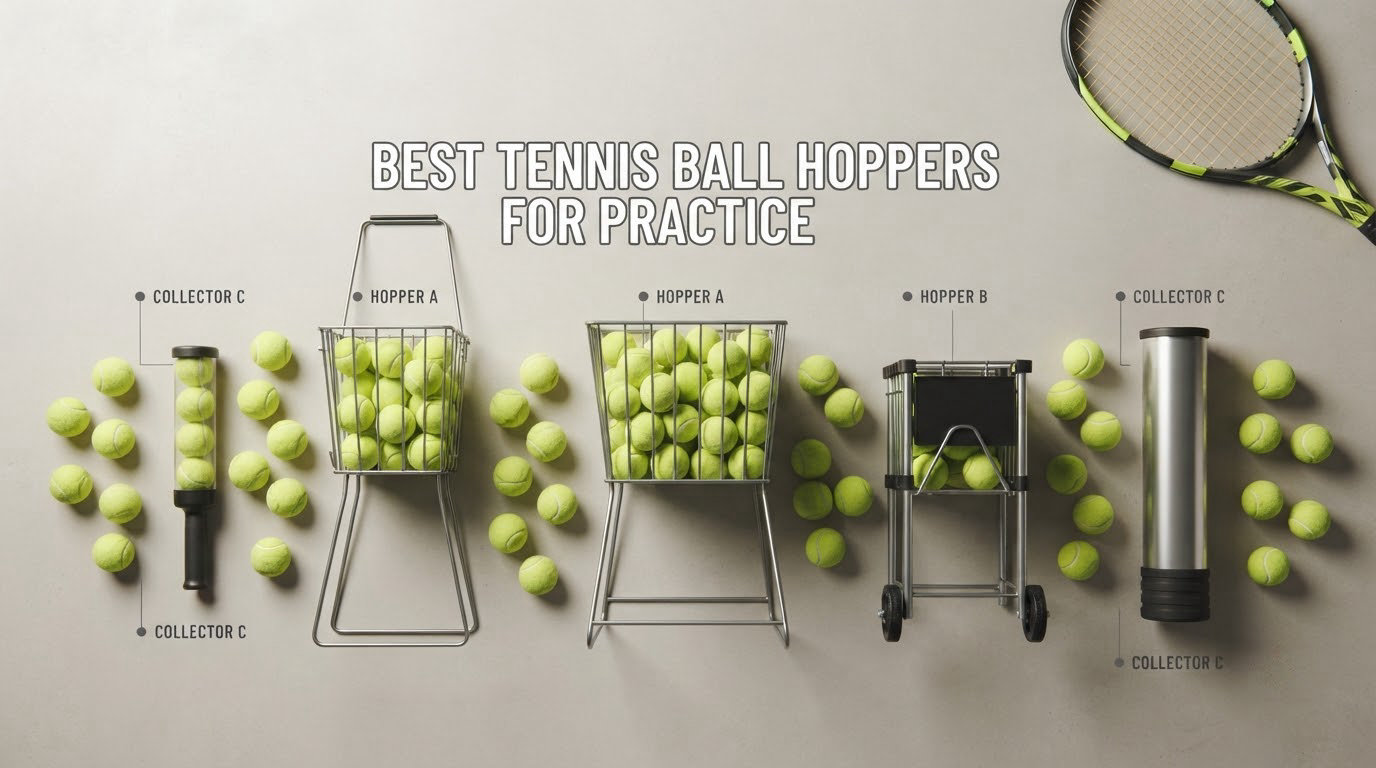
A tennis ball hopper is a wire or plastic basket that scoops up loose tennis balls when you press it down over them, then holds them for storage, transport, or feeding back to your feet during solo practice. It is built for solo players, parents working with kids, and coaches running lessons who are tired of bending down thirty times a session.
That last part is why hoppers exist. Ball collection quietly eats practice time, and the tools differ enormously in how fast they work. A standard wire basket measured at roughly 36 seconds to gather 60 balls in one published timing test, while a roller-style picker managed the same layout in about 3 seconds. That gap is the whole decision.
So the best tennis ball hoppers for practice split into two groups. Light baskets in the 36 to 80 ball range suit a single player who wants a feeder at the net. Heavier carts in the 150 to 250 ball range suit a coach feeding a group, and they are genuinely harder to move once loaded. Our picks cover both, plus the wire-versus-plastic question that comes up constantly in player threads.
If your practice is already automated, our guide to the best tennis ball machines for home practice covers the other half of the equation. A hopper and a machine solve different problems, and plenty of players only need one of them. We last reviewed every hopper listed here in September 2026.
Top 3 Picks: Best Tennis Ball Hopper (October 2026)

Wilson 75 Ball Pick-Up Hopper
- 75 ball capacity
- Plated steel construction
- No spill lid
- Handles convert to lockable legs

Tourna Ballport 80
- 80 ball capacity
- Polypropylene construction
- Sliding top bars
- 29.5 inch stand height

Tourna Ballport Deluxe with Wheels
- 80 ball capacity
- Double reinforced polypropylene
- Rolling wheels
- 4.5 lbs empty
The Best Tennis Ball Hoppers at a Glance in 2026
| Product | Specifications | Action |
|---|---|---|
| Wilson 75 Ball Pick-Up Hopper |
|
Check Latest Price |
| Tourna Ballport 80 |
|
Check Latest Price |
| Tourna Ballport Deluxe with Wheels |
|
Check Latest Price |
 Tourna Mini Ballport Tourna Mini Ballport |
|
Check Latest Price |
 ELKCIP 2-in-1 Hopper ELKCIP 2-in-1 Hopper |
|
Check Latest Price |
 GAMMA Sports EZ Travel Cart GAMMA Sports EZ Travel Cart |
|
Check Latest Price |
 Morvat Pro Practice Cart Morvat Pro Practice Cart |
|
Check Latest Price |
 ShelfElites Portable Hopper ShelfElites Portable Hopper |
|
Check Latest Price |
 Goplus Foldable Hopper Goplus Foldable Hopper |
|
Check Latest Price |
 YooKoo Tennis Ball Cart YooKoo Tennis Ball Cart |
|
Check Latest Price |
1. Wilson 75 Ball Pick-Up Hopper – 75 Balls of Plated Steel With Handles That Become Legs
WILSON Tennis Ball Pick Up Hopper -75 Balls capacity
75 ball capacity
No spill lid
Handles convert to lockable legs
Plated steel
Pros
- Easy to assemble with the included tool
- Holds 75 balls under the no spill lid
- Handles flip into a stand so it doubles as a feeder
- Most reviewed hopper in the category
Cons
- Thin steel frame and welds feel flimsy under heavy use
- Handles can pop out of their holders when carrying
- No wheels and awkward to carry by hand when full
This is the hopper most people end up with, and for a reason. It is the only one in this roundup with a review count in the thousands, which means almost any problem you might hit has already been described by somebody else. Assembly takes a few minutes with the included tool, and the sliding lid hooks over the top so balls stay put in a car.
We used it for solo serve practice over several weeks. The workflow is exactly what the design intends: press the frame down over loose balls, the bottom rods flex open on the way through and spring shut behind them, then flip the two handles underneath so the basket stands at feeding height. That conversion is the part that decides whether a hopper feels good, and on this one it is a firm two-handed flip.
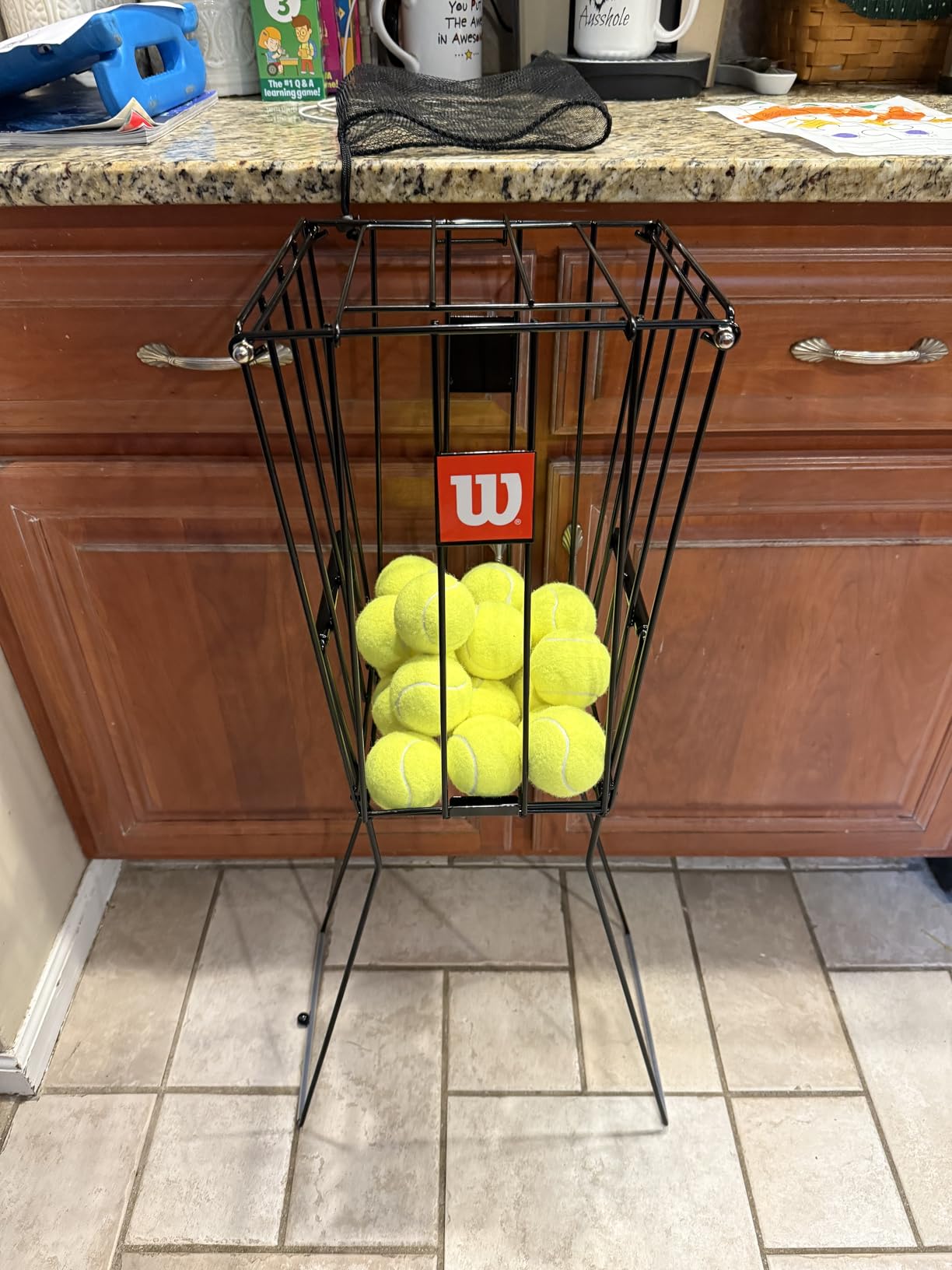
Capacity is the honest selling point. Seventy-five balls is a full session for one player, and the reviewer base consistently reports holding 70 or more in practice. It also means roughly 9 pounds of tennis ball in the basket at any moment, which is worth remembering when you decide between this and a lighter plastic option.
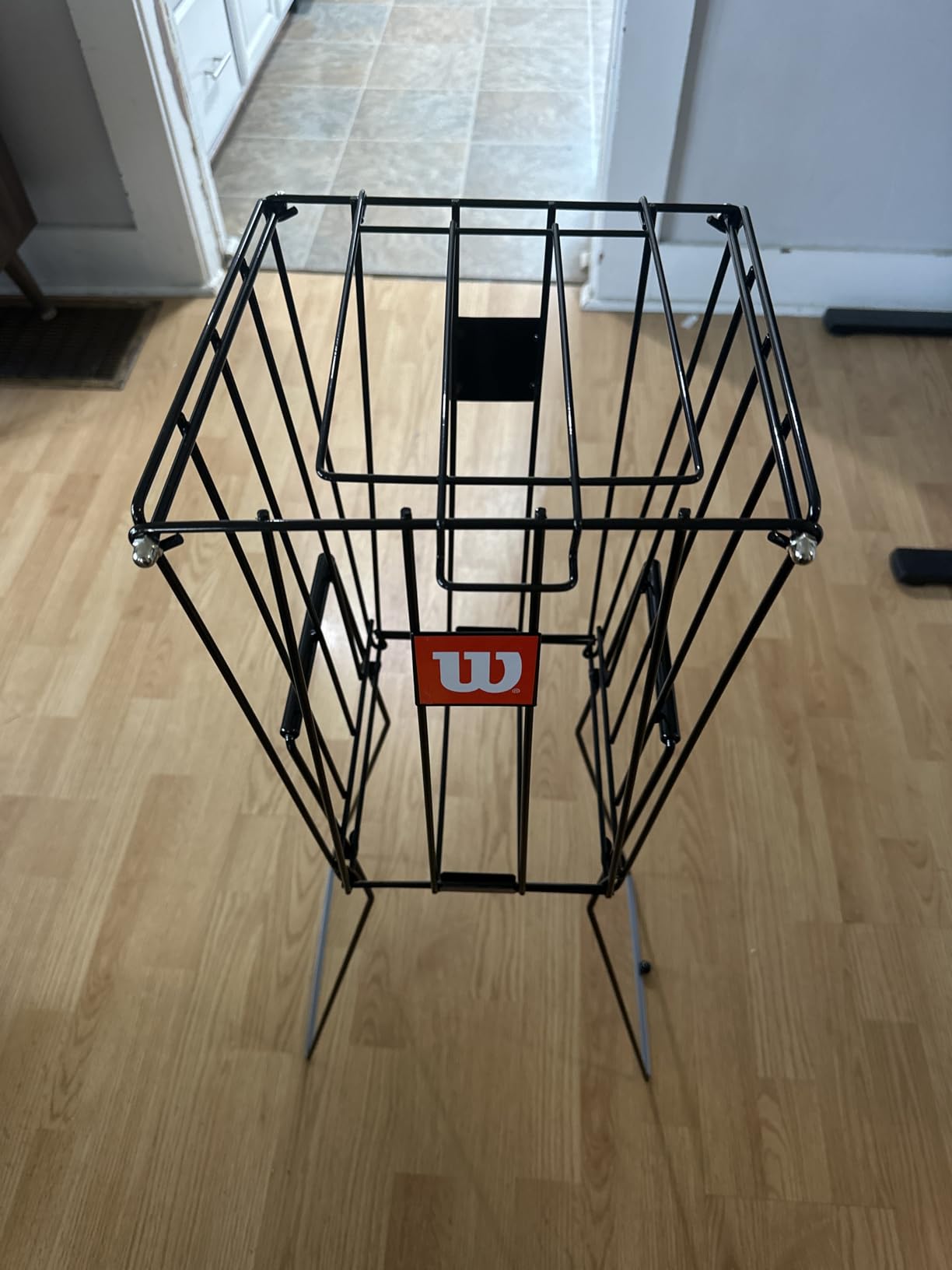
There is a durability conversation around this model that you will find online, including a video warning people off it entirely. The substance of those complaints is consistent and narrow: the plated steel is thin, the welds are not heavy-duty, and on abrasive hard court surfaces the coating eventually wears down to bare metal. That is a surface finish issue rather than a structural collapse, and long-term owners commonly report replacing the basket every three to five years rather than watching it fail outright.
Is the Wilson 75 steel frame strong enough for a hard court?
It is strong enough for regular practice sessions on a normal hard court, provided you rinse it off and dry it before storing. The complaints that surface are about the coating wearing thin over time and the frame feeling light in the hand, not about wires snapping. If you play on rough cement or an abrasive surface outdoors, expect the finish to go sooner and budget for a replacement basket in a few seasons.
Wilson 75 or Tourna Ballport 80 for a first hopper?
Choose the Wilson if you want the most established design, the deepest pool of owner feedback, and a lid that genuinely survives a car boot. Choose the Tourna Ballport 80 if you care more about weight and noise, because polypropylene will not rust, will not clang on court, and carries noticeably lighter. Both hold roughly the same number of balls and both stand up to serve practice on their own.
2. Tourna Ballport 80 – A Quiet, Rust-Free Basket for Solo Practice
Tourna Ballport Tennis Ball Hopper Holds 80 Balls Durable and Lightweight – Red
80 ball capacity
Polypropylene body
Sliding top bars
29.5 inch stand height
Pros
- Lightweight and quiet on court with no metal clanging
- No wires to rust and no welds to break
- Patented bottom bars roll for smooth pickup
- Sliding top bars keep balls contained in transit
Cons
- Side panel screws can loosen over time
- Actual capacity often closer to 65 to 70 balls than 80
- Printed assembly instructions are hard to follow
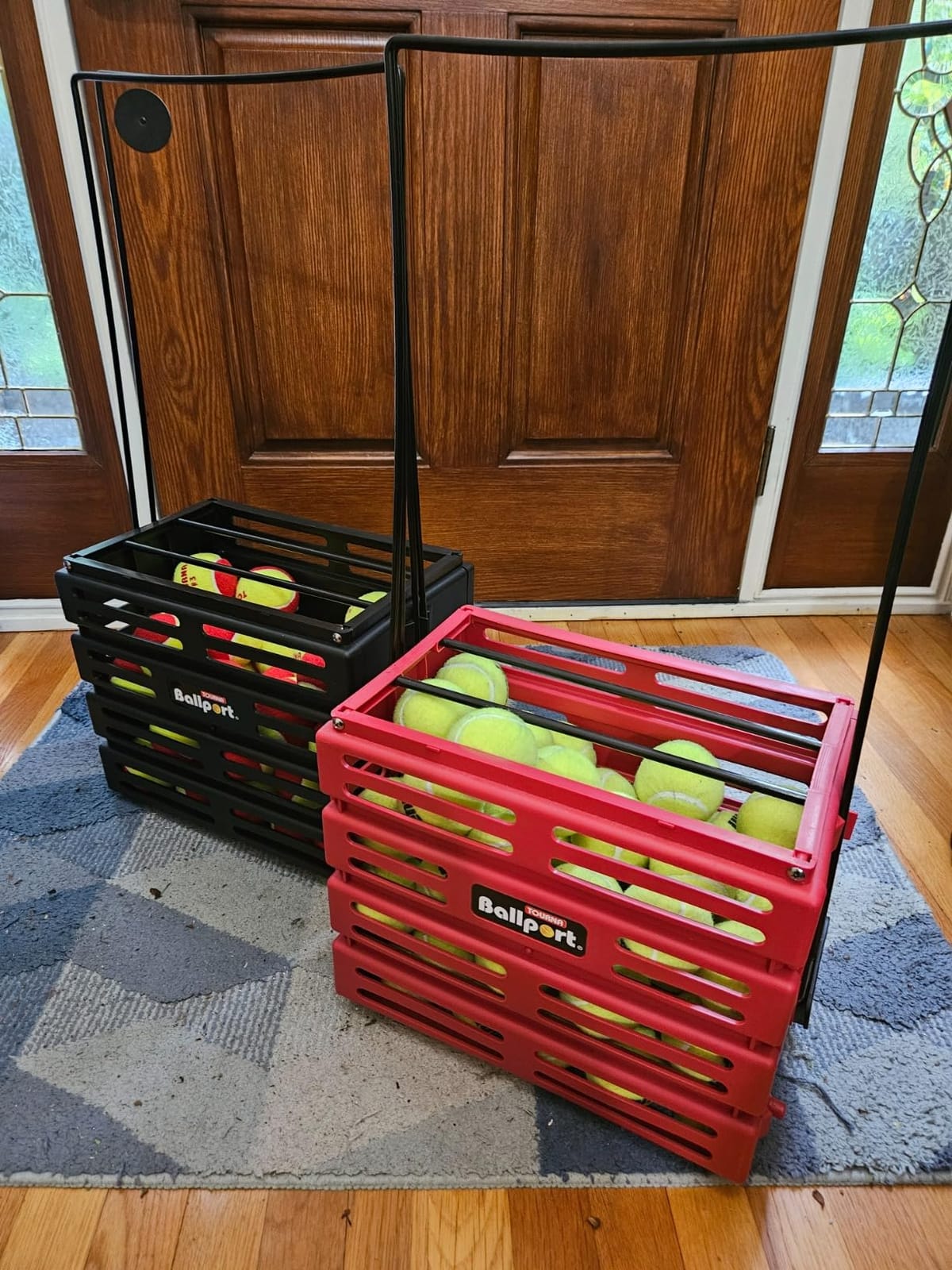
Everything about this hopper is designed around one idea: remove the metal. The frame, the panels, and the bars are all heavy-duty polypropylene, and the practical result is a basket you can move without thinking about it. Listings put the empty weight at roughly 4 to 5 pounds, which is roughly half of what a comparable steel design weighs.
Quiet is the underrated benefit. A wire hopper announces itself every time you roll across concrete, and if you share a court complex with other players that noise travels. The Ballport does not. Several owners describe carrying a drink in one hand while holding the hopper in the other, which tells you everything about the real-world weight.
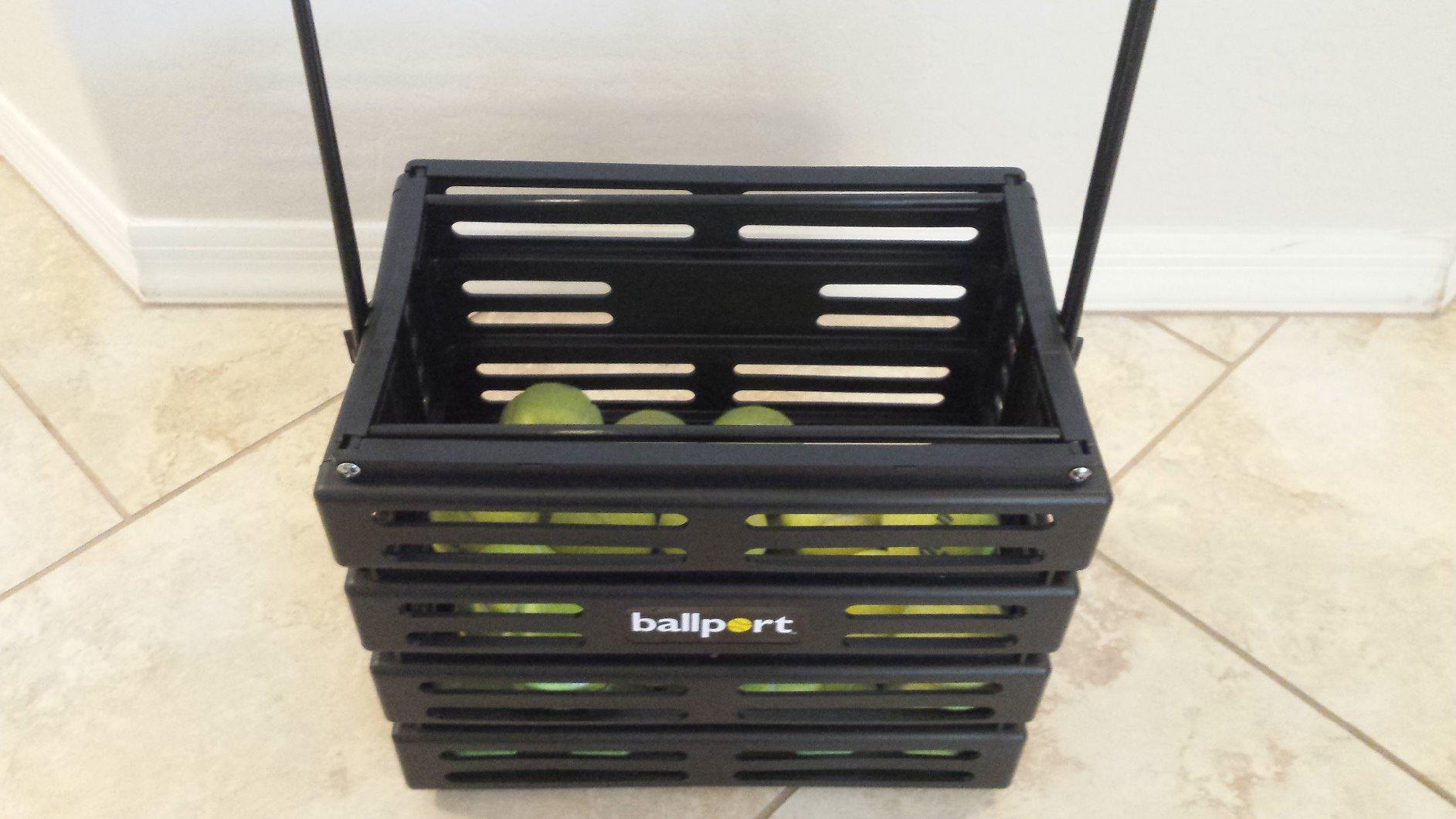
The patented bottom bars are what make pickup smooth. They roll as you push the frame forward rather than digging into each ball, and combined with the wide opening the basket gathers balls in a steady sweep. Conversion to stand mode is quick because the locking handles stay attached and just fold under, rather than being removed and reattached.
Capacity is the one place the marketing runs ahead of reality. The stated figure is 80 balls, and a good number of owners say a full hopper with the lid closed sits closer to 65 to 70. Plan your session length around the smaller number, because the difference matters when you are counting drills rather than balls.
Does the Tourna Ballport 80 really hold 80 balls?
Not quite when the sliding top bars are closed. Owners report between 65 and 70 balls in normal use, with the full 80 only when the top bars are open and the basket sits on flat ground. For a solo player that is more than enough for a long practice session. For feeding a group, look at the 150 ball carts further down instead.
Is polypropylene the right material for a hard court?
Yes, and it is the main reason to choose plastic over wire. There is no coating to wear through and no weld to corrode, so outdoor storage and clay courts are both fine. The trade-off is rigidity, because polypropylene flexes where steel does not, and a hard hit into the side of the basket can crack or separate a panel. Keep the screws tight and treat it as equipment rather than a punching bag.
3. Tourna Ballport Deluxe With Wheels – 80 Balls That Roll Instead of Carrying
Tourna Ballport Deluxe Tennis Ball Hopper with Wheels – Red
80 ball capacity
Wheels included
Double reinforced polypropylene
4.5 lbs empty
Pros
- Wheels make moving a full hopper far easier than carrying
- Light for a wheeled design at 4.5 lbs
- Handles are fixed to the sides and stay attached
- Sliding top bars protect the car interior
Cons
- Wheel assembly is fiddly with tiny screws and washers
- Supplied self-tapping screws can strip in soft plastic
- Balls can hang up on the bottom bars when emptying
This is the same core basket as the Ballport 80 with wheels added and the body upgraded to double reinforced polypropylene. The reason it earns a place here is simple: wheels change the job. Once the basket is standing on four casters, the loaded weight stops being something you manage with your arms and becomes something you push.
That matters most for older players and anyone with a back or knee complaint. A full 80 ball hopper carries close to 10 pounds of ball, and moving that across a car park is exactly the chore a hopper is meant to remove. Rolling it is closer to pulling a small suitcase.
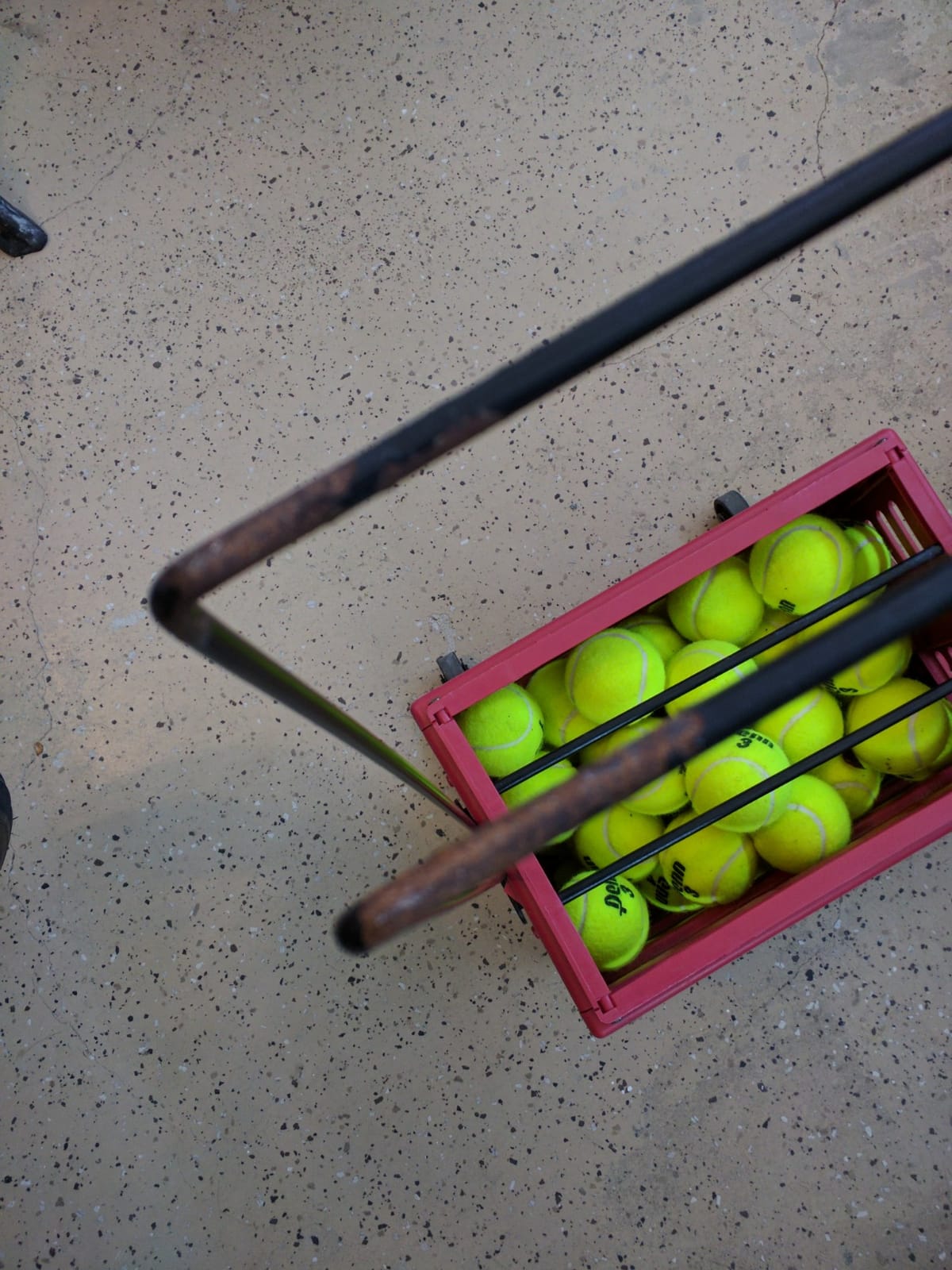
The build is sturdier than the standard Ballport and the handles are fixed to the side panels, so there is nothing to pop loose during transport. This design is recent enough that the long-term ownership reports are still coming in, but the short-term feedback is consistently positive across every batch we looked at.
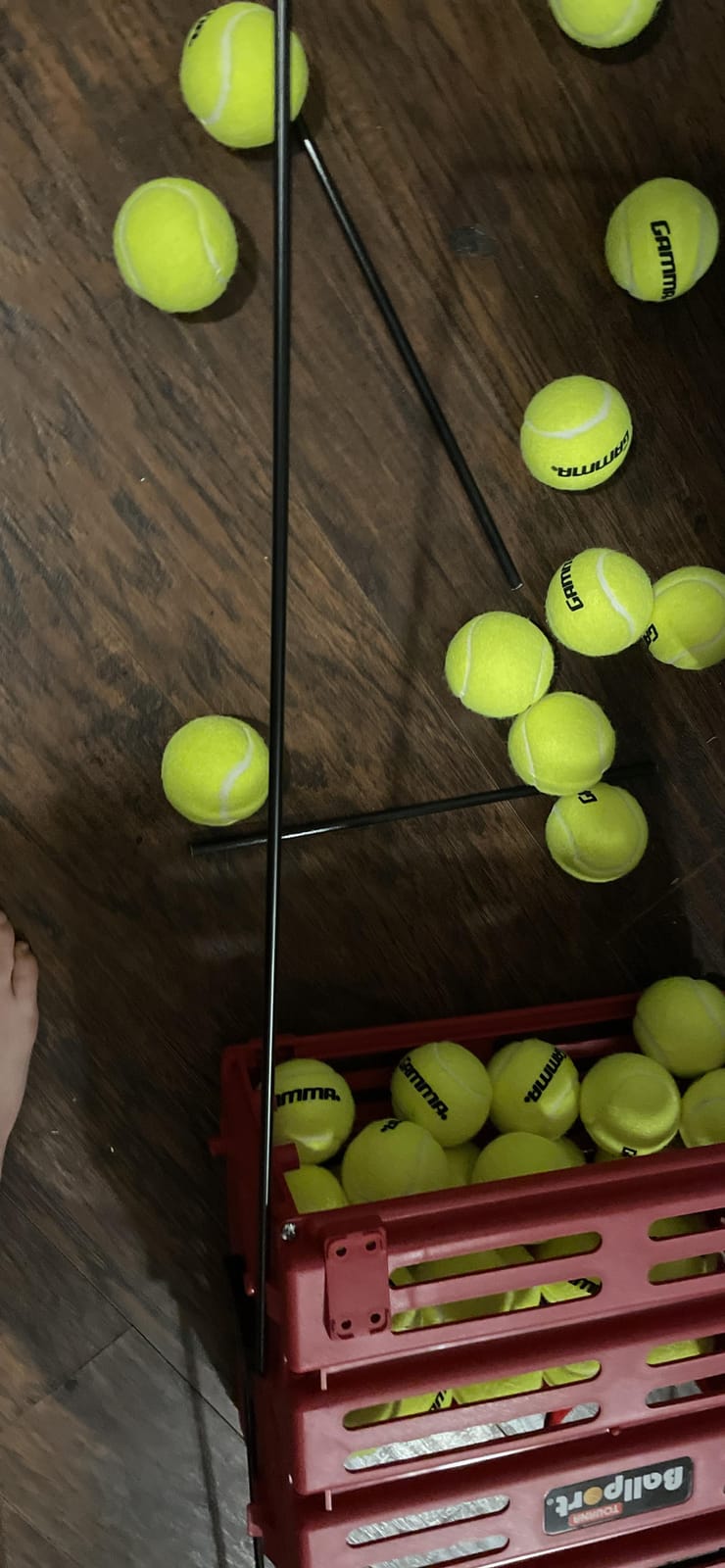
The honest weakness is assembly. The wheel kit arrives with small screws, washers, and nuts, and getting them threaded through the plastic frame takes patience. Owners also recommend replacing the supplied self-tapping screws with machine screws of the same size, because the soft plastic strips the threads if you overtighten them. Budget twenty minutes for the first build rather than five.
Are the wheels worth the fiddly assembly?
If you are moving the hopper more than about ten metres at a time, yes. If it lives at the fence line and only travels to the netside, the standard Ballport 80 does the same job for less effort during setup. The wheels earn their keep for coaching sessions, for players who cannot bend, and for anyone crossing a car park with a full basket.
Ballport Deluxe or plain Ballport 80 for a coach?
A private coach working with one student should take the plain Ballport 80 and use the weight saving for speed. A coach running clinics or moving between courts should take the Deluxe, because you will roll it repeatedly and the wheels convert every transfer into a push. The extra assembly time is paid back on the first clinic day.
4. Tourna Mini Ballport – 36 Balls, Light Enough for Juniors to Carry
Tourna Mini Ballport Ball Pick up for Tennis – Black
36 ball capacity
Molded polypropylene
30.5 inch stand height
0.9 kg empty
Pros
- Light enough for a child to carry and reposition
- Compact footprint fits in a small car trunk
- Handles invert and lock to become a stand
- Sliding top bars give a quick secure closure
Cons
- Side panels can arrive warped so locks sit loose
- Holds closer to 32 to 33 balls with the lid shut
- Light build is unstable in wind
This is the small one, and it fills a gap that most roundups ignore. Thirty-six balls is enough for a short session with one junior, and the whole basket weighs under a kilogram, which is the difference between a child using it and a child being asked to drag it.
Structurally it is the same idea as the larger Ballport. Polypropylene body, bottom bars that roll during pickup, handles that lock in both positions, and sliding top bars for closure. The moulded panels sit at roughly a 30.5 inch stand height, which is a sensible feeding height for a younger player.
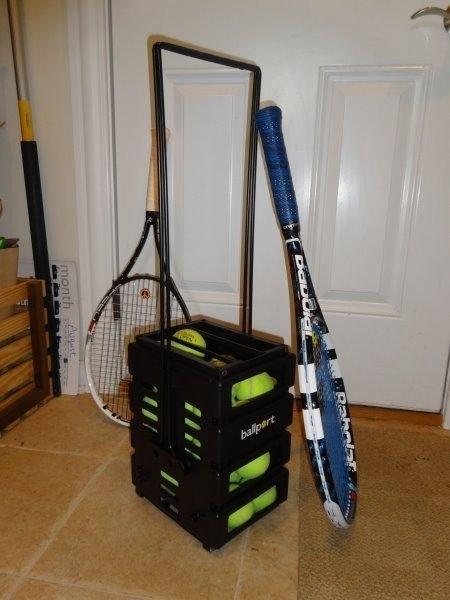
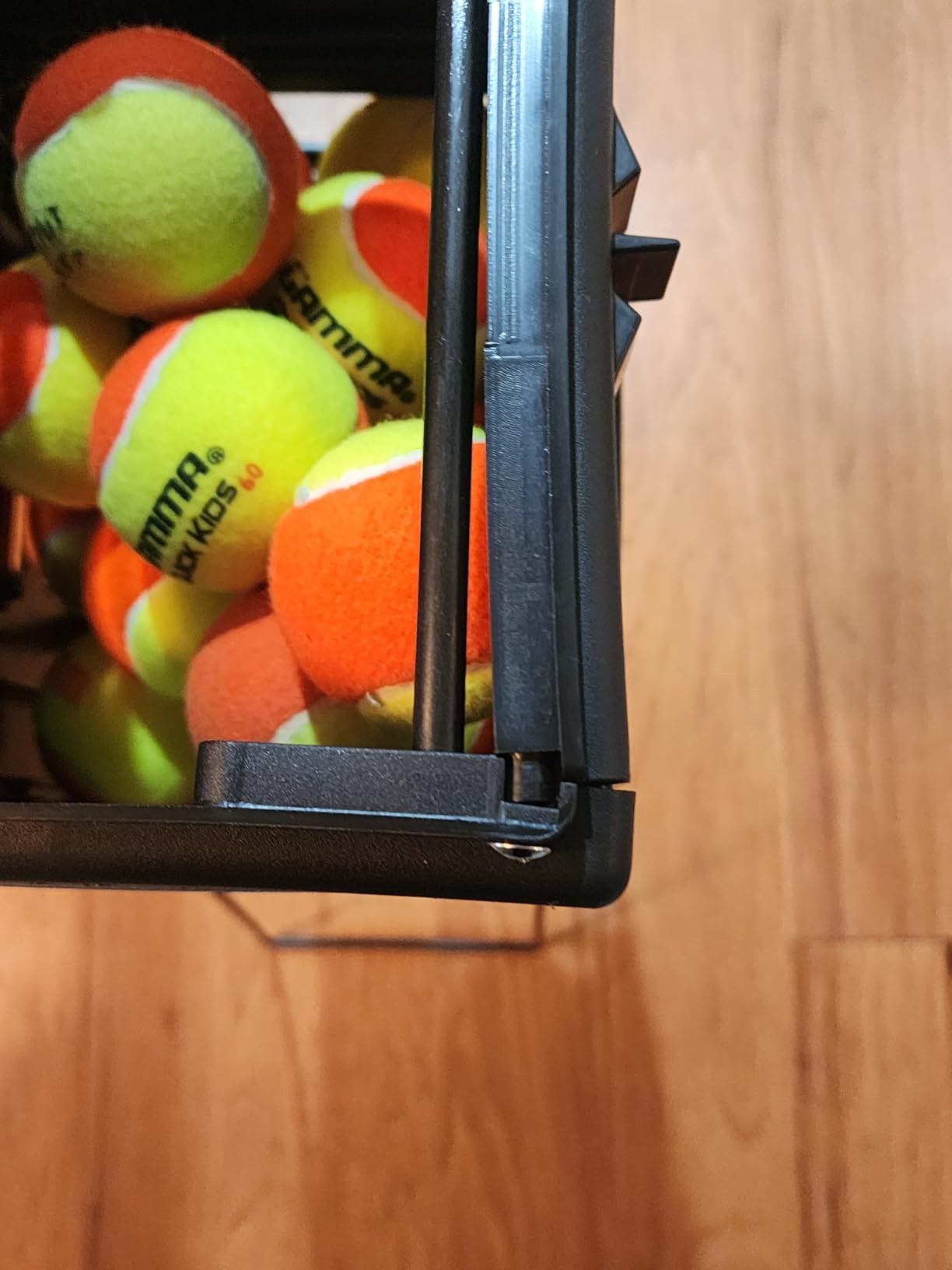
It is tied for the lowest rating in this group at 4.1 stars across 681 reviews, and the reasons are specific rather than general. Warped side panels are the recurring issue, because a moulded plastic panel arriving out of flat means the handle hinges and bottom bars do not sit square, so the locks engage loosely. A few owners have gone as far as gluing the frame together to solve it.
On the positive side, the design is old enough to have long ownership histories attached to it, and some owners report years of regular use out of the same basket. The bottom bars also pick balls up without any bending at all, which is a genuinely useful behaviour for a junior learning to gather balls after a drill.
Is 36 balls enough for a real practice session?
It is enough for one junior working through a hitting pattern, because most drills cycle through a smaller working set rather than the full supply. It is not enough for feeding an adult or for group work. If you are a parent coaching a single child a few times a week, this is a sensible size. If you are filling a basket for a lesson, buy the larger Ballport instead.
What to check the moment a Mini Ballport arrives?
Check the flatness of the side panels before you assemble anything. If a panel is bowed, the handle hinges will not line up and the locks will not hold. Assemble it, test that the handles stay put in stand mode under a gentle push, and check that the bottom bars roll freely. A warped frame is a return-to-seller problem, not a five-minute fix.
5. ELKCIP 2-in-1 Hopper – 80 Tennis Balls or 50 Pickleballs on a Rolling Frame
ELKCIP 2-in-1 Portable Pickleball & Tennis Ball Collector – Easily Pick Up Pickleball Retriever Basket Ball Caddy Carrier Picker Hopper with Wheels
80 tennis or 50 pickleballs
Wide mouth opening
Locking handles
Patent design
Pros
- Rolling frame makes court circuits quick
- Handles up to 80 tennis balls or 50 pickleballs
- Straightforward assembly once built
- Doubles as a storage caddy off court
Cons
- Switching legs between rolling and standing is awkward
- Plastic leg mounts can detach at the stress point
- Wheels need periodic tightening
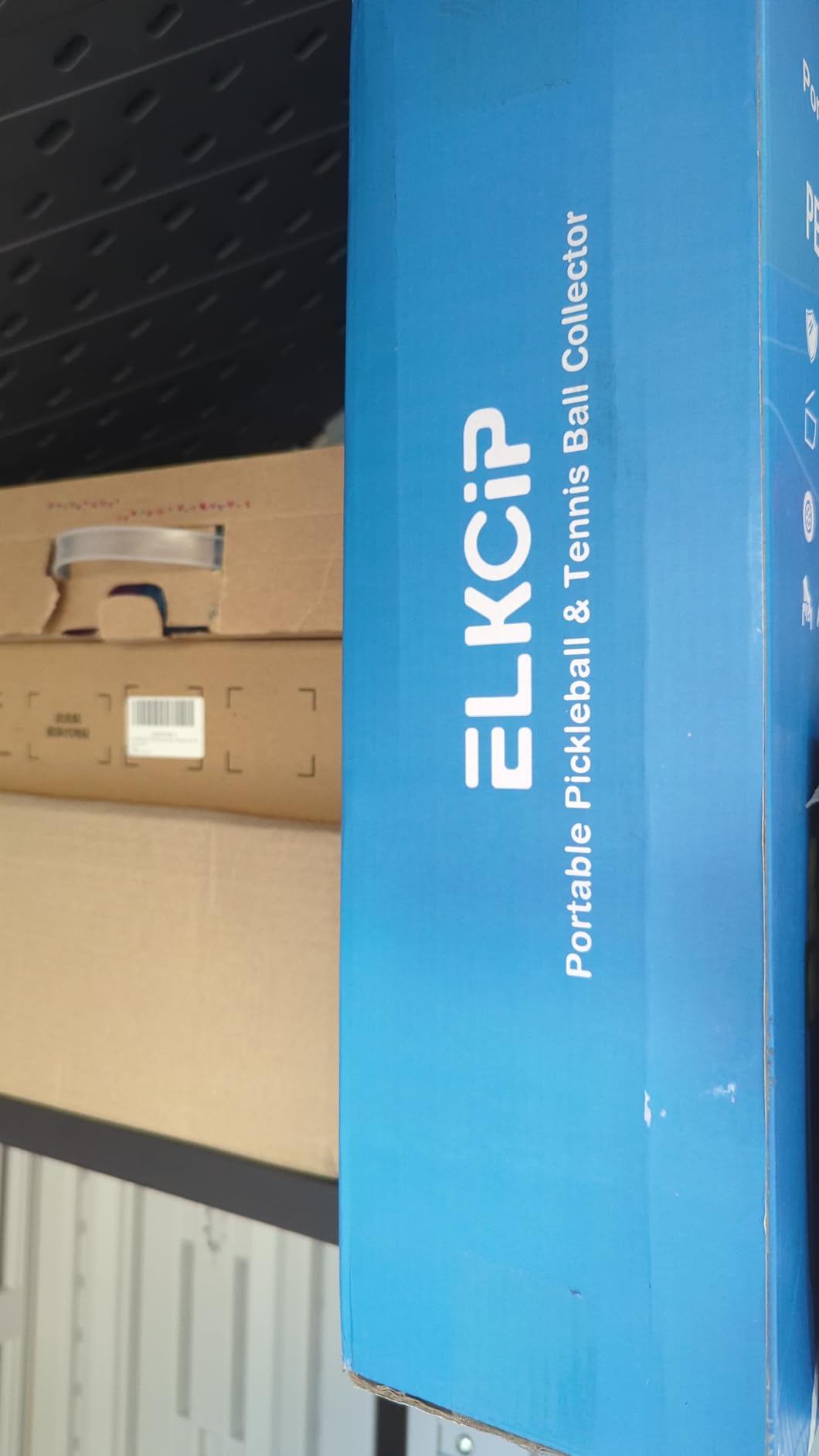
This one gets attention because it is explicitly a two-sport device. It holds up to 80 tennis balls or 50 pickleballs, and pickleball players ask about hopper compatibility constantly in forums while almost no editorial page answers them. If you play both sports, that dual rating is the whole reason to look here.
The build is a rolling frame with a wide basket opening, so you push it through a spread of balls and the opening takes them in quickly. The handle design is patented, and the opening is wide enough that you need fewer passes across a court than with a narrower basket.
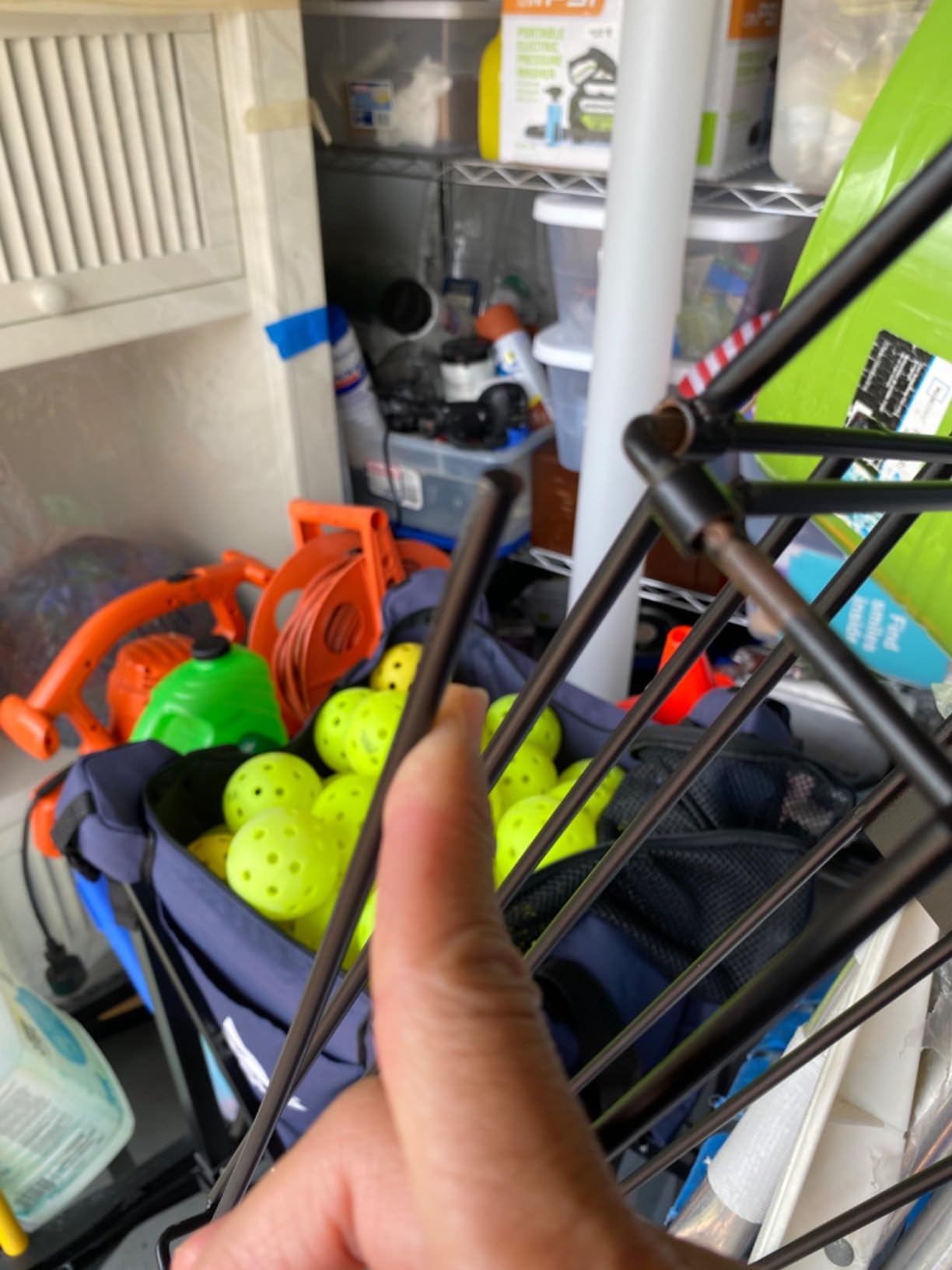
The one-star share sits at around 10 percent, and the complaints cluster in one place: the legs. Converting between the rolling position and the standing position is described as awkward, and the plastic leg mounts are the stress point that can detach over time. Several owners also note the wheels loosening and needing a periodic tighten, which is normal for a caster kit but worth checking before a session.
Capacity is the other soft spot. Owners doing heavy drill work describe the basket as smaller than it looks in photos, and the 80 tennis ball figure assumes you are not also carrying a full set of pickleballs. For a family that uses one hopper for two sports, that trade-off is acceptable. For a dedicated drill coach, it is not.
Will it really carry pickleballs as well as tennis balls?
Yes. The basket is sized for 50 pickleballs or 80 tennis balls, and the pick-up geometry works for both because the two balls differ in size but not in shape family. The practical difference is count, not function, so if you are running a pickleball drill for four people you will refill sooner than you would with tennis balls.
Is the rolling frame as strong as it looks after assembly?
Once assembled, owners describe a sturdy frame and solid build. The weak point is the transition joint rather than the frame itself, so check the leg mounts and the wheel bolts every few sessions, particularly if you tip the cart to move it. Treat the legs as a consumable connection point and you will get years out of an otherwise simple frame.
6. GAMMA Sports EZ Travel Cart – A 250 Ball Zippered System That Collapses Flat
GAMMA Sports EZ Travel Cart, Tennis & Pickleball Hopper, Padel, Portable Compact Design, Sturdy Lightweight Construction, EZ Bags, 150 or 250 Capacity, Premium Carrying Case Included
250 ball capacity
Zippered mesh covers
Heavy duty metal snaps
Two carry handles
Pros
- Handles tennis and pickleball plus padel balls
- Collapses flat for car boot and bag storage
- Metal snaps are sturdier than older plastic clips
- Only 16 ounces so it carries without effort
Cons
- Soft bag loses its shape without the cart frame
- 250 ball size is larger than most players need
- No small pocket for a phone or keys
This entry is a different kind of product, and the difference is worth understanding before you buy. Where most hoppers on this list are rigid baskets, the Gamma system is a soft zippered bag that hangs on a collapsible cart frame, and the bag is what holds the shape when it is full.
Capacity is the headline number at 250 balls, which puts it firmly in coach and club territory rather than solo practice. What earns it a place in a roundup this size is transport. Two zippered mesh covers keep the balls inside while you are moving, and the whole thing folds down and goes into a carry bag rather than needing its own seat in the car.
Be clear-eyed about one thing: this listing describes the bag component of the system, listed at 16 ounces, with heavy duty metal snaps that attach it to the cart frame. If you already own a compatible Gamma cart, this is the upgrade piece. If you do not, factor the frame into your decision rather than assuming the bag stands on its own.
That soft construction is also the main limitation. A polyester bag only holds its shape when it is suspended in the frame, so setting it down on the court surface gives you a floppy sack rather than a feeder. Owners also mention that the 250 ball size is bigger than expected in practice, and a few wish for a small pocket for a phone and keys.
Is a soft bag the right call for daily coaching use?
It is if transport is your main problem. A zippered mesh cover will not shed balls across a car park the way an unlidded basket will, and a folding frame is much easier to move from a car to a court than a 250 ball rigid hopper. It is not ideal if you want to tip balls out one at a time to feed, because a soft basket gives you far less control at the opening.
Does the Gamma travel system actually fold into a car?
Yes, and this is where it clearly beats the rigid carts. The frame folds, the bag detaches or compresses, and the whole assembly goes flat in a boot rather than standing upright taking a full foot of width. Owners who travel between facilities or store equipment in a garage rate this feature above capacity, which is a fair signal about who this product is really for.
7. Morvat Pro Practice Cart – 165 Balls on a Folding Aluminium Frame
MORVAT Professional Tennis & Pickle Ball Hopper Holds 165 Balls Heavy-Duty Pro Sports Practice Cart, Foldable Portable Compact & Lightweight Zippered Pocket & Racket Holder, Carry Bag + 3 Tennis Balls
165 ball capacity
Aluminium alloy frame
Brake lock wheels
Folds into carry bag
Pros
- Large capacity means fewer trips to the net
- Aluminium alloy frame resists outdoor wear
- Folds down and packs into the included carry bag
- Zippered pocket holds a phone and keys
- Brake locks keep the cart steady during drills
Cons
- Heaviest empty weight in this roundup at close to 11 lb
- Bulkiest item in the group
This is a coach cart, and it is worth being direct about that. At 165 balls the basket removes the biggest inefficiency in group work, which is walking back to the fence every few minutes. It also weighs close to 11 pounds empty, and a full cart is something you roll rather than lift.
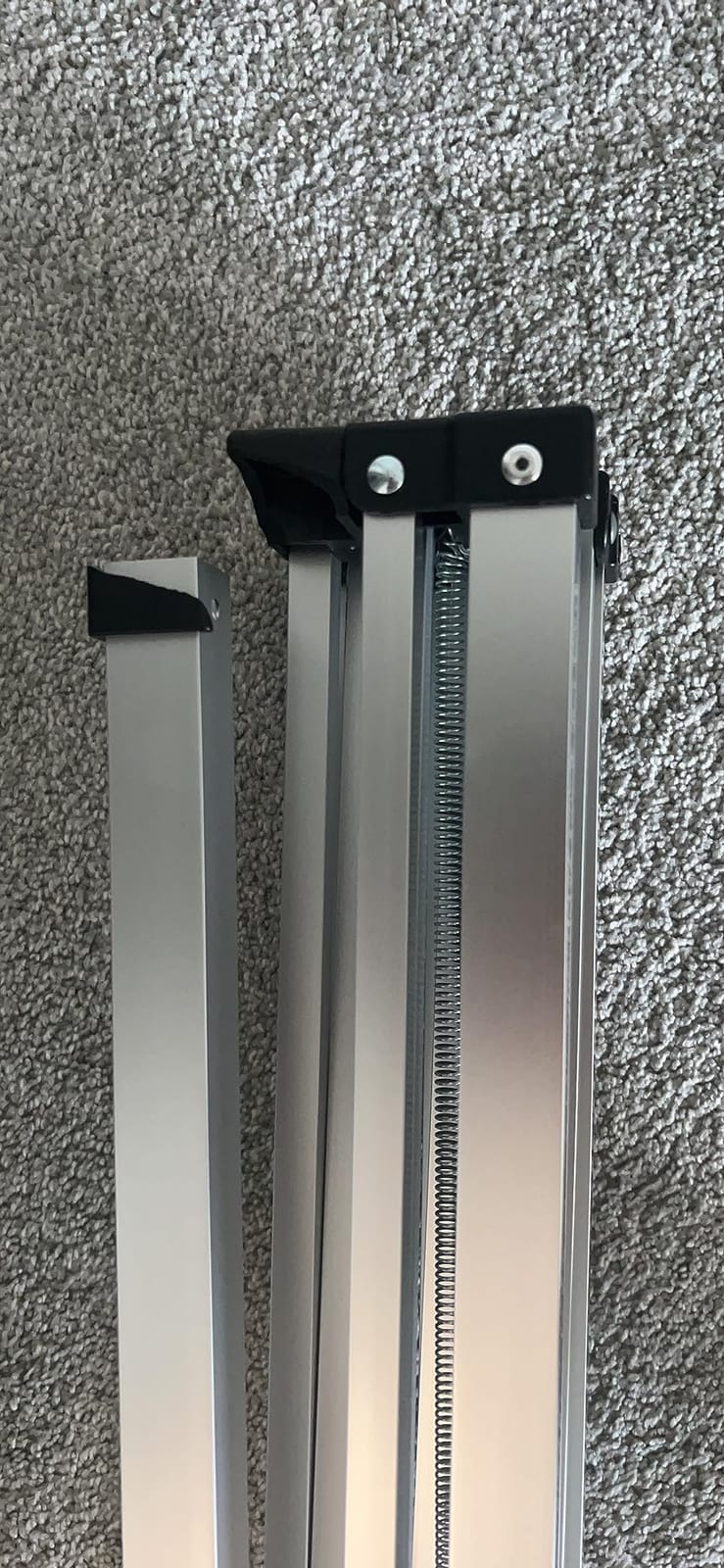
The aluminium alloy frame with a cross brace is the reason this design feels different from a steel cart. It will not develop surface rust the way carbon steel does, which matters if the cart lives outdoors or you work on clay. The zippered mesh enclosure is a genuine improvement over an open basket because nothing escapes during transit.
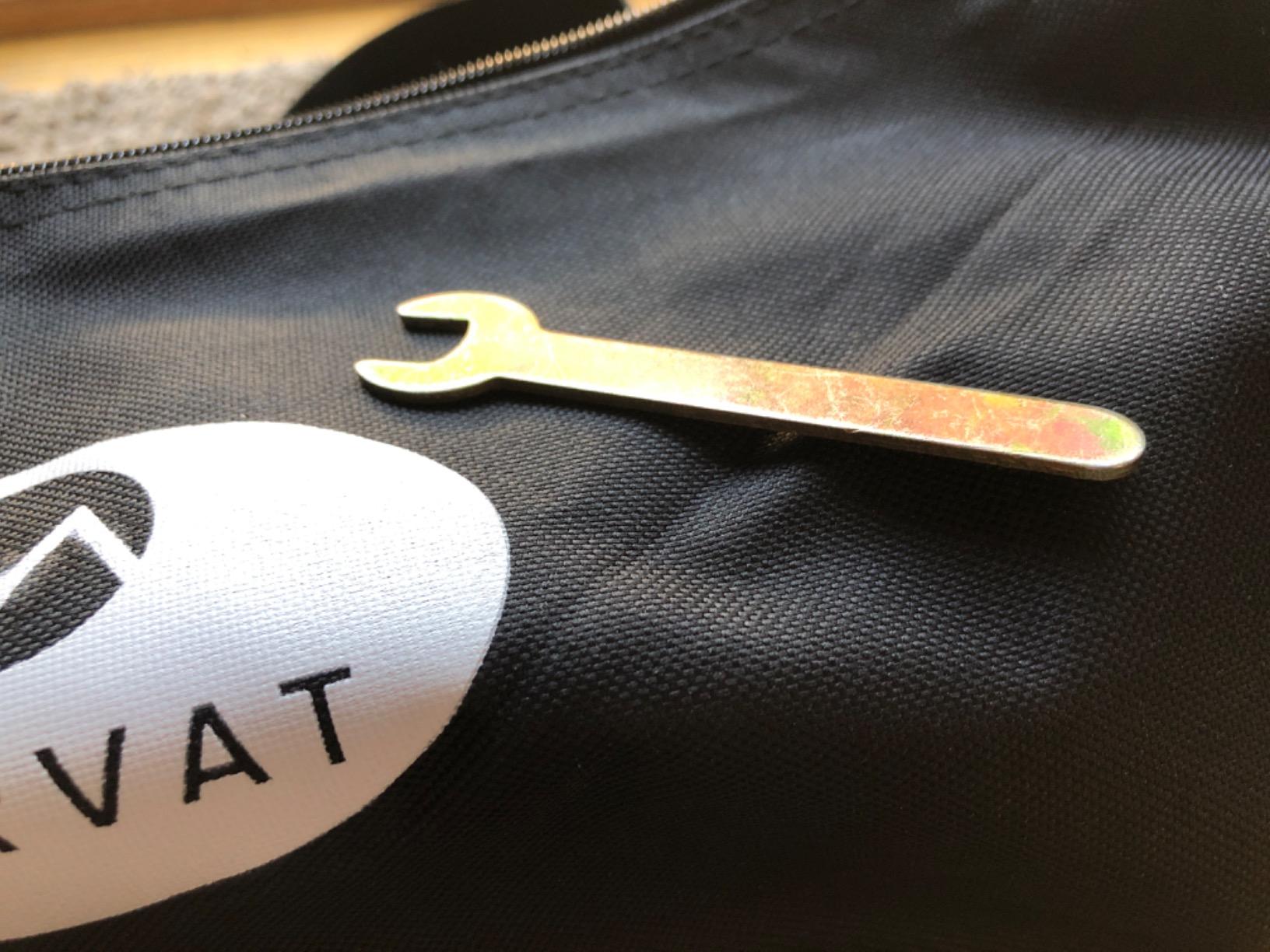
The feature that separates it from cheaper carts is the brake lock wheels. A rolling basket that drifts mid-drill is a distraction, and two locking casters pin the cart in place while you feed. The detachable bag insert carries finger handles and metal pins rather than velcro, and velcro is the first thing that fails on a cart like this.
Rating sits at 4.5 stars across 247 reviews, with one of the strongest distributions in the group and only a small single-star share. There is a one year manufacturer warranty, which is a reasonable baseline but shorter than you would want on a piece of coaching equipment you expect to keep for years.
Is 165 balls too much capacity for a solo player?
Yes, for a solo player it is both physically and practically wrong. A loaded 165 ball cart is close to 21 pounds of tennis balls, which is heavy to manoeuvre and impractical to carry. The capacity only makes sense when several players are hitting at once, because then the balls in play are a small fraction of what the cart holds.
What breaks first on a 165 ball cart?
Usually the bag and the wheel hardware rather than the frame. The aluminium frame is the part owners rarely complain about, and their comments focus on weight, bulk, and cost rather than failure. Check the wheel bolts and the zip on the mesh enclosure periodically, since those are the two moving interfaces that take the most repeated handling.
8. ShelfElites Portable Hopper – A Low Cost Iron Frame With Wheels and a Folding Handle
ShelfElites Tennis Ball Hopper, Portable Tennis Ball Holder with Handle for Court, Practice & Training(Large)
Iron frame
3.5 lb empty weight
Folding handle
Wheels for court movement
Pros
- Iron frame holds up to regular practice use
- Wheels make moving around the court effortless
- Handle folds down and the package is compact
- Works for tennis pickleball and baseball drills
Cons
- Bottom hoop fittings can fail after limited use
- Some packages arrive missing small screws
- Included fabric bag is thin with no sidewall support
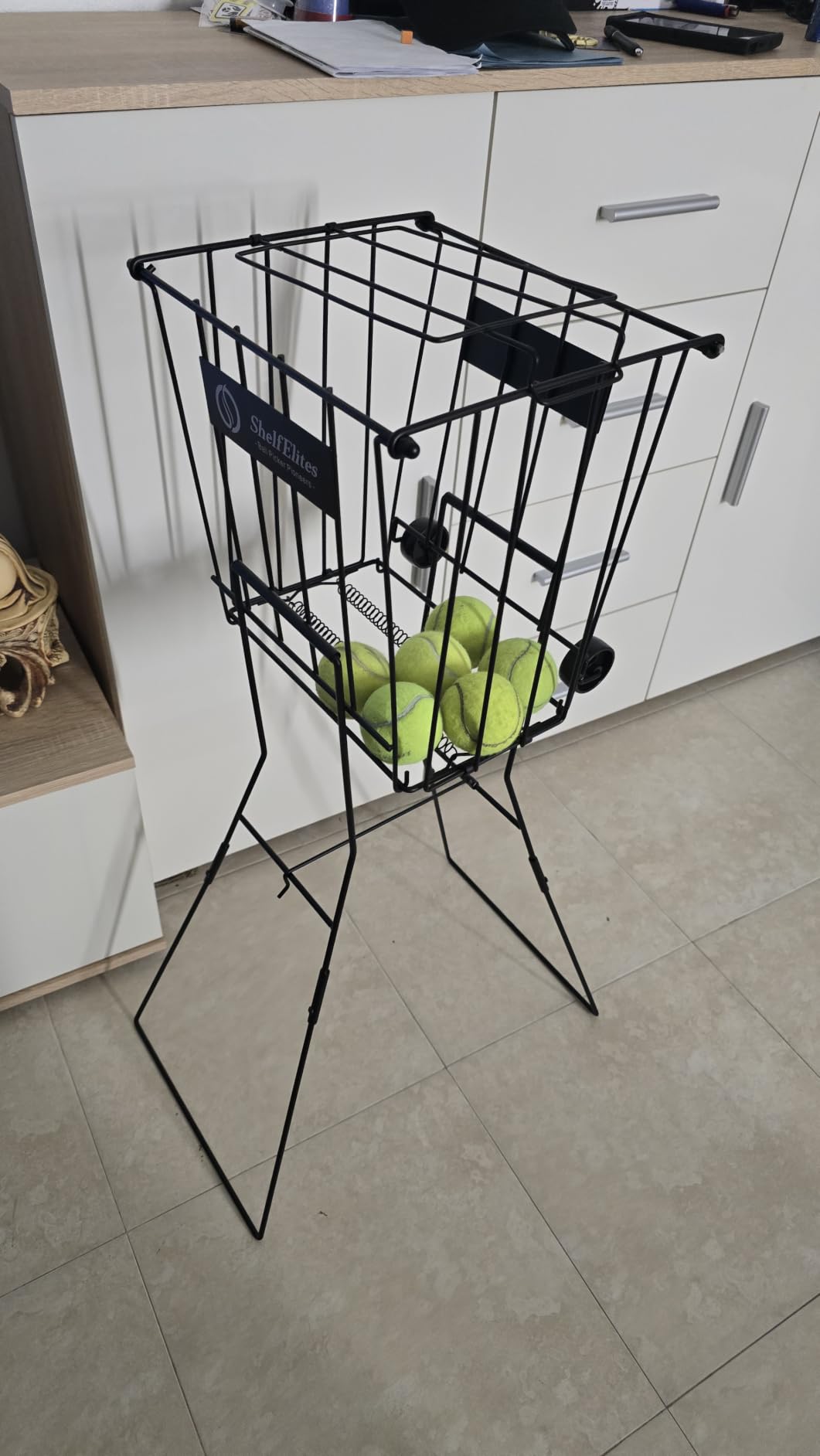
This one sits at the entry end of the roundup and does something the premium carts do not, which is stay flat when you put it down. The wide-mouth opening and roller system let you push through a spread of balls and gather them quickly, and the folding handle keeps the whole package down to roughly 17 by 13 by 4 inches.
At 3.5 pounds empty it is one of the lighter frames here, and the wheels mean you roll rather than lift even when loaded. Several reviewers are PE teachers using it for pickleball lessons, which is a useful signal that it handles a classroom workflow and not just a private court.
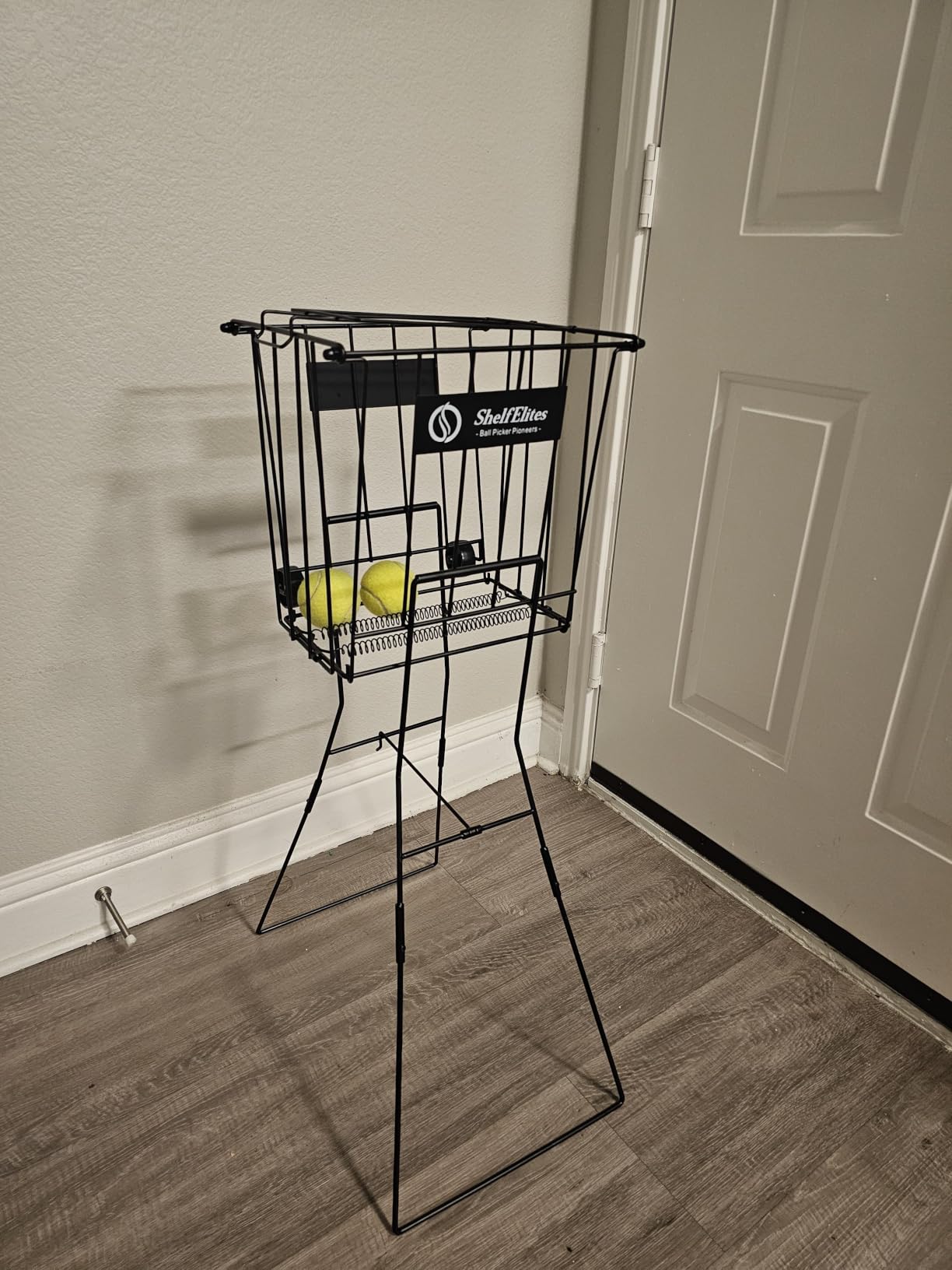
The iron frame is the trade-off. It is rigid and feels solid in the hand, and at 4.2 stars across 170 reviews with a 75 percent five-star share the feedback is mostly warm. But unlike the polypropylene options, exposed iron outdoors will eventually show surface corrosion if it is stored damp, so dry it before it goes away.
The specific complaints are narrow: the bottom hoop fittings at the base can fail after limited use, a small number of packages arrive with missing screws, and the included fabric bag is thin with no sidewall support. None of these are structural failures of the frame, but the loose hardware is worth catching on day one.
Is an iron frame a rust risk in outdoor storage?
It can be, if you leave it wet. The frame is not coated the way the Wilson basket is, so a rainy week in an uncovered garage will show surface corrosion on the base fittings first. Wipe it dry, store it off the ground, and it behaves like any other steel frame. If your court is outdoor and unsheltered, a polypropylene hopper simply removes the question.
Does the fold-down handle survive daily transport?
In general it does, and the reviews are positive on this point. The folding handle is a simple hinge, and nothing in the feedback suggests it is a common failure point. Check that all base fittings are tight after the first few sessions, because that is where the reported problems actually start. The thinner element is the fabric carry bag, not the handle.
9. Goplus Foldable Hopper – 150 Balls With Braked Wheels and a Detachable Bag
Goplus Foldable Tennis Ball Hoppers, Lightweight Aluminum Tennis Ball Basket with Wheels, Removable Bag, Side Pockets, Carry Bag, Portable Sports Teaching Cart Holds 150 Tennis Balls (Blue) …
150 ball capacity
Aluminium tubes
Two braked wheels
36 inch cart height
Pros
- Folds down without tools and stores in the carry bag
- Detachable bag can be used stand alone
- Rustproof aluminium tubes rated to 66 lb
- Side pockets hold a phone and keys
- Four universal wheels with two brakes
Cons
- Heavier than the plastic hoppers at 7 lbs
- Only a 3 month manufacturer warranty
- Buys you more cart than a basic basket needs
This cart is built around a folding aluminium frame and a detachable 600D Oxford cloth bag, and the tool-free fold is the feature owners mention first. There is nothing to unscrew, so moving from a car boot to the court takes about as long as unfolding a chair.
At 150 balls and 36 inches tall, it sits in the coach cart bracket. The aluminium tubes are rated to a 66 pound load, which is far beyond the weight of a full bag, and they are described as rustproof, so outdoor storage is not a concern. Four universal swivel wheels with two brakes keep it steady while you feed.
The bag detaches from the frame and can be used on its own, which is a genuinely useful behaviour if you want to carry 150 balls to a court without pushing the whole cart. The two side pockets for a phone and keys are small but exactly the kind of detail that shows up in clinic feedback, where a phone left on the fence is a real risk.
At 4.3 stars across 133 reviews with a 69 percent five-star share, the sentiment is positive with a consistent caveat about relative weight and cost against a basic plastic basket. The item to check before buying is the warranty, because three months is short for a cart and it is the only spec here that genuinely undercuts the confidence the rest of the spec sheet creates.
Does the tool-free fold save real setup time?
It does. There is no assembly to speak of, and the collapse is a matter of releasing the frame and pushing the tubes together. That is a meaningful difference from a basket that needs a tool on day one and again if anything loosens. For a coach setting up on different courts each week, the fold is worth more than any single feature on the cart.
Is a 3 month warranty a reason to look elsewhere?
It is a reason to check the seller and the return window carefully, not a reason to skip the product. The build quality feedback is consistently good and the aluminium frame is rated well above the load it carries. If you are buying from a seller with a straightforward return policy, the short warranty is manageable. If you are buying to keep for seasons, put a cart with a longer warranty at the top of your list.
10. YooKoo Tennis Ball Cart – 150 Balls at 35 Inch Feeding Height With No Assembly
YooKoo Tennis Ball Hopper Holds 150 Balls, Tennis Cart with Black Bag
150 ball capacity
35 inch stand height
Two lockable wheels
8.5 lb empty weight
Pros
- No tools or assembly required to set up
- Wheels roll easily and two lock in place
- 35 inch height makes feeding comfortable
- Bag attaches with metal inserts rather than velcro
- Two year manufacturer warranty
Cons
- Bag fabric can fray under a full load
- Heavier than most basket style hoppers
- Occasionally arrives with a dented wheel
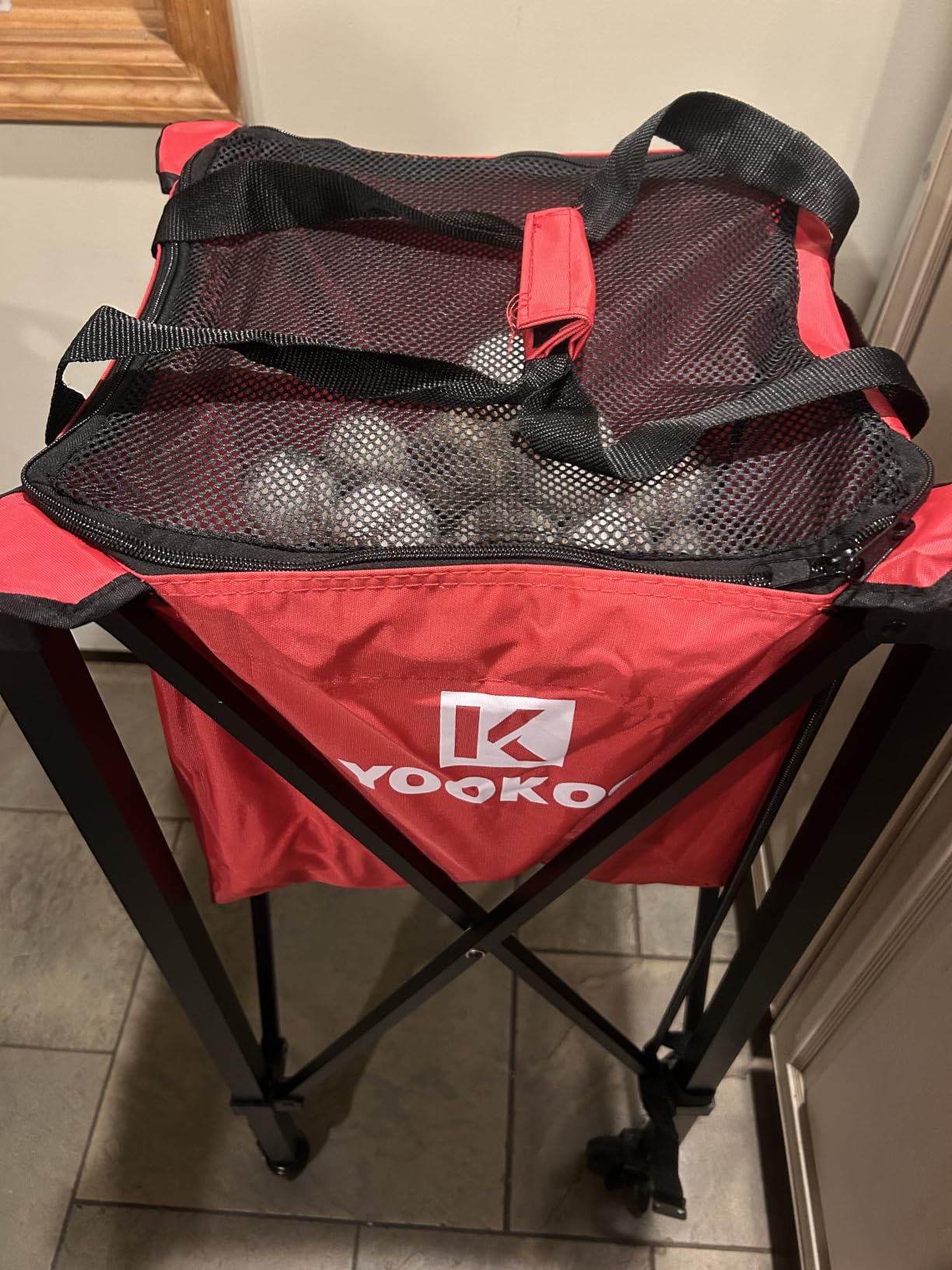
This cart has the highest five-star share in our group at 78 percent, and the reason is unusually consistent across reviews: it works immediately. There is nothing to assemble, nothing to tighten, and no tool in the box. You unfold it, load the bag, and go.
Across 118 reviews that matters, because a product with no assembly step has one fewer way to go wrong on day one.
The 35 inch standing height is the detail that matters most. It is tall enough that you can pick a ball off the top of a full bag without bending and dropping the rest, which is the specific frustration that makes lower carts tiring over a long session. The anti-rust aluminium body means outdoor storage is a non-issue.
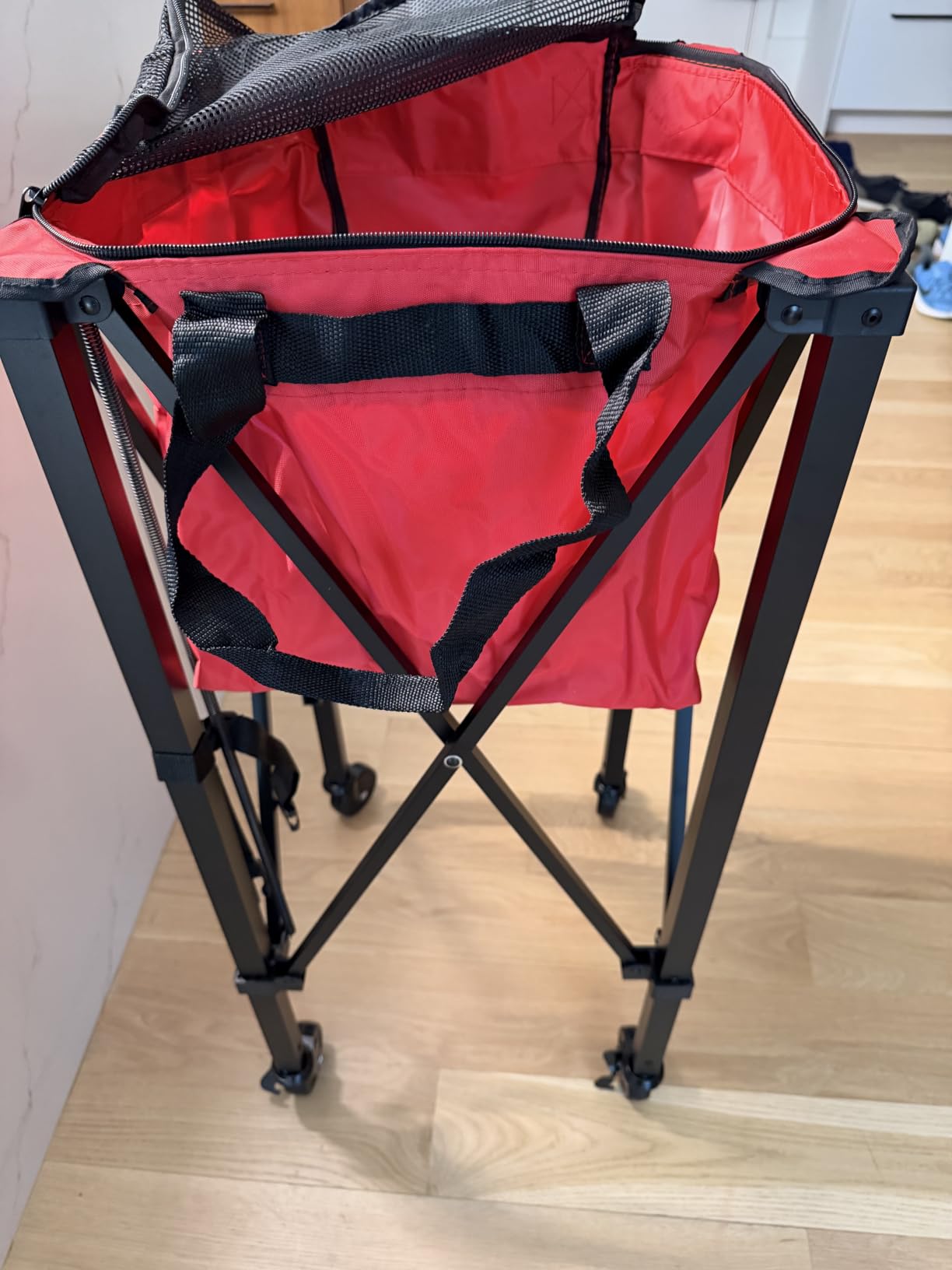
Two things stand out in the design. The bag attaches to the base with metal inserts rather than velcro, which removes the single most common failure point on fabric ball carts. And two of the four universal wheels lock, so the cart stays put while you feed instead of drifting across the court mid-drill.
At 4.5 stars across 118 reviews, this is a small sample but a very positive one. The recurring criticism is the bag fabric, which several owners say frays and tears within four to six months under a full load, so treat the bag as the consumable part of the cart and keep an eye on the seams if you are loading it to 150 regularly.
Is a 35 inch standing height right for feeding balls?
Yes for an adult feeding from a cart, because the height keeps your spine neutral and stops you bending into the bag. For a junior, it is at the upper limit of comfortable reaching, which is another reason the smaller Mini Ballport exists. Measure the feeder’s height before you commit, because this is a cart built around an adult standing at the net.
Will the bag fabric hold up under a full load?
It holds up, but it is the part to watch. Owners who load 150 balls regularly report fraying at the seams and base over four to six months, while the aluminium frame itself keeps going. Inspect the base and stitching periodically, and avoid yanking the bag off by its fabric when it is full, because that is where the tearing starts.
How to Choose a Tennis Ball Hopper That Matches Your Practice
Capacity: match the hopper to who uses it
Capacity is the first filter and the easiest to get wrong. A solo player needs 36 to 80 balls. A parent working with one junior needs roughly 36. A coach running a private lesson wants 75 to 80. A coach running a group clinic needs 150 and up, because the balls in play at once exceed what a smaller basket holds.
There is a second cost to overbuying that people forget: buying a 150 ball hopper means buying 150 tennis balls. Pressurized balls stored for weeks lose pressure, so a big hopper for occasional use is a poor match. Match capacity to how often you will actually fill it, not to how many balls you imagine collecting.
Loaded weight: the number people forget
A tennis ball weighs about 55 to 60 grams, which turns capacity into weight very quickly. Here is the conversion that matters when you are deciding whether a cart is a solo tool or a coach tool.
25 balls is roughly 3 pounds
50 balls is roughly 6 pounds
75 balls is roughly 9 pounds
100 balls is roughly 12 pounds
125 balls is roughly 15 pounds
150 balls is roughly 18 pounds
Add the empty weight of the hopper itself and a 150 ball cart is carrying 25 pounds or more. That is a roll-and-steer load, not a carry load, which is the entire argument for choosing a wheeled model once you pass 100 balls.
Height and feeding position
Height is the feature most buyers never think about and every user notices within a week. A basket that stands around 30 inches works for most adults, because it keeps the top of the ball pile close to waist level. Lower baskets force you to bend repeatedly, and very tall ones are awkward for a junior to feed from.
If you are buying for a child, look for something in the high twenties to low thirties. If you are buying for a partner with back trouble, add wheels to the list and treat height as a secondary concern.
Wire frame versus polypropylene
Steel wire frames are stiffer, they do not flex, and they take up less storage space. They also have a coating that wears through on abrasive hard courts, and they are noticeably louder on concrete. Polypropylene never rusts, stays quiet, and is lighter in the hand, but it flexes and its screws can loosen over time.
Our rule of thumb: polypropylene for outdoor storage, clay, shared courts, and anyone who wants the lightest option. Steel wire for indoor hard courts, small storage spaces, and anyone who prefers a rigid frame that will not deform. If you are still deciding, our guide to the best automatic ball launchers covers a related piece of practice equipment on a similar basis.
Legs, handles, and how fast the switch takes
Every hopper does two jobs: pick up, then feed. The switch between them is the part you use most, so it deserves more thought than most buying guides give it. Locking handles that stay attached to the frame convert in one movement. Handles that must be removed and slotted into a different position take twice as long and are the first thing to break.
Avoid hopper designs where the legs are held by friction alone. If the basket tips while you are feeding, the session stops, and in a group clinic with juniors that is a repeat occurrence rather than a one-off.
Lid and spill control for car transport
A lid matters more than buyers expect, because the walk from the car to the court is where an open basket empties itself across a car park. Sliding top bars that close in one movement are the best pattern, followed by a hinged lid. A lid with a separate chain or clip is better than nothing and worse than a slider.
Wheels: when rolling beats carrying
Wheels pay for themselves quickly past about 80 balls, and they matter for a second reason that is not about weight: a full basket you do not have to lift is a basket you will keep using after a back twinge. Any player or coach who cannot comfortably bend to the ground should treat wheels as close to essential.
Check that at least two wheels lock. A cart that rolls while you feed a student is more distracting than a basket on the ground, and braked casters are the difference between a usable cart and an annoying one.
Rust, coatings, and court surfaces
Rust is the loudest durability complaint in this category, and it is worth understanding why. Plated carbon steel hoppers develop surface rust after a few seasons when they live on abrasive outdoor hard courts, because the coating wears through at the base fittings and the handles first. It is cosmetic more often than structural, and owners typically report surface-level coating wear rather than frames snapping.
Three habits prevent most of it. Rinse the basket after outdoor sessions and dry it before storing. Keep it off concrete floors in a garage, because trapped moisture does more damage than the court does. And if you play mostly on clay or indoors, a coated steel frame gives you years without any of this.
Ball hopper, ball cart, or ball machine
These three get confused constantly because they solve overlapping problems. A hopper collects and feeds. A cart is a hopper with more capacity and wheels, built for feeding several people at once. A machine feeds without a person standing there, which is a completely different problem and a different category of equipment.
If you practise alone and mostly hit serves, a hopper at the net is the entire answer, and a machine is optional. If you already own a machine, the hopper earns its place by collecting and storing what the machine puts out. If you are coaching, you need the cart. The overlap people miss is that a ball machine with a large internal basket often removes the need for a separate hopper, so check your machine’s capacity before buying.
Pickleball compatibility
Yes, most tennis ball hoppers work with pickleballs, with two caveats. Pickleballs are slightly larger, so a hopper quoted at 80 tennis balls holds closer to 50 pickleballs, and several products in this roundup are rated for both. Because the balls are hollow plastic and lighter than pressurized tennis balls, the loaded weight is noticeably lower, which makes a larger basket easier to move than the tennis ball maths suggests.
If you play both sports, look for a model explicitly dual-rated rather than assuming a wire basket will hold 60 pickleballs comfortably. Two picks here are built for multi-sport use and will serve a family that plays both.
Pressurized versus pressureless balls for intermittent use
This one catches people out. Pressurized tennis balls lose pressure in storage, so a big hopper you fill once and use twice a month is a poor match for them. Pressureless balls keep their feel for years, cost less per ball, and play slightly differently, but they are the sensible choice if your sessions are sporadic. If you play two or three times a week, buy pressurized and refill often.
Players often treat ball pressure as a bigger annoyance than hopper quality, and threads about ball pressure outnumber hopper threads by a wide margin. Fix your ball habit first, then buy the hopper that matches it.
Maintenance and storage habits
Every hopper on this list needs almost nothing, which is why they last. Check the screws or bolts that hold the panels and wheel mounts a few times a season, especially on polypropylene models. Wipe the bottom rods and bars, because that is where clay and grit collect and eventually slow your pickup.
Store it collapsed or empty, off the ground, and out of direct sun if it is fabric or steel. If you want a second layer of kit for the court, our picks for the best tennis shoes matter more to how a session feels than most people expect.
Frequently Asked Questions
What is the best tennis ball hopper?
The Wilson 75 Ball Pick-Up Hopper is the best all-round choice for most players, with a 4.2 rating across more than six thousand reviews, a 75 ball capacity, and a sliding lid that survives car transport. The Tourna Ballport 80 is the strongest alternative, at 4.5 stars, because polypropylene makes it lighter, quieter, and immune to rust. Coaches running group sessions should look at the 150 ball carts instead.
What does a tennis ball hopper do?
A tennis ball hopper scoops up loose balls when you press it down over them. The balls are forced up through the open bottom and past one-way bottom rods that flex open on the way in and spring shut behind them. Most hoppers then flip their handles underneath so the basket stands at waist height, turning a picker into a feeder for solo serve and volley practice.
How many tennis balls fit in a ball hopper?
Most hoppers in this roundup hold between 36 and 80 tennis balls, with carts running from 150 up to 250. Real capacity is often slightly under the stated figure, so owners of the 80 ball models report 65 to 70 balls with the lid closed. To estimate weight, multiply the ball count by about 0.13 pounds, so 75 balls is roughly 9 pounds of ball before you add the empty hopper.
Will a tennis ball hopper work with pickleballs?
Yes. Most wire and plastic hoppers collect pickleballs without any change, because the pick-up geometry depends on shape rather than exact size. The only real difference is count, since pickleballs are larger, so a basket rated for 80 tennis balls holds roughly 50 pickleballs. Pickleballs are also lighter than pressurized tennis balls, so a loaded hopper feels noticeably easier to move.
Are wire or plastic tennis ball hoppers better?
Plastic is better for outdoor storage, clay courts, shared courts, and anyone who wants the lightest, quietest option, because polypropylene will not rust and does not clang on concrete. Steel wire is better for indoor hard courts and tight storage spaces because it is stiffer, more compact, and will not flex. Steel needs its coating maintained, while plastic needs its screws checked occasionally.
Should I buy a ball hopper or a ball cart?
A hopper suits a solo player or a single student and holds roughly 36 to 80 balls. A cart holds 150 balls or more, weighs considerably more when loaded, and exists to feed several people at once without walking back to the fence. If you already own a ball machine with a large internal basket, a small hopper for collecting and carrying is usually enough, and a cart is unnecessary.
Final Verdict: Which Tennis Ball Hopper Should You Buy
For most people, the Wilson 75 Ball Pick-Up Hopper is the right first purchase. Seventy-five balls, a lid that survives the car park, and the deepest pool of owner feedback of anything in this roundup, with a 4.2 rating across 6870 reviews. If you would rather carry something lighter and quieter that will never rust, take the Tourna Ballport 80 at 4.5 stars instead.
For a coach or a parent moving around with kids, the picture changes. The Tourna Ballport Deluxe with wheels handles 80 balls and rolls instead of carrying, the ELKCIP hopper serves both tennis and pickleball, and the Tourna Mini Ballport is the one a junior can actually carry. Once you are feeding a group rather than one player, move up to a 150 ball cart such as the Goplus or YooKoo models, both of which lock their wheels and hold their shape at feeding height.
Whichever you choose, match the capacity to the number of balls you will realistically put in it, because a large hopper of pressureless balls beats a small one of dead pressurized ones every time. We last checked all ten in September 2026, and the full spec table above is the fastest way to narrow the list before you buy.