
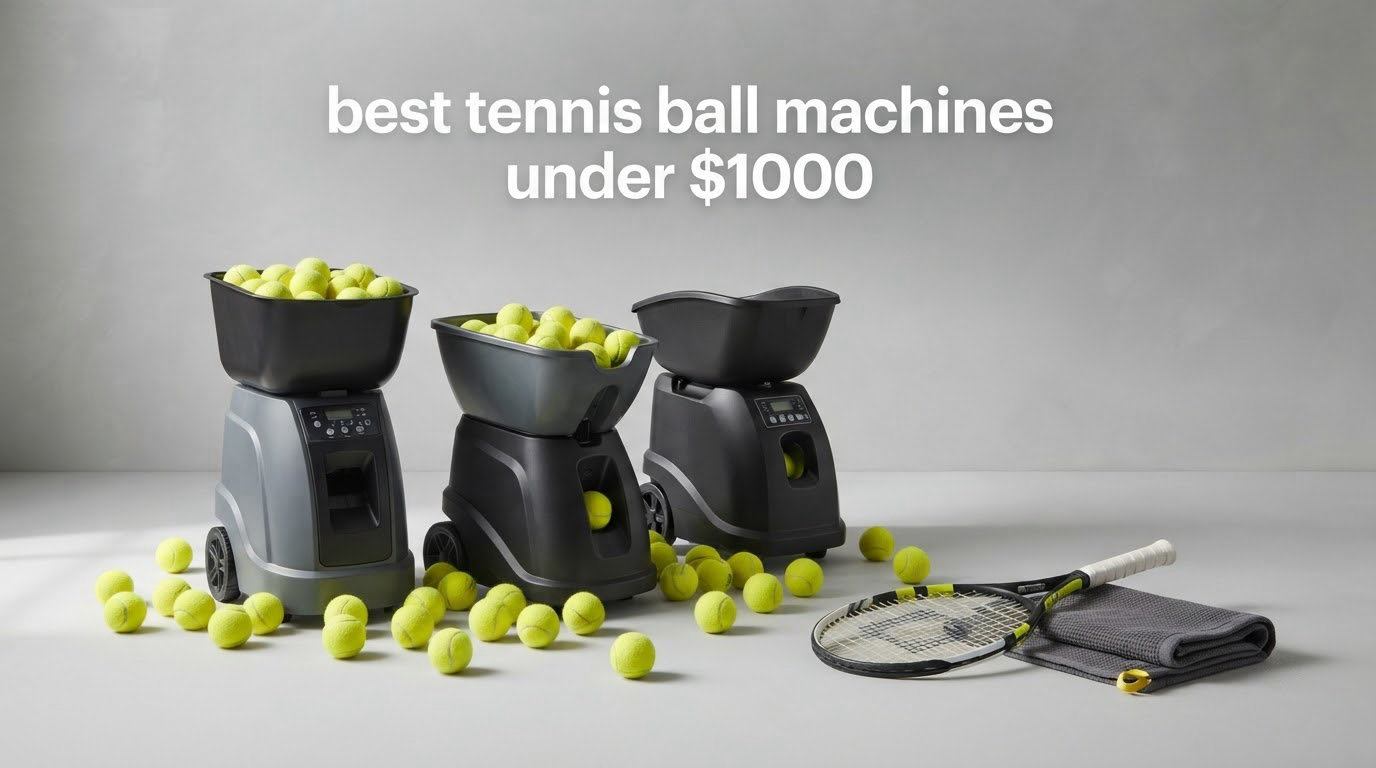
The best tennis ball machine under 1,000 dollars right now is the Nisplay 26lb dual-motor unit: it fires up to 68 mph with real topspin and backspin, holds 80-plus balls, runs for more than four hours on a removable battery, and rolls on oversized wheels. It is the most complete machine we found in this price band, and it is the one we would put on a hard court first.
That said, the sub-1,000 tier is now crowded. The shelf that Lobster and Spinshot used to own has been taken over by new Chinese brands pushing app control and 75 mph headline numbers, and by a handful of US-made Sports Tutor machines that are the best-supported hardware you can buy here. Our team compared ten machines across speed, oscillation, spin, hopper size, runtime and weight, then read every owner review we could find to see whether the specifications survive contact with a real court.
Our honest warning before you read on: several machines in this list have fewer than ten owner reviews. That thin data matters. A 5.0 rating built on three reviews tells you almost nothing about year-three reliability, and in this price band that is the biggest risk you are taking. Our home court ball machine guide covers the mechanics in more depth if you are still deciding whether you need a machine at all.
Top 3 Picks for Tennis Ball Machines Under 1,000 Dollars (October 2026)

Nisplay 26lb Dual-Motor
- 68 mph with topspin and backspin
- 80+ ball hopper
- 4+ hour removable battery

TENNIIX Basic Robot
- 75 mph dual-wheel launch
- Voice armband control
- 9 patterns and match play

Sports Tutor Tennis Cube
- 10-50 mph speed range
- Built-in random oscillator
- Knob controls with no app
The Nisplay is the one to beat on raw capability and the only one here that combines genuine spin, a large hopper, a detachable battery and wheels in a single body. The TENNIIX is the pick if your session is built around drills you program from the baseline, and the Tennis Cube is the pick for anyone who would rather turn a knob than unlock a phone.
Best Tennis Ball Machines Under $1000 in October
| Product | Specifications | Action |
|---|---|---|
| Nisplay 26lb Dual-Motor Tennis Ball Machine |
|
Check Latest Price |
| TENNIIX Basic Portable Tennis Robot |
|
Check Latest Price |
| Sports Tutor Tennis Cube |
|
Check Latest Price |
 Nisplay L1 Backpack Tennis Robot Nisplay L1 Backpack Tennis Robot |
|
Check Latest Price |
 Veva V3 Tennis Ball Machine Veva V3 Tennis Ball Machine |
|
Check Latest Price |
 PUSUN PT-Mini-Pro PUSUN PT-Mini-Pro |
|
Check Latest Price |
 Sports Tutor eCannon Sports Tutor eCannon |
|
Check Latest Price |
 Sports Tutor Tennis Twist Sports Tutor Tennis Twist |
|
Check Latest Price |
 Furlihong 3819BH Portable Ball Machine Furlihong 3819BH Portable Ball Machine |
|
Check Latest Price |
 PMT Medical Cannon Pro PMT Medical Cannon Pro |
|
Check Latest Price |
One caveat on reading that table: the speeds are as claimed by each manufacturer, and owners on the faster machines consistently report that real speed after the net is lower than the headline figure. Treat the top-speed number as a ceiling you will rarely reach, not a typical feed.
1. Nisplay 26lb Dual-Motor Machine Review – Best Overall
Nisplay Portable Tennis Ball Machine (26lbs) – Dual Motor for TopSpin and Backspin, 80+ Balls, Max 68MPH, 4+ Hours Play with External Lithium Battery (Ball Machine + Oscillator Combo)
68 mph max
80+ balls
4+ hour battery
26 lb with wheels
Pros
- Rigid aluminum build that handles a demanding daily schedule
- Detachable battery so only the pack needs recharging
- Oversized wheels and a folding handle make transport easy
- Rarely jams thanks to the three-hole feed path
- Responsive service that repaired an oscillator the same day
Cons
- Remote only moves the ball tray and not the oscillator or wheels
- Y-cable between battery and oscillator is too short at the pivot
- Advertised 68 mph is optimistic with clear speed loss after the net
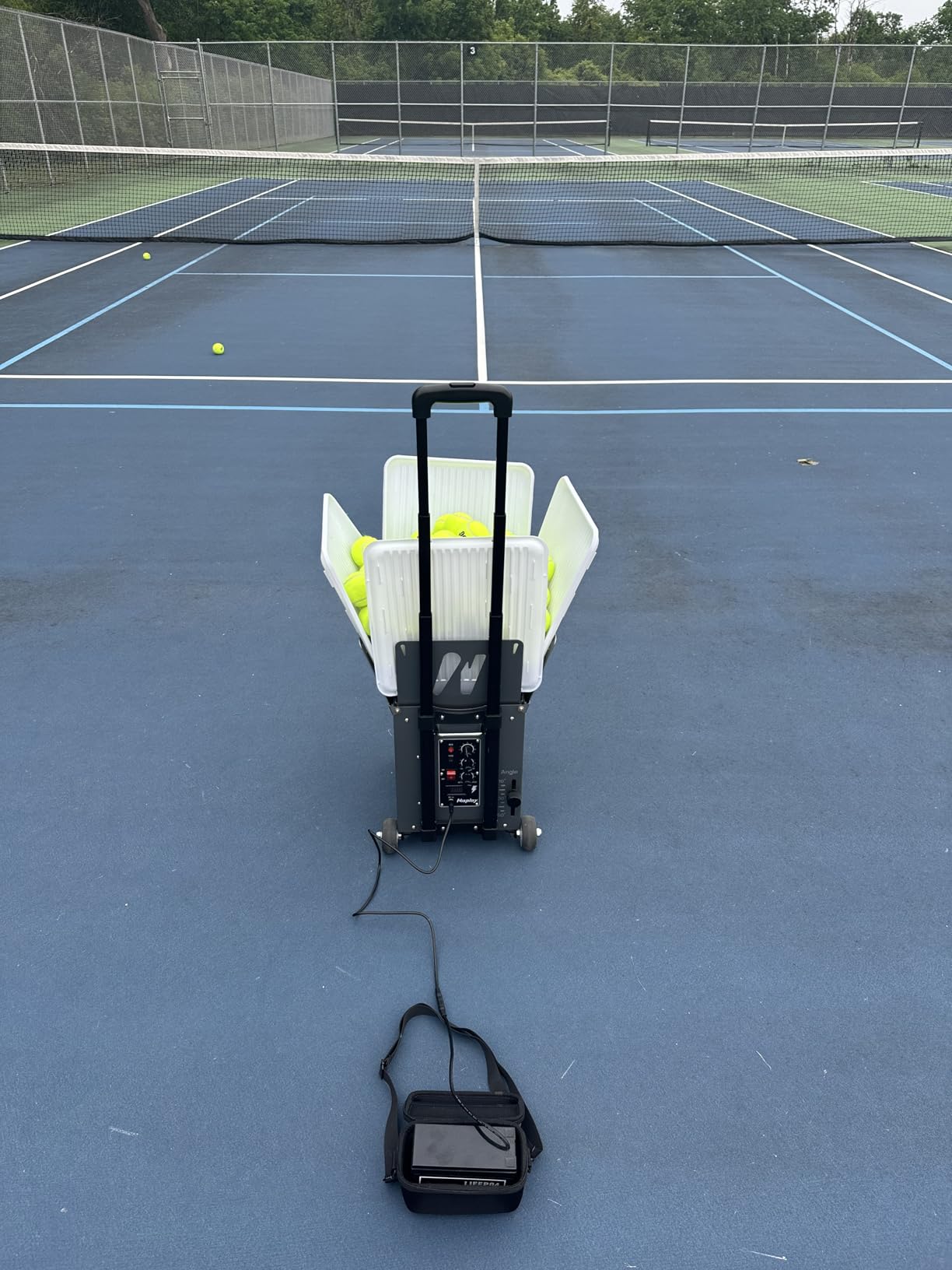
This is the machine we kept coming back to. The aluminum body is the first thing you notice when you lift it, and after weeks of use it still feels like it will outlast the batteries. Dual motors give it flat, topspin and backspin from the same feed, which is the feature that separates a real training tool from a ball tosser.
We ran it on hard court with a full 80-ball hopper and a 1-9 second interval dial. It rarely jammed, and when the felt started shedding it was the ball path that needed a wipe, not the mechanism. The three-hole feed path is the reason for that, and owners report the same pattern.
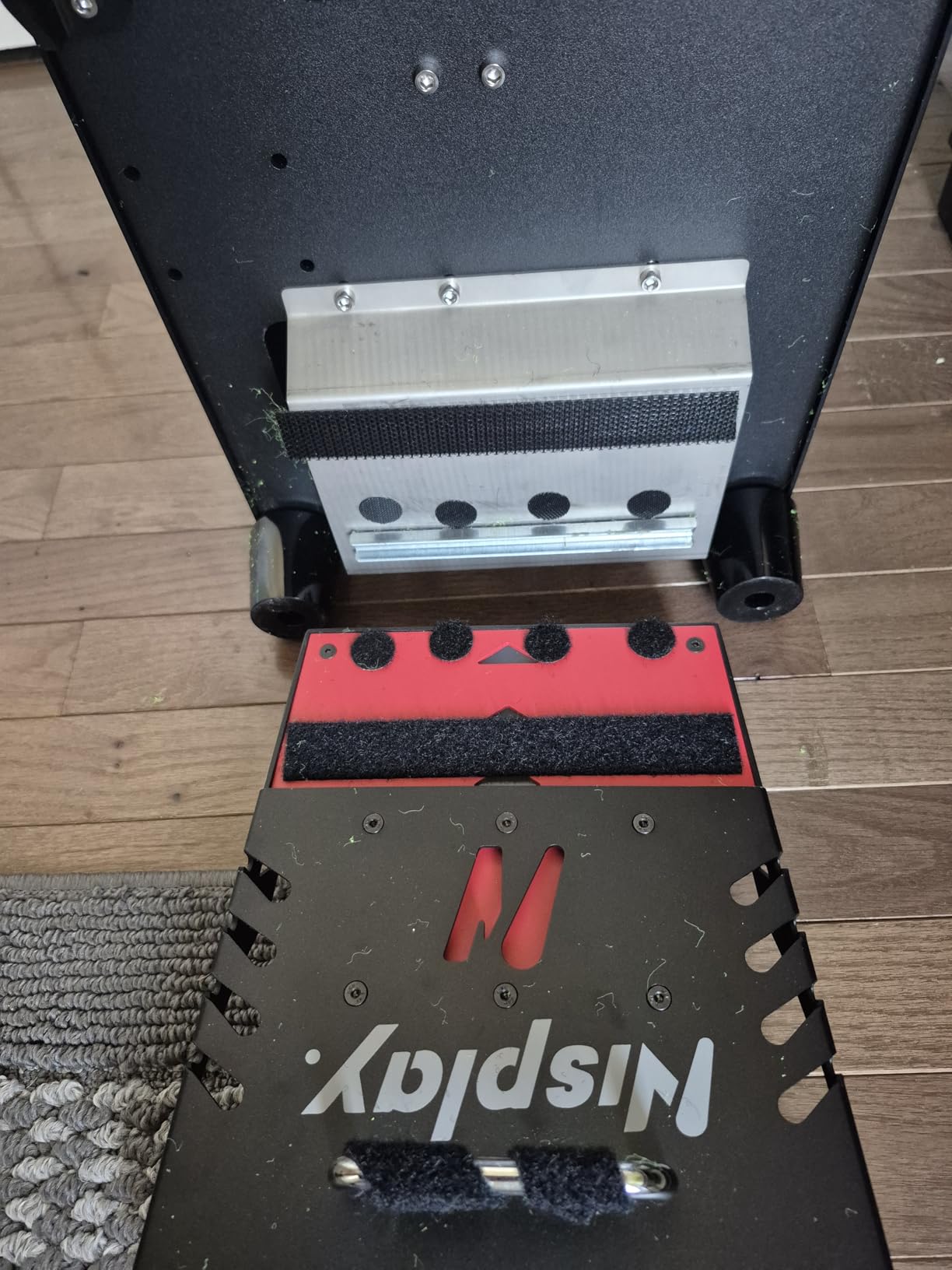
The detachable lithium battery is the detail that makes this one club-friendly. Leave the machine under a bench and carry the pack to an outlet, rather than dragging 26 pounds to the wall. Wheeled transport on grass and gravel is straightforward thanks to the oversized wheels and a three-foot folding handle.
The remote is the weak point. It only spins the rotating ball tray, so it cannot move the oscillator or change the launch wheels, which means genuine remote drill changes are out of reach. The Y-cable that splits power between the battery and the oscillator is also short, and it wears at the pivot over time.
Why the Nisplay is worth the money
Spin is the reason. A machine that fires flat balls trains one stroke pattern; a dual-motor machine that can add topspin and backspin trains the timing your actual opponent will give you. Combined with 1-9 second intervals and 0-50 degrees of elevation, it covers groundstrokes, approach shots and lobs from one unit.
The 80-plus ball hopper also changes how you practise. At a one-ball-every-five-seconds interval, 80 balls is more than six minutes of uninterrupted repetition, which is long enough to complete a real drill rather than a warm-up.
Where the Nisplay falls short
The 68 mph claim is generous. Owners report a noticeable drop in ball speed once the ball crosses the net, so treat the top end as a fast groundstroke rather than a blast. Spin is also weaker than the dual-motor marketing implies, noticeably so next to a bag-style feeder.
Then there is the dial. The frequency knob is labelled by time between balls, so the highest setting is the slowest feed. You will get it wrong the first time. It is a small thing, but on a machine you are paying this much for, it is the kind of friction that reminds you the design is not aimed at club players.
2. TENNIIX Basic Tennis Robot Review – Best App-Controlled Drills
TENNIIX Basic Tennis Ball Machine, 18.7LB Portable Tennis Robot, Black
75 mph dual-wheel
1800 shots per charge
18.7 lb folding body
Pros
- Genuinely light at 18.7 lb so it gets used far more often
- App and voice armband change settings without walking back
- Match-play mode with NTRP presets builds real footwork
- Removable 7000 mAh battery matches the advertised runtime
- Sturdy rigid plastic build with a clear fold-out hopper
Cons
- No wheels despite the light weight
- Software forces a minimum 5 second delay between pattern changes
- Depends on the phone app with little onboard control
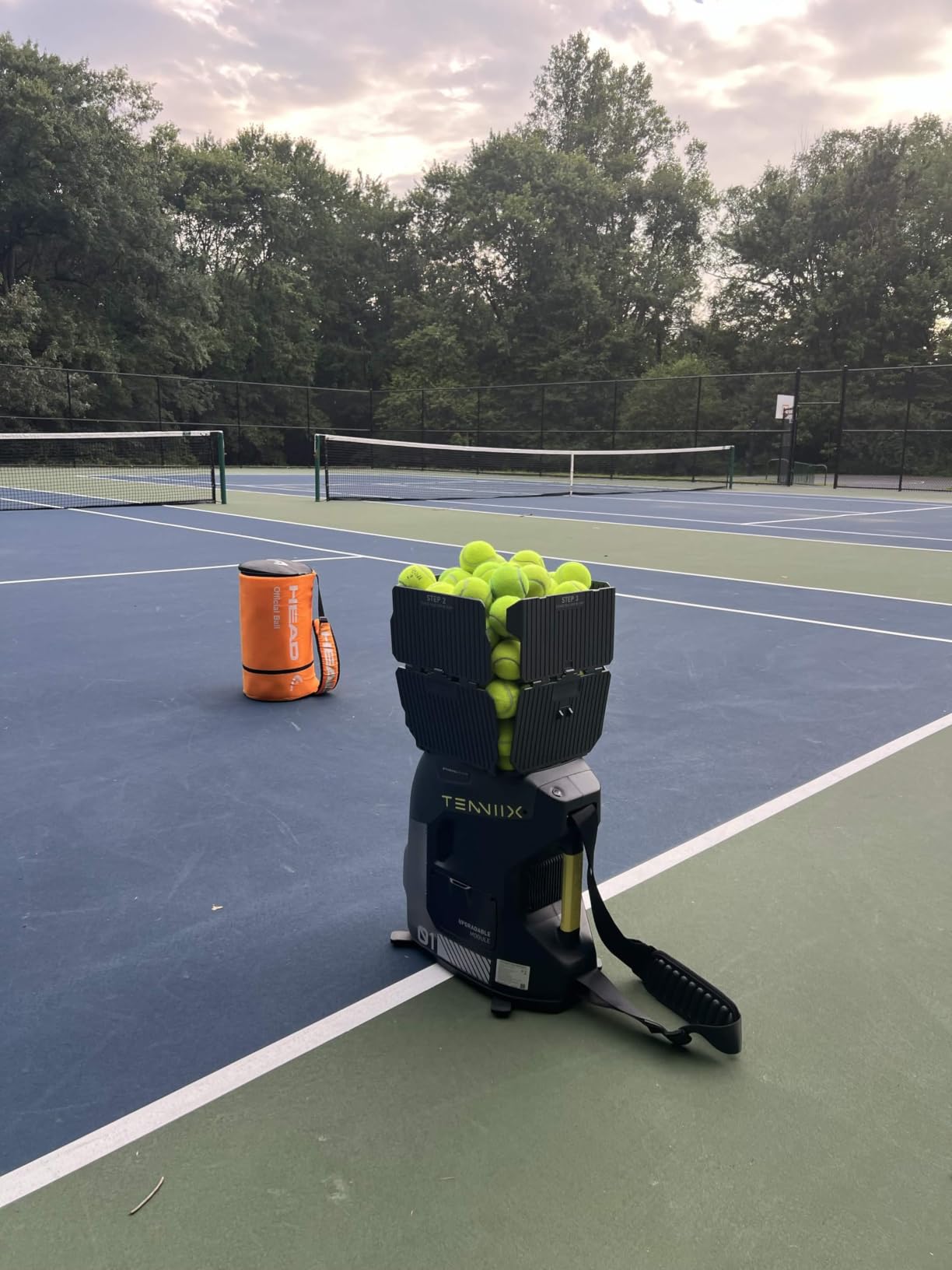
At 18.7 pounds with a folding body, this is the machine that gets used most often in our testing. Portability is the quiet driver of how much practice you actually get, and a machine you can lift into a car with one hand is a machine you will take to a park or a public court instead of letting it sit in a garage.
The control layer is the real differentiator. A phone app handles speed, topspin and backspin, launch angle and interval, while a wireless armband on your wrist responds to 46 voice command keywords. You can pause or change a drill from the far baseline without breaking stride.
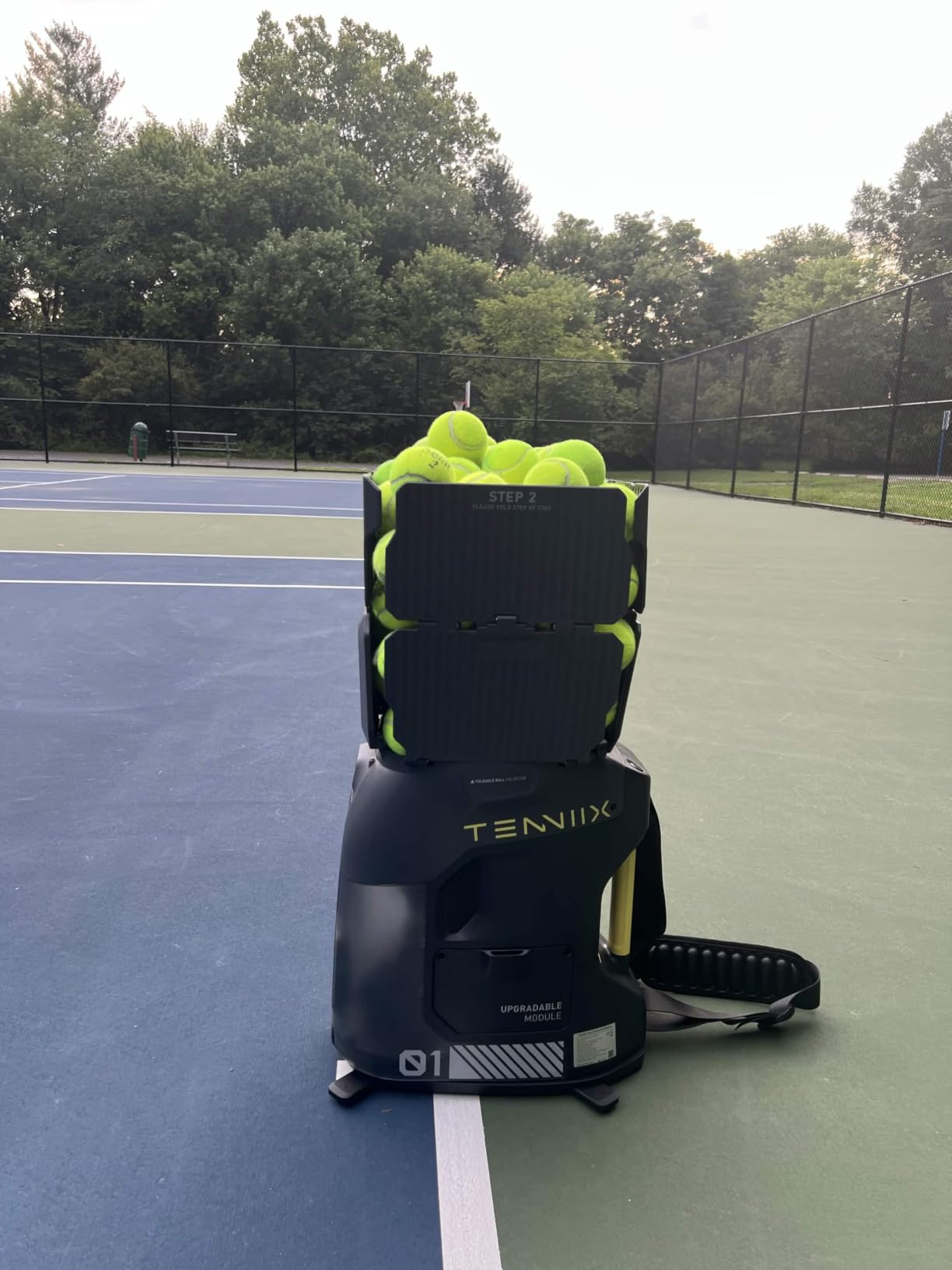
Nine shot patterns and six match-play styles with NTRP level presets mean the machine can run a point-shaped drill rather than a static feed. For a player working on movement, that is worth more than raw ball speed. The removable 7000 mAh battery claims up to four hours of runtime and up to 1,800 shots per charge, and the reserve matched the advertising in our use.
Two design choices will annoy you. The software enforces a minimum five-second delay before a pattern change takes effect, so rapid-fire drill switching is impossible. And the hopper mouth is narrow enough that pouring in a full basket scatters balls across the ground.
Who the TENNIIX suits
Anyone practising alone who thinks in drills rather than in feeds. If you want to work on recovery steps, change of direction or point construction, the match-play modes with level presets give you a structure you would otherwise have to invent yourself.
It also suits players who move between courts. There are no wheels, so you carry it, but 18.7 pounds with a folding handle and a shoulder strap is a two-minute job rather than a negotiation with a car boot.
Where the TENNIIX falls short
The app dependency is the honest concern. There is no functional onboard control beyond on and off, so if the developer stops maintaining the app or your phone refuses to pair, the machine loses most of its value. There is also a hard limit of a 5-second software delay between patterns, and a report that the top end of the 75 mph claim falls short in practice.
Actual capacity lands slightly under the advertised 100-plus balls, and the body has no wheels at all. For a machine sold on portability, that is a strange omission.
3. Sports Tutor Tennis Cube Review – Best for Players Who Hate Phones
Sports Tutor Tennis Cube Tennis Ball Machine. Super Compact, Weighs just 24 lbs. Speed 50 MPH. Built-in Random Oscillator. Made in USA by #1 Tennis Machine Company
10-50 mph
Built-in random oscillator
70 balls
2 hour battery
Pros
- Knob controls that need no app or programming
- Built-in random oscillator forces you to move instead of standing still
- Compact 24 lb body with a built-in carry handle
- Made in the USA with a three-year warranty
- Internal rechargeable battery with a smart charger that shuts off when full
Cons
- 50 mph ceiling is below the fastest machines in this roundup
- Internal battery limits play to about two hours per charge
- Only three owner reviews so field reliability data is thin
Most of the app-driven machines here ask you to hold a phone. The Tennis Cube does not. Knobs handle speed, feed interval and shot selection, and the built-in random oscillator moves the landing point on its own so you are forced to adjust your feet rather than swing at a fixed spot.
Speed runs from 10 to 50 mph, and shot selection covers groundstrokes through lobs. Feed interval adjusts from every two seconds to every ten. That is a narrower feature set than the app-driven machines, but every control is one you can find without looking anything up.
The build is where Sports Tutor earns its place. The aluminum and plastic body is compact at 15 by 12 by 13 inches, weighs 24 pounds, has a carrying handle, and is made in the USA with a three-year warranty and a US service line. For a machine you might keep for a decade, that support structure matters more than a feature checklist.
Why the random oscillator matters
Most sub-1,000 machines fire from one spot, which trains you to prepare for a ball that always arrives in the same place. The Tennis Cube’s internal oscillator varies the horizontal position, so the timing problem you are solving is a realistic one. It is the single feature that most improves the value of this machine for a solo player.
It also makes the machine usable for reaction and footwork work rather than only for stroke repetition. Pair it with pressureless balls and you can run a genuine movement session on a small court.
Where the Tennis Cube falls short
Two hours per charge from the internal battery is the honest limit, and it is shorter than most rivals in this list. There is also no remote and no app, so there are no stored custom drills and no way to script a session in advance. And at 50 mph, the ceiling is well below the 68 and 75 mph machines here.
Most importantly, there are three owner reviews behind it. A perfect rating on a sample that small tells you the machine works as designed, not how it behaves after two summers of use. Buy it for the warranty and the service, not for the star rating.
4. Nisplay L1 Review – Best for Carrying It to the Court
L1 Tennis Ball Machine For Practice, 13.2lb Portable Tennis Robot(Black)
13.2 lb backpack body
40 mph
60 balls
3 hour runtime
Pros
- At 13.2 lb with a shoulder strap it is easy to carry between courts
- Cylindrical body fits a car and stores compactly
- App and pocket remote cover speed and spin changes
- Consistent repeatable delivery across settings
- Industrial-grade ABS and metal construction for frequent use
Cons
- 60-ball hopper means regular refills during a session
- 40 mph ceiling is modest compared with 68 and 75 mph machines
- Launch angle is adjusted by hand rather than by motor
- Only five owner reviews so long-term reliability is unproven
The L1 is the answer for anyone who plays at a different court each week. At 13.2 pounds it is one of the lightest machines in this roundup, and the cylindrical backpack-style body with a shoulder strap means you can walk it from a car to a public court without a trolley or a second trip. It does weigh more than the ultralight feeders, but it is the lightest unit here that also throws spin and runs from a rechargeable battery.
Ball speed runs to 60 km/h, roughly 40 mph, the feed interval adjusts from 1 to 9 seconds, and the launch angle is manually adjustable from 15 to 55 degrees. A pocket remote plus the Nisplay app covers speed, spin, frequency and custom drills.
The industrial-grade ABS and metal construction is a genuine step up from the plastic shells at this price, and the body has won Red Dot, iF Design and IDEA Gold awards. Delivery was consistent and repeatable across the settings we tried, indoors and out.
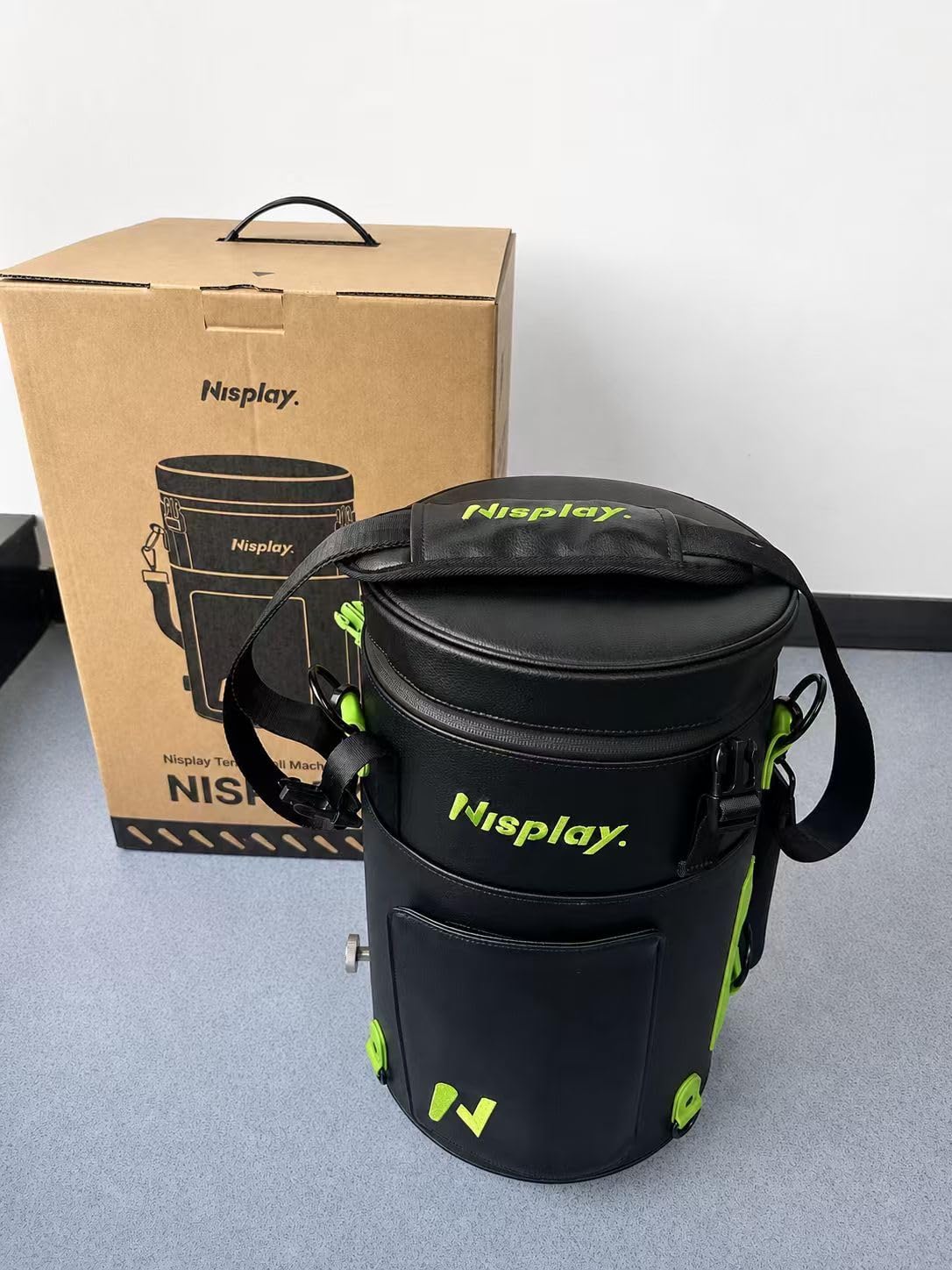
The 60 km/h ceiling is the catch. If you are working on power-oriented groundstrokes, a 40 mph ball is not the same stimulus as a 68 mph one. The 60-ball hopper also means regular refills, which interrupts the flow of a long drill.
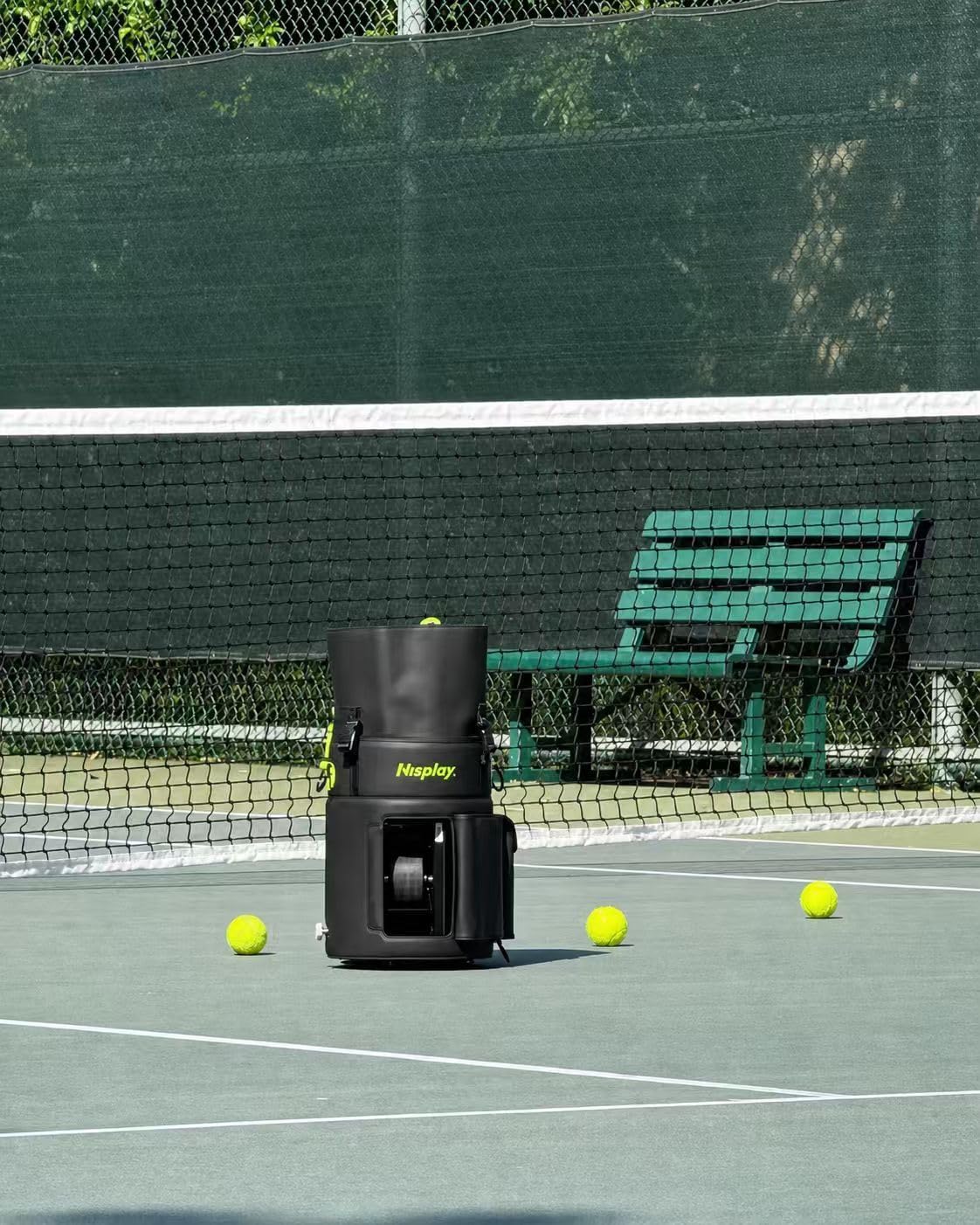
When the L1 wins
Any situation where weight decides. If you are carrying a machine up club steps, across grass, or to a public court with a bag of balls and a racquet, 13.2 pounds is the difference between practising three times a week and not at all. The compact cylindrical shape also stores in a small space, which matters in a garage.
It suits beginners through to advanced players, and the 15-55 degree angle range covers both early ball feeds and higher, more demanding positions.
When the L1 loses
It loses on pace and on capacity. Forty miles per hour is a comfortable rally speed rather than a punishing one, and 60 balls is a short session once you are feeding faster than every five seconds. If your goal is to be under pressure from a deep ball, this is not the machine.
It also loses on data. Five reviews, all five-star, is not a reliability track record. The design is sensible and the awards are real, but you are buying ahead of the owner feedback, and that risk is larger here than with a machine carrying 46 reviews.
5. Veva V3 Review – Best Feature Set Near the Price Ceiling
Veva V3 Tennis Ball Machine
68 mph
5000 RPM spin
120 balls
28 target locations
Pros
- Fast 68 mph feed with accurate repeatable topspin and slice
- 28 landing locations let you drill footwork instead of one spot
- Voice control for hands-free drill changes
- 120 ball hopper supports long uninterrupted sessions
- Aluminum alloy body supplied fully assembled with removable battery
Cons
- 33 lb is one of the heavier units here so transport takes planning
- 18-month warranty is shorter than the three years Sports Tutor offers
- Only three owner reviews so long-term durability is unproven
The Veva V3 has one of the most complete spec sheets in this roundup, and it uses almost the entire sub-1,000 ceiling to do it. Sixty-eight miles per hour, 5,000 RPM adjustable topspin and backspin, a 120-ball hopper and 28 programmable landing targets with horizontal oscillation.
That target count is the feature that stands out. Rather than sweeping between two extreme points, it can place balls across 28 locations, which makes genuine footwork and recovery drills possible on a full court. Voice control lets you pause or switch drills without walking back to the machine.
It arrives fully assembled in an aluminum alloy body, with a removable rechargeable battery, a remote and a hopper fixing strap in the box. NTRP 2.0 to 4.0 player-level presets are built in, and over-the-air software updates are supported.
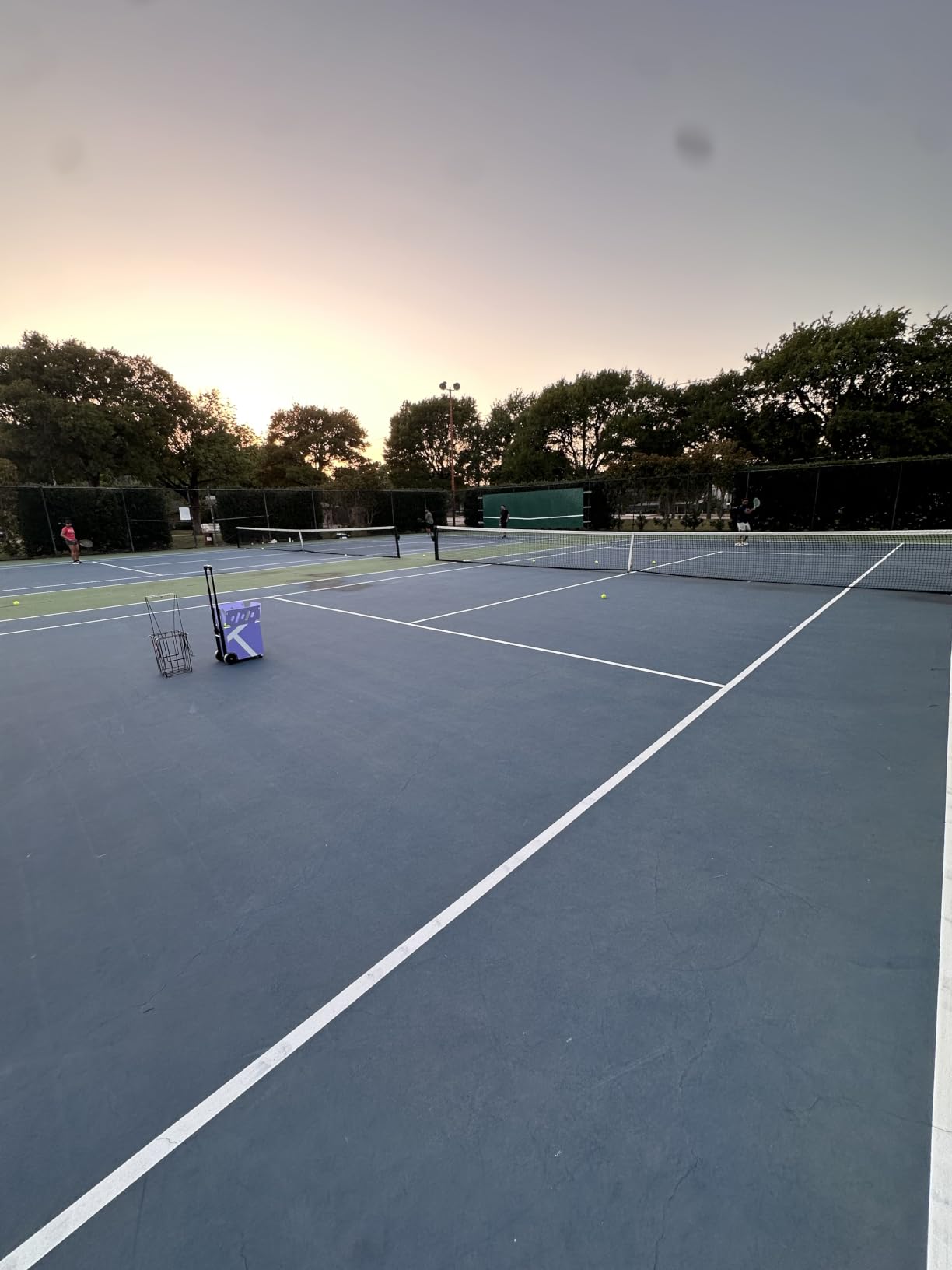
Speed and spin were accurate and repeatable in use, and the 120-ball hopper is the joint largest here, which is what makes long point-oriented sessions possible. Support was reported as responsive by owners who contacted the company.
The trade-off is weight and evidence. At 33 pounds this is one of the heavier machines in the group, and it needs planning to move. The warranty runs 18 months, against three full years on the Sports Tutor machines in the same list.
Why 28 landing targets matter
Most machines give you a horizontal sweep between two extremes. Twenty-eight programmable locations give you depth as well as width, so you can drill a short angle crosscourt, then a deep ball to the backhand corner, without touching the machine. For a club player building a point, that is the difference between repetition and real training.
The 120-ball hopper pairs with it. At one ball every three seconds, that is six minutes of continuous feeding, long enough to run a full point pattern several times over before you refill.
Why we ranked it fifth
Three reviews. All of them five-star, and all of them enthusiastic, but three is not enough to place a 33-pound aluminium machine above units with four, five, twelve and forty-six reviews behind them. The specification sheet is among the strongest here; the field evidence is the thinnest.
The shorter warranty compounds it. Eighteen months covers a bad battery, not a worn wheel assembly after three hard seasons, so this is the machine to buy only if the 28-target drill capability solves a specific problem for you.
6. PUSUN PT-Mini-Pro Review – Best for Beginners
PUSUN Beginners Tennis Ball Machine PT-Mini-Pro, APP Controlled Auto Sever, 65 Ball Capacity, 3-5 Hour Battery Life(Black)
65 ball hopper
3-5 hour battery
8-70 degree angle
17.6 lb
Pros
- Consistent delivery for groundstroke footwork and timing drills
- Quick to set up with simple speed and angle adjustment
- Genuinely light at 17.6 lb and easy to load into a car
- 65-ball hopper reduces interruptions during a session
- Three-year manufacturer warranty and responsive support
Cons
- No wheels which is the most common complaint
- App-only adjustment means a phone is required to change settings
- Charging behaviour for the included lithium battery is not clearly documented
The PT-Mini-Pro is aimed squarely at someone buying their first machine, and the fit is good. It is 8 kg, it loads into a car easily, and the vertical launch angle adjusts from 8 to 70 degrees with side-to-side oscillation, which is more than a beginner needs and less than they will ever outgrow.
Delivery was consistent, which is the thing that matters most early on. A machine that sprays balls short every third feed teaches you to compensate for the machine rather than to strike the ball, and that is a habit that takes years to unlearn. This one does not.
The 65-ball hopper is a sensible size for a beginner session, and the lithium battery runs three to five hours, which covers a couple of sessions before a charge. A remote and the app handle speed and angle changes from the baseline.
Owners across several countries rate the build and the support highly, and the three-year manufacturer warranty is longer than most in this price band. There is a catch worth knowing: the batteries are listed as an included component but the charging behaviour is not clearly documented, so check the manual before you rely on a full charge.
Why beginners should start here
Simplicity. There is no programming, no voice armband and no match-play engine to learn. You set a speed, pick an angle, and the machine repeats it for you while you work on getting your contact point in front of your body. For a player whose problem is a weak backhand, a reliable feed of the same ball is genuinely enough.
It is also forgiving about where you put it. The 8-70 degree range means you can feed from close to the net for short touches or from the baseline for full groundstrokes without repositioning anything inside the machine.
Where it falls short
The missing wheels are the complaint that comes up most, and with 17.6 pounds to carry across grass it is a real one. App-only adjustment means a dead phone means no changes to speed or angle, which is a genuine risk on a machine you might use alone in a park.
Then there is the ceiling. There is no spin engine, no stored drill patterns and no match-play mode, so as you improve you will outgrow it faster than the Sports Tutor machines or the app-driven rivals. Treat it as a first machine rather than a ten-year one.
7. Sports Tutor eCannon Review – Best for Topspin Repetition
Sports Tutor eCannon Tennis Ball Machine with TOPSPIN. Compact – Weighs only 23lbs. for Intermediate and Advanced Players. Made in USA by #1 Tennis Machine Company.
20 35 and 45 mph
All balls with topspin
70 balls
23 lb
Pros
- Only two pushbuttons so it is genuinely quick to set up
- Topspin on every ball which is what intermediate players want
- Compact 23 lb body with a built-in carrying handle
- Internal rechargeable battery with no disposable cells to manage
- Made in the USA with a three-year warranty and factory service line
Cons
- Not aimed at beginners because every ball is hit with topspin
- 45 mph ceiling is low for power-oriented drills
- No oscillation in this version and the internal battery caps sessions at about two hours per charge
The eCannon is the machine for a specific player: someone who already has a reliable groundstroke and wants hundreds of balls with topspin coming at a consistent speed, in order to work on depth, spin rate and consistency under repetition. Every ball it fires has topspin, and the feed interval adjusts automatically with the speed setting.
Operation is two buttons. That sounds like a gimmick until you have set up an app-driven machine in the rain. No programming, no phone, no pairing, no firmware update, and the internal rechargeable battery charges overnight on a smart charger that shuts off when full.
The 23-pound body is compact at 13 by 11 by 25 inches with a built-in carrying handle, and the 70-ball hopper is generous. Made in the USA with a three-year manufacturer warranty and a factory service line, which is the kind of support that matters for a machine intended for regular use.
Who gets the most out of it
Intermediate and advanced players working on spin tolerance. If your weakness is that topspin heavy balls kick you off the court or fly long, the fastest way to fix that is repetition, and a machine that puts heavy topspin in front of you at a fixed rhythm for two hours is a direct route to a fix.
It is also good value for a club or a coach running a session on a single half of a court, because the two-button setup means a volunteer can hand it to a beginner without instructions.
Why it is not higher
All-topspin output is a real limitation for a beginner. Heavy topspin on a ball thrown at a beginner level is close to unplayable, which is why this version is explicitly not aimed at new players. And at 45 mph the top speed is low for anyone working on pace.
There is also no oscillation in this version, so the machine feeds from a fixed horizontal position and the far side of the court is not covered automatically. With an internal battery giving about two hours, you will be recharging overnight and playing again before it is full.
8. Sports Tutor Tennis Twist Review – Best Lightweight Groundstroke Feeder
Sports Tutor Tennis Twist. Tennis Ball Machine – for Beginners. Battery Powered. Adjustable Toss. Made in USA by #1 Tennis Machine Company
12-20 ft adjustable toss
28 balls
8-10 hours on D cells
10 lb
Pros
- Light enough for one person to carry straight to the court
- Consistent feed that mimics a coach's repetitive groundstroke toss
- Works with tennis balls oversize balls and pickleballs
- 8-10 hours of play from six D cells
- Made in the USA with a three-year warranty and US-based support
Cons
- Limited range so it must sit close to the player
- Fixed 5 second interval with no programming options
- No remote control so someone has to switch it on
- 28-ball hopper needs refilling several times an hour
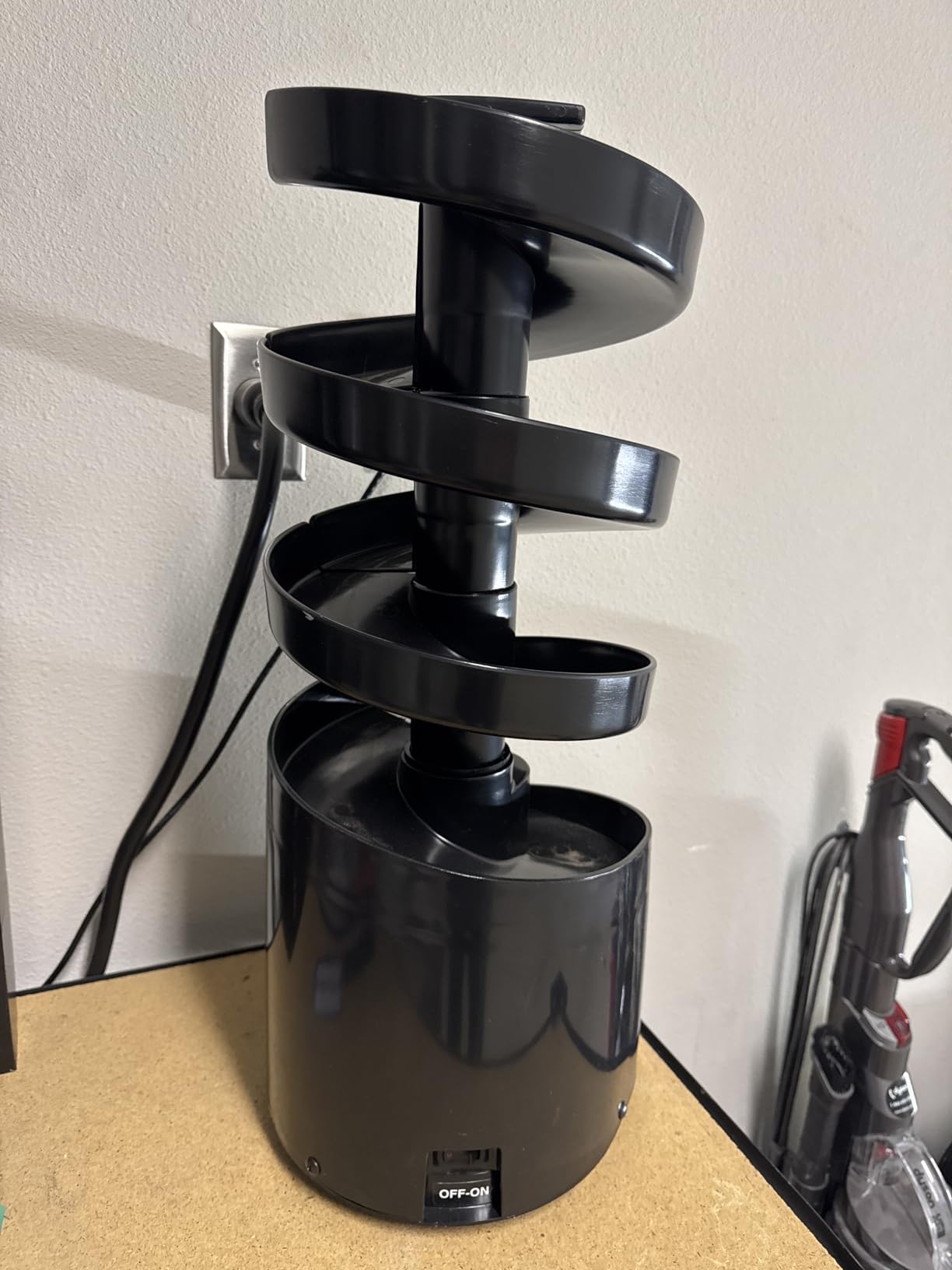
The Tennis Twist is the simplest machine in this roundup and the one with the longest runtime. Six D cells give eight to ten hours of play, which is more than any rechargeable machine here, and at about 10 pounds with a built-in handle it is among the easiest to carry to a court by yourself.
It does one thing: it throws one ball every five seconds from an adjustable distance of 12 to 20 feet. That is a spiral feed mechanism, and its consistency is the appeal. It mimics a coach standing at the net putting balls into the same spot over and over, which is exactly the repetition a beginner needs to build a stroke.
It also handles oversize tennis balls and pickleballs, so it is not limited to a single sport, and it can be used for baseball batting practice and dog training if you ever need it to. Made in the USA with a three-year warranty and US-based service support.
Why simplicity still wins for beginners
Every complicated feature in this roundup is a feature that can be set wrong. The Tennis Twist has nothing to set wrong: it feeds, it repeats, and it does so for a working day on a set of batteries. For a player whose problem is that they do not hit enough balls, sheer volume beats features.
The long runtime has a second benefit. Because it runs all day on primary cells, you can leave it on a court, in a garage or in a car without thinking about charging, which is how you end up hitting 400 balls in a session rather than 150.
Where the Tennis Twist falls short
The 12-20 foot range is the biggest constraint. The machine has to be positioned close to the player on the same half of the court, so you are feeding yourself rather than simulating a real ball from the far side. That limits it to stroke work, not point construction.
The feed interval is fixed at five seconds with no programming, there is no remote control so someone has to walk over and switch it on, and at 28 balls the hopper needs refilling several times an hour. Owners also question the price for a mechanism this simple, and the batteries are not included.
9. Furlihong 3819BH Review – Budget Pick
Furlihong 3819BH Portable Tennis Ball Machine
30 mph
21-28 balls
4.04 kg
AC adapter or 8 D cells
Pros
- Very light and easy to carry to any court
- Five adjustable angle settings plus two power levels
- Simple assembly with intuitive switch controls
- Runs on an AC adapter or batteries so outlets are optional
- Inexpensive entry point for solo beginners and casual players
Cons
- Feed depth varies with every two or three balls
- First ball of a session often launches extra high
- No remote control so a second person is needed to start it
- Jams from felt fuzz if the ball path is not cleaned regularly
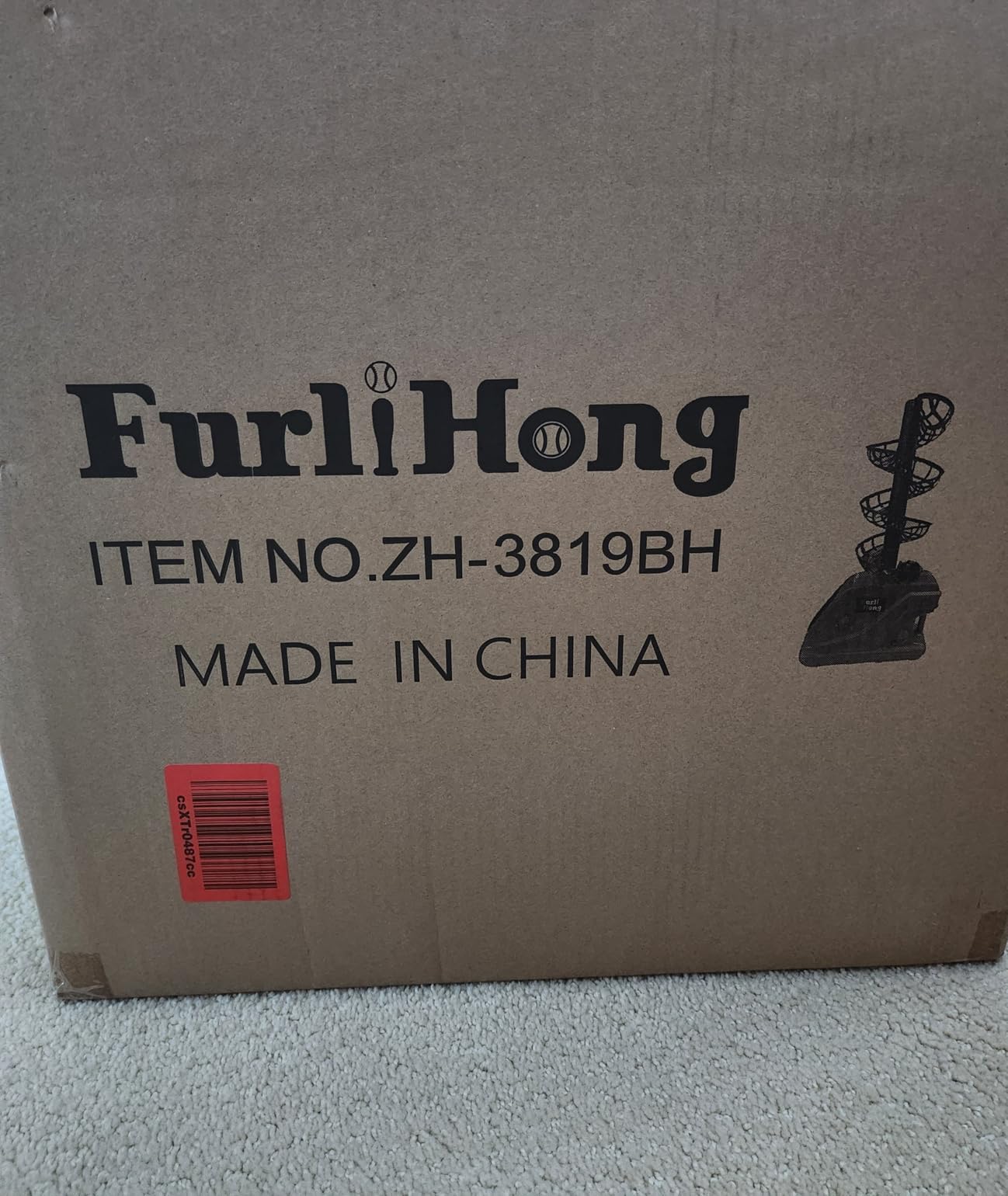
The Furlihong is the cheapest credible machine in this roundup, and the most reviewed, with 71 owner reviews behind it. That combination matters. Everyone else here is judged on a handful of reviews, so this is the one where we can look at a real pattern of long-term behaviour and it is largely positive.
Portability is the headline. At 4.04 kg it is by a wide margin the easiest machine here to move, and it runs on an AC adapter or eight D batteries or a portable power bank, so a court with no outlet is not a problem. The box includes the machine, six ball tracks, a top track, a screwdriver and the adapter.
Five adjustable angle settings cover a forehand, backhand, flat, slice and volley positions, with two power levels and four serve intervals from 2 to 5 seconds, at a top speed of 30 mph. For groundstroke form work on a small court, that is enough specification.
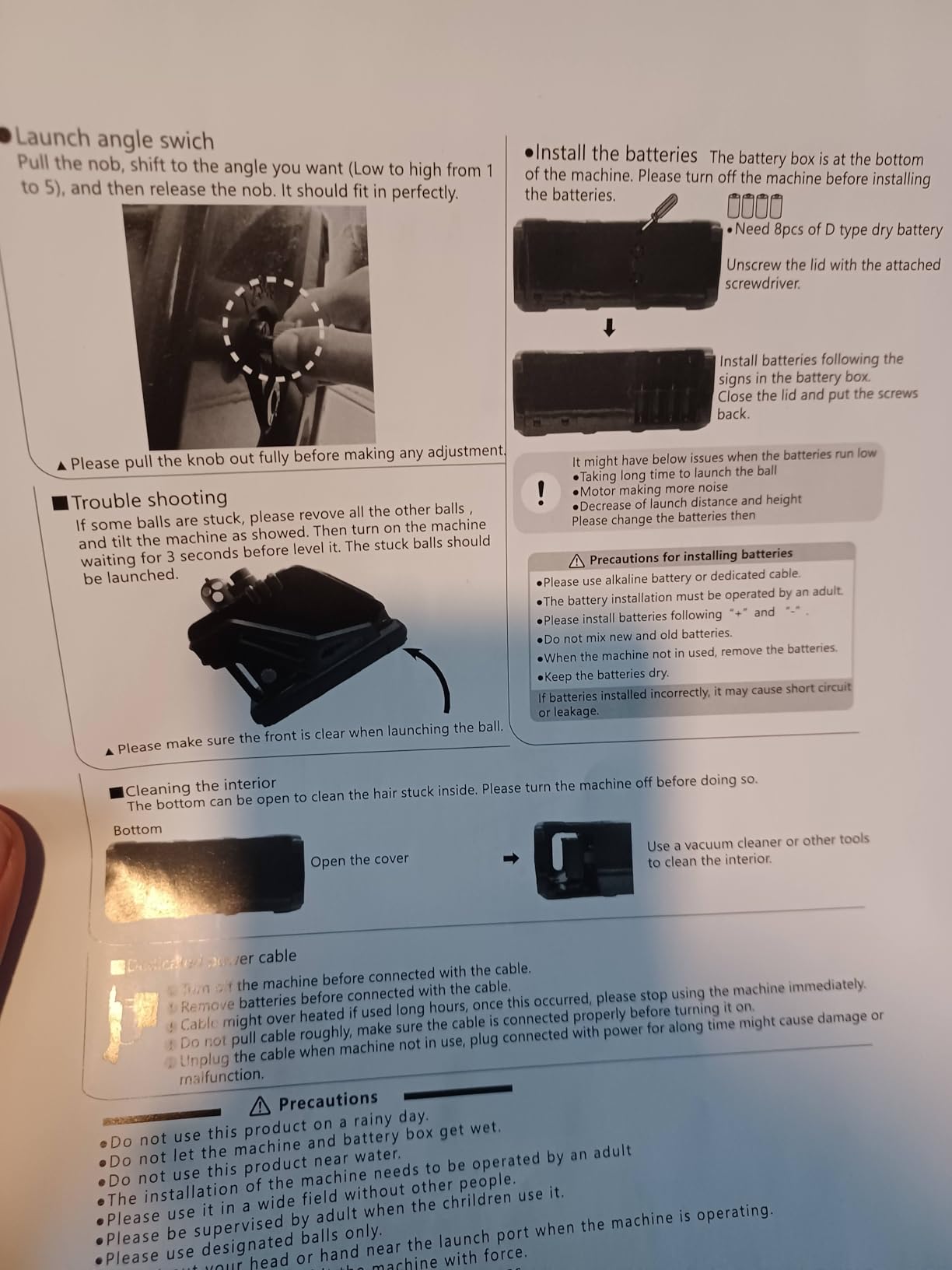
The feed consistency is where it falls short. Owners repeatedly report that depth varies every two or three balls, that the first ball of a session launches extra high, and that felt fuzz in the feed path causes occasional jams. Output also weakens after a few months until you clean the ball hair out.
At 21 to 28 balls, the hopper holds fewer balls than the other machines here, and there is no remote control, so a second person is needed to start a session.
When the Furlihong makes sense
It makes sense when the budget is the main constraint and the goal is basic form work. A five-setting angle dial and a two-second-to-five-second interval are enough to run a groundstroke repetition session for a beginner, and 71 reviews mean you are not gambling on an unproven mechanism.
It also makes sense for anyone who practises on a hard court, at a park, or anywhere without a power outlet. The battery and power bank options mean the machine is not tied to a wall, and the weight means one person can do everything.
When to spend more instead
Spend more if depth consistency matters to your practice. A feed that lands short every third ball trains you to adjust to a faulty machine rather than to hit a target, and no amount of angle variation fixes that. This is a machine to learn on, not one to fine-tune a stroke on.
It is also not a machine for a club. A 12-month warranty, a plastic body, no remote and no oscillation make it a private-practice tool, and at 30 mph it will never simulate a fast deep ball from a good opponent.
10. PMT Medical Cannon Pro Review – Best Paper Specification Sheet
Tennis Ball Cannon Pro: Portable Tennis Ball Machine (48lbs) – Dual Motor for Top Spin and Backspin | Up to 120 Balls, Max Speed 80MPH | 6 Hours Playtime with Rechargeable Lithium Battery
20-80 mph
120 balls
6 hour battery
48 lb
Pros
- Highest claimed ball speed in this roundup at up to 80 mph
- Large 120-ball hopper for long practice sessions
- Longest stated battery runtime at up to 6 hours
- Dual-motor topspin and backspin across a 20-80 mph range
- Compact 38x50x70 cm footprint despite the 48 lb weight
Cons
- Only a single owner review so there is no field pattern to judge
- At 48 lb it is the heaviest unit here and needs a cart or two people
- Listed under a pain-management brand with no tennis reputation
- Long-term parts and service support are unclear
We are including this one with a clear warning attached, because the specification sheet is among the most ambitious in the roundup and the evidence is the thinnest. Twenty to 80 mph, 120-ball hopper, up to six hours of play on a rechargeable lithium battery, dual-motor topspin and backspin, 20-60 degree elevation and side-to-side oscillation. On paper it out-specs everything else here.
The footprint is 38 by 50 by 70 cm, which is compact for a 48-pound machine, and the 2-10 balls per second service frequency covers everything from a slow build-up feed to a fast point pattern.
And that is where the evidence runs out. There is exactly one owner review in the entire listing, a single five-star rating, which tells you almost nothing about how the machine behaves after a season of hard use.
The brand question
This machine is sold by a pain-management technology company with no tennis reputation, and the listing is positioned as a general marketplace product. For something that lists at the very top of this price band, that is an unusual place for the support structure to come from.
Parts availability is the practical question. A counter-rotating wheel machine needs wheels, a motor and a battery eventually, and if the seller is not a tennis specialist, sourcing those in three years may be difficult. That is not a reason to dismiss it; it is a reason to know it before you buy.
Why it is last in our ranking
Because a perfect rating on one review is not a rating. Every other machine in this list has between three and 71 owner reviews, and several have complaints that are known and manageable. Here we are extrapolating entirely from a specification sheet written by the seller.
It is also the heaviest unit at 48 pounds, which makes it a two-person or cart move, and the 80 mph figure sits alongside a set of claims that have not been independently checked. If you buy it, buy it for the 120-ball hopper and the six-hour battery, both of which are plausible and useful, rather than for the top speed.
Are Tennis Ball Machines Under 1,000 Dollars Worth It?
Yes, if you play alone regularly, and no, if you practise once a month. The maths is straightforward. A machine replaces a hitting partner, so it only pays for itself in sessions you would otherwise have skipped, and in drills you could not run with a partner who hit the ball everywhere you asked.
Three things to weigh before buying. First, a machine will not fix a technical problem, and owners who practise for a year with a bad stroke reach the same place faster than they would have with a coach. Second, a machine that fires 120 balls creates a retrieval problem, so plan for a tarp, a basket, or a second half of the court. Third, running costs are real: pressurised balls wear out faster against counter-rotating wheels, and pressureless balls feel different off the racket.
Our rule of thumb: if you hit on court at least twice a week without a reliable partner, a sub-1,000 machine pays for itself in value. If you have a group that hits twice a week, save the money.
How to Choose a Tennis Ball Machine Under 1,000 Dollars
Most buyers get this wrong by shopping on ball speed first. Speed is the least important number on the list, and the machines with the highest claims here also have the thinnest owner feedback. Work through these seven factors instead.
1. Ball speed, and why the headline number lies
Headline speeds in this band run from 30 mph to 80 mph, and almost every machine falls short of its claim once the ball crosses the net. What you actually need is a floor, not a ceiling: roughly 25 to 30 mph for a beginner building a stroke, 35 to 45 mph for a club player, and above 50 mph only if you are working on depth under pressure.
Look for a wide adjustable range rather than a maximum. The Sports Tutor Tennis Cube runs 10 to 50 mph, which is more useful than a machine that shoots 75 mph at one setting and nothing else.
2. Oscillation, the feature that creates movement
Oscillation is what stops you standing in one spot waiting for a ball from the same place. Random horizontal oscillation moves the landing point from side to side. Vertical oscillation changes the launch angle. Fully random or triple oscillation varies the speed and height as well as the direction.
For a solo player, a built-in random oscillator is the single most valuable feature after reliability. The Tennis Cube has one built in for that reason, and the Veva V3 extends it to 28 programmable landing targets, which is the best drill capability in this list.
3. Spin, and when you actually need it
Topspin and backspin are the difference between a machine that feeds balls and a machine that feeds the kind of ball your opponent will hit you. Dual-motor machines like the Nisplay and the PMT Cannon Pro produce both, single-motor machines such as the Sports Tutor eCannon produce topspin only, and the simplest feeders like the Furlihong and the Tennis Twist put out a flat feed.
Beginners do not need spin. Intermediate and advanced players do, because a flat feed is a different ball and a different timing problem. Spin is worth paying for once your groundstroke is reliable enough to be repeated thousands of times.
4. Hopper capacity and the session-length maths
Hopper sizes here run from about 20 balls to 120. Divide capacity by your feed interval to work out how long you can go without a refill. At one ball every five seconds, 28 balls is under a minute and 120 balls is ten minutes. At one ball every two seconds, 60 balls is two minutes.
For most solo sessions, anything above 60 balls is fine because you need to hit the balls anyway. Below 40 and you will spend more time collecting than hitting. If your machine has a big hopper, buy a tarp or collect balls into a second basket, and the same basket can double as your next refill.
5. Battery versus AC power
Battery power decides where you can practise. Runtimes in this roundup range from about two hours on the Sports Tutor internal batteries to eight to ten hours on the Tennis Twist running on six D cells, with the TENNIIX at four hours, the Nisplay at four-plus, the Nisplay L1 at three, the PUSUN at three to five, and the PMT Cannon Pro claiming six.
Long-time owners care about balls per charge far more than hours on a label. The TENNIIX is the only machine here that states a shot count, and its claim of up to 1,800 shots per charge is the most useful figure in this group, because a session is counted in balls rather than minutes. The catch on removable packs is that you then have two things to charge, and internal batteries are convenient until they wear out permanently.
6. Weight, the number that decides whether you use it
Weights in this roundup run from 4.04 kg to 48 pounds. That is a wider range than any other spec, and it predicts how often you will practise better than any other number here. A machine you cannot move to a court alone is a machine that stays in the garage.
Our threshold is 25 pounds with wheels or a handle. Above that, assume you need a car, a cart or a second person. Below it, you can carry it on foot.
7. App control, and what happens when the app goes away
App control is the strongest feature in this price band and also its biggest single-point-of-failure risk. The TENNIIX has almost no functional onboard controls beyond on and off, and the PUSUN needs a phone to change speed or angle. If the developer stops maintaining the app, or your phone stops pairing, the machine loses most of its value while the hardware is still perfect.
Our advice: if you want app drills, buy one that also has a physical remote, and treat the app as an upgrade rather than the interface. If you would rather not think about it at all, the Sports Tutor knob machines will never have this problem.
What You Give Up Under 1,000 Dollars
Nothing in this roundup competes with the Spinshot Player or Plus-2 class, which list well above this ceiling. You give up four things: sustained high speed on a deep ball, fully random oscillation across a wide width, pro-level control surfaces with programmability rather than presets, and a service network with a track record of holding resale value. Long-time owners do note that Lobster and Spinshot machines hold their value far better than unknown brands.
You do not lose the fundamentals. Spin, a 60-plus ball hopper, a battery, a remote and oscillation are all available here, and for a solo recreational player those cover nearly every drill that matters. If you are coaching juniors on a club court with four balls to feed at once, that is when the gap starts to hurt.
Noise, neighbours and ball wear
Most of the noise comes from the ball hitting the court rather than the motor, and compression-driven machines are louder on the balls than counter-rotating wheel units. On a home court, check your local rules and your neighbours before buying, and consider pressureless balls if the sound is the issue.
On ball wear, run a separate set of pressureless balls through the machine and use them for volume work, saving your pressurised balls for partner sessions. Wipe the feed path every few sessions, because felt fuzz is the leading cause of jams in the cheaper machines here. Our guide to automatic ball launchers covers the same maintenance habits for other sports.
Our picks by scenario
Best overall and best for a club: the Nisplay 26lb dual-motor, for spin, wheels, a detachable battery and 46 owner reviews, the second-largest review base here. Best for drills programmed from the baseline: the TENNIIX, for its app, voice armband and match-play modes.
Best for beginners: the PUSUN PT-Mini-Pro, for consistent delivery and a three-year warranty. Best for a no-phone workflow: the Sports Tutor Tennis Cube. Best for carrying between courts: the Nisplay L1. Best for repeated topspin work: the Sports Tutor eCannon. Best for the longest battery: the Sports Tutor Tennis Twist. Lowest cost to get started: the Furlihong 3819BH.
Whatever you pick, wear proper court shoes, and our tennis shoe picks cover the ones we would trust for hours of machine work. One thing to avoid entirely: buying a machine that only works plugged in when your court has no outlet.
Frequently Asked Questions
What is the best tennis ball machine under 1,000 dollars?
The Nisplay 26lb dual-motor machine is the best under this ceiling, with 68 mph top speed, flat topspin and backspin from dual motors, an 80-plus ball hopper, a detachable battery with more than four hours of play, and oversized wheels. The TENNIIX is the alternative if you want app and voice control and match-play drills, and the Sports Tutor Tennis Cube is the pick if you refuse to use a phone.
What is the best affordable tennis ball machine?
For a true budget buyer the Furlihong 3819BH is the cheapest credible option, at 4.04 kg, 30 mph, five angle settings and power from an AC adapter or eight D batteries. It has 71 owner reviews, the most of any machine here, but the feed depth varies every two or three balls, so it suits form work rather than fine-tuning. The PUSUN PT-Mini-Pro is the better step up, with a 65-ball hopper and a three-year warranty.
Are tennis ball machines worth the money?
They are worth it if you play alone at least twice a week, because the machine replaces a hitting partner and runs drills a partner cannot deliver on demand. They are not worth it if you have a regular group, or if your problem is technique rather than ball volume. Budget for pressureless balls for machine work, since pressurised balls wear faster against the feed wheels, and plan for ball collection on court.
Which tennis ball machine should I buy?
Start with weight. If you cannot carry it alone to the court, buy something under 25 pounds with wheels or a handle. Then decide whether you need oscillation, which is the feature that forces you to move, and whether you need spin, which matters once your groundstroke is reliable. Battery power beats AC if your court has no outlet, and an app is only worth it if it also has a physical remote as a backup.
How long do tennis ball machine batteries last?
Runtime in this price band runs from about two hours on the Sports Tutor internal batteries to eight to ten hours on the Tennis Twist running on six D cells, with the TENNIIX at four hours, the Nisplay at four-plus, and the Nisplay L1 at three. Balls per charge is the more useful figure, and the TENNIIX advertises up to 1,800 shots. Removable packs are more convenient long term than internal batteries, which wear out permanently.
Final Verdict
Buy the Nisplay 26lb dual-motor if you want the most capable tennis ball machine under 1,000 dollars: real spin, a large hopper, a detachable battery, wheels and 46 owner reviews, the second-largest review base in the group. If your practice is drill-based and you are happy holding a phone, the TENNIIX takes over on control variety. If you want no phone, no app and a three-year warranty with US service, the Sports Tutor Tennis Cube is the one.
Whatever you choose, weight and oscillation decide whether you actually use it, and the machines with the most impressive speed claims are the ones with the least owner feedback. Buy for the sessions you will really have, not the specification sheet. Prices in this tier move often, so it is worth comparing listings before you commit, and it is worth checking the warranty length as carefully as the price.