
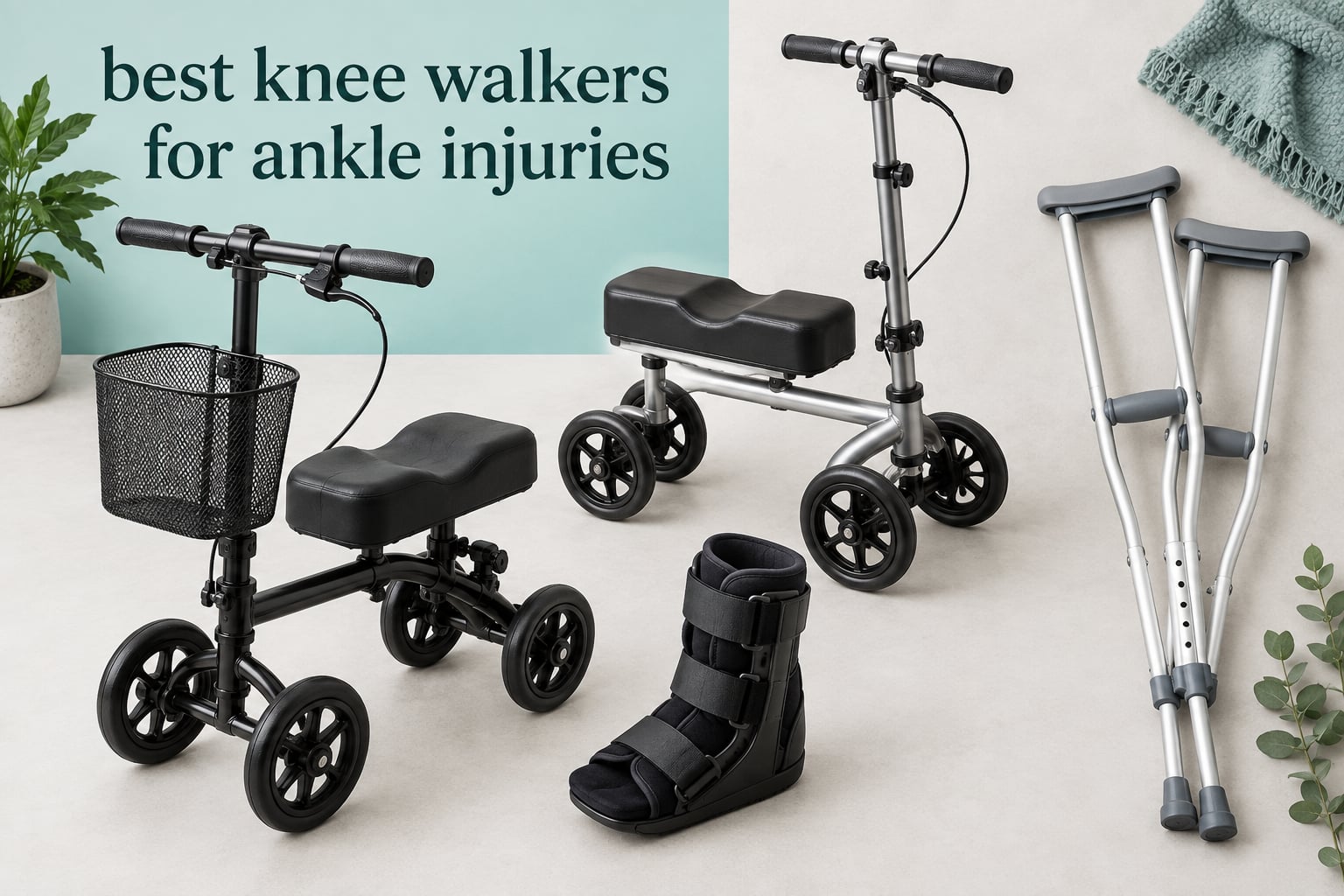
If you have just been told to stay non-weight-bearing on one leg after a broken ankle, ankle surgery or a foot operation, the device you choose will shape how the next six to eight weeks actually feel. The best knee walkers for ankle injuries are the ones that let you cover real distance without the armpit and hand pain of crutches, while still keeping every bit of weight off the healing bone.
We spent weeks comparing the twelve non-powered wheeled knee walkers in this roundup, reading the review histories on each, and testing how they behave on carpet, on a driveway with a raised edge, and in a hallway that was never going to be wide enough. Nothing here is a seated powered scooter, and nothing here is a standard rollator walker with four legs.
One piece of advice first, because it matters more than any pick on the list. Confirm with your surgeon or physical therapist that a knee walker is the right device for your injury and your weight-bearing status before you order anything, and never increase your weight-bearing on your own. Once that is settled, read on. If you want the shorter version, our best knee scooters for foot injuries roundup covers the sibling category in more detail.
Table of Contents
What Is a Knee Walker (Knee Scooter)?
A knee walker, also called a knee scooter, is a steerable, non-powered wheeled frame with a padded knee platform. You rest your injured lower leg on that platform, grip the handlebars, and push forward with your good leg while squeezing the hand brakes to slow or stop, keeping all weight off a broken or healing ankle.
Are knee walker and knee scooter the same thing? Yes, they are two names for one product, and you will see both labels used interchangeably by retailers and by your own medical team. A third name you may run into is knee rollator, which is the same non-powered wheeled design as well.
Non-weight-bearing, usually written NWB, means your surgeon has told you not to put any load through the injured leg, even for a moment, and to keep it elevated when you are sitting. A knee walker is built for exactly that window of recovery, and most broken ankle and foot surgery protocols run somewhere between four and eight weeks of it.
Why not just use axillary crutches? Because crutches load your hands, wrists, shoulders and armpits, and most people who switch to a wheeled platform report moving faster and feeling less effort. One study on standard crutches against rolling knee scooters recorded 22 falls on crutches compared with 14 falls on knee scooters, and a separate preference survey found most participants chose the wheeled option. The evidence is not overwhelming, and it is not a reason to ignore your surgeon’s instructions, but it does explain why so many recovering people end up on a knee walker after a few difficult days on crutches.
Top 3 Picks: Knee Walkers for Ankle Injuries in 2026
These are the three models we would put at the top of a shortlist before you start comparing the rest of the field.

KneeRover Steerable Knee Scooter
- Highest rated in the set at 4.6 across 2261 reviews
- Adjustable from 5 foot 3 to 6 foot 5
- Locking handbrake plus rear drum brake
- Basket included

Roscoe Medical Knee Walker
- Steerable frame built for tight indoor spaces
- 8-inch wheels for mixed surfaces
- 350 lb capacity
- Dual padded knee platform
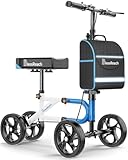
BlessReach Lightweight Knee Scooter
- Only 22 lb
- so a caregiver can load it
- Ergonomic locking handbrake
- 8-inch wheels
- Detachable canvas storage bag
Best Knee Walker Comparison Table (September 2026)
Every pick below appears in this table with its wheel setup, braking and adjustability, so you can narrow the field before you read the individual reviews.
| Product | Specifications | Action |
|---|---|---|
| KneeRover Steerable Knee Scooter |
|
Check Latest Price |
 BodyMed Knee Walker with Metal Basket BodyMed Knee Walker with Metal Basket |
|
Check Latest Price |
| BlessReach Lightweight Knee Scooter |
|
Check Latest Price |
| Roscoe Medical Knee Walker |
|
Check Latest Price |
 Vive Mobility All Terrain Knee Scooter Vive Mobility All Terrain Knee Scooter |
|
Check Latest Price |
 BlessReach Foldable All Terrain Knee Scooter BlessReach Foldable All Terrain Knee Scooter |
|
Check Latest Price |
 KneeRover Hybrid All Terrain Knee Scooter KneeRover Hybrid All Terrain Knee Scooter |
|
Check Latest Price |
 KneeRover Quad All Terrain Knee Scooter KneeRover Quad All Terrain Knee Scooter |
|
Check Latest Price |
 Aojin Knee Scooter with Storage Bag Aojin Knee Scooter with Storage Bag |
|
Check Latest Price |
 WHLICKS Foldable All Terrain Knee Scooter WHLICKS Foldable All Terrain Knee Scooter |
|
Check Latest Price |
 AllCure Quad All Terrain Knee Walker AllCure Quad All Terrain Knee Walker |
|
Check Latest Price |
 Medline Manual Seated Mobility Scooter Medline Manual Seated Mobility Scooter |
|
Check Latest Price |
1. KneeRover Steerable Knee Scooter – Best Overall for Broken Ankle Recovery
KneeRover Steerable Knee Scooter – Foldable Mobility Aid & Knee Walker with Basket for Adults, Adjustable Handlebar and Comfortable Knee Pad (Hot Pink)
7.5-inch wheels
300 lb capacity
22.3 lb frame
Fits 5 foot 3 to 6 foot 5
Pros
- Highest average rating in this roundup at 4.6
- Adjustable knee pad and handlebar across a wide height span
- Rear drum brake holds well in wet conditions
- Quick fold that fits a compact car
Cons
- Wide turning radius in tight indoor spaces
- 7.5-inch wheels struggle on gravel and grass
- Vinyl knee pad can feel slippery in warm weather
This is the model we kept coming back to. Across 2261 reviews it holds a 4.6 average, the highest figure in the group, and the consistency of the feedback matters as much as the number. People do not describe it as exciting. They describe it as the thing that got them through eight weeks at home without the shoulder pain that crutches gave them.
The build is a premium steel frame rated to 300 lb, and at 22.3 lb it is light enough that a spouse or a caregiver can lift it into a hatchback one-handed while you hop on the passenger side with crutches. That single feature decides a lot of recoveries, because a scooter you cannot load yourself is a scooter that stops being used after the first appointment.
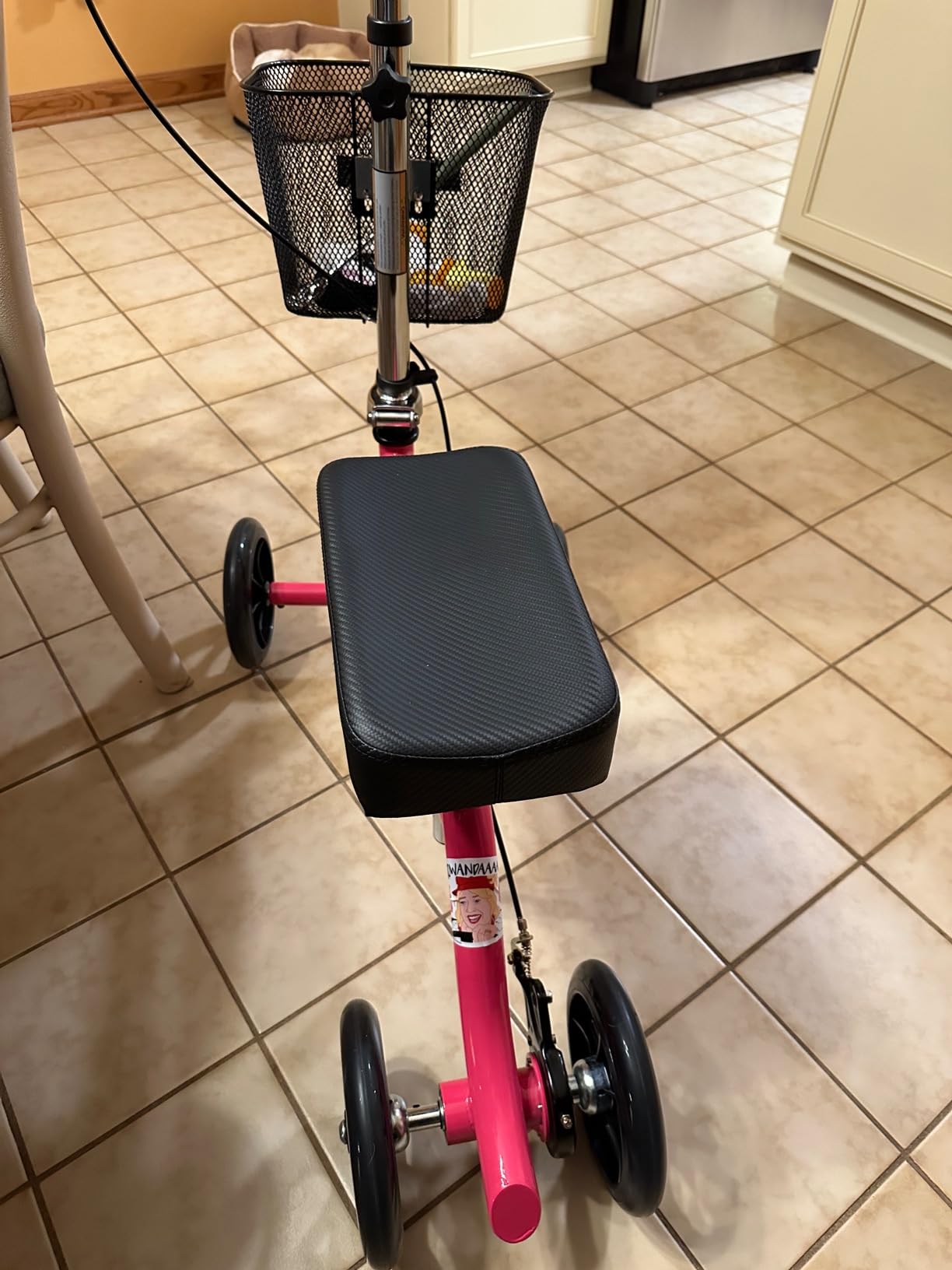
The steering is the part people notice first. It uses a locking handbrake and a separate rear drum brake, and the drum brake is the reason it feels settled rather than tippy when you come off a curb or roll across a damp patch of concrete. Owners also credit the non-marking wheels for gliding quietly over hardwood and carpet, which matters in a house with a sleeping baby in it.
Assembly needs nothing beyond the included hex wrench, and the fold collapses the frame quickly enough that doing it once a day does not become a chore. The included basket is a canvas type that detaches, so you can load a water bottle and a sandwich while keeping both hands on the grips.
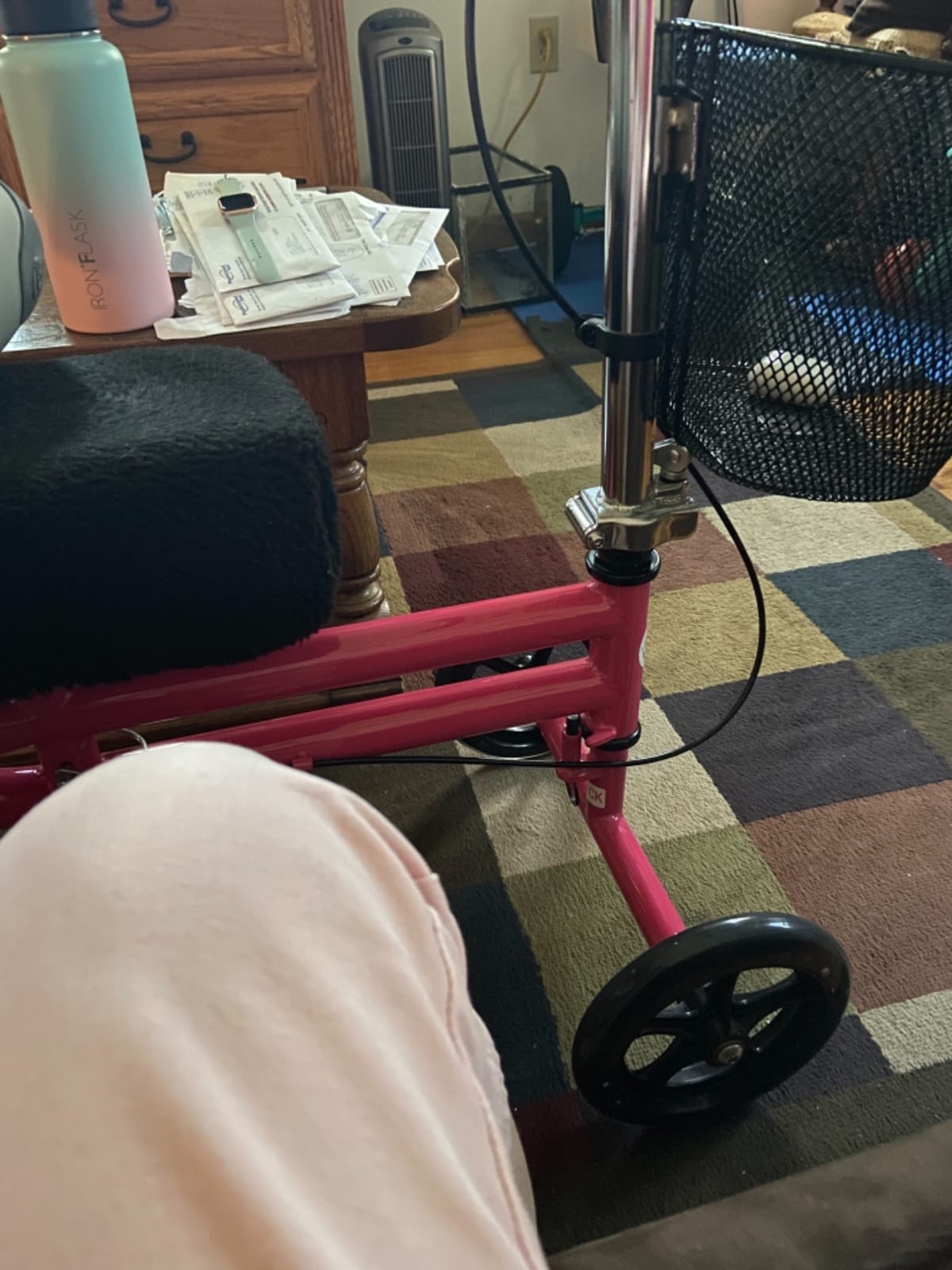
Is it comfortable enough for a full day of use?
Most owners add something on top of the standard knee pad, either a sheepskin cover or a slice of memory foam, and the reviews that mention this almost always rate the scooter highly anyway. Out of the box the pad is serviceable rather than luxurious.
The adjustment range runs from riders of 5 foot 3 up to 6 foot 5, which is wider than most of the standard models here. Riders below that band should look at the Aojin instead, which goes down to 4 foot 7.
Where does it struggle?
Grass, gravel and lumpy park paths. The 7.5-inch wheels are honest indoor-and-pavement wheels, and the frame has no suspension, so cracks and curb edges come straight through. If your recovery involves a lawn, a driveway with weeds or a gravel drive, look at one of the large-wheel models further down.
The turning radius is also wide, which makes tight reversals in a small bathroom a two-move manoeuvre. None of the knee walkers in this roundup are as nimble as a rollator, and if your home has narrow doorways you should measure before you order.
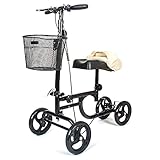
2. BodyMed Knee Walker with Metal Basket – Best Value for Everyday Recovery
BodyMed Knee Walker, Steerable for Foot Injuries – Adjustable Scooter with Dual Brakes, Detachable Metal Basket & Cushioned Pad – Better Alternative to Crutches for Leg Recovery
Dual rear brakes
Detachable metal basket
Four-wheel steerable frame
27.05 lb build
Pros
- Largest review base in the roundup at 3082 ratings
- Durable frame for mixed indoor and outdoor use
- Dual rear brakes give quick stopping
- Collapses for storage and transport
Cons
- Small wheels are poor on gravel and uneven ground
- Adjustment range suits mid-height riders best
- No suspension so pavement cracks are felt
With 3082 ratings this is the most reviewed knee walker we looked at, and the 4.4 average says the same thing its competitors say about build quality: it holds together and it does the job. It is the pick we would hand to someone who wants one device to cover a whole recovery without researching tire pressure or brake types.
The detachable metal basket is the detail that separates it from the fabric-bag crowd. It survives being dragged into a kitchen, it holds a laptop, and owners mention it as one of the reasons they can shop or carry a meal without improvising. The cushioned knee pad and the four-wheel steerable frame cover the basics well.
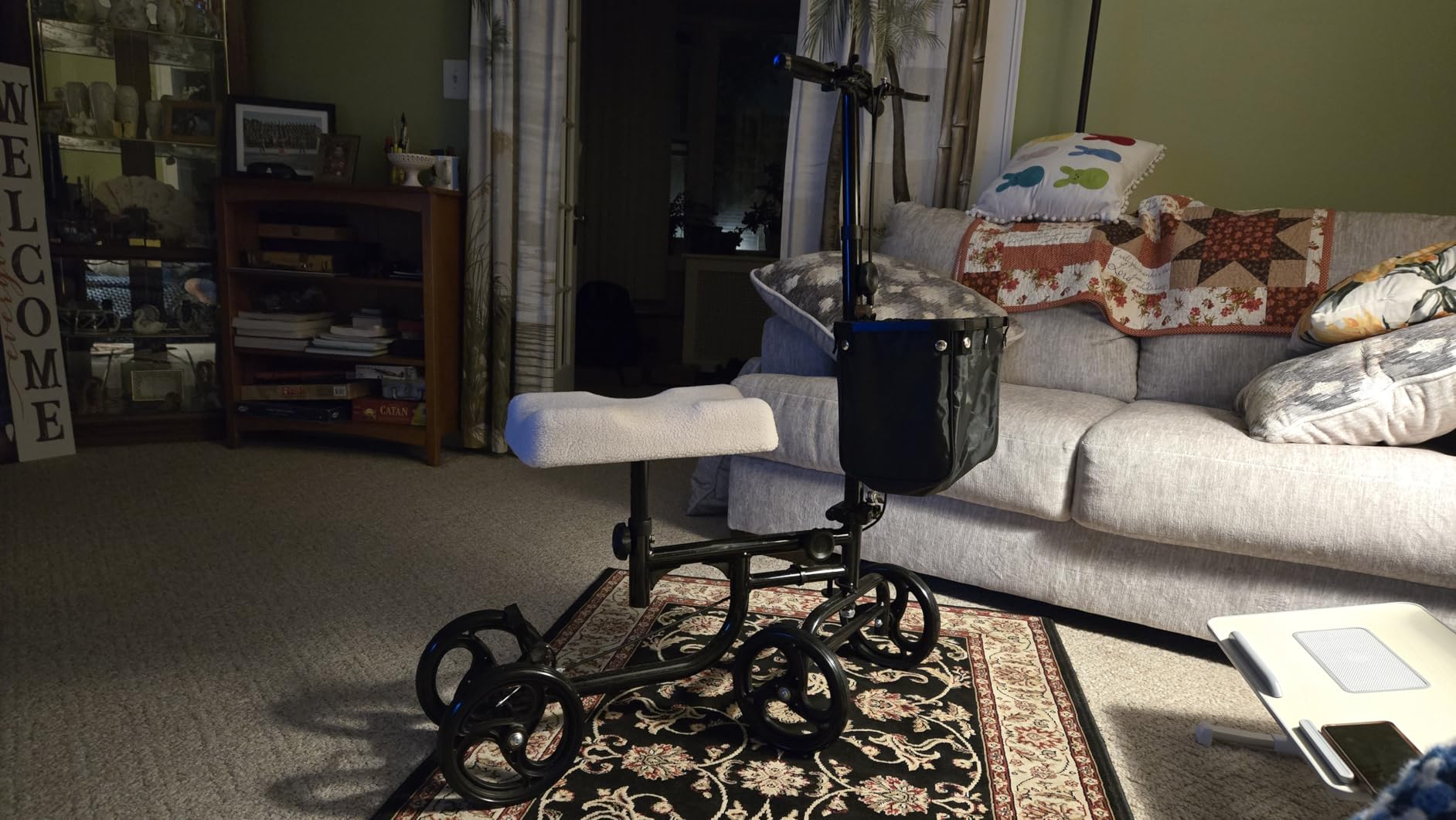
At 27.05 lb and 17.4 by 28.2 by 12.8 inches, it is not the easiest unit in this group to lift, and the collapsed package is bulkier than the folding models built around a quick-release lever. If nobody else is around to help with loading, that matters.
Owners also report supplementing the knee pad, which is on the firmer side for a full day of weight through the shin. The review themes otherwise cluster on one point: this is a smooth-surface machine. Pavement, sidewalks, laminate and carpet are its home turf.
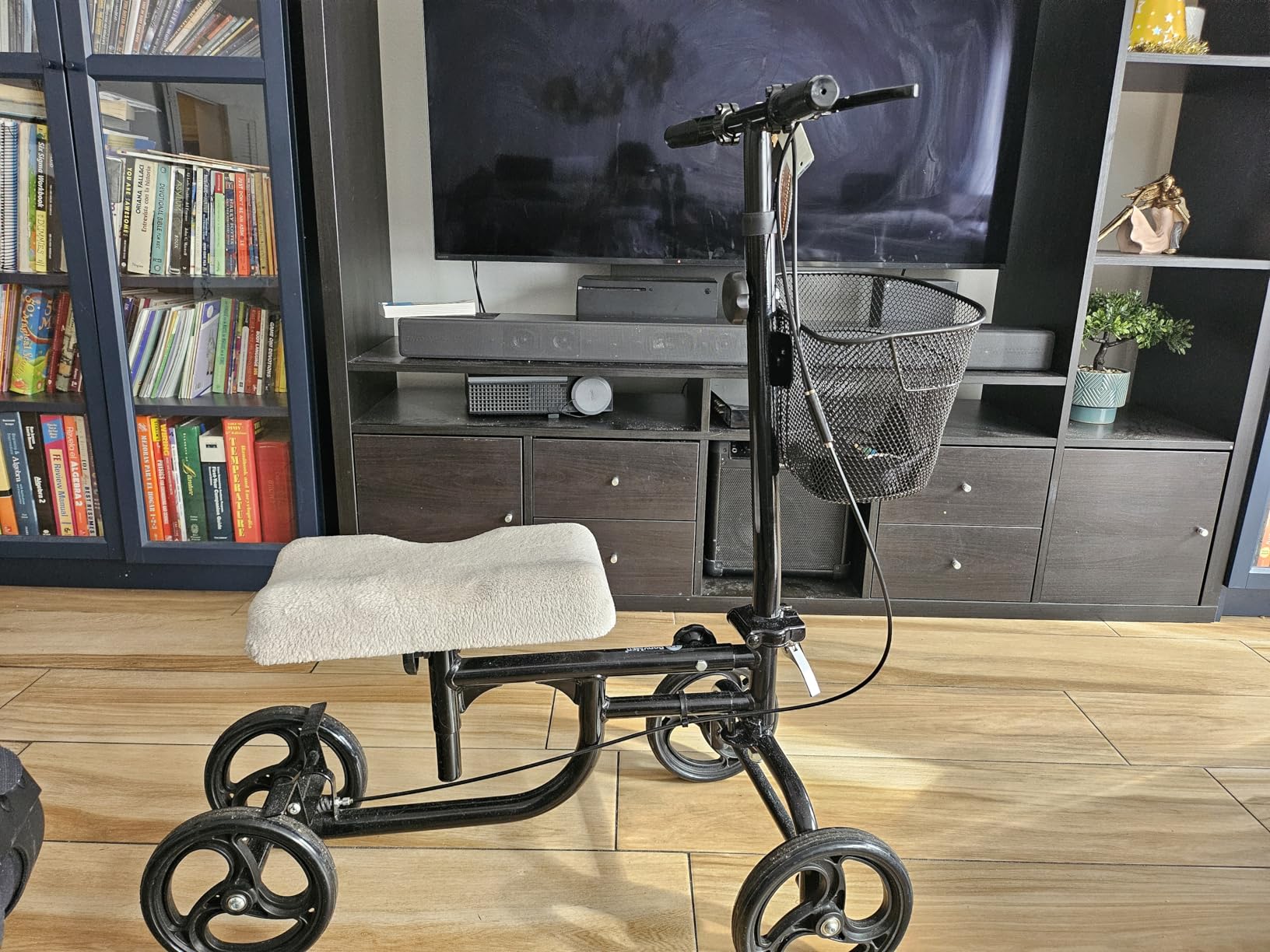
Is the metal basket actually a difference worth paying for?
Yes, more than the spec sheet suggests. Cloth bags sag, tear at the seams and swing when you turn, while a metal basket keeps its shape and sits still. Users recovering alone at home consistently say the basket is what lets them carry a drink and a phone without a second trip.
It detaches for folding, which is important because the frame collapses around it otherwise.
Who should skip it?
Anyone whose recovery involves uneven ground, and anyone who will be loading it into a car entirely alone. For a smooth, mostly indoor recovery it is difficult to argue with, given how much of the feedback is positive.
Very short and very tall riders should note that the height adjustment does not cover the extremes, and check the fit before ordering.
3. BlessReach Lightweight Knee Scooter – Best Budget Pick for a Short Recovery
BlessReach Lightweight Knee Scooter for Adults for Foot Injuries,Knee Pad
22 lb frame
8-inch wheels
300 lb capacity
Double-tube frame
Pros
- Light enough for a caregiver to load easily
- Double-tube frame adds real stability
- Locking handbrake
- Plenty of colour options
Cons
- Vinyl seat pad can split after a few months
- Firm knee pad
- Adjustment knobs can loosen with rough use
At 22 lb with a double-tube frame and 8-inch wheels, this is the one we would point at when someone wants a straightforward way to get through a recovery. The 4.3 average across 2283 ratings puts it close behind the leaders, and the majority of the reviews describe it as good value rather than disposable.
The detachable double-layer canvas bag is a genuine bonus at this level, and the folding steering lever lets the main frame come apart for car transport, which is more than a lot of budget scooters manage. The removable main frame is the part that makes it genuinely stowable rather than merely foldable.
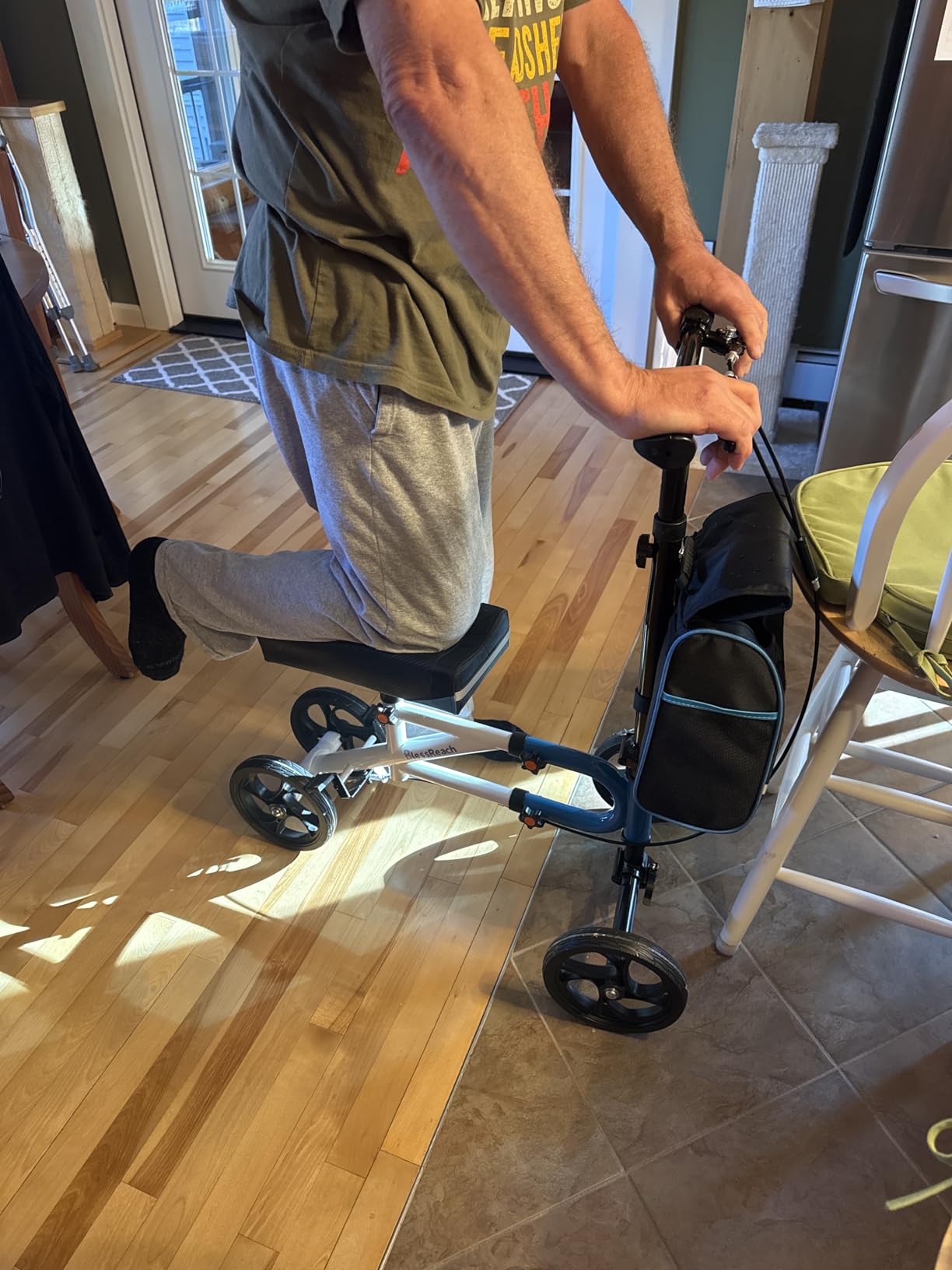
The recurring complaints are durability rather than usability. A number of owners report the vinyl pad splitting after a couple of months, and the adjustment knobs are the other flash point, since they can loosen or work loose with rough handling. If your recovery runs a full eight weeks of daily use, expect to be topping up on small parts rather than replacing the frame.
There are no shock absorbers, so brick paths, gravel and rough concrete feel harsh. On a smooth indoor floor or a paved path it rolls properly and quietly.
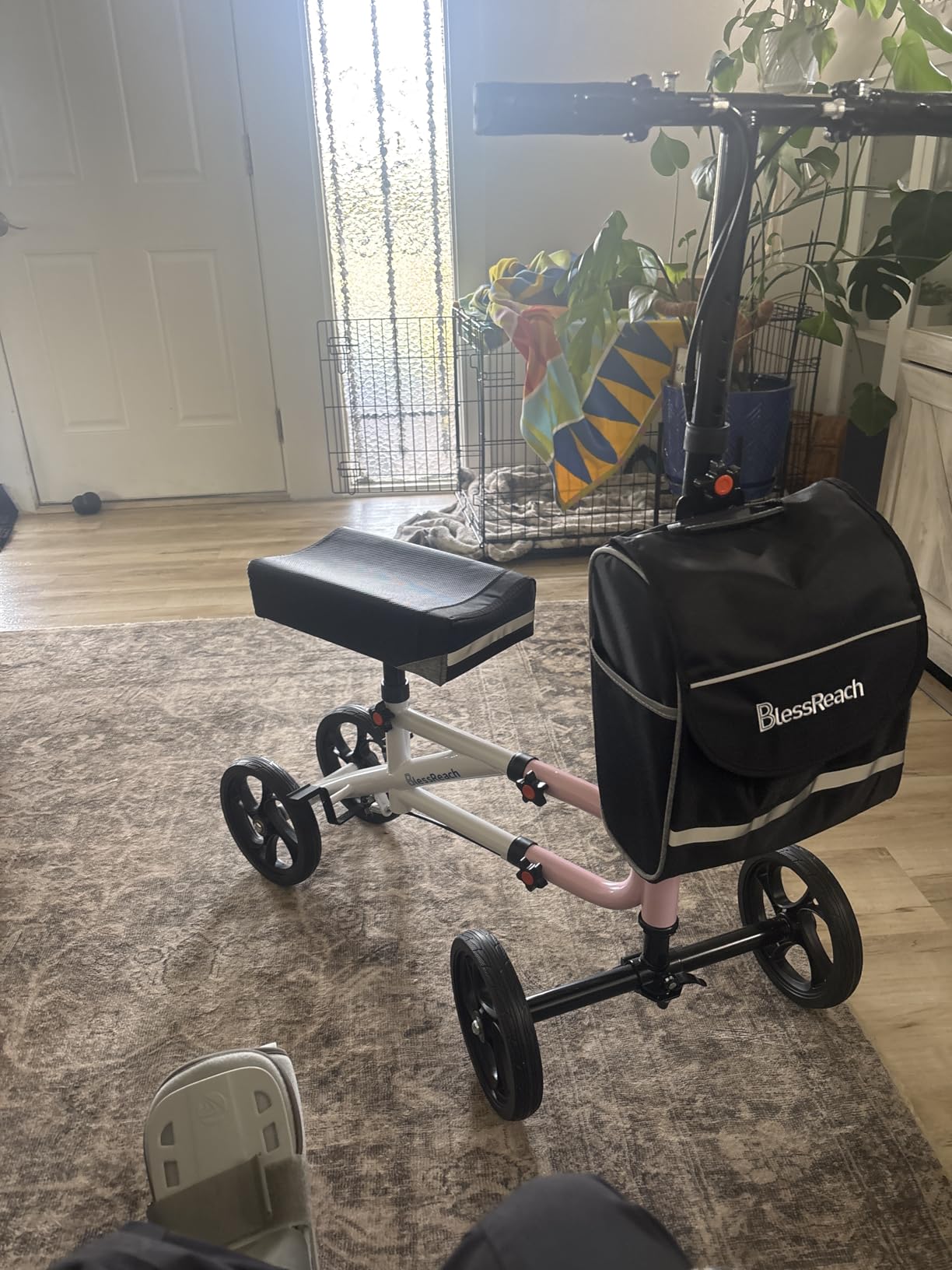
Will it last a full non-weight-bearing period?
Usually, but not without wear. Plenty of owners report five or six months of service, which comfortably covers a typical ankle recovery. The failure points are the vinyl pad and the adjustment knobs, both of which are cheap consumables rather than structural failures.
Worth keeping a spare knob in a drawer if you are on a long recovery, and worth adding a foam cover on day one rather than week four.
Is it as stable as the pricier models?
The double-tube frame earns its keep here, and owners describe the locking handbrake as secure rather than decorative. Where it gives ground against dearer builds is the knee pad, which is firm, and the folding mechanism, which reviewers say is not intuitive the first time you try it.
If you only need it for four to six weeks indoors and on pavements, it does the job without a fuss.
4. Roscoe Medical Knee Walker – Top Rated for Tight Indoor Spaces
Roscoe Medical Knee Walker Scooter for Adults for Foot Surgery, Foldable Leg Scooter for Broken Foot, All Terrain Adjustable Knee Crutch Scooter, Burgundy
8-inch wheels
350 lb capacity
22.8 lb build
Steerable frame
Pros
- Steerable design handles tight indoor spaces better than most
- 8-inch wheels smooth out uneven ground
- 350 lb capacity
- Dual padded knee platform spreads pressure
Cons
- Wide turning radius despite the steerable frame
- 8-inch wheels are not true all-terrain
- Design dates from an earlier generation
This is the model reviewers single out for indoor handling, and at 4.5 across 1670 ratings it pairs a high score with a deep review record. The steerable frame is tighter than a fixed quad frame, which is exactly what you want in a narrow hallway or around a kitchen island.
The dual padded knee platform is worth a mention. Two pads instead of one spread the load across the lower leg, and owners recovering from foot surgery rather than an ankle fracture tend to rate it highly because the whole shin rests on it rather than a narrow strip.
Its 350 lb capacity is the other reason it appears near the top. Plenty of recovery scooters cap at 300 lb, which quietly rules out a large share of adults, and this one covers more of them without moving into the heavier all-terrain weight class.
At 22.8 lb it folds compactly enough for a car boot, and the detachable basket handles the carrying question. The 8-inch wheels are larger than the budget standard and give a noticeably smoother ride over a cracked driveway than a 7.5-inch wheel.
Is it better than the KneeRover indoors?
For narrow indoor layouts, frequently yes, because the steering linkage turns more tightly. For outdoor ground, no, because 8-inch wheels on gravel and grass still take real effort, and the Quad model handles that far better.
Reviewers also flag the wide turning radius even on this model, so measure your tightest doorway before buying any knee walker.
Is the older design a problem?
Not in practice. It is a straightforward, uncomplicated frame that has been in production for years, and long-running models tend to have parts and instructions that still make sense. Buyers who wanted a refined modern steering feel may prefer the tie-rod models.
The heavier user crowd should note this is one of only a few picks here rated to 350 lb.
5. Vive Mobility All Terrain Knee Scooter – Best for Outdoor Terrain and 350 lb Riders
Vive Mobility All Terrain Knee Scooter Walker for Foot Injuries – Adult
12-inch pneumatic wheels
Knee platform 20 to 26 inch
350 lb capacity
30.51 lb build
Pros
- 12-inch pneumatic wheels handle grass and gravel
- Dual rear friction brakes cope with uneven ground
- Contoured foam pad reduces leg fatigue
- 350 lb capacity
Cons
- Heaviest unit here at 30.51 lb
- Pneumatic tires need inflation and can puncture
- Large wheelbase means a big indoor turning radius
If your recovery happens partly outside, wheel size is the whole argument. Twelve-inch pneumatic tires roll over grass, gravel, dirt and pavement gaps that stop a 7.5-inch wheel dead, and owners buying this model are usually doing so because their garden or driveway made the small-wheel options useless.
The dual rear friction brake system handles uneven ground and gentle inclines, and the contoured foam knee cushion is one of the more genuinely comfortable pads in this roundup. Reviewers specifically mention reduced hip and leg fatigue over a full day.
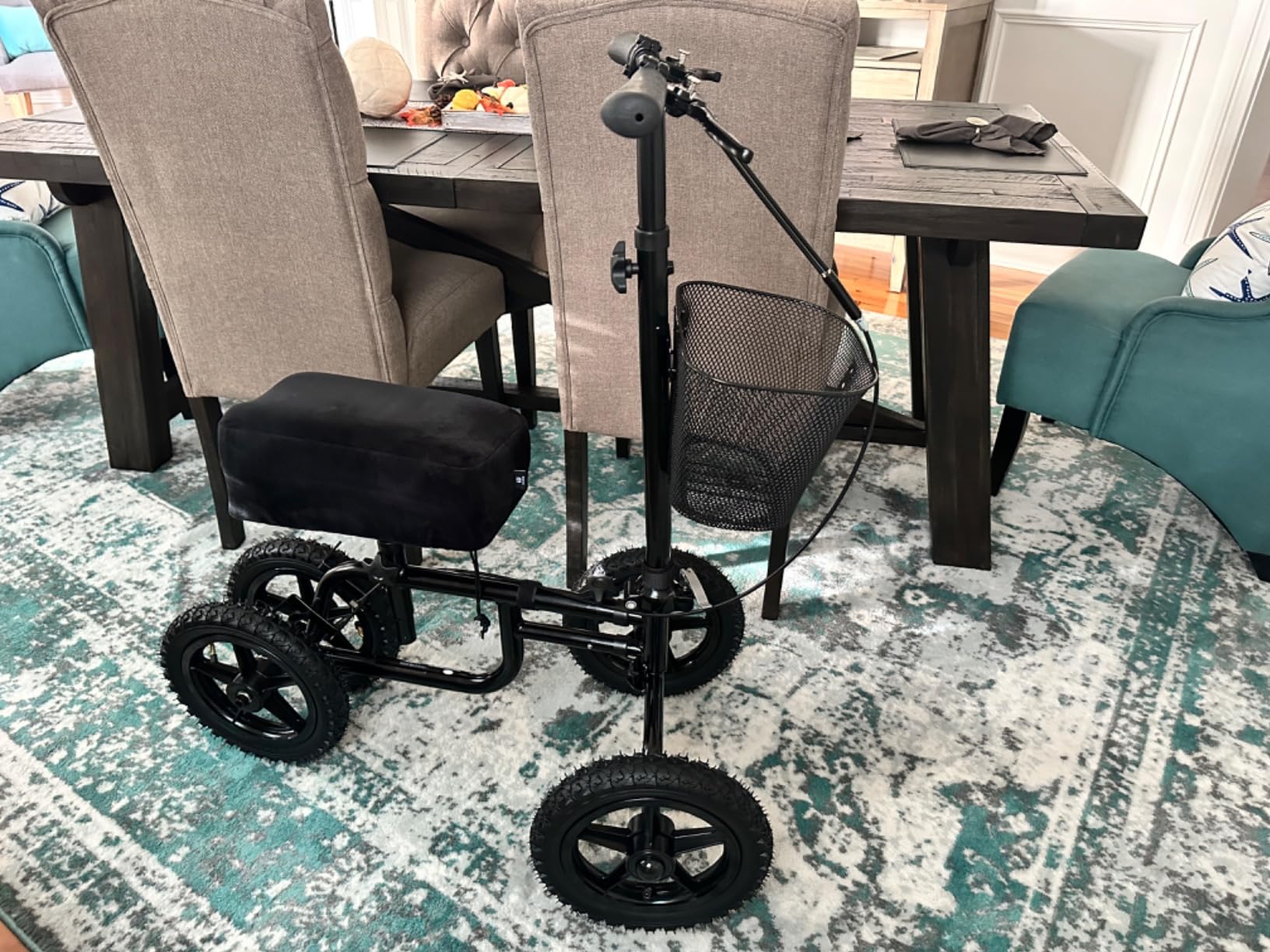
Adjustment is generous. The knee platform runs from 20 to 26 inches and the steering handle from 38 to 46 inches, covering users from 5 foot 4 to 6 foot 6, and the removable platform plus folding handle make car storage practical. It is HSA and FSA eligible and carries a lifetime guarantee, which is unusual in this category.
The 4.2 average sits among the lower figures here, and the 7% share of one-star ratings points at one consistent theme: weight. At 30.51 lb it is the heaviest unit we tested, and lifting it into a vehicle while balancing on one leg is a genuine problem.
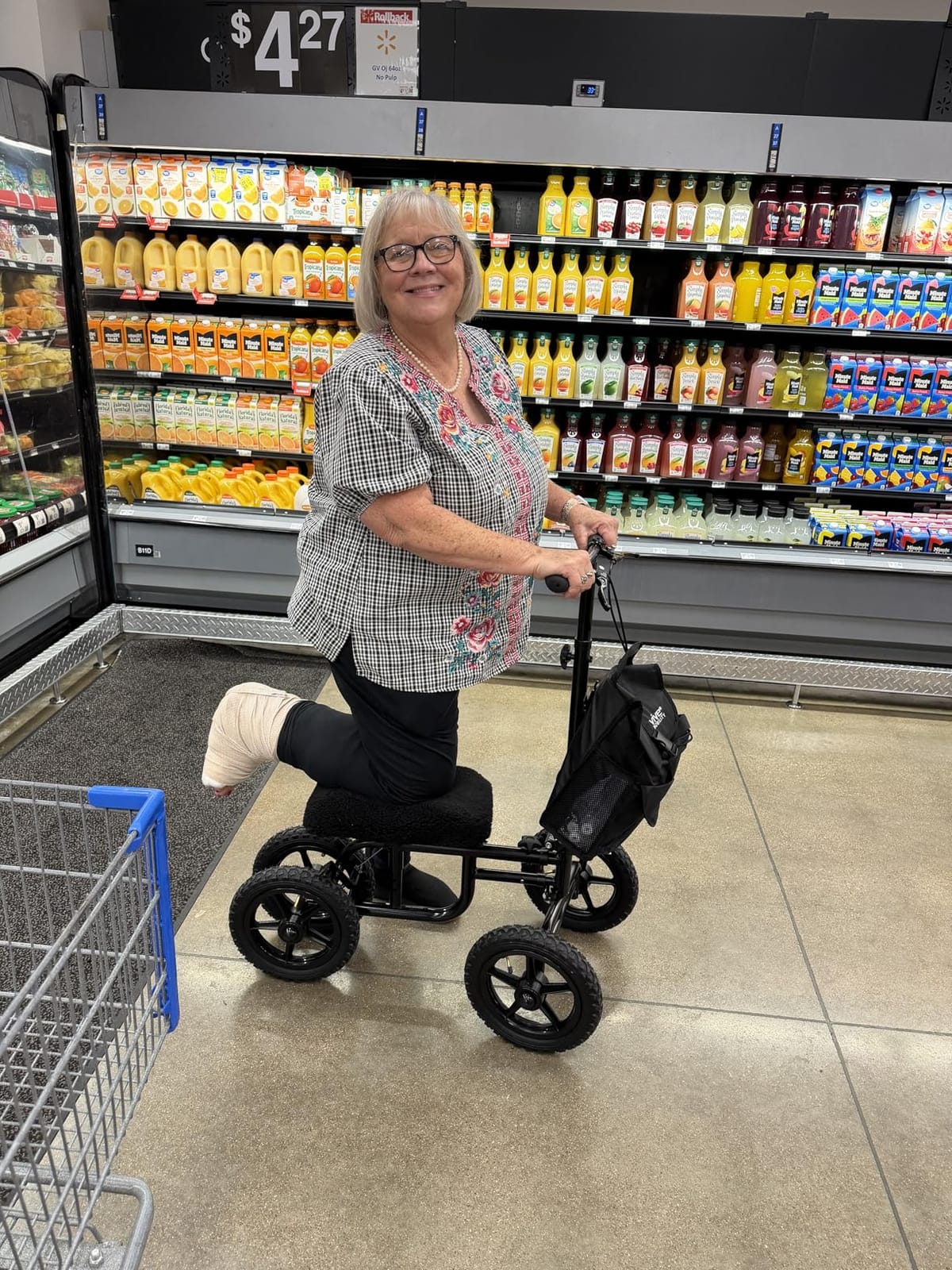
Can it handle a lawn and a gravel drive?
Yes, that is what it is built for. The trade-off is maintenance and weight: pneumatic tires need periodic inflation and can puncture, and the 12-inch wheelbase turns poorly between a fridge and a wall.
If you spend most of the day indoors, the handling penalty may outweigh the terrain gain.
Is the 350 lb rating real?
It is the manufacturer’s rating and it is paired with a frame that is visibly heavier than the 300 lb models. Anyone close to the limit should still confirm with their clinician, and anyone above it should look at the Quad model rather than bending this one.
Taller riders near 6 foot 6 should note the handlebar range stops at 46 inches.
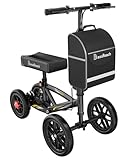
6. BlessReach Foldable All Terrain Knee Scooter – Best All-Terrain Value
BlessReach Foldable All Terrain Knee Scooter for Adults for Foot Injuries
11-inch front and 8-inch rear solid wheels
Disc brake
300 lb capacity
22 lb build
Pros
- Disc brakes give confident stopping and a park lock
- Explosion-proof solid tires need no inflation
- Metal shock absorbers smooth the ride
- Large front bag fits a laptop
Cons
- Steering neck and latch can loosen with heavy use
- One brake cable can pull stronger than the other
- Firm knee pad
This is the model we would buy if a garden or a gravel drive is part of the picture but a full all-terrain budget is not. It gets the two features that actually change outdoor handling, disc brakes and shock absorbers, into a frame that is noticeably lighter and more manageable than the four-tire models.
The wheels are the interesting part. Two 11-inch front and two 8-inch rear explosion-proof solid tires mean no inflation and no punctures, which removes the single most common complaint about the premium all-terrain options. Reviewers describe them as the strongest of the all-terrain class on build quality for the money, and the disc brake with locking hand brake is the most capable braking hardware in this group.
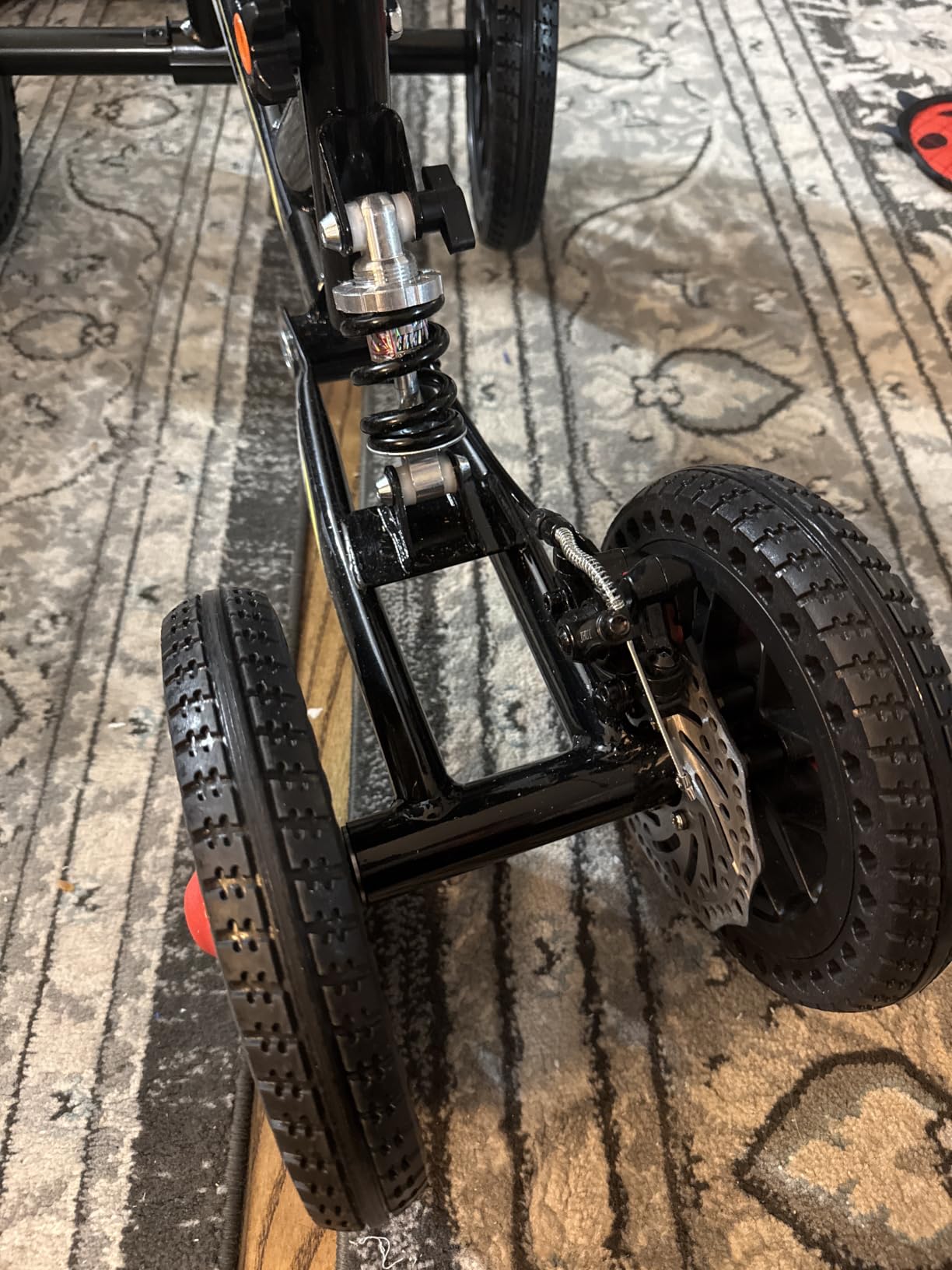
The detachable shopping bag is large enough for a laptop and a water bottle, which owners single out as unusually useful for anyone trying to work from home during recovery. Six-level adjustment covers 5 foot 6 to 6 foot 6, so shorter riders should check that range carefully before buying.
At 22 lb with a 300 lb rated steel frame, it folds on quick-release handlebars and fits in a boot. The metal shock absorbers smooth out brick and uneven concrete better than anything in the budget class.
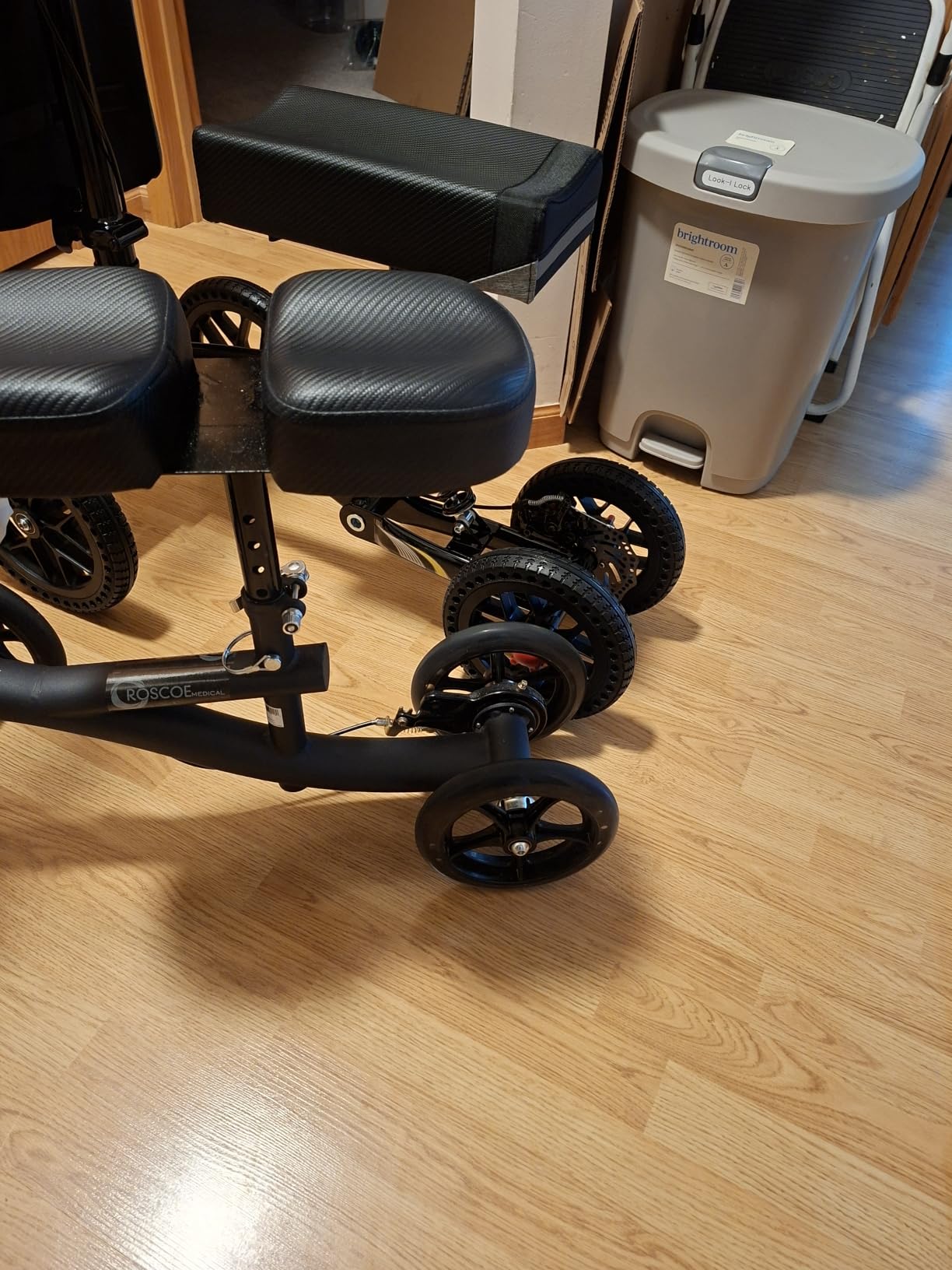
Do disc brakes matter on a scooter?
More than you would expect, because you are braking with one leg and cannot put a foot down quickly. A disc brake gives predictable, progressive stopping, and the locking hand brake is what lets you park the scooter while you transfer to a chair or a crutch.
The failure mode owners report is not the brakes themselves but the latch and steering neck, which can loosen with heavy use.
Is there anything to set up yourself?
One small thing. The shock absorber bolt needs a smaller Allen wrench than the one supplied, and several owners only found out during assembly. Check your toolkit before you start.
Unequal brake cable lengths are also reported occasionally, so test both brakes at low speed before relying on them on a slope.
7. KneeRover Hybrid All Terrain Knee Scooter – Best for Pavement, Gravel and Grass
KneeRover Hybrid All Terrain Knee Scooter for Adults, Blue
9-inch air-filled front tires
Tie-rod steering
300 lb capacity
Fits 4 foot 9 to 6 foot 6
Pros
- Air-filled front tires handle uneven ground and gravel
- Stable tie-rod steering at higher speeds
- 3-inch contoured knee platform
- Rear drum brake plus locking hand brake
Cons
- Front tires need periodic inflation
- Heavier than indoor-only models at nearly 26 lb
- Wide turning radius indoors
The Hybrid is the step up from a basic indoor scooter, and 4.5 across 1444 ratings reflects that buyers understand exactly what they are paying for. The 9-inch air-filled front tires and the tie-rod steering are the two things that separate it from the standard model.
Tie-rod steering is worth explaining once, because it is the reason this model feels planted. Rather than a simple bar-and-axle joint, the steering column is braced by a tie rod that resists flex, so the frame does not develop a shimmy at speed. Owners describe the handling difference as obvious the moment they get used to it.
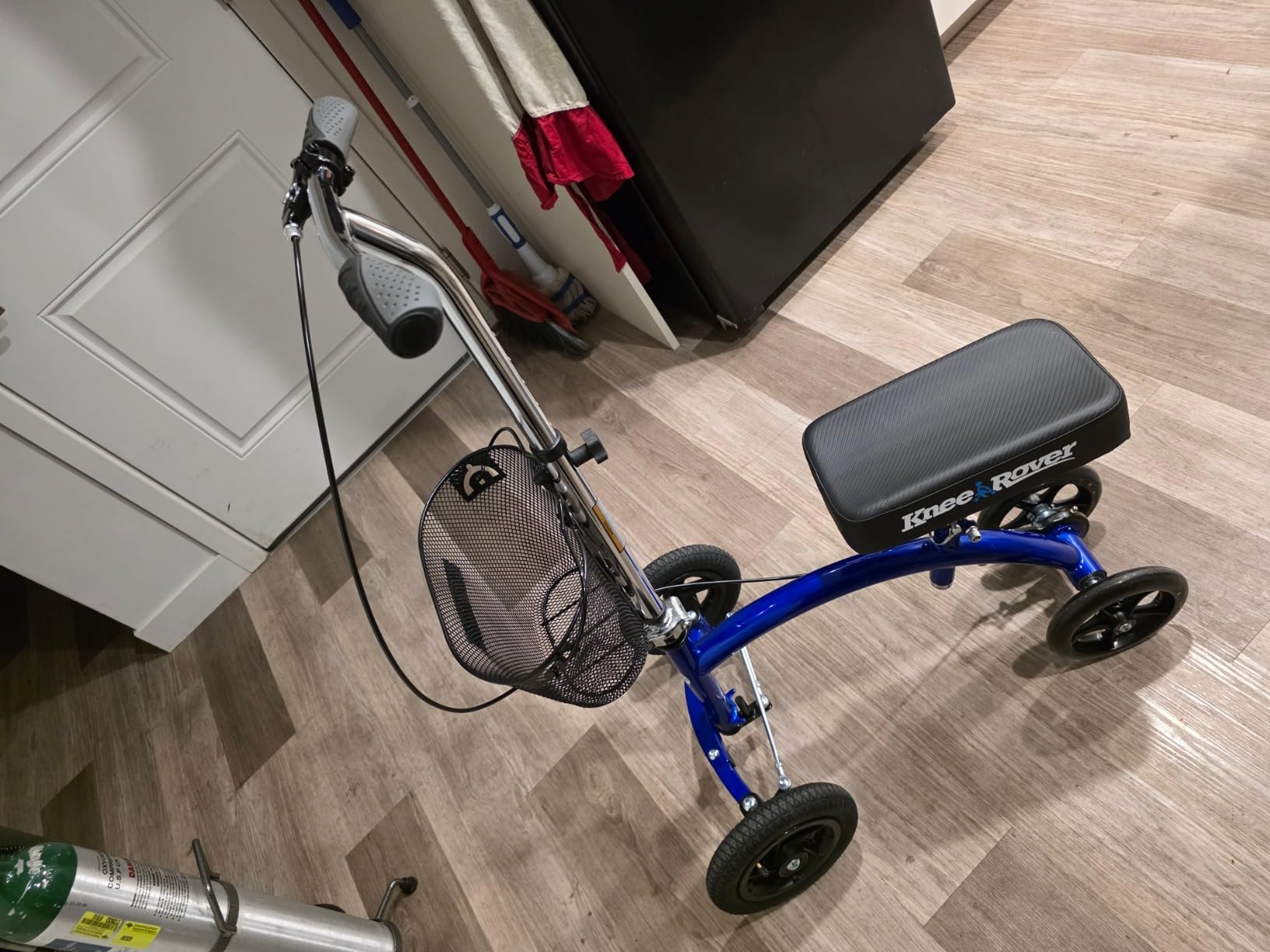
The 3-inch thick contoured knee platform is a real comfort upgrade over the thinner pads on budget models, and the height range from 4 foot 9 to 6 foot 6 is among the widest here. The detachable basket measures 12 by 8 by 8.5 inches and the frame folds for a compact car.
The catch is the same one that comes with air-filled tires anywhere. They need periodic inflation, they can puncture, and 76% of owners still rate it five stars, so the inconvenience is clearly a fair trade for the terrain handling.
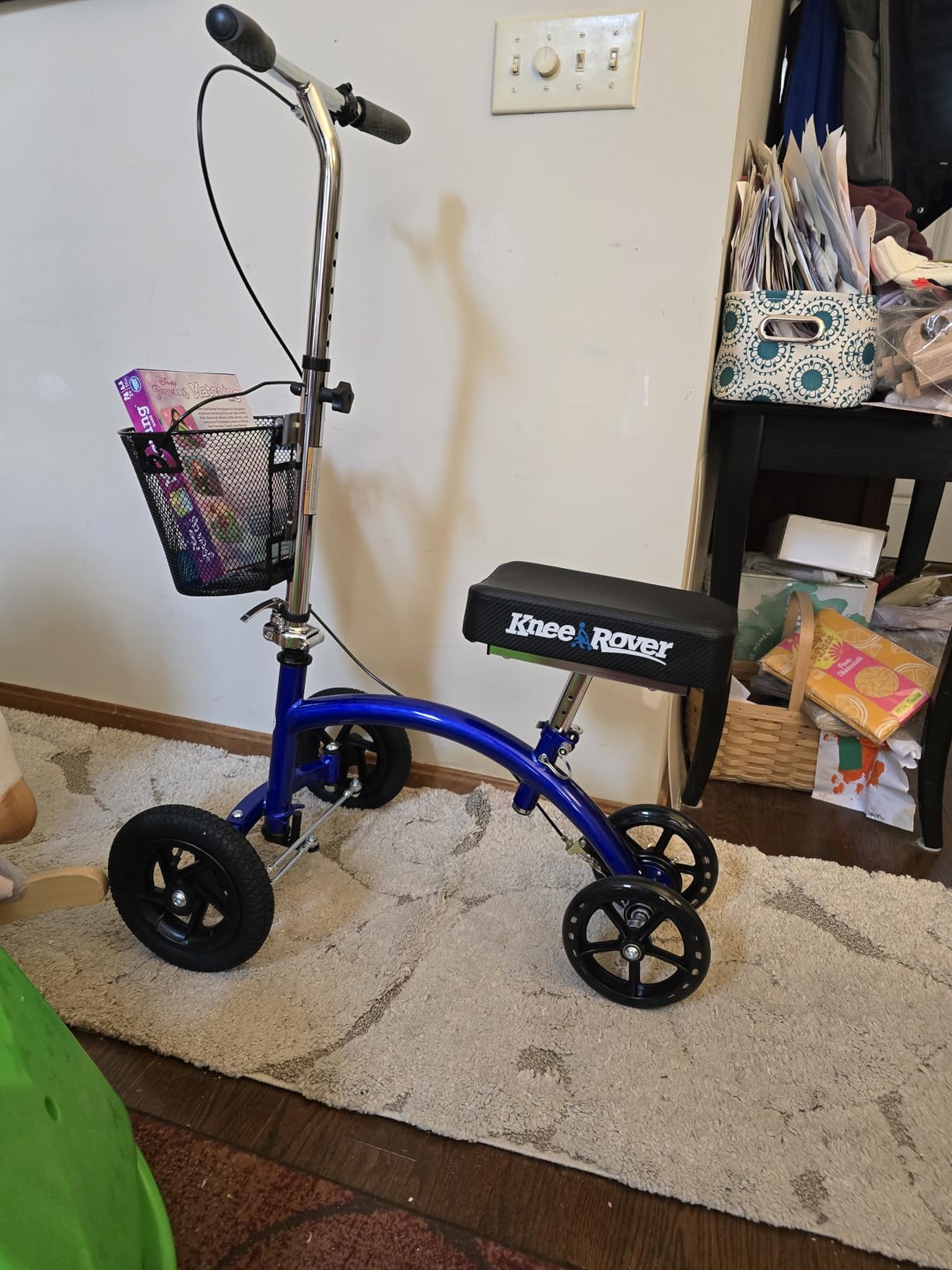
Hybrid tires or all-solid tires?
Air-filled front tires give a softer, faster ride over gravel and grass, which matters if you are covering distance outdoors. Solid explosion-proof tires remove maintenance entirely at the cost of a firmer ride. If your route is pavement and packed paths, solid is enough. If it is grass and gravel, air-filled wins.
The 7.5-inch rear wheels mean this is not a full all-terrain machine, and the frame at nearly 26 lb is a lift to load.
Is the wide turning radius a real problem?
It is in tight spaces, and it is the most common indoor complaint. If you plan to use this mostly outside, it barely registers. If a small kitchen is your main environment, look at the Roscoe or the standard KneeRover instead.
Between those two situations, the Hybrid handles the most kinds of ground.
8. KneeRover Quad All Terrain Knee Scooter – Best for 350 lb Riders and Rough Ground
KneeRover Quad All Terrain Knee Scooter for Adults, Metallic Blue
Four air-filled tires
350 lb capacity
Folds to 16.5 inch height
Fits 4 foot 9 to 6 foot 6
Pros
- Handles grass and dirt and sidewalk gaps
- Stable tie-rod steering with a 350 lb rating
- 3-inch contoured knee platform
- Single thumb-release fold
Cons
- Most expensive model we reviewed
- Air-filled tires need inflation and can puncture
- Large quad footprint means a big indoor turning radius
The Quad is the reference all-terrain model in this category, and with 4.5 across 1167 ratings and a 76% five-star share it has the kind of settled history you want from something you will rely on for two months. Four air-filled tires is a genuinely different machine from everything else on this list.
Where the smaller all-terrain models have one pair of large wheels, this has four, so it stays composed over grass, gravel, dirt and the gaps between sidewalk slabs. The tie-rod steering and 350 lb steel frame rating give it stability that heavier riders in particular tend to notice.
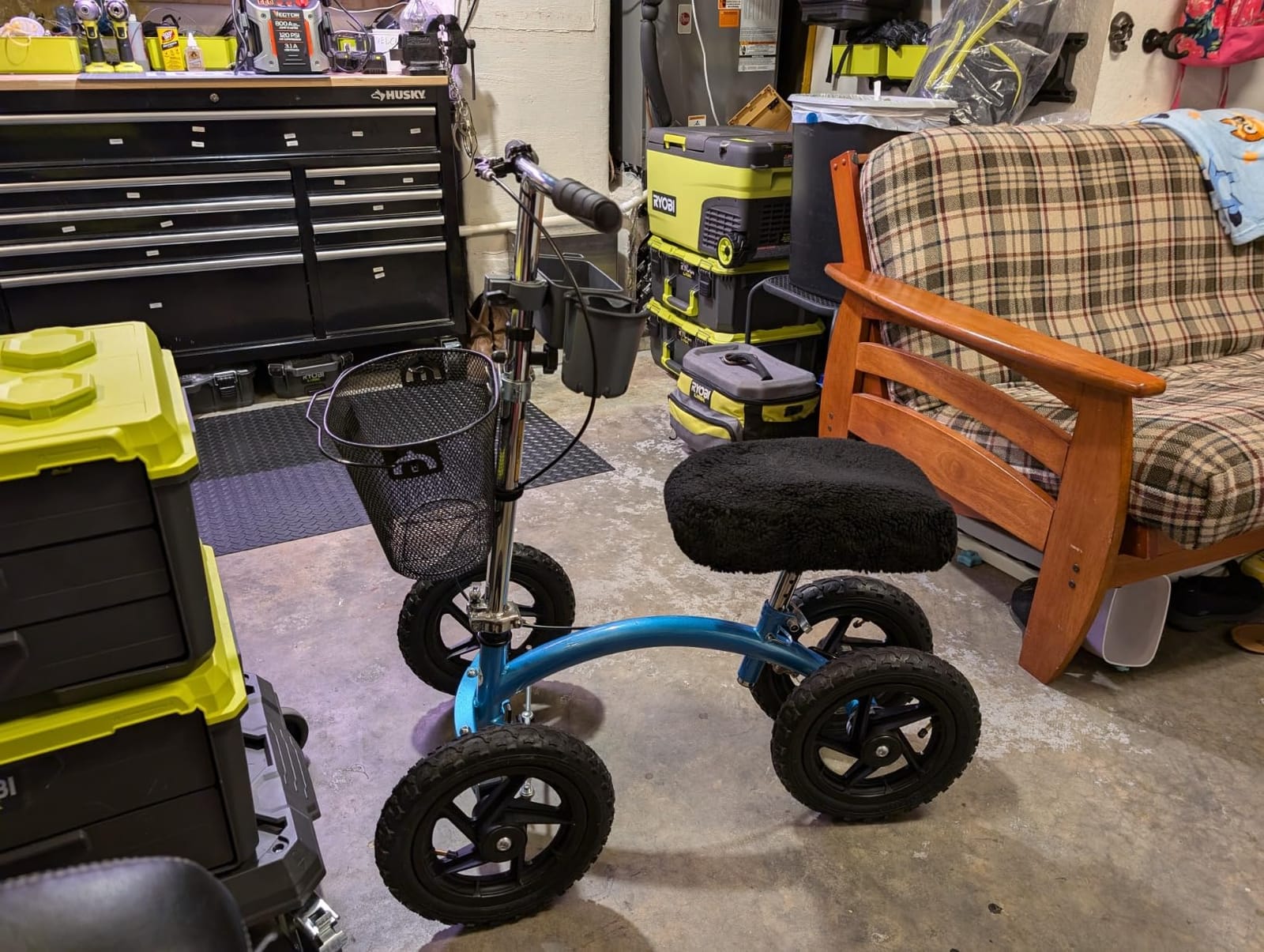
The thumb-release folding lever is the detail that changes daily life. It collapses the frame to 16.5 inches tall in one movement, which means it fits a compact car boot without the disassembly that most premium scooters require, and the 3-inch contoured knee platform is comfortable enough for a full recovery.
Everything negative about it is about cost, upkeep and indoor manners. Air-filled tires need inflation and can puncture, the quad footprint turns poorly in tight rooms, and the frame is nearly 27 lb.
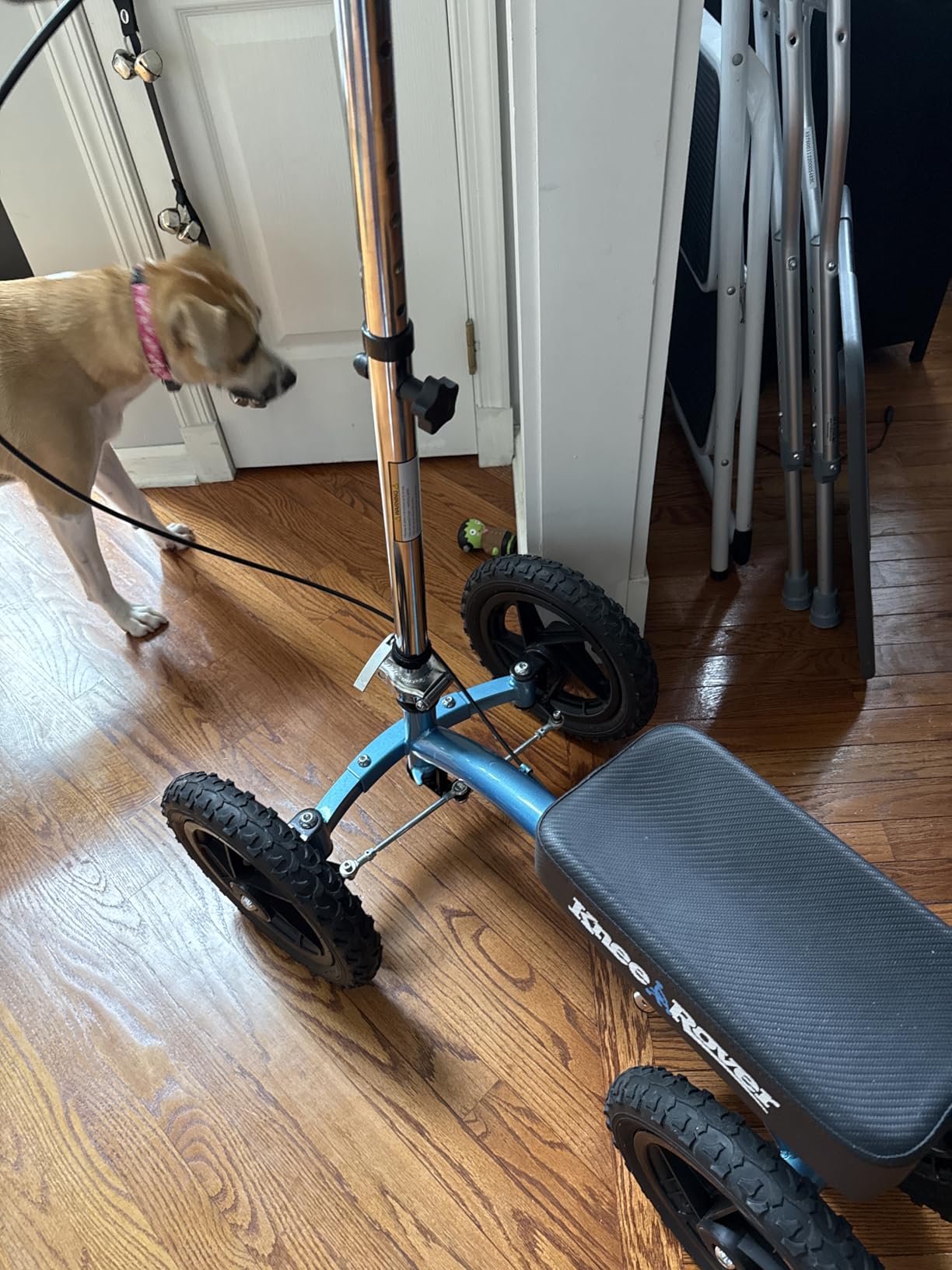
Is it worth the premium over the Hybrid?
Only if you will genuinely be on rough ground. The Hybrid handles grass and gravel well with 9-inch air-filled fronts; the Quad handles badly broken ground, ruts and deep gravel better. If your route is pavement and a driveway, the Hybrid gives you most of the experience for less money.
If you are above 300 lb, the question is easier, because this and the Roscoe are the picks here rated that high.
How is the knee pad over long recoveries?
Well. The 3-inch contoured platform is one of the thicker pads here, and it is one of the few that owners do not immediately replace with a foam cover. That matters for a device you will use eight hours a day for two months.
The ergonomic rubber grips are also worth noting for anyone with reduced grip strength.
9. Aojin Knee Scooter – Best for Shorter Riders and 4 foot 7 to 6 foot 1 Heights
Aojin Knee Scooter for Adults for Foot Injuries, Storage Bag, 8” Wheels
Carbon steel frame
300 lb capacity
Adjustable 4 foot 7 to 6 foot 1
25.55 lb build
Pros
- Widened chassis with a low centre of gravity
- Thickened padded knee rest
- Handle adjusts 33 to 38.9 inches
- Fits riders from 4 foot 7 up
Cons
- Heavier than most similarly priced scooters
- 8-inch wheels limit it to smooth surfaces
- Wide turning radius in small rooms
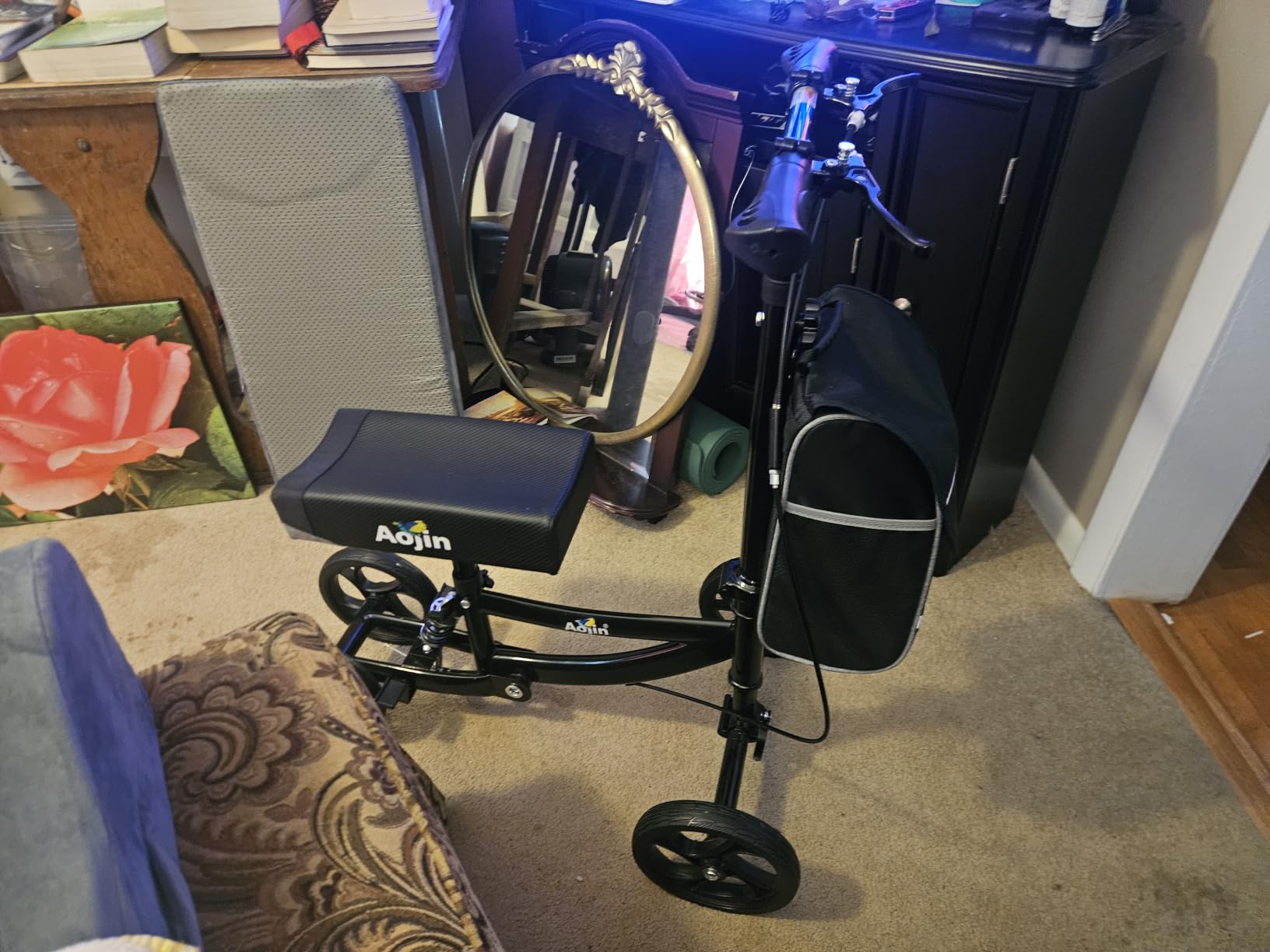
Height fit is the thing that spoils knee walker purchases more than anything else, and this is the pick for shorter riders. The handle adjusts from 33 to 38.9 inches and the knee rest from 15.8 to 19.7 inches, covering users from 4 foot 7 to 6 foot 1, a low ceiling that most models here cannot match.
The widened chassis and low centre of gravity are the second selling point. A low centre of gravity resists rollover, which is the fear that stops a lot of new users from trusting a four-wheel device at all, and buyers consistently mention the confidence it gives them.
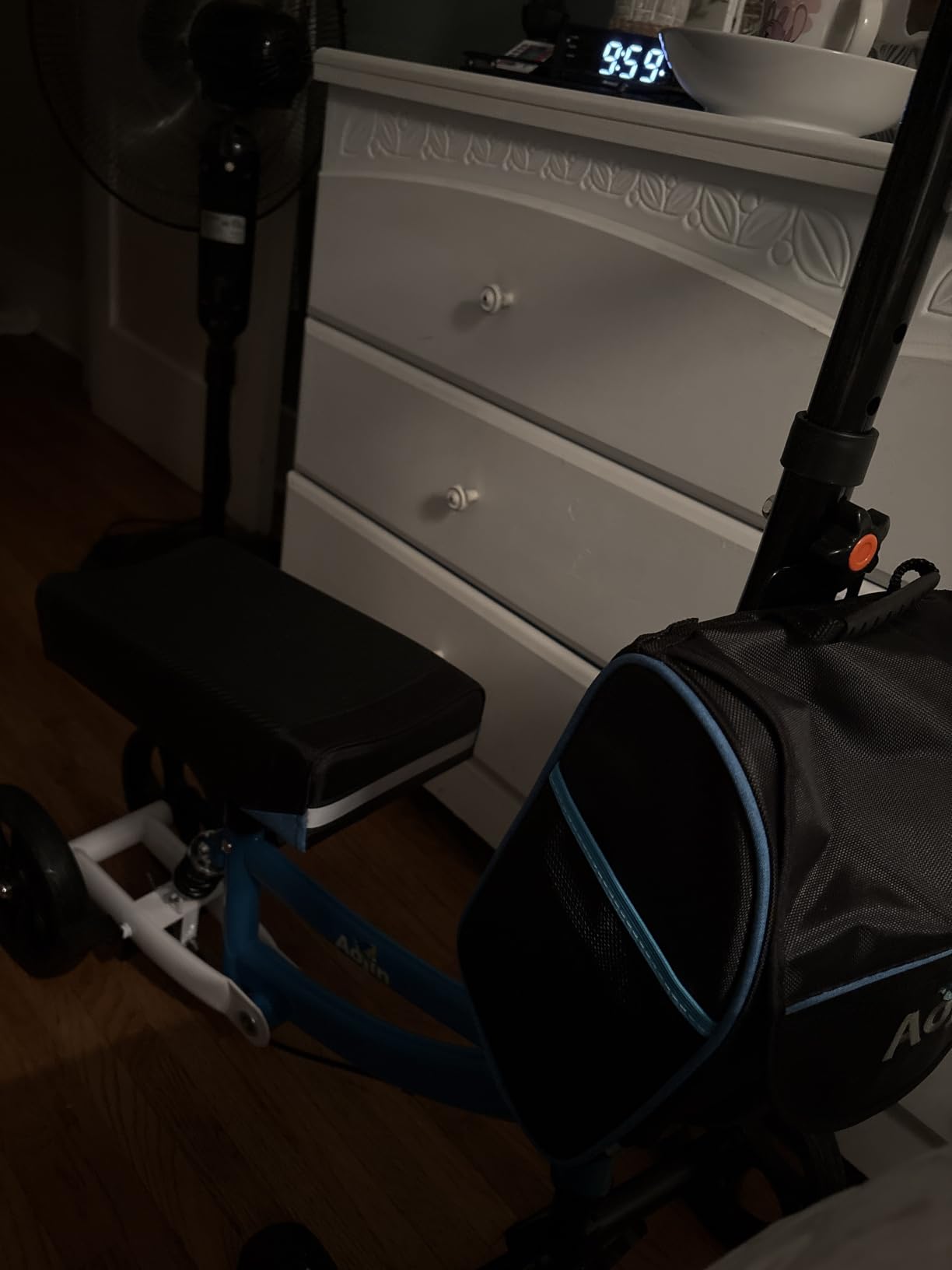
The thickened padded knee rest is also better than the norm at this level. With 1565 ratings at 4.2 and a 65% five-star share, the feedback reads like a solid purchase with a couple of specific drawbacks rather than a model with problems.
Those drawbacks are weight and wheels. At 25.55 lb it is heavier than most of its price peers, and the 8-inch rubber wheels are for smooth floors and pavement. The removable storage bag and one-touch dual handbrakes with a clear lock control round out a competent package.
How do I know my height will fit?
Stand up and measure from the floor to your hip crease, then set the knee rest slightly below that measurement so your thigh is roughly level. Then adjust the handlebars to roughly waist height. If your measurements sit inside the published ranges, you are fine.
Measure before you buy, because a knee platform set too high pushes all of your weight into the back of the leg rather than through the shin.
Is it heavy for a budget model?
Yes, it is one of the heavier frames in the entry group, and that is the trade for the widened, low-centre-of-gravity chassis. If you will be loading it into a vehicle by yourself, check with a caregiver first, or look at the lighter WHLICKS.
The wide turning radius is the other limit, and it matters in a small kitchen or a narrow bathroom.
10. WHLICKS Foldable All Terrain Knee Scooter – Lightest Model to Lift Into a Car
WHLICKS Foldable All Terrain Knee Scooter for Adults for Foot Injuries
20.72 lb build
8-inch PU wheels
300 lb capacity
Quick-release fold
Pros
- Lightest unit in the roundup at 20.72 lb
- PU wheels are smoother and absorb shock better than PVC
- Reinforced frame holds steady at its rating
- Quick-release folding for storage
Cons
- Only 134 ratings so the long-term record is thin
- Highest three-star share in the set
- 8-inch wheels are not true all-terrain
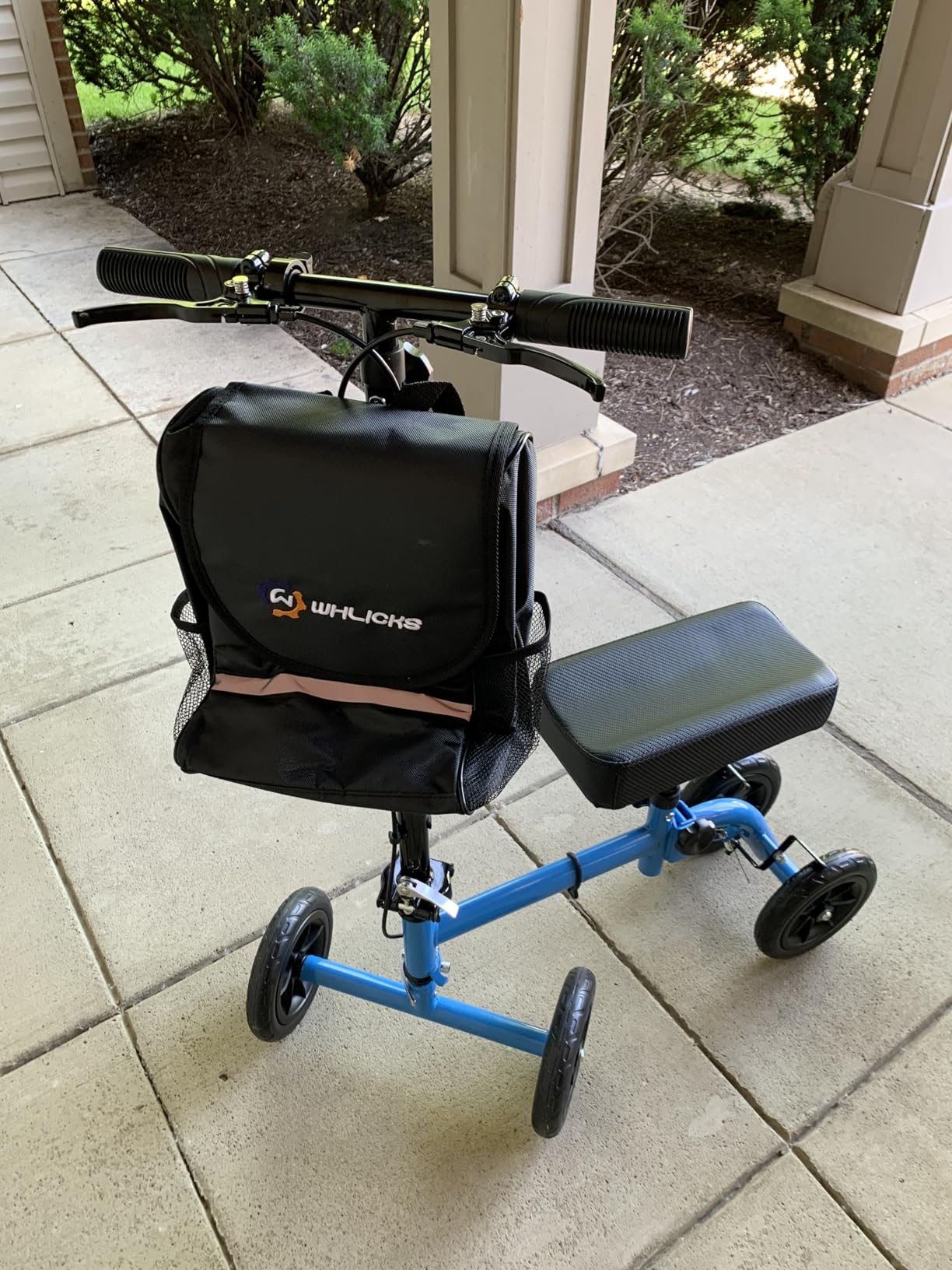
At 20.72 lb this is the lightest knee walker we reviewed, and that is a genuinely useful number when you are hopping into a car on one leg. It is the pick for anyone whose recovery includes appointments, work or a support person driving them around.
The wheels are 8-inch explosion-proof polyurethane, and the claim that they roll smoother and absorb shock better than comparable PVC scooter wheels is one of the more specific points owners make. No inflation, no punctures, and a slightly softer ride than plastic.
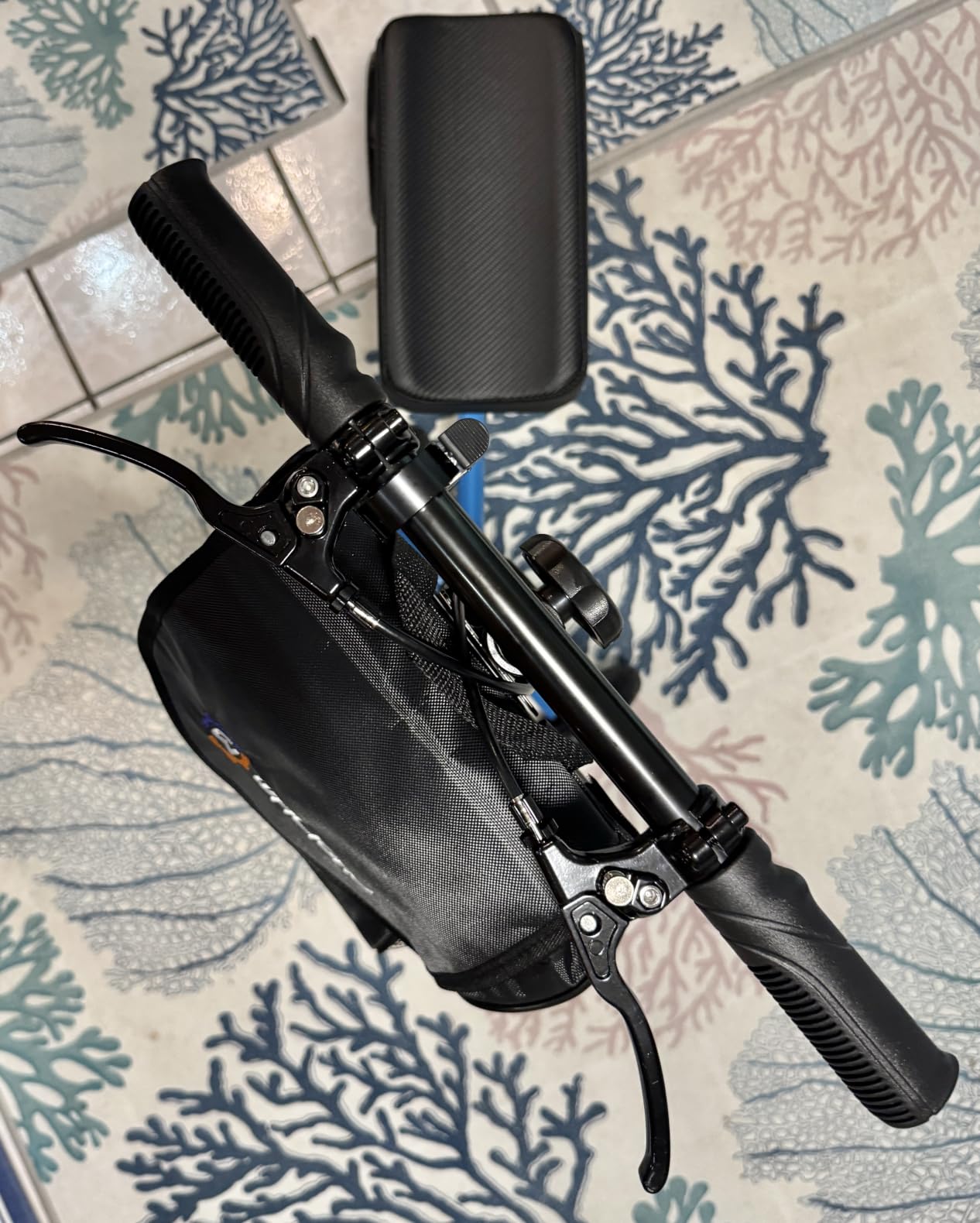
The reinforced tube frame is rated to 300 lb and owners report no wobble at that rating, and the quick-release folding mechanism makes storage in a tight space straightforward. The contoured padded platform and detachable canvas bag complete a sensible package.
The honest limitation is evidence. With 134 ratings and 12% of ratings at three stars, the weakest star distribution in the roundup, this is a newer listing without the long recovery histories the established brands have built up. Nothing in the feedback suggests a fault, but durability over a long non-weight-bearing period is simply not documented yet.
Is lightness more important than features?
During a non-weight-bearing period, frequently yes. A scooter you cannot get into the car is a scooter that stays at home, and a scooter that stays at home is a return trip and a worse recovery. Weight is one of the few specs where a lower number is unambiguously better.
You give up nothing crucial here. The frame rating, the brakes and the fold are all adequate.
How does it handle outdoor ground?
Well on paths and firm ground, less well on loose gravel and grass, because 8-inch wheels are still 8-inch wheels. The PU compound helps with shock absorption but does not change the geometry.
If your recovery is mostly outdoors on rough ground, spend up on a large-wheel model instead of saving on this one.
11. AllCure Quad All Terrain Knee Walker – Best Paper Specs for Paved Paths and Driveways
AllCure Quad All Terrain Foldable Medical Steerable Knee Walker Scooter, Walking Aid Roller for Foot Injuries, Height Adjustable Crutch Alternative, Deluxe Brake System & Basket, Black
12-inch front and 10-inch rear pneumatic tires
23.3 lb build
300 lb capacity
Folds to 22 by 20 by 20 inch
Pros
- 12-inch front and 10-inch rear tires are among the largest here
- Light 23.3 lb frame for a quad all-terrain model
- Dual quick-release fold to a compact package
- Hand pump included in the box
Cons
- Lowest average rating in the roundup at 4.0
- Narrow height range from 5 foot 5 to 6 foot 3
- Pneumatic tires need regular inflation
On paper this has the most capable spec sheet in the group. Twelve-inch front and 10-inch rear pneumatic tires are the widest tire setup here, the frame is a light 23.3 lb for a quad all-terrain design, and the dual quick-release mechanism folds it down to roughly 22 by 20 by 20 inches, a genuinely compact package.
The included hand pump is a small touch that removes a common extra purchase, and the storage basket keeps belongings organised with your hands on the grips. A 300 lb capacity covers most adult users.

What the ratings do not support is the spec sheet. The 4.0 average is the lowest in this roundup, with 9% one-star and 13% three-star ratings, and 143 ratings is a thin evidence base among the models here. That combination is why we placed it rather than crowning it.
The recommended user height range of 5 foot 5 to 6 foot 3 is also the narrowest in the roundup, which excludes a lot of people on both sides of the band. If you fall outside it, this is not the model.
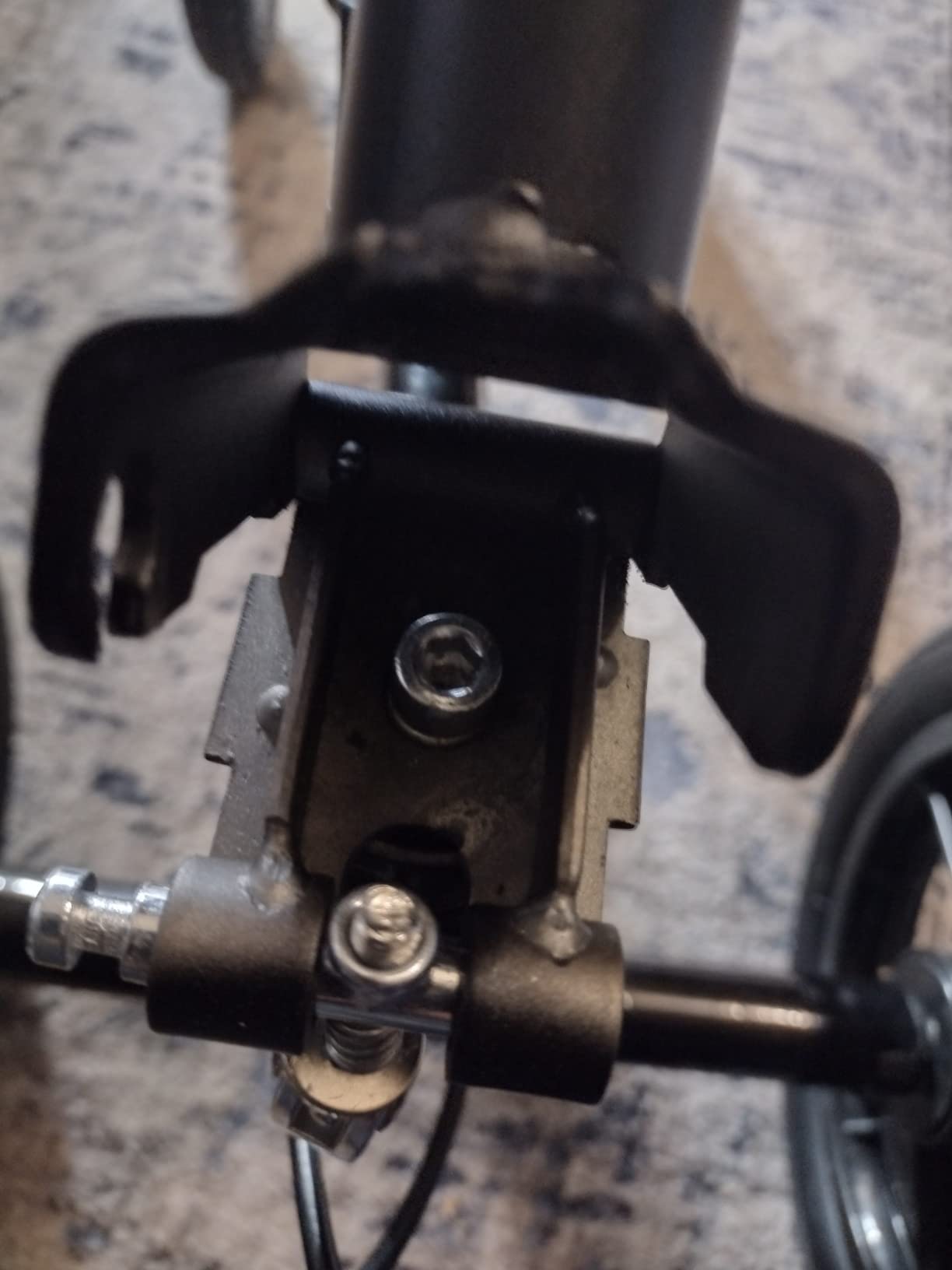
Should I buy on specs alone?
No, not at a 4.0 average. The tires and the fold are genuinely good, but a large share of three-star ratings means real owners are hitting problems the data does not describe, and 143 ratings is too thin to resolve it.
If the 5 foot 5 to 6 foot 3 range fits you and someone nearby can help when something needs adjusting, the tires and the fold are worth having. Otherwise an established model with a deep review record is the safer bet.
Is it lighter than the other quad model?
Yes, at 23.3 lb against nearly 27 lb, and it still carries a 300 lb rating. The trade is capacity, since the heavier all-terrain option is rated to 350 lb.
For someone near the weight limit, the heavier frame with the higher rating is the safer purchase.
12. Medline Manual Seated Mobility Scooter – Best Seated Alternative When Kneeling Is Not Possible
Medline Manual Seated Mobility Scooter Knee Walker, 8” Wheels, 300 lbs. Capacity, Black- for Leg & Foot Injuries, Crutch Alternative, 1 Ct.
Seated configuration
Padded seat and two leg platforms
300 lb capacity
8-inch wheels
Pros
- A real option for people who cannot manage a kneeling scooter
- Padded seat and two leg platforms for comfort
- 300 lb capacity suits larger users
- Easy to assemble with an attached basket
Cons
- Seated format sits higher and is less stable
- Built for flat surfaces only
- 29.5 lb build is among the heavier frames
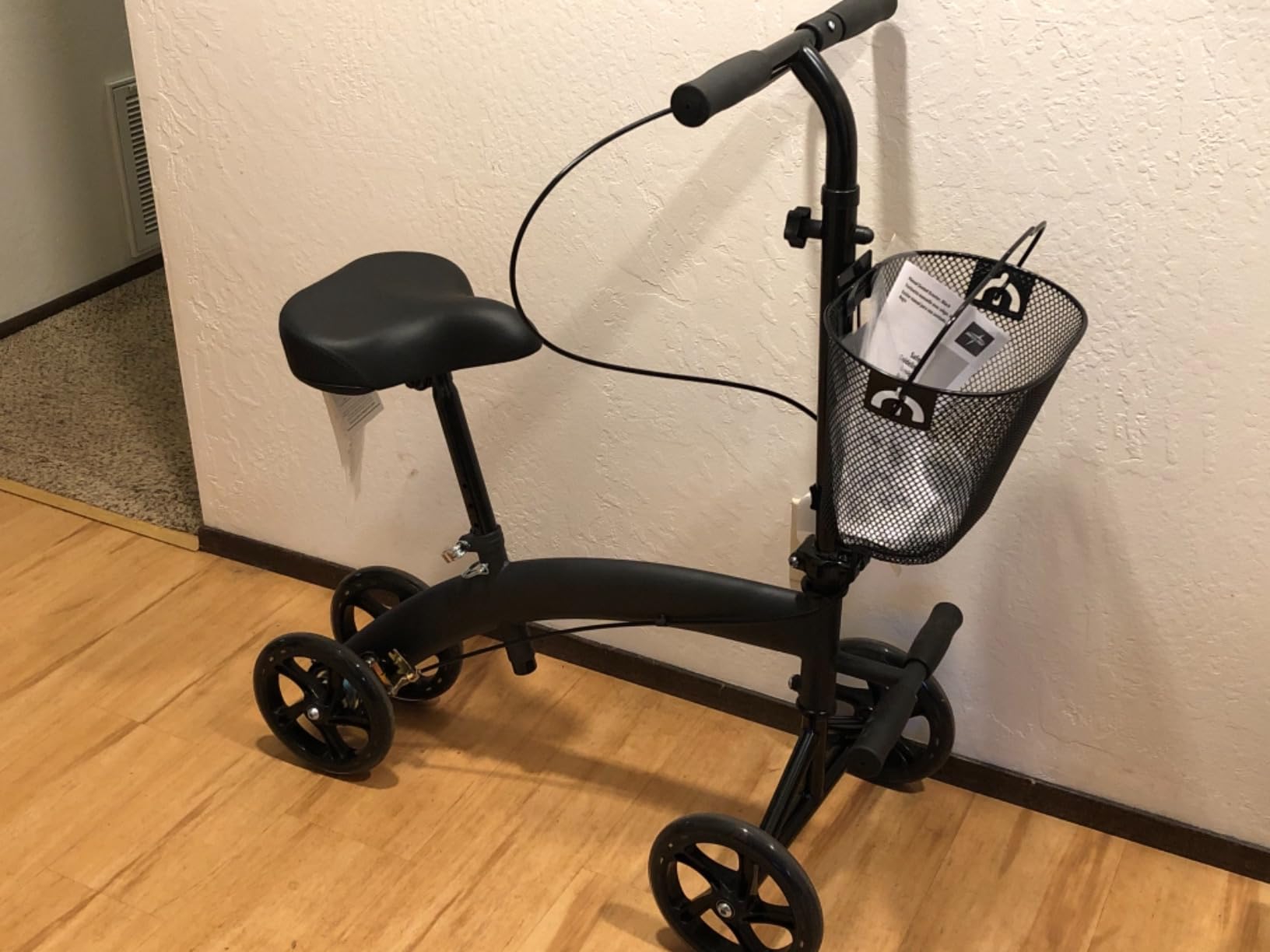
This is the odd one out, and it earns its place for a specific reason. A seated scooter is the answer for someone who needs a crutch alternative but cannot kneel on a platform, whether because of knee pain, balance, or simply a body that will not tolerate the position. It is manual and non-powered, so it still moves by pushing with one leg.
The padded seat and the two leg platforms let the injured foot rest at a normal height rather than up on a knee rest, and that single change is why some people find a kneeling scooter impossible and this one workable. The attached basket gives hands-free storage, and assembly is straightforward.
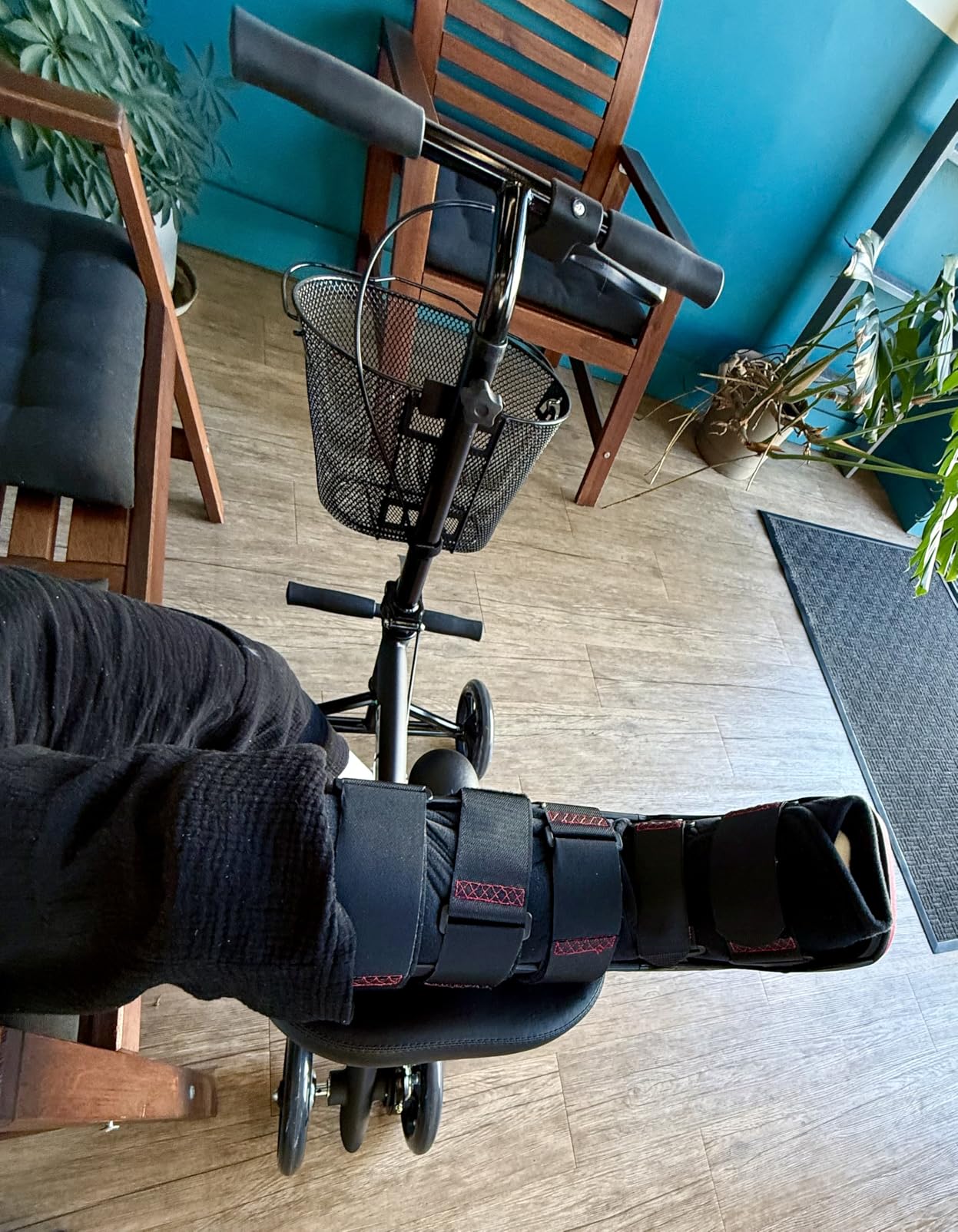
The 4.1 average is modest, with 8% one-star and 10% two-star ratings, and the reasons are structural rather than fixable. A seated frame has a higher centre of gravity than a kneeling one, and it is built for flat surfaces, so uneven outdoor ground is genuinely out of scope.
At 29.5 lb it is one of the heavier frames we reviewed, and 134 ratings is a thin evidence base. This is a niche pick, but for the person who needs it, it may be the only thing that works.
When does a seated scooter make more sense than a knee walker?
When kneeling is the problem, not the ankle. If your knee cannot take the sustained pressure of a platform, or you have balance issues, a seated scooter keeps the injured leg supported at seat height and lets you push from a sitting position. It is worth asking your physical therapist about it directly.
Many people start on crutches, move to a knee scooter later, and only need one of these. Check with your clinician before choosing a seated model.
Can you use it outside?
On flat, paved ground, yes, cautiously. On grass, gravel, slopes or anything uneven, no. The 8-inch wheels and the seated height combine badly with rough ground, and this is not a device to take down a driveway with a bad camber.
It is a home-and-pavement device, and it is at its best on smooth indoor floors.
How to Choose a Knee Walker for an Ankle Injury
Fit beats features every time, and most disappointing knee walker purchases come down to a height range that did not cover the rider or a weight that nobody checked. Work through these ten points in order.
1. Confirm the device is right for your injury
A knee walker suits a broken ankle, foot surgery, an ankle fracture or a lower-leg injury where you are non-weight-bearing. It does not suit a knee injury, because you would be resting your weight on the joint that is already hurt. Ask your surgeon or physical therapist before you buy.
2. Get the type right
Standard indoor models use roughly 7.5 to 8 inch wheels and suit smooth floors, carpet and pavements. All-terrain models use 9 to 12 inch wheels and cost more, weigh more and turn worse. Seated scooters are a separate category for people who cannot kneel at all.
3. Match the height range to your body
This is the number one source of dissatisfaction. Measure from the floor to your hip crease, then compare against the published knee platform range. The Aojin reaches down to 4 foot 7, the standard KneeRover fits 5 foot 3 to 6 foot 5, and the Quad models reach 4 foot 9 to 6 foot 6.
4. Set the knee platform correctly
Your thigh should be close to level with the ground, with the platform just below hip height. Too high and your weight goes into the back of your leg and hip; too low and you will hunch forward and tire faster. This one adjustment changes comfort more than any other setting on the device.
5. Check the weight capacity against your actual weight
Most models in this roundup are rated to 300 lb. The Roscoe, the Quad and the all-terrain model are rated to 350 lb. If you are near or above a model’s limit, buy the higher-rated frame rather than stretching the lower one.
6. Weigh the product weight against who will lift it
Product weights here run from 20.72 lb to 30.51 lb. If you will be loading it into a car alone while non-weight-bearing, choose the lighter end of the range. If a caregiver handles transport, weight matters far less and features matter more.
7. Look at the brakes, not just the wheels
Because you brake with one leg, predictable stopping matters more than most buyers expect. A locking hand brake is essential for parking while you transfer. Rear drum brakes and disc brakes both outperform a bare lever, and the models with both are the ones we would choose.
8. Decide pneumatic or solid before you pick a wheel size
Pneumatic and air-filled tires give a softer, faster ride over grass and gravel but need inflation and can puncture. Explosion-proof solid tires need nothing at all and are the sensible choice if your route is pavement and packed paths, or if nobody in the house will remember to check tire pressure.
9. Be honest about folding and storage
A quick-release lever that collapses the frame in one movement, as on the Quad, is a different experience from a multi-step fold. If you will fold it daily, weigh that heavily. Check the folded dimensions against your car boot and your closet before ordering.
10. Choose storage that suits your hands
Both hands are needed for steering and braking, so without a basket you cannot carry a drink, a phone or a bag of shopping. A detachable metal basket holds more and lasts longer than a canvas one, and a large front bag can carry a laptop if you are working from home.
Once you have a model in mind, it is worth reading our guide to the best rollator walkers for seniors to see whether a four-wheel upright walker fits your situation better, particularly if the ankle injury is not your only mobility limitation.
Knee Walker Safety: Four Rules You Should Not Break
These four rules came up constantly in the forum conversations we read, and three of them contradict things people commonly assume.
Never ride a knee walker on stairs
This is the hard limit, not a caution. A knee scooter has four small wheels in a narrow footprint and no way to distribute your weight across a step. Use a stair lift, a handrail with crutches, or have someone help you. In a multi-level home this is a planning problem to solve before you leave the hospital, not during week three.
Brakes are not designed for steep slopes
Rear drum brakes and disc brakes give you control on gentle inclines and flat ground. They are not designed for steep ramps, and a loaded scooter on a slope can run away from you faster than one leg can stop it. Avoid steep driveways and hills entirely during recovery.
A knee injury makes a knee walker the wrong tool
The whole device works by resting your body weight through the shin and knee onto the platform. If your knee is the injured joint, that is the last place you want load. This is the single most important contraindication, and it is also the reason seated scooters exist.
Respect the capacity, and never put weight through the healing ankle
Exceeding the rated capacity risks frame failure, and even a small accidental load through an NWB ankle can reset healing. Build the habit of keeping the injured leg elevated whenever you are stopped, and of never swinging down onto the foot to brake.
One recurring forum fear is worth naming so it does not stop you buying a scooter: users report that the tiniest pebble can jolt the front end. That is a real reason to prefer larger wheels, not a reason to avoid the device. The same people report the scooter replaced a fall risk, since crutch users in one thread describe falling repeatedly before switching.
And when your surgeon clears you to bear weight, plan the transition properly. The related ankle support boot roundup is the stage most people reach after the knee walker comes out of the closet.
Renting or Buying a Knee Walker for a 6-8 Week Recovery
Rent for a short, predictable recovery. Buy when the maths stops working.
The decision is arithmetic. A typical broken ankle protocol is six to eight weeks of non-weight-bearing, and over that window daily rental charges add up quickly against a one-off purchase that you may keep for a second injury later in life. If your surgeon has given you a firm end date and that date is inside about two months, renting is the sensible option, and most orthopaedic clinics will prescribe or arrange one through a durable medical equipment supplier.
Buy if you are facing a longer or less certain timeline, if you will be travelling between homes, or if you would rather own the thing than return it. Two other routes are worth knowing: a health savings account or flexible spending arrangement can often reimburse a durable medical equipment purchase if your plan covers it, and a supplier such as the one named in the all-terrain pick is HSA and FSA eligible, which is a detail most buyers never check.
Whatever you choose, confirm with your insurer or clinic first. Durable medical equipment coverage is far easier to arrange before you buy than after.
Frequently Asked Questions
What is the best mobility device for a broken ankle?
For most people told to stay non-weight-bearing, a steerable wheeled knee walker is the best mobility device for a broken ankle because it keeps all load off the injured leg while letting you move faster and with less effort than axillary crutches. A seated scooter is the alternative when kneeling is not tolerable, and a wheelchair when the non-weight-bearing period is long. Confirm the choice with your surgeon or physical therapist first.
Are knee walker and knee scooter the same?
Yes. Knee walker and knee scooter are two names for the same non-powered, steerable, wheeled mobility aid with a padded knee platform. Knee rollator is a third, less common name for the same device. Some sellers use seated knee scooter for a different product with a chair instead of a knee rest.
Is it better to use crutches or a knee scooter?
For a six to eight week non-weight-bearing ankle recovery, most people end up preferring a knee scooter. A study of standard crutches against rolling knee scooters recorded 22 falls on crutches compared with 14 on knee scooters, and participants generally reported lower perceived effort with the wheeled option. Your surgeon’s instruction takes priority over any general comparison.
Can you ride a knee scooter on stairs?
No. Never ride a knee walker or knee scooter on stairs. The four small wheels in a narrow frame cannot distribute your weight across a step, and the brakes are not designed for that task. Use a stair lift, a handrail with crutches, or a second person instead, and plan the route before you leave the hospital.
How high should my knee scooter be set?
Set the knee platform so your thigh is roughly level with the ground, which usually puts it slightly below your hip height measured from the floor. Then set the handlebars around waist height so your elbows stay slightly bent. A platform set too high pushes your weight into the back of your leg, and this one adjustment changes comfort more than any other setting.
How long should I use a knee scooter after ankle surgery?
Most ankle fracture and foot surgery protocols involve four to eight weeks of non-weight-bearing, so that is the usual window for a knee scooter, though your own surgeon’s timeline governs. Many people start on crutches and move to a scooter once they feel comfortable, and they keep the scooter until they are cleared to bear weight. Ask your surgeon to confirm when you can transition.
Our Verdict: Which Knee Walker Should You Buy?
For most people recovering from a broken ankle, the KneeRover Steerable is the best knee walker in this roundup, because it combines the highest rating in the group with a 300 lb frame, a real rear drum brake, and a fold light enough for one person to manage. The BodyMed is the value alternative, the Roscoe is the one to buy if your home is tight, and the KneeRover Quad or the all-terrain model are the right call if a lawn or gravel drive is part of your route.
Whatever you order, get your clinician’s sign-off first, set the knee platform to hip height before you ride anywhere, and settle the stairs question while you are still mobile. The best knee walkers for ankle injuries are the ones you trust enough to use every single day of your non-weight-bearing period in 2026.