
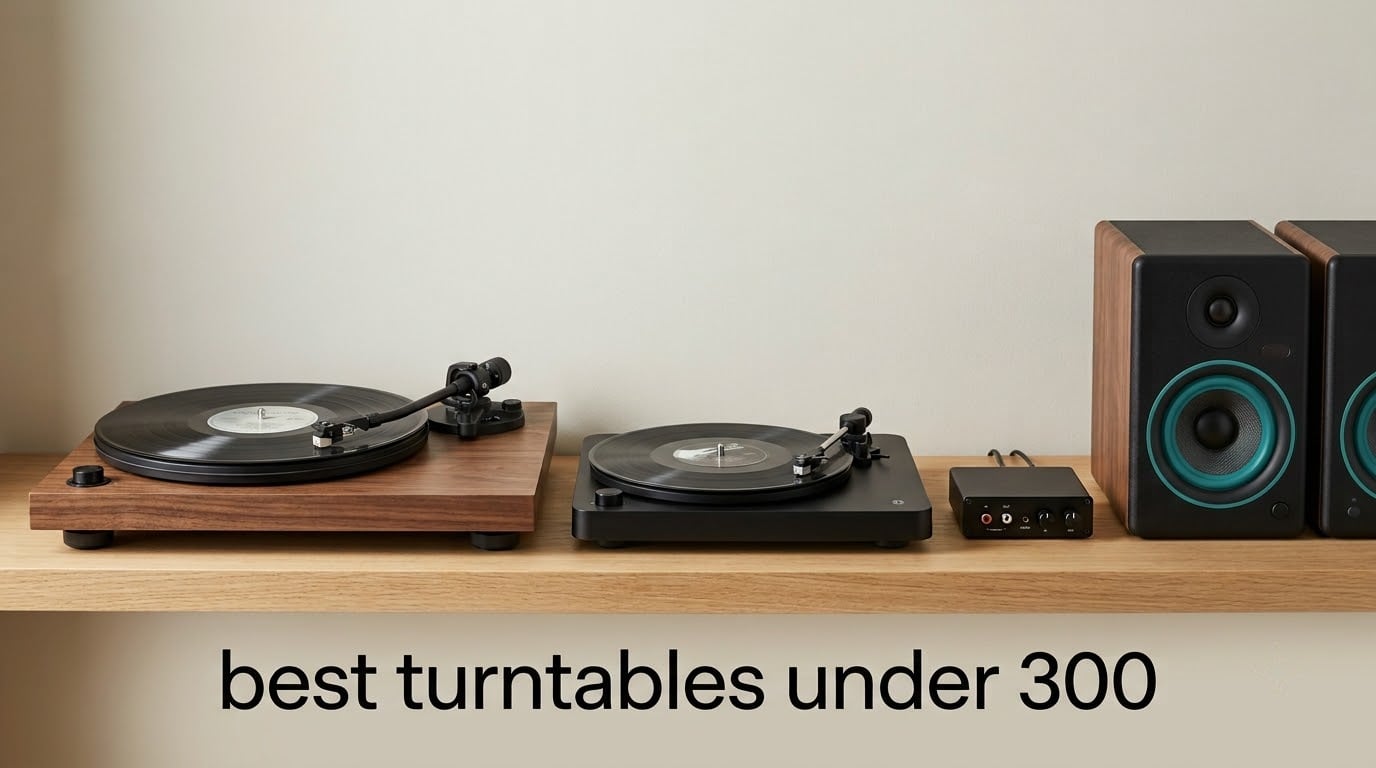
If you are searching for the best turntables under 300, you are one search away from a list that quietly breaks its own promise. Most results for this query include decks priced well above the cap. The 12 record players below all sit under it.
We spent weeks reading owner reviews across these 12 decks, comparing drive type, phono stage, cartridge platform and automation. Our top pick for the bracket is the Victrola Quincy, because it is the most heavily reviewed turntable here and it plays something the moment you plug it in. The best sound comes from the Fluance RT81, and the best cartridge upgrade path belongs to the Audio-Technica AT-LP70X.
One warning before you shop. The deck is rarely the whole cost. A turntable produces a tiny phono-level signal that most budget amplifiers cannot amplify without a phono preamp, so add one to your maths if your system has no PHONO input. Threads on r/turntables and audiokarma.org keep circling the same complaint: people budget the deck, forget the stage, and end up with a silent system.
New to the format? Our guide to the best turntables for beginners covers setup, and the vinyl beginner guide covers your first cartridge choices.
Top 3 Picks for Turntables Under $300 in 2026

Victrola Quincy 6-in-1
- Vinyl
- CD
- cassette and radio in one cabinet
- Bluetooth and 3.5 mm AUX
- Three-speed belt drive
- Built-in stereo speakers

Audio-Technica AT-LP60X
- Fully automatic start
- stop and return
- Switchable phono preamp
- Replaceable diamond stylus
- Die-cast anti-resonance platter
Fluance RT81
- Audio-Technica AT95E cartridge
- Balanced S-type arm with counterweight
- Switchable built-in preamp
- High-mass MDF plinth
Quick Overview: Best Every Turntable Under $300 We Reviewed
Here is the full field at a glance. Every deck sits under the 300-dollar ceiling, and the features column tells you what each one solves best.
| Product | Specifications | Action |
|---|---|---|
| Victrola Quincy 6-in-1 |
|
Check Latest Price |
| Audio-Technica AT-LP60X |
|
Check Latest Price |
 Audio-Technica AT-LP60XBT Audio-Technica AT-LP60XBT |
|
Check Latest Price |
 1byone Belt Drive with Speakers 1byone Belt Drive with Speakers |
|
Check Latest Price |
| Fluance RT81 |
|
Check Latest Price |
 ANGELS HORN All-in-One ANGELS HORN All-in-One |
|
Check Latest Price |
 1byone Fully Automatic 1byone Fully Automatic |
|
Check Latest Price |
 Fluance RT80 Fluance RT80 |
|
Check Latest Price |
 Audio-Technica AT-LP70X Audio-Technica AT-LP70X |
|
Check Latest Price |
 Victrola Century Victrola Century |
|
Check Latest Price |
 Teac TN-180BT Teac TN-180BT |
|
Check Latest Price |
 Electrohome Montrose RR35 Electrohome Montrose RR35 |
|
Check Latest Price |
Short on time? The Victrola Quincy is the safest first buy, the Audio-Technica AT-LP60X is the cleanest step up, and the Fluance RT81 is the deck enthusiasts name most often in this price class.
1. Victrola Quincy 6-in-1: The One That Plays Out of the Box
Victrola Quincy – 6-in-1 Bluetooth Record Player – Mahogany
Vinyl, CD, cassette, AM/FM radio
Bluetooth and 3.5 mm AUX
Three-speed belt drive
Stereo speakers, 14.9 lb
Pros
- Plays vinyl
- CDs
- cassette and radio with no extra equipment
- Warm
- full sound that upgrades listeners from cheaper players
- Retro cabinet that doubles as furniture
- RCA line-out for external speakers
- Bluetooth pairs quickly
Cons
- No counterweight or anti-skate and a basic diamond stylus
- CD tray feels clunky and FM tuning is slow
- Lid does not open fully
- Minority of reports of cracked ceramic cartridges on arrival
This is the deck we recommend first for most people, and the reason is simple: it removes every decision between the box and the first record. No preamp to buy, no amplifier, no speakers, nothing to balance.
The 3-speed belt drive covers 33, 45 and 78 rpm, which is unusual at this level and matters if you have inherited 78s. Owner reviews for the Quincy are the largest set we read, and the pattern holds: people buy it to escape a suitcase player and describe the result as a step change in weight and clarity.
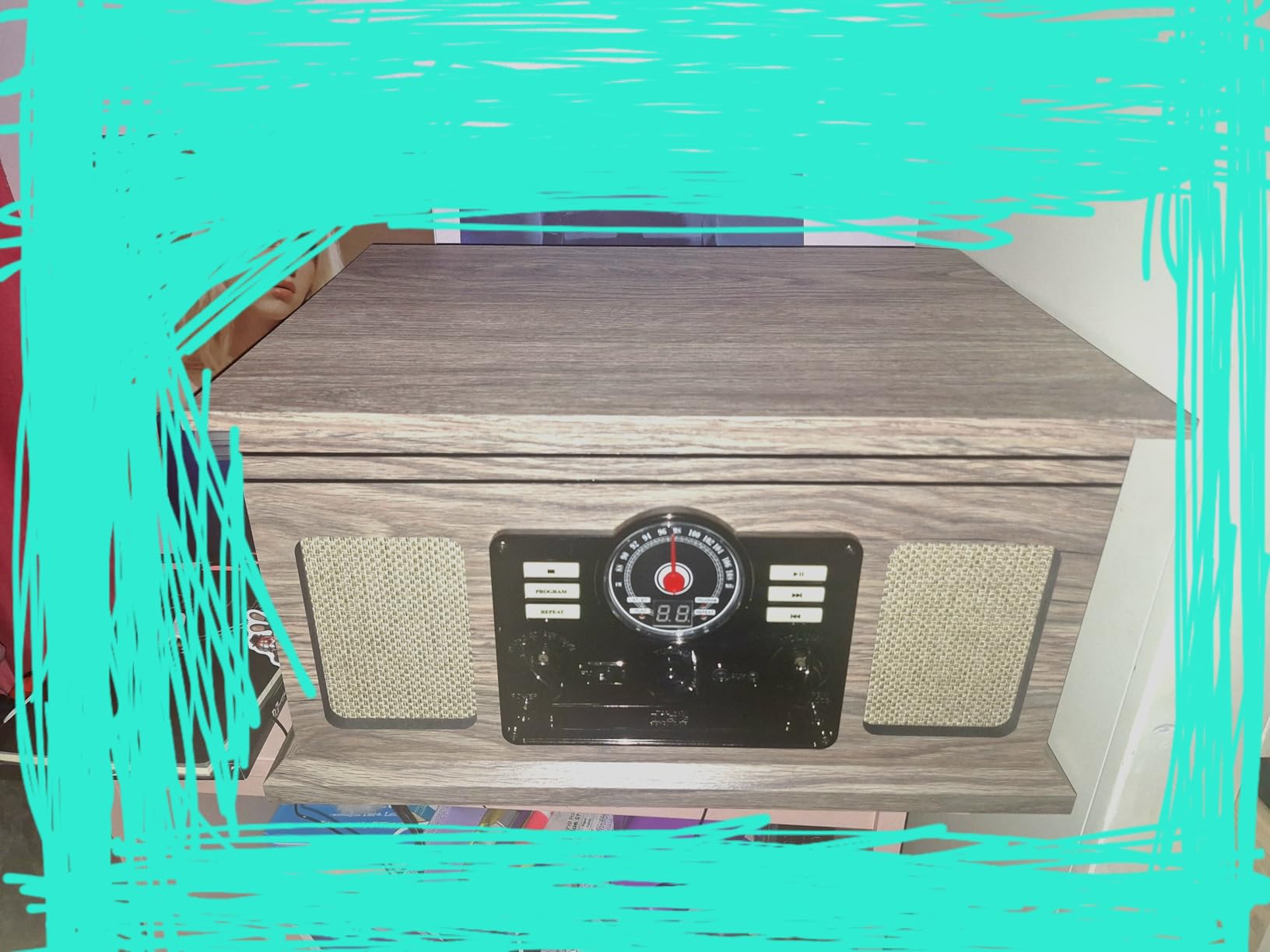
What you give up for that convenience is control. The tonearm has no counterweight and no anti-skate adjustment, and the stylus is a basic diamond tip. Owners with worn records report skipping that a weighted arm would ride through.
Other notes are cosmetic. FM tuning is manual and slow, the CD tray feels tinny, and the lid does not open fully, which limits record clearance on large sleeves. A minority received units with a cracked ceramic cartridge needing a swap.
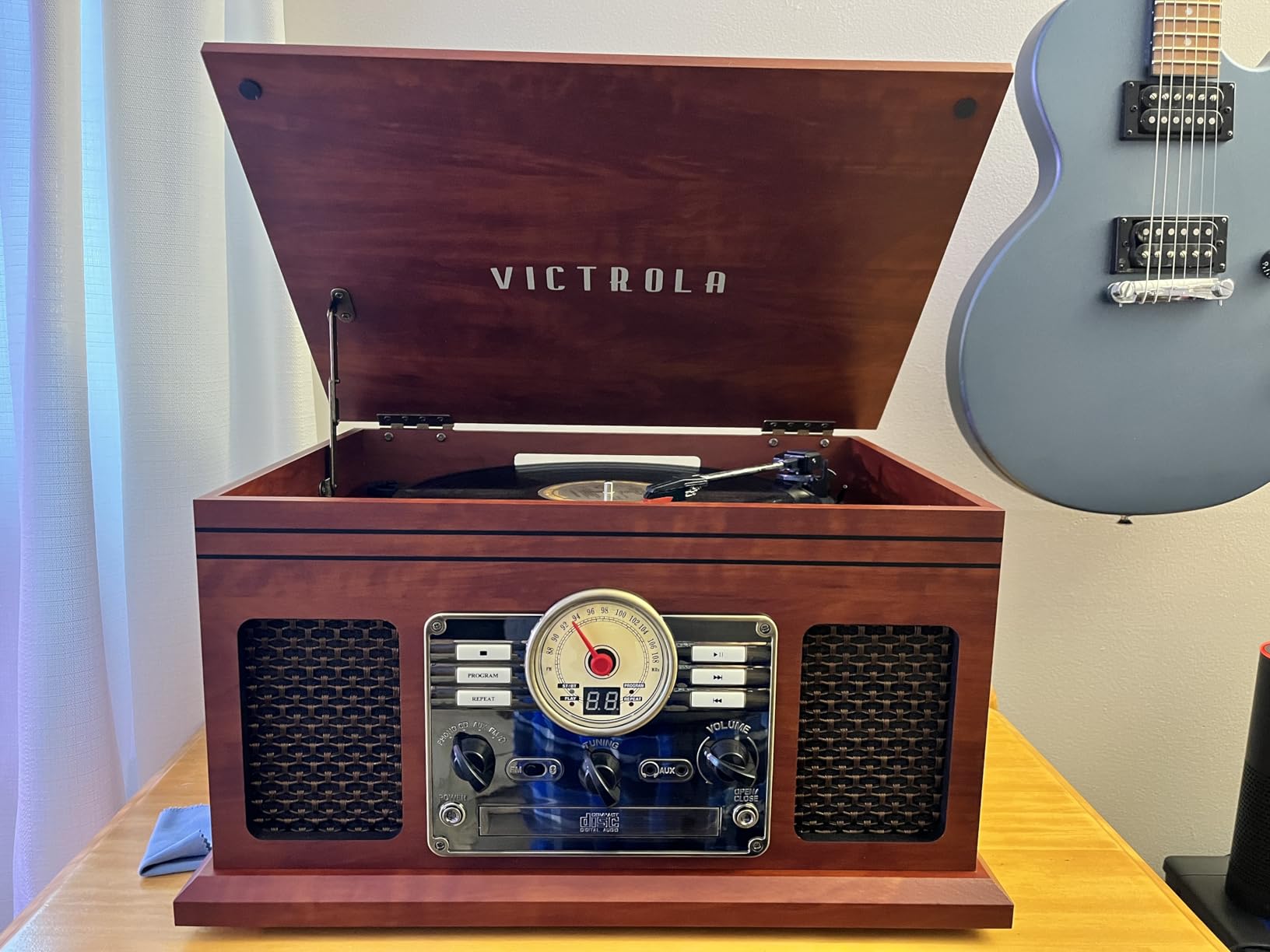
Who the Victrola Quincy suits best
It suits anyone who wants records playing tonight with zero research, and anyone furnishing a room where furniture matters. It is also the safest gift here, because there is no setup to fail and no way to connect it wrongly.
If you already own a real amplifier and speakers, skip it. The RCA line-out exists, but a sub-300 all-in-one cabinet is a compromise on tonearm mass, and you will hear that once you compare.
Where the Quincy falls short
Collectors hit a ceiling here. The arm is not counterweighted, tracking pressure cannot be set properly, and there is no way to fit a better stylus later.
It is also the wrong pick for anyone digitising records, because there is no USB output. If your plan is to rip a library to a computer, look at a deck built for that job.
2. Audio-Technica AT-LP60X: The Best Value Turntable Under 300
Audio-Technica AT-LP60X-BK Fully Automatic Belt-Drive Stereo Turntable, Black, Hi-Fidelity, Plays 33-1/3 and 45 RPM Vinyl Records, Dust Cover, Anti-Resonance, Die-Cast Aluminum Platter
Fully automatic belt drive
Die-cast anti-resonance platter
Switchable phono preamp
Replaceable stylus
Pros
- Clean
- detailed sound users compare to lossless streaming
- Sets up in about five minutes with no balancing
- Die-cast platter and dust cover feel solid
- Auto stop and stow for daily use
- Switchable preamp works with powered speakers
Cons
- No Bluetooth and no 78 rpm support
- Light plastic chassis
- Stock felt mat collects static
- A few reports of used or faulty units from third-party sellers
The AT-LP60X is the sensible middle of this bracket. It costs noticeably less than the manual belt-drive alternatives and gives you the two features beginners actually need: automatic operation and a switchable phono preamp.
Automatic means the arm lifts, plays, stops and returns without you touching it, so a distracted evening cannot end with a stylus parked in a record. The preamp switch lets you feed powered speakers or an amplifier with no phono stage at all.
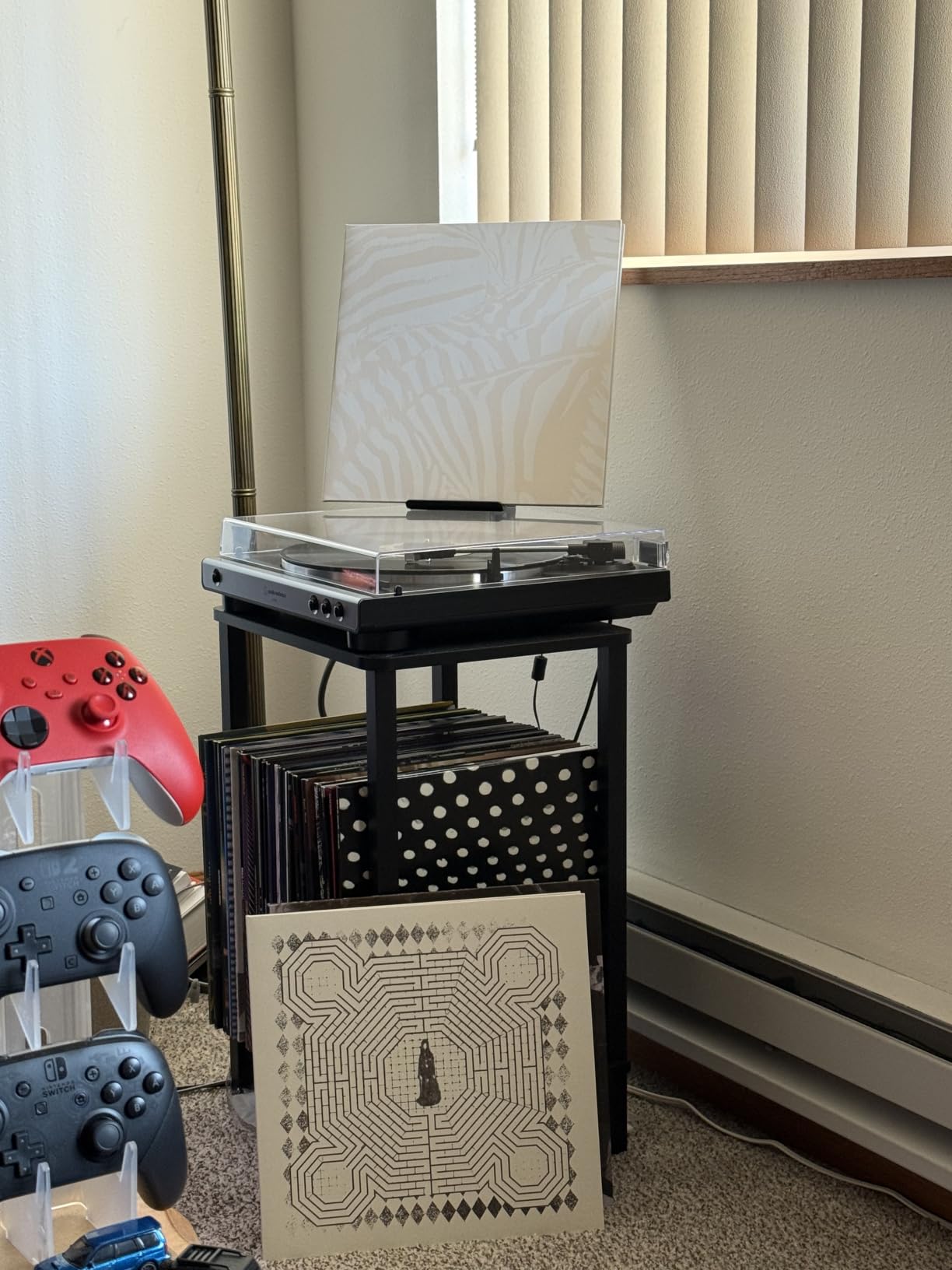
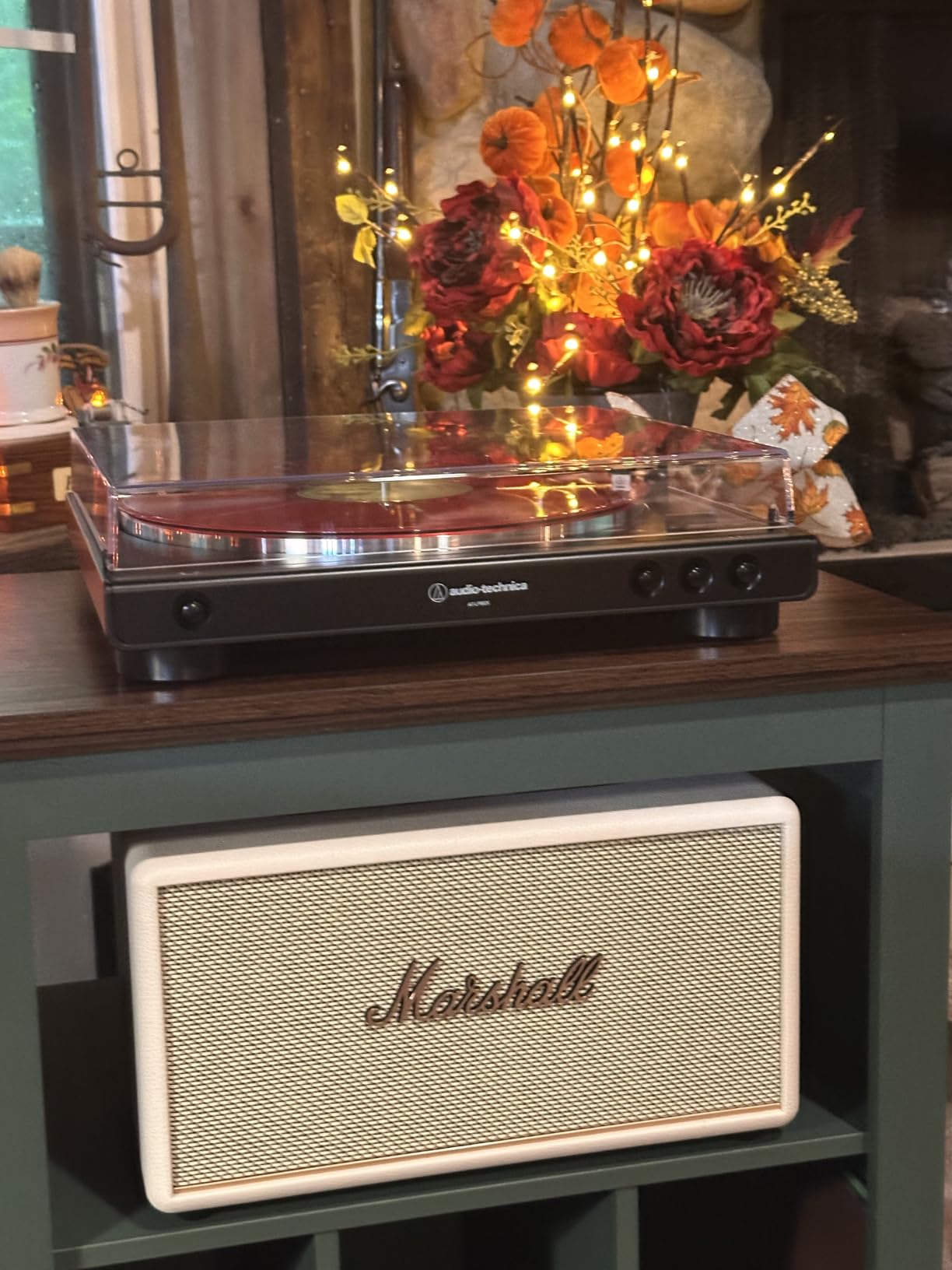
Owners describe the sound as clean and detailed, with several saying they struggled to tell it apart from digital on good speakers. That is fair for a belt-drive deck with a die-cast anti-resonance platter, and well ahead of entry-level belt-drive boxes.
The limits are honest. There is no Bluetooth, no USB and no 78 rpm. The chassis is mostly plastic, and the supplied felt mat is a static magnet that some owners replace with a silicone mat as a first mod.
Is the AT-LP60X good enough to stop upgrading at?
For most first-time buyers, yes. It holds speed, tracks reliably and has a cartridge whose stylus you can replace when it wears out, which is more than many cheaper decks offer.
It is not the ceiling for sound quality. The tonearm is fixed rather than adjustable, so tracking and anti-skate are not user settings, and worn records can defeat it.
Where this Audio-Technica will frustrate you
If your speakers are wireless, this deck cannot talk to them. You need an amplifier with a line input, or a Bluetooth receiver of your own.
If you plan to keep buying records, plan on a later cartridge step. Upgrading to a moving-coil design means replacing the whole cartridge, and the tonearm is not ideal for tracking those.
3. Audio-Technica AT-LP60XBT: Best for Wireless Listening Under 300
Audio-Technica AT-LP60XBT-RD Fully Automatic Belt-Drive Stereo Turntable, Red/Black, Bluetooth, Hi-Fi, 2 Speed
Bluetooth transmitter with aptX
Automatic 33 and 45 rpm
Die-cast platter
Dual RCA output cable
Pros
- No amplifier or speakers needed to start listening
- Automatic start
- stop and return protect records
- Clean
- warm sound well clear of suitcase players
- Works straight out of the box
- Runs wired and wireless at the same time
Cons
- Paper instructions send owners hunting for setup steps
- Bluetooth will not pair to some PCs and laptops
- No power button so it stays on until unplugged
- Bluetooth lags the RCA output
- Two speeds only
Everything we liked about the AT-LP60X is here, plus a Bluetooth transmitter with aptX. That addition changes who this deck is for, because it can send audio straight to wireless speakers or headphones with no amplifier in the chain.
Built-in speakers on cheap decks are usually the weak link, and pairing with a decent pair of wireless speakers bypasses that weakness instantly. The wired RCA output is still there, and both can run at once.
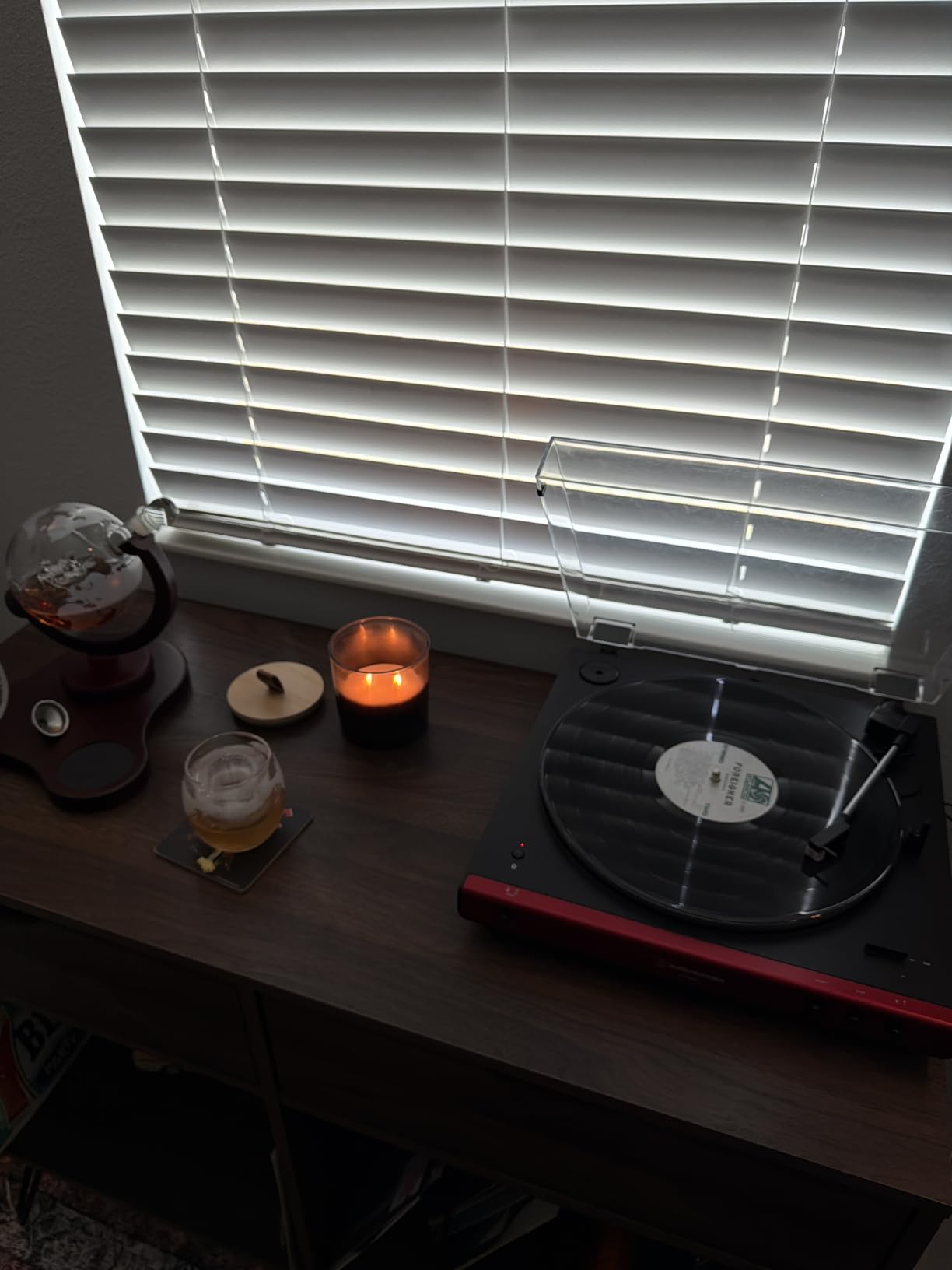
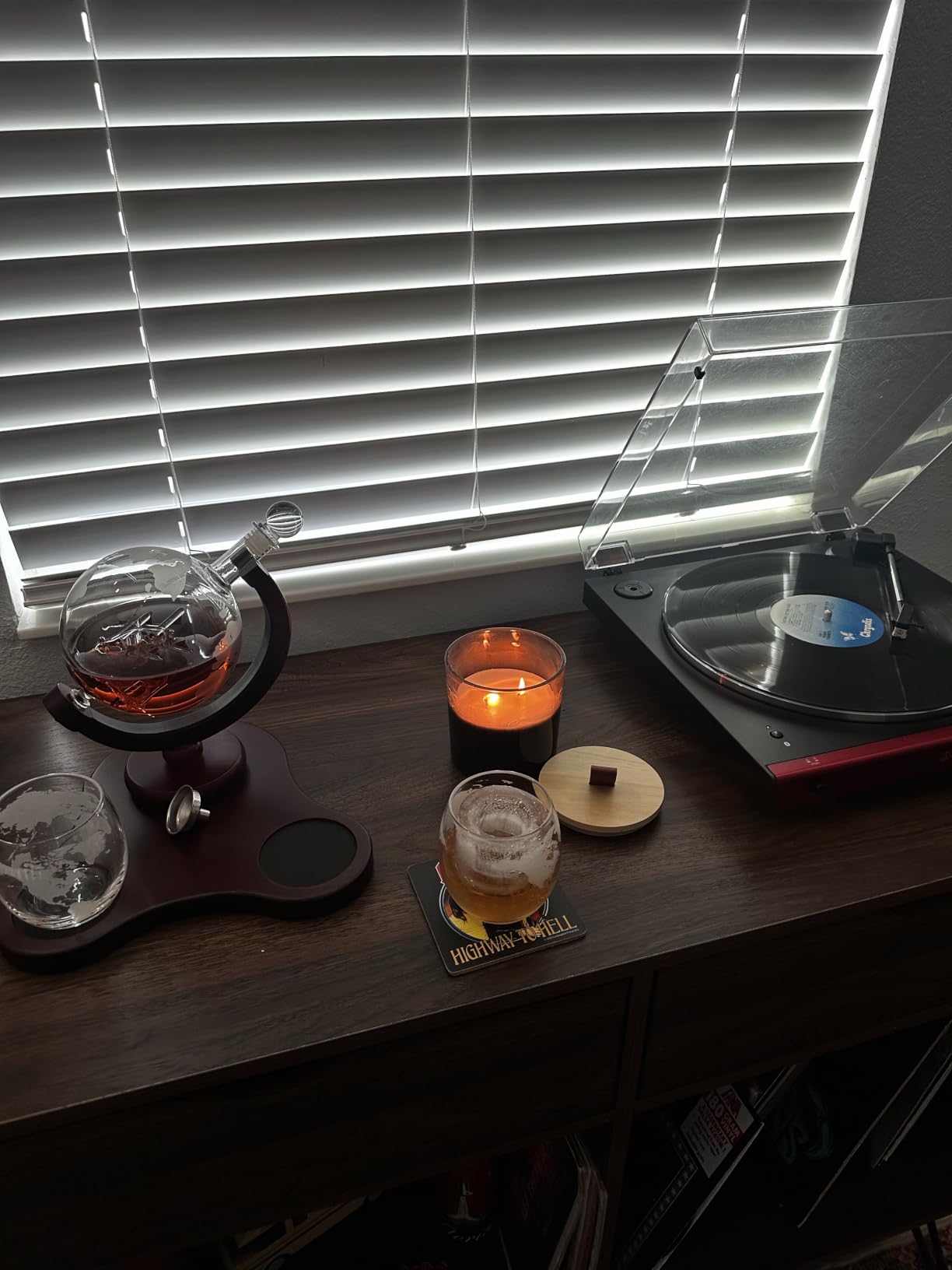
The sound reputation tracks the wired model closely. Owners describe it as clean and warm, and clearly a step above the suitcase players people buy first. Bluetooth is a convenience, not a sound upgrade, and forum consensus is that the RCA path still sounds better.
Complaints concern setup and pairing rather than sound. The instructions are thin, some computers and dual-direction stereo gear refuse to pair, and there is no power button, so the deck stays live until unplugged.
Who should buy the AT-LP60XBT
Buy it if your speakers are wireless, your flat is small, or you want one box that does everything without an amplifier. Gifting is an easy sell here, since there is no input to choose and no balance to set.
It also works as a second system for a room where running cables is impractical, because the simultaneous wired and wireless output makes that straightforward.
Where it is the wrong buy
Skip it if you care about 78 rpm records, since it plays 33 and 45 only. It is also not for you if you want a manual tonearm experience with pitch control.
If you already own good wired speakers with a phono-capable amplifier, the Bluetooth radio is a feature you will rarely switch on. Buy the wired model and keep the money.
4. 1byone Belt Drive with Built-in Speakers: Best for Small Spaces
1 BY ONE High Fidelity Belt Drive Turntable with Built-in Speakers
Belt drive at 33 and 45 rpm
Built-in speakers and amp
Adjustable counterweight
Replaceable stylus
Pros
- Integrated speakers that outperform typical all-in-ones
- Compact single-cabinet footprint
- Wood cabinet with metal accents looks good on display
- Audio-Technica stylus is easy to source
- Bluetooth range fine within a room
Cons
- Volume and speed controls sit under the dust cover
- No automatic arm return
- Two speeds only
- Limited Bluetooth range
- One report of the power button failing early
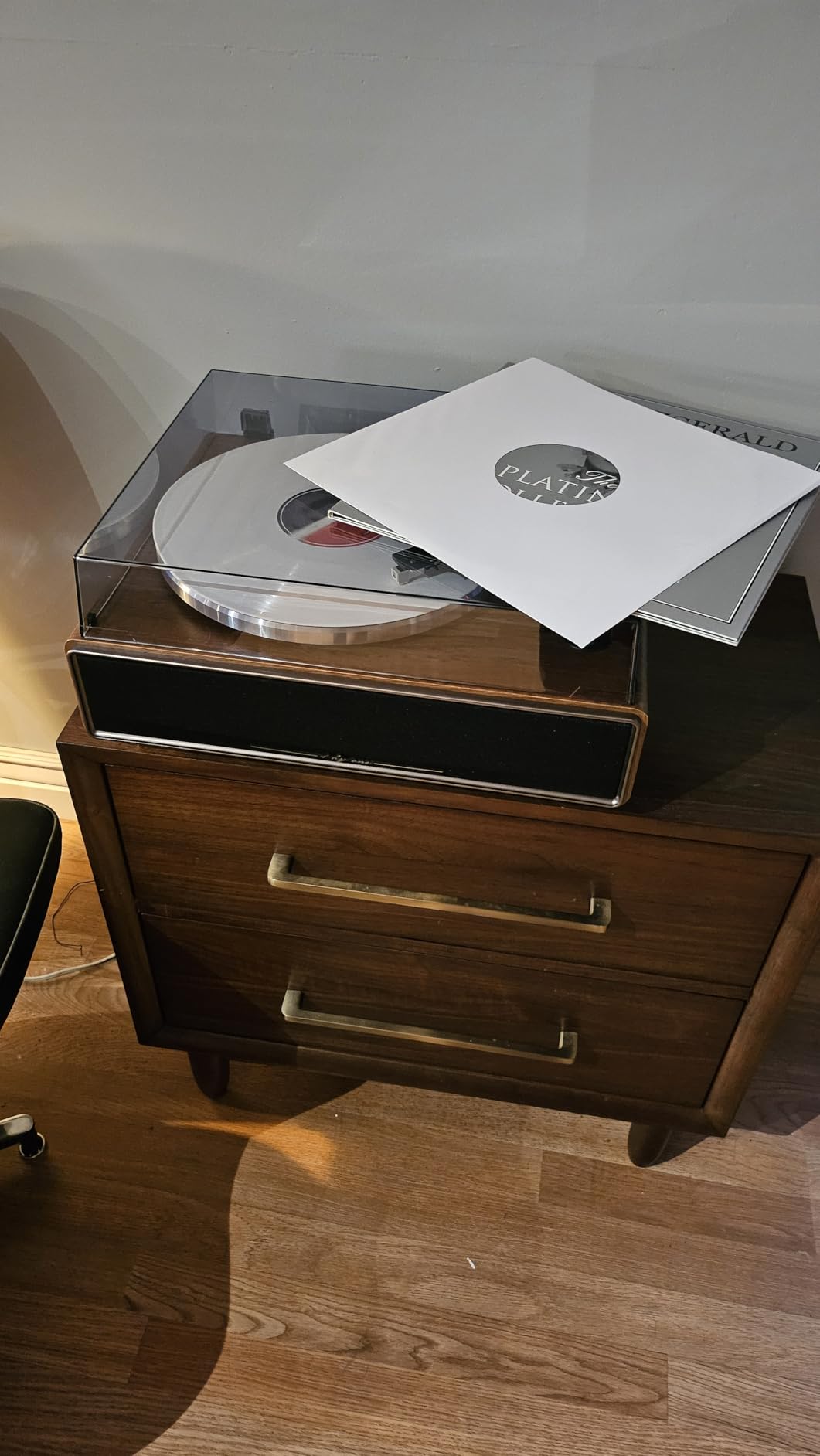
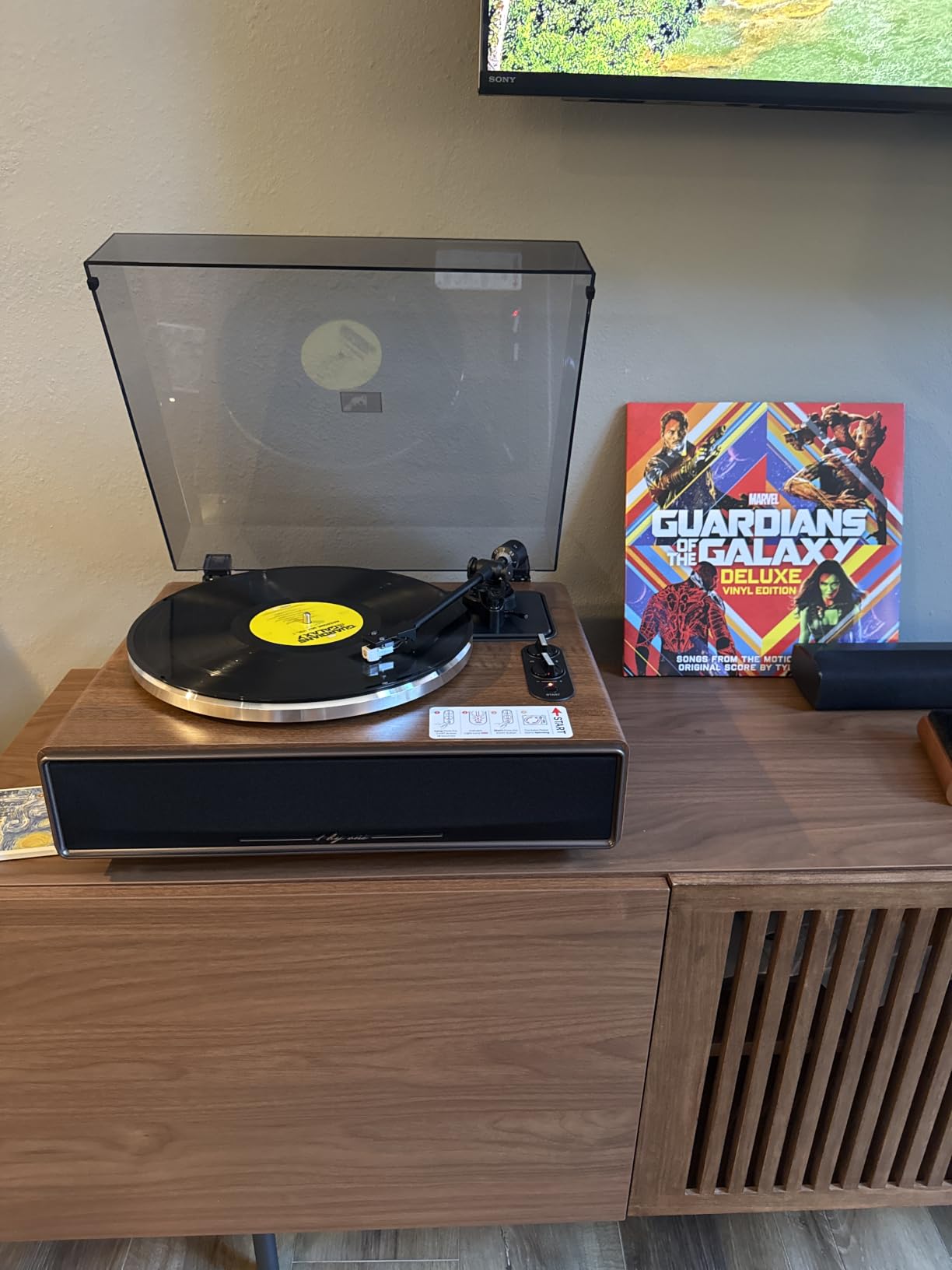
This is the interesting middle path between a plain deck and a full entertainment cabinet. It is a proper belt-drive turntable with a counterweighted arm, and it also carries built-in stereo speakers and an integrated amplifier in a single wooden box.
That matters in small apartments. A separate deck, amplifier and speaker pair needs surface area and cable runs, and this needs a shelf. Reviewers who own larger systems are candid that they did not expect the built-in speakers to sound this good.
The cartridge is a magnet type with an adjustable counterweight for channel balance, and it carries an Audio-Technica diamond-tipped replaceable stylus. That is the one genuinely upgradeable part, and replacement styli are easy to find.
The practicality complaints are consistent. Volume and speed controls sit under the dust cover, there is no automatic arm return so the stylus stays in the groove when a record ends, and Bluetooth drops out if you leave the room.
Is the built-in speaker quality good enough to skip an amplifier?
For casual listening in one room, yes, and owners with far more expensive systems say so. It is warm and clear, and it beats most all-in-one furniture decks.
It will not beat proper bookshelf speakers. If you care about detail at low volume or want real stereo separation, the RCA output lets you graduate later without buying a new deck.
Where it will disappoint you
If you play records and then walk out of the room, the lack of auto return is irritating, because you must lift the arm by hand. It is also two-speed only, with no 78 rpm support.
Do not buy it as a first deck for someone building a large collection. There is no USB, and the counterweight arrangement is not the precision setup a manual-arm enthusiast expects.
5. Fluance RT81: The Best-Sounding Turntable Under 300
Fluance RT81 Elite High Fidelity Vinyl Turntable Record Player with Audio Technica AT95E Cartridge, Belt Drive, Built-in Preamp, Adjustable Counterweight, High Mass MDF Wood Plinth – Walnut
AT95E elliptical stylus
S-type arm with counterweight
Switchable TI preamp
14.1 lb MDF plinth
Pros
- Warm
- detailed
- bassy sound reviewers credit with reviving their collection
- Switchable preamp connects straight to speakers or a network port
- Heavy MDF plinth and isolation feet damp vibration
- Balanced arm and counterweight allow cartridge upgrades
- Two-year warranty with responsive support
Cons
- Not fully automatic
- the arm never lifts or returns
- Tonearm balancing takes time to learn
- A few units needed trimpot speed adjustment
- Stock stylus can skip on worn records
- Not compatible with Ortofon replacement styli
The RT81 has the highest rating of any deck in this roundup, and it comes up most often when owners compare manual belt-drive models at the same price. It is also the one that requires you to actually learn how to use a turntable.
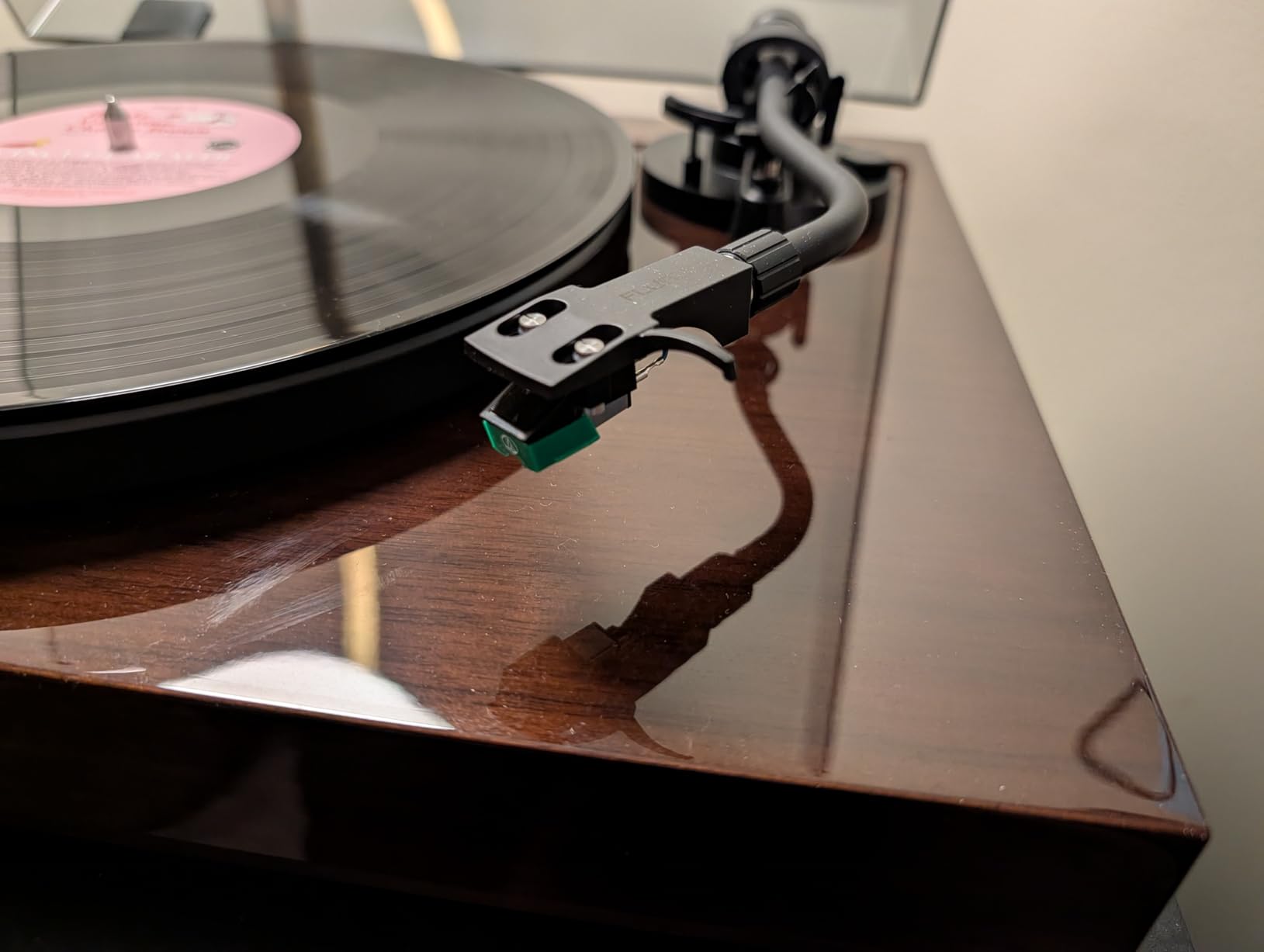
The hardware is what separates it: a high-mass MDF plinth with isolation feet, an aluminum platter, a rubber mat, and a balanced aluminum S-type tonearm with an adjustable counterweight. The Audio-Technica AT95E elliptical stylus is a genuine step above the basic diamonds on cheaper decks.
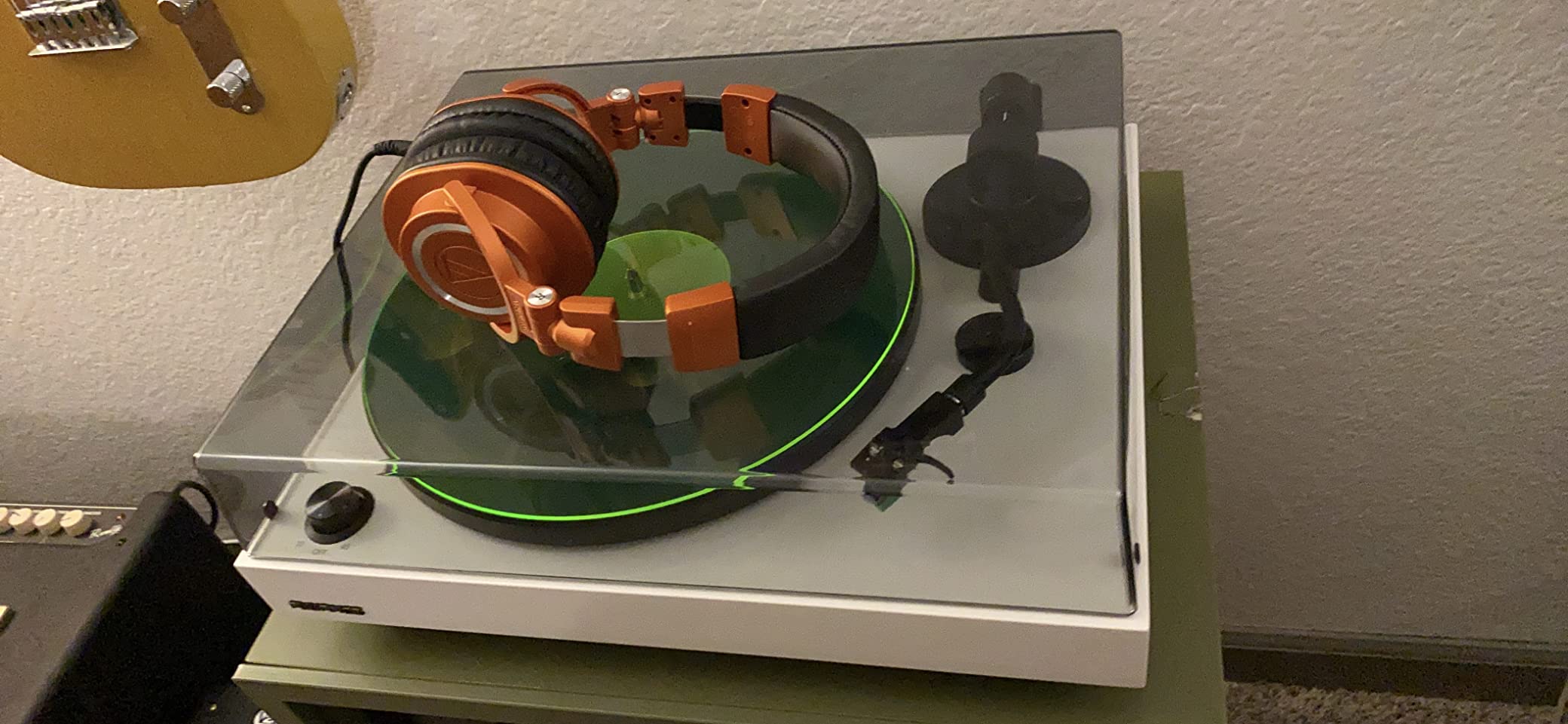
Owners describe the sound as warm, detailed and bassy, and several say it made them hear records differently. The switchable preamp with gold-plated RCA outputs and a ground terminal means you can run it into a modern amplifier, powered speakers or a network port without a separate box.
Setup is manual. You balance the tonearm, set tracking force, adjust anti-skate and drop the arm yourself. That is real work for a first record player, and in return the arm is calibrated well enough that a stylus upgrade later is a genuine option.
Is the RT81 worth the extra setup time?
If you plan to keep buying records for years, yes. Long-term owners on r/turntables point to this deck as the step up that stays relevant, and the two-year warranty supports that framing.
The arm will not lift or return automatically, so a record ending while you are not there means getting up to lift it. That is the trade for the more precise tonearm.
Where the RT81 is the wrong pick
It is the wrong gift for a complete beginner or a child. Without preamp knowledge, tonearm balancing and a manual arm return, a new owner will struggle and the benefit will not be obvious.
It is also a no-go if you plan to fit an Ortofon cartridge, since the stock AT95E is not compatible with Ortofon replacement styli. A small number of units also needed the underside trimpot adjusted for speed stability.
6. ANGELS HORN All-in-One: The Complete System for a Fresh Start
ANGELS HORN Vinyl Record Player with Speakers, Bluetooth Hi-Fi Turntable
Turntable, preamp and speakers
AT-3600L cartridge
Counterweight and pitch
Bluetooth 5.3
Pros
- Everything needed is in the box
- nothing extra to buy
- Bluetooth 5.3 switches easily between records and streaming
- AT-3600L cartridge gives clean warm sound
- Real manual turntable features with pitch control
- Line in and line out join a larger system
Cons
- Two speeds only
- with no 78 rpm support
- Large combined footprint for smaller rooms
- No automatic start
- stop or arm return
- Some plastic parts inside a wood-look cabinet
This one exists to solve a specific problem, and it solves it well. It is a belt-drive turntable, a phono preamp and a pair of bookshelf speakers in a single wood cabinet, playing at 33 and 45 rpm.
The appeal is that the turntable and speakers are designed to work together out of the box. Owners point out that no extra amplifier is needed, which is the exact trap most first-time buyers fall into with a bare deck.
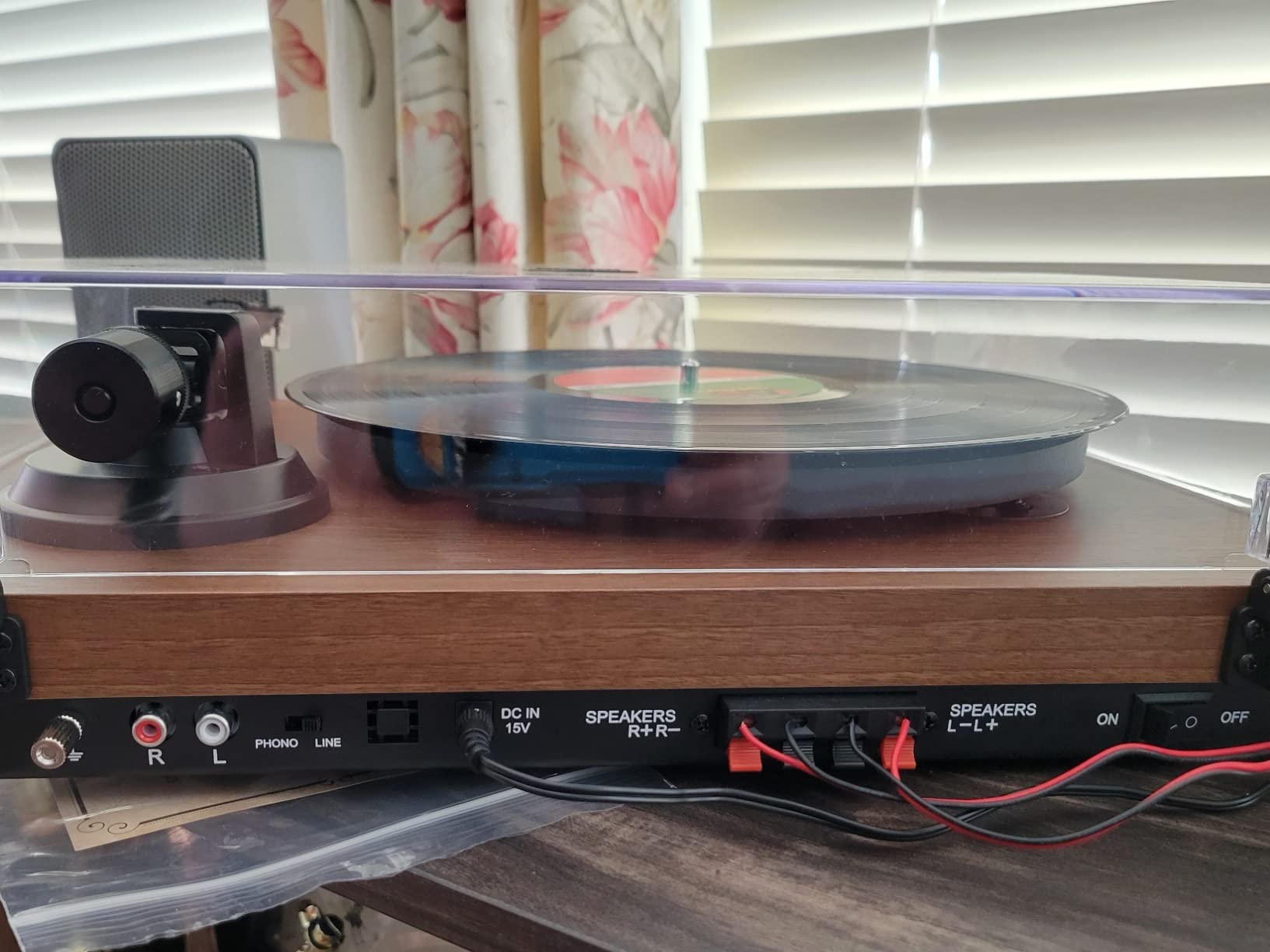
Underneath, it is closer to a real turntable than the other all-in-ones here. You get an adjustable counterweight, an anti-skating weight and variable pitch control, plus an Audio-Technica AT-3600L cartridge. Bluetooth 5.3 handles streaming, and RCA line in and out let it join something larger.
That cartridge gives it a cleaner, warmer voice than the typical all-in-one, and reviewers say it delivers sound they expected from a much more expensive separate chain. Set that expectation with the caveat that the speakers are the limiting part.
Who should buy the ANGELS HORN system
Buy it if you are starting from nothing and want records playing without buying a second box. It suits a student room, a bedroom setup, or a gift where the recipient has no equipment at all.
It also works for someone who wants to try vinyl cheaply before committing to separates, since the RCA outputs mean you can move up later.
Where the all-in-one approach falls short
The combined footprint is large for a small room, and there is no auto-stop or arm return, so the stylus stays down at the end of a record. It is also two-speed only.
If you already own any speakers, this is a downgrade for the same money. A single deck plus your existing system is almost always the better allocation of budget.
7. 1byone Fully Automatic All-in-One: Best for Sofa Listening
1 BY ONE Fully Automatic Record Player, All-in-One Vinyl Turntable
One-touch start with arm return
Quad speakers with DSP
Built-in preamp and amplifier
Three-year warranty
Pros
- Truly automatic
- one touch starts and the arm returns alone
- Quad speakers with DSP are loud and clean
- Remote with forward
- back
- repeat and volume
- No counterweight balancing needed
- RCA line out feeds a larger stereo
Cons
- Fixed DSP EQ with no user bass
- treble or pitch control
- Fixed AT-3600L cartridge cannot be upgraded
- Spoken mode announcements annoy some owners
- Platter runs slightly fast until the belt breaks in
- Built-in phono amp cannot be bypassed
This is the most fully automatic option here, and the automation is unusually complete. One touch starts playback, the record plays, and the tonearm returns to its rest by itself. Nothing needs balancing first.
The sound system is a quad arrangement, two 15W woofers and two 10W tweeters with DSP tuning, driven by a built-in amplifier and phono preamp. Reviewers who returned several other all-in-ones over poor sound end up recommending this one, which tells you how common that disappointment is.
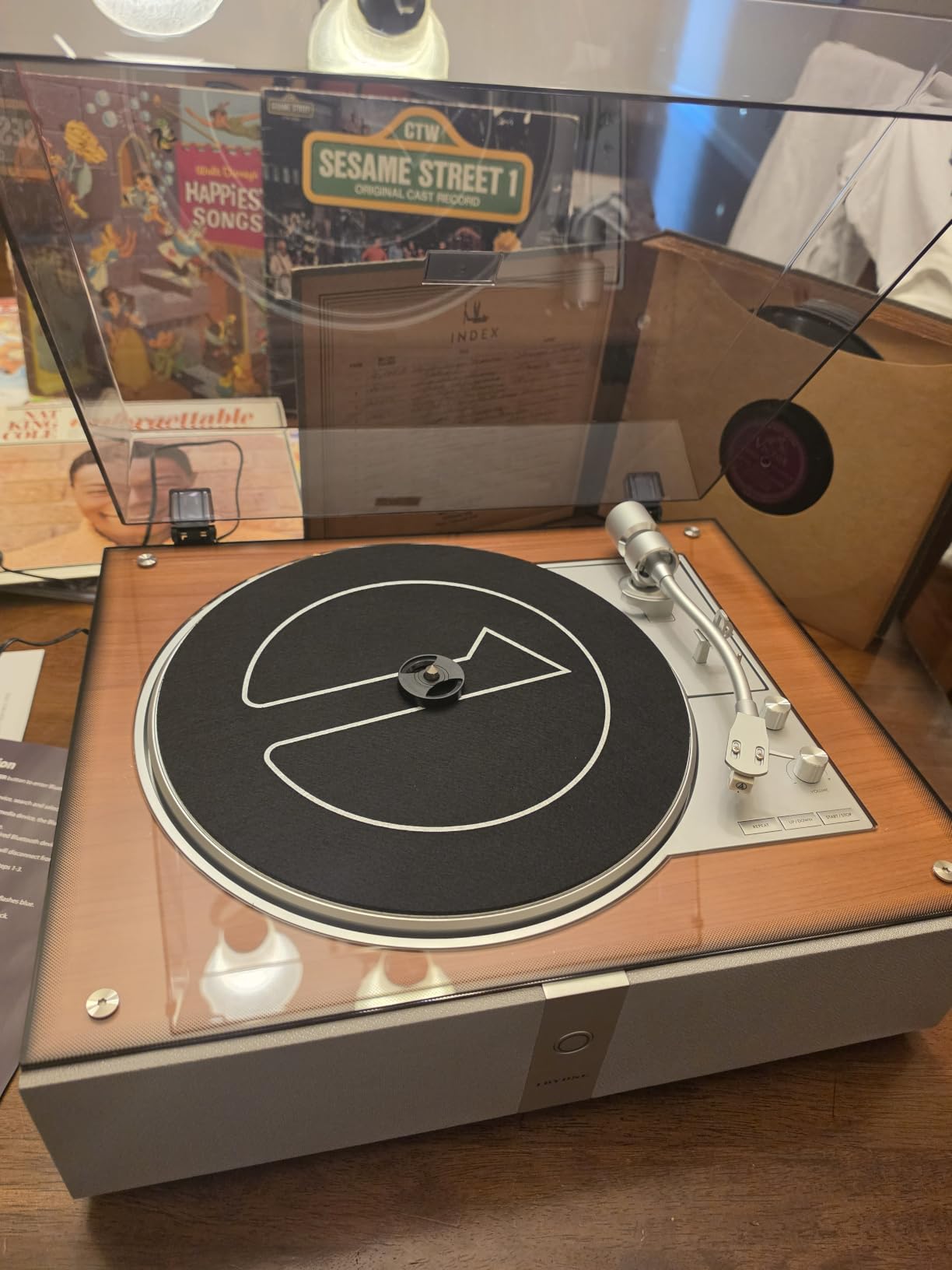
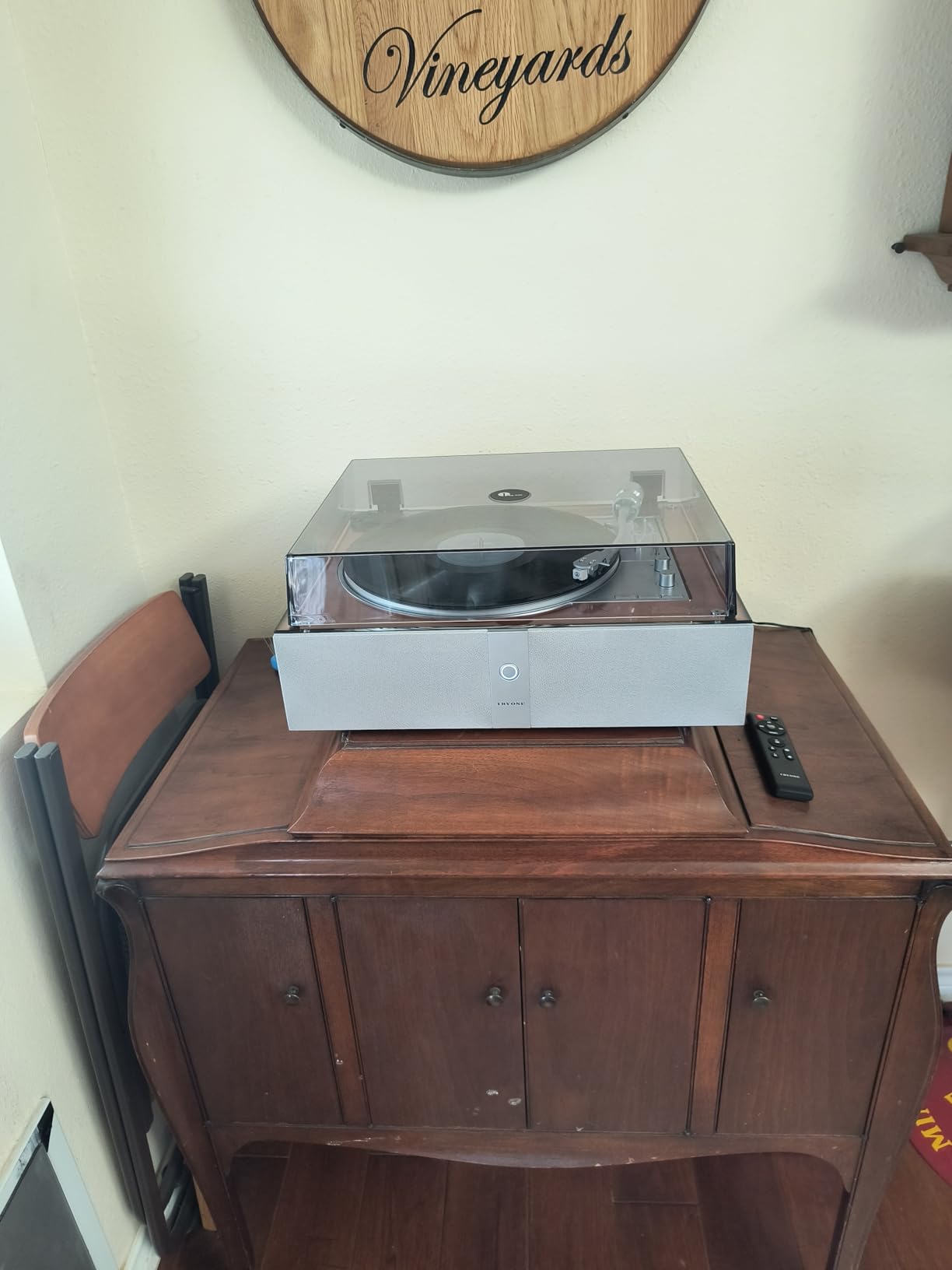
A remote control with forward, back, repeat and volume means you can operate it from the sofa, and the RCA line out lets it feed a larger stereo for a noticeable improvement when you are ready for one.
The trade-offs are specific. There is no user bass, treble or pitch control, only the fixed DSP setting. The AT-3600L cartridge is fixed. The mode announcements annoy some owners, and the platter runs slightly fast until the belt has broken in.
Is this the best turntable for a beginner who knows nothing?
It is a strong candidate, because the step that stops most new owners, balancing a tonearm, simply does not exist here. Add the auto return and the remote, and it is about as low-friction as vinyl gets.
It is also a good fit for older listeners or anyone with limited mobility, because nothing has to be lifted, aimed or set down by hand.
Where the 1byone automatic system falls short
Anyone who wants to fine-tune sound is stuck with the fixed DSP EQ. There is no bypass on the built-in phono amp, so you must not connect it to an amplifier that already has a phono input.
It is the wrong choice for a serious collector, since the cartridge cannot be upgraded and the arm is not adjustable. The forward and back controls are also not track-specific.
8. Fluance RT80: The Step-Up Platform Without the Top Price
Fluance RT80 Classic High Fidelity Vinyl Turntable Record Player with Audio Technica AT91 Cartridge, Belt Drive, Built-in Preamp, Adjustable Counterweight, Solid Wood Plinth – Piano Black
AT91 diamond stylus
S-type arm with counterweight
Switchable preamp
MDF plinth with feet
Pros
- Warm
- high-fidelity sound from a switchable preamp
- Balanced arm and counterweight allow cartridge swaps
- MDF plinth with feet reduces vibration transfer
- Gold-plated RCA and ground terminal suit both preamp routes
- Two-year parts and labor warranty
Cons
- Manual operation only
- Requires tonearm balancing at setup
- No Bluetooth and no 78 rpm support
- AT91 cartridge is a step down from the RT81's AT95E
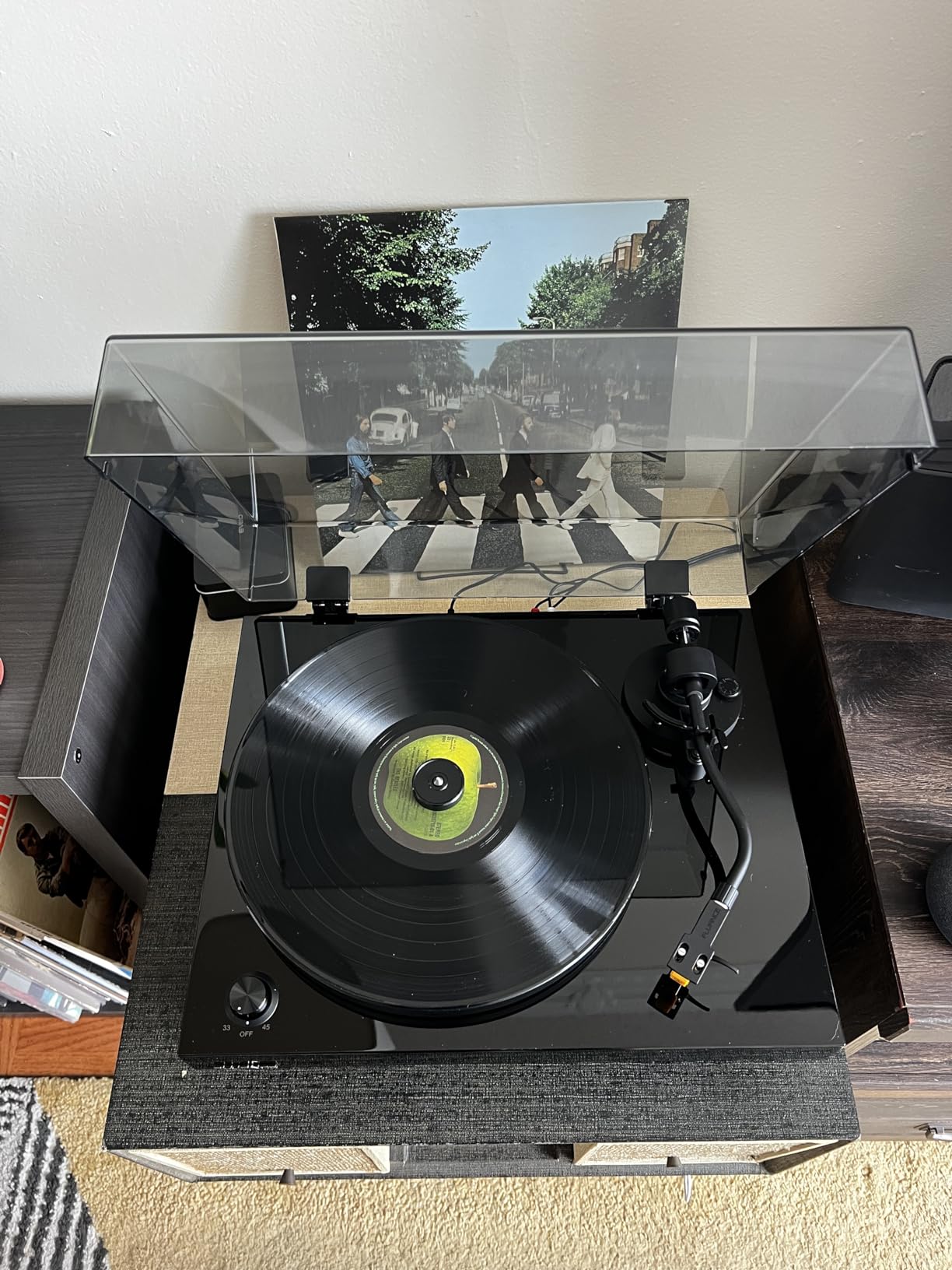
The RT80 is Fluance’s route into a proper manual belt-drive deck, and it covers the two things beginners usually compromise on: a built-in preamp you can switch, and an adjustable counterweight.
Mechanically it is close to the RT81, with an MDF wood plinth on isolation feet, an aluminum platter, a felt mat and a balanced aluminum S-type tonearm. The difference is the fitted cartridge, where you get an AT91 rather than the RT81’s AT95E.
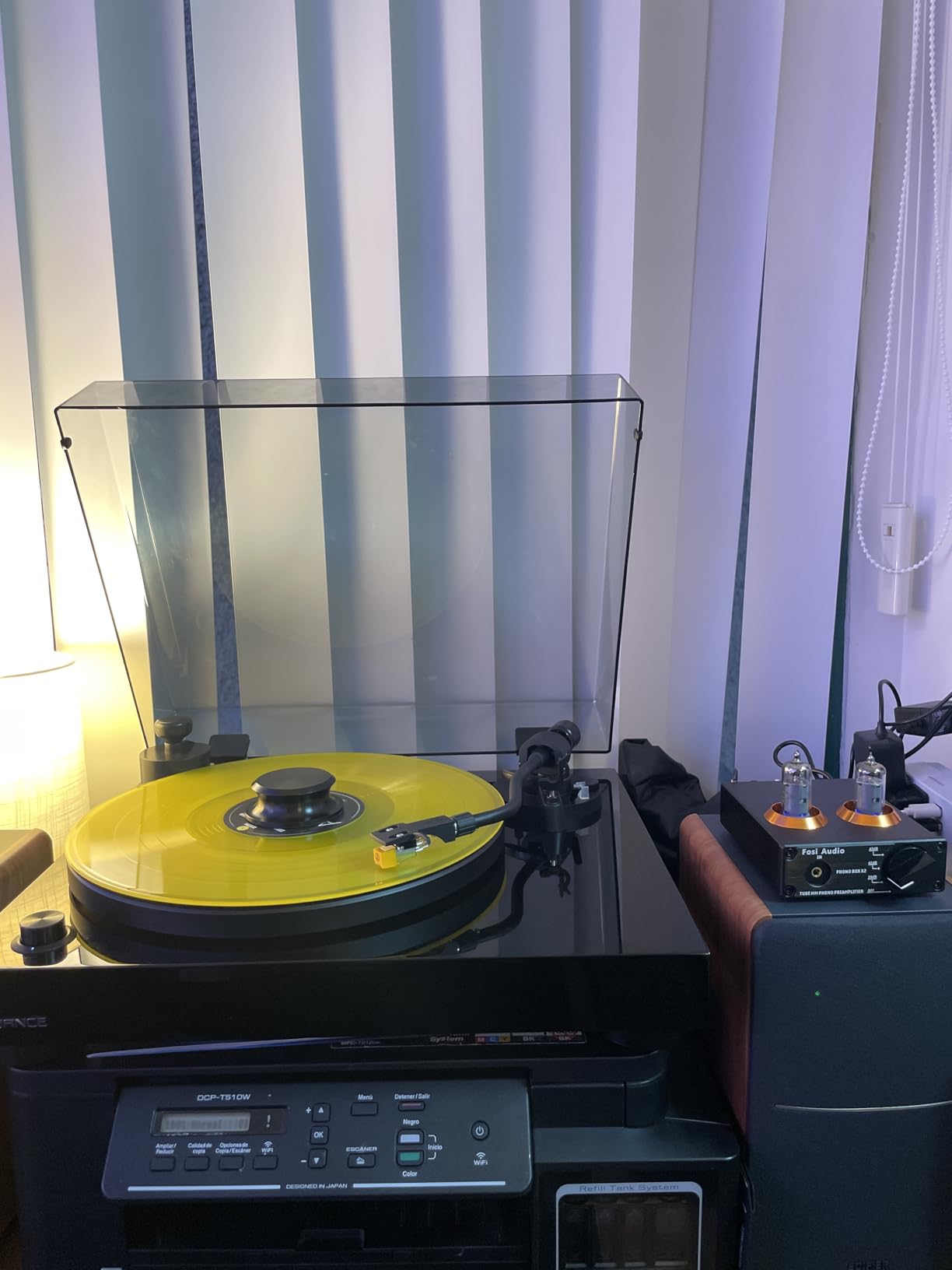
That cartridge difference is audible, and it is the reason to step up rather than sideways. Owners still describe the sound as warm and high fidelity, just with less detail and treble extension than the deck above it.
The switchable preamp, gold-plated RCA outputs and a ground terminal make hookup flexible. You can run it into speakers now and move to an external preamp later without changing anything but a switch position.
Who should choose the RT80 over the RT81
Choose it if you want the manual belt-drive platform and the adjustable counterweight but would rather keep the budget for speakers. It is the same handling experience at a lower tier of cartridge.
It also suits buyers who already have an amplifier with a phono input and just want a solid, isolated deck with the option to bypass the internal stage.
Where the RT80 falls short
It is manual only, so the arm never lifts or returns, and setup requires balancing the tonearm. Anyone new to records will find that a real hurdle.
There is no Bluetooth and no 78 rpm support. If you want either, this is the wrong deck, and if you can stretch, the RT81’s cartridge is the better long-term bet.
9. Audio-Technica AT-LP70X: Best Cartridge Upgrade Path Under 300
Audio-Technica AT-LP70X Automatic Turntable (Black/Bronze)
Automatic with tonearm lock
AT-VM95C VM95 cartridge
Switchable preamp
Damped three-piece chassis
Pros
- Automatic start
- stop and return are safe for a new player
- VM95 cartridge platform makes stylus upgrades simple
- Built-in preamp connects straight to powered speakers
- Two-year warranty with fast replacement service
Cons
- Lightweight mostly plastic chassis
- No anti-skate or tracking adjustment
- Some owners reported progressive distortion on louder passages
- No Bluetooth and only two speeds
- RCA cable not included for some setups
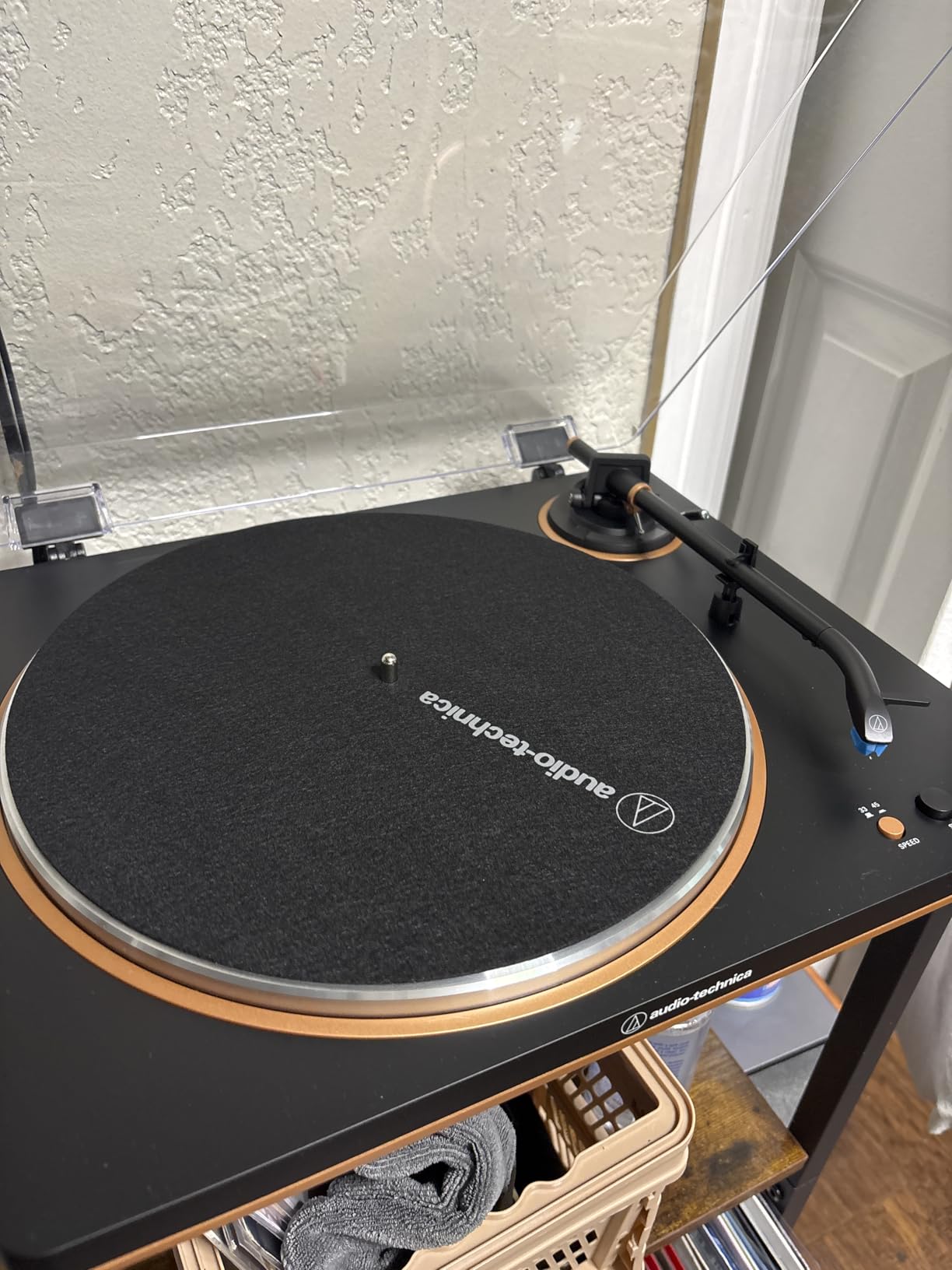
The AT-LP70X takes what the LP60X does well and fixes the one decision that matters later. It ships with an AT-VM95C cartridge, the entry point of Audio-Technica’s VM95 stylus family, so you can upgrade the needle without replacing the cartridge body.
It is also automatic from start to return, and it has a tonearm lock that parks the arm safely, a thoughtful detail for a busy room or a household with children.
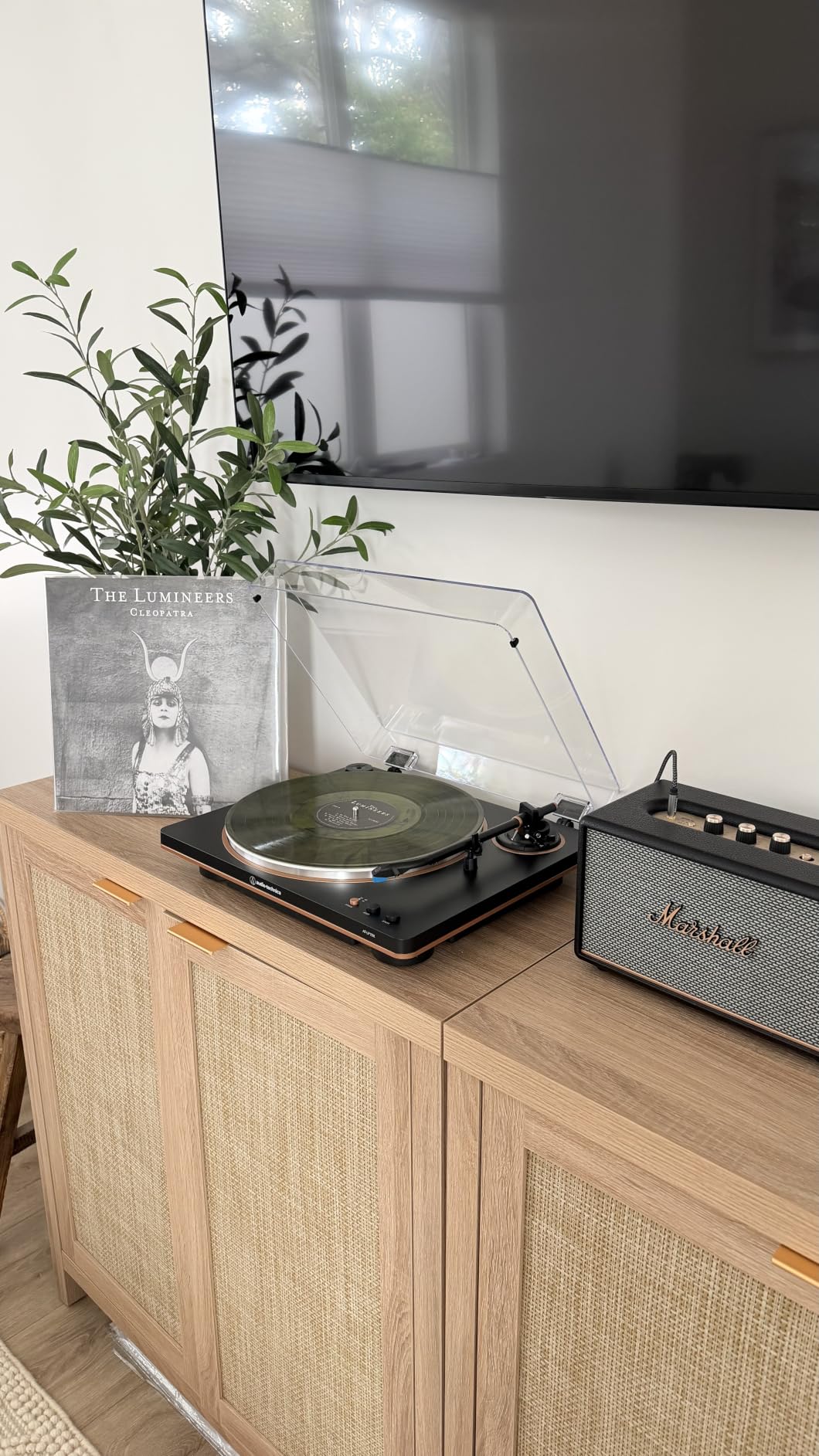
Because the VM95 platform has a long catalogue of replacement styli, the first upgrade you are likely to make costs very little and moves the sound in a noticeable direction. That is a cheaper path to better audio than buying a whole new deck later.
The criticisms centre on the mostly plastic chassis and on the arm, which offers no anti-skate or tracking adjustment. A minority of owners reported distortion on loud passages that worsened over time, and the two-year warranty replaced those units.
Is the VM95 upgrade path worth choosing this deck?
Yes, if you are relatively new and know you will still be buying records in a year. Stepping the stylus up in small increments is why many people end up here instead of a sealed all-in-one.
It is a good middle ground between the plastic AT-LP60X and the manual Fluance decks, giving you automation and a better chassis without a counterweight to balance.
Where the AT-LP70X is the wrong buy
Records that skip will not be rescued here, because there is no anti-skate or tracking adjustment. If your collection includes worn pressings, a weighted manual arm is a better fit.
Some speaker setups also need an RCA cable that is not included, an easy fix but an annoying surprise. There is no Bluetooth and only two speeds.
10. Victrola Century: Best for Collectors of 78 RPM Records
Victrola Century – 6-in-1 Bluetooth Record Player – Walnut
Vinyl, CD, cassette, Bluetooth
Three-speed drive with 78 rpm
VINYLSTREAM output
Built-in speakers
Pros
- Plays vinyl
- CD
- cassette
- 78 rpm and Bluetooth in one cabinet
- VINYLSTREAM output sends records to wireless speakers or headphones
- Built-in speakers are clear and room-filling
- Mid-century styling that suits a living room
- Simple setup with RCA output for better speakers
Cons
- No adjustable counterweight or anti-skate
- so some records skip constantly
- Built-in speakers lack low end at higher volume
- No remote control included
- Limited warranty
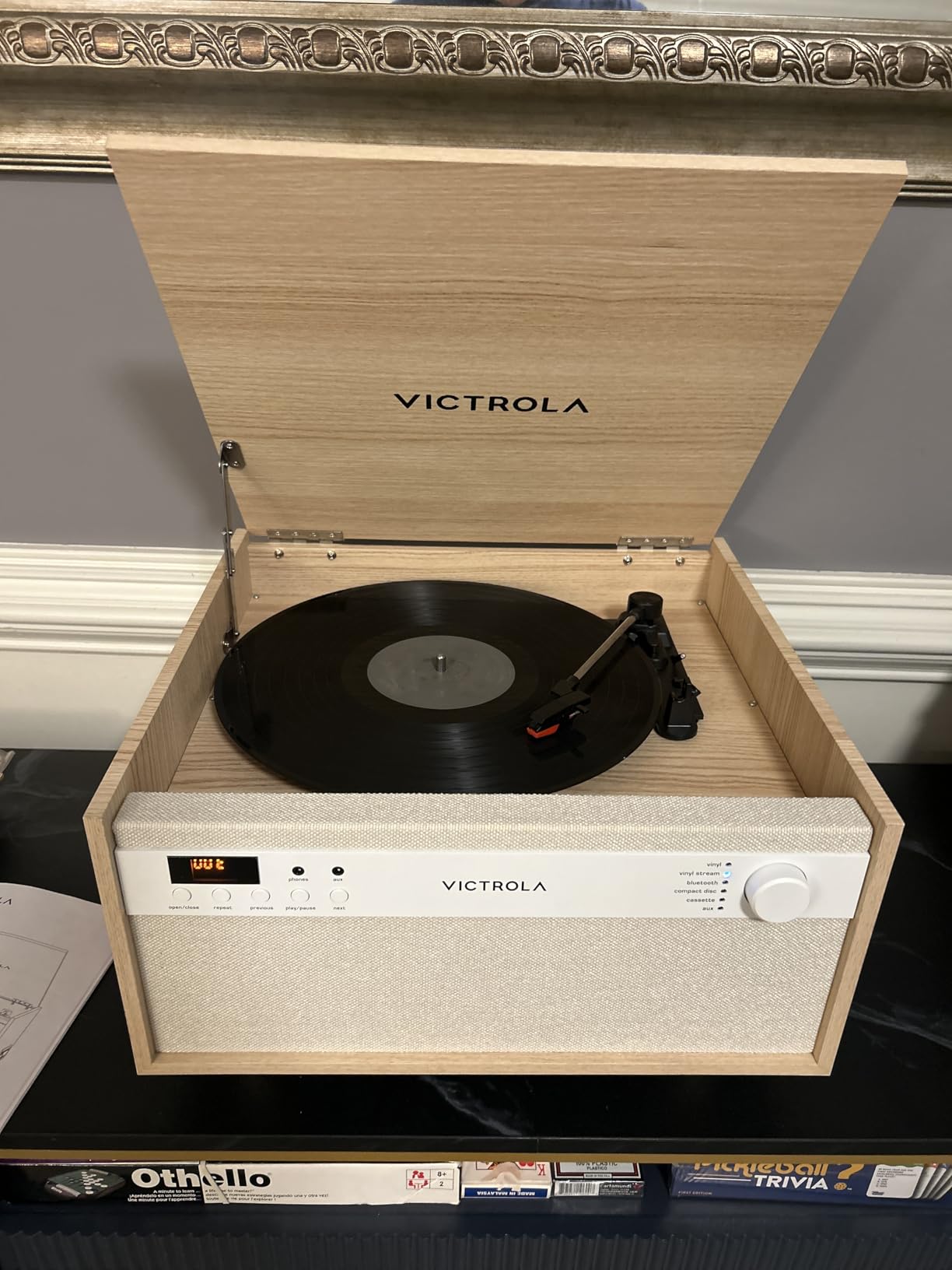
This is the model to look at if 78 rpm records are part of your collection. The three-speed belt drive covers 33, 45 and 78 rpm, and the cabinet also handles CD, cassette, Bluetooth streaming and AUX input.
The feature that separates it from the other Victrola here is VINYLSTREAM, a Bluetooth output that sends the playing record to wireless speakers or headphones. That is different from Bluetooth input, and it is useful if your speakers are wireless.
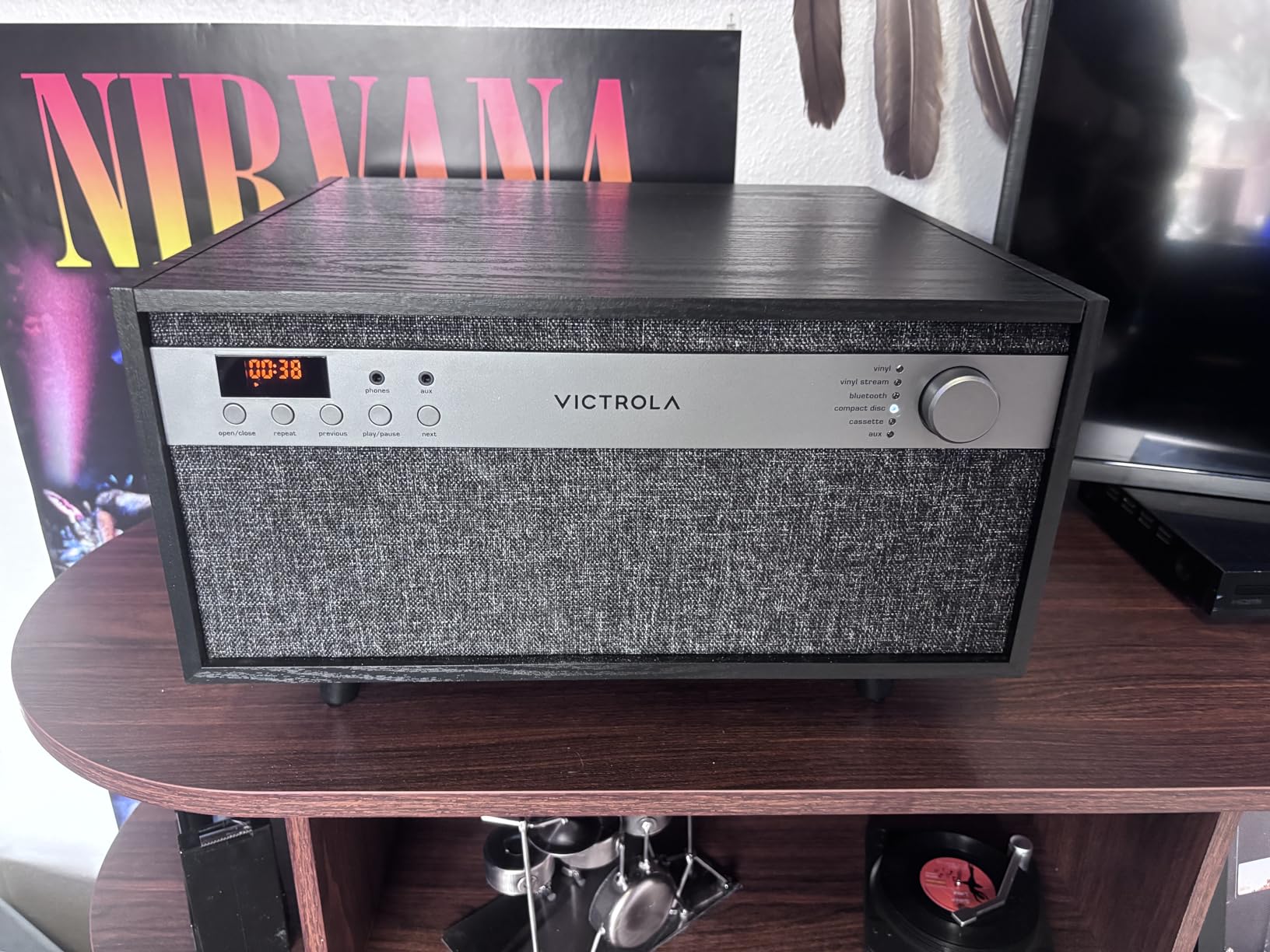
Sound from the built-in custom-tuned speakers is clear and room-filling for casual listening, and the mid-century styling matters if the deck lives in a living room. RCA line output is there for better external speakers when you are ready.
The significant criticism comes from owners whose records skip repeatedly, and the cause is the arm. With no counterweight and no anti-skate, stylus pressure is fixed, so worn or warped pressings will not track. The speakers also run out of low end at higher volume.
Who should buy the Victrola Century
It suits people with a mixed-format collection who want one box, and anyone whose 78s would otherwise gather dust. If you own wireless speakers, VINYLSTREAM makes it the most flexible all-in-one here.
It is also a straightforward choice for casual listening in a bedroom or living room where convenience matters more than system design.
Where it is the wrong choice
Do not buy it if you own a lot of well-loved records, because fixed tonearm pressure is the most common reason owners report skipping. A weighted arm solves that properly.
There is no remote control and the warranty is limited, so if you want similar styling with a more capable arm, the Audio-Technica models are the safer route.
11. Teac TN-180BT: Three Speeds, Auto-Return and a Phono EQ
Teac TN-180BT-B 3-Speed Analog Turntable with Phono EQ and Bluetooth (Black)
Three-speed belt drive 33, 45, 78 rpm
Built-in phono EQ
Bluetooth transmitter
Auto-return tonearm
Pros
- Three-speed belt drive covers 33
- 45 and 78 rpm
- Built-in phono EQ with both phono and line outputs
- Bluetooth transmitter sends audio to wireless speakers
- Auto-return tonearm lifts and parks the arm
- High-density MDF cabinet reduces resonance
Cons
- Stock MM cartridge is a basic moving-magnet unit
- No pitch control for fine speed correction
- Bluetooth is transmit-only so it cannot receive streamed music
- AC adapter power supply rather than internal
The TN-180BT covers more formats than most decks in this bracket while still behaving like a real turntable. It plays 33, 45 and 78 rpm, and its auto-return tonearm lifts and parks the arm when a record ends.
It also carries a built-in phono equalising amplifier with both phono and line outputs, which is more flexibility than most competitors offer. That single switch is what lets it work with an amp, a speaker system or a later upgrade.
Owners also note that the switchable phono stage means the deck can feed an amplifier that already has a phono input, by running it in phono mode rather than line mode. That is a small detail, and it removes a common first-day wiring mistake.
The cabinet is high-density MDF rather than thin plastic, and at nearly 5 kg it has a damped, substantial feel that reviewers mention. The included MM cartridge, dust cover, rubber mat and EP adapter cover the basics without extra purchases.
Criticism is limited and consistent. The pre-installed moving-magnet cartridge is basic with little upgrade guidance, there is no pitch control, and the Bluetooth is transmit-only, so it cannot receive streamed music.
Who is the TN-180BT for
It suits someone who wants 78 rpm support and an auto-return without moving up into a manual counterweighted arm. The auto-return also makes it safer for a shared household than a purely manual deck.
If you have wireless speakers, the Bluetooth transmitter covers the output side, and the dual phono and line outputs cover every wired arrangement you are likely to meet.
Where it falls short
It is not a good platform for cartridge upgrades, because the supplied moving-magnet unit comes with limited guidance and the tonearm is not adjustable like a counterweighted one.
If you want Bluetooth input for streaming from a phone, this is the wrong choice, since the radio only transmits. And if you want pitch control to correct records cut slightly fast, it does not have it.
12. Electrohome Montrose RR35: Budget Pick With a Surprising Cartridge
Electrohome Montrose Vinyl Record Player 2-Speed Belt-Drive Turntable, with Audio-Technica Stylus, Speed Control Motor, Built-in Preamp, Wood Plinth, Anti-resonant Platter, Auto-Stop (RR35)
2-speed belt drive with speed control
AT3600L removable headshell
Switchable preamp
7.2 lb
Pros
- Audio-Technica stylus gives clean sound well beyond its class
- Counterweight and anti-resonant platter reduce skipping
- Bypassable built-in preamp allows a later upgrade
- Optical speed control holds 33 and 45 rpm accurately
- Wood plinth with damping feet reduces vibration
Cons
- No speakers included
- so an amplifier or powered speakers are required
- No headphone jack
- Conical stylus where an elliptical is the easy upgrade
- A persistent startup hum reported on a minority of units
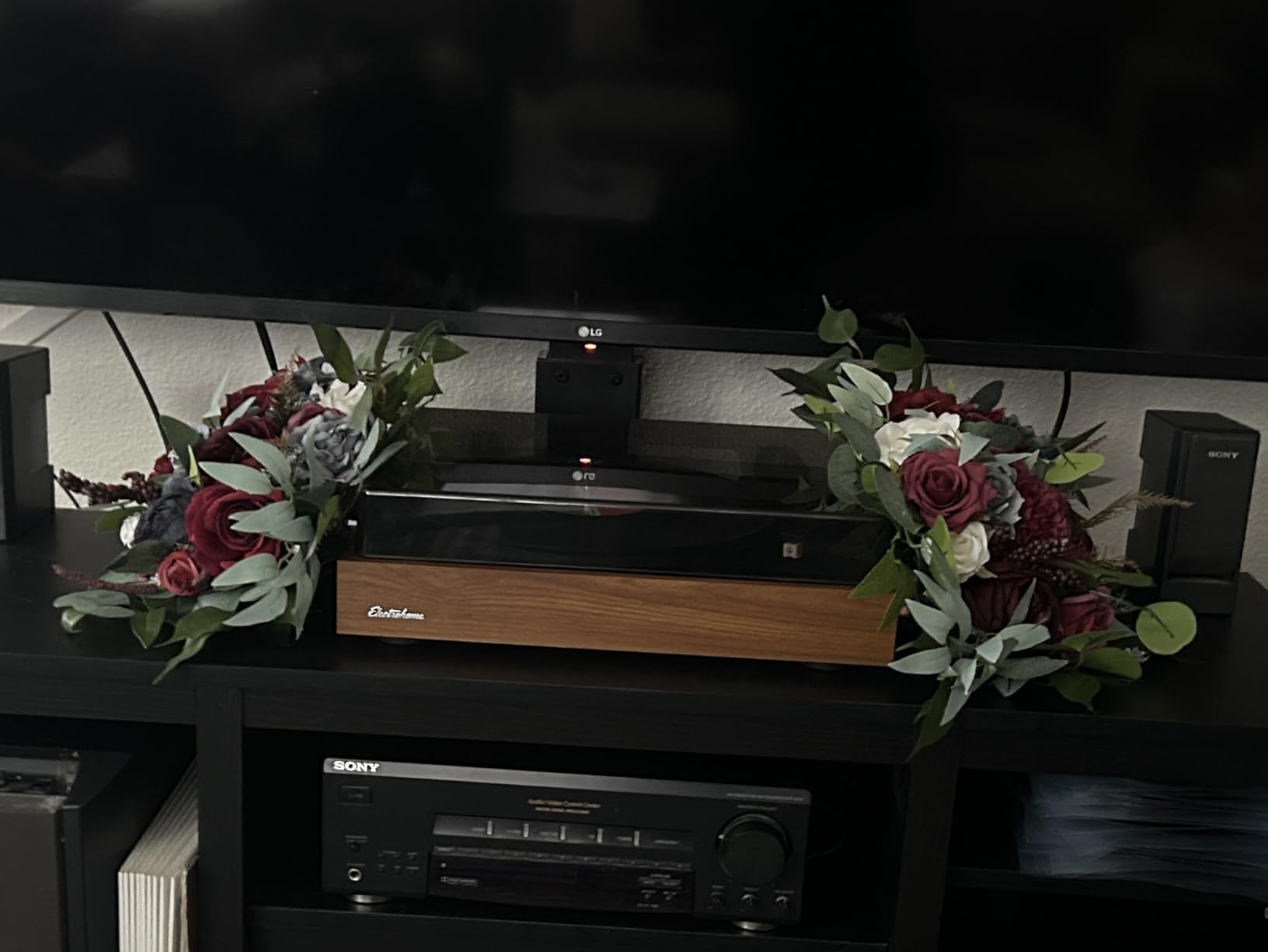
The Montrose is the cheapest deck here and the one that most often surprises owners. It is a genuine two-speed belt drive with a wood plinth, an anti-resonant platter, damping feet and an adjustable counterweight on an arm separate from the platter.
Owners say it punches above its price, and the reason is the Audio-Technica AT3600L cartridge in a removable headshell plus the counterweighted arm. That combination reduces skipping even at higher volume, which is not something a budget deck normally manages.
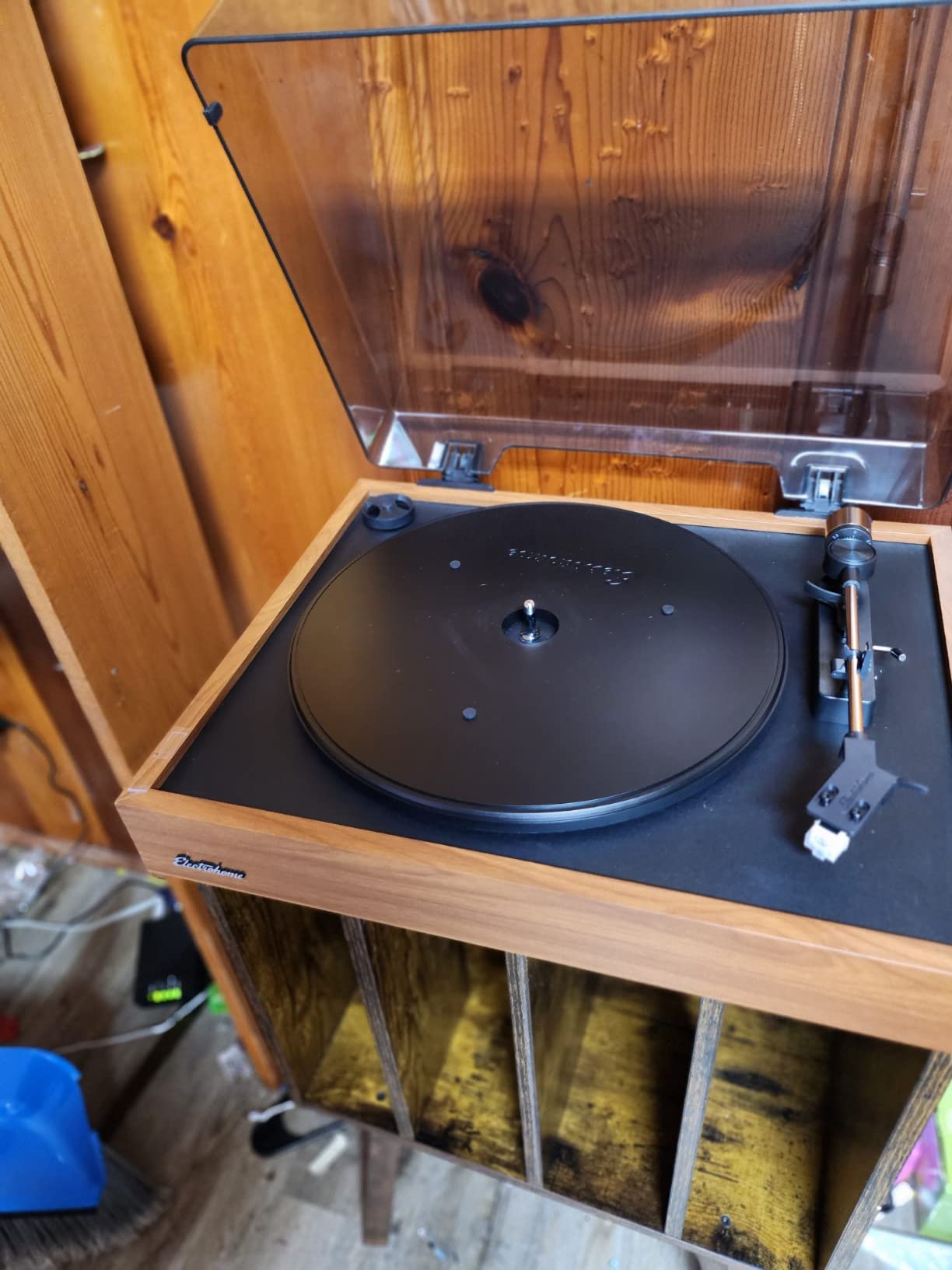
Two details make it friendlier than it looks. The built-in preamp is switchable and can be bypassed, so you can start with your existing amplifier and move to an external preamp later. The optical speed control holds 33 and 45 rpm accurately.
The honest limitation is that no speakers are included at all. You need a powered speaker system or an amplifier with a phono input, and there is no headphone jack. A minority of owners also reported a startup hum or a skating tonearm.
Is this the right budget turntable for you
It is right if you already own speakers and want the largest share of a small budget spent on the deck itself, rather than on an all-in-one cabinet that plays records and little else.
The bypassable preamp makes it a good first step too, since you are not locked into the internal electronics if you outgrow them.
Where the Montrose is the wrong buy
Do not buy it expecting a complete system. The absence of speakers and any headphone output means there is a real chance you have nothing to play it through on day one.
The supplied cartridge uses a conical stylus, which is the first thing to upgrade, and there is no Bluetooth or USB output at all. Expect to add a cable or a preamp to the budget.
Do You Need a Phono Preamp? The 300-Dollar Budget Question
Only if your amplifier or powered speakers lack a PHONO input. Look at the back panel: a PHONO input is a pair of RCA sockets labelled PHONO, and a deck connected to a line input instead will sound very quiet and thin.
A turntable produces a signal measured in millivolts. A phono preamp applies the RIAA equalisation curve and brings that up to line level, without which the bass is missing and the treble harsh. Decks with a switchable built-in preamp do this for you and can usually be bypassed.
This is where the real budget trap sits. Threads on r/turntables and forums.stevehoffman.tv repeat the same story of a deck bought first and a preamp added later. Check your system before you order, and if you own nothing at all, choose a deck with a built-in preamp such as the Victrola Quincy, the AT-LP60X or the Fluance RT81.
Our vinyl beginner guide covers the rest of the chain, including what a turntable cannot do on its own.
Belt Drive vs Direct Drive Under 300 Dollars
Belt drive is the better default for most people. A rubber belt decouples the motor from the platter, which reduces motor noise and improves speed stability, and it is what you find on the AT-LP60X, the Fluance RT80 and RT81, and the Victrola units here.
Direct drive spins the platter from the motor itself. There is no belt to replace, startup is instant, and on this generation of automatic decks the motor also handles speed control, which is why those decks can start and stop alone.
Neither is universally better. Direct drive wins on convenience, belt drive on isolation and refinement. Pick belt drive if you value sound quality and can handle manual arming, and direct drive if you want it to just play.
Bluetooth on a Turntable: What You Gain and What You Lose
You gain the ability to play records through wireless speakers or headphones with no amplifier in the chain. In this roundup the AT-LP60XBT, the 1byone and Victrola units, the ANGELS HORN and the Teac all cover that side of the market.
You lose signal quality. Bluetooth compresses the audio before it leaves the turntable, so the record goes through an extra lossy step that no amplifier quality reverses. Wired RCA out against Bluetooth out is not a close comparison, and wired wins.
Treat Bluetooth as a convenience feature, not an upgrade. Forum consensus in the vinyl communities is the same, and it is worth paying less for a wired model if you already own good speakers.
Cartridges: The Cheapest Sound Upgrade in This Bracket
The cartridge is usually the limiting component at this level, which is why two of our picks are chosen for cartridge reasons rather than features. Audio-Technica’s VM95 platform on the AT-LP70X is the clearest upgrade path, because the whole styli family fits the same body.
Elsewhere the fitted cartridges are Audio-Technica units too: the AT95E on the Fluance RT81, the AT91 on the RT80, and the AT3600L on the ANGELS HORN and Electrohome Montrose. Replacement styli for them are easy to source.
One practical warning. The Fluance cartridges are not compatible with Ortofon replacement styli, so check the compatibility list before assuming a generic stylus will fit. The beginner turntable guide covers moving magnet and moving coil in more depth.
Matching Your Turntable to Your Speakers
A turntable does not make sound on its own, and the deck is rarely the weak link. Cheap built-in speakers are the more common weak link, which is why all-in-one decks tend to sound worse than the same turntable wired to something better.
If you own nothing, count on needing speakers as a second purchase, and choose that purchase first if you can. Our picks for the pairing are in the bookshelf speakers for turntables guide.
If you already own powered speakers, check whether they have a PHONO input. If they do, you can use almost any deck here. If they only have line inputs, you need either a deck with a built-in preamp or a small outboard preamp.
Turntable Setup Basics: Tracking Force, Anti-Skate and Record Cleaning
For a fully automatic deck there is almost nothing to do. Press start, choose an input, and set the tracking force to the figure printed on the supplied stylus if you want to adjust it at all.
For a manual counterweighted arm, the sequence matters. Float the arm at rest, turn the counterweight until the arm sits at zero, then set the tracking force with the dial and set anti-skate to match it. Fifteen minutes is enough to make the manual decks here behave predictably.
Finally, clean your records. A soft brush removes dust between plays, and cleaning fluid removes the fingerprints and static that make an otherwise clean stylus skip. It is the cheapest improvement available and it protects the cartridge you just paid for.
Frequently Asked Questions
What is the best quality, affordable turntable under 300 dollars?
For most people the Victrola Quincy is the best affordable turntable in this bracket because it plays records immediately with no amplifier, speakers or preamp required. If you already own a system with a phono input, the Audio-Technica AT-LP60X is the better long-term value, and the Fluance RT81 is the best-sounding manual belt-drive deck here.
What is the best turntable cartridge under 300 dollars?
The Audio-Technica AT-VM95C fitted to the AT-LP70X is the strongest upgrade path, because every stylus in the VM95 family fits the same cartridge body. The Fluance RT81 ships with the AT95E elliptical, which is the best-sounding cartridge fitted to any deck in this bracket, while the Fluance RT80 uses the step-down AT91.
Do I need a separate phono preamp?
Only if your amplifier or powered speakers have no PHONO input. A turntable outputs a millivolt-level signal that needs RIAA equalisation before it can drive speakers. Decks with a switchable built-in preamp, such as the AT-LP60X, the AT-LP70X, the Fluance RT80 and RT81, handle it internally, and most can be bypassed later.
Should I buy a belt drive or direct drive turntable?
Belt drive isolates the motor from the platter and usually sounds slightly more refined, which makes it the better default for listeners who can handle a manual arm. Direct drive needs no belt replacement and is what enables fully automatic start and stop on decks like the AT-LP60X. Both work well, so choose based on whether you want automation or refinement.
Are Bluetooth turntables worth it?
They are worth it if you own wireless speakers or want to listen with headphones and own no amplifier at all. They are not a sound upgrade, because Bluetooth compresses the record signal before transmission, and the wired RCA output sounds better. Treat it as a convenience feature and pay less for a wired model if you already have speakers.
Can I use a turntable with powered or Bluetooth speakers?
Yes, as long as something in the chain applies phono equalisation. Powered speakers with a PHONO input work with any deck. Powered speakers with only line inputs need a deck with a built-in switchable preamp, such as the AT-LP60X, AT-LP60XBT, AT-LP70X, the Fluance RT80 and RT81, or an outboard preamp. Bluetooth speakers need a deck with a Bluetooth transmitter, such as the AT-LP60XBT or the Teac TN-180BT.
Final Verdict: The Best Turntables Under $300
Every deck above sits under the 300-dollar ceiling, and the right one depends almost entirely on what you already own. Starting from nothing, buy the Victrola Quincy and you are playing records tonight. Owning speakers with a phono input, buy the Audio-Technica AT-LP60X for the cleanest path to a proper manual setup later. Chasing the best sound, the Fluance RT81 is the answer, and the AT-LP70X is the smartest place to start if you want an easy cartridge upgrade path.
Add speakers and a preamp to your budget before you order, and whichever deck you choose will be a keeper for years rather than a month. The beginner turntable guide covers the setup side in more detail.