
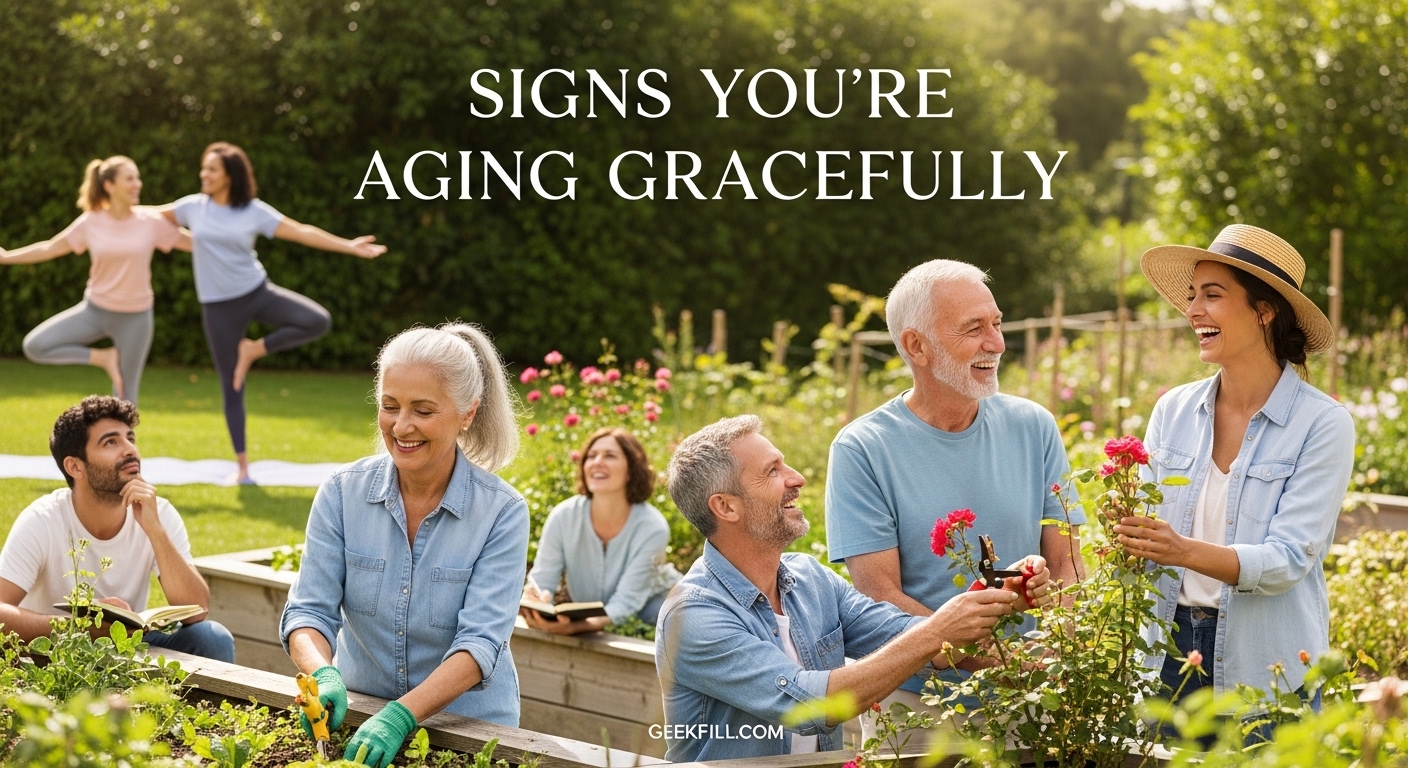
We spend so much time worrying about the physical markers of aging that we completely miss the profound internal shifts happening simultaneously. I noticed this in myself around age 42. One morning I caught my reflection and saw new lines around my eyes. But instead of panic, I felt something unexpected: curiosity about what stories those lines held.
That moment made me realize that signs of aging gracefully have almost nothing to do with appearance. Research from Yale University confirms what many of us feel intuitively. People with positive perceptions of aging live an average of 7.5 years longer than those with negative views. Your mindset about growing older literally shapes your longevity.
But here is what makes graceful aging genuinely fascinating: most of the indicators emerge naturally. You do not need expensive creams, strict protocols, or monk-like discipline. The habits and perspectives that define aging gracefully tend to develop organically when you prioritize what actually matters. The wisdom of years starts working in your favor without you having to force it.
I spent six months researching this topic, talking to adults across age ranges, and examining the science of subjective age. What I discovered surprised me. The people who report feeling most satisfied with their aging process share common behavioral and psychological patterns. They have cultivated specific ways of relating to themselves and the world that younger people often have not yet developed.
This article identifies 15 signs that you are already aging gracefully, often without conscious effort. Some might feel familiar. Others may surprise you. Each one represents a shift toward greater authenticity, resilience, and peace. Let us explore what genuine graceful aging actually looks like in practice, and why these changes matter more than any cream or procedure ever could.
Table of Contents
15 Signs You’re Aging Gracefully (Without Even Trying)
1. You Bounce Back Faster from Setbacks
Emotional resilience might be the single most reliable indicator of graceful aging. When I was younger, a rough day could derail my entire week. A critical email would send me spiraling. A minor conflict would keep me awake for nights.
Now something different happens. The sting arrives, I feel it fully, and then it passes through me more quickly. This is not suppression. It is integration.
Studies on emotional regulation show that as we age, most people develop better distress tolerance naturally. The amygdala, our brain’s alarm system, becomes less reactive with time and experience. We literally get neurologically better at handling difficulty.
The graceful aging version looks like this: you acknowledge that today was hard. You give yourself permission to feel disappointed, frustrated, or sad. Then you make tea, call a friend, or take a walk.
By evening, the weight has lifted. You sleep normally. Tomorrow feels possible again. That recovery speed is emotional maturity in action, and it develops naturally as we accumulate life experience.
2. You Invest Energy in Safe Relationships
One of the most liberating shifts in my forties was realizing I could choose where my energy went. For decades I maintained connections out of obligation, history, or fear of confrontation. Family members who drained me. Old friends who only contacted me when they needed something.
Something changes as we age. The currency of time becomes visible and precious. We start measuring relationships by how we feel after interacting with someone, not by how long we have known them.
Safe relationships become the priority. These are connections where you do not perform, explain, or defend yourself. You simply show up as you are.
Research on social networks and aging confirms this pattern. Adults who age gracefully typically maintain smaller but higher-quality social circles. They invest deeply in relationships characterized by mutual respect, genuine interest, and emotional safety.
The superficial networks of youth naturally fall away, and what remains feels nourishing rather than depleting. This selective approach to relationships is wisdom in action.
3. You Say ‘No’ Without the Guilt Spiral
Healthy boundaries were a foreign language to me in my twenties and thirties. Every request felt like a demand I must meet. Every invitation required elaborate excuses if I declined.
I would agree to things I hated, then resent everyone involved. The word no came with a three-day guilt hangover and a compulsive need to over-explain myself.
Now I observe something different in myself and my peers who are aging gracefully. The ability to decline without over-explaining has become natural. We recognize that our time and energy belong to us.
We understand that saying no to one thing creates space for what actually matters. The guilt has diminished because we trust our own judgment.
The graceful version sounds like: “I cannot make it, but I hope you have a wonderful time.” Or simply: “That does not work for me.” No lengthy justifications. No invented emergencies.
No subsequent anxiety about whether the other person is upset. Just a clear statement of truth followed by genuine well-wishing. This is boundary health, and it deepens with age for those paying attention to their own needs.
4. Small, Steady Habits Make You Proud
We live in a culture obsessed with dramatic transformation. Reality television sells us makeovers. Social media feeds us before-and-after stories.
The implication is that meaningful change must be visible, rapid, and extreme. But the people I know who are aging gracefully have abandoned this framework entirely. They understand that consistency beats intensity every time.
They take pride in tiny, consistent actions. The ten-minute morning stretch that has happened for three years. The single vegetable added to every lunch.
These small habits compound over time into genuine well-being. They require no willpower drama because they have become identity-level behaviors rather than willpower battles.
I interviewed a 68-year-old marathon runner for this piece. She started running at 55 with a single block. She felt ridiculous.
Her neighbors probably thought she was having a medical event. But she kept showing up for one block, then two, then a mile. Ten years later she has completed twelve marathons.
She told me the pride comes not from the races but from never missing more than two consecutive days. That is the graceful aging approach to change: small, sustainable, and self-respecting.
5. You Choose Peace Over Being Right
The compulsion to prove your point is exhausting. I remember spending hours crafting perfect arguments in my head, preparing for debates that rarely happened.
I needed people to understand my perspective, to acknowledge my correctness, to admit they were wrong. This drive created constant tension in my relationships and persistent anxiety in my mind.
Aging gracefully involves recognizing that being right is often less valuable than being peaceful. You start asking different questions. Is this worth my energy?
Will this matter in a year? What am I actually trying to win here? Most conflicts reveal themselves as ego protection rather than genuine principle when examined honestly.
Psychologists call this shift “response flexibility” and identify it as a hallmark of emotional maturity. We gain the ability to pause between stimulus and reaction.
We can choose silence when speaking would escalate. We can validate someone’s feelings without agreeing with their conclusions. This does not mean becoming a doormat.
It means saving your energy for conflicts that genuinely matter and releasing the rest with grace. The relief of letting go is immediate.
6. Your Curiosity Has Stayed Alive
Curiosity is the antidote to rigidity. I have watched adults grow increasingly closed as they age, convinced they already know what they need to know.
They stop asking questions. They dismiss new ideas. They repeat the same stories, eat the same foods, visit the same places.
This is not graceful aging. It is premature fossilization, and it accelerates cognitive decline. The people who age with genuine vitality maintain what researchers call “cognitive flexibility.”
They remain interested in the world around them. They ask questions at dinner parties. They try new restaurants. They read outside their usual genres.
They listen to music from younger generations without automatic dismissal. This curiosity keeps neural pathways open and prevents the mental brittleness that makes aging feel limiting.
Neuroscience supports this approach. Learning new skills and exposing yourself to novel experiences promotes neuroplasticity, your brain’s ability to form new connections.
Adults who maintain curious, exploratory mindsets show greater cognitive resilience as they age. They process information more efficiently and adapt more readily to change. Curiosity is not just charming. It is protective of your mental acuity.
7. You Treat Your Body Like a Teammate
Our culture presents two dysfunctional options for relating to our bodies: worship or war. We are supposed to either achieve aesthetic perfection through relentless discipline or fight aging through endless intervention.
Neither approach creates a sustainable, peaceful relationship with the physical self. Both lead to burnout and resentment.
Aging gracefully introduces a third option: partnership. You start viewing your body as a teammate rather than a project or an enemy. You appreciate what it does for you.
You notice when it needs rest and provide it. You move in ways that feel good rather than punishing. You feed it food that energizes rather than following restrictive rules born from shame.
This shift shows up in language. Instead of “I was bad this weekend” when discussing food choices, you say “I enjoyed a celebration with friends.”
Instead of “I need to burn off that meal,” you say “I feel like moving my body today.” The relationship becomes collaborative and respectful rather than conditional and adversarial.
This body respect is perhaps the most important physical aspect of graceful aging. Your body becomes a companion on the journey, not an enemy to defeat.
8. You Notice Feelings Without Getting Stuck
Emotional awareness separates reactive living from conscious living. Many people move through their days pushed around by feelings they do not recognize.
They snap at family members because of work stress they have not acknowledged. They withdraw from friends because of shame they have not named. They make major decisions from fear they have not examined.
Aging gracefully involves developing the capacity to notice emotions without becoming them. You feel anger without acting angry. You experience anxiety without believing catastrophic thoughts.
You recognize sadness without sinking into despair. This capacity, which psychologists sometimes call “differentiation,” allows you to respond to situations rather than react from triggered states.
I learned a simple practice from a therapist that exemplifies this shift. When a strong feeling arises, name it precisely.
Not just “stressed” but “overwhelmed by multiple deadlines while feeling unsupported.” Not just “sad” but “grieving a friendship that has naturally ended while feeling lonely for connection.”
The specificity creates distance. You are having an experience rather than being consumed by it. This skill deepens naturally with age for those who develop it intentionally.
9. You Laugh More Easily, Even at Yourself
Humor is a survival skill. The ability to find something amusing in difficult situations, to laugh at your own foibles, to not take yourself too seriously, these are indicators of psychological health.
I have noticed that people aging gracefully laugh more freely than their younger, more self-conscious counterparts. The burden of self-importance has lifted.
This laughter comes from perspective. When you have lived through enough challenges, you recognize that most problems are temporary.
You forget your keys, you miss a deadline, you say something awkward at a party. These events feel catastrophic in your twenties. In your fifties, they are Tuesday.
The ability to chuckle at your own humanity is hard-won wisdom. Research on humor and aging consistently finds that older adults who maintain playful, lighthearted approaches report higher life satisfaction.
They experience less stress, enjoy better immune function, and maintain stronger social connections. Laughter literally changes your physiology, reducing cortisol and increasing endorphins.
Those who age gracefully have learned that taking everything seriously is a recipe for misery and isolation. A good laugh can dissolve a day’s tension in seconds.
10. You Handle Change With Flexibility
Change is the only constant, yet most of us resist it fiercely. We create elaborate plans and then suffer when reality deviates. We form expectations and then experience disappointment when they are not met.
This rigidity causes enormous unnecessary suffering throughout life but becomes especially problematic as we age and face inevitable transitions.
Graceful aging requires what researchers call “psychological flexibility.” This is the ability to adapt to changing circumstances without losing your core sense of self.
Plans change. Bodies change. Relationships change. The people who navigate these transitions well share a common trait: they hold their preferences lightly while maintaining their values firmly.
I watched my aunt model this during a major life transition. She planned to retire in her home state near lifelong friends.
Instead, her daughter needed help with grandchildren across the country. My aunt sold her house, packed her belongings, and moved to a city where she knew no one.
She grieved the loss of her planned retirement while creating a new, meaningful chapter. She told me: “I wanted one thing. Life offered another. Both can be good.” That is flexibility.
11. You Rest Without Earning It First
Productivity culture has infected us with a toxic belief: rest must be earned. We can only take a vacation after completing a major project.
We can only nap on weekends after a brutal work week. We can only slow down in retirement after decades of grinding. This conditional approach to rest creates chronic depletion and burnout.
Aging gracefully involves dismantling this belief. You recognize that rest is not a reward for productivity. It is a biological requirement for functioning.
You start giving yourself permission to rest because you are human, not because you have met some arbitrary achievement threshold. This shift feels revolutionary in a culture that equates busyness with worth.
The practical manifestation looks simple. You take the afternoon off when you feel tired, not when your to-do list is empty.
You sleep in on Sunday without justification. You book the massage because your body aches, not because you completed a milestone.
This unearned rest is a hallmark of people who have made peace with their own needs. It represents the understanding that your value does not depend on your output.
12. You Think About the Future With Warmth
Attitude toward the future reveals everything about how someone is aging. Fear creates a contracted, defensive approach to what comes next.
Optimism creates openness and possibility. I have noticed that people aging gracefully look forward with what researchers call “future warmth.”
They anticipate the years ahead with curiosity rather than dread. This warmth does not require ignoring reality. They know challenges will come.
Health issues may develop. Losses will happen. But they hold a fundamental trust in their own capacity to meet whatever arrives.
They have survived difficulties before. They have adapted to unexpected changes. This track record creates confidence about the future even while acknowledging uncertainty.
The contrast is stark when you observe people with different orientations. Those aging anxiously speak about the future in terms of decline and limitation.
They focus on what they might lose. Those aging gracefully speak in terms of possibilities and continued growth. This warm future orientation is both a result of and contributor to healthy aging.
13. You Accept Physical Changes as Stories
The obsession with fighting visible aging is exhausting and expensive. Billions of dollars flow into products promising to reverse time.
Entire industries exist to help us pretend we are not getting older. But the people I observe aging gracefully have taken a different path.
They see their changing bodies as evidence of lives lived, not problems to solve. This does not mean neglecting health or stopping self-care.
It means releasing the war against natural processes. The gray hair represents decades of experience. The wrinkles map moments of laughter and concern.
The changing body reflects adaptation through different life stages. These physical markers become stories rather than flaws. Evidence rather than enemies.
A friend who recently turned 60 told me about her decision to stop coloring her hair. She had spent thousands of dollars and countless hours hiding her natural silver.
One day she asked herself why. The answer was fear of looking old. She realized she was not actually afraid of looking her age.
She was afraid of how others might treat her if she did. This insight helped her release the coloring routine. She now describes her silver waves as “my years visible.” That is acceptance.
14. You No Longer Follow the Crowd
Conformity is a young person’s game. We follow trends, adopt opinions, and pursue goals because others do.
We fear standing out, being different, or making unconventional choices. This pressure to conform creates enormous anxiety and often leads us away from our authentic preferences and values.
Something liberating happens as we age. The desire to fit in diminishes while the need for authenticity increases.
We realize that the crowd is often wrong, or at least not right for us. We become willing to make choices that confuse others because they align with our actual desires.
This independence is a beautiful feature of later life stages that younger people rarely understand. I see this in small choices and large ones.
The friend who stopped attending obligatory social events she hated. The colleague who changed careers at 50 to pursue work that actually mattered to him.
The relative who wears what she finds comfortable regardless of whether it is fashionable. Each represents a rejection of crowd-following in favor of self-alignment.
These choices feel scary until you make them. Then they feel like freedom. Authenticity becomes more important than approval.
15. Your Own Approval Matters Most
External validation is a drug. It feels good in the moment but requires constant dosing.
When we depend on others for our sense of worth, we become endlessly performing versions of ourselves. We shape our choices around what will impress, please, or satisfy other people.
This creates a life that looks successful from the outside while feeling hollow from within. Aging gracefully culminates in a profound shift: your own approval becomes the metric that matters most.
You still care about others. You want to contribute, connect, and be kind. But you no longer require their validation to feel okay about yourself.
You develop an internal compass that guides your decisions. This is the ultimate freedom. This self-validation shows up in subtle ways.
You make decisions without polling everyone you know. You accept that some people will not understand your choices and that is fine.
You feel satisfaction from meeting your own standards rather than society’s. This is perhaps the ultimate sign of graceful aging: the full transition from external to internal authority.
You have become your own home base. Your own approval is enough.
Frequently Asked Questions
What are the 5 subtle signs that you are aging well?
The five most subtle signs include: 1) Faster emotional recovery from setbacks, 2) Choosing quality relationships over quantity, 3) Setting boundaries without excessive guilt, 4) Taking pride in small consistent habits rather than dramatic changes, and 5) Prioritizing peace over the need to be right in conflicts.
What are the 7 pillars of anti aging?
The seven pillars of healthy aging typically include: regular physical activity, quality sleep, stress management, social connection, cognitive engagement, proper nutrition, and preventive healthcare. These foundational elements support both physical vitality and psychological well-being as we age.
What ethnicity gets the least wrinkles?
Research indicates that individuals with darker skin tones, particularly those of African and Asian descent, tend to show fewer visible signs of aging such as wrinkles and fine lines. This is primarily due to higher melanin content, which provides greater protection against UV damage and maintains skin elasticity longer.
What is the first organ to show signs of aging?
The skin is typically the first organ to show visible signs of aging, with changes often appearing in our twenties and thirties. However, internally, the brain begins subtle changes as early as our late twenties, including slight reductions in processing speed and neuroplasticity. The cardiovascular system also shows early changes that are not visible but measurable.
What does aging gracefully really mean?
Aging gracefully means growing older with acceptance, resilience, and authenticity. It involves focusing on emotional maturity, self-care, and positive adaptation rather than fighting natural physical changes. It prioritizes psychological well-being, meaningful relationships, and self-acceptance over appearance or societal expectations.
Can you age gracefully without trying?
Many aspects of graceful aging do emerge naturally when you prioritize what matters. Emotional resilience, better boundaries, and increased self-acceptance often develop organically through life experience. However, intentional practices like maintaining curiosity, nurturing relationships, and practicing self-compassion can significantly enhance the process.
If you recognized yourself in several of these 15 signs, you are already further along the path of graceful aging than you might have realized. The shifts described here are not about perfection or constant happiness. They represent a gradual reorientation toward what genuinely matters: connection, authenticity, peace, and growth.
This is the heart of aging well. Here is what I hope you take from this exploration. Aging gracefully is not a destination you reach at a certain age or appearance. It is an ongoing relationship with yourself and your life.
Some days you will embody all fifteen signs. Other days you will struggle with basic boundaries and find yourself spiraling over minor setbacks. Both are part of the process.
Perfection is not the goal. Progress is. The research is clear about one thing: your attitude toward aging shapes your experience of it.
Adults who view aging as a time of continued growth, wisdom, and possibility report higher life satisfaction, better health outcomes, and longer lifespans. Those who see aging as pure decline experience the opposite.
Your mindset is not just poetic. It is physiological and directly impacts your biology. Perhaps the most encouraging finding from my research is that it is never too late to develop these patterns.
Neuroplasticity continues throughout life. Relationship skills can be learned at any age. Self-acceptance can deepen with every passing year.
The person you will be in five years is still forming, shaped by the choices you make today. This is hopeful news.
I invite you to return to this list periodically. Notice which signs feel natural now and which feel aspirational. Celebrate your growth without demanding perfection.
Trust that the signs of aging gracefully you have already developed will continue deepening. And know that the best years may still be ahead, not behind.
That is the truth of graceful aging: it keeps getting better when you let it.