
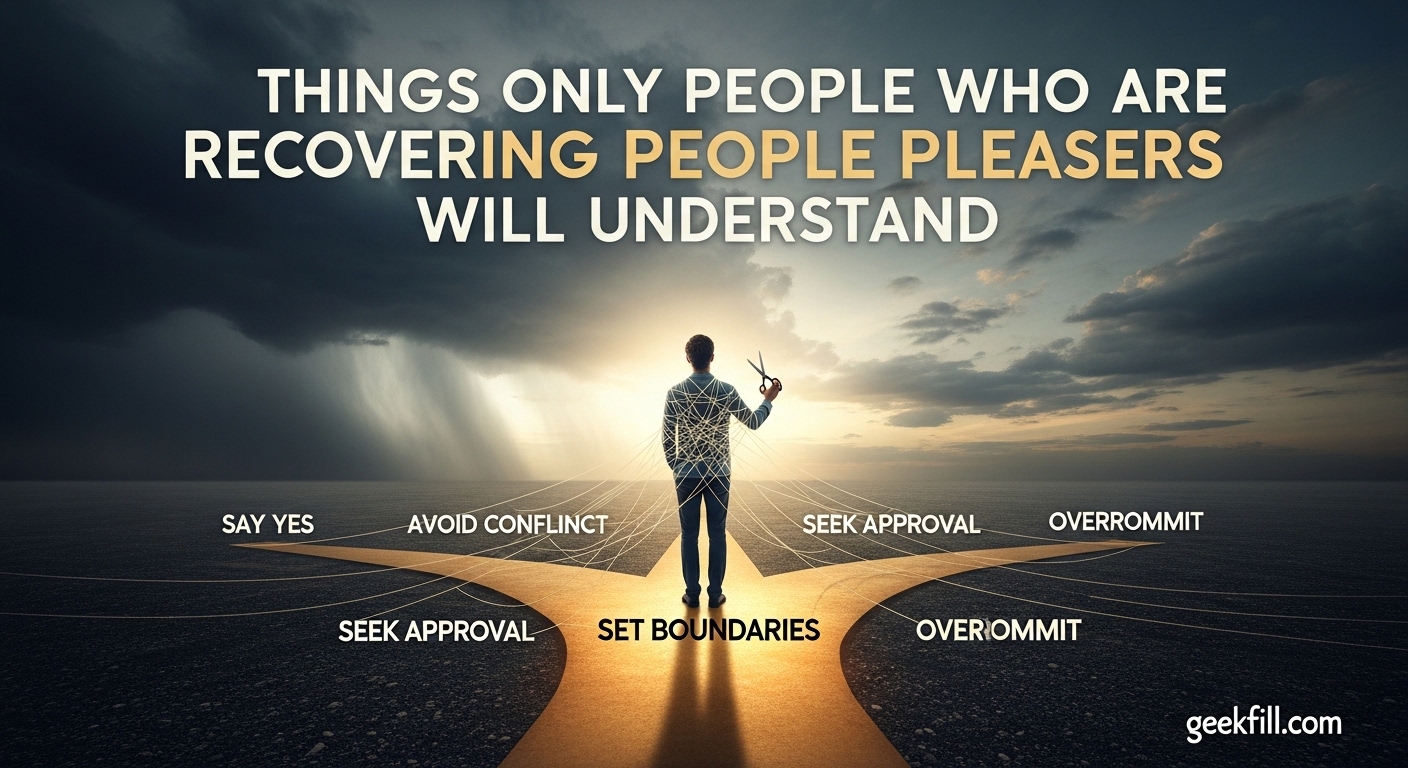
If you have ever found yourself apologizing for taking up space, saying yes when every fiber of your being screamed no, or feeling guilty for doing something as basic as resting, you might be a recovering people pleaser. And I want you to know something important: the path from chronic approval-seeking to authentic self-expression is not a straight line. It is messy, confusing, and sometimes deeply uncomfortable.
People-pleasing rarely develops by accident. For most of us, it started as a survival strategy. Maybe you grew up in an environment where love felt conditional on being helpful, agreeable, or invisible. Maybe disagreement meant withdrawal of affection. Maybe your needs were consistently framed as inconvenient. So you learned to become whatever others needed you to be. That hyper-vigilance about others’ feelings kept you safe then. But now, as an adult, that same pattern is keeping you stuck.
The good news? Recovery is possible. The challenging part? It comes with experiences that can feel isolating if you do not realize how completely normal they are. Here are twelve things that only those of us deep in people-pleasing recovery truly understand.
Table of Contents
1. Saying No Feels Like Committing a Crime
Your heart races. Your palms get sweaty. You rehearse the rejection speech you are convinced is coming. The word “no” sits on your tongue like a foreign object, heavy and dangerous.
For a recovering people pleaser, declining a request can trigger the same physiological response as actual danger. That is because, neurologically, your brain has learned that disappointing others equals threat. This is the fawn response in action, a trauma reaction where you default to appeasing others to maintain safety. Your nervous system has not quite caught up to the reality that you are now an adult with choices, not a child dependent on others’ moods for security.
The guilt that follows a boundary is often worse than the boundary itself. You might spend hours replaying the conversation, wondering if you sounded rude, imagining the other person thinking less of you. But here is what I have learned: that discomfort is temporary, while the resentment of saying yes when you meant no lasts much longer.
2. You Realize You Do not Actually Like Some People
This one hits different. You are going about your recovery, setting boundaries, feeling proud of yourself, and then it happens. You look at someone you have called a friend for years and realize you never actually enjoyed their company.
You only kept them around because saying no to their invitations felt impossible. Because they needed you, and you needed to be needed. Because the relationship existed entirely on the foundation of your willingness to show up and perform emotional labor without reciprocity.
The grief of this realization is real. You are not just losing a friendship. You are mourning the version of yourself who tolerated relationships that drained you. You are grieving all the energy you poured into connections that never truly fed you. And yes, it feels incredibly awkward to recognize that your “friendship” was actually just a people-pleasing marathon you have finally stopped running.
3. Free Time Feels Foreign and Uncomfortable
When you stop rescuing everyone around you, something strange happens: you have time. Actual empty hours with no one asking for your help, your attention, or your emotional support.
For most recovering people pleasers, this emptiness feels terrifying at first. Your worth has been so tied to your usefulness that existing without a purpose feels like failure. You might find yourself creating imaginary problems to solve, offering help no one asked for, or scrolling through your contacts wondering who needs you today.
This is the identity crisis of healing from people pleasing. You are learning that you are allowed to simply exist without earning your place through service. That lesson takes time. Be patient with the part of you that panics at rest. It is learning a new language, and fluency does not happen overnight.
4. You Apologize for Things That Are Not Your Fault
Someone bumps into you on the street. You apologize. The restaurant gets your order wrong. You apologize for being difficult. The weather ruins plans. You somehow feel responsible.
The over-apology habit runs deep for recovering people pleasers. You say sorry for having needs, for taking up space, for existing in a way that might inconvenience anyone else. Often these apologies are reflexes, spilling out before your brain even processes whether you actually did something wrong.
Children who grow up in critical or unpredictable environments often learn to apologize preemptively. It becomes a shield, a way to deflect anger before it arrives. In recovery, you start catching yourself mid-apology. You pause. You ask: “Did I actually do something that requires an apology, or am I just trying to manage someone else’s feelings?” That pause is progress, even when the sorry still slips out.
5. Setting Boundaries Makes You Feel Selfish
You finally worked up the courage to say you cannot take on that extra project. You declined the invitation you did not have energy for. You asked for space when you needed it.
And then the guilt tsunami hit. You feel selfish. You feel like a bad friend, a bad employee, a bad partner. Your inner voice whispers that you are difficult, demanding, too much.
This is one of the most paradoxical parts of people pleasing recovery. Healthy behaviors feel wrong because wrong behaviors felt normal for so long. When your baseline has been over-giving and self-abandonment, anything less feels like a failure. But boundaries are not walls; they are the fences that keep your garden safe. You are not being selfish. You are being a steward of your own limited energy.
6. You Get Angry at Your Past Self for What You Tolerated
As your awareness grows, so does your anger. You look back at relationships where you accepted breadcrumbs, situations where you let people speak to you disrespectfully, years where you said yes to everything and no to yourself.
You want to shake your past self and ask what she was thinking. Why did she let them treat her that way? Why did she not walk away sooner? Why did she believe that love had to hurt to be real?
This anger is part of the healing process, but it needs a container. Your past self was not stupid or weak. She was surviving with the tools she had. She was doing what she learned kept her safe, kept her connected, kept her from being abandoned. Direct some of that anger toward the people and systems that taught her tolerance was her only option. And then offer her compassion. She got you here, to this moment of awareness. That matters.
7. Silence in Conversations Makes You Panic
The conversation pauses. A beat of quiet hangs in the air. Immediately, your nervous system screams that you must fill it.
You rush in with agreement, with reassurance, with a complete change of subject just to make the silence go away. You might over-explain your opinions, backtrack on your stance, or laugh at jokes you do not find funny. Anything to keep the connection smooth, conflict-free, comfortable for the other person.
For recovering people pleasers, silence often signals danger. It might have meant disapproval in your past, the calm before an emotional storm, or the withdrawal of connection you desperately needed to feel safe. Learning to tolerate conversational silence is practice for tolerating relational honesty. Not every pause needs rescue. Sometimes silence is just space, and space is okay.
8. You Crave Validation But Hide It
You post something online and refresh repeatedly, hoping for likes. You accomplish something difficult and wait, hungry for someone to notice. You give a gift and feel deflated when the reaction is smaller than you imagined.
Then you hide the wanting. You tell yourself you should not need external validation. You should be confident without praise. You should be internally motivated, self-sufficient, above the need for approval.
This creates a painful internal split: the part of you that still craves validation, and the part of you that shames that craving. Here is the truth: validation feels good because connection matters. Being seen matters. The goal of recovery is not to eliminate your need for others’ positive regard entirely. It is to make it one input among many, not the sole source of your self-worth.
9. Healthy Relationships Feel Boring at First
After years of chaotic, intense, drama-filled connections, you finally meet someone who treats you well consistently. They text when they say they will. They respect your boundaries without punishing you. They do not create crises that require your rescue.
And you feel… bored. Unsettled. Waiting for the other shoe to drop.
This is a classic sign of unlearning people pleasing. When your nervous system has been wired for the highs and lows of unpredictable relationships, calm feels like something is missing. Secure attachment lacks the adrenaline spikes of trauma bonding. It takes time to recalibrate your sense of normal. Boring is not bad. Boring is safe. Safe is worth learning to appreciate.
10. You Do Not Know What You Want Anymore
Someone asks where you want to eat. Your mind goes blank. Someone asks what movie you want to watch. You genuinely do not know. Someone asks what you need from this relationship, and you feel utterly lost.
Years of people-pleasing often result in what therapists call self-abandonment. You became so skilled at reading others’ needs and molding yourself to fit them that you lost track of your own preferences entirely. Decision paralysis is common in recovery because you are rebuilding a self from scratch.
Start small. Notice what temperature you actually want the room to be. Pay attention to which foods you genuinely enjoy. Ask yourself what you want before automatically deferring to others. These small moments of choice rebuild the muscle of self-knowing. It is in there, buried under years of accommodation. You are just excavating it now.
11. The Word ‘Selfish’ Lost Its Power Over You
There was a time when being called selfish would have destroyed you. It was your kryptonite, the ultimate accusation, the thing you organized your entire existence to avoid.
Now, in recovery, you hear the word differently. Sometimes you even wear it with a kind of rebellious pride. You recognize that “selfish” is often just code for “not doing what I wanted you to do.” You understand that prioritizing your own needs is not the same as ignoring everyone else’s.
You have started to reclaim the word. Self-care is not selfish. Self-preservation is not selfish. Having preferences is not selfish. You are learning that a healthy relationship with self-interest is not just acceptable; it is necessary. The people who matter will not use your self-respect against you.
12. Some Relationships Will Not Survive Your Growth
This might be the hardest truth of all. As you change, as you stop over-giving, as you set boundaries and speak your truth, some people will fall away.
They were not bad people necessarily. They were just compatible with your old self, the one who showed up on demand, who never needed anything, who made their life easier. That version of you served a purpose for them, and the new version might not fit in their world the same way.
The grief of this is real and valid. Letting go of relationships that no longer serve you does not mean those connections were never meaningful. It just means you have outgrown them. Growth creates incompatibility sometimes. That is not your fault, and it is not something to fix. It is simply part of the landscape of becoming who you actually are.
Frequently Asked Questions About Recovering From People Pleasing
What is the root cause of people pleasers?
People-pleasing typically develops as a survival response to childhood environments where love, safety, or acceptance felt conditional on being agreeable, helpful, or invisible. It often stems from emotional neglect, critical parenting, or unpredictable family dynamics where the child learned to monitor others’ moods to feel secure. This pattern becomes wired into the nervous system and persists into adulthood as the fawn response, a trauma reaction where appeasing others feels like the safest option.
What kind of childhood trauma causes people pleasing?
Childhood trauma that commonly leads to people-pleasing includes emotional neglect, inconsistent parenting, having a narcissistic or emotionally unavailable caregiver, being parentified (forced into a caretaker role too young), and environments where conflict was dangerous or love was withdrawn as punishment. Children in these situations learn that their needs are inconvenient and that safety comes from managing others’ emotions. This creates the foundation for chronic people-pleasing patterns in adulthood.
Is it normal to feel guilty for setting boundaries?
Yes, feeling guilty when setting boundaries is completely normal for recovering people pleasers. This guilt arises because your nervous system has learned that disappointing others equals danger. Setting boundaries activates the same physiological responses as actual threat. However, this guilt is temporary and decreases with practice. The discomfort of a boundary is always shorter-lived than the resentment that builds from saying yes when you mean no.
Do recovering people pleasers lose friends?
Some relationships may naturally end during people-pleasing recovery, and this is a normal part of growth. Connections that were built on your over-giving, your constant availability, or your willingness to prioritize others’ needs above your own may not survive your new boundaries. This loss, while painful, makes space for relationships that can accommodate the authentic version of you. The right people will respect your growth rather than punish it.
What does recovery from people pleasing look like?
Recovery from people pleasing is a non-linear journey that includes learning to recognize your own needs, setting and maintaining boundaries, tolerating the discomfort of disappointing others, rebuilding your identity separate from your usefulness, and developing self-worth independent of external validation. It involves grief, anger, awkwardness, and moments of backsliding. Progress looks like catching yourself in old patterns faster, choosing yourself more often, and building relationships where you can be fully authentic.
The Journey Continues
If you saw yourself in even a few of these experiences, you are not alone. People pleasing recovery is one of the most common hidden struggles in our culture, precisely because it hides so well behind masks of kindness, helpfulness, and generosity. The difference between healthy giving and people-pleasing is not the behavior itself but the motivation and the cost to your wellbeing.
Recovery does not mean becoming cold or uncaring. It means becoming discerning. It means offering your help from a place of genuine desire rather than fear. It means knowing that you are allowed to take up space without earning it through service.
You will backslide. You will say yes when you mean no and hate yourself a little for it. You will apologize unnecessarily and only catch it after the fact. That is okay. Recovery is not about perfection. It is about awareness, choice by choice, day by day, slowly becoming someone who trusts herself enough to honor her own needs.
You are already doing the work simply by reading this, by recognizing these patterns, by wanting something different for yourself. Keep going. The world needs you fully authentic, not just fully available.
If any of these twelve things resonated with your experience, I would love to hear which ones hit home in the comments. Your story might be exactly what another recovering people pleaser needs to hear today.