
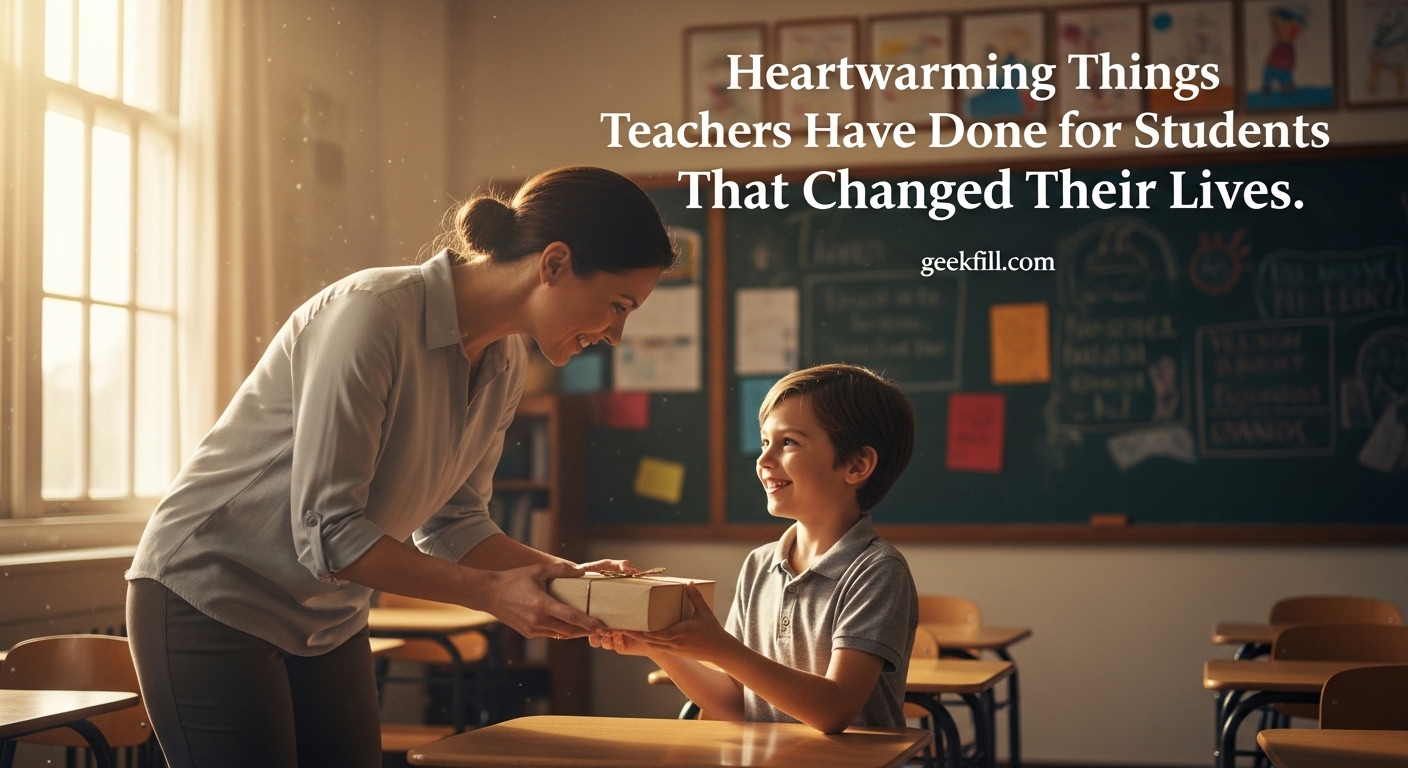
Some people remember their teachers for the subjects they taught. Others remember them for the lives they changed. I have spent years collecting stories from students whose lives were transformed by educators who saw something in them that no one else did. These are not tales of extraordinary heroics or dramatic interventions. They are small moments of human connection that rippled outward for decades.
The heartwarming things teachers have done for students often happen in the quiet spaces between lessons. A whispered encouragement before a test. A bag of groceries left discreetly on a doorstep. A belief held stubbornly until the student could believe it themselves. These acts of kindness create invisible threads that connect generations.
What follows are 15 true stories of teachers who went above and beyond. Each one represents thousands of similar moments happening in classrooms around the world 2026. Some names have been changed to protect privacy, but every story is real. They remind us that education is fundamentally human work.
Table of Contents
1. The Quiet Student Who Found Her Voice
Maya Chen sat in the back corner of Ms. Rodriguez’s third-grade classroom for three months without speaking a single word during class discussions. Other teachers had labeled her selectively mute. Some suggested special education placement. Ms. Rodriguez noticed something different. She saw a girl who watched everything with intense, intelligent eyes.
Instead of forcing participation, Ms. Rodriguez started leaving small notes in Maya’s desk. “I loved your drawing today,” one read. “You have kind eyes,” said another. She never asked for a response. After six weeks, Maya left her first reply: a folded paper with a single sentence about her cat. By spring, Maya was raising her hand regularly.
Fifteen years later, Maya is a speech therapist working with selectively mute children. She keeps a framed note on her desk: “Your voice matters, even when it is silent.” Ms. Rodriguez attended Maya’s graduate school graduation. Maya told the audience that one teacher’s patience taught her that being seen did not require being heard.
2. The College Application That Changed Everything
Diego Martinez grew up in a family where college was not discussed. His parents worked double shifts at restaurants. His older siblings dropped out to help with bills. When his senior year arrived, Diego assumed he would follow the same path. Then his English teacher, Mr. Patterson, asked him to stay after class one October afternoon.
Mr. Patterson had noticed Diego’s analytical essays. He also noticed that Diego never mentioned applications or campus visits. Over the next three months, Mr. Patterson helped Diego navigate every step. He explained FAFSA forms using simple language. He drove Diego to three college interviews in his own car. He called admissions offices to advocate for Diego’s unique circumstances.
Diego received a full scholarship to a state university. He became the first in his family to earn a degree. Today he runs a nonprofit that helps first-generation students apply to college. Mr. Patterson’s belief that Diego deserved higher education started a chain reaction that has now helped over two hundred families.
3. When the Pantry Was Empty
Sarah Thompson taught fifth grade in a rural district where poverty rates exceeded the state average by double digits. She noticed that Marcus always ate his free breakfast slowly, scraping every bit of food from his tray. She started watching more carefully. His clothes were clean but worn at the cuffs. He never brought snacks for the class party.
Instead of calling home or involving administrators, Sarah took a different approach. She started packing an extra lunch each day. “I always make too much food,” she would say casually, handing him a container. She kept granola bars in her desk drawer. She bought him a winter coat by claiming she had received it as a gift that did not fit her.
Marcus graduated high school last spring. At the ceremony, he found Sarah in the audience. He told her that her lunches were often the only food he had on weekends. He is now studying agricultural science, hoping to address food insecurity in rural communities. Sarah never made him feel like a charity case. She made him feel like a kid who deserved care.
4. Learning Differently, Succeeding Brilliantly
James Harrison was twelve when his history teacher, Mrs. Okonkwo, realized he might have dyslexia. Other teachers saw a lazy student who never turned in written work. Mrs. Okonkwo noticed that James could discuss historical concepts with remarkable depth during oral conversations. She also noticed he never read aloud when called upon.
Rather than accepting the failing grades, Mrs. Okonkwo requested a special education evaluation. She attended the meetings with James’s grandmother to explain the findings. She learned about dyslexia herself so she could teach James alternative strategies. She arranged for him to use text-to-speech software. She gave him oral exam options.
James graduated with honors after receiving proper accommodations. He now works as a software engineer building accessibility tools for learning differences. He speaks at education conferences about the importance of teachers who look past surface behaviors to underlying potential. Mrs. Okonkwo saw his intelligence when others saw only his struggles.
5. The Email That Came at 2 AM
Remote learning during the pandemic created unprecedented challenges. For seventeen-year-old Jordan, it created a crisis. Their father lost his job. Their family faced eviction. Jordan stopped attending Zoom classes and stopped submitting assignments. Most teachers marked them absent. One teacher, Ms. Lee, noticed the pattern and sent an email at two in the morning.
The email did not ask about missing work. It said simply: “I am worried about you. You do not need to reply. But if you need to talk, I am here.” Jordan read that message a dozen times before responding. They explained their situation in a reply sent at three AM. Ms. Lee responded immediately. She connected Jordan with community resources. She advocated for deadline extensions with other teachers.
Jordan graduated on time and is now studying social work. They still have that email saved in a special folder. Ms. Lee taught them that asking for help is not weakness. She also demonstrated that teaching extends far beyond classroom hours and lesson plans. Their connection began in isolation but created a bond that outlasted the pandemic.
6. From Troublemaker to Class President
Tyrone Williams entered Mr. Henderson’s freshman biology class with a reputation. He had been suspended twice in middle school. He talked back to teachers. He disrupted lessons. Other teachers warned Mr. Henderson about him. Mr. Henderson chose to see something else: a bored, intelligent kid who needed challenge, not more discipline.
Mr. Henderson started giving Tyrone extra lab assignments. He asked Tyrone to help set up equipment before class. He mentioned that Tyrone had natural leadership abilities. He never brought up the past suspensions. By sophomore year, Tyrone was tutoring other students. By senior year, he was elected class president with Mr. Henderson’s vote.
Tyrone is now a high school principal. He keeps a photo of Mr. Henderson on his desk. When students walk into his office with disciplinary records, Tyrone remembers how one teacher looked past labels to see a person. Mr. Henderson’s mentorship showed Tyrone that identity is not fixed. People can become whoever they choose to be.
7. The Art Supplies That Opened a World
Lily Chen drew constantly in her notebook margins. Her pencils were stubs. Her family could not afford art supplies or classes. Her middle school art teacher, Ms. Donovan, noticed the raw talent in those margin sketches. She also noticed Lily’s supplies were limited to a single ballpoint pen and notebook paper.
Ms. Donovan started leaving supplies in Lily’s locker anonymously. High-quality sketchbooks. Professional colored pencils. Watercolor sets. She wrote encouraging notes on post-it stickers. She arranged for Lily to attend a weekend workshop by claiming she had won a scholarship. She entered Lily’s work in a regional competition without telling her.
Lily won that competition. The prize money bought her family groceries for a month. More importantly, the recognition gave Lily confidence she had never experienced. She is now a graphic designer for a major studio. She runs free art workshops for low-income students every summer. Ms. Donovan still attends her gallery openings. The supplies were materials. The belief they carried was everything.
8. Grieving Together, Healing Together
When Emma lost her mother to cancer during her sophomore year, the world stopped making sense. She stopped doing homework. She stopped talking to friends. She sat in classes in a fog of grief. Most teachers gave her extensions and sympathetic looks. Her chemistry teacher, Dr. Weber, did something more profound.
Dr. Weber had lost his own mother as a teenager. He recognized the particular loneliness Emma was experiencing. He started checking in daily, not about chemistry, but about her. He shared his own story of grief and healing. He gave her a journal and suggested she write letters to her mother. He told her that academic performance mattered less than her survival.
Emma graduated and became a pediatric oncology nurse. She works with teenagers who have lost parents to cancer. She tells them about Dr. Weber, the teacher who understood that some lessons cannot be graded. Their conversations about grief taught her that pain could be shared rather than carried alone. Dr. Weber turned his own tragedy into connection for a student who needed it desperately.
9. Believing in the ‘Difficult’ Child
Kevin O’Brien had ADHD that made traditional classroom environments torture for him. He fidgeted constantly. He blurted answers. He forgot homework. Previous teachers had placed him in the corner, sent him to the office, or ignored him. His fourth-grade teacher, Mrs. Sullivan, tried a different approach entirely.
Mrs. Sullivan gave Kevin a standing desk so he could move while working. She let him answer questions by writing them down first. She turned his energy into an asset by making him her “classroom helper” who distributed papers and organized supplies. She told his mother that Kevin had remarkable creativity and problem-solving abilities. She never used the word “difficult.”
Kevin is now an entrepreneur who built a successful tech startup. He credits Mrs. Sullivan with teaching him that his brain was an asset, not a liability. She helped him develop strategies that work with his neurology rather than against it. Kevin speaks openly about his ADHD at business conferences. He says Mrs. Sullivan taught him that being different is not the same as being broken.
10. The Safe Space for Questions
Amara Patel was terrified of being wrong. She never raised her hand. She sat frozen during class discussions, afraid of saying something stupid. Her physics teacher, Dr. Chen, noticed her anxiety. He created a new classroom rule: “There are no stupid questions, only questions we have not explored yet.”
Dr. Chen made a point of celebrating wrong answers. “That is a brilliant mistake,” he would say. “It shows us exactly where the concept needs clarification.” He created a “question wall” where students could post anonymous questions. He spent extra time with Amara after class, not to tutor her, but to help her feel safe speaking up.
Amara is now a physics professor herself. She uses Dr. Chen’s exact phrases in her own classroom. She tells her students that her career began when one teacher made her feel safe being wrong. Dr. Chen’s classroom taught her that learning requires risk. You cannot discover anything if you are afraid to make mistakes.
11. When Glasses Changed Everything
Tyler squinted at the whiteboard from the front row but never told anyone he could not see clearly. His family did not have vision insurance. He was falling behind in every subject because he could not read the board. His third-grade teacher, Ms. Williams, noticed him squinting and leaning forward during lessons.
Ms. Williams did not send a note home that might embarrass Tyler or his parents. Instead, she contacted a local Lions Club that provided free vision screenings. She arranged for Tyler to be tested during a “special project day” so other students would not notice. When the test confirmed he needed glasses, she found a program that provided them at no cost.
Tyler put on his new glasses and looked around the classroom in amazement. He could see leaves on trees outside the window for the first time. His grades improved immediately. He is now an optometrist working with low-income communities. Ms. Williams protected his dignity while solving a problem that was blocking his entire future.
12. The Teacher Who Stayed After Zoom
The pandemic isolated everyone, but it hit some students harder than others. Maria lived in a small apartment with eight family members. She had no quiet space for online classes. She was responsible for helping her younger siblings with their schoolwork while managing her own. She started missing assignments. Her grades plummeted.
Her math teacher, Mr. Torres, noticed Maria’s camera was always off. He started staying on Zoom after class ended, just in case someone needed to talk. Maria logged on one day after everyone else left. She cried for twenty minutes while Mr. Torres listened. He connected her with a program that provided WiFi hotspots and noise-canceling headphones. He adjusted assignment deadlines.
Maria passed her classes and graduated. She is now studying to become a teacher herself. She wants to be the kind of educator who stays after virtual class ends just in case someone needs a listening ear. Mr. Torres taught her that teaching is about seeing the whole student, not just the assignments they submit.
13. From English Learner to Valedictorian
Ana arrived in the United States at age fourteen speaking minimal English. She was placed in ESL classes where many students remained for years. Her ESL teacher, Mrs. Park, saw something different in Ana. She noticed how Ana asked for extra books to read. She saw Ana practicing pronunciation in the mirror during lunch.
Mrs. Park worked with Ana before school, after school, and during lunch periods. She connected Ana with a community mentor who had also immigrated as a teenager. She advocated for Ana to take advanced courses once her language skills improved. She wrote recommendation letters that emphasized Ana’s determination and resilience rather than just her grades.
Ana graduated as valedictorian four years later. She gave her speech in both English and her native language, thanking Mrs. Park for seeing her potential before she could fully express it in words. She is now a immigration lawyer helping families navigate the system that once confused her. Mrs. Park’s investment of time created a multiplier effect that continues today.
14. The Tuition Check That Arrived Anonymously
Rashid had been accepted to his dream university with a partial scholarship. The remaining tuition was impossible for his family. He prepared to decline the offer and attend community college instead. A week before the deadline, a check arrived at his home with no return address. It covered exactly the gap he needed.
Rashid never knew who sent the money. Years later, at his college graduation, his high school guidance counselor pulled him aside. She told him the check came from his English teacher, Ms. Brennan. Ms. Brennan had asked the counselor to keep it secret. She did not want gratitude or recognition. She simply wanted Rashid to have his chance.
Rashid is now a doctor working in underserved communities. He created a scholarship fund in Ms. Brennan’s honor, though she still refuses public acknowledgment. She attends his fundraising events quietly, sitting in the back row. Rashid says her anonymous generosity taught him that the best giving expects nothing in return. It simply opens doors.
15. Twenty Years Later: The Reunion
David was a struggling student in Mr. Kawamoto’s high school history class. He failed the first exam spectacularly. Instead of writing him off, Mr. Kawamoto spent lunch periods helping David develop study strategies. David improved gradually, eventually earning a B in the course. He went to college, built a career, and started a family.
Twenty years later, David tracked down Mr. Kawamoto, who had retired and moved to another state. David flew across the country to visit him. He brought his teenage daughter, who was struggling with history herself. He told Mr. Kawamoto that those lunch periods had taught him he was capable of learning. Mr. Kawamoto remembered David’s effort more than his initial failures.
David’s daughter left that meeting with a new attitude about her own struggles. She saw her father, a successful professional, thanking his teacher for patience extended decades ago. The reunion demonstrated that teacher impact does not end when the school year closes. It echoes across generations and time zones and decades.
Frequently Asked Questions
How can a good teacher change the lives of students?
Good teachers change lives by building confidence in students who doubt themselves, providing emotional support during difficult times, recognizing potential that others overlook, creating safe learning environments where mistakes become growth opportunities, and offering guidance that extends beyond academic content to life skills and character development.
What is the 80/20 rule in teaching?
The 80/20 rule in teaching suggests that students should do 80% of the talking and active learning while teachers do 20% of the direct instruction. This student-centered approach emphasizes active participation over passive listening, helping students engage deeply with material through discussion, problem-solving, and collaboration rather than lecture alone.
What are the 5 C’s for teachers?
The 5 C’s for teachers are: Communication (clearly conveying ideas and listening actively), Collaboration (working with students, parents, and colleagues), Critical Thinking (teaching students to analyze and evaluate information), Creativity (innovating new approaches to engage learners), and Compassion (caring about students as whole people beyond academic performance).
Can a teacher change a student’s life?
Yes, teachers absolutely can and do change students’ lives. Through belief and encouragement, providing resources and opportunities, modeling character and values, creating lasting relationships, and offering support during pivotal moments, teachers transform trajectories. The stories in this article demonstrate how single teachers have enabled college attendance, helped students overcome learning differences, provided crisis support, and inspired career choices that echo across decades.
The Lasting Impact of a Great Teacher
These fifteen heartwarming things teachers have done for students share common threads. Each educator looked past surface behaviors to see the person beneath. They offered patience when others offered judgment. They provided resources when others saw only deficits. They held belief for students who could not yet believe in themselves.
The impact of these actions extends far beyond individual lives. Maya Chen helps selectively mute children find their voices because Ms. Rodriguez helped her. Diego Martinez assists first-generation students because Mr. Patterson assisted him. Tyrone Williams leads a school because Mr. Henderson led him to see his own potential. Each transformed student becomes a transforming force for others.
Teaching is often measured through test scores and graduation rates. These metrics matter, but they capture only part of the story. The true measure of a teacher’s impact may be impossible to calculate fully. It lives in the confidence of a student who once felt invisible. It shows up in the career choices of adults who remember one person who believed. It echoes through generations of students paying forward the kindness they received.
If you are a teacher reading this, know that your efforts matter even when they feel invisible. You may never receive a reunion visit or a thank-you note. Your students may not recognize your impact until years have passed. But the seeds you plant in young minds grow in directions you cannot predict. Your patience, your belief, and your care become part of who your students become.
If you are a student who has been changed by a teacher, consider reaching out. That email or letter you have been meaning to write could arrive on a difficult day. Your former teacher may need the reminder that their work mattered as much as you needed their support. These connections between past and present sustain the human work of education.
The stories in this article represent millions of similar moments happening in classrooms around the world 2026. Teachers continue showing up with groceries, glasses, and grace. They continue staying after class ends, both in person and on Zoom. They continue seeing potential where others see problems. They are changing lives one student at a time.
Share Your Story
We would love to hear about a teacher who changed your life. Leave a comment below sharing your experience. Your story might inspire another teacher to keep going on a difficult day. It might help a student recognize the support they are receiving. It might remind all of us why this human work of teaching and learning matters so deeply.
Which of these heartwarming things teachers have done for students resonated most with your own experience? Have you ever thanked a teacher who made a difference in your life? Let us know in the comments.