
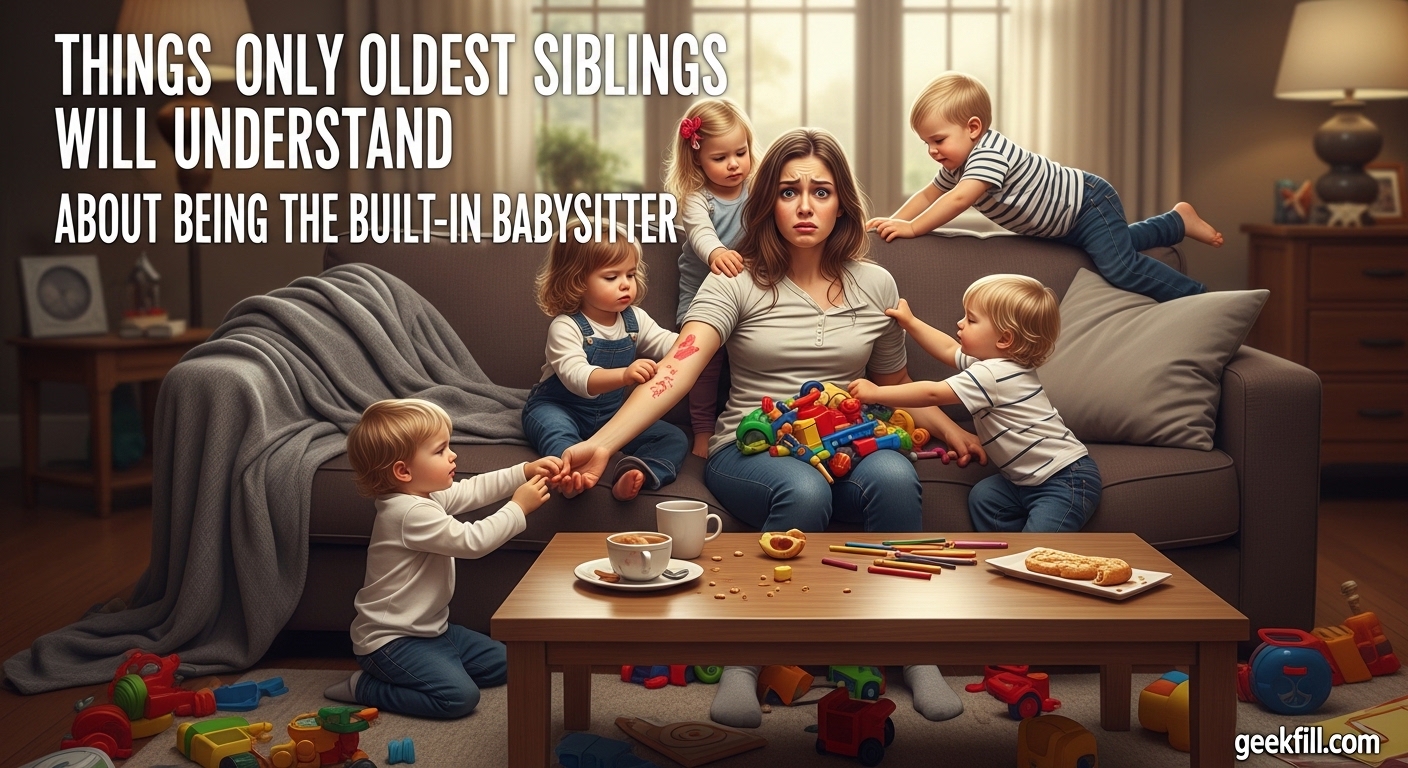
If you are the oldest sibling, you have probably heard the phrase “watch your brother” or “your sister is your responsibility” more times than you can count. You did not apply for the position of built-in babysitter. Nobody handed you a job description or asked if you wanted the gig. Yet somehow, you became the default childcare option the moment your parents needed to run errands, work late, or simply catch their breath.
I spent years of my childhood as the oldest sibling built-in babysitter, and the experience shaped me in ways I am only beginning to understand. The oldest child responsibilities started small. Maybe holding the baby while Mom cooked dinner. Then it escalated to full weekend afternoons alone with toddlers while parents went shopping. Before you knew it, you were scheduling your entire teenage social life around when you were needed at home.
This is not a complaint about loving your siblings. Most oldest siblings genuinely adore the younger ones they helped raise. But there is a difference between choosing to help and being expected to serve as unpaid childcare. Here are ten things only oldest siblings will understand about being the family babysitter.
Table of Contents
1. The “Third Parent” Identity That Stuck
There is a psychological term called parentification, and it perfectly describes what happens to many oldest siblings. You stop being just a brother or sister and start functioning as a third parent in the household.
I remember being twelve years old and knowing exactly how to warm a bottle, check a diaper, and soothe a crying toddler. My friends were still playing with dolls. I was already living the reality. The shift happens gradually, almost invisibly, until one day you realize your siblings see you as an authority figure instead of a playmate.
That identity does not fade when you become an adult either. Years later, at family gatherings, you still find yourself checking that everyone has eaten or stepping in when younger siblings argue. The third parent role becomes permanent.
2. Plans Cancelled Because Someone Had to Watch the Kids
Every oldest sibling has a collection of memories where their social life took a backseat to babysitting duty. Birthday parties missed because both parents worked. Sleepovers declined because there was nobody else to watch the baby. Movies skipped because “we need you home by six.”
The forum insights from other oldest siblings tell the same story. One person wrote, “I was a built-in babysitter from age twelve to nineteen. It is not okay. I am never having children because I already raised four.” That comment resonated with thousands who recognized their own lost childhood in those words.
What stings most is not the individual events you missed. It is the cumulative effect of always being the responsible one while your friends enjoyed normal teenage freedom. You learned early that your needs came second to family obligations.
3. Being Called “Mean” When You Are Just Enforcing Rules
Here is a scenario every oldest sibling recognizes. Your parents leave the house with instructions about bedtime, screen limits, or homework. You try to follow those rules. Your younger sibling rebels. Tears happen. Then your parents return to find chaos, and suddenly you are the villain.
Being the oldest sibling means walking an impossible tightrope. If you enforce the rules, you are mean and bossy. If you relax the rules, you are irresponsible. There is no winning position, only different ways to disappoint someone.
The emotional labor of this dynamic is exhausting. You are not paid like a real babysitter would be. You have no real authority like a parent has. Yet you are expected to perform childcare and discipline simultaneously. No wonder so many oldest siblings grow up feeling misunderstood.
4. The Unpaid Labor Nobody Acknowledged
Real babysitters get paid. They charge hourly rates, sometimes fifteen to twenty dollars per hour or more. They go home when their shift ends. They are thanked and appreciated for their service. Oldest siblings get none of that.
The unpaid childcare provided by oldest siblings represents thousands of dollars in value over the course of childhood. If you babysat two afternoons per week from ages twelve to sixteen, that is roughly four hundred sessions of free labor. At even ten dollars per hour, your parents received over six thousand dollars worth of childcare from you alone.
What makes it worse is watching younger siblings get paid for basic chores while your babysitting was framed as “helping the family.” The message becomes clear. Your labor is expected. Their labor is compensated.
5. Your Childhood Ended Earlier Than Everyone Else’s
Firstborn children often mature faster than their siblings, and not always by choice. When you are responsible for younger children, you do not have the luxury of being carefree. You learn to anticipate needs, manage conflicts, and prioritize safety.
I watched my younger siblings enjoy childhood freedoms I never had. They played outside without checking on babies. They went to friends’ houses without worrying about who would make dinner. They had actual weekends instead of babysitting shifts.
Psychologists call this role compression. The oldest child compresses their own developmental needs to accommodate family demands. It creates capable, responsible adults who sometimes struggle to remember what it felt like to just be a kid.
6. When Your Friends Became “Too Loud” or “Not Appropriate”
Having friends over as the oldest sibling was always complicated. Your friends wanted to hang out and be normal teenagers. But there were babies napping, toddlers who needed supervision, and parents who expected you to set a good example.
Suddenly your friends were “too loud” for the house. Their music was “inappropriate” for little ears. Their language needed monitoring. Instead of relaxing with peers, you became the fun police, shushing everyone and apologizing to parents.
Many oldest siblings solved this by simply not having friends over. It was easier to go to other people’s houses than to manage the chaos of hosting. That solution worked practically but created social distance. You were always the guest, never the host. Always fitting into other people’s spaces rather than claiming your own.
7. The Double Standard of “Because You’re Older”
Nothing triggers oldest sibling rage quite like the phrase “because you are older.” It is the universal excuse for unequal treatment. You must share because you are older. You must apologize first because you are older. You must babysit because you are older.
The phrase never works in reverse. When do younger siblings have to give you the bigger piece because you are older? When do they have to respect your needs because you are older? The double standard only flows one direction.
This creates resentment that can damage sibling relationships for years. You love your siblings, but you also feel the injustice of being held to standards they will never face. The oldest child responsibilities were never negotiable. They were simply expected.
8. Learning Skills You Never Asked For
By the time I left for college, I could change a diaper in thirty seconds, negotiate a truce between fighting children, and cook dinner for five people using whatever was in the pantry. These are useful skills. I never asked to learn them.
Oldest siblings become accidental experts in childcare, conflict resolution, and household management. We know how to soothe nightmares and which foods cause choking hazards. We can spot the warning signs of a tantrum brewing from across the room.
These skills transfer to adulthood in interesting ways. Many oldest siblings excel in leadership positions and caring professions. But we also sometimes feel like our childhood was a training program we did not choose to attend. Competence is not the same as consent.
9. The Love-Hate Relationship with Your Siblings
This might be the most complicated truth of all. You can love your siblings fiercely and resent them simultaneously. You can be proud of the people they became and angry about the childhood you sacrificed for them.
The built-in babysitter dynamic creates conflicting emotions that are hard to explain to people who have not lived it. Your siblings did not ask to be babysat by you any more than you asked to babysit them. They were children too, caught in the same family system.
As adults, many oldest siblings work to redefine these relationships. We want to be siblings, not substitute parents. We want friendships instead of authority dynamics. But years of habit are hard to break, and the love-hate tension can persist well into adulthood.
10. You Are Still The Default Emergency Contact
Years after moving out, you might think the built-in babysitter days are over. Think again. When your parents need someone to pick up a sick grandchild from school, they call you first. When your adult siblings have a crisis, you are the one they expect to step in.
The patterns established in childhood do not disappear. You are still the responsible one. Still the fixer. Still the person everyone assumes will handle emergencies because that is what you have always done.
Some oldest siblings embrace this role. Others set boundaries and step back. Neither choice is wrong. What matters is recognizing that being the oldest sibling built-in babysitter was not just a phase. It was an identity forged in childhood that follows you throughout life.
Frequently Asked Questions About Oldest Sibling Dynamics
What is elder sibling syndrome?
Elder sibling syndrome refers to the psychological and behavioral patterns that develop in firstborn children who are expected to serve as role models and caregivers for younger siblings. It often involves premature maturity, excessive responsibility, and feelings of being misunderstood or burdened by family expectations.
Are older siblings supposed to take care of younger siblings?
There is no universal rule requiring older siblings to care for younger ones. While helping occasionally is reasonable, expecting consistent unpaid childcare crosses into parentification. Healthy family dynamics recognize that older siblings deserve their own childhood and should not serve as default babysitters.
Should you pay an older sibling to babysit?
Yes, compensating older siblings for regular babysitting is recommended. Payment acknowledges the value of their time and labor. Fair rates help prevent resentment and teach younger siblings that childcare is valuable work. Even small payments or trade arrangements show respect for the oldest child’s sacrifice.
At what age can a sibling babysit their younger sibling?
Most experts recommend ages twelve to fourteen for short periods with infants, and younger for brief supervision of older children. However, age alone does not determine readiness. Maturity, emergency training, and the specific children’s needs matter more than a specific age cutoff.
Which sibling is hardest to be?
Each birth order position has unique challenges. However, research suggests oldest siblings often face the most pressure due to role model expectations, parentification risks, and the burden of being first to navigate every developmental stage. The intensity varies significantly based on family dynamics and parental expectations.
Final Thoughts on Being the Built-In Babysitter
If you recognized yourself in these ten experiences, know that your feelings are valid. Being the oldest sibling built-in babysitter is a real phenomenon with lasting psychological effects. The resentment you sometimes feel does not cancel out the love you have for your family.
Our team has researched oldest sibling experiences extensively, and the patterns are remarkably consistent across cultures and generations. The unpaid childcare, the lost freedom, the pressure to be perfect. These are not imaginary grievances. They are documented effects of birth order expectations and parentification.
If you are currently living this reality as a young oldest sibling, consider setting boundaries. Talk to your parents about fair compensation or reduced babysitting loads. Your childhood matters too. And if you are an adult oldest sibling still carrying these patterns, remember that it is never too late to redefine your role in the family. You were more than a babysitter. You still are.