
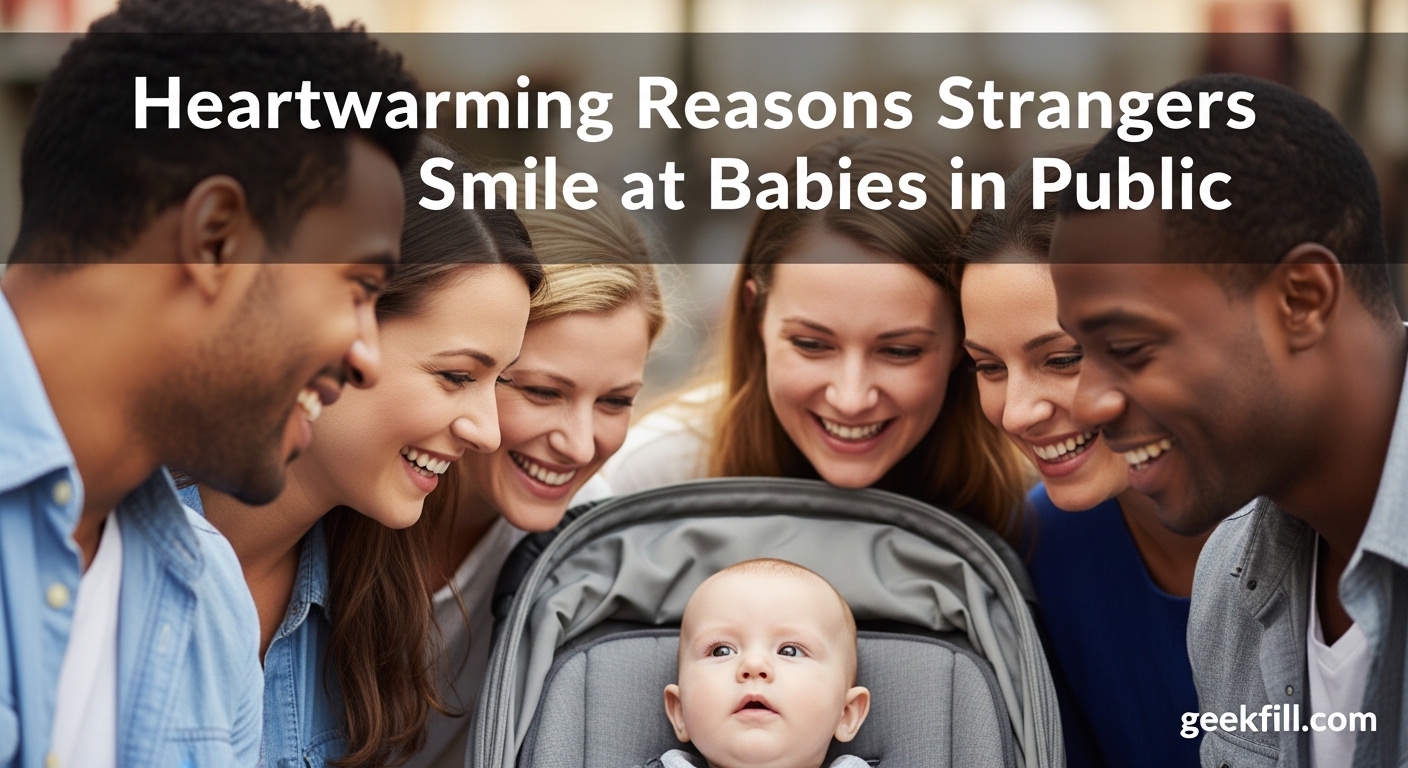
Picture this: You are waiting in line at the grocery store. A parent walks in pushing a stroller, and inside sits a bright-eyed baby who looks around the store with pure wonder. Before you even realize it, you find yourself grinning from ear to ear. You are not alone. Within seconds, half the people in line are doing the same thing.
Why does this happen so automatically? Why do strangers feel this instant pull to smile at babies they have never met? The heartwarming reasons strangers smile at babies in public go deeper than simple politeness. They tap into something fundamental about what makes us human.
In this guide, I will share 12 heartwarming reasons that explain this beautiful phenomenon. Each reason draws from psychology, evolutionary biology, and the shared experiences that connect us all.
Table of Contents
1. They Trigger Our Hardwired Nurturing Instinct
Babies activate what scientists call “baby schema” or Kindchenschema. This is a specific set of features including large eyes, round faces, small noses, and chubby cheeks that evolution programmed us to find irresistible.
When we see these features, our brains release dopamine and oxytocin. These are the same chemicals associated with love and bonding. We smile because on a biological level, we are being rewarded for noticing something that needs protection and care.
This response is not limited to parents. Studies show that adults without children respond just as strongly to infant features. It is humanity’s built-in insurance policy that ensures the youngest and most vulnerable members of our species receive attention and protection.
2. Babies Represent Pure Potential and Hope
There is something profound about looking at a baby that reminds us of what is possible. They have not yet faced disappointment, heartbreak, or the cynicism that can weigh down adult life. They represent a blank slate full of potential.
When we smile at a baby, part of us is acknowledging that the future still holds promise. In a world that often feels heavy with bad news, a baby is living proof that life continues and new beginnings are always possible.
I have heard parents say that complete strangers will stop them just to say, “Enjoy every moment. They grow up so fast.” That sentiment captures what babies represent: hope for tomorrow wrapped up in a tiny package.
3. Their Joy Is Contagious
Have you ever noticed how impossible it is not to smile back when a baby grins at you? This is not just politeness. It is emotional contagion at work.
Our brains contain mirror neurons that fire both when we perform an action and when we observe someone else performing that action. When a baby smiles, our mirror neurons activate the same neural pathways we use when we smile ourselves. We do not just see their joy. We feel it.
Research published by the British Psychological Society confirms that baby smiles trigger genuine positive emotions in adults. The more authentic the baby’s smile (what psychologists call a “Duchenne smile” that reaches the eyes), the stronger our response.
4. Large Eyes Activate Our Caregiving Response
Baby eyes are proportionally much larger than adult eyes, and this is not an accident. Those big, bright eyes are evolutionary magnets for attention and care.
Scientists have found that when adults look at photos of babies with enlarged eyes, their brains show increased activity in regions associated with caretaking and reward. The effect is so powerful that we even respond this way to baby animals with large eyes, like puppies and kittens.
When a baby makes eye contact with you in public, those oversized eyes are essentially pressing the “care” button in your brain. Your smile is an automatic response to that ancient biological signal.
5. They Remind Us of Our Own Children or Grandchildren
For parents and grandparents, seeing a baby in public often triggers powerful memories. That little face might remind them of their daughter at that age, or their grandson when he was just starting to explore the world.
These nostalgia-driven smiles come from a place of warm remembrance. The stranger smiling at your baby might be mentally transported back to midnight feedings, first steps, or the particular way their own child used to giggle.
From forum discussions, I learned that many older adults especially gravitate toward babies in public. One grandparent shared that smiling at other people’s babies helps them feel connected to their own grandchildren who live far away.
6. Smiling Is Our Way of Saying Hello Without Words
Babies cannot hold conversations, but they are remarkably skilled at non-verbal communication. A smile becomes the universal language we use to bridge that gap.
When a stranger smiles at a baby, they are initiating social contact in the purest form. There are no agendas, no small talk, no awkward silences. Just a simple acknowledgment that says, “I see you, and I welcome your presence in this space.”
This wordless greeting crosses language barriers, cultural differences, and generational gaps. It is perhaps the most democratic form of human connection available to us.
7. Babies Make Us Feel More Connected to Humanity
In an increasingly isolated world where we often avoid eye contact with strangers, babies break down social barriers. They give strangers permission to acknowledge each other’s existence.
When multiple adults gather around a stroller to coo at a baby, something magical happens. For those moments, the checkout line becomes a community. The bus stop becomes a gathering place. Complete strangers become connected through their shared appreciation of something beautiful.
These micro-moments of connection remind us that we are not just individuals navigating public spaces. We are members of a human community that continues generation after generation.
8. We Want to Reward Their Social Bravery
When a baby ventures a smile at a stranger, they are taking a social risk. They do not know if this new person will respond kindly. When we smile back, we are rewarding that bravery.
Psychologists call this “anticipatory smiling” when babies use smiles to initiate social interaction. It is a sophisticated social skill that develops around 8 to 10 months. Babies who master this skill tend to show stronger social competence later in childhood.
By smiling back at a baby’s tentative grin, strangers are actually supporting that child’s social development. We are providing positive reinforcement that helps babies learn their smiles have power to create connection.
9. Their Innocence Feels Like a Breath of Fresh Air
Adult life comes with complications. We navigate politics at work, manage difficult relationships, worry about finances, and process endless streams of troubling news. Babies exist outside all of that.
When we encounter a baby in public, their innocence creates a temporary refuge from adult concerns. Their biggest worry is when they will eat next or whether they want to be held. There is something deeply refreshing about being reminded that life can be that simple.
Our smiles acknowledge this relief. For a moment, we are not thinking about deadlines or bills. We are simply present with something pure and uncomplicated.
10. They Make Us Remember Life’s Simple Pleasures
Watch a baby in a public space, and you will see them find wonder in things adults ignore. The ceiling fan spinning overhead. The way light filters through a window. The sound of a distant siren.
Babies experience the world with fresh eyes, and their curiosity is contagious. When we smile at a baby staring fascinated at something mundane, part of us is remembering when we experienced that same wonder.
Parents in online forums often mention how strangers comment that babies “remind us to slow down.” That smile is partly gratitude for the reminder that joy does not require grand experiences. Sometimes it just takes noticing the spinning fan.
11. Smiling Back Feels Like a Tiny Act of Kindness
In a world where we often feel powerless to make a difference, smiling at a baby is something positive we can do right now. It requires no money, no special skills, and no time commitment.
This micro-interaction gives us a small hit of the “helper’s high” that comes from prosocial behavior. We feel good because we did something kind, even if that something was as simple as returning a smile.
Research shows that even small acts of connection improve our mood and sense of wellbeing. When you smile at a baby, you are not just making their day a little brighter. You are making your own day better too.
12. They Give Us Permission to Be Playful
Adult life often demands seriousness. We wear professional faces to work. We maintain composure in public. We worry about what others think of us.
Babies do not care about any of that. They will stick out their tongue, make funny faces, or break into delighted giggles without a hint of self-consciousness. And when they do, they give everyone around them permission to be playful too.
A stranger making silly faces at a baby in the checkout line is experiencing something rare: socially sanctioned playfulness. The baby is their excuse to drop the adult mask for a moment and simply be joyful.
The Psychology Behind Baby Smiles
Understanding why we smile at babies requires looking at what psychologists have discovered about infant communication. Babies do not smile randomly. They use smiles strategically as their primary tool for social engagement.
The anticipatory smile is one of the most significant developments in infant social skills. This occurs when a baby looks at an object, then smiles while looking at an adult to share their positive feelings about that object. It represents the beginnings of joint attention, a foundational skill for human communication.
Duchenne smiles are genuine expressions of joy that involve both the mouth and the eyes. When babies give these authentic smiles, adults can tell the difference, and their response is stronger and more genuine in return.
Research from the British Psychological Society shows that babies as young as 6 months use smiles to regulate social interactions. They smile more when someone smiles at them, creating a positive feedback loop that strengthens social bonds.
Frequently Asked Questions
Why do babies smile at some strangers and not others?
Babies are remarkably perceptive about social cues. They often smile at strangers who appear friendly, relaxed, and open to interaction. They may avoid smiling at people who seem stressed, aggressive, or whose body language feels threatening. Some research suggests babies can pick up on subtle facial expressions and tone of voice that signal whether someone is safe and approachable.
Can babies sense a good person?
While babies cannot magically detect morality, they are skilled at reading emotional signals and social cues. Studies show infants prefer people who are helpful rather than harmful, and they notice when someone is kind to others. They respond to warmth, gentle voices, and open body language. This perceptiveness helps them navigate social interactions and identify potential caregivers.
Why are you supposed to smile at babies?
Smiling at babies supports their social and emotional development. When adults smile back at babies, they teach infants that their communication efforts work. This positive reinforcement helps babies learn that they can influence their social environment. Research shows that responsive smiling from adults helps babies develop secure attachment patterns and stronger social skills later in childhood.
What does it mean when a baby smiles at you?
When a baby smiles at you, they are initiating social contact and expressing positive feelings. This is a significant developmental milestone showing they feel safe and interested in connecting. It could mean they find you approachable, they want to interact, or they are practicing their newfound social skills. Consider it a compliment that this little human has chosen you for a moment of connection.
Why do strangers feel compelled to smile at babies?
Strangers smile at babies due to a combination of biological programming and emotional response. Evolution has equipped humans with nurturing instincts triggered by baby features like large eyes and round faces. Additionally, babies represent hope, innocence, and joy that contrasts with adult concerns. The smile is often automatic, rewarding the smiler with positive emotions through emotional contagion.
Conclusion: The Beautiful Truth About Public Baby Smiles
The next time you find yourself grinning at a stranger’s baby in the checkout line or on the bus, know that your response is both deeply human and wonderfully complex. Those 12 heartwarming reasons strangers smile at babies in public reveal something beautiful about who we are as a species.
We are wired to care for the vulnerable. We seek connection in a disconnected world. We remember our own pasts when we see the future in a baby’s eyes. Most importantly, we have not lost our capacity for spontaneous joy.
So keep smiling at those babies. You are not just being nice. You are participating in one of humanity’s oldest traditions: welcoming the next generation with open hearts and genuine smiles.