
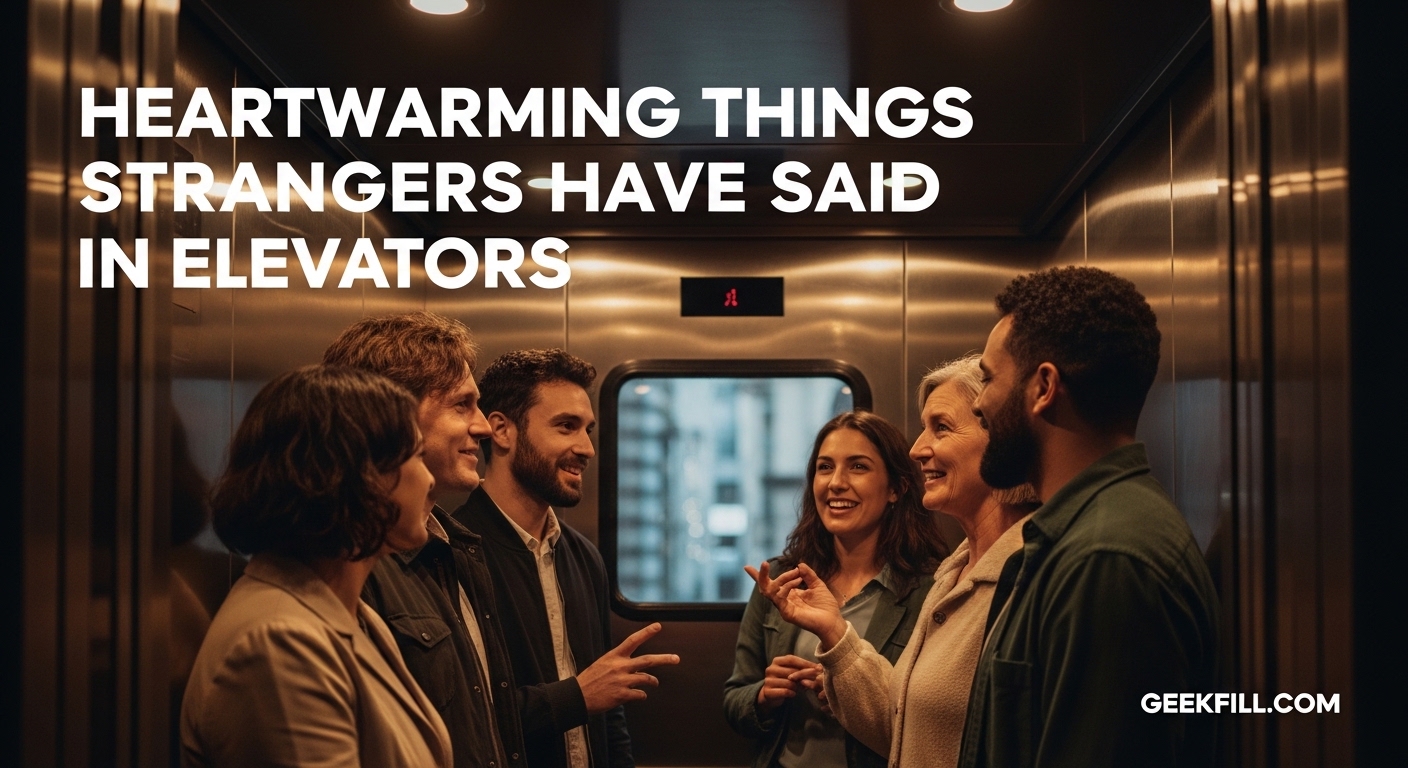
We have all experienced that peculiar silence that descends when strangers pack into a small metal box suspended between floors. Eyes dart to the numbered buttons, the floor indicator, or anywhere else to avoid accidental connection.
Yet sometimes, in those brief 30-second journeys between floors, magic happens. A stranger breaks the unspoken rule of elevator etiquette and says something so unexpectedly kind that it stays with you for years.
I have collected eight heartwarming things strangers have said in elevators that stuck with people forever. These are the moments that remind us humanity still exists in our busiest, most impersonal spaces.
Table of Contents
1. The “I Hope Your Day Gets Better” Moment
Sarah had just spent forty-five minutes crying in her car after receiving devastating news about her grandmother’s health. She thought she had composed herself enough for the elevator ride up to her office on the twelfth floor.
She was wrong. The tears started flowing again the moment the doors closed.
An older woman standing in the corner noticed immediately. Instead of looking away uncomfortably, she reached out and touched Sarah’s shoulder gently. “I hope your day gets better,” she said softly. “Whatever it is, you are stronger than you think.”
The doors opened at the seventh floor, the woman stepped out, and Sarah never saw her again. That was three years ago. Sarah still thinks about that stranger whenever she has a difficult day. Those nine words became a mantra she repeats to herself during hard moments.
Sometimes the simplest acknowledgment of struggle is exactly what we need to keep going.
2. The Birthday Surprise
Marcus was turning thirty and had never felt more alone. He had just moved to a new city for work, leaving behind family and friends. His birthday fell on a Wednesday, and he spent the morning pretending it was just another ordinary day.
At 7:45 AM, he stepped into the elevator of his apartment building carrying a small cupcake he had bought for himself. An elderly man noticed the cupcake and asked if it was someone’s birthday.
Marcus admitted it was his. The man immediately broke into a huge grin and started singing “Happy Birthday” at full volume. By the time they reached the lobby, three other residents had joined in. A woman Marcus had never met gave him a hug and said, “Thirty is going to be your best year yet. I can feel it.”
That impromptu elevator concert still makes Marcus smile every birthday. He now makes a point to wish happy birthday to any stranger he sees carrying cake or wearing a birthday pin.
3. The “You Look Beautiful Today” Comment
Jessica was attending a conference in Chicago and feeling completely out of her element. She was the youngest person in her company attending, and imposter syndrome had her in its grip. She had spent an hour that morning trying to look professional enough to belong.
In the hotel elevator, an elderly woman turned to her as they descended to the lobby. “You look beautiful today,” she said with genuine warmth. “That color suits you perfectly.”
Jessica was wearing a navy blazer she had second-guessed a dozen times that morning. The compliment wasn’t flirty or creepy. It was the pure, uncomplicated kindness that grandmothers specialize in.
Jessica walked into her first conference session standing taller. Six years later, that blazer still hangs in her closet even though it no longer fits. She keeps it as a reminder that confidence can come from the most unexpected places.
4. The Interview Encouragement
David was riding the elevator to the forty-second floor for the biggest interview of his life. His palms were sweating through his resume folder. He had rehearsed answers all night but suddenly couldn’t remember his own name.
A woman in a sharp suit noticed his nervousness. “First interview?” she asked with a knowing smile.
David admitted it was for his dream job. The woman looked him directly in the eye and said, “They are lucky to get thirty minutes of your time. Remember that you are interviewing them too. You have everything you need already.”
She got off two floors before his stop, but her words completely shifted his mindset. David walked into that interview room seeing himself as a valuable professional, not a desperate candidate.
He got the job. He never saw the woman again to thank her, but he now offers the same encouragement whenever he spots nervous candidates in his building’s elevators.
5. The New Parent Acknowledgment
Rachel hadn’t slept more than three consecutive hours in six weeks. Her newborn was colicky, and she was running on pure adrenaline and cold coffee. She barely recognized herself in the mirror anymore.
She shuffled into the elevator of her residential building wearing yesterday’s shirt, dried milk stains and all, pushing the stroller with one hand while holding a diaper bag with the other.
A middle-aged man held the door for her. Instead of the usual awkward silence, he looked at the baby, then at Rachel, and said, “You are doing an incredible job. The hardest weeks pass, and you will look back and be amazed at your own strength.”
Rachel burst into tears on the spot. Not sad tears. Tears of being truly seen for the first time in weeks.
That stranger acknowledged the invisible labor of new parenthood that so often goes unrecognized. Rachel is now the one who offers kind words to exhausted parents she encounters in elevators and grocery stores.
6. The “You Got This” Before a Presentation
Thomas was about to deliver a presentation to five hundred people at a major conference. He had spent months preparing, but as he rode the elevator to the ballroom level, panic set in. His hands were shaking so badly he dropped his clicker.
A teenager in the elevator picked it up for him. “Big presentation?” the kid asked.
Thomas nodded, trying to appear calm. The teenager handed back the clicker and said, “You got this. Seriously. You wouldn’t be here if you didn’t. Just talk like you are explaining it to one person who really wants to know.”
Thomas laughed and asked if the kid was some kind of motivational speaker. “Nah,” the teenager grinned. “Just been watching a lot of TED talks.”
Thomas delivered that presentation with unexpected confidence. He still uses the “one person who really wants to know” technique whenever he speaks publicly.
7. The Elderly Gentleman’s Wisdom
Jennifer was visiting her father at a hospital after his surgery. She was emotionally exhausted from the week-long bedside vigil and the uncertainty of his recovery. The elevator ride to the parking garage felt like the longest journey of her life.
An elderly gentleman in a tweed jacket noticed her red-rimmed eyes. “Visiting someone?” he asked gently.
Jennifer nodded, not trusting her voice. The man waited a moment, then said, “I have learned that the hardest part of loving someone is the waiting. But here is what I know for sure: the love you are feeling right now is the point. Not the outcome. Just the love.”
The doors opened to the garage level. The man touched his hat and walked away without another word.
Jennifer sat in her car for twenty minutes processing what he had said. Her father recovered fully, but even if he hadn’t, those words would have changed how she remembered that difficult period. The love was indeed the point.
8. The “Thank You for Being Here” Genuine Gratitude
Michael was leaving a shopping mall on a rainy Saturday afternoon after buying absolutely nothing. He was in a foul mood, frustrated with his finances, his job, and his general life trajectory.
In the parking garage elevator, a young woman turned to him suddenly and said, “Thank you for being here.”
Michael was confused. “For being where?” he asked.
“For being here,” she repeated, gesturing vaguely around the elevator. “For existing. The world is better with you in it.” Then she got off at her floor.
Michael stood there stunned as the doors closed. A stranger had looked at him, really looked at him, and expressed gratitude for his mere existence. He walked to his car crying, but this time the tears felt like release rather than frustration.
That moment started a slow transformation in how Michael saw himself. He mattered. Simply by existing, he mattered to someone.
Why These Moments Stick With Us
Psychologists have long studied why small kindnesses from strangers can have outsized emotional impact. The answer lies in our expectations. We enter elevators prepared for silence, awkwardness, or at best, polite indifference.
When someone breaks that pattern with genuine warmth, it creates what researchers call a “positive interruption.” Our brains mark these moments as significant because they violate our predicted social script.
These elevator encounters are also uniquely powerful because they are completely non-transactional. The strangers have nothing to gain from being kind. They will likely never see us again. Their words are gifts given freely, with no expectation of return.
That purity of intent makes the kindness feel more real than compliments from friends or family, which our skeptical brains sometimes discount as obligation.
Can You Create These Moments Too?
After reading these stories, you might wonder if you could be the stranger who changes someone’s day. The answer is absolutely yes.
The most effective elevator kindness follows a simple formula. Be specific. Be brief. Be genuine. Comment on something you actually notice rather than generic compliments. Keep it to one or two sentences since you only have seconds. Mean what you say.
Pay attention to body language. Someone clearly absorbed in their phone probably wants to be left alone. But someone staring at the floor numbers with tension in their shoulders might welcome a kind word.
Start small. Hold the door. Compliment an accessory. Wish someone a good day with real warmth. You have no idea what battles the people around you are fighting.
What is the number one unspoken rule of riding an elevator?
The number one unspoken rule of riding an elevator is to maintain personal space and avoid unnecessary conversation. Most people expect a quiet ride with minimal eye contact, facing forward toward the doors. Breaking this silence with kindness can be surprisingly impactful precisely because it violates this expected norm of elevator etiquette.
What do elevators mean spiritually?
Spiritually, elevators often symbolize transitions, ascension, and movement between different states of being. They represent the journey between levels of consciousness or life stages. The confined space creates a temporary liminal zone where normal social rules relax, making elevators potent settings for unexpected spiritual connections and meaningful encounters with strangers.
What is the inspirational quote about the elevator?
A popular inspirational elevator quote states: ‘There is no elevator to success. You have to take the stairs.’ This quote emphasizes that achievement requires effort and persistence rather than shortcuts. However, the stories in this article show that while success may require stairs, kindness can be found in the elevators along the way.
Why do small kindnesses from strangers affect us so much?
Small kindnesses from strangers affect us deeply because they are completely non-transactional. Unlike kindness from friends or family, which we might dismiss as obligation, stranger kindness has no strings attached. These moments also violate our expected social scripts, creating what psychologists call a ‘positive interruption’ that our brains mark as significant and memorable.
These Heartwarming Things Strangers Said in Elevators That Stuck With People Forever
Elevators are strange spaces. We share them with strangers, suspended between destinations, avoiding connection while physically closer than we would ever voluntarily stand. Yet these eight stories prove that the most meaningful moments can happen in the most mundane places.
Each story shared here represents a real person who received exactly the words they needed at exactly the right time. The woman crying after bad news needed to hear she was strong. The lonely birthday celebrator needed to feel seen. The nervous interviewee needed to remember his own value.
The next time you step into an elevator, consider what you might say to the strangers around you. You have no idea what kind of day they are having. Your brief kindness might become the story they tell for years to come.
These heartwarming things strangers said in elevators that stuck with people forever remind us that human connection is always possible, even in the briefest of encounters. We just have to be brave enough to break the silence.
Have you ever experienced a moment of unexpected kindness in an elevator? Or have you been the one who spoke up and changed someone’s day? These are the stories that remind us we are all in this together, floor by floor, moment by moment.