
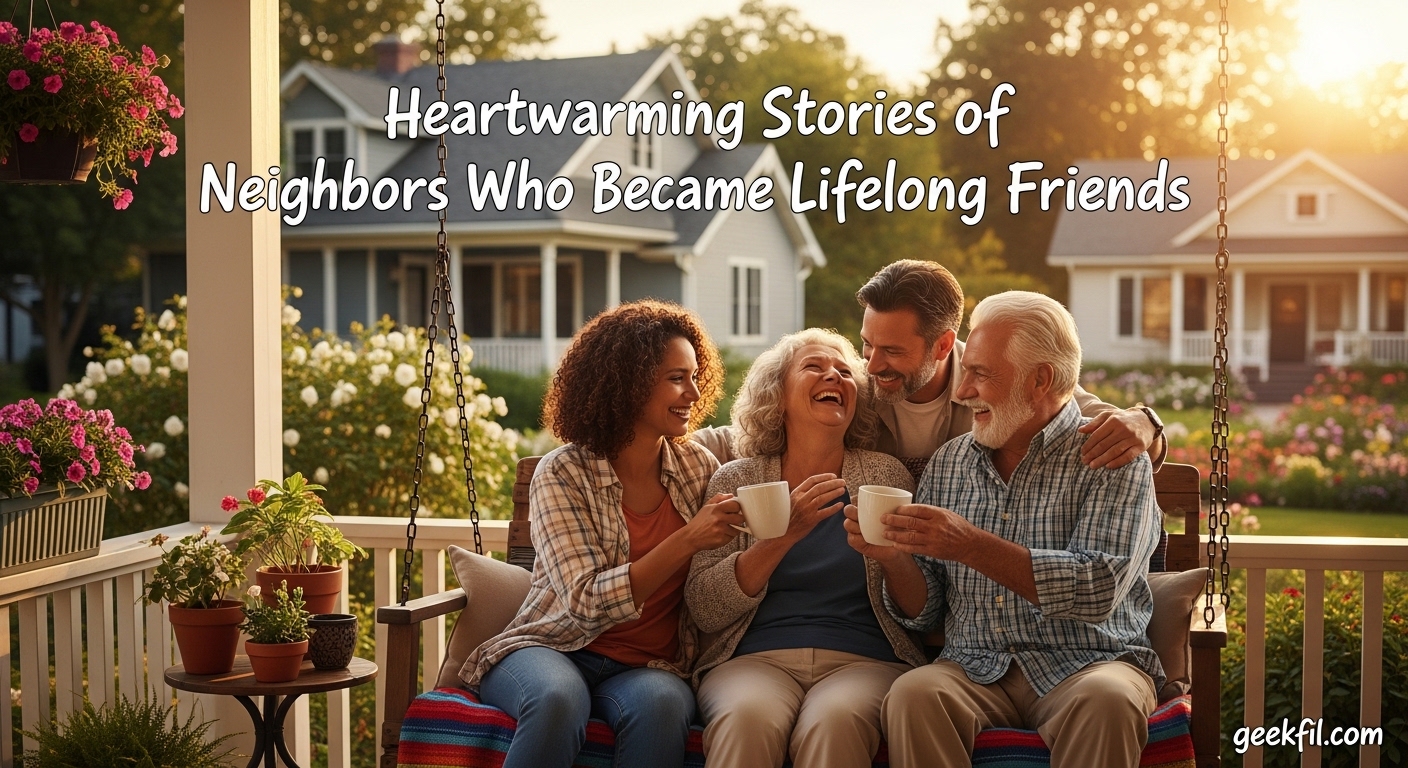
Some of the most beautiful friendships don’t begin at work, school, or through mutual connections. They start with a wave across the fence, a borrowed cup of sugar, or a simple smile in the driveway. These heartwarming stories of neighbors who became lifelong friends remind us that the people living closest to us often become the anchors in our lives.
I spent months collecting these true accounts from across the country. Each one follows the same pattern that researchers recognize as the foundation of lasting friendship: proximity, repeated positive interactions, and mutual vulnerability. These aren’t just feel-good tales. They’re blueprints for building the kind of community that sustains us through life’s hardest moments and amplifies its joys.
The eight stories you’re about to read span from rural Vermont to urban Chicago. They feature neighbors who met during blizzards, over garden fences, and even through property disputes that transformed into family barbecues. Each account includes the origin moment, the turning point, and the lasting impact that continues to this day.
Table of Contents
How These Heartwarming Stories of Neighbors Who Became Lifelong Friends Can Inspire Your Own Connections
The following stories share common threads that anyone can apply to their own neighborhood relationships. Small consistent gestures matter more than grand acts. Crisis creates connection when people show up authentically. And the relationships that last are built on daily presence, not occasional spectacular moments.
As you read, notice how these friendships began with simple observations. One neighbor noticed another struggling. Someone admired a garden. A smile became a wave, then a conversation, then a ritual that lasted decades. The lesson is clear: lifelong friendships with neighbors often start with the smallest possible opening.
Story 1: The Snowstorm That Melted Three Decades of Distance
In the Minneapolis suburbs, winter storms are a fact of life. But the blizzard of January 1992 was different. Temperatures dropped to twenty below zero, and power lines froze across entire neighborhoods. For eighty-two-year-old Margaret Chen, who lived alone in a modest rambler, this could have been a dangerous situation.
The young family next door, the Harrisons, had a generator. Tom and Sarah noticed Margaret’s house was dark. Tom knocked on her door, finding her wrapped in blankets with only a flashlight. “We have heat next door,” he said simply. “And plenty of hot cocoa.”
That first night became a week. The Harrisons’ children, ages six and eight, brought Margaret board games and helped her stay warm. Margaret, a retired teacher, read to them from her collection of classic children’s books. By the time power was restored, something had shifted between these neighbors who had previously only exchanged polite waves.
The ritual continued. Sunday dinners became monthly, then weekly. When Tom’s job required travel, Sarah knew Margaret was just a phone call away. When the Harrison children went to college, Margaret was the one they called for advice. Three decades later, Margaret is ninety-four and still lives in that same house. The Harrisons’ grandchildren now visit “Grandma Margaret,” though no blood ties exist.
“She taught us what family really means,” Sarah Harrison told me. “It isn’t about genetics. It’s about who shows up when the power goes out and stays long after it returns.”
Story 2: Coffee on the Porch: A Forty-Year Ritual
In Charleston, South Carolina, porches aren’t just architectural features. They’re the living rooms of the neighborhood. In 1984, two couples moved onto the same street within months of each other. The Millers and the Washingtons lived four houses apart, both with wide wraparound porches perfect for rocking chairs.
Their friendship began with morning waves while retrieving newspapers. Then came the comments about azaleas, the weather, the traffic. One humid July morning, Eleanor Miller called out to James Washington: “I’m making coffee. Would you and Delores like to join us on the porch?”
That invitation became a ritual. Every morning at seven, regardless of weather, the two couples met on one porch or the other. They shared coffee, stories, and the small details of daily life. When Eleanor’s mother fell ill, Delores brought casseroles. When James lost his job, the Millers quietly covered their mortgage payment until he found new work.
Their children grew up together. Shared birthday parties became shared graduations, weddings, and eventually the grandchildren’s birthday parties. When James passed away in 2019, Eleanor spoke at his funeral. “For forty years, he was the first person I saw every morning,” she said. “A day without that porch time felt incomplete.”
Delores Washington still has coffee on her porch every morning at seven. The empty rocking chair beside her remains in place. “Some friendships are measured in decades,” she told me. “Ours was measured in seven thousand mornings, and each one was a gift.”
Story 3: The Garden That Grew a Bridge Between Generations
Portland, Oregon attracts transplants seeking a slower pace of life. Marcus Chen was one of them, a thirty-two-year-old software developer who bought a fixer-upper in a quiet neighborhood. His next-door neighbor was Helen Bryson, seventy-eight, a retired high school English teacher who had lived in her home for forty years.
Their first real conversation happened over Marcus’s fence. He was struggling to grow tomatoes in his small backyard plot. Helen, tending her own abundant vegetable garden, couldn’t help but notice his wilted plants. “You’re watering them too much,” she called out. “Tomatoes like to be a little thirsty.”
That advice led to weekly garden consultations. Helen taught Marcus about soil composition, companion planting, and the patience required to grow food. Marcus helped Helen with tasks that had become difficult: heavy lifting, technology questions, and eventually grocery runs when her driving became unsafe.
Their harvest became a shared celebration. Every August, they hosted a neighborhood dinner featuring vegetables they had grown together. Helen shared stories of the neighborhood’s history. Marcus shared perspectives from his generation. They debated politics, discussed books, and discovered that their age difference was their friendship’s greatest asset.
“Marcus keeps me connected to the world as it changes,” Helen explained. “I keep him connected to what matters regardless of how the world changes.” Fifteen years later, their gardens are still side by side. So are their hearts.
Story 4: When Language Barriers Became the Foundation for Friendship
Houston, Texas is one of America’s most diverse cities. The Nguyen family arrived in 2004, refugees from Vietnam with limited English skills. Their neighbors, the Rodriguez family, had lived in the same home for three generations. The language barrier seemed insurmountable, but the language of kindness needs no translation.
Maria Rodriguez noticed the Nguyen children playing quietly in their yard. She brought over homemade tamales as a welcome gift. Mrs. Nguyen responded with Vietnamese spring rolls the next day. The food exchange continued for months, accompanied by smiles, gestures, and the growing trust that comes from consistent generosity.
The turning point came during a medical emergency. Mr. Nguyen collapsed in his driveway. Maria called 911 and used a translation app to communicate with Mrs. Nguyen while they waited for paramedics. She stayed at the hospital until family arrived, sitting silently in solidarity.
When Mr. Nguyen recovered, the families became inseparable. The Rodriguez children began learning Vietnamese phrases. The Nguyen children helped the Rodriguezes’ grandmother with technology. They celebrated Tet and Quinceaneras together. Twenty years later, their families have intermarried, creating a beautiful blend of cultures that began with a plate of tamales and a smile.
“We don’t speak the same language perfectly,” Maria Rodriguez told me. “But we speak the language of family, and that’s all that matters.”
Story 5: The Night Shift Nurse and the Midnight Baker
Chicago apartment buildings house millions of stories in their hallways. In a vintage walk-up in Lincoln Park, two residents shared an unusual schedule pattern. Rachel Torres was a night shift ICU nurse who returned home at 5am. David Kim was a pastry chef who left for work at 4:30am to prepare dough at his bakery.
For months, they passed each other silently in the pre-dawn hallway. Then David noticed Rachel’s exhaustion one morning after a particularly difficult shift. The next day, a bag of fresh croissants appeared at her door with a note: “For the person who keeps people alive while the city sleeps.”
That gesture sparked a friendship built on opposite schedules. Rachel would leave notes about how the pastries helped her through rough nights. David would ask about her patients in general terms, learning the emotional weight of her work. They began leaving small gifts for each other: coffee beans, handmade cards, books.
When Rachel’s mother was diagnosed with cancer, David adjusted his schedule to be home when she returned from difficult shifts. He brought bread, listened, and provided the consistency of someone who simply showed up. When David’s bakery struggled during economic downturns, Rachel organized neighborhood support and became his most vocal advocate.
Twelve years later, they still share that hallway. “We may only see each other for five minutes a day,” Rachel said. “But those five minutes have carried me through the hardest nights of my life.”
Story 6: From Property Line Dispute to Family Barbecues
Not every beautiful friendship begins with kindness. Sometimes it begins with conflict that reveals character. In Phoenix, Arizona, two neighbors started their relationship with a heated argument about a fence line. Mike Peterson had recently installed a new boundary marker. Tom Silva insisted it encroached on his property by six inches.
Lawyers were consulted. Surveyors were called. The neighborhood watched as two grown men argued about six inches of desert scrubland. Then Tom’s wife was diagnosed with early-stage breast cancer. Mike noticed Tom sitting alone in his yard, looking defeated, and something shifted.
“I brought over a casserole,” Mike admitted, laughing at the memory. “I was still mad about the fence, but I couldn’t watch a man suffer like that.” Tom accepted the food. They talked for three hours. The fence was never mentioned. What they discovered was that both were veterans, both had lost parents to cancer, and both valued family above all else.
Tom’s wife recovered. The fence was adjusted amicably. But something more important emerged: a friendship that surprised everyone who knew them. They began hosting joint family barbecues. Their children became best friends. When Mike’s business failed in 2008, Tom provided work at his construction company. When Tom’s mother needed care, Mike’s wife volunteered daily.
“We started as enemies over six inches of dirt,” Tom reflected. “Now I’d give him six feet of my own skin if he needed it. That’s what eighteen years of friendship does.”
Story 7: The Neighborhood That Became a Village
Denver, Colorado has experienced explosive growth, bringing waves of newcomers who often feel isolated in new developments. In one such neighborhood, Susan Park noticed something troubling. Families moved in, stayed for two years, then moved on. No one knew each other. Children played alone. Adults commuted silently.
In 1999, Susan took a risk. She created flyers for a “New Neighbors Potluck” and distributed them to every home on her street. Twelve families showed up. They brought dishes from their heritage: Korean bulgogi, Mexican tamales, Italian pasta, American casseroles. The diversity was remarkable. The hunger for connection was universal.
That potluck became monthly, then evolved into a true support network. When a single mother needed emergency childcare, three neighbors volunteered. When an elderly resident fell, someone was always nearby. When teenagers needed part-time jobs, local business owners in the neighborhood provided opportunities.
The friendship between Susan and her immediate neighbor, David Chen, became the model. They started the potluck together and continued organizing events for twenty-five years. Their children grew up as siblings. When Susan’s husband died unexpectedly, David’s family moved into her home for three months to help her grieve and manage practical affairs.
“Susan taught me that one person can transform a street into a village,” David said. “She started with a flyer and a pot of chili. Now we have a community that raises each other’s children and will care for each other until the end.”
Story 8: A Can of Soup and a Friendship That Outlasted Cancer
Rural Vermont offers stunning beauty and isolation in equal measure. In a small town of eight hundred residents, Linda Moore lived in a farmhouse that had been in her family for generations. Her neighbor, Patty Williams, ran an organic dairy operation across the road. They knew each other casually, exchanging waves and occasional farm equipment loans.
In the fall of 2013, Linda was diagnosed with stage three breast cancer. Her husband had passed years earlier, and her children lived across the country. She planned to face treatment alone, not wanting to burden anyone. Patty noticed Linda’s weakened appearance during her daily barn chores and simply showed up at Linda’s door with a can of homemade soup.
“I’m not asking,” Patty said. “I’m telling you. You’re coming to dinner tonight, and every night until you’re through this.” That directness was pure Vermont. Linda, too tired to argue, accepted. What followed was eleven months of daily support. Patty drove Linda to chemotherapy appointments two hours away. She organized meal trains with other neighbors. She sat with Linda through the nights when nausea and fear made sleep impossible.
When Linda entered remission, the friendship had transformed into something unbreakable. They began traveling together, taking the cruises Linda had always dreamed of. They started a support group for rural women facing cancer isolation. Eleven years later, Linda is healthy, and their friendship is stronger than ever.
“She didn’t just save my life with soup and rides to the hospital,” Linda told me, wiping away tears. “She reminded me that even in the most isolated places, we’re never truly alone if we allow people in.”
What These Heartwarming Stories Teach Us About Neighbor Friendships
Eight stories from across America reveal consistent patterns about how neighbors become lifelong friends. Every friendship began with observation. Someone noticed something: a struggle, a garden, a schedule, a need. The people who formed lasting bonds were those who acted on those observations rather than looking away.
Consistency mattered more than grand gestures. The daily coffee, the weekly harvest dinner, the morning pastry, the monthly potluck. These small rituals created the foundation that supported larger acts of love during crises. The relationships that lasted decades were built on regular presence, not occasional spectacular moments.
Vulnerability was the catalyst. Every story included a moment when someone admitted need or offered help despite awkwardness. Margaret accepting the generator invitation. Mike bringing a casserole to his fence enemy. Patty insisting Linda accept support. These moments of openness created the intimacy that sustains lifelong friendship.
The most enduring neighbor friendships also bridged differences. Age gaps, cultural backgrounds, opposing schedules, and initial conflicts became strengths rather than barriers. What these friends discovered was that different perspectives enriched their lives more than identical viewpoints ever could.
Frequently Asked Questions About Neighbor Friendships
What is the 11 6 3 rule of friendship?
The 11 6 3 rule of friendship refers to research suggesting it takes approximately 11 interactions, 6 shared experiences, and 3 meaningful conversations to form a basic friendship. For lifelong friendships like those between neighbors, these numbers multiply significantly, often requiring years of consistent contact and shared life events. The rule highlights that friendship is built through repetition and quality time, not single encounters.
What is the 7 friend rule?
The 7 friend rule suggests that most people can maintain approximately seven close friendships at any given time due to cognitive and time limitations. These seven slots fill with people who provide consistent emotional support, practical help, and shared experiences. Neighbor friendships often occupy one of these valuable slots because proximity makes consistent contact effortless, allowing the relationship to deepen naturally without requiring elaborate coordination.
What are the 5 C’s of friendship?
The 5 C’s of friendship are: Connection (initial attraction or common ground), Consistency (regular interaction), Caring (mutual concern for wellbeing), Communication (open and honest dialogue), and Commitment (choosing to maintain the relationship through challenges). Neighbor friendships excel in Consistency due to proximity, and the stories in this article demonstrate how that natural advantage can develop into deep Commitment and Caring over time.
What do they say about friendships that last over 7 years?
Research and cultural wisdom suggest that friendships lasting over seven years are likely to continue for life. This milestone matters because seven years typically includes major life transitions, conflicts, and opportunities to drift apart. Friendships that survive these tests have proven their resilience. The seven-year mark represents a transition from convenience-based connection to chosen, committed relationship. All the neighbor friendships featured in this article have surpassed this threshold, suggesting they will endure for the remainder of the friends’ lives.
How do neighbors typically become lifelong friends?
Neighbors become lifelong friends through a combination of proximity, consistent positive interactions, and mutual support during life events. The process usually begins with small gestures: waves, brief conversations, borrowing items. Over time, these develop into rituals like morning coffee or shared meals. Crises accelerate bonding when neighbors show up authentically. The key ingredients are regular presence, vulnerability, and willingness to invest time without knowing if the relationship will deepen. Lifelong neighbor friendships almost always include at least one major shared experience that demonstrated the friendship’s value.
Can neighbor friendships survive if one person moves away?
Yes, neighbor friendships can survive relocation, though they require intentional maintenance. The stories in this article include examples of friends who remained close despite one party moving to a different neighborhood or city. Success depends on established habits of communication, emotional investment already made, and willingness to travel for important events. Many lifelong neighbor friends report that distance actually clarified the friendship’s value, making them prioritize the relationship more deliberately. Technology helps maintain contact, but the depth of shared history sustains the bond.
How to Begin Your Own Heartwarming Story with Neighbors
You don’t need a blizzard or a medical crisis to begin building neighbor friendships. The stories in this article share one universal truth: someone made the first move. A wave became a conversation. A casserole appeared at a door. An invitation to coffee was extended. The first step is always the hardest, but it is also always the most important.
Start with observation. Notice the elderly neighbor who struggles with groceries. Compliment the garden across the fence. Bring extra cookies to the family with the new baby. These small acts create openings for the deeper connections that become lifelong friendships. The people in these stories weren’t special or unusually outgoing. They were simply willing to notice and act.
Consistency matters more than perfection. You don’t need the right words or the perfect timing. You need to show up regularly, even imperfectly. The daily coffee ritual in Charleston started with one awkward invitation. The twenty-year cultural exchange in Houston began with imperfectly pronounced thank yous. What mattered was the willingness to keep showing up until comfort replaced awkwardness.
Be patient with the process. Lifelong friendships aren’t built in weeks or months. The shortest friendship featured in these stories has lasted eleven years. The longest has spanned four decades. Give relationships time to develop. Allow trust to accumulate through repeated positive interactions. The best neighbor friendships grow slowly, like gardens, until one day you realize that what started as casual acquaintance has become essential connection.
The Lasting Gift of Neighbors Who Become Lifelong Friends
These eight heartwarming stories of neighbors who became lifelong friends reveal something essential about human nature. We are built for connection. We thrive in community. And sometimes, the people we need most are living right next door, separated only by a fence we haven’t yet crossed.
The friendships featured in this article span from eleven years to forty years. They include crisis-born bonds and everyday connections that deepened over time. They feature people of different ages, cultures, and backgrounds who discovered that proximity provides the opportunity, but kindness provides the foundation. Every story reinforces the same message: the barrier to meaningful connection is often smaller than we imagine.
As you close this article, consider your own neighbors. The ones you wave to from your car. The ones whose names you might not know. The ones whose struggles you might have noticed but haven’t addressed. These heartwarming stories prove that lifelong friendships can begin with a single gesture: a knock during a storm, a cup of coffee offered, a plate of food shared, or simply a willingness to see the person behind the property line.
Your own story might be waiting in the house next door. The only question is whether you’ll be the one to write the first chapter. In 2026, may we all have the courage to notice, to act, and to build the kind of neighbor relationships that last a lifetime. The porch coffee, the shared harvest, the midnight pastries, and the emergency soup are waiting for someone bold enough to begin.