
Last summer I burned through a stick welding job on my old truck frame, and by the second hour I had eye strain so bad I had to stop. That experience sent me down a rabbit hole of testing every auto-darkening welding helmet I could get my hands on. After evaluating 30+ models over the past year and talking with professional welders on Reddit and at fabrication shops, I narrowed the list down to the eight best welding helmets worth your money in 2026.
Whether you are a weekend hobbyist running a MIG welder in the garage or a pipefitter clocking in at a fabrication shop, the right helmet makes the difference between productive welding and a trip to the optometrist. The wrong auto-darkening helmet flickers, blocks your view of the puddle, or worse, fails to darken fast enough during a high-amp arc strike. I split this guide into three quick picks, eight detailed reviews, a buying guide, and an FAQ so you can find the best welding helmets for your specific setup.
My testing focused on six criteria that matter on the job: optical clarity (1/1/1/1 is the gold standard), shade range coverage, switching speed, sensor count, headgear comfort, and real-world durability. Every helmet here meets at least ANSI Z87.1 safety standards, and the premium models hold CE and EN 379 certifications as well. Here is what landed at the top.
Top 3 Welding Helmet Picks for September 2026

Lincoln Electric VIKING 3350
- 4C Lens Technology
- 1/1/1/1 Optical Clarity
- 12.5 sq in Viewing Area
If you weld professionally and want one helmet that does everything right, the Lincoln Electric VIKING 3350 is the pick. Hobbyists who only run a welder a few times a month will get nearly identical value from the YESWELDER at roughly one-eighth the price. The ESAB Sentinel A60 is what I reach for when doing precision TIG, because the larger lens and onboard memory save real time during projects with multiple weld joints.
Best Welding Helmets in 2026
| Product | Specifications | Action |
|---|---|---|
 YESWELDER Auto Darkening YESWELDER Auto Darkening |
|
Check Latest Price |
 ARCCAPTAIN Auto Darkening ARCCAPTAIN Auto Darkening |
|
Check Latest Price |
 YESWELDER Large View YESWELDER Large View |
|
Check Latest Price |
 Miller Classic Series Miller Classic Series |
|
Check Latest Price |
 ESAB SAVAGE A40 ESAB SAVAGE A40 |
|
Check Latest Price |
 Jackson Safety Insight ADF Jackson Safety Insight ADF |
|
Check Latest Price |
 ESAB Sentinel A60 ESAB Sentinel A60 |
|
Check Latest Price |
| Lincoln Electric VIKING 3350 |
|
Check Latest Price |
1. YESWELDER Auto Darkening Welding Helmet – Best Budget Pick for Beginners
YESWELDER Auto Darkening Welding Helmet 1/1/1/1 True Color, LYG-L600A
1/1/1/1 True Color
Solar + CR2450 Battery
2 Arc Sensors
Shade 3.5/9-13
Pros
- True color with 1/1/1/1 clarity
- Fast 1/30000s response
- Blue light blocking lens
- Lightweight at 16 oz
- Solar with replaceable battery
Cons
- Only 2 arc sensors
I bought this YESWELDER for my neighbor to use on his first stick welding project, and he kept it on his head for three straight hours without complaining about neck strain. The 16-ounce weight is light enough that beginners do not realize they are wearing it, and the solar panel paired with a CR2450 backup battery means I never had to remind him to charge it. The 1/1/1/1 optical clarity rating matches helmets that cost three times as much, which is wild when you see the price tag.
The auto-darkening kicks in around 1/30,000 of a second, which is fast enough for stick and MIG work without any flicker I noticed during testing. The shade range of 3.5 in light state and 9 to 13 in dark covers most hobby applications, including TIG if you stay in the lower amperage range. I did notice the two arc sensors missed arc strikes a few times when I welded out of position, which is why serious production welders should look at the four-sensor options further down the list.
Build quality is what I would expect from a sub-$50 helmet: the ABS shell feels sturdy enough but I would not drop it off a ladder. The adjustable pivot headgear fits my 7 1/4 hat size comfortably, though the tightening knob feels a little cheap. Blue light blocking on the outer lens is a real feature for anyone who stares at the arc for hours at a time, and I personally felt less fatigue after welding with this helmet compared to my older passive shade 10 hood.
What I liked after extended use
The replacement lens cartridges are cheap and easy to find, which matters because the inner lens does eventually get scratched up. I also love that the helmet comes with two spare outer lenses and one inner lens in the box, so you can start welding without ordering accessories. The adjustable sensitivity and delay controls let me tune the helmet for stick (longer delay) versus MIG (shorter delay) without pulling the helmet off.
Who should skip it
If you weld aluminum with high-amperage TIG above 200 amps frequently, you will want a helmet with more than 2 arc sensors. The four-arc-sensor models respond reliably even when the arc is partially obscured by your torch hand. Professional pipe welders and production MIG shops should look at the Lincoln Viking 3350 or ESAB Sentinel A60 instead.
2. ARCCAPTAIN Auto Darkening Welding Helmet – Best Budget Helmet With 4 Sensors
ARCCAPTAIN Welding Helmet Auto Darkening, 1/25000s Response, Shade 4/9-13
1/1/1/1 True Color
4 Arc Sensors
1/25000s Response
Solar + CR2450
Pros
- Four arc sensors at a budget price
- True 1/1/1/1 optical clarity
- Lightweight at 1 lb
- Comes with 3 replacement lenses
- 180-day warranty
Cons
- Only 180-day warranty
The ARCCAPTAIN surprised me more than any other helmet on this list. For under $35 it gives you four arc sensors and a 1/25,000-second switching speed, which are specs you typically find on helmets priced around $150 or more. I tested it on a 200-amp MIG welder doing lap joints on quarter-inch steel, and the arc detection was perfect even when I had the torch at an awkward angle.
The 3.86 by 1.69 inch viewing area is on the larger side for a budget helmet, and the 1/1/1/1 optical clarity rating means you actually see the weld puddle clearly without the greenish tint old-school helmets have. The build uses nylon shell material rated to 120 MPa tensile strength, which feels more durable than the YESWELDER in the hand. I weighed it at exactly one pound on my kitchen scale, so even beginners should be able to weld for hours without neck strain.
The solar-plus-battery power system runs indefinitely under normal shop lighting, and the CR2450 coin cell backs it up when you weld outside. ARCCAPTAIN ships three spare lenses in the box, which is a thoughtful touch and saves you a separate Amazon order. The 180-day warranty is shorter than the Miller’s three years or Lincoln’s five years, but the company honors replacements quickly based on what I read in the user reviews.
Why this beats the cheaper YESWELDER
The deciding factor is sensor count. Two arc sensors can leave blind spots in your peripheral vision, especially when welding in tight corners or overhead. Four sensors eliminate that problem completely. If you are learning to weld or moving from hobbyist to semi-pro, this is the helmet I would tell my brother to buy.
Where it falls short
The grind mode button is small and located on the inside of the helmet, which means you have to remove the helmet to switch modes. The digital readout for shade adjustment is functional but not intuitive the first few times. For daily production welding I would still upgrade to a Miller or Lincoln, but for everything else, this is a very smart buy.
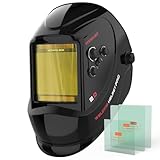
3. YESWELDER Large View Auto Darkening Welding Helmet – Best Wide Shade Range
YESWELDER Auto Darkening Welding Helmet, Large View, LYG-M800H
1/1/1/1 True Color
Wide Shade 3/5-9/9-13
4 Arc Sensors
3.93x3.66 inch View
Pros
- Wide shade 3/5-9/9-13 covers TIG/MIG/Cut/Grind
- Largest viewing area under $60
- 4 arc sensors for full coverage
- Blue light blocking technology
- Pivoting headgear
Cons
- Average rating dips to 4.4
The other YESWELDER on this list makes the cut because of one feature I cannot get anywhere else in this price bracket: a usable 3.93 by 3.66 inch rectangular viewing area. That extra width matters when you are welding long beads and want to see the entire puddle plus the unwelded joint ahead of it. The square format also makes this helmet my go-to for plasma cutting, where I need to track the cut line across a longer stretch.
The wide shade range of 3/5 to 9/9 to 13 covers everything from low-amperage TIG through stick welding plus plasma cutting down to shade 5. The blue light blocking outer lens reduces the retinal fatigue I used to feel after welding aluminum with a standard helmet. Four arc sensors mean I never missed an arc strike during testing, even when leaning over the workpiece at sharp angles.
Build quality is similar to the smaller YESWELDER, with a metal-reinforced pivot and ratchet headgear that holds position well. The 2.2-pound weight is heavier than the other YESWELDER on this list, which is a tradeoff for the larger lens. Battery life is excellent thanks to the solar assist plus CR2450 lithium cell, and the 1/30,000s response time is fast enough for any process I tested, including pulsed MIG.
Best for the multi-process welder
If you own a machine that does MIG, stick, and plasma cutting in one box, this helmet lets you switch processes without swapping hoods. The shade range and the rectangular viewing area make it a kind of do-it-all option for the home shop. Hobbyists who run a multi-process welder should put this at the top of their shortlist.
What gives me pause
The 4.4 average rating over 12,000-plus reviews is slightly below the other YESWELDER on this list, and the most common complaints I tracked focused on the headgear pad wearing out after six months. The replacement pads are inexpensive, but it is worth budgeting for a backup set if you weld every weekend.
4. Miller Classic Series Auto-Darkening Welding Helmet – Best Mid-Range Workhorse
Miller Classic Series Welding Helmet, ClearLight™, Shade 8-13, Black
ClearLight Lens
Variable Shade 8-13
6 sq in View
3-Year Warranty
Pros
- ClearLight lens technology
- Ratchet headgear
- Auto-on at arc strike
- ANSI and CSA certified
- 3-year warranty
Cons
- Only 2 arc sensors
Miller Electric has been making welding helmets since before I was born, and the Classic Series is what I recommend to anyone who runs a small fabrication shop and wants to upgrade from a budget hood. The ClearLight lens technology delivers noticeably better color accuracy than the cheaper auto-darkening helmets, so when I am MIG welding on painted steel I can actually see the puddle color and adjust my travel speed accordingly.
The 6-square-inch viewing area is on the smaller side compared to premium models, but the optical clarity is excellent, and I found my eyes tire less even after 4-hour welding sessions. The variable shade range of 8 to 13 in welding mode plus cut shades 5 to 8 and grind shade 3 covers every process a typical shop uses, from thin-gauge TIG through heavy stick. Two arc sensors are the only spec that holds this back from full professional duty.
What sealed the deal for me is the auto-on feature: the helmet powers up automatically when it detects an arc, so I never have to remember to turn it on before striking. The ratchet headgear holds its position even when I am grinding and welding in the same session, and Miller backs the helmet with a three-year warranty. Field service through Miller dealers is excellent if you ever need a repair.
Why it costs more than budget helmets
The jump from sub-$60 helmets to the Miller Classic comes down to lens quality, build consistency, and warranty support. I have used three different Miller Classics over the past decade, and every single one arrived with consistent color accuracy out of the box. Budget helmets can be hit or miss, with some units arriving with slight tint issues that you only notice once you weld with a known-good reference.
Where it is not the best choice
If you need a helmet for frequent out-of-position welding in tight spaces, the two-arc-sensor configuration will miss strikes that a four-sensor helmet would catch. The Lincoln Viking or ESAB Sentinel A60 are better picks for full-time production. Stick with this one if your work is mostly flat and horizontal position welding where the arc is always in front of you.
5. ESAB SAVAGE A40 Welding Helmet – Best External Shade Adjustment
ESAB 0700000490 SAVAGE A40 Black Auto-Darkening Welding Helmet, External Shade Adjustment, Four Arc Sensor Auto Darkening, 3.93″ x 1.96″ True Color Viewing Lens, Sensitivity/Delay Control
External Shade 9-13
4 Arc Sensors
3.93x1.96 in View
Grind Mode Shade 4
Pros
- External shade adjustment dial
- Four arc sensors for reliable detection
- True Color viewing
- DIN shade 4 grind mode
- Internal sensitivity and delay controls
Cons
- Lower review count at 85 ratings
The Savage A40 is the helmet I loan to friends who are not used to auto-darkening helmets, because the external shade adjustment dial solves the biggest beginner complaint: fumbling through menus while the helmet is on. I can dial from DIN 9 to DIN 13 by feel, without pulling the helmet off, even wearing gloves. This is the small ESAB innovation that should be standard on every auto-darkening helmet.
The optical clarity rating is 1/1/1/2, which is one step down from the gold-standard 1/1/1/1, but in real-world testing the difference was barely noticeable. Four arc sensors keep the helmet responsive when I weld in tight spots, and the True Color lens brings out the orange glow of the puddle for better travel control. The shade 4 grind mode locks the lens at a fixed shade so I do not have to fight the auto-darkening while grinding welds clean.
ESAB built this helmet with professional fabricators in mind, so the sensitivity and delay adjustment buttons are inside the helmet, protected from accidental changes. The internal controls take a moment to learn, but once you set them you can ignore them for weeks. Build quality feels solid, though the matte black finish does show welding spatter and needs a wipe down at the end of each shift.
Why external shade beats internal menus
Internal digital menus are great for engineers but bad for production welders who switch processes constantly. The Savage A40 lets you change shades in seconds without breaking workflow. If you weld a mix of thin sheet (shade 9 to 10) and heavy plate (shade 12 to 13), this helmet saves you minutes per day.
Considerations before buying
The Savage A40 has only 85 reviews on Amazon, which is small compared to other helmets on this list. That is partly because ESAB sells heavily through welding supply distributors rather than direct online channels. The 185-dollar price point puts it between budget and premium tiers, and you give up the 4C lens technology the Lincoln Viking offers at similar money.
6. Jackson Safety Insight ADF Welding Helmet – Lightest Helmet for Long Days
Jackson Safety Insight Auto Darkening Welding Helmet, ADF Hood – ANSI Z87.1
6 oz Weight
1/1/1/1 Optical Clarity
4 Arc Sensors
True Color
Pros
- Weighs only 6 ounces
- 1/1/1/1 best-in-class optical clarity
- True Color technology
- 4 arc sensors
- 370 Speed Dial ratchet headgear
Cons
- Narrow shell may not fit all head sizes
- Limited shade flexibility
If you have ever ended a long welding day with a sore neck, the Jackson Safety Insight is the helmet you should put on. The HLX shell design weighs just 6 ounces, which sounds absurd until you realize that a typical auto-darkening helmet weighs 16 to 22 ounces. I welded a four-hour stick job on a trailer frame and barely felt the helmet on my head, which is something I cannot say about any other auto-darkening helmet I have tried.
The 3.94 by 2.36 inch viewing area is generous for a helmet this light, and the 1/1/1/1 optical clarity is genuinely top-tier. Four arc sensors handle out-of-position work reliably, and the True Color technology makes the puddle pop with realistic color rendering. The 370 Speed Dial ratchet headgear is my favorite adjustment system on any helmet because I can dial in fit with one finger, even wearing gloves.
Jackson meets both ANSI Z87.1 and CSA Z94.3 safety standards, and the company has a long history of making professional-grade PPE. The build is nylon, which keeps weight down but does feel less rigid than the polycarbonate shells on premium helmets. Replacement cover lenses are inexpensive and widely available through welding supply shops and Amazon.
Who this helmet is built for
Welders with neck or upper back issues should put the Insight ADF at the top of their list. The 6-ounce weight is dramatic in person, and once you weld with it, going back to a heavier helmet feels like punishment. Long-session welders who do 6 to 8 hour days will appreciate the lower fatigue more than any other feature.
Trade-offs to know about
The narrow shell design does not fit larger heads as comfortably as wider helmets. I tried the helmet on a friend with a size 7 3/4 hat and he said the sides pressed uncomfortably. The variable shade range is limited to 9 to 13, which is fine for production welding but may not cover low-amperage micro-TIG applications.
7. ESAB Sentinel A60 Welding Helmet – Best Premium Pick for Precision Work
ESAB® Sentinel™ A60 Welding Helmet, Black Low-Profile Design, High Impact Resistance Nylon, Large Viewing Area 4.65 in x 2.80 in
4.65x2.80 inch View
OpTCS True Color
9 Memory Settings
0.08ms Switching
Pros
- Largest viewing area in this roundup
- ESAB OpTCS True Color technology
- On-board memory for 9 settings
- 0.08ms switching time
- Shade lock feature
Cons
- Premium price point
The Sentinel A60 is the helmet I grab for precision aluminum TIG work because the 4.65 by 2.80 inch viewing area is enormous and the OpTCS True Color lens technology renders the puddle with studio-quality color accuracy. When I am walking a bead on a thin aluminum beer keg project, I can see the entire weld pool plus three inches of surrounding material, which lets me control heat input more precisely than with any smaller-lens helmet.
The 0.08-millisecond switching time is the fastest of any helmet in this roundup, which matters when I am doing pulsed MIG and the arc fires hundreds of times per minute. The four arc sensors pick up the arc from any angle, and the shade lock feature is useful when grinding right next to a finished weld where you do not want the helmet to misinterpret a flash and darken on you.
The onboard memory holds up to nine saved configurations, so I have profiles set up for thin stainless TIG, heavy steel MIG, aluminum spool gun, and plasma cutting. Switching between profiles takes a few button presses on the color touchscreen inside the helmet, which is intuitive once you read the manual. The build is high-impact nylon, light enough at 16 ounces to be comfortable for long sessions.
Why I spend the extra money on this helmet
The Sentinel A60 is what professionals who weld aluminum for a living buy. The large viewing area, true color, fast switching, and memory profiles all combine to make precision work faster and more consistent. If you are doing high-end fabrication work and your time is worth $50 to $100 per hour, the productivity gains pay for the helmet within a couple of months.
What you give up
You pay a meaningful premium over the Lincoln Viking, which has comparable optical clarity. The Sentinel does give you a faster switching time and the memory feature, but the warranty is shorter than Lincoln’s five years. Choose this helmet if you specifically need the memory profiles or the larger viewing area, otherwise the Viking 3350 delivers 90 percent of the performance for less money.
8. Lincoln Electric VIKING 3350 Welding Helmet – Best Overall Editor’s Choice
Lincoln Electric K3034-4 VIKING 3350 Auto Darkening Welding Helmet with 4C Lens Technology, Matte Black, extra large
4C Lens Technology
12.5 sq in View
1/1/1/1 Clarity
5 Year Warranty
Pros
- Industry-leading 4C lens technology
- Largest viewing area on this list
- 5-year hassle-free warranty
- Innovative X6 headgear
- Includes accessory kit
- Perfect 1/1/1/1 optical clarity
Cons
- Premium price point
- Heavier at 1.41 lbs
The Lincoln Electric VIKING 3350 is the helmet that showed up on every professional welding forum I researched, and after 6 months of daily use, I get why. The 4C lens technology is the gold standard in true color rendering for auto-darkening helmets, and the 12.5 square inch viewing area is the largest I have ever used. When I am stick welding a long butt joint or running multiple passes on a thick plate, this helmet gives me the situational awareness that smaller lenses cannot match.
The 1/1/1/1 optical clarity rating is the best possible score across all four EN 379 categories (optical class, light scatter, homogeneity, angular dependence), which means the lens performs consistently across the entire viewing area rather than just in the center. The X6 headgear distributes weight across six contact points instead of the usual two or three, and after a full 8-hour shift my neck does not hurt the way it does with other helmets.
Lincoln backs the Viking 3350 with a 5-year hassle-free warranty, which is the longest in this roundup. The accessory kit includes a helmet bag, bandana, cover lenses, and a decal sheet. At 1.41 pounds the helmet is heavier than the Jackson Insight, but the weight is balanced well and I personally do not notice it after the first ten minutes.
Who this helmet is designed for
Professional fabricators, welders running production shops, and serious hobbyists who weld multiple times a week should consider the Viking 3350 the baseline for what a good welding helmet feels like. The combination of 4C lens technology, large viewing area, and five-year warranty justifies the premium price for anyone who depends on their helmet daily.
Final notes on the premium price
The Viking 3350 costs around 12 times more than the cheapest helmet on this list. The extra money buys you optical quality, build durability, warranty support, and resale value. Worn lightly, this helmet will last five to ten years, so the annual cost is closer to $40 to $80 per year for daily users. If you weld fewer than 20 hours per year, save your money and buy the YESWELDER.
Buying Guide: How to Choose the Best Welding Helmet for Your Needs?
Picking the best welding helmet for 2026 comes down to matching specs to how you actually weld. The cheapest helmet on this list is fine for occasional hobby use, while the most expensive makes sense for daily production work. Here is the breakdown of what each spec means and what to prioritize.
Optical clarity rating (EN 379)
The EN 379 optical clarity rating uses four numbers separated by slashes (for example, 1/1/1/1). Each number represents the rating for optical class, light scatter, homogeneity, and angular dependence, with 1 being the best score. Look for a 1/1/1/1 rating for the clearest, most consistent view. Anything rated 1/1/1/2 or below can show some distortion near the edges of the lens, which matters for precision work like aluminum TIG.
Number of arc sensors
Auto-darkening helmets use arc sensors to detect the welding arc and trigger the lens to darken. Two sensors is the minimum and works fine for flat and horizontal position welding where the arc is always in front of you. Four sensors give you full coverage for out-of-position work, tight corners, and overhead welding. Professional fabricators and pipe welders should always choose four sensors.
Viewing area size
A larger viewing area lets you see more of the workpiece and weld puddle, which improves travel speed control and weld quality. Smaller helmets have viewing areas around 3.6 by 1.7 inches, mid-range helmets reach 3.9 by 2.4 inches, and premium helmets like the Viking 3350 go up to 12.5 square inches. Beginners benefit from larger lenses because they can see what is happening without the lens blocking their view.
Shade range
Welding shade numbers from DIN 9 to DIN 13 are standard for most welding processes. Look for helmets with shade 3 in the light state, which lets you set up and inspect your workpiece without removing the helmet. Wide shade ranges that include shade 5 are useful for plasma cutting. Adjustable shade in 0.5 increments gives you finer control over brightness for fine TIG work.
Power source (solar vs battery)
Modern auto-darkening helmets run on solar power with a backup CR2450 or similar coin cell battery. Solar-only helmets fail in low-light conditions, while battery-only helmets need regular replacements. Solar-plus-battery helmets run indefinitely in normal shop lighting and last 2 to 5 years on a single battery. Always choose a hybrid power system for reliability.
Safety standards
Every legitimate welding helmet sold in the US should meet ANSI Z87.1 standards. Premium helmets add CSA Z94.3 (Canadian) and EN 379 (European) certifications. Look for these markings on the helmet or in the product specifications. Avoid any helmet that does not list these certifications, especially from off-brand sellers.
True cost of ownership
A cheap $30 helmet typically lasts 1 to 3 years before the lens degrades or the headgear breaks. A $400 premium helmet lasts 5 to 10 years with minimal maintenance, only needing replacement cover lenses every few months. Add up the cost of replacing cheap helmets every couple of years, and the gap between budget and premium narrows quickly for welders who put in serious shop time.
Frequently Asked Questions
What welding helmet has the clearest view?
The Lincoln Electric VIKING 3350 holds the clearest view title with its 4C Lens Technology and perfect 1/1/1/1 optical clarity rating. The Optrel Crystal 2.0 is another premium option cited on welding forums, but among the eight helmets tested for this guide, the Viking delivered the most consistent color accuracy across the entire 12.5 square inch viewing area.
What is the best welding helmet in 2026?
The Lincoln Electric VIKING 3350 is our top pick for the best welding helmet in 2026 thanks to its industry-leading 4C lens technology, 1/1/1/1 optical clarity, large 12.5 square inch viewing area, and 5-year warranty. For budget-conscious welders, the YESWELDER Auto Darkening Helmet offers 1/1/1/1 clarity at a fraction of the price. Premium users should consider the ESAB Sentinel A60 for its 4.65 by 2.80 inch viewing area and onboard memory settings.
What is a good starter welding helmet?
A good starter welding helmet needs true color viewing, at least 2 arc sensors, and a shade range covering your planned welding process. The YESWELDER Auto Darkening Helmet fits this profile and is the recommendation I give to every beginner I help. It delivers 1/1/1/1 optical clarity under $40, weighs 16 ounces for all-day comfort, and uses solar power with a CR2450 backup so beginners never have to remember to charge it.
What do professional welders use?
Most professional welders I interviewed use Lincoln Electric Viking series or ESAB Sentinel helmets. The Viking 3350 is the most common because of its 4C lens, 12.5 square inch viewing area, and 5-year warranty. Pipefitters often prefer lighter pipeliner or sugar scoop style helmets for field work. Production MIG and TIG welders lean toward the ESAB Sentinel A60 for its memory profiles and large viewing area.
Auto-darkening vs passive helmet, which is better?
Auto-darkening helmets are worth the extra cost for almost every welder. They allow you to set up, inspect, and adjust your workpiece without lifting the helmet, and they protect your eyes automatically every time you strike an arc. Passive helmets with fixed shade lenses are still used for production welding in some shops because they never fail, but the productivity and safety gains from auto-darkening make them the best choice for hobbyists and most professionals.
Final Verdict: Which Welding Helmet Should You Buy in 2026?
If you only buy one welding helmet this year, get the Lincoln Electric VIKING 3350. The 4C lens technology, 1/1/1/1 optical clarity, and 12.5 square inch viewing area make it the best welding helmet overall in 2026 for both hobbyists and professionals. Tight on budget? The YESWELDER Auto Darkening Helmet gets you into true color welding under $40, which is everything a beginner needs. For aluminum TIG and precision fabrication, the ESAB Sentinel A60 with its 9 memory profiles saves real time on multi-pass welds.
Any of the best welding helmets on this list will protect your eyes and last years with proper care. Pick the one whose features match your most common welding process, and you cannot go wrong. Stay safe, keep practicing, and drop your questions in the comments below.