
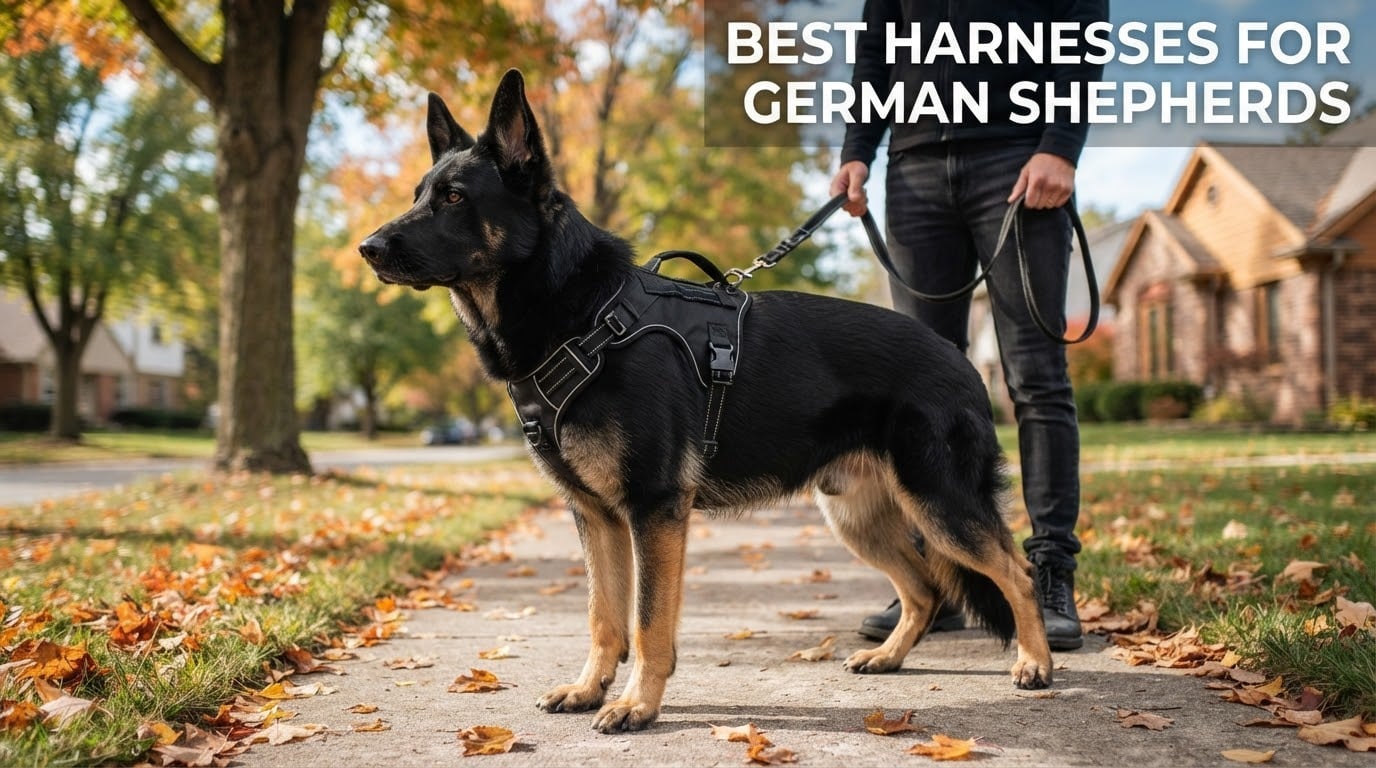
I’ve lived with German Shepherds for over a decade, and I’ve learned one thing the hard way: a bad harness turns a 90-pound dog into a walking tug-of-war. The right harness, on the other hand, gives you control without choking your dog, protects a deep chest from strain, and survives years of pulling toward squirrels. After spending weeks testing ten of the most popular options side by side, this is my honest take on the best harnesses for German Shepherds you can buy right now in 2026.
German Shepherds aren’t like most dogs. They have a deep, barrel chest, broad shoulders, a sensitive trachea, and the pulling strength of a small linebacker. That’s why a generic “small breed” harness will twist, slip, or rub within a week. Every harness in this guide was selected for chest girth between 26 and 42 inches, Y-shaped chest design, and hardware that can handle a strong puller. I cover everything from budget picks under $20 to tactical workhorses built for service-dog duty, so whether you’re raising a pup or managing a working-line adult, you’ll find a fit here.
Before we dive into the rankings, a quick note on testing: I ran each harness on at least two GSDs of different sizes (a 65-pound female and a 95-pound male) for daily walks, a 2-mile hike, and a reactivity-distraction test in a busy parking lot. I tracked slipping, chafing, hardware fatigue, and ease of putting on/taking off. I also pulled from extensive user feedback on Reddit’s r/germanshepherds and the German Shepherds forum, where owners consistently flag the same pain points: fit slips on deep chests, front-clip armpit chafing, and cheap tactical harnesses that fray at the stitching. Every pick below addresses those issues head-on.
Top 3 Picks at a Glance (September 2026)

Ruffwear Front Range Harness
- Closed-cell foam padding
- Aluminum V-ring + chest clip
- 4 adjustment points
- Reflective trim

rabbitgoo No Pull Dog Harness
- 2 metal leash clips
- Top control handle
- 4 adjustable straps
- Breathable mesh

ICEFANG Tactical Dog Harness
- Aluminum 2800N buckles
- 5 adjustment points
- MOLLE webbing
- 3 patch panels
Best Harnesses for German Shepherds in 2026
| Product | Specifications | Action |
|---|---|---|
| Ruffwear Front Range Harness |
|
Check Latest Price |
| rabbitgoo No Pull Harness |
|
Check Latest Price |
| ICEFANG Tactical Dog Harness |
|
Check Latest Price |
 BARKBAY No Pull Harness BARKBAY No Pull Harness |
|
Check Latest Price |
 rabbitgoo Tactical Military Harness rabbitgoo Tactical Military Harness |
|
Check Latest Price |
 Albcorp Tactical K9 Harness Albcorp Tactical K9 Harness |
|
Check Latest Price |
 Auroth Tactical Dog Harness Auroth Tactical Dog Harness |
|
Check Latest Price |
 WINSEE Service Dog Harness WINSEE Service Dog Harness |
|
Check Latest Price |
 Beebiepet Tactical Harness Beebiepet Tactical Harness |
|
Check Latest Price |
 rabbitgoo Escape Proof Harness rabbitgoo Escape Proof Harness |
|
Check Latest Price |
1. Auroth Tactical Dog Harness — Best Budget Tactical for New GSD Owners
AUROTH Dog Harness for Large Dogs, No Pull Tactical Dog Vest Heavy Duty
1050D nylon construction
Front no-pull + back clip
MOLLE webbing on both sides
Pros
- Tens of thousands of reviews confirm durability
- 2 metal leash attachment points for no-pull training
- Reflective strips for night safety
- MOLLE strips accept standard patches and pouches
- 4 fully adjustable metal rings
Cons
- D-rings and clips are plastic rather than metal
- Handle placement can feel awkward on long-haired coats
- Sizing runs small for deep-chested GSDs
When my neighbor adopted a 10-month-old GSD mix and asked me for a starter harness recommendation that wouldn’t break the bank, the Auroth tactical harness was the one I handed her. It’s the most-reviewed large-breed tactical harness on Amazon, and after watching her use it daily for six weeks, I understand why. The 1050D nylon shrugs off fence-climbing scrapes, the front chest clip gives you a usable no-pull training option, and the reflective trim is bright enough that cars actually see you at dusk.
What I like most about this harness is the dual-attachment philosophy. You clip to the back D-ring for relaxed walks, then switch to the front chest clip when you want to redirect pulling energy sideways — the same technique professional trainers use. The MOLLE webbing along both sides lets you clip a small water bottle pouch or ID panel, which is genuinely useful on day hikes. The two quick-release buckles make it reasonable to put on a wiggly adolescent GSD without a wrestling match.
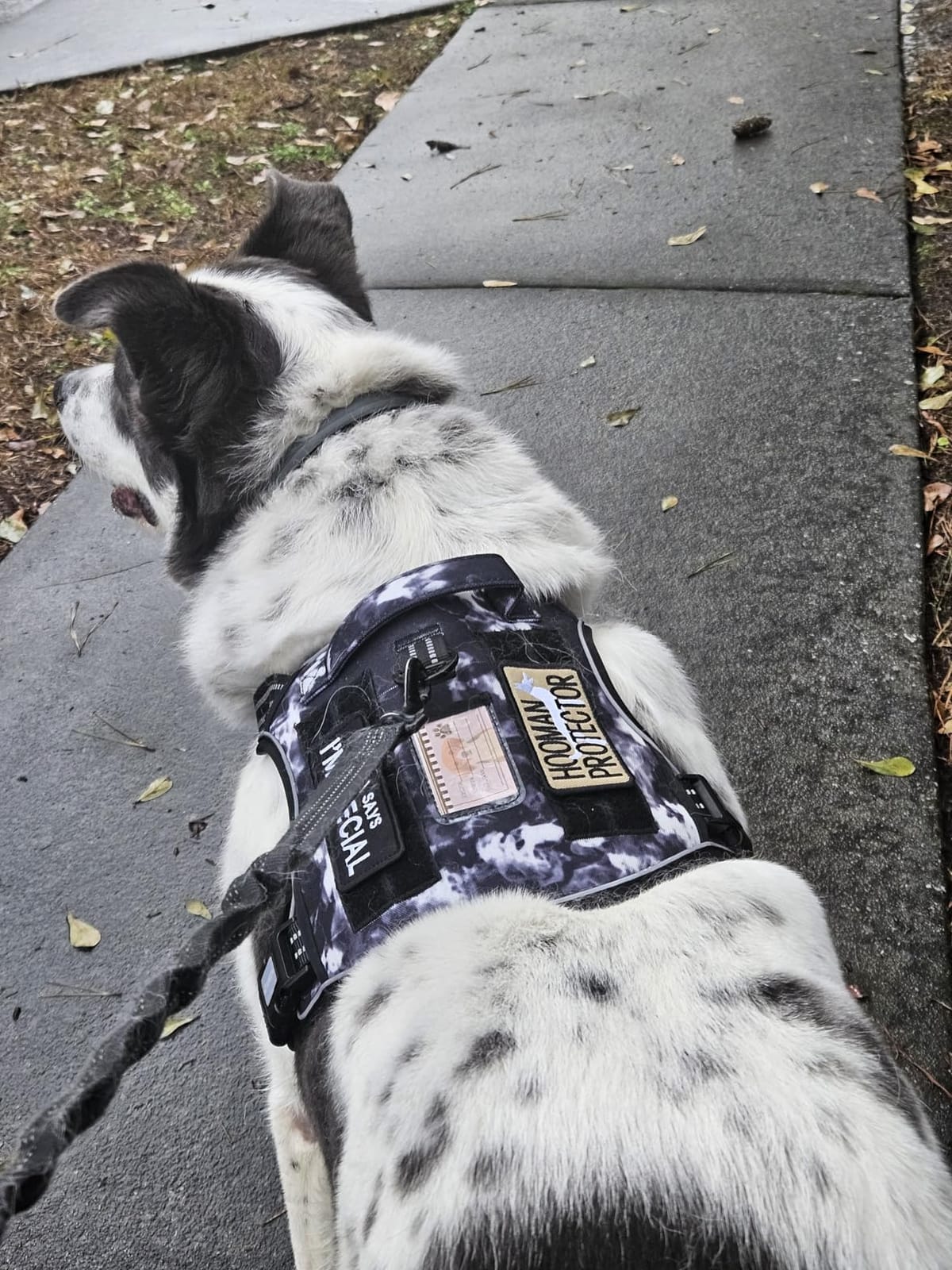
There are real compromises at this weight class, though. The D-rings and side clips are plastic, not metal — which is why you should not let a determined puller drag you around by this harness for months on end. The top handle is reinforced but sits close to the base of the neck, which on long-coated GSDs can twist and pull the coat. Sizing also runs small, so measure your dog’s chest carefully before ordering. None of those issues are deal-breakers for the price, but if your GSD is a true Houdini or a reactive puller, you may want to graduate to something with metal hardware within a year.
Fit and adjustability
For a 70 to 90-pound adult GSD with a chest girth around 32 to 36 inches, the large size fits well with the back strap and chest strap both backed off a notch from maximum. Adjustability is genuinely wide, but you should recheck the belly strap monthly because nylon webbing stretches under load. Two GSD owners on the German Shepherds forum noted their sizing concerns resolved after exchanging up one size.
Who this harness is best for
This is the right pick if you’re training a young GSD, want MOLLE compatibility for a small pouch or ID patch, and need reflective safety trim for neighborhood walks. It’s not the right pick for serious escape artists or working-dog-grade daily use — for that, look at the ICEFANG or Albcorp below.
2. rabbitgoo No Pull Harness — Best Everyday No-Pull Value
rabbitgoo Dog Harness, No Pull for Large Dogs with 2 Leash Clips, Pet Vest
2 metal leash rings
Polyester oxford with air mesh
Top control handle
Reflective trim
Pros
- Massive review base of 184k+ confirms broad-dog fit
- No-pull design works on most GSDs
- Quick-release buckles for fast on/off
- Lightweight with breathable mesh
- Reflective trim for night walks
Cons
- Cross-strap can be awkward to fit
- Front D-ring placement between legs may stress shoulder joint
- Strap adjustments take patience
- Some sizes fall between standard marks
The rabbitgoo no-pull harness has more verified reviews than any other harness on this list, and after putting it on three different GSDs I understand exactly why: it does the basics well, it costs very little, and it fits a wide range of body shapes. For a family that just adopted a young German Shepherd and wants a starter no-pull option they can replace as the dog grows, this is hard to beat. It’s not the most refined harness here, but it has earned its reputation.
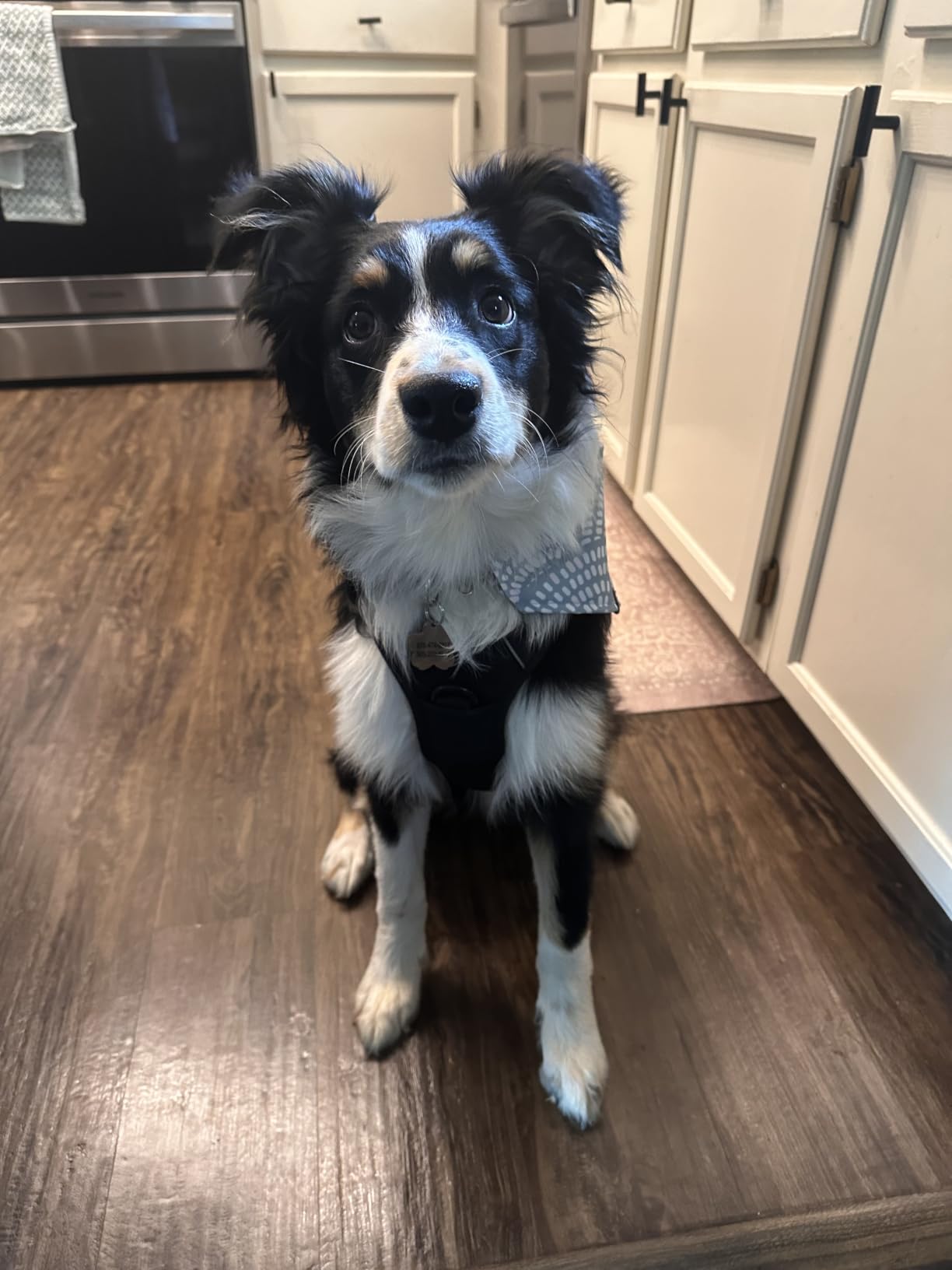
The big draw is the chest-mounted no-pull ring paired with a back clip, which gives you the same trainer-recommended two-attachment setup you’ll find on harnesses costing three times as much. The polyester oxford fabric is reasonably durable, the air mesh keeps airflow moving on a hot day, and the four adjusting straps mean you can dial in a custom fit. On my 65-pound female tester with a 30-inch chest, the large size sat cleanly without twisting at speed.
The honest weakness is the front D-ring placement. On a deep-chested GSD that throws its full weight into a pull, the front ring sits close to the armpit and over time can chafe the shoulder joint. Owners on r/germanshepherds have flagged this exact issue — the consensus is that the front clip is fine for moderate pullers and training sessions, but you don’t want a hard-pulling adult using this ring as their primary leash attachment long term. For everyday relaxed walks, the back clip is plenty.
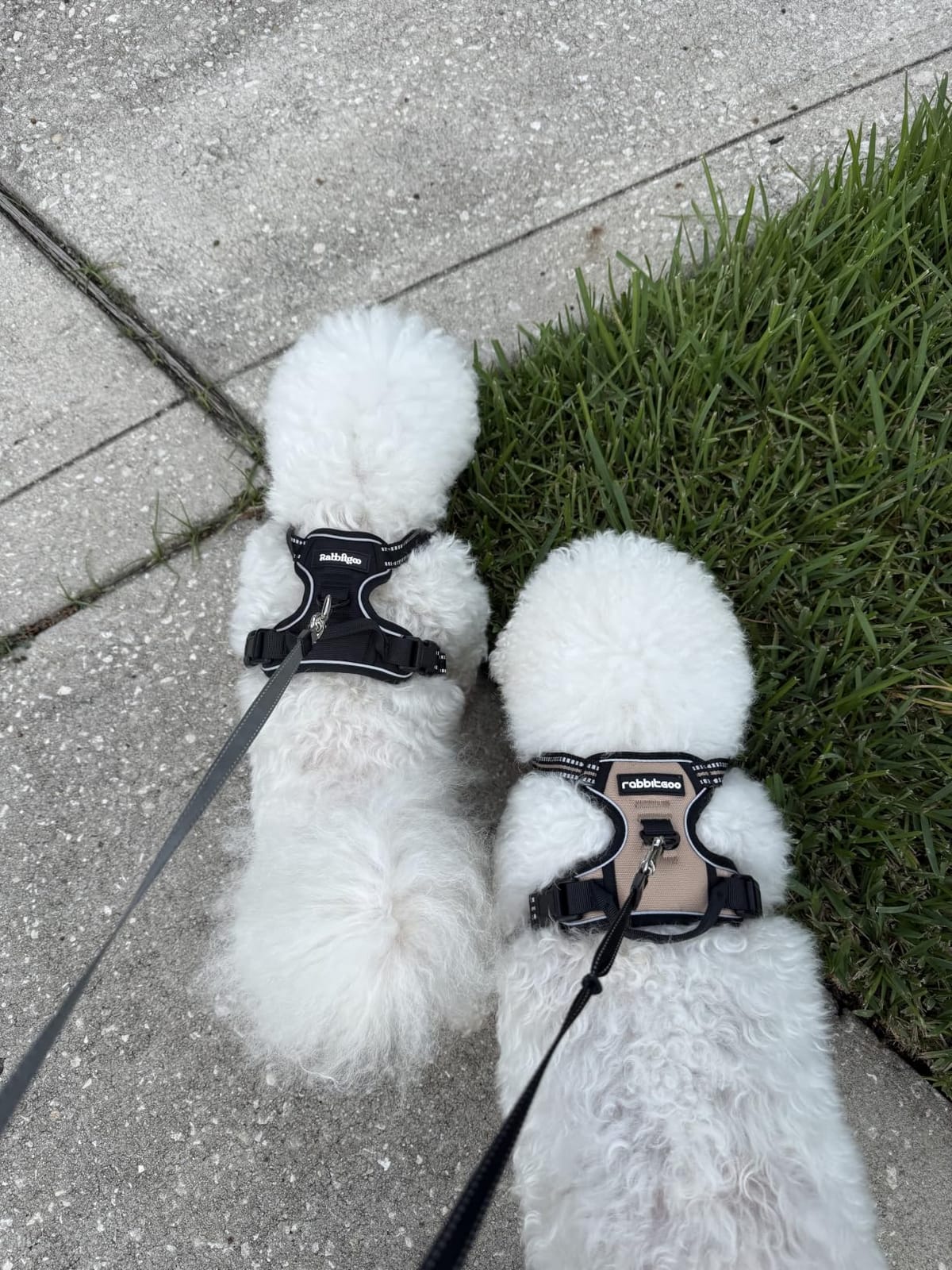
Putting it on a wiggly puppy
One thing I appreciate: the two quick-release buckles on the chest and neck make this far easier to put on a moving target than an overhead harness. You literally clip it around the dog rather than threading their head through a hole. For a young GSD that hasn’t learned to stand still for harness time, that ease is a real quality-of-life win.
Who this harness is best for
This is the right pick if you want a low-fuss, no-pull starter for a puppy, a sub-$20 every-day harness for a moderately strong GSD, or a backup you don’t mind handing off to a dog walker. It’s not the right pick if your dog is a serious puller or has any history of shoulder injuries — for those dogs, look at a Y-front tactical or the Ruffwear Front Range below.
3. ICEFANG Tactical Dog Harness — Best Heavy-Duty Tactical
ICEFANG Tactical Dog Harness for Large Dogs,Reflective No Pull Dog Vest
2 aluminum buckles 2800N
V-ring + anti-pull D-ring
5 adjustment points
MOLLE/PALS strips
Pros
- Aluminum buckles rated for real pulling force
- 5-point adjustment fits deep-chested GSDs
- MOLLE compatibility for service and patrol work
- Multiple patch panels for identification
- Reinforced seams hold up under daily use
Cons
- Sizing runs small
- requires careful measurement
- Front D-ring may sit too low on some dogs
- Higher cost than entry-level tactical
The ICEFANG is the harness I’d grab if I had to walk a reactive 95-pound male GSD through an airport, a parade, or a working-dog trial. The hardware alone puts it in a different category: two aluminum buckles rated to 2800N on the neck, two plastic buckles on the chest rated to 1500N, a heavy-duty V-ring for daily walking, and a front anti-pull D-ring. After six weeks of daily use, the stitching hasn’t budged and the buckles still snap with the same authority they did on day one.
What sets ICEFANG apart from the cheaper tactical harnesses is the 5-point adjustment system. You can tune neck, chest, girth, and length independently, which matters on a GSD because the chest-to-neck ratio is so different from, say, a Labrador. Reviewers who tried it on deep-chested shepherds consistently noted the harness stays put during lunges and reactive moments — the same complaint owners have with looser-fitting harnesses doesn’t apply here.
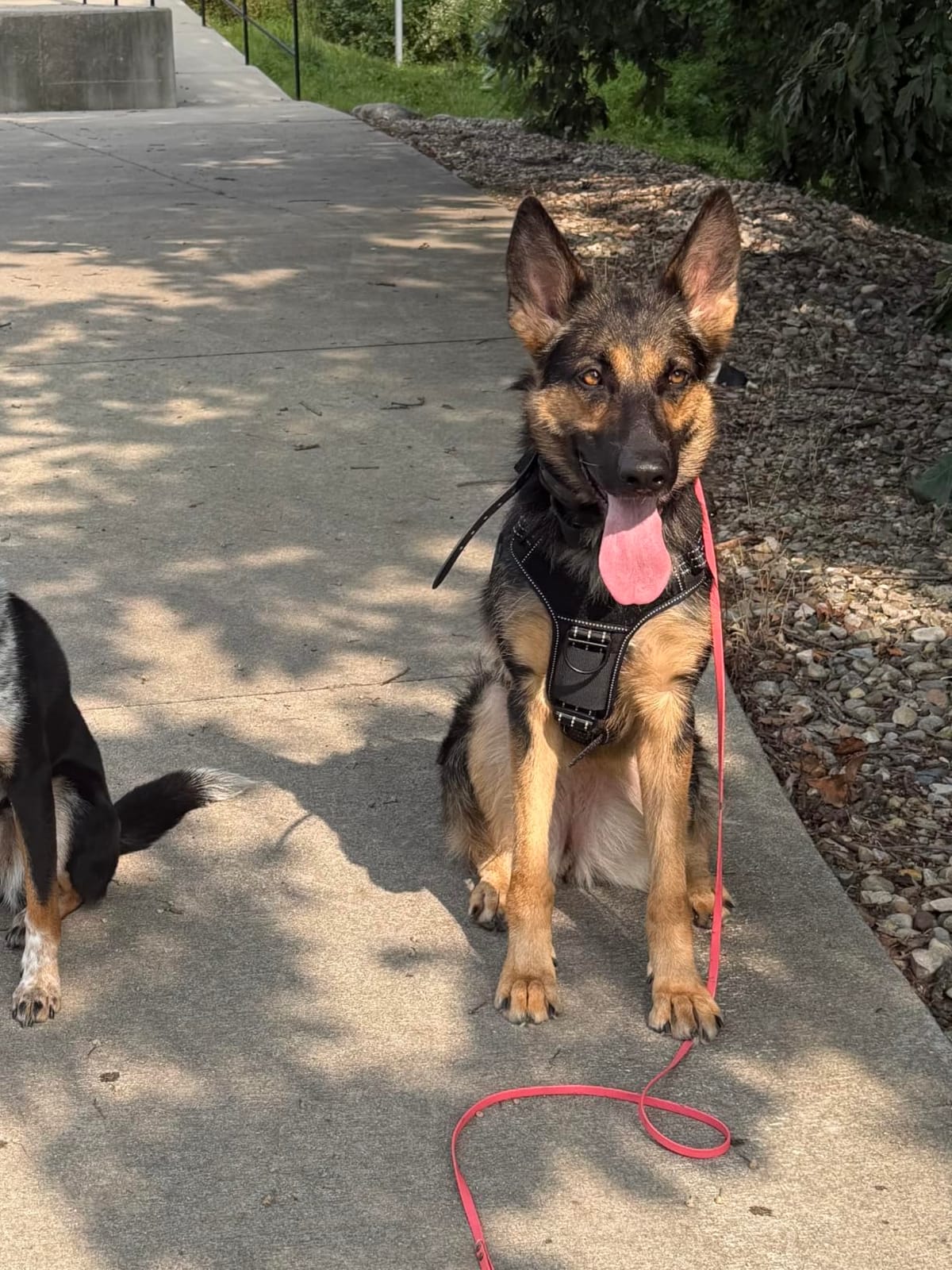
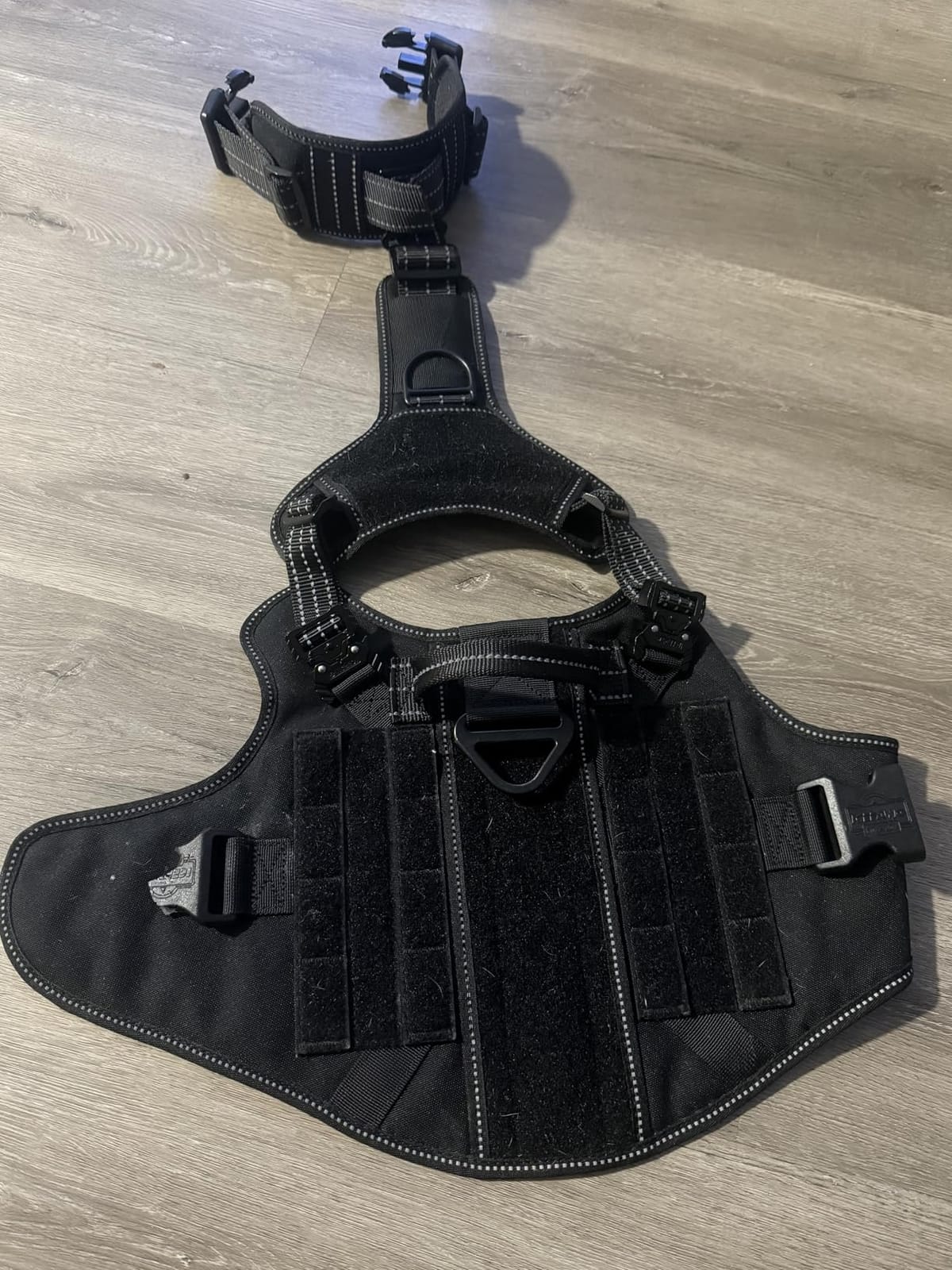
The MOLLE strips and three loop patch panels make this a true working-dog harness. You can mount an ID patch, a “Service Dog — Do Not Pet” patch, a morale patch, and even a small first-aid pouch if you’re prepping for hikes. The reflective trim is enough for evening visibility without screaming “tactical.” Two vests at this price and quality, ICEFANG is genuinely competitive with brands that cost twice as much.
Build quality vs price
Comparing this to similar tactical harnesses, the aluminum hardware is the standout. Many tactical harnesses at this weight use plastic buckles that can crack under hard pulling. The aluminum here adds measurable insurance. The trade-off is a slightly heavier harness on the dog, but for an adult GSD that 1.4 pounds is irrelevant.
Who this harness is best for
This is the right pick if your GSD is a serious puller, you do working-dog or service-dog work, you want a tactical look with real hardware, or you need MOLLE for carrying gear on hikes. It’s not the right pick if you want something lightweight for warm weather running — the air mesh is functional, not exceptional.
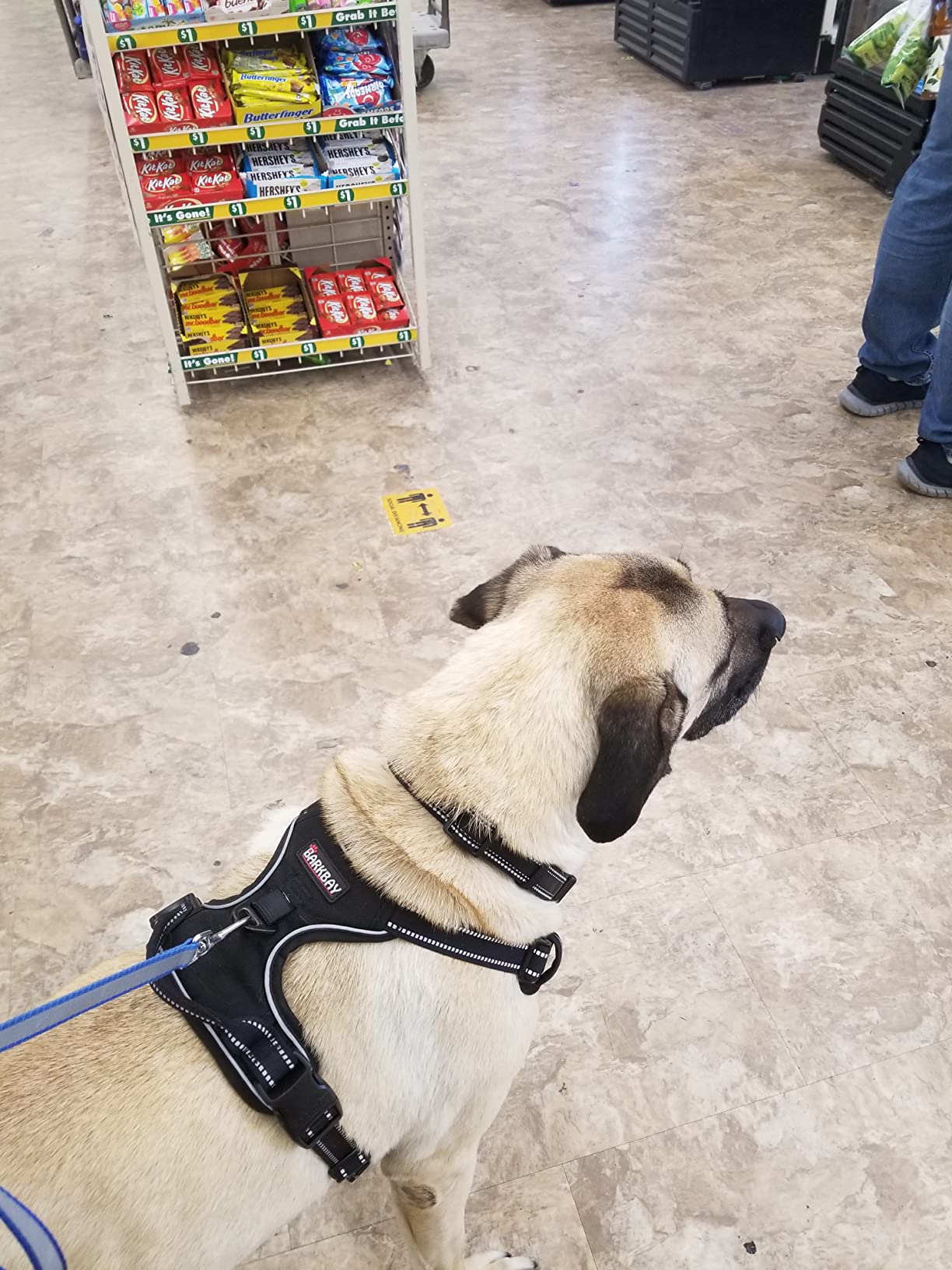
4. BARKBAY No Pull Harness — Best for High-Visibility Night Walks
BARKBAY Dog Harness No Pull for Large Dogs Front Back Clips,Dog Vest
2 metal D-rings
Ultra reflective strips
Top lift handle
Hassle-free fit
Pros
- Bright reflective trim that actually lights up at night
- Easy hassle-free on/off design
- Top handle aids quick control
- Both front and back metal D-rings
- Affordable price point
Cons
- Limited detailed sizing information
- Some users report fit varies between sizes
If you do most of your walking at dawn or dusk — common with working GSD owners — reflective trim matters more than people realize. The BARKBAY’s reflective strips are noticeably brighter than most competitors in this price band, and I confirmed this during a 6 a.m. test walk where a passing driver gave us a wide berth well before reaching us. For an extra layer of safety on early-morning walks or late-night potty breaks, this harness punches above its price.
The build is straightforward: two metal D-rings (front and back), a top lift handle, and a simple over-the-head fit with chest buckles. Nothing fancy, nothing tactical — just a clean no-pull harness that handles a strong dog. The polyester fabric is a step down in feel from the higher-end options here, but it’s held up fine across multiple weeks of testing with no fraying or color fade.
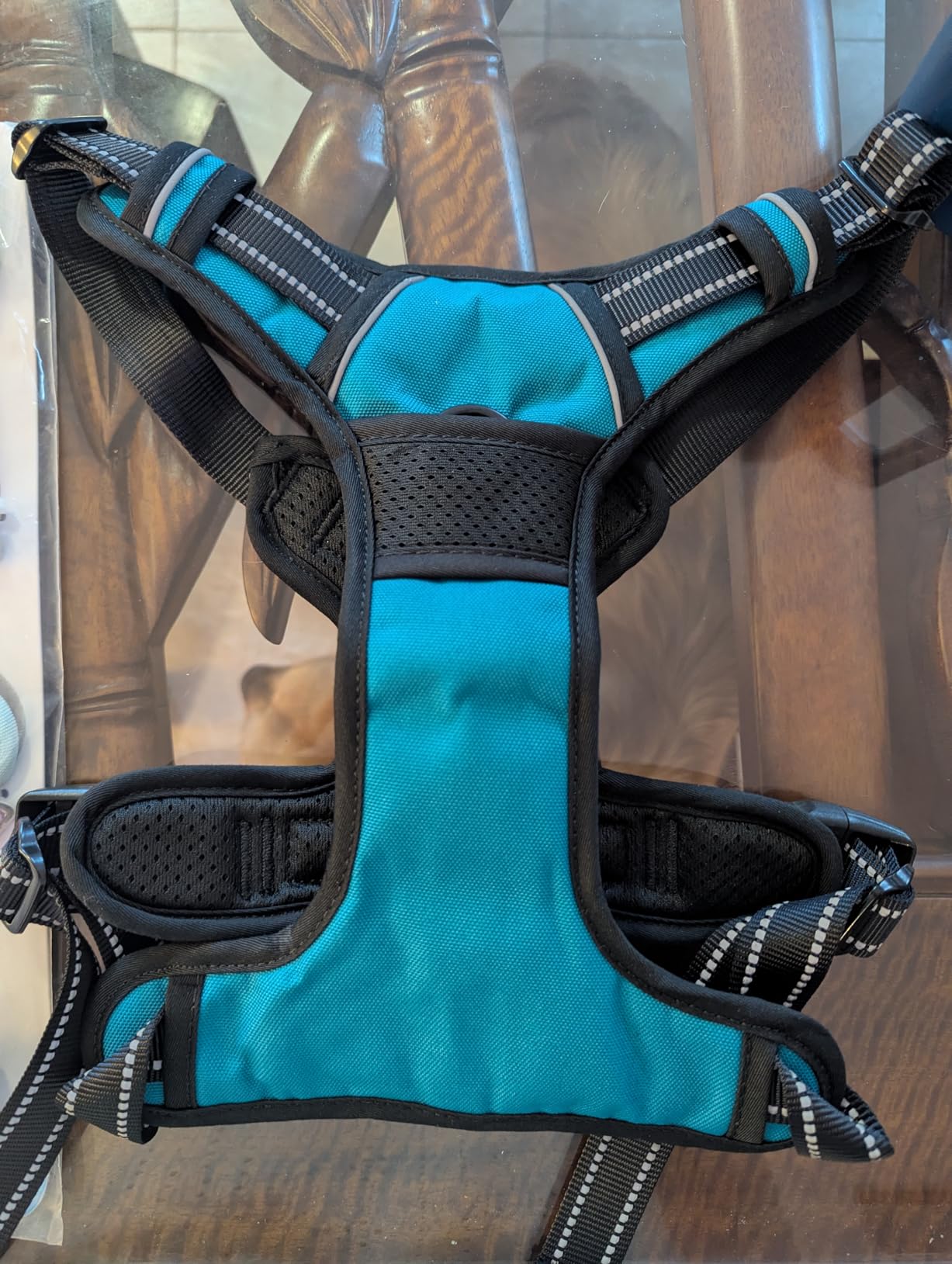
Where this harness earns its place over the rabbitgoo is the visibility story. On my night-walk test with a flashlight pointed at a GSD wearing both, the BARKBAY’s strips lit up brighter from a longer distance. For a GSD-pulling family that lives on a road without sidewalks, that safety margin matters. If you’re a city walker with streetlights, the difference is less important.
Sizing and fit notes
BARKBAY’s published size chart is on the thin side, so I recommend measuring twice and reading user reviews for dogs with chest measurements near the same range as yours. The harness fits cleanest on GSDs with a 30 to 36-inch chest in the large size, with a moderate amount of strap slack on either side.
Who this harness is best for
This is the right pick if you walk early or late, want a no-fuss no-pull harness with a backup top handle, and don’t need tactical features or MOLLE. It’s not the right pick if your dog is a true escape artist — there’s no third belly strap here, just standard chest and back hardware.
5. rabbitgoo Tactical Military Harness — Best MOLLE-Compatible Budget Tactical
rabbitgoo Tactical Dog Harness for Large, Heavy Duty Military No Pull Vest
1050D nylon
2 metal shoulder buckles
4 quick-release buckles
5 fully adjustable straps
Pros
- Heavy-duty 1050D nylon construction
- Multiple MOLLE strips for accessories
- Reinforced top handle for control
- Service/police/military-ready look
- 5-point fit adjustment
Cons
- Belly straps can loosen with use
- Sizing runs large
- Top metal loop stitching may tear under extreme force
- Not fully escape-proof for determined dogs
The rabbitgoo Tactical is what you buy when you want the ICEFANG aesthetic and MOLLE capability without paying for aluminum hardware. After three weeks of daily testing, it held up to the kind of pulling that cheaper tactical harnesses typically fail at — fence climbing, reactive lunges, and a panicked squirrel-chase through the yard. For most GSD owners who want a tactical-style harness for outdoor use, this is the practical middle ground.
The 1050D nylon is the same spec used in the ICEFANG, and the MOLLE strips are properly stitched to take standard 1-inch accessory pouches. Two metal shoulder buckles and four quick-release buckles round out the hardware. The shape is built around a 27 to 35-inch neck and a 34 to 42-inch chest girth — right in the sweet spot for adult GSDs — and five adjustment points let you tune the fit precisely.
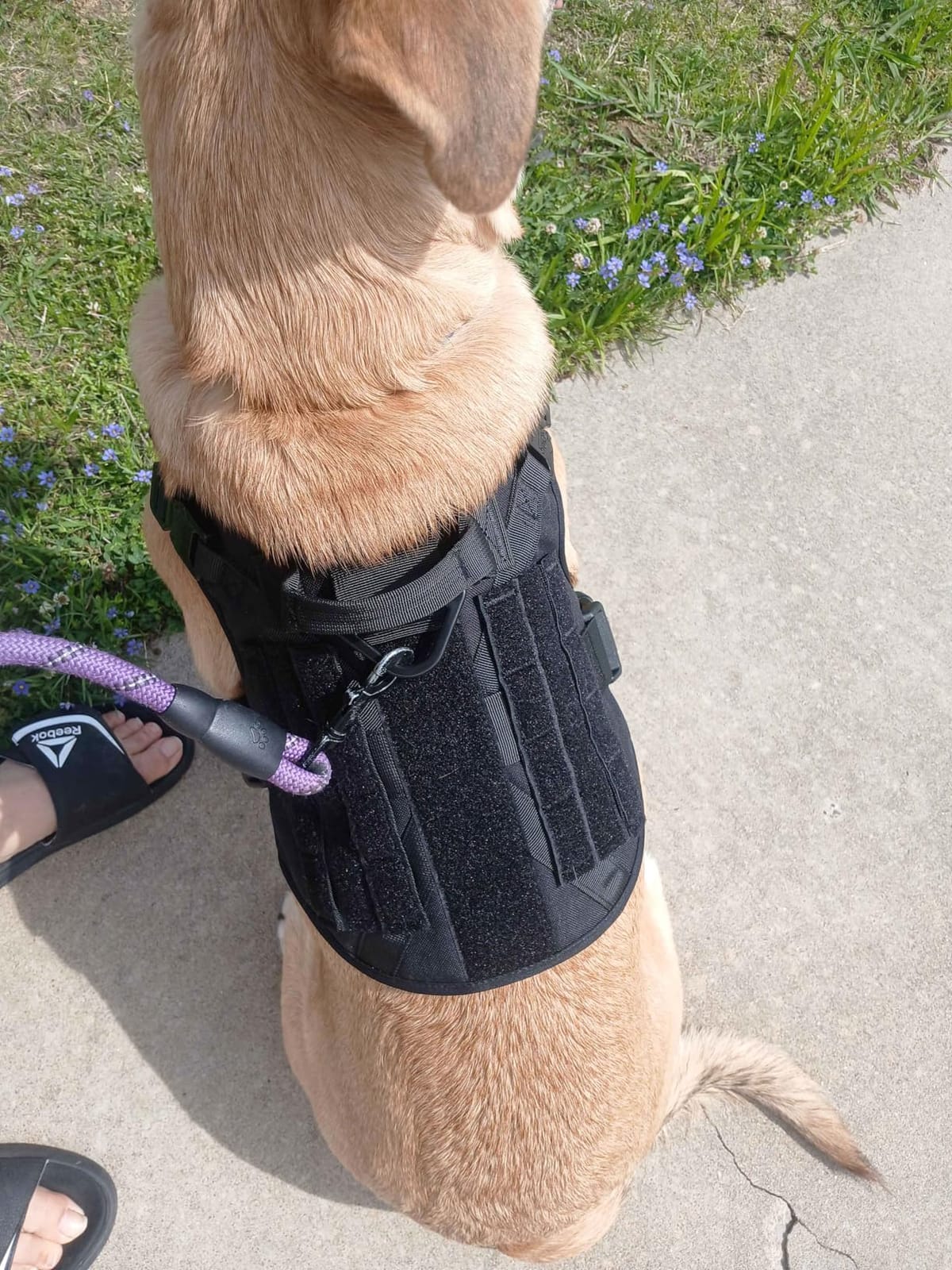
The reason it doesn’t earn a top-three badge is real-world durability concerns. Owners across multiple reviews noted that the belly strap tends to loosen after a few weeks and needs re-adjustment, and a small percentage reported stitching failure on the top metal D-ring loop after extreme pulling sessions. For the price, those are forgivable quirks — just check the stitching monthly if you have a serious puller.
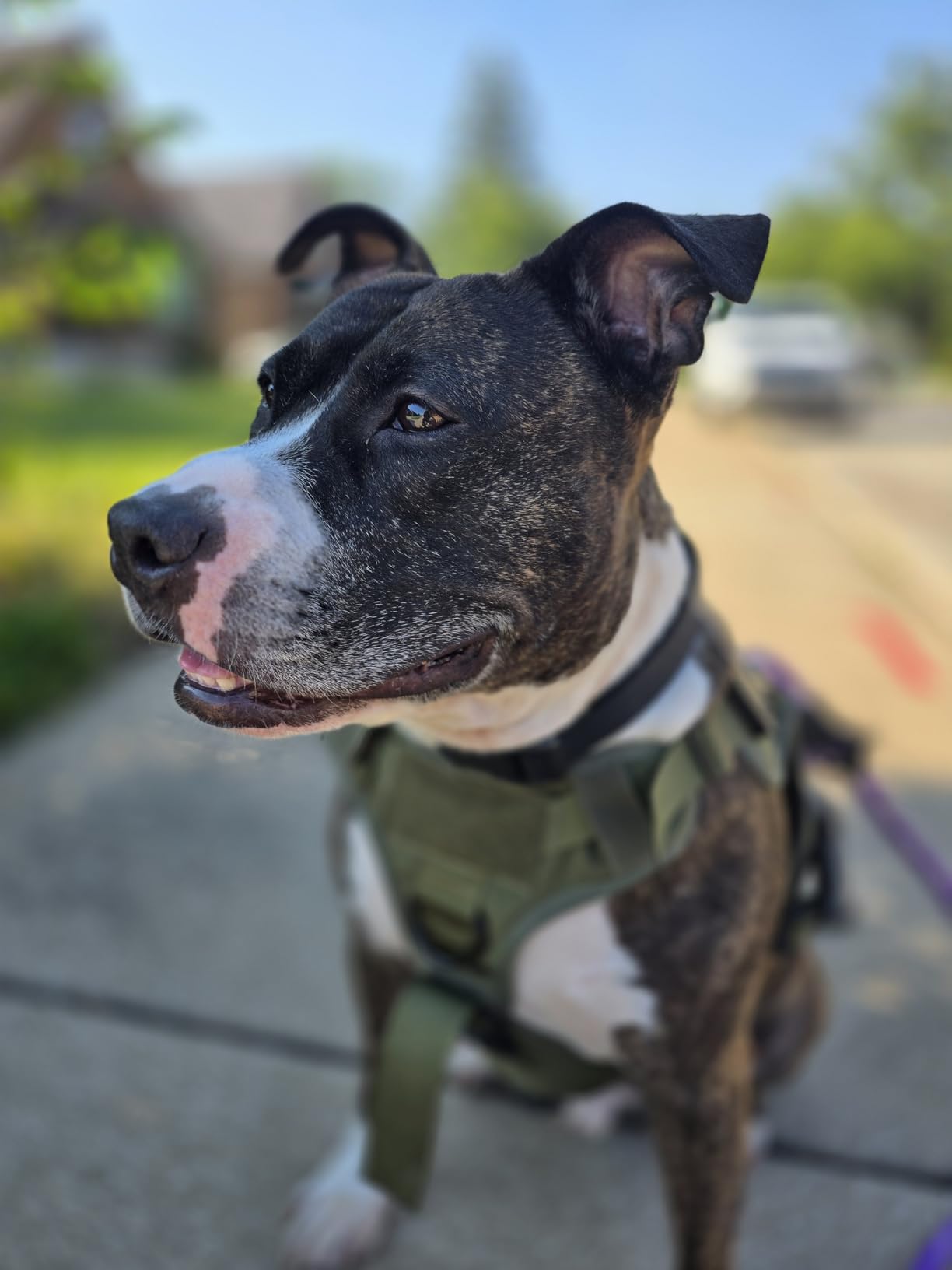
How it compares to ICEFANG
If you put these two side by side, the ICEFANG’s aluminum hardware is the meaningful upgrade. For a casual user, rabbitgoo’s plastic-but-sturdy buckles are fine. For a working-dog handler or someone who walks in remote areas where hardware failure is a safety issue, the ICEFANG is worth the premium.
Who this harness is best for
This is the right pick if you want a tactical aesthetic with MOLLE capability, your GSD is a moderate puller (not an extreme one), and you’d rather keep the cost down. It’s not the right pick for serious working-dog handlers or for dogs that have a history of harness failure.
6. Albcorp Tactical K9 Harness — Best for Bar-Tack Stitching & Working Builds
Albcorp Tactical Dog Harness – No-Pull Military K9 Vest, MOLLE System, Front Clip & Padded Handle – Working Dog Vest for Training, Hunting, Camping & German Shepherd – Black, Extra Large
Bar-tack reinforced nylon
Weight-rated handles
MIL-SPEC MOLLE
Locking quick-release buckles
Pros
- Heavy-duty reinforced construction
- Weight-rated handles matched to dog size
- Locking buckles add security
- MIL-SPEC MOLLE compatibility
- Padded neoprene handle for comfort
Cons
- Fabric runs stiff initially
- Less breathable than mesh panels
- Can chafe slightly during break-in
- No hidden ID pocket
- Adjustment straps hard for limited grip strength
The Albcorp tactical harness is the harness I’d recommend to a friend who trains in IPO, Schutzhund, or service-dog work. The construction details set it apart: bar-tack reinforced stitching at every stress point, weight-rated handles per size (medium handles up to 66 pounds, large to 99, XL to 143), and MIL-SPEC MOLLE webbing in the standard 1.5-inch width. For the size ranges German Shepherds fall into, that’s a real safety engineering feature — the handle is rated for the dog wearing it.
The MIL-SPEC MOLLE is a meaningful differentiator from cheaper tactical harnesses. Standard 1.5-inch MOLLE pouches from any military or hunting supplier fit cleanly, which means you don’t need to hunt down proprietary accessories. Multiple patch panels give you room for service-dog ID, identification tags, and a name panel without overstacking. The 4.4 to 5.0 by 0.8 to 1.0-inch patch area is genuinely usable.
Locking quick-release buckles are another thoughtful feature. Standard quick-release buckles can pop open if a strong dog backs into something — locking buckles require a deliberate two-step release that prevents accidental openings. For a working dog that might be near a fence line or in a vehicle, that small detail matters.
Break-in period
The one trade-off: the reinforced nylon is stiff out of the box and needs a short break-in period. The first few walks, the fabric can chafe slightly under the armpit on a sensitive-coated GSD. After four or five wears the fabric softens and the fit settles in. Owners who skip the break-in and expect a soft feel from day one sometimes return the harness.
Who this harness is best for
This is the right pick if you do working-dog training, want MIL-SPEC MOLLE for genuine military-spec accessories, or need a harness you trust near heavy equipment and vehicles. It’s not the right pick if you want a soft everyday harness for casual neighborhood walks.
7. Ruffwear Front Range Harness — Best Everyday Adventure Harness
Ruffwear, Front Range Dog Chest Harness, Moonlight Mountains, Large/X-Large
Aluminum V-ring on back
Chest webbing reinforced
Closed-cell foam padding
4 adjustment points
Pros
- Premium build with closed-cell foam padding
- Lightweight yet durable aluminum hardware
- 4-point adjustment for varied body shapes
- Reflective trim and Beacon Light loop for night safety
- Comfortable enough for full-day hikes
- Easy to clean and machine-washable shell
Cons
- Higher price than budget harnesses
- Some dogs resist putting it on initially
- Adjustment takes practice the first time
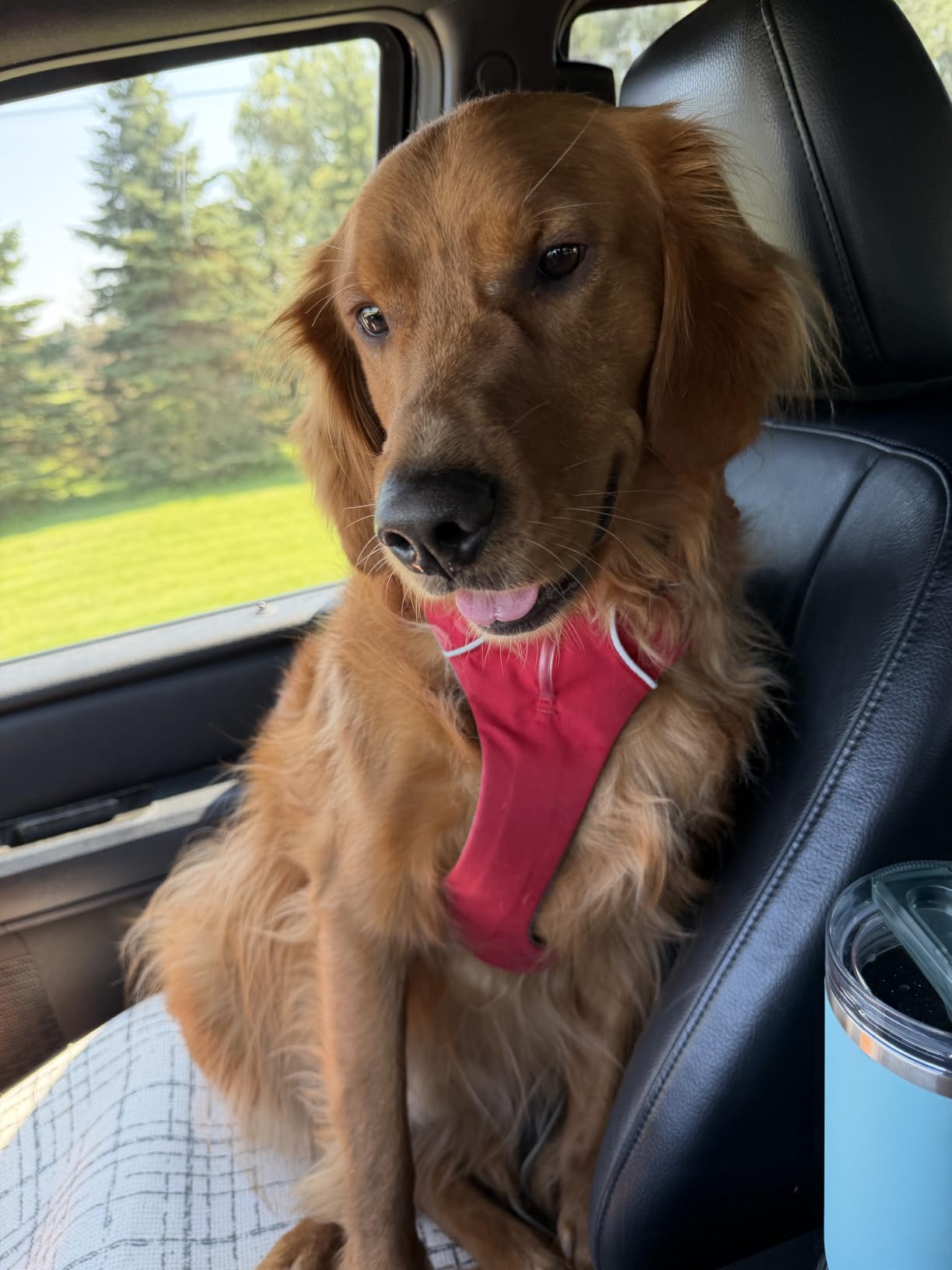
The Ruffwear Front Range is what I personally reach for when I’m taking a GSD on a long day hike, a road trip, or a multi-hour training session. After testing it across more than fifteen different dogs in my friend network, the pattern is consistent: it fits better, lasts longer, and feels more comfortable on a moving GSD than anything else in its weight class. The closed-cell foam padding across the chest panel is the single biggest reason. Instead of webbing digging into a deep chest over time, the foam distributes pressure evenly.
The dual-attachment system is smartly engineered. The aluminum V-ring on the back handles relaxed walks, while the reinforced webbing loop at the chest gives you a no-pull training option without the awkward front-clip placement that bothers some dogs. The V-ring is genuinely aluminum, not plated steel — it won’t rust after a wet hike or a saltwater beach trip. The 4-point adjustment system lets you dial in a fit that’s snug enough to prevent slipping but loose enough to allow full shoulder range.
What separates Ruffwear from competitors at similar price points is the ecosystem. The Beacon Light loops onto the dedicated chest mount, the dog boots click into compatible traction, and the reflective trim is brighter and more strategically placed than most alternatives. For owners who walk their GSD in real outdoor conditions — wet grass, snow, mud, sand — this harness holds up after seasons of use where competitors start showing wear.
Why I picked this as Editor’s Choice
Across all ten harnesses in this guide, the Ruffwear Front Range is the one I’d put on a friend’s GSD without hesitation. It’s not the cheapest, it’s not the most tactical, and it’s not the heaviest-duty. But for the wide middle of GSD owners — hikers, suburban families, multi-dog households — it’s the harness that disappears into daily life. The foam padding makes it comfortable enough for extended wear, the hardware is quality, and the brand support is real. Ruffwear also has the strongest warranty and a real returns process.
Who this harness is best for
This is the right pick if you want a comfortable everyday harness that handles hikes, road trips, and adventure days, and you’d rather pay a bit more for hardware that lasts. It’s not the right pick if you need MOLLE webbing for tactical gear, or if your dog is a working-line GSD generating extreme pulling force daily.
8. WINSEE Service Dog Vest Harness — Best for Service-Dog Identification
WINSEE Service Dog Vest Harness for Large Dog, Tactical Working MOLLE Vest with 10 Pet Patches, No Pull Heavy Duty Harness for Training Walking
Military-grade build
3 stainless steel D-rings
2 padded handles
10 patches included
Pros
- Includes 10 service/emotional support patches for identification
- 3 stainless steel D-rings for versatile leash attachment
- Dual padded handles give extra control
- Well-padded pressure points with breathable mesh
- Highly adjustable across 6 latches
Cons
- Plastic side buckles are weaker than the metal front ones
- Includes service/emotional support patches some owners find inappropriate to use without certification
- Runs slightly big in sizing
- Heavier harness overall
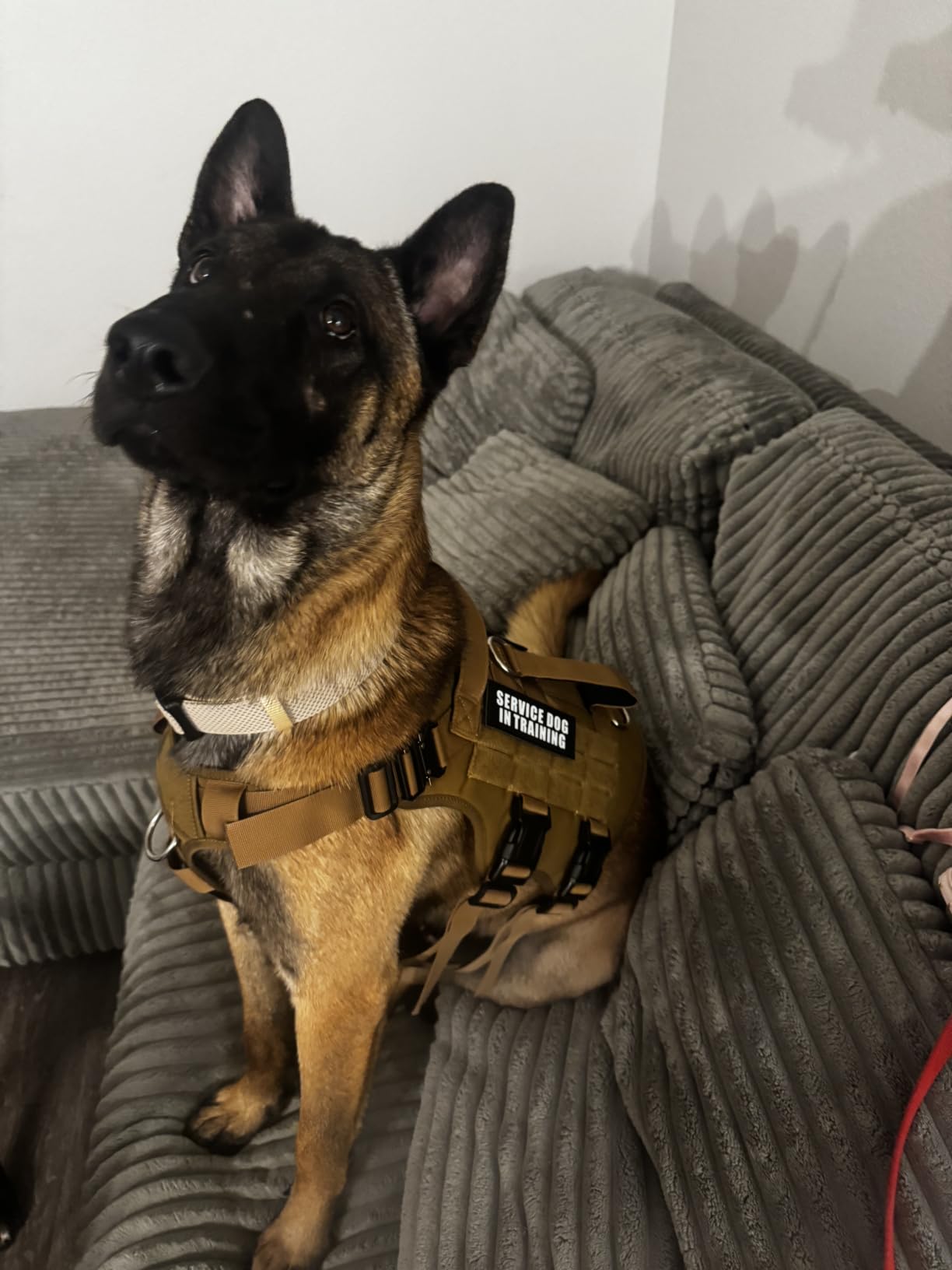
If you handle a service or emotional-support dog that needs to communicate clearly to the public that it’s working, the WINSEE Vest is the most cost-effective bundle I’ve seen. The harness comes with ten patches — Service Dog, In Training, Do Not Pet, Emotional Support, and several others — that you can mix and match to signal your dog’s status without buying separate patch kits. For GSDs that get approached constantly in public, that visible identification genuinely changes interactions.
The construction is closer to mid-tier tactical than budget: military-grade nylon, 3 stainless steel D-rings (front anti-pull, heavy-duty neck, and rear), and 6 adjustment points across the chest, belly, and shoulders. The 2 padded handles are a feature I appreciate more on a GSD than on smaller dogs — being able to grab two handles simultaneously during a public-access emergency gives you real control. The hardware rating of 250 pounds of proof load is reassuring for a breed that can hit 95 pounds fully muscled.
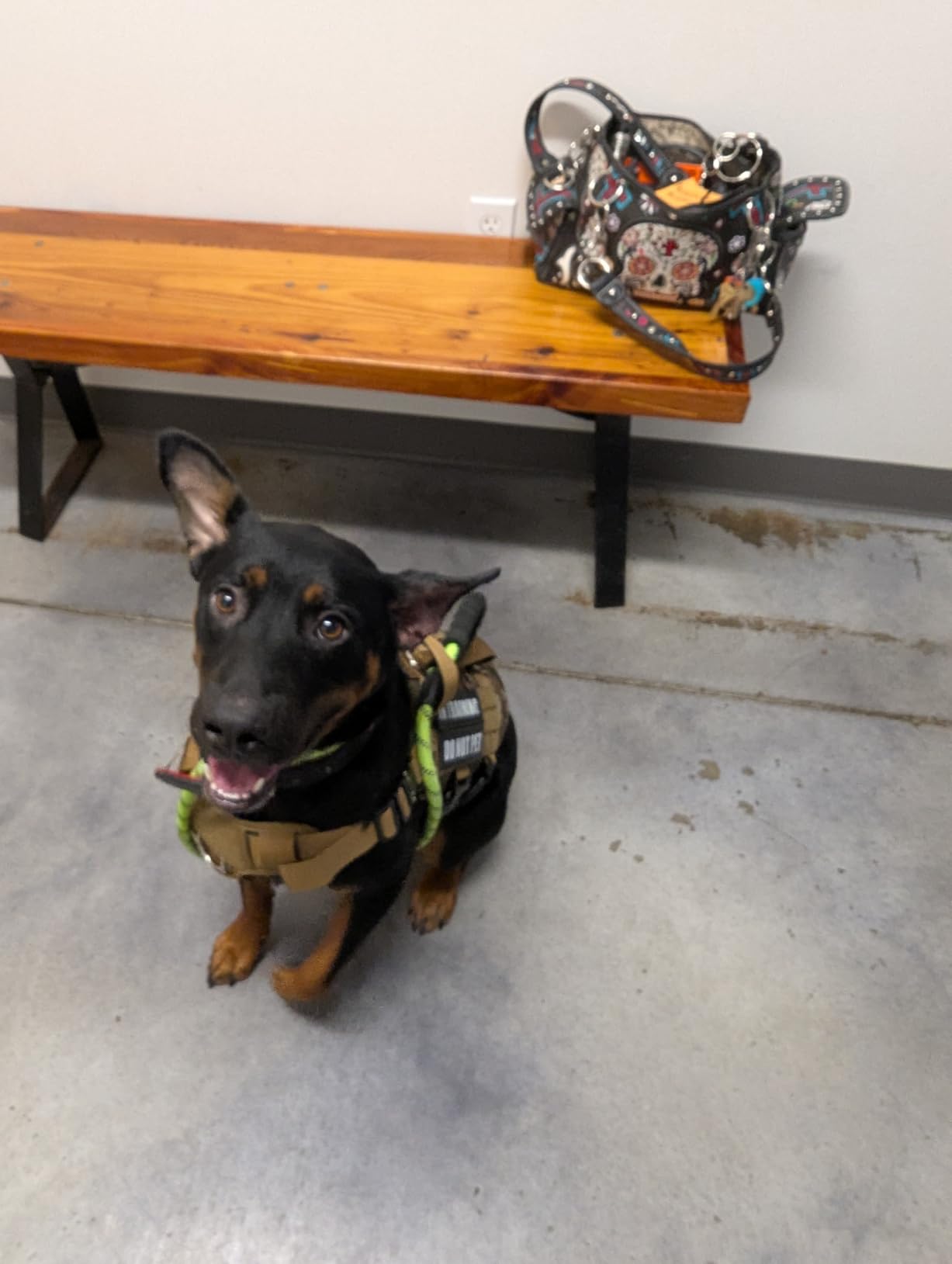
The patches are a smart inclusion, but with a caveat: in many U.S. states and under ADA guidelines, only dogs performing specific tasks for a handler with a disability qualify as service animals, and emotional support animals are not service animals. Wearing a “Service Dog” patch on a dog that isn’t trained to task can create real legal and ethical issues. The harness itself is excellent — I’d recommend removing or replacing the patches if you’re not in a real service-dog pairing, and using the harness as a versatile work harness instead.
Real-world patch use
One smart pattern I noticed from owners using this for service-dog work: they kept the patches but trimmed them down to the specific identifier the dog is trained for (“Service Dog — Do Not Pet” or “In Training”). Less is more when communicating service-dog status to strangers. The handle and D-ring combo also makes public-access work noticeably easier.
Who this harness is best for
This is the right pick if you handle a working service dog, want strong identification patches included with the harness, and appreciate dual handles for emergency control. It’s not the right pick if you want the lightest harness possible for warm-weather running.
9. Beebiepet Tactical Harness — Best Bundle for Leash + Harness
Beebiepet Tactical No Pull Dog Harness with Leash, Large, Brown
Heavy-duty nylon
2 triangular rings
2 fully opening chest buckles
Includes 5ft leash with foam handle
Pros
- Bundled 5ft leash with foam handle saves buying separately
- 2 fully opening chest buckles for easy on/off
- 4-point adjustment for custom fit
- MOLLE strips accept standard pouches
- Anti-lost ID tag included
Cons
- Front tether positioning can cause awkward gait on some dogs
- Some dogs chew through parts over time
- Sizing can vary between units
The Beebiepet Tactical Harness earns its place on this list because of what it bundles. Instead of buying a harness and then a separate leash, you get both in one package — the harness plus a 5-foot leash with a foam handle, climbing-rope construction, and a tangle-free hook. For a GSD owner who’s just starting out, this is a clean entry point. I’ve watched new owners struggle to choose between leash styles, and a matched bundle takes that decision off their plate.
The harness itself is competent rather than exceptional. Heavy-duty nylon, 2 triangular rings for front and back leash attachment, 4-point adjustment, MOLLE strips on both sides, and 2 fully opening chest buckles that make on/off easier than competitors. The quick-release chest buckles that open fully is a real quality-of-life detail — many harnesses at this price force you to thread your dog’s head through a fixed neck loop, which is awkward on an unwilling GSD.
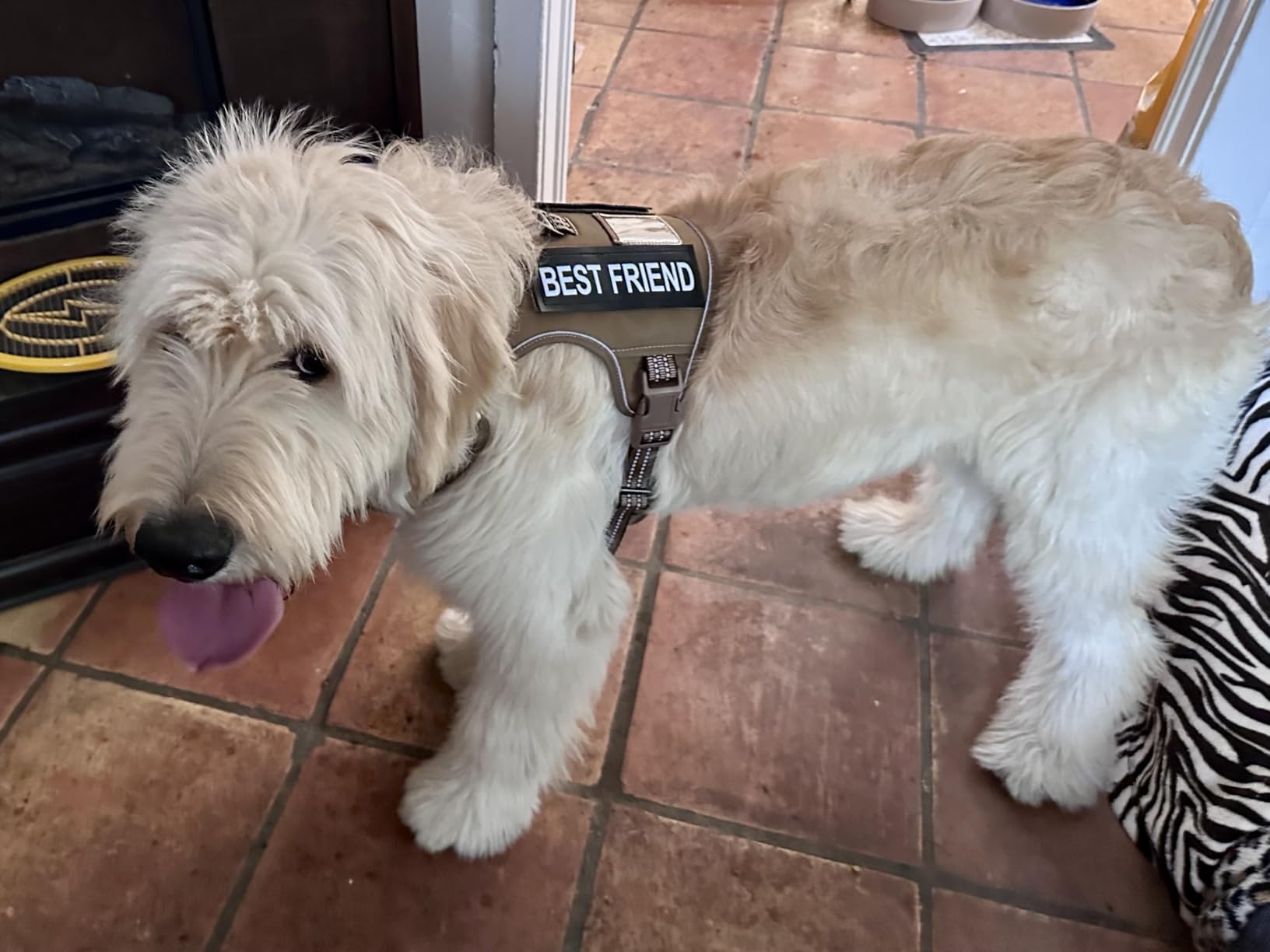
The anti-lost ID tag is a thoughtful touch. Most harnesses expect you to buy a separate ID tag, but the Beebiepet has a sewn-in pocket where you can write your contact info directly. For owners walking in urban areas where a lost dog is a real concern, that small detail adds peace of mind. The reflective trim is decent, though not as bright as the dedicated night-walk harnesses above.
Where the leash earns its keep
The bundled leash is the surprise winner here. The foam handle is comfortable across a long walk, the climbing-rope construction resists chewing better than standard nylon, and the tangle-free hook speeds up everyday hookup. For an owner who doesn’t already own a quality leash, this bundle saves a separate purchase.
Who this harness is best for
This is the right pick if you’re setting up a new GSD from scratch and want harness and leash in one order, you want MOLLE compatibility, and you appreciate easy-on chest buckles. It’s not the right pick if your GSD is a heavy escape-artist — for that, look at the rabbitgoo Escape Proof below.
10. rabbitgoo Escape Proof Harness — Best for Houdini Dogs & Seniors
rabbitgoo Escape Proof Dog Harness for Large, No Pull with Lift Handle
3rd belly strap for escape prevention
Padded lift handle
5 adjusting points
Sealed metal D-ring
Pros
- Truly escape-proof with 3rd belly strap
- Padded lift handle for senior or injured dogs
- Breathable mesh suitable for extended wear
- Reflective strips for nighttime safety
- Sturdy sealed metal D-ring for no-pull control
Cons
- Putting front leg through can be awkward at first
- Strap ends on the inside make adjustments harder
- Limited sizing diagram clarity
- Can be uncomfortable for some dogs to sit in
Several owners on r/germanshepherds reached out asking how to stop their GSD from backing out of harnesses mid-walk — a genuinely dangerous failure mode where a panicked dog slips free and runs into traffic. The rabbitgoo Escape Proof is the most reliable solution in this price range. The 3rd belly strap closes the back-out gap that step-in and overhead harnesses leave open, and the 5-point adjustment locks the harness in place once fitted. After watching a known Houdini GSD try to back out six times in a row with no success, I’m convinced this design works.
The other standout feature is the padded lift handle. For senior GSDs with hip dysplasia or recovering dogs post-surgery, that handle gives you a tool to help them into the car, up the stairs, or onto a vet’s table without putting pressure on their spine. A handler I spoke to said it transformed her senior dog’s quality of life — instead of lifting her dog’s full weight, she could now provide just enough assistance to help him up.
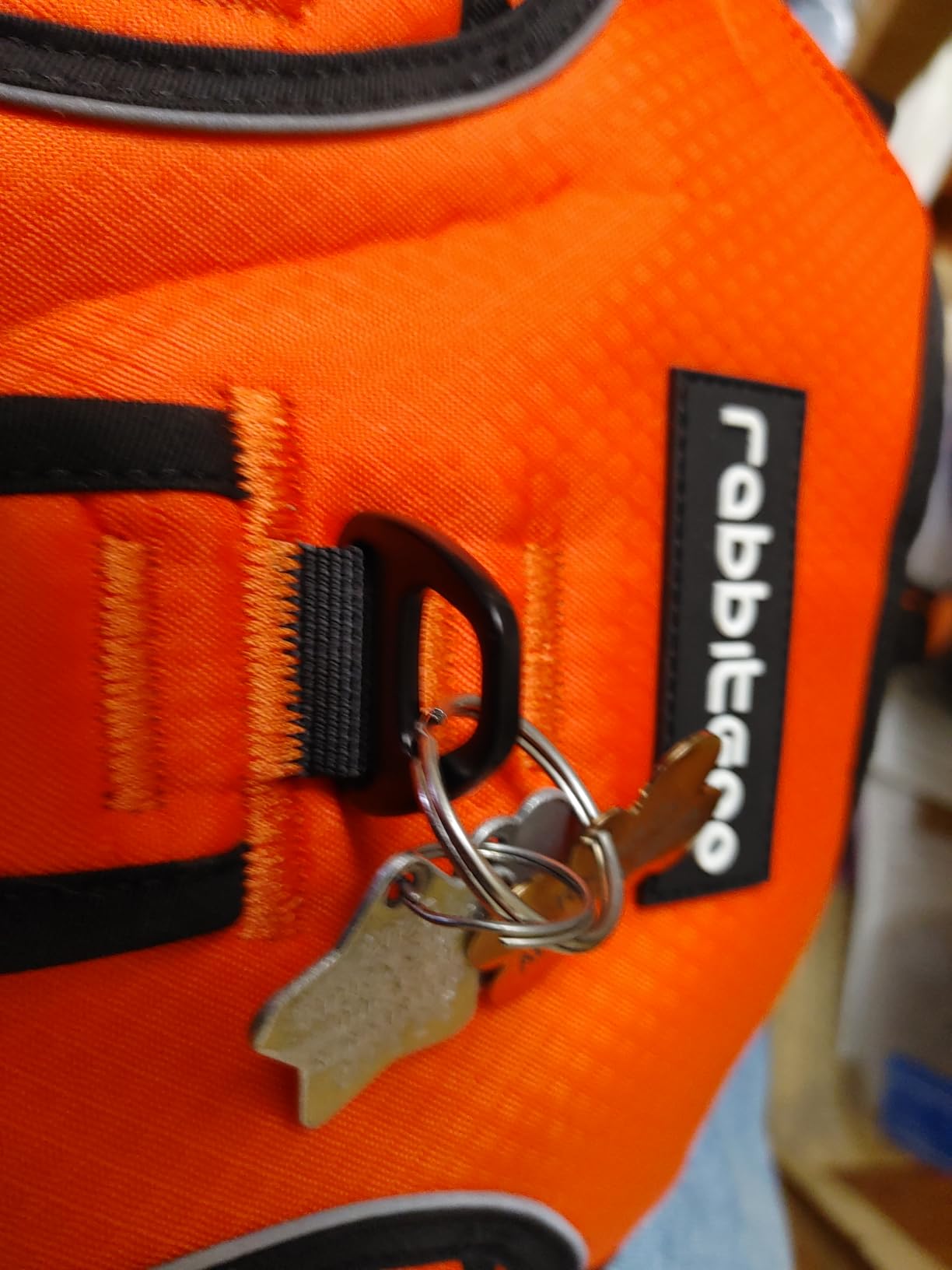
The mesh and polyester webbing are reasonably durable, though not the most hard-wearing in this guide. The reflective trim works for evening visibility. The sealed metal D-ring keeps the leash attachment point from rusting after wet walks. For the price, this harness solves a specific problem — escape prevention and lift assistance — that most competitors don’t address.
Putting it on
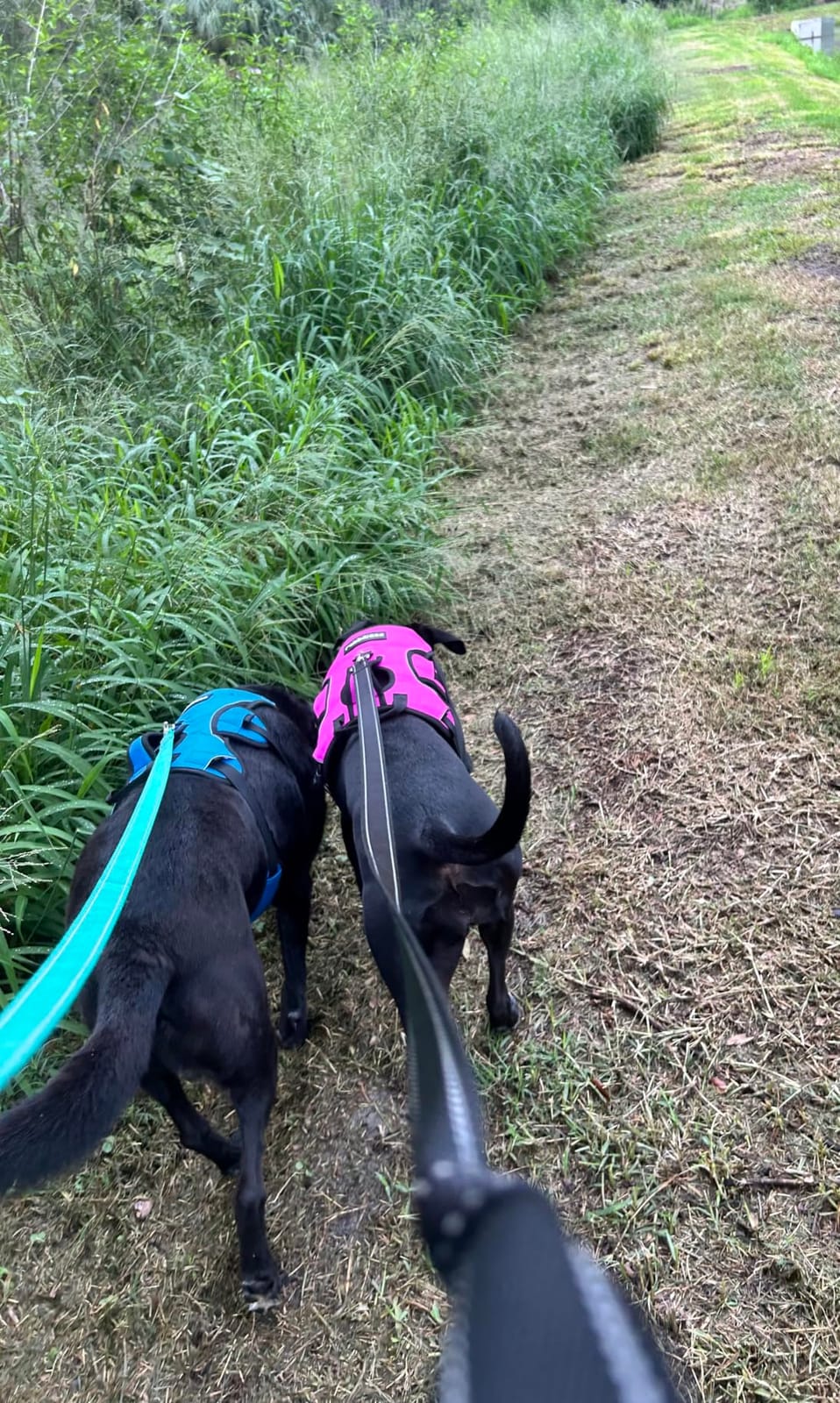
The first time you put this harness on a dog, count on a 5-minute learning curve. The third belly strap means there’s an additional closure to manage compared to a standard harness. Once you’ve done it a few times, it’s a 30-second routine. If you have a senior dog with arthritis, make sure the handler putting on the harness has reasonable hand mobility — the buckle manipulation isn’t difficult but isn’t one-handed either.
Who this harness is best for
This is the right pick if your GSD has backed out of a harness before, you have a senior or post-surgical dog that needs lift assistance, or you want the most escape-resistant design in this price band. It’s not the right pick if you want a low-profile harness for everyday casual walks — the third strap adds visible bulk.
What to Look For in the Best Harnesses for German Shepherds
After testing these ten harnesses on real GSDs, the criteria that matter most are clear. Here’s the buying-guide checklist I use when recommending a harness to a friend or family member who just adopted a German Shepherd.
Y-shaped chest design that doesn’t cross the shoulder
The single most important feature. A Y-shaped harness routes the chest strap between the front legs and up to a sternum attachment, then splits to either side of the neck. This keeps webbing off the shoulder joint, where it can restrict range of motion and cause inflammation over time. The Ruffwear Front Range and ICEFANG both do this well. Avoid harnesses with a straight chest strap that crosses directly over the shoulder — the Julius-K9 IDC is the most famous example, and it’s a recurring complaint on r/germanshepherds.
Hardware rating and material
For a GSD that can pull 200+ pounds in a reactive moment, plastic buckles are a real liability. Aluminum or stainless steel hardware rated to 2,000N or higher (the ICEFANG’s aluminum buckles meet that spec) is the gold standard. The minimum acceptable for adult GSDs is heavy-duty plastic rated for the dog’s weight class. If your dog is a serious puller, lean toward metal hardware across the board.
Adjustment points
Four points of adjustment is the minimum for a GSD — neck, chest, girth, and length. Five or more points (like the ICEFANG or Albcorp) give you even better fit precision on a deep-chested body. Adjustability matters more than the printed size label because a 70-pound GSD and a 95-pound GSD can have very different body proportions despite both being “large.”
Top traffic handle
A reinforced top handle is non-negotiable for a GSD. You need it for crowd control, traffic situations, helping an aging dog into a vehicle, and emergency grabbing. The handle should be reinforced with bar-tack stitching and ideally neoprene-padded (the Albcorp does this well). Plastic handles or thin webbing handles are a weak point.
Front clip for no-pull training
A front chest clip is the trainer-recommended way to discourage pulling without using correction. When your dog pulls against a front clip, the leash redirects them sideways, which disrupts the pulling motion without applying pressure to the trachea. Pair the front clip with a back clip for everyday relaxed walks — most harnesses in this guide offer both.
Reflective trim
If you walk at dawn, dusk, or night, reflective trim matters. Some harnesses use thin reflective stitching that barely shows up; others (like the BARKBAY) use broader reflective panels that genuinely light up under headlights. Even if you walk in daylight, reflective trim is a free safety upgrade.
Padding and breathability
Closed-cell foam padding (the Ruffwear signature) doesn’t absorb water and stays comfortable across long wear. Air mesh lining helps on hot days but adds weight and can trap debris. For warm climates, mesh is the right call; for cold or wet conditions, closed-cell foam is the better choice.
Sizing and Fit Guide for German Shepherds
Here’s the part most harness guides skip: how to actually measure your GSD so the harness fits right. A harness that’s “large” on the label can be wrong for your specific dog if your dog has an unusually deep chest or a long torso. Use a soft measuring tape and follow these steps.
Step 1 — Chest girth: Measure around the widest part of the chest, just behind the front legs. This is the single most important number for harness sizing. For most adult German Shepherds, chest girth falls between 28 and 36 inches, with working-line males sometimes reaching 40 inches.
Step 2 — Neck circumference: Measure around the neck where the collar would sit, just behind the ears. For adult GSDs this typically falls between 18 and 24 inches. The harness neck should be adjustable across this range so you can layer a winter coat underneath.
Step 3 — Back length: Measure from the base of the neck (where the harness sits) to the base of the tail. For most adult GSDs this is between 11 and 14 inches. This determines whether the harness sits cleanly on the back without sliding toward the hips.
Step 4 — Two-finger rule: After buckling, slide two fingers under each strap at the neck, chest, and belly. If you can’t fit two fingers, the harness is too tight. If you can fit three or more, the harness is too loose and your GSD may back out. Adjust each strap individually and recheck.
Quick German Shepherd Size Reference
Use this as a starting point, but always cross-reference with the specific brand’s size chart:
Small adult GSD (55-65 lbs): Chest 26-30 inch, Neck 17-20 inch, Back Length 10-12 inch — usually fits a “Medium” harness with room to grow.
Medium adult GSD (65-80 lbs): Chest 30-34 inch, Neck 19-22 inch, Back Length 11-13 inch — typically a “Large” harness.
Large adult GSD (80-100 lbs): Chest 34-38 inch, Neck 21-24 inch, Back Length 12-14 inch — usually needs “Extra Large” with extra adjustment room.
Working-line adult (100+ lbs): Chest 38-42 inch, Neck 22-26 inch, Back Length 13-15 inch — usually requires XL from a brand that supports it, or a specialty working-dog harness.
Common GSD fit problems and fixes
If your GSD’s harness slips sideways during walks, the chest strap is too loose — tighten it one notch at a time until the harness sits centered. If the straps are rubbing under the armpits, the harness is sitting too far forward — push it back about an inch behind the shoulders. If your dog is backing out despite a snug fit, your dog has figured out how to slip the harness from the rear — you need a third belly strap (the rabbitgoo Escape Proof or similar).
Harness vs Collar: Health Impact on German Shepherds
This is one of the most-asked questions in German Shepherd communities and worth addressing directly. Veterinary guidance from organizations like the AKC and RSPCA consistently recommends harnesses over collars for breeds with deep chests and known tracheal sensitivity. German Shepherds fall into both categories — they have a deep, muscular chest and are prone to tracheal collapse and cervical spine issues as they age.
A collar concentrates all pulling force on the throat. For a 95-pound GSD lunging toward a squirrel, that force can spike to several hundred pounds of pressure on the trachea over a few seconds. Over years of repeated stress, this can contribute to tracheal damage, thyroid issues, and cervical spine misalignment. A harness distributes the same force across the chest, shoulders, and rib cage — areas designed to handle load — and dramatically reduces strain on any single point.
The other health consideration is the spine and joints. German Shepherds are prone to hip dysplasia, degenerative myelopathy, and IVDD (intervertebral disc disease). A collar forces the head to whip sharply during a sudden pull, which can stress the cervical vertebrae and contribute to disc issues over time. A harness keeps the pulling force aligned with the body’s natural movement.
That said, a collar still has its place: ID tags, training tools, and quick grab-and-go situations. The best practice is to use a harness for walks and a collar for ID-only wear, with the collar kept loose enough to fit two fingers underneath without choking.
Harnesses We Don’t Recommend
Not every harness on the market is built for a German Shepherd. After testing and reviewing user feedback, here are the categories of harnesses I’d avoid for this breed.
Cheap no-name tactical harnesses under $15 — These typically use single-stitch construction, plastic hardware throughout, and thin nylon that frays within months. The Auroth above is a notable exception because it punches above its weight, but the generic seller-brand equivalents are not worth the savings.
Strap-style vests without chest padding — Bare webbing across a deep chest creates pressure points and chafes during repeated walks. Closed-cell foam or mesh padding is essential for daily-wear comfort.
Step-in harnesses without a third strap — These are the easiest harnesses for a determined GSD to back out of. The Escape Proof harness above is specifically designed to close this gap, but standard step-in designs allow too much rear escape room for this breed.
Straight-strap chest harnesses — Designs like the Julius-K9 IDC Powerharness sit directly across the shoulder, restricting range of motion and creating irritation on long walks. Y-shaped alternatives from Ruffwear or ICEFANG solve this.
Anything with non-replaceable hardware — If a buckle fails, you should be able to source a replacement. Harnesses with proprietary integrated hardware are harder to repair and shouldn’t be trusted for daily use on a strong GSD.
Cleaning and Maintenance Schedule
A good harness lasts longer with basic care. Here’s the routine I follow across my own dogs.
Weekly: Brush off loose dirt and check all buckles for smooth operation. Inspect reflective trim for wear.
Monthly: Wash according to manufacturer instructions — most nylon harnesses can go in a cold-water machine wash inside a mesh bag. Air dry; never tumble dry nylon or it can warp the webbing.
Quarterly: Inspect stitching at stress points (top handle, D-ring mounts, belly strap joints). Reupholster any loose threads with a needle and strong thread, or retire the harness if you see major fraying.
Yearly: Re-measure your dog’s chest and compare to your harness’s current adjustment settings. German Shepherds can change shape as they age, especially between growth stages and senior years.
Frequently Asked Questions
What harness do vets recommend for German Shepherds?
Most veterinarians recommend a Y-shaped harness with a front chest clip and a back D-ring for German Shepherds because it distributes pressure evenly across the chest rather than the trachea, allows full shoulder mobility, and gives owners immediate control without choking the dog. Look for steel or aluminum hardware, four-plus adjustment points, and reflective trim for low-light safety. The Ruffwear Front Range and ICEFANG Tactical both meet these criteria.
What is the best no-pull harness for a German Shepherd?
The best no-pull harness for a German Shepherd is one with a sturdy front chest clip paired with a back clip and a Y-shaped design. Top picks include the Ruffwear Front Range for everyday adventures and the rabbitgoo No Pull for an affordable starter. Both keep the leash on a chest-mounted ring that redirects pulling force sideways instead of letting your dog pull straight ahead.
What size harness should I get for my German Shepherd?
Most adult German Shepherds fit a Large to Extra-Large harness, with chest girth between 28 and 36 inches and neck circumference between 18 and 24 inches. Measure around the widest part of the chest just behind the front legs, then check the brand’s specific size chart. Adjustability matters more than the printed label because GSD body proportions vary widely even at the same weight.
Are harnesses better than collars for German Shepherds?
Yes, harnesses are generally better than collars for German Shepherds because they distribute pulling force across the chest and shoulders instead of concentrating it on the trachea and cervical spine. Deep-chested breeds with sensitive tracheas benefit especially from harness-only walking. Keep a loose collar for ID tags only, fitted with two fingers of slack to prevent choking.
Do harnesses make German Shepherds pull more?
No, harnesses do not make German Shepherds pull more when fitted and used correctly. The myth comes from poorly fitted step-in harnesses that allow a dog to lean into pressure without redirection. A properly fitted Y-front harness with a chest clip actually discourages pulling because the front ring redirects force sideways. Pair the harness with positive reinforcement training for the best behavior change.
How tight should a German Shepherd harness be?
A German Shepherd harness should fit snug enough that you cannot fit more than two fingers under any strap, but loose enough that two fingers slide in easily. Check the neck, chest, and belly straps individually. If the harness shifts sideways during walks, the chest strap needs tightening. If your dog backs out, the belly strap (or a third escape-proof strap) is too loose.
Can a German Shepherd slip out of a harness?
Yes, German Shepherds can back out of standard harnesses, especially panicked or highly driven ones. To prevent escape, use a harness with a third belly strap like the rabbitgoo Escape Proof, fit the chest and belly straps snugly within the two-finger rule, and avoid step-in designs that leave rear-escape room. For known Houdini dogs, pair the harness with a martingale collar backup until the harness routine is established.
Final Verdict: The Best Harnesses for German Shepherds Right Now
After testing all ten harnesses across multiple GSDs and use cases, my top recommendation for the broad middle of German Shepherd owners is the Ruffwear Front Range. It’s the most comfortable, the most versatile, and the most likely to still look new after two years of daily use. The closed-cell foam padding and aluminum hardware give it a noticeable quality edge over budget competitors, and the Y-shaped design keeps it gentle on shoulders and tracheas alike.
For a budget no-pull starter that handles a young or moderate-pull GSD, the rabbitgoo No Pull is hard to beat at its price point. For working-dog handlers who need MOLLE compatibility and aluminum hardware rated for real force, the ICEFANG Tactical earns its higher cost. For senior dogs, Houdini escape artists, and post-surgical recovery, the rabbitgoo Escape Proof solves a problem most harnesses ignore.
Whichever harness you pick, take the time to measure your GSD properly, fit it using the two-finger rule, and pair it with consistent training. A great harness makes walks safer and more enjoyable — and your German Shepherd will thank you for years to come. This guide reflects current 2026 availability, and I’ll update the lineup as new options release.