
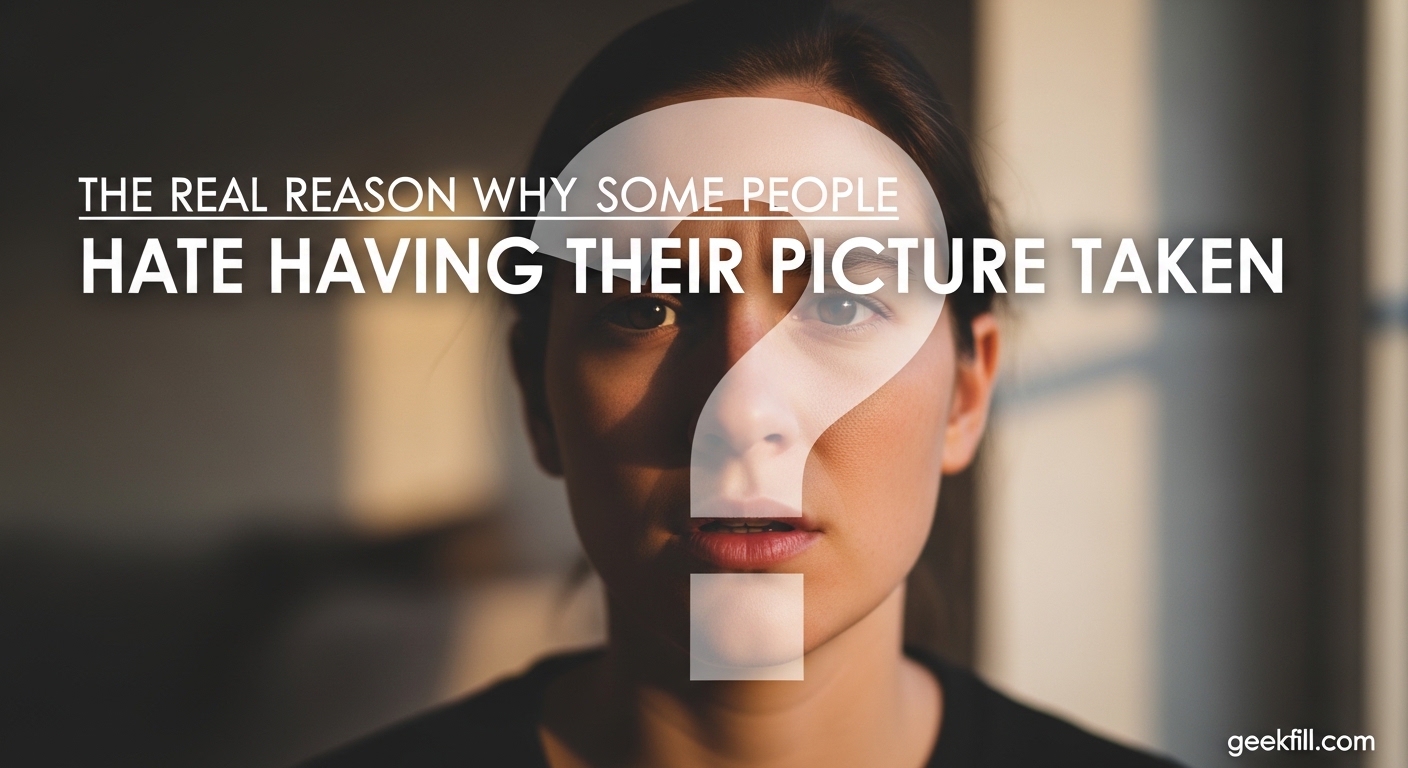
You are standing at a family gathering when someone pulls out a camera. Your stomach drops. The familiar dread sets in. You feel the need to retreat, to hide, to make yourself invisible somehow.
If this sounds familiar, you are not alone. Millions of people experience camera shyness, that gut-wrenching discomfort that comes with having your picture taken. But why does this happen? Why do some people hate having their picture taken while others strike a pose without a second thought?
The answer runs deeper than simple vanity or insecurity. The real reason why some people hate having their picture taken stems from a fundamental disconnect between how we see ourselves internally and how we appear in static images. This psychological mechanism, combined with social pressures and our unique neurological wiring, creates a perfect storm of photo aversion.
Table of Contents
Why We Look Different in Photos Than in the Mirror
Most of us look at ourselves in mirrors every day. We brush our teeth, style our hair, and check our outfits using this reflective surface. What we see in the mirror is not what others see when they look at us, and it is definitely not what the camera captures.
When you look in a mirror, you see a reversed version of yourself. Your face is flipped horizontally. The mole on your left cheek appears on the right side in the mirror. Your parted hair falls in the opposite direction from how others perceive it. This mirror-reversed image is what your brain has come to accept as “you” over years of daily exposure.
Then someone snaps a photo. Suddenly you are looking at a non-mirrored version of yourself. The mole is on the correct side. Your hair falls the way others see it. Your features appear subtly different from what you expect. This creates an immediate feeling of wrongness, of unfamiliarity. You are literally looking at a stranger.
Psychologists call this the mirror reversal effect, and it explains why photos can feel so jarring even when you look perfectly fine to everyone else. Your brain has built an internal model of your appearance based on thousands of hours of mirror exposure. The camera shows reality, but reality does not match your internal self-perception.
The Psychology Behind Camera Shyness
Beyond the mirror effect lies a deeper psychological phenomenon called self-image dysphoria. This occurs when there is a mismatch between how you perceive yourself internally and how you appear in external representations like photographs.
Think about how you see yourself in your mind. It is probably dynamic, animated, full of movement and expression. You imagine yourself laughing, talking, existing in motion. Your internal self-image includes your personality, your energy, your essence. It is not a static frozen moment.
Photographs capture a single millisecond. One pose, one expression, one angle. That frozen image cannot possibly contain your full identity. When you see that photo, your brain compares it against your rich internal self-image and finds it lacking. The photo feels like a poor representation of who you actually are.
This disconnect triggers confirmation bias. If you already have concerns about your appearance, the photo seems to confirm every negative thought you have ever had about yourself. You zero in on perceived flaws. You notice asymmetries you never saw before. The photo becomes evidence supporting your worst self-criticism.
Research supports this phenomenon. Studies show that people consistently rate themselves as less attractive in photographs than others rate them. We are our own harshest critics, and photographs give us endless material for that criticism.
Social Pressure and Performance Anxiety
Camera shyness also involves a peculiar type of performance anxiety. Being photographed requires you to “look natural” while knowing you are being documented. This paradox creates immediate tension.
The instruction to “just act normal” is impossible to follow when you know a camera is pointed at you. Suddenly you become hyper-aware of your expression, your posture, your hands, your smile. Every movement feels calculated rather than spontaneous. The more you try to look natural, the more unnatural you feel.
Social media has amplified this pressure significantly. Unlike the film cameras of previous generations, digital photography means your image can be shared instantly and permanently. You lose control over who sees it, how it is edited, and what context accompanies it. This loss of control triggers primitive anxieties about social judgment and rejection.
Beauty standards add another layer of complexity. We are constantly bombarded with images of perfectly posed, filtered, edited photographs. When we compare our candid snapshots to these professional images, we inevitably fall short. The gap between our reality and these impossible standards creates shame and photo aversion.
Neurodivergent Perspectives
For neurodivergent individuals, particularly those with autism or ADHD, camera aversion can be even more pronounced. The reasons extend beyond simple self-consciousness into sensory and social processing differences.
Many autistic individuals report that being photographed feels invasive and overwhelming. The bright flash can trigger sensory sensitivities. The expectation to hold still, maintain eye contact, and produce a facial expression on command contradicts natural autistic communication styles.
The performance aspect creates particular challenges. Autistic people often struggle with scripted social interactions, and posed photographs represent the ultimate scripted moment. The pressure to produce a “good” expression while receiving multiple conflicting instructions creates cognitive overload.
Additionally, some neurodivergent individuals experience difficulty recognizing faces, including their own. This condition, called prosopagnosia or face blindness, can make photographs particularly disorienting. The person in the photo might not even register as “me” to the viewer.
ADHD can contribute to photo aversion through difficulties with sustained attention and physical stillness. Holding a pose while waiting for the camera timer or dealing with multiple photo attempts feels torturous when your brain wants to move on to the next thing.
Understanding and Acceptance
If you recognize yourself in these descriptions, know that your discomfort is valid and shared by millions. Camera shyness is not a character flaw or something you need to force yourself to overcome. It is a natural response to the complex psychological, social, and neurological factors we have explored.
That said, there are strategies for managing photo-related anxiety when avoidance is not possible. If you need to be in a group photo, try these approaches:
Focus on connection, not perfection. Instead of worrying about how you look, concentrate on the people you are with. Think about why the photo matters to them. Your genuine connection will shine through more than any perfect pose.
Give yourself permission to be awkward. Accept that you might look uncomfortable. Most people will not notice or care nearly as much as you think. The photo is a memory, not a beauty contest.
Practice self-compassion. When you see a photo of yourself, notice the negative self-talk and gently redirect it. Treat yourself with the same kindness you would offer a friend.
If you need to decline being photographed, simple scripts work best: “I prefer not to be in photos, but thank you for asking” or “I will take the picture so everyone else can be in it.” Most people will respect your boundary when you state it clearly.
For important life events where photos feel unavoidable, communicate your needs ahead of time. Let photographers know you are camera shy. Ask for candid shots rather than posed photos. Request that unflattering images be deleted rather than shared.
Frequently Asked Questions
Why would someone hate having their photo taken?
Many photo-averse individuals experience a fundamental disconnect between their internal self-image and how they appear in static photographs. This image dysphoria occurs because we are accustomed to seeing ourselves in mirrors, which present a reversed version we are familiar with, while photos show us as others see us.
Why do I look worse in photos than in the mirror?
The mirror reversal effect means you see a flipped version of yourself daily. Photos show your true non-mirrored appearance, which looks unfamiliar and therefore wrong to your brain. Additionally, mirrors show you in motion while photos capture a single frozen moment that can emphasize angles and expressions you never see in reflection.
Is it normal to hate having pictures taken?
Yes, camera shyness is extremely common and completely normal. Research indicates that most people experience some level of discomfort with photographs due to the disconnect between internal self-perception and external images, combined with social pressures and performance anxiety.
How do I get over camera shyness?
Complete elimination may not be necessary or possible. Instead, focus on management strategies: practice self-compassion when viewing photos, concentrate on connection rather than appearance, communicate boundaries clearly, and remember that others see you more kindly than you see yourself.
Why do I feel anxious even thinking about being photographed?
Anticipatory anxiety about photography often stems from knowing you will have to confront an image that contradicts your internal self-perception. This creates dread about seeing yourself non-mirrored and potentially having that image shared or judged by others.
Conclusion
The real reason why some people hate having their picture taken is not vanity or insecurity. It is a complex interplay between mirror-reversed self-perception, psychological disconnect from static images, social performance pressure, and for some, neurodivergent processing differences.
Understanding these mechanisms helps us recognize that photo aversion is not a personal failing. It is a natural human response to an unnatural situation: being frozen in time and displayed in a way that contradicts how we see ourselves.
If you struggle with camera shyness, take heart in knowing you are not alone. The next time you feel that familiar dread at a family gathering or social event, remember that your discomfort makes perfect sense. Your brain is doing exactly what it evolved to do: protecting you from perceived threats and maintaining your sense of self.
You do not owe anyone photographic evidence of your existence. You are allowed to decline. You are allowed to feel uncomfortable. And you are definitely allowed to look at photos of yourself with the same compassion you would offer anyone else.