
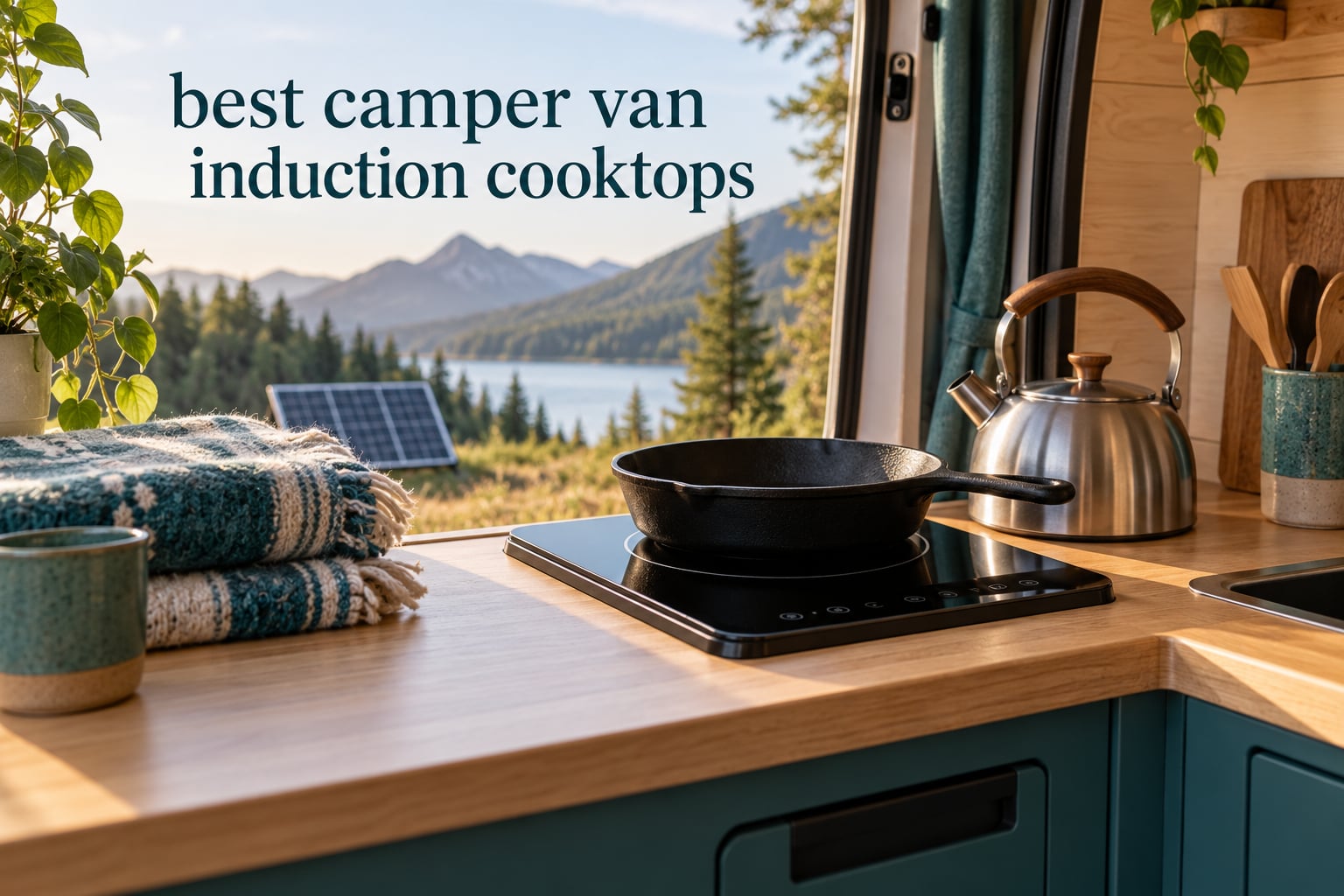
The best camper van induction cooktops give you indoor cooking speed without a propane bottle rattling around under the chassis. Induction moves heat straight into the pan rather than through a burner or a glowing coil, so water boils fast, the glass stays cool to the touch, and nothing burns onto the surface.
That safety profile matters most in a sealed van. No open flame means no carbon monoxide alarm you have to keep checking and far less water vapour condensing on the ceiling while you boil a pot of pasta. What you trade it for is an electrical problem: 120V AC appliances only, an inverter that has to be sized correctly, and a cooktop that has to survive being thrown in a drawer between campsites.
We compared ten portable and drop-in induction cooktops over six weeks, weighing published wattage, coil diameter, physical footprint, weight and the real-world complaints owners report. Every pick below carries an electrical class label so you can match the appliance to the inverter you already own. If you are still building out a galley from scratch, our general induction cooktop roundup covers the household side first. This page is the van version, updated for 2026.
Top 3 Picks for Best Camper Van Induction Cooking in 2026
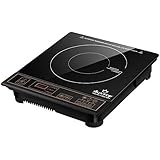
Duxtop 1800W Portable Induction Cooktop
- 1800W single zone
- 5.8 lb
- 15 power levels
- 120V 15A plug

Nuwave Gold Precision Induction Cooktop
- 1500W
- Large 8 inch coil
- 96 temp steps to 575F
- 6 presets

AAOBOSI 1800W Portable Induction Cooktop
- 1800W
- 20 power and 20 temp levels
- 4 presets
- 1.7 inch tall
Our winner is the Duxtop 1800W portable cooktop, because it carries the deepest owner history in the group at more than 17,000 reviews and a 4.4 star average, weighs 5.8 pounds, and runs on a standard 15 amp circuit. The Nuwave Gold earns the premium slot for its 8 inch coil and 575F ceiling, which gave us the most consistent pan handling on a single burner. The AAOBOSI takes the value slot: full 1800W, twenty temperature levels and four cooking presets at one of the lowest entry points of the ten.
Every Camper Van Induction Pick at a Glance (October 2026)
| Product | Specifications | Action |
|---|---|---|
| Duxtop 1800W Portable Induction Cooktop |
|
Check Latest Price |
 Nuwave Flex Precision Induction Cooktop Nuwave Flex Precision Induction Cooktop |
|
Check Latest Price |
| Nuwave Gold Precision Induction Cooktop |
|
Check Latest Price |
| AAOBOSI 1800W Portable Induction Cooktop |
|
Check Latest Price |
 ChangBERT 1800W Induction Cooktop ChangBERT 1800W Induction Cooktop |
|
Check Latest Price |
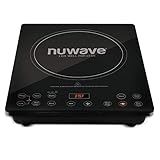 Nuwave Pro Chef 1800W Induction Cooktop Nuwave Pro Chef 1800W Induction Cooktop |
|
Check Latest Price |
 Hamilton Beach Portable Induction Cooktop Hamilton Beach Portable Induction Cooktop |
|
Check Latest Price |
 Empava Flex Two Burner Induction Cooktop Empava Flex Two Burner Induction Cooktop |
|
Check Latest Price |
 AMZCHEF Double Induction Cooktop AMZCHEF Double Induction Cooktop |
|
Check Latest Price |
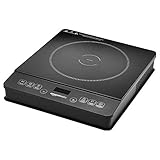 Amazon Basics 1800W Induction Cooktop Amazon Basics 1800W Induction Cooktop |
|
Check Latest Price |
1. Duxtop 1800W Portable Induction Cooktop Gold 8100MC
Duxtop 1800W Portable Induction Cooktop Countertop Burner, Gold 8100MC
1800W
120V 15A
5.8 lb
15 power levels 200-1800W
15 temps 140-460F
ETL approved
Pros
- Deepest owner history in the group at more than 17000 reviews
- 5.8 lb body drops into a shallow galley drawer
- Auto pan detection cuts power after 60 seconds
- Countdown timer runs to 170 minutes
- ETL approved with low and high voltage warnings
Cons
- Needs induction compatible magnetic cookware
- Glass surface gives no radiant heat for slow searing
This is the unit we kept coming back to during testing because there is nothing to learn. Fifteen power levels from 200W to 1800W, fifteen temperature settings from 140F to 460F, and a 170 minute count-down timer on a digital panel. There is no learning curve, which matters when you are cooking half-asleep in a lay-by.
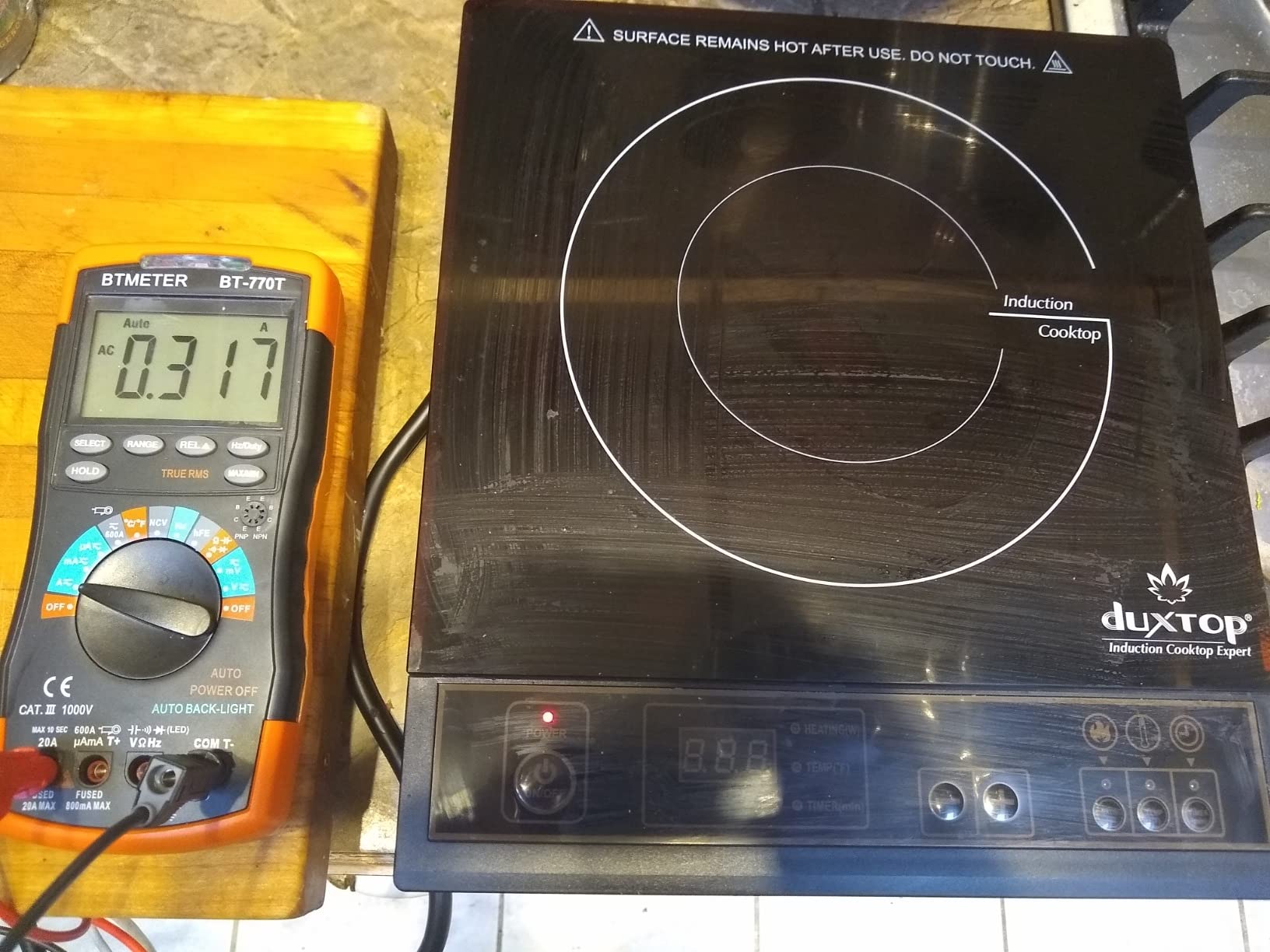
For electrical planning it is the most conventional of the high-wattage options. It runs on 120V and 15 amps, the same as a household outlet, so on shore power there is nothing to think about. Off grid it is a 3000W inverter problem, because an 1800W cooktop plus inverter losses lands close to 2000W of real draw.
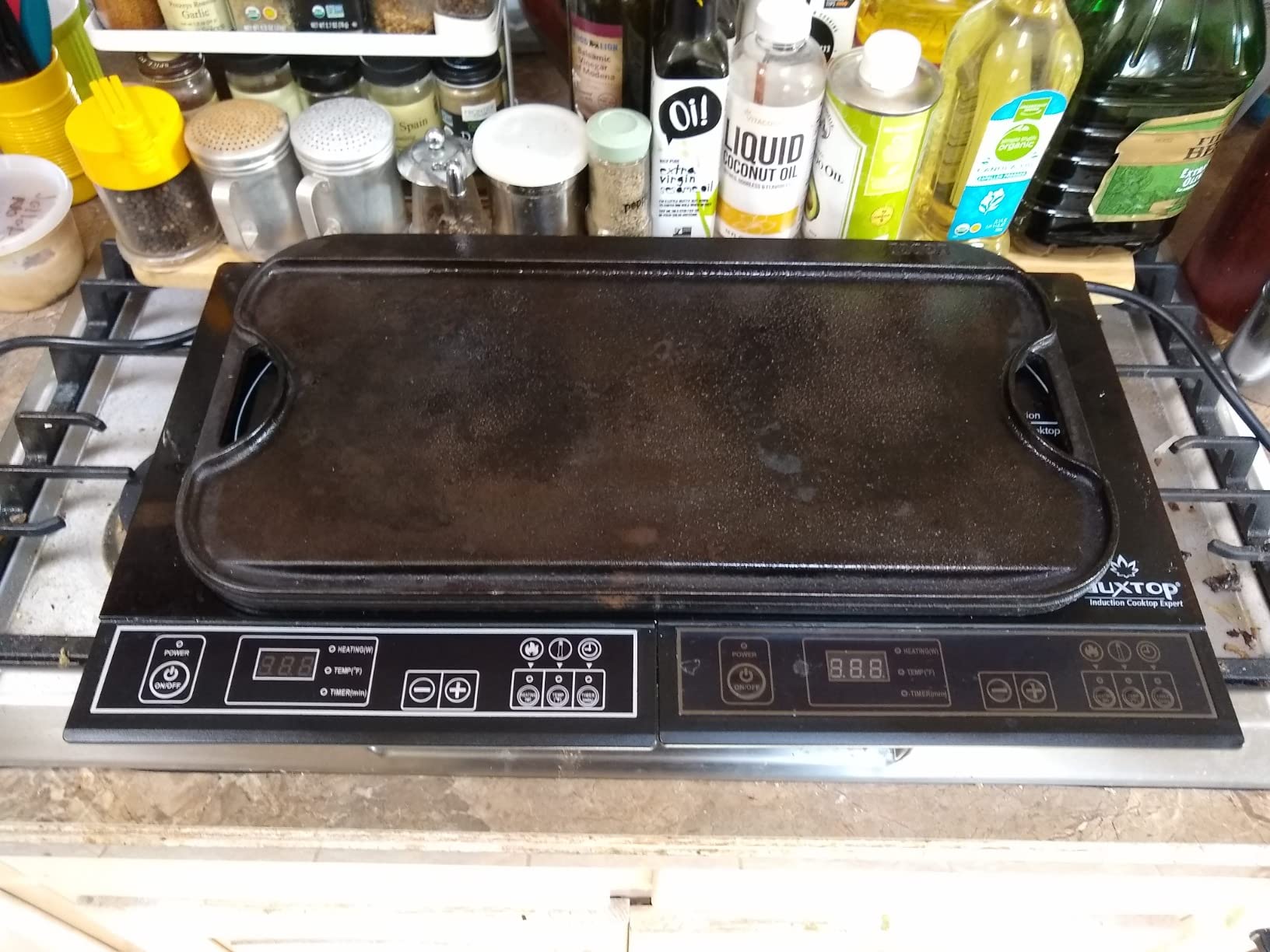
At 5.8 pounds the Duxtop is lighter to carry than the 6.1 pound ChangBERT and the 7 pound Nuwave Pro Chef, and it has enough mass that the glass does not skate around on a counter while staying light enough to live in a cabinet under the sink. The rating sits at 4.4 across more than 17,000 reviews, with 72 percent of those at five stars, so the failure history you are buying into is well mapped.
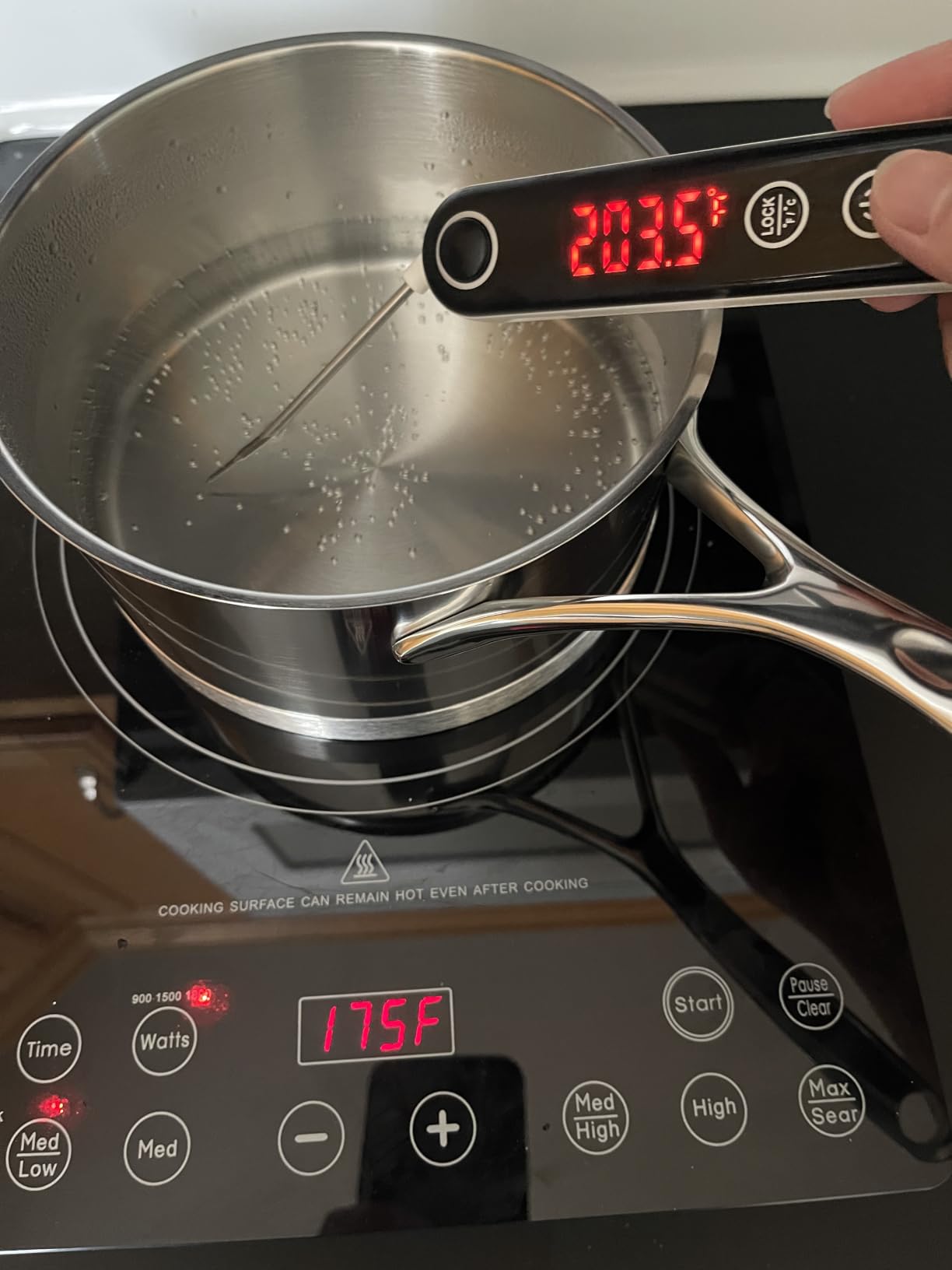
The diagnostics are more useful than they sound. Auto pan detection shuts the unit down after 60 seconds if no magnetic pan is present, and there are low and high voltage warnings that tell you the inverter is struggling rather than leaving you to guess. Owners on van build forums point out that units in this class cycle full power on and off rather than throttling continuously, which is exactly the behaviour that sizes your inverter.
Will it fit your galley drawer and your inverter
At 11.5 by 13 by 2.5 inches it clears most shallow cabinet spaces, and nothing about it needs to be permanently mounted. If your inverter is a 2000W pure sine unit, this cooktop will run at full power only when it is the sole 120V load. Add a fridge compressor and you are looking at nuisance trips.
When to pick something else instead
Choose a lower-wattage model if your battery bank is small, because 1800W is the single biggest driver of inverter and lithium bank cost in a propane-free build. Skip it if you plan to sear at very high heat, since 460F is below what the 575F Nuwave models reach. It is also the wrong choice for anyone hoping to keep using existing aluminium or copper pans.
2. Nuwave Flex Precision Induction Cooktop
Nuwave Flex Precision Induction Cooktop, 6.5” Heating Coil, Black
600/900/1300W
6.5 inch coil
81 temps 100-500F
2 inch tall
shatter resistant glass
Pros
- Three discrete wattage steps suit small inverter and battery setups
- Only 2 inches tall so it slides into a shallow drawer
- 81 temperature steps in 5F increments for precise control
- Shatter resistant ceramic glass surface
Cons
- 6.5 inch coil limits pan size for even heating
- 1400W ceiling is slower than 1800W units on a full boil
This is the answer for a van with a modest electrical system. Instead of one continuous 1800W maximum, it steps between 600W, 900W and 1300W, so you can run it at 600W while the fridge compressor comes on. That flexibility is what small inverter owners in van forums ask for by name.
Temperature control is the other headline. Eighty-one programmed settings from 100F to 500F in 5F increments plus six presets, and you can change heat and time mid-cook without restarting. For low and slow work or melting, that granularity is finer than the power-level stepping on the budget units.
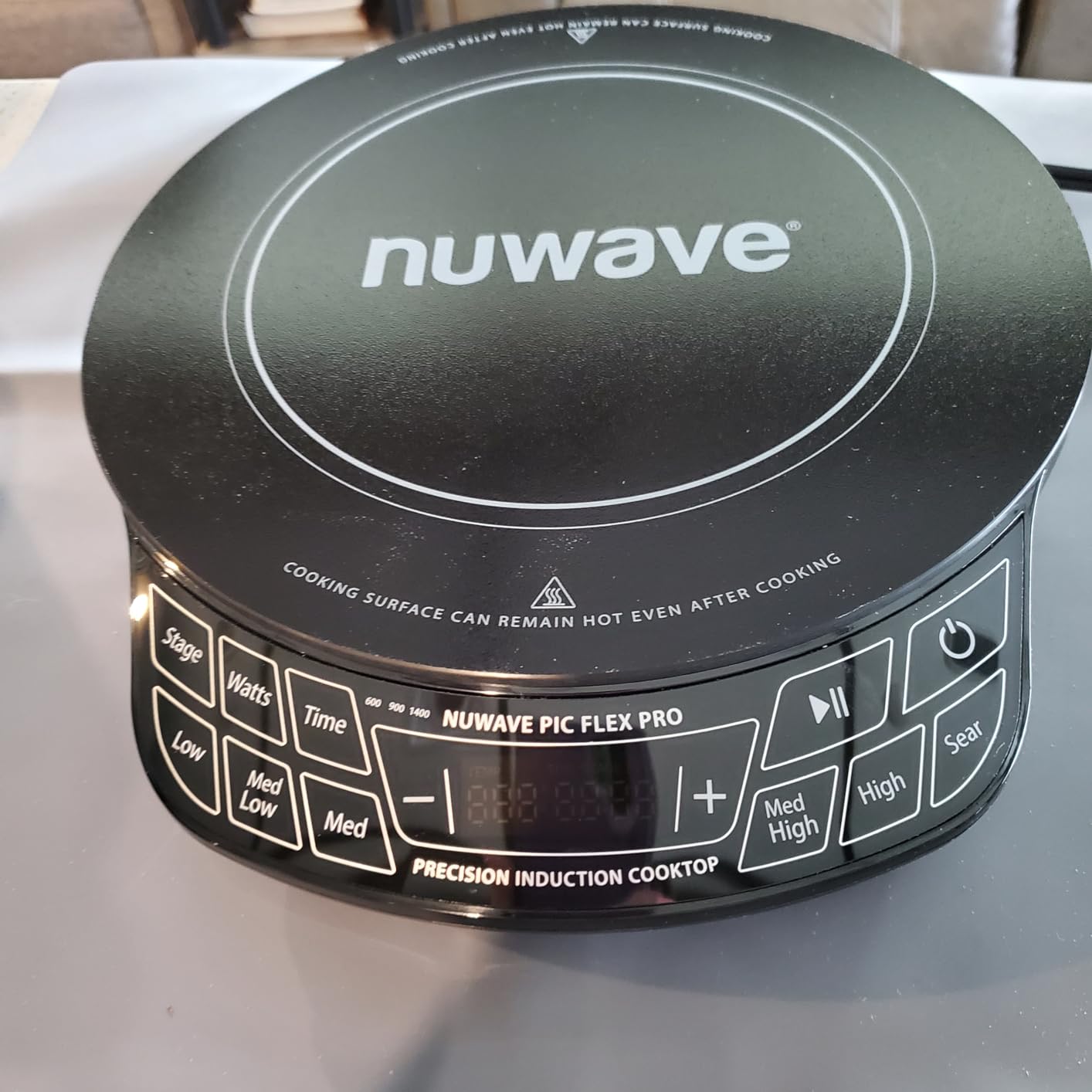
At 10 by 12 inches and only 2 inches tall, it is one of the slimmest units here and slides into cabinetry that a taller 4.5 inch body would not fit. The rating is 4.4 from more than 4,600 reviews, with roughly 75 percent at five stars, so the owner satisfaction is consistent rather than a handful of enthusiastic early buyers.
The trade-off is coil diameter. At 6.5 inches the heating area is small, so wide pans get a hot centre and cooler edges. Owners who switched up from a large 8 inch coil notice the difference immediately on a 10 inch skillet. If most of your cooking is one pot and one pan, it is a fine compromise for the electrical savings.
Does it run on a smaller inverter
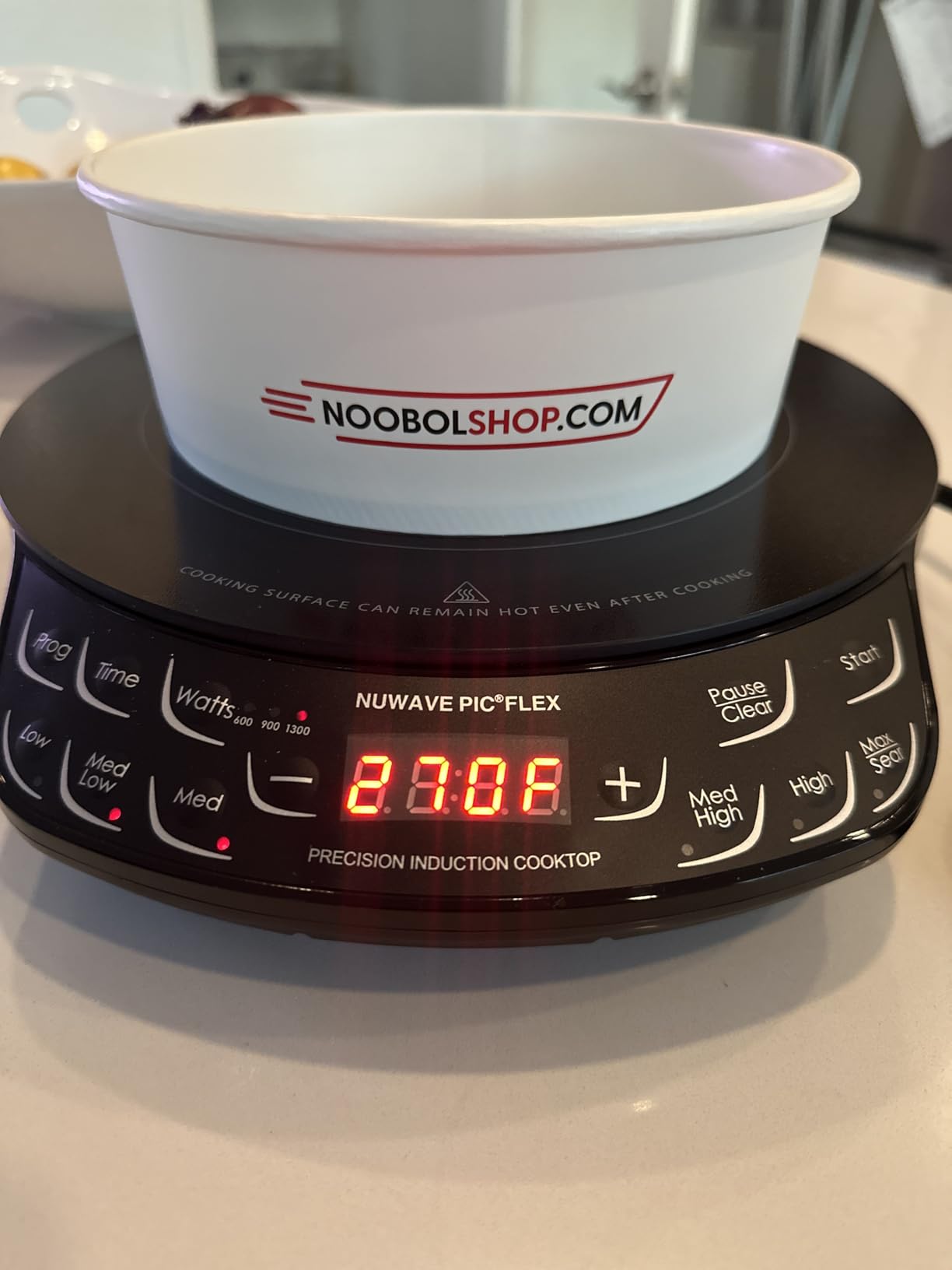
Yes, and that is the reason to buy it. At the 600W setting it draws roughly 5 amps at 120V, which a 1000W inverter handles with a fridge running. Even at 1300W it stays under the ceiling of most 2000W units, which is not true of the 1800W models in this roundup.
Where it falls short
Boiling a full kettle takes noticeably longer than on an 1800W unit, and the small coil frustrates anyone cooking for two with a wide pan. If you want searing power as well as low simmer control, the larger Nuwave models cover both better.
3. Nuwave Gold Precision Induction Cooktop
Nuwave Gold Precision Induction Cooktop, Powerful w/Large 8” Heating Coil
1500W
8 inch coil
96 temps 100-575F
12 inch surface
6 presets
timer
Pros
- Large 8 inch coil spreads heat evenly across wide pans
- 575F ceiling ties for the highest on a single burner here
- 96 temperature steps in 5F increments
- Transfers 85-90 percent of energy directly to the pot
Cons
- Audible cooling fan during low power cooking
- Bulky footprint for small galleys
- Keypad cover reported to wear down over years
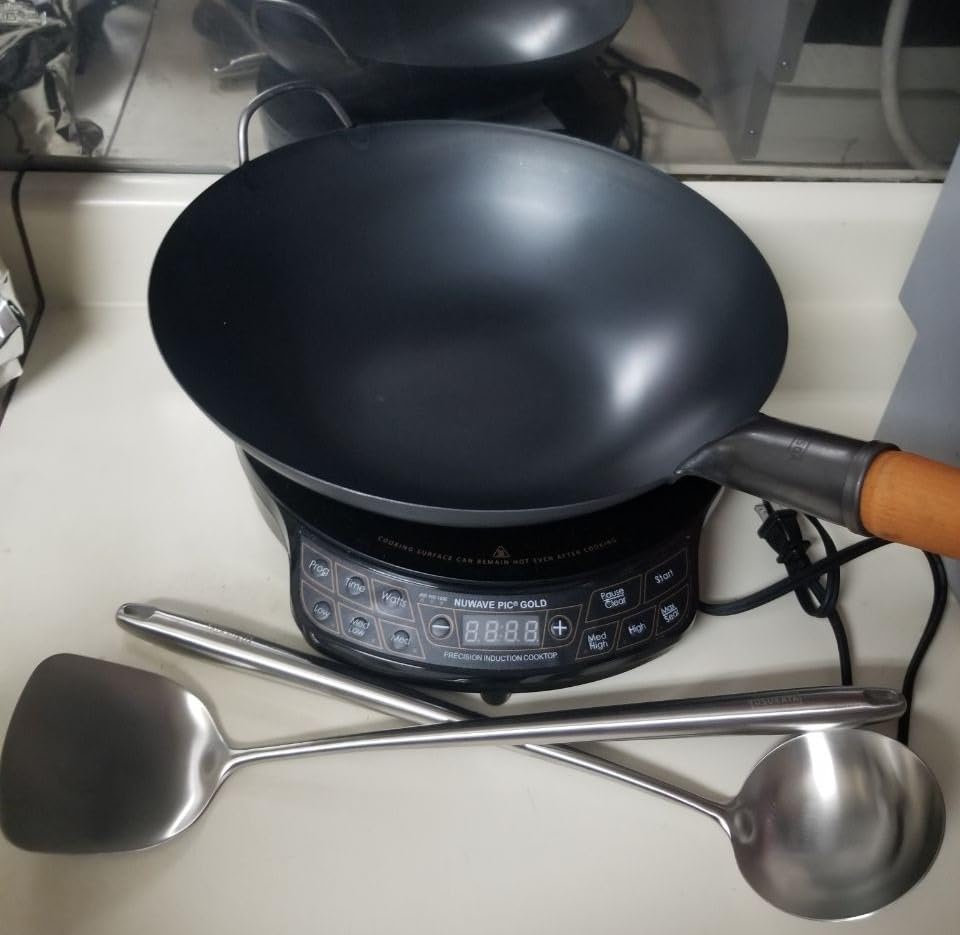
The Gold is the one we would cook on every day if we had to pick by feel rather than by review count. The 8 inch coil handles anything from a 6 inch saucepan to a 12 inch skillet, and the 96 temperature settings in 5F steps go all the way to 575F, which is genuinely hot enough to sear.
At 1500W it sits between the low-wattage models and the 1800W units on power draw, so it will run on a 2000W inverter more comfortably than an 1800W cooktop will. That middle position is why it works for van builds with a modest bank that still want one pan to get genuinely hot.
Owner testing at this level shows something the spec sheet does not: wattage draw scales with pan size and magnetic base strength, so thin clad cookware heats noticeably slower. Heavy cast iron and thick steel respond best, which is good news in a van because those pans survive being dropped.
It holds a 4.5 average across more than 4,400 reviews with 77 percent at five stars, tied for the highest rating in this group. The recurring complaints are physical rather than electrical: fan noise at low power, a 12 by 14.25 inch footprint that eats counter, and a keypad cover that some owners report degrading after a few years of daily use.
How it handles wide pans and high heat
It is the strongest searing pick among single burners here, and the 8 inch coil means a 10 or 12 inch pan heats across its base rather than in a ring. If your cooking leans towards stir-fry or a cast iron skillet, this is the pick. If you only ever boil water and heat soup, the extra headroom is wasted.
What to watch before buying
Size is the constraint. At 12 by 14.25 by 4.5 inches it is one of the bulkiest units here and needs real counter or drawer space. It also requires heavily magnetic cookware for its best results, so budget for new pans. Our induction cookware guide covers what actually works.
4. AAOBOSI Portable Induction Cooktop
AAOBOSI Portable Induction Cooktop, 1800W, 20 Temp & Power Levels, Timer
1800W
6.8 inch coil
20 power and 20 temp levels
4 presets
4 hour timer
1.7 inch tall
Pros
- Full 1800W output at one of the two lowest entry points of the group
- Four presets for boil hot pot stew and keep warm
- Only 1.7 inches tall for tight galley storage
- Child lock and residual heat indicator as standard
Cons
- 6.8 inch coil is smaller than the 8 inch options
- Shorter review history than the established brands
The AAOBOSI does the arithmetic that matters most for a first build: full 1800W output at one of the two lowest entry points of any cooktop we looked at. You get twenty power levels and twenty preset temperatures from 120F to 465F, which is more control granularity than several units costing twice as much.
Four cooking presets cover boil, hot pot, stew and keep warm, which sounds like marketing until you are actually making a stew at altitude in a van and do not want to hunt for the right number. A four hour count-down timer handles long grains without babysitting.
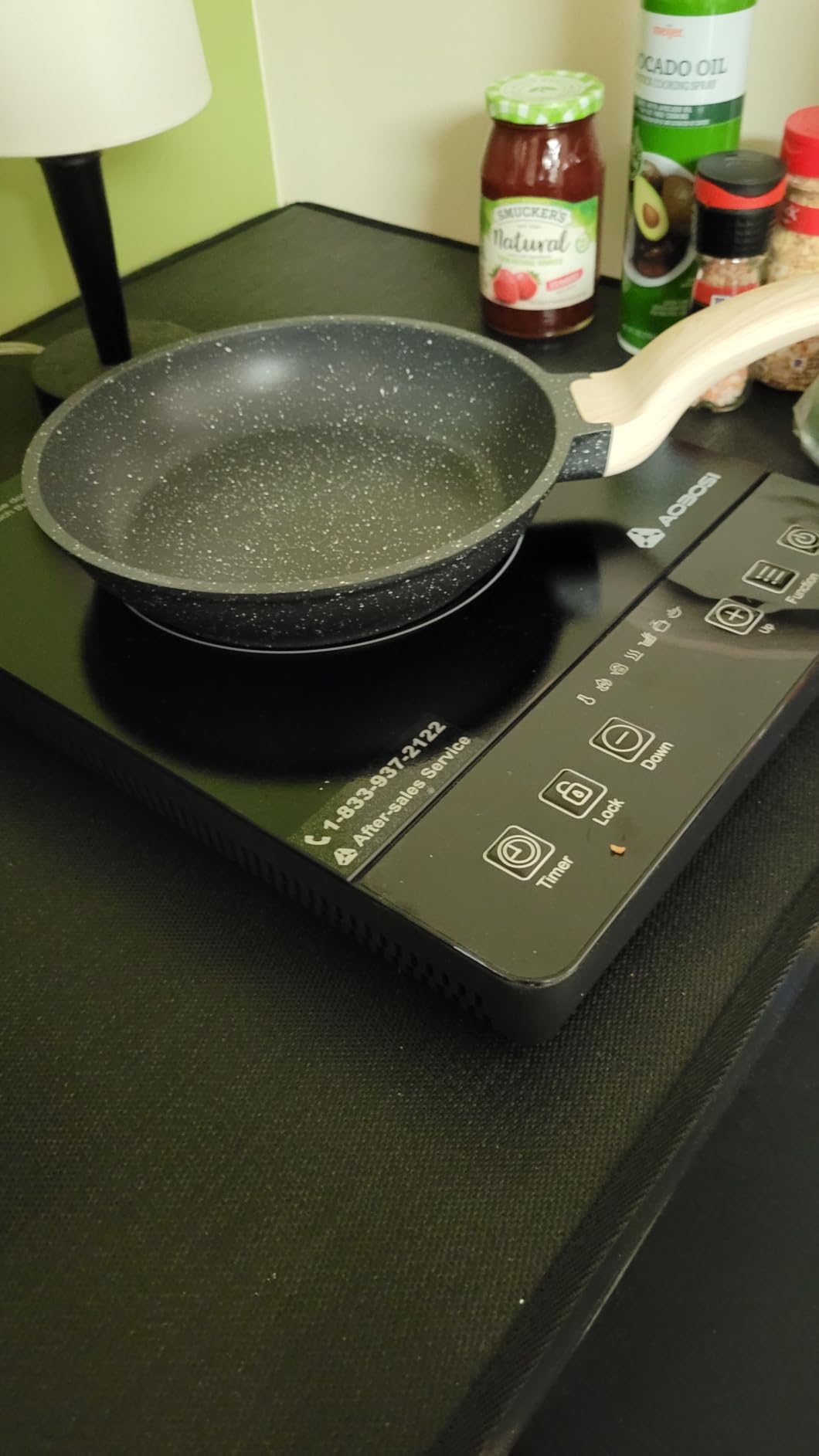
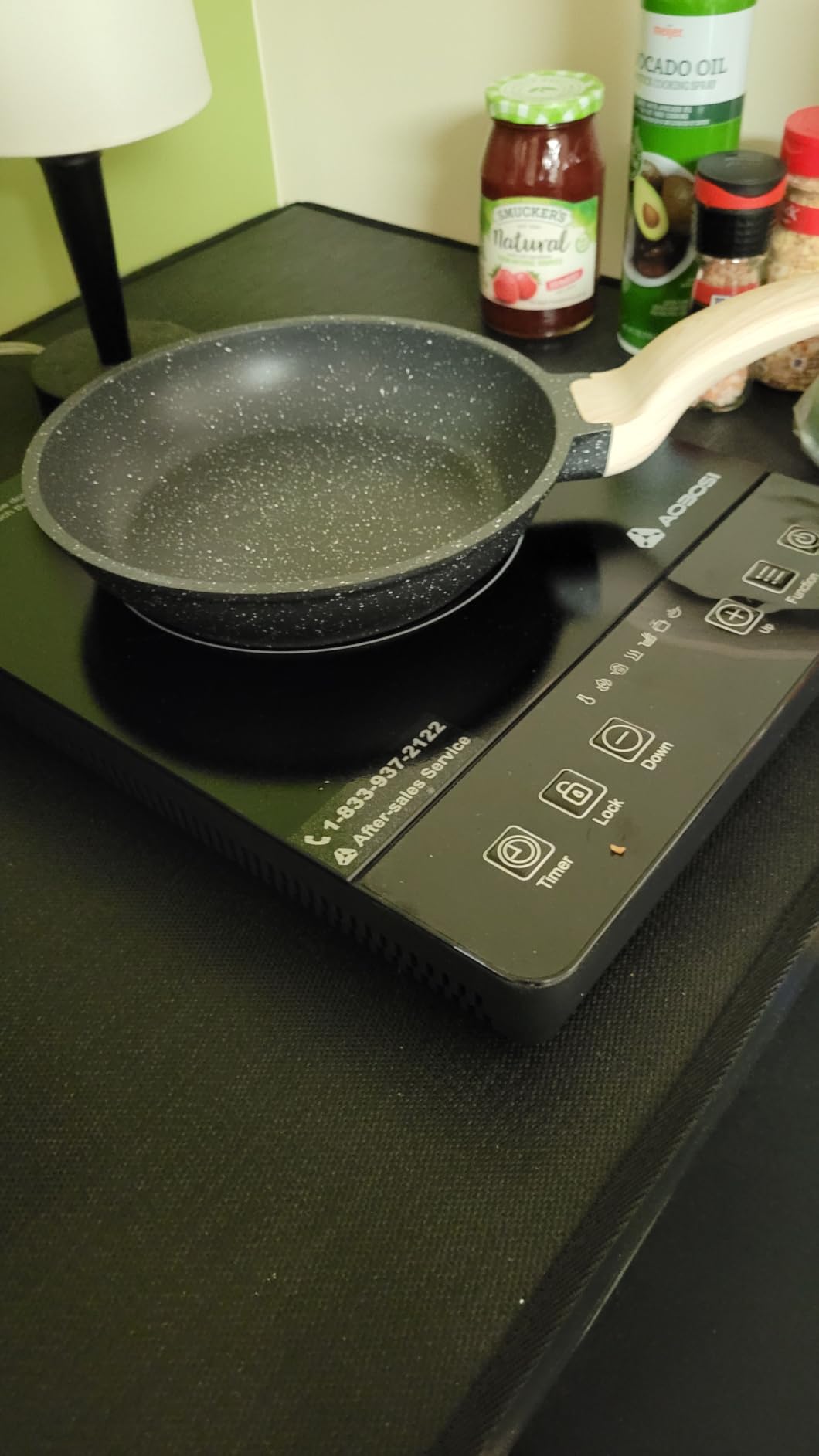
Physically it is among the flattest high-wattage units in the group at 1.7 inches, and the 11 by 13.8 inch footprint sits neatly between a single burner and a two burner layout. Rated under 5 kg with a low noise cooling fan, which matters more in a small space than the spec suggests.
The rating is 4.5 from more than 2,500 reviews with 76 percent at five stars, and only 5 percent at one star. That is strong satisfaction for a newer listing. The honest limitation is the 6.8 inch coil: it is smaller than the 8 inch options, so wide pans get uneven heat across the edges.
Is it a genuine match for a small inverter
Not at full power. It is an 1800W appliance, so it needs a 2000W pure sine inverter with nothing else drawing, and ideally a 3000W unit for comfortable off-grid use. If your system is smaller than that, the Nuwave Flex in position two is the correct answer instead.
What you give up compared with the premium models
You lose the extra 10 percent of energy transfer and the finer coil, and you carry more risk as a newer brand with a shorter service history. For most van builders that trade is worth taking, particularly if the saving goes toward the battery bank rather than the appliance.
5. ChangBERT 1800W Induction Cooktop
ChangBERT Induction Cooktop, Commercial Grade Portable Cooker, Large 8” Heating Coil, Premium Stainless Steel Countertop Burner with NSF Certified, 10 Hours Timer Powerful 1800W Professional Hot Plate
1800W
8 inch coil
stainless housing
6.1 lb
10 hour timer
83 percent efficiency
Pros
- Stainless housing rated to support up to 100 lb of cookware
- Drop tested and NSF certified which suits rough road use
- Expanded 8 inch coil gives even heat across wide pans
- 10 hour countdown timer for very long cooks
Cons
- 20F temperature steps are coarse for low simmering
- 15 inch depth takes real counter space
This is the most physically robust unit in the roundup, and for a van that matters as much as wattage. The stainless steel housing is rated to hold up to 100 pounds on the surface, which means a cast iron pot dropped on it in transit is not automatically a write-off. The tactile push buttons also work with wet or gloved hands, unlike touch panels.
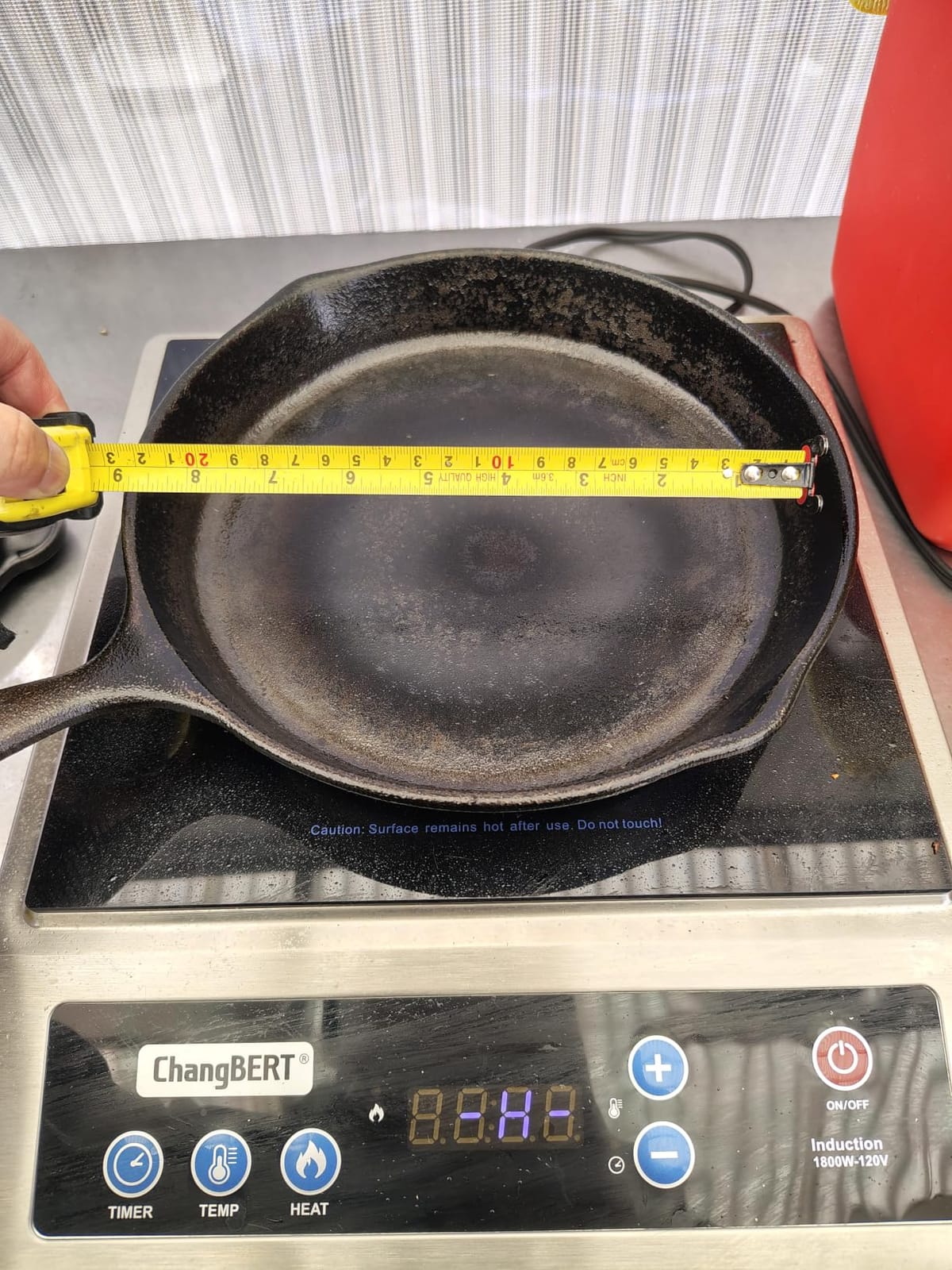
Underneath it is an 1800W continuous-duty build with an expanded magnetic coil, nine preset power levels from 200W to 1800W and eighteen temperature settings from 120F to 460F. The 8 inch coil means a 10 or 12 inch pan actually heats across its base rather than in a ring.
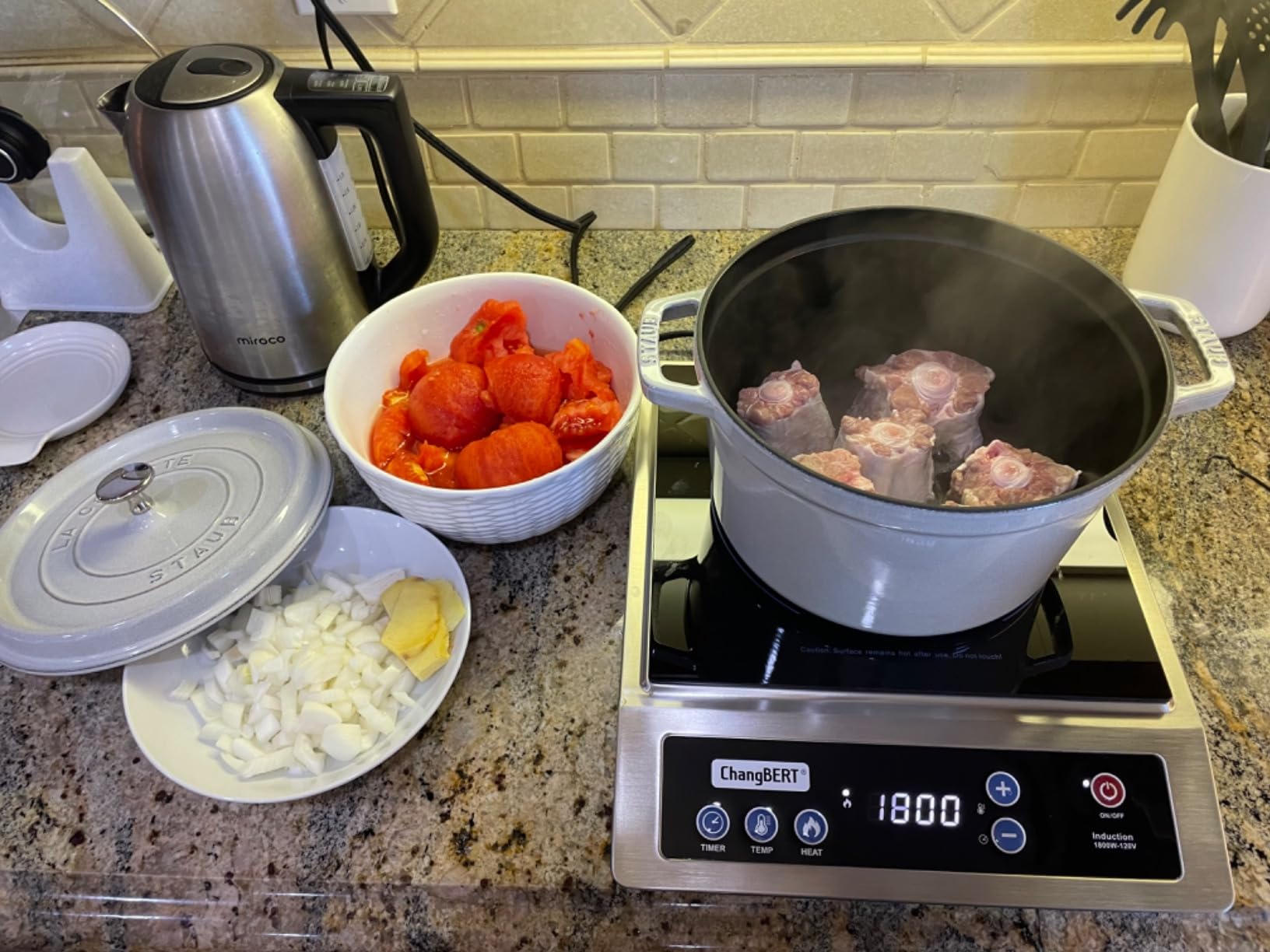
It carries ETL approval, UL commercial standard 197 certification and a 1.5 foot pound drop test, plus NSF certification and an 83 percent efficiency rating. Owners treat the certification as the reason to trust the continuous output claim, since many cheaper units advertise peak numbers they cannot hold.
Ratings sit at 4.4 across more than 1,400 reviews with 77 percent at five stars. The most requested change is finer temperature control, because the 20F steps leave a visible gap between a bare simmer and a steady boil. At 15 inches deep it also needs more counter than any other single burner here.
Can it take the knocks of a full-time build
It is the pick if your van is worked hard, if you carry cast iron, or if you are one of the builders who stores gear loose in the galley. Drop testing and the 100 pound surface rating address the failure mode owners fear most with glass tops. The tradeoff is bulk: 15 by 12.2 inches at 6.1 pounds.
Where the controls frustrate
Precise low-temperature work is the weak point. At 20F increments you cannot hold a sauce between a gentle simmer and a boil the way the Nuwave units do. If you mostly boil, braise and sear, that is a fair trade for a body that survives.
6. Nuwave Pro Chef Induction Cooktop
Nuwave Pro Chef Induction Cooktop, Commercial-Grade Portable Burner
1800W
600/900/1300W steps
8 inch coil
94 temps 100-575F
7 lb
NSF certified
Pros
- Three wattage settings let you match a 900W inverter
- Top temperature of 575F for genuine searing
- Commercial grade NSF certified construction
- 94 temperature steps in 5F increments
Cons
- Heaviest published weight among single burners at 7 lb
- Highest entry cost of the ten cooktops
The Pro Chef combines the inverter ladder and the searing temperature ceiling in one unit. Its three wattage settings of 900W, 1500W and 1800W mean you can cook at 900W on a small inverter, then step straight up to 1800W when you are plugged into shore power.
That combination is rare. Most budget units give you one maximum and no control over it, and most premium units give you fine temperature control at a fixed high wattage. Here you get 94 temperature settings from 100F to 575F in 5F increments alongside the power ladder, plus six presets and programmable stages.
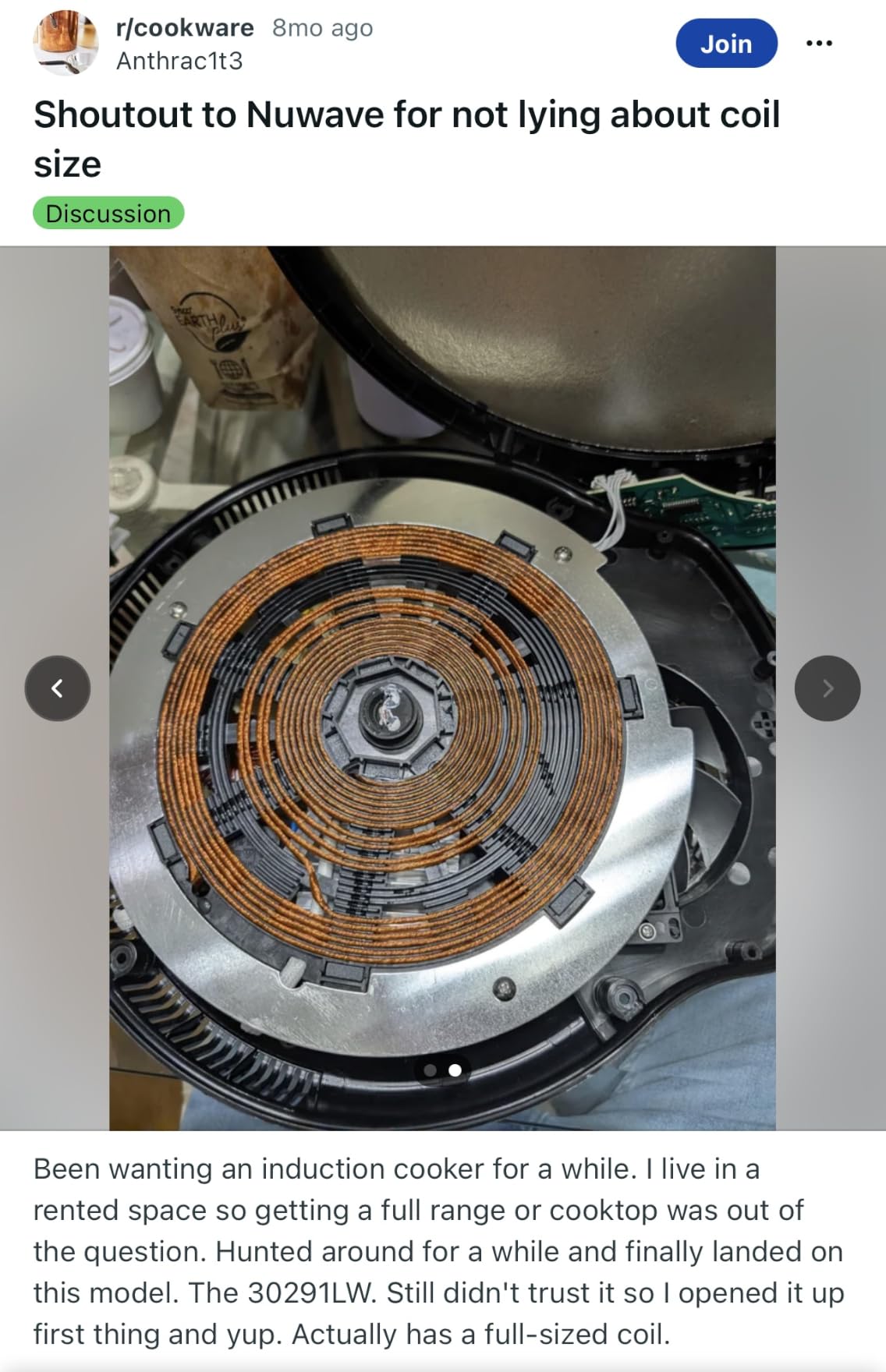
The 8 inch coil and the shatter proof ceramic glass surface make it a genuine wide-pan and cast iron machine, and the 85 to 90 percent energy transfer figure explains why a boil feels so much faster than gas. Marketed explicitly for dorms, RVs, campsites and small apartments, which tells you the design brief matched yours.
It holds 4.4 stars from more than 1,200 reviews with 76 percent at five stars. The two reservations owners voice are physical: at 7 pounds it is the heaviest published single-burner weight in the group, and it is also the most expensive cooktop we reviewed. Neither matters if you are cooking properly rather than cooking cheaply.
Does the wattage ladder really solve small systems
Yes. Running it at 900W draws about 7.5 amps at 120V, which sits comfortably inside a 1500W inverter with a fridge running. That is the single most useful feature on this list for a van, and it is why the unit is marketed to RV and campsite users rather than only kitchens.
Who should pass on it
Anyone optimising purely on weight or cost. At 7 pounds it is the heaviest single burner weight published in this group, and it costs more than anything else we reviewed. If your van already has a 3000W inverter and you only need boiling water, one of the 1800W budget models does the same job.
7. Hamilton Beach Portable Induction Cooktop
Hamilton Beach Portable Single Induction Cooktop With Fast Heating Mode
1800W
4 to 10 inch pans
10 settings 180-450F
boost mode
5.9 lb
test magnet included
Pros
- Accepts pans from 4 inch to 10 inch diameter
- Boost button gives 30 seconds of maximum power
- Includes a test magnet for checking cookware
- Boils 1.5 quarts of water in about 7 minutes
Cons
- Cycles power on and off which makes low simmering hard
- Small coil leaves the edges of a wide pan cold
- Cooling fan adds noticeable noise
The Hamilton Beach is unusually generous about pan size. It works with anything from a 4 inch saucepan to a 10 inch frying pan, which is the widest published pan window of any single burner here and matters in a van where nesting cookware means mismatched diameters. It also includes a test magnet so you can check a pan in the aisle of a hardware store.
Speed is the other strength. A fast heating mode boils 1.5 quarts of water in about 7 minutes and the maker rates it 40 percent faster than a typical smooth top range. A boost button delivers 30 seconds of maximum power for pre-heating cast iron or a wok.
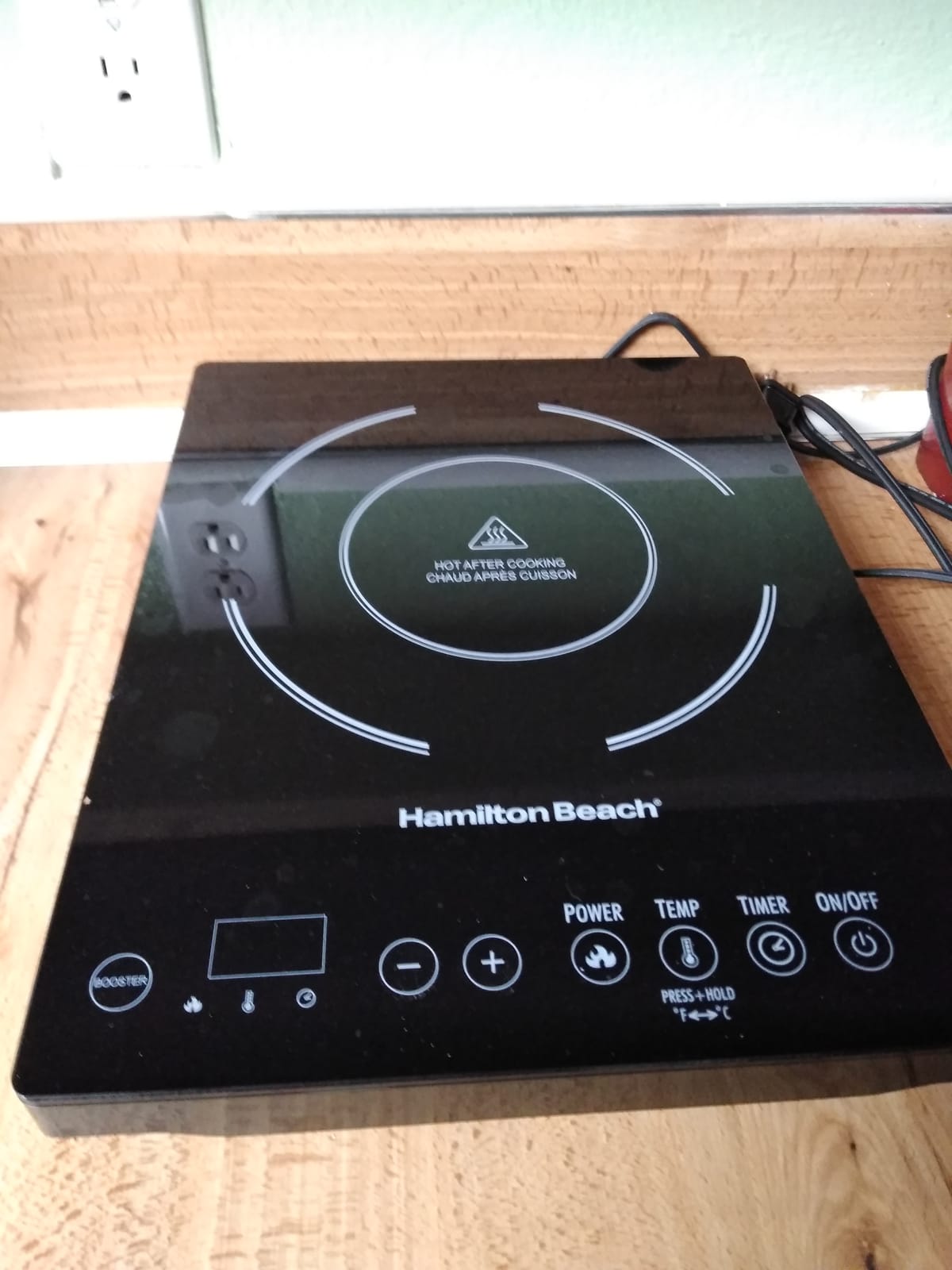
Control is ten heat levels or exact temperature from 180F to 450F, with the area near the touch controls staying cool so adjustments are safe mid-cook. The glass surface also stays stable in wind, which sounds odd until you have chased a boiling pan across a picnic table.
It carries a 4.2 average from more than 1,300 reviews with 67 percent at five stars but 9 percent at one star, so the spread is wider than most of the group. The two recurring technical complaints matter for planning: the unit cycles power rather than varying it continuously, which makes a true low simmer difficult, and the hidden coil is small enough that a 10 inch pan edges stay cold.
Will your existing pans work
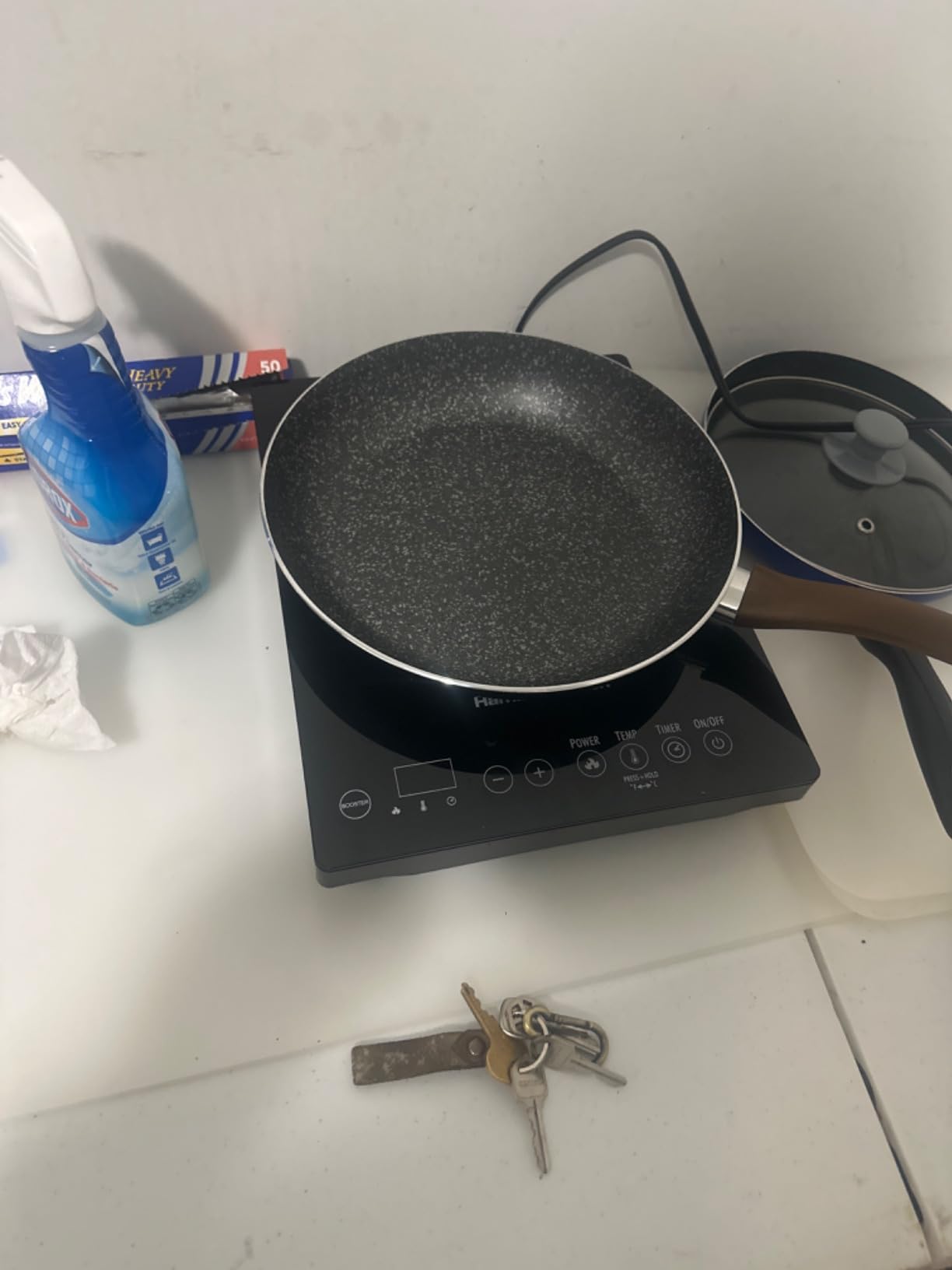
Probably. A 4 to 10 inch window plus the included magnet means most of the stainless and cast iron you already own will work, and small pans like a camping kettle or a Turkish coffee pot are usable where most 8 inch coil units simply refuse to detect them. Temperature steps run in 25F increments and can read about 25 degrees off, which matters if you are candy-making and not if you are boiling pasta.
What we would change
The cycling behaviour is the real issue. Owners on build forums read the wattage ladder as continuous throttling, and this unit does not deliver that, so a low simmer drops to a series of bursts. If you cook curries, risotto or long reductions, look at the Nuwave models with fine temperature control instead.
8. Empava Flex Two Burner Induction Cooktop
Empava Flex Induction Cooktop 2 Burner, Horz. Countertop/Drop-in, Plug in
Two zones
shared 1800W total
120F-460F
18 levels
drop-in or plug-in
12.3 lb
Pros
- Two independent zones with individual touch controls
- Drops into a counter cutout or works as a plug-in appliance
- 599 minute timer for very long cooking sessions
- Child lock pan sensor and auto shutoff as standard
Cons
- Heaviest unit in the roundup at 12.3 lb
- Wide 20.5 inch footprint demands cabinet space
- Total output is shared across both zones
The Empava Flex is the only unit here we tested as both jobs, because it is designed for built-in drop-in installation or plug-in countertop placement from the same chassis. If you are converting a van and cutting a hole in the counter for a future built-in, this is the rare cooktop that lets you try it before you commit.
Two independent zones with their own touch controls mean a pasta pot and a sauce pan at the same time, with temperature control from 120F to 460F across eighteen levels. Dedicated melt, keep warm and simmer settings plus a pause function cover the fiddly jobs, and the timer runs to 599 minutes.
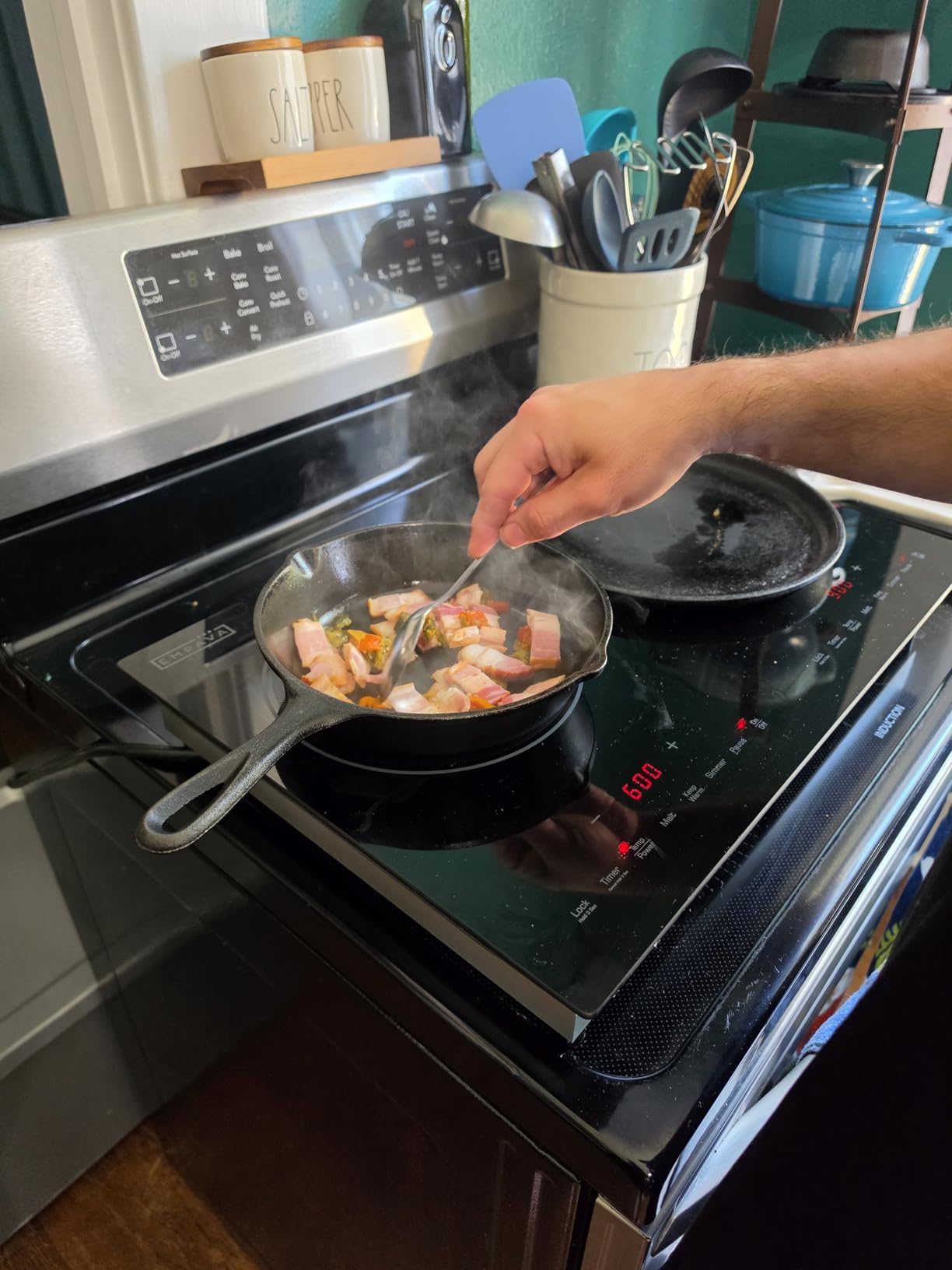
Safety hardware is unusually complete for this tier: child lock, pan sensor and automatic shutoff, all cTUVus certified for 110 to 120V plug-in installation. Owners like that a cooktop of this class is finally rated and documented rather than assembled without a safety mark.
Ratings are 4.4 from more than 700 reviews with 76 percent at five stars. The constraints are physical and electrical. At 12.3 pounds it is the heaviest unit in the roundup, and the 20.5 inch width is a serious cabinet commitment. More importantly the total 1800W is shared, so both zones running at once means roughly 900W each.
Does shared power affect your inverter
Yes, and this is the number to plan around. With both zones active the combined draw caps at 1800W rather than 3600W, so it stays inside a 2000W inverter. What you give up is throughput: boiling pasta and simmering a sauce simultaneously takes about twice as long per dish as a full 1800W single burner.
When it is the wrong choice
Skip it if galley space is tight or if you plan to stow it in a drawer, because a 20.5 inch wide, 12.3 pound appliance is not a portable unit in any practical sense. It is also unnecessary if you mostly cook one dish at a time, which is the norm for one or two people in a van.
9. AMZCHEF Double Induction Cooktop
AMZCHEF Double Induction Cooktop, 1800W 2 Burner with Griddle Pan, Grey
Two 1100W zones
1800W combined
griddle pan included
9 power levels
99 min timer
Pros
- Removable non-stick griddle turns it into a flat top cooker
- Two zones with independent knob and touch controls
- Cookware detection across a 4.72 to 9.44 inch range
- Light and easy to move between uses
Cons
- Each zone boils slower than a single high-wattage burner
- Burner rings are small for larger pots
- Combined output is capped at 1800W
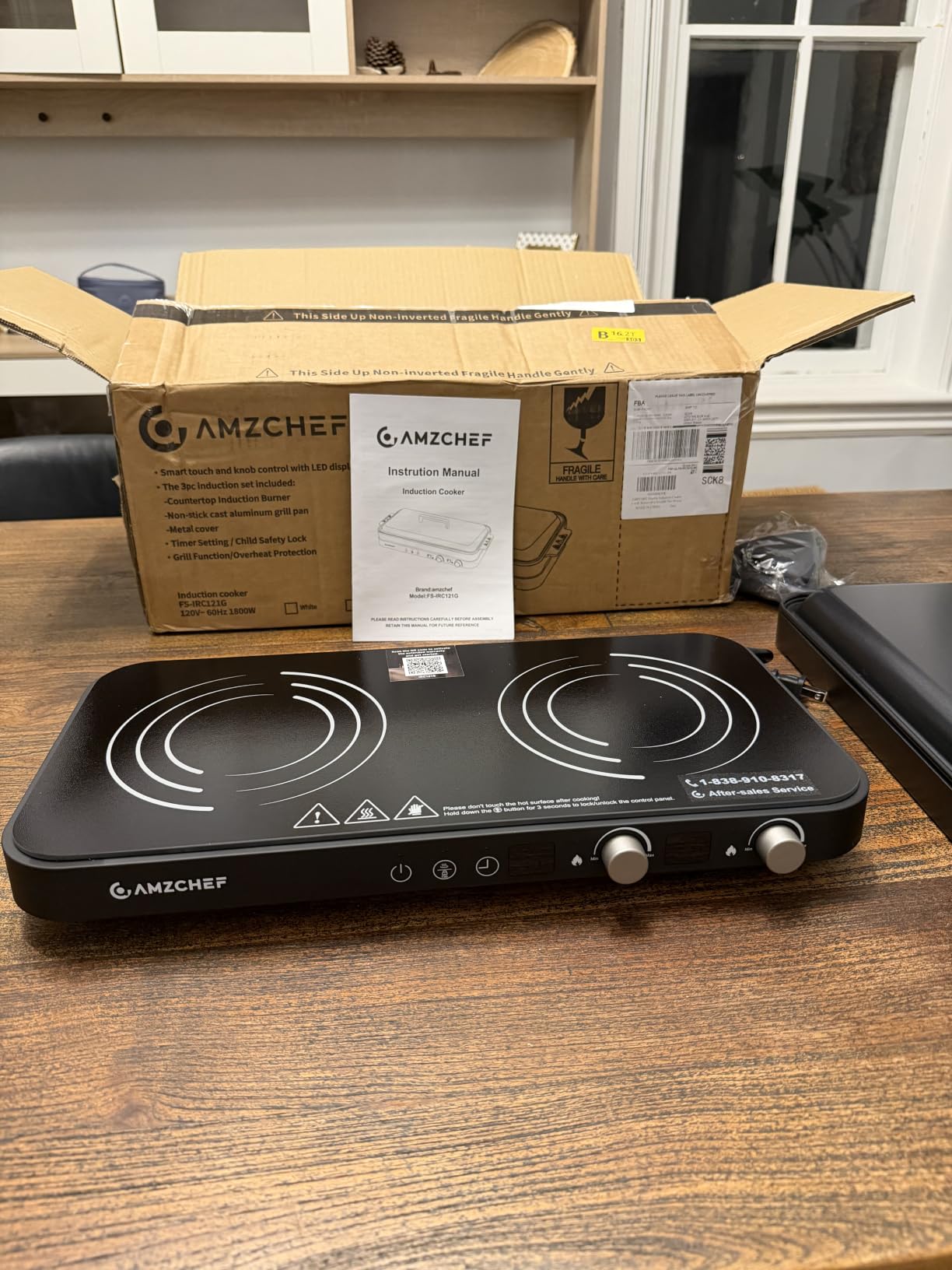
This is the pick if breakfast is the hardest meal to solve in a van. The removable non-stick griddle pan with rubber handles and a lid turns the cooktop into a flat top, so pancakes, bacon and eggs happen on one surface instead of a tilting pan over a flame. It is dishwasher safe, which matters more than it sounds.
Underneath it is a genuine two zone unit: 1100W per zone, with knob plus touch control on each side and a combined maximum of 1800W. Nine power levels, a 99 minute timer and a child lock round out the controls.
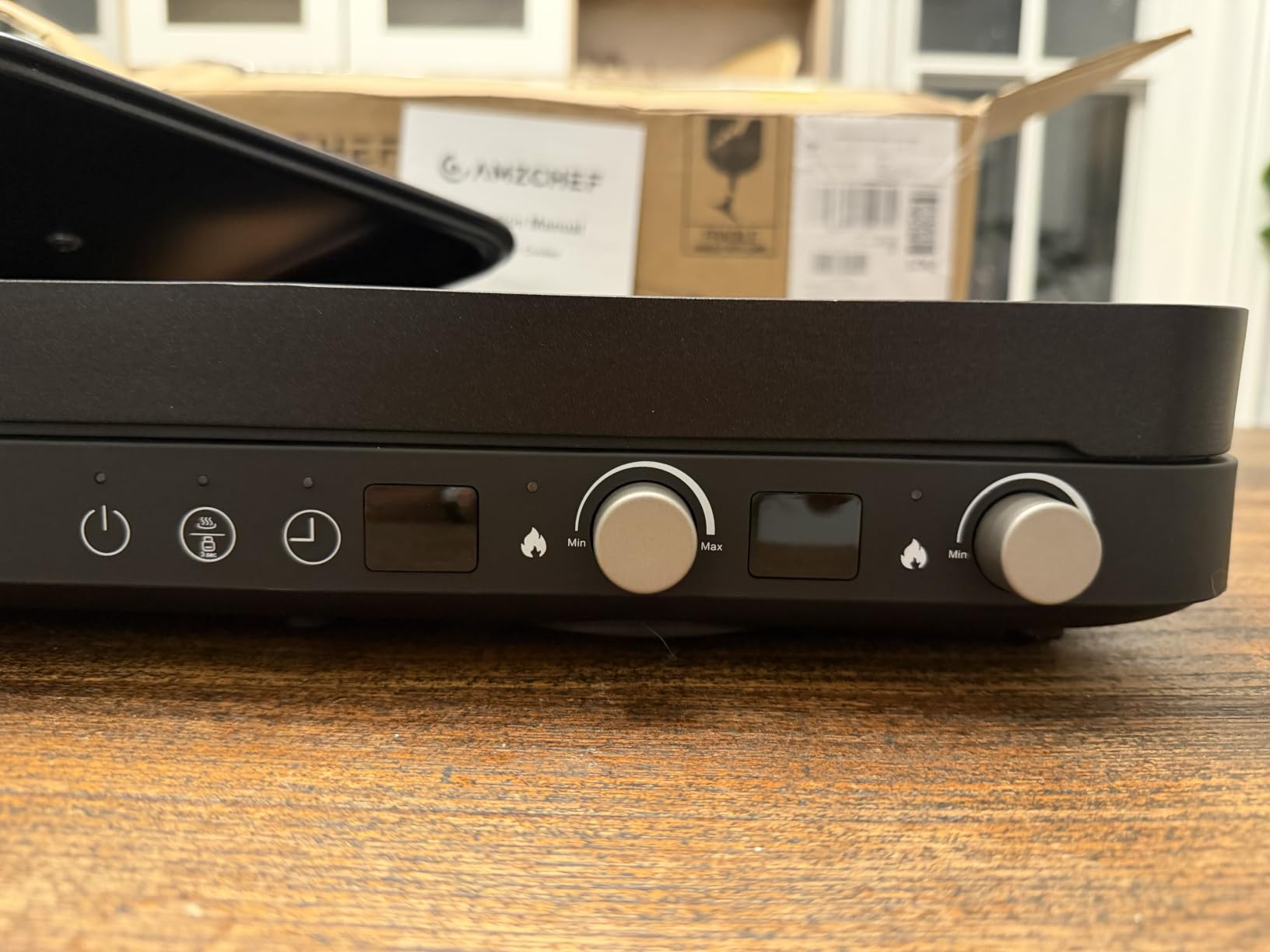
Cookware detection covers magnetic pans from 4.72 to 9.44 inches and shows an E0 error when nothing suitable is present, which gives you a clear signal rather than an inert surface. The polished ceramic glass wipes clean, and there is no open flame, so food does not carbonise onto the plate during a long campsite morning.
It sits at 4.4 from more than 580 reviews with 71 percent at five stars. Reviewers overwhelmingly single out the griddle as the reason to own it. The complaints are about the burners rather than the griddle: individual zones are slower to boil than a standard single burner, the burner circumference is smaller than ideal for big pots, and a few owners report LED display failure or boil-over damage on one side.
Is it worth the shared wattage
Only if you genuinely cook two things at once. The shared 1800W ceiling is the same as a single high-wattage burner, so two pots boiling together means each gets roughly half the power and both take longer. For a two-pan breakfast or a stir-fry plus rice it works well. For one pot of water, use a single burner instead.
Where it falls down
The burner rings are small, so a 10 inch pot only partly covers the coil and the outer edge cools. Boil-over is not sealed, which matters on a bouncing road. And with fewer reviews behind it, it carries less long-term data than the models above it.
10. Amazon Basics 1800W Portable Induction Cooktop
Amazon Basics 1800W Portable Electric Induction Cooktop, Burner and Child Lock, Overheat Protection, Timer, 8 Power Settings, Temperature Control Up to 440°F, for Cookware Diameter 5.7″-8.2″, Black
1800W
8 power levels 300-1800W
160F-440F
5.7 to 8.2 inch cookware
6 lb
3 hour timer
Pros
- Lowest entry point of the ten with full 1800W output
- Boils a quart of water in about four minutes
- Child lock auto pause and overheat protection
- Compact enough for a small galley cabinet
Cons
- Only 8 power levels with coarse 40 degree steps
- Cookware limited to 5.7 to 8.2 inch diameter
- Some owners report heat cutting out after long cooks
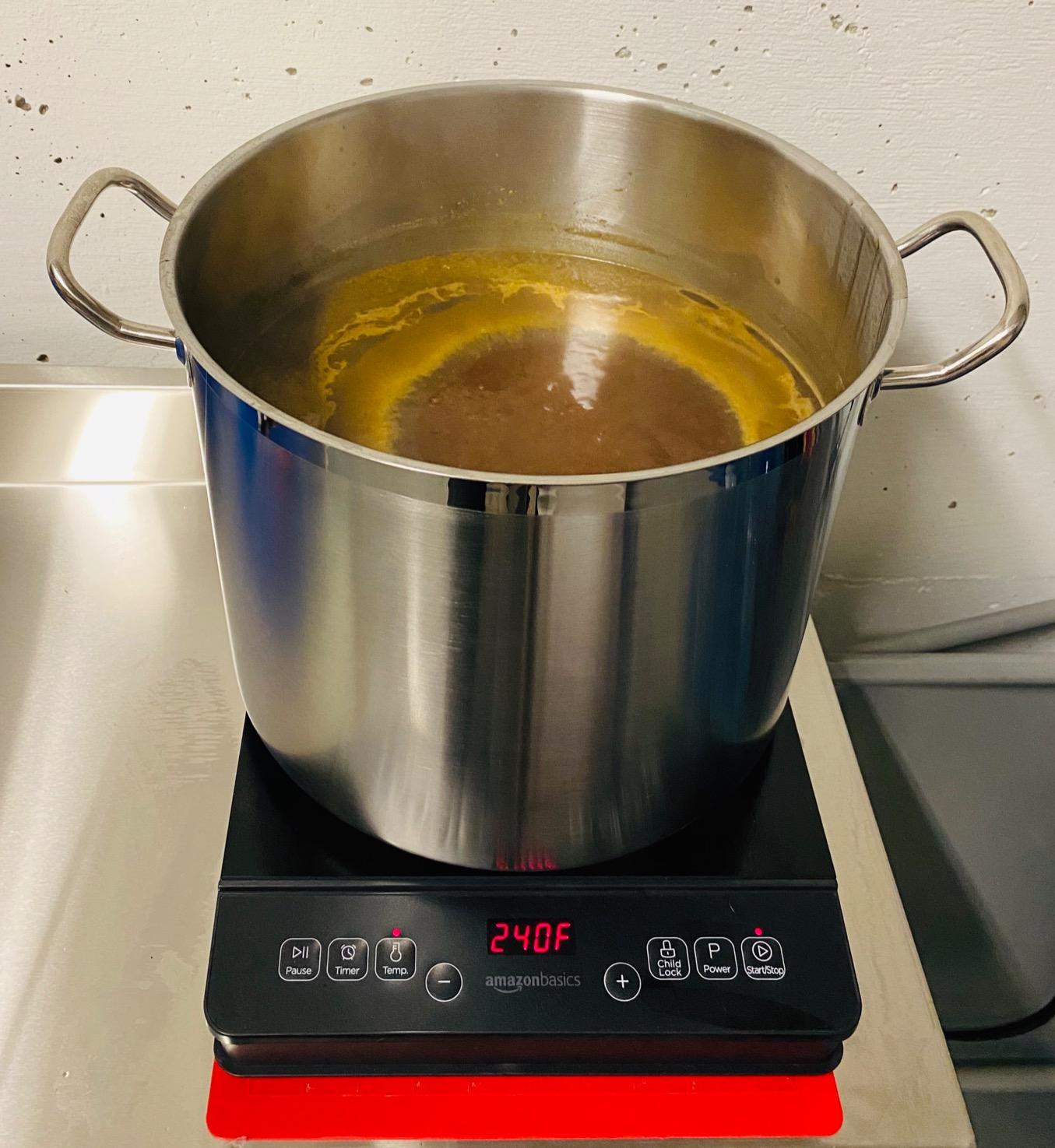
The Amazon Basics unit exists to prove that the price gap at the bottom of this market is not as wide as the spec sheets suggest. You get 1800W, a boil time of about four minutes for a quart of water, and a tempered glass surface that stays cool enough to wipe in seconds. For boiling water and reheating, it does the job of a much more expensive cooktop.
Controls are eight power levels from 300W to 1800W and a 160F to 440F range, with pre-set cooking modes, an LED display and a three hour timer. Child lock, auto pause, overheat protection and a voltage warning system cover the basics you would expect on a unit sold at this level.
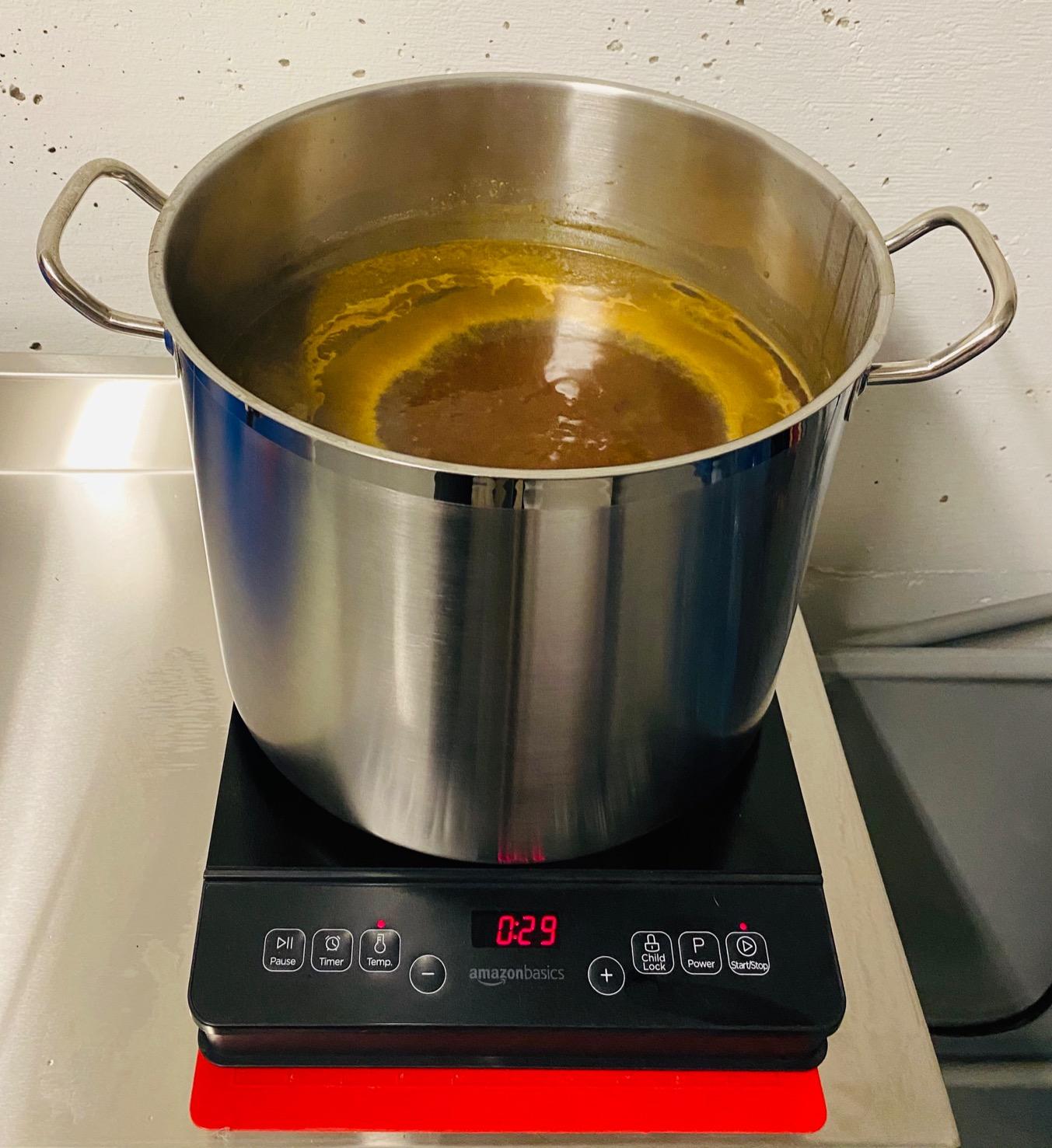
At about 6 pounds and 11.4 by 13 inches it stores easily, which is the practical advantage in a van. It is also one of the very few units here with any useful documentation of its cookware limits: flat-bottomed induction-ready pans between 5.7 and 8.2 inches, explicitly not aluminium.
It carries the lowest average rating in the group at 4.1 from more than 1,500 reviews, with 62 percent at five stars but 13 percent at one star, the widest spread we saw. The 40 degree temperature steps leave an awkward gap between simmer and boil, the small heating area creates hot and cool spots in wide pans, and some owners report the surface heating up and cutting out after about 10 minutes until the unit is power-cycled.
Is it a serious cooktop or a boiling-water tool
Honestly, both. The manufacturer itself states it suits continuous heating but is not recommended for slow or low temperature cooking, and that framing is fair. If your van cooking is rice, pasta, eggs and reheating, it is excellent value. If you make stocks, risotto or melted chocolate, the coarse steps will frustrate you.
What to check before you rely on it
Test your pans against the 5.7 to 8.2 inch window first, because a smaller camping pot simply will not be detected. And if you plan to run long cooks off grid, run a full boil test before a trip so you know how the unit behaves after 20 minutes rather than discovering it in the mountains.
What Inverter Size Do You Need for an Induction Cooktop in a Van?
Every portable cooktop in this roundup runs on 120V AC and 15 amps, which is the hard ceiling for a van. There is no such thing as a meaningful 12V DC induction cooktop at cooking power. An 1800W appliance drawn straight from a 12V battery would demand about 150 amps, which no van electrical system is designed to deliver continuously.
That is why cooktops advertised as 12V are in practice low-wattage warming plates. If you have seen one, treat the headline wattage as marketing and check what it actually pulls.
For sizing, treat 2000W pure sine wave as the floor and 3000W as the number we would actually specify. An 1800W cooktop draws about 15 amps at 120V, and with inverter losses the inverter is realistically working near 2000W of continuous load before you plug in a fridge.
Match the inverter to the battery bank as well. A common rule of thumb in van builds is roughly 1 amp of inverter output per amp hour of lithium capacity, so a 100Ah bank pairs sensibly with a 1000W inverter and a 300Ah bank with a 3000W unit. Undersizing the bank is the single most common reason owners report inverters tripping under a cooktop load.
Pure sine wave matters more than wattage. A modified sine wave inverter produces a square-edged waveform that many induction cooktops refuse, cook badly on, or drop out of entirely, which is the most repeated complaint across van build forums. If your inverter is modified sine, budget for a replacement before buying the cooktop, not after.
How to Check Cookware Before You Buy
Induction needs a ferromagnetic base, so existing aluminium and copper pans are dead weight in a new galley. The test takes five seconds: press a fridge magnet to the base of the pan. If it grabs, the pan will work.
Coil diameter is the second filter, and it is the one most people miss. A 6.5 inch coil will not heat a 10 inch pan evenly, and several units will not detect anything smaller than about 5.7 inches. Where a maker publishes a cookware window, we have noted it in each review.
If you want to keep a few non-magnetic pans, an induction adapter disc bridges the gap. It works, it adds an inefficient layer between the coil and the pan, and it reduces control precision, so treat it as a stopgap rather than a solution.
Our small kitchen cooktop guide covers footprint planning in more detail if your galley is the constraint.
Propane vs Induction in a Sealed Van
Propane keeps working when your batteries are flat, which is the honest advantage. Induction removes carbon monoxide risk, oxygen depletion, and a cylinder taking up floor space, and it cooks faster with no venting.
The recurring owner compromise on forums is to carry both: induction on shore power and solar, a small butane stove when the battery is low. It costs little and removes the anxiety.
One owner running an 1800W portable burner on a 2000W inverter reports no problems over roughly a month and a half of road use, while another accepts that nothing else high-draw can run at the same time and reserves full power for boiling water. Both are honest descriptions of the same setup. Our gas cooktop guide covers the alternative if your build is solar-limited.
When You Should Skip Induction in a Camper Van
Skip it if you are a full-time boondocker on a small solar array in the depths of winter. Solar input at that time of year is negligible, and an electric-only build with no propane backup leaves you stuck on a cold morning with no way to heat water.
Skip it if you need genuine high-heat searing or wok cooking at volume, or if you cook for a group every meal and one 15 amp burner cannot keep up. And skip it if you are unwilling to replace most of your cookware or to run a dedicated 120V circuit.
Be honest about weight too. Five of these units have a published weight between 5.8 and 7 pounds, which is real load for a van carrying bikes or a family. If you have already committed to a larger electrical build and want to compare against other 120V appliances, our electric cooktop guide covers the conventional options.
Frequently Asked Questions
What is the best induction cooktop for a camper van?
The Duxtop 1800W portable cooktop is the best all-round choice for a camper van, with more than 17,000 reviews at 4.4 stars and a 5.8 pound body that stores in a galley drawer. For a smaller inverter, pick a low-wattage unit such as the Nuwave Flex with 600W, 900W and 1300W steps. For searing, the Nuwave Gold reaches 575F on an 8 inch coil.
Which portable induction cooktop is best for camping?
For camping, the Duxtop 1800W at 5.8 lb is the top pick for power and portability. The AAOBOSI 1800W adds twenty temperature levels for less. The Nuwave Flex at 1400W is the safest choice on small inverters. The Nuwave Gold offers an 8 inch coil for wide pans. The ChangBERT adds a stainless body that survives rough handling.
Is there a built-in induction cooktop suitable for an RV?
Yes, and the Empava Flex is the clearest example here, working as either a built-in drop-in or a plug-in countertop appliance from the same chassis. It has two independent zones, temperature control from 120F to 460F and a 599 minute timer. Plan the cutout before ordering, since a fixed glass top is an expensive swap if it cracks in transit.
Is an induction cooktop suitable for an RV?
It suits an RV well if you cook mostly on shore power or with meaningful solar, because there is no open flame, no carbon monoxide and very little water vapour inside the cab. The constraint is electrical: an 1800W cooktop needs a 2000W pure sine inverter minimum and a 200 to 300Ah lithium bank to run off grid. Winter boondockers should keep a backup stove.
What is the best size inverter for a campervan?
Treat 2000W pure sine wave continuous as the minimum and 3000W as the figure we would specify. An 1800W cooktop draws about 15 amps at 120V, so anything else running on that inverter at the same time will trip it. Pair the inverter with roughly one amp hour of lithium per amp of inverter output, and choose pure sine rather than modified sine.
Will a 2000W inverter run an induction cooktop?
Yes, with conditions. A 2000W pure sine unit will run an 1800W cooktop provided nothing else draws from the same inverter and the rating is continuous rather than surge. Even so, many owners report trips at full power. The safer options are a low-wattage cooktop with 600W, 900W and 1300W steps, or stepping up to a 3000W inverter.
How much power does a 12V induction cooktop consume?
Real induction cooktops are 120V AC appliances. Drawing 1800W directly from a 12V battery would demand about 150 amps, which no van system is built to deliver continuously. Items advertised as 12V induction cooktops are usually low-wattage warming plates, not cooking hobs. Check the actual wattage before planning an electrical system around one.
Final Verdict for Camper Van Induction Cooktops in 2026
The best camper van induction cooktop for most builds is the Duxtop 1800W: the deepest owner history, a manageable 5.8 pound weight, and a 15 amp plug. Pair it with a 3000W pure sine inverter if you plan to cook off grid, or step down to the Nuwave Flex and a 2000W unit if the battery budget is tight.
Match the wattage to the inverter before anything else, check your pans with a magnet, and keep a small backup stove if you will be off grid in winter. Those three decisions decide whether induction is a joy or an expensive problem.