
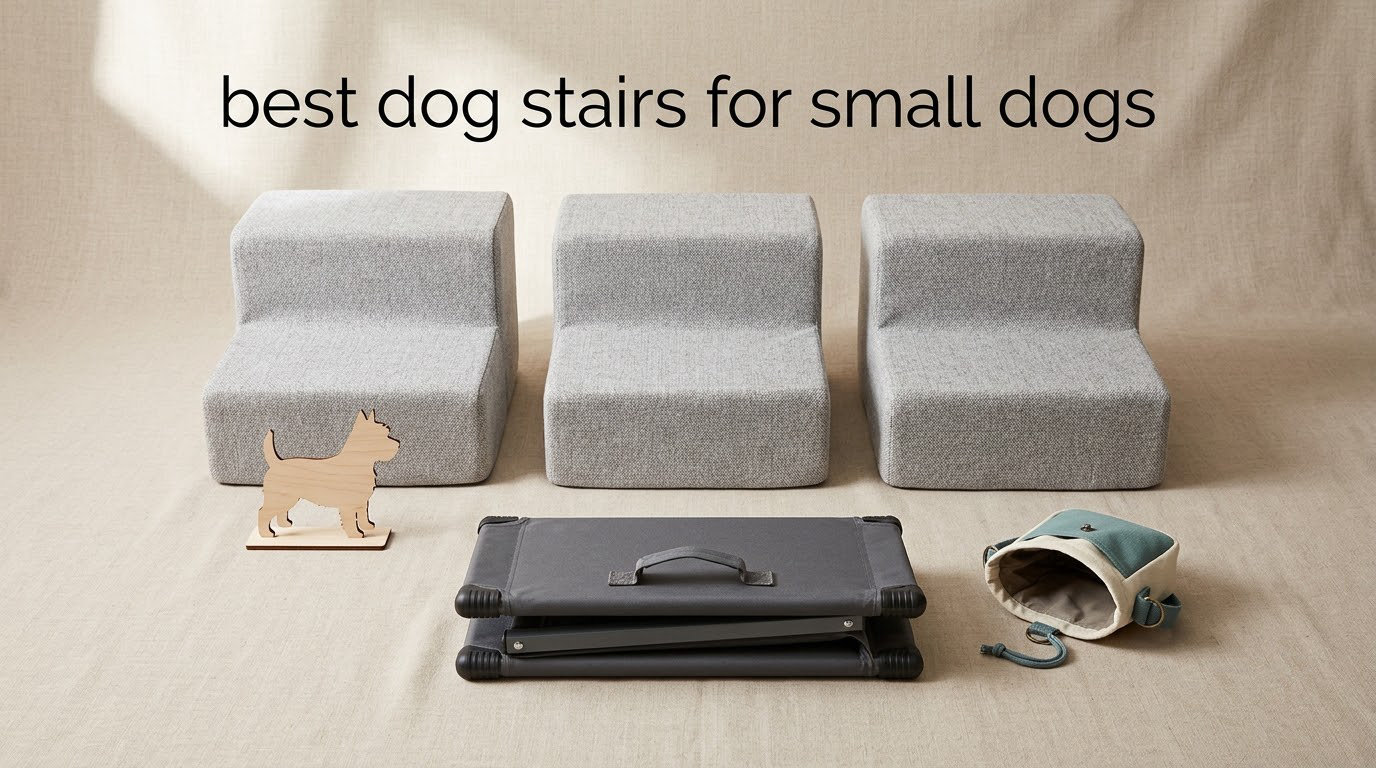
There is a specific kind of small-dog frustration we hear about constantly: a dog who wants to be on the bed, wants it badly, and then lands on the floor beside it instead. A Chihuahua, Yorkie, or Pomeranian will happily leap onto a sofa twenty times a day without ever considering that the landing works against gravity and their own joints. Owners usually notice the problem on the way down, when the same dog hesitates, slides, or refuses to jump at all.
That hesitation is the reason pet stairs exist. The best dog stairs for small dogs replace one punishing vertical leap with several short, shallow rises, so a short-legged or senior dog can climb and descend on its own terms. It sounds simple, but the difference between a well-matched set and a badly matched one is the difference between a dog that uses it daily and a dog that sniffs it once and goes back to jumping.
We spent weeks with ten of the most-reviewed pet steps on the market, most of them foam, one of them folding plastic, and all of them aimed at the same problem. Along the way we kept returning to four things: total height, step rise, weight capacity with a margin, and traction on the floor and on the tread itself. We also found that the descent problem deserves its own attention, because the climb is where people measure and the drop is where dogs get hurt.
If your dog is new to furniture access, you may also want to check the bedding they’ll be climbing onto, like our picks for bolster dog beds for small dogs. For the travel half of the problem, our dog stroller reviews cover the gear that solves the same problem outside the house.
Table of Contents
What to Look For in Dog Stairs
Height and step count: Measure floor to mattress or cushion, then pick a model whose top step lands at or just above that height. Three-step models around 13-15 in suit most sofas; 19-21 in reaches most high beds. More steps means a gentler climb for a puppy.
Material: High-density foam is soft, light and quiet but can flatten over time; plastic is rigid and folds flat but has hard edges. Match the material to your dog’s age, a puppy prefers foam, a large dog needs a rigid frame.
Traction: A textured or corduroy tread plus a non-slip base matters more than anything else on hardwood. A slick tread sends a small dog sliding sideways before it ever slips down, and slippery footing is what makes nervous dogs quit the stairs.
Top 3 Picks: Dog Stairs for Small Dogs in 2026
Best Every Dog Stair We Tested in 2026
| Product | Specifications | Action |
|---|---|---|
| PetSafe CozyUp Folding Dog Stairs |
|
Check Latest Price |
| EHEYCIGA 3-Step Foam Dog Stairs |
|
Check Latest Price |
 Aodisman 3-Step Pet Ramp Aodisman 3-Step Pet Ramp |
|
Check Latest Price |
 COZY KISS 3-Step Foam Stair COZY KISS 3-Step Foam Stair |
|
Check Latest Price |
 Heeyoo Extra Wide 3-Tier Steps Heeyoo Extra Wide 3-Tier Steps |
|
Check Latest Price |
 Gardner Pet 2-in-1 Stairs and Ramp Gardner Pet 2-in-1 Stairs and Ramp |
|
Check Latest Price |
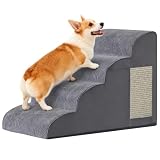 Ahpmeoa 4-Step Curved Dog Ramp Ahpmeoa 4-Step Curved Dog Ramp |
|
Check Latest Price |
 LE SURE 4-Step Pet Ramp LE SURE 4-Step Pet Ramp |
|
Check Latest Price |
 Chic Threads 3-Step Dog Stairs Chic Threads 3-Step Dog Stairs |
|
Check Latest Price |
 Topmart 3-Tier Foam Steps Topmart 3-Tier Foam Steps |
|
Check Latest Price |
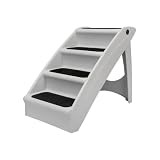
1. PetSafe CozyUp Folding Dog Stairs: Best Overall for Sofas and Beds
PetSafe CozyUp Folding Dog Stairs, 20 in Tall, Gray
4 steps
20 in tall
24 x 16 x 20 in
Up to 200 lb
6.15 lb unit
Pros
- Rock-solid plastic frame with side rails does not wobble
- Fabric tread covers give reliable traction
- Folds flat in seconds and weighs 6.15 lb
- Neutral gray and tan colors
- Widest height range in the plastic category
Cons
- Hard plastic sides in a dark room
- Can slide on smooth floors without a mat
- Adhesive non-slip pads can detach
This is the model most people are actually buying. With more than 30k reviews behind it, the PetSafe CozyUp is the one we could find the longest record of real household use for, and the plastic frame is the reason. Small dogs put their whole body weight onto a front tread when they hesitate, and a rigid frame with side rails simply does not shift under that kind of load the way foam does.
The 4-step layout measures 20 in tall overall and folds down flat in seconds. Owners of small senior dogs and arthritic cats consistently credit the replaceable fabric tread covers for traction and the flat fold for moving the unit between the bedroom and the living room. It weighs 6.15 lb, so one person can carry it to a different piece of furniture without a fight.
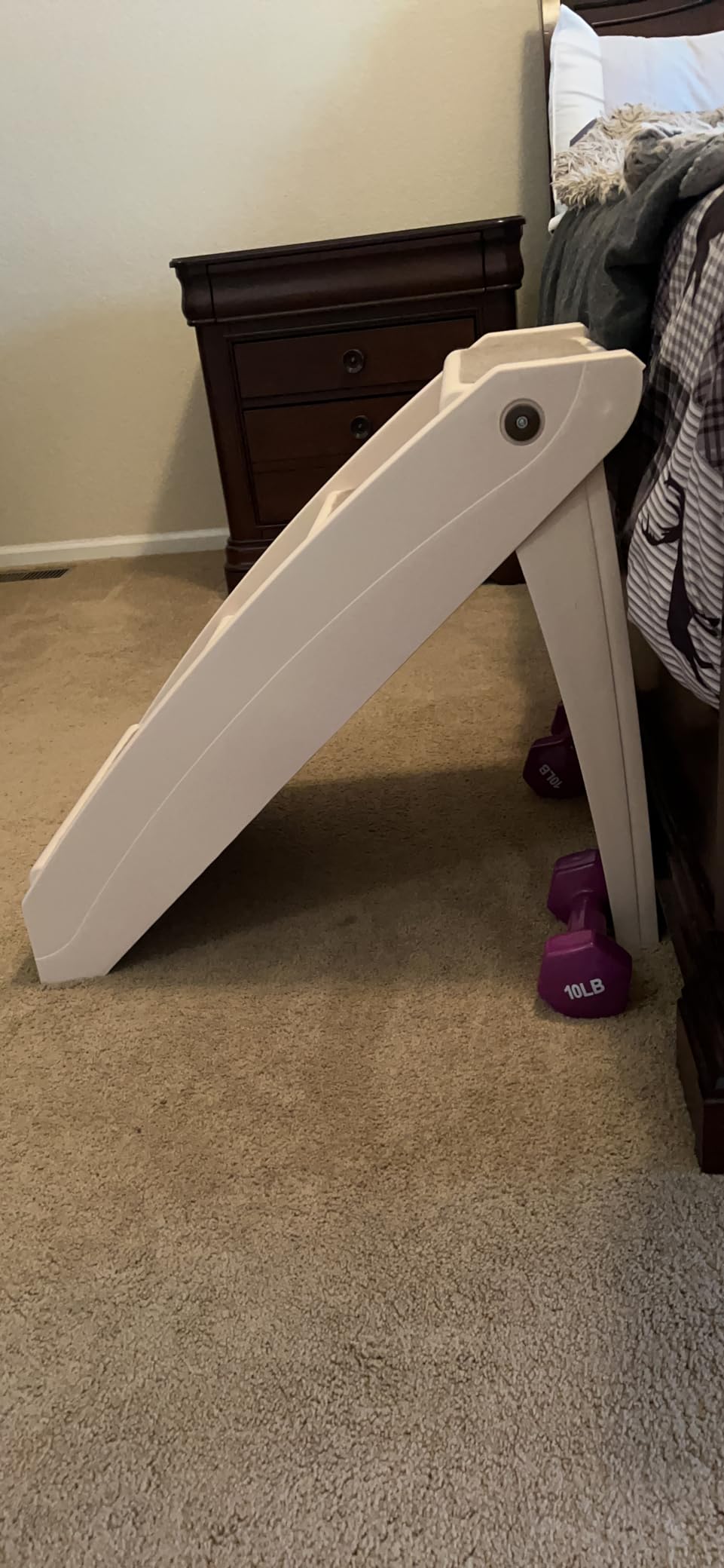
We want to be straight about one thing: at 4.1 stars, this is the lowest-scoring product in our group, and the reason is consistent across reviews. The complaints cluster around stability on hard floors, adhesive-backed tread pads that curl and detach within hours, and the fact that some nervous dogs will not commit until the unit is physically secured to the bed frame.
So it earns the top spot on evidence and range, not on stars. The frame is the most rigid thing we tested, the height range is the widest in the plastic category, and the review volume means replacement parts and fabric treads are easy to find. If your floor is hardwood and your dog is a hesitant climber, put a mat under it before anything else.
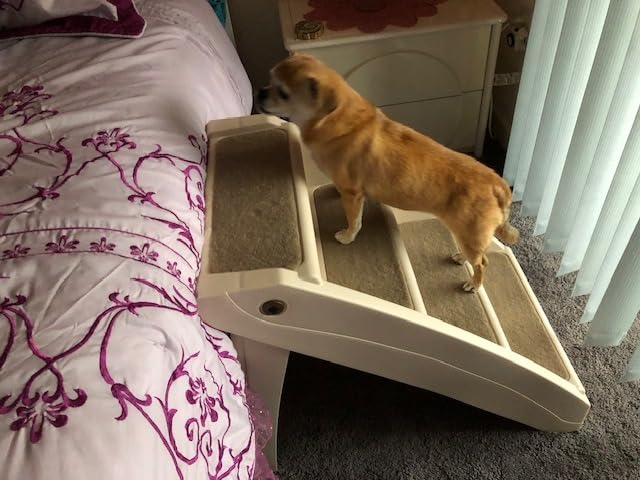
What to check before you order this one
Measure your furniture first, because the trick here is the top step, not the total height. The stairs are sold in 20 in and 25 in versions, and buying the taller one for a low sofa is how people end up with a step that overshoots the cushion and a dog who steps over it instead of onto it.
Then decide how you will anchor it. The frame is rigid enough that many owners clamp or wedge the top against the bed frame, and that single change is the difference between a dog who uses the stairs and a dog who goes back to jumping.
How it handles a senior or arthritic dog
The climb is handled well: side rails, a firm tread, and a frame that does not flex under a hesitant paw. The descent is the harder half, and this unit has shallow treads, which means your dog needs clear floor space in front of it to come down without landing on your toes.
For a dog with genuinely stiff hips, a foam ramp-style unit such as the one we rate best for high beds gives a smoother surface than a hard plastic tread, but the CozyUp wins if you need something that folds flat and lives in a small apartment.
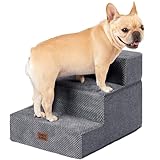
2. EHEYCIGA 3-Step Foam Dog Stairs: Most Versatile for Low Furniture
EHEYCIGA Dog Stairs for Small Dogs 13.5″ H, 3-Step Dog Steps for Cats, Grey
3 steps
13.5 in tall
18 x 15 x 13.5 in
30D foam
4.97 lb unit
Pros
- Firm step inserts stop the treads feeling spongy
- Weighs under 5 lb and folds flat under a bed
- Removable machine-washable cover
- Range covers sofas through high beds
- Category bestseller with 11k reviews
Cons
- Standard-width treads are narrow for medium dogs
- Vacuum packaging is hard to open and shape
- Cannot be returned in the box once expanded
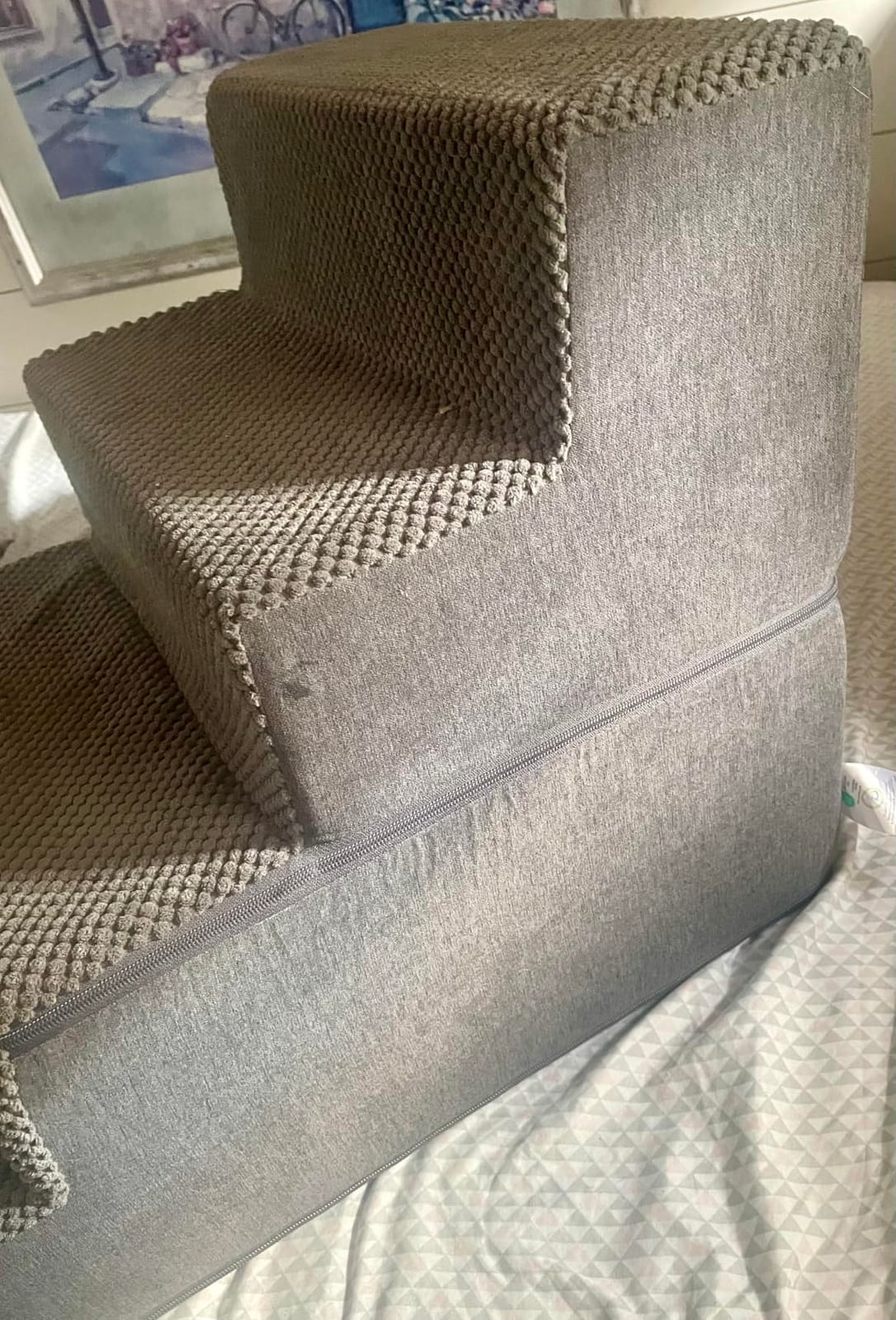
The EHEYCIGA design solves one specific problem that most cheap foam stairs have: the give. The core is 30D high-density foam wrapped in fabric, but the tread surfaces contain firm inserts, so a paw pressing down meets resistance instead of sinking. That is the difference between a dog who trusts the stairs and a dog who bounces off the first step.
It is also the category bestseller, and the listing sits at number one in Dog Stairs and Steps. The 3-step version measures 13.5 in tall, which makes it the right height for a low sofa or a low bed, and the range continues through 4-step and 5-step versions that reach 23 in and 27 in.
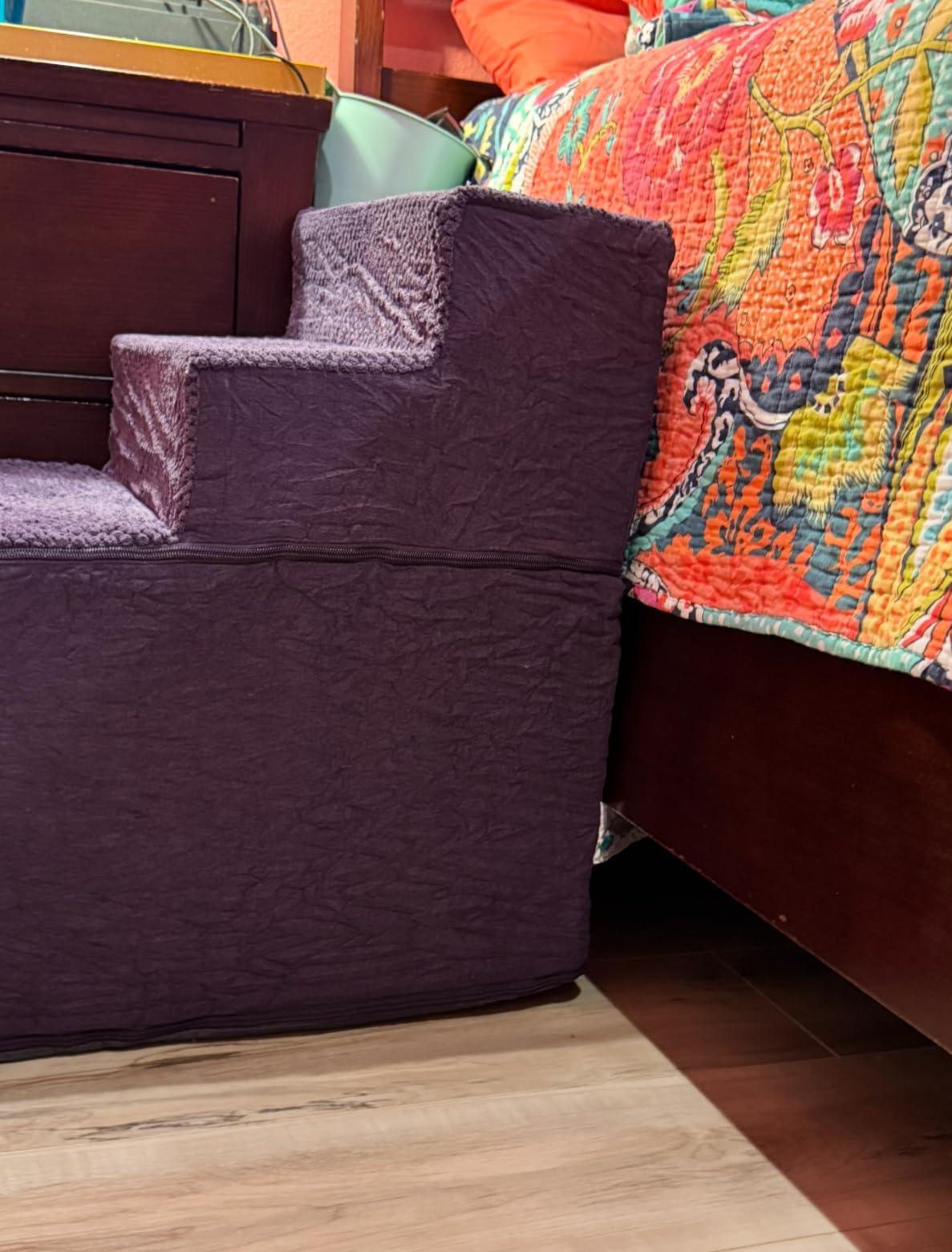
At under 5 lb, it is one of the easiest units here to move, and it zips flat into a block or a pet bed shape when it is not in use, which matters in a small apartment. Owners of senior Chihuahuas, Frenchies, and cats report the cover coming off easily for washing and the dog learning the stairs within a few minutes when treats are involved.
The honest drawback is the packaging. The foam arrives vacuum-compressed and needs 24-48 hours to expand, and reviewers are blunt that once opened it cannot be returned in the original box. Measure your furniture before you cut into that bag.
When the 3-step version is the wrong choice
Standard-width treads are fine for Chihuahuas, Yorkies, and cats, but owners of medium and large breeds describe them as narrow. If your dog is over roughly 30 lb or has a long body that needs to stretch out on a landing, look at the extra-wide treads on the Heeyoo or the 50 lb-rated Topmart instead.
Also check your furniture height against the 3-step 13.5 in figure. If your mattress top sits at 18 in or higher, a 3-step unit leaves your dog jumping the last stretch, and no amount of training fixes that.
How it fits a multi-pet household
Foam stairs earn their keep in homes with cats, because the same gentle profile a senior dog needs is the one a kitten uses without hesitation. A washable cover is the deciding factor here: this one unzips completely, while the foam interior itself cannot be washed.
Place a mat or a towel at the bottom on hardwood. Even with a grippy base, a foam unit that shifts on the first descent turns a confident climb into a scramble.
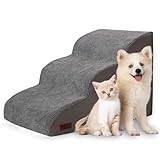
3. Aodisman 3-Step Pet Ramp: Best Value for Skittish Small Dogs
Aodisman Dog Stairs for Small Dogs and Cats,3-Step Pet Ramp for Bed & Couch
3 steps
15.35 in tall
22.05 x 15.55 in
Corduroy cover
Under 50 lb
Pros
- Shallow ramp-like rise accepted immediately by nervous dogs
- Soft rounded edges avoid toe-stubbing
- Silicone-footed base grips carpet and hard floors
- Only 4.25 lb so it travels easily
- Many height and color options
Cons
- Some pets need days to weeks of training
- Not sized for large breeds
- Thick foam takes floor space
This is the answer for the dog who looks at stairs and walks away. The Aodisman profile is closer to a shallow ramp than a set of tiers, and that geometry removes the vertical drop that triggers hesitation in small and toy breeds. Owners of Chihuahuas, Yorkies, and Shih Tzus report many of their dogs using it the same day it arrived.
The corduroy outer cover does real work here. It adds friction between paw and step, which matters for a dog that approaches the climb cautiously rather than bounding up it. The base uses silicone footprints that grip both carpet and hard flooring, and at 4.25 lb the whole unit moves between rooms without effort.
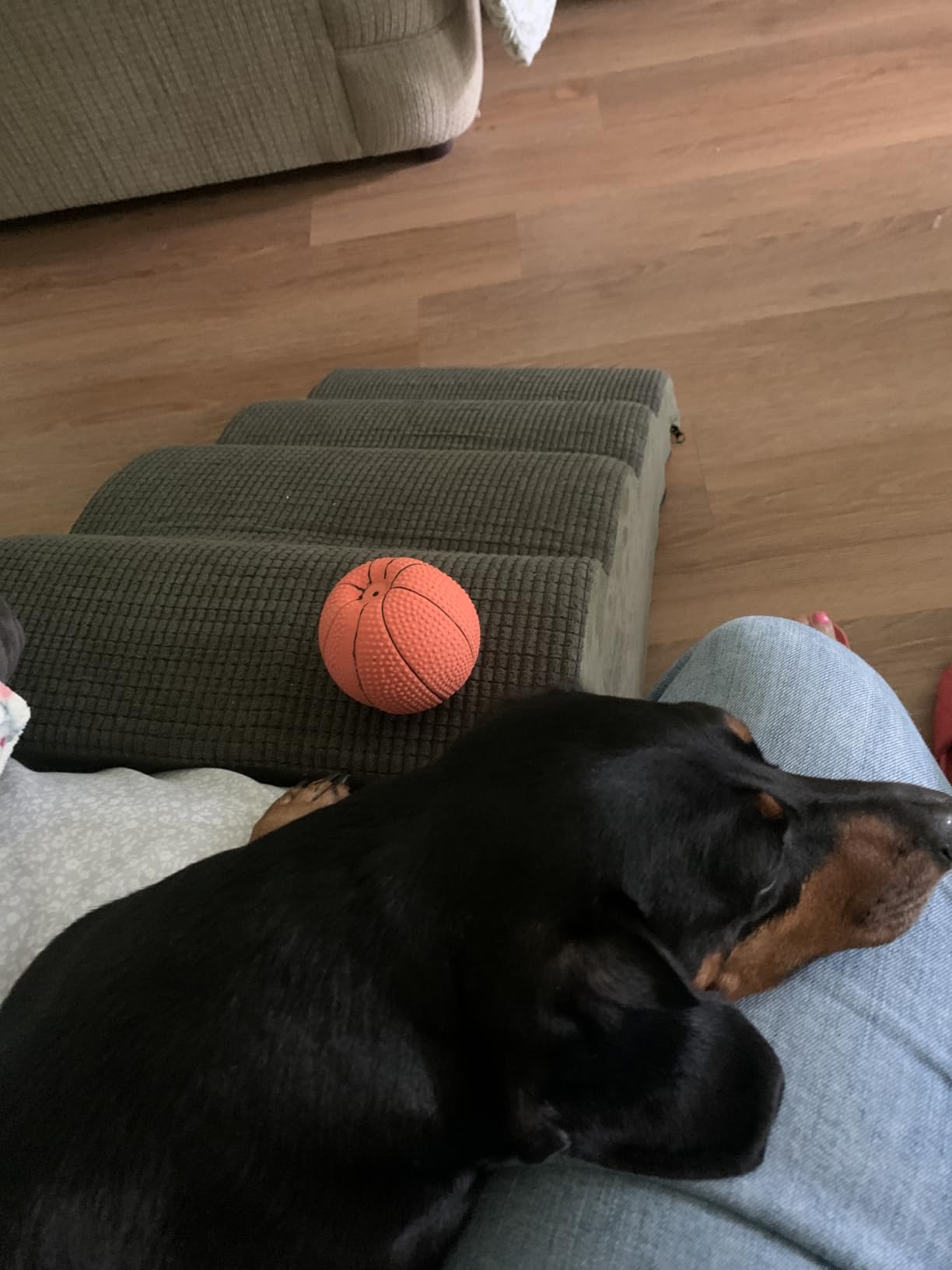
It is rated 4.5 from more than 5500 reviews, with a 79 percent five-star share, which puts it among the best-scoring foam units we looked at. The 3-step version measures 15.35 in tall and is built for sofas and chairs, with 4-step and 5-step versions for beds and high beds.
Two limitations are worth stating plainly. Some pets need several days or a couple of weeks of treat-based training before they commit, and the design is not sized or reinforced for large breeds. A dachshund at 22 lb is fine; a 70 lb dog pressing against the top is not what it was built for.
How the shallow rise helps on the way down
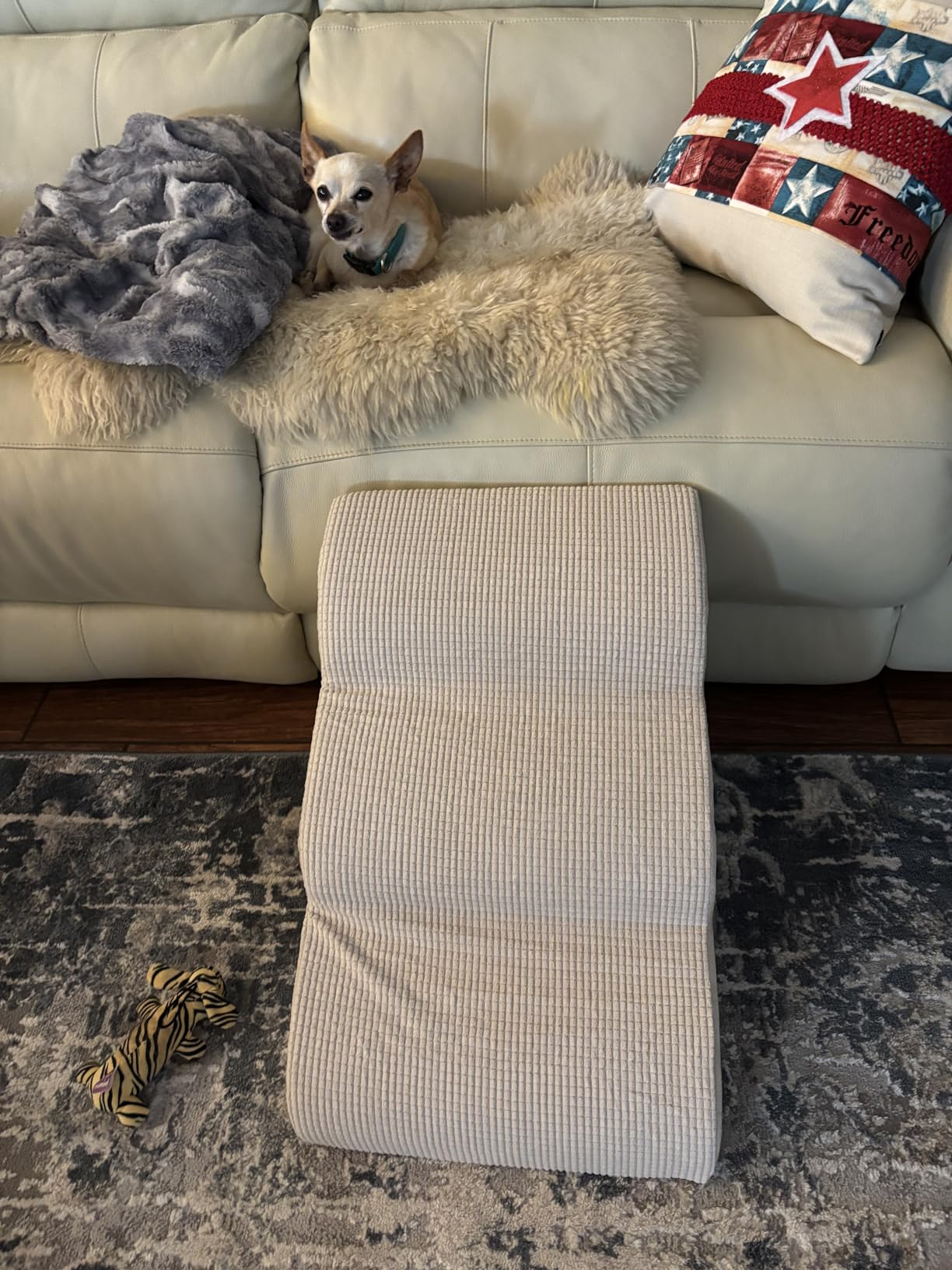
This is the product we would pick if the descent is the bigger worry. Because there is no sharp vertical riser to drop off, a dog sliding slightly backward slides a few inches along an incline rather than falling off an edge. That is a meaningful difference for a toy breed with weak rear legs.
The corduroy also hides claw marks and cleans up with a lint roll, which is useful in a home where the stairs sit in a walkway rather than beside a bed.
What to check before you buy
Measure the floor-to-cushion height, not the floor-to-frame height, since a thick mattress eats several inches. Then confirm the 50 lb guidance matches your dog with margin, and think about the 48-72 hour expansion window in a cool room, where compressed foam takes longer to open up.
If your dog is a large or senior dog with real stiffness, the small-dog foam profile may feel too soft. The Ahpmeoa four-step model handles a heavier footprint with a firmer core and curved edges.
4. COZY KISS 3-Step Foam Stair: Top Rated for Small Dogs Under 80 Pounds
COZY KISS Dog Stair for Small Dog 15.7″ H, 3 Step Pet Ramp for Couch
3 steps
15.7 in tall
22.44 x 15.75 in
Up to 80 lb
4.67 lb unit
Pros
- Curved profile avoids hard edges that startle small dogs
- Waterproof removable cover survives accidents
- Wide base stays put and does not tip
- Fabric arrives already fitted to the foam
- Holds shape over long daily use
Cons
- Underside is light on grip over area rugs
- Not built for large or very senior dogs
- Wrinkled look until steamed flat
The COZY KISS is the most complete small-dog unit we tested, and it is the one we would hand to a household that has more than one pet or a dog with a history of mishaps. The 30D high-density foam is rated to support up to 80 lb, which is a higher ceiling than most foam steps in this price band, and the corduroy cover has a TPU waterproof layer underneath.
That waterproof layer is not a small detail. Owners of Cavaliers, Yorkies, Chihuahuas, and Frenchies specifically call out that the cover can be removed and machine washed after an accident, which is the difference between a product you keep and a product you tolerate.
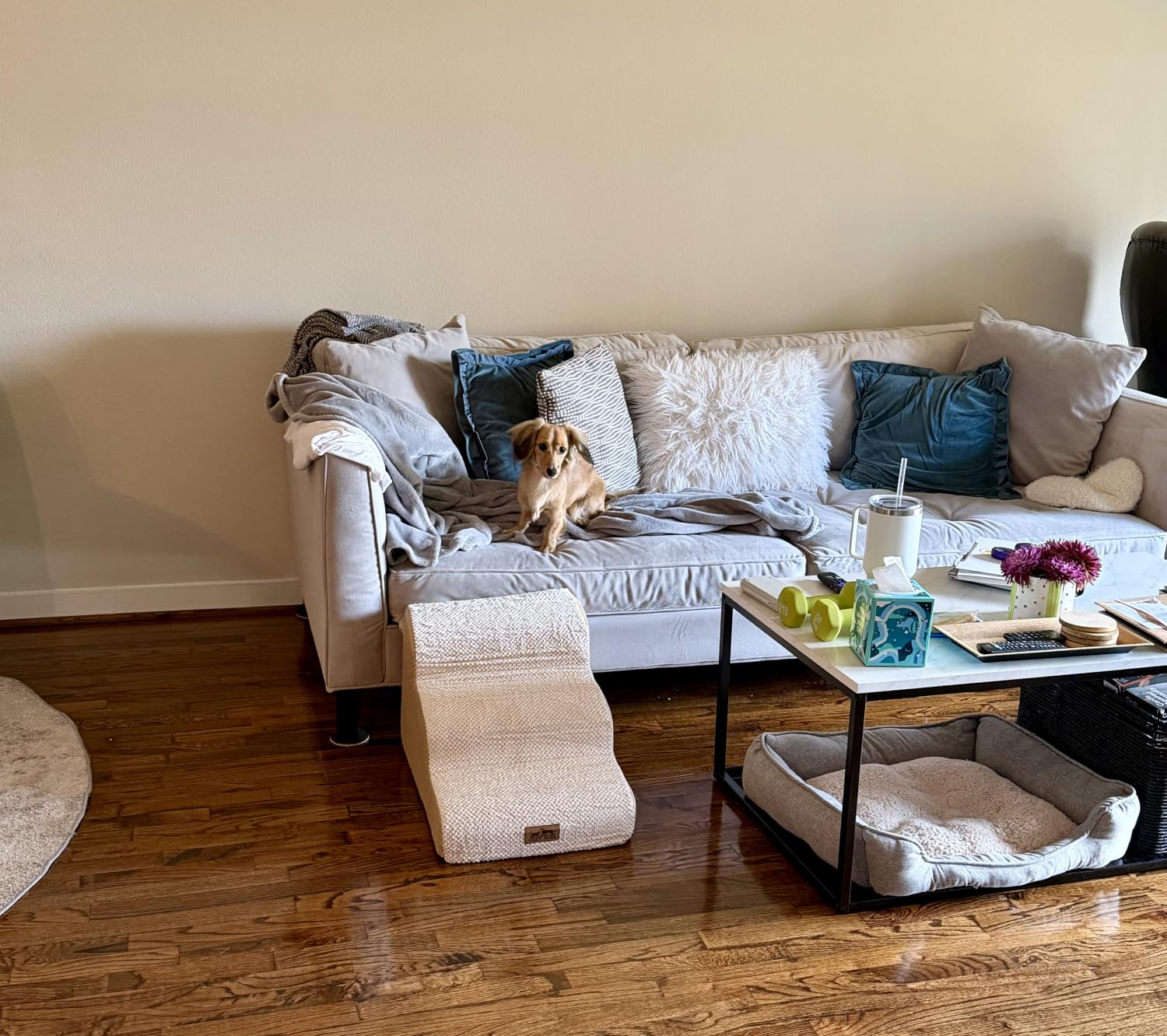
There is also a rear carry handle, and the fabric is already installed on the foam rather than something you have to fight into a sleeve after unpacking. The base is wide and long enough that the stairs do not tip when a dog commits at speed, and owners report the shape and fabric holding up over long-term daily use.
At 4.6 stars from more than 6200 reviews, with 81 percent five-star ratings, it is comfortably among the strongest performers here. The reservation that comes up most is the underside: it grips hard floors well but is not dense enough for some area rugs, so put a rubber mat under it if your bedroom is carpeted with a loose rug.
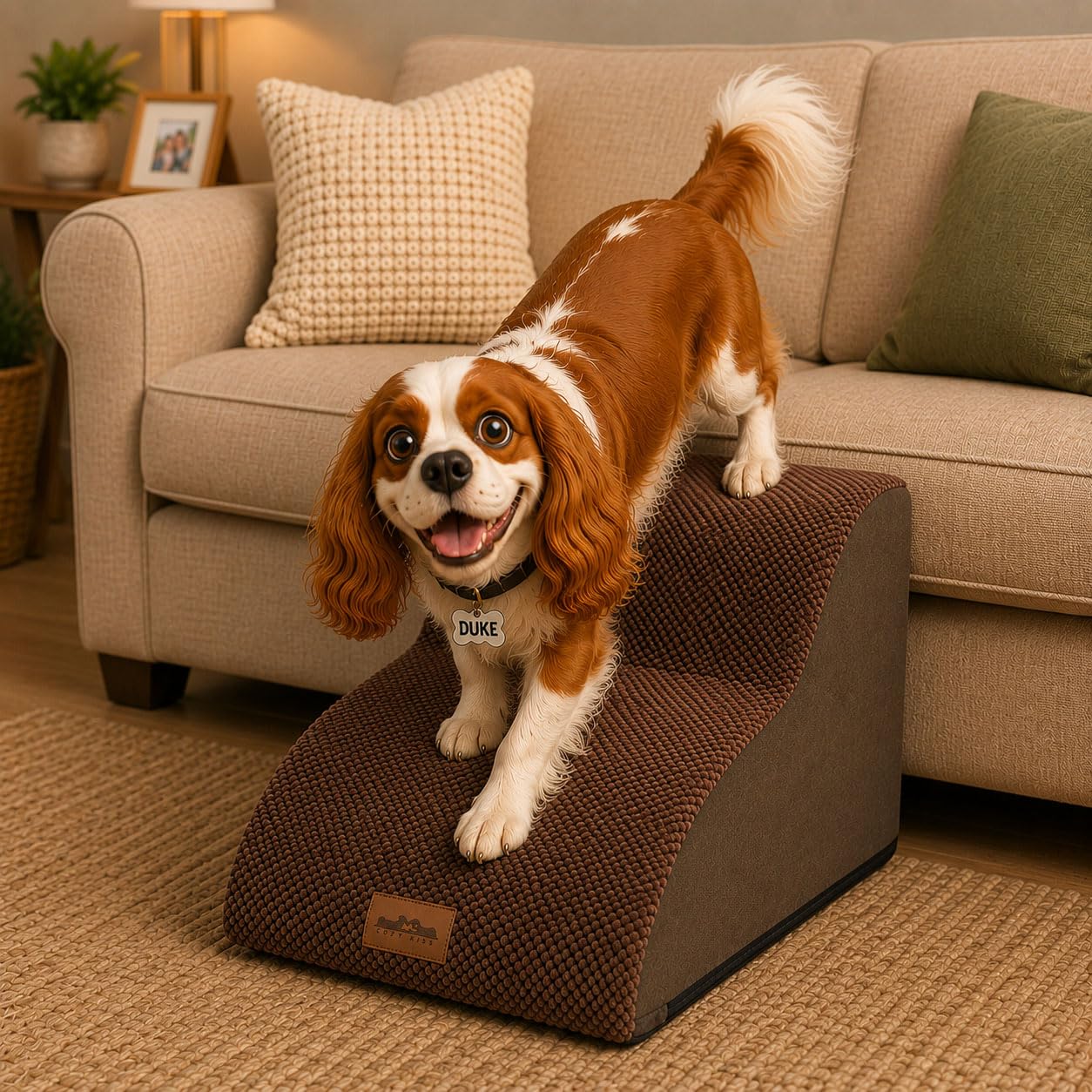
Why the curved profile matters for small paws
Conventional tiered stairs present a hard vertical face at the front of every step. A small dog’s paw can catch that face on the way up or, worse, land flat on it on the way down, and the resulting knock is what makes some dogs develop a habit of sliding instead of stepping.
The soft curved design here removes that face entirely, and the side panels are a wear-resistant cotton-linen that takes claw sharpening without damaging the foam underneath.
What to check before you order
Confirm your furniture height against the 2-layer, 3-layer, and 4-layer options, which cover chairs, sofas, beds, and high beds. Note that this is not a senior or large-dog product by design: the 80 lb rating is a foam rating, not a recommendation for a dog with stiff hips.
Allow 24-48 hours after unpacking, and steam the cover flat if appearance matters to you. It arrives wrinkled from vacuum compression, and steam fixes that quickly.
5. Heeyoo Extra Wide 3-Tier Steps: Best for Puppies and Short-Legged Dogs
Dog Stairs for Small Dogs, 3 Tiers High Density Foam Dog Ramp, Extra Wide Non-Slip Pet Steps for High Beds Or Couch, Soft Foam Doggie Ladder for Dogs Injured, Older Pets, Small Cats
3 steps
15 in tall
23.6 in L x 15.7 in W
High-density foam
4.76 lb unit
Pros
- Deeper and wider treads than most competitors
- High-density foam resists deforming
- Corduroy cover removes and machine washes
- Styling blends with bedroom furniture
- Rebounds within minutes of unpacking
Cons
- Up to 48 hours to rebound in cold rooms
- Cover wrinkles from compression
- Wider footprint beside a bed
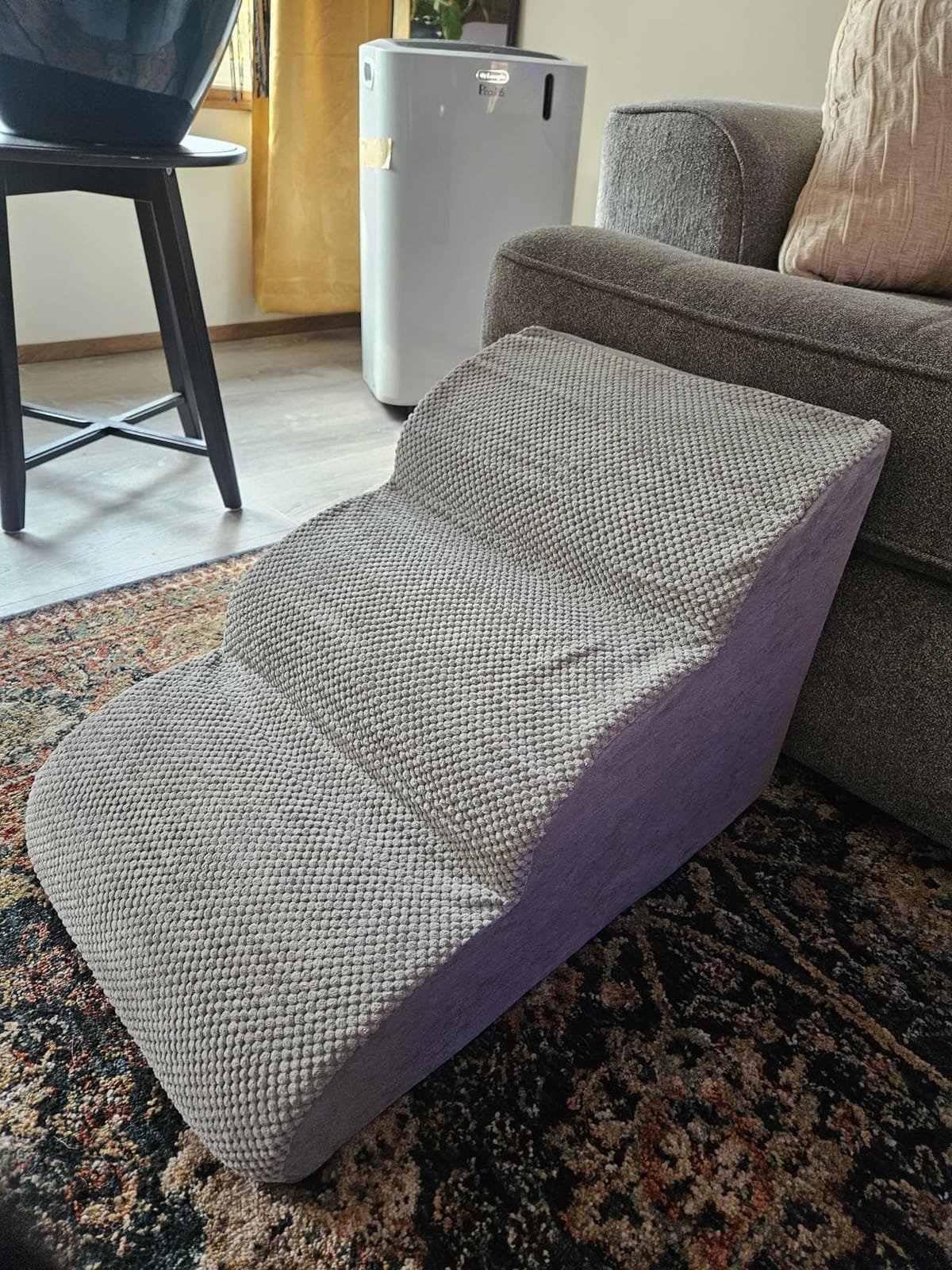
The Heeyoo exists to solve a sizing problem the rest of the category mostly ignores: tread size. At 23.6 in long by 15.7 in wide, the treads are noticeably deeper and wider than standard models, and reviewers single that out as the reason their dogs place their feet properly instead of edging down onto a narrow lip.
That is exactly what a growing puppy needs. A puppy whose legs are still short wants a big flat landing, and the extra width also suits dachshunds and senior dogs with limited mobility who take a moment to position themselves before each step.
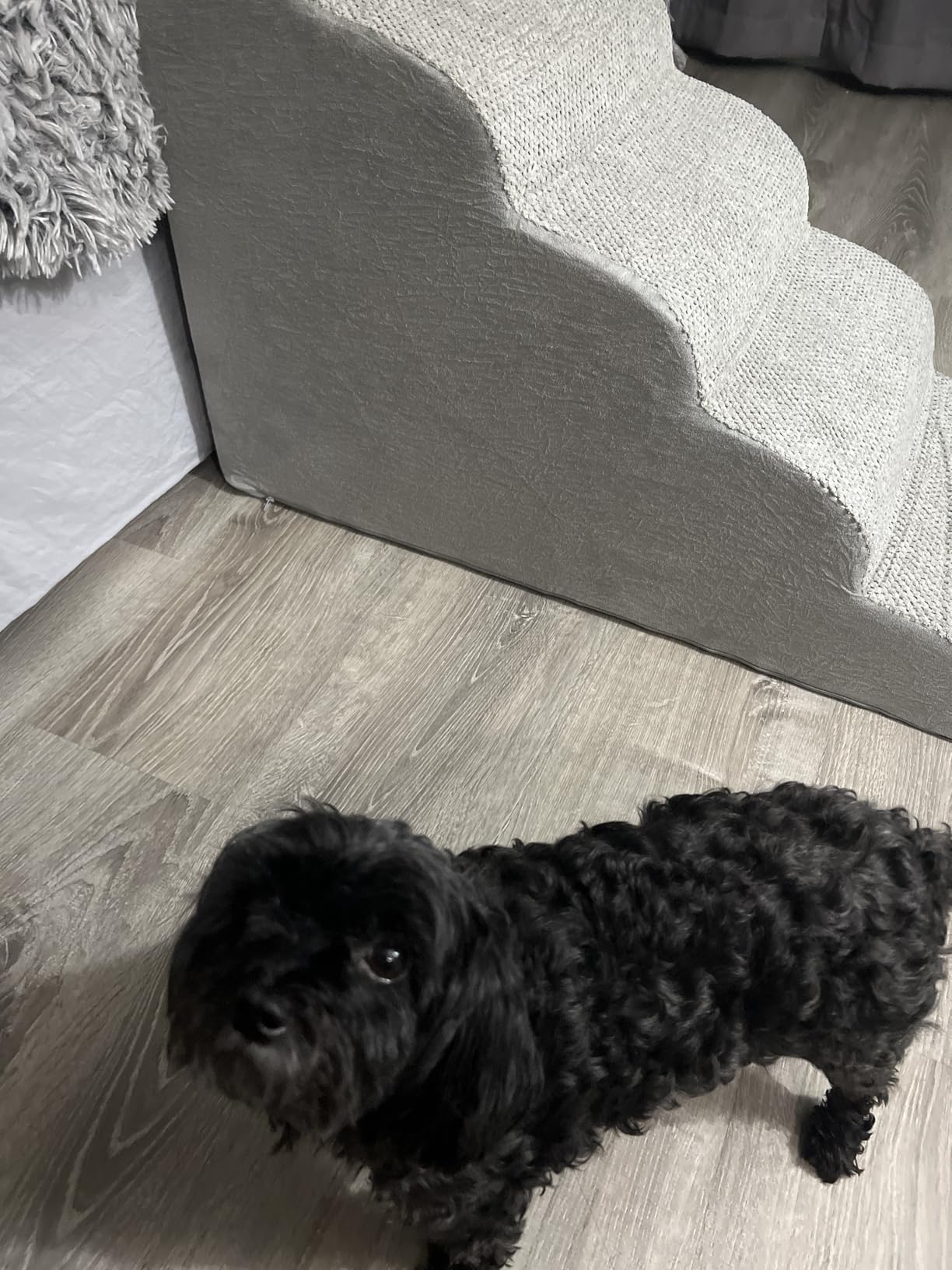
The core is high-density foam chosen to resist deforming under repeated use, and the corduroy cover is non-slip and unzips for machine washing. The foam itself can only be lightly vacuumed. Colors are neutral by design, and owners frequently mention that the stairs do not look like pet equipment in a bedroom.
It holds 4.5 stars across more than 2700 reviews with 76 percent five-star ratings. The main caveat is delivery: vacuum compression means the cover arrives wrinkled and the foam can take up to 48 hours to rebound in a cool room, though it usually opens within minutes in a warm one.
How to plan for a puppy who will outgrow it
This is the honest weakness of every foam stair and it deserves a straight answer. Foam stairs are sized for the furniture height of a specific dog at a specific age, and a puppy that grows past 20 lb will need a taller unit within months. Budget for one replacement rather than assuming a foam stair is a permanent fixture.
What soft foam does buy you is time, because it is far kinder to a puppy’s developing joints than a jump, and the wide treads are much harder to fall off than narrow ones.
How it behaves in a tight living space
The wide treads cost you floor length, not width. With a 23.6 in depth you need roughly two feet of clear floor in front of the bed for a comfortable descent, so measure both the footprint and the approach path before ordering.
If you need the vertical reach more than the tread size, the four-step Ahpmeoa model gets you to 21 in of furniture height in a similar footprint.
6. Gardner Pet 2-in-1 Stairs and Ramp: Best Convertible Option
Gardner Pet Dog Stairs for Small Dogs 16.5″ H, 2 in 1 Transformable 3-Step Pet Stairs and ramp, Dog Steps for Couch (13-20 in) with Durable Non-Slip Waterproof Cover and CertiPUR-US Certified Foam
3 steps
16.5 in tall
26.7 x 15.7 in
35D foam
9.92 lb unit
Pros
- Converts from stairs into a low-angle ramp in one unit
- 35D high-density foam is supportive but joint-friendly
- Machine-washable waterproof cover
- Rubber-dot base grips hard floors
- No assembly and OEKO-TEX certified material
Cons
- Heaviest unit here at nearly 10 lb
- Wrinkled foam recovers in 24-48 hours
- Curved shape uses more floor space
Most households end up with one low chair and one taller sofa, and buying two sets for that is where this design earns its place. The Gardner Pet unit converts from a standard stepped configuration into a gentle ramp, so the same object covers a 13 in chair and a taller piece of furniture depending on how you set it up.
The foam is 35D high-density, which is firmer than most of the foam in this group while still cushioning the joint. Reviewers confirm it feels firm rather than spongy, and the ramp surface is deliberately low-angle to reduce the load through the front legs during a climb.
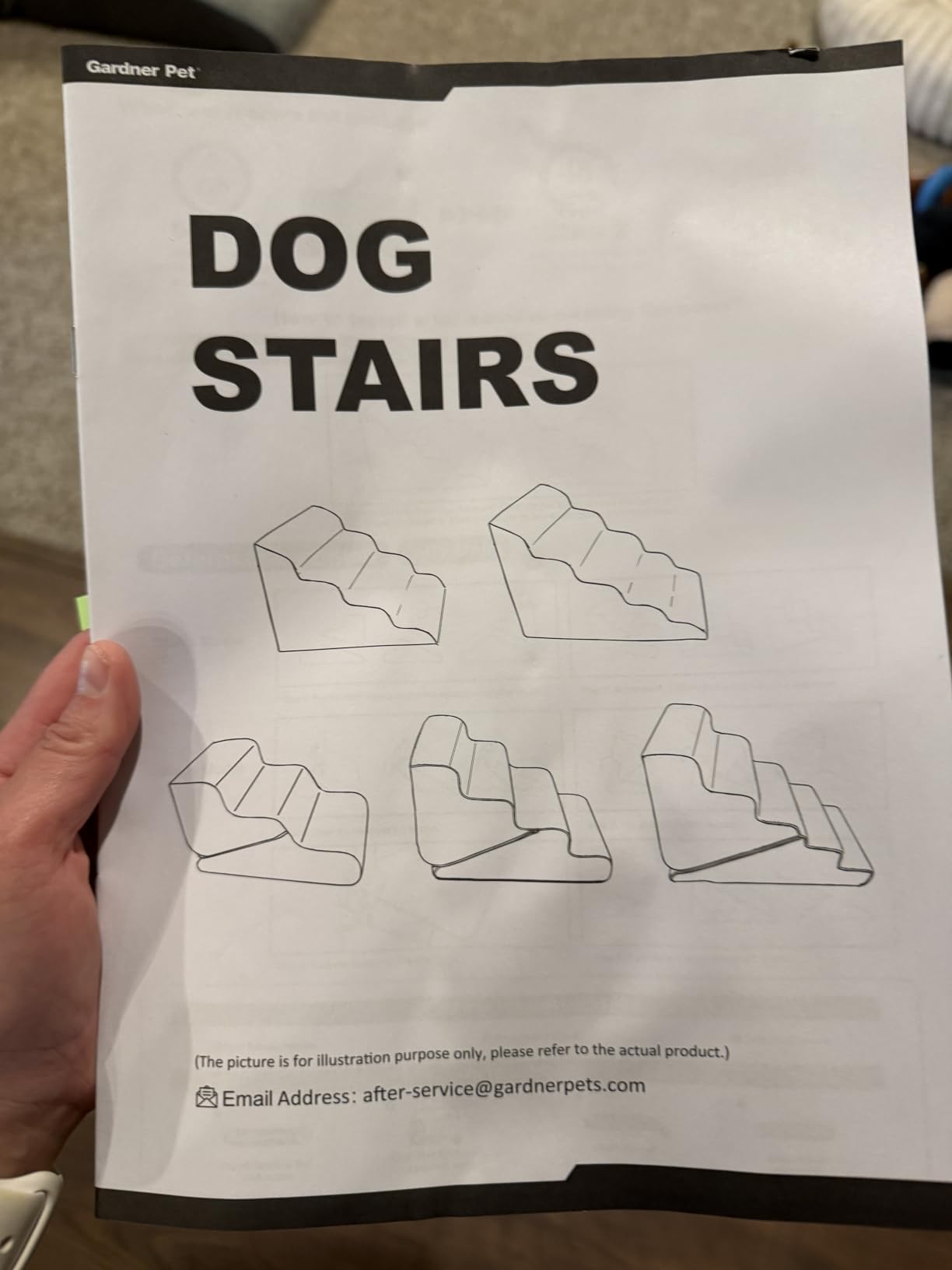
It is one of the newer listings in this group and already carries 4.6 stars from more than 2100 reviews with 81 percent five-star ratings. The rubber-dot anti-slip base grips hard floors, the waterproof cover is machine washable, and there is no assembly at all beyond letting the foam recover its shape for 24-48 hours.
At nearly 10 lb, it is the heaviest unit we tested, and the curved or 2-in-1 shapes use more floor length than a straight three-step model. Owners with knee-injured dogs and small to medium dogs report it working well, but if you plan to move it between rooms constantly, a lighter unit fits the job better.
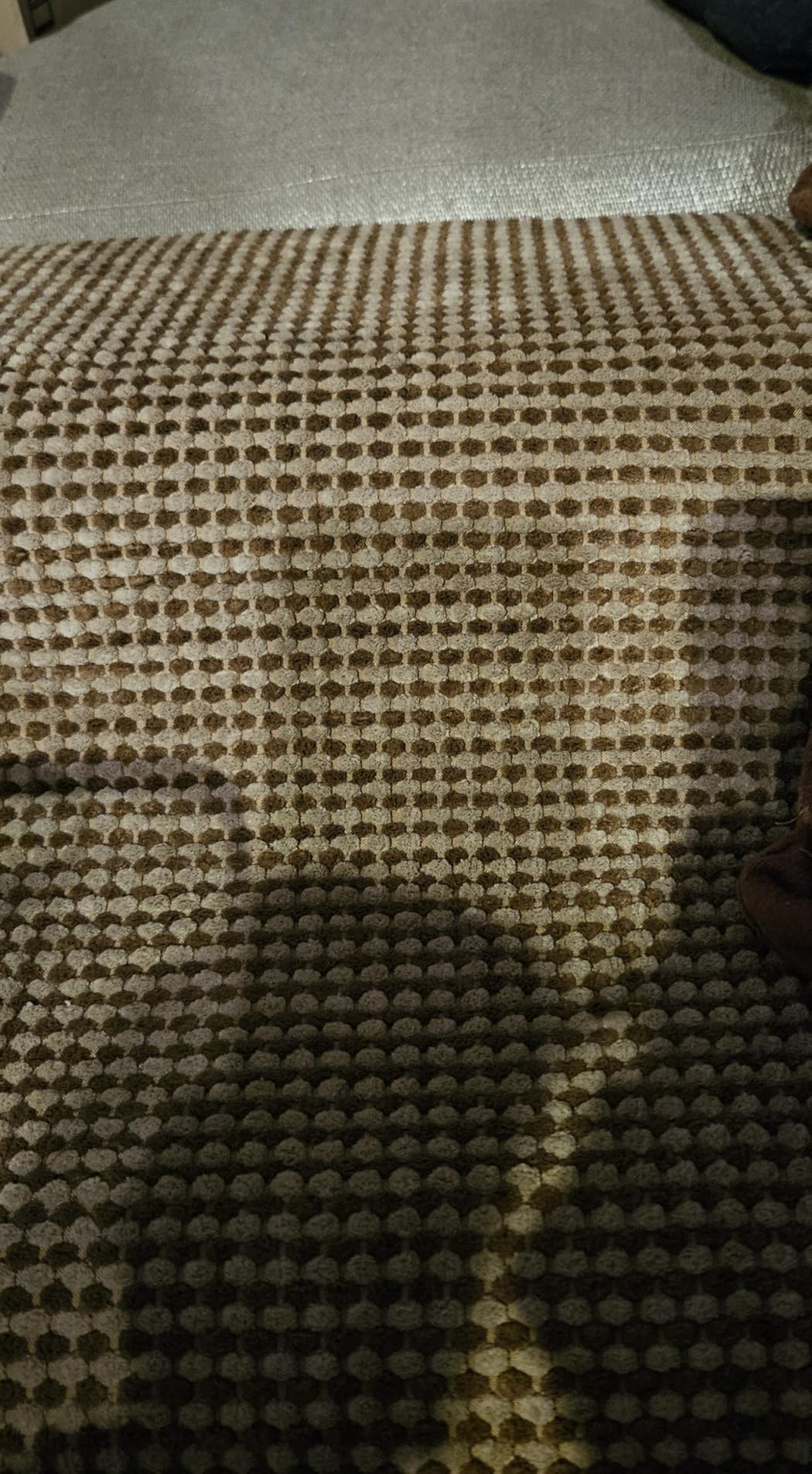
How to set the ramp configuration correctly
The conversion is a folding job, not a disassembly job, so read the shape before you position it. Walk your dog up the ramp configuration for a few days first, because a dog trained on the stepped side may hesitate when the surface changes angle.
Its height guide runs 2-step to 18 in, 3-step to 20 in, 4-step to 25 in, and 5-step to 28 in, which covers more furniture range than any single unit in this roundup.
How it handles an older dog recovering from surgery
The low-angle ramp is the reason orthopedic and post-surgery owners recommend this shape: the dog keeps all four feet in contact instead of extending a front leg down to a lower step. The firm foam also means the surface does not collapse under a hesitant paw, which is what makes hesitant dogs give up on foam.
Pair it with a mat at the top landing so the transition onto the bed or sofa is not the part that scares your dog.
7. Ahpmeoa 4-Step Curved Dog Ramp: Best for Dachshunds and Long-Backed Breeds
Ahpmeoa Dog Stairs for Small Dogs 19.7″ H, Dog Ramp for Bed, 4-Step, Grey
4 steps
19.7 in tall
28.3 x 15.7 in
High-density foam
8.07 lb unit
Pros
- Curved edges remove the vertical faces dogs clip paws on
- High-density core stays stable for 35-55 lb dogs
- Fleece cover unzips and washes
- Four steps reach beds narrower stairs cannot
- Light enough to slide across a carpet
Cons
- Side fabric stays wrinkled unless steamed
- Light build is less stable for larger pets
- Up to 48 hours to rebound when cool
This is the pick for dachshunds, corgis, and any long-backed breed, and the reason is the edge geometry rather than the foam. The steps are curved so that stairs and ramp blend into one continuous incline, which means a long body never has to drop its rear onto a hard vertical riser. Owners of dachshunds and miniature poodles specifically report that their dogs stopped striking the fronts of their paws.
It is also the tallest small-dog-oriented unit in the group at 19.7 in, with a four-step layout, so it reaches a high bed that a three-step model cannot. For a toy breed with an unusually tall bed, that extra reach matters more than it does for a mid-size dog.
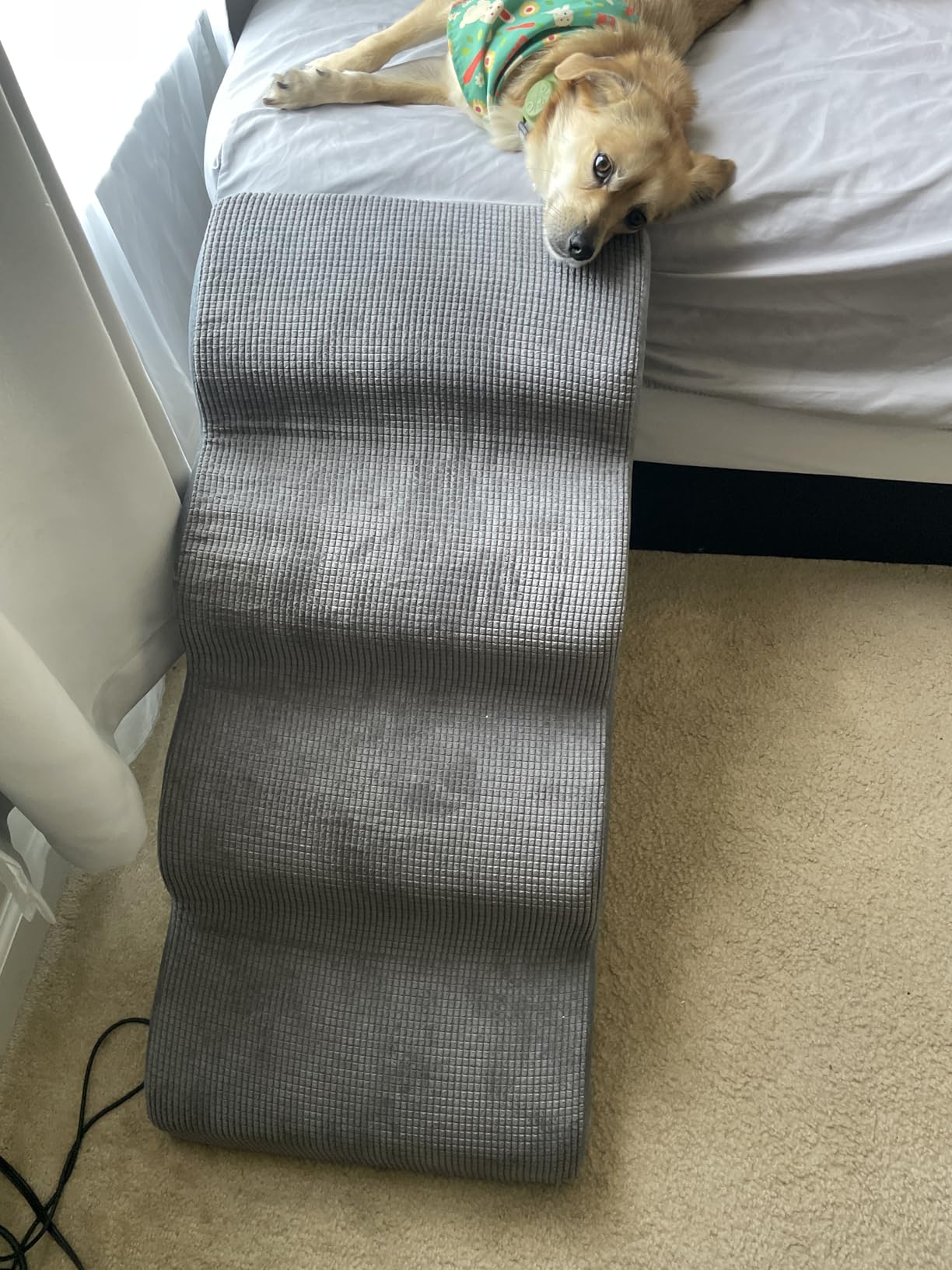
The high-density foam core stays stable underfoot for dogs in the 35-55 lb range, and the removable bonded-fleece cover unzips for hand or machine washing and doubles as a resting spot. Reviewers mention being able to slide it across a carpet single-handed at 8.07 lb, which is a real convenience in a bedroom.
It earns 4.7 stars from just over 2000 reviews with 84 percent five-star ratings, alongside a handful of notes that the light build is less stable for larger pets and that the side fabric needs steaming after vacuum sealing. Its height guide runs 2-step to 13 in through 5-step to 24 in.
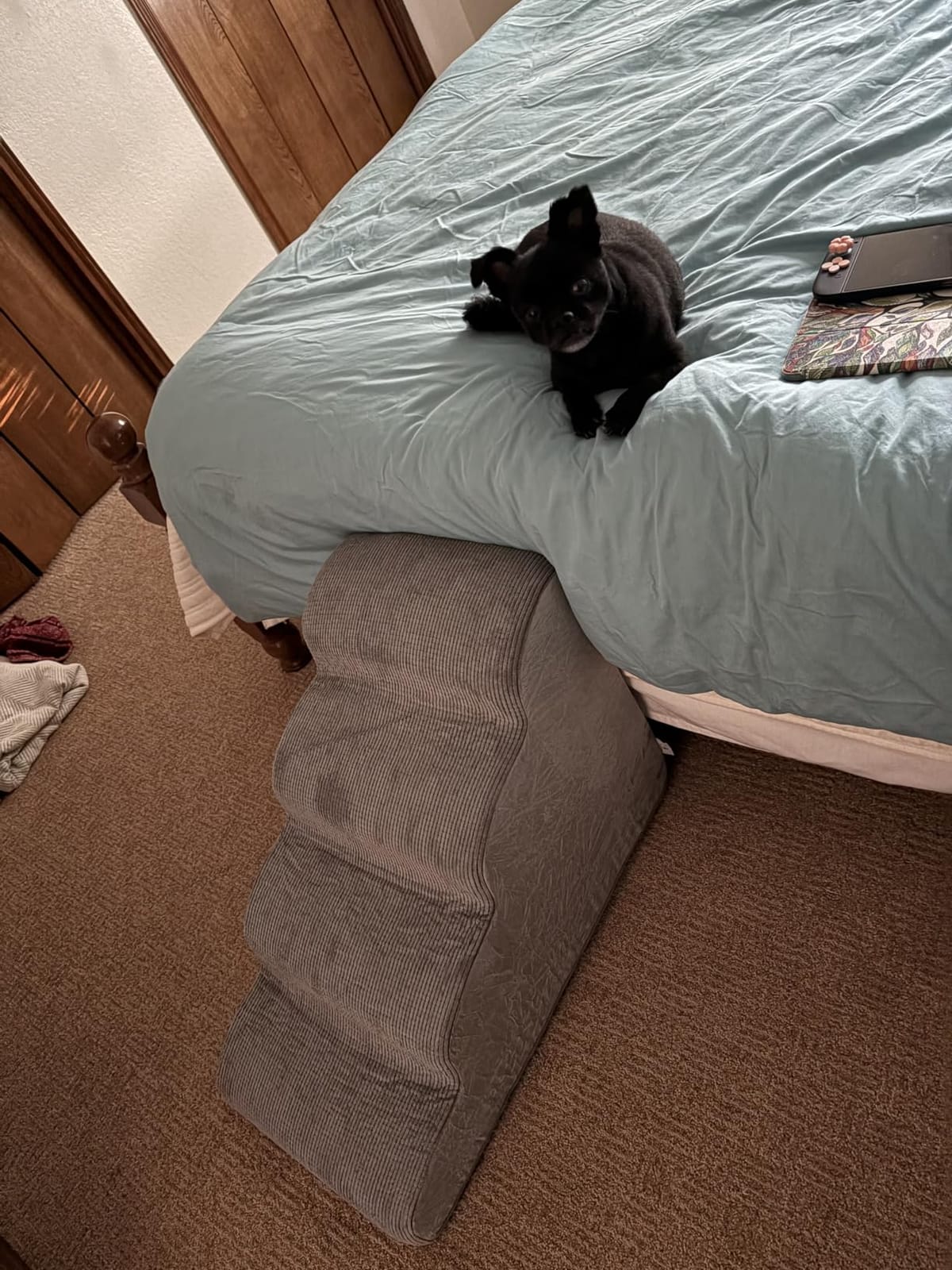
Why long-backed breeds need a different shape
A dachshund’s spine runs the full length of its body, and every abrupt vertical drop in a stair is a moment where the front half of that body is lower than the rear half while the dog is unsupported. A continuous incline removes that moment, which is the argument the AI overview and the dachshund groups on this query both keep making.
It is also why a carpeted tread is not automatically enough. A group member with a Yorkie reported sliding all the way down carpeted step inserts because the incline was still too steep, not because the grip failed. Curvature and angle matter more than surface material here.
How it performs on the descent
On the way down this is one of the safer designs we tested, because the dog’s weight stays distributed along a slope rather than dropping step to step. Give your dog an open path in front of the stairs and consider a low mat at the base to soften the last few inches.
For the same reason, it is a poor choice for a heavy dog. The light foam core is the trade-off for the curved shape, and reviewers with larger pets report more shifting underfoot.
8. LE SURE 4-Step Pet Ramp: Best for Senior and Arthritic Dogs
Lesure Dog Stairs for Small Dogs, Beige, 4 Step Pet Ramp for Bed and Couch
4 steps
19.7 in tall
28.3 x 15.7 in
Up to 50 lb
33D foam
Pros
- Padded step-and-ramp slope gives excellent grip
- High-density foam does not compress over time
- Smoother incline replaces hard tiered stairs
- Washable cover unzips easily
- Light but firm and senior dogs use it confidently
Cons
- Needs 24-72 hours to fully expand
- Foam core cannot be machine washed
- Deeper footprint than a compact two-step
The LE SURE is a padded hybrid, and its users describe the reason better than the manufacturer does: their dogs stopped knocking their paws on hard vertical risers. The step-and-ramp slope gives grip while keeping the surface continuous, and at 4.7 stars from more than 1400 reviews it sits alongside the Ahpmeoa at the top of the ratings in this group.
The foam is 33D high-density, CertiPUR-US certified, and rated for dogs up to 50 lb. Owners of aging dogs and senior cats consistently report that their animals use it without hesitation, which is the test that matters for a dog whose joints make hesitation painful.
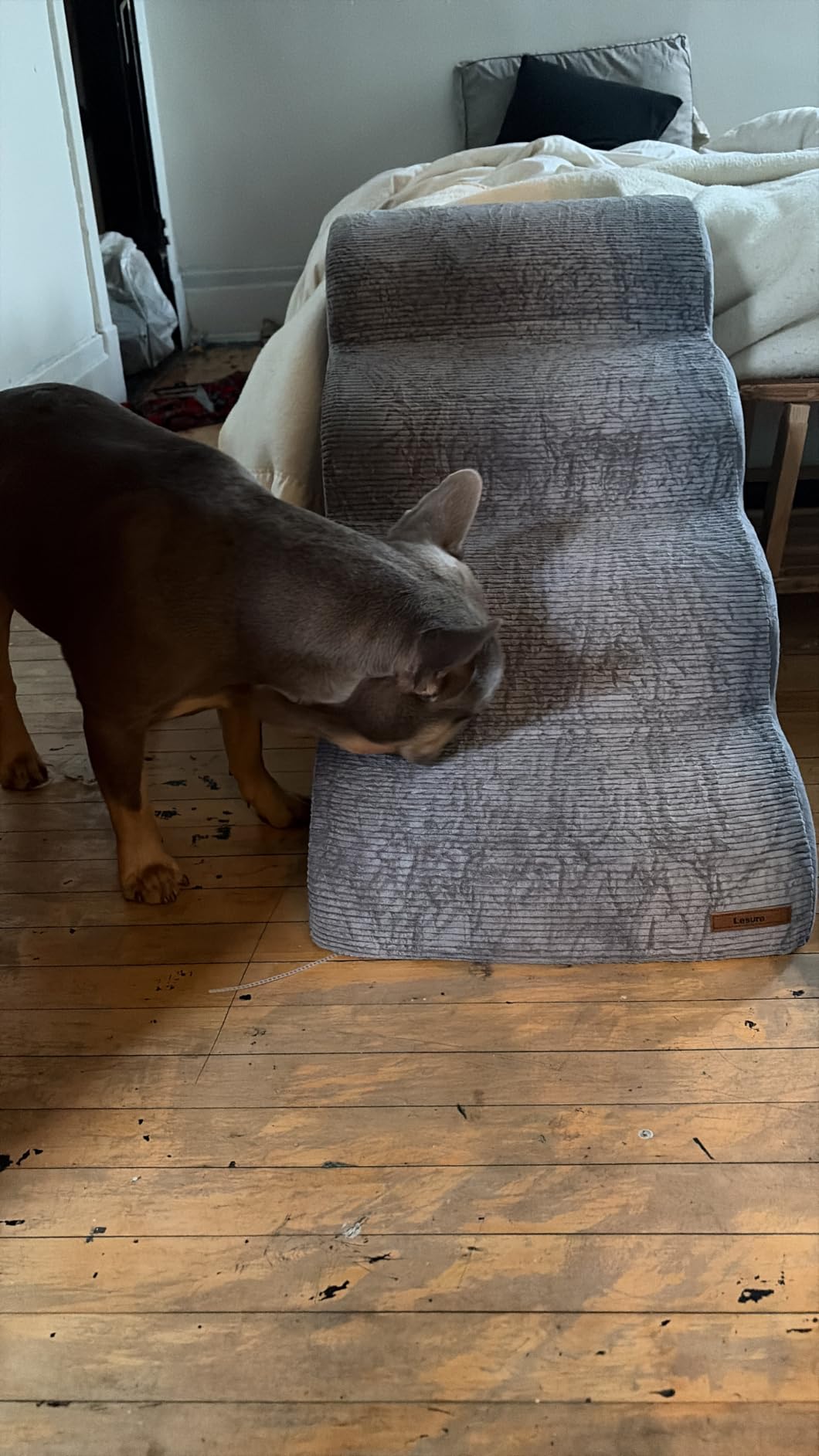
It measures 19.7 in tall across a four-step layout, so it does the work of a high-bed stair while feeling closer to a ramp. The rubber-dot non-slip bottom handles hard floors, and a built-in carry handle plus a 7.85 lb weight make it manageable to reposition.
There is no assembly. It arrives vacuum-compressed and expands over 24-72 hours, the cover unzips for a cold delicate machine cycle, and the foam core must not be washed. The deeper footprint than a compact two-step model is the one space cost worth planning for.
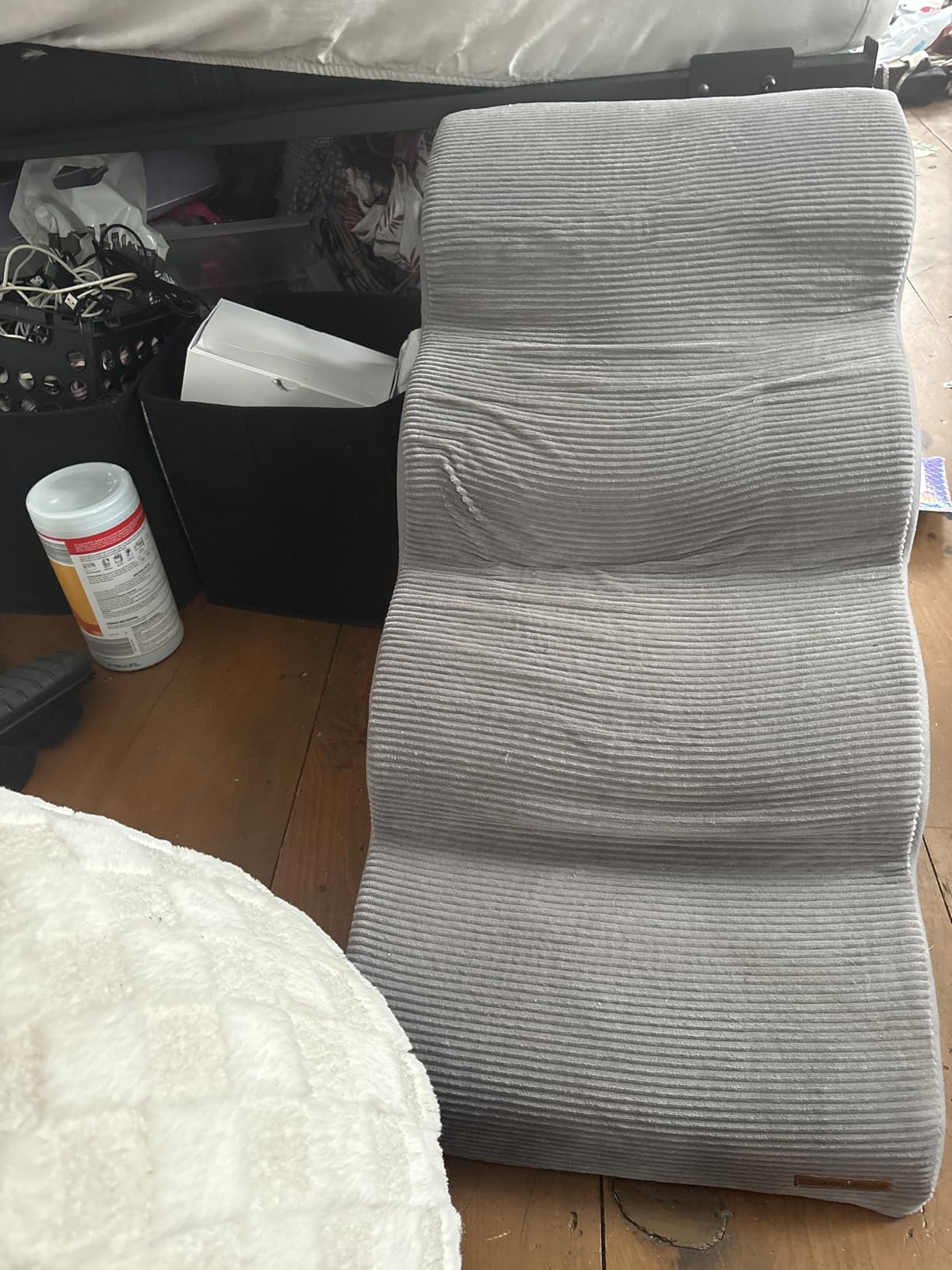
How to introduce it to a dog that is afraid of steps
Put the stairs where the dog already goes, not where you want them to go, and start by placing a treat on the lowest tread only. Most senior dogs will step onto a padded incline long before they will step onto a hard tier, because the surface does not change under the paw.
Keep sessions short. Two minutes a day for a week does more than a twenty-minute session on day one, because a stiff dog that overdoes it the first day often refuses the whole idea afterward.
What to check before you buy
Confirm your dog is inside the 50 lb rating with margin, and measure the bed height including the mattress. At 28.3 in of footprint depth, you need real floor space in front of the bed for a safe descent, which is the part people forget.
Start the expansion clock the day it arrives. Setting it up against the bed before the foam has fully recovered leaves a slumped surface that your dog will distrust for weeks.
9. Chic Threads 3-Step Dog Stairs: Budget Pick and Chewing Dogs
Chic Threads 3-Step Dog Stairs for Small Dogs, Dog Ramp for Bed 15.7″ H
3 steps
15.7 in tall
22.4 x 15.7 in
5.05 lb unit
15.7 in wide
Pros
- High-density rebound foam holds shape and elasticity
- Double-layered anti-skid bottom grips hardwood and carpet
- Concealed zipper deters chewing and scratching
- Removable machine-washable cover
- Soft corduroy helps pets adjust quickly
Cons
- Needs 24-48 hours to rebound after unpacking
- Cover can look wrinkled from compression
- Three-step height suits sofas and low beds only
The Chic Threads is the sensible compact pick, and its distinguishing detail is the concealed zipper. A standard exposed zipper on a fabric cover is an invitation to a curious puppy, and this design hides the pull behind a protective flap, which is why buyers with chewers rate it well.
The bottom uses a double-layered anti-skid mesh fabric rather than a smooth panel, and that layer is what makes it a good apartment choice. It grips hardwood and carpet without needing a separate mat underneath, which matters when the stairs have to sit in a small room beside a sofa.
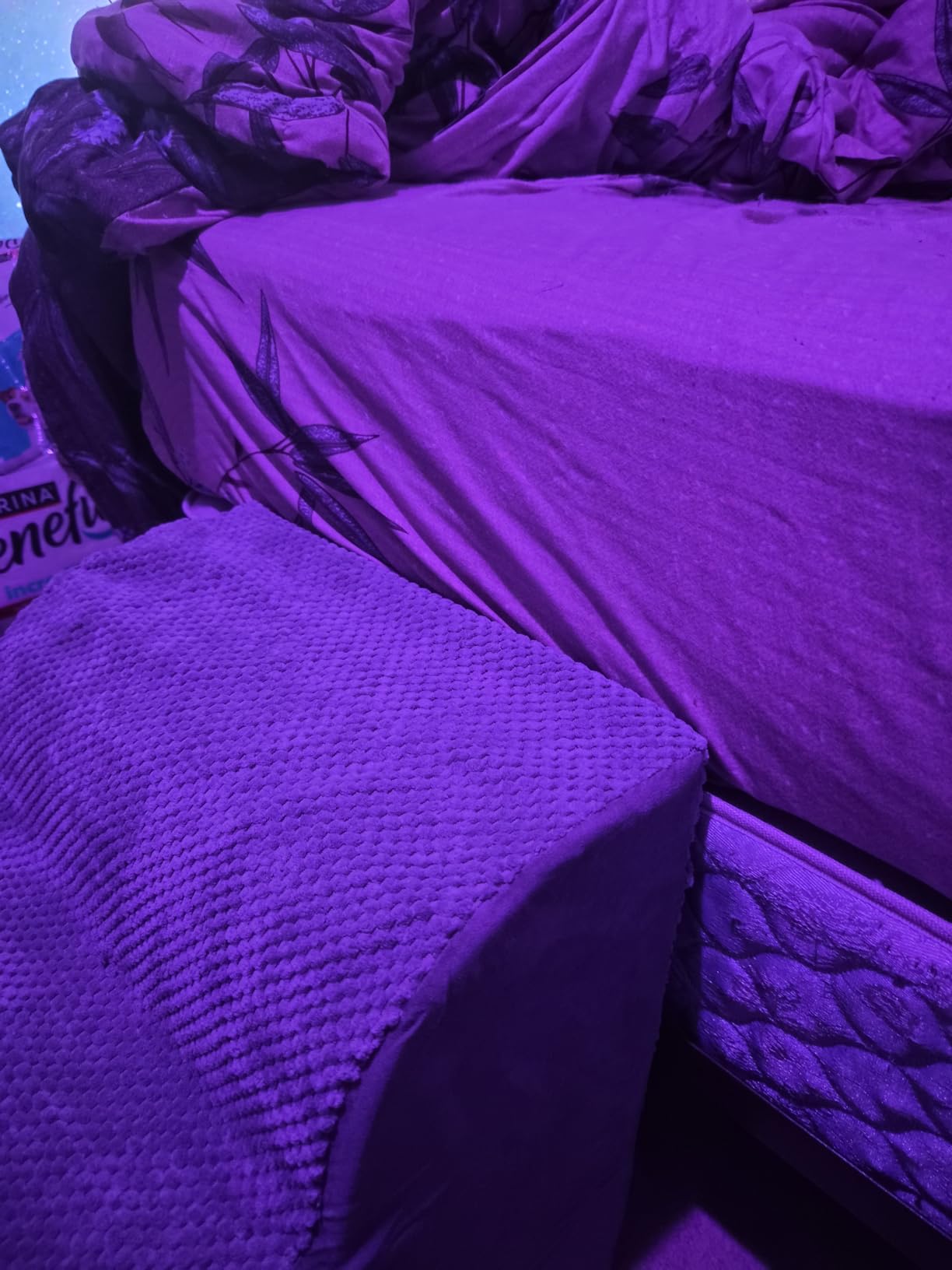
At 22.4 by 15.7 in and 5.05 lb, it is one of the smaller footprints here, and the 15.7 in height suits sofas and low beds rather than a high mattress. The corduroy surface is soft, which helps a nervous dog commit, and the high-density rebound foam holds both shape and elasticity over repeated use.
It scores 4.5 stars from close to 2000 reviews with 78 percent five-star ratings. The recurring caveat is the same one that applies to every vacuum-packed foam unit: 24-48 hours of rebound time, and a cover that looks wrinkled until the foam pushes back into it.
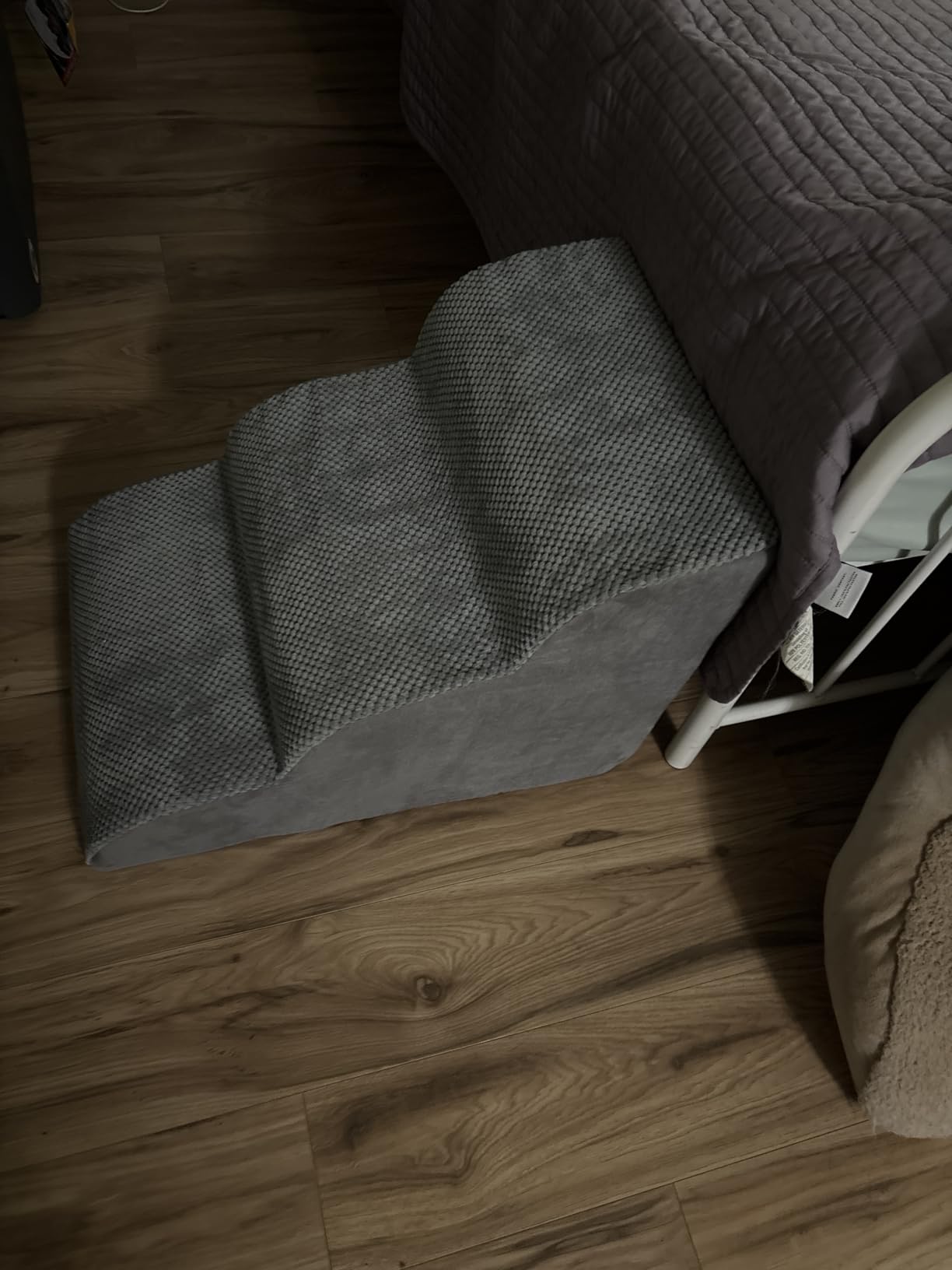
How it handles a floor you do not want to scratch
On hardwood, the value here is that the unit stays where you put it. Foam stairs with smooth or lightly textured bottoms creep forward on each climb and then slide back on each descent, and over months that movement is what scuffs a floor or drags the unit away from the sofa.
The mesh base here is the answer to a common forum complaint that non-slip feet are not enough on their own. If your floor is particularly slick, a thin rubber mat under the footprint still adds margin.
How to tell if the foam is still good
Press firmly in the center of each tread with your thumb. High-density foam that has been overworked feels permanently flat, and a dog will start sliding on a surface that used to hold. The rebound foam in this model holds elasticity for most owners, but the test is a fast way to know when a replacement is due.
Watch the cover seams as well. A zip that is starting to gap is the first sign a chewer has found the concealed flap.
10. Topmart 3-Tier Foam Dog Ramps: Best for Small Spaces for Deep, Stable Treads
Topmart 3 Tiers Foam Dog Ramps/Steps,Non-Slip Pet Steps
3 tiers
15.7 in tall
23.6 in D x 15.7 in W
7.8 in deep treads
Up to 50 lb
Pros
- Deep 7.8 in treads reduce joint strain
- Anti-oxidation grey foam resists yellowing
- Corduroy top plus silicone-dotted bottom grips all floors
- Concealed zipper deters chewing
- Cover unzips for machine washing
Cons
- 24-48 hours of expansion before use
- Only fits furniture 14-19 in tall
- Comfort rating is lower above 35 lb
The Topmart is the value option, and the reason it earns a place is tread depth. Each step measures 15.7 in wide by 7.8 in deep, which gives a short-legged dog a genuine landing rather than a ledge, and owners of French Bulldogs, Corgis, Dachshunds, and cats credit that depth for stability.
With more than 9500 ratings it carries a well-established record of real use, and it holds a 4.3 average with a 69 percent five-star share, the widest spread here. That spread is informative: plenty of owners are very happy, and a meaningful share had an experience worth reading about before you buy.
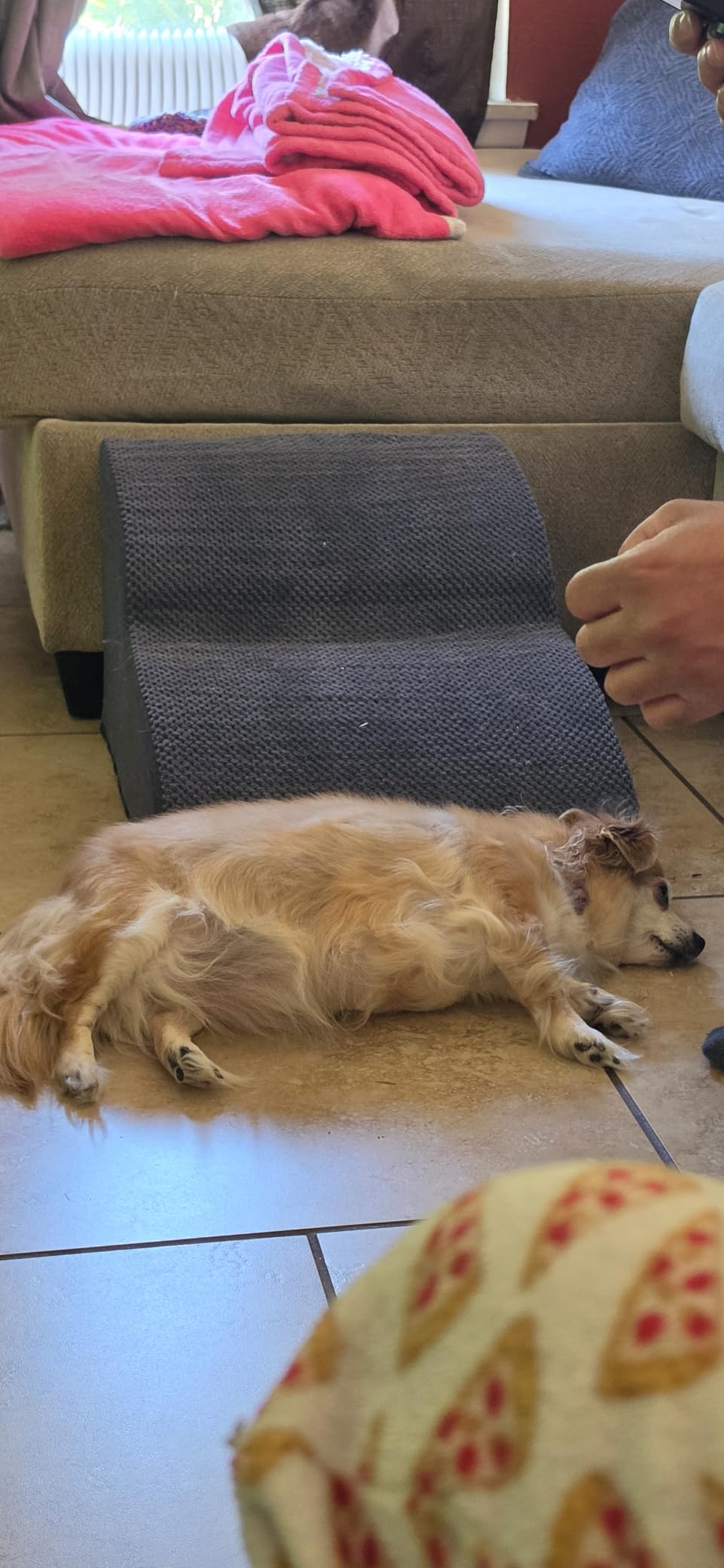
The 30D high-density grey foam is treated to resist yellowing and oxidation, which is a real difference after a year of daily use next to a bed. The top is corduroy for traction, the bottom is silicone-dotted for grip on hardwood, tile, and carpet, and the concealed zipper sits behind a protective flap.
Two limits are worth planning around. It fits furniture between 14 and 19 in tall only, which is the narrowest range in the roundup, and although it is rated to 50 lb, reviewers report the best comfort for pets under 35 lb.
How to avoid the two complaints that recur most
First, the 24-48 hour expansion window. Open the package, lay the unit in its final position, and leave it alone for two days. Setting it up early and letting the foam slump against the bed frame is what produces a permanently bent shape.
Second, the height range. If your measured furniture height falls outside 14-19 in, this unit is the wrong buy no matter how good the treads are, and one of the four-step models will cover you instead.
How it holds up for a short-legged dog
Deep treads are the reason this one works well for brachycephalic and short-legged breeds, because a Frenchie or a corgi has a low center of gravity and benefits from a wide, flat place to pause. A dog that keeps jumping down from the furniture instead of using the steps needs training rather than a different product, but the depth here at least makes the steps worth using.
For anything heavier than 35 lb or stiffer than a typical small dog, look at the Gardner Pet unit, which carries a higher capacity rating on firmer foam.
Tread Surfaces Explained: Carpet, Rubber, Foam or Fabric
The short answer to what type of stair treads are best for dogs is that surface material matters less than surface texture, and texture matters less than the angle of the step. Grip gets a dog’s paw onto the tread, but a shallow, continuous rise is what stops the paw from sliding once it is there.
Corduroy is the most common choice in this category and the one most owners end up happy with. The raised ribs add friction without collecting much hair, and it can be vacuumed or lint-rolled easily. Rubber tread inserts grip best when wet or when a paw is dusty, but they tear and trap debris, and the adhesive-backed versions are the single most common complaint in reviews across every brand we tested.
Plain carpeted treads feel good but wear at the center of the tread first, and long-haired small breeds compress pile into a slick surface over time. Foam-only surfaces are the quietest and softest on joints, but they have no texture of their own, which is why almost every foam stair in this roundup wraps the foam in a corduroy or fabric cover.
Fabric covers solve the cleaning problem but create a second one: a washable cover is only useful if you take it off, and the foam core underneath cannot be washed. Plan for the cover to be laundered every few weeks in a multi-pet home, and use a lint roller rather than a stiff brush on the tread surface.
Whatever you choose, add a mat at the top landing and the bottom of the unit. The transition off the stairs is where slips happen, and a low-pile mat there is cheaper than any tread upgrade.
Stairs vs Ramps: Which Is Better for Small Dogs?
Stairs win on space, sound, and acceptance by dogs that treat any change in surface as a threat. Ramps win on joint protection, and they are the better answer for a senior dog, a dachshund, or any dog recovering from orthopedic surgery. If you are asking specifically about a small dog who is still spry, a short set of steps is usually the easier purchase.
For an older dog, a ramp wins. The reason is that a ramp keeps all four feet in contact while a set of stairs asks the dog to extend its front legs down to a lower tread and then take the full load on impact. Repeating that pattern on a stiff hip is exactly what owners of aging dogs are trying to avoid.
For a dachshund or corgi, a low-angle ramp wins for spinal reasons. A stair asks the dog to bend at the waist repeatedly, and a shallow incline does not. A yard sloping from a porch down to a lawn is a different problem entirely, and it calls for a ramp with a gentle enough grade for the dog’s footing rather than furniture steps.
Alternatives to dog stairs are worth naming. A low platform or ottoman beside the sofa removes the height difference entirely. Blocking the jump by keeping the landing clear of furniture teaches some dogs to wait for help. A sofa ramp or a wheeled step works for a car or a porch. And lowering the bed frame or using a low-profile mattress solves the problem permanently for a dog whose furniture is a platform bed.
The most underrated alternative is a second, lower sleeping spot your dog actually prefers. Plenty of dogs will happily accept a floor-level bed next to yours rather than risk a slip on a set of stairs they never wanted in the first place.
How to Measure and Choose Dog Stairs
Measure from the floor to the top of the mattress or cushion, not to the bed frame. A thick mattress adds three or four inches, and buyers who guess this number are the ones returning orders. Then subtract nothing: the top step should land at or just above the finished surface so the dog steps on rather than leaping the last inch.
Next, pick the step count from that number. Two-step units handle furniture around 13 in, three-step units cover roughly 13-19 in, four-step units reach about 20-24 in, and five-step models extend past that toward taller beds. More steps on the same height means a smaller rise per step, which is the single number that decides whether a small dog can climb it comfortably.
Give the weight capacity real margin. Manufacturers rate to a limit; we would want at least double your dog’s weight on the number, because a hesitant dog loads the front tread far harder than a confident one. Anything rated below your dog by even a small amount should be skipped, and a foam unit that feels thin under your hand is telling you something.
On hardwood, plan for movement before you buy. Put a rug strip, a rubber mat, or a non-slip pad under the footprint, and wedge the top of the stairs against the bed frame so it cannot slide during a descent. If you are keeping young children out of the area while the dog is learning, a dog gate for stairs at the top of a real staircase is a different job than the one these products do.
Be realistic about foam durability. High-density foam holds shape for a few years of light use and flattens faster with a chewing puppy or a heavy dog on the top tread, and any foam stair will eventually be outgrown when the dog grows. A rigid plastic stair is a longer-term purchase for that reason, and a washable cover is what keeps a foam unit presentable for as long as you have it.
Finally, check the footprint against your room, not just the height against your bed. A 23 in deep unit needs roughly two feet of clear floor in front of the furniture for a safe descent, and in a small apartment that space is often the deciding factor. If the space is tight, a lighter unit you can move each time is better than a heavier one that stays put.
How to Get Your Dog to Actually Use the Stairs
Put a treat on the lowest tread and leave the room. Most small dogs investigate within minutes, and the fastest reported results came from owners who did nothing more than stage snacks and walk away.
Move up one step at a time, and only move up once your dog is using the current step without pausing. The goal is a dog who runs up without thinking, and thinking about each step means the climb is still too tall.
Reward at the top, not at the bottom. Reinforcing the landing teaches your dog that the stairs end somewhere good, which is what makes the descent easier later.
For a dog who slides, fix the surface before you retrain. Carpeted inserts are still too slick for some small long-haired breeds, and a dog that has slipped once will remember it. Add a non-slip mat underneath, check the base grippers, and consider a unit with a shallower rise.
For a dog who is afraid rather than unsure, shorten the first run. One step at a time, twice a day, for a week. A scared dog that is pushed will abandon the stairs entirely, and going back to jumping is worse for the joints than never having stairs at all.
On the descent, the thing that helps most is a non-slip mat directly at the base, plus clearing the floor path so the dog is not turning a corner at the bottom. Most falls on pet stairs happen in the first second of the drop, not during the climb.
Building your own is possible, and pet owners do it with stacked foam blocks or cinder blocks. We would only suggest it for a temporary or very low solution, because a homemade build rarely offers a rated weight capacity, a grippy tread, or a base that stays put, and a fail here means a fall onto a hard floor. If you want a sturdier temporary option, a crate placed beside the bed gives a short, stable step without a full stair unit.
Frequently Asked Questions
Is a ramp or stairs better for small dogs?
For a healthy, spry small dog, a short set of stairs is usually easier because it takes less floor space and dogs accept stepped surfaces quickly. A ramp is better for senior, arthritic, or long-backed dogs such as dachshunds, because it keeps all four feet in contact instead of asking the dog to absorb the load of each step down. A low-angle ramp-style foam stair is the compromise most small-dog buyers end up choosing.
What type of stair treads are best for dogs?
A textured corduroy or rubber tread is best for most dogs because it adds friction without collecting hair, and it can be vacuumed or lint-rolled easily. Rubber grips best when dusty or wet but tears and traps debris, while plain carpet compresses into a slick surface over time. Grip matters, but the step angle matters more: a shallow, continuous rise prevents sliding better than any surface change.
Do vets recommend dog steps?
Veterinarians generally recommend steps or ramps for small, senior, and long-backed dogs, because repeated jumping puts load through joints and the spine that stairs remove. The benefit is largest for dogs with hip dysplasia, arthritis, or a dachshund-type body, and for puppies whose developing joints should not absorb landing impacts. Steps are not a treatment for an injury, so a dog in pain should be examined first.
How can I make DIY pet stairs for my small dog?
The common DIY method is cutting stacked high-density foam blocks in descending sizes, wrapping them in carpet or fabric, and adding a non-slip pad underneath. It works for a temporary or very low step, but homemade builds rarely provide a rated weight capacity, a consistent tread texture, or a base that resists sliding. A build that fails means a fall onto a hard floor, so a rated product is the safer choice for furniture height.
What are the alternatives to dog stairs?
Common alternatives are a low ottoman or platform beside the sofa, lowering the bed frame or using a thinner mattress, blocking the jump by clearing the landing of furniture, and a portable ramp for a car or porch. Some dogs also prefer a floor-level bed placed next to theirs. If the height difference is the problem, removing the height solves it more reliably than any step product.
How do I help older dogs get up stairs?
Reduce the rise by adding a ramp or a lower intermediate step so the dog never has to drop far onto a stiff joint. Put a non-slip mat at the base of the stairs and on the landing, keep the floor path clear, and reward the dog at the top so the climb ends somewhere good. Start with one step and very short sessions, since a senior dog that overdoes it on day one often refuses the stairs afterward.
The Verdict: Which Dog Stairs Should You Buy in 2026?
After testing all ten, the PetSafe CozyUp Folding Dog Stairs are the best dog stairs for small dogs overall, because the rigid frame holds its shape under a hesitant paw and folds flat into a small apartment when it is not in use. It carries the lowest star rating in our group, so treat it as the durability pick rather than the comfort pick, and put a mat under it on hardwood.
Pick a different one if your priority is specific. The COZY KISS 3-Step is the best all-rounder with its waterproof cover and 80 lb foam rating. The Aodisman 3-Step has the shallowest rise and wins with nervous dogs. The Ahpmeoa 4-Step and LE SURE 4-Step are the right call for dachshunds and senior dogs. The Gardner Pet 2-in-1 covers two furniture heights in one unit, and the Topmart 3-Tier is the budget option with the deepest treads at 7.8 in.
Measure your furniture before anything else, then train in short sessions starting at the bottom step. Get the height right and the rest of the decision takes ten minutes.