
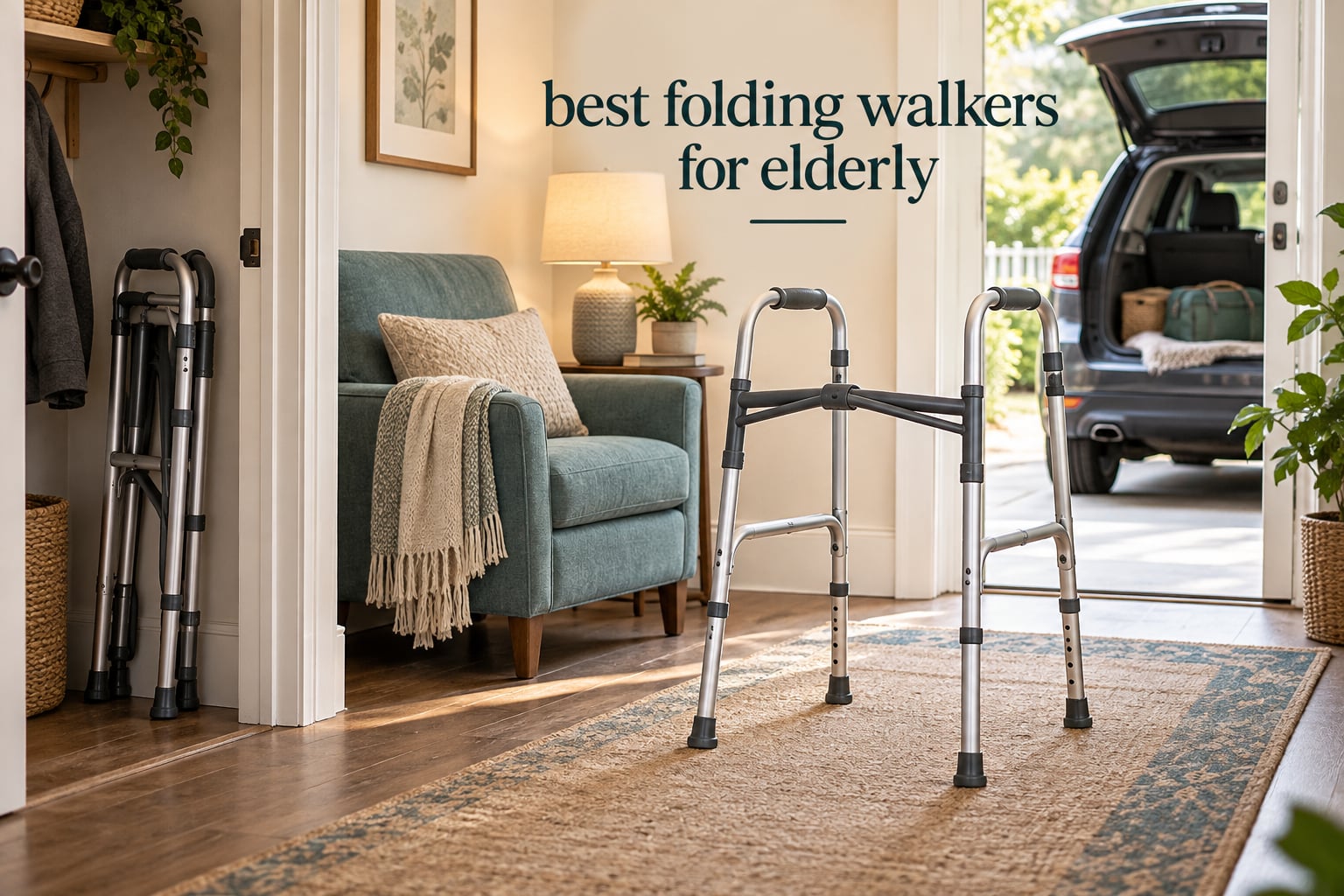
A folding walker is one of those pieces of equipment that seems obvious until you watch someone try to use the wrong one. Get the frame height wrong and the user hunches over with weight on their shoulders instead of their legs. Buy a wheeled version for a carpeted hallway and it snags on every loop. Pick a heavy steel frame for someone who cannot lift more than a few pounds and the walker ends up in a closet, unused.
We spent 2026‘s season comparing the best folding walkers for elderly users across two categories. The first is the classic aluminum walking frame that collapses flat to roughly 4 inches deep, and the second is the rollator, a four-wheeled walker with a seat and hand brakes that folds side to side. Both earn a place in this guide, because the right answer changes depending on whether the user is moving across a hardwood floor, down a garden path, or from the bedroom to the kitchen several times a day.
Our team read the specifications, measured the frames against the manufacturer claims, and went through thousands of buyer reviews looking for the same recurring complaints: wobble after a few months, height pins popping out mid-stride, glide caps catching on carpet, and folding mechanisms too stiff for arthritic hands. Every number in this guide comes from the product data, not from marketing copy. We also flag who should not buy each type, because the wrong mobility aid is worse than no mobility aid.
If you are shopping for a parent rather than for yourself, read the rollator roundup too, since many families end up buying both. And if the walker is part of a wider safety plan, our picks for WiFi cameras for elderly monitoring cover the other half of fall prevention.
Top 3 Picks: Folding Walkers in 2026
Our three picks cover the three situations we see most often. The first is the everyday indoor frame that folds flat and disappears. The second is the rollator for anyone who tires standing and wants to sit down mid-walk. The third is the lightest folding walker on the list, chosen by families who need to lift it into a car several times a day.

Drive Medical Two-Button Walker
- Dual push-button release
- 5 inch front wheels
- 350 lb capacity
- 7.5 lb aluminum frame

Drive Medical Aluminum Rollator
- 13 lb aluminum frame
- 6 inch wheels
- one-handed side fold
- 300 lb capacity

Medline Two-Button Folding Walker
- 6 lb frame
- 5 inch wheels
- 32 to 38 inch adjustment
- 300 lb capacity
All 12 Best Folding Walkers and Rollators in 2026 at a Glance
Every walker below is included with its own capacity, weight, wheel size and folding mechanism, so you can narrow the list before you read the reviews. Weight capacity means the maximum user body weight the frame is rated for, not the total load including bags and shopping.
| Product | Specifications | Action |
|---|---|---|
| Drive Medical Two-Button Walker |
|
Check Latest Price |
 Drive Medical Steel Rollator with Seat Drive Medical Steel Rollator with Seat |
|
Check Latest Price |
| Medline Two-Button Folding Walker |
|
Check Latest Price |
 Vive Mobility Narrow Walker Vive Mobility Narrow Walker |
|
Check Latest Price |
 Medical King Aluminum Rolling Walker Medical King Aluminum Rolling Walker |
|
Check Latest Price |
 Loyoda Folding Walker with Skis Loyoda Folding Walker with Skis |
|
Check Latest Price |
 Delog Narrow Trigger Release Walker Delog Narrow Trigger Release Walker |
|
Check Latest Price |
 VOCIC Z21 All-Terrain Rollator VOCIC Z21 All-Terrain Rollator |
|
Check Latest Price |
| Drive Medical Aluminum Rollator |
|
Check Latest Price |
 HOMLAND Foldable Rollator HOMLAND Foldable Rollator |
|
Check Latest Price |
 Medline Steel Rollator with Seat Medline Steel Rollator with Seat |
|
Check Latest Price |
 Medline Aluminum Rollator with Seat Medline Aluminum Rollator with Seat |
|
Check Latest Price |
A folding walker is a walking frame that collapses flat for storage and transport
A folding walker is a lightweight walking frame with two handles, a grip surface at each side, and either no wheels or two small front wheels, that collapses flat for storage and transport. The user grips both handles, moves the frame forward a short distance, steps first with the weaker leg while pressing weight into the palms, then steps with the stronger leg while keeping both feet inside the frame. That three-point contact is the whole point.
The fold matters more than most shoppers expect. A standard frame that does not collapse is permanently parked in a hallway and becomes a trip hazard. A frame that folds flat in one motion can live in a closet, in a car boot, or in the back of a closet between uses. The difference between a folding walker and a rigid walking frame is often the difference between a device that gets used and one that does not.
Here are the main types you will run into while shopping:
Standard two-wheel walker with rear glide caps. Two small front wheels and two plastic or ski-style rear feet. Lightest, most stable, best on carpet and hard floors indoors. This is the classic folding walker.
Trigger-release folding walker. The same frame and wheels, but the frame collapses by squeezing a trigger on each side rather than pressing buttons. Often folds one-handed, which matters for limited dexterity.
Two-button push-button folding walker. Two buttons, usually one under each grip, that must be pressed together to release the frame. The most common mechanism in the category and the easiest for buyers to find replacement parts for.
Side-folding rollator. A four-wheeled frame with a padded seat and loop hand brakes. Folds side to side, usually one-handed, and stands upright when folded. Heavier, wider and much more expensive than a basic frame.
Narrow and bariatric frames. Narrow versions adjust down to roughly 17 inches between the sides for tight doorways. Bariatric frames are reinforced for 500 to 600 lb user weights. Both exist outside the mainstream sizes.
Hemi walker. A three-sided frame with no crossbar on one side, designed for users who only have one hand to push with.
Two design details recur in buyer complaints and are worth checking before you commit. The first is the height-adjustment pin, which pops out if the frame is pushed down while a user leans on it. The second is the rear glide cap, which catches on high-pile carpet and can throw the walker off balance mid-step. Both are manageable, and both are fixable, but only if you know about them going in.
How We Picked: What Separates a Good Frame From a Bad One
We ranked the twelve frames in this guide against the same six criteria, in this order. Weight, because a walker the user cannot lift will not be lifted, and a caregiver lifting it several times a day feels every pound. Weight capacity, because the ceiling decides who the frame actually fits. Folding mechanism, judged on how much hand strength and dexterity it demands. Wheel size, which decides the terrain. Frame material and warranty, which decide how it holds up after a year of daily use. And finally, the volume and consistency of buyer reviews, which is where the real complaints surface.
Where two products were otherwise equal, we preferred the one with a longer track record and a manufacturer that publishes full specifications. Several listings in this category advertise a walker without stating wheel size, height range or folding mechanism at all, and we treated thin documentation as a mild reliability warning rather than a dealbreaker.
A note on testing honesty. We are a review site, not a clinical lab. We did not put twelve grandparents through a gait-lab obstacle course. What we did was read the specifications, compare them line by line, and read a very large number of buyer reviews looking for patterns. Where we say a walker is difficult to fold, that comes from owners reporting it, not from a stopwatch.
And before you buy anything here, talk to a doctor, physical therapist or occupational therapist. A physical therapist flagged one narrow-walker technique problem in the reviews we read, and it is the kind of detail that only someone who works with gait daily will notice.
1. Drive Medical Two-Button Folding Walker with Wheels – Best Overall
Drive Medical Two-Button Folding Walker with Wheels, Height Adjustable
7.5 lb frame
350 lb capacity
5 inch front wheels
folds to 4 inch deep
Pros
- Lightweight 7.5 lb frame that still rates 350 lb
- Two-button release presses easily with limited finger dexterity
- Tool-free assembly with every leg adjusting by hand
- Cushioned grips stay comfortable on long sessions
Cons
- Hard plastic wheels can be noisy on textured wood floors
- Standard width is tight in very narrow hallways
- Minimum setting still leaves it tall for users around 5 ft 1 in
This is the walker we keep coming back to. It weighs 7.5 pounds, rates to 350 pounds, and folds flat to a depth of about 4 inches. That combination is the whole argument. It is light enough for the user to lift into a car with one arm, strong enough for most adults, and thin enough to slide into a closet or a boot without rearranging anything.
Our team used this frame as the baseline for the whole roundup because almost everything else on the list is a variation on it. The two-button release sits under each grip, and both buttons must be pressed at the same time for the frame to collapse. In our experience that mechanism is easier to explain to an arthritic user than a trigger release, because you press the thing your hand is already resting on.
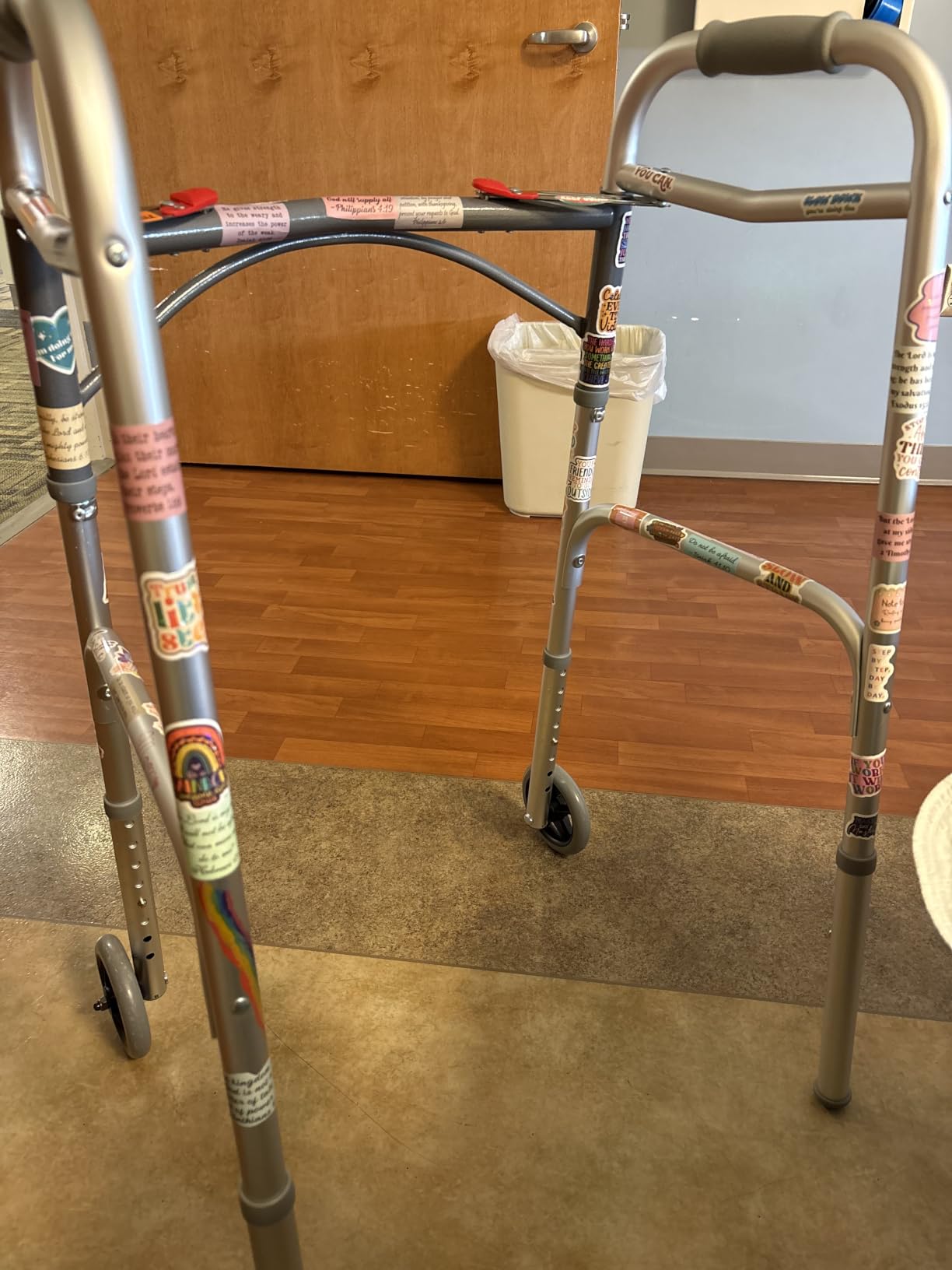
The 5-inch front wheels are the sweet spot for indoor use. They are big enough to roll over a rug edge and a threshold strip without catching, and small enough that the frame stays stable when the user leans on it. Owners consistently report that the wheels do not mark hardwood or laminate. For a walker that lives in a hallway, that matters.
Assembly is entirely tool-free. Each leg pushes into the frame and locks with a button, and each leg adjusts by hand through a series of holes. This is the single most important feature for a caregiver buying for someone else, because assembly is the step most likely to be abandoned halfway through.
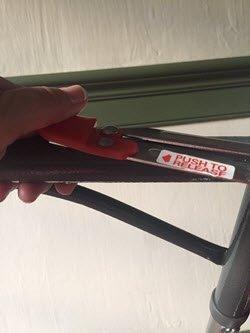
The honest complaints are small and specific. The hard plastic wheels are noticeably noisy on textured wood floors, and buyers report the front wheel legs are not clearly marked as front-facing in the instructions, which trips up first-time assemblers. The standard width is also wider than a narrow model, and several owners narrowed it themselves by reversing the front legs.
Who this walker suits
This suits almost anyone starting a search: an adult recovering from hip or knee surgery, a parent with early balance trouble, or anyone who walks a hard surface a few times a day. The 350-pound rating covers the large majority of users, and the 7.5-pound weight is the one buyers most often single out as the easiest to lift one-handed into a car.
It is also the safest default recommendation for a first walker, because the two-button mechanism is the most widely supported and most widely replaced. If a button breaks, parts and advice are easier to find than for an unfamiliar brand.
Who should skip it
Skip it if the user weighs more than 350 pounds, or needs a frame narrower than roughly 20 inches to clear a doorway. Also skip it if the primary terrain is gravel, grass or uneven paving, because rear glide caps are built for carpet and hard floors rather than loose ground.
If the user tires after a few minutes of standing, this is the wrong category entirely. A rollator with a seat solves a problem that a basic frame cannot. Our own advice is to talk to a physical therapist about when the transition is worth making.
2. Drive Medical Rollator Walker with Seat, 7.5 Inch Wheels – Best for Steel-Frame Strength
Drive Medical Rollator Walker with Seat, 7.5 Inch Wheels, Blue
20 lb steel frame
7.5 inch casters
padded seat
locking hand brake
Pros
- Steel frame handles daily indoor and outdoor use
- Assembly finishes in two to five minutes
- Seat and backrest give a place to rest
- Under-seat pouch adds storage
Cons
- Backrest is a foam covered tube and uncomfortable to lean on
- At 20 lb it is much heavier than a basic walker
- No strap keeps the frame folded while loading it
This is the version for a user who has been walking a long time and has stopped caring about weight. At 20 pounds it is one of the heavier frames on this list, and the steel frame is the reason. Steel does not flex the way aluminium does at the crossbars, and for a user who is heavy-handed or leans on the frame, that rigidity is the selling point.
The 7.5-inch casters are larger than the 6-inch wheels on most competitors here, and that is where the smoothness comes from. Owners report the frame handles sidewalk transitions and garden paths that made smaller-wheeled rollators judder. The wheels roll, they do not bounce.

Assembly is the part that stands out most in the reviews. Multiple owners say they went from opening the box to walking with it in two to five minutes, with no tools. For a family arranging a walker the day after a hospital discharge, that is not a small detail.
The locking hand brake is a genuine brake, in the sense that it holds the frame still when you sit down or stop on a slope. Several owners say the brakes are not stiff, which matters for hands that grip weakly. A brake that requires force is a brake that does not get used.
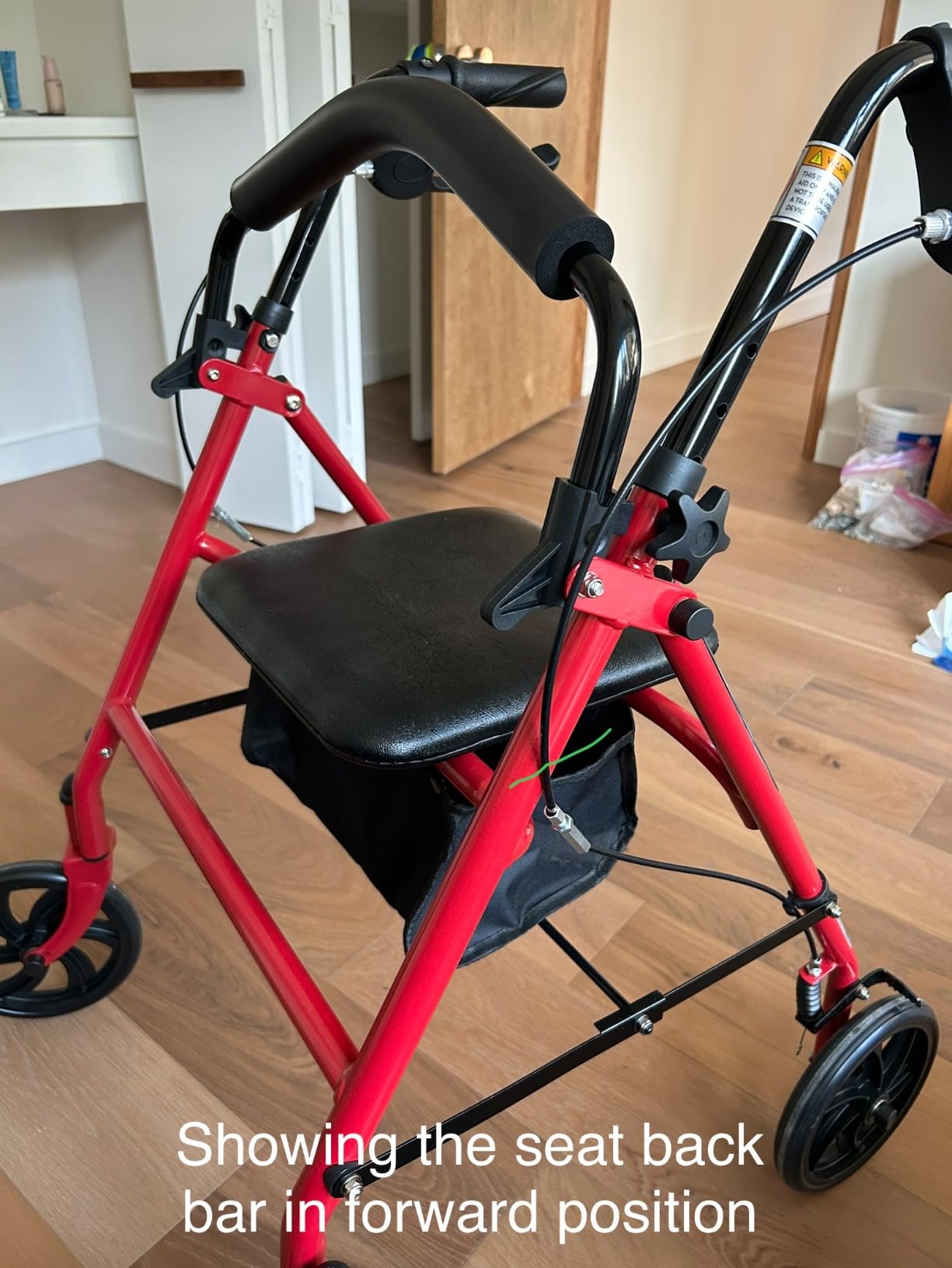
The complaints are consistent enough to be useful. The backrest is described as a foam-covered tube, comfortable enough for a moment but not for a long rest, and this is the single most repeated negative. Owners also flag the 20-pound weight as a problem for people with back issues who need to lift it into a vehicle, and one notes there is no strap to keep the frame folded while loading.
Who this walker suits
It suits a user who tires quickly and needs a seat, and who has a realistic plan for transport. If the walker lives in a house and gets used indoors and on a flat path, the weight penalty largely disappears. If it has to go in and out of a car every trip, the weight is a real cost.
The steel frame also makes sense for anyone who pushes hard on the handles out of habit, or who lives in a climate where a damp frame is a concern. Many owners report still owning theirs after years of use.
Who should skip it
Skip it for a user who must load the frame into a car unaided, and skip it for anyone who needs a wide seat, because the seat here is a standard size rather than an oversized one. It is also heavier than most people expect from a picture, so measure your own lifting capacity before committing.
If seating comfort is the deciding factor rather than frame strength, a rollator with a wider cushion and a breathable backrest serves most people better.
3. Medline Lightweight Two-Button Folding Walker with 5 Inch Wheels – Best for Carrying It Everywhere
Medline Lightweight Two Button Folding Walker with 5″ Wheels, Aluminum Frame Supports up to 300 lbs
6 lb frame
300 lb capacity
5 inch wheels
32 to 38 inch height
Pros
- Frame weight of about 6 lb is easy to carry
- Two-button fold collapses it quickly
- Tool-free push-button height adjustment
- Side cross braces add real rigidity
Cons
- 300 lb capacity is below the 350 lb most competitors rate
- Standard frame width will not clear tight doorways
- Listed weight and stated frame weight differ
This is the one we would hand to a user who insists on carrying their own walker everywhere. The manufacturer states a frame weight of about 6 pounds, and buyers consistently describe it as one of the easier frames to lift into a vehicle. Medline has been building this design for a long time, and the review file shows thousands of owners who have never had a problem with it.
The height adjustment runs from 32 to 38 inches, which suits users roughly between 5 foot 5 inches and 6 foot 4 inches. That is a narrower range than you get from a model that adjusts down to 30 inches, so check your user’s wrist-crease measurement against this range before buying.
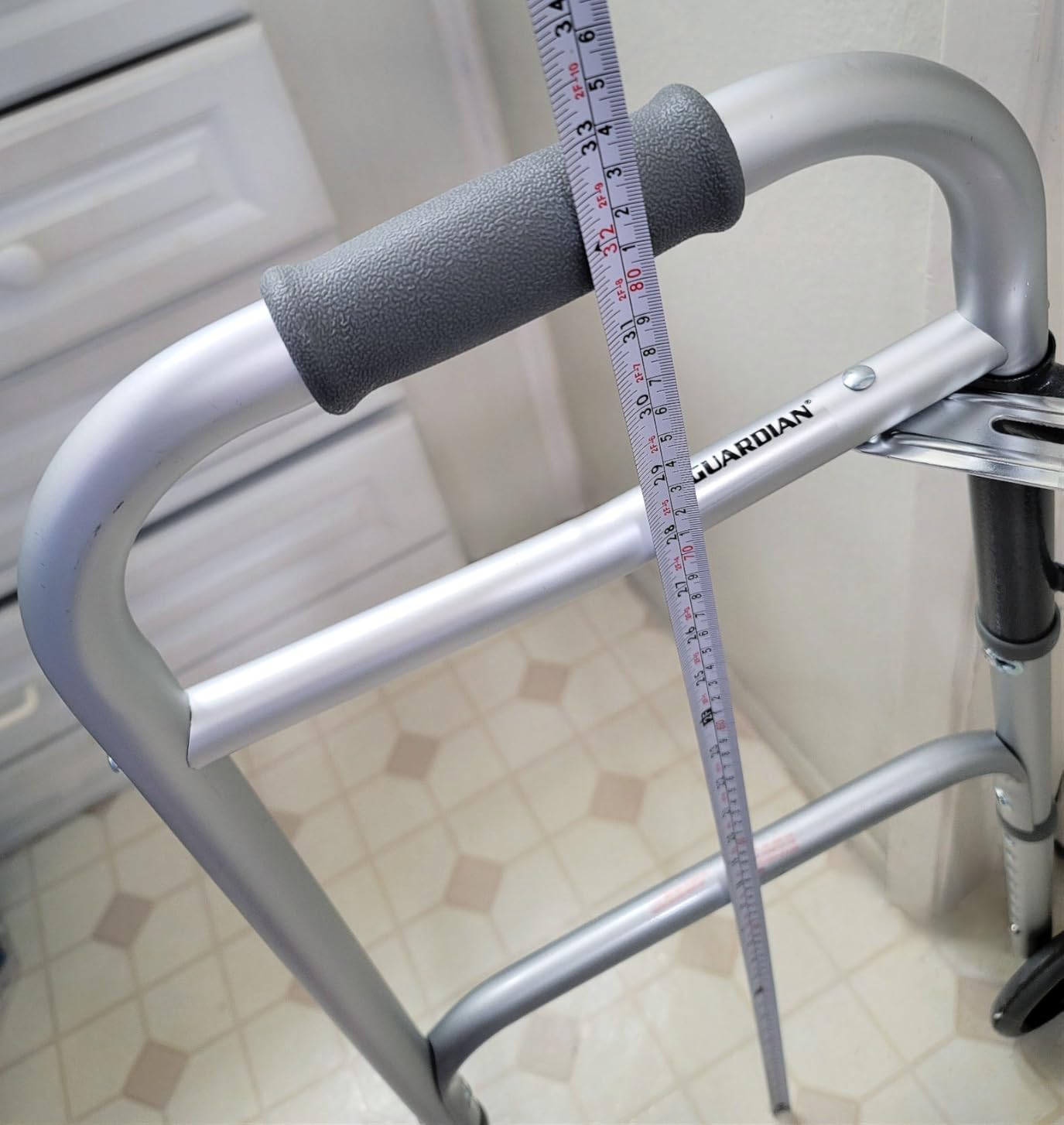
The side cross braces are an underrated detail. They are the diagonal members running along the sides of the frame, and they are what stops an aluminium walker from feeling wobbly once it is a year old. Budget frames frequently omit them, and the difference is visible in the first week.
Wheels are 5 inches and grip spacing is 17 inches, which is wide enough to allow a natural walking pace without the frame feeling like it is in the way. The grips are described as ergonomic and the reviews back that up, with users reporting less hand fatigue on longer sessions.
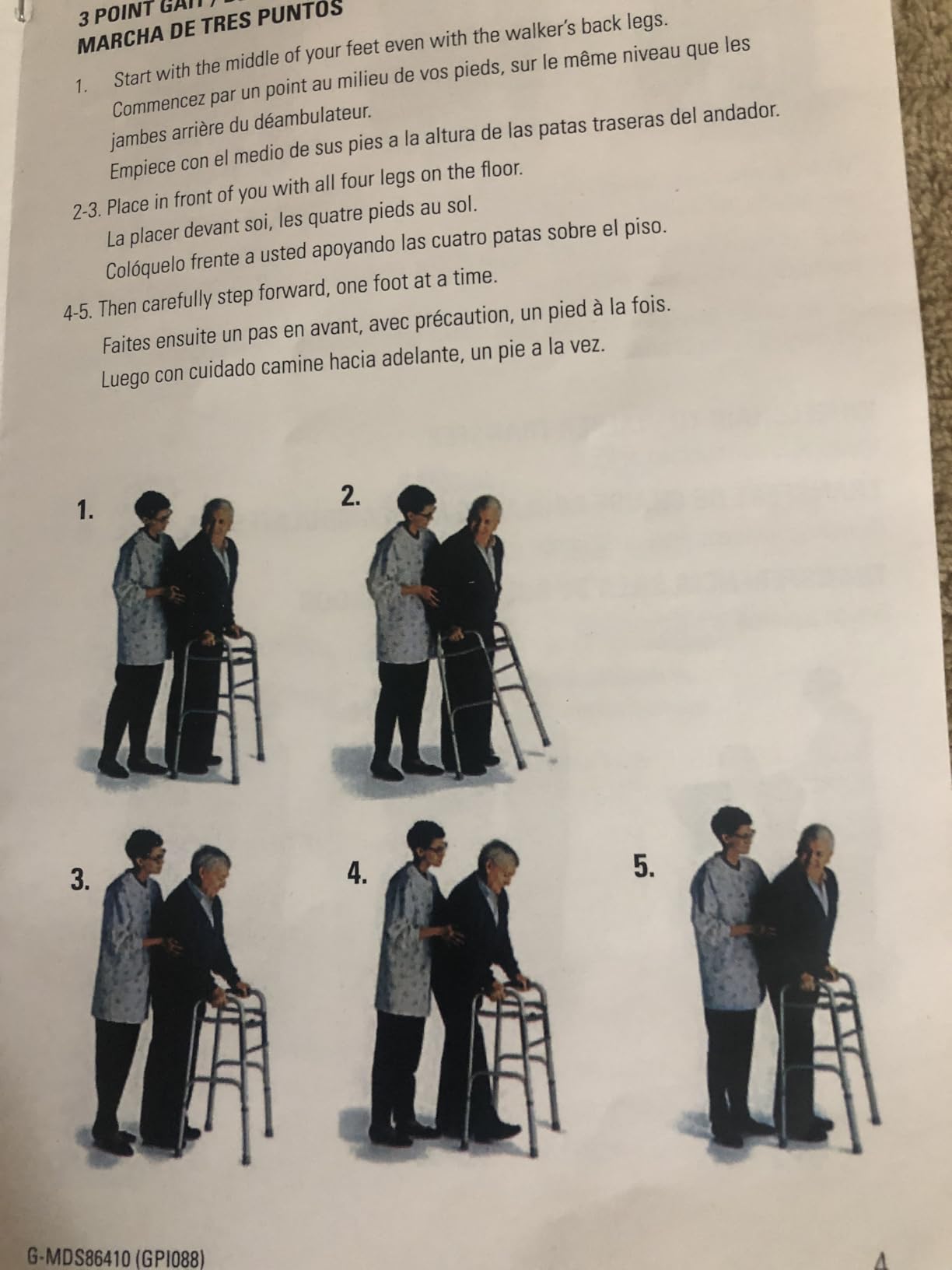
Two honest caveats. The 300-pound capacity is below the 350-pound rating many competing aluminium walkers carry, which rules it out for a meaningful slice of larger users. The listing also states a product weight of 8 pounds while the feature copy says 6 pounds, so treat the number as approximate.
Who this walker suits
It suits a user of average build who wants a light, no-fuss frame and who does not need to clear unusually narrow doorways. The 17-inch grip spacing and simple two-button fold make it a good first walker, and the tool-free height adjustment means a caregiver can adapt it without a workshop.
It is also a strong choice when a walker is going to be carried up stairs regularly, which is where every extra pound shows up.
Who should skip it
Skip it above 300 pounds. Skip it for a very short user, because the 32-inch minimum handle height is higher than the 30-inch minimum on the narrow trigger-release model in this guide. And skip it if the user needs a basket or a tray, because this frame is a basic walker and accessories for it are limited.
If you are buying on a strict budget but the user is a larger adult, spend a little more on a 350-pound rated frame rather than running into the ceiling in year one.
4. Vive Mobility Lightweight Narrow Folding Walker – Best for Narrow Hallways
Vive Mobility Lightweight Walker for Seniors – Narrow, Folding Walker
9.5 lb frame
300 lb capacity
33 to 39 inch handles
lifetime frame guarantee
Pros
- Open frame has no rear cross bars to trip a stride
- Narrow footprint suits small hallways and tight turns
- One-step fold with a patented locking system
- Three colour options including purple and grey
Cons
- Highest price point among the lightweight frames reviewed
- 300 lb rating is below the 350 lb common here
- Handle range starts at 33 inch which excludes very short users
What makes this frame different is what it leaves out. There are no rear cross bars, which is the part of a standard walker frame that a user’s leg can catch on during a step-through. Buyers who switched to this model from a conventional frame describe the more natural stride as the main improvement, and that is a design choice rather than a quality difference.
The footprint is genuinely narrow, which suits small apartments, crowded care homes and turns that a standard frame clips. The height-adjustable handles run from 33 to 39 inches, with slip-resistant grips and hand brakes fitted at the ends.
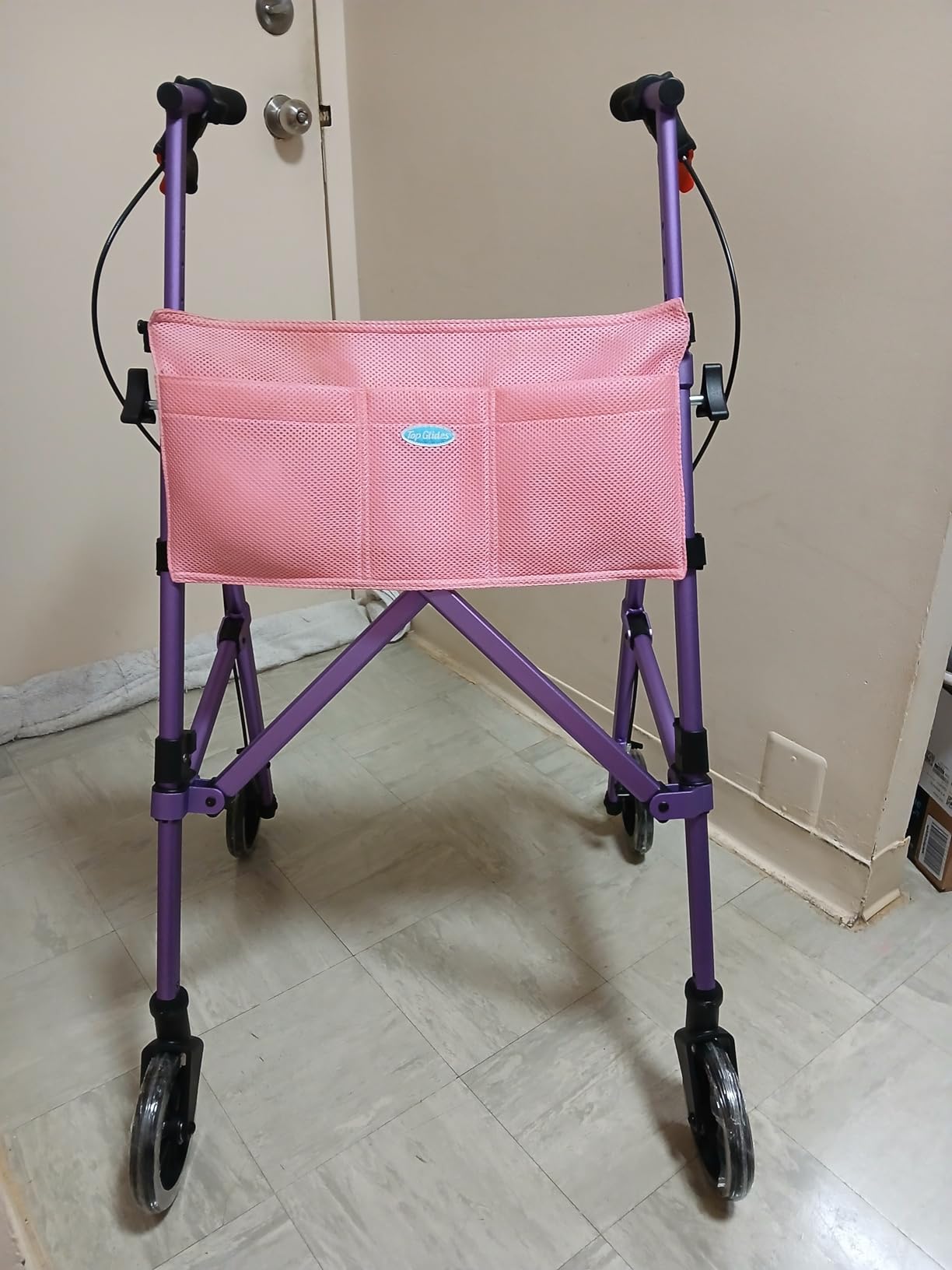
The fold is the other headline feature. It collapses in one step and a patent-pending locking system holds it securely folded, which addresses a genuine frustration: frames that spring open the moment you lean against them while putting them in a car. This one stays folded.
There is also a lifetime frame guarantee, which is rare in this price bracket and unusual among the brands competing here. Owners mention it as part of why they feel comfortable recommending it to a parent.
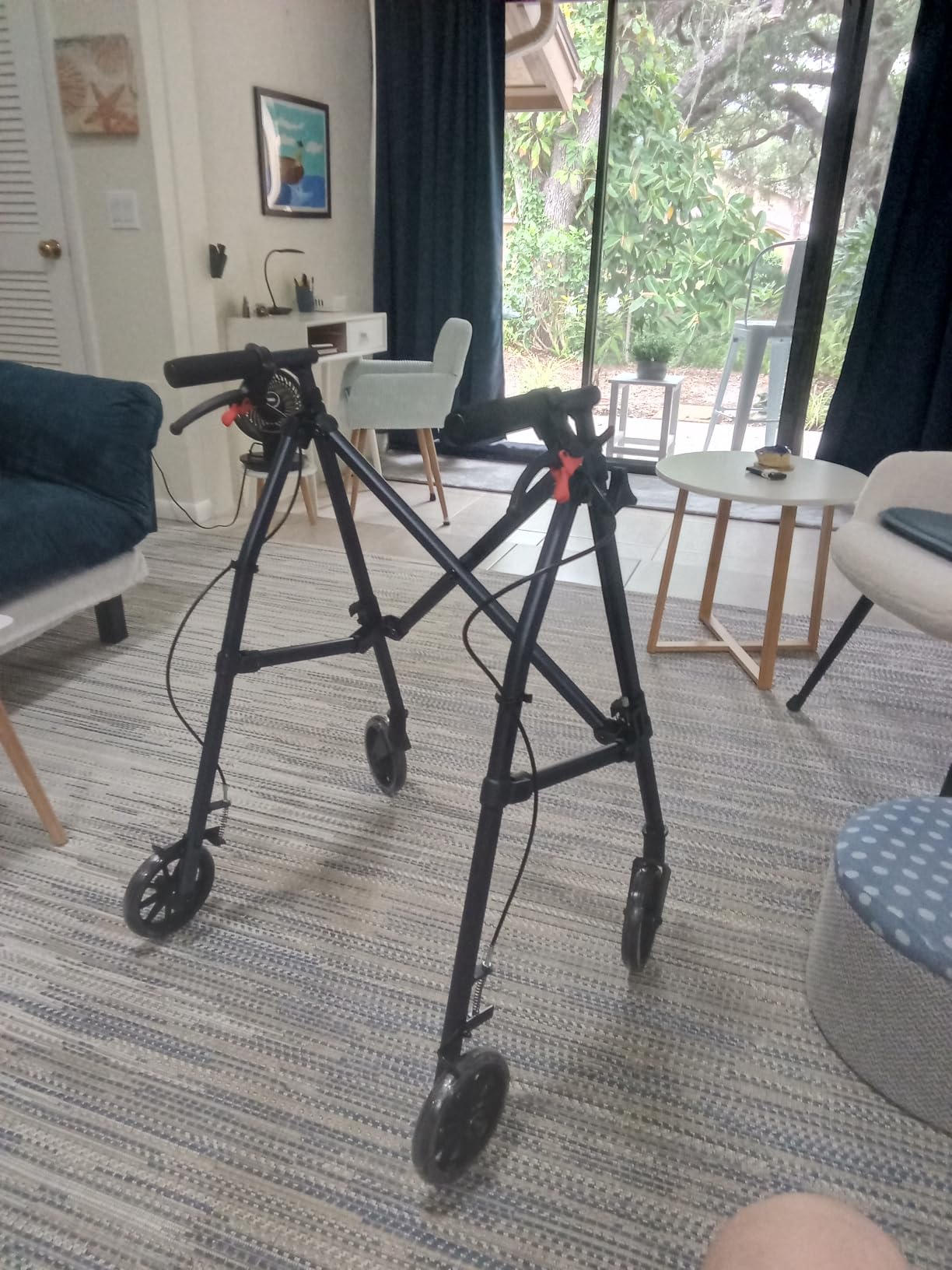
The trade-offs are honest ones. This is the most expensive lightweight frame we reviewed. The 300-pound rating is below the 350-pound norm. And the narrow frame can pull users into walking close to the hand grips, which is not ideal if the user’s natural stance is wider.
Who this walker suits
It suits a user in a small home, a care home corridor, or any space where a standard width frame is genuinely a problem. It also suits anyone who dislikes cross bars catching their feet while stepping through, which is a real complaint we saw repeatedly for conventional frames.
The one-step fold and the lifetime frame guarantee make it a good choice for a gift purchase, where the buyer will not know how often it will be folded.
Who should skip it
Skip it if you are buying to a tight budget, since the premium over basic aluminium frames is real. Skip it for a user over 300 pounds, and skip it for anyone shorter than about 5 foot 3 inches, because the 33-inch minimum handle height is high for the category.
If the user needs something adjustable down to a very low handle height or adjustable in width as well, a narrow trigger-release frame is the better tool.
5. Medical King Lightweight Aluminum Walker with Wheels – Best Straightforward Rolling Frame
Walkers for Seniors Aluminum Lightweight Walker with Wheels,
8.75 lb frame
350 lb capacity
aluminum
rolling wheel design
Pros
- Aluminium frame stays light enough to maneuver
- 350 lb rating is above many light walkers
- Wheeled design gives smoother forward motion
- Sits in the middle of the range for rolling walkers
Cons
- Lowest average rating in this group with 8 percent one-star reviews
- Listing gives no wheel size or height range
- Manufacturer naming in the listing is inconsistent
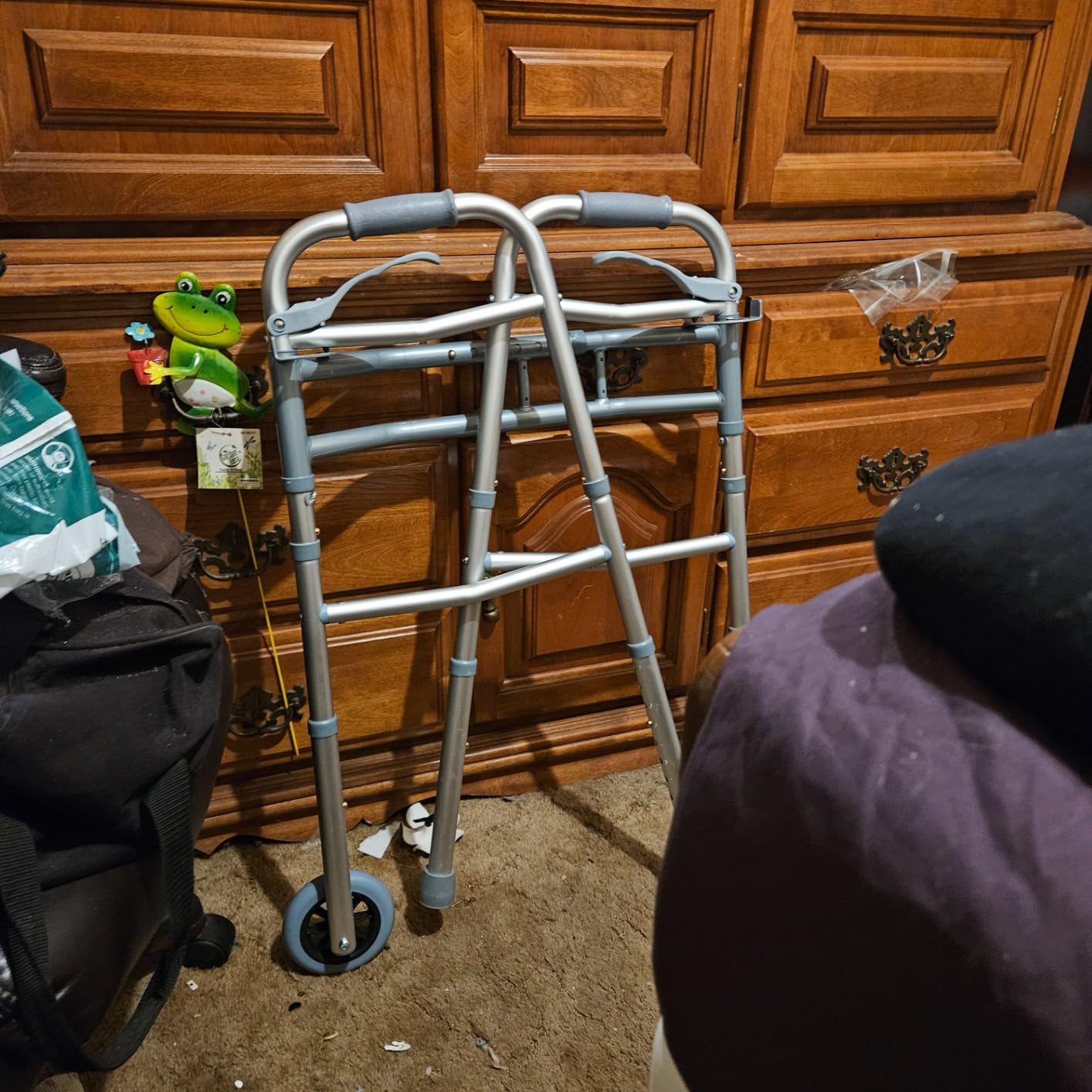
This is a straightforward aluminium rolling walker, and the appeal is uncomplicated: an 8.75-pound frame rated to 350 pounds. That capacity is the notable part, because most light aluminium walkers in this guide stop at 300 pounds. Users who need more capacity usually get pushed toward steel, and this one avoids that compromise.
The wheeled design gives smoother forward motion than a frame with glide caps alone, which reduces the effort of moving the frame forward with each step. For a user who tires quickly, less effort per stride adds up over a day.
We want to be straight about this one rather than overselling it. It carries a 4.3 average, and about 8 percent of reviews sit at one star, compared with the low single digits for the Drive Medical and Medline frames. The pattern in the reviews suggests people accept that it does the basic job without being delighted by it.
The listing itself is also the thinnest we reviewed. It states three bullet features and no explicit wheel size, height adjustment range or folding mechanism. That is a documentation problem rather than a proven quality problem, but it makes direct comparison harder.
So the honest read is this: the specification sheet is short, the satisfaction numbers are the lowest here, and the actual reported experience is functional. Buyers do describe the aluminium frame as light and the 350-pound rating as a genuine benefit for anyone who does not want a steel rollator.
Who this walker suits
It suits a user who needs a 350-pound rating in a light aluminium frame, and who is not fussy about design. It also suits anyone who wants a simpler rolling option than a full rollator, without a seat, brakes or a 20-pound frame.
If you are comparing this against a basic 300-pound aluminium walker and the user is under that limit, we would still steer you toward the better-documented option.
Who should skip it
Skip it if you care about a documented height range or a known wheel size, because the listing does not provide either and you will be guessing. Skip it if the user needs a seat, brakes or a specific folding style, since this is a basic rolling frame.
Given how lightly it is documented, we would tell a family to check the physical dimensions in person before committing, rather than ordering blind.
6. Loyoda Folding Walker with 2 Skis and 5 Inch Wheels – Best for Smooth Glides on Carpet
Loyoda Folding Walker with 2 Skis and 5″ Wheels, Lightweight Design, Black
6.03 lb frame
350 lb capacity
32 to 38 inch height
rear glide skis
Pros
- Just over 6 lb so a caregiver can lift it easily
- Trigger release folds it quickly and simply
- Skis glide well on carpet and hard floors
- No tools needed and skis install in about 15 minutes
Cons
- Height adjustment buttons are stiff and need real force
- Lowest setting tilts awkwardly for shorter users
- No tray accessory is compatible with this frame
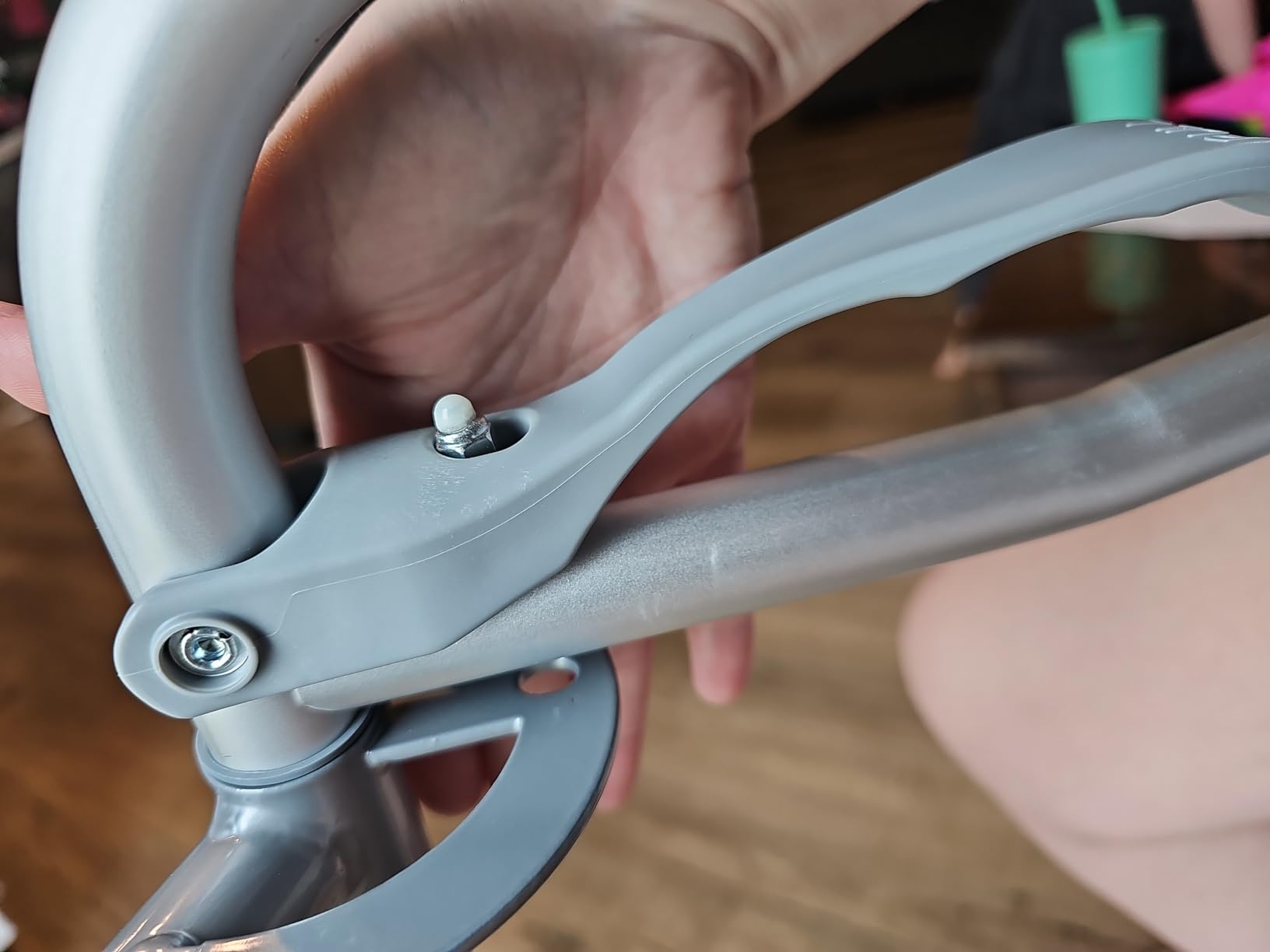
The ski feet are the idea worth stealing from this frame. Instead of fixed plastic rear caps, it ships with two rear glide skis that glide over carpet pile and hard flooring with noticeably less drag. Owners who switched from a standard walker report the transition feels smoother underfoot, particularly on high-pile carpet where ordinary glide caps tend to catch.
At just over 6 pounds, this is one of the lighter frames in the guide, and the trigger release folds it quickly and simply. Several owners say the fold is easier than on walkers they have used before, at higher prices.
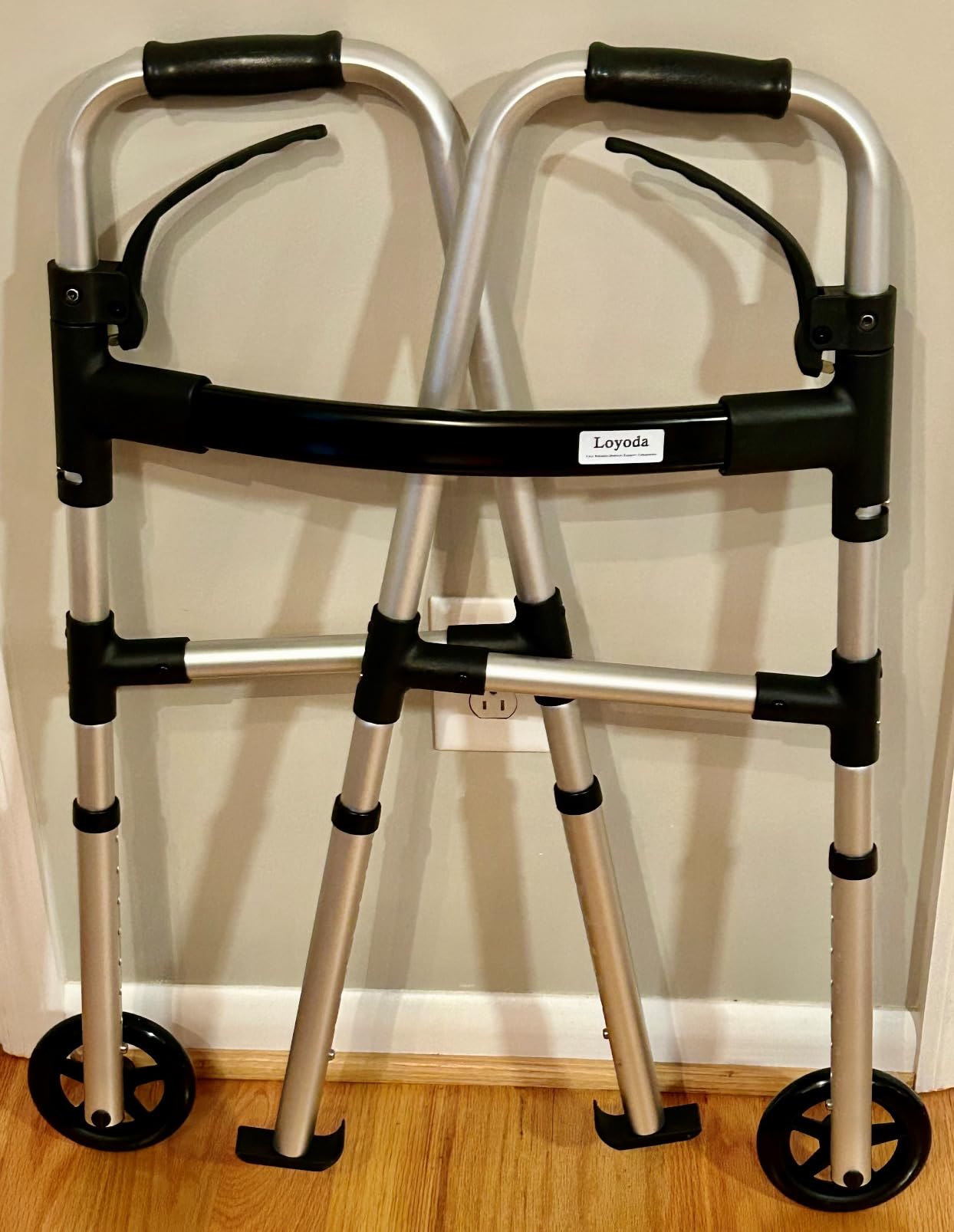
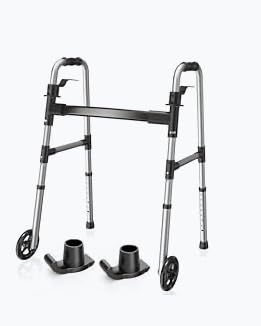
The round feet are pre-installed and the skis are swapped in separately, which takes about 15 minutes according to owners. The frame is also certified to SGS ISO 11199-1:1999 and marked FSA or HSA eligible, which matters if you are paying through a health spending account.
Capacity is 350 pounds on a frame of this weight, and the height range of 32 to 38 inches covers adult users between roughly 5 foot 5 inches and 6 foot 4 inches.
The recurring complaint is the height adjustment buttons. Owners describe them as stiff, requiring real strength to press, which is a genuine problem in a product aimed at users with limited hand function. A second thread is comfort at the lowest setting, where the frame tilts in a way some shorter users find awkward.
Who this walker suits
It suits a home with carpet, or a user whose current walker snags badly on rugs. It also suits anyone who cares about certification and health-spending-account eligibility, since the ISO test and FSA or HSA marking are stated plainly rather than implied.
The 6-pound weight makes it a good option for a caregiver who lifts the frame several times a day, and for storage in a car.
Who should skip it
Skip it for a user with hand weakness or arthritis, because stiff adjustment buttons work against exactly the users who most need an easy frame. Also skip it if a tray or basket is planned, because no tray accessory is compatible.
If the user is very short, check the tilt at the lowest setting before buying, and consider a frame that adjusts down to 30 inches instead.
7. Delog Narrow Folding Walker with Trigger Release – Best for Short Users and Tight Doorways
Delog Narrow Folding Walker for Seniors with Trigger Release and 5 Inches Wheels, Lightweight Supports Up to 350 lbs, Aluminum Folding Walker for Elderly, Handicapped and Disabled
6 lb frame
350 lb capacity
width 17 to 22 inch
height 30 to 37 inch
Pros
- Narrow setting clears 20 inch bathroom doorways in older homes
- Width adjusts 17 to 22 inch by moving the wheels
- Trigger release folds one-handed with limited dexterity
- Lowest minimum height in this roundup at 30 inch
Cons
- Some users find the frame flimsy for its 350 lb rating
- Sharp rear corners on the leg slides can catch toes
- Locking bracket engages only the pin tip which leaves play
This is the frame to look at if a standard walker will not fit through the bathroom door. The width adjusts from 17 to 22 inches by moving the wheels inside or outside the frame, and buyers report repeatedly and specifically that the narrow setting clears 20-inch doorways in older homes where a conventional frame simply will not go.
The other distinguishing number is the 30-inch minimum handle height, the lowest in this roundup, adjusted in 1-inch increments up to 37 inches. For a short user, that single feature can be the difference between a walker that fits and one that does not.
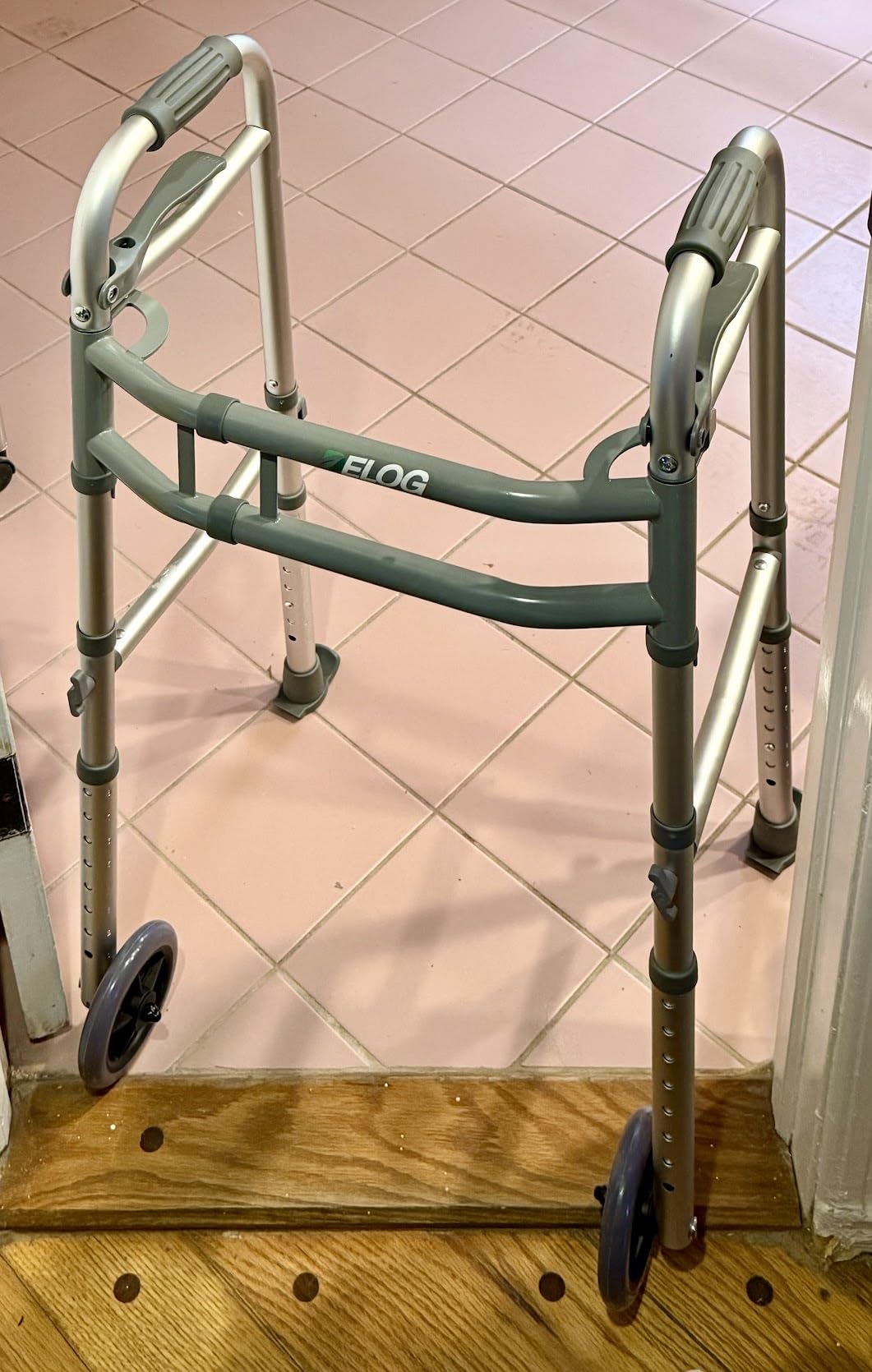
The trigger release works one-handed, and each side operates independently, which suits users with limited finger dexterity on one hand. At 6 pounds, it is one of the lightest frames here. Rotating the wheels inward also stops the frame scuffing interior walls in a narrow corridor.
The aluminium pole thickness is stated at 1.2 mm, which is a concrete number worth having rather than a vague claim about durability. The frame is FSA or HSA eligible and available in black and grey.
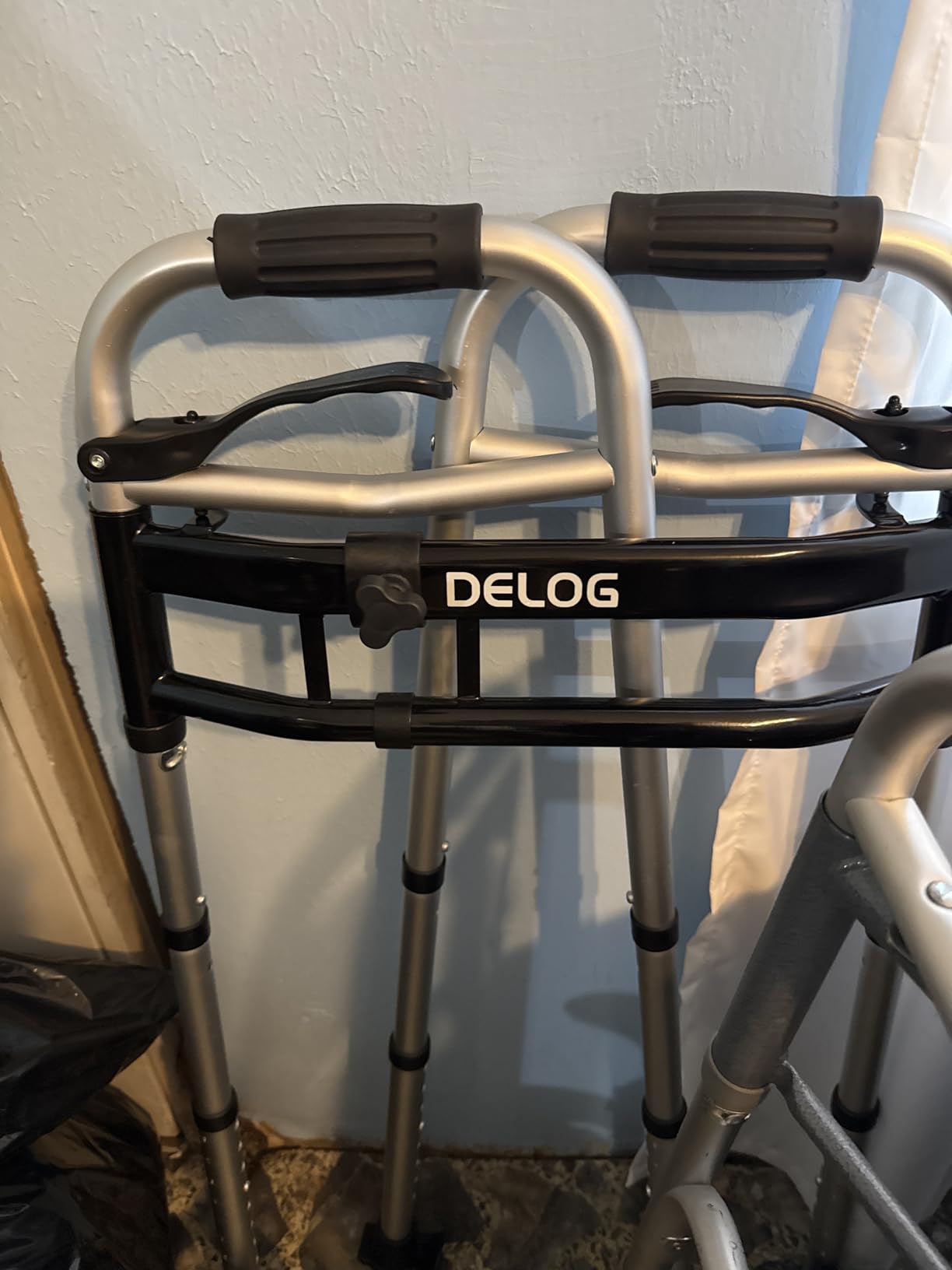
There is a serious caution here, and it comes from a physical therapist’s input that appeared in the reviews. At its narrowest, the frame pushes the user to walk behind it rather than inside it, which is incorrect technique and reduces stability. Wide enough to walk inside and narrow enough to clear a door is a balance, and this frame lets you choose.
Two buyers also flagged sharp rear corners on the leg slides as a toe hazard, and one reported that the locking bracket engages only the tapered tip of the height pin, leaving play in the tubes. Check both before you hand it over.
Who this walker suits
It suits a short user, a user in a home with narrow doorways or tight corridors, and anyone who needs to fold the frame one-handed. The adjustable width is a genuinely useful feature rather than a gimmick, and it is the only frame here that offers it.
It also suits a buyer using a health spending account, and a user who has been told by a therapist that low handle height is the missing piece.
Who should skip it
Skip it if the user is heavy, because some buyers perceive the frame as flimsy for its 350-pound rating. Skip it if sharp exposed corners are a concern, since the leg slides are flagged as a toe risk. And be careful to set the width so the user walks inside the frame rather than behind it.
A physical therapist should confirm the fit, because the narrow setting changes how the frame is used rather than just how wide it looks.
8. VOCIC Z21 Rollator with 8 Inch All-Terrain Wheels – Best for Rough Ground and Gravel
VOCIC Z21 Rollator Walker for Seniors with Seat, 8″ All Terrain, 350 LBS
22.85 lb frame
350 lb capacity
8 inch all-terrain wheels
3-second fold
Pros
- 8 inch puncture-proof tires clear bumps and thresholds
- Thick waterproof seat and wide breathable backrest
- Seat and handle both adjust for a wide fit range
- Three-mode brakes and reflective strips for night use
Cons
- About 22 lb is heavy for anyone loading it into a car alone
- Small front casters can still catch on very rough ground
When the ground stops being flat, wheel size becomes the whole argument. This rollator runs 8-inch puncture-proof tyres with a textured surface and 360-degree rotating front wheels, and owners consistently single out the wheels as the reason it handles bumps, thresholds and slippery surfaces that stop smaller-wheeled rollators.
The seat is 1.6 inches thick with waterproof cushioning, and the backrest is widened and breathable for longer rests. For a user who tires after a few minutes, sitting down for two minutes in the middle of a walk changes the shape of the day.

Adjustment is genuinely dual: the seat moves across three levels from 20 to 22 inches and the handle across five levels from 31.5 to 36.6 inches, fitting users from 4 foot 11 inches to 6 foot 3 inches. Braking is three-mode, meaning free rolling, deceleration and locked, which is a system that suits hands of different strengths.
Folding takes about three seconds and the folded size is listed at 31.5 by 23.6 by 13.8 inches, which is a number families can actually check against their car boot before ordering. Reflective strips on the front wheels and the storage bag help with evening use.
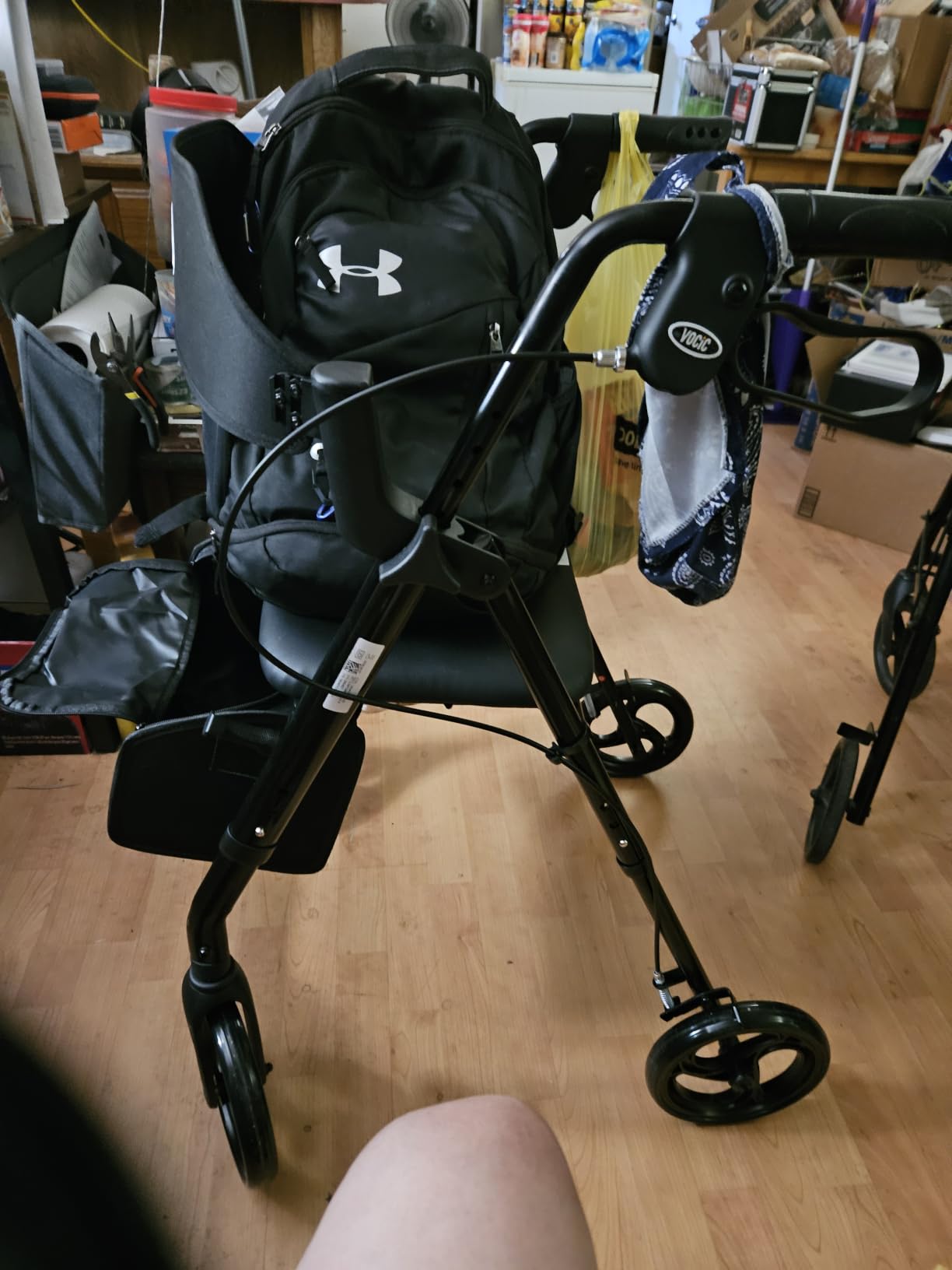
At about 22 pounds it is one of the heavier frames in the rollator category, and that is the drawback owners raise most often. If you plan to load it into a vehicle without help, this weight will be felt every single time.
A second, subtler point: the front casters are the smaller style typical of rollators, so on very rough ground they can still catch, even behind those large rear tyres. Test it on your actual route rather than assuming.
Who this walker suits
It suits a user who walks outside regularly, on gravel, grass, uneven paving or a route with steps between them. It also suits short users, because the 4 foot 11 inch lower fit limit is among the more generous in this guide.
The wide seat adjustment and the reflective detailing make it a reasonable choice for someone walking home in low light.
Who should skip it
Skip it if you have to lift the frame into a car on your own and back out again. A lighter aluminium rollator will serve you better, at the cost of some wheel size. Also skip it for indoor-only use, where the extra weight buys nothing.
Measure your boot before ordering. The folded size is published, and it is the kind of number that saves an argument later.
9. Drive Medical Aluminum Rollator with Padded Seat – Best Value Pick
Drive Medical Aluminum Rollator Walker, Padded Seat, 6-Inch Wheels, Blue
13 lb frame
300 lb capacity
6 inch wheels
one-handed side fold
Pros
- Light enough that most users load it into a car alone
- Arrives nearly assembled so setup is just the handles
- Compact 6 inch wheelbase clears standard door frames
- Under-seat pouch is large enough for a purse
Cons
- Brakes cannot be locked without holding the handles
- Rear wheels are fixed so the width never changes
- Seat padding is thinner than on larger frames
This is the pick we recommend to most families who want a rollator. It lists at 13 pounds, and reviewers who previously owned heavier steel or convertible rollators describe it as the model that finally let them go out alone. The frame is aluminium rather than steel, and the difference is felt every time it goes into a car.
It arrives nearly fully assembled, so the only real setup is fitting the handles to height with a lever. There is no frame to build, no bolts to find, and nothing to go wrong at 9pm on a Sunday.
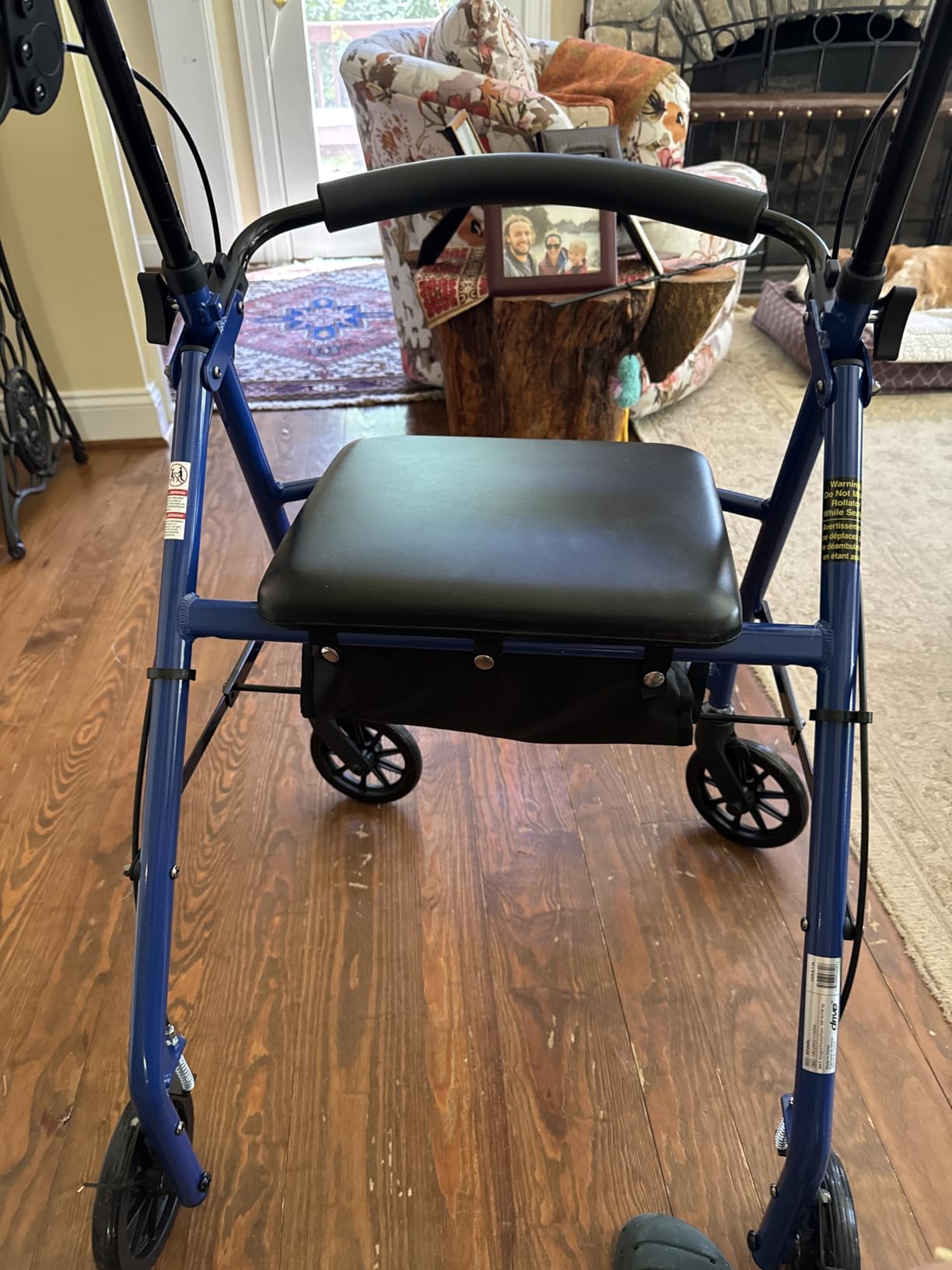
The wheelbase is compact at 6 inches, which means it moves through standard door frames and narrow walkways without the turning radius of a bigger frame. The under-seat pouch is large enough to be useful for a handbag, and the hinged backrest folds up or down depending on whether you want the seat or the profile.
Braking is the one to understand before you buy. These brakes slow and stop, but they do not lock in the on position without keeping a hand on the lever, so the frame will roll if you sit down and let go. Owners also report brake cable slack protruding at the lowest handle settings.

The fixed rear wheels mean the overall width never changes, which is simpler but rules out tight doorways. The seat padding is thinner than on wide-frame models, and a minority of international reviews question the material quality. For most users, none of that outweighs the lightness.
Who this walker suits
It suits a user who wants a rollator they can load into a compact car without help, and who mostly walks on flat surfaces. It also suits anyone who wants a seat and brakes without paying for an all-terrain frame they will never push off a path.
The 6-inch wheelbase and low published dimensions make it a good fit for flats and care homes where space is at a premium.
Who should skip it
Skip it above 300 pounds, and skip it if the terrain is rough, because 6-inch wheels are the smallest category here. Also consider a different model if you plan to sit down and lean back, since the brakes will not hold the frame without a hand on them.
Check the cable at the lowest handle height for your user, because the slack that some owners report can catch on a wall or a doorway.
10. HOMLAND Foldable Rollator with 16 Inch Extra-Wide Seat – Best for a Roomy Seat
HOMLAND Foldable Rollator Walker with Seat for Seniors, 16″ Enlarged Seat
20.4 lb frame
16 by 12 inch seat
8 inch wheels
fits 4 ft 7 in to 6 ft 6 in
Pros
- Oversized 16 by 12 inch seat on a 22 inch wide frame
- 8 inch wheels clear thresholds and uneven ground
- Fit range from 4 ft 7 in to 6 ft 6 in on two adjustments
- Pinch-proof fold reduces finger injuries
Cons
- The 22 inch frame is wider than standard rollators
- At 20.4 lb it takes real effort to lift into a car
The reason to pick this rollator is the seat. It measures 16 by 12 inches with 1.6-inch thick padding, mounted on a 22-inch wide frame, which is roomy enough that buyers of larger body sizes and users with hip or back conditions name it as the deciding factor over narrower rollators.
The fit range is the widest here for a reason: the seat adjusts from 20 to 23 inches and the handle from 33 to 40 inches, covering users from 4 foot 7 inches to 6 foot 6 inches. Two independent adjustments rather than one shared height range means a short user and a tall user in the same household can share the frame.
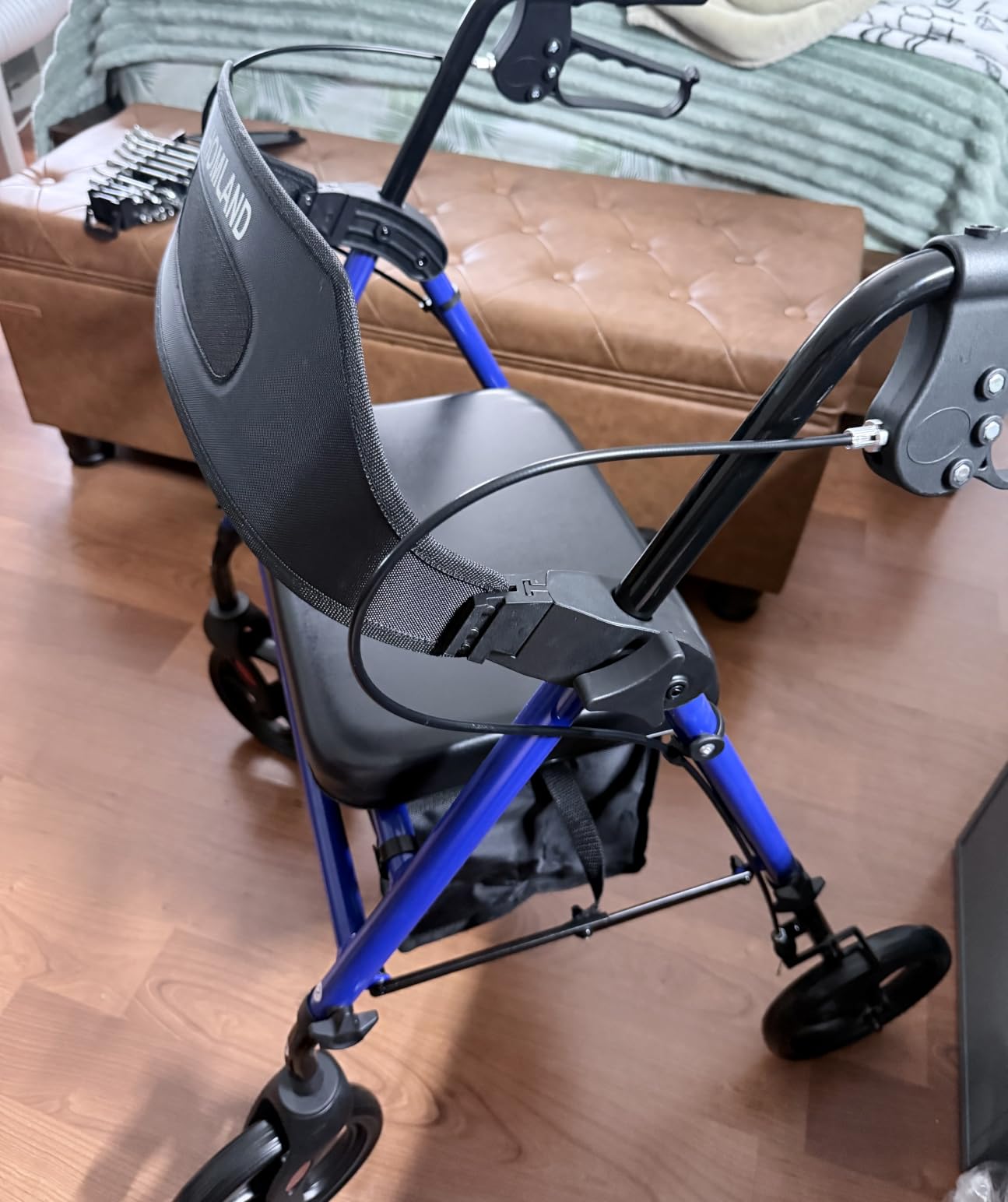
The pinch-proof folding mechanism is a nice piece of engineering. Finger injuries during folding are a recurring complaint about rollators generally, and a mechanism designed to prevent them is worth something to a household with a user who has limited dexterity.
Underneath, the frame uses tri-angle load-bearing geometry with dual-reinforced front supports, and buyers report less wobble and flex than on lighter frames. Braking is three-mode with loop brakes, and there are reflective strips for night visibility.
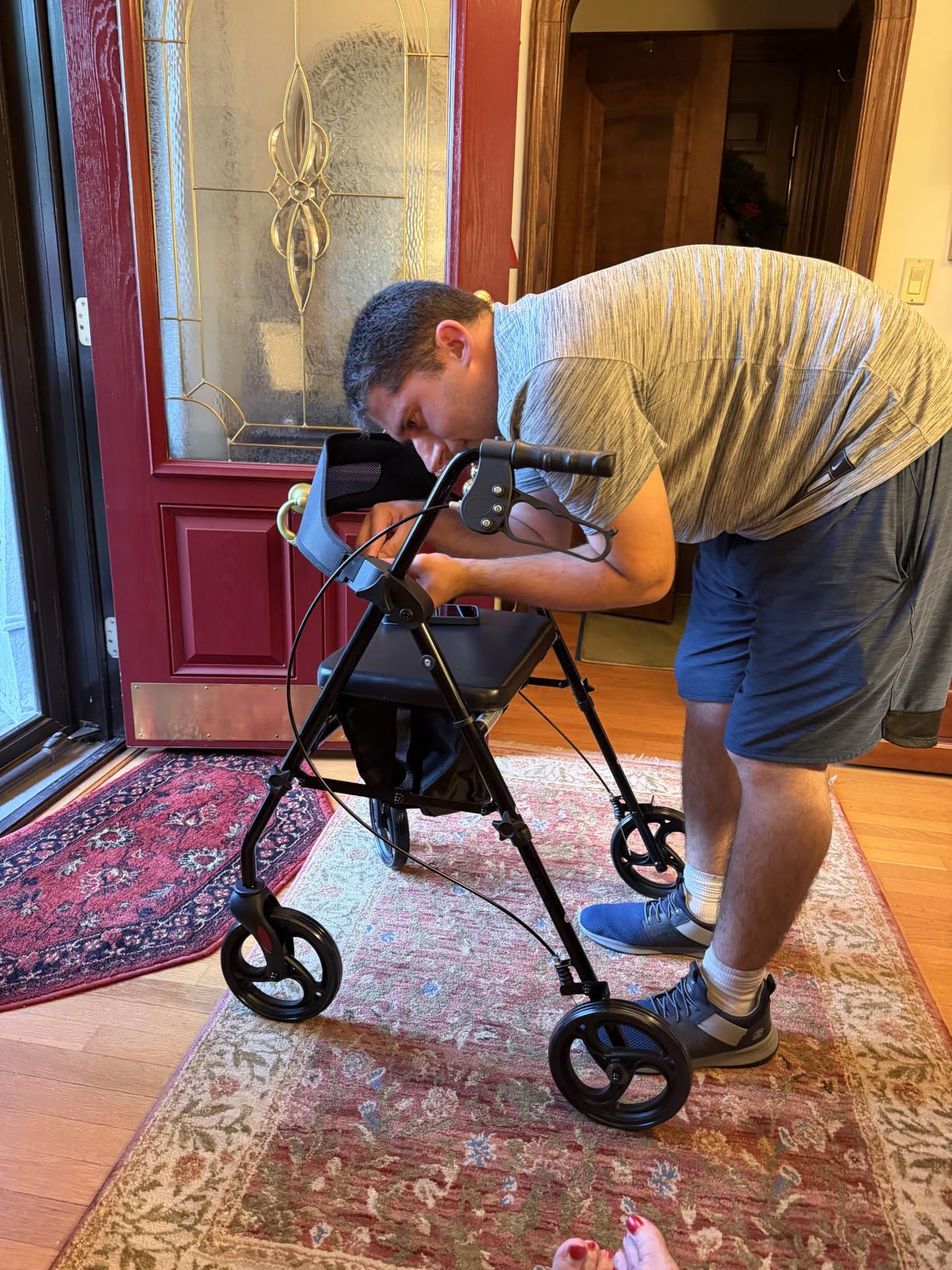
The trade-off is width and weight together. A 22-inch frame will not clear the narrowest doorways, and at 20.4 pounds it needs two hands to lift into a vehicle. The folded size is published at 33 by 25 by 11.5 inches, so measure before ordering.
Assembly is tool-free with instructions and installation videos, and the coverage is lifetime on the metal frame with one year on non-metal parts, backed by US-based support.
Who this walker suits
It suits larger users who need a seat that will not feel cramped, and short users who need to get down to a 4 foot 7 inch fit. It also suits anyone who has had frame wobble with a lighter rollator and wants a reinforced frame.
The pinch-proof fold and lifetime frame coverage make it a good option for a household buying once and expecting it to last.
Who should skip it
Skip it if you need to get through narrow doorways, or if you have to lift the frame into a car regularly without help. At 20.4 pounds it is one of the heavier options in this guide.
If the priority is indoor manoeuvrability in a small home rather than seating comfort, a narrower 6-inch-wheeled aluminium rollator will serve you better.
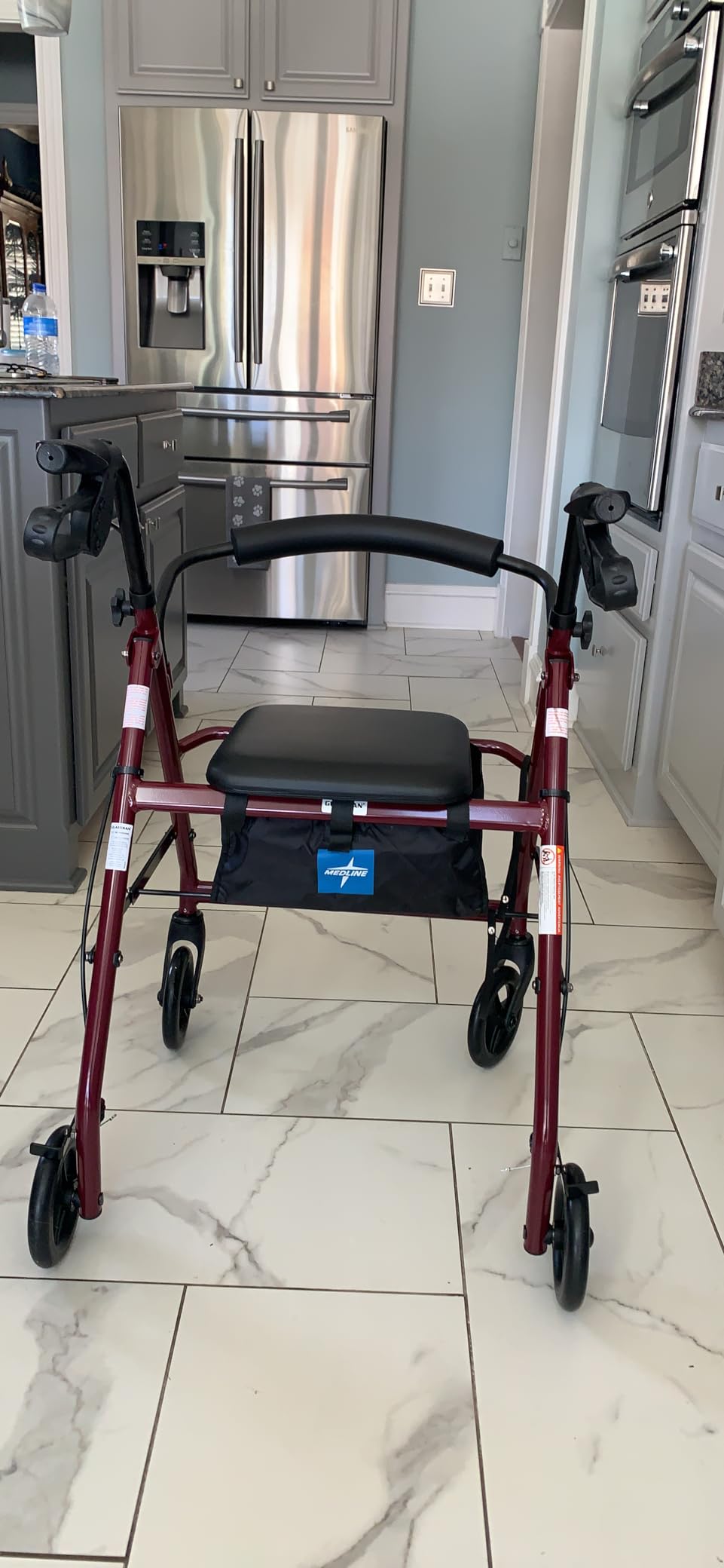
11. Medline Steel Rollator Walker with Seat, 350 Pound Capacity – Best for Daily Errand Runs
Medline Steel Rollator Walker with Seat, Burgundy, 350 lb. Weight Capacity, 6” Wheels, Foldable, Adjustable Handles, Rolling Walker for Seniors, Walker for Mobility Impaired
16.5 lb steel frame
350 lb capacity
6 inch wheels
31 to 35 inch handles
Pros
- Steel frame rated to 350 lb above most aluminium rivals
- Ergonomic non-slip brake handles for weak grip
- Dual-action brakes slow and lock the rear wheels
- 12 by 12 inch padded seat with under-seat storage
Cons
- 16.5 lb is heavier than comparable aluminium rollators
- 6 inch wheels are smaller than newer 7 and 8 inch models
This is the most established design in the guide, with more than 25,000 reviews behind it, and that consistency is itself a reason to consider it. Buyers describe a steel frame rated to 350 pounds, which is meaningfully more than the 250 and 300 pound ceilings on several aluminium rivals.
The brake handles are designed specifically for hands with limited grip: you push up to brake and push down to lock the rear wheels, and the levers are large and non-slip. Owners with arthritic hands specifically call these out as usable, which is rarer than it should be.
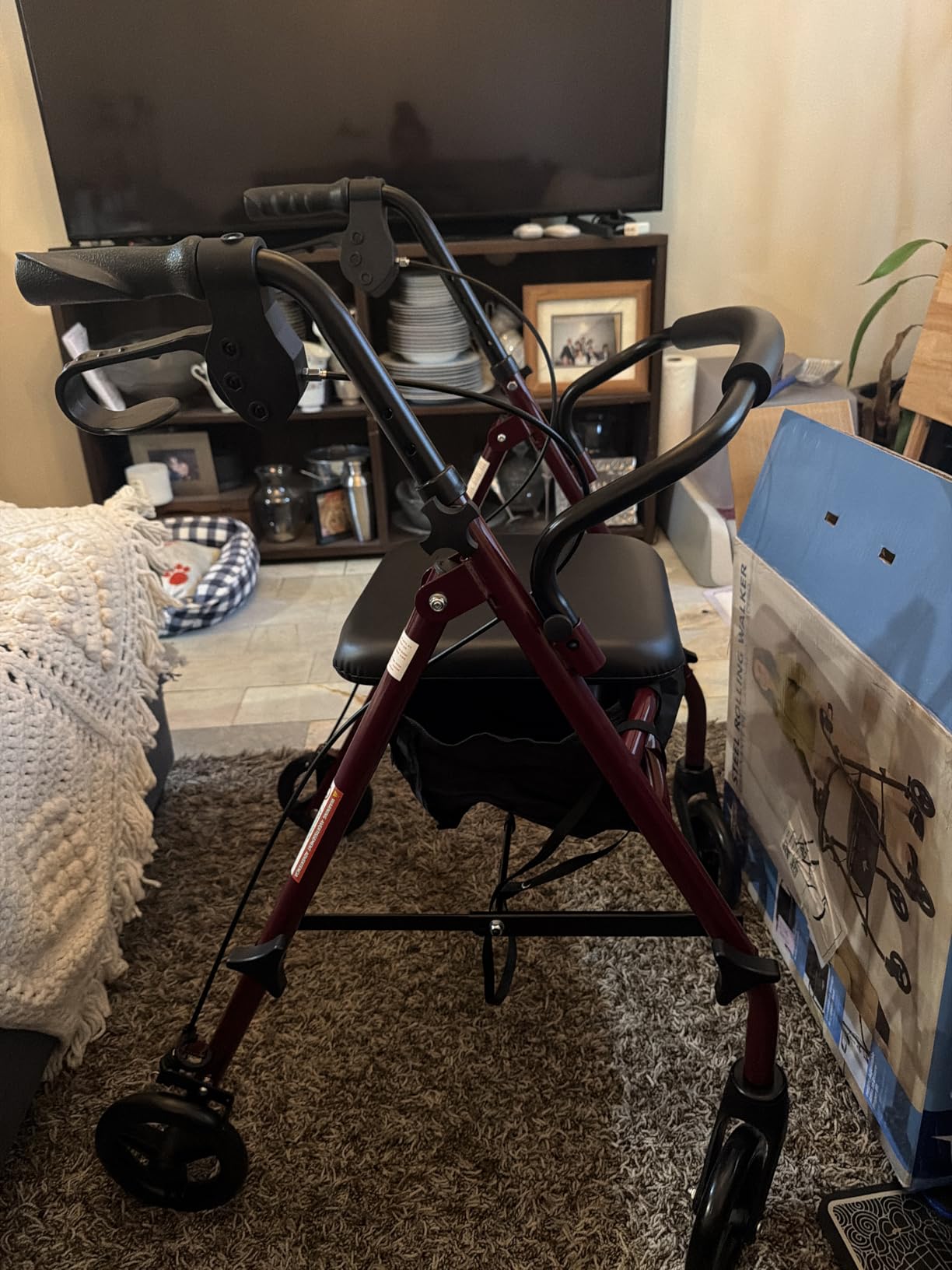
The seat is 12 by 12 inches with a matching padded backrest, and there is a storage compartment underneath. Buyers typically cite the seat, the storage and the simple fold-and-go as the three practical wins for shopping trips and long walks to the postbox.
Handle height adjusts from 31 to 35 inches, and the frame folds down for transport. The published dimensions are 23 by 21 by 31 inches, which is a compact footprint for a steel rollator.
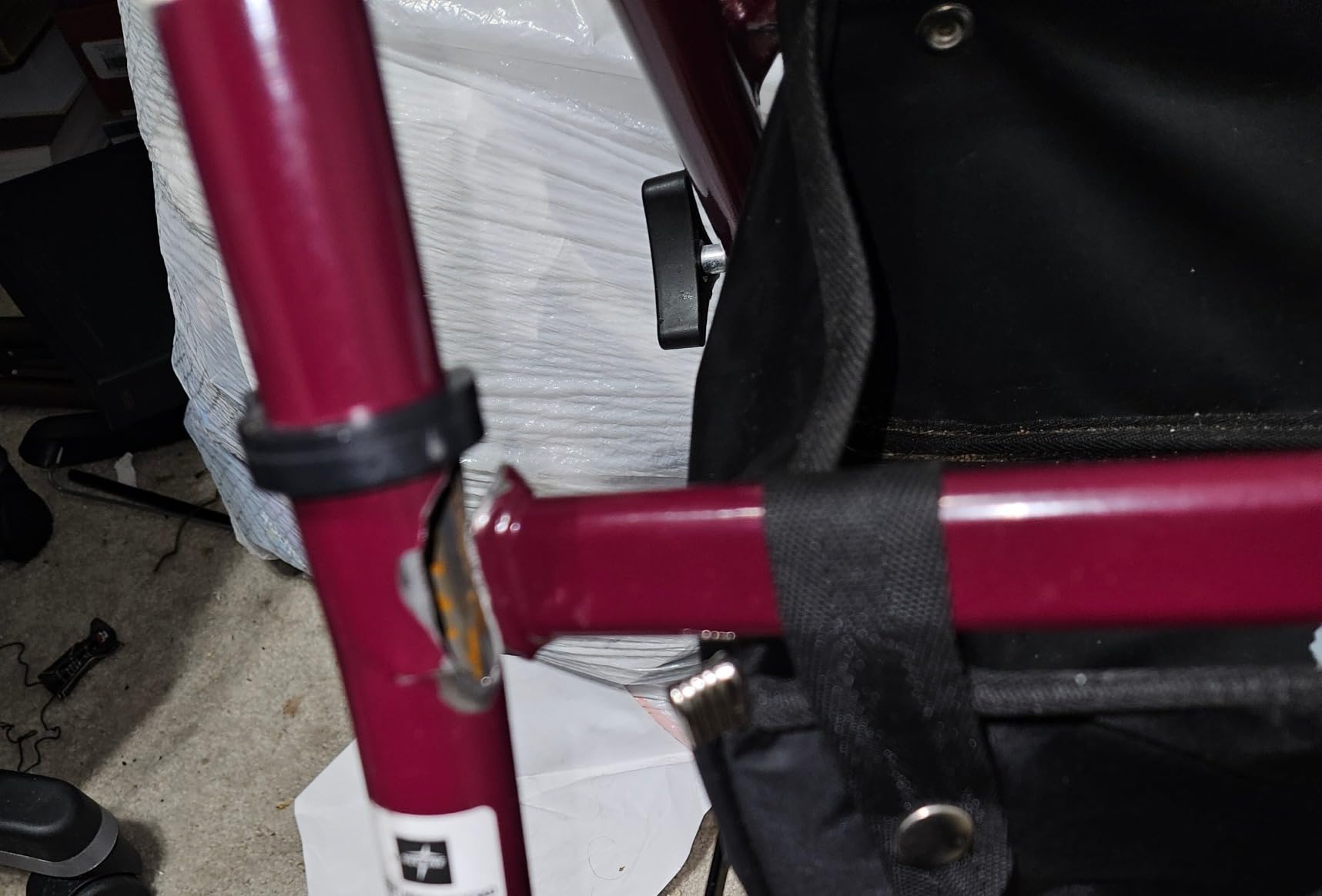
Two complaints recur. The first is weight: 16.5 pounds is more than the aluminium alternatives here, and that gap widens if you are comparing with a 13-pound model. The second is the 6-inch wheel size, which is more forgiving on flat paths than on textured pavers and concrete.
Neither is a dealbreaker for a user who mainly walks on pavements and shop floors, but both matter if the route is uneven or the walker travels in a car.
Who this walker suits
It suits users over 300 pounds who want a rollator rather than a bariatric special order. It also suits anyone with grip weakness, because the brake levers are among the most forgiving in this roundup.
For a user doing regular shopping trips, the under-seat storage and the seat itself are what justify the steel frame.
Who should skip it
Skip it if you need to lift the frame into a vehicle regularly, or if your route involves rough paving where 6-inch wheels will judder. Skip it if you want an oversized seat, since 12 by 12 inches is a standard size.
If lightness matters more than capacity, an aluminium rollator with a 350-pound rating keeps the strength and drops the weight.
12. Medline Lightweight Aluminum Rollator with Seat – Best Premium Lightweight Rollator
Medline Aluminum Rollator Walker with Seat, Purple, 250 lb. Weight Capacity, Lightweight, 6” Wheels, Foldable, Adjustable Handles, Rolling Walker for Seniors
14 lb aluminum
250 lb capacity
6 inch wheels
31 to 35 inch handles
Pros
- 14 lb loads into a car trunk without help
- Six colour options that gift buyers like
- Brakes lock the rear wheels firmly in place
- Seat
- backrest and under-seat storage included
Cons
- 250 lb capacity is lower than the steel models
- Paddle-shaped handles can catch on jacket pockets
- Under-seat pouch straps let heavier items fall out
At 14 pounds this is the aluminium frame that competes directly with the 13-pound Drive Medical rollator, and the reason to choose it over that one is the finish. Six colour options are listed, including purple and green, and buyers and gift buyers mention the colour specifically as a reason they liked it.
The brakes lock the rear wheels firmly, so the frame does not roll away when a user sits down. That is the practical safety detail people notice first, and it is the same push-up-to-brake, push-down-to-lock arrangement as the steel Medline model.
Inside, the seat and backrest are 12 by 12 inches with storage underneath, and the frame folds down for transport. Handle height adjusts from 31 to 35 inches, and the 6-inch wheels are for smooth indoor and outdoor surfaces rather than rough ground.
Reviewers consistently name the 14-pound weight as the decisive advantage, because it lets a solo user or a caregiver load it into a vehicle without arranging help. That is the whole case for this model.

Now the cautions, which are specific and worth reading. The paddle-shaped handle tops catch on jacket and hoodie pockets when a user stands up, and some buyers treat that as a genuine fall risk. The under-seat pouch straps are short, so heavier items can unhook and fall out.
The 250-pound capacity is the lowest rating among the rollators here, and that rules it out for larger users regardless of how much they like the colour. A minority of international reviews also report screws loosening after several months of use.
Who this walker suits
It suits a user under 250 pounds who wants a light rollator with a seat, brakes and colour choices, and who mostly walks on flat indoor surfaces or smooth pavements. It is a good gift for someone who has expressed that they do not want a medical-looking device.
For anyone who wants a similar weight with a higher capacity, the steel Medline model in this guide covers 350 pounds instead.
Who should skip it
Skip it above 250 pounds, and skip it for a user who wears jackets with large pockets, because of the handle design. Look elsewhere if you need a wider seat or wheels that handle uneven ground.
Check the under-seat pouch before you rely on it to carry shopping. It is sized for a purse, not a weekly shop.
How to Choose a Folding Walker: 8 Details That Decide the Purchase
The difference between a walker that gets used every day and one that ends up in a closet is almost never the model name. It is a handful of measurable details. Work through these in order and the recommendation makes itself.
Measure the user before the model. Stand the user up straight, let their arms hang, and measure from the wrist crease to the floor. That number is the handle height. Buy the frame whose range contains it, not the one whose range happens to overlap it.
Check the weight against the lifting. A basic aluminium walker here runs about 6 to 9.5 pounds. A steel or all-terrain rollator runs 13 to 23 pounds. If a caregiver will be lifting it into a car several times a day, the difference compounds quickly.
Pick the folding mechanism for the hands. A two-button push release is the easiest to demonstrate and press. A trigger release folds one-handed and suits limited dexterity. Test whichever you are considering with the weakest hand available.
Match wheels to the ground. 5-inch wheels with rear glide caps or skis are built for carpet, tile and hardwood. 6-inch wheels handle smooth pavements. 8-inch all-terrain wheels are the only real option for gravel and grass.
Verify the width against the narrowest doorway. Measure the tightest door on the route. Standard frames are wide; adjustable-width frames narrow from 17 to 22 inches and are the answer for older homes with 20-inch bathroom doors.
Confirm the weight capacity above the user. Capacity means maximum user body weight, not the total load. Buy a margin above the user’s weight, not an exact match.
Decide on a seat or no seat. A seat solves fatigue. It also adds roughly 4 to 17 pounds and requires brakes. There is no middle ground, so decide which problem you are solving.
Check the warranty and the return terms. A lifetime frame guarantee appears on one model here. On everything else, confirm the coverage length and how a replacement part is handled before you need it.
One more practical note that families mention constantly: measure your car. A walker used several times a day has to fit in the boot every time, and the folded dimensions are usually published even when nobody mentions them. We would put that ahead of any other feature after weight.
How to Measure for the Right Handle Height
Handle height is the single measurement that determines whether a walker feels stable or feels wrong, and it takes about a minute. Stand the user up straight with shoes on and arms relaxed at their sides. Measure straight down from the crease of the wrist to the floor. That distance is the height the grips should sit at.
Why the wrist crease? Because it puts the elbow at roughly a 30-degree bend when the user stands inside the frame holding the grips. At that angle the shoulders relax and the arms do the pushing rather than the back. Set the grips too high and the user hunches, pushes with their shoulders, and loads their neck. Set them too low and the user bends forward constantly, which is exhausting and unsafe.
Now check that number against the frame. In this guide the handle ranges run from 30 inches at the lowest to 40 inches at the highest. Most adult frames cover roughly 32 to 38 inches, which is why so many standard walkers do not fit a very short or a very tall user.
If the measurement falls outside a frame’s stated range, do not force it. A narrow frame that adjusts down to 30 inches is the correct answer for a short user, and a wide-frame rollator with handles up to 40 inches is the correct answer for a tall one. Buying a frame that “is close” produces the hunching problem you were trying to avoid.
One more thing the measurement cannot tell you: whether the bathroom route is workable. If the user is spending time at a toilet and the room is tight, our picks for bidet toilet seats for elderly users can remove some of the transfers that make a narrow room feel harder to navigate with a frame.
How to Fold a Two-Button and a Trigger-Release Walker
Two-button folding, which is what the Drive Medical and Medline frames in this guide use: stand the walker in front of you facing the user. Find the button under each hand grip. Press both buttons at the same time while pushing the frame forward slightly, and the two sides will swing toward each other. Keep pressing until the sides meet, then release the buttons so the frame locks folded. Lift it by the middle of the top bar.
To unfold, set the folded frame on the floor a short distance in front of you, pull the two sides apart until you hear the click of the locking pin, then check that the pins are fully seated on both sides before putting weight on it. An unlocked walker that is pushed down will fold under the user, and this is the mechanism behind the pin-popping complaints in the reviews.
Trigger-release folding, used by the narrow and ski-feet frames here: squeeze the trigger on the grip, or on the side of the frame, and the side collapses inward without a second hand. Each side usually operates independently, so you can fold one side and then the other. This is the mechanism to choose when only one hand works well, and the reason one-handed folding is specified in the feature lists at all.
Whichever mechanism you use, do the first three or four folds with the user present and watching. A fold that surprises someone mid-step is how walkers end up against a wall at full speed.
Will Medicare or Insurance Pay for a Folding Walker?
Medicare Part B will generally cover a walker or rolling walker prescribed by a doctor as durable medical equipment, paid at 80 percent of the Medicare-approved amount after the deductible is met. The two forms of walker Medicare recognises are a folding walker without wheels and a rolling walker with wheels, so both the basic frames and the rollators in this guide fall inside the category.
The process runs like this. First, a doctor, physical therapist or occupational therapist writes a prescription stating why the device is needed. Next, you take that prescription to a durable medical equipment supplier who is enrolled with Medicare, or order through a Medicare-approved online supplier. The supplier submits the paperwork, and Medicare applies its payment rate.
Two practical warnings. Many people assume buying a walker online is reimbursable, and in general purchases are only covered when they go through the supplier process with a valid prescription. And not every feature is covered the way people expect, so ask the supplier what is billable before you commit to a specific model.
If you are not on Medicare, ask your insurer directly for its durable medical equipment rules, and check whether your health spending account can be used. Two of the frames in this guide are marked FSA or HSA eligible.
Folding Walker vs Rollator vs Cane: Which One Do You Need?
Choose a basic folding walker if the user can lift the frame, needs maximum stability, and mostly walks on carpet or hard floors indoors. It is the lightest and the most stable option, and it is the right starting point for post-surgery recovery.
Choose a rollator if the user tires while standing, wants a seat, walks outdoors, or needs brakes on a slope. You pay for that with roughly 4 to 17 extra pounds and a wider turning circle, which is why a rollator is a second step rather than a first one.
Choose a cane if only one hand needs support and the user has good balance. A single point of contact is far less stable than a frame, and a cane that is used instead of a walker when a walker is needed is a common cause of the falls people were trying to prevent.
There is no shame in moving up the categories. Plenty of the buyers in our review files started with a basic walker and later added a rollator for longer outings. Our rollator roundup covers that upgrade in detail if you are at that stage.
Frequently Asked Questions
What is the very best walker for seniors?
The best folding walker for most elderly users is the Drive Medical Two-Button Folding Walker with 5-inch front wheels. It weighs 7.5 pounds, carries a 350 pound capacity, folds flat to about 4 inches deep and uses a two-button release that is easy to press with arthritic hands. If the user tires while standing or walks outdoors, a rollator with a seat is the better choice, and our top pick there is the Drive Medical Aluminum Rollator at 13 pounds.
What kind of walker will Medicare pay for?
Medicare Part B covers a walker or rolling walker prescribed by a doctor as durable medical equipment, and it typically pays 80 percent of the Medicare-approved amount after the deductible. The recognised categories are a folding walker without wheels and a rolling walker with wheels. You need a prescription, and the purchase must go through a Medicare-enrolled durable medical equipment supplier rather than a general retail checkout.
Which type of walker is best for the elderly?
A basic aluminium two-wheel folding walker is best for indoor use on carpet and hard floors, because it is the lightest and most stable option. A rollator with a seat is best when the user tires while standing, walks outdoors or needs brakes on a slope. A cane is only appropriate when one hand is sufficient and balance is otherwise good. A physical therapist can confirm which category matches the user’s specific gait and strength.
How do I measure for a folding walker?
Stand the user up straight in shoes with arms relaxed at their sides, then measure from the wrist crease straight down to the floor. That measurement is the correct handle height, and it puts the elbow at roughly a 30 degree bend. Compare it against the frame’s stated handle range, which in this guide runs from 30 to 40 inches, and buy a frame that contains the number rather than one that merely overlaps it.
How do you fold a walker?
For a two-button walker, stand the frame in front of you, press both buttons under the hand grips at the same time while pushing slightly forward, and let the sides swing together until they meet. For a trigger-release walker, squeeze the trigger on the grip and the side collapses inward, and each side usually works independently so it can be folded one-handed. Always check that the locking pins are fully seated before the user puts weight on it.
What is a good lightweight walker for seniors?
A good lightweight walker weighs roughly 6 to 9.5 pounds with an aluminium frame and rates to 300 or 350 pounds. The Medline Two-Button Folding Walker has a frame weight of about 6 pounds, and the Vive Mobility narrow walker is 9.5 pounds with a lifetime frame guarantee. For a rollator, the Drive Medical Aluminum Rollator at 13 pounds is the lightest option with a seat in this guide.
Our Best Folding Walkers for 2026
The Drive Medical Two-Button Folding Walker with 5-inch wheels is our overall pick for 2026. At 7.5 pounds with a 350-pound rating and a flat fold of roughly 4 inches, it does the three things a daily walker has to do without any of them being a compromise, and its two-button release is the mechanism we would put in the hands of an arthritic user first.
The rest of the guide is sorted by the problem being solved rather than by rank. Buy the Medline Two-Button Folding Walker if lightness matters more than a 350-pound rating. Buy the narrow trigger-release frame if the user is short or the doorways are narrow. Buy a rollator if the real problem is fatigue, and pick the aluminium one if someone has to load it into a car.
Before any of them goes out the door, measure the wrist crease to the floor, test the folding mechanism with the user’s weaker hand, and measure the narrowest door and the car boot. If anything about the fit is uncertain, a physical therapist or occupational therapist can settle it in a few minutes, and that conversation is worth more than any spec sheet.