
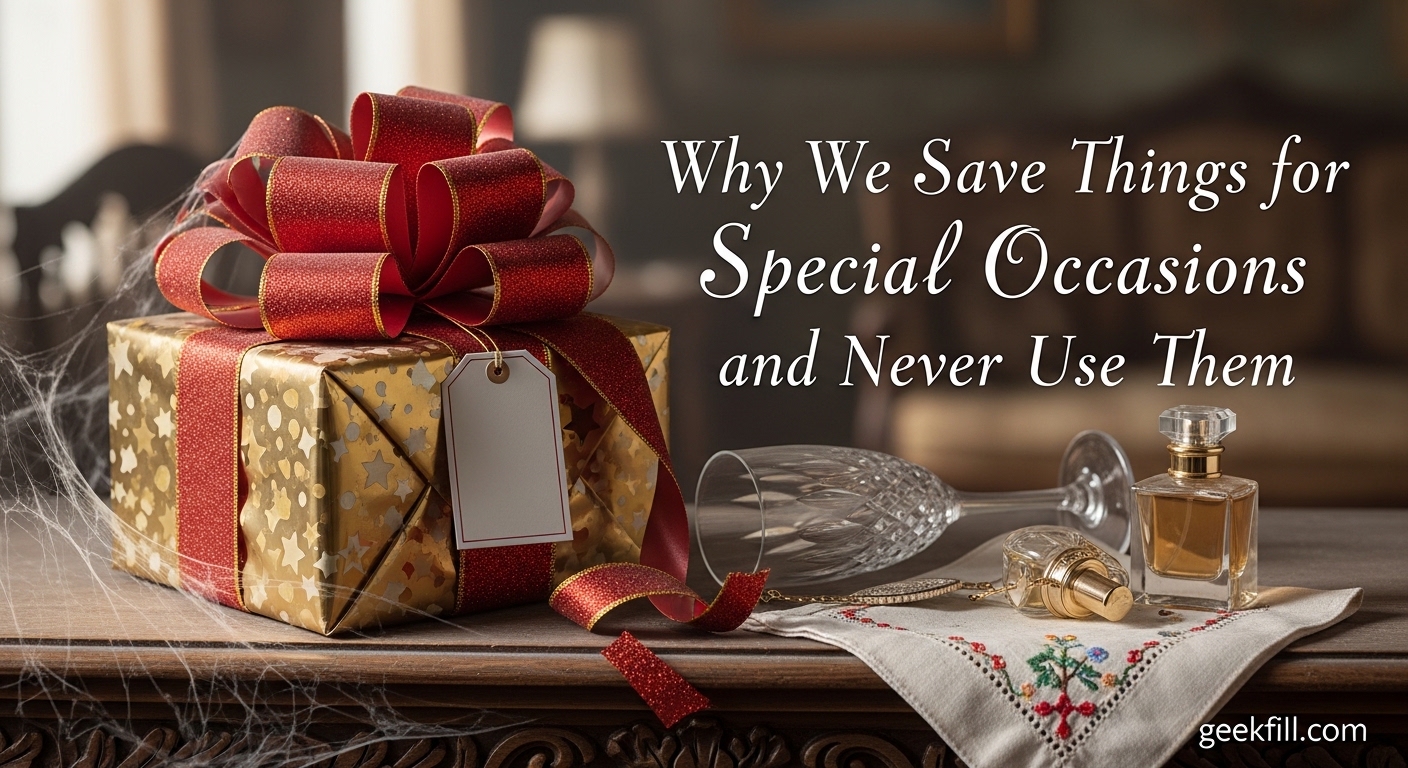
We all know that person. Or maybe we are that person. The one who has a bottle of wine that has traveled through three apartments, a dress with tags still attached from two summers ago, or fancy dinnerware that only sees the light of day on Thanksgiving. Why we save things for a special occasion and never use them is a question that touches nearly everyone, yet few of us understand the psychology driving this peculiar behavior.
In this article, I will break down the science behind this phenomenon. You will learn about the “specialness spiral” discovered by Wharton researchers, the three psychological drivers that trap us in this cycle, and practical strategies you can use starting today to actually enjoy the things you own.
Table of Contents
What Is the Special Occasion Phenomenon?
The special occasion phenomenon is a behavioral pattern where people purchase or receive items they perceive as special, then defer using them indefinitely while waiting for an occasion worthy of their value. This waiting period stretches from weeks to years, and often the “perfect” moment never arrives. Meanwhile, the item sits unused, sometimes expiring, going out of style, or simply being forgotten.
I have seen this play out in countless forms. A friend owns a $200 perfume that has been on her dresser for four years because “it is too nice for everyday use.” Another has wedding china packed in boxes that has seen the table exactly twice in a decade. My own closet once held a silk blouse purchased for “interviews” that remained unworn because no meeting felt quite important enough.
Common Items We Save but Never Use
Certain categories of items seem to trigger this saving instinct more than others. Understanding which possessions you are most likely to hoard can help you spot the behavior before it takes hold.
Clothing and accessories top the list. That interview suit, the dress for weddings, the shoes that are “too nice” for regular wear. According to forum discussions, many people have donated brand new clothes with tags still attached because they never found the right occasion.
Tableware and kitchen items follow closely behind. Good china, crystal glasses, silver serving pieces. These often come out only for holidays, if at all, because daily meals feel unworthy of their elegance.
Consumable luxuries create the most heartbreaking waste. Expensive skincare that expires, wine that turns to vinegar, perfume that degrades. These items literally diminish in value while waiting for their moment.
Decorative items also accumulate. Candles, throw pillows, art pieces that feel “too special” for everyday display. They remain wrapped or stored while cheaper alternatives get daily use.
Why We Save Things for a Special Occasion and Never Use Them: The Psychology
The psychology behind this behavior runs deeper than simple indecision. Three interconnected mental forces work together to create a powerful resistance against using our nicest possessions. Understanding these drivers is the first step toward breaking free from them.
The Fear of Waste
At the core of the special occasion mindset sits a deep fear of wasting something precious on an unworthy moment. We worry that if we use our best items now, we will not have them available when something truly important comes along. This creates a perpetual state of waiting.
The fear operates on an emotional level that overrides logical thinking. Intellectually, we know a $50 candle will not be more valuable five years from now. Emotionally, we feel we are “saving” its value by preserving it. This emotional override explains why even people who understand the irrationality of their behavior continue to save things anyway.
For many, this fear connects to childhood experiences. Growing up with limited resources or in households that emphasized frugality can ingrain the belief that special things must be protected. One forum user shared how their grandmother’s Depression-era mentality passed down through generations, creating guilt around using anything “too nice” for ordinary purposes.
The Scarcity Mindset
The scarcity mindset convinces us that special items are limited resources that cannot be replaced. We view that particular bottle of wine, that specific dress, as irreplaceable treasures rather than consumable goods. This perception makes using them feel like a permanent loss rather than an experience.
Marketing reinforces this mindset constantly. Limited editions, “while supplies last” messaging, and luxury positioning all train us to see possessions as scarce. We internalize the message that once this item is gone, we cannot get it back. This makes using it feel risky.
In reality, most items we save are replaceable. That might mean buying a similar dress next season or finding a comparable wine at the store. But the scarcity mindset blocks us from seeing this truth, trapping items in a state of suspended animation where they serve no purpose.
Deferred Gratification Gone Wrong
Deferred gratification, the ability to delay immediate pleasure for greater future rewards, serves us well in many areas of life. It helps us save money, pursue education, and achieve long-term goals. But when applied to consumable items with expiration dates, it backfires spectacularly.
We tell ourselves that waiting will make the eventual experience more satisfying. The special dinner will taste better on an anniversary. The dress will look more spectacular at the perfect event. This optimistic prediction about future enjoyment justifies present deprivation.
The problem is that future we imagined rarely arrives as expected. Anniversaries get postponed. Plans change. Or the occasion arrives but we have built it up so much in our minds that reality cannot match the fantasy. We end up with neither the deferred pleasure nor the years of use we could have enjoyed.
The Specialness Spiral: How Not Using Things Makes Them Seem More Special
Wharton School professor Jonah Berger and his colleague Jacqueline Rifkin identified a fascinating phenomenon they call the “specialness spiral.” Their research, published in the Journal of Consumer Psychology, reveals how our saving behavior actually intensifies over time through a self-reinforcing cycle.
How the Spiral Works
The specialness spiral operates through a simple but powerful feedback loop. Each time we choose not to use an item, we signal to ourselves that it must be special. After all, we would not save something ordinary. This increased perception of specialness makes us even less likely to use the item in the future, which further increases its perceived specialness.
Berger and Rifkin conducted six experiments demonstrating this effect. In one study, participants who were asked to consider not using an everyday product rated it as significantly more special than those simply asked to evaluate the product. The act of considering nonconsumption alone elevated perceived value.
In another experiment, participants given the option to use a product “now or later” showed a clear pattern. Those who chose “later” rated the product as more special than those who used it immediately. Waiting literally made the item seem more valuable in their minds, even when both groups received identical products.
From Products to “Perceived Treasures”
Berger describes this transformation as turning ordinary products into “perceived treasures.” An item that started as a nice bottle of wine becomes an irreplaceable artifact through repeated deferral. A dress becomes a museum piece rather than clothing.
This explains why the behavior feels so difficult to break. We are not just fighting habit or inertia. We are fighting a psychological perception that has grown stronger through our own actions. The longer we save something, the more impossible using it seems.
The researchers also found that this effect applies across categories. Whether testing wine, chocolate, or candles, the pattern held. Nonconsumption increased perceived specialness, which increased resistance to future consumption. The specialness spiral is a universal feature of human decision-making, not a quirk of specific product types.
The Forbidden Fruit Effect
Related to the specialness spiral, Berger’s research also touches on what psychologists call the “forbidden fruit effect.” When we cannot have something, we want it more. By declaring an item off-limits for ordinary use, we inadvertently make it more desirable in our minds.
This creates a painful contradiction. We want to use the item, which is why we bought it. But our own rules about when it can be used make it feel increasingly forbidden. The result is a closet full of things we simultaneously desire and deny ourselves.
How to Break the Special Occasion Mindset: 5 Practical Strategies
Understanding the psychology is essential, but changing the behavior requires action. After researching this topic extensively and testing approaches myself, I have identified five strategies that actually work for breaking the special occasion mindset.
1. Adopt the “Cheers Rule”
The “cheers rule” comes from a story about a woman named Kristen whose grandmother had a box of expensive wine she was saving for a special occasion. When the grandmother passed away, the family discovered the wine had gone bad. Kristen made a rule: “If you would not serve it to guests you are toasting with ‘cheers,’ it is not worth saving.”
This simple mental shortcut cuts through the specialness spiral by forcing an immediate evaluation. Would I use this item for a casual dinner with friends? If not, why am I keeping it? The cheers rule lowers the threshold for what counts as a “worthy” occasion to the level of normal social connection.
I applied this rule to my own kitchen and discovered I had three bottles of wine I would not actually serve to friends. That realization made it easier to either use them in cooking or donate them. The cheers rule turns abstract future occasions into concrete present decisions.
2. Redefine What Counts as Special
Part of the problem is our definition of “special occasion.” We reserve that label for birthdays, anniversaries, and major holidays. But why should Tuesday dinner with family be less special than a birthday? Why is a random Friday less worthy of a nice outfit than a wedding?
Try expanding your definition of special to include everyday moments of connection, rest, or joy. Making it through a difficult week is special. A spontaneous dinner with a friend is special. Being alive and healthy on an ordinary Wednesday is special.
One approach that works for me is the “reverse special occasion” test. Instead of asking if today is special enough for this item, ask if this item would make today feel more special. If wearing that dress or using those plates would elevate an ordinary evening, that is reason enough to use them.
3. Start Small and Build Momentum
Breaking a long-standing habit all at once feels overwhelming. Instead, start with one category or one specific item. Pick the thing you have been saving longest, or the one that causes you the most guilt, and commit to using it this week.
For consumables like wine, perfume, or skincare, set an expiration date policy. If you have not used it by a certain date, you must either use it or discard it. This creates urgency that counteracts the endless deferral of the specialness spiral.
For durable goods like clothing or dishes, try a “rotation rule.” Every time you do laundry or set the table, you must include at least one “special” item. This forces regular use and prevents items from accumulating dust while waiting for hypothetical future events.
4. Take Inventory and Audit Your Savings
Many people do not realize how much they are saving until they actually look. Take an afternoon to go through your home and identify everything you have been saving for a special occasion. Lay it all out where you can see it together.
The visual impact of seeing everything at once can be shocking. I did this last year and found I had enough “special” clothing for three months of daily wear, plus wine that would take two years to drink. Seeing the scale of my accumulated savings made the problem impossible to ignore.
For each item, ask three questions: When did I acquire this? What occasion was I originally saving it for? Has that occasion happened yet? If the answer to the last question is no after more than a year, that occasion is unlikely to arrive. The item either needs to be integrated into regular use or given away.
5. Give Yourself Permission to Enjoy Things
At the deepest level, the special occasion mindset often stems from a belief that we do not deserve nice things on ordinary days. This deserves-based thinking links enjoyment to worthiness, creating a trap where we can never feel worthy enough.
Work on separating the concepts of worthiness and enjoyment. You do not need to earn the right to use your possessions through suffering or exceptional achievement. The simple fact of your existence, of having made it through another day, is enough justification to enjoy something nice.
One mantra that helps: “I bought this to use it, not to store it.” Repeat it when you feel hesitation about opening that bottle, wearing that outfit, or lighting that candle. The money is already spent. The only way to extract value from the purchase is through use.
The Hidden Costs of Waiting
We often think of saving things as a harmless or even virtuous habit. But the special occasion mindset carries real costs that extend beyond the obvious waste of unused items. Understanding these costs can provide additional motivation for change.
Financial Waste
Unused items represent money spent with no return. That $150 dress with tags still on is not a $150 asset. It is $150 of wasted income. When you add up the value of all saved items across a household, the total can be staggering.
Forum users consistently report guilt over this financial waste. One person described donating hundreds of dollars worth of unworn makeup that had expired. Another calculated they had spent over $2,000 on “special occasion” clothing they never wore. The financial pain of recognizing this waste often exceeds the discomfort of using the items.
Environmental Impact
Every unused item carries an environmental cost that is wasted twice: once in its production and again in its disposal. The resources, labor, and shipping that brought that special dress to your closet all went to nothing if the dress sits unworn.
When we eventually donate or discard these items, they often end up in landfills. Even donated goods have limited lifespans. The special occasion mindset contributes to consumer waste by creating a pipeline of items that move from store to closet to trash without ever being used.
Using what we own, rather than continuously buying new things while saving old ones, is one of the most effective ways to reduce personal environmental impact. It maximizes the value extracted from items that already exist.
Missed Daily Joy
The most tragic cost of the special occasion mindset is the accumulation of ordinary days that could have been slightly more beautiful, more enjoyable, more special. Years of Tuesdays that might have included a nice glass of wine, a lovely outfit, or an elegant dinner setting instead passed in utilitarian blandness.
Research on happiness consistently shows that small, frequent pleasures contribute more to overall life satisfaction than rare, intense experiences. Using nice things regularly creates a steady stream of small joys that compound over time. Saving them for rare occasions concentrates pleasure into brief moments while extending deprivation across years.
I think about this when I use my grandmother’s china for weeknight pasta. She saved it for decades, using it maybe a dozen times before she passed away. Now I use it weekly. The plates have seen more meals in the past year than in the previous forty combined. That feels like honoring both her and myself.
Why do people save good things and not use them now?
Why do we keep things we don’t use?
Why do people buy things and not use them?
What are three reasons for saving?
Conclusion: Being Alive Is the Special Occasion
Why we save things for a special occasion and never use them comes down to a fundamental misunderstanding about what makes life meaningful. We imagine that joy is best concentrated into rare, peak moments, when in fact it is distributed more effectively across ordinary days.
The research is clear. The cheers rule works. The specialness spiral can be broken. The items you have been saving will bring more happiness spread across a year of Tuesdays than packed into one hypothetical future event that may never arrive exactly as you imagined.
Being alive is the special occasion. Making it through another day, sharing a meal with people you care about, having the health and resources to own nice things at all. These are the worthy occasions. Use the good plates. Wear the nice dress. Open the special wine. Do it tonight.
Your future self will not remember the Tuesday you saved something for later. But you will remember the Tuesday you made special by actually using the things you love.