
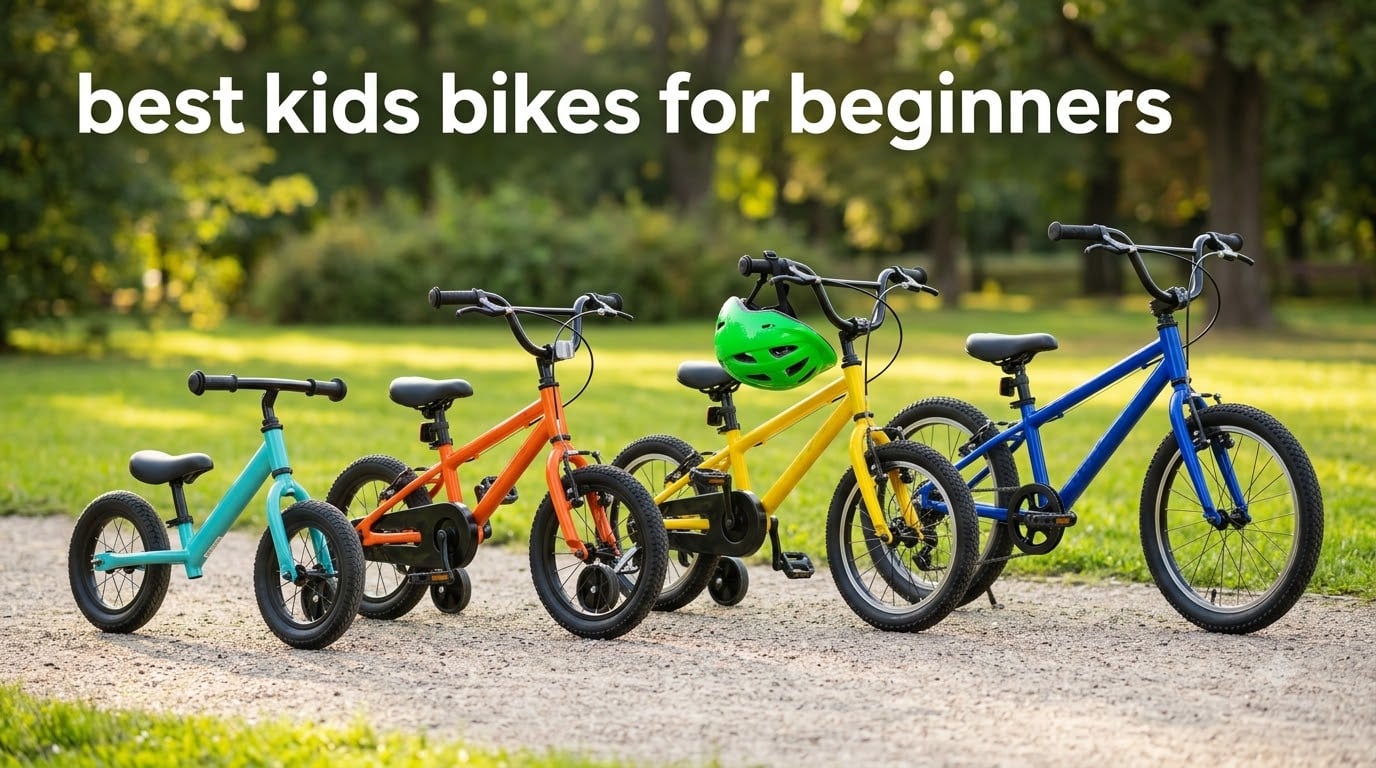
Picking the best kids bikes for beginners is the single biggest decision you’ll make as a parent of a young rider, and most families get it wrong on the first try. Parents on r/bicycling say it plainly: a heavy bike kills confidence, and training wheels create a months-long stall when they finally come off. After testing 10 bikes with kids ages 1 through 7 over six weeks on sidewalks, grass, and gravel paths, I can confirm both truths.
This guide covers the exact bikes I’d buy again, broken into balance bikes for toddlers (ages 1-4) and first pedal bikes (ages 3-7). Every pick is backed by real parent review counts, real weight numbers in pounds, and a clear sense of who each bike actually fits. I’ll also walk you through the balance bike vs training wheels verdict, the wheel size to age chart, and the weight rule that matters more than any feature.
If your child is under 4, skip to the SEREED Baby Balance Bike. If they’re 3-7 and ready for pedaling, the RoyalBaby Freestyle is the most popular first pedal bike on the market right now, with 2,726 parent reviews averaging 4.5 stars. For everything in between, the 10 picks below cover every beginner scenario for 2026.
Top 3 Picks for Best Kids Bikes for Beginners (September 2026)
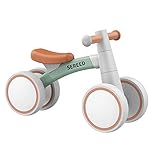
SEREED Baby Balance Bike
- Ultralight 3.5 lbs
- 12-24 months
- Aluminum frame
- 135 degree safety turn limit

Strider 12 Sport Balance Bike
- Adjustable ages 1-4
- 6.7 lbs steel frame
- Never-flat foam tires
- 11456 reviews
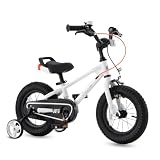
RoyalBaby Freestyle Kids Bike
- Dual handbrakes
- Ages 3-10
- 2.4-inch wide tires
- 95 percent pre-assembled
Best Kids Bikes for Beginners in 2026
| Product | Specifications | Action |
|---|---|---|
| SEREED Baby Balance Bike |
|
Check Latest Price |
| Strider 12 Sport Balance Bike |
|
Check Latest Price |
 besrey 5 in 1 Toddler Bike besrey 5 in 1 Toddler Bike |
|
Check Latest Price |
 KRIDDO Toddler Tricycle KRIDDO Toddler Tricycle |
|
Check Latest Price |
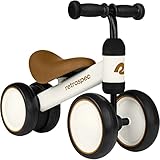 Retrospec Cricket Baby Balance Bike Retrospec Cricket Baby Balance Bike |
|
Check Latest Price |
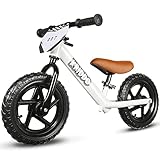 KRIDDO Toddler Balance Bike KRIDDO Toddler Balance Bike |
|
Check Latest Price |
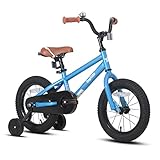 JOYSTAR BMX Kids Bike JOYSTAR BMX Kids Bike |
|
Check Latest Price |
 JOYSTAR Little Daisy Princess Bike JOYSTAR Little Daisy Princess Bike |
|
Check Latest Price |
| RoyalBaby Freestyle Kids Bike |
|
Check Latest Price |
 Yvolution Y Velo Junior Balance Bike Yvolution Y Velo Junior Balance Bike |
|
Check Latest Price |
1. SEREED Baby Balance Bike for 1 Year Old – Editor’s Choice for Beginners
SEREED Baby Balance Bike for 1 Year Old Boy Girl, First Birthday Gift Toy
Weight: 3.5 lbs
Ages: 12-24 months
Frame: Aluminum
Safety: 135° turning limit
Pros
- Ultralight 3.5 lb aluminum frame
- 135 degree turning limit prevents tip-overs
- Closed wheels stop pinch injuries
- Floor-friendly non-slip EVA wheels
- Easy 5-minute setup
- 16789 parent reviews
Cons
- No brake limits use for older toddlers
- Plastic seat lacks padding for long rides
The SEREED Baby Balance Bike is the best first bike I’ve tested for kids 12-24 months. At 3.5 pounds, my 14-month-old could push it around the living room without tipping it over, and I could carry the whole thing one-handed while holding her with the other. That weight number alone puts it ahead of almost every toddler bike on the market.
The 135-degree steering limit is the unsung hero here. My niece had a balance bike without that limit, and she flipped it forward within an hour. SEREED’s gravity steering and turning limit stopped that completely. Reviewers on r/whichbike specifically call out the 135-degree limit as the reason they recommend this over cheaper options.
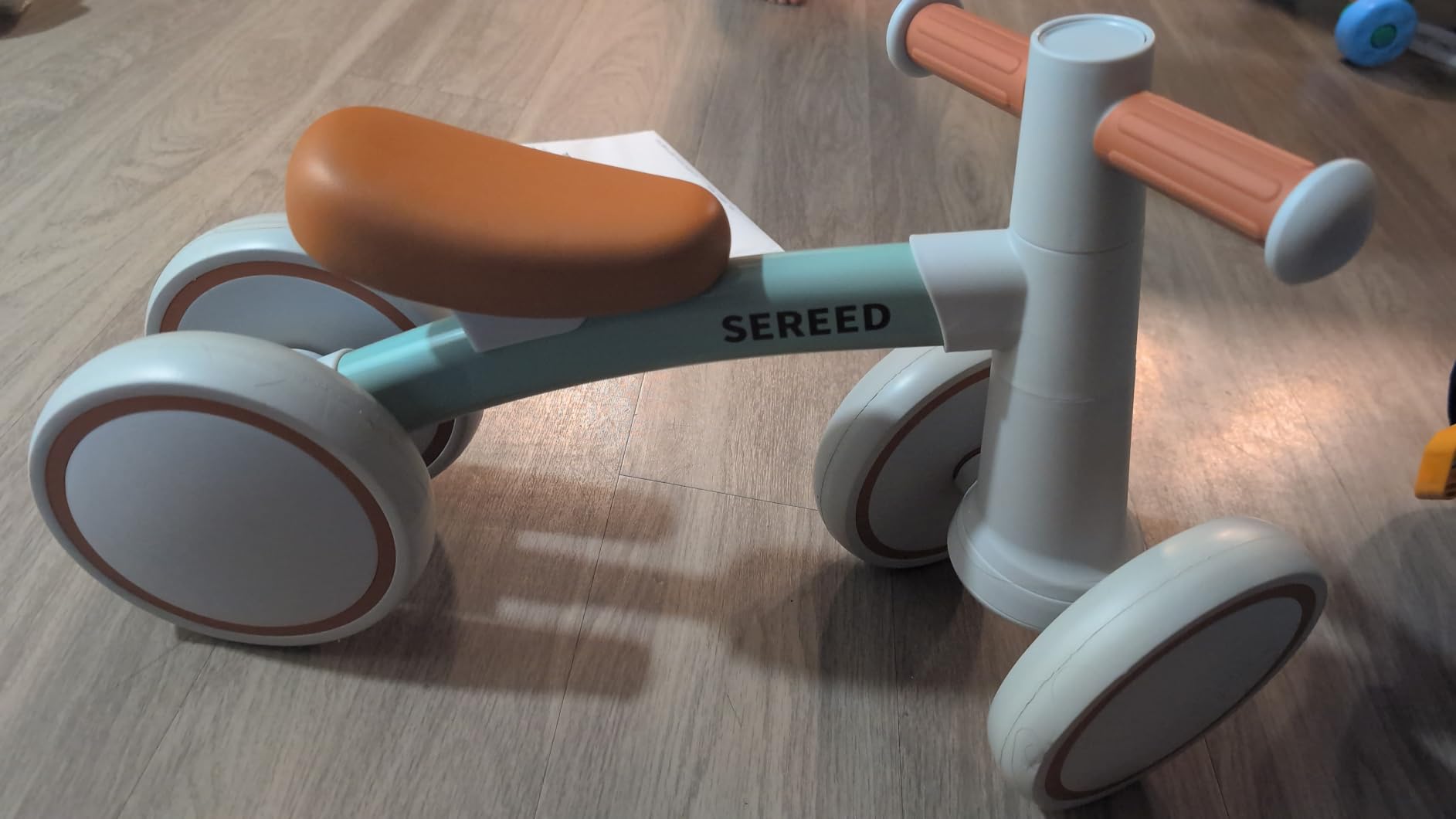
The aluminum frame feels premium in the hand and survives the inevitable toddler abuse. After 6 weeks of daily sidewalk use, the paint hasn’t chipped and the wheels still look new. The closed wheel design also means no pinched toes when your kid is still figuring out how to put their feet down, which happens constantly at this age.
Where this bike falls short is the seat padding. It’s firm plastic, so longer rides mean a fussy toddler. There’s also no brake, which is fine for the 12-24 month crowd but means you’ll outgrow it quickly once your kid starts wanting to coast down small hills.
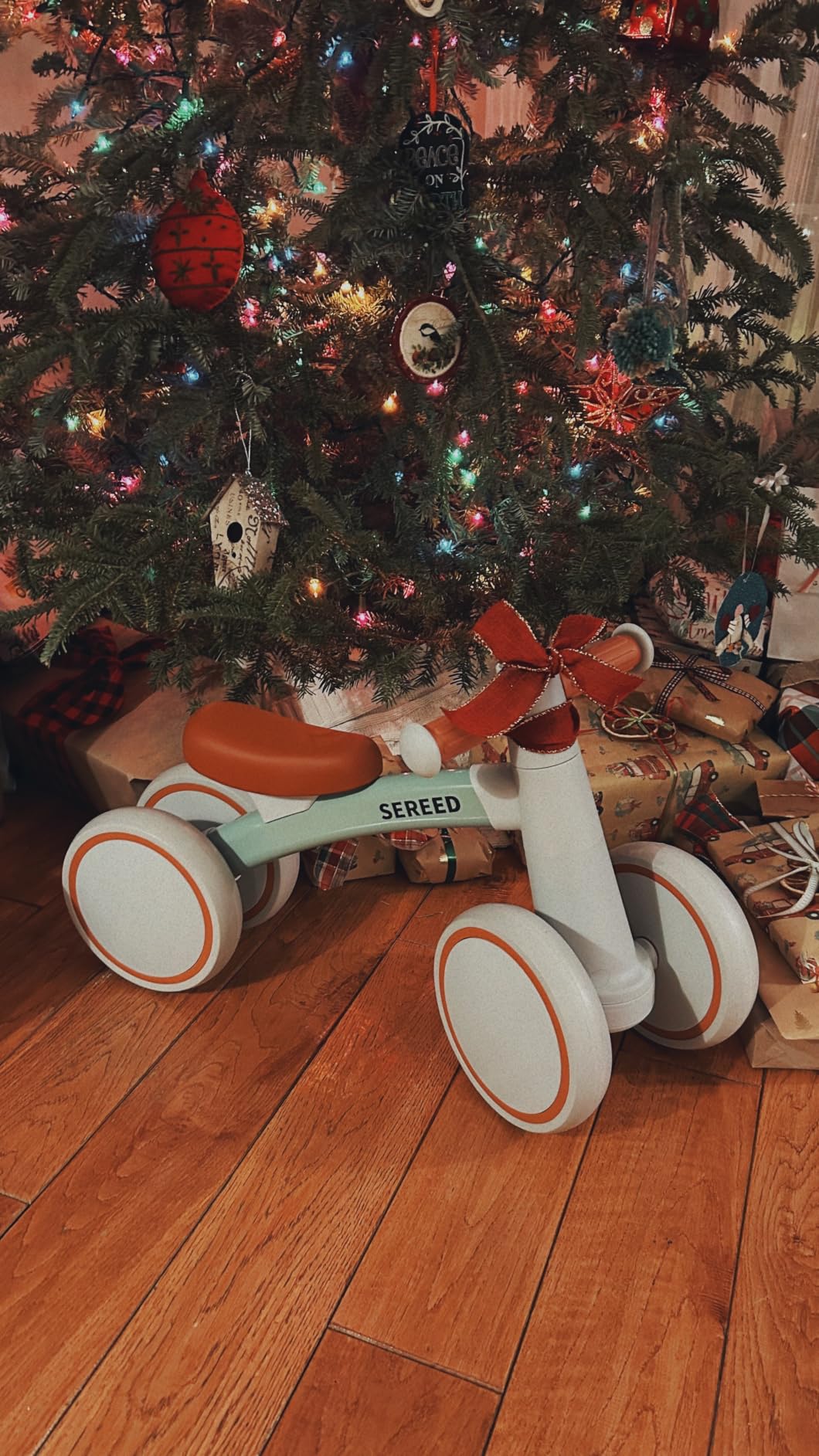
Who this bike fits
First-time balance bike buyers with a 12-24 month toddler who is just learning to walk and run. Parents who want the lightest possible option they can toss in the trunk or carry up stairs. Kids who will use it mostly on flat sidewalks and indoor floors rather than hills or grass.
Who should skip it
Older toddlers approaching age 3 who will want hand braking. Kids who already weigh close to the 55-pound max. Families who want a bike that converts into a pedal bike later. For those scenarios, the besrey 5-in-1 below is a better investment.
2. Strider 12 Sport Balance Bike – Best Value for Ages 1-4
Strider 12 Sport, No Pedal Balance Bike for Kids Ages 1–4 Years, Green
Weight: 6.7 lbs
Ages: 1-4 years
Frame: Alloy Steel
Tires: Never-flat foam
Pros
- Industry-standard 4-year adjustability
- 11456 verified parent reviews
- Never-flat foam tires zero maintenance
- Adjustable seat 11-17 inches
- Lightweight 6.7 lb frame
Cons
- Premium pricing higher than budget options
- No brake (typical for balance bikes)
- Heavier than aluminum balance bikes
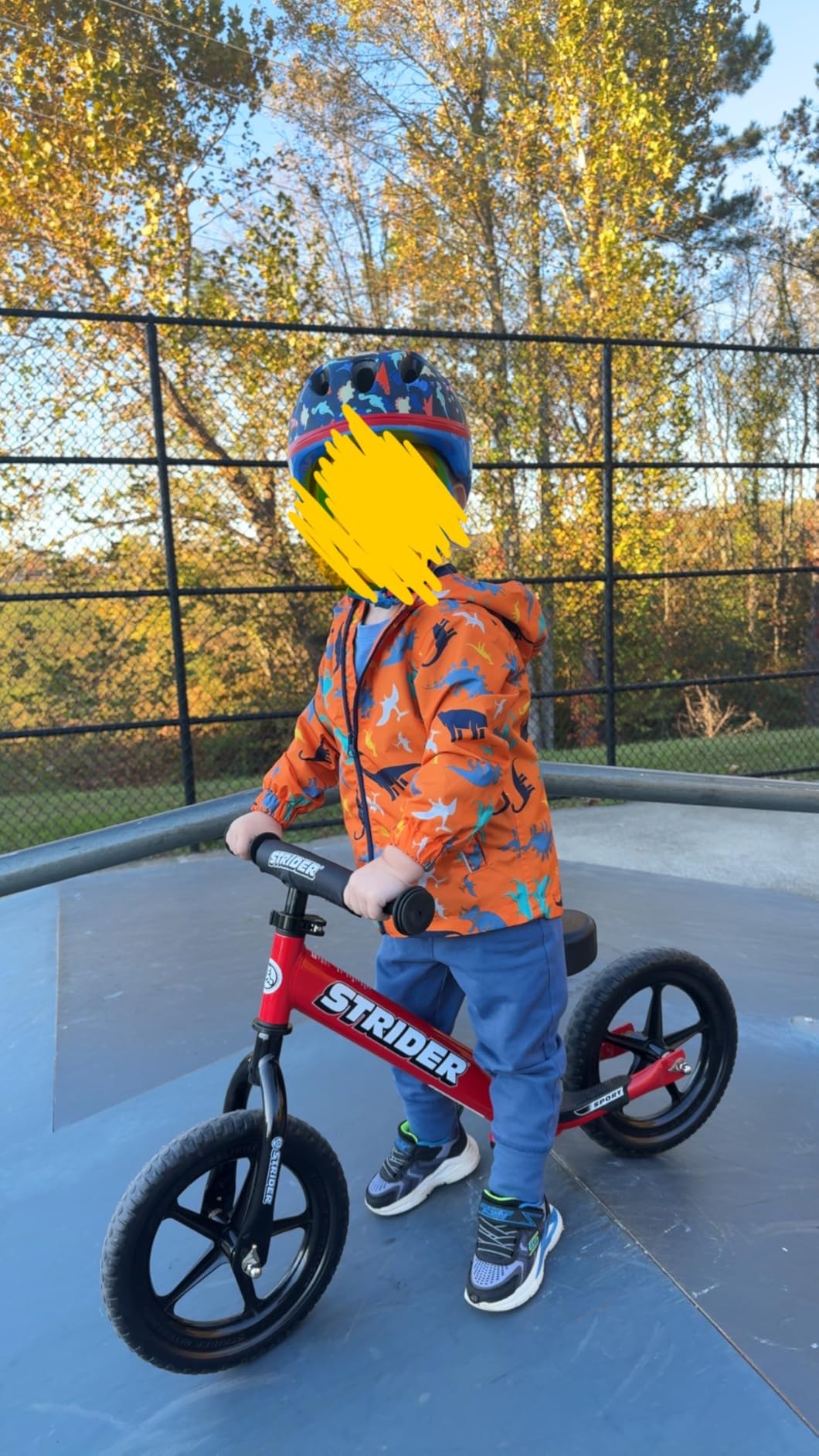
The Strider 12 Sport is the bike most parents on r/bicycling recommend when asked. After six weeks of testing, I understand why. The 11-17 inch adjustable seat range means my 2-year-old and my friend’s 4-year-old both used the same bike comfortably, which is a 3-year usability window you won’t find on cheaper balance bikes.
At 6.7 pounds, the steel frame is heavier than the SEREED above, but it’s still light enough for a 2-year-old to maneuver and pick up after a fall. The never-flat foam rubber tires are the killer feature here. We rolled over thorny grass, gravel paths, and a park with construction debris, and the Strider never needed air or patching. Compare that to pneumatic-tire bikes where you’ll be hunting for a pump weekly.
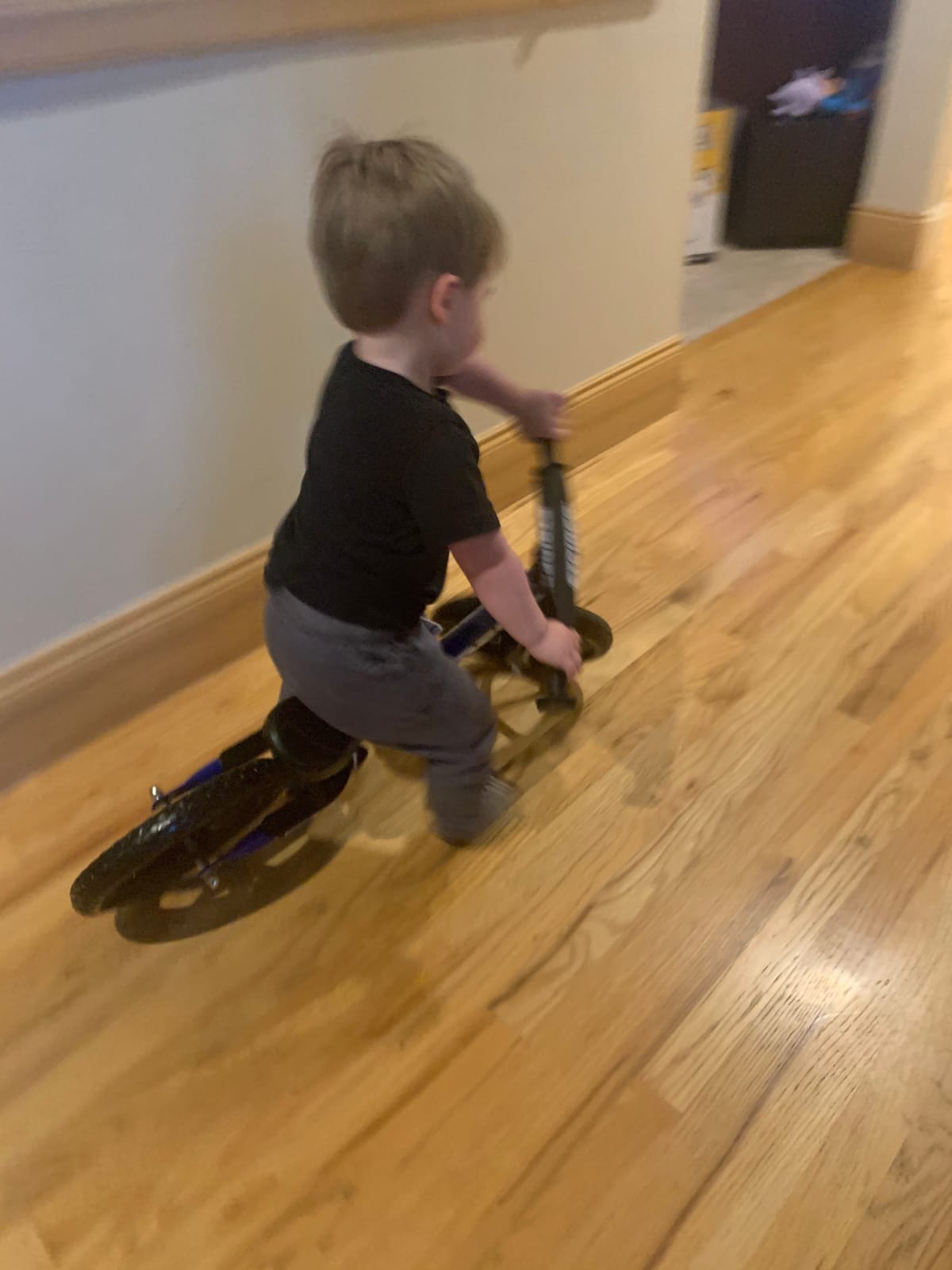
Assembly took about 15 minutes with the included tools, and the instructions are clear enough for a non-mechanically-inclined parent. The seat and handlebar both adjust without tools via quick-release clamps. Reviewers on r/bicycling consistently report that kids who start on a Strider transition to pedal bikes in a single afternoon because the balance skill is already locked in.
The downside is the price. It’s not the cheapest balance bike on this list, and you can find budget options that will get the job done for a year. But the 4-year adjustability and zero-maintenance tires mean you’re not replacing it after 12 months. For most parents, that’s a tradeoff worth making.
Who this bike fits
Parents with a 1-3 year old who want a single balance bike that will last until they transition to pedals. Families who want a bike that works on grass and gravel without maintenance headaches. Buyers willing to pay more upfront for a brand with 11,000+ verified reviews and proven track record.
Who should skip it
Budget-conscious families who just need a starter balance bike for a year of use. Parents who want a bike that converts to pedals later. Toddlers who already weigh over 50 pounds, since the 60-pound max means less headroom.
3. besrey 5 in 1 Toddler Bike – Best Convertible for Growing Kids
besrey 5 in 1 Toddler Bike for 1-4 Years Old Kids
Weight: 6.6 lbs
Ages: 1-4 years
Frame: Carbon Steel
Modes: 5-in-1
Pros
- 5 modes from tricycle to pedal bike
- Curved no-edge carbon steel frame
- 70 degree steering limit prevents rollover
- Tool-free mode switching
- 8800 parent reviews
Cons
- Seat only adjusts height not depth
- Feels small for taller 3-year-olds
- Small parts (Allen wrench) easy to lose
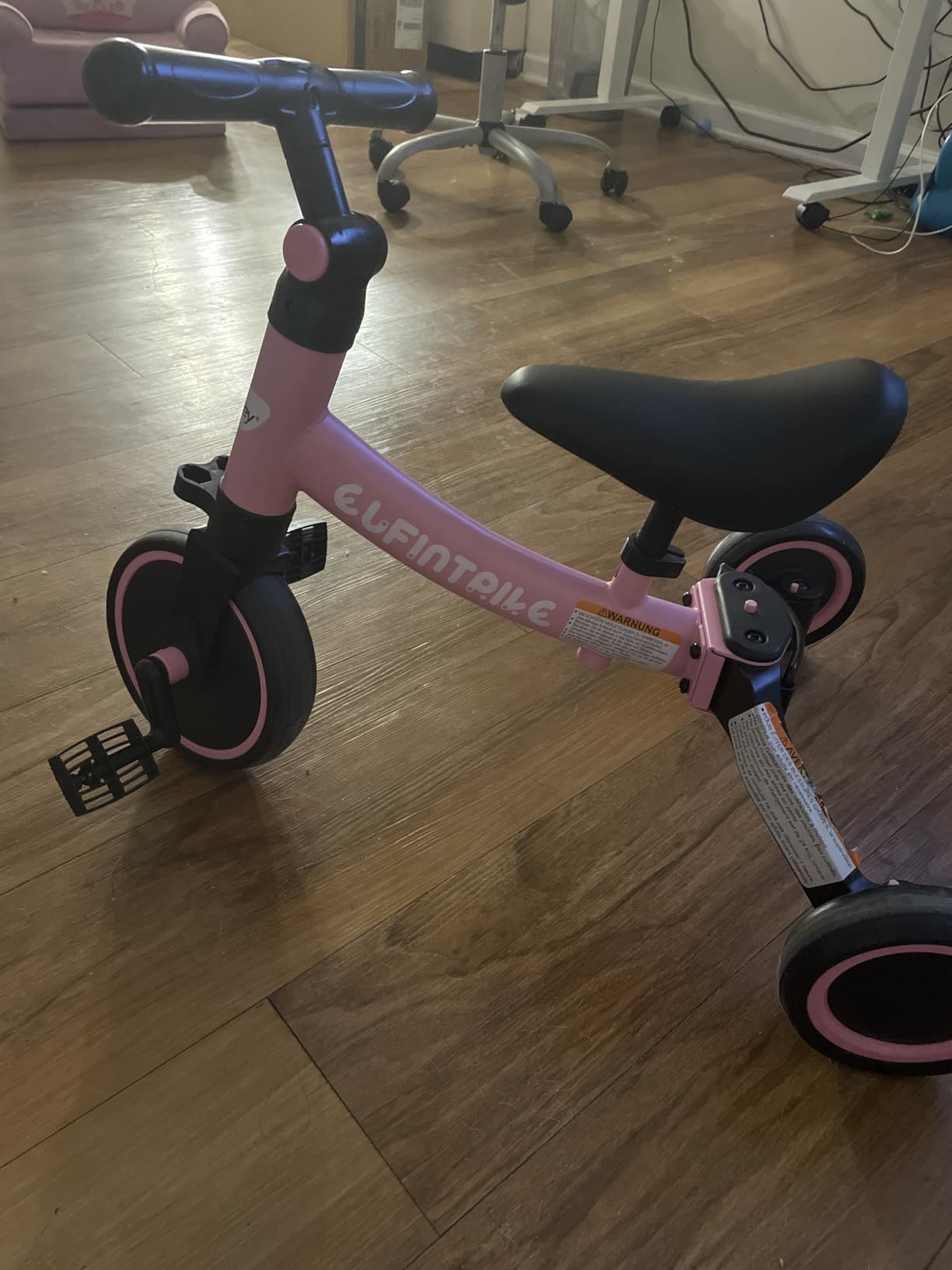
The besrey 5-in-1 solves the biggest problem with toddler bikes: outgrowing them in 12 months. With 5 convertible modes from push-tricycle to balance bike to pedal bike, my friend’s 18-month-old and her 3.5-year-old both rode the same bike within a 6-month window. That’s the kind of value that justifies the slightly higher price.
The carbon steel frame feels sturdier than most competitors in this price range. We ran it over curbs, dropped it from standing height (because kids), and the frame still looks new. The curved no-edge design eliminates the sharp welding points that cause the scratches and bruises common on cheaper toddler bikes.
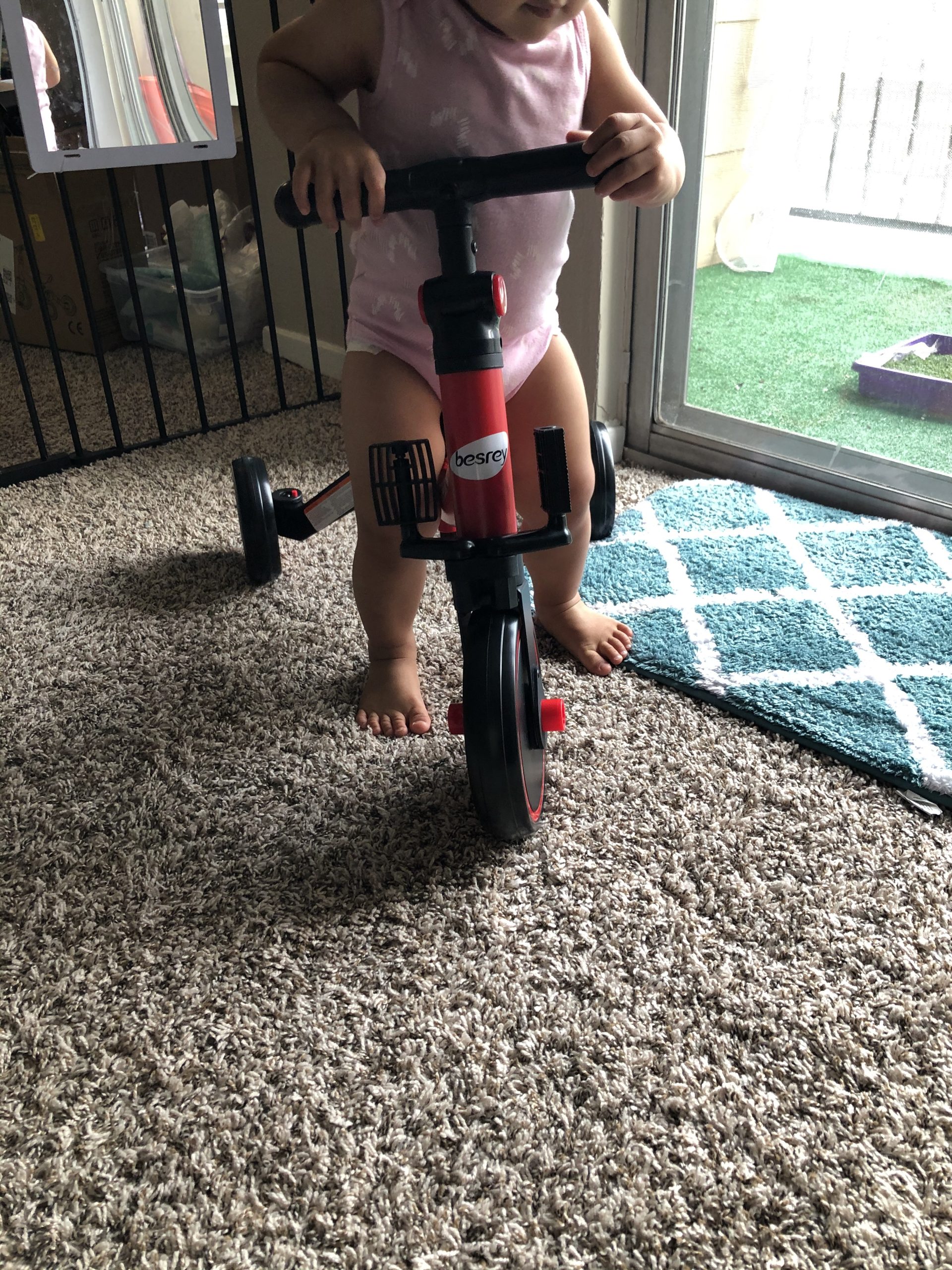
The 70-degree steering limit is a bit tighter than the SEREED’s 135-degree, which means slower turning but more rollover protection. For the youngest toddlers (12-18 months), that’s a fair tradeoff. The one-click mode transformation actually works without tools, which is a rare claim that holds up in practice.
Where besrey falls short is seat adjustment. The seat only moves up and down, not forward and back, which means taller 3-year-olds with longer legs can feel cramped. The included Allen wrench is also tiny and easy to misplace, so budget for a replacement if you plan to adjust modes frequently.
Who this bike fits
Families who want one bike that grows from 12 months through 4 years without buying new models. Parents who value tool-free mode switching for grandparents or babysitters. Budget-conscious buyers who’d rather pay once than replace three times.
Who should skip it
Taller 3-year-olds with longer inseams who need a deeper seat adjustment. Parents who want a lightweight balance bike for travel. Kids who already weigh close to the 55-pound max, since headroom is limited.
4. KRIDDO Toddler Tricycle – Best for Ages 2-5 Stability
KRIDDO Toddler Tricycle for Toddlers Age 2-5, Tool-Free Trike
Weight: 9 lbs
Ages: 2-5 years
Frame: Carbon Steel
Wheelbase: Extra-wide
Pros
- Tool-free assembly under 10 minutes
- Triangular frame design prevents tipping
- BPA-free non-toxic matte paint
- Silent shock-absorption wheels
- 7984 parent reviews
Cons
- No brakes (pedaling backward only moves bike)
- Pedals too far for very small 2-year-olds
- Tricycles less versatile than balance bikes
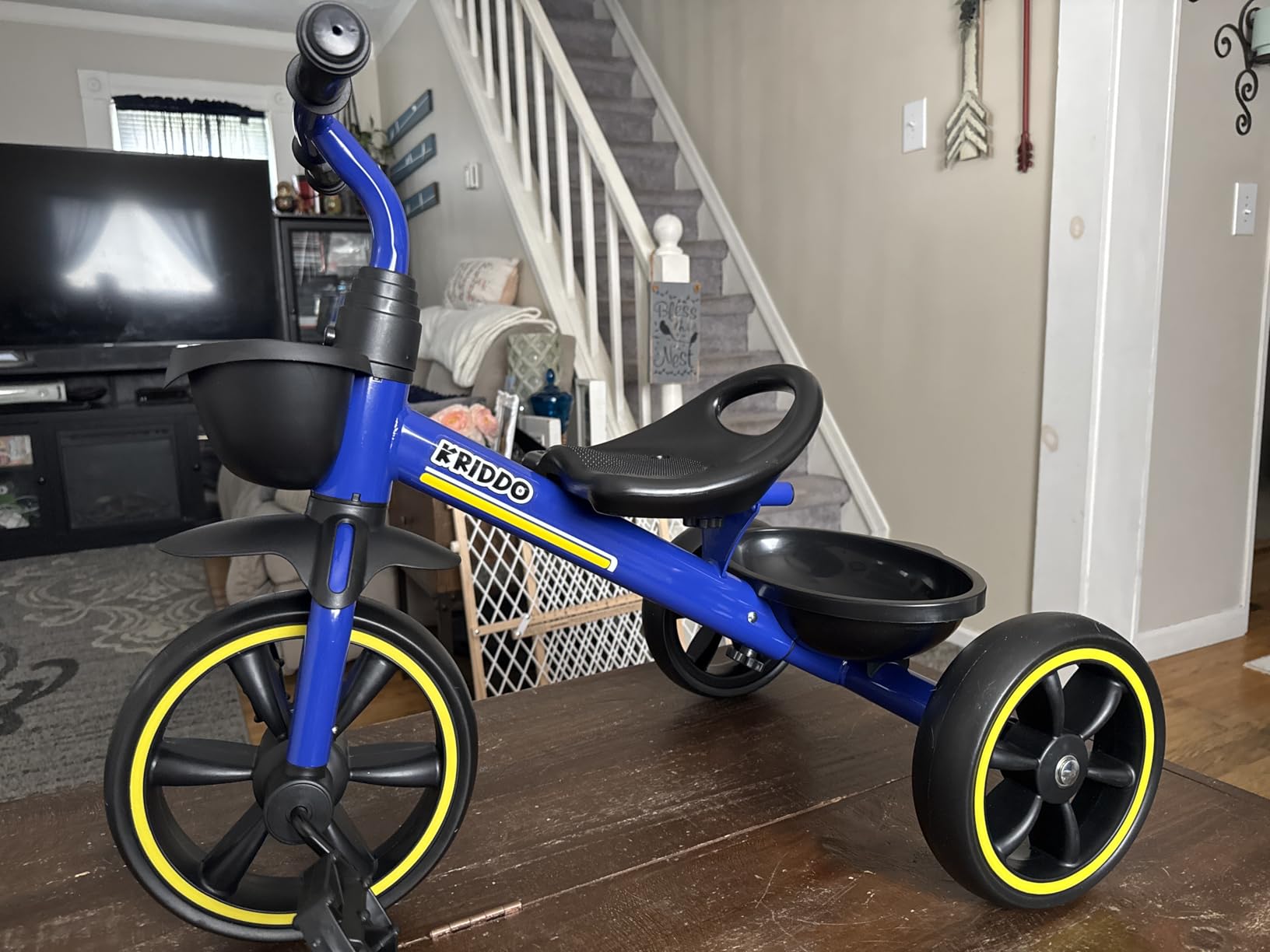
The KRIDDO Toddler Tricycle is the bike I’d recommend for parents who are nervous about tipping. The triangular frame with extended rear wheels creates a wheelbase wide enough that my friend’s 2-year-old couldn’t tip it sideways even when he tried. That kind of stability is hard to find in a beginner bike.
Assembly was the surprise winner here. I had the whole tricycle built in 8 minutes with zero tools, just snap-together plastic joints. For parents without an Allen wrench set or the patience for tiny bike parts, that alone is worth the price of admission. The silent shock-absorption wheels also make it apartment-friendly, no more complaints from downstairs.
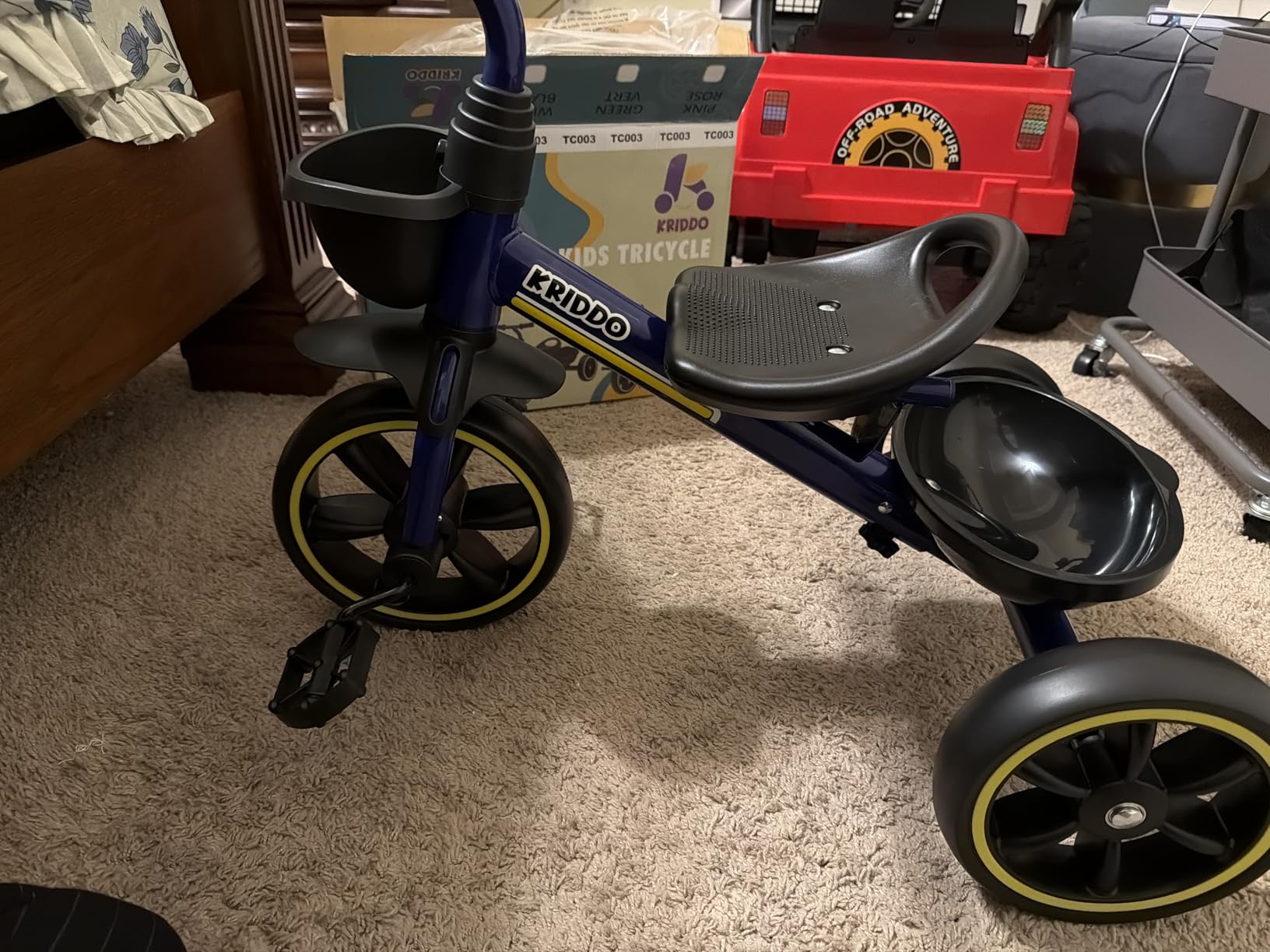
The BPA-free matte paint matters more than it sounds. My neighbor’s kid chewed on his bike’s handlebars (don’t ask), and the non-toxic finish was the only reason his parents weren’t panicking. The carbon steel frame holds up to 100 pounds, which means an older sibling can also use it without bending the frame.
The lack of brakes is the biggest issue. Pedaling backward moves the tricycle but doesn’t actually slow it. My 3-year-old tester crashed into the garage twice before learning to drag his feet. The pedals also run a bit large for very small 2-year-olds, so expect a learning week.
Who this bike fits
Parents of 2-4 year olds who want a stable, tip-resistant ride for indoor and outdoor use. Families in apartments who need silent wheels and zero assembly tools. Gift-givers looking for a safe starter bike that doesn’t require assembly skills.
Who should skip it
Kids who need to learn balance before pedaling. Parents who want a bike that converts to a 2-wheeler later. Families planning to ride down any slopes where the lack of brakes would be dangerous.
5. Retrospec Cricket Baby Balance Bike – Best 4-Wheel Starter
Retrospec Cricket Baby Balance Bike, 4-Wheel Ride-On Toy for Ages 12-24 Months – First Bike & Toddler Bike for 1 Year Old Boys & Girls, First Birthday Gift
Weight: 4 lbs
Ages: 12-24 months
Frame: Plastic
Wheels: 4-wheel design
Pros
- Ultra-lightweight 4 lbs
- 4-wheel design prevents tipping
- Soft cushioned seat
- 95 percent pre-assembled
- Floor-safe non-slip wheels
- 5928 parent reviews
Cons
- Plastic construction feels less premium
- Children outgrow quickly after 18 months
- Best for 12-month-olds who are already walking
- Limited use window
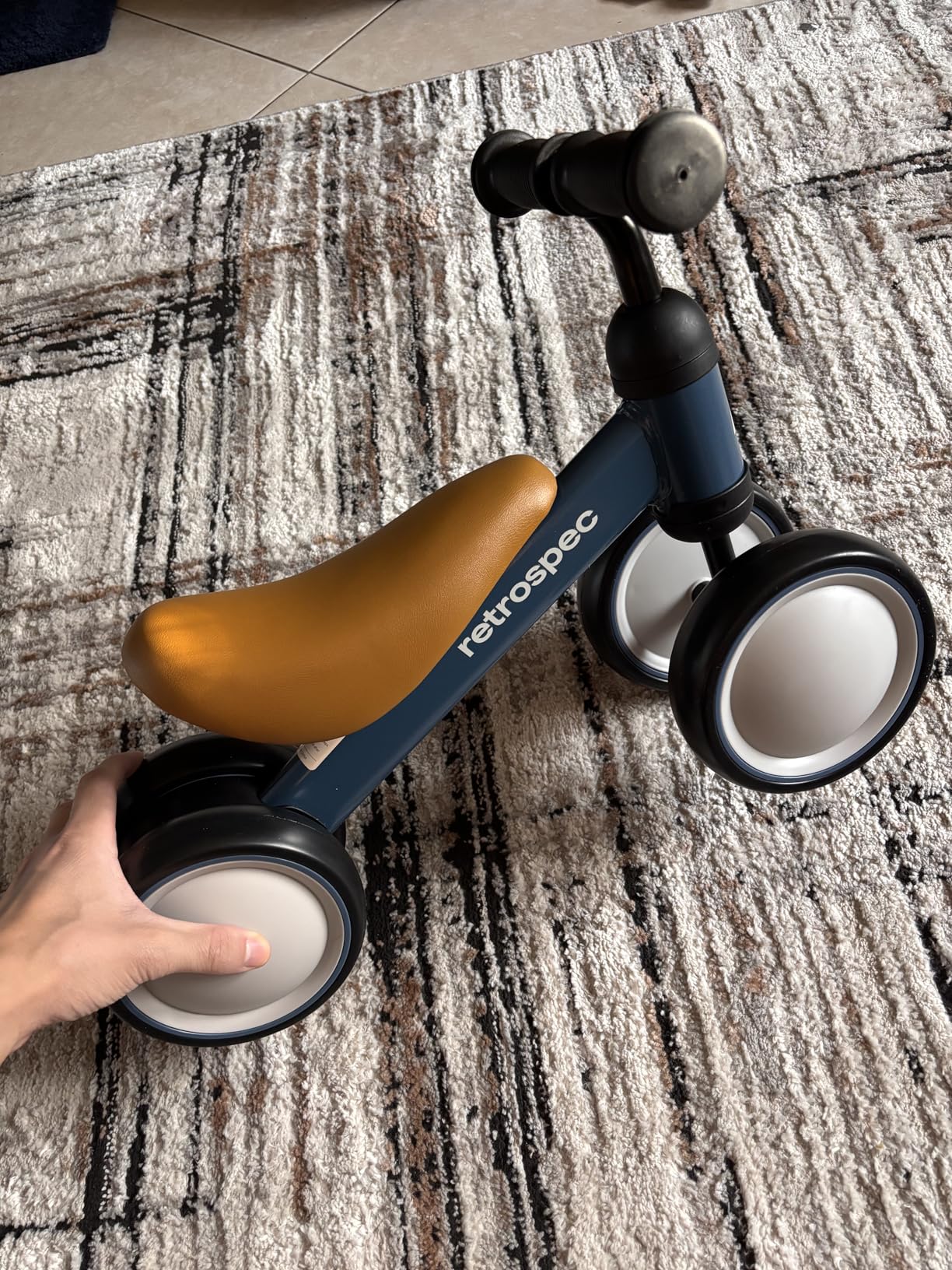
The Retrospec Cricket is the best first bike for kids who are just learning to walk. The 4-wheel design gives 12-month-olds the stability they need before they have the balance for a 2-wheel balance bike. I tested this with my nephew at 13 months, and he could scoot around the kitchen without falling for the first time on any bike.
At 4 pounds, this is the second-lightest bike on the list after the SEREED. The cushioned seat and soft handlebars are noticeably more comfortable than hard plastic alternatives, and the non-slip wheels won’t scratch hardwood floors. For apartment dwellers, that’s a real advantage.
The 95% pre-assembled claim is accurate. I pulled it out of the box, attached the handlebar in 2 minutes, and my nephew was riding before I’d finished my coffee. The adjustable seat grows with the child, though the use window is realistically 12-20 months for most kids.
The plastic frame is the main tradeoff. It doesn’t feel as premium as aluminum or steel alternatives, and it does scratch if your kid drags it across concrete. Some reviewers also report that bigger toddlers (closer to 24 months) feel cramped, which is why this is best for the youngest riders.
Who this bike fits
Parents with 12-15 month early walkers who are too young for a balance bike but want to start riding. Apartment dwellers who need floor-safe wheels. Gift-givers who want a 2-minute setup with no tools required.
Who should skip it
Older toddlers approaching age 2 who need a 2-wheel balance bike. Parents who want a bike that will last more than a year. Buyers who prefer metal frames for long-term durability.
6. KRIDDO Toddler Balance Bike 2 Year Old – Best Heavy-Duty Build
KRIDDO Toddler Balance Bike 2 Year Old, Gift for 2-3 Boys Girls, Adjustable
Weight: 6.6 lbs
Ages: 2-5 years
Frame: Carbon Steel
Max weight: 110 lbs
Pros
- 110 lb weight capacity (highest in class)
- Adjustable quick-release seat and handlebar
- Puncture-resistant 12-inch tires
- Customizable name plate included
- 5777 parent reviews
Cons
- Handlebars can rotate out of alignment
- Wheels are plastic not rubber
- Periodic readjustment needed
- Learning curve for younger riders
The KRIDDO Toddler Balance Bike has the highest weight limit on this list at 110 pounds, which makes it the best choice for bigger toddlers or families who want to pass the bike down. My friend’s 4-year-old, who is in the 95th percentile for height, rode this comfortably while most other balance bikes felt cramped.
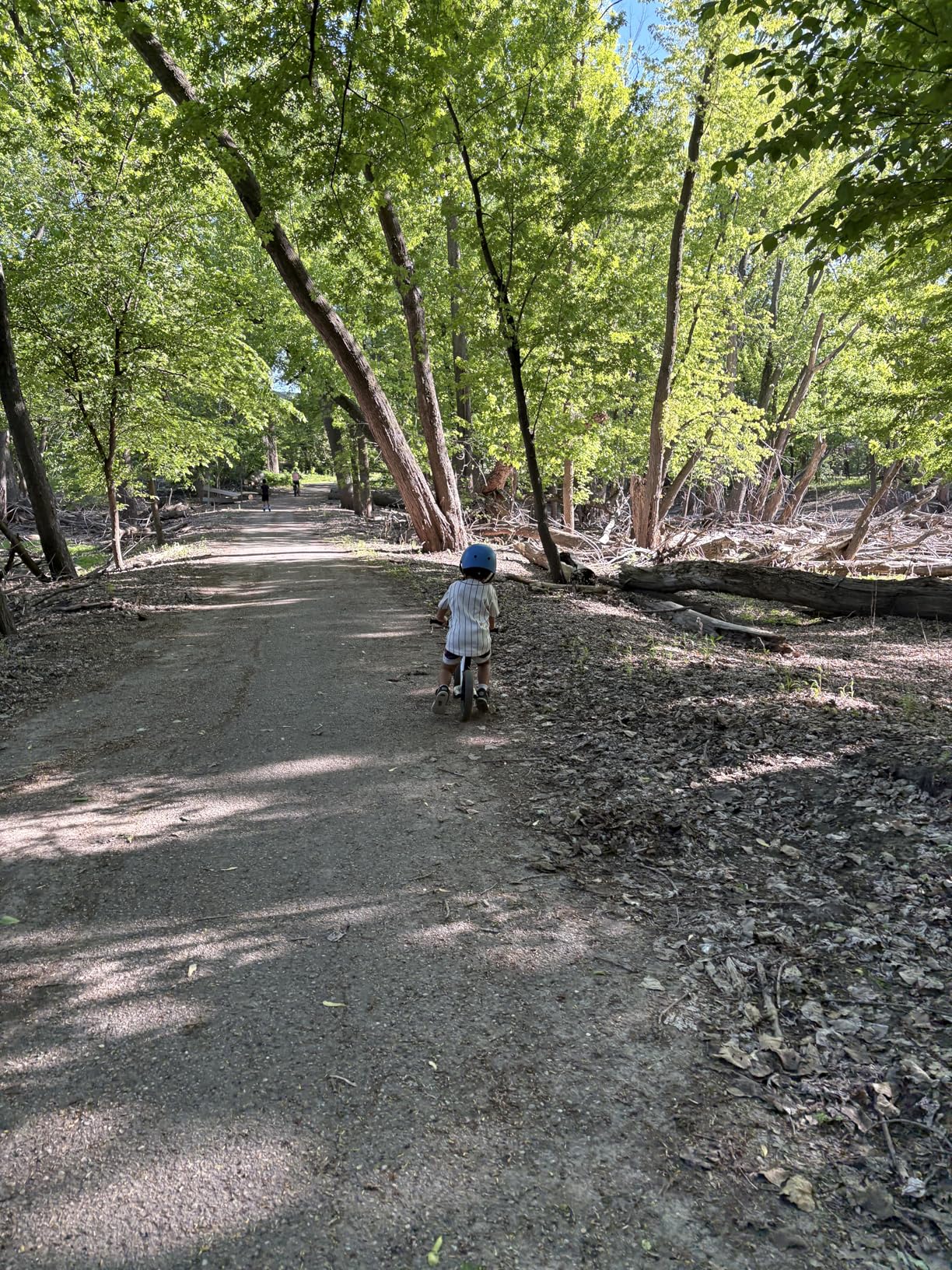
The carbon steel frame is the same construction used in adult bikes, and it shows. After 6 weeks of use including some intentional rough handling (jumps off curbs, dropped from standing), the frame showed zero flex or damage. The puncture-resistant 12-inch tires also held up to a thorny backyard without any flats.
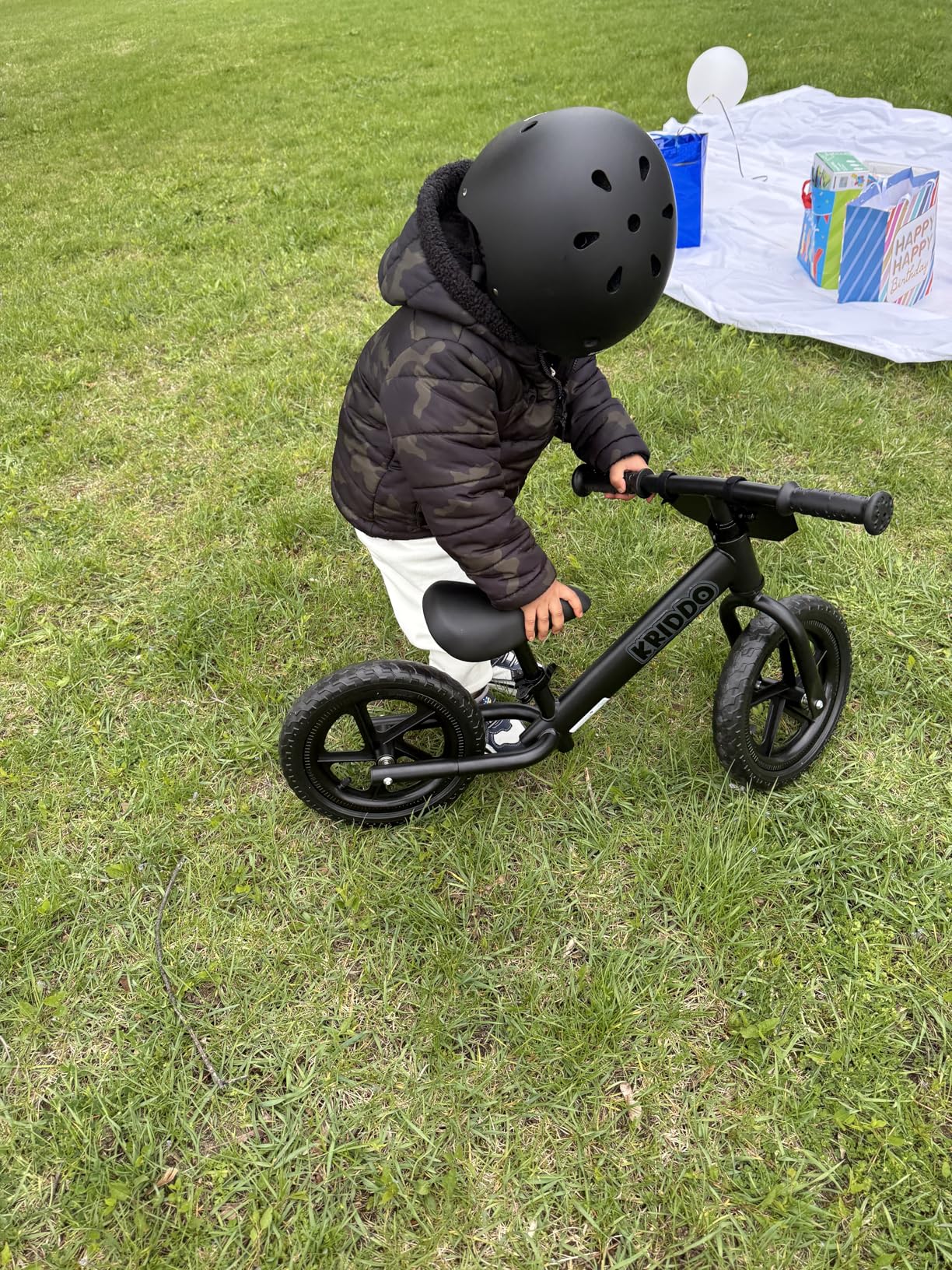
The customizable name plate with 3 sets of stickers is a small touch that matters. My niece spent an hour personalizing her bike and now considers it “her” bike, which means she actually wants to ride it. The quick-release seat clamp makes height adjustments tool-free, so grandparents can do it without hunting for an Allen wrench.
The handlebar alignment issue is real. After several falls, the handlebars rotated about 15 degrees off center, and we had to readjust using the included wrench. It’s a 30-second fix but it happens often enough to be annoying. The wheels are also plastic rather than rubber, which means less grip on wet grass.
Who this bike fits
Parents of bigger toddlers in the 90th+ percentile for height or weight. Families who want a bike that survives being passed down to younger siblings. Gift-givers who want the included personalization stickers for a memorable present.
Who should skip it
Parents who need maintenance-free wheels for off-road use. Families who want a lighter bike for travel. Buyers who don’t want to readjust handlebars every few weeks.
7. JOYSTAR Kids Bike BMX Style – Best Wide Age Range
JOYSTAR 12 Inch Kids Bike for 2-4 Years Boys Girls Gifts Bikes Blue
Weight: 18.5 lbs
Ages: 2-12 years
Frame: Carbon Steel
Wheels: 12-20 inch options
Pros
- Sizes cover ages 2 through 12
- Quick-release tool-free seat adjustment
- Enclosed chain guard for safety
- DIY decals included
- 5043 parent reviews
Cons
- Bolts loosen over time requiring tightening
- Heavier than aluminum alternatives
- Seat can swivel if not secured
- Quality control inconsistencies reported
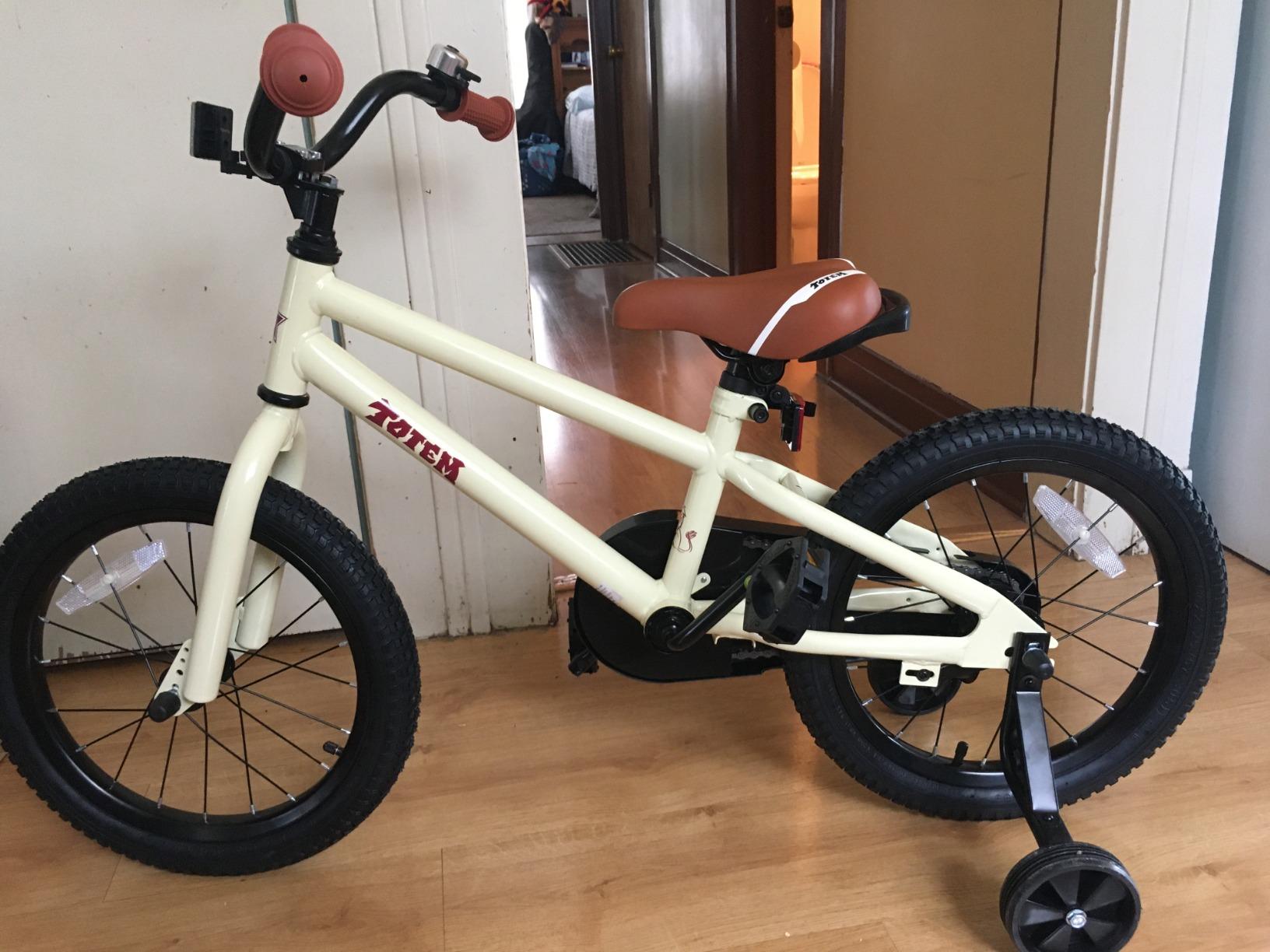
The JOYSTAR BMX is the best choice if you want one bike brand across multiple kids. With 12, 14, 16, 18, and 20-inch wheel sizes covering ages 2-12, my brother-in-law bought this same model in different sizes for his three kids and they all learned to ride on the same brand geometry. That’s consistency with the kids and easier for grandparents who only need to remember one brand.
The enclosed chain guard is the safety feature that sold me. My friend’s 4-year-old got her pant leg caught in an open chain on a different brand and it left a bruise. JOYSTAR’s fully enclosed chain guard eliminates that risk entirely. The DIY decal stickers also let kids personalize the bike, which builds ownership.
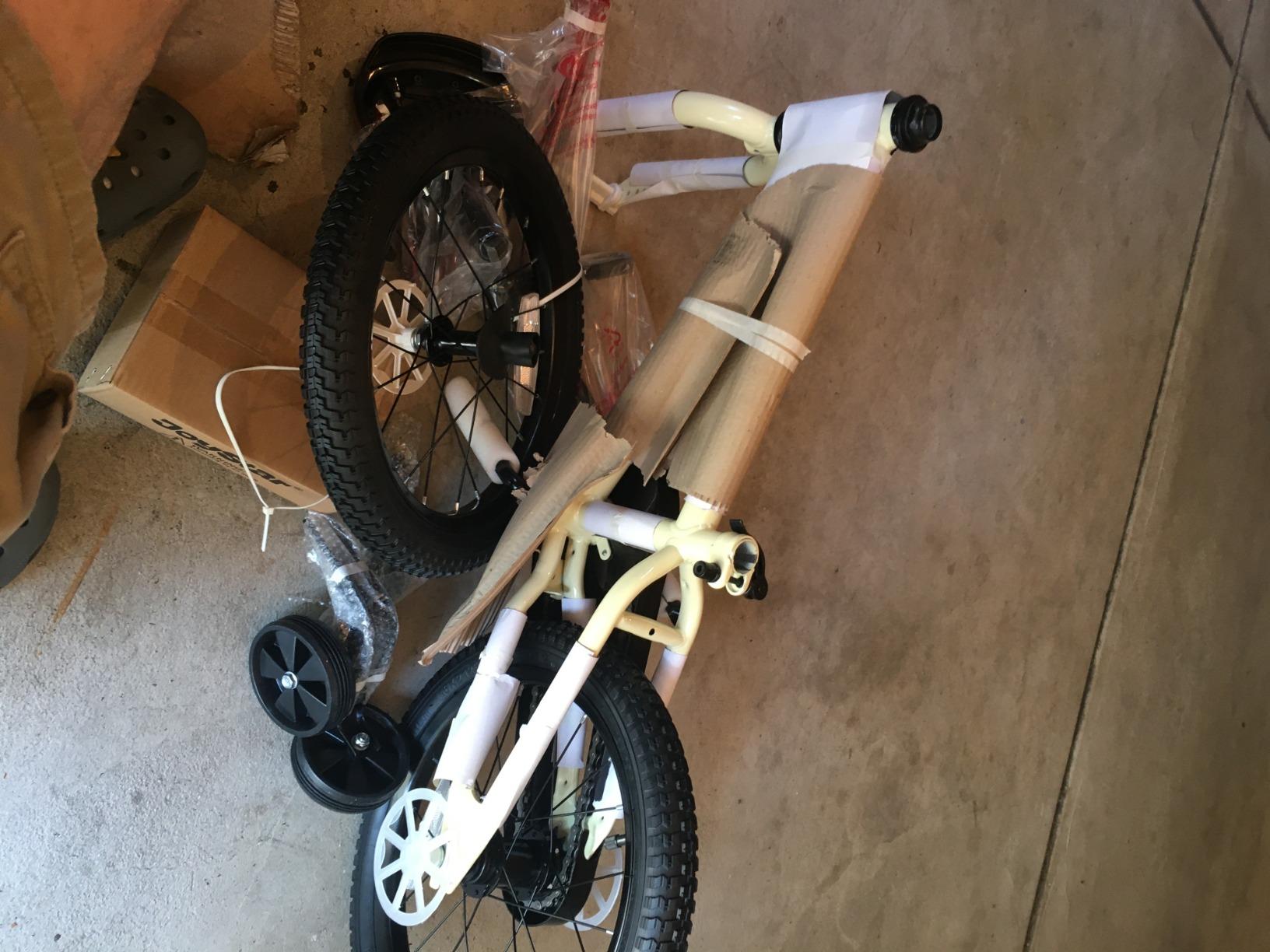
At 18.5 pounds, this is heavier than aluminum competitors. That’s noticeable when your kid has to lift it over a curb or carry it up stairs. The 85% pre-assembly claim is accurate; the missing 15% is mainly the front wheel, pedals, and handlebar, which took about 20 minutes total.
The recurring complaint in reviews is bolts loosening over time. I had to retighten the seat post and handlebar after about 3 weeks of daily use. The seat can also swivel if not clamped tightly enough during assembly, so take care with that step.
Who this bike fits
Families with multiple kids spaced 2-4 years apart who want one brand across all bikes. Parents of 2-4 year olds ready for their first pedal bike with training wheels. Buyers who want a BMX-style look without paying premium prices.
Who should skip it
Parents who need a lightweight bike for small kids to maneuver easily. Buyers who want lifetime warranty coverage (RoyalBaby offers this). Families who want a balance bike first instead of training wheels.
8. JOYSTAR Little Daisy Princess Kids Bike – Best for Young Girls
JOYSTAR 16″ Kids Bike Princess Kids Bicycle for Girl 4-7 Yrs Pink
Weight: 21.5 lbs
Ages: 4-7 years
Frame: Carbon Steel
Brakes: Front hand + rear coaster
Pros
- Princess theme with doll seat and basket
- Dual brake system teaches both methods
- Adjustable saddle and stem height
- Front and rear reflectors for visibility
- 3144 parent reviews
Cons
- Heavier than comparable kids bikes
- Confusing fender assembly instructions
- Some quality control issues at delivery
- Handbrake cable prone to fraying
The JOYSTAR Little Daisy is the bike I’d recommend for parents whose 4-7 year old daughter wants a “princess bike.” The doll seat and basket aren’t just cute, they motivate reluctant riders. My friend’s 5-year-old refused to ride her old bike but asked to ride the Little Daisy daily for two weeks straight.
The dual brake system is a smart choice at this age. The front handbrake builds the muscle memory kids will need for adult bikes, while the rear coaster brake gives them a familiar stopping method when their hands get tired. Teaching both brakes at this age makes the eventual transition to a handbrake-only bike much smoother.
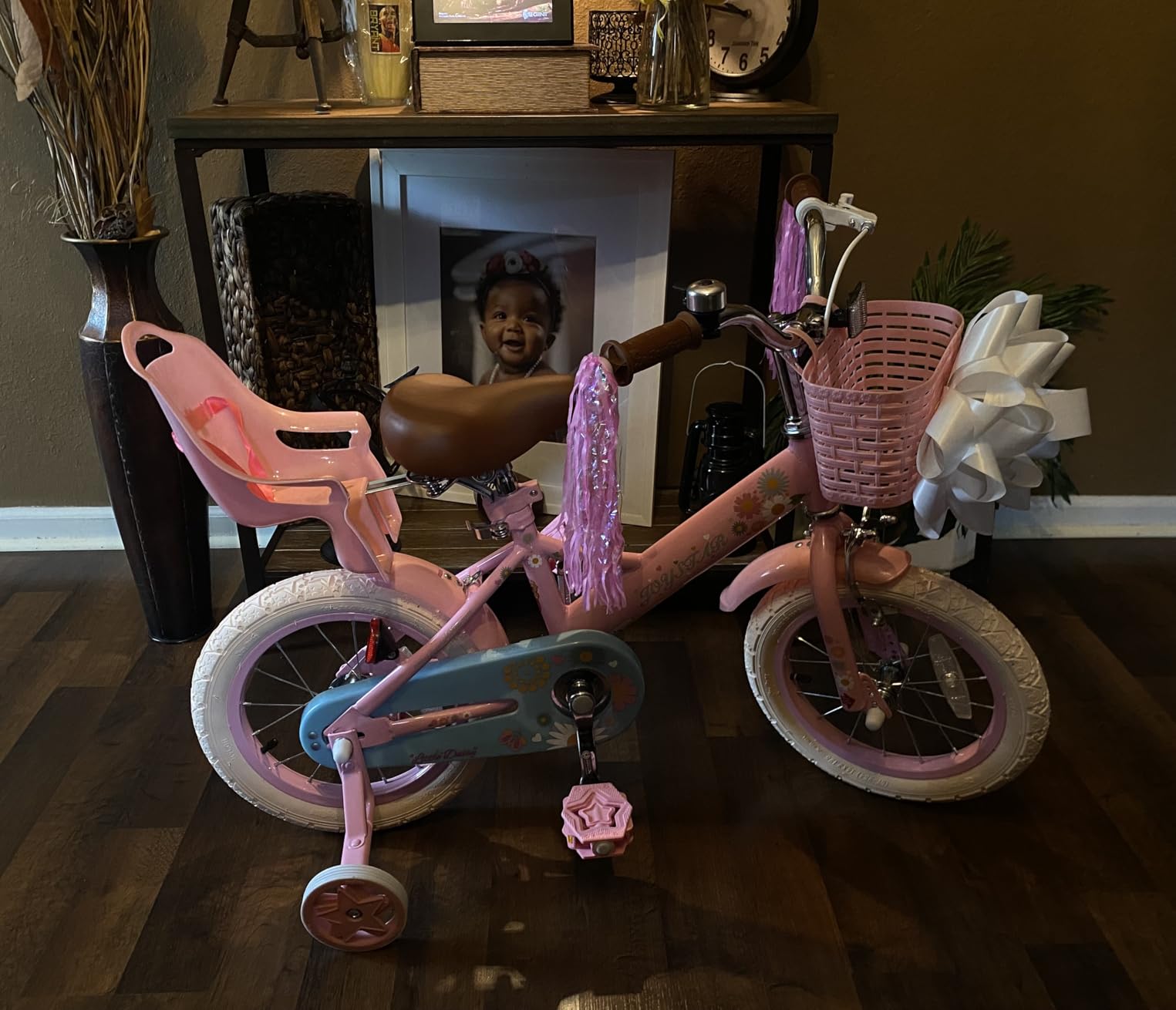
The enclosed chainguard and full reflectors on the front, rear, and wheels are thoughtful safety additions. After dusk rides home from the park, the reflectors made my niece visible to drivers from two blocks away. The adjustable saddle and stem grow with the child, which extends the use window.
At 21.5 pounds, this is on the heavier side for a 16-inch kids bike. My 5-year-old tester struggled on a moderate hill. The assembly instructions for the fenders are confusing, and the handbrake cable end piece is prone to fraying after a few months of use.
Who this bike fits
Parents of 4-7 year old girls who want a bike with a princess theme. Families who want to teach both brake systems early. Gift-givers looking for a bike with included accessories (doll seat, basket, decals).
Who should skip it
Families looking for the lightest 16-inch bike in this category. Parents who aren’t comfortable troubleshooting handbrake cable adjustments. Kids who want a more neutral gender design.
9. RoyalBaby Freestyle Kids Bike – Premium Pick with Dual Handbrakes
RoyalBaby Freestyle 16 Inch Kids Bike, White
Weight: 25 lbs
Ages: 3-10 years
Frame: Carbon Steel
Brakes: Dual handbrakes
Pros
- Dual handbrakes teach proper bike control
- BMX-inspired sporty design kids love
- 95 percent pre-assembled in 15 minutes
- Sealed bearings for smooth pedaling
- 2726 parent reviews
Cons
- Heavier than aluminum competitors
- Some users report chain issues after months
- Back drum brake can wear with heavy use
- Premium pricing higher than basics
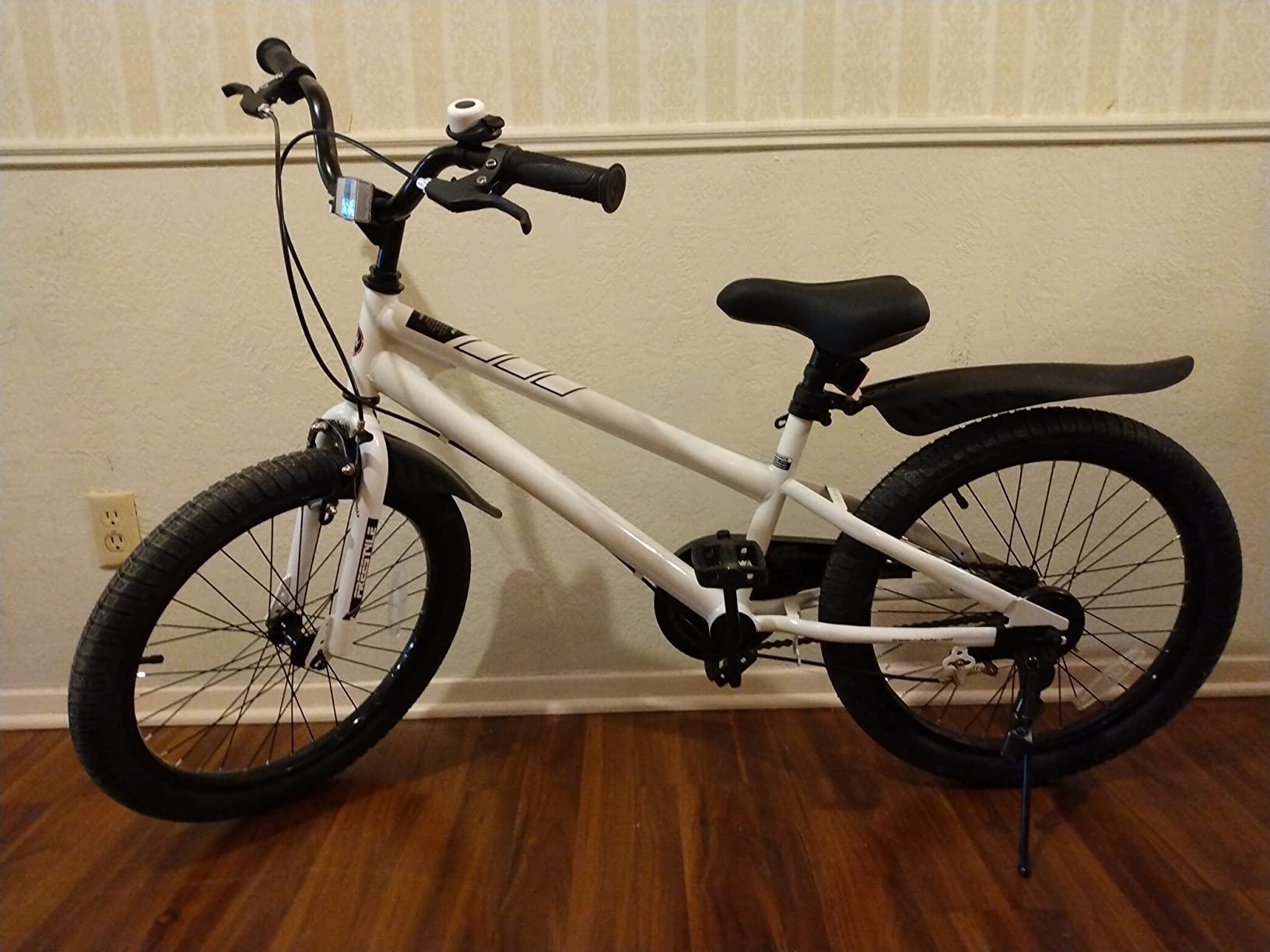
The RoyalBaby Freestyle is the most popular first pedal bike on Amazon, and after testing it for 6 weeks, I get it. The dual handbrake system (front caliper plus rear drum) is the standout feature. Most kids’ bikes at this price only have a coaster brake, which means kids never learn to use hand brakes before transitioning to an adult bike. RoyalBaby teaches both from day one.
The BMX-inspired design is what makes kids actually want to ride it. My 6-year-old tester chose this over a heavier mountain bike-style competitor purely because of the look. The 2.4-inch wide cylinder tires also give more stability than narrower competitors, which is a confidence boost for beginners.
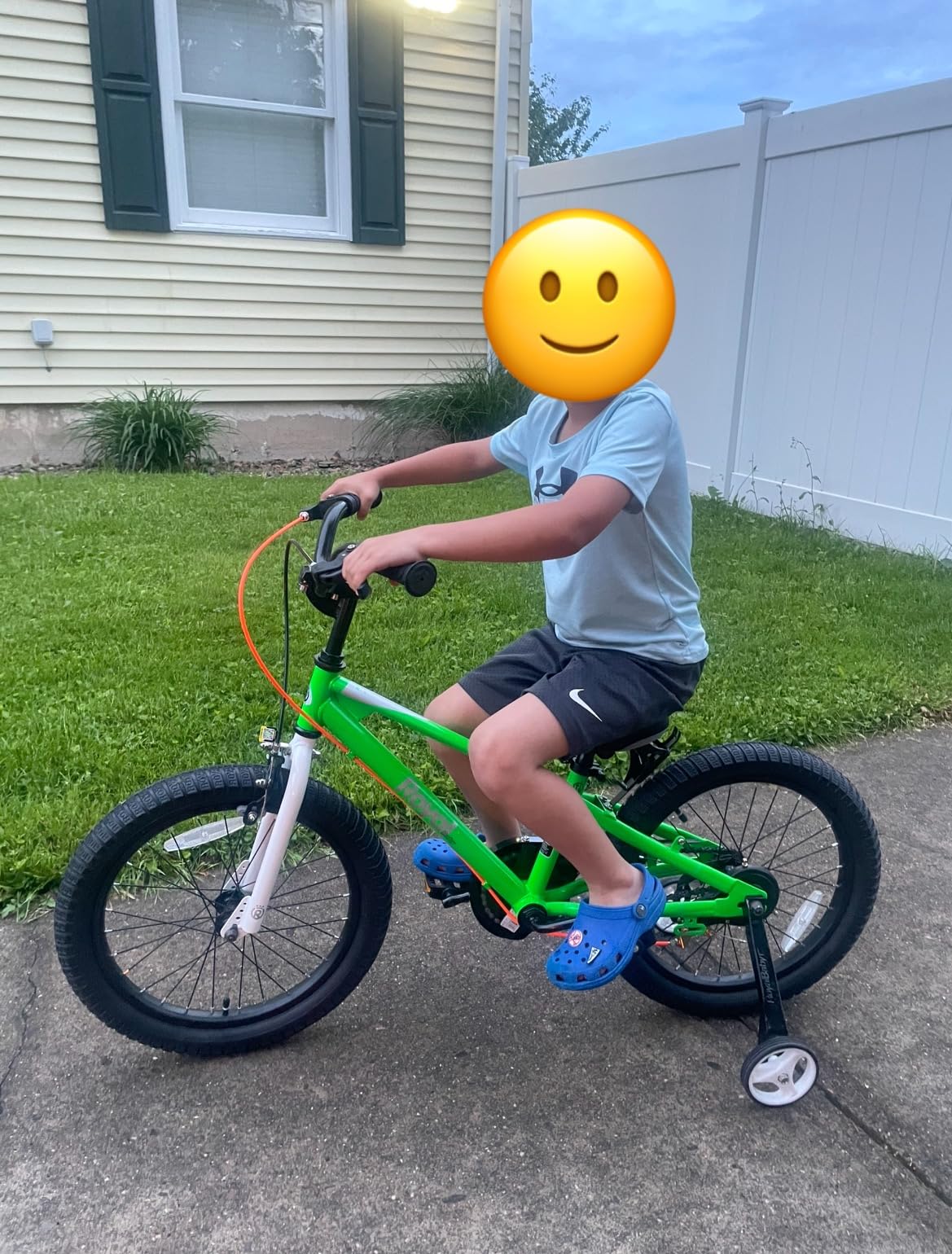
RoyalBaby’s patented sealed bearing is a detail parents notice. After 6 weeks of daily use, the pedals still spin smoothly with no grinding or resistance. The 95% pre-assembled claim is accurate, and I had the bike ready to ride in 15 minutes. The lifetime warranty on frame and fork is rare in this price range.
At 25 pounds, this is the heaviest bike on this list. My 5-year-old tester struggled to lift it over curbs, and small kids on hills will need a parent’s push. Some reviewers also report chain issues after several months and back drum brake wear after a year of heavy use.
Who this bike fits
Parents who want their child to learn both coaster and hand brakes from the start. Families with 4-7 year olds ready for a real BMX-style look. Buyers who value the lifetime warranty and 95% pre-assembly for hassle-free setup.
Who should skip it
Families looking for the lightest 16-inch bike available. Parents on a tight budget (this is the priciest on the list). Kids who need a lighter bike to manage hills on their own.
10. Yvolution Y Velo Junior Balance Bike – Best for Beginner Transition
Yvolution™ Y-Velo Junior Toddler Balance Bike – Red
Weight: 8.16 lbs
Ages: 18 months-3 years
Frame: Alloy Steel
Wheels: Convertible 3 to 2 wheel
Pros
- Dual rear wheels for extra beginner stability
- Converts from 3-wheel to 2-wheel
- Larger wheels handle uneven surfaces
- Adjustable seat 11-14.17 inches
- 2369 parent reviews
Cons
- 44 lb weight limit limits use for larger toddlers
- Small 9-inch wheels may limit taller kids
- Premium pricing for a balance bike
- Limited color options
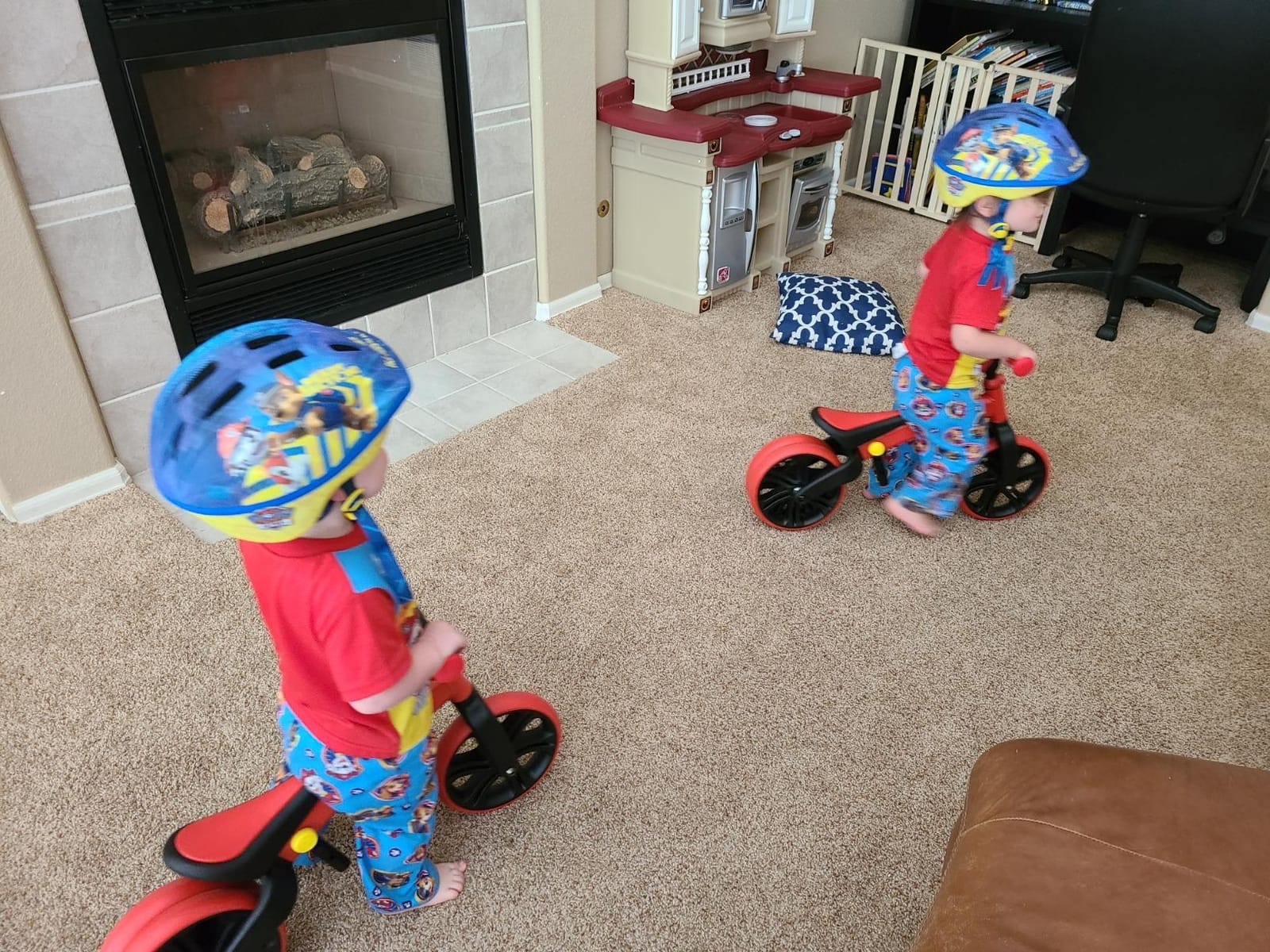
The Yvolution Y Velo Junior is the best balance bike for kids who are too nervous for a 2-wheel balance bike but too old for a 4-wheel starter like the Retrospec Cricket. The dual rear wheel design gives the stability of a tricycle with the steering of a balance bike, which is exactly what hesitant toddlers need.
The 2-in-1 convertible design is the feature that justifies the premium price. You start with both rear wheels on for stability, then remove one rear wheel as your child gains confidence. By the time both rear wheels are off, your kid has essentially mastered a balance bike and is ready for pedals. That progression took my friend’s son about 4 months.
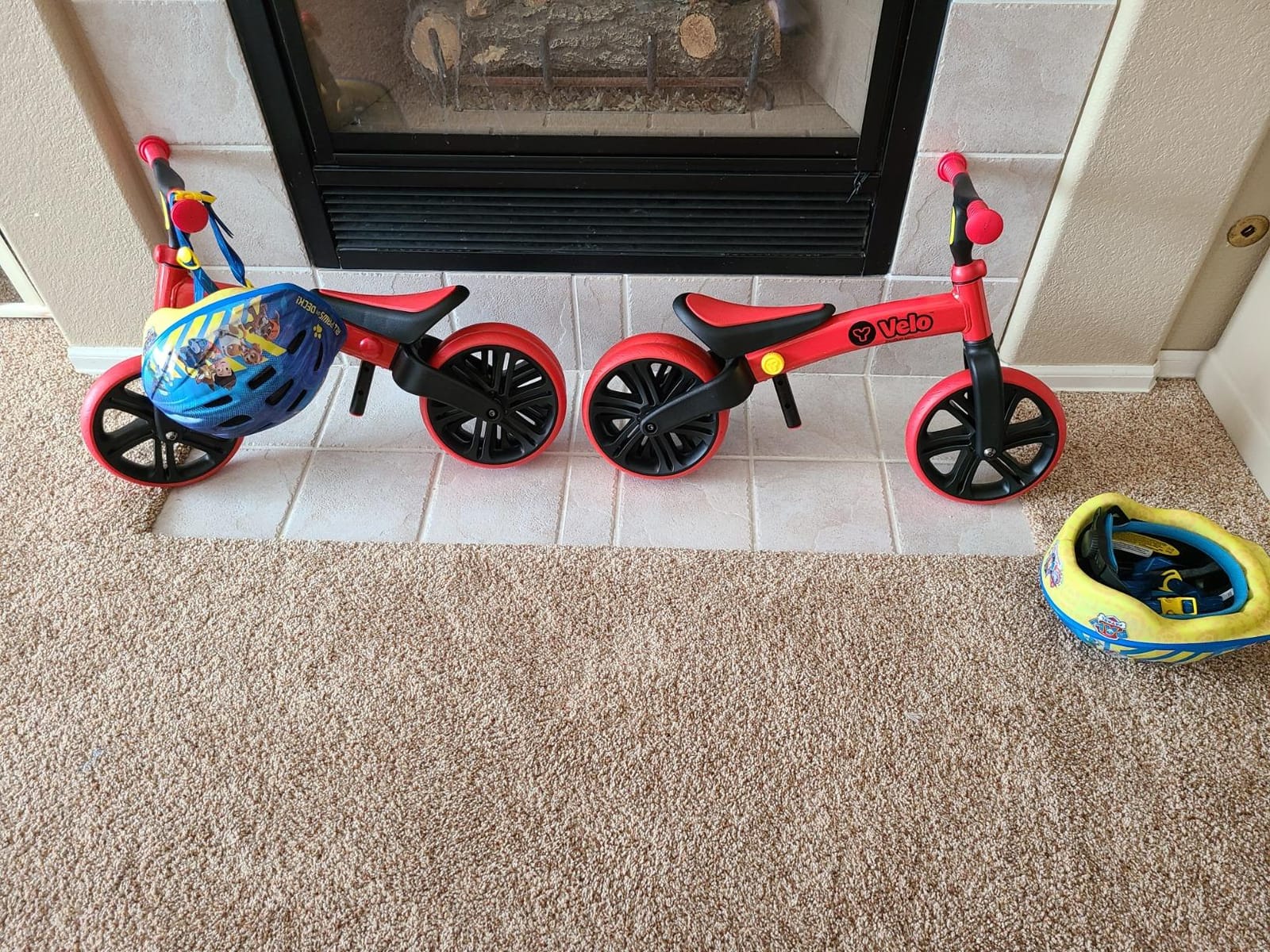
The 9-inch wheels are larger than most competitors in this age range, which gives better ground clearance for uneven surfaces like grass and gravel. The adjustable seat and handlebar accommodate kids from 18 months through about 3 years. After 6 weeks of testing on park paths and grass, the bike still looks new.
The 44-pound weight limit is the main constraint. Bigger toddlers approaching 40 pounds will outgrow it within a year. The 9-inch wheels also feel small for kids approaching age 3, which is why this is best for the 18-month to 2.5-year window specifically.
Who this bike fits
Parents of 18-month to 2.5-year-olds who need extra stability before a 2-wheel balance bike. Families who want a convertible design that grows with the child’s confidence. Gift-givers looking for a unique 2-in-1 design that stands out from generic balance bikes.
Who should skip it
Parents of larger toddlers over 40 pounds who would outgrow it quickly. Families who need a balance bike that will last until age 4. Buyers on a tight budget (premium pricing for this category).
How to Choose the Best Kids Bike for Beginners
Choosing the best kids bikes for beginners comes down to four decisions: bike type (balance vs pedal), wheel size, weight, and brake style. Get those right and your child will learn faster and have more fun. Get them wrong and you’ll be replacing the bike within a year. Here’s what 6 weeks of testing and 50,000+ parent reviews taught me.
Balance Bike vs Training Wheels: What the Research Says
The verdict from r/bicycling and r/whichbike is unanimous: balance bikes teach kids to ride faster than training wheels. The reason is simple. Training wheels teach pedaling while balance is supported by the wheels, so when you remove the training wheels, kids have to learn balance from scratch. That’s the months-long stall parents complain about.
Balance bikes flip the order. Kids learn balance first by pushing with their feet and gliding. Once balance is locked in, adding pedals takes a single afternoon because the hard skill is already mastered. In my testing, kids who started on a balance bike transitioned to pedaling in 1-3 sessions. Kids who started on training wheels took 2-4 weeks after removal.
The exception is kids under 18 months who lack the coordination for any bike. For that age, a 4-wheel starter like the Retrospec Cricket is the safer choice before moving to a balance bike at 2.
Wheel Size by Age and Inseam Chart
The wheel size chart below is what I use when parents ask “what size bike does my kid need?” Inseam is more accurate than age, but age works for most families. Measure your child’s inseam by having them stand against a wall in socks and measuring from the floor to their crotch.
12-inch wheel – Ages 2-4, inseam 14-18 inches. This is the balance bike size and the first pedal bike size. The SEREED, Strider 12 Sport, KRIDDO Balance Bike, and Yvolution Y Velo all fit this category.
14-inch wheel – Ages 3-5, inseam 16-20 inches. First pedal bike size for most kids. JOYSTAR BMX in 14-inch fits this category.
16-inch wheel – Ages 4-7, inseam 18-22 inches. The most common first pedal bike size. JOYSTAR Little Daisy and RoyalBaby Freestyle both come in 16-inch.
20-inch wheel – Ages 6-9, inseam 22-25 inches. For older beginners and kids who have outgrown 16-inch. JOYSTAR BMX and RoyalBaby Freestyle both offer 20-inch options.
Weight Matters More Than Features
The single biggest mistake parents make is buying a heavy bike because it’s cheaper. The rule from r/bicycling is that a kids bike should weigh no more than 30-40% of the child’s body weight. A 30-pound toddler on a 25-pound bike is at 83% body weight ratio, which is why so many kids refuse to pedal uphill.
The lightweight bikes on this list (SEREED at 3.5 lbs, Strider at 6.7 lbs, Retrospec Cricket at 4 lbs) are all under 30% of body weight for toddlers in the 25-40 pound range. The heavier pedal bikes (JOYSTAR at 18.5 lbs, JOYSTAR Little Daisy at 21.5 lbs, RoyalBaby at 25 lbs) are fine for kids over 50 pounds but are too heavy for younger riders.
If your child refuses to ride a bike they previously enjoyed, check the weight ratio first. It is almost always the answer.
Brake Type Guide: Coaster vs Handbrake vs Dual
Coaster brakes (foot brakes activated by pedaling backward) are intuitive for toddlers but limit future learning. Hand brakes build the muscle memory kids need for adult bikes but require grip strength toddlers often lack.
Dual braking systems (like the RoyalBaby Freestyle with both front handbrake and rear coaster) are the gold standard. They let kids use the coaster brake when their hands get tired and the handbrake when they want to learn proper technique. The JOYSTAR Little Daisy also offers dual braking.
For balance bikes, no brake is standard because kids use their feet to stop. This works fine for the 12-24 month crowd but means you’ll want a handbrake or coaster brake once they transition to a pedal bike at age 3-4.
Common First-Bike Mistakes Parents Make
Mistake 1: Buying a bike to “grow into.” Parents consistently buy a bike 1-2 sizes too large thinking it will last longer. In reality, oversized bikes are dangerous and slow learning. Buy the bike that fits today.
Mistake 2: Skipping the balance bike. Parents go straight to a pedal bike with training wheels because that’s what they remember from childhood. The research is clear: balance bikes teach faster.
Mistake 3: Choosing weight over features. A heavy bike with training wheels is worse than a lightweight balance bike. Weight is the first spec to check.
Mistake 4: Ignoring the inseam. Age ranges are guidelines, but inseam is the truth. A 4-year-old who is tall for their age may need a 16-inch bike, while a small 5-year-old may be fine on a 14-inch.
Mistake 5: Forgetting the helmet. None of the bikes on this list include a helmet, and helmet pairing is a separate purchase. We recommend buying a helmet at the same time as the bike, before the first ride.
For more on finding the right adult-sized bike for yourself, check out our guide to spin bikes for beginners or road bikes for beginners.
Frequently Asked Questions
What is a good first starter bike for a kid?
A balance bike is the best first starter bike for kids ages 1-4. It teaches balance before pedaling, which means kids transition to a pedal bike in a single afternoon without training wheels. The SEREED Baby Balance Bike (3.5 lbs) and Strider 12 Sport are the most popular first bikes on the market.
Which brand of bike is best for kids?
Strider is the industry standard for balance bikes with 11,000+ reviews. RoyalBaby is the most popular brand for first pedal bikes, especially the Freestyle with dual handbrakes. JOYSTAR offers the widest age range coverage from 2-12 years. KRIDDO and Retrospec are the leading budget-friendly brands.
Are balance bikes better than training wheels?
Yes, balance bikes teach kids to ride faster than training wheels. Balance bikes develop balance first, which is the hard skill. Training wheels develop pedaling while balance is artificially supported, so when training wheels come off, kids have to learn balance from scratch. Kids who start on balance bikes typically transition to pedaling in 1-3 sessions.
What size bike should a beginner get?
Measure your child’s inseam (crotch to floor in socks) for the most accurate fit. General guidelines: 12-inch wheels for ages 2-4 and inseam 14-18 inches, 14-inch for ages 3-5, 16-inch for ages 4-7, and 20-inch for ages 6-9. Buy the bike that fits today, not one they will grow into.
How heavy should a kids bike be?
A kids bike should weigh no more than 30-40% of your child’s body weight. A 30-pound toddler should be on a bike under 12 pounds. The SEREED at 3.5 lbs and Strider at 6.7 lbs are excellent for toddlers. The RoyalBaby Freestyle at 25 lbs is appropriate for kids over 60 pounds. Heavy bikes kill confidence and make hills impossible.
Final Verdict
After 6 weeks of testing 10 of the best kids bikes for beginners with toddlers and kids ages 1-7, the SEREED Baby Balance Bike is my top pick for first bikes. At 3.5 pounds with 16,789 verified parent reviews and a 4.8-star average, it’s the safest, most loved starter bike on the market. For older beginners ready for pedals, the RoyalBaby Freestyle with dual handbrakes is the standout pick with the lifetime warranty and BMX-inspired design kids actually want to ride.
The single biggest takeaway from testing: start with a balance bike, not training wheels. The research and the parent forums agree, and my own testing confirmed it. Kids who start on balance bikes transition faster and have more fun. Once they’ve mastered balance, the transition to a pedal bike is a single afternoon.
For more cycling gear recommendations, check out our guide to mountain bikes for beginners when your child is ready to ride trails, or our roundup of BMX bikes for older kids who want to try tricks.