
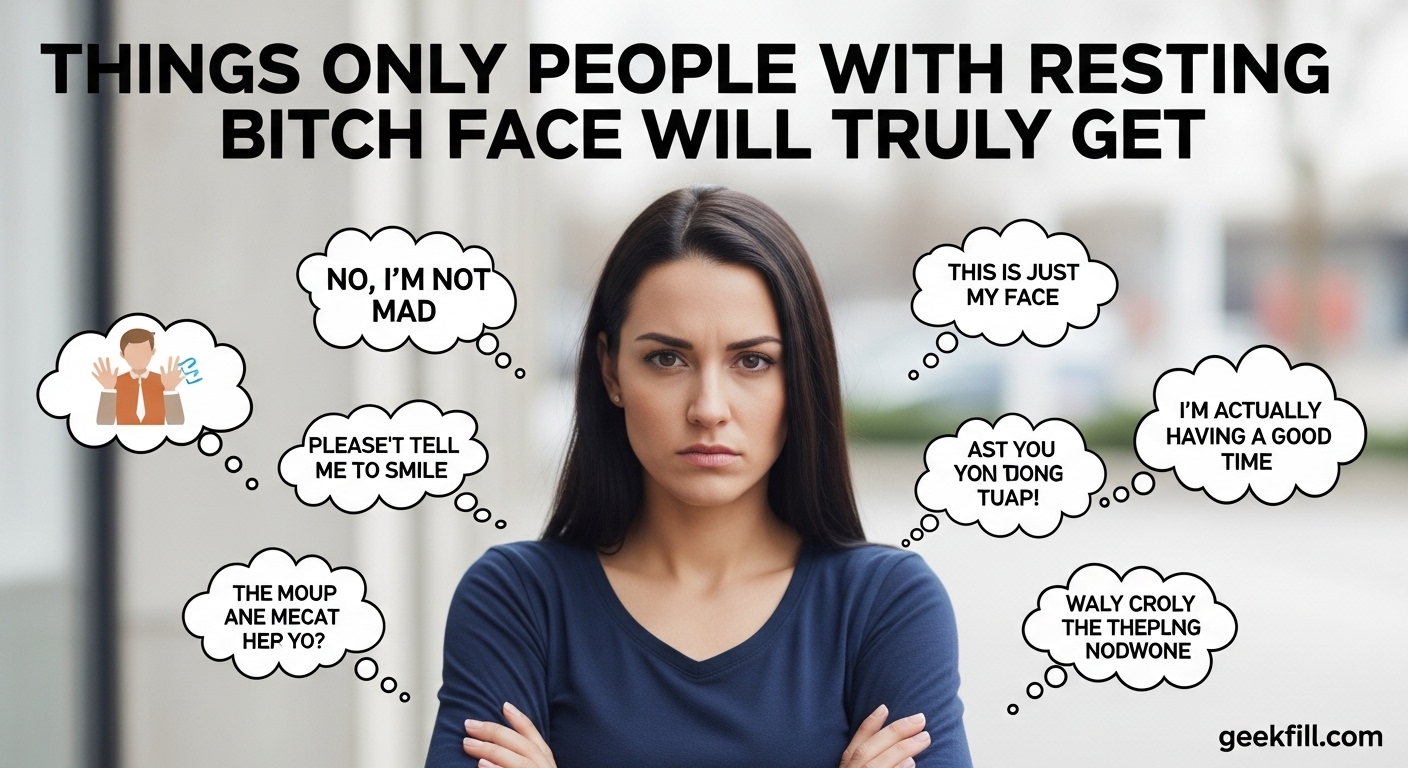
Resting Bitch Face (RBF) is that magical condition where your neutral expression accidentally broadcasts “I am judging your life choices and finding them wanting” to everyone within a ten-foot radius. You could be thinking about what to have for lunch, mentally calculating if you have enough milk at home, or genuinely enjoying a beautiful sunset. To the outside world, you look like you’re plotting someone’s demise.
The term exploded into popular culture around 2013 and has since become a badge of honor for those of us whose faces simply refuse to cooperate with social niceties. I have lived with RBF my entire life. I’ve been asked if I’m angry while reading a book I love, questioned about my mood while watching puppy videos, and approached with caution at parties where I was actually having a fantastic time.
This article is for everyone who has ever been told to “smile more” by a complete stranger. Here are 14 things that only people with resting bitch face will truly understand.
Table of Contents
1. People Asking If You’re Okay… Constantly
This starts early. Like, straight-out-of-the-womb early. People with RBF have been fielding concerned inquiries since childhood. Teachers pulled us aside to ask if everything was alright at home. Relatives hovered at family gatherings wondering why little Timmy or Tammy looked so serious.
It continues into adulthood with alarming persistence. Coworkers swing by your desk daily to check if you’re upset about something. Friends text you after parties asking if you had a good time (you did). Random strangers on public transit offer sympathetic looks like you’re having the worst day of your life.
The irony? Nothing is wrong. This is just how your face decided to assemble itself when you’re not actively performing happiness for the world.
2. The Smile Police Are Everywhere
If you have RBF, you’ve been told to smile by people who have absolutely no business commenting on your facial expression. Cashiers, Uber drivers, random men on the street, and that one coworker who thinks positivity is a personality trait. They all feel compelled to instruct you on how your face should arrange itself.
What they don’t understand is that forcing a smile when you’re naturally neutral feels like performing an emotional labor you didn’t sign up for. The fake smile that results usually looks more terrifying than the RBF itself. You end up looking like a malfunctioning animatronic from a horror movie.
My personal favorite is when someone says “you’re so much prettier when you smile.” As if my resting face is some kind of aesthetic crime that needs correction.
3. Making Friends Is an Extreme Sport
People with resting bitch face are consistently rated as less approachable in social psychology studies. This isn’t speculation. It’s documented science that your neutral expression sends unintentional keep-away signals to potential friends.
The result? People don’t strike up conversations with you at coffee shops. Coworkers hesitate before inviting you to lunch. At parties, you watch groups form around people with naturally pleasant expressions while you stand near the chips and dip hoping someone brave will approach.
Once people do get to know you, they usually realize you’re lovely. But that initial barrier means you have to work twice as hard to form connections that others make effortlessly.
4. Photo Day Is Your Nemesis
Every driver’s license photo looks like a mugshot. Your passport picture suggests you’re about to be detained for questioning. Group photos capture you looking like you just smelled something terrible even when you’re genuinely happy to be there.
Selfies require intense concentration. You have to actively arrange your features into something that says “human having good time” rather than “human planning heist.” The result is often a strained expression that looks nothing like how you actually look when genuinely smiling.
I have literally deleted hundreds of photos where I looked furious despite being at weddings, birthday parties, and graduation ceremonies. The camera doesn’t lie, but it definitely misrepresents people with RBF.
5. Video Calls Added a Whole New Layer of Struggle
Remote work in 2026 means spending hours on Zoom, Teams, and Google Meet. For people with RBF, this is a special kind of torture. You’re trying to take notes, listen intently, or simply process information, but your video thumbnail shows someone who appears to be in the middle of a rage spiral.
I’ve had managers ask if I was upset about project feedback when I was literally just concentrating on a spreadsheet. I’ve been told I seem disengaged in meetings where I was the most active participant. The disconnect between your actual engagement and your facial broadcast is genuinely problematic in professional settings.
Some of us have resorted to keeping a slight smile plastered on during calls, which is exhausting. Others have given up and simply turn their cameras off, which defeats the purpose of video conferencing entirely.
6. Your Dating App Photos Send the Wrong Message
Dating in the age of apps is already brutal. Add RBF to the mix and it’s basically impossible. Your carefully selected photos that you think show you looking normal actually scream “swipe left unless you want to date someone who hates everything.”
Potential matches look at your profile and see intensity, anger, or judgment. You look at the same photos and see… yourself. Just existing. The gap between self-perception and how you photograph is a canyon that dating algorithms cannot bridge.
I’ve had matches tell me after meeting in person that I seemed “so much friendlier than my photos suggested.” Which is lovely to hear, but also means I’m losing potential connections before I even get a chance to make them in person.
7. First Impressions Are Basically Unfair
Job interviews are particularly cruel to the RBF-afflicted. You walk in confident, prepared, and genuinely interested in the position. You shake hands firmly and answer questions thoughtfully. But your interviewer sees someone who looks like they’d rather be anywhere else on earth.
Meeting your partner’s parents? They spend the entire dinner wondering if you dislike them, their cooking, or their child. Networking events? You watch people gravitate toward more facially inviting strangers while you clutch your business cards and hope for a brave soul.
Studies show first impressions form within seconds, and facial expression is the primary input. When your default setting reads as negative, you’re climbing uphill before you’ve even opened your mouth.
8. Your Family Has a Constant Worry Line
Family members with good intentions are often the worst offenders when it comes to misreading RBF. Your mother asks if you’re depressed every time you visit. Your father wonders if you’re angry about something from childhood. Siblings assume you’re in a mood and tiptoe around you.
Holiday gatherings become exhausting performance art where you have to actively smile, nod, and arrange your features into expressions of delight just to avoid concerned conversations in the kitchen. “Is Sarah okay? She seems off.” Sarah is fine. Sarah is just listening to Uncle Bob’s fishing story with a neutral expression.
The people who know you best should theoretically understand your face by now. But for many of us, even decades of exposure hasn’t trained our families to stop worrying.
9. Flirting Is Basically Impossible
Attempting to show romantic interest while afflicted with RBF is like trying to whisper in a windstorm. The signal gets completely lost in the noise of your unintentionally intimidating expression. Your crush sees someone who looks like they’re calculating tax liabilities, not someone who’s actually nervous and interested.
You try to smile coyly. It looks like a grimace. You attempt the “lingering eye contact” move recommended by dating advice columns. They think you’re staring them down. You lean in to show interest. They lean back because you look like you’re about to deliver bad news.
The only people who consistently approach those with RBF are the extremely confident or the extremely clueless. Everyone else assumes you’ve already rejected them before they even tried.
10. You’ve Mastered the “I’m Actually Fine” Explanation
By a certain age, people with RBF develop a prepared statement they deliver to new acquaintances, coworkers, and anyone else who seems intimidated by their face. It goes something like: “Just so you know, this is just my face. I’m not mad. I’m actually having a good time.”
Some people make jokes about it. “Warning: resting bitch face in action.” Others hand out metaphorical business cards explaining the condition. The constant need to reassure people becomes a low-grade background task in every new social interaction.
What makes this exhausting is that you’re essentially apologizing for your own face. You’re managing other people’s reactions to something you cannot control and shouldn’t have to justify.
11. Men Experience This Too (And It’s Overlooked)
Most RBF content focuses on women, but men absolutely experience this phenomenon too. Male RBF is real, prevalent, and arguably less discussed because society already expects men to have less expressive faces. A man with RBF is often just seen as “serious” or “professional” rather than “bitchy.”
But men with resting bitch face face their own challenges. They’re perceived as intimidating, unapproachable, or angry in situations where neutrality would serve them better. Dating is just as difficult. Making friends requires the same extra effort.
Celebrities like Kanye West and Jon Hamm are frequently cited as having prominent male RBF. Their neutral expressions broadcast intensity that has nothing to do with their actual moods. The experience is universal, even if the conversation around it tends to be gendered.
12. Customer Service Interactions Are Awkward
Walking into a store, restaurant, or any customer-facing business with RBF means being treated like a potential problem from the moment you arrive. Servers approach your table cautiously. Retail staff offer help with a defensive posture. Baristas brace themselves for a difficult order.
You’re just standing there thinking about whether you want oat milk or almond milk. To the staff, you look like someone about to launch into a complaint. The interaction starts tense because your face has already set the wrong tone.
I’ve started purposefully softening my expression the moment I enter shops, which works but feels like emotional labor I shouldn’t have to perform to buy a coffee.
13. There’s Actual Science Behind Your Face
RBF isn’t just a social media joke. There’s legitimate research behind why some faces read as angry at rest. Studies using facial recognition software have analyzed the phenomenon, finding that certain micro-expressions around the eyes and mouth create impressions of contempt, disgust, or anger even when the person feels neutral.
Some researchers suggest connections between RBF and neurodivergence. People with ADHD or autism sometimes report having expressions that don’t match their internal states, either due to focus intensity or different processing of social expression norms. The connection isn’t fully studied but comes up frequently in community discussions.
The bottom line? Your face isn’t broken. It’s just constructed differently, and that construction happens to read as threatening to human brains wired for quick social threat assessment.
14. You’ve Developed a Secret Superpower
After all the challenges, here’s the silver lining people rarely mention. RBF comes with some genuine advantages once you learn to leverage them. You have a built-in filter for social interactions. People who approach you despite your intimidating expression are usually worth knowing. They’re confident, genuine, or simply don’t judge books by their covers.
You have a fantastic poker face. In professional negotiations, difficult conversations, or any situation requiring emotional restraint, you’re ahead of the game. Nobody can read you because your neutral face already broadcasts intensity. Adding actual emotion barely changes the dial.
You’re also less likely to develop certain wrinkles. All that not-smiling means your face experiences less repetitive muscle movement over time. It’s not much, but it’s something.
What causes people to have RBF?
Resting bitch face is primarily caused by the natural positioning of facial muscles at rest. Genetics play a major role in how your features arrange themselves. Some people have heavier brows, downturned mouth corners, or eye shapes that create the appearance of negative emotions. Unconscious tension, habitual frowning from concentration, and even certain neurological conditions can contribute to RBF.
Is RBF a trauma response?
While RBF is usually biological rather than psychological, chronic tension from stress or trauma can contribute to a more severe resting expression. Some people develop habitual facial tension as a protective mechanism or stress response. However, most RBF is simply how someone’s face is built, not a reflection of past experiences or emotional state.
Can you get rid of resting B face?
You can reduce the intensity of RBF through conscious practice. Try relaxing your jaw, unclenching your teeth, and slightly lifting the corners of your mouth when you remember. Some people practice mirror exercises to find a more neutral expression. Botox is another option that some use to soften forehead lines or lift mouth corners. However, complete elimination is difficult since RBF is largely genetic.
Who came up with RBF?
The term “resting bitch face” gained widespread popularity around 2013, spreading through social media and viral content. A comedic skit about “bitchy resting face” helped popularize the concept. The phenomenon itself has existed forever, but giving it a catchy name helped people identify and discuss the shared experience.
Embrace Your Face
Resting bitch face isn’t a flaw that needs fixing. It’s a facial feature, like having freckles or a particular nose shape. The world might need to catch up on understanding that neutral expressions don’t equal negative emotions, but that’s their work to do, not yours.
The constant questions, the smile demands, the first impression struggles – they all add up to a shared experience that millions of people understand. You’re not alone in this. There’s an entire community of people whose faces accidentally broadcast intensity while they’re just existing.
Your RBF has probably filtered out some people who weren’t worth your time anyway. The ones who stick around, who get to know you past the intimidating exterior, those are your people. And when you do smile – genuinely, not because someone demanded it – it actually means something.
So keep your chin up, unclench your jaw when you remember, and remember that your face is not a problem to be solved. It’s just your face. And that’s exactly enough.