
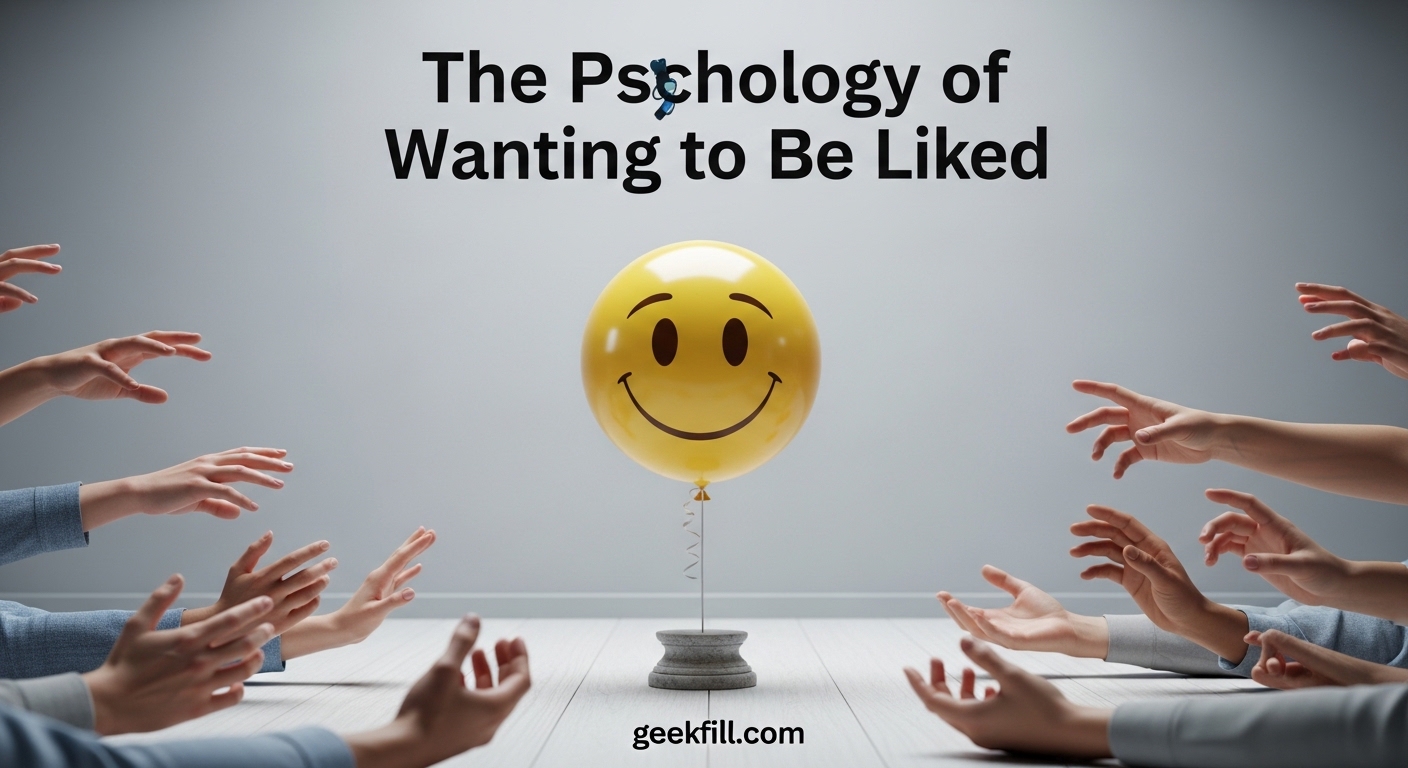
Have you ever found yourself rehearsing what you will say in a meeting three times before speaking? Or maybe you have spent an entire evening replaying a conversation, worrying someone took something the wrong way. I have been there too. The psychology of wanting to be liked runs deeper than simple insecurity. It is wired into our brains, our evolution, and often our earliest childhood experiences.
This is not about becoming indifferent to others’ opinions. Understanding why we crave social acceptance helps us distinguish between healthy connection and destructive people-pleasing. In this guide, I will walk you through the science behind our need for approval, from brain imaging studies that show rejection literally hurts, to practical strategies for building authentic self-worth that does not depend on likes, follows, or constant validation.
Table of Contents
Why Humans Are Wired to Want Social Acceptance
Thousands of years ago, being disliked was not just emotionally uncomfortable. It was potentially fatal. Our ancestors lived in tight-knit tribes where social acceptance meant access to food, protection from predators, and help during illness. Being cast out literally meant death.
This evolutionary pressure shaped our brains. Dr. Matthew Lieberman, a neuroscientist at UCLA, explains that our brains treat social acceptance as a survival necessity because for most of human history, it was. The individuals who cared most about fitting in were the ones who survived and passed on their genes. That is why wanting to be liked feels so primal, almost like hunger or thirst.
Research from 2026 continues to support this evolutionary psychology perspective. Studies show that social rejection activates the same brain regions as physical pain. Your brain cannot tell the difference between a broken arm and a broken heart, at least not at the neurological level. This explains why being disliked or excluded triggers such intense emotional responses, even when our modern lives are not actually threatened.
Being part of a group also meant sharing resources and knowledge. The liked members of a tribe got better food, better mates, and better protection. Natural selection favored those who paid attention to social dynamics and adjusted their behavior to maintain acceptance. We are the descendants of people who were really good at being liked.
The Neuroscience of Social Rejection: Why Being Disliked Physically Hurts
Here is something that might change how you view your social anxiety. Brain imaging studies using fMRI technology show that social rejection activates the anterior cingulate cortex and the insula, the exact same regions that process physical pain. When someone excludes you from a group chat or gives you a cold look at work, your brain responds as if you have been physically injured.
In one famous study, researchers had participants play a virtual ball-tossing game while monitoring their brain activity. The game was rigged. After a few minutes, the other two players stopped throwing the ball to the participant. Even though this was a computer simulation and the participants knew it was not real, their brains lit up with pain responses. The anterior cingulate cortex, which typically responds to physical pain like breaking a bone, became highly active.
Dr. Naomi Eisenberger, who conducted much of this research at UCLA, calls this “social pain.” She discovered that the brain produces natural painkillers in response to social rejection, just as it does for physical injury. This is why Tylenol has been shown to reduce emotional pain from rejection in studies. The overlap between social and physical pain is not metaphorical. It is literal biology.
Understanding this neuroscience helps explain why you cannot just “get over it” when someone dislikes you. Your brain is treating social rejection as a genuine threat to survival. This awareness can help you be more compassionate with yourself when you feel hurt by others’ opinions.
Psychological Mechanisms Behind Approval-Seeking
Several psychological concepts explain why some people struggle more than others with the need to be liked. Understanding these mechanisms gives you specific targets for change. Let me break down the key terms you will encounter in psychology literature.
External Locus of Control
People with an external locus of control believe that outside forces determine their outcomes. They see their worth as dependent on others’ approval rather than their own internal standards. If someone with an external locus gets praise, they feel good. If they get criticism, they crumble.
This creates a rollercoaster of self-esteem that depends entirely on other people’s moods and opinions. Research shows that individuals with a strong external locus are more prone to anxiety, depression, and people-pleasing behaviors. They have essentially handed over the keys to their self-worth to everyone around them.
Developing an internal locus of control means recognizing that you are the ultimate judge of your worth. Others’ opinions provide information, not verdicts. This shift takes practice but dramatically reduces the anxiety that comes from constantly monitoring how others respond to you.
Sociotropy
Sociotropy is a personality trait characterized by excessive investment in relationships and a need for social acceptance. The term comes from the Greek words for “social” and “feeding” or “nurturing.” People high in sociotropy derive their sense of self primarily from relationships with others.
While caring about relationships is healthy, sociotropy becomes problematic when it dominates your identity. You might find yourself unable to make decisions without considering how everyone will react. Your mood might fluctuate based entirely on whether someone texted you back quickly enough. This trait is strongly linked to depression, especially when relationships inevitably face conflict or disappointment.
Research by psychologist Sidney Blatt identified sociotropy as one of two primary personality styles that predict depression vulnerability. The other, autonomy, involves excessive concern with independence and achievement. People with high sociotropy are particularly sensitive to interpersonal loss and rejection.
Anaclitic Depression and the Fawning Response
In the 1940s, psychiatrist René Spitz studied infants in orphanages who received basic physical care but lacked emotional connection. He called the resulting condition “anaclitic depression.” These babies stopped developing normally, became withdrawn, and some even died despite having adequate food and shelter. This research demonstrated that human connection is literally necessary for survival.
The fawning trauma response develops when a child learns that safety comes from pleasing others. If you grew up with unpredictable caregivers, you might have learned to constantly scan for what others want and mold yourself to provide it. This becomes a survival strategy that persists into adulthood, even when you are no longer in danger.
Fawning shows up as automatic people-pleasing, difficulty identifying your own preferences, and anxiety when others are upset. Your nervous system learned that being liked equals being safe. Healing involves teaching your body that you can handle others’ disapproval without catastrophe.
Wanting to Be Liked vs. Needing to Be Liked: The Critical Difference
There is a world of difference between enjoying social acceptance and requiring it to function. Wanting to be liked is human and healthy. Needing to be liked creates a prison of constant performance where authenticity becomes impossible.
When you want to be liked, you prefer positive social interactions. You enjoy praise and feel good when people appreciate you. But your fundamental sense of self remains intact regardless of others’ opinions. You can handle disagreement, set boundaries, and make choices that might disappoint some people.
When you need to be liked, every interaction feels like an evaluation. You monitor others’ reactions constantly, adjusting your words, opinions, and even personality to maintain approval. The thought of someone disliking you triggers genuine panic. This creates people-pleasing behaviors that exhaust you and ultimately make authentic connection impossible.
Here are some self-assessment questions to help you identify where you fall on this spectrum. Do you find yourself saying yes when you want to say no? Do you avoid expressing opinions that differ from the group? Do you replay social interactions analyzing what you should have done differently? Does criticism feel like a personal attack on your worth? Do you change your personality depending on who you are with? An internal locus of control means your self-worth comes from within. An external locus means it depends entirely on others’ validation.
If you answered yes to several of these questions, your need to be liked might be causing more harm than good. The good news is that this pattern can change with awareness and practice.
The Pratfall Effect: How Vulnerability Makes You More Likable
In 1966, psychologist Elliot Aronson conducted a fascinating study that challenges everything perfectionists believe about likability. He had participants listen to recordings of people answering quiz questions. Some recordings included the person spilling coffee and saying “Oh my, I made a mess.” The results were surprising.
Competent people who made small mistakes were rated more likable than competent people who were perfect. Aronson called this the Pratfall Effect. It turns out that vulnerability and minor imperfections make us more relatable and trustworthy, not less.
The effect only works for people who are already seen as competent. If someone seems generally incompetent, mistakes just confirm that perception. But for most of us who are reasonably capable, showing occasional vulnerability actually increases how much others like us. Perfection creates distance. Imperfection creates connection.
This research has huge implications for how we approach social situations. Many of us exhaust ourselves trying to appear flawless, thinking this will make us more likable. In reality, the opposite is often true. Sharing a genuine struggle, admitting you do not know something, or acknowledging when you are nervous can make people like you more, not less.
How Childhood Experiences Shape Your Need for Approval
Your early relationships with caregivers created the blueprint for how you understand social acceptance. Attachment theory, developed by John Bowlby and Mary Ainsworth, explains how our earliest bonds shape our adult relationships and our relationship with ourselves.
Children who received consistent, responsive care typically develop secure attachment. They internalize the belief that they are worthy of love and that others can be trusted. These children grow into adults who can tolerate some social disapproval without crumbling. They do not need everyone to like them because they fundamentally like themselves.
Children with critical or conditional parents often develop anxious attachment patterns. They learned that love and safety depend on performing correctly, being agreeable, or meeting others’ needs. The message, whether explicit or implicit, was “I will love you if…” rather than “I love you because you exist.” These children become adults who constantly monitor social situations for signs of disapproval.
Some children had caregivers who were unpredictable, neglectful, or frightening. These children might develop avoidant or disorganized attachment patterns. The fawning trauma response often develops here, as the child learned that survival meant anticipating and meeting others’ needs before their own.
The patterns you developed made sense in childhood. They helped you survive and get your needs met as best you could. But as an adult, these same patterns can keep you trapped in anxiety and inauthenticity. The good news is that attachment styles can change with awareness, therapy, and new relationship experiences.
How Social Media Amplifies the Need for Validation
Our ancestors got social feedback from a few dozen people in their tribe. Today, we can receive quantified approval from thousands of strangers within minutes. Social media has created a perfect storm for amplifying our evolutionary need for acceptance into something potentially destructive.
Platforms are designed to trigger dopamine-driven feedback loops. Every like, comment, and follow provides a small hit of validation. The brain’s reward system lights up just as it would for food or social connection in earlier eras. We become conditioned to seek these digital signals of acceptance multiple times per day.
Research from the past decade shows concerning correlations between social media use and anxiety, depression, and approval-seeking behaviors. A study from the University of Pennsylvania found that limiting social media use to 30 minutes per day resulted in significant reductions in loneliness and depression. The constant comparison, the curated perfection of others’ feeds, and the quantification of social worth all contribute to unhealthy validation needs.
The problem is not the desire for connection itself. It is the substitution of deep, authentic relationships with shallow, performance-based interactions. When your sense of worth depends on how many likes your post gets, you are outsourcing your self-esteem to an algorithm and an audience you cannot control.
Warning Signs Your Need to Be Liked Has Become Unhealthy
Recognizing when your desire for approval has crossed into unhealthy territory is the first step toward change. Here are specific warning signs that your need to be liked is causing harm in your life.
You have difficulty setting boundaries and saying no, even when you are exhausted or the request violates your values. You find yourself automatically agreeing to things and then feeling resentful later. You change your opinions based on who you are talking to, not because you have learned new information but because you want to avoid conflict.
You feel intense anxiety when someone seems displeased with you, even if their reasons are unreasonable. You replay social interactions repeatedly, analyzing what you could have done differently to earn more approval. You avoid sharing your authentic preferences, opinions, or personality traits because you are not sure how they will be received.
Your mood depends heavily on others’ reactions to you. A compliment makes your day, while indifference or criticism ruins it. You feel like you are performing a role rather than being yourself in social situations. You have lost touch with what you actually want because you have spent so long anticipating and meeting others’ needs.
Practical Strategies for Building Healthy Self-Worth
Changing deep-seated patterns takes time, but these strategies can help you develop a more internal locus of control and reduce unhealthy approval-seeking behaviors.
Practice noticing when you are about to say yes out of habit. Before automatically agreeing, pause and ask yourself what you actually want. Start with low-stakes situations like choosing a restaurant or a movie. Build the muscle of identifying your preferences.
When you need to set a boundary, use clear, simple language. You do not need to over-explain or apologize excessively. Try phrases like “I cannot take that on right now” or “That does not work for me.” The more you practice, the easier it becomes.
Experiment with small authentic expressions. Share an opinion that differs slightly from the group. Mention a hobby or interest that feels vulnerable. Notice that the world does not end when people see the real you. In fact, they often respond with more connection, not less.
Develop self-compassion practices. Kristin Neff’s research shows that self-compassion reduces the impact of negative feedback. When you treat yourself with kindness rather than harsh self-criticism, others’ opinions lose some of their power. Try talking to yourself as you would talk to a good friend.
Notice the fawning response when it shows up. Ask yourself, “Am I agreeing with this person because I actually agree, or because I feel anxious and want them to like me?” Sometimes agreeing is appropriate, but making it a conscious choice rather than an automatic reaction gives you back control.
Consider limiting social media use or taking breaks. Notice how your self-esteem shifts when you are not constantly exposed to quantified approval and comparison. Many people report feeling more grounded and less anxious after reducing their social media consumption.
Practice tolerating the discomfort of others’ disapproval. When someone seems upset with you, resist the urge to immediately fix it or apologize unnecessarily. Sit with the discomfort for a few minutes. Notice that you can handle it. Your nervous system learns from these experiences that disapproval is uncomfortable but not catastrophic.
When to Seek Professional Help
Sometimes approval-seeking patterns are deeply rooted in trauma or have developed into clinical conditions like social anxiety disorder or depression. Working with a therapist can provide targeted support for changing these patterns.
Consider seeking professional help if your need to be liked is significantly interfering with your work, relationships, or daily functioning. If you find yourself unable to make decisions without extensive reassurance, or if the anxiety about others’ opinions is causing panic attacks, a therapist can help.
Cognitive Behavioral Therapy (CBT) is particularly effective for addressing external locus of control and anxiety about others’ opinions. Attachment-based therapy can help heal childhood patterns that contribute to approval-seeking. Dialectical Behavior Therapy (DBT) offers skills for managing the intense emotions that come with perceived rejection.
Taking the first step to talk to a professional is an act of self-care, not weakness. It takes courage to face these patterns directly and commit to change.
Frequently Asked Questions About the Psychology of Wanting to Be Liked
What is the psychology of wanting to be liked?
The psychology of wanting to be liked stems from our evolutionary need for social acceptance and survival. It involves seeking external validation to feel worthy and safe. Key concepts include external locus of control, where self-worth depends on others’ opinions, and sociotropy, a personality trait characterized by excessive investment in relationships. Brain imaging studies show that social rejection activates the same pain centers as physical injury, explaining why being disliked feels so threatening.
What do you call a person who wants to be liked by everyone?
Someone who wants to be liked by everyone might be described as a people-pleaser, though psychologists use more specific terms. Individuals with high sociotropy excessively invest in relationships and derive their sense of self from social acceptance. Those with an external locus of control depend on others’ validation to determine their worth. In some cases, this pattern reflects a fawning trauma response, where people-pleasing became a survival strategy in childhood.
Is it normal to want to be liked by everyone?
Wanting to be liked is completely normal and human. Evolutionarily, social acceptance meant access to resources, protection, and survival. However, wanting to be liked is different from needing to be liked. The former is healthy, while the latter creates anxiety and inauthenticity. It is not realistic or necessary for everyone to like you, and accepting this is key to emotional freedom.
Why do humans need to be liked?
Humans need social connection because we evolved as tribal creatures. For most of human history, being disliked or excluded meant losing access to food, protection, and mating opportunities. Our brains are wired to seek social approval as a survival necessity. Neuroscience research confirms that social rejection activates the same brain regions as physical pain, making the drive to be liked deeply biological.
What is the need to be liked called?
Psychologists use several terms to describe an excessive need to be liked. Sociotropy refers to a personality trait involving overinvestment in relationships. People-pleasing describes the behavioral pattern of prioritizing others’ needs over your own. Anaclitic depression describes the devastating effects of lacking social connection, first observed in orphaned infants. The fawning trauma response explains approval-seeking that developed as a childhood survival strategy.
What causes people-pleasing behavior?
People-pleasing behavior stems from multiple sources including childhood experiences with critical or conditional parenting, trauma that created a fawning response, an external locus of control where self-worth depends on others’ opinions, and high sociotropy as a personality trait. Evolutionary psychology explains the biological basis, while neuroscience shows that social rejection literally hurts, driving us to avoid it through people-pleasing.
How can I stop needing everyone to like me?
To reduce unhealthy approval-seeking, start by developing an internal locus of control where your self-worth comes from within. Practice setting small boundaries and saying no. Experiment with authentic self-expression in low-stakes situations. Develop self-compassion to reduce the impact of criticism. Limit social media use to reduce comparison and quantified validation. Consider therapy, particularly CBT or attachment-based approaches, for deeper patterns.
Conclusion: Embracing Authentic Connection
The psychology of wanting to be liked is not a character flaw. It is a deeply human trait rooted in our evolutionary history, our brain structure, and often our earliest childhood experiences. Understanding this can help you be more compassionate with yourself when you catch yourself people-pleasing or worrying about others’ opinions.
The goal is not to become indifferent to what others think. Healthy social connection remains one of life’s greatest sources of joy and meaning. The goal is to shift from needing approval to simply wanting it, from an external locus of control to an internal one. When your self-worth comes from within, you can engage with others authentically without the constant anxiety of evaluation.
Remember the Pratfall Effect research. Your imperfections and vulnerabilities do not make you less likable. They make you human and relatable. The people worth having in your life will appreciate your authenticity more than your perfection. As you practice the strategies in this guide, you may find that releasing the desperate need to be liked actually makes you more genuinely connected to others.