
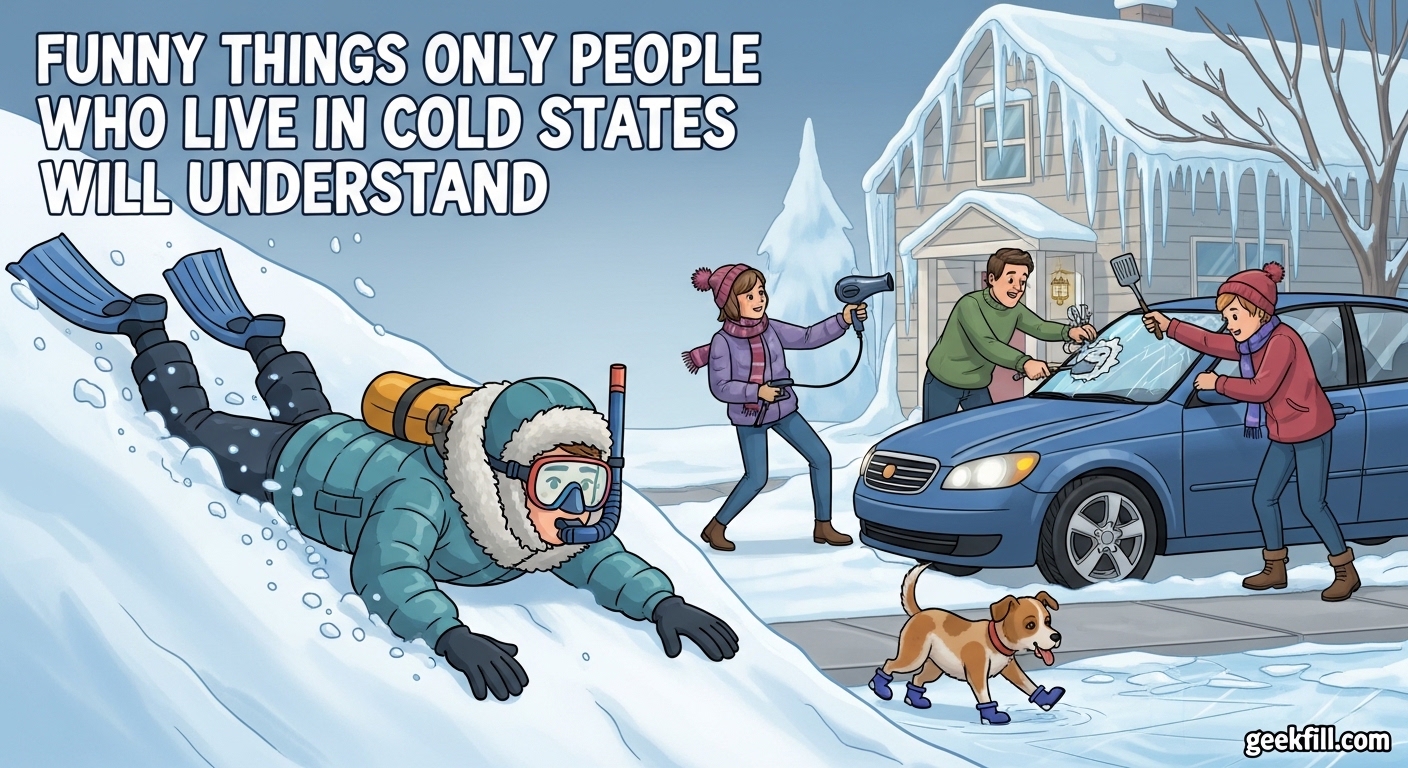
There’s a special bond among those of us who endure six months of darkness, scrape ice off our windshields while barely awake, and consider 40 degrees “shorts weather.” Funny things only people who live in cold states will understand become our shared language, a kind of regional shorthand that bonds strangers at gas stations and grocery stores.
I’ve lived through Minnesota winters that hit -30 degrees and Alaskan summers where you still need a jacket. Along the way, I’ve collected a catalog of bizarre habits and cultural quirks that make perfect sense to locals but leave warm-state visitors scratching their heads. If you’ve ever used your car as a refrigerator or planned your social calendar around lake thawing dates, you’ll find yourself nodding along with every item on this list.

Table of Contents
12 Funny Things Only People Who Live in Cold States Will Understand
1. Your Vocabulary Includes “Uff Da” and Other Regional Gems
“Uff da” isn’t just an expression. It’s a full emotional vocabulary packed into two syllables that perfectly captures the feeling of stepping outside into -20 degree wind chills. In Alaska, you’ll hear “termination dust” describing the first snow on mountain peaks that signals summer’s official end. Minnesota has “hotdish,” Wisconsin has “bubbler,” and North Dakota has enough Scandinavian-influenced phrases to fill a dictionary.
These words serve as emotional shorthand for weather extremes that would break people from warmer climates. When someone sighs “uff da” while scraping their windshield at 6 AM, no further explanation is needed. We’ve all been there.
2. You’ve Used Your Car as a Walk-In Freezer
Every cold state resident knows the secret to perfectly chilled beverages doesn’t involve a refrigerator at all. During December through March, your back seat becomes nature’s cooler, keeping soda, beer, and even frozen groceries at the ideal temperature without using a single watt of electricity.
I learned this trick during my first Minnesota winter when my neighbor showed up to a party with a case of beer that had been “chilling” in his truck bed for three hours. It was colder than anything from my actual refrigerator. Now I plan my grocery shopping around this free refrigeration system, leaving items in the car while I run other errands knowing they’ll stay perfectly frozen.
3. You Own More Ice Scrapers Than Pairs of Shoes
My glove compartment has one. My back seat has another. There’s a heavy-duty version in my garage, and a compact emergency scraper lives in my winter coat pocket. I’ve probably purchased 15 ice scrapers over the years, yet somehow I can never find one when I need it most.
People in warm states own maybe one ice scraper for that rare mountain trip. We treat them like disposable commodities, buying them in bulk every fall like we’re preparing for an ice-scraping apocalypse. The good ones have brass blades that won’t scratch your windshield. The great ones extend to reach your roof because nothing says “amateur” like driving with a snow-covered top that slides onto your windshield at the first stoplight.
4. You Know Exactly How Many Minutes Your Car Battery Has Left
Cold state residents develop an almost supernatural sense for automotive health. We can tell by the slight hesitation in the starter whether our battery will survive the week or die tomorrow morning in the Target parking lot. We’ve all had that moment of panic when the engine turns over just a little slower than usual, triggering immediate mental calculations about replacement timing.
The rituals around this are universal. We park facing downhill whenever possible for potential jump-start rolling. We keep jumper cables in every vehicle like they’re standard equipment. We know which parking spots at work get afternoon sun and therefore offer slightly warmer starting conditions at 5 PM. My friend in Florida thinks I’m paranoid for carrying a portable jump starter. He’s never tried to start a car at -25 degrees while running late for work.
5. You Don’t Own Light Jackets, Just Layers Upon Layers
My closet doesn’t contain “light jackets” or “heavy coats.” It contains base layers, mid-layers, shell layers, and an intricate system of combinations that would impress military supply chain managers. A 20-degree day might mean thermal underwear, fleece, and a windbreaker. A 0-degree day adds a down vest and heavier socks. At -20, we break out the expedition-grade gear and face coverings that make us look like we’re robbing banks.
Visitors from warm states marvel at our clothing calculus. They don’t understand why we remove four layers upon entering a restaurant or why we keep emergency jackets in our cars year-round. The concept of “dressing for the weather” means something completely different when the weather can kill you within minutes of exposure.
6. You Judge People by How They Handle a Snowy Parking Lot
Winter driving serves as an instant character assessment tool in cold states. We watch how someone navigates a snowy parking lot and immediately form opinions about their competence, patience, and general life skills. The person who guns their engine and fishtails wildly? Impulsive and lacks preparation. The driver who creeps along at 2 mph paralyzed by fear? Probably shouldn’t have left home today.
The true masters make it look effortless, maintaining steady momentum without panic. We’ve all developed this evaluative skill because our survival sometimes depends on predicting how other drivers will behave on ice. Someone from California might think we’re being judgmental. We’re actually conducting rapid risk assessment based on observable behavior patterns that we’ve learned through years of winter survival.
7. Your Definition of “Warm” Is Completely Warped
After three months of subzero temperatures, 35 degrees feels like a tropical vacation. I’ve seen people in Minnesota break out shorts and t-shirts the moment the thermometer hits 40 degrees in March. Visitors from Florida watch in horror as we celebrate weather they’d consider winter emergency conditions.
This temperature perception shift is documented in the experiences of cold state residents everywhere. After your body adapts to surviving -20 degrees, anything above freezing triggers an almost giddy response. We open windows, go for walks without heavy coats, and generally act like spring has arrived when there’s still snow on the ground. To outsiders, we look insane. To us, we’re simply enjoying the warmth while it lasts.
8. You Keep Emergency Supplies in Your Car Year-Round
My trunk contains a blanket, extra jacket, flashlight, protein bars, and hand warmers that have lived there since 2026. None of this gets removed in summer because winter always returns, usually when we least expect it. Cold state residents know that a sudden storm or breakdown in rural areas can become life-threatening within an hour.
The emergency kit mentality extends to our daily preparation. We keep boots in our cars even when wearing dress shoes to work. We maintain phone chargers because cold drains batteries faster. We carry water that won’t freeze immediately. Someone from Arizona recently asked why I have a sleeping bag in my sedan. I explained that getting stranded overnight in a Minnesota January without shelter isn’t an inconvenience. It’s a survival situation.
9. You Understand the Sacred Art of the Hotdish
“Hotdish” isn’t just a casserole. It’s a cultural institution that sustains cold state communities through the darkest months. These hearty combinations of starch, protein, and cream-of-something soup represent the culinary adaptation to both cold weather and social necessity. When roads become impassable and leaving home requires 20 minutes of preparation, you need food that feeds many people efficiently.
The hotdish tradition extends to church basement potlucks, funeral gatherings, and community events where everyone brings their signature version. Tater tot hotdish holds iconic status in Minnesota, but variations exist across cold states. These dishes aren’t gourmet cuisine. They’re survival fuel designed to provide maximum calories and comfort during months when fresh vegetables cost a fortune and going outside feels like a punishment.
10. You’ve Explained “Cabin Culture” to Confused Outsiders
Having a lake cabin isn’t a luxury in cold states. It’s a necessary psychological escape valve that prevents winter insanity. We spend weekdays dreaming about weekend cabin trips where we embrace the very cold we’re trying to escape from home, because somehow it feels different when surrounded by pine trees and frozen lakes.
The cabin tradition includes specific rituals: ice fishing, snowmobiling between frozen lakes, sauna sessions that end with brief snow rolls, and community gatherings where everyone knows everyone else’s business. Outsiders don’t understand why we’d drive three hours to sit in a smaller, less comfortable house in colder conditions. We can’t fully explain it either. We just know that cabin time resets something essential in our cold-adapted brains.
11. Your Calendar Revolves Around Ice-Out Dates
Cold state residents track “ice-out dates” with the intensity that farmers monitor planting seasons. When the lakes thaw determines everything from fishing season openings to dock installation schedules to the psychological end of winter imprisonment. Local news stations actually report ice-out dates for major lakes like they’re significant historical events.
This obsession makes no sense to warm-state visitors who can boat year-round. For us, ice-out represents liberation. The exact date becomes a matter of regional pride and betting pools. Was this year’s ice-out earlier than 2023? How does it compare to the record from 2012? These questions dominate conversations during the transition weeks when we’re all desperately waiting for water to reappear.
12. You’ve Had to Explain Why You’re Wearing Shorts in 40-Degree Weather
The sight of cold state residents wearing shorts while there’s still snow visible confuses outsiders universally. After months of thermal everything, our bodies adapt to the point where 40 degrees triggers heat responses. I’ve been photographed wearing shorts and sandals in March while snow banks still lined the streets, looking like I’d lost my mind to visiting relatives from Georgia.
This phenomenon demonstrates the remarkable adaptability of human physiology and psychology. Our internal thermostats recalibrate based on environmental norms. What feels frigid to someone from Miami feels balmy to someone who’s endured three months of subzero wind chills. We don’t wear shorts to prove anything. We wear them because we’re genuinely warm and celebrating the seasonal shift with every fiber of our being.
FAQs
What are the 5 P’s for cold weather?
The 5 P’s for cold weather are: People (check on vulnerable individuals), Pets (bring them inside), Plants (protect from freezing), Pipes (prevent freezing and bursting), and Pools (winterize properly). This mnemonic helps cold state residents remember essential cold weather preparation tasks before temperatures drop dangerously low.
What are the 4 P’s of cold weather?
The 4 P’s of cold weather are: People, Pets, Plants, and Pipes. This simplified version focuses on the most critical elements to protect during freezing temperatures. Cold state residents use this checklist before major cold snaps to ensure nothing important gets overlooked when dangerous weather arrives.
What is a fun fact about cold weather?
A fun fact about cold weather is that snow acts as an insulator rather than just making things colder. Snow contains trapped air between ice crystals, creating insulation that protects plants and animals from extreme temperature drops. This is why farmers actually welcome a layer of snow before deep freezes.
What is the 3rd coldest state in the US?
Maine is typically ranked as the 3rd coldest state in the US, behind Alaska and Minnesota. Maine’s northern location and coastal influences create consistently low winter temperatures, with average winter lows reaching single digits and frequent subzero conditions in northern regions.
Why do cold states have strange traditions?
Cold states develop unique traditions as survival adaptations and psychological coping mechanisms for extreme winters. Extended darkness, dangerous temperatures, and isolation create community bonds through shared experiences like hotdish potlucks, cabin culture, and ice-out celebrations. These traditions help residents maintain mental health during challenging seasons.
Conclusion
Living in a cold state transforms you in ways that are difficult to explain until you’ve experienced them yourself. Funny things only people who live in cold states will understand serve as both survival mechanisms and cultural bonds that unite us through the harshest months. From using our cars as refrigerators to celebrating ice-out dates like national holidays, these quirks represent the resilience and humor required to thrive where others would merely survive.
If you’re from a warm state visiting Minnesota, Alaska, Maine, or any other cold weather region, watch for these signs in the locals you meet. Ask about their ice scraper collection or their cabin traditions. You’ll discover a community that’s adapted to extreme conditions with creativity, humor, and some truly excellent layered clothing strategies. Funny things only people who live in cold states will understand aren’t really funny at all when you’re living them. They’re simply the price we pay for experiencing summers that make everything worth enduring.
What cold state quirks did we miss? Share your own regional habits and winter survival strategies in the comments below. We’d love to hear how your state handles the cold differently than ours.