
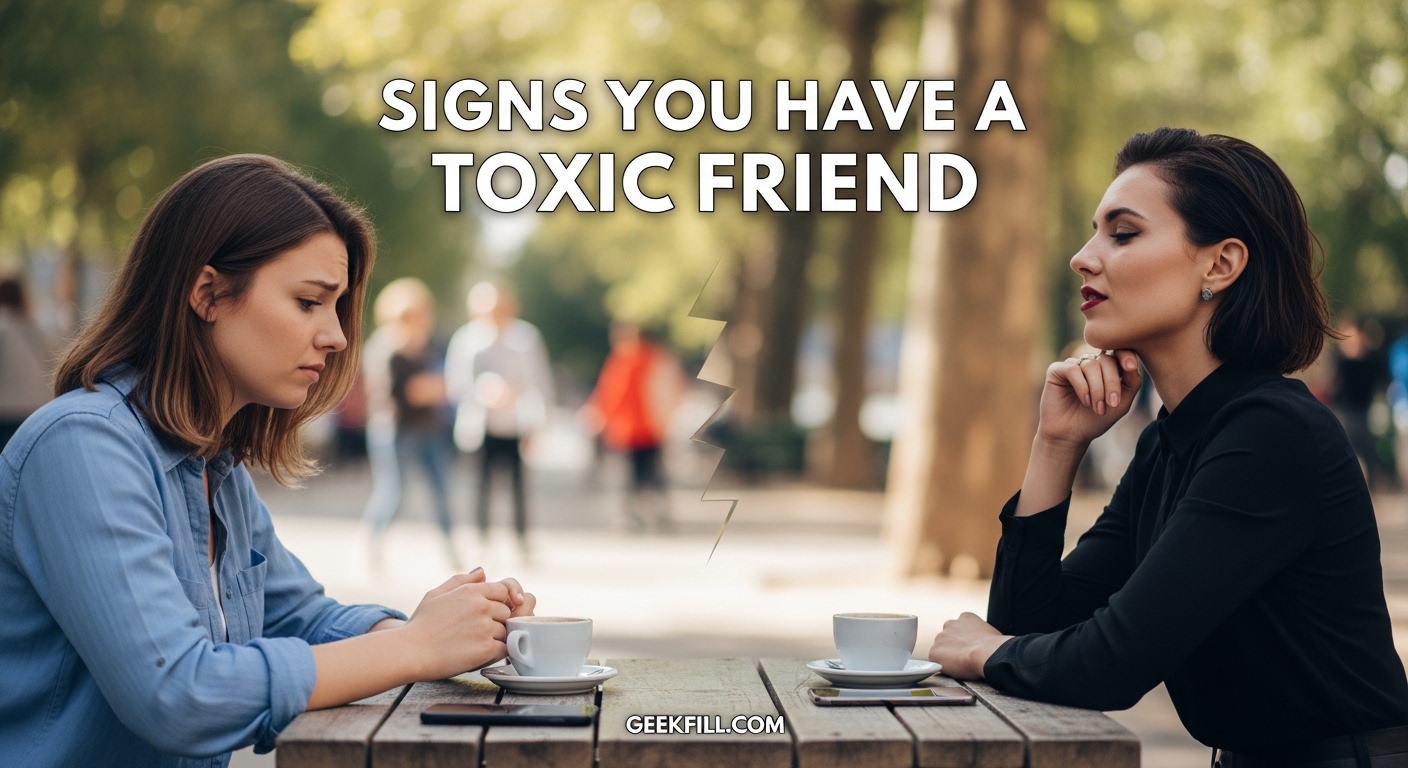
It is 2 a.m. and you are staring at your phone.
You just got home from dinner with that friend, the one you have known for years, and instead of feeling good about catching up, you feel exhausted. Your shoulders are tight. You are replaying conversations in your head, wondering if you said something wrong, or if they were actually making fun of you again.
Your thumb hovers over the search bar. You type four words: “is my friend toxic?”
If that scenario sounds familiar, you are not alone. I have been there. Most of us have. The truth is, toxic friendships do not announce themselves with neon signs. They creep in slowly, disguised as history, loyalty, or “just how they are.”
A toxic friend is someone who consistently drains your emotional energy, disrespects your boundaries, and leaves you feeling worse after interactions rather than better. These relationships operate on imbalanced power dynamics where one person takes emotional value without giving anything back.
This guide breaks down 12 signs you have a toxic friend. Some are obvious. Others are subtle enough to make you question your own judgment. All of them matter.
Table of Contents
12 Signs You Have a Toxic Friend
1. You find yourself Googling “is my friend toxic”
Here is the thing about intuition: it speaks softly before it screams.
If you have already searched for validation about your friendship, that is sign number one. Healthy friendships do not send you down rabbit holes at midnight looking for confirmation that something is wrong. You would not be reading this article if some part of you did not already know.
Trust that part of yourself. The fact that you are questioning the friendship is often the first and most important red flag.
2. You walk on eggshells around them
You know that tight feeling in your chest when you see their name pop up on your phone? That is not normal.
In a toxic friendship, you learn to monitor everything you say. You rehearse responses. You avoid certain topics. You become hyperaware of their mood before you speak. Walking on eggshells means you are constantly managing their reactions instead of being yourself.
One person on Reddit described it perfectly: “I felt like I needed a script before calling her.” That is not friendship. That is emotional labor without pay.
3. Every conversation becomes about them
You start telling a story about your rough day at work. Five minutes in, somehow the conversation has shifted to their problems, their drama, their needs. Again.
Toxic friends are emotional vampires. They take up all the air in the room. Your struggles get minimized, redirected, or forgotten entirely. Over time, you stop sharing altogether because you know the spotlight will never reach you.
A real friendship has give and take. If you are always the audience and never the main character, that is a performance, not a relationship.
4. They violate your boundaries repeatedly
You asked them not to share that personal detail with others. They did it anyway. You said you needed space. They showed up at your door. You established limits on borrowing money. They made you feel guilty for saying no.
Toxic friends treat boundaries like personal attacks. They push, test, and ignore your limits while expecting you to respect theirs without question. This is not forgetfulness. It is a pattern of entitlement.
Healthy friends respect the word “no” without making you defend it.
5. They use guilt-trips as manipulation
“After everything I have done for you…”
“I guess I am just a terrible friend then.”
“If you really cared about me, you would…”
These are guilt-trip classics. Toxic friends weaponize obligation. They keep a mental ledger of every favor, real or imagined, and cash it in when they want something. The goal is to make you feel like a bad person so you will comply.
Guilt should not be the primary currency in any relationship.
6. They cannot celebrate your success
You got promoted. They changed the subject. You started a new relationship. They found something critical to say. You shared good news, and somehow the conversation ended with you comforting them about their own lack of progress.
Toxic friends see your wins as their losses. They compete instead of cheering. They minimize, deflect, or turn your moments into theirs. This competitive undercurrent leaves you shrinking yourself to make them comfortable.
A real friend lights up when you shine. They do not throw shade.
7. They never apologize and always need to be right
Even when they are clearly wrong, they find a way to be the victim. They rewrite history. They use phrases like “I am sorry you feel that way” instead of “I am sorry I hurt you.”
Toxic friends cannot tolerate being wrong. It threatens their self-image. So they deflect, minimize, or turn the blame back on you. Every disagreement becomes a referendum on their character, and you end up apologizing just to keep the peace.
Accountability is the foundation of trust. Without it, you are building on sand.
8. You feel drained after every interaction
This might be the most telling sign of all. Your body keeps score even when your brain makes excuses.
After seeing a healthy friend, you feel energized, seen, and supported. After seeing a toxic friend, you feel depleted, anxious, or somehow smaller than before. Your nervous system is trying to tell you something your loyalty is ignoring.
Pay attention to your energy levels. They rarely lie.
9. They keep score of everything
Friendship is not a spreadsheet. But toxic friends treat it like one.
They remember every time they picked up the check but forget when you covered them. They tally favors like debts. They bring up past kindnesses as ammunition in arguments. This transactional approach turns connection into commerce.
Real generosity does not come with receipts. If they are keeping score, they are not keeping friendship.
10. They gossip about everyone, including you
If they talk about everyone else to you, they are talking about you to everyone else.
Toxic friends use gossip as social currency. They share secrets, spread rumors, and create drama to feel powerful or included. You might think you are the exception, the one they would never betray. You are not.
Listen to how they talk about mutual friends. That is how they talk about you when you are not around.
11. You make excuses for their behavior
“They are just going through a hard time.”
“That is just how they are.”
“They did not mean it like that.”
If you find yourself explaining away patterns of bad behavior, you are in denial. Everyone has bad days. Everyone says things they regret. But toxic behavior is a pattern, not an incident. Making excuses keeps you stuck in a cycle that is not your responsibility to fix.
Their struggles might explain their behavior, but they do not excuse the impact on you.
12. You feel relieved when plans get canceled
This one hurts because it is so honest.
When you see that text saying they cannot make it, your first feeling is relief. Not disappointment. Not “oh, we will reschedule.” Just pure, uncomplicated relief that you do not have to see them today.
Your body knows before your mind admits it. That relief is your truth speaking louder than your loyalty. Listen to it.
The 4 Types of Toxic Friends
Not all toxic friends look the same. Understanding the type you are dealing with can help you decide how to respond. Here are the four most common categories:
The Energy Vampire: This friend leaves you exhausted. Every conversation is a monologue about their problems. They take emotional support but never give it. You feel like their unpaid therapist, and they never ask how you are doing.
The Critic: Nothing you do is quite right. They disguise insults as jokes or “just being honest.” They undermine your confidence with backhanded compliments. Over time, you start questioning your own judgment.
The User: This friend only shows up when they need something. They disappear during your hard times but expect you to be available 24/7 for theirs. The friendship is transactional, and you are always paying.
The Drama Magnet: Chaos follows them everywhere. There is always a crisis, always a villain, always a reason why they are the victim. They drag you into conflicts that have nothing to do with you and exhaust you with their constant instability.
Most toxic friends blend these traits, but one usually dominates. Knowing which type you are dealing with helps you set appropriate boundaries.
What to Do When You Recognize These Signs ?
Recognizing the problem is the first step. Deciding what to do about it is the second. Here is a practical framework for moving forward:
Step 1: Trust your body. Your physical and emotional reactions are data. If you consistently feel drained, anxious, or small after interactions, that is information worth honoring. Do not override your instincts with loyalty.
Step 2: Stop making excuses. Their childhood trauma, current stress, or past kindness does not obligate you to endure present harm. You can have compassion without sacrificing your wellbeing.
Step 3: Test with a small boundary. Before making any big decisions, try setting a minor limit. Say no to one request. Decline one invitation. See how they respond. Healthy friends respect boundaries. Toxic ones blow up, guilt-trip, or punish you.
Step 4: Decide on the distance needed. Not every toxic friendship needs to end completely. Sometimes reducing contact, becoming more surface-level, or changing the context of your interactions is enough. Other times, a clean break is necessary. You get to choose what level of distance serves you.
Step 5: Prepare for the “hoover.” When you pull away, toxic friends often try to suck you back in with love-bombing, promises to change, or manufactured crises. This is called hoovering. Expect it. Plan for it. Do not mistake their panic for genuine transformation.
Step 6: Let yourself grieve. Even toxic friendships represent time, history, and hope. It is okay to mourn what you wanted the friendship to be, even as you accept what it actually was.
Step 7: Rebuild your circle. Invest in friendships that leave you feeling energized, seen, and safe. Healthy friendships exist. You deserve them.
Frequently Asked Questions
What is the 11 6 3 rule of friendship?
What is the 7 friend rule?
What are the 4 types of toxic friends?
What single word can destroy a friendship?
Conclusion
Recognizing 12 signs you have a toxic friend is not about judging others or assigning blame. It is about honoring your own wellbeing.
Friendship should add to your life, not subtract from it. The people closest to you should make you feel more like yourself, not less. They should leave you energized, not exhausted. Seen, not shrunken.
If you recognized yourself in these signs, know this: you are not overreacting. You are not being too sensitive. You are not a bad friend for wanting better.
You are allowed to outgrow people. You are allowed to set boundaries. You are allowed to choose peace over history, health over loyalty, and yourself over relationships that diminish you.
The friendship you want exists. Start by being the friend to yourself that you have been trying to find in others.