
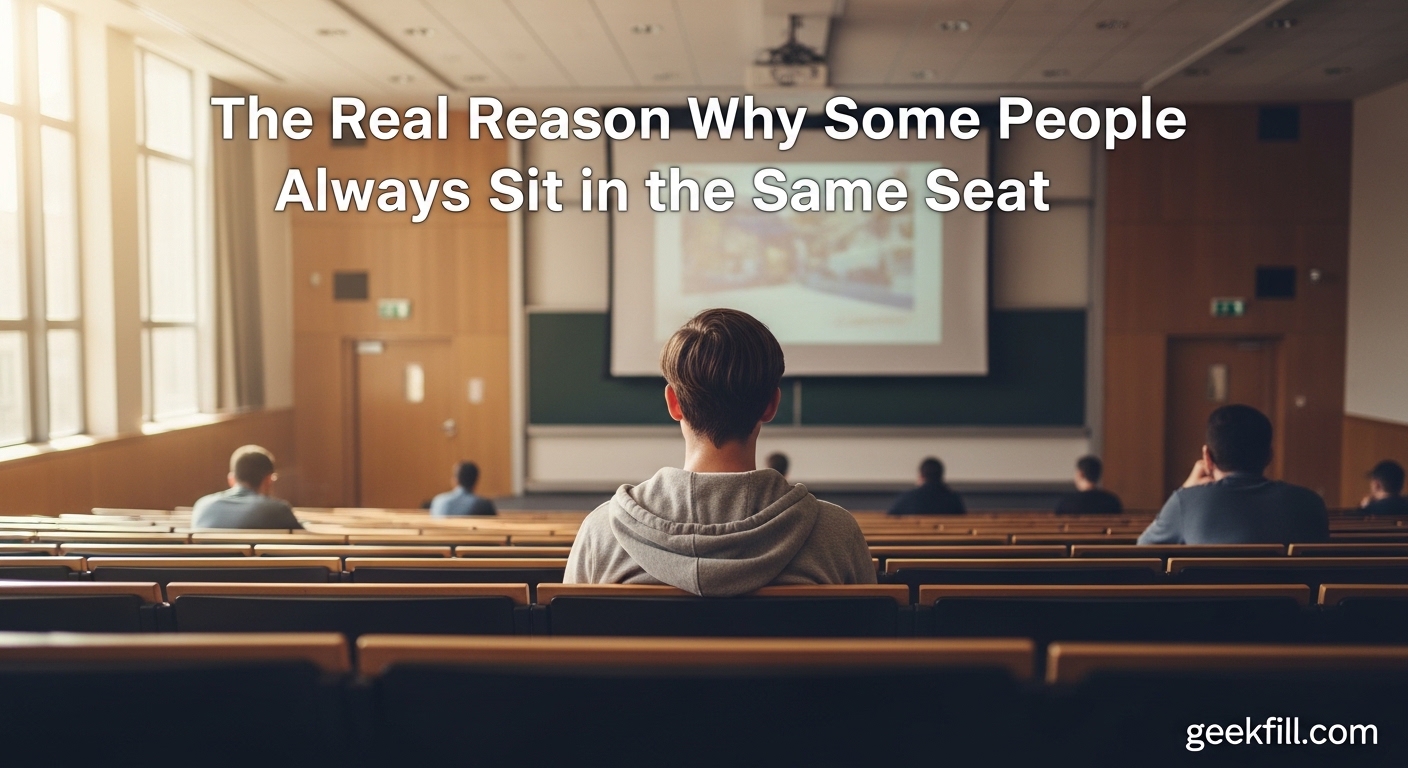
People sit in the same seat repeatedly because of a psychological concept called territoriality. Territoriality is a spatial organizing mechanism where we unconsciously claim and defend personal spaces to create stability and control in our environment.
Have you ever walked into a classroom, meeting room, or even your living room and felt an immediate pull toward “your” seat? This isn’t random preference. Our brains are wired to seek out familiar spaces that offer comfort, predictability, and a sense of ownership.
I remember feeling genuinely annoyed when someone took my usual spot at the coffee shop where I work. It took me years to understand that my reaction wasn’t about being difficult. It was my brain defending territory it had claimed as safe and productive.
Table of Contents
What Is Territoriality in Environmental Psychology?
Territoriality is a fundamental concept in environmental psychology that explains how humans organize and claim spaces. Dr. Robert Gifford, an environmental psychologist at the University of Victoria, describes territoriality as “a spatial organizing mechanism that helps people regulate relationships in shared environments.”
This behavior serves an important purpose. When we claim a space through repeated occupation, our brains begin to associate that location with positive outcomes. The seat becomes linked with productivity, relaxation, or social connection depending on the setting.
Territoriality isn’t limited to humans. Animals mark and defend territories for survival. While we don’t use physical markers like scent, we use behavioral patterns. Returning to the same chair, leaving personal items, or even simply sitting in a predictable location signals ownership to ourselves and others.
The concept connects closely to proxemics, the study of human use of space. Together, these fields explain why the distance between seats matters, why we feel uncomfortable when someone sits too close, and why having “our” spot feels so important.
Why Do People Always Sit in the Same Seat?
Understanding why some people always sit in the same seat requires looking at multiple psychological factors. Control sits at the center of this behavior.
When life feels chaotic, predictable seating provides a small but meaningful anchor. You might not control your work deadlines, traffic, or family schedule. But you can control where you sit. This predictability reduces cognitive load and frees up mental energy for other tasks.
Comfort also plays a major role. Our bodies learn which seats provide proper support. We unconsciously remember which chairs hurt our backs, which tables wobble, and which spots offer the best view of the room. After a few visits, our nervous system catalogs this information and guides us back to the comfortable choice.
Social psychology adds another layer. When we consistently choose the same seat, we establish a pattern that others recognize. Friends learn not to take “your” chair. Colleagues know which side of the conference table you prefer. This unspoken agreement reduces social friction and creates shared understanding.
Forums reveal this clearly. One Reddit user described feeling actual anxiety when someone sat in their designated spot at the office. Another mentioned the strange comfort of returning to their “usual” booth at a restaurant even after months away. These experiences resonate because territoriality is nearly universal.
Personality Traits Linked to Seating Behavior
Psychologists have identified several personality traits that correlate with strong seating preferences. Understanding these connections helps explain why some people are more territorial about their spots than others.
The Need for Control
People with high control needs gravitate toward the same seats repeatedly. These individuals often experience anxiety when routines change. Choosing a predictable location provides psychological safety.
If you feel uneasy when plans shift unexpectedly, your seating preferences likely reflect this trait. The seat becomes a controllable element in an unpredictable world.
Habit Formation Strength
Some people form habits more easily than others. Strong habit-formers automatically return to the same locations without conscious thought. The behavior becomes ingrained after just a few repetitions.
Research suggests these individuals may also struggle more to change seating patterns when needed. The automatic nature of the behavior makes it harder to override.
Introversion and Territory
Introverts often show stronger territorial seating patterns than extroverts. Having a designated spot reduces the energy required to navigate social spaces. It eliminates the decision fatigue of choosing new locations and creates a familiar base for social interaction.
Extroverts, by contrast, often feel comfortable varying their seating. They may even prefer changing locations to meet new people or gain different perspectives.
Security-Seeking Behavior
People who prioritize security over novelty tend to maintain consistent seating. This trait connects to our evolutionary past when familiar territory meant safety from predators and threats.
The modern equivalent shows up in office workers who panic when someone takes their desk, or students who feel off-balance when forced to sit elsewhere in the lecture hall.
Everyday Examples of Territorial Seating
Territoriality shows up in nearly every shared space. Recognizing these patterns helps us understand our own behavior and empathize with others.
The Office Desk Phenomenon
Office workers develop fierce attachments to their assigned workstations. Even in hot-desking environments, people quickly claim preferred spots and resist change. Studies show that desk changes can temporarily reduce productivity as employees adjust to new spatial relationships.
Personalization reinforces this. Adding photos, plants, or desk accessories strengthens territorial claims. The space becomes an extension of identity.
Classroom Seating Patterns
Within the first two weeks of a semester, most students settle into consistent seating patterns. These choices often reflect academic goals. Front-row sitters typically demonstrate higher engagement. Back-row choices may indicate social anxiety or a desire to avoid participation.
Dr. Gifford’s research found that students who chose the same seat throughout a term reported higher satisfaction with their learning environment. The stability helped them focus on coursework rather than spatial uncertainty.
Home Territory and Family Dynamics
Family living rooms often feature the “dad chair” or “mom’s spot” that everyone else avoids. These territorial claims become so ingrained that taking someone else’s seat feels almost taboo.
Children learn these patterns early. They may claim specific spots at the dinner table or on the couch and defend them against siblings. This behavior teaches them about personal boundaries and shared space.
Public Spaces and Unwritten Rules
Regulars at coffee shops, libraries, and restaurants develop seating preferences quickly. Baristas often know which customers prefer which tables. Patrons may arrive earlier than necessary just to secure their spot.
These patterns create interesting social dynamics. When someone takes a regular’s seat, tension can arise even though no formal reservation exists. The territorial claim exists in shared understanding rather than explicit rules.
Cultural Variations in Seating Preferences
While territoriality appears universal, cultural norms shape how it manifests. Understanding these differences provides important context for interpreting seating behavior.
Individualistic cultures like the United States and Western Europe emphasize personal space more strongly. People expect larger buffers between seats and feel more protective of their claimed territory. The concept of “my spot” carries significant weight.
Collectivist cultures in Asia and Latin America often show more fluid seating patterns. Family and group cohesion may take precedence over individual territorial claims. However, hierarchy still influences seating. Elders or leaders may claim preferred positions while younger members remain flexible.
Some Middle Eastern and Mediterranean cultures feature seating arrangements that prioritize conversation and social connection over individual comfort. People may move closer together or change positions to facilitate interaction.
These cultural patterns suggest that territoriality is biological, but its expression is learned. We inherit the need for stable spaces but develop specific preferences based on our upbringing.
When Seating Habits Become Problematic
Most territorial seating is harmless and even beneficial. However, excessive rigidity can indicate underlying issues worth addressing.
Signs of unhealthy territoriality include significant distress when seating changes, arguments with others over spots, or avoiding activities entirely because preferred seating isn’t available. These patterns may signal anxiety disorders that benefit from professional support.
If you recognize rigid patterns in yourself, small experiments can help. Try sitting in a different spot once per week. Notice what feels uncomfortable and what surprises you. Gradual exposure reduces anxiety and builds flexibility.
For workplaces and shared spaces, clear communication helps. Designating specific seats reduces conflict. Alternatively, rotating seating arrangements intentionally can break unhealthy patterns before they form.
Children with strong seating preferences may need extra support during transitions. Explaining changes in advance and allowing them to preview new seating can reduce distress.
Frequently Asked Questions
Why do people always sit in the same seats?
People sit in the same seats due to territoriality, a psychological mechanism that helps create stability and control. This behavior reduces anxiety, establishes comfort, and communicates ownership of personal space to others.
What is the 90-90-90 rule for sitting?
The 90-90-90 rule refers to optimal sitting posture with 90-degree angles at the hips, knees, and ankles. While not directly related to territoriality, people often choose seats that naturally support this comfortable position.
What does your sitting posture reveal about your personality?
Posture and seating choices can indicate personality traits. Front-row sitters often show higher engagement. Back-row preferences may suggest social anxiety. Consistent seat choices typically reflect a need for control and predictability.
Is it normal to have a favorite seat?
Having a favorite seat is completely normal and reflects healthy territorial behavior. This preference helps create psychological safety and comfort in familiar environments. Only excessive distress when separated from your seat indicates potential concerns.
Conclusion
The real reason why some people always sit in the same seat comes down to territoriality. This psychological mechanism helps us organize space, reduce anxiety, and establish control in shared environments. Understanding territoriality explains why taking someone’s seat can feel like a personal violation, even when no explicit claim exists.
Your seating preferences reveal important information about your personality, comfort needs, and relationship with control. They connect to deep evolutionary drives for safety and stability while adapting to modern social contexts.
Next time you feel that pull toward your usual spot, recognize it for what it is. Your brain is seeking the comfort of the familiar. That impulse isn’t strange or problematic. It’s simply human.