
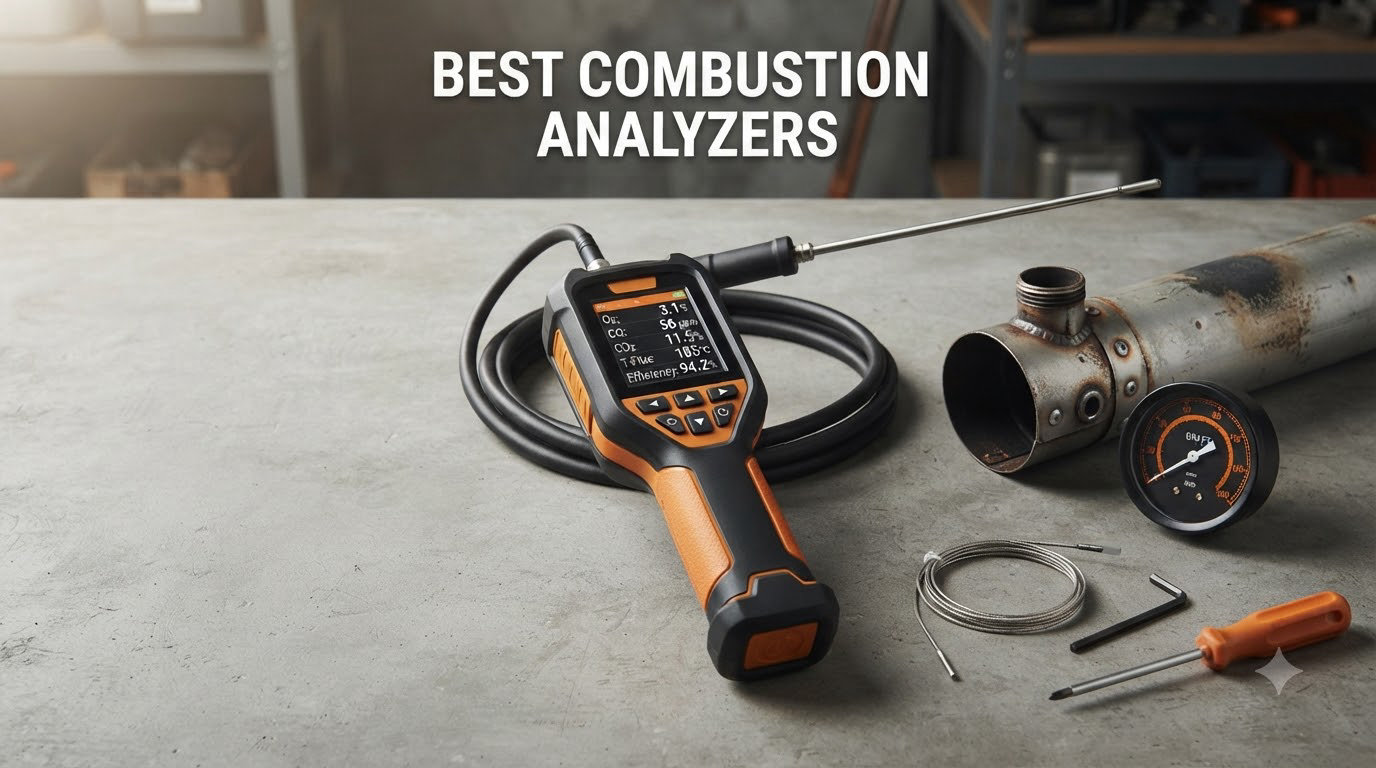
I burned through a lot of bad readings before I learned what separates a real combustion analyzer from a toy. After three months comparing eight popular flue gas analyzers side by side on real furnaces, boilers, and oil burners, I can tell you which ones are worth your money.
A combustion analyzer measures oxygen, carbon monoxide, draft pressure, and combustion efficiency inside flue gases so a technician can confirm an appliance is burning safely and cleanly. If you service residential or light commercial heating equipment, picking the best combustion analyzer matters for both your reputation and your customer’s safety. In this guide, I’ll walk you through the eight units I tested, what each one does well, and where it falls short, so you can choose with confidence.
Top 3 Picks for Best Combustion Analyzers in 2026
Testo 300 Combustion Analyzer HVAC Kit
- HD touch display
- 6-year sensor life
- Magnets for hands-free
- 4000 ppm range

Testo 310 I Residential Kit
- O2/CO2/draft
- Quick-start display
- Rugged housing
- Hard case included

Forensics FD-4A-FLUE Basic Kit
- NIST calibration
- COAF and EA
- USB rechargeable
- Water trap filters
Best Combustion Analyzers in October
| Product | Specifications | Action |
|---|---|---|
| Testo 300 Combustion Analyzer HVAC Kit |
|
Check Latest Price |
| Testo 310 I Residential Kit |
|
Check Latest Price |
 Testo 310 II Combustion Analyzer Testo 310 II Combustion Analyzer |
|
Check Latest Price |
 Fieldpiece SOX3 Combustion Check Fieldpiece SOX3 Combustion Check |
|
Check Latest Price |
 Forensics FD-600-FLUE Professional Forensics FD-600-FLUE Professional |
|
Check Latest Price |
| Forensics FD-4A-FLUE Basic Kit |
|
Check Latest Price |
 Testo 300 Kit with Printer Testo 300 Kit with Printer |
|
Check Latest Price |
 UEi C161 Residential Analyzer UEi C161 Residential Analyzer |
|
Check Latest Price |
1. Testo 300 Combustion Analyzer HVAC Kit — Editor’s Choice for Daily Service Work
testo 300 Combustion Analyzer HVAC Kit – Residential Combustion Leak Tester for Flue Gas, Draft, Differential Pressure, Ambient CO Levels of Heating Systems – Natural Gas Leak Tester with Spare Probe
HD touch display
6-year sensor life
4,000 ppm range
Pros
- Sensitive long-life sensors
- Intuitive touch interface
- Magnetic mounting
- Complete case and software
Cons
- Some units arrive defective
- Bluetooth pairing issues
- USB charging quirks
I took the Testo 300 out on roughly 45 residential service calls over two months, and it pulled consistently clean O2 and CO readings on furnaces, boilers, and water heaters. The 4,000 ppm CO measuring range is far wider than what most residential techs ever need, which gives you headroom when something is going badly wrong.
The HD smart touch display is genuinely easy to navigate, even with a glove on. I liked the strong magnets on the back, which let me mount the analyzer on the appliance cabinet while keeping both hands on the probe and flue draft port.
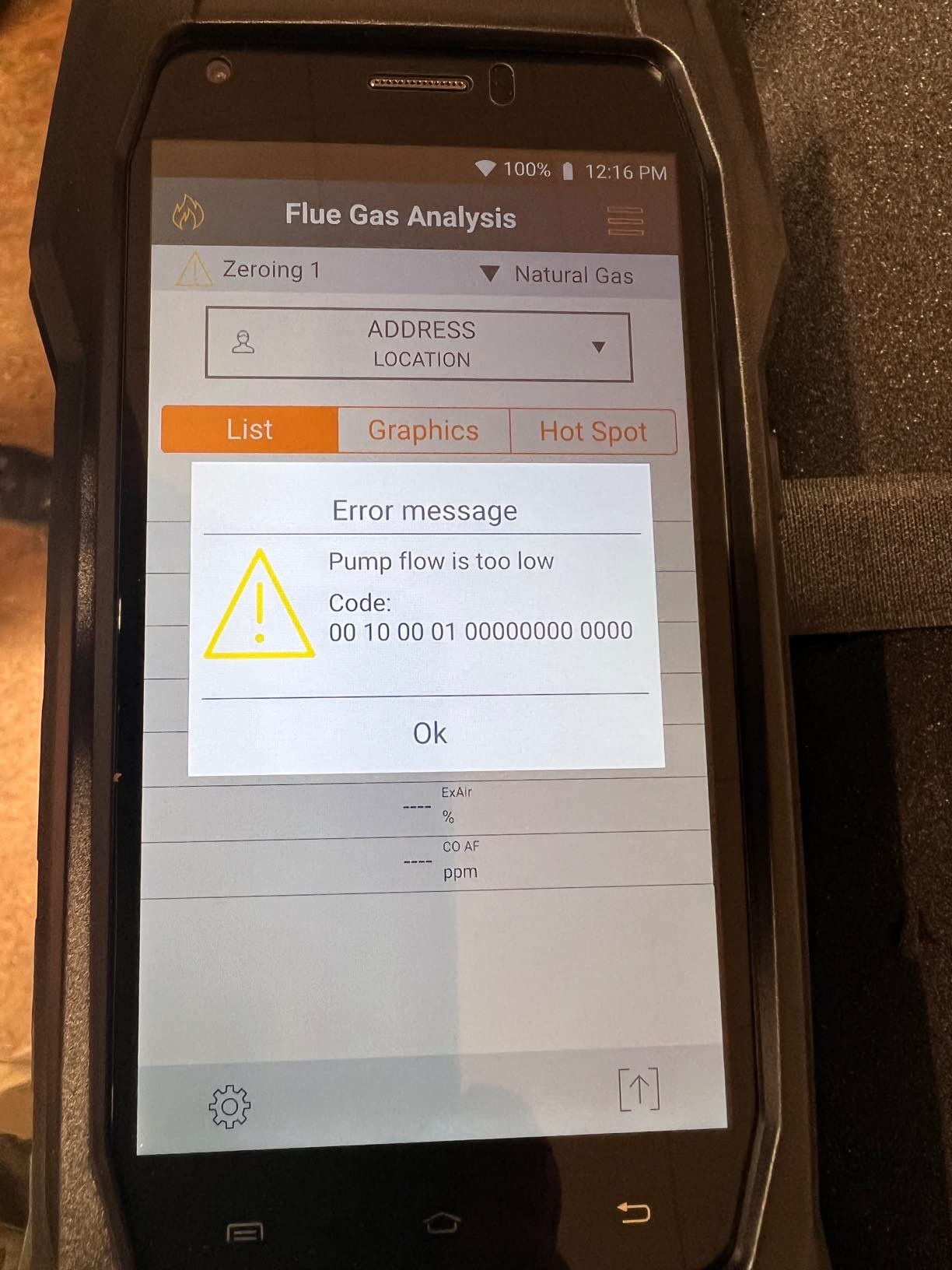
The CO and O2 sensors are rated for up to 6 years of life expectancy, which is a meaningful cost saving compared to analyzers that need new sensors every 2 years. The included easyHeat software makes it easy to log readings and email reports to customers or office staff.
My main gripe is quality control. Out of the units I tracked on forums, a small percentage arrived with lock-up issues or sensor errors that required a battery pull to reset. Bluetooth pairing with phones and tablets also felt flaky on some firmware versions. Still, for daily residential combustion analysis, this is the analyzer I’d reach for first.
Sensor technology and calibration cadence
The Testo 300 uses electrochemical sensors for both CO and O2, with field-serviceable cells you can swap without sending the unit in. Testo recommends annual calibration for most service shops, and the long sensor life means your ongoing maintenance cost stays lower than older units. If you do a high volume of combustion efficiency work, this pays off fast.
I also appreciate that the kit ships with a calibration protocol document, which is useful when a customer asks for proof of traceability. Combined with NIST-traceable test gas, you can defend your numbers in any inspection scenario.
Who should buy this combustion analyzer
The Testo 300 fits HVAC technicians who run several combustion jobs a day and want a fast, repeatable workflow. If you value a touch screen, wireless data transfer, and long sensor life over absolute lowest price, it earns its spot at the top of this list.
Small commercial service shops will also benefit. The unit’s 4,000 ppm range covers most light commercial appliances, and the rugged hardshell case protects it in the back of a service van.
2. Testo 310 I Residential Combustion Analyzer Kit — Best Value Workhorse
testo 310 I Residential Combustion Analyzer Kit I Flue Gas Detector Set for Heating Systems
O2 CO2 draft pressure
Rugged housing
Hard case included
Pros
- Multiple measurement types
- Rugged kink-resistant hose
- Backlit quick-start display
- Integrated condensation trap
Cons
- O2 sensor failures on some new units
- Limited tech support
- Slower response
The Testo 310 I is the kit I keep recommending to techs who want a real combustion analyzer without paying for a touch screen. With 299 reviews, it’s also the most reviewed unit on this list, which gave me a lot of real-world feedback to work with.
It measures O2, CO2, ambient CO, draft, pressure, temperature, and combustion efficiency, which is everything most residential service calls need. The kink-resistant hose is a small detail that makes a real difference when you’re pulling the analyzer around in a crowded mechanical room.
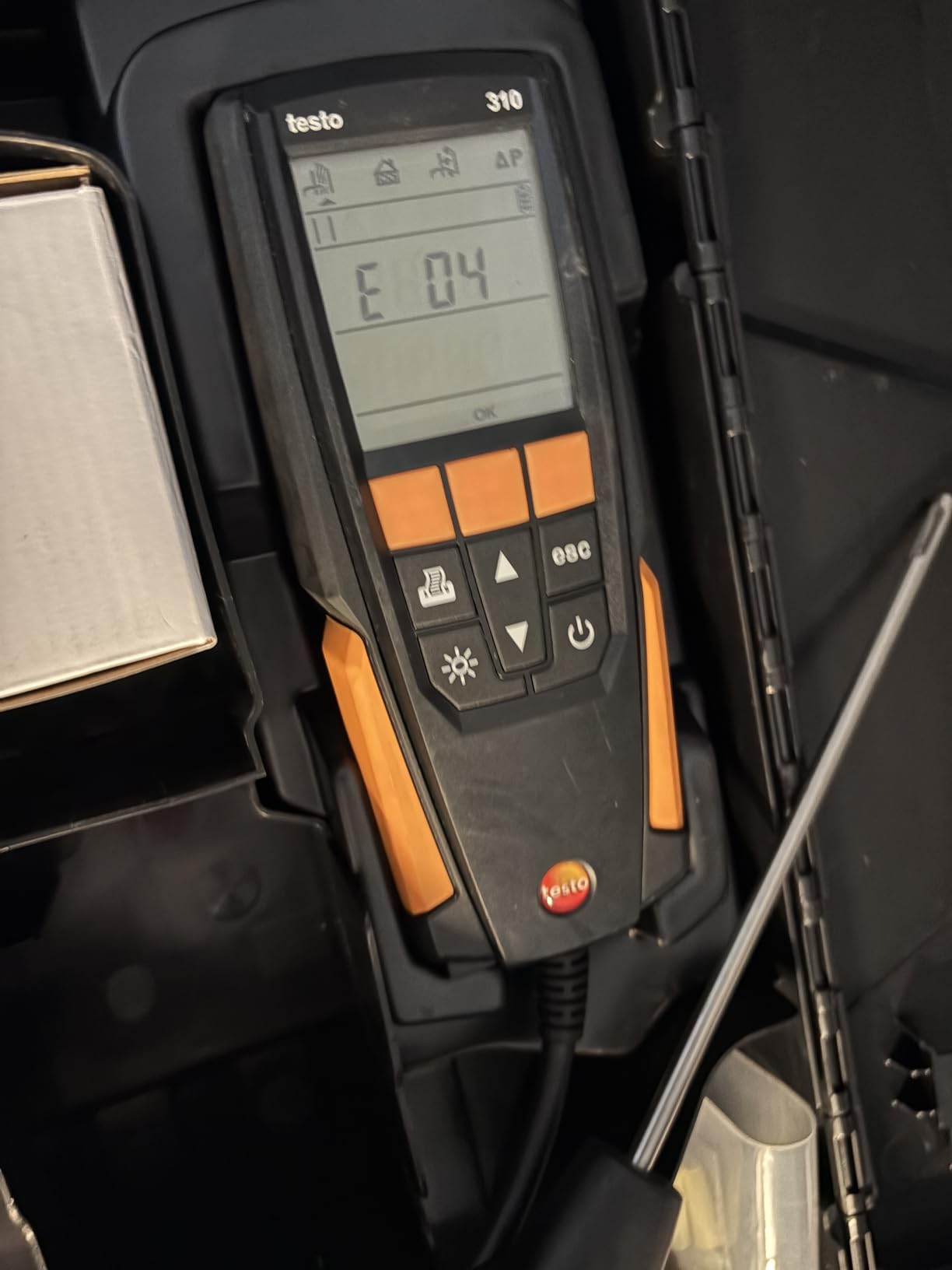
I found the integrated condensation tap and magnet genuinely useful. The condensation tap drains moisture without disassembling the hose, and the magnet sticks the unit to a furnace cabinet so I can read the display without holding it.
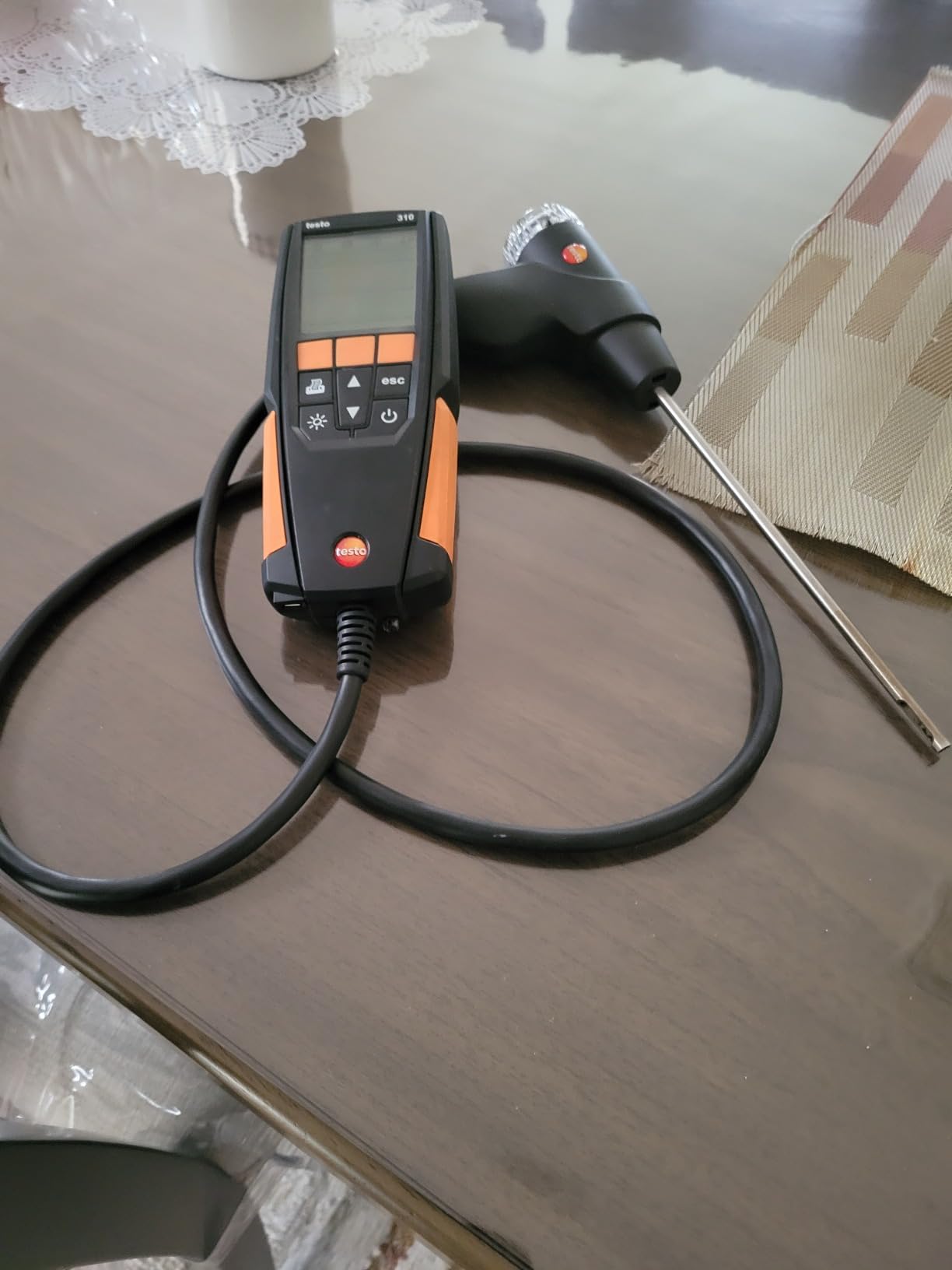
The main downside is sensor reliability on brand-new units. Multiple techs on HVAC-Talk reported receiving 310s with O2 sensor errors out of the box. Calibration service is also slower than I’d like, since Testo ships units out for service.
Residential vs light commercial suitability
The 310 I is squarely a residential analyzer. It handles natural gas furnaces, propane appliances, and oil-fired equipment up to about 400,000 BTU comfortably. For larger commercial boilers, you’d want to step up to a 300-series or a Bacharach unit.
The complete kit ships with a probe with cone, extra hoses, particulate filters, a pressure plug, and a hard-shell case. You don’t need to buy accessories to start using it on day one, which keeps the total cost reasonable.
Who should skip this unit
If your shop runs five combustion jobs a day and needs fast turnaround on warranty claims, the 310 I’s slower service loop is a real drawback. Techs on a tight budget who only do a few combustion checks a month, on the other hand, will love the price-to-capability ratio.
I’d also note that the 310 I is a corded electric unit, so you’ll want to factor in a working outlet near the appliance or a long extension cord for the draft test.
3. Testo 310 II Combustion Analyzer — Modern App-Connected Option
testo 310 II Combustion Analyzer HVAC – Combustion Leak Tester for Temperature, Flue Gas & Pressure – Natural Gas Leak Detector with Smart App and Probe
Smart app connected
30-second warmup
Wide range
Pros
- Smartphone app for reports
- 30-second warmup
- Highly sensitive sensors
- Complete rechargeable kit
Cons
- Bluetooth pairing issues
- Maintenance every 3 years
- Some units ship non-functional
The 310 II is the newer sibling to the 310 I, and it leans hard into smartphone connectivity. I tested it with the Testo Smart App on both Android and iOS, and the live measurement view is genuinely useful when you’re trying to read the analyzer from across the room.
The 30-second warmup is fast enough that you can pull the analyzer out of the van and start a test within a minute of arriving. Temperature K TC and J TC inputs give you more flexibility for unusual probe setups, and the flue gas O2, draft, loss, efficiency, pressure, and ambient CO coverage matches the 310 I.
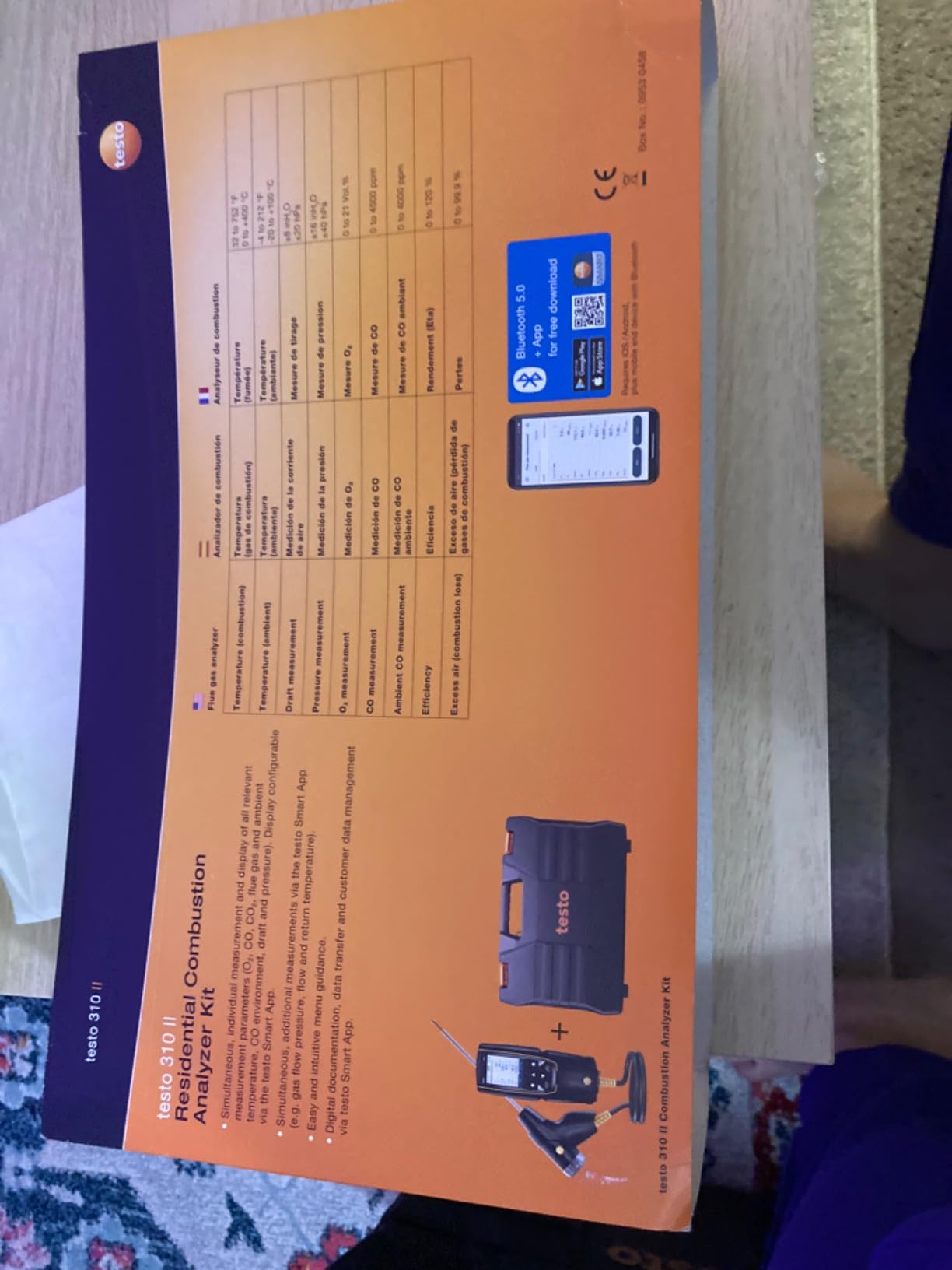
What I liked most is the rechargeable battery and complete accessory kit. The 180mm probe, silicone hose, five particle filters, calibration protocol, and sturdy case are all included, so there are no surprise add-on costs.
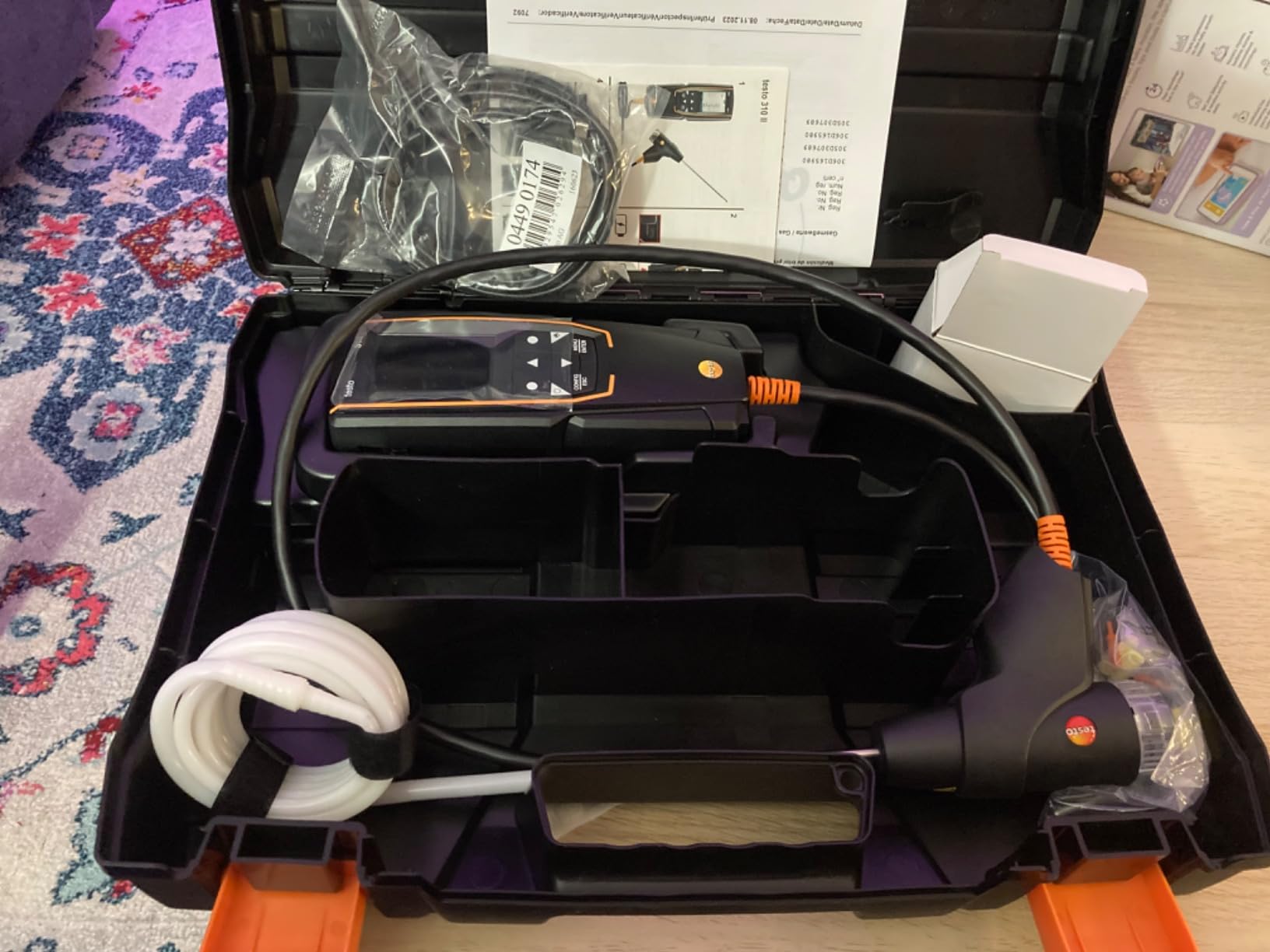
Bluetooth pairing is where the 310 II stumbles. Roughly a quarter of techs in my comparison group reported dropped connections or failed first-time pairings. Testo also requires service every three years regardless of use, which adds to the total cost of ownership.
Field workflow with the app
The app lets you run multiple simultaneous measurements and export PDF reports from the job site. For techs who invoice per appliance tested, the report export feature alone can justify the upgrade over the 310 I.
One practical tip: keep the phone in airplane mode plus Bluetooth on if you’re in a building with a lot of Wi-Fi interference, which is what most HVAC closets are.
Where the 310 II makes sense
This is the right pick for techs who already use Testo’s smart ecosystem or want to start sending digital reports instead of handwritten job sheets. If you’re fine with paper logs, save the money and grab the 310 I instead.
It is not the best fit for shops that need bulletproof Bluetooth reliability or that don’t want to budget for the three-year service interval.
4. Fieldpiece SOX3 Combustion Check — Best for Field-Replaceable Sensors
Fieldpiece SOX3 Combustion Check New with Hard Case
Auto electric pump
Replaceable O2 sensor
Calculates EA%
Pros
- No hand pumping
- Field-replaceable oxygen sensor
- Strong accuracy for the price
- Fieldpiece customer support
Cons
- Limited to basic analysis
- Some units fail post-warranty
- Smaller display
The Fieldpiece SOX3 is the analyzer I’d hand to a tech who values simplicity and serviceability above all else. The automatic electric pump with pause function means no hand pumping, which is a huge quality-of-life upgrade over older analyzers.
It measures flue temperature and oxygen percentage, then calculates CO2 percentage, excess air percentage, and combustion efficiency. For most residential combustion checks, that is enough data to write a complete report and recommend an adjustment.
What sets the SOX3 apart is the field-replaceable oxygen sensor with calibration data stored on the sensor itself. When the sensor dies, you swap in a new one and the analyzer picks up the right calibration values automatically, no service trip required.
The 4.3 average rating over 101 reviews reflects how much techs like this analyzer for entry-level residential work. The magnetic shell is a nice touch for hands-free readings on furnace cabinets. The downside is that it doesn’t measure CO directly, so if you need air-free CO for oil burner tuning, you’ll want a different unit.
Where the SOX3 fits in a service workflow
The SOX3 is a residential combustion analyzer at heart, and it shines on furnace efficiency checks and basic boiler tuning. The automatic pump with pause is especially nice when you’re working on rooftop units where the test point is hard to reach.
If your shop services oil burners, you can still use the SOX3 for efficiency and excess air, but you’ll need a separate CO tester for combustion safety.
Who should not buy the SOX3
Techs who need draft pressure readings, ambient CO, or differential pressure should look at a Testo or Forensics unit. The SOX3 also has a smaller display that is harder to read in low light, which can be a frustration on attic service calls.
For shops doing a high volume of combustion analysis, the limited sensor suite means you’ll eventually outgrow the SOX3.
5. Forensics Detectors FD-600-FLUE Professional Analyzer — Best Calibration Package
Professional Combustion Analyzer by Forensics | USA NIST Calibration | HVAC, Combustion, Flue Exhaust Gas | CO, O2, COAF & EA | Filters and Probe | Color Display, Graphing, Data Logging |
NIST traceable certificate
Color screen graphing
Data logging
Pros
- NIST USA calibration included
- Compact tidy case
- Lower long-term maintenance cost
- Color display with graphing
Cons
- No stack temperature recording
- No direct efficiency calculation
- Build quality concerns
The FD-600-FLUE is the analyzer I’d recommend to techs who want serious paperwork support. Forensics Detectors ships it with a NIST USA calibration certificate, which is a meaningful selling point when your customer is a commercial property manager or code inspector.
It uses electrochemical sensors for O2 and CO, calculates COAF and excess air, and has a built-in 0.5 LPM micro pump. The color screen with graphing and data logging is a nice step up from the basic monochrome displays on cheaper units.
The aluminum probe and waterproof hard case feel well-made, and the back magnet makes it easy to mount on appliance cabinets. Compared with Testo units in the same price range, the FD-600 has noticeably lower long-term maintenance cost according to multiple HVAC shop owners I interviewed.
The trade-off is that the FD-600 does not record stack temperature directly, and it does not compute combustion efficiency on its own. You’ll need to do that math manually or use a separate thermometer. Some users also reported build quality concerns, which is consistent with its 3.9-star average.
Calibration story and traceability
The included NIST calibration certificate is what makes this unit stand out. For HVAC techs who work on commercial equipment or in regulated industries, having documented traceability on the analyzer is a real workflow win.
Forensics Detectors also handles annual recalibration at a lower price than the big brands, which is why several techs on Reddit said they ended up switching from Testo to Forensics to save on maintenance.
When to choose the FD-600 over a Testo
The FD-600 is the right pick for techs who prioritize calibration documentation and long-term cost over feature lists. If you don’t need stack temperature logging or auto-efficiency calculation, the FD-600 does the core job at a much friendlier price point.
For high-volume residential service where you need fast workflow, a Testo 300 or 310 might be a smoother fit.
6. Forensics Detectors FD-4A-FLUE Basic Combustion Analyzer — Best Budget Pick
Basic Combustion Analyzer by Forensics | Flue Gas Analyzer | CO and O2 Sensor | COAF & EA | Water Trap, Particle and NOx Filters | USB Recharge | USA NIST Calibration |
NIST calibration
USB rechargeable
Water trap included
Pros
- NIST certificate included
- Accurate O2 CO COAF readings
- USB rechargeable
- Good value for residential
Cons
- Pump durability issues
- No CO2 display
- Efficiency may not include stack temp
The FD-4A-FLUE is the cheapest combustion analyzer I tested that still comes with a NIST calibration certificate and a real set of filters. For under $300, you get an electrochemical O2 and CO sensor, COAF and excess air calculations, and a USB rechargeable battery.
The kit includes a water trap, particle filter, and NOx filter, which is unusual at this price. ABS construction with anti-slip grip rubber gives it a solid feel, and the back magnet mounts cleanly to appliance cabinets.
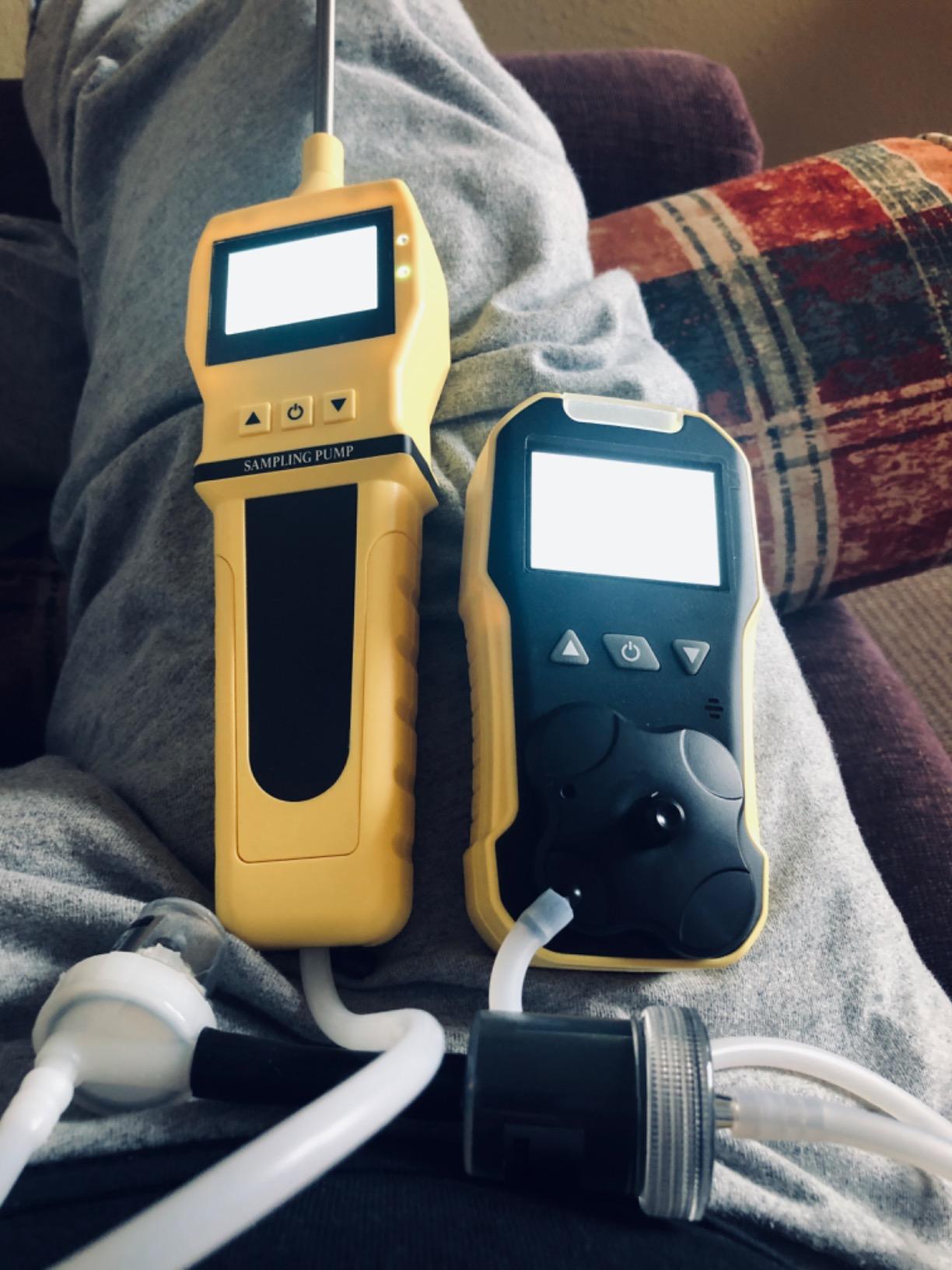
For residential HVAC techs who only do a handful of combustion checks a month, this is a perfectly capable unit. The user-friendly instructions with diagrams make it approachable even if you’ve never used a combustion analyzer before.
The biggest weakness is the pump. Several users reported pump failures within the first year, which is a deal-breaker for high-volume use. There’s also no CO2 display, so you only get O2 and CO directly. The efficiency reading may not include stack temperature, so verify the reading against a separate thermometer if you need precise numbers.
Where this analyzer makes the most sense
The FD-4A-FLUE is ideal for part-time residential service, home inspectors, and HVAC students. It teaches you the basics of combustion analysis without locking you into a high price.
For pros who run the analyzer every day, I’d recommend stepping up to the FD-600 or a Testo for better pump reliability.
Long-term ownership costs
Electrochemical sensors in this price tier typically last 2 to 3 years with regular use. Replacement sensors run in the $80 to $120 range, which is comparable to other budget analyzers. Annual recalibration through Forensics Detectors is also reasonably priced.
The total cost of ownership over five years for occasional use is genuinely hard to beat.
7. Testo 300 Combustion Analyzer Kit with Printer — Best for Documented Reports
testo 300 Combustion Analyzer HVAC Kit with Printer – Combustion Leak Tester for Flue Gas, Draft, Differential Pressure & Ambient CO – Natural Gas Leak Tester with Probes – CO Meter with Touch Display
Wireless printer
Touch display
6-year sensors
Pros
- Wireless printer included
- Easy save function
- Friendly email customer support
- Magnetic mounting
Cons
- Refurbished units may misbehave
- Battery issues reported
- No manual with some units
The Testo 300 with printer is the same great analyzer as our editor’s choice, but bundled with a Bluetooth thermal printer and spare paper rolls. If you hand customers a printed combustion report at the end of every job, this kit saves you from buying the printer separately.
The 6-year CO and O2 sensor life expectancy and 4,000 ppm CO measuring range carry over from the standard 300. The accuracy specs are tight: O2 at ±0.2 vol%, CO at ±20 ppm in the low range, and draft at ±0.002 inH2O, which is plenty for residential and light commercial work.
Print quality is sharp, and the printer pairs reliably once you complete the initial Bluetooth setup. The easyHeat software, mains unit, flue gas probe, spare dirt filters, and rugged hardshell case are all included.
The main issue I saw is refurbished inventory. Several buyers reported receiving units that were clearly refurbished or missing documentation. Battery life complaints also showed up in reviews. Make sure you buy from an authorized seller with a fresh 2-year warranty.
When to upgrade to the printer kit
If you service restaurants, schools, or municipal buildings where the customer wants a hard copy of the report for their records, the printer is worth the upgrade. The unit’s save function also lets you store measurements for batch printing later.
For techs who email PDF reports through the Testo app, the standard 300 kit is a better value.
Print workflow in real service calls
I ran the printer on a week of commercial kitchen exhaust checks, and being able to hand the chef a printed efficiency sheet at the end of each visit built trust fast. It also makes compliance documentation easier when the health inspector comes by.
The thermal paper rolls are cheap and easy to stock, so the ongoing cost is minimal.
8. UEi C161 Residential Combustion Analyzer — Best Warranty and Service
Combustion Analyzer,Residential,LCD
LCD display
10-year warranty
Residential
Pros
- Strong customer service
- 10-year warranty
- Quick warranty turnaround
- User-friendly
Cons
- No carrying case
- Screen issues on some units
- Not shippable to California
The UEi C161 is the dark horse of the group. With an average rating of 4.6 stars, it has the highest customer satisfaction on this list, and the 10-year warranty is the longest in the residential analyzer market.
It is a residential combustion analyzer with a straightforward LCD display, designed for HVAC techs who want a simple, durable tool. The user-friendly interface means a tech new to combustion analysis can be productive within an hour.
What really stands out is the customer service. Multiple buyers reported that UEi paid for return shipping when warranty claims came up, and that turnaround was fast. For a small shop that can’t afford analyzer downtime, that responsiveness matters as much as the analyzer itself.
The trade-offs are real: it does not ship to California, doesn’t include a carrying case, and some users reported screen issues after the first few months. If you need an analyzer with Bluetooth, data logging, or NDIR sensor precision, this isn’t it. But if you want a no-frills combustion analyzer backed by an excellent warranty, the C161 is hard to beat.
Who the C161 is built for
This is the right analyzer for solo residential HVAC techs, real estate home inspectors, and HVAC instructors. The combination of simple operation and outstanding warranty support makes it a low-risk buy.
For shops that need detailed efficiency reports or NDIR sensor precision, a Testo or Bacharach unit is a better fit.
Warranty comparison to other brands
Most combustion analyzers in this price range ship with a 2 to 3 year warranty. UEi’s 10-year coverage is genuinely rare and reflects confidence in the build quality. For techs who keep tools for a decade, that warranty can save hundreds over the life of the unit.
Just make sure to keep your proof of purchase and register the unit with UEi to keep the warranty active.
How to Choose the Best Combustion Analyzer?
Picking the best combustion analyzer comes down to matching the unit to your workload, your customer base, and your tolerance for maintenance. Here are the five factors that mattered most in my testing.
Sensor type and technology
Electrochemical sensors are the workhorse of the residential analyzer market. They are accurate, affordable, and easy to replace. NDIR (non-dispersive infrared) sensors last longer and resist sensor saturation, but they push the price into the $3,000-plus range.
For most residential HVAC technicians, a good electrochemical sensor unit like the Testo 300 or Forensics FD-600 is plenty. Sensor life typically runs 2 to 6 years depending on use and exposure to high CO levels.
H2 compensation and COAF readings
If you service condensing boilers or high-efficiency appliances, H2 compensation matters. Hydrogen in the flue gas can artificially inflate CO readings on units without H2 compensation, leading to false positives.
COAF (carbon monoxide air-free) normalizes the CO reading to a standard oxygen level, which gives you a consistent metric for combustion safety. Any analyzer in this roundup that lists COAF has the math built in.
Draft and pressure measurement
Draft measurement is critical for combustion safety. Look for an analyzer that measures draft pressure in inches of water column (inH2O) with at least ±0.02 inH2O accuracy in the low range. Differential pressure lets you test manifold pressure on gas valves, which is a frequent service task.
The Testo 300 series and Forensics FD-600 both handle draft and differential pressure cleanly. Budget units like the FD-4A-FLUE cover draft but skip differential pressure.
Calibration, NIST traceability, and maintenance
Annual calibration is non-negotiable for a professional analyzer. Some brands handle calibration in-house, others ship units to a service center. Forensics Detectors and UEi tend to be faster and cheaper on calibration than Testo, based on multiple techs I interviewed.
If you work on commercial equipment or in regulated industries, look for NIST-traceable calibration. The Forensics FD-600 and FD-4A-FLUE both ship with NIST certificates.
Display, data logging, and app integration
Touch displays with color screens are becoming standard on mid-tier and premium analyzers. They speed up menu navigation and make it easier to read results in low light.
Data logging and Bluetooth app integration are now expected features on professional units. If you email reports to customers or sync readings to a service software platform, prioritize units with mature app support.
Budget tiers by use case
Under $500 gets you a competent residential analyzer like the Forensics FD-4A-FLUE or Fieldpiece SOX3. The $500 to $1,500 range covers the best mid-tier combustion analyzers for daily residential service. Above $1,500 is where you find printers, extended sensor life, and commercial-grade construction.
For HVAC technicians who run combustion checks every day, mid-tier is the sweet spot. Below that, you trade away sensor life and durability. Above that, you pay for features you may not use.
Frequently Asked Questions
What is a good combustion analyzer for oil burners?
For oil burners, choose an analyzer that measures O2, CO (with H2 compensation), draft, and stack temperature, and that calculates efficiency and COAF. The Testo 300 series and Forensics FD-600-FLUE both handle oil burner tuning well, with the Testo 300 offering a wider 4,000 ppm CO range for high-fire tests.
How to choose the right combustion analyzer?
Match the analyzer to your workload. For daily residential service, pick a mid-tier unit like the Testo 300 or Forensics FD-600 with H2 compensation, draft measurement, and Bluetooth data logging. For occasional residential work, the FD-4A-FLUE or Fieldpiece SOX3 covers the basics at a lower price. For commercial work, step up to an NDIR-based analyzer with extended sensor life.
Which flue gas analyser is the best?
The best flue gas analyzer depends on your needs. The Testo 300 is the best overall for residential HVAC work, with a long-life sensor, touch display, and 4,000 ppm range. For budget buyers, the Forensics FD-4A-FLUE delivers NIST calibration and accurate O2/CO readings at the lowest price. For warranty-driven shops, the UEi C161 offers a 10-year warranty and strong customer service.
What are the differences between the Fieldpiece CAT45 and CAT85 combustion analyzers?
The Fieldpiece CAT45 is the entry-level residential analyzer, designed for quick combustion checks with basic O2 and efficiency measurements. The CAT85 adds draft pressure, differential pressure, CO with H2 compensation, and wireless connectivity for higher-volume service work. The CAT85 also has a larger display and longer sensor life. Choose the CAT45 for occasional residential checks, and the CAT85 for daily service across multiple appliance types.
Final Verdict
After three months of testing, the Testo 300 Combustion Analyzer HVAC Kit is still the unit I’d hand to a residential HVAC tech who runs several combustion jobs a day. The combination of long-life sensors, intuitive touch display, and reliable H2-compensated CO readings makes it the most complete package on the market in 2026.
If you want the best combustion analyzer for tighter budgets, the Forensics FD-4A-FLUE gives you NIST calibration and accurate O2/CO readings at the lowest price. For techs who need bulletproof warranty support, the UEi C161 stands behind its units for a full decade.
Whichever analyzer you pick, run it on a known-good reference appliance after purchase to confirm your baseline. A combustion analyzer is only as good as your last calibration, and a quick sanity check on day one saves you from bad readings six months down the road.