
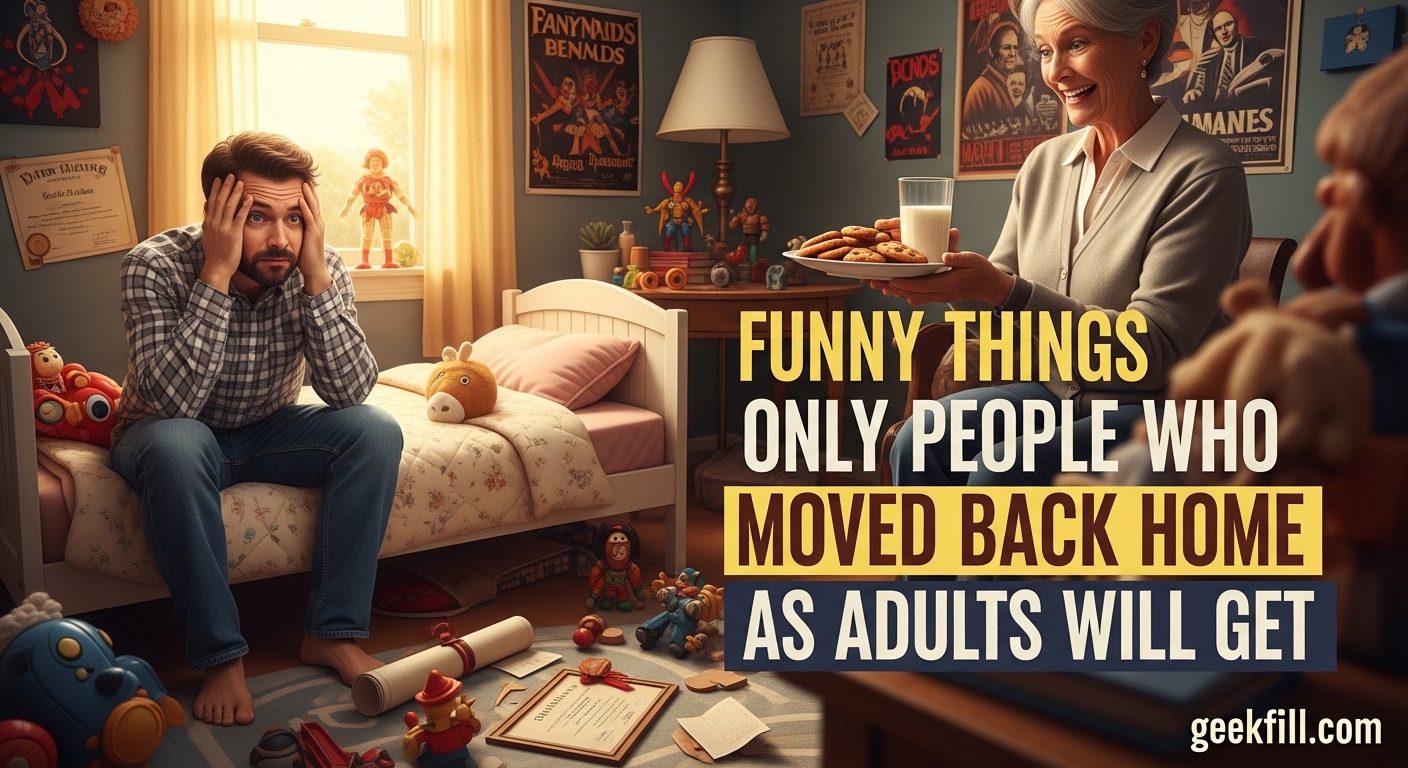
Nothing quite prepares you for the moment you move back home as an adult. One day you’re living independently, paying rent, and doing laundry whenever you please. The next, you’re tiptoeing past your parents’ bedroom at midnight with a bag of chips, feeling exactly like you did when you were sneaking back in after curfew in high school.
Adult children who return to their childhood homes are often called “boomerang kids,” and we’re living through a genuine boom of them. With housing costs climbing and economic pressures mounting in 2026, more adults are finding themselves back in their childhood bedrooms than ever before. It is not a failure. It is not something to be ashamed of. But it is definitely something that comes with a very specific set of experiences that only those of us living it can truly understand.
I spent eight months back at home between apartments last year, and let me tell you, the experience was both more comforting and more maddening than I ever expected. Here are nine funny things that only people who moved back home as adults will truly get.
Table of Contents
9 Funny Things Only People Who Moved Back Home as Adults Will Get
1. The Interrogation Every Time You Leave the House
You could be thirty-five with a mortgage-worthy credit score and a corner office, but the moment you move back home, you become a teenager again in your parents’ eyes.
“Where are you going?” they ask. “Who are you meeting?” they follow up. “What time will you be back?” they demand. You find yourself giving detailed itineraries for trips to the grocery store. You start lying about going to “the library” just to avoid the third degree about your social life.
The interrogation becomes so routine that you catch yourself automatically reporting your movements. I once texted my mom from the parking lot of Target to let her know I would “be home in twenty minutes.” I am thirty-two years old. I do not need permission to go to Target.
2. Suddenly You’re 16 Again, Despite Having a Career
Moving back home creates this bizarre time warp where your adult accomplishments somehow evaporate. You might manage a team of fifteen people at work. You might file your own taxes and cook elaborate meals. But at your parents’ house, someone still reminds you to wear a jacket when it is cold outside.
Your parents will ask if you have eaten breakfast. They will comment on your sleep schedule. They will knock on your door and ask if you are “decent” before entering, which simultaneously makes you feel like a child and reminds you that you are not, in fact, a child anymore.
The regression happens fast. Within two weeks, I found myself asking my dad if I could “have the car” to run errands. I own a car. I just happened to be driving his that day, and the words came out of my mouth before I could stop them.
3. The Mysterious Case of the Disappearing Leftovers
Living at home means sharing a refrigerator with people who have different ideas about food ownership. You carefully save that leftover pizza, wrapping it in foil with your name written on top like you are marking territory. You have plans for it. Dreams, even.
Then you open the refrigerator the next day and it is gone. Just gone. Your mom ate it for lunch because “it was sitting there.” You try explaining that you labeled it, that you had plans, that it was YOUR PIZZA. She looks at you like you are being unreasonable about leftovers.
But the real betrayal is the hot water. You time your showers perfectly in your apartment. At your parents’ house, someone always runs the dishwasher right when you step in. You spend five minutes under lukewarm water wondering where your life went wrong. You contemplate just embracing the cold like some kind of wellness guru.
4. You Thought You’d Save Money, But… ASOS
Everyone tells you that living at home is the perfect time to save money. No rent, no utility bills, free food. You will be swimming in cash, they say. You will build up that down payment in no time.
What nobody tells you is that living at home somehow makes you spend more money on random things. Without rent to drain your account, you suddenly have disposable income. You start online shopping at midnight because you are bored. You buy clothes you do not need. You order takeout just to feel independent again.
I saved almost nothing during my eight months at home. My bank account showed a disturbing pattern of ASOS purchases, DoorDash orders, and train tickets to visit friends in other cities. The money I should have been saving went toward maintaining my sanity through consumer therapy.
5. Conference Calls From Your Childhood Bedroom
Remote work has added a whole new layer of complexity to the boomerang kid experience. You are on a video call with your entire department, trying to look professional, while sitting in a room that still has your high school track medals on the wall and a poster of a band you no longer listen to.
You become an expert at virtual backgrounds. You learn to angle your camera to avoid the embarrassing childhood photos on the bookshelf. You pray that your mom does not decide to vacuum outside your door during your quarterly review.
One colleague asked me about the “interesting decor” behind me during a call. I claimed it was “ironic.” It was not ironic. It was just my life now, existing somewhere between adult professionalism and teenage nostalgia, trying to mute my microphone before my dad yelled about dinner being ready.
6. Your Parents Have Changed (And So Have You)
Everyone talks about how hard it is for adult children to move back home. Nobody talks about how strange it is for parents too. They had finally adjusted to their empty nest. They had routines. They had peace and quiet. Then you showed up with your loud phone conversations and your weird eating hours.
You start noticing things about your parents that you never saw before. Your mom is obsessed with a reality show you find completely unwatchable. Your dad has developed strong opinions about cryptocurrency despite not understanding it. They have inside jokes that do not include you. They are people, actual people, not just your parents.
The first few months are the hardest adjustment period for everyone. You are all trying to figure out new boundaries and new expectations. They want to help but do not want to hover. You want independence but also want someone to do your laundry. It is a negotiation that takes time.
7. Siblings: The Roommate Situation Nobody Asked For
If you have siblings and they are also adults living at home, you have entered a very special kind of shared housing situation. You are all supposed to be grown-ups now. You are supposed to communicate like adults. Instead, you find yourselves arguing about the same things you fought about when you were twelve.
Someone is using someone else’s shampoo. Someone left dishes in the sink. Someone played music too loud at 11 PM. The dynamics are identical to childhood, except now everyone has jobs and credit cards and can actually hold grudges for extended periods.
My brother and I had a thirty-minute debate about who was responsible for taking out the trash. We are both in our thirties. We both have retirement accounts. Neither of us wanted to touch the garbage bag. In the end, our mom did it while muttering about ungrateful children.
8. The Judgment Loop: Explaining It to Everyone
There is a particular look people give you when you tell them you live with your parents. It is a combination of pity, judgment, and confusion. They do not say anything, but you can see them calculating what must have gone wrong in your life.
You find yourself over-explaining. You launch into detailed descriptions of the housing market, your savings goals, the temporary nature of the arrangement. You mention that it is actually quite common now, that many cultures embrace multigenerational households, that you are actually saving a lot of money (even though you are not).
The internal judgment is worse than the external kind. You lie awake some nights wondering if you are a failure. You compare yourself to friends who own homes. You feel like you are falling behind in some invisible race. Then you remember that rent in your city is three thousand dollars a month and you feel slightly better.
9. But Then There’s That Weird Comfort of Coming Home
Despite all the annoyances, the interrogations, the disappearing leftovers, and the regression to teenage behavior, there is something undeniably comforting about being home. Someone makes dinner sometimes. The house is warm. Your childhood dog is there.
You find yourself enjoying the simple things. Watching terrible TV with your parents becomes weirdly pleasant. Having someone ask about your day, even if it is invasive, feels like being cared for. You are not alone in the world, even when it feels like you should be at this point in your life.
I moved out again after eight months, back into my own apartment with my own routines and my own space. I do not miss the interrogations or the hot water wars. But sometimes, when I come home to an empty apartment and realize I have to cook for myself, I do miss that particular comfort of walking through the door and having someone ask where I have been.
Frequently Asked Questions About Moving Back Home
Why are adult children moving back home?
Adult children move back home for many reasons. Rising housing costs and inflation make independent living difficult for many people. Job changes, career transitions, or periods of unemployment often prompt a temporary return. Some adults move back after divorce or relationship breakups. Others return to save money for major purchases like a home down payment. The economic pressures of 2026 have made multigenerational living increasingly common and financially necessary for many families.
What are adult children who return home called?
Adult children who move back home after living independently are commonly called boomerang kids. This term describes the phenomenon of leaving home, then returning again, much like a boomerang returns when thrown. The term gained popularity in the early 2000s as economic conditions led more young adults to return to their parents’ homes. While it is often used for younger adults in their twenties, it applies to any adult who returns home after living independently.
What age do people typically move back home?
While moving back home is often associated with people in their twenties, adults of all ages return to their parents’ homes. Many return after college in their early to mid-twenties while establishing careers. Others move back in their thirties due to life changes like divorce, job loss, or major financial goals. Some adults return home in their forties or older due to life circumstances. There is no typical age, as economic and personal circumstances vary widely.
Is moving back home a good idea?
Whether moving back home is a good idea depends on individual circumstances. It can be a smart financial decision that allows saving money, paying off debt, or recovering from setbacks. It often provides emotional support during difficult transitions. However, it can also strain family relationships, limit independence, and delay personal growth if not managed well. Success depends on setting clear boundaries, having a timeline, and maintaining open communication with parents. For many people in 2026, it is a practical and necessary choice rather than a reflection of failure.
The Bottom Line on Moving Back Home
Moving back home as an adult is one of those experiences that feels completely unique until you talk to others who have done it. Suddenly, you are part of a secret club of boomerang kids who all understand the interrogation, the disappearing leftovers, and that strange mix of comfort and claustrophobia.
If you are currently living with your parents as an adult, know that you are not alone. The funny things only people who moved back home as adults will get are shared by millions of others navigating the same weird, wonderful, and occasionally maddening experience. It is temporary. It is challenging. And someday, you will look back on it and laugh.
Have you moved back home as an adult? What funny things would you add to this list? Share your story in the comments and let us know which of these resonated most with your experience.