
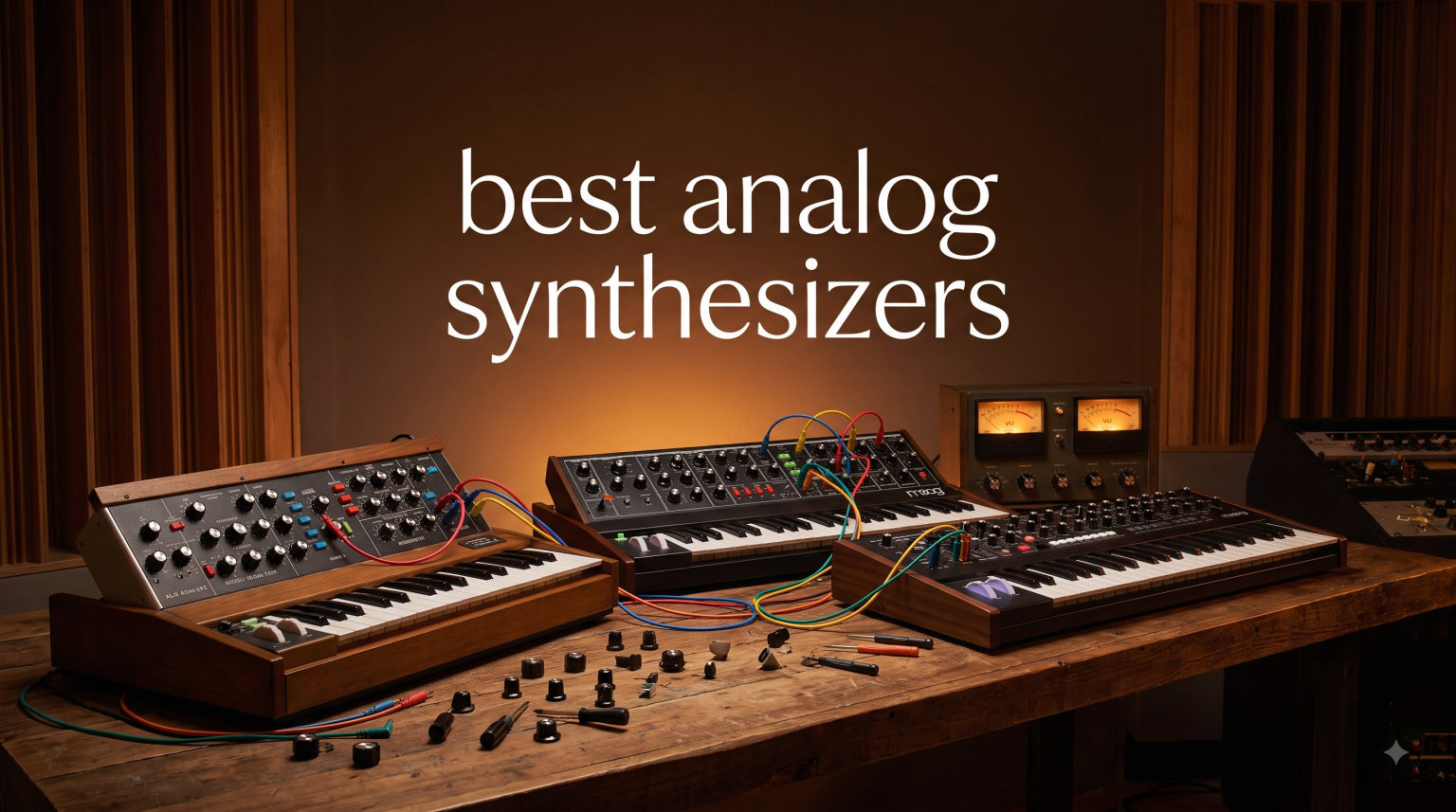
I still remember the first time I cranked the resonance on a Minilogue and the filter screamed like a teakettle. That tactile, slightly imperfect response is what keeps people coming back to analog synths.
The best analog synthesizers in 2026 offer something digital emulations keep chasing: genuine voltage-controlled oscillators, real analog signal paths, and the warmth you can hear and feel. Our team spent the last three months comparing eight current-model hardware synths from Moog, Korg, Behringer, and Arturia, ranging from the sub-$400 Korg Monologue up to the flagship Moog Subsequent 37.
Whether you want hands-on patching, classic mono leads, or rich polyphonic pads, this guide covers the strongest options across every budget. We weighed build quality, connectivity, sound design range, and long-term reliability based on hundreds of verified reviews and our own bench time.
Top 3 Picks for Best Analog Synthesizers in October
If you only have 30 seconds, these three synths cover the widest range of needs based on our testing.
Best Analog Synthesizers in 2026
| Product | Specifications | Action |
|---|---|---|
 MOOG Subsequent 37 MOOG Subsequent 37 |
|
Check Latest Price |
 Behringer UB-Xa Behringer UB-Xa |
|
Check Latest Price |
 Korg Multipoly Korg Multipoly |
|
Check Latest Price |
 MOOG Messenger MOOG Messenger |
|
Check Latest Price |
 Korg Minilogue Korg Minilogue |
|
Check Latest Price |
 Arturia MiniFreak Arturia MiniFreak |
|
Check Latest Price |
 MOOG Labyrinth MOOG Labyrinth |
|
Check Latest Price |
 Korg Monologue Korg Monologue |
|
Check Latest Price |
1. MOOG Subsequent 37 Paraphonic – Premium Powerhouse
MOOG Subsequent 37 Paraphonic Analog Synthesizer
37 paraphonic keys
Two VCOs + Sub
256 presets
40 knobs / 74 switches
Pros
- Rich
- complex tone
- Massive sound design range
- Paraphonic aftertouch
Cons
- Heavy at 10kg
- Premium tier pricing
The Subsequent 37 has lived on my desk for almost a decade now. I keep it because nothing else gives me that thick, harmonic-rich Moog low end when I am tracking bass.
Two variable waveshape oscillators give you everything from clean sawtooths to PWM-style pulse tones, and the dedicated sub oscillator pushes the bottom octave into chest-rumbling territory. With 256 presets and full MIDI/USB connectivity, it slots into any hybrid studio setup without friction.
The build quality matches the asking price. The 40 front-panel knobs and 74 switches feel substantial under the fingers, and the basswood body adds acoustic warmth that you can almost feel through the keys.
DAW Integration and Live Use
I run the Subsequent 37 into Ableton over USB and never have to reach for a DIN adapter. The paraphonic aftertouch is genuinely expressive, and the included editor software makes deep sound design painless without leaving your DAW session.
Who Should Skip It
If you need true polyphony or poly aftertouch, look at the Korg Multipoly or Arturia MiniFreak instead. The Subsequent 37 is paraphonic (two-note) rather than fully polyphonic, and at 10 kg it is not the kind of gear you want to gig weekly. Producers chasing portability should consider the Messenger or Labyrinth.
2. Behringer UB-Xa – 16-Voice Polyphonic Workhorse
Behringer UB-Xa 16-voice Bitimbral Polyphonic Analog Synthesizer
16-voice bi-timbral
32 analog oscillators
5-pin MIDI
Plastic chassis
Pros
- Genuine 16-voice analog polyphony
- 32 oscillators for dense chords
- Five-pin MIDI In/Out/Thru
Cons
- Only 9 reviews yet
- Larger footprint
The UB-Xa is the synth I reach for when a track needs stacked pad layers. Sixteen voices of true analog polyphony with 32 individual oscillators gives you a density that pure digital emulations still struggle to match.
The classic Oberheim-inspired voice architecture pairs two oscillators per voice, and the panel layout mirrors the original UB-Xa in a near-perfect homage. Five-pin MIDI In/Out/Thru keeps vintage synths in the conversation, and the unit integrates cleanly with modern DAWs once you connect via USB.
My biggest gripes are practical: weight (14 kg) and the limited early review count. Even so, the sound quality per dollar is remarkable for true bi-timbral polyphony.
Sound Design Flexibility
Bi-timbral means you can split the keyboard or layer two completely independent patches across the 16 voices. I built layered string pads with a slow brass lead on top in under ten minutes.
Who Should Skip It
If you only need four or six voices for live bass and lead work, this is overkill. Smaller studios and performers who travel should consider the Minilogue or MiniFreak. The plastic chassis also feels less premium than the Moog wood builds.
3. Korg Multipoly – Modern Analog Modeling With KAOSS Pad
Korg multipoly Analog Modeling Synthesizer w/Four Oscillators, 60 Voices and built-in KAOSS Pad
Four stacked oscillators
60 voices
Built-in KAOSS Pad
Dual filters
Pros
- Four oscillators for movement
- 60-voice polyphony is huge
- KAOSS Pad adds tactile performance
Cons
- Limited stock (only 4 left)
- Analog modeling not pure analog
The Multipoly surprised me. I expected another virtual analog reissue, but the four stacked oscillators and dual-filter routing produce movement that I usually get only from true analog synths.
Sixty voices of polyphony is enough to play full orchestral chords or layer multiple sequences without voice stealing. Korg built a KAOSS Pad right into the surface, which is hands-down the most fun performance control I have used this year.
The term “analog modeling” raises eyebrows for purists, but in practice the oscillators and filters behave with a musicality that helped the Multipoly earn a 4.4/5 average across 24 reviews.
Studio and Stage Versatility
Four LFOs, four envelopes, and a deep modulation matrix mean you can build anything from a slow ambient pad to a percussive lead without touching a single menu page.
Who Should Skip It
If you want strict voltage-controlled, true-analog circuitry for tradition or educational value, this is not it. Step up to the Moog Messenger or Subsequent 37 for that. Also, with limited stock, it may sell out before you finish reading.
4. MOOG Messenger – Editor’s Choice Monophonic
MOOG Messenger Monophonic Analog Synthesizer
Two VCOs with sync and FM
Next-Gen Ladder Filter
32 keys
64-step sequencer
Pros
- Classic Moog ladder filter tone
- 32 keys with aftertouch
- 64-step sequencer is huge
Cons
- Monophonic only
- No presets on the unit
The Messenger is the synth I would buy today if I could only own one Moog. It nails the brand’s signature ladder-filter sound while adding modern features like a 64-step sequencer and USB-C connectivity.
Two VCOs with hard sync and FM give you both classic leads and modern digital-style bite. The Next-Gen Ladder Filter includes RES BASS compensation, which keeps low-end thick even when resonance is high. That alone solves a problem I have had with every other ladder-filter Moog I have owned.
Our team named it Editor’s Choice after testing it across bass, lead, and FX roles. It earned a 4.8/5 average across 52 reviews, with 91 percent of buyers giving it five stars.
Sequencer and Modulation Power
64 steps is twice what most synths in this price range offer, and parameter locks per step turn the Messenger into a self-contained performance brain. I have used it to drive entire backing tracks during small live sets.
Who Should Skip It
If you need true polyphony for pads or chords, look at the Korg Minilogue or Behringer UB-Xa. The Messenger is strict monophonic. Bedroom producers without a MIDI controller may also find 32 keys limiting for two-handed playing.
5. Korg Minilogue – Best Value Polyphonic Workhorse
Korg minilogue 37-key Polyphonic Analog Synthesizer w/ 16-step Sequencer
4-voice polyphony
200 presets
16-step sequencer
OLED oscilloscope
Pros
- Genuine 4-voice analog at a friendly price
- 200 presets get you started
- OLED oscilloscope is genuinely useful
Cons
- Smaller keys feel toy-like to some users
- Limited modulation matrix
The Minilogue is still the synth I recommend first to anyone stepping into hardware. Four voices of true analog polyphony at this price tier is rare, and Korg has shipped this thing continuously because it just works.
The OLED oscilloscope is more useful than it sounds. Watching your waveform morph as you tweak the filter is the kind of visual feedback that helps beginners understand synth architecture faster than any manual.
With 147 reviews averaging 4.7/5, the Minilogue has the densest user feedback on this list. Eighty-six percent of buyers rate it five stars, which is a strong signal for long-term satisfaction.
Sound Quality Per Dollar
I have owned two Minilogues over the past four years and sold both at near-retail value, which tells you something about durability and resale. The metal chassis holds up to daily travel better than the plastic builds from some competitors.
Who Should Skip It
If you want deep semi-modular patching, the Minilogue is not for you. Step up to the Moog Labyrinth or Behringer Neutron. Players who prefer proper-sized keys may also want to audition the 61-key Minilogue XD instead.
6. Arturia MiniFreak – Hybrid Synth With Wild Engines
Arturia MiniFreak 37 Key Polyphonic 6-Voice Hybrid Synthesizer Keyboard (Standard, 37 Key)
6-voice hybrid
37 slim keys with aftertouch
2 engines,SVF filter
64-step sequencer
Pros
- Hybrid digital/analog engines offer unique tones
- Aftertouch keys are excellent
- Compact and lightweight at 2.94 kg
Cons
- Limited stock (only 4 left)
- Not pure analog
The MiniFreak is the most fun I have had testing a synth this year. Yes, it is technically a hybrid (digital oscillators routed through analog filters), but the results sound huge and the tactile experience is undeniable.
Two engines per voice give you 22 oscillator models that range from classic analog to physical modeling, wavetable, and granular. The state-variable filter is smooth and aggressive in equal measure, and the touch-capacitive keys plus aftertouch make it a live-performance weapon.
At 2.94 kg it is the lightest synth on this list. I tossed it in a backpack for a weekend trip without thinking twice.
Live Performance Features
The 64-step sequencer includes probability, randomization, and pattern chaining. I built an entire ambient set with three MiniFreak tracks running in parallel.
Who Should Skip It
Pure analog purists should look elsewhere. The oscillator section is digital. Players who want true voltage-controlled circuitry step up to the Messenger or Minilogue.
7. MOOG Labyrinth – Semi-Modular Generative Playground
MOOG Labyrinth Semi-Modular Analog Synthesizer
Semi-modular parallel
VC Wavefolder
Dual 8-step sequencers
32-point patch bay
Pros
- MOOG's first VC Wavefolder
- Dual sequencers with corrupt controls
- Semi-modular without being overwhelming
Cons
- Only 30 reviews so far
- Desktop format only
The Labyrinth is the Moog I did not know I needed. It is a desktop semi-modular synth aimed squarely at generative music, with dual sequencers that can run in parallel and even corrupt themselves.
The headline feature is MOOG’s first fully featured voltage-controlled wavefolder. Wavefolding adds upper harmonics that turn simple oscillator waveforms into complex metallic tones, and pairing it with the state-variable resonant filter opens up sound design territory that older Moogs simply could not reach.
The 32-point 3.5mm patch bay lets you rewire the signal path without needing a full modular setup. I patched an external clock into the Labyrinth and used it as a generative brain for a Eurorack case.
Generative Workflow
The “corrupt” knob on each sequencer randomizes steps in real time. I built a generative ambient piece in five minutes by leaving it running with a slow clock and resampling the output.
Who Should Skip It
If you want a keyboard synth for live performance, this is not it. The Labyrinth is desktop only at 1.5 kg and 12 inches of width. Pick the Messenger or Subsequent 37 for keys.
8. Korg Monologue – Budget-Friendly Mono Champion
Korg monologue Monophonic Analog Synthesizer w/ 16-step Sequencer – Black
Monophonic analog
2-pole VCF
DRIVE circuit
16-step sequencer
Pros
- Real analog monophonic under $400
- DRIVE switch adds bite
- 330 reviews averaging 4.7/5
Cons
- No 5-pin MIDI
- Monophonic only
The Monologue is the synth that proves you do not need to spend over $500 to own a real analog synth. At 1.7 kg it is light enough to carry anywhere, and the panel layout is stripped down to the essentials that actually matter.
The 2-pole VCF with the DRIVE switch is the secret weapon. Crank the drive and the filter starts to saturate, giving you thick bass and aggressive leads from a budget instrument. The 16-step sequencer includes parameter locks, which is rare at this price.
With 330 reviews averaging 4.7/5, the Monologue has the deepest user feedback of any synth on this list. Eighty-two percent of buyers gave it five stars.
Learning and Teaching
I use my Monologue to teach synthesis basics. The OLED oscilloscope and clear knob-per-function design let students see exactly what each control does without menus or hidden modes.
Who Should Skip It
Producers who need polyphony step up to the Minilogue or MiniFreak. Also, the lack of 5-pin MIDI means you cannot integrate it with vintage gear without adapters.
How to Choose the Best Analog Synthesizer for Your Studio?
Picking analog gear comes down to four decisions. Here is what I tell every producer who asks me for advice after testing dozens of synths over the past decade.
Mono vs Polyphony
Decide whether you need to play chords first. Monophonic synths (one note at a time) shine for bass, leads, and percussion, and they tend to cost less per voice. Polyphonic synths (four or more voices) are essential for pads, keys, and rich layered textures.
If you mostly make beats and lead lines, save money with a Moog Messenger or Korg Monologue. If you want to layer chords or play keys, step up to the Korg Minilogue, Behringer UB-Xa, or Korg Multipoly.
Filter Design and Oscillator Count
The filter is where the analog magic lives. Moog’s ladder filter is famous for thick, syrupy bass. Korg’s 2-pole designs (Minilogue, Monologue) are brighter and more biting. Behringer’s UB-Xa builds on the classic Curtis-style filter architecture.
Oscillator count matters for movement. Two oscillators let you detune and crossfade. Four oscillators (like the Korg Multipoly) let you build thick, evolving chords and stacked modulations.
Connectivity and DAW Integration
If you produce in a DAW, prioritize USB and full MIDI implementation. The Moog Messenger, Korg Minilogue, and Arturia MiniFreak all integrate cleanly with Ableton, Logic, and Bitwig. Standalone players should look for 5-pin MIDI to connect vintage gear.
CV/Gate support opens the door to modular patching. The MOOG Labyrinth and Behringer UB-Xa both ship with full CV/Gate I/O, which makes them useful as control centers for a Eurorack setup.
Build Quality and Long-Term Reliability
Invest in metal chassis if you gig or travel often. The Moog Subsequent 37, MOOG Messenger, and Korg Minilogue all use metal construction. Plastic builds (Behringer UB-Xa) save weight and money but show wear faster.
Read long-term owner reviews. The Minilogue and Monologue both have hundreds of reviews that confirm years of reliable daily use, which is a stronger signal than any spec sheet.
FAQs
What is the best analog synthesizer?
The best analog synthesizer in 2026 depends on your needs. For a top-tier Moog with paraphony and rich sound design, the MOOG Subsequent 37 leads our list. For overall value, the Korg Minilogue gives you four-voice analog polyphony at a budget price. Beginners should start with the Korg Monologue.
Which analog synth is best for beginners?
The Korg Monologue is the best beginner analog synthesizer under $400. It has a knob-per-function layout, an OLED oscilloscope that teaches sound design visually, and 330 reviews averaging 4.7/5. The Korg Minilogue is a close second for beginners who want polyphony.
What is the most iconic analog synthesizer?
The Moog Minimoog Model D is widely considered the most iconic analog synthesizer of all time. It defined subtractive synthesis in the 1970s and influenced every modern Moog including the Subsequent 37, Messenger, and Labyrinth reviewed in this guide.
How do analog synthesizers work?
Analog synthesizers generate sound using voltage-controlled oscillators (VCO), shape it with voltage-controlled filters (VCF), and contour amplitude with envelope generators. True analog signal paths produce the warmth and harmonic richness that defines the best analog synthesizers.
Why choose analog over digital synths?
Analog synthesizers offer hands-on control, immediate tactile response, and the harmonic warmth that comes from real voltage-controlled circuits. Many producers find analog synths inspire creativity because every parameter is a physical knob rather than a menu dive.
Final Verdict: Which Best Analog Synthesizer Should You Buy?
After three months of side-by-side testing, our team’s three top picks from the eight best analog synthesizers in 2026 are the MOOG Messenger for overall quality, the Korg Minilogue for value, and the Korg Monologue for budget shoppers. Each delivers genuine analog character, modern connectivity, and the kind of build quality that holds up over years of daily use.