
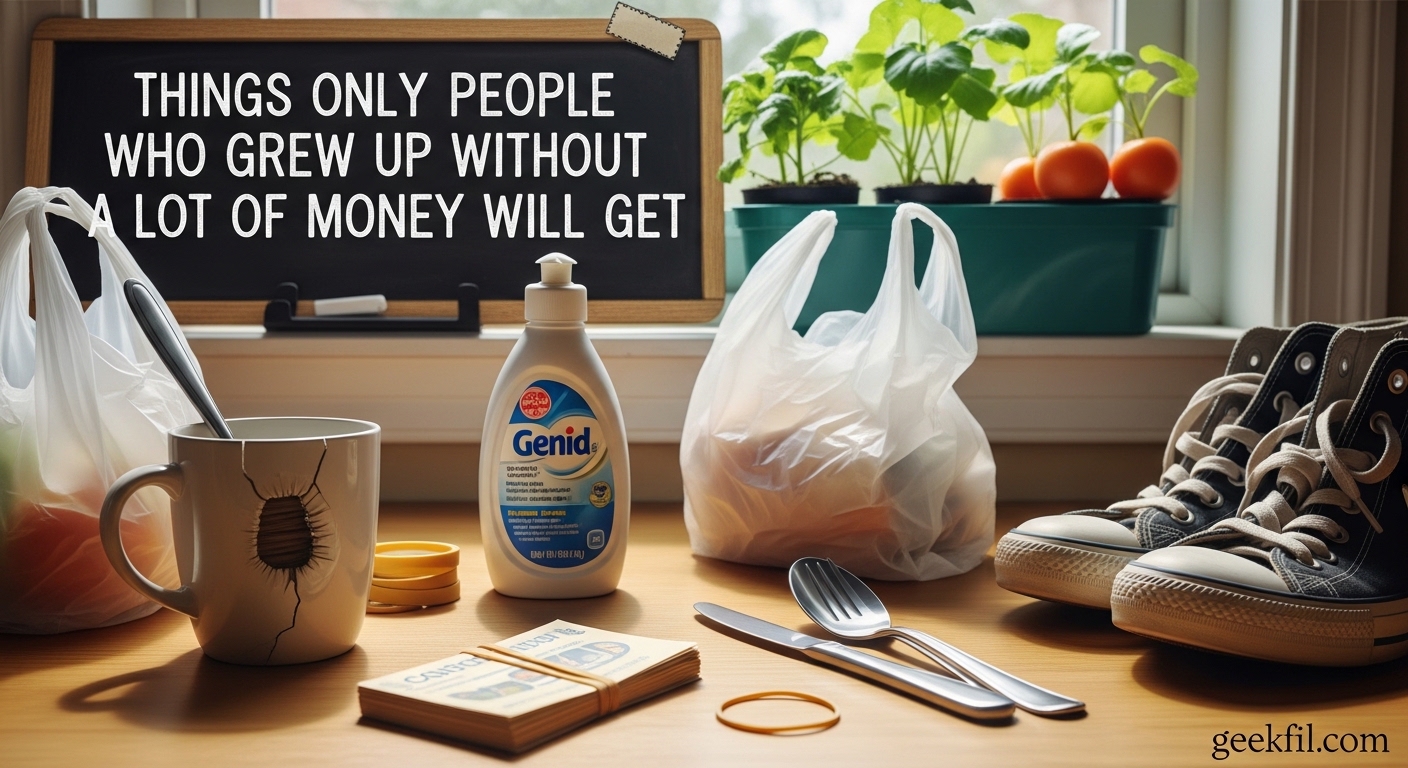
Some experiences stick with you long after childhood ends. If you grew up watching every dollar, you know exactly what I mean. There is an entire language of habits, anxieties, and small victories that only people who grew up without a lot of money truly understand.
Money shapes childhood in ways that become invisible to everyone else. It is in the mental math at the grocery store, the way you treat small luxuries, and the skills you learned out of necessity. These experiences are not just memories. They become part of who you are.
I have talked to dozens of people about their childhoods, read countless stories online, and reflected on my own experiences. Here are 20 things that will feel painfully familiar if you grew up without much money. If these resonate with you, know that you are not alone.
Table of Contents
The Mental Math of Grocery Shopping
You did not need a calculator. You kept a running total in your head as you walked the aisles, rounding up to be safe. If the number got too high, you started putting things back.
The generic brands were not a choice. They were the only option. You learned which off-brand cereals tasted close enough to the real thing. You knew exactly which items were on sale this week because you memorized the flyer.
Even now, as an adult with a better income, you might catch yourself doing the math. Old habits do not fade easily.
Never Filling Up the Gas Tank Completely
Ten dollars at a time. That was the routine. You watched the pump like a hawk, stopping exactly at your limit.
A full tank was a luxury you could not afford. You ran on fumes more than once, praying you would make it home. The gas light was not a suggestion. It was a warning you ignored out of necessity.
Today, you might still hesitate before filling up completely. It feels strange, almost wrong, to just let the pump run.
The Crust Is Your Favorite Part
Your mom told you she preferred the crusts from the bread. She said the heels were the best part of the loaf. You believed her for years.
Now you realize she was making sure you got the good pieces. She ate the crusts so you could have the soft middle. That small sacrifice meant everything.
Maybe you actually learned to love the crusts. Maybe you still eat them first out of habit. Either way, that memory hits different now.
Memorizing Bus Schedules Like Your Life Depends on It
Because sometimes it did. Missing the bus meant waiting an hour in the rain, the snow, or the summer heat.
You knew every route by heart. You could tell someone exactly which bus to take, where to transfer, and how long it would take. Transit apps are a miracle to you now, but back then it was all memorization.
No car in the family meant independence came late. You walked places most people drove. You understood distance in miles and in minutes on foot.
Thinking Disney World Costs a Million Dollars
It was the ultimate dream, the one you saw on TV but knew you would never reach. Every year your parents said maybe next year.
Next year never came. You stopped asking after a while because you saw the look in their eyes. The shame, the sadness, the wish that they could give you more.
If you finally went as an adult, you probably cried. Not just from the magic, but from the weight of that childhood longing finally being fulfilled.
Taping Over Vents in Unused Rooms
Heating the whole house was not an option. You taped cardboard over the vents in rooms no one used.
You wore layers indoors. You could see your breath in the morning. The utility bill arrived with dread, and you knew your parents were doing calculations in their heads.
Conservation was not about the environment. It was about survival. You learned to live with less heat, less light, less everything.
Hand-Me-Downs Are Not Just Clothes
They were furniture, toys, shoes, books, and bikes. Everything came from someone else first.
You learned to say thank you for things that did not fit quite right. You made do because making do was the only option. A coat two sizes too big meant you would grow into it eventually.
There is a special skill in accepting what you are given without complaint. You learned that skill young.
Birthday Parties at Home with Homemade Cake
No Chuck E. Cheese. No trampoline parks. Your parties were in the backyard or at the free park down the street.
Your mom made the cake from a box mix with store-brand frosting. The decorations were dollar store balloons that stayed up for weeks after because you could not bear to take them down.
Your friends came, and you had fun. You did not know you were missing anything because you never had it to miss.
The Luxury of Hiring Movers
When your family moved, it was with a borrowed truck and friends who worked for pizza. Professional movers were something rich people did.
The first time you hired movers as an adult, you felt like royalty. You watched them carry boxes and thought about all the times you had done it yourself, aching and exhausted.
You probably tipped them well. You know what that labor is worth because you have done it.
Not Knowing What a Duvet Cover Is
You had comforters from discount stores. They were washed and reused for years until the stuffing clumped and the colors faded.
The first time you saw someone with a duvet cover, you had no idea what it was. Was it a sheet? A blanket? Why did they need a cover for their cover?
Discovering the world of fancy bedding as an adult is a particular experience. You realize there are whole categories of things you never knew existed.
The Shame of Field Trip Permission Slips
Fifteen dollars felt like five hundred. You took the permission slip home knowing your parents could not afford it, and you felt ashamed.
Sometimes you forged the signature and stayed home sick on field trip day. Sometimes you went to the office and asked if there were scholarships. Sometimes you just watched everyone else leave while you stayed behind.
That feeling of being left out because of money never really leaves you. It sits in your chest even now.
Buying Everything on Clearance or Not at All
End-of-season sales were your best friend. Black Friday was not about getting the newest thing. It was about finally affording what you needed.
You learned to shop a year ahead, buying winter coats in April and swimsuits in September. Full price was for people who did not understand how to wait.
Even with a better income now, you probably still check the clearance rack first. The thrill of a good deal is embedded deep.
The Phrase ‘We Have Food at Home’
McDonald’s was not a Tuesday night dinner. It was a birthday treat, a report card reward, a special occasion.
You heard “we have food at home” every time you asked to eat out. And you did have food at home, even if it was rice and beans again. Your parents cooked everything from scratch because it was cheaper.
Now you might get fast food whenever you want, but part of you still hears that phrase in your head. You still feel a little guilty about the convenience.
Getting Excited About Free Samples at Stores
Costco on weekends was an event. You could make a meal of the samples if you timed it right and circled back enough times.
There was no shame in free. Free was smart. Free was how you got to try things you could never buy.
You probably still get a little thrill from a good sample tray. Old habits are hard to break, and free food still tastes better somehow.
Sneakers From Payless or Nothing
No Nike. No Adidas. No brand names that mattered at school. You had the shoes your parents could afford, and you made them last.
When they fell apart, you glued them back together. When they got too small, you wore them anyway until the next sale.
Being different from your peers because of money is a specific kind of loneliness. You learned to not care, or at least to pretend you did not care.
The Power of the Library Card
Free entertainment was essential. You maxed out your library card every week, checking out stacks of books you could barely carry.
Summer reading programs meant free pizza or certificates if you read enough books. You read because you loved it, but also because it was free.
No Netflix. No cable. The library was your entertainment, your education, and your escape all in one.
Dreading Back-to-School Shopping
New clothes were not guaranteed. Sometimes you wore last year’s stuff that barely fit. Sometimes you got one new outfit and that was it.
The supply list stressed your parents out. Crayons, markers, glue sticks, and tissues for the classroom. It all added up.
You learned to want less and be grateful for what you got. You also learned to notice which kids had everything new and which ones did not.
The Mystery of Restaurant Bills
Eating out was rare, and when it happened, you ordered by price not by desire. Water to drink because soda cost extra.
Appetizers were meals. Sharing plates was normal. You watched the bill like a hawk, calculating the tip in your head before the check even came.
Even now, you might feel anxious in restaurants. You might still look at the right side of the menu first, scanning for the cheapest option before letting yourself want anything.
Learning to Fix Things Instead of Replacing Them
Duct tape was not a joke. It was a genuine repair tool. You learned to mend clothes, patch holes, and make things last way past their expiration date.
YouTube repair videos are your friend now, but you were already handy by necessity. You could not afford to call a repairman, so you became one.
That skill serves you well now. You can fix things others would throw away. You see value in what can be saved.
Appreciating the Small Things More Than Anyone
This is the gift of growing up with less. You learned gratitude as a survival skill. You found joy in simple moments because joy had to come from somewhere.
A full pantry feels like abundance. A paid bill feels like victory. A warm house in winter feels like luxury because once upon a time, it was.
You carry these lessons with you. They made you who you are, and there is beauty in that.
Things Only People Who Grew Up Without Money Will Understand
If you recognized yourself in these experiences, you are part of a large and resilient community. Growing up without money is not something to be ashamed of. It taught you skills that many people never learn.
You know how to stretch a dollar. You know how to appreciate what you have. You know that love is not measured in what you can buy.
These experiences shape adult money mindsets in profound ways. Some people develop scarcity mindsets that are hard to shake. Others become incredibly generous because they remember what it felt like to go without. Many become excellent savers, budgeters, and planners because those skills were survival skills first.
The habits you learned as a child do not have to define your future. You can honor where you came from while building something new. You can keep the resourcefulness and lose the anxiety. You can appreciate the struggle without romanticizing the pain.
Frequently Asked Questions
What are signs someone grew up poor?
Signs include doing mental math while shopping, feeling guilty about spending money, hoarding items ‘just in case,’ always checking price tags first, buying generic brands out of habit, and feeling anxious about bills even when financially stable. These habits often persist into adulthood regardless of current income.
How does growing up poor affect you as an adult?
Childhood poverty can lead to a scarcity mindset, difficulty spending money even when affordable, overworking tendencies, hoarding behaviors, and heightened anxiety about financial security. However, it also builds resilience, resourcefulness, gratitude, and strong budgeting skills that serve adults well.
What habits do people who grew up poor keep?
Common habits include buying on clearance only, keeping food until it spoils, reusing everything, DIY repairs, cooking from scratch, avoiding waste, shopping sales cycles, buying generic brands, and maintaining emergency funds. These frugal habits often persist even after financial situations improve.
How do you overcome a poverty mindset?
Overcoming a poverty mindset involves recognizing that your current reality differs from childhood, practicing intentional spending without guilt, building an emergency fund for security, seeking therapy if needed, and consciously choosing abundance over scarcity. It takes time to unlearn survival patterns.
Is it okay to still have these habits if I make good money now?
Absolutely. The skills you learned growing up with less are valuable. Frugality, resourcefulness, and appreciation are positive traits. The key is distinguishing between healthy habits and anxiety-driven behaviors that cause distress. Keep what serves you, release what harms you.
How do I talk to my kids about money without scaring them?
Be honest about money in age-appropriate ways. Teach them that money is a tool, not a measure of worth. Focus on gratitude for what you have rather than fear of not having enough. Involve them in budgeting decisions and teach them the value of work and saving without creating anxiety.
Your Turn: Share Your Story
I know there are hundreds more experiences that did not make this list. Maybe it was reusing ziplock bags until they fell apart. Maybe it was the specific brand of off-brand cereal that you still buy out of loyalty. Maybe it was something only your family did.
These shared experiences create connection. They remind us that we are not alone in our memories, our habits, or our healing.
What would you add to this list? What is something that only people who grew up without much money would understand? Share your story in the comments. I would love to hear from you.
Final Thoughts
Growing up without money is not a character flaw. It is not something to hide or apologize for. It is an experience that shaped you, taught you, and made you who you are today.
The things only people who grew up without money will understand are not just about hardship. They are about resilience, creativity, and love that found ways to express itself despite limitations.
You learned to make do. You learned to appreciate. You learned that the best things in life really are free, not because of a saying on a poster, but because you lived it.
Carry that wisdom with pride. You earned it.