
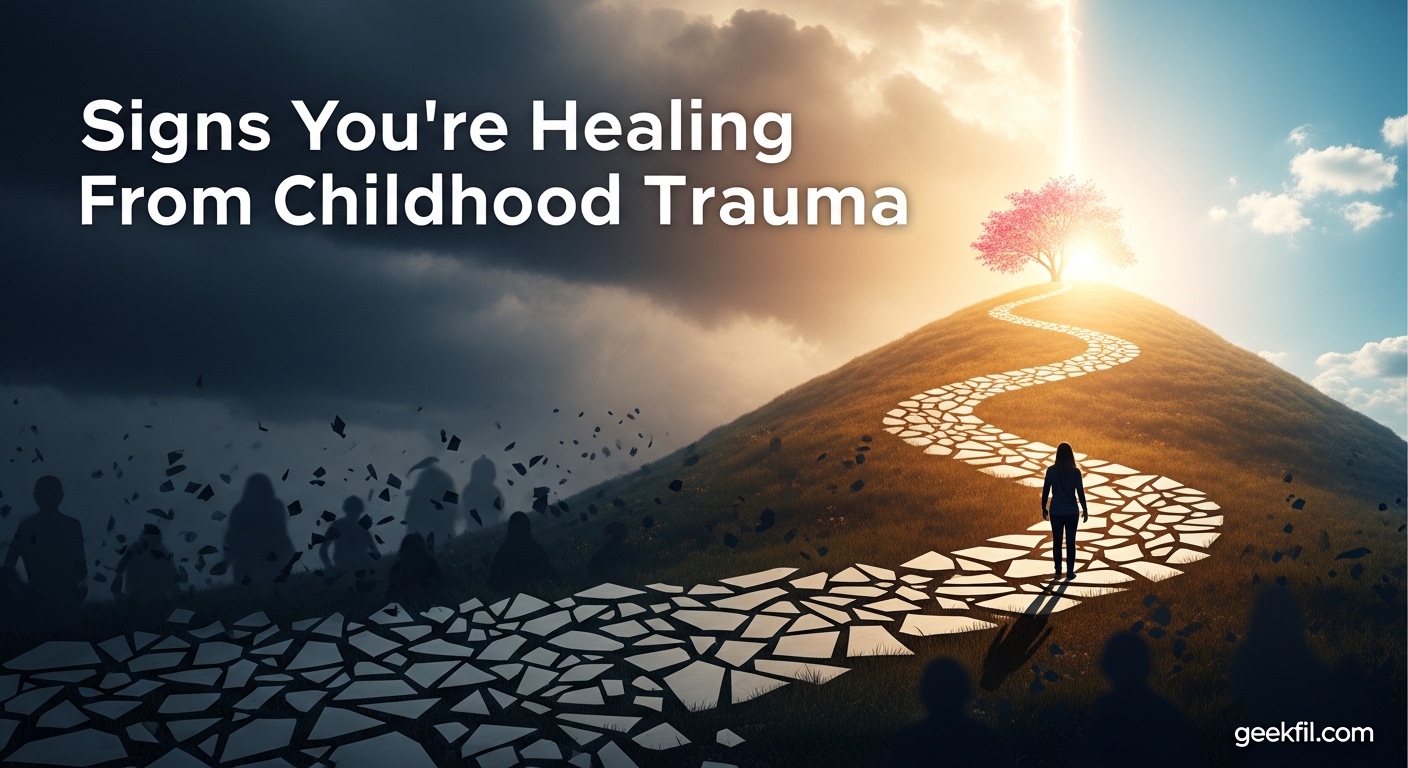
Healing from childhood trauma rarely announces itself with a parade. It sneaks up on you in quiet moments, disguised as ordinary life finally feeling less exhausting. Most people miss the signs you’re healing from childhood trauma because they expect fireworks.
They expect a finish line. They expect to wake up one day and feel “cured.” The reality is messier and more beautiful than that.
Healing happens in the background while you’re living your life. Your body starts feeling different. Your reactions shift in ways you barely notice.
Relationships either deepen or fall away. You begin experiencing moments of peace that once felt impossible. Our team has researched hundreds of trauma recovery stories and spoken with survivors at various stages of their journeys.
What we’ve learned is that recognition matters. When you can name the signs of progress, you validate the hard work your nervous system has been doing behind the scenes.
You stop dismissing small improvements as coincidences. You start trusting the process. This guide shares 10 signs you’re healing from childhood trauma, even when you don’t realize it.
Some may surprise you. Others might validate what you’ve already suspected. All of them offer proof that your healing is real, even on days when it doesn’t feel that way.
Table of Contents
10 Signs You’re Healing From Childhood Trauma
1. Your Body Feels Safer to Occupy
The first and most fundamental shift happens in your body. You start feeling safe in your own skin.
Childhood trauma often creates a persistent sense of danger that lives in your nervous system. Your body stays locked in survival mode, scanning for threats even when you’re objectively safe. Hyper-vigilance becomes your default setting.
You might notice your shoulders permanently raised toward your ears, your jaw clenched, or your stomach perpetually tight. As healing progresses, these physical defenses begin softening.
You realize you’ve gone hours without bracing. Your breathing deepens naturally. You can rest without feeling guilty or anxious.
The concept of somatic experiencing teaches us that trauma lives in the body, and so must healing. When your body finally starts trusting that the danger has passed, you feel it as a physical sensation of relief.
You might notice you’re sleeping better. Your digestion improves. Chronic tension headaches decrease.
These aren’t random health improvements. They’re your nervous system regulating itself after years of overdrive.
2. Emotional Reactions Feel More Manageable
Your emotional landscape starts looking less like a hurricane and more like weather you can navigate.
Before healing, emotions often hit like tidal waves. You might have experienced intense anger, crushing sadness, or paralyzing anxiety that seemed to come from nowhere.
These reactions felt uncontrollable and overwhelming. You probably developed coping mechanisms to survive them, some healthy and some not.
During recovery, you develop what therapists call a wider “window of tolerance.” This means you can handle more emotional intensity before tipping into shutdown or overwhelm.
You still feel everything, but you don’t get swept away. After an upsetting event, you return to baseline faster. Your mood swings become less dramatic.
You start recognizing emotions as they arise rather than after they’ve hijacked your behavior. You can name what you’re feeling.
This emotional literacy is a profound sign of healing from developmental trauma. Children who experienced trauma often missed the opportunity to learn emotional regulation from safe adults. Learning it as an adult is both healing and proof of growth.
3. Triggers Have Less Power Over You
The things that used to send you spiraling now feel more like gentle nudges.
Triggers are specific stimuli that activate traumatic memories or responses. They might be sounds, smells, words, situations, or even types of people.
In early recovery, triggers can feel like assaults, instantly transporting you back to childhood fear or pain. As you heal, several things change with your triggers.
First, you recognize them faster. Instead of wondering why you suddenly feel terrible, you identify the trigger immediately. This recognition itself reduces the trigger’s power.
Second, your reactions become less severe. A trigger might cause discomfort instead of a full flashback. Third, the time between trigger events increases. They become less frequent.
Flashbacks, if you experience them, get shorter and less intense. Where they once lasted hours, they might now last minutes. Where they felt completely real, you now maintain some awareness that you’re experiencing a memory, not current reality.
These changes happen gradually, so you might not notice until you look back months later.
4. You’re Setting Boundaries Without Guilt
The word “no” stops feeling like a weapon and starts feeling like a complete sentence.
Childhood trauma often trains us to ignore our own needs for the sake of others. We become expert people-pleasers. We say yes when we mean no.
We overextend ourselves chronically. We feel responsible for other people’s emotions and guilty when we prioritize ourselves.
One of the most empowering signs you’re healing from childhood trauma is boundary development. You start recognizing what you need and asking for it.
You decline invitations without constructing elaborate excuses. You protect your time and energy without apologizing for having limits.
This boundary work often causes some relationship fallout. People who benefited from your lack of boundaries may resist your new limits.
This is actually another sign of healing, your relationships reorganizing around your authentic self rather than your trauma responses.
You might notice you’re less resentful because you’re not agreeing to things you don’t want to do. Your relationships feel cleaner because they’re based on honesty rather than obligation.
5. Your Relationships Are Changing
Your social circle begins reflecting your growth rather than your wounds.
Healing changes how you relate to everyone. With family, you might establish more distance or create new dynamics that protect your wellbeing.
With friends, you become more selective about who gets access to your energy. With romantic partners, you develop capacity for intimacy that wasn’t possible before.
Many trauma survivors report that healing initially feels lonely. As you stop tolerating unhealthy dynamics, some relationships naturally end. This is painful but necessary.
The space created allows healthier connections to form. You start attracting people who respect your boundaries because you finally have boundaries to respect.
Trust becomes possible again. Not naive trust that ignores red flags, but earned trust that develops over time.
You can be vulnerable without feeling certain it will be weaponized against you. You can depend on others occasionally without believing it makes you weak or burdensome.
Perhaps most importantly, you stop repeating childhood relationship patterns. You no longer unconsciously seek out dynamics that mirror what you experienced growing up. This breaking of intergenerational trauma patterns is profound evidence of healing.
6. You Feel Present Instead of Dissociated
The world comes into sharper focus as you spend more time actually in it.
Dissociation is a brilliant survival mechanism. When childhood experiences were too overwhelming to process, your mind learned to check out.
You might have felt like you were watching your life from outside your body. Time became fuzzy. Memories fragmented. The present moment felt unreachable.
Healing brings you back into your body and back into time. You notice small details you once missed, the way light falls through a window, the taste of your coffee, the feeling of ground under your feet.
Your mindfulness capacity increases not because you’re forcing it through meditation but because staying present becomes safe enough to do.
You might find yourself crying during movies or feeling moved by music in ways you couldn’t before. This isn’t weakness. It’s connection.
Your capacity to feel has been restored. The numbness that protected you in childhood is no longer necessary, so it’s gently releasing.
Driving somewhere and actually remembering the journey is a small victory worth celebrating. Finishing a conversation and realizing you were fully engaged the whole time is progress.
7. Self-Worth Is Growing From Within
You stop needing external validation to believe you’re allowed to exist.
Childhood trauma often damages our fundamental sense of value. We learn that love must be earned through performance, compliance, or achievement.
We become dependent on praise and terrified of criticism. Our self-worth exists entirely outside ourselves.
As healing progresses, something radical happens. You start believing in your inherent worth without evidence. You can have a bad day, make a mistake, or disappoint someone and still feel fundamentally okay.
This internal validation is the foundation of genuine self-esteem. Self-compassion becomes possible.
You talk to yourself the way you’d talk to a friend. When you struggle, you offer comfort rather than contempt.
This reparenting of yourself addresses the developmental gap left by inadequate childhood nurturing. You might notice you’re less competitive and comparative with others.
Their success doesn’t threaten you because your worth isn’t a limited resource. Their criticism doesn’t destroy you because it doesn’t define you.
You have a solid center that external circumstances can’t fully shake.
8. Physical Symptoms Are Shifting
Your body finally starts releasing what it’s been holding for years.
Physical signs of trauma healing are often overlooked but deeply significant. Your body stores what your mind couldn’t process.
As healing occurs, this stored trauma begins releasing, sometimes in uncomfortable ways. You might experience vivid dreams as trauma energy moves through your consciousness.
Your sleep patterns normalize after years of insomnia or nightmares. Chronic muscle tension, especially in the neck and shoulders, begins dissolving.
Digestive issues that plagued you for years mysteriously improve. Some people experience temporary increases in physical symptoms during intensive healing periods.
Old injuries might ache. You might feel unusually fatigued as your body processes long-held stress hormones.
These uncomfortable signs of healing are actually positive indicators that your system is finally doing the repair work.
Headaches might decrease. Your immune system might function better. You might catch yourself taking deep, satisfying breaths.
Your body is returning to its natural state of regulation after years of survival mode activation.
9. You’re Reconnecting With Your Inner Child
The wounded child inside you finally gets the parenting they deserved.
Inner child healing is particularly relevant to childhood trauma recovery because the wounds were inflicted during development. Part of you got stuck at the age when trauma occurred.
That part still holds the beliefs, fears, and needs from that time. As you heal, you develop a relationship with this inner child.
You start recognizing when they’re activated, when present situations are actually triggering old childhood pain. You learn to comfort them, validate their feelings, and protect them the way no one did back then.
This work often feels strange at first. Talking to yourself as a child might seem silly. But it’s powerful developmental trauma recovery.
You’re providing the secure attachment experiences you missed. You’re rewiring the neural pathways formed in childhood with new, healthier experiences.
You might find yourself drawn to activities you loved as a child before trauma took them away. You might feel protective of children in ways that surprise you.
You might finally grieve what you lost, and that grief is healing.
10. Hope and Future Feel Possible Again
You can imagine a tomorrow that isn’t just survival.
Deep trauma creates a kind of temporal narrowing. The future feels too dangerous to consider. Hope feels like a setup for disappointment.
You live day by day, sometimes hour by hour, just getting through. One of the most beautiful signs you’re healing from childhood trauma is restored capacity for hope.
You start making plans beyond immediate survival. You set goals. You invest in things that take time to grow.
You allow yourself to want things. Joy becomes accessible again.
Not the manic highs of trauma responses, but genuine, grounded pleasure in simple things. You can laugh without guilt.
You can enjoy success without waiting for punishment. You can experience good moments without bracing for them to end.
Post-traumatic growth becomes visible. You’re not just returning to who you were before trauma. You’re becoming someone new who carries wisdom from what you survived.
You might even find purpose in helping others or creating meaning from your pain. The trauma doesn’t disappear, but it stops being the defining story of your life.
What Makes Childhood Trauma Healing Different
Healing from childhood trauma differs significantly from recovering from adult-onset trauma. Understanding these differences helps validate your specific experience.
Understanding Developmental Trauma
When trauma happens during childhood, it shapes developing brains and nervous systems. Unlike adult trauma that interrupts an established identity, childhood trauma forms the foundation upon which identity is built.
You never knew a self before trauma. There is no “going back to normal” because normal was never established.
This is why healing from childhood trauma often involves discovering who you are rather than recovering who you were. You’re not returning to a pre-trauma state. You’re building an authentic self for the first time.
Developmental trauma affects attachment patterns, emotional regulation capacity, and core beliefs about self and world. These aren’t just symptoms to eliminate.
They’re fundamental structures that require patient, ongoing work to reshape.
The Non-Linear Nature of Healing
Perhaps the most important thing to understand about childhood trauma healing is that it isn’t linear. You don’t steadily improve until you’re done.
You improve, then regress, then improve again. Setbacks are not failures.
They’re often signs that you’re going deeper, touching more profound layers of wound that weren’t accessible before. The fact that you can now feel pain you once numbed is progress, even when it feels like going backward.
Many trauma survivors describe the process as spiral-shaped rather than linear. You revisit the same themes multiple times, but from increasingly higher ground.
The triggers still happen, but you handle them better. The pain still comes, but you trust it will pass.
Forum discussions with trauma survivors consistently emphasize this point. People who’ve been healing for years report that the biggest change isn’t that life stops being hard.
It’s that they stopped believing hard means broken.
Healing Across Different Life Stages
The signs of healing look different depending on when in life you’re doing the work. Healing in your twenties often focuses on establishing independence and identity separate from family.
Healing in your thirties and forties might center on parenting, either your own children or the inner child. Healing later in life often involves integration and meaning-making.
Life transitions can activate dormant trauma wounds. Getting married, becoming a parent, changing careers, or losing parents can all trigger new healing phases.
This doesn’t mean you failed to heal before. It means you’re ready for deeper work.
Different types of childhood trauma also heal differently. Abuse, neglect, parental loss, and household dysfunction each leave distinct patterns that require specific approaches.
Your healing path is unique to your particular combination of experiences.
How to Recognize and Reinforce Your Healing Progress
Knowing the signs is helpful, but actively tracking your progress accelerates healing. Here are practical ways to validate and reinforce the changes happening in your life.
Self-Assessment Questions to Track Progress
Regular reflection helps you notice changes that happen too gradually to perceive day-to-day. Consider journaling about these questions monthly:
How quickly do I return to baseline after upsetting events compared to six months ago? Am I able to name my emotions in the moment or only after the fact?
Do I notice physical tension or relaxation signals from my body? How often do I say yes when I want to say no?
Can I identify when I’m triggered and what triggered me? Am I having more moments of genuine presence?
How do I speak to myself when I make mistakes? Can I imagine my life five years from now?
Am I sleeping through the night more consistently? These questions aren’t tests you pass or fail.
They’re reference points. Answering them periodically creates a record of your journey you can review when you need encouragement.
When to Seek Professional Support
While self-healing is possible and valuable, professional support often accelerates progress. Consider working with a trauma-informed therapist if you’re experiencing severe symptoms that interfere with daily functioning.
Also consider therapy if you’ve been stuck in the same patterns for years without change. If you’re having thoughts of self-harm, reach out immediately.
If you simply want expert guidance, that’s reason enough to seek professional support.
Effective trauma therapies include EMDR, somatic experiencing, trauma-focused CBT, internal family systems therapy, and Ego State therapy.
Different approaches work for different people. It’s okay to try several before finding your fit.
Remember that seeking help is itself a sign of healing. It means you’ve developed enough self-worth to invest in your wellbeing and enough hope to believe change is possible.
Frequently Asked Questions About Childhood Trauma Healing
What are physical signs your body is releasing trauma?
Physical signs of trauma release include deeper and slower breathing patterns, reduced muscle tension especially in the neck and shoulders, more regular sleep patterns, spontaneous trembling or shaking as the nervous system discharges energy, changes in digestion, yawning or sighing more frequently, temperature fluctuations, and vivid dreams as stored memories process. These symptoms indicate your body is finally releasing what it has been holding for years.
How long does childhood trauma healing take?
Childhood trauma healing has no fixed timeline. Because developmental trauma shapes developing brains and nervous systems, the work often takes years rather than months. Most trauma survivors report that healing accelerates once they begin consistent therapeutic work, but the journey continues throughout life in deepening layers. Progress is measured not by speed but by increasing capacity for regulation, connection, and joy.
Can you fully heal from childhood trauma?
Full healing from childhood trauma doesn’t mean erasing memories or never being affected again. It means the trauma stops controlling your life. You develop a relationship with your history that acknowledges it without being defined by it. Many survivors report reaching states where they feel fundamentally safe, worthy, and capable despite what happened. The wounds become integrated into your story rather than remaining open injuries.
What does healing from childhood trauma feel like?
Healing from childhood trauma often feels like coming home to yourself after being lost for years. It feels like your body belongs to you. Emotions become manageable waves rather than overwhelming tsunamis. Relationships feel nourishing rather than depleting. You experience moments of genuine peace that don’t require explanation. Simultaneously, healing can feel uncomfortable as old patterns release and new ways of being feel unfamiliar.
What are uncomfortable signs you’re healing from trauma?
Uncomfortable healing signs include vivid or disturbing dreams as your brain processes memories, temporary increases in anxiety or physical symptoms, relationship changes that feel like losses, intense emotional releases including crying without clear triggers, feeling worse before feeling better as suppressed pain surfaces, and temporary regression to old coping patterns. These uncomfortable experiences typically indicate that deep processing is occurring, not that healing has failed.
Conclusion
Recognizing the signs you’re healing from childhood trauma isn’t about declaring victory. It’s about noticing that the work you’re doing matters.
Every small shift in your nervous system, every moment of genuine presence, every boundary you manage to set, these are victories worth acknowledging.
Your healing journey is yours alone. It won’t look exactly like anyone else’s. Some signs on this list will resonate deeply while others might not apply to your situation.
That’s normal. Trauma is deeply personal, and so is recovery. The fact that you’re reading this article suggests you’re already on the path.
You’re seeking information, increasing self-awareness, and investing in your growth. These actions themselves are healing behaviors.
Keep going. The person you’re becoming is worth every difficult step of the journey. If you recognized yourself in several of these signs, trust that your healing is real.
If you recognized yourself in only one or two, trust that progress is happening in ways you haven’t yet perceived.
And if you’re struggling to see any signs at all, trust that simply being here, still trying, still breathing, is evidence of profound resilience.