
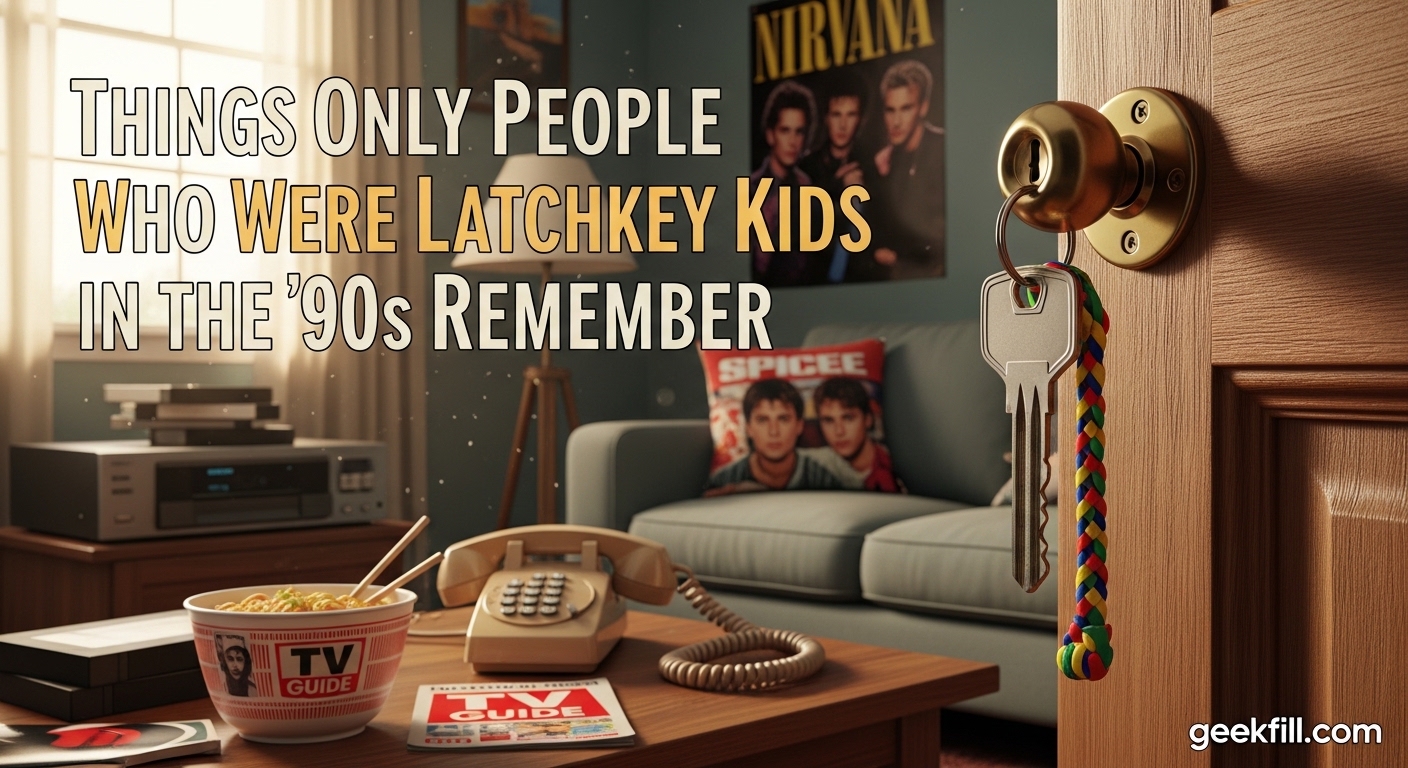
There was a specific weight to it. A house key hanging from a shoelace or yarn, looped around your neck and tucked under your shirt. It bounced against your chest as you walked home from the bus stop, a physical reminder that you were about to enter an empty house and fend for yourself until dinnertime.
Being a latchkey kid in the 1990s was a rite of passage for millions of Gen Xers and Xennials. Our parents worked. We walked home alone. And we learned to navigate hours of unsupervised freedom long before cell phones could track our every move. This article is for everyone who remembers what it felt like to be eight years old, home alone, and completely in charge of your own afternoon.
Table of Contents
1. The Key on a String Around Your Neck
No fancy keychains. No lanyards with your school name. Just a raw metal key threaded through whatever material your parents had on hand. Sometimes it was a worn leather cord. Other times it was literally a piece of yarn from a craft project.
The key got warm against your skin during the walk home. You could feel it through your shirt, and you would touch it constantly to make sure it was still there. Losing that key meant disaster. It meant sitting on the porch for hours, or having to call your mom at work and face the disappointment in her voice.
2. Letting Yourself In and the Empty House Silence
The moment you turned that key and pushed open the door, you were hit with it. The silence. The stillness of a house that had been empty all day.
Some kids found it comforting. Others found it eerie. You would flick on lights even if it was still bright outside, just to chase away the emptiness. And that first sound you made – whether it was dropping your backpack or turning on the TV – seemed to echo through the rooms like you were announcing your presence to no one in particular.
3. Saved by the Bell Reruns Every Afternoon
You knew the schedule by heart. The bus dropped you off at 3:15. By 3:30, you were planted in front of the television, catching the same episodes of Saved by the Bell you had seen a dozen times before.
It did not matter that you already knew Zack was going to scheme his way out of trouble, or that Kelly would ultimately choose the right thing. These were your afterschool companions. They filled the silence while you ate your snack and avoided your homework for as long as possible.
4. Hot Pockets and Microwave Disasters
The latchkey kid diet was a masterclass in questionable nutrition. Hot Pockets were the crown jewel – that nuclear-hot center that would simultaneously burn your tongue and leave the outer edges frozen solid.
But the real danger came from experimentation. You were alone. No one was watching. Which meant you might try to microwave a metal pot of macaroni and cheese, or attempt to cook a frozen pizza without removing the cardboard. Every latchkey kid has at least one story of smoke alarms, melted plates, or the frantic fanning of smoke before parents got home.
5. The AOL Dial-Up Symphony
That sound. That glorious, screeching, robotic symphony of connection.
You knew every phase of it. The dial tone. The ringing. The handshake noise that sounded like two robots arguing. And then, finally, the triumphant “You’ve Got Mail.” Getting online meant tying up the phone line, which meant your parents could not call the house. But that was a risk worth taking to enter the growing world of the internet.
6. Chat Rooms and Your First Screen Name
Once you were connected, the world opened up. You would enter chat rooms with names like “Teen Hangout” or “90s Music Lovers” and pretend to be someone slightly cooler than you actually were.
Your screen name was a carefully crafted identity. It might involve your favorite band, a reference to Sailor Moon, or some variation of the word “angel” with creative spelling. And the thrill of a private message popping up – “a/s/l?” – was both terrifying and exhilarating. You were talking to strangers, unsupervised, and it felt like the future had arrived early.
7. Racing Home Before the Streetlights
The rule was universal. You could go anywhere, do anything, roam as far as your bike could take you. But the moment those streetlights flickered on, you had better be home.
This was the invisible leash of the latchkey kid generation. Our parents gave us genuine freedom, but it came with that single, non-negotiable boundary. You would be miles from home, deep in the woods or at a friend’s house across town, and you would suddenly notice the light changing. Then it was a race against the dying sun, pedaling frantically to beat the streetlight countdown.
8. Biking Anywhere Without Permission
There was no text checking in. No GPS tracking. No “find my friends” feature to monitor your location.
You simply got on your bike and went. To the park. To the convenience store. To that friend’s house your parents did not entirely approve of. The only requirement was that you were back before they were, or that you answered the phone if they called the landline. The freedom was intoxicating. You were ten years old and you had a transportation-based autonomy that would make modern parents clutch their pearls.
9. Locking Yourself Out and Creative Entry Methods
It happened to everyone. You were not supposed to take the key off your neck. But maybe you did, just for a moment, while you were playing basketball in the driveway. Or maybe you simply forgot to grab it in your rush to get outside.
Locked out latchkey kids became amateur locksmiths. You knew which window was loose. You knew the garage had a hidden key. You might even know how to shimmy onto the roof and enter through a second-floor window that your parents did not realize could be opened from the outside. Getting back inside was a matter of pride. Calling your parents was an admission of failure.
10. Keeping Your Tamagotchi Alive
The responsibility was enormous. This digital pet depended entirely on you, and you were the only one home to feed it.
You would check it obsessively during class, hiding it behind your textbook to make sure it had not pooped itself into oblivion. But the real danger came during those afterschool hours when you were distracted by TV or outdoor adventures. The beep of a hungry Tamagotchi could strike at any moment, sending you scrambling for the plastic keychain to press the feeding button before your virtual pet died and you had to restart with that shameful egg.
11. MTV and Watching Videos Parents Didn’t Approve Of
During the day, MTV was a different channel entirely. The edgy music videos. The TRL countdown. The programming that your parents would switch off the moment they walked in.
But you were alone. You could watch Christina Aguilera’s “Genie in a Bottle” or Eminem’s latest controversial release without anyone changing the channel or making a disapproving sound. You were consuming culture that was slightly too mature for you, and you felt sophisticated doing it. This was your education in popular music, unsupervised and glorious.
12. Jerry Springer and Daytime TV You Shouldn’t Watch
There was a special category of television that existed only between the hours of 3 PM and 6 PM. Jerry Springer. Ricki Lake. The Jenny Jones Show.
You knew you should not be watching grown adults throw chairs at each other while revealing affair secrets. You knew this was trash television. But the taboo nature of it made it irresistible. You would watch with a mixture of horror and fascination, and the moment you heard a car pull into the driveway, you would frantically change the channel to something wholesome like Discovery Channel and hope your parents did not notice how flushed you looked.
13. The Blockbuster Friday Night Ritual
Even if you were a latchkey kid, Friday nights were often family movie nights. Which meant a trip to Blockbuster.
You knew the layout by heart. New releases on the back wall. Comedy in the middle rows. Horror carefully stashed in its own section that you were not technically allowed to browse. The blue and yellow plastic cases held endless possibilities. You would beg for Mortal Kombat or Independence Day, and if you were lucky, your parents would say yes. Walking out with that rented VHS, knowing you had two days to watch it as many times as possible, was pure childhood joy.
14. Nintendo 64 Marathons with Volume on Low
The ultimate latchkey kid sport was gaming, and the Nintendo 64 was the arena.
You would play Super Mario 64, GoldenEye 007, or The Legend of Zelda: Ocarina of Time for hours, completely absorbed in digital worlds. But you had to keep the volume low. You needed to be able to hear the garage door opening or the key in the lock. Every experienced latchkey gamer knew the panic of hearing the front door handle turn while you were in the middle of a level, and the frantic scramble to hit pause, hide the controller, and look like you had been doing homework.
15. AIM and the Drama of Away Messages
AOL Instant Messenger was the social network of the latchkey generation. And the away message was your personal broadcasting system.
You would craft the perfect away message to convey exactly how you were feeling without being present. Song lyrics were the currency of emotional expression. A Dashboard Confessional lyric meant you were having feelings. Something from OutKast meant you were fun and approachable. And the moment someone messaged you, the pop-up window would flash orange on your taskbar, giving you that dopamine hit of being wanted while sitting alone in an empty house.
16. Making Mixtapes from the Radio
Before playlists, there were mixtapes. And making one required dedication.
You would sit by the boombox with a blank cassette, finger hovering over the record button, waiting for that perfect song to come on the radio. When it finally played, you had to catch the beginning perfectly, then hit stop before the DJ started talking over the end. A perfect mixtape was a work of art. It took hours. It required patience. And when you gave it to someone, you were giving them a piece of your time and taste.
17. The Panic of Hearing a Car in the Driveway
Every latchkey kid had a sixth sense for parental arrival. You could identify your parent’s car by the sound of the engine, the rhythm of the garage door, or even the way the front porch creaked under specific footsteps.
And when you heard it, the adrenaline would spike. What were you doing that you should not be doing? Were you watching something inappropriate? Had you failed to start your homework? Was there a mess you had forgotten to clean up? The scramble to appear like a responsible, supervised child – rather than the feral creature you had been for the past three hours – was a daily exercise in improvisation.
18. Calling Friends on the Landline
There was no texting. If you wanted to make plans, you had to call. And that meant navigating the terrifying landscape of parent phone etiquette.
You would dial your friend’s house and hope their parent did not answer. If they did, you had to be polite. “Hi, this is [name]. May I please speak with [friend]?” It was a formal ritual. And if your friend was not home, you had to leave a message with their parent, who would write it down on actual paper. The whole system was inefficient, slightly anxiety-inducing, and completely charming in retrospect.
19. Building Forts and Climbing on Things You Shouldn’t
Without supervision, the house became an adventure playground. Couch cushions became castles. Sheets became caves. And furniture became mountain ranges to be conquered.
You would climb on things your parents never knew you climbed on. The roof of the garage. The highest branches of the backyard tree. The forbidden attic ladder. You would build elaborate forts that took up entire rooms, creating spaces that felt like your own secret headquarters. And when you heard the garage door opening, you would experience that unique terror of knowing you had fifteen seconds to deconstruct your entire civilization and appear to have been quietly reading.
20. The Bittersweet Freedom That Shaped a Generation
Looking back, being a latchkey kid was a unique experience that sits at the intersection of freedom and responsibility.
We learned to take care of ourselves. We learned to solve problems without calling for help. We learned the boundaries of our own judgment, sometimes through mistakes that left small scars or broken dishes. And we did it all in a world before smartphones, before social media, before parents could track our every movement. That freedom created a specific kind of adult – independent, resourceful, maybe a little too comfortable with solitude, but grateful for the trust our parents placed in us.
Frequently Asked Questions About Latchkey Kids
What is a latchkey kid?
A latchkey kid is a child who returns to an empty home after school because their parents are working, carrying a house key to let themselves in. The term became common in the 1970s and 1980s as dual-income families became more prevalent. These children learned independence early, managing their own snacks, homework, and entertainment until parents returned home.
What generation had the most latchkey kids?
Generation X (born 1965-1980) and the Xennial micro-generation (born 1977-1985) had the highest rates of latchkey kid experiences. The 1990s saw peak latchkey kid culture as divorce rates stabilized and dual-income households became the norm, creating millions of unsupervised afternoons for children who learned self-reliance at early ages.
What did latchkey kids do all afternoon?
Latchkey kids filled their unsupervised hours with a mix of television watching, video gaming, snacking, outdoor exploration, early internet use, and occasional mischief. They made their own food, navigated chat rooms, watched shows their parents might not approve of, and often roamed their neighborhoods freely until streetlights came on.
Are latchkey kids a thing anymore?
True latchkey kid experiences have declined significantly due to smartphones enabling constant contact, GPS tracking apps, after-school programs becoming more prevalent, and shifts in parenting styles toward more supervision. While some children still spend time home alone, the unsupervised freedom and independence that defined 90s latchkey culture is largely a thing of the past.
The Key Still Hangs Around Our Necks
Things Only 90s Latchkey Kids Remember is more than just a nostalgia list. It is a tribute to a specific kind of childhood that built resilience, creativity, and independence.
If you wore that key around your neck, if you know the sound of your parent’s car engine by heart, if you ever scrambled to change the channel from Jerry Springer to something wholesome – this article was for you. The latchkey kid experience shaped an entire generation. We learned to be comfortable with ourselves, to solve our own problems, and to appreciate the freedom we were given.
What do you remember most about being a latchkey kid? Share your story in the comments. We are all still carrying that key around somewhere.