
Picture this: you’re sitting at a family dinner, surrounded by relatives who all seem to speak the same language. They laugh at jokes you don’t find funny. They discuss traditions you stopped caring about years ago. And somewhere between the awkward silences and the pointed questions about your life choices, it hits you. You don’t belong here.
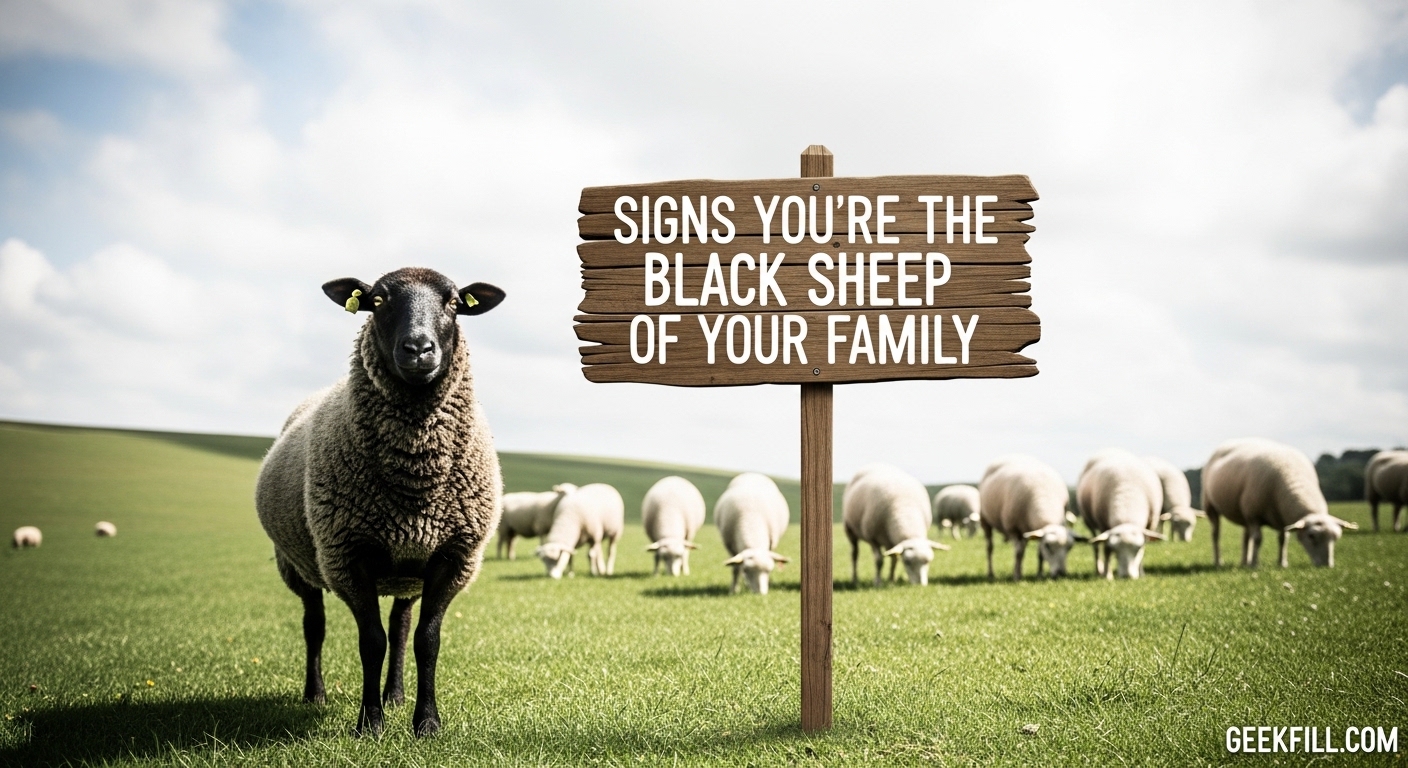
If that scenario feels painfully familiar, you might be the black sheep of your family. The term comes from sheep farmers who noticed that black sheep stood out against white flocks. In family terms, it means you’re the member who feels or is perceived as different from the rest, often seen as an outsider or non-conformist by relatives.
Our team has spent months researching family dynamics and talking to people who identify with this label. What we’ve learned is eye-opening. Being the black sheep isn’t a character flaw. It’s often a sign that you’re living authentically in a family system that values conformity over truth. This guide will walk you through 13 signs that confirm your black sheep status. More importantly, we’ll show you why that’s not just okay, it might actually be your superpower.
Table of Contents
13 Signs You’re the Black Sheep of Your Family
Recognizing the signs you’re the black sheep of your family can be both validating and painful. You may have sensed this for years without having words for it. These indicators come from real experiences shared by people in online communities who finally understood why they never quite fit in.
1. You Feel Like an Outsider at Family Gatherings
The sensation starts before you even walk through the door. Your stomach tightens. You rehearse answers to questions you know are coming. When you arrive, conversations flow around you rather than including you. Everyone else seems to share inside jokes, references to childhood memories you barely recall, and a warmth that feels manufactured to you.
I’ve heard from dozens of people who describe family gatherings as performances they endure rather than celebrations they enjoy. One person told me they sit in their car for ten minutes before every holiday dinner, gathering the emotional strength to walk inside. If family events feel more like obligation than connection, this is your first sign.
2. Your Family Uses You as a Cautionary Tale
Your life choices become the example parents point to when warning younger relatives. “Don’t end up like your cousin,” they might say. Or “We just want you to be happy, not struggle like your sibling.” Your existence gets weaponized as a warning about what happens when you don’t follow the family script.
This role is particularly painful because it twists your authentic path into something shameful. The things that make you different, your career choices, your relationship status, your lifestyle, become symbols of failure rather than expressions of individuality. Families do this to reinforce conformity. It has nothing to do with your actual success or happiness.
3. You’re Compared Negatively to Siblings or Cousins
The comparison game gets old fast. Your sister bought a house. Your cousin got married. Your brother had a baby. Meanwhile, your accomplishments, whatever they might be, get minimized or ignored entirely. One forum user shared that they had to apologize for making a sports team because it made their sibling look bad. That’s the level of absurdity we’re dealing with.
These comparisons serve a purpose. They reinforce the family hierarchy and keep everyone in their assigned roles. When you’re the black sheep, your wins threaten that system. So they get downplayed, dismissed, or turned into problems. Recognize this pattern for what it is. A control mechanism, not a reflection of your actual value.
4. Your Achievements Go Unnoticed While Others Are Celebrated
You graduated with honors. Crickets. You got promoted at work. Silence. You completed a marathon, published an article, or learned a new language. Nothing. But when your sibling announces they’re thinking about going back to school, the family erupts in celebration and praise.
This selective attention is a hallmark of black sheep status. The family system literally cannot see your successes because acknowledging them would disrupt the narrative that you’re the one who struggles. Many people from online communities describe this as feeling invisible. Your good news gets buried while everyone else’s gets announced on social media and discussed for weeks.
5. Family Members Openly Criticize Your Life Choices
Most people get curious questions from relatives. Black sheep get interrogations. Why aren’t you married yet? When are you going to get a real job? Why did you move so far away? Why don’t you have kids? These aren’t innocent inquiries. They’re judgments disguised as concern.
The criticism often happens in front of others, amplifying your outsider status. Your clothes, your diet, your hobbies, your politics, nothing is off limits. One person shared that their weight gets commented on at every single gathering, while other family members receive nothing but compliments. This isn’t about you. It’s about maintaining power dynamics through public shaming.
6. You Have Completely Different Values and Interests
You care about environmental issues while your family dismisses climate change. You’re an artist in a family of accountants. You’re introverted among extroverts. You’re spiritual in a strictly religious household. The gap between who you are and who your family expects you to be feels like an unbridgeable canyon.
These differences aren’t superficial. They shape how you see the world, how you spend your time, and what you find meaningful. When your fundamental values clash with family expectations, every interaction becomes a potential conflict zone. You learn to self-edit, to hide parts of yourself, or to simply avoid certain topics entirely. This is exhausting and lonely.
7. Family Photos Show Limited Evidence of Your Existence
This sign cuts deep because it’s visual proof of your outsider status. Walk through a family member’s home and count the photos. Are you there? How many compared to your siblings? One person from a forum described visiting their mother’s house and seeing pictures everywhere of their sisters and their children, but not a single photo of them.
Social media tells the same story. Family accounts post celebrations of everyone else’s milestones while yours get ignored. You watch from the outside as relatives gush over your siblings’ posts while yours get minimal engagement. This erasure isn’t accidental. It reflects how the family system has mentally categorized you. Different. Other. Less central.
8. You’re the First to Leave or Skip Family Events
Leaving early has become a survival strategy. You time your exit before tensions escalate or before certain relatives arrive. Or maybe you’ve stopped attending altogether. The invitations still come, but you find reasons to decline. Work commitments, travel plans, or just a vague sense that you can’t handle it right now.
Your absence gets noticed and commented on, of course. Family members gossip about why you never come around. They speculate about what you think you’re too good for. But they rarely ask you directly with genuine curiosity. They don’t want to know the real reasons. That would require acknowledging how unwelcome you actually feel.
9. Relatives Use Guilt or Religious Rhetoric on You
Emotional manipulation comes in many forms. Religious families might quote scripture about honoring parents or family unity. Others lean on guilt about mortality. “Your grandparents won’t be around forever.” “Family is all you have.” These phrases weaponize your natural care for relatives against your own wellbeing.
One forum user described how their parents desperately wanted siblings to get along, using religious guilt to force reconciliation. The pressure to maintain family harmony at your own expense is a common black sheep experience. You’re expected to absorb mistreatment, forgive without apology, and show up smiling even when you’ve been hurt. This is not healthy. It’s control.
10. You Feel Pressure to Apologize for Who You Are
Your authentic self seems to require constant justification. You find yourself explaining, defending, or apologizing for things that aren’t wrong. Your career path, your relationship choices, your lifestyle, your beliefs. The underlying message is clear. You should be different. You should be more like them.
I’ve heard stories of people apologizing for being good at something because it threatened a sibling. Apologizing for being happy because it highlighted someone else’s misery. Apologizing for existing in a way that didn’t match the family script. If you constantly feel like you need to justify your existence, that’s a profound sign of black sheep status.
11. You’re the Last to Know About Family News
Important information reaches you last, if at all. Someone got engaged. A relative is sick. Plans changed for the holiday dinner. You find out through social media, through mutual friends, or by showing up to events that were cancelled without anyone telling you. The family communication network seems to bypass you intentionally.
This exclusion serves to reinforce your outsider position. You’re not part of the inner circle where decisions get made and news gets shared. The message is subtle but consistent. You don’t need to know because you’re not really part of this family anyway. It’s cruel and it keeps you off balance, never quite sure what’s happening or where you stand.
12. Your Humor or Communication Style Doesn’t Land
You make a joke and silence follows. You share an opinion and eyebrows raise. You try to connect and the conversation moves on without acknowledging what you said. Your communication style, the words you use, your sense of humor, your topics of interest, all feel mismatched with your family’s preferences.
This isn’t about being funny or not. It’s about being fundamentally different in how you process and share information. You might be more direct while your family is passive aggressive. You might be intellectual while they’re emotional. These mismatches create friction in every interaction. You leave conversations feeling misunderstood and disconnected.
13. You’ve Created a Life That Looks Nothing Like Your Family’s
Perhaps the clearest sign is the cumulative evidence of your divergence. You live in a different city. You chose a different career. Your relationship structure is different. Your hobbies, your friends, your goals, none of it matches the family template. Looking at your life objectively, you’ve built something entirely your own.
This is actually the most positive sign on the list. It means you’ve succeeded in being authentic despite pressure to conform. Your life reflects your values, not theirs. That takes courage. That takes persistence. And while it may have cost you some family closeness, it gained you something far more valuable. A life that actually fits who you are.
Why Families Create Black Sheep Roles
Understanding the psychology behind family dynamics helps depersonalize your experience. Families are systems, and like all systems, they resist change. When you deviate from expected norms, you threaten the family’s collective identity. Rather than adapt to accommodate difference, many families push the different member to the margins.
Dr. Jonice Webb, a psychologist who studies childhood emotional neglect, explains that families often designate one person as the problem to avoid looking at systemic dysfunction. If you’re the black sheep, you absorb the family’s unacknowledged issues. You become the scapegoat for problems that belong to everyone. This isn’t fair, but it is common.
The conformity pressure in families serves to maintain stability, even when that stability is unhealthy. Questioning family beliefs, pursuing different paths, or simply being visibly different disrupts the status quo. Rather than examine why that feels threatening, families often pathologize the different member. You’re not just different. You’re difficult, rebellious, or broken.
It’s important to distinguish between being the black sheep in a functional family versus a toxic one. In healthier families, difference might cause friction but doesn’t lead to ongoing mistreatment. In toxic families, the black sheep role becomes a weapon used to control, shame, and exclude. If your family uses your differentness to justify abuse, neglect, or constant criticism, you’re not just different. You’re in a harmful environment.
Why Being the Black Sheep Is Actually Okay
Here’s what no one tells you at those uncomfortable family dinners. Being the black sheep is often a sign of psychological health. It means you haven’t surrendered your authenticity to gain approval. It means you can think independently from your family of origin. These are strengths, not weaknesses.
People who break from family patterns often report greater life satisfaction in the long term. They’ve built lives based on their own values rather than inherited expectations. They’ve developed resilience, self-knowledge, and the ability to create chosen family connections that feel more genuine than biological ones.
The emotional validation you seek from family may never come. That’s painful to accept. But the validation you can give yourself is ultimately more reliable. Your worth isn’t determined by their inability to see it. Being the black sheep often means you’ve outgrown a system that couldn’t accommodate your growth. That’s not failure. That’s evolution.
Self-acceptance becomes essential when family acceptance is conditional. You learn to trust your own judgment, to validate your own experiences, and to find community with people who appreciate your authentic self. The family outsider often develops deeper friendships, more meaningful work, and a clearer sense of purpose than those who stayed inside the fold.
FAQs
How do I know if I am the black sheep of the family?
You are likely the black sheep if you consistently feel like an outsider at family gatherings, receive more criticism than other members, have different values and interests from your relatives, and feel like you don’t fit in with family expectations. Other signs include being used as a cautionary tale, having your achievements ignored while others are celebrated, and feeling pressure to justify your life choices to family members.
Who is usually the black sheep of the family?
The black sheep can be any family member who differs significantly from family norms, but research suggests certain patterns exist. The black sheep is often the most emotionally honest member, the one who questions family dysfunction, or someone with fundamentally different values, interests, or lifestyle choices. Birth order doesn’t necessarily determine black sheep status, though middle children and youngest siblings sometimes report feeling like outsiders more frequently.
Which sibling is usually the black sheep?
Any sibling can become the black sheep depending on family dynamics, but certain patterns emerge. The sibling who most challenges family norms, pursues a different path, or refuses to participate in unhealthy family patterns often gets labeled. Sometimes it’s the sibling who moved away geographically or emotionally. Other times it’s the one who chose a different career, religion, or relationship style than what the family expected.
How to cope with being the black sheep?
Coping strategies include finding validation outside the family, building chosen family connections, setting boundaries around family interactions, and practicing self-acceptance. Limit time with toxic family members when necessary. Focus on relationships that support your authentic self. Consider therapy to process family wounds. Remember that being different isn’t wrong, it’s just different. Build a life that reflects your values, not theirs.
Conclusion
Recognizing the signs you’re the black sheep of your family can feel painful, but it can also be liberating. Once you understand the dynamics at play, you can stop internalizing criticism as truth. You can stop apologizing for being authentically yourself. You can build a life that fits you, even if it doesn’t fit your family’s expectations.
The black sheep metaphor actually contains a hidden truth. Black sheep produce valuable wool that was once rare and prized. Your difference isn’t a defect. It’s a distinction. In 2026, embrace your outsider status as evidence that you had the courage to be real in a family system that preferred conformity. That’s not just okay. That’s extraordinary.