
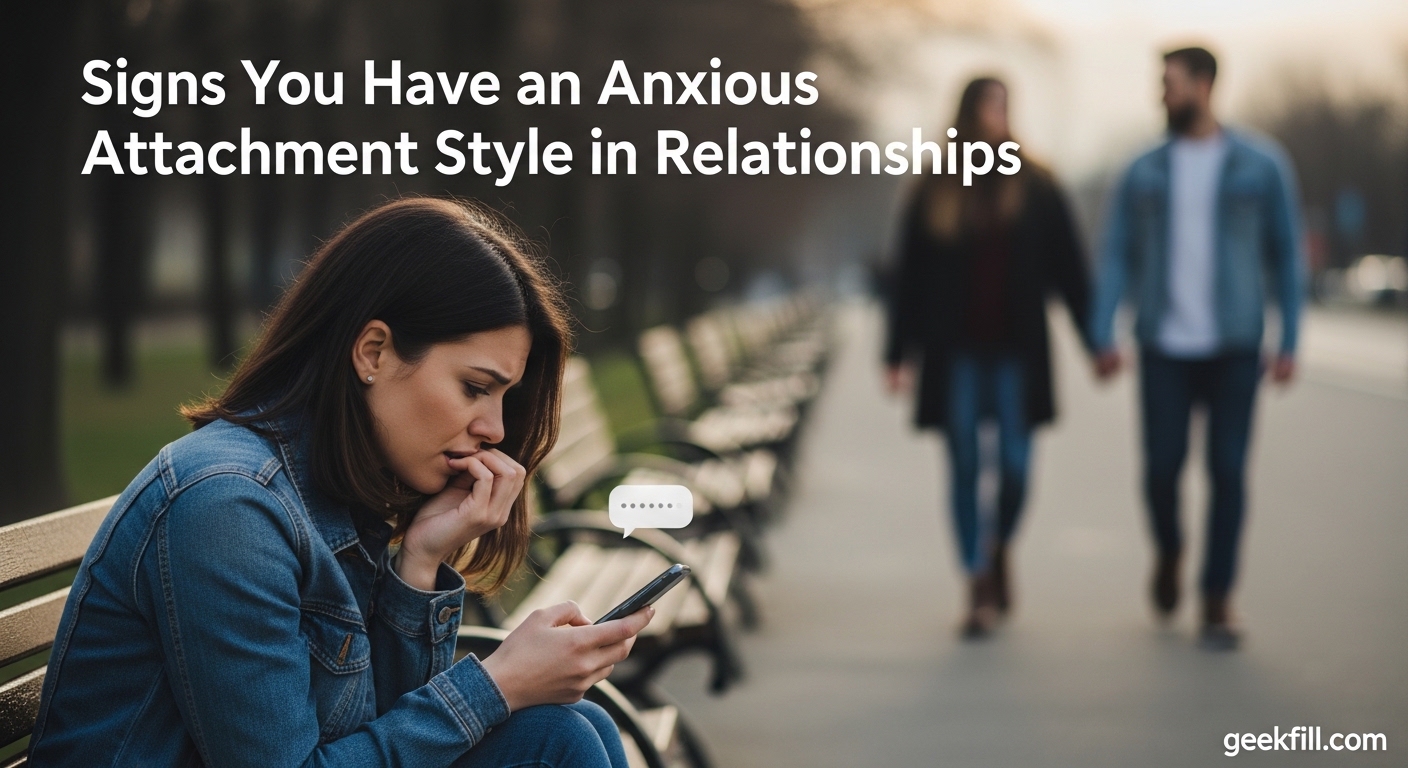
Do you find yourself staring at your phone, wondering why they haven’t texted back yet? Maybe your mind spirals through every possible scenario – they’re losing interest, they met someone else, you said something wrong. Three hours later, you get a simple “sorry, busy day” and feel an overwhelming wave of relief… followed by shame for overreacting.
If this sounds familiar, you might have an anxious attachment style. Don’t worry – you’re not broken, you’re not “too much,” and you’re definitely not alone. Understanding these patterns is the first step toward healthier relationships and emotional freedom.
In this guide, I’ll walk you through 10 signs you have an anxious attachment style in relationships. I’ll share real examples, explain where these patterns come from, and most importantly – show you that change is absolutely possible. Whether you’re just learning about attachment theory or you’ve been exploring it for years, this article will give you clarity and hope.
Table of Contents
What Is Anxious Attachment Style?
Anxious attachment style (also called anxious-preoccupied attachment) is one of four attachment styles identified in attachment theory, developed by psychologist John Bowlby and later expanded by Mary Ainsworth. It describes a pattern of relating to others characterized by a strong fear of abandonment, an intense need for closeness and reassurance, and difficulty self-soothing when apart from loved ones.
People with this attachment style typically developed it in childhood when caregivers were inconsistently responsive. Sometimes your needs were met with warmth and attention. Other times, they were ignored or dismissed. This unpredictability taught your nervous system to stay on high alert, constantly scanning for signs of rejection or abandonment.
It is important to understand the difference between normal relationship anxiety and an anxious attachment style. Everyone feels insecure sometimes – that is human. But if you notice these patterns showing up repeatedly across multiple relationships, affecting your daily life and emotional wellbeing, you might be dealing with an attachment style rather than situational anxiety.
The four attachment styles are:
Secure attachment: Comfortable with intimacy and independence; trusts others; communicates needs effectively.
Anxious attachment: Craves closeness but fears abandonment; seeks constant reassurance; hypervigilant to relationship threats.
Avoidant attachment: Values independence over intimacy; uncomfortable with closeness; suppresses emotional needs.
Disorganized attachment: Combination of anxious and avoidant patterns; often stems from trauma or frightening caregiver behavior.
Understanding where you fall on this spectrum is not about labeling yourself. It is about recognizing patterns so you can make conscious choices rather than being driven by unconscious fears.
10 Signs You Have an Anxious Attachment Style in Relationships
The following signs represent common patterns I have observed and experienced. You do not need to identify with every single one to have an anxious attachment style. Even recognizing three or four strongly suggests this pattern may be at play in your relationships.
1. You Constantly Fear Abandonment
The underlying current beneath everything you do in relationships is a persistent fear that the people you love will leave you. This is not just a mild worry – it is a deep-seated terror that influences your thoughts, feelings, and behaviors daily.
In modern dating, this might look like panicking when your partner does not respond to your text within a few hours. Your mind immediately assumes the worst: they are ghosting you, they have changed their mind about the relationship, or something terrible has happened. The rational part of your brain knows this is probably untrue, but the anxious part has already activated your fight-or-flight response.
This fear of abandonment often leads to what therapists call “protest behaviors” – actions meant to regain connection but which often push people away instead. You might send multiple messages, call repeatedly, or demand explanations for minor changes in behavior.
Self-reflection question: When was the last time you felt certain a partner was about to leave you, even without concrete evidence? What did that feel like in your body?
2. You Need Frequent Reassurance
People with anxious attachment often need to hear “I love you,” “I am not leaving,” or “Everything is okay” more frequently than others. One reassurance session does not last long – the anxiety returns, sometimes within hours, and you need to hear it again.
This reassurance seeking can take many forms. You might ask direct questions like “Do you still love me?” or “Are we okay?” You might fish for compliments or validation about your appearance, intelligence, or desirability. Some people create small conflicts just to receive the make-up reassurance that follows.
The challenge is that reassurance seeking often creates the very outcome you fear. Partners may feel suffocated, exhausted, or resentful. They might distance themselves, which triggers even more anxiety and more reassurance seeking – a painful cycle that can destroy relationships.
Self-reflection question: How often do you find yourself seeking verbal or behavioral confirmation that your partner cares? What happens internally when you receive it? How long does the calm last?
3. You Overanalyze Your Partner’s Behavior
Hypervigilance is a hallmark of anxious attachment. Your nervous system is constantly scanning for signs of rejection, much like a smoke detector that goes off at the slightest hint of smoke. You notice everything: the tone of a text message, how long it took to respond, a slight change in word choice, body language shifts, or even how they said goodbye.
In today’s digital dating landscape, this hypervigilance has new playgrounds. You might analyze their social media activity – who liked their posts, who they follow, what time they were last online. You might read and re-read text conversations, searching for hidden meanings or signs of cooling interest.
This overanalysis is exhausting and usually inaccurate. Most of the “signs” you detect are normal variations in human behavior or completely unrelated to you. But your anxious attachment system treats every uncertainty as a potential threat, demanding immediate resolution.
Self-reflection question: How much mental energy do you spend analyzing your partner’s words and actions? What percentage of your worries have actually come true?
4. You Struggle to Set Boundaries
People with anxious attachment often have difficulty recognizing, expressing, and maintaining healthy boundaries. You might say yes when you want to say no. You might allow behavior that bothers you because setting a limit feels like risking the relationship. You might merge your identity with your partner’s, losing sight of your own needs and preferences.
This connects strongly to people-pleasing tendencies. When your core fear is abandonment, anything that might create distance – including asserting your needs – feels dangerous. You prioritize keeping your partner happy over keeping yourself healthy.
The boundary struggle often extends beyond romantic relationships into friendships and family. You might find yourself over-giving, over-committing, and feeling resentful when others do not reciprocate at the same level. This pattern leads to burnout and relationship imbalances.
Self-reflection question: When was the last time you clearly stated a boundary or need? What did it feel like before, during, and after?
5. You Prioritize Your Partner Over Yourself
A common pattern among anxiously attached individuals is consistently putting their partner’s needs, schedule, and preferences ahead of their own. This might look like canceling plans with friends to be available in case your partner wants to see you. It might mean staying up late when you are exhausted because they want to talk. It could involve abandoning hobbies, goals, or self-care routines to focus entirely on the relationship.
This behavior stems from the fear that if you are not constantly available and accommodating, your partner will find someone who is. You try to become indispensable through usefulness and availability.
The danger here is codependency – a relationship dynamic where your wellbeing becomes dependent on your partner’s presence and approval. Without them, you feel empty. With them, you feel whole… but only when they are actively showing love. This creates an unstable foundation for any relationship.
Self-reflection question: What activities, friendships, or goals have you set aside to prioritize your relationship? How would you feel spending a weekend alone while your partner was busy?
6. You Experience Intense Emotional Highs and Lows
Relationships feel like emotional roller coasters when you have anxious attachment. When things are good – when your partner is attentive, affectionate, and available – you feel euphoric, safe, and deeply connected. But when they pull back even slightly, you crash into anxiety, despair, or anger.
Many people with this attachment style use their relationship as their primary source of emotional regulation. Your mood depends heavily on your partner’s behavior and the current state of the relationship. This creates instability not just for you, but for your partner as well, who may feel pressured to constantly manage your emotions.
From a neuroscience perspective, this pattern involves your amygdala (the brain’s threat detector) and your nervous system. When attachment fears trigger, your body enters a stress response. The relief when connection is restored can feel almost addictive – like getting a hit of a drug. This biochemical component helps explain why these patterns are so hard to break.
Self-reflection question: Track your mood for a few days, noting what influences it most. How much of your emotional state depends on your partner’s behavior?
7. You’re Quick to Forgive to Avoid Conflict
For someone with anxious attachment, conflict represents a terrifying threat. Arguments feel like doors swinging open toward abandonment. If you fight, they might leave. So you become highly motivated to resolve conflicts quickly, often at the expense of your own needs and boundaries.
This might look like apologizing even when you did nothing wrong. It might involve accepting weak explanations for hurtful behavior. You might minimize your own pain (“It wasn’t that bad”) or rush to make up before the issue is actually resolved.
The problem with this pattern is that unresolved issues accumulate. When you consistently suppress your needs to avoid conflict, resentment builds. Relationships need healthy conflict to grow and address real problems. By avoiding it, you may actually be weakening the foundation you are trying to protect.
Self-reflection question: Think about your last relationship conflict. Did you fully express your perspective and needs? Or did you rush to smooth things over?
8. You Feel Like a Burden When Expressing Needs
Expressing needs is a basic human necessity, but for those with anxious attachment, it often comes wrapped in shame. You might apologize repeatedly when asking for something (“I am so sorry to bother you, but…”). You might minimize your request (“It is not a big deal, forget I mentioned it”). Or you might simply not ask at all, hoping your partner will magically intuit what you need.
When you do express needs and your partner responds with anything less than immediate, enthusiastic support, you may spiral into shame. “I am too needy.” “I am too much.” “Normal people don’t need this much reassurance.” These internal messages keep you silent and suffering.
This pattern usually connects back to childhood experiences where emotional needs were dismissed, minimized, or punished. You learned that having needs was dangerous or shameful. As an adult, you still carry that belief, even when your partner has never given you reason to fear expressing yourself.
Self-reflection question: What beliefs do you hold about having emotional needs? Where did you learn those beliefs?
9. You Struggle to Be Alone
Being alone feels uncomfortable or even intolerable when you have anxious attachment. Solitude activates your fear of abandonment. Without someone present to provide reassurance, your anxious thoughts run unchecked.
This difficulty with alone time often leads to staying in relationships that are not healthy simply to avoid being single. You might jump quickly from one relationship to another, leaving no time to process, heal, or discover who you are outside of a partnership.
People with anxious attachment often have underdeveloped self-soothing skills. You may rely entirely on external sources – partners, friends, distractions – to regulate your emotions. Learning to comfort yourself, enjoy your own company, and find peace in solitude is a crucial part of healing anxious attachment.
Self-reflection question: How do you feel when you have an entire day with no plans and no one around? What do you typically do to fill that time?
10. You Often Attract or Are Drawn to Avoidant Partners
One of the most painful patterns for anxiously attached individuals is the anxious-avoidant trap. People with anxious attachment often find themselves drawn to partners with avoidant attachment styles – those who value independence, need space, and feel uncomfortable with too much closeness.
This dynamic creates a push-pull cycle that keeps both people stuck. The more the anxious partner seeks closeness, the more the avoidant partner pulls away. The more the avoidant partner withdraws, the more the anxious partner chases. It feels like a dance where you are constantly stepping on each other’s feet.
You might wonder why you keep attracting these partners. Often, it is because avoidant partners feel familiar. If you had emotionally unavailable caregivers, an avoidant partner replicates that dynamic. Your unconscious mind seeks to “win” the love you did not get as a child, hoping this time will be different.
Breaking this pattern requires awareness of your attraction patterns, willingness to walk away from incompatible dynamics, and ideally, dating partners with secure attachment styles who can help you heal through healthy relating.
Self-reflection question: Look at your relationship history. Have your partners generally been more emotionally available or more distant? What drew you to them initially?
Where Does Anxious Attachment Come From?
Understanding the origins of your attachment style is not about blaming anyone. It is about recognizing that these patterns developed for valid reasons and served a purpose at one time.
Anxious attachment typically develops in childhood when caregivers were inconsistently responsive to a child’s emotional needs. Sometimes they were warm, attentive, and nurturing. Other times they were distracted, dismissive, or unavailable. This unpredictability taught the child that love and care could disappear at any moment.
Children in these environments learn to become hypervigilant. They monitor their caregiver’s mood constantly, trying to predict when needs will be met and when they will be ignored. They develop what attachment researchers call “emotional hunger” – an intense need for connection that never feels fully satisfied.
It is worth noting that anxious attachment can also develop or intensify in adulthood through traumatic relationship experiences. A painful betrayal, an unexpected abandonment, or a series of disappointing relationships can trigger or worsen anxious attachment patterns.
These patterns are not your fault. You developed them because you needed to survive emotionally. The good news is that what was learned can be unlearned. Attachment styles are not life sentences.
How Anxious Attachment Affects Your Relationships (October 2026)
Anxious attachment does not only impact romantic relationships, though those often feel most intense. These patterns can show up in friendships, family dynamics, and even workplace interactions.
In romantic relationships, anxious attachment often creates self-fulfilling prophecies. Your fear of abandonment leads to behaviors (reassurance seeking, hypervigilance, emotional volatility) that exhaust your partner. They distance themselves, which confirms your fear that they were going to leave all along. The relationship ends, and you enter the next one with even stronger abandonment fears.
In friendships, you might find yourself over-giving, over-sharing, or feeling jealous when friends spend time with others. You might fear being excluded or forgotten. These patterns can strain even long-standing friendships.
In the workplace, anxious attachment might manifest as people-pleasing with supervisors, difficulty handling criticism, or intense anxiety about job security. You might overwork to prove your value or struggle to assert yourself in team settings.
Recognizing these patterns across all areas of your life helps you understand the full scope of what you are working with – and what you stand to gain by healing.
Can You Change Your Attachment Style?
Yes. Absolutely. Unequivocally yes.
Attachment styles are not fixed traits like eye color. They are patterns of relating that developed through experience, and they can change through new experiences. The concept of “earned secure attachment” describes people who developed insecure attachment styles in childhood but, through conscious work and healthy relationships, became securely attached adults.
Healing anxious attachment involves several key strategies:
Develop self-awareness. Notice your patterns without judgment. Simply observing when your attachment system activates gives you the power to choose your response rather than reacting automatically.
Build self-soothing skills. Learn to regulate your own emotions rather than depending entirely on others. This might include mindfulness practices, breathing exercises, physical movement, or creative outlets.
Challenge anxious thoughts. When your mind catastrophizes, practice asking: “What is the evidence for this fear? What is the evidence against it? What is a more balanced perspective?”
Communicate differently. Learn to express needs clearly without apology. Practice tolerating the discomfort of having needs without immediate resolution.
Consider therapy. Working with a therapist who understands attachment theory can accelerate your healing. Approaches like Emotionally Focused Therapy (EFT), Internal Family Systems (IFS), and schema therapy are particularly effective.
Date securely attached people. If possible, seek partners who demonstrate consistency, reliability, and emotional availability. Being with someone secure can actually help rewire your attachment system through new, positive experiences.
Most importantly, practice self-compassion. Healing is not linear. You will have setbacks. Your attachment system developed over years or decades – changing it takes time. Be patient with yourself.
FAQs
What triggers anxious attachment?
Can you get rid of anxious attachment?
How do I know if my partner has an anxious attachment style?
Is anxious attachment a disorder?
Conclusion
Recognizing the 10 signs you have an anxious attachment style in relationships is not about finding something wrong with you. It is about finally understanding patterns that have likely confused and pained you for years.
You are not broken. You are not too much. You developed these patterns because you needed to survive emotionally in environments where love felt uncertain. That took strength and adaptability.
The beautiful truth is that attachment styles can change. Every moment of awareness is a step toward healing. Every time you self-soothe instead of spiraling, you are rewiring your nervous system. Every healthy relationship experience teaches your brain that secure connection is possible.
Healing anxious attachment is a journey, not a destination. Be patient with yourself. Seek support when you need it. And remember – the fact that you are reading this article, seeking understanding, means you are already on the path to change.
You deserve relationships where you feel safe, loved, and secure. That future is absolutely possible for you.