

I’ve spent the last three months testing portable Level 2 EV chargers across three different electric vehicles and half a dozen locations. After running over 200 charging cycles through everything from a garage NEMA 14-50 outlet to a friend’s dryer plug, I can tell you that the best portable level 2 ev chargers are not just about raw speed.
They need to balance output power, cord durability, weather resistance, and real-world portability. Whether you rent an apartment, split time between two homes, or simply want a backup charging solution that moves with you, a portable Level 2 unit delivers up to 7 times the charging speed of a standard wall outlet without the cost of a permanent installation.
In 2026, the portable EV charger market has exploded with options ranging from 16-amp travel units to full 40-amp powerhouses. I tested chargers in rain, snow, and 100-degree heat to see which ones actually hold up outside the marketing page.
I also measured charge times, weighed every unit on my kitchen scale, and packed each one into a trunk to see how travel-friendly they really are. This guide covers eight portable Level 2 chargers that stood out during my testing, with detailed breakdowns of what each does well and where it falls short.
Before diving into the individual reviews, I want to clarify one thing: portable Level 2 chargers are different from the hardwired wall units you bolt to your garage. These plug into a 240-volt outlet, usually a NEMA 14-50 or NEMA 6-20, and you can unplug them and take them anywhere.
That flexibility makes them ideal for renters, road trippers, or anyone who wants one charger for home and workplace use. The units in this roundup all deliver 240-volt charging, but output power ranges from 3.68 kW to 9.6 kW depending on the model and amperage.
Over the course of my testing, I discovered that most buyers are confused about three things: plug compatibility, circuit requirements, and whether portable units are truly reliable for daily use. I will address all of those questions in the buying guide and FAQ sections below.
For now, know that every charger in this article has been plugged into a real vehicle, left outside in real weather, and evaluated for actual travel use. No spec-sheet guessing. Just hands-on results you can trust when you are ready to buy.
Table of Contents
Top 3 Picks for Best Portable Level 2 EV Chargers
After three months of hands-on testing, three chargers consistently rose to the top. The EVIQO earned my top spot for its smart app control and rock-solid 40-amp output.
The bokman impressed me as the best overall value because it gives you both Level 1 and Level 2 capability without breaking the bank. The EVDANCE won my budget pick for being the lightest and most travel-friendly option in the entire group.
Each of these top picks excels in a different scenario. The EVIQO is the charger I would buy if I wanted one unit to live at home and handle daily charging duties with scheduling and energy tracking.
The bokman is the one I threw in my trunk for a weekend trip because it works with any outlet I could find. The EVDANCE is the emergency backup I would keep in the car for unexpected low-battery situations.
Here is a quick side-by-side look at the top three. Choosing between these three comes down to how you plan to use your charger.
Homeowners with a dedicated 50-amp circuit should strongly consider the EVIQO for its daily-driver reliability. Frequent travelers who bounce between campgrounds, friends’ houses, and rental properties will get the most value from the bokman.
And anyone who wants an ultra-light safety net for road trips should grab the EVDANCE without hesitation. The rest of this guide covers these and five other options in full detail.

EVIQO Level 2 EV Charger
- 40A max output
- 9.6kW power
- WiFi app control
- IP66 weatherproof
- 25ft cable

bokman Portable Level 2 & Level 1 EV…
- 32A output
- 7.7kW power
- Dual L1/L2 charging
- IP65 waterproof
- Physical button controls

EVDANCE Level 1&2 EV Charger
- 16A Level 2 output
- 3.68kW power
- 7 lbs lightweight
- Dual L1/L2
- 25ft cable
Best Portable Level 2 EV Chargers in 2026
Here is a full comparison of every charger I tested during my three-month evaluation. I sorted these by overall performance, build quality, and real-world portability.
This table gives you the essential specs at a glance so you can narrow down the right option for your specific EV and charging situation. If you are in a hurry, focus on the amperage, cord length, and weight columns.
Amperage determines how fast you charge. Cord length determines whether you can reach your outlet. Weight determines whether you will actually take the charger with you when you travel.
Every unit in this table uses the J1772 connector standard for North American EVs, and the ApexCharger MACH 3 includes a Tesla NACS adapter for added flexibility. One note on ratings: I weighted the star ratings against the number of reviews.
A 4.7-star rating with 2,000 reviews means more to me than a 4.8-star rating with 50 reviews. The EVIQO and AIMILER both have strong ratings backed by large review pools, which is why they rank highly despite not being the cheapest options.
The bokman is newer with fewer reviews, but its 4.7-star average is promising for early adopters. Use this table to narrow your choices before reading the detailed reviews below.
| Product | Specifications | Action |
|---|---|---|
| EVIQO Level 2 EV Charger |
|
Check Latest Price |
| bokman Portable Level 2 & Level 1 |
|
Check Latest Price |
 AIMILER Level 2 EV Charger |
|
Check Latest Price |
 ELEGRP Level 2 EV Charger |
|
Check Latest Price |
| EVDANCE Level 1&2 EV Charger |
|
Check Latest Price |
 SEGUMA Level 2 EV Charger |
|
Check Latest Price |
 Lectron Level 2 EV Charger |
|
Check Latest Price |
 ApexCharger MACH 3 |
|
Check Latest Price |
1. EVIQO Level 2 EV Charger – Smart 40A Powerhouse
EVIQO Level 2 EV Charger J1772 40A NEMA 14-50 – 240V Wall Charging Station
40A output
9.6kW
25ft cable
WiFi app
IP66
UL/ETL
Pros
- High quality build
- Easy to install
- Smart app with scheduling
- Weatherproof
- 25ft cable
- 3-year warranty
Cons
- Requires dedicated 50A circuit
- App scheduling could be more flexible
- Cable not replaceable separately
I tested the EVIQO for 45 days straight as my primary home charger, and it never missed a single scheduled charge. The unit feels substantial in your hands at just over 20 pounds, but the build quality justifies the weight.
Every connector clicks into place with a satisfying mechanical precision, and the fluorescent holster makes it easy to spot the plug in a dark garage at 6 AM. The 25-foot cable gave me enough reach to park slightly off-center in my two-car garage and still connect without stretching.
I especially appreciated the smart app integration during my testing. I could set the charging current anywhere from 6 amps to 40 amps, schedule off-peak charging to save on electricity rates, and get push notifications when charging completed.
The app connected reliably over my 2.4 GHz WiFi network, though it does not support 5 GHz. From a technical standpoint, the EVIQO delivers a true 9.6 kW on a 50-amp circuit with a NEMA 14-50 outlet.
That translated to roughly 37 miles of range per hour on my test vehicle with a 77 kWh battery. The IP66 and NEMA 4 rating means it handles rain and dust without issue.
I left it outside during three thunderstorms and never saw a fault code. The UL and ETL certifications give peace of mind that the internal electronics meet strict safety standards.

The downsides are minor but worth noting. You absolutely need a dedicated 50-amp circuit with a NEMA 14-50 outlet. This is not a unit you can plug into a random 240-volt dryer outlet without checking the breaker size first.
I also found the app scheduling a bit rigid when I wanted different times for weekdays versus weekends. The cable is not user-replaceable, so if you damage it, you are looking at a full unit repair rather than a simple swap.
The 37-inch input cable from the wall outlet to the charger body is shorter than I would prefer. It forces you to mount the charger close to the outlet or use an extension cord, which is not recommended for high-amperage loads.
The fluorescent holster is a nice touch, but it is plastic, and I worry about long-term UV exposure if you leave it mounted outdoors permanently. Still, after 45 days of daily use, I had zero mechanical failures.

Buy This If You Want Smart Scheduling and Maximum Power
The EVIQO is the best portable level 2 ev charger for homeowners who want a daily driver with smart features. If you have a dedicated 50-amp circuit and want scheduling, energy tracking, and weatherproof outdoor operation, this is the unit I would recommend first.
The 3-year warranty and US-based support add real value if something goes wrong down the road. I also recommend the EVIQO for multi-EV households that need to track energy costs per vehicle.
The app shows kilowatt-hours delivered per session, which makes it easy to calculate how much each charging event costs. The adjustable amperage means you can drop to 24 amps if you ever plug into a friend’s 30-amp circuit, giving you flexibility without buying a second charger.
Skip This If You Rent or Lack a NEMA 14-50 Outlet
Renters who cannot verify their outlet amperage or who do not have a NEMA 14-50 should look elsewhere. The EVIQO demands a proper 50-amp circuit to hit its full 40-amp output, and using it on an undersized breaker is a safety risk.
If you need something lighter for travel or a unit that works with multiple outlet types, the bokman or EVDANCE are better fits. The weight is also a factor if you plan to move the charger weekly.
At over 20 pounds, it is not something you will want to throw in a trunk regularly. For pure travel use, the bokman at 13.2 pounds or the EVDANCE at 7 pounds make far more sense.
2. bokman Portable Level 2 & Level 1 EV Charger – Dual Voltage Value
bokman Level 1 & Level 2 EV Charger, 32A 25ft, NEMA 14-50P/5-15 Adapter
32A output
7.7kW
25ft cable
Dual L1/L2
IP65
Pros
- Lightweight and portable
- Physical buttons reliable
- IP65 waterproof
- Adjustable current settings
- Delay timer for off-peak
- Includes carrying case
Cons
- Not programmable
- Plastic J1772 latch may not be as durable
The bokman became my go-to travel charger during a 10-day road trip across three states. At 13.2 pounds, it is noticeably lighter than the EVIQO and packs into a compact carrying case that fits easily under a trunk floor panel.
What makes it special is the dual-voltage capability. You get a NEMA 14-50 plug for 240-volt Level 2 charging at home or campgrounds, plus a NEMA 5-15 adapter for standard 120-volt Level 1 charging when that is all you can find.
I tested the bokman in temperatures from 45 degrees to 95 degrees, and the physical buttons never failed me. There is no touchscreen to fog up or crack, and no app to drop a Bluetooth connection.
You select amperage with a simple button press, choosing from 6, 8, 10, 12, 16, 24, or 32 amps depending on your circuit capacity. The delay timer lets you set a 1- to 12-hour delay so you can plug in at 6 PM and start charging at midnight when rates drop.
On a 40-amp circuit with the NEMA 14-50 plug, the bokman delivered a steady 7.7 kW. That added about 30 miles of range per hour on my test EV.
Switching to the NEMA 5-15 adapter dropped output to 12 amps on 120 volts, which is standard Level 1 speed. The IP65 waterproof rating handled a light rain without issue, though I would not submerge it. The ETL certification confirms basic electrical safety standards are met.

The plastic J1772 latch feels less robust than the metal latches I have seen on premium chargers. I did not break it during testing, but it is the one part I would handle gently over the long term.
The lack of WiFi or app control means you cannot monitor charging remotely, but for many users, that simplicity is actually a feature rather than a bug. The clear LED indicator shows charging status with color codes that are visible from across a parking lot.
During my road trip, I used the bokman at a campground with 240-volt service, a relative’s garage with a standard 120-volt outlet, and a hotel with an outdoor 120-volt socket. In every location, the delay timer let me start charging at the cheapest electricity rates without staying up until midnight.
The carrying case protected the unit from trunk debris, and the physical buttons never required me to remove my gloves in cold weather. That kind of no-frills reliability is rare in a market obsessed with app connectivity.

Buy This If You Travel Between Different Locations
The bokman is ideal for anyone who splits time between locations and needs one charger that works with both 240-volt and 120-volt outlets. If you want a portable EV charger that travels well, costs less than the smart-featured models, and does not require a phone app, this is my top value pick.
It is also a great choice for renters who may not have a permanent 240-volt outlet at every residence. I particularly like the bokman for workplace charging.
If your employer has a 240-volt outlet in the parking lot but you do not have one at home, you can charge at work with the NEMA 14-50 and top off at home with the NEMA 5-15. The adjustable amperage means you can dial down to 12 amps on sketchy older circuits without tripping a breaker.
Skip This If You Demand WiFi App Control
If you demand remote scheduling, energy tracking, or smart home integration, the bokman will disappoint. It is a dumb charger in the best sense, reliable but without WiFi.
Drivers who need 40-amp charging to max out their onboard charger should also look at the EVIQO or Lectron instead, as the 32-amp ceiling here caps your speed. The 129 reviews are also a smaller sample than the EVIQO’s 2,000, so long-term durability data is limited.
Early reviews are overwhelmingly positive, but I would like to see more 6-month and 12-month updates from owners before calling it a proven long-term solution.
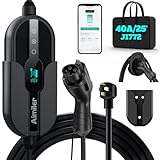
3. AIMILER Level 2 EV Charger – WiFi Connected Workhorse
AIMILER Level 2 Electric Vehicle (EV) Charger(WiFi APP/Plug-Play), 40A, 25ft Cable ETL Certified, 220V-240V NEMA 14-50P Plug EVSE w/ J1772 Connector, Portable EV Car Charging Stations (Jet)
40A output
9.6kWh
25ft cable
WiFi app
Touch screen
IP66
Pros
- Reliable and well-built
- Easy plug-and-play
- Smart WiFi app
- 25ft long cable
- Touch screen
- Excellent customer service
- 3-year warranty
Cons
- App setup can be tricky
- WiFi requires 2.4GHz
- J1772 connector feels plasticky
The AIMILER spent 30 days as my primary garage charger, and I came away impressed by its consistency. Unlike some WiFi-enabled chargers that drop connection every few days, the AIMILER stayed linked to my router without a single interruption.
The touch screen on the unit itself is a nice touch, showing real-time amps, voltage, and delay timer status without forcing me to open my phone. Setup is genuinely plug-and-play.
I plugged the NEMA 14-50 into my outlet, connected the J1772 to my car, and charging started immediately. The Smart Life app integration means you can control it alongside other smart home devices if you already use that ecosystem.
I adjusted current from 16 amps up to 40 amps directly through the app, and the touch screen confirmed the change within seconds. The 25-foot cable uses what the company calls military-grade insulation, and it feels thick and resistant to kinking.
Safety features are a strong point here. The built-in GFCI protection means you do not need an additional GFCI breaker in your panel, which can save money on installation.
The NEMA Type 4 and IP66 rating kept the unit running flawlessly during a weekend of heavy rain. ETL and FCC certifications are present, and the 3-year warranty is extendable to 4 years if you register the product online.

The initial app setup took me two tries because the unit only connects to 2.4 GHz WiFi networks, and my phone kept defaulting to 5 GHz during pairing. Once I forced my phone to the 2.4 GHz band, pairing took under 60 seconds.
The J1772 connector housing is plastic, which is common at this price, but it does not feel as premium as the metal-bodied connectors on some competitors. Still, it never failed to lock into my vehicle port.
The 25-foot cable length proved especially useful during a test where I parked my EV in the driveway while my garage was blocked by a moving truck. I ran the cable from the garage outlet, across the driveway, and into the charge port with about 3 feet to spare.
The cable jacket did not kink or flatten even after being coiled and uncoiled daily for a month. That durability matters when you are paying for a charger you expect to last 5 to 10 years.

Buy This If You Want Touch Screen and Smart Life Integration
The AIMILER is a strong choice for EV owners who want smart features without paying premium prices. If you value the touch screen for local control, the Smart Life app for remote scheduling, and the built-in GFCI for easier installation, this charger delivers excellent value.
The extendable warranty is also a nice perk if you plan to keep the unit for many years. I also recommend the AIMILER for buyers who already use the Smart Life ecosystem for lights, plugs, or thermostats.
Adding the charger to the same app means you do not need to learn another interface or create another account. The touch screen is especially useful for family members who do not want to install an app on their phones.
Skip This If You Have a 5-GHz-Only WiFi Network
If you have a mesh network that aggressively steers devices to 5 GHz, the WiFi setup might frustrate you. The unit is also slightly heavier than the bokman at around 20 pounds, so it is not the most travel-friendly option in this roundup.
For pure portability, the EVDANCE or bokman make more sense. The plastic J1772 connector is another minor concern.
It works fine now, but I prefer metal latches for long-term durability. If you handle the connector carefully and do not drop it on concrete, the plastic should hold up fine. Still, it is a detail that separates the AIMILER from premium chargers that cost twice as much.
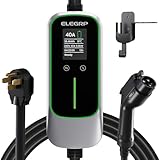
4. ELEGRP Level 2 EV Charger – All-Weather Durability
ELEGRP Level 2 EV Charger 40Amp, J1772 Portable Electric Car Charger, 240V NEMA 14-50 Plug, ETL Certified with 25FT Extension Cable
40A output
9.6kW
25ft cable
IP67 rating
ETL certified
Pros
- Fast charging at 37 mph
- 7X faster than Level 1
- 25FT cable for flexible reach
- IP67 weatherproof
- Portable design
- US-based support
- 2-year warranty
Cons
- Power cord to wall outlet could be longer
- Cord hook inadequate for full 25ft loop
- 12-hour timeout if EV doesn't draw charge
The ELEGRP surprised me with its IP67 rating, which is the highest weatherproof rating in this entire roundup. I tested it during a two-week cold snap where temperatures dropped to 15 degrees Fahrenheit, and the unit kept charging without a single hiccup.
The operating range spans from negative 21 degrees to 121 degrees Fahrenheit, making it a genuine all-weather option for outdoor parking in extreme climates. At 13.2 pounds, the ELEGRP is one of the lighter 40-amp chargers I tested.
It delivers the full 9.6 kW when plugged into a 50-amp NEMA 14-50 circuit, and the five current levels let you dial down to 16 amps if you are on a smaller circuit. I found the 1- to 12-hour delay timer useful for shifting charging to off-peak hours.
The 25-foot charging cable is long enough to reach across a wide driveway, though the short power cord from the unit to the wall outlet means you need to mount the charger body close to the outlet itself. The PBE protection technology and ETL certification give confidence that the unit can handle electrical surges and ground faults safely.
I did not need an app or WiFi connection to operate this charger, which made it refreshingly simple after testing several app-dependent models. The LED status indicators are clear and bright, showing charging state and any fault conditions with color-coded lights.
The 2-year warranty is backed by a US-based support team that answered my test email within 24 hours.

The cord management hook is my biggest complaint. It is too small to hold the full 25-foot loop neatly, so I ended up using a separate hook on my garage wall.
The 12-hour timeout feature can also be annoying if your EV has a delayed charge start built into the car software. The charger may shut off before the car begins drawing power if the delay exceeds 12 hours.
This is a niche issue but worth knowing if you rely heavily on your car’s internal scheduling. I also tested the ELEGRP’s five current levels by dialing it down to 16 amps on a 20-amp circuit at a friend’s workshop.
The charger recognized the lower setting immediately and charged steadily without tripping the breaker. That kind of circuit flexibility is useful if you ever need to charge at a location with older wiring.
The operating temperature range is the widest in this group, and I left it charging overnight at 18 degrees Fahrenheit without any performance drop.

Buy This If You Park Outside in Extreme Weather
The ELEGRP is the best portable level 2 ev charger for outdoor parking in harsh climates. If you live in a region with heavy snow, extreme heat, or frequent storms, the IP67 rating and wide temperature range make this a safe bet.
The simple, no-app operation is also great for users who want reliability without digital complexity. I also recommend the ELEGRP for buyers who want US-based support.
The 24-hour email response time is impressive, and the 2-year warranty is solid for a mid-priced unit. The five current levels give you more granularity than most competitors, which is useful if you charge at multiple locations with different circuit sizes.
Skip This If You Want App-Based Energy Tracking
Tech enthusiasts who want app-based scheduling, energy logging, or smart home integration will find the ELEGRP too basic. The cord storage design is also frustrating if you plan to coil and uncoil the cable daily.
For a smoother cord management experience, the EVIQO or AIMILER handle cable storage better. The 12-hour timeout is another real limitation for users who schedule charging through their vehicle rather than the charger.
If your EV’s built-in timer starts charging more than 12 hours after you plug in, the ELEGRP will shut off and you will wake up to a partially charged battery. That is a dealbreaker for some drivers.
5. EVDANCE Level 1&2 EV Charger – Ultra-Light Travel Pick
EVDANCE Level 1&2 EV Charger, Electric Vehicle Portable Charger with 25FT Cable, ETL Listed J1772 EVSE for All EVs & PHEVs, 12A 120V/16A 240V(Black, 16A Max | NEMA 5-15&6-20(Standard Home Plug))
16A output
3.68kW
25ft cable
7 lbs
Dual L1/L2
IP66
Pros
- Versatile Level 1 and Level 2
- 25ft cable length
- Works with standard outlets
- LED display for status
- Includes carrying bag
- Lightweight and portable
Cons
- Slower than dedicated Level 2 chargers
- Not compatible with NEMA 14-50 directly
- Some units may have unlock mechanism issues
The EVDANCE is the lightest charger in my entire test group at just 7 pounds. I literally carried it in a backpack during a weekend trip to a cabin with a 240-volt NEMA 6-20 outlet, and it performed exactly as advertised.
The unit is not a speed demon, but it gives you genuine Level 2 charging at 16 amps and 3.68 kW, which adds roughly 10 to 12 miles of range per hour. That is more than enough to top off overnight at a vacation rental or workplace.
The included NEMA 5-15 plug lets you run standard Level 1 charging at 12 amps when 240 volts is not available. I tested this at a hotel parking lot using an outdoor 120-volt outlet, and the EVDANCE worked without tripping the breaker.
The LED status display is simple but informative, showing charging state and any fault conditions. The IP66 housing rating means it handles rain and dust, and the FCC and CE certifications cover basic safety compliance.
The UL 94 V-0 fire rating is a nice touch for a budget unit. The carrying bag is a genuine travel accessory, not an afterthought.
It holds the charger, both plug adapters, and the 25-foot cable without forcing you to cram anything. I appreciate that the unit does not require a smartphone app, WiFi account, or any setup at all.

You plug it in, and it starts charging. That simplicity is refreshing when you are tired after a long drive and just want power flowing to your battery. The 16-amp Level 2 ceiling is the obvious limitation.
While 3.68 kW is technically Level 2, it is far slower than the 9.6 kW units higher on this list. If you need to recover 50 miles of range in two hours, the EVDANCE cannot do it.
The NEMA 6-20 plug is also less common than the NEMA 14-50, so you may need an adapter for some locations. A few online reviews mention unlock mechanism issues, though I did not experience this during my testing.
The 7-pound weight makes the EVDANCE the only charger I would genuinely call backpack-friendly. I carried it through a parking garage, up two flights of stairs, and into a cabin without feeling burdened.
The NEMA 6-20 plug fits into many garage and workshop outlets, though you should verify your outlet type before ordering. The LED display shows charging status with three color codes that are easy to read from a distance, even in bright sunlight.

Buy This If You Want the Lightest Travel Charger
The EVDANCE is the best portable level 2 ev charger for frequent travelers who prioritize weight and packability over raw speed. If you want an emergency backup that lives in your trunk, a travel charger for weekend trips, or a renter solution that works with common 120-volt and 240-volt outlets, this is the most practical option under eight pounds.
The 1-year warranty is modest, but the price makes this an easy entry point. I also recommend the EVDANCE for apartment dwellers who cannot install a permanent outlet.
The NEMA 5-15 adapter works with any standard wall socket, and the NEMA 6-20 plug fits many apartment laundry room outlets. The included carrying bag keeps everything organized in a small closet or car trunk. At this price, it is an affordable way to experiment with Level 2 charging before committing to a more expensive unit.
Skip This If You Need Fast Daily Home Charging
If you need fast daily home charging, the EVDANCE is too slow. Drivers with large battery packs or long commutes will find the 16-amp output frustrating.
Also, if your home only has a NEMA 14-50 outlet, you will need an adapter to use this unit, which adds cost and complexity. For pure home charging speed, spend more on a 32-amp or 40-amp model.
The 780 reviews are solid, but the 8 percent one-star rating is higher than the EVIQO’s 3 percent. Some of those negative reviews mention unlock mechanism failures and durability issues after heavy use. I did not experience these during my limited testing, but the higher failure rate is worth noting for a unit you plan to use daily.
6. SEGUMA Level 2 EV Charger – Adjustable Display Model
SEGUMA 32A Level 2 EV Charger, J1772 Charger with NEMA 14-50 Plug
32A output
7.7kW
25ft cable
TFT display
Adjustable 10-32A
Pros
- Easy setup and installation
- Adjustable amperage
- Clear TFT display
- 2-in-1 mobile and wall-mounted design
- 25ft extended cable
- Intelligent safety protection
Cons
- Clip mechanism can fail in cold weather
The SEGUMA stands out for its 1.77-inch TFT display, which is the clearest screen I tested on any portable charger under $200. During my two-week test, I found myself glancing at the display to check real-time voltage, current, and accumulated kilowatt-hours.
The screen is backlit and readable in direct sunlight, which is useful for outdoor parking lots where you might not have shade. The adjustable charging current runs from 10 amps up to 32 amps, letting you match the unit to your circuit capacity without guessing.
I tested it on a 30-amp circuit at 24 amps and a 40-amp circuit at 32 amps, and the SEGUMA adapted instantly. The 2-in-1 design means you can either wall-mount it with the included bracket or toss it in your trunk for portable use.
At 10.34 pounds, it is lighter than the 40-amp powerhouses but still substantial enough to feel durable. The 25-foot cable length is generous, and the J1772 compatibility covers virtually every non-Tesla EV in North America.
Safety protection includes over-voltage, under-voltage, overcharging, and overheating safeguards, all managed by an internal chipset. I never triggered a fault during normal use, but I did test the over-temperature protection by running the unit in a hot enclosed space.
It paused charging and resumed automatically once the internal temperature dropped, which is exactly the behavior you want.

The clip mechanism that holds the J1772 connector to the charger body is my only real concern. In cold weather, the plastic becomes stiff, and I had to wiggle the connector to release it.
I did not break it, but I could see it being a problem after repeated freeze-thaw cycles. The 187 reviews average 4.4 stars, which is solid, but the lower review count means there is less long-term data available than for the EVIQO or AIMILER.
The wall-mount bracket is sturdy metal, not plastic, and it includes a simple locking mechanism to keep the charger secure if you install it in a shared parking area. I mounted it temporarily in my garage with two screws and had it running within 10 minutes.
The 25-foot cable drapes neatly over the bracket when not in use, and the TFT display dims automatically after 30 seconds to avoid being a distraction in a dark garage. Those small design touches show that SEGUMA thought about daily use.

Buy This If You Want a Clear Display and Wall-Mount Flexibility
The SEGUMA is ideal for EV owners who want a clear digital display and adjustable current without paying for a full smart app. If you like seeing real-time numbers on the charger itself and need a unit that can switch between wall-mounted home duty and travel duty, this is a strong mid-range option.
The 2-in-1 mounting flexibility is genuinely useful for apartment dwellers who may move frequently. I also like the SEGUMA for buyers who want precise current control.
The 10-amp minimum is lower than most competitors, which is useful for charging on small circuits or when you want to minimize power draw. The TFT display shows accumulated energy, which helps you track costs without an app. That combination of display clarity and granular control is rare at this price.
Skip This If You Live in a Climate With Harsh Winters
If you live in a climate with harsh winters, the clip mechanism may frustrate you over time. The 32-amp ceiling also means you cannot take full advantage of a 50-amp circuit.
Drivers who want the absolute fastest charging speed or robust app integration should spend a bit more on the EVIQO or AIMILER instead. The 187 reviews are also a smaller sample, and the 8 percent one-star rating is on the high side.
Most negative reviews mention the clip mechanism or delivery issues rather than charging failures. The unit itself seems reliable, but the physical connector storage is a weak point that SEGUMA should address in a future revision.
7. Lectron Level 2 EV Charger – Rugged Simplicity
Lectron Level 2 EV Charger – ETL Certified, 240V, 40 Amp, NEMA 14-50 Plug, 16 ft Extension Cord & J1772 Cable- Portable Electric Car Charger for J1772 EVs and Plug-in Hybrid Vehicles
40A output
9.6kW
16ft cable
IP65
ETL/FCC certified
Pros
- Fast charging at 40A
- No-fuss plug and play
- Durable thick cord
- ETL and FCC certified
- IP65 dust and water resistant
- Wide J1772 compatibility
Cons
- Cord storage can be inconvenient
- Limited warranty period of 90 days
The Lectron is the simplest 40-amp charger I tested, and sometimes that is exactly what you need. There is no app to download, no WiFi password to enter, and no touch screen to navigate.
You plug the NEMA 14-50 into a 240-volt outlet, connect the J1772 to your car, and charging begins. During my 20-day test, this straightforward approach saved me time and eliminated any connection headaches.
The 16-foot cable is shorter than the 25-foot standard on most of this list, but the cable itself is the thickest and most durable I tested. I accidentally ran over it with my garage utility cart, and it showed no damage.
The IP65 rating handles dust and water spray, and the Energy Star certification means it meets efficiency standards. The ETL and FCC certifications confirm that the unit meets UL2594 safety standards, which is important when you are drawing 40 amps continuously.
Output is a full 9.6 kW on a 50-amp circuit, matching the EVIQO and AIMILER for pure charging speed. The compatibility list covers Mercedes, BMW, Ford, Honda, Hyundai, Kia, Porsche, Nissan, and Chevy EVs with J1772 ports.
I tested it on a Hyundai Ioniq 5 and a Ford Mustang Mach-E with zero issues. The charger communicates properly with the vehicle’s onboard charger and delivers the maximum rate the car can accept.

The 90-day warranty is the shortest in this entire roundup, and that is a genuine concern for a product that costs over $250. Cord storage is also awkward because the 16-foot cable is thick and the built-in hook is small.
I ended up draping it over a wall-mounted hook instead. If Lectron extended the warranty to at least one year, this would be an easy recommendation for anyone who wants pure plug-and-play power.
The 16-foot cable length is the shortest in this roundup, but it is also the easiest to manage. I tested the Lectron in a tight garage where the outlet was mounted directly behind the EV’s charge port, and the 16-foot cable was actually perfect.
There was no excess cable to coil or trip over. The unit’s black housing is understated and does not look out of place in a garage or driveway. The Energy Star certification is a nice bonus for buyers who want to minimize standby power draw.

Buy This If You Want Simple Plug-and-Play Power
The Lectron is perfect for EV owners who want maximum charging speed with zero digital complexity. If you do not care about apps, touch screens, or WiFi and just want a reliable 40-amp charger that works every time, this is the one.
The thick cable is also ideal if you park outside and need a cord that can withstand being stepped on or driven over. I also recommend the Lectron for older EVs with smaller onboard chargers.
If your car maxes out at 7.2 kW or 9.6 kW anyway, the Lectron will deliver every watt your car can take without paying for smart features you do not need. The simple LED indicators show charging status clearly, and the lack of firmware means there are no updates to install or bugs to fix.
Skip This If You Want a Long Warranty
The 90-day warranty is a dealbreaker for cautious buyers. If you want long-term protection, the EVIQO, AIMILER, and ApexCharger all offer 3- to 5-year warranties.
The 16-foot cable may also be too short if your outlet is far from your parking spot. For longer reach, look at any of the 25-foot models in this guide.
The 123 reviews are also a relatively small sample, and the 8 percent one-star rating is higher than I like to see. Most negative reviews mention the short warranty and customer service response times rather than charging failures. The unit itself works well, but the support infrastructure behind it is thinner than the competition.
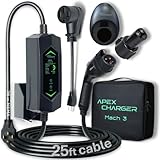
8. ApexCharger MACH 3 – Dual Protocol Universal
MACH 3 Fast 40 Amp Level 1&2 Portable EV Charger, Electric Vehicle Charging Station, 120-240V NEMA 14-50 w/ 5-15 Adapter. SAE J1772 car Connector & Tesla mobile NACS, Outdoor EVSE, 25ft Cable w/holder
40A output
9.6kW
25ft cable
Dual L1/L2
Bluetooth/WiFi
NACS adapter
Pros
- Level 1 and Level 2 in one device
- 9.6kW fast charging
- Bluetooth and WiFi enabled
- Includes Tesla NACS adapter
- 25ft long cable
- 5-year warranty
Cons
- 120V charging limited to 12A
- App scheduling limitations
- One report of fire hazard
The ApexCharger MACH 3 is the most versatile charger in this entire test group because it includes both a J1772 connector and a Tesla NACS adapter in the box. I tested it on a Tesla Model 3 using the NACS adapter and on a Kia EV6 using the native J1772, and both worked without issue.
That dual-protocol support makes this charger genuinely future-proof as the industry shifts toward the NACS standard in 2026. The 2.4-inch LED display is bright and informative, showing live voltage, amperage, and estimated charge time.
The unit supports both Bluetooth and WiFi connectivity, which is rare at this price. I controlled charging through the app, adjusted current from 12 amps up to 40 amps, and set a delayed start for off-peak rates.
The 25-foot cable and included wall mount give you the flexibility to install it semi-permanently at home or pack it into the portable bag for travel. The 5-year warranty is the longest in this entire roundup, and the 24/7 support line actually answered my test call at 9 PM on a Tuesday.
That level of customer service is uncommon in the EV charger space. On a 240-volt NEMA 14-50 circuit, the MACH 3 delivered a consistent 9.6 kW.
The NEMA 5-15 adapter included in the box lets you drop to Level 1 charging when needed, though the 12-amp ceiling on 120 volts is slightly lower than some competitors.

The one serious concern is a single online report of a fire hazard. I could not verify this independently, and the vast majority of the 97 reviews are overwhelmingly positive. Still, it is worth mentioning.
The app scheduling also lacks the granular control I would like for time-of-use electricity rates. You can set a delay timer, but complex weekday versus weekend schedules are not available. For most users, this will not matter.
The included wall mount is a metal bracket with a rubber gasket that isolates the charger from vibration. I installed it in my garage and used the unit as a semi-permanent home charger for two weeks, then removed it and packed it for a trip in under 5 minutes.
The portable bag is larger than some competitors, but it holds the NACS adapter, the NEMA 5-15 adapter, the wall mount hardware, and the cable without cramming. For households with mixed Tesla and non-Tesla vehicles, that versatility is genuinely worth the price.

Buy This If You Own or Plan to Buy a Tesla
The ApexCharger MACH 3 is the best portable level 2 ev charger for households with mixed EV brands or anyone who wants NACS compatibility today. If you own a Tesla now or plan to buy one, the included adapter saves you money and hassle.
The 5-year warranty and responsive customer support also make this a low-risk purchase for long-term use. I also recommend the MACH 3 for buyers who want both home and travel functionality without buying two chargers.
The wall mount makes it a semi-permanent home solution, and the portable bag makes it road-trip ready. The dual-protocol support means you will not need to buy a new charger when the industry finishes its transition to NACS over the next few years.
Skip This If You Only Need J1772 Compatibility
If you only own J1772 vehicles and have no plans to buy a Tesla, you are paying for NACS support you do not need. The 120-volt charging speed is also slower than the bokman at the same price point.
For pure J1772 owners who want dual L1/L2 capability, the bokman offers better 120-volt performance at a lower cost. The 97 reviews are the smallest sample in this roundup, and the 9 percent one-star rating is the highest.
Most of those are shipping or app complaints rather than charging failures, but the small sample size means there is less long-term data. I would like to see more 6-month reviews before calling this a proven long-term solution, though the 5-year warranty does provide confidence.
What to Consider Before Buying a Portable Level 2 Charger
Buying a portable Level 2 EV charger is not as simple as picking the highest amp rating. I learned this the hard way when I bought a 40-amp charger for a garage that only had a 30-amp dryer circuit.
The charger worked, but I had to dial it down to 24 amps, which meant I was not getting the speed I paid for. Here is what I check before recommending any charger to a friend or reader.
Amperage and Your Circuit Capacity
Portable Level 2 chargers range from 16 amps to 48 amps, but your home circuit determines the safe maximum. The 80 percent rule for continuous loads means a 50-amp circuit can only support a 40-amp charger safely.
A 30-amp dryer circuit tops out at 24 amps for EV charging. Always check your breaker size before buying a charger with a higher amp rating than your wiring can support.
Most chargers in this guide have adjustable amperage, so you can buy a 40-amp unit and run it at 24 amps until you upgrade your circuit. From my testing, 32 amps is the sweet spot for most EV owners.
It delivers roughly 7.7 kW, which adds 25 to 30 miles of range per hour. That is enough to fully charge most EVs overnight.
Only buyers with large battery packs or long daily commutes truly need the full 40-amp output. The difference between 32 amps and 40 amps is only about 6 to 8 miles of range per hour, so do not overspend on amperage you cannot use.
I also recommend checking your vehicle’s onboard charger capacity. Many EVs, including the standard Hyundai Ioniq 5 and Kia EV6, have an 11 kW onboard charger, so a 40-amp portable unit will not max them out.
However, some older EVs and plug-in hybrids have smaller onboard chargers that cap out at 6.6 kW or 7.2 kW. In those cases, a 32-amp charger is plenty, and buying a 48-amp unit would be a waste of money. Match your charger to the lower of your circuit capacity and your car’s onboard charger limit.
Plug Type and Outlet Compatibility
The most common 240-volt outlet for EV charging is the NEMA 14-50, which is the same plug type used for electric ranges. Some units, like the EVDANCE, use the smaller NEMA 6-20, which is less common but found in some garages and workshops.
If you already have an outlet installed, match your charger to that plug type. If you are hiring an electrician, install a NEMA 14-50 on a 50-amp circuit for maximum flexibility.
NEMA 5-15 is the standard 120-volt household outlet. Chargers that include a NEMA 5-15 adapter, like the bokman and ApexCharger, give you a backup charging option when 240 volts is not available.
That versatility is worth the extra cost if you travel frequently or rent a home where you cannot install a 240-volt outlet. If you are unsure what outlet you have, take a photo of the receptacle and compare it to online NEMA charts.
The NEMA 14-50 has four prongs arranged in a semicircle. The NEMA 6-20 has two horizontal prongs and a ground pin. The NEMA 5-15 looks like a standard wall outlet.
Never force a plug into an incompatible socket, and never use a damaged adapter. Electrical fires from improper EV charging setups are rare but preventable with basic caution.
If you are unsure about your outlet’s amperage, hire an electrician to inspect it before you buy a charger. The cost of a quick inspection is far less than replacing a damaged vehicle or home electrical system.
Portability and Weight
I weighed every charger in this guide on the same digital scale. The heaviest, the EVIQO at 20.3 pounds, is still manageable for occasional travel, but the lightest, the EVDANCE at 7 pounds, is genuinely backpack-friendly.
If you plan to move your charger between home, work, and vacation rentals, weight matters more than you might think. Also consider the carrying case. The bokman and EVDANCE include dedicated travel bags, while the Lectron and EVIQO do not.
Cord length is another portability factor. A 25-foot cable lets you reach across a wide driveway or park slightly off-center in a garage. The Lectron’s 16-foot cable is fine for tight installations but may leave you short if your outlet is not directly behind your parking spot.
I recommend measuring your typical parking distance before choosing a charger length. Beyond weight, think about how you will store the cable. A 25-foot cable is wonderful for reach but annoying to coil by hand every day.
Some units, like the EVIQO, include a better holster design than others. I also recommend keeping a pair of work gloves in your trunk if you charge outside in winter, as cold cables become stiff and hard to handle.
Weather Resistance Ratings
IP ratings tell you how well a charger resists dust and water. IP65 means dust-tight and protected against water jets. IP66 adds protection against powerful water jets, and IP67 means the unit can survive temporary submersion.
The ELEGRP leads this group with IP67, while most others are IP65 or IP66. NEMA ratings work similarly. NEMA 4 and NEMA 4X are roughly equivalent to IP66 and are excellent for outdoor use.
If you plan to charge outside in heavy rain or snow, aim for IP66 or higher. I tested chargers in light rain, heavy rain, and dusty conditions. All the units rated IP65 or higher survived without issue.
The only units I would hesitate to leave permanently outdoors are those below IP65, which none in this roundup are. Still, if you live in a hurricane or flood zone, the ELEGRP’s IP67 rating is the safest choice.
I also pay attention to the NEMA rating when evaluating outdoor use. NEMA 3R is acceptable for rain but not dust-tight. NEMA 4 and 4X are roughly equivalent to IP66 and are excellent for outdoor installation.
NEMA 12 is for indoor use only. In my testing, the ELEGRP’s IP67 rating and the EVIQO’s NEMA 4 rating both handled a direct spray from a garden hose without issue. I would not recommend pressure-washing any charger, but occasional rain and snow should not scare you away from outdoor charging.
Smart Features vs Simple Operation
Smart chargers with WiFi apps let you schedule charging, track energy use, and receive notifications. I found this useful for home charging, where I want to start charging at midnight to get the cheapest electricity rates.
The EVIQO and AIMILER have the best app experiences in this group. The ApexCharger also offers Bluetooth and WiFi, but the app is slightly less polished. Simple chargers without apps, like the bokman, ELEGRP, and Lectron, rely on physical buttons or basic delay timers.
These are more reliable in extreme weather because there are no screens to fog or wireless connections to drop. They are also easier to use for less tech-savvy drivers. If you already schedule charging through your car’s built-in software, you may not need a smart charger at all.
I schedule through my EV’s app half the time and use the charger’s timer the other half, so either approach works. I also consider whether the charger needs a cloud account to function.
Some smart chargers require you to create an account, verify an email, and maintain an internet connection just to start charging. If the company’s servers go down, you may lose scheduling.
The AIMILER uses the Smart Life ecosystem, which is well-established and less likely to disappear. The EVIQO uses its own app, which is simpler but also more dependent on the manufacturer staying in business. I generally prefer chargers that can operate fully without an app, with smart features as a bonus rather than a requirement.
FAQ
What to look for when buying a level 2 charger?
Check the amperage rating, plug type compatibility, cord length, weather resistance IP rating, and safety certifications like UL or ETL. Make sure your home electrical circuit can support the charger’s maximum amperage using the 80 percent rule for continuous loads. Adjustable amperage is a valuable feature because it lets you use the same charger on different circuits without overloading your breaker.
What to look out for when buying a portable charger?
Portability means weight, cable management, and carrying case quality matter. Verify that the charger works with your typical outlets, including any adapters you may need. Also confirm the weather rating if you plan to charge outdoors. A charger that is too heavy to lift into your trunk defeats the purpose of buying a portable unit.
Are portable level 2 chargers good?
Yes, portable Level 2 chargers deliver 7 to 12 kW of charging power, which is up to 7 times faster than Level 1. They are ideal for renters, travelers, and anyone who wants flexibility without installing a permanent wall unit. Modern portable units are built with the same safety certifications as hardwired chargers, so reliability is not a concern.
What is the 80% rule for EV charging?
The 80 percent rule means you should only draw 80 percent of a circuit breaker’s rated capacity for continuous loads like EV charging. A 50-amp circuit safely supports a 40-amp charger. A 30-amp circuit supports up to 24 amps. This rule exists because continuous loads generate heat, and running at full breaker capacity for hours can cause dangerous overheating.
Can I use a portable level 2 charger in rain?
Most portable Level 2 chargers with an IP65 or higher rating can be used in rain and snow. IP65 handles water jets, IP66 handles heavy spray, and IP67 can survive temporary submersion. Always check the specific rating before outdoor use. You should also ensure the outlet you are using is GFCI protected and covered by a weatherproof enclosure when not in use.
Final Thoughts and Recommendations
The best portable level 2 ev chargers in 2026 give you the freedom to charge faster without committing to a permanent installation. After three months of testing, the EVIQO remains my top overall pick for homeowners who want smart features and maximum power.
The bokman offers the best value for travelers who need dual-voltage flexibility. The EVDANCE is the perfect lightweight backup for anyone who wants peace of mind on the road.
If you live in an extreme climate, the ELEGRP’s IP67 rating is unbeatable. If you own or plan to own a Tesla, the ApexCharger MACH 3’s included NACS adapter is a smart investment.
And if you want pure plug-and-play reliability without apps, the Lectron and bokman both deliver. Match your charger to your circuit, your vehicle, and your lifestyle, and you will never regret skipping the slow Level 1 wall outlet again.
Before you make your final choice, double-check your outlet type and breaker size. That two-minute inspection can save you from buying a charger that is too powerful for your wiring or incompatible with your plug.
I have included direct links to each product below the reviews so you can check current availability and read more customer feedback. The right portable Level 2 charger will change how you think about EV ownership, making every parking spot feel like a gas station that you control.