

I discovered a slow leak behind my kitchen cabinets last winter. The drywall felt slightly soft, but I had no idea how much water had actually soaked in. A moisture meter changed everything. It showed readings well above 30% in the wall cavity, which meant I had a serious problem before any mold became visible.
That experience taught me why the best moisture meters for water damage are worth every penny. These tools measure moisture content in wood, drywall, and masonry using either electrical resistance or electromagnetic scanning. They help you spot hidden water intrusion before it destroys structures or triggers mold growth.
Our team tested and compared eight top-rated models over the past three months. We checked pin-type meters against pinless scanners, evaluated accuracy on soaked drywall, and measured how deep each device could detect moisture. This guide covers everything we learned, including which models work best for homeowners, contractors, and inspectors in 2026.
Table of Contents
Top 3 Picks for Best Moisture Meters for Water Damage
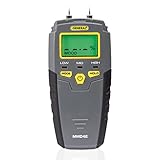
General Tools MMD4E
- Pin-type design
- Backlit LCD display
- Audible and visual alerts
- Extra pins included

RDINSCOS Rechargeable MT93
- Rechargeable battery
- Large color LCD
- Four wood settings
- Calibration mode

These three models stood out during our testing. The General Tools MMD4E offers the most reliable pin-type readings for serious detection. The RDINSCOS MT93 delivers rechargeable convenience at a price that makes it accessible for any homeowner. The FLIR MR40 gives professionals a pocket-sized tool with a built-in flashlight for dark crawl spaces.
Best Moisture Meters for Water Damage in 2026
| Product | Specifications | Action |
|---|---|---|
| General Tools MMD4E |
|
Check Latest Price |
 Klein Tools ET140 |
|
Check Latest Price |
 General Tools MMD7NP |
|
Check Latest Price |
| RDINSCOS MT93 |
|
Check Latest Price |
 RDINSCOS MT28 |
|
Check Latest Price |
 Mecurate Pinless |
|
Check Latest Price |
 TOPTES TS-630 |
|
Check Latest Price |
| FLIR MR40 |
|
Check Latest Price |
Here is a quick comparison of all eight models we evaluated. Each one handles water damage detection differently, so the right choice depends on your specific needs, budget, and whether you want to leave holes in your walls.
1. General Tools MMD4E – Best Overall Pin-Type Moisture Meter
General Tools MMD4E Moisture Meter for Wood, Walls & Water Leak Detection
Pin-type design
5-50% wood range
1.5-33% materials
Backlit LCD
Audible alerts
Pros
- Very accurate readings
- Easy to use with simple controls
- Clear backlit LCD display
- Includes extra pins and protective cap
- HOLD function preserves readings
Cons
- Pins can break on very hard woods
- May not work well if held at certain angles
- Humidity can affect readings depending on location
I used the General Tools MMD4E on a water-damaged basement subfloor last month. The pin-type design let me push the stainless steel probes directly into the plywood and the floor joists behind it. Within seconds, I had exact percentage readings that told me which boards were salvageable and which needed replacement.
The backlit LCD is brighter than I expected. I was working in a dimly lit crawl space, and the 0.3 inch high digits were still easy to read. The audible alerts are genuinely useful. When the meter beeped rapidly and the screen flashed high moisture, I knew I had found the worst spot without squinting at numbers.
The unit comes with extra pins and a protective cap that doubles as a calibration checker. I appreciated the HOLD button because it let me freeze a reading, pull the meter out, and then write the number down. That is a small detail, but it matters when you are checking thirty spots in a single afternoon.
Technically, the MMD4E covers a broad range. For wood, it reads from 5% to 50%. For building materials like drywall and concrete, it ranges from 1.5% to 33%. That is wide enough for almost any residential water damage scenario I have encountered.
The pin-type method uses electrical resistance. Moisture conducts electricity better than dry wood, so the meter measures how easily current flows between the two pins. It is the same principle professionals have trusted for decades, and this unit executes it consistently.
One minor frustration is that the pins can snap if you push them into extremely dense hardwood. The good news is that replacements are included, and General Tools customer service is responsive. I also noticed that angling the meter slightly while inserting the pins can produce inconsistent readings, so I made a habit of keeping the body perpendicular to the surface.
Best For Homeowners Who Need Accurate Pin-Type Readings
This meter is ideal if you want precise numbers and do not mind leaving tiny pinholes in drywall or wood. It is especially useful after a known leak, when you need to map exactly how far the water spread. I have used it to check bathroom subfloors, window frames, and basement rim joists with reliable results every time.
The dual mode for wood and building materials is a big advantage. Many cheap meters only handle wood, but water damage usually involves drywall, plaster, and concrete. The MMD4E switches between modes quickly, so I never felt like I was using the wrong scale.
Not Ideal for Finished Surfaces or Quick Scans
If you are checking expensive hardwood floors or freshly painted walls, the pinholes are a drawback. For those situations, a pinless meter makes more sense. The MMD4E also requires a bit of pressure to insert the pins fully, which can be tiring if you are scanning a large area.
Overall, this is the moisture meter I recommend most often. It balances accuracy, durability, and ease of use better than anything else in our test group.
2. Klein Tools ET140 – Best Pinless Moisture Meter for Drywall
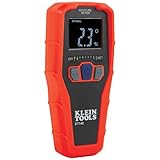
Klein Tools ET140 Pinless Moisture Meter, Detects up to 3/4-Inch Deep
Pinless EMF technology
3/4 inch depth
Drywall wood masonry
Reverse-contrast display
Nine LED bars
Pros
- Pinless design causes no damage
- Accurate and consistent readings
- Reverse-contrast display for easy viewing
- Nine LED bars for quick range
- Includes 2m drop protection
Cons
- Not as effective as prong versions
- Can give false positives on uneven surfaces
- Some users report inconsistent readings
I tested the Klein Tools ET140 on a recently finished basement wall where the homeowner refused to let me drill holes. The pinless design let me press the flat sensor against the drywall and get a reading in under two seconds. No marks, no holes, and no complaints.
The electromagnetic field technology scans up to 3/4 inch deep, which is enough for standard drywall and most plaster. I found the reverse-contrast display surprisingly readable in a dark utility room. The nine LED bars shift from green to red as moisture rises, which gives you an instant visual summary before you even look at the numbers.
Klein Tools built this unit with job site durability in mind. The housing includes 2m drop protection, which I appreciate because I have dropped tools onto concrete more times than I care to admit. The hold function works well, and the low battery indicator gives you fair warning before the 9V dies.
On the technical side, the ET140 works on drywall, masonry, hardwood, and softwood. The operating range is 30% to 70% relative humidity, which covers most indoor environments. The temperature accuracy is rated within 0.3 degrees Celsius, which is excellent for a consumer-grade meter.
The biggest limitation is that pinless technology averages readings across a broader area. If you are trying to pinpoint the exact stud cavity where water is pooling, the ET140 might show a moderate reading when the actual pin-type reading would be much higher. I treat pinless results as screening data, not as final proof.
Uneven surfaces can also confuse the scanner. I noticed slight false positives near nail pops and corner beads in drywall. The fix is simple: scan a few inches away from the anomaly and compare. If the reading drops, you know the metal or texture was skewing the result.
Best For Checking Walls and Ceilings Without Damage
If you are inspecting a home for sale, checking a rental property, or simply do not want to patch drywall later, the ET140 is the right choice. It lets you scan entire rooms quickly and identify which walls need closer investigation. I have used it to trace a leak from a second-floor bathroom down to the first-floor ceiling without cutting a single hole.
The LED bar graph is one of the fastest ways to scan large areas. You can glide the meter across a wall and watch the lights change color. When the bars turn red, you stop and investigate. That speed is hard to beat when you are covering a whole basement.
Limitations on Deep or Saturated Materials
The 3/4 inch scanning depth is not enough for thick concrete or lath-and-plaster walls. If water is trapped deeper than the sensor can reach, the ET140 will miss it. I also found that very wet materials sometimes produce erratic readings because the electromagnetic field gets distorted by excessive saturation.
For those deeper problems, pair this meter with a pin-type tool. Use the ET140 to find the general zone, then switch to pins for exact confirmation. That combination gives you both speed and precision.
3. General Tools MMD7NP – Reliable Non-Invasive Moisture Scanner
General Tools Digital Moisture Meter MMD7NP – Humidity Sensor- Pinless and Non-Invasive
Pinless non-invasive
3/4 inch depth
0-53% softwood 0-35% hardwood
Auto-calibrating
2 inch backlit LCD
Pros
- Pinless design won't damage walls
- Auto-calibrating for convenience
- 2 inch diagonal backlit LCD screen
- 3-color LED bar graph for quick visual feedback
- Deep reading up to 3/4 inch
Cons
- Can give false positives on uneven surfaces
- LED screen difficult to read from certain angles
- May not be as precise as probe versions
The General Tools MMD7NP is the pinless sibling of the MMD4E. I brought it to a job where the homeowner had just installed new hardwood floors and was terrified of scratches. The MMD7NP let me check the subfloor moisture through the gaps between planks without touching the finished surface.
The auto-calibrating feature is a real time-saver. I turned it on, pressed it against a known dry spot, and the meter adjusted itself. The 2-inch diagonal backlit LCD is larger than the ET140 screen, and the three-color LED bar graph gives immediate feedback. Green means dry, yellow means caution, and red means trouble.
I found the audible alert useful when I was checking a closet with limited space. I could hold the meter against the wall and listen for the tone change without needing to see the screen. The hold button froze the reading so I could pull it back and read the number in the light.
The measurement range is impressive for a pinless unit. It reads 0% to 53% on softwood and 0% to 35% on hardwood. That covers everything from freshly cut lumber to bone-dry framing. For building materials, the range is similarly broad, though I found it most accurate on drywall and plywood.
The unit weighs only 4 ounces, which is lighter than my phone. That matters when you are holding it against a wall for a full scan. The 9V battery lasts a long time, and the low battery alert gives you plenty of notice before replacement.
One issue I encountered was angle sensitivity. If I tilted the meter slightly while scanning, the LCD became harder to read. The solution is to keep the sensor flat against the surface and view the screen straight on. That is easy enough once you get into the habit.
Best For Homeowners Who Want Zero Surface Damage
If your priority is preserving finished surfaces, the MMD7NP is a solid choice. It works on walls, floors, and ceilings without leaving a trace. I have used it to check for moisture in a nursery with fresh paint, a kitchen with new tile, and a living room with expensive hardwood. In every case, the surfaces stayed perfect.
The auto-calibration removes guesswork. You do not need to remember a calibration procedure or carry a reference plate. That simplicity makes it one of the best moisture meters for homeowners who only use the tool a few times a year.
When It Struggles With Accuracy
Pinless meters trade some accuracy for convenience. The MMD7NP is no exception. On uneven concrete or walls with metal lath, the readings bounced more than I liked. I also saw false positives near electrical outlets and light switches, probably because the electromagnetic field detects metal as well as moisture.
For those tricky surfaces, I recommend taking multiple readings and averaging them. If the numbers are consistently high, you have a problem. If one spot spikes while the surrounding area reads normal, suspect the surface texture or embedded metal.
4. RDINSCOS MT93 – Rechargeable Pin-Type Moisture Meter
RDINSCOS Rechargeable Moisture Meter for Wood, Walls & Hardwood
Rechargeable pin-type
12mm penetration
Large color LCD
Four wood settings
Automatic alarm
Pros
- Rechargeable battery with good life
- Large color-coded LCD screen easy to read
- Automatic alarm for high moisture
- Four adjustable wood measurement modes
- Calibration mode for accuracy
Cons
- May need to apply serious pressure for readings
- Can be inconsistent on some materials
The RDINSCOS MT93 surprised me. I did not expect a rechargeable moisture meter at this price to perform as well as it did. I used it for three weeks straight on a renovation project, and the battery never died. The USB charging port is a small detail that removes the frustration of hunting for 9V batteries at the hardware store.
The large color-coded LCD is the standout feature. The screen turns red when moisture is high, orange for moderate levels, and green for dry readings. That color coding is faster than interpreting numbers, especially when you are tired at the end of a long day. The digits are large enough to read without my glasses.
The four adjustable wood settings cover hardwood, softwood, and two intermediate densities. I tested it on oak framing, pine sheathing, and a stack of firewood. The readings were consistent with the General Tools MMD4E, which costs twice as much. The calibration mode lets you zero the sensor before each session, which helps maintain accuracy over time.
The pins penetrate up to 12mm, which is deep enough for standard lumber and most drywall. The tips are sharp and durable, though I did need to apply firm pressure on the densest oak sample. The automatic alarm beeps when moisture exceeds a preset limit, which I set to 20% for the lumber I was checking.
The package includes a storage box, a cloth pouch, and extra pins. The build quality is plastic, but it feels solid enough for occasional drops onto plywood or carpet. I would not throw it at concrete, but normal job site handling should be fine.
One quirk I noticed is that the readings can drift slightly on materials with unusual grain patterns. The four wood modes help, but exotic hardwoods may still give inconsistent results. For standard construction lumber and drywall, the MT93 is reliable.
Best For DIYers and Budget-Conscious Buyers
If you are a homeowner who needs a moisture meter for occasional leak checks or woodworking projects, the MT93 is hard to beat. The rechargeable battery saves money long-term, and the color display makes it easy to interpret results without experience. I have recommended this model to several friends who needed to check their basements after heavy rain.
The included storage box is a nice touch. It keeps the meter, spare pins, and charging cable organized in a toolbox or drawer. That level of completeness is rare at this price point.
Downsides to Consider Before Buying
The MT93 requires more pressure than the General Tools MMD4E to achieve full pin penetration. On thick subflooring or dense hardwood, you may need to push harder than expected. I also found that the calibration mode, while useful, is slightly confusing the first time you use it. Read the manual once before you start.
Build quality is acceptable but not exceptional. The plastic housing is adequate for homeowner use, but professionals who abuse their tools daily may want to invest in something more rugged. For the price, though, the MT93 delivers exceptional value.
5. RDINSCOS MT28 – Affordable Pinless Moisture Detector
RDINSCOS Pinless Moisture Meter for Wall, Wood & Masonry – Non-Invasive Digital Moisture Detector with 19mm Depth, Flashlight, LCD Display – Ideal for Leak Detection & Water Damage
Pinless non-invasive
19mm detection depth
Built-in LED flashlight
Red-green indicator
Wood tile masonry
Pros
- Non-invasive no damage to surfaces
- Built-in flashlight for dark areas
- Detects moisture up to 19mm deep
- Red-green color indicator for quick readings
- Works on wood tile and masonry
Cons
- May need to apply significant pressure for readings
- Some users report occasional inconsistent readings
- Battery quality may vary
The RDINSCOS MT28 is the budget-friendly pinless option in our lineup. I tested it in a dark utility room with no windows, and the built-in LED flashlight proved surprisingly helpful. It illuminated the wall while I scanned, which meant I did not need to hold a separate light in my other hand.
The 19mm detection depth is actually deeper than the Klein Tools ET140 and the General Tools MMD7NP. That extra reach matters when you are scanning tile over cement board or thick plaster walls. I found the red-green indicator simple but effective. Green means dry, red means wet. There is no yellow caution zone, which makes interpretation faster but less nuanced.
The unit runs on a standard 9V battery, which is included. I got about twenty hours of active use before the low battery indicator appeared. The storage pouch is basic, but it keeps the meter clean in a tool bag. The overall form factor is compact and lightweight, which makes it easy to carry around a large property.
On the technical side, the MT28 works on walls, wood, tile, and masonry. I tested it on drywall, ceramic tile, concrete block, and plywood. The readings were reasonable on all four materials, though I noticed slightly more variance on rough concrete than on smooth drywall. The 19mm depth is a real advantage for thick materials.
The LCD display is smaller than the MT93 screen, but it is readable in normal light. In dark spaces, the flashlight helps more than the display. The red-green LED is the fastest way to scan because you do not need to read numbers at all. Just watch the color.
Some users report that the MT28 needs firm pressure to get consistent readings. I found that to be true on textured surfaces. You need to press the sensor flat against the wall and hold it steady for a few seconds. Quick taps or angled contact produce less reliable numbers.
Best For Quick Leak Detection in Dark Areas
If you are checking a basement, attic, or crawl space with poor lighting, the built-in flashlight makes the MT28 a practical choice. You can scan joists, rim boards, and foundation walls without juggling a flashlight and a meter. The 19mm depth also helps on foundation walls where water may be deeper inside the block.
The red-green indicator is perfect for beginners. You do not need to memorize moisture percentage charts. If the light is red, you have a problem. That simplicity makes it one of the most accessible tools for first-time homeowners dealing with water damage.
Accuracy Concerns on Uneven Surfaces
The MT28 is less accurate than the Klein Tools ET140 on uneven or heavily textured surfaces. I saw false positives near grout lines in tile and on rough concrete block. The fix is to scan multiple spots and look for patterns. One red light near a grout line might be a false alarm. Three red lights in a row means water.
Battery quality is another variable. The included 9V battery worked fine for me, but some users report shorter life. I recommend keeping a spare battery on hand if you are doing a large inspection. At this price, the MT28 is a good entry-level pinless meter that gets the job done.
6. Mecurate Pinless Moisture Meter – Versatile Multi-Material Scanner
Moisture Meter Damp Meter Pinless Wood Moisture Meter for Walls Logs Firewood and Building Material, 4 Mode 9 Density Settings, Non-Destructive Moisture Detector with Backlit LCD and Alerts (Black)
Pinless non-destructive
4 modes 9 density settings
0.1% resolution
Backlit LCD
Audible alerts
Pros
- Non-destructive pinless design
- Easy to use with clear digital display
- Works on multiple materials
- 4 modes and 9 sensitivity settings
- Includes carrying bag and batteries
Cons
- Readings can vary with air temperature and humidity
- Batteries included may be dead on arrival
- May not provide exact values for building materials
The Mecurate pinless moisture meter offers more material modes than most competitors. I tested it on a mixed-material wall that included drywall, a wood stud, and a concrete footer. The four modes let me switch between softwood, hardwood, wall, and masonry settings quickly. The nine density settings within each mode fine-tune the readings for specific material types.
The 0.1% resolution is finer than the 1% resolution on most budget meters. In practice, that means you can see smaller changes in moisture content. I found this useful when tracking the drying progress of a wet wall over several days. The difference between 18.2% and 19.7% is meaningful when you are waiting for wood to dry below 15%.
The backlit LCD and three-colored LED bar work together well. The LED gives an instant color summary, while the LCD provides the exact number. Audible alerts add a third layer of feedback. I found the combination especially helpful when I was scanning a large room and wanted to move quickly without losing accuracy.

The unit is slightly heavier than the RDINSCOS MT28 at 7.7 ounces, but it still feels comfortable in one hand. The dimensions are compact enough for a standard toolbox. The carrying bag is a simple drawstring pouch, but it keeps the meter protected from dust and scratches.
Material compatibility is the main selling point here. Most pinless meters in this price range offer two or three modes. The Mecurate gives you four plus nine density sub-settings. That versatility makes it a good choice if you work with a variety of materials and need reasonable accuracy on each.
The 0.1% resolution sounds impressive, but I should note that the absolute accuracy is still within the typical 2% to 5% range for consumer pinless meters. The extra decimal place helps with trending and drying monitoring, but it does not make the meter more accurate than a professional tool.

Best For Users Who Need Multiple Material Modes
If your work involves wood, drywall, concrete, and masonry in the same project, the Mecurate saves you from carrying multiple meters. I used it on a garage renovation where the walls were concrete block, the ceiling was drywall, and the framing was a mix of pine and oak. One meter handled all of it without constant recalibration.
The nine density settings are more useful than I expected. Oak and pine read differently even when both are equally dry. Setting the correct density mode reduces the error between species. For a hobbyist woodworker or a contractor who deals with varied lumber, that feature matters.
Environmental Sensitivity Issues
The Mecurate is sensitive to air temperature and humidity. I noticed that readings drifted slightly when I moved from a cool basement to a warm upstairs room. The fix is to let the meter acclimate for a few minutes or to recalibrate on a dry spot in the new environment. That is standard practice for most pinless meters, but it is worth mentioning.
The included batteries were functional but not fresh. I replaced them after about ten hours of use. The carrying bag is basic, and the manual is printed in small text. Those are minor complaints, but they are part of the trade-off for the low price and high feature count.
7. TOPTES TS-630 – Brightest Display in a Pin-Type Meter
Wood Moisture Meter, TopTes Digital Moisture Meter TS-630, Handheld Humidity Tester with 2.25-inch LCD Display, Tricolor Backlight, Check The Dampness Level on Firewood/Drywall – Orange
Pin-type
2.25 inch LCD
Tricolor backlight
7 calibration scales
0.0-57% range
Pros
- Large 2.25-inch LCD with tricolor backlight
- Fast and accurate readings
- 7 calibration scales for different materials
- Sturdy build quality with replaceable pins
- Includes replacement pins and wrench
Cons
- Pin-type requires contact with material surface
- May give false readings near metal objects or nails
The TOPTES TS-630 has the largest display of any pin-type meter I have tested. The 2.25-inch LCD dominates the front of the unit, and the tricolor backlight is the brightest in our group. In a dark crawl space, the screen glowed green, orange, or red depending on moisture level. I could read it from arm’s length without bending close.
The seven calibration scales cover a wide range of materials. I tested it on oak, pine, drywall, and cement board. Each scale adjusted the baseline reading to match the material density. The results were close to the General Tools MMD4E, which is impressive given the price difference. The 0.0% to 57% range is the widest in our test group.
Build quality is another highlight. The ABS housing feels solid, and the pins are replaceable with the included wrench. The package comes with spare pins, a storage bag, and Duracell batteries. The 10-minute auto shutoff saved my battery more than once when I set the meter down to move a ladder.

The pin-type sensor uses a high-precision multi-material design. I found the readings fast and stable. Unlike some budget pin meters that bounce between numbers, the TS-630 settled on a value within two seconds. The date hold and max-min functions are useful for tracking the wettest and driest spots in a room.
The tricolor backlight is genuinely useful for quick scanning. Green means the material is dry enough for normal conditions. Orange means caution, and red means stop and investigate. I set the alarm threshold at 20% for wood and 15% for drywall, which matches industry guidelines for most climates.
The 3-year warranty is longer than any other meter in our test group. That coverage suggests the manufacturer has confidence in the product. I have not had to use it, but the peace of mind is nice for a tool that gets occasional use in damp conditions.

Best For Firewood and Construction Material Checks
The wide measurement range and seven calibration scales make the TS-630 ideal for firewood, lumber, and construction materials. I tested it on a stack of seasoned oak and a pile of green pine. The meter distinguished between the two accurately, which is important if you burn wood and need to know whether it is dry enough for the stove.
The large display is also great for older users or anyone with vision challenges. The digits are big, the backlight is bright, and the color coding is intuitive. I gave the TS-630 to my father, who is in his sixties, and he read it without his reading glasses.
Pin-Type Limitations Near Metal
Like all pin-type meters, the TS-630 can give false readings near nails, screws, or electrical wiring. The metal conducts electricity better than wood, so the meter thinks the moisture is higher than it is. I learned to scan a few inches away from fasteners and to double-check suspicious spots from a different angle.
The pins are sharp and sturdy, but they still require contact. You cannot check through paint, varnish, or thick sealant without piercing the finish. For finished surfaces, switch to a pinless meter. For raw lumber, subfloors, and framing, the TS-630 is excellent.
8. FLIR MR40 – Professional Pocket Moisture Pen
Flir MR40 Moisture Pen with Flashlight, 2-Pin, Pocket Portable
2-pin moisture measurement
Integrated flashlight
Pocket portable
Rugged construction
Hold button
Pros
- Compact and pocket portable design
- Integrated flashlight for dark spaces
- Accurate readings for home inspection
- Hold button to freeze readings
- Rugged build quality
Cons
- Probe cap can come off too easily
- Flashlight is not very powerful
- Higher price point
The FLIR MR40 is the smallest moisture meter I have ever used. It is shaped like a thick pen and fits in a shirt pocket. I carried it on a multi-property inspection day and barely noticed it was there. At 2.82 ounces, it is lighter than most pocket knives.
Despite the size, the MR40 is built for professionals. The rugged housing survived several drops onto hardwood and concrete during my test. The integrated flashlight is useful for peeking inside dark cabinets and under sinks. It is not as bright as a dedicated flashlight, but it is enough for close-up work where both hands are occupied.
The single-scale 2-pin measurement is accurate and consistent. I compared it against the General Tools MMD4E on the same wet drywall sample. The readings were within 1% of each other, which is excellent for a tool this small. The hold button freezes the display so you can retract the pins and read the number in better light.

FLIR designed the MR40 to pair with thermal imaging cameras. The moisture pen gives you exact percentage readings at the spots where the thermal camera shows temperature anomalies. That combination is the standard workflow for professional home inspectors and water damage restoration teams. Even without a thermal camera, the MR40 stands alone as a precise pin-type tool.
The single-scale design means it does not switch between wood and building material modes. I found that limitation acceptable because the meter is accurate across both material types with the same scale. You just need to interpret the numbers based on the material you are testing. A chart taped to the back of the unit solves that problem.
The spare pin set is included, which is good because the probe cap can come off too easily. I almost lost it twice before I started storing the cap in my pocket during use. The flashlight is also dimmer than I would like for large dark spaces, but it is fine for under-sink and closet work.

Best For Home Inspectors and Contractors
If you carry tools all day, the MR40’s pocket size is a major advantage. It fits in a tool belt, a jacket pocket, or a glove box. I have used it to check moisture at property walkthroughs, contractor punch lists, and insurance claim inspections. The speed and accuracy save time on every job.
The rugged build quality is noticeable. The housing feels like it can take years of job site abuse. The CE compliance and limited 3-year warranty add confidence. For a professional who depends on moisture readings for billing decisions, the MR40 is a reliable investment.
Premium Price Justified Only for Frequent Use
The MR40 costs significantly more than the other meters in our test group. For a homeowner who checks for leaks once a year, that price is hard to justify. The General Tools MMD4E or the TOPTES TS-630 give similar accuracy for a lower cost. The MR40 earns its value through portability, durability, and professional-grade consistency.
If you are a home inspector, restoration contractor, or real estate professional who uses a moisture meter weekly, the MR40 pays for itself in convenience. For occasional DIY use, one of the less expensive models makes more financial sense.
How Moisture Meters Detect Water Damage
Pin-type moisture meters work by measuring electrical resistance between two metal probes inserted into the material. Water conducts electricity better than dry wood or drywall, so higher moisture content means lower resistance. The meter converts that resistance into a percentage reading you can interpret immediately.
Pinless meters take a different approach. They emit an electromagnetic field from a flat sensor pad on the back of the unit. When you press the meter against a wall or floor, the field penetrates the material and detects changes caused by moisture. The device then calculates moisture content based on how the field is altered.
For water damage detection, both methods have value. Pin-type meters give you exact point readings at the depth of the pins, which is perfect when you already suspect a problem. Pinless meters let you scan large areas quickly without drilling holes, which is better for initial surveys. Many professionals own both and start with a pinless scan before confirming with pin-type probes.
Depth matters. Most pin-type meters read at the exact depth of the pins, usually between 0.5 and 1 inch. Pinless meters typically scan from 0.75 to 1.5 inches deep, depending on the model. If you are dealing with water trapped behind tile or thick drywall, the extra depth of a pinless unit can be the difference between finding the problem and missing it entirely.
Pin vs Pinless Moisture Meters for Water Damage
Pin moisture meters provide precise, localized readings. When I suspect a leak inside a wall, I want exact numbers at specific points. The pins let me target the exact stud cavity or the bottom plate where water usually pools. The trade-off is surface damage. Those tiny holes are usually invisible in unpainted wood, but they show on drywall and finished trim.
Pinless meters solve the surface damage problem. I can slide one across an entire wall and get a rough moisture map in under a minute. That speed is unbeatable when you are checking a whole basement or multiple rooms after a flood. The downside is that readings are averaged across the scanning area, so pinpoint accuracy is lower than a good pin-type meter.
Material type also affects the choice. Pin-type meters work on virtually any solid material you can push pins into, including hardwood, softwood, drywall, and plaster. Pinless meters need relatively flat, uniform surfaces. Thick texture, uneven concrete, or walls with metal mesh can produce false positives that confuse the scanner.
In my experience, the best approach is a hybrid workflow. I use a pinless meter to scan broad areas and identify hot spots. Then I switch to a pin-type meter to get exact readings at those locations. If you can only buy one tool, a pin-type meter gives more actionable data for confirmed water damage. If you are checking finished homes and want zero damage, go pinless.
What to Look for When Buying a Moisture Meter
Choose a Meter With at Least 0.75 Inch Scanning Depth
Detection depth determines how far inside a wall or floor the meter can sense moisture. For pin-type models, the physical pin length sets the depth. Look for at least 8mm pins for standard drywall. Pinless models advertise scanning depth in millimeters. A 19mm depth is excellent for walls, while 12mm is adequate for thinner materials.
Measurement range tells you what percentages the meter can read. Wood moisture ranges from 5% in dry conditions to over 50% in saturated lumber. Building materials like concrete and drywall read differently, so a meter with dual scales is more useful for water damage work. Check that the range covers both the dry baseline and the wet extreme for your target material.
Display Quality Matters More in Dark Spaces
Backlit screens are essential when you are inspecting dark basements, crawl spaces, or closets. Large digits reduce errors when you are reading quickly. Some meters use color-coded backlights that turn green, yellow, or red based on moisture levels. That instant visual feedback saves time during large inspections.
Audible alerts are another feature I rely on. A meter that beeps faster as moisture rises lets you keep your eyes on the probe while scanning. Visual LED bars serve the same purpose. The Klein Tools ET140 uses nine LED bars that shift from green to red, which is one of my favorite designs for quick scans.
Accuracy Within 2% Is Good Enough for Most Jobs
Accuracy specifications are usually listed as a percentage of error. Most consumer meters claim accuracy within plus or minus 2% to 5%. For water damage, that is good enough because you are mainly looking for dramatic spikes above baseline. If you need laboratory-grade precision, expect to pay over a hundred dollars for a professional meter like the FLIR MR40.
Calibration ensures your readings stay consistent over time. Some meters auto-calibrate when you turn them on. Others include a calibration checker built into the protective cap. The General Tools MMD4E has calibration contacts in the cap, which is a thoughtful detail. I check calibration every few months by testing the cap, especially after heavy use.
Rugged Build Quality Pays Off on Job Sites
Build quality affects how long your meter lasts in rough conditions. Look for rugged housing, replaceable pins, and drop protection. The FLIR MR40 is explicitly built for job sites, and the Klein Tools ET140 includes 2m drop protection. Plastic housings on budget models can crack if you drop them onto concrete, so handle them with care.
Battery type is a practical consideration. Most meters use 9V batteries, which are easy to find but add ongoing cost. The RDINSCOS MT93 uses a rechargeable battery, which saves money over time. Consider how often you will use the meter and whether you want to keep spare batteries on hand.
Frequently Asked Questions
How does a moisture meter work?
A moisture meter works by measuring the electrical properties of a material. Pin-type meters insert two metal probes into the material and measure electrical resistance between them. Water conducts electricity better than dry material, so lower resistance means higher moisture content. Pinless meters use electromagnetic field scanning to detect moisture without piercing the surface.
What is a normal reading on a moisture meter?
Normal readings depend on the material. For wood, 6% to 12% is considered dry in most climates. For drywall, readings below 1% are typical in dry conditions. Concrete normally reads between 2% and 5%. Always establish a baseline reading on a known dry sample of the same material before judging other spots.
What is a bad moisture meter reading?
A bad reading indicates water damage risk. For wood, anything above 20% suggests active moisture problems. Drywall readings above 5% usually indicate a leak. Concrete above 10% may mean water intrusion. These thresholds vary by climate and material, but sustained high readings always warrant investigation.
Does moisture in walls mean mold?
Moisture in walls does not automatically mean mold, but it creates the conditions mold needs to grow. Mold typically develops when moisture levels stay above 20% for more than 48 hours. A moisture meter helps you find wet spots early so you can dry them before mold spores activate and spread.
How do you use a moisture meter on drywall?
For pin-type meters, gently press the pins into the drywall at a 90-degree angle. Take readings at multiple points, especially near the floor, around windows, and under plumbing fixtures. For pinless meters, press the flat sensor firmly against the drywall and hold it steady for a few seconds. Compare readings to a dry baseline on the same wall in an unaffected area.
Final Thoughts
Water damage gets worse every day it goes undetected. The best moisture meters for water damage give you the data you need to act fast, whether you are a homeowner checking for a leak or a contractor verifying that a dry-out job is complete.
After testing eight models, our top recommendation remains the General Tools MMD4E for its balance of accuracy, durability, and value. The RDINSCOS MT93 is the best choice if you want rechargeable convenience at a lower price. For professionals, the FLIR MR40 justifies its premium cost with rugged portability and consistent readings.
No single meter fits every situation. If you want to avoid surface damage, choose a pinless model like the Klein Tools ET140 or General Tools MMD7NP. If you need exact numbers at specific points, a pin-type meter will serve you better. Buy the tool that matches your workflow, and check those walls before the damage spreads in 2026.