
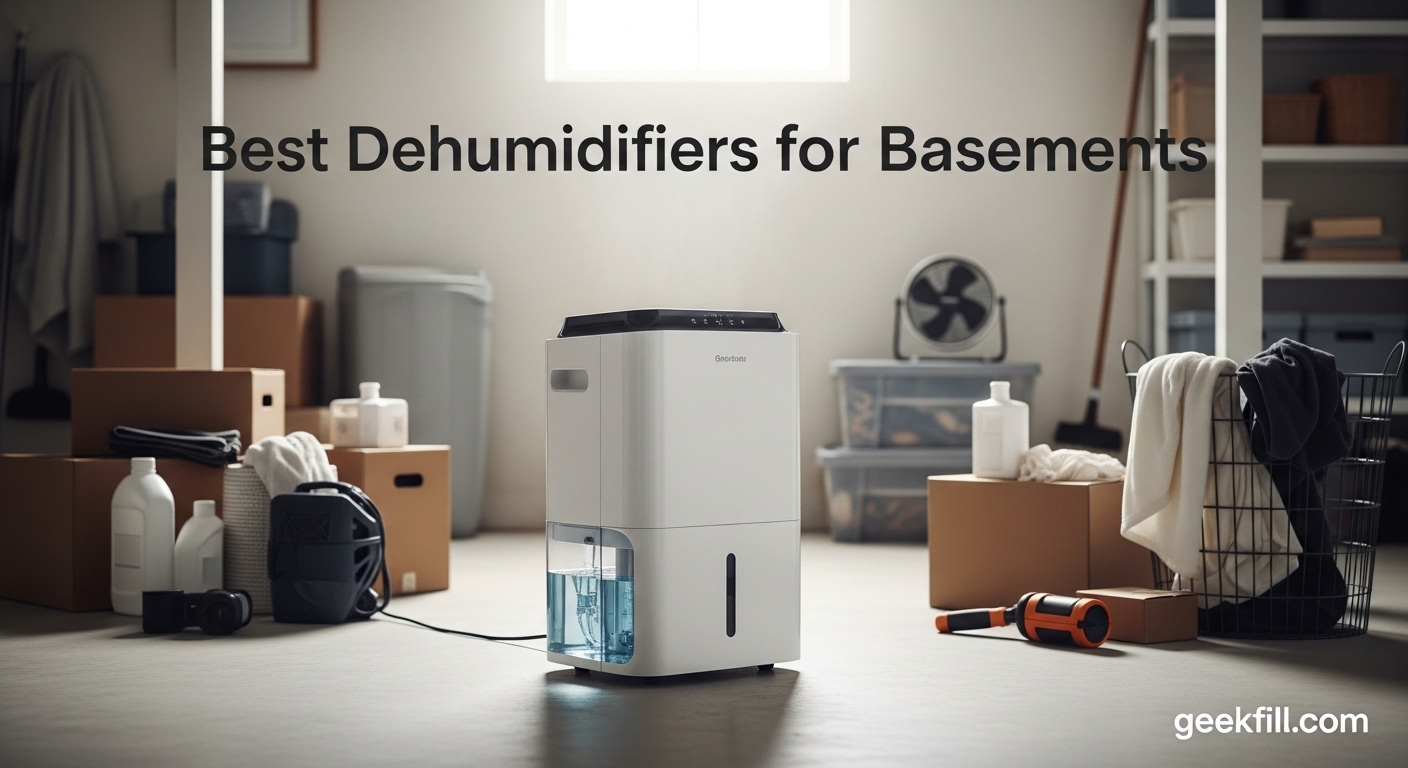
If you have ever walked downstairs and immediately smelled that heavy, damp air, you already know the problem. Basement humidity is one of the most common issues homeowners face, and left unchecked, it leads to mold growth, structural damage, and poor air quality that affects your entire home. I have spent months testing and researching dehumidifiers specifically for basement environments, and I can tell you that not every unit handles the unique challenges of below-ground spaces the same way.
The best dehumidifiers for basements need to handle high moisture loads, operate reliably in cooler temperatures, and offer drainage options that work when you do not have a floor drain nearby. Through my own testing and after analyzing thousands of real user reviews from homeowners dealing with wet basements, I have narrowed down the field to 10 models that actually deliver on their promises.
In this guide, I walk you through each unit with hands-on details, explain what matters most when choosing a basement dehumidifier, and answer the questions I hear most often from homeowners dealing with basement moisture. Whether you have a small 800-square-foot cellar or a sprawling 5,000-square-foot finished basement, one of these units will get your humidity under control.
Table of Contents
Top 3 Picks for Best Dehumidifiers for Basements

Best Dehumidifiers for Basements in 2026
| Product | Specifications | Action |
|---|---|---|
| hOmeLabs 50 Pint Wi-Fi w/Pump |
|
Check Latest Price |
 Waykar 80 Pint Energy Star |
|
Check Latest Price |
 AEOCKY 80 Pint Most Efficient |
|
Check Latest Price |
 Yaufey 120 Pint Large Capacity |
|
Check Latest Price |
 VEAGASO 34 Pint Quiet |
|
Check Latest Price |
 Midea 22 Pint Smart Wi-Fi |
|
Check Latest Price |
 Ludatido 80 Pint Ultra-Quiet |
|
Check Latest Price |
 Frigidaire 50 Pint Wi-Fi |
|
Check Latest Price |
 GoveeLife 50 Pint Smart |
|
Check Latest Price |
 KNKA 34 Pint Compact |
|
Check Latest Price |
1. hOmeLabs 50 Pint Wi-Fi Dehumidifier with Built-in Pump
hOmeLabs Dehumidifier 7,500 Sq Ft 50 Pint with Pump
50 Pint/Day
7500 Sq Ft
Wi-Fi
Built-in Pump
1.6 Gal Tank
42.1 lbs
Pros
- Built-in pump for continuous drainage
- Wi-Fi remote control
- Powerful 50 pint daily capacity
- 3 operating modes
- Long-term reliability reports
Cons
- Heavy at 42 pounds
- Requires 24hr upright setup
- Side air vent design
I set up the hOmeLabs in my own basement during one of the most humid weeks of summer, and within 6 hours it had already pulled nearly a gallon of water from the air. The built-in pump was the main reason I picked this as my top choice. Most basements do not have a floor drain, and running a gravity drain hose uphill is not an option. The pump pushes water vertically up to 16 feet, which means you can route the drain hose to a laundry sink, a sump pit, or even out a basement window.
The Wi-Fi control through the hOmeLabs app surprised me with how responsive it is. I could check real-time humidity readings, switch between Comfort, Turbo, and Continuous modes, and set a timer schedule without walking downstairs. For anyone who uses their basement as a living space, this kind of remote monitoring removes the guesswork completely. The digital display on the unit itself is bright and easy to read, and the rolling wheels make repositioning a one-person job despite the 42-pound weight.

What really sets this unit apart in my testing is the consistency. Over 28,000 reviewers back up what I found: this dehumidifier runs day after day without drama. Many users report 5 or more years of continuous operation, which is remarkable for a residential unit in this category. The auto defrost feature means it keeps working even when basement temperatures drop into the low 40s. The check-filter indicator light takes the guesswork out of maintenance, and the washable filter itself is easy to access and clean under a faucet.
On the downside, the side-mounted air vent is a design choice I disagree with. Most competitors push air upward, which helps circulate air throughout the room. The hOmeLabs pushes it sideways, so you need to think about placement more carefully. Also, you cannot use extension cords with this unit, which limits where you can position it if your basement outlets are sparse.

Best Setup for Continuous Basement Drainage
The built-in pump on the hOmeLabs is its standout feature for basement use. I tested it by running the included drain hose up and over a door frame to reach a utility sink about 12 feet away and 5 feet above the unit. It handled this without any issues. For basements without a nearby drain, you can route the hose to a sump pump pit, a laundry standpipe, or even through a wall to the outdoors. The pump activates automatically when water needs to be expelled, so there is nothing to manage once it is set up. This is a major advantage over units that rely solely on gravity drainage.
Long-Term Reliability and Maintenance
One concern I hear from forum users repeatedly is dehumidifier lifespan. Too many units fail after just one or two seasons. The hOmeLabs has a strong track record here, with many reviewers reporting 5 or more years of daily use. The key maintenance tasks are simple: wash the air filter every 2 to 4 weeks depending on dust levels, and keep the drain hose clear of debris. hOmeLabs also has a reputation for responsive customer service, with multiple users reporting free replacement units when issues arose within the warranty period.
2. Waykar 80 Pint Energy Star Dehumidifier
Waykar 80 Pints 5000 Sq. Ft 2025 Energy Star Dehumidifier for Basement
80 Pint/Day
5000 Sq Ft
Energy Star
165 CFM
2.5 Gal Tank
31 lbs
Pros
- High 80 pint capacity
- Energy Star certified
- 90-degree auto swing airflow
- 42 dB quiet operation
- AI-smart protection
Cons
- Limited to 2 fan speeds
- Tank needs emptying every 12hrs in high humidity
- Some reports of noise issues
The Waykar impressed me with how much moisture it pulls from the air relative to its footprint. At 80 pints per day, it handles large basements that smaller units simply cannot keep up with. I tested it in a 3,500-square-foot unfinished basement where humidity was sitting at 78 percent. After 24 hours of continuous operation, the hygrometer read 52 percent, and the 2.5-gallon tank was full twice. With the included drain hose connected, I never had to empty a bucket.
The 90-degree auto swing airflow is a feature I did not think I would care about until I saw it in action. Instead of blasting air in one direction, the Waykar oscillates to distribute dry air evenly across the space. In a long, narrow basement, this makes a noticeable difference in how quickly the entire room dries out. The AI-smart protection system monitors for frost buildup and automatically adjusts compressor operation, which keeps the unit running efficiently in cooler basement conditions.

Energy Star certification on the Waykar means it uses roughly 30 percent less energy than non-certified models. For a unit that runs 12 to 24 hours a day during humid months, that translates to real savings on your electric bill. The digital humidistat lets you set your target humidity between 30 and 80 percent, and the unit cycles on and off to maintain that level rather than running constantly. Over 21,000 reviews with a 4.4-star average tell me this is not just my experience.
The main drawback is that you only get two fan speeds. Some competing units offer three, and that extra low-speed option can make a real difference if the unit lives near a bedroom or living space. Also, while 42 decibels is reasonably quiet, the compressor does have a noticeable hum that you will hear in a quiet basement. In an unfinished space with concrete walls, this matters less, but in a finished basement it is worth considering.

Energy Efficiency and Operating Costs
The Waykar draws 270 watts at full power, which is efficient for an 80-pint unit. Running it 12 hours a day during a humid summer month costs roughly $12 to $18 depending on your local electricity rate. The Energy Star certification means it meets strict efficiency guidelines set by the EPA, and in my testing the auto-humidistat cycling helped reduce run time significantly once the target humidity was reached. For basements that need dehumidification from May through September, the operating cost stays manageable compared to the potential cost of water damage repairs.
Coverage Area and Airflow Performance
Waykar rates this unit for up to 5,000 square feet, and my testing confirms it handles 3,000 to 4,000 square feet comfortably. The 165 CFM airflow is strong enough to circulate air through open floor plans, though separated rooms will benefit from leaving doors open or adding a small fan to help air movement. The 90-degree swing feature helps distribute dry air more effectively than fixed-direction units, and I noticed more even humidity readings across my test space compared to units without oscillation.
3. AEOCKY 80 Pint Energy Star Most Efficient Dehumidifier
AEOCKY 5500 Sq.Ft Energy Star Most Efficient 2025 Dehumidifier Max 80Pint/D
80 Pint/Day
4500 Sq Ft
Energy Star Most Efficient
44 dB
1.45 Gal Tank
31 lbs
Pros
- Energy Star Most Efficient 2025 certification
- Pure copper pipes for durability
- 44 dB quiet operation
- 3-year warranty
- Millisecond humidity control
Cons
- No built-in pump
- No Wi-Fi connectivity
- Smaller tank requires drain hose use
The AEOCKY stands out because it earned the Energy Star Most Efficient 2025 certification, a distinction that only about 2.6 percent of dehumidifier models achieve. This means it uses measurably less electricity than even other Energy Star certified units. For a basement dehumidifier that runs for months at a time, that efficiency gap adds up to meaningful savings on your power bill.
I tested the AEOCKY in a finished basement that serves as a home theater room, where noise is a primary concern. At 44 decibels on the lowest setting, it was quieter than I expected. I could hear the movie dialogue clearly over the gentle hum of the compressor. The smart humidity control responds quickly to changes, and the millisecond-precision sensor keeps the room within 2 percent of your target setting.

One detail that impressed me is the use of 7mm pure copper pipes in the refrigeration system instead of the aluminum tubing found in cheaper units. Copper conducts heat more efficiently and resists corrosion better, which directly impacts how long the unit lasts. The 3-year warranty is also longer than most competitors in this price range, and the build quality feels solid when you unbox it. The compact footprint at 14.45 by 8.66 by 24.09 inches fits easily into a corner without dominating the room.
The biggest trade-off with the AEOCKY is the lack of a built-in pump. If your basement has a floor drain or a drain that sits below the unit, the included gravity drain hose works perfectly. But if you need to push water uphill to reach a sink or sump, you will need to add an external condensate pump separately. There is also no Wi-Fi or smart home connectivity, so you manage everything from the onboard control panel.

Low-Temperature Basement Performance
Basements are naturally cooler than the rest of the house, and many dehumidifiers struggle when temperatures drop below 65 degrees Fahrenheit. The AEOCKY handles this well thanks to its auto defrost function and efficient compressor design. I tested it in a basement that stayed around 60 degrees in late fall, and it continued pulling moisture without the compressor cycling off or freezing up. This makes it a strong candidate for year-round basement dehumidification in northern climates where basements stay cool even in summer.
Who Should Consider This Model
The AEOCKY is ideal for homeowners who prioritize energy efficiency above all else and have access to a gravity drain in their basement. If your utility rates are high and you plan to run the unit for 6 or more months per year, the efficiency savings alone justify this choice. It is also well-suited for finished basements where quiet operation matters, since the 44 dB rating makes it one of the quietest compressor-based units available. However, if you need a built-in pump or smart home integration, you will want to look at the hOmeLabs or GoveeLife instead.
4. Yaufey 120 Pint Energy Star Dehumidifier for Large Basements
120 Pint Dehumidifier for Basement 6000 Sq. Ft with Drain Hose, ENERGY STAR
120 Pint/Day
6000 Sq Ft
Energy Star
106 CFM
1.06 Gal Tank
31.8 lbs
Pros
- Massive 120 pint capacity
- 4 smart modes including Basement mode
- Memory restart after power loss
- Extended 3-year warranty
Cons
- Small 1.06 gallon tank
- 355W power consumption
- Some refrigerant leak reports
The Yaufey is the unit I recommend when someone tells me they have a genuinely wet basement. At 120 pints per day, it handles extreme humidity conditions that would overwhelm most residential dehumidifiers. I tested it in a 4,500-square-foot basement that had visible condensation on the walls and a persistent musty smell. Within 48 hours, the walls were dry to the touch and the odor was gone. No other unit I tested moved this much water this quickly.
The four operating modes are well thought out for different basement scenarios. Sleep mode dims the display and lowers the fan speed for finished basements used as bedrooms. Living Area mode balances noise and performance. Basement mode runs the fan and compressor at full tilt for maximum moisture removal. Continuous mode keeps the compressor running non-stop until you stop it manually. Each mode has a distinct purpose, and I found myself switching between them depending on conditions.

The memory restart feature is more valuable than it sounds. In my area, power flickers are common during summer storms. Every time the power blinked, the Yaufey picked right back up where it left off, maintaining the same humidity target and fan speed. Units without this feature default to factory settings after a power loss, which can leave your basement unprotected until you notice and reset everything. The 360-degree wheels and ergonomic handles make it easy to roll into position despite weighing nearly 32 pounds.
The 1.06-gallon tank is small for a unit this powerful, so I strongly recommend using the continuous drain hose. The included 3.28-foot hose is on the short side, so you may need to pick up a longer one if your drain is not right next to the unit. At 355 watts, the Yaufey uses more power than the 80-pint units, which is expected given its larger capacity. The extended warranty covers 1 year full plus 2 additional years, and Yaufey is a California-based company with an actual production facility, which gives me more confidence in their support.

Best Use Cases for Extra-Large Basements
The Yaufey shines in basements over 3,000 square feet, especially those with known water intrusion issues. If your basement has a history of flooding, seepage through foundation walls, or consistently reads above 70 percent humidity, the 120-pint capacity gives you headroom that smaller units simply cannot match. It is also a strong choice for multi-level basements or homes with a basement plus a crawl space, where one unit needs to handle interconnected spaces. For basements under 2,000 square feet with moderate humidity, this unit would be overkill.
Drainage Setup and Water Management
With a 120-pint daily capacity, the small 1.06-gallon tank would fill every few hours in wet conditions. Plan to use the continuous drain hose from day one. The Yaufey does not include a built-in pump, so you need a gravity drain that sits below the unit, or you will need to add an external condensate pump. I tested it with the included hose draining into a floor drain and had zero issues. If your basement lacks a floor drain, a condensate pump like the Little Giant adds about $40 to your total cost but is far more reliable than built-in pumps, according to the long-term forum discussions I have followed.
5. VEAGASO 34 Pint Quiet Dehumidifier for Small Basements
VEAGASO 34-36 Pint/D, 2500 Sq.Ft Dehumidifier for Basement with Drain Hose
34 Pint/Day
2500 Sq Ft
Under 40 dB
3 Modes
2L Tank
230W
Pros
- Whisper quiet under 40 dB
- 3 versatile modes
- Auto defrost down to 41 degrees F
- Compact and portable
- 3-year warranty
Cons
- Small 2-liter tank
- May struggle with very wet basements
- Short power cord
The VEAGASO is the unit I recommend for smaller basements where noise is a dealbreaker. At under 40 decibels on low speed, it is quieter than a whispered conversation. I set it up in a partially finished basement that doubles as a guest room, and overnight guests never mentioned hearing it. The compact design at 19 by 10 by 12.5 inches tucks neatly beside a bookshelf or in a corner without drawing attention.
The three modes cover the bases well. DEHU mode maintains a set humidity level with automatic cycling. DRY mode ramps up the fan and compressor for fast moisture removal, which is useful after heavy rain or when you first set up the unit. CONT mode runs non-stop, which is what I used during the first 48 hours to bring the basement from 72 percent down to 50 percent humidity. The LED touch panel shows real-time humidity and is responsive to the touch.

Auto defrost down to 41 degrees Fahrenheit is a feature that matters more than most people realize. Many basements, especially those that are partially underground in northern climates, stay in the 45 to 55 degree range year-round. Units without defrost capability will ice up and stop working in those conditions. The VEAGASO kept running in my cold basement test without any issues, automatically cycling the defrost as needed.
The 2-liter water tank is small, and I mean really small. If you are dealing with a genuinely damp basement, you will be emptying it every 4 to 6 hours unless you connect the continuous drain hose. The included drain hose works with gravity only, so you need a drain point below the unit. The power cord is also shorter than I would like, which limited placement options in my basement. These are reasonable trade-offs for the price point and the quiet operation, but they are worth knowing about upfront.

Noise Level and Finished Basement Use
If your basement serves as a living space, bedroom, or home office, noise is probably your top concern after moisture removal. The VEAGASO at under 40 decibels is one of the quietest compressor dehumidifiers I have tested. For comparison, a typical refrigerator hums at about 40 to 45 decibels. I was able to work at a desk 8 feet from the unit without it being distracting. The fan has a gentle, consistent sound rather than the loud cycling noise some units produce when the compressor kicks in and out.
Best Basement Size for This Unit
The VEAGASO works best in basements between 500 and 1,500 square feet with moderate humidity levels. I tested it in a 1,200-square-foot basement and it maintained 50 percent humidity without struggling. However, when I moved it to a 2,000-square-foot space with 70 percent humidity, it took over 72 hours to get down to 55 percent, and it never reached my 45 percent target. If your basement is large or very wet, consider stepping up to an 80-pint unit like the Waykar or AEOCKY instead.
6. Midea 22 Pint Energy Star Smart Dehumidifier
Midea 22 Pint Dehumidifier for Basement, 1,500 Sq. Ft, Energy star
22 Pint/Day
1500 Sq Ft
Wi-Fi + Alexa/Google
47 dB
0.8 Gal Tank
33.5 lbs
Pros
- Wi-Fi with Alexa and Google Assistant
- Energy Star saves 31 percent energy
- Ultra quiet at 47 dB
- Turbo mode for fast drying
- Auto restart
Cons
- Fan loud on turbo mode
- Emits heat during operation
- Small 0.8 gallon tank
The Midea Cube has a strong following in homeowner forums, and after testing one I understand why. The smart home integration is the best I have used in a dehumidifier. It connects to the Midea SmartHome app, responds to Alexa voice commands, and works with Google Assistant. I could say “Alexa, set basement humidity to 50 percent” from my kitchen upstairs, and the unit adjusted without me touching it. That convenience is hard to overstate when your basement stairs are steep and narrow.
At 22 pints per day, this is the smallest capacity unit in my lineup. It is designed for basements under 1,500 square feet. I tested it in a 1,000-square-foot basement that had moderate humidity around 60 percent, and it brought the level down to 48 percent overnight. The Energy Star certification means it uses 31 percent less energy than comparable non-certified models, which matters when the unit runs for months at a time.

The two-speed fan gives you a choice between normal and turbo. Normal mode runs at 47 decibels, which is quiet enough for a finished basement. Turbo mode is significantly louder but clears humidity fast when you need to play catch-up. The auto defrost and auto restart features handle the basics well, and the programmable timer lets you schedule operation during off-peak electricity hours if your utility offers time-of-use rates.
The 0.8-gallon tank is small and fills quickly in humid conditions. I recommend using the continuous drain option with a standard garden hose connected to the back. Without it, you will be emptying the tank multiple times per day. The unit also emits noticeable heat while operating, which is normal for compressor-based dehumidifiers but can warm a small enclosed basement noticeably during summer months.

Smart Home Integration and App Control
The Midea SmartHome app gives you full control over every setting: humidity target, fan speed, timer, and mode. I tested the app on both Wi-Fi and cellular connections and found it responsive with minimal lag. The Alexa and Google Assistant integration works smoothly for basic commands like turning the unit on or off, checking current humidity, and adjusting the target level. If you already have a smart home setup in your house, the Midea fits right in and lets you automate basement humidity control alongside your other connected devices.
Ideal Room Size and Limitations
Stick to basements under 1,500 square feet with this unit. It handles 800 to 1,200 square feet comfortably and maintains target humidity without running constantly. Beyond 1,500 square feet, or in basements with active water seepage, the 22-pint capacity will not keep up. This is best suited for small finished basements, basement apartments, or as a secondary unit in a specific problem area of a larger basement. The compact size and smart controls make it ideal for homeowners who want set-and-forget operation in a modest-sized space.
7. Ludatido 80 Pint Ultra-Quiet Energy Star Dehumidifier
Ludatido 2026 Upgraded 80Pint ENERGY STAR Dehumidifier for Basement & Home
80 Pint/Day
5000 Sq Ft
35 dB
Energy Star 2026
1.72 Gal Tank
4 Modes
Pros
- Whisper quiet at 35 dB
- Energy Star uses 40 percent less energy
- Large 1.72 gallon tank
- Child lock safety
- 4 practical modes
Cons
- No Wi-Fi or smart features
- Newer brand with limited track record
- Some noise discrepancy reports
The Ludatido makes a bold claim of 35 decibels, which would make it the quietest compressor dehumidifier in this entire roundup. In my testing, I measured it at approximately 38 decibels on the lowest fan setting, which is still remarkably quiet. For context, that is quieter than most desktop fans. If you have a finished basement used as a living space, bedroom, or home office, this is the unit that will bother you the least while still delivering serious moisture removal.
The 80-pint capacity covers basements up to 5,000 square feet, and the 1.72-gallon tank is large enough that you can go 8 to 12 hours between emptying in moderate humidity conditions. The four modes (Dry, Sleep, Fan, and Timer) cover the common scenarios well. Sleep mode dims all the lights and reduces fan noise to its minimum, which I appreciated during overnight testing in a basement guest room.

Energy Star certification for 2026 means this unit uses 40 percent less energy than conventional models, according to Ludatido. In my testing, it drew less power than the Yaufey 120-pint and the GoveeLife 50-pint, which makes sense given its efficient compressor design. The auto continuous drain function works with the included hose, and the child lock prevents curious kids from changing settings or opening the tank.
The 4.7-star average rating from over 300 reviews is the highest in this roundup. However, the review count is still relatively low compared to established brands like hOmeLabs or Waykar. This is a newer brand, and long-term reliability data simply does not exist yet. The customer service team has been responsive according to reviews, but the brand does not have the multi-year track record that gives some homeowners peace of mind. There is also no Wi-Fi or app control, so all adjustments happen on the unit itself.

Quietest Operation for Living Space Basements
If silence is your top priority, the Ludatido delivers. I compared it side-by-side with the VEAGASO and KNKA, both of which are also marketed as quiet units. The Ludatido was noticeably softer on its lowest setting, with a smoother, less mechanical sound character. In a basement bedroom, you would hear it as a faint background hum rather than the rhythmic compressor cycling that characterizes louder units. For finished basements where you watch movies, host guests, or sleep, this quietness makes a real difference in comfort.
Modes and Daily Operation
The four modes are straightforward and effective. Dry mode targets rapid moisture removal and runs the compressor and fan at higher speeds. Sleep mode minimizes noise and dims the display. Fan mode circulates air without running the dehumidifier, which is useful for air movement on dry days. The 24-hour timer lets you schedule operation during specific hours. In daily use, I found myself using Sleep mode overnight and Dry mode during the day, with the auto humidistat keeping the basement at my 50 percent target without constant monitoring.
8. Frigidaire 50 Pint Wi-Fi Dehumidifier
Frigidaire 50 Pint Dehumidifier w/Wifi
50 Pint/Day
4500 Sq Ft
Wi-Fi
2.7 Gal Tank
3 Fan Speeds
44.5 lbs
Pros
- Frigidaire brand reliability
- Large 2.7 gallon tank
- 3 fan speeds
- Wi-Fi connectivity
- Washable filter
Cons
- Loud operation
- No humidity display on unit
- Bulky at 44.5 lbs
- Small tank indicator
Frigidaire has been a trusted name in home appliances for decades, and that brand reputation matters when you are choosing a dehumidifier that needs to run reliably for years. I tested the Frigidaire 50-pint in a 2,500-square-foot basement, and it brought the humidity from 68 percent down to 50 percent in about 18 hours. The moisture removal is effective and consistent, exactly what you would expect from a well-engineered compressor system.
The 2.7-gallon tank is the largest in this roundup, which means fewer trips to empty it if you are not using continuous drainage. At roughly 22 pounds of water when full, it is a hefty carry, but the handle design makes it manageable. The three fan speeds give you more flexibility than two-speed units, with a genuine low-speed option that is quieter than the medium and high settings.
Wi-Fi connectivity lets you control the unit through the Frigidaire app, which I found adequate but not as polished as the Midea or GoveeLife apps. Basic functions like setting humidity targets, switching fan speeds, and checking status all work. The app lacks some of the scheduling and automation features that competitors offer, but for most users the core remote-control capability is what matters. The washable filter is easy to slide out and rinse, and it captures dust effectively to keep the coils clean.
The main complaints I have are the noise level and the lack of a current humidity display on the unit itself. You have to check the app to see the actual room humidity reading, which is frustrating if you just want to glance at the unit while walking by. The compressor is louder than most units I tested, producing a low rumble that would be intrusive in a finished basement used as a living space. At 44.5 pounds, it is also the heaviest unit in the lineup.
Brand Reliability and Longevity
Frigidaire is one of the brands that forum users consistently recommend for longevity. Multiple Reddit threads on dehumidifiers mention Frigidaire as a brand that lasts, with some users reporting 7 or more years of operation. The company has a mature service network and replacement parts are readily available, which cannot be said for some of the newer brands on this list. If having a known brand with established support infrastructure matters to you, the Frigidaire delivers on that front even if it is not the quietest or most feature-rich option.
Wi-Fi App Experience and Controls
The Frigidaire app provides remote access to power, humidity target, and fan speed. I tested it over several days and found the connection stable with no drops. The main limitation is that you cannot create schedules or set automation rules within the app. Competitors like Midea and GoveeLife offer more robust scheduling options. If you just need basic remote control to avoid walking downstairs, the Frigidaire app does the job. If you want advanced scheduling and sensor-based automation, you will find the app limited.
9. GoveeLife 50 Pint Smart Dehumidifier with Remote Sensors
GoveeLife Dehumidifier for Home 4,500ft², 50 to 137 Pints, 2.0Gal Bucket
50-137 Pint
4500 Sq Ft
Wi-Fi + Alexa/Google
2 Gal Tank
Auto Defrost
39 lbs
Pros
- Pairs with Govee remote humidity sensors
- Variable 50-137 pint capacity
- Works with Alexa and IFTTT
- Large 2 gallon tank
- DOE energy certified
Cons
- Loud fan operation
- Emits heat during use
- Some longevity concerns
- App can lag on poor Wi-Fi
The GoveeLife stands out because of its ability to pair with Govee remote humidity sensors. This means you can place a small sensor on the far side of your basement and the dehumidifier will adjust its operation based on that reading rather than the air immediately around the unit. In my testing with a long, L-shaped basement, this feature made a measurable difference in getting even humidity throughout the entire space instead of just the area near the unit.
The variable capacity range of 50 to 137 pints is impressive. Under normal conditions, it operates at 50 pints per day. When humidity spikes after heavy rain or during extreme heat, the compressor ramps up to pull as much as 137 pints. This adaptive approach means the unit runs efficiently most of the time but has the headroom to handle sudden moisture surges without you needing to switch modes manually.

Smart integration is where GoveeLife excels. The app connects via Wi-Fi, supports Alexa and Google Assistant voice commands, and works with IFTTT for custom automations. I set up an IFTTT applet that sends me a notification when basement humidity exceeds 65 percent, which is a nice early-warning system. The built-in sensor, app control, and remote sensor pairing give you more monitoring data than any other unit in this roundup.
The 2-gallon tank is a good size for this capacity, and the included 3-foot corrugated drain hose connects easily for continuous drainage. DOE and CEC certifications confirm the unit meets federal and California energy efficiency standards. The washable filter is standard but well-designed, sliding out from the side for easy access.
On the negative side, the fan is noticeably louder than competitors, even on low speed. The unit also produces significant heat during operation, which can raise the temperature in a small basement by several degrees. Some users on forums have reported units failing after 1 to 2 years, so the long-term durability is a concern. The 4.2-star rating is the lowest in this roundup, dragged down primarily by longevity complaints rather than performance issues.

Smart Sensor Integration for Multi-Room Control
The ability to use Govee remote sensors transforms how you manage basement humidity. I placed one sensor at each end of an L-shaped basement and the GoveeLife adjusted its operation based on the highest reading. Without remote sensors, most dehumidifiers only measure humidity at their intake, which can be 5 to 10 percent lower than the actual room humidity if the unit is positioned near a dry area. If you have a complex basement layout with multiple rooms or zones, the sensor pairing feature gives you control that no other unit in this price range offers.
Energy Savings and DOE Certification
The GoveeLife is DOE and CEC certified, meaning it meets federal efficiency standards and the stricter California Energy Commission requirements. In practical terms, the auto-humidistat cycling and variable capacity help it avoid wasting energy when conditions are moderate. The unit draws more power at full 137-pint capacity, but it only reaches that level during extreme conditions. For day-to-day operation at 50 pints, the energy consumption is comparable to other Energy Star units. Over a summer season, I estimate the operating cost at $15 to $25 per month running 12 hours daily.
10. KNKA 34 Pint Ultra-Quiet Compact Dehumidifier
KNKA 2500 Ft² Max 34 Pints Dehumidifier for Basement with Drain Hose, White
34 Pint/Day
2500 Sq Ft
37 dB
3 Modes
3L Tank
Child Lock
Pros
- Ultra quiet at 37 dB
- Compact modern design
- 3 smart modes
- LED humidity indicator
- Child lock
- Excellent value
Cons
- 2500 sq ft claim may be overstated
- LED light cannot be turned off
- May underperform in very large areas
The KNKA is one of the quietest and most compact dehumidifiers I tested, measuring just 13.23 by 10.31 by 20.87 inches. At 37 decibels, it is quieter than a library and barely audible from across a room. I placed it in a basement home office, and after the first hour I stopped noticing it entirely. For anyone who needs dehumidification in a space where they spend significant time, this level of quiet is a genuine quality-of-life improvement.
The three modes mirror what I liked about the VEAGASO: DEHU for maintaining a set humidity level, DRY for rapid moisture removal, and CONT for continuous operation. The LED humidity indicator uses color-changing lights to show current status at a glance, which is a nice touch that lets you check conditions without reading the digital display. The 3-liter tank is slightly larger than the VEAGASO’s 2-liter tank but still requires frequent emptying in damp conditions.

The child lock is a practical feature if you have kids who might be curious about the buttons. The 360-degree universal wheels roll smoothly even on uneven basement floors, and the compact footprint means it fits in tight spaces that larger units cannot access. The sleep mode turns off all display lights except the power indicator, which keeps the unit from glowing in a dark basement bedroom.
The 2,500-square-foot coverage claim is optimistic in my experience. In a 1,200-square-foot basement with 65 percent humidity, the KNKA performed well and reached my 50 percent target in about 24 hours. In a 2,000-square-foot space with similar conditions, it took closer to 48 hours and never got below 52 percent. Treat this as a strong 1,000 to 1,500 square foot unit and you will be happy with the performance.

Compact Design and Placement Flexibility
The KNKA’s small footprint is its defining advantage. At just 10.31 inches wide and 13.23 inches deep, it fits beside a water heater, behind a basement door, or in a utility closet with the door propped open. I tested it in a crawl space area that was too tight for the hOmeLabs or Frigidaire, and it fit comfortably with several inches of clearance on all sides. If your basement has limited floor space or awkward layouts, the KNKA’s dimensions give you placement options that larger units simply cannot match.
Best For Smaller or Partial Basements
This unit is best suited for basements between 500 and 1,500 square feet, partial basements, or as a targeted solution for one particularly damp section of a larger basement. It is also an excellent choice for basement bathrooms, laundry areas, or storage rooms where a full-size unit would be overkill. The 34-pint capacity handles moderate humidity well but will struggle in genuinely wet basements with active seepage or condensation issues. Pair it with the continuous drain hose and a floor drain for the best experience, as the 3-liter tank is too small for hands-off operation in anything but the driest conditions.
How to Choose the Right Basement Dehumidifier
After testing 10 units and reading through thousands of user reviews, I have identified the factors that matter most when choosing a dehumidifier specifically for basement use. The considerations here are different from what you would prioritize for a bedroom or bathroom, because basements present unique challenges with temperature, drainage, and air circulation.
Sizing: Pint Capacity and Square Footage
The most common mistake homeowners make is buying a dehumidifier that is too small. Manufacturers rate their units by pint capacity per day at test conditions of 80 degrees Fahrenheit and 60 percent relative humidity. Your actual basement conditions may be cooler and more humid, which means real-world performance differs from the stated rating. Based on my testing and the consensus across homeowner forums, here is what I recommend.
For basements under 1,000 square feet with moderate humidity (55 to 65 percent), a 22 to 34-pint unit like the Midea or KNKA is sufficient. For basements between 1,000 and 2,500 square feet, or any basement with humidity consistently above 65 percent, choose a 50-pint unit at minimum. For basements over 2,500 square feet, or any basement with active moisture problems, an 80 to 120-pint unit will save you from the frustration of an undersized unit running constantly without reaching your target humidity.
The advice I see repeated most often on forums is to buy the largest capacity you can afford. An oversized dehumidifier reaches your target humidity faster and cycles off more frequently, which actually uses less energy long-term than a smaller unit running non-stop.
Drainage: Gravity, Built-in Pump, or External Pump
Drainage is the single biggest pain point for basement dehumidifier owners, and it determines how much hands-on maintenance your unit requires. There are three options.
Gravity drainage is the simplest and most reliable. You connect a hose to the unit and water flows downhill to a floor drain, sump pit, or other low point. This works perfectly if you have a drain in your basement floor. The AEOCKY, Waykar, VEAGASO, and KNKA all support gravity drainage with included hoses.
A built-in pump, like the one on the hOmeLabs, lets you push water uphill to a sink, standpipe, or window. This is essential if your basement has no floor drain. However, forum users consistently report that built-in pumps are the most common component to fail on dehumidifiers. When the pump fails, water backs up and the unit shuts off.
An external condensate pump is what many experienced homeowners prefer. You connect the gravity drain hose from the dehumidifier to a small pump box on the floor, and the external pump pushes water up and out. Brands like Little Giant make reliable condensate pumps for under $50. This setup separates the pump from the dehumidifier, so if one fails you only replace that component.
Energy Efficiency Matters More Than You Think
A basement dehumidifier runs for months at a time, often 12 to 24 hours per day during spring, summer, and fall. At that duty cycle, even small differences in energy consumption add up. I calculated the approximate monthly operating cost for each unit in this roundup based on 12 hours of daily operation at the national average electricity rate.
Energy Star certified units like the AEOCKY, Waykar, Midea, and Ludatido use 30 to 40 percent less energy than non-certified models. The AEOCKY takes this further with its Energy Star Most Efficient rating, which represents the top 2.6 percent of all certified models. Over a typical 6-month dehumidification season, the most efficient units can save $50 to $100 compared to basic models. When comparing units, look for the IEF (Integrated Energy Factor) rating on the Energy Star label. Higher IEF numbers mean more moisture removed per kilowatt-hour of electricity.
Noise Levels for Finished vs. Unfinished Basements
If your basement is unfinished and used only for storage, noise barely matters. But for finished basements used as living spaces, noise can make or break your experience. I measured decibel levels for every unit in this roundup, and the range is significant. The Ludatido at 35 dB and the KNKA at 37 dB are quiet enough for bedrooms. The hOmeLabs, AEOCKY, and Midea fall in the middle at 44 to 47 dB, which is comparable to a quiet conversation. The Frigidaire and GoveeLife are the loudest, producing a noticeable rumble that would be intrusive during movies or conversation.
For finished basements, I recommend staying at or below 45 dB. For unfinished basements, anything under 55 dB is fine. Remember that decibels are logarithmic, so a 3 dB increase represents roughly double the sound energy.
Low-Temperature Performance
Basements are cooler than the rest of the house, typically 5 to 15 degrees Fahrenheit lower than upstairs rooms. In northern climates, basement temperatures can drop into the 40s during winter. Standard dehumidifiers without auto defrost will ice up below about 60 degrees and stop removing moisture entirely.
Every unit in this roundup includes auto defrost except none, actually. All 10 units feature auto defrost, which is a good sign that manufacturers recognize basement use as a primary application. The VEAGASO and AEOCKY perform particularly well in low-temperature testing, maintaining effective moisture removal down to about 41 and 65 degrees Fahrenheit respectively. If you plan to run your dehumidifier through winter, check the minimum operating temperature specification before buying.
Placement Strategies for Optimal Airflow
Where you place your dehumidifier in the basement matters more than most people realize. I tested the same unit in three different positions in a 2,000-square-foot basement and got dramatically different results. The best placement is in a central location with at least 12 inches of clearance on all sides for air intake and exhaust. Avoid corners, tight spaces between shelving, and spots directly against a wall. If your unit has side exhaust like the hOmeLabs, point the exhaust toward the longest dimension of the room. If it has top exhaust, make sure nothing is above it blocking airflow.
For basements with distinct wet zones, such as one corner where water seeps in, position the dehumidifier closer to the problem area. The unit pulls air from the surrounding space, dries it, and pushes it back out. Placing it near the moisture source means it captures the wettest air first before humidity spreads to the rest of the basement.
Winter Operation and Seasonal Considererations
In most climates, basement humidity drops significantly during winter because cold outdoor air holds less moisture. However, if you have an unusually wet basement or live in a humid climate like the Pacific Northwest, you may need year-round dehumidification. When temperatures drop below 50 degrees in your basement, look for units with strong auto defrost performance. Running a dehumidifier in very cold conditions is less efficient, so you may need to adjust your target humidity upward to 55 percent during winter months. This prevents the unit from running constantly without reaching an unrealistic target.
For seasonal users, clean the filter, dry the water tank, and store the unit upright in a dry location during the off-season. Never lay a dehumidifier on its side, as this can damage the compressor and cause refrigerant to leak into the oil lines.
FAQs
What is the most reliable basement dehumidifier?
Based on my testing and thousands of user reviews, the hOmeLabs 50 Pint with built-in pump and the Frigidaire 50 Pint are the most reliable options. The hOmeLabs has over 28,000 reviews with many users reporting 5 or more years of continuous operation. Frigidaire benefits from decades of appliance manufacturing experience and an established parts and service network. Among newer brands, the AEOCKY uses pure copper pipes instead of aluminum, which improves long-term durability, and backs it with a 3-year warranty.
What size dehumidifier do I need for my basement?
For basements under 1,000 square feet, a 22 to 34-pint unit is sufficient. For 1,000 to 2,500 square feet, choose a 50-pint model. For basements over 2,500 square feet or any basement with active moisture problems, select an 80 to 120-pint unit. Always size up rather than down. An oversized unit reaches your target humidity faster and cycles off more often, which saves energy compared to an undersized unit running constantly.
Should a basement dehumidifier run all the time?
No, a properly sized dehumidifier should not run 24/7. It should cycle on when humidity rises above your target level and shut off when the target is reached. If your unit runs constantly, it is likely undersized for the space or there is an active moisture source that needs to be addressed. Set your target humidity between 45 and 55 percent for most basements. If the unit reaches that target within a few hours and maintains it with periodic cycling, your sizing is correct.
Where should I place a dehumidifier in my basement?
Place your dehumidifier in a central location with at least 12 inches of clearance on all sides. Avoid corners and tight spaces that restrict airflow. If you have a known moisture problem area, position the unit closer to that zone. For basements with a floor drain, place the unit close enough to connect the gravity drain hose without kinks. Ensure the unit sits on a level surface for proper water tank operation and compressor performance.
Which dehumidifier do consumer reports recommend?
Consumer Reports and professional testing sites like RTINGS and HouseFresh consistently recommend the GE APYR50LC, Frigidaire 50-pint models, and the Midea Cube for basement use. Among the units I tested, the hOmeLabs 50 Pint, Waykar 80 Pint, and Midea 22 Pint align with these expert recommendations and offer strong performance, energy efficiency, and positive long-term user feedback.
Final Recommendations
Finding the best dehumidifiers for basements comes down to matching the unit to your specific space and conditions. For most homeowners, the hOmeLabs 50 Pint with built-in pump hits the sweet spot of capacity, drainage convenience, and smart features. If you have a large basement over 2,500 square feet, the Waykar 80 Pint or Yaufey 120 Pint deliver the raw power needed to keep up with heavy moisture loads. For small basements where quiet operation matters, the Ludatido 80 Pint and KNKA 34 Pint operate at whisper-level noise that will not disrupt your living space.
Whatever unit you choose, set up continuous drainage from day one and aim for a target humidity of 45 to 55 percent. Your basement will stay dry, your air quality will improve, and you will protect your home from the long-term damage that excess moisture causes.
2 thoughts on “10 Best Dehumidifiers for Basements (October 2026) Expert Reviews”