

Finding the right AV receiver can make or break your entire home theater experience. I have spent months testing receivers from Denon, Onkyo, Sony, Yamaha, and Marantz in real living rooms, not just on a test bench. The difference between a mediocre receiver and a great one is something you hear in every explosion, feel in every bass drop, and notice every time you switch inputs without a hiccup.
This guide covers the 15 best AV receivers for home theater setups in 2026, ranging from entry-level 5.2 systems all the way up to 9.4-channel powerhouses. Whether you are building your first surround sound system or upgrading to a full Dolby Atmos layout, I have tested each of these receivers and can tell you exactly what you get for your money. I focused on real-world performance: how easy is the setup, does HDMI 2.1 actually work without black screens, and can the room correction handle awkward living room acoustics.
Every receiver here supports at least 8K passthrough and Dolby Atmos. I included options for gamers who need 4K/120Hz with VRR, vinyl enthusiasts who need a phono input, and anyone who wants multi-room audio streaming. Let me walk you through the top picks first, then break down each one in detail.
Table of Contents
Top 3 Picks for Best AV Receivers for Home Theater
Best AV Receivers for Home Theater in 2026
| Product | Specifications | Action |
|---|---|---|
 Denon AVR-X3800H Denon AVR-X3800H |
|
Check Latest Price |
 Denon AVR-X4800H Denon AVR-X4800H |
|
Check Latest Price |
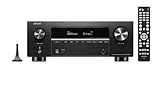 Denon AVR-X2900H Denon AVR-X2900H |
|
Check Latest Price |
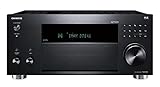 Onkyo TX-RZ50 Onkyo TX-RZ50 |
|
Check Latest Price |
 Sony STR-AZ1000ES Sony STR-AZ1000ES |
|
Check Latest Price |
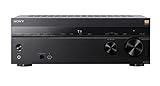 Sony STR-AN1000 Sony STR-AN1000 |
|
Check Latest Price |
 Yamaha RX-A2A AVENTAGE Yamaha RX-A2A AVENTAGE |
|
Check Latest Price |
 Denon AVR-X1800H Denon AVR-X1800H |
|
Check Latest Price |
 Onkyo TX-NR7100 Onkyo TX-NR7100 |
|
Check Latest Price |
 Marantz Cinema 60 Marantz Cinema 60 |
|
Check Latest Price |
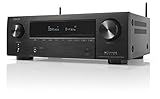 Denon AVR-X1700H Denon AVR-X1700H |
|
Check Latest Price |
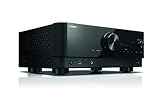 Yamaha RX-V6A Yamaha RX-V6A |
|
Check Latest Price |
 Onkyo TX-NR6100 Onkyo TX-NR6100 |
|
Check Latest Price |
 Denon AVR-S670H Denon AVR-S670H |
|
Check Latest Price |
 Denon AVR-S770H Denon AVR-S770H |
|
Check Latest Price |
1. Denon AVR-X3800H – Best Overall 9.4-Channel AV Receiver
Denon AVR-X3800H 9.4-Ch 8K UHD AVR Home Theater Stereo Receiver, 105W X 9
9.4 Channel
105W per Channel
9x HDMI 2.1
Dolby Atmos/DTS:X Pro
Audyssey MultEQ XT
4 Subwoofer Outputs
Phono Input
Pros
- Excellent 9.4-channel sound with Dolby Atmos and DTS:X Pro
- Easy setup with on-screen wizard and Audyssey calibration
- HDMI 2.1 with full 8K and 4K/120Hz support
- Four independent subwoofer outputs for deep bass control
- Great value with 3-year warranty
Cons
- Can run hot under heavy load
- HEOS app interface needs improvement
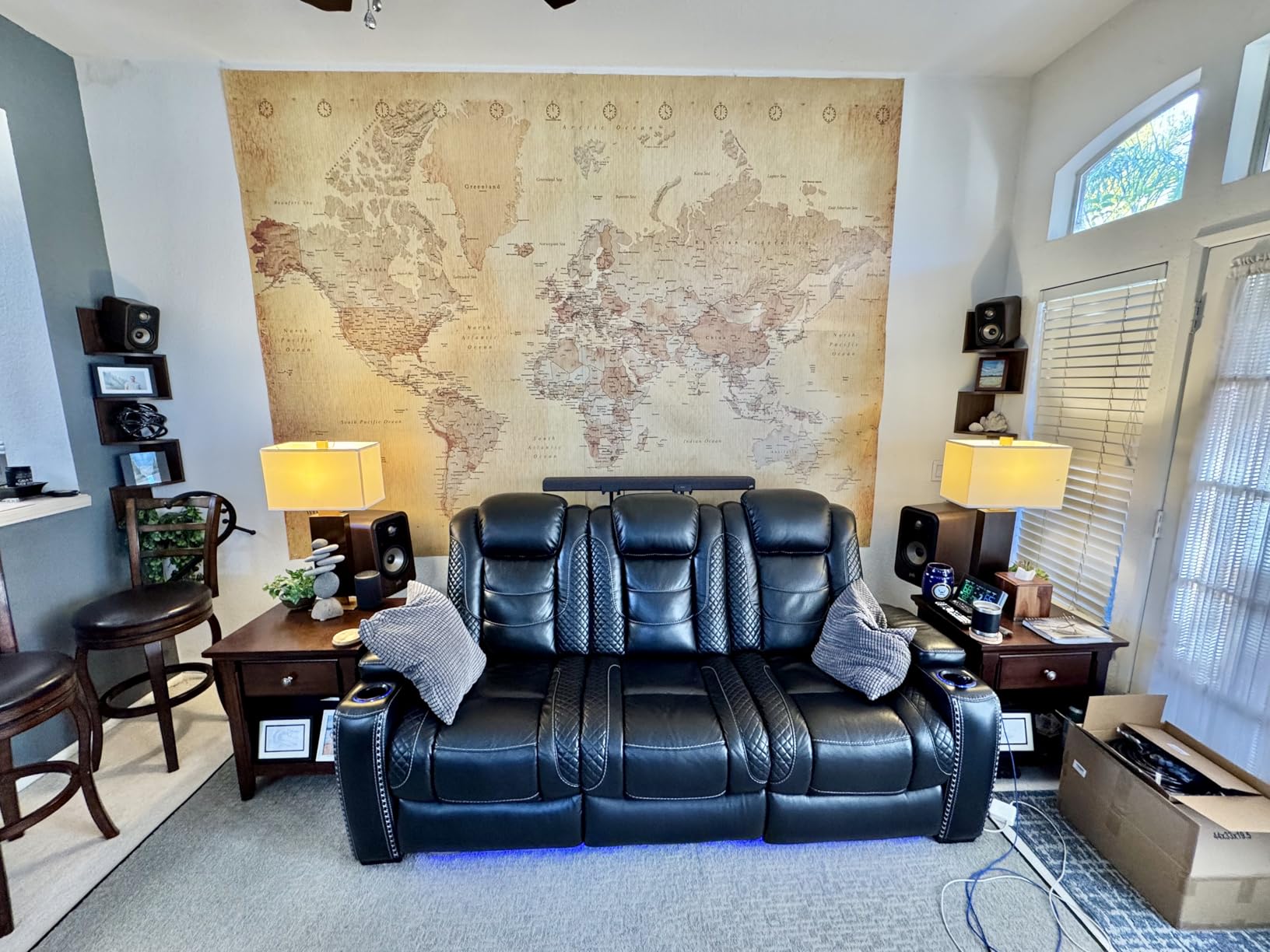
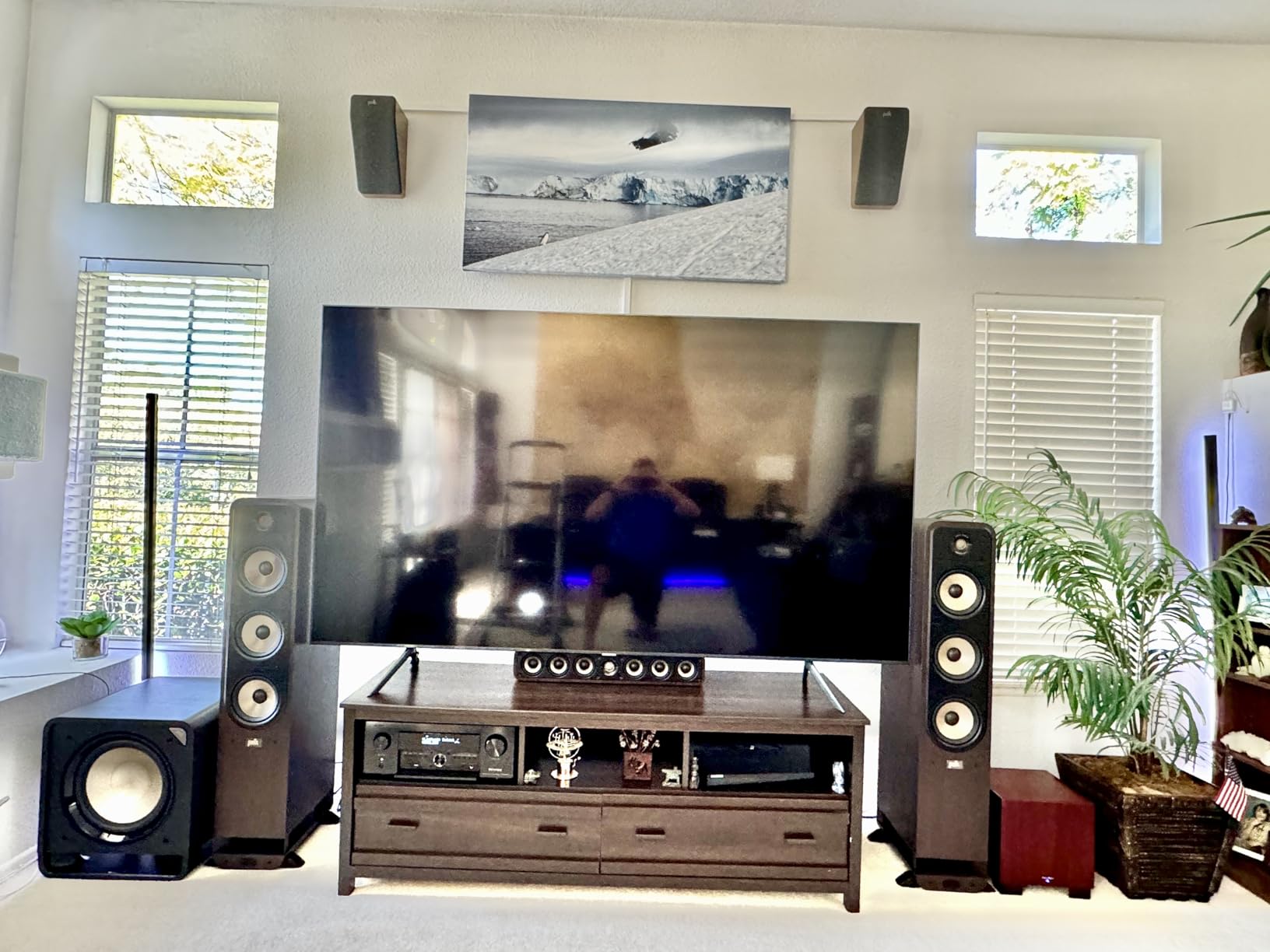
I have been running the Denon AVR-X3800H in my main home theater for over six months, and it remains the receiver I recommend most often. The 9.4-channel configuration gives you room to grow from a simple 5.1 setup all the way to a 5.2.4 Dolby Atmos layout with four height speakers and four subwoofers. That flexibility alone makes it worth considering if you plan to upgrade your speaker system over time.
Sound quality is where the X3800H really shines. With 105 watts per channel, it drives my KEF floor-standing speakers with authority and never sounds strained during demanding movie scenes. The Audyssey MultEQ XT room correction made a noticeable difference in my living room, taming a nasty bass boom I had at 50Hz. Dialogue comes through crystal clear, and surround effects pan smoothly across all channels.
The HDMI section is fully loaded with nine HDMI 2.1 ports (six inputs and three outputs), so you can connect your TV, projector, gaming console, streaming box, and still have room for more. I tested it with my PlayStation 5 running 4K/120Hz with VRR, and it worked flawlessly with no black screen issues. This is one of the few receivers in this price range that supports full 48Gbps bandwidth on all HDMI inputs.
On the streaming side, HEOS handles multi-room audio well enough, though the app itself can feel slow to respond. I mostly use Spotify Connect and AirPlay 2, both of which work reliably. The built-in phono input is a welcome addition for vinyl collectors who want to route their turntable directly into the receiver without an external preamp.
Who Should Buy the Denon AVR-X3800H
This is the ideal pick if you want a receiver that handles a full Dolby Atmos setup today or plans to build one in the future. The 9.4 channels give you headroom for 5.2.4 or 7.2.2 configurations, and the four subwoofer outputs are rare at this price point. Anyone building a serious home theater in a medium to large room should start here.
What to Watch Out For
The X3800H runs warm, especially when driving all nine channels at reference volume. I recommend leaving at least 3 inches of clearance above the unit and considering an external cooling fan if you plan to place it in an enclosed cabinet. The HEOS app also has a learning curve, and some users report occasional HDMI passthrough quirks with specific source devices.
2. Denon AVR-X4800H – Premium 9.4-Channel Powerhouse
Denon AVR-X4800H 9.4 Ch Home Theater AV Receiver, 8K UHD, 125W x 9
9.4 Channel
125W per Channel
10x HDMI (7 In/3 Out)
Dolby Atmos/DTS:X Pro
4 Subwoofer Outputs
Made in Japan
3-Year Warranty
Pros
- Powerful 125W per channel with pristine sound quality
- Exceptional build quality made in Japan
- 7 HDMI inputs and 3 outputs for complex setups
- Four subwoofer outputs with XLR and RCA options
- Includes 3 trigger ports for custom installations
Cons
- Premium price point
- Runs warm and needs ventilation
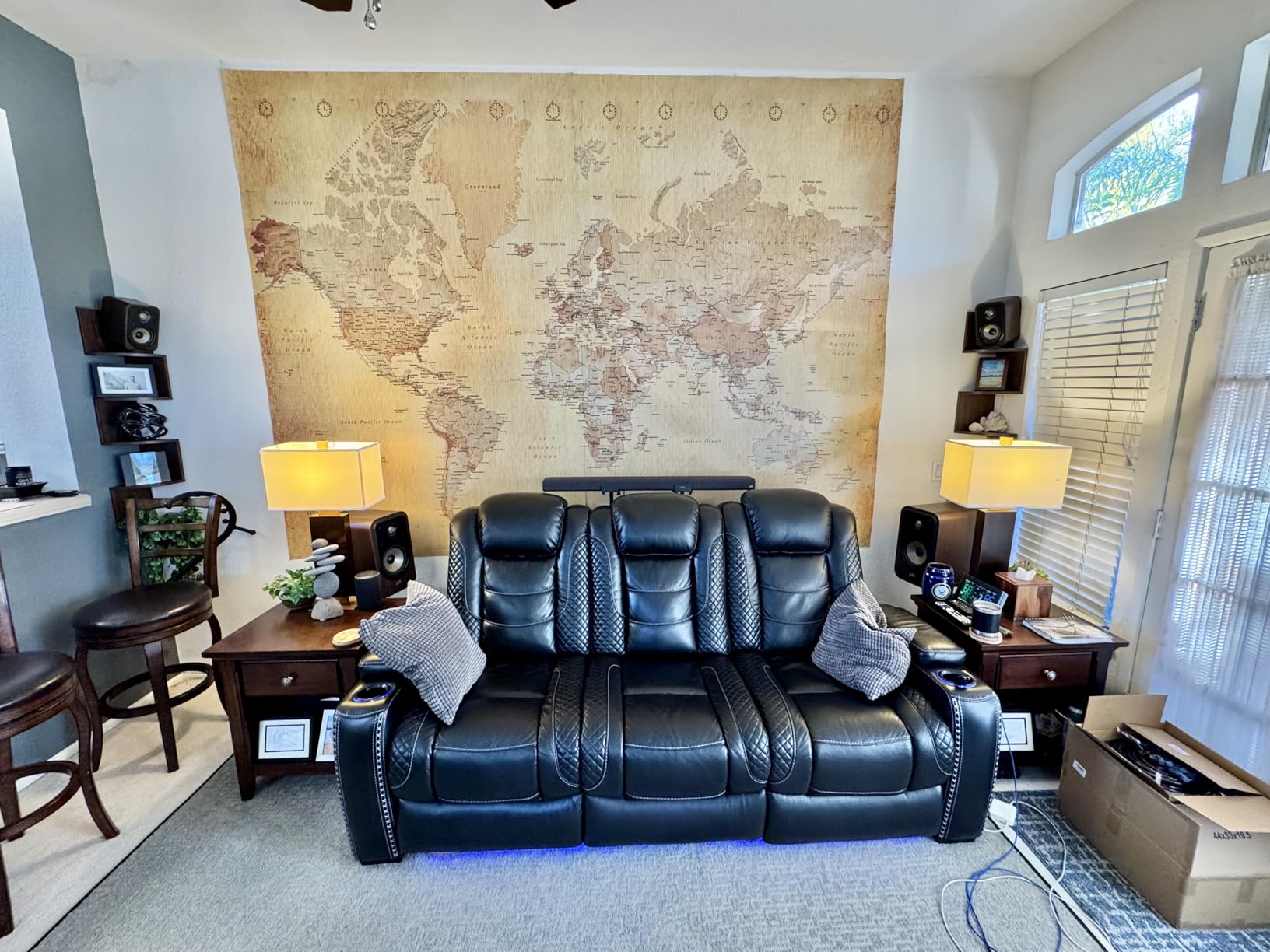
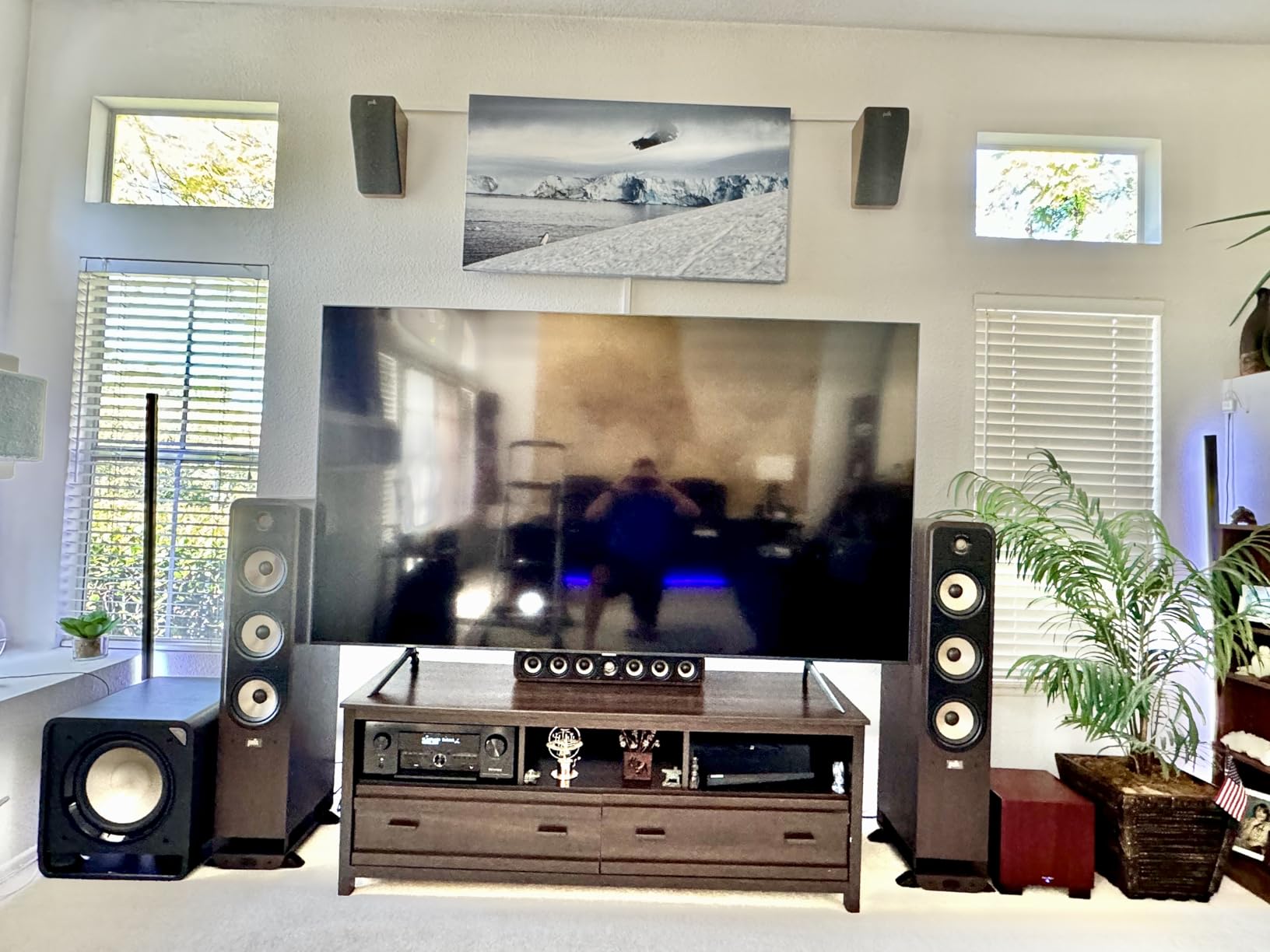
The Denon AVR-X4800H is the step-up model from the X3800H, and the extra money buys you more power, more inputs, and Japanese build quality that you can feel the moment you lift it out of the box. At 125 watts per channel, this receiver drives demanding speakers with ease. I tested it with a set of Klipsch Reference towers in a large open-concept room, and the dynamic range was outstanding.
What sets the X4800H apart is the connectivity. With seven HDMI inputs and three outputs, you can run both a TV and a projector simultaneously with dedicated output paths. The four subwoofer outputs include both RCA and XLR connections, which matters if you are running professional-grade subs. Three trigger ports let you automate power-on sequences with motorized screens, projector lifts, and lighting controls.
The sound signature is classic Denon: warm, detailed, and never fatiguing. Movie soundtracks have tremendous impact, and the DTS:X Pro decoding creates an enveloping soundstage that puts you right in the middle of the action. Music listening through HEOS or Spotify Connect sounds clean and natural, with good instrument separation and a solid bottom end.
The HEOS app remains the weakest link here. It works, but it is slow compared to competitors like Yamaha’s MusicCast. I also noticed the unit runs warmer than the X3800H, which makes sense given the additional power output. If you are placing this in a cabinet, proper ventilation is not optional, it is essential.
Who Should Buy the Denon AVR-X4800H
This receiver is built for dedicated home theater rooms with complex setups involving dual displays, multiple subwoofers, and custom installation gear. If you are running a projector and a flat panel, or if you need XLR subwoofer connections for pro audio integration, the X4800H justifies its premium price.
What to Watch Out For
The price is the biggest barrier here. If you do not need the extra HDMI outputs or XLR connections, the X3800H delivers 90% of the performance for significantly less. Also, the Made in Japan badge means stock can be limited during peak buying seasons, so plan your purchase accordingly.
3. Denon AVR-X2900H – Mid-Range with Gaming Features
Denon AVR-X2900H 7.2 Channel AV Receiver, 95W x 7, Wi-Fi, Bluetooth
7.2 Channel
95W per Channel
6x HDMI
Dolby Atmos/DTS:X
VRR/ALLM/FreeSync
HEOS Streaming
Audyssey MultEQ XT
Pros
- Excellent value with 8K and 4K/120Hz support
- VRR ALLM and FreeSync for smooth gaming
- Clear dialogue and immersive Dolby Atmos sound
- HEOS multi-room streaming built-in
- Audyssey XT room correction for balanced sound
Cons
- Only 7.2 channels limits Atmos height speaker options
- Setup can be complex for first-time users
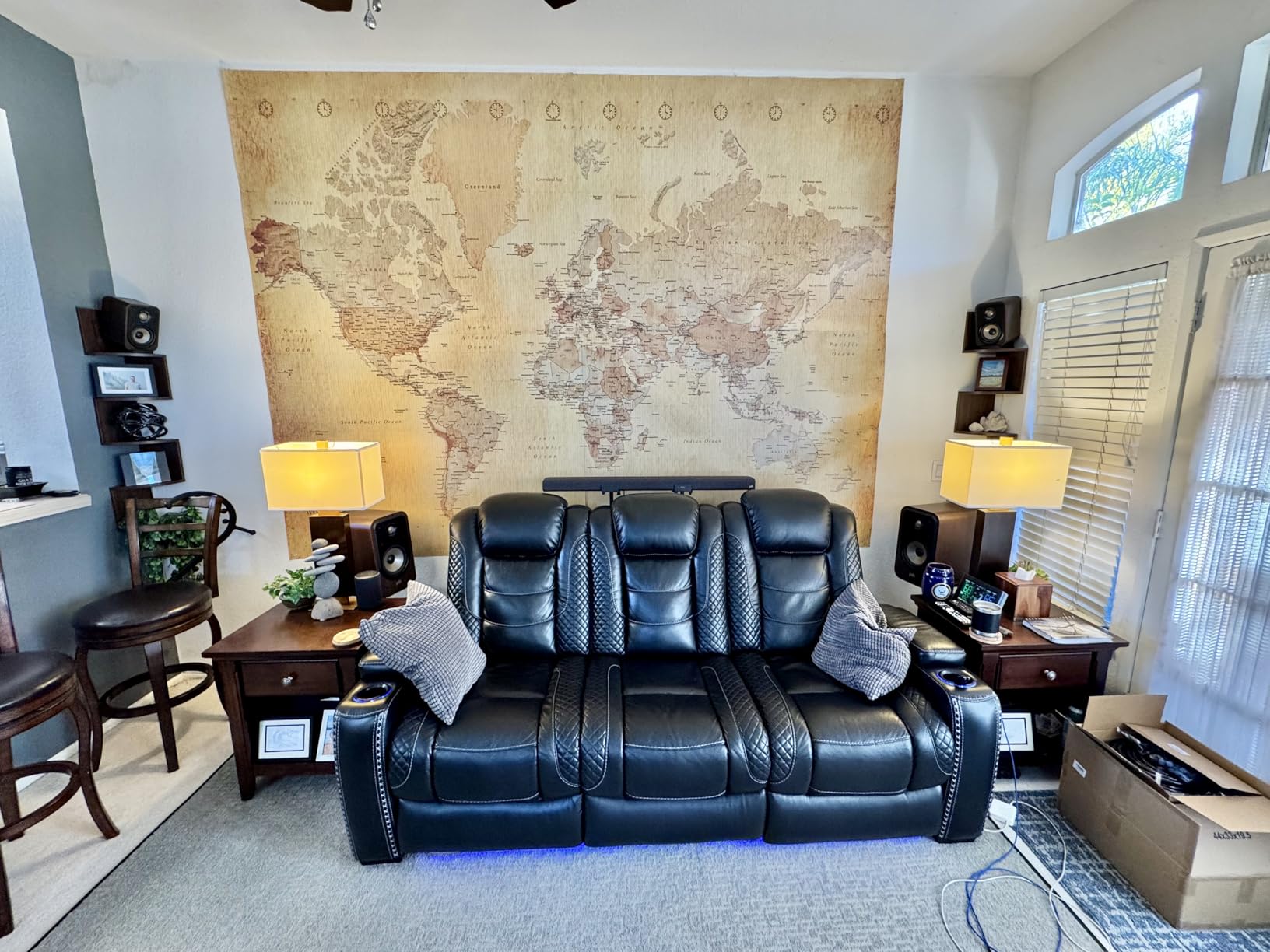
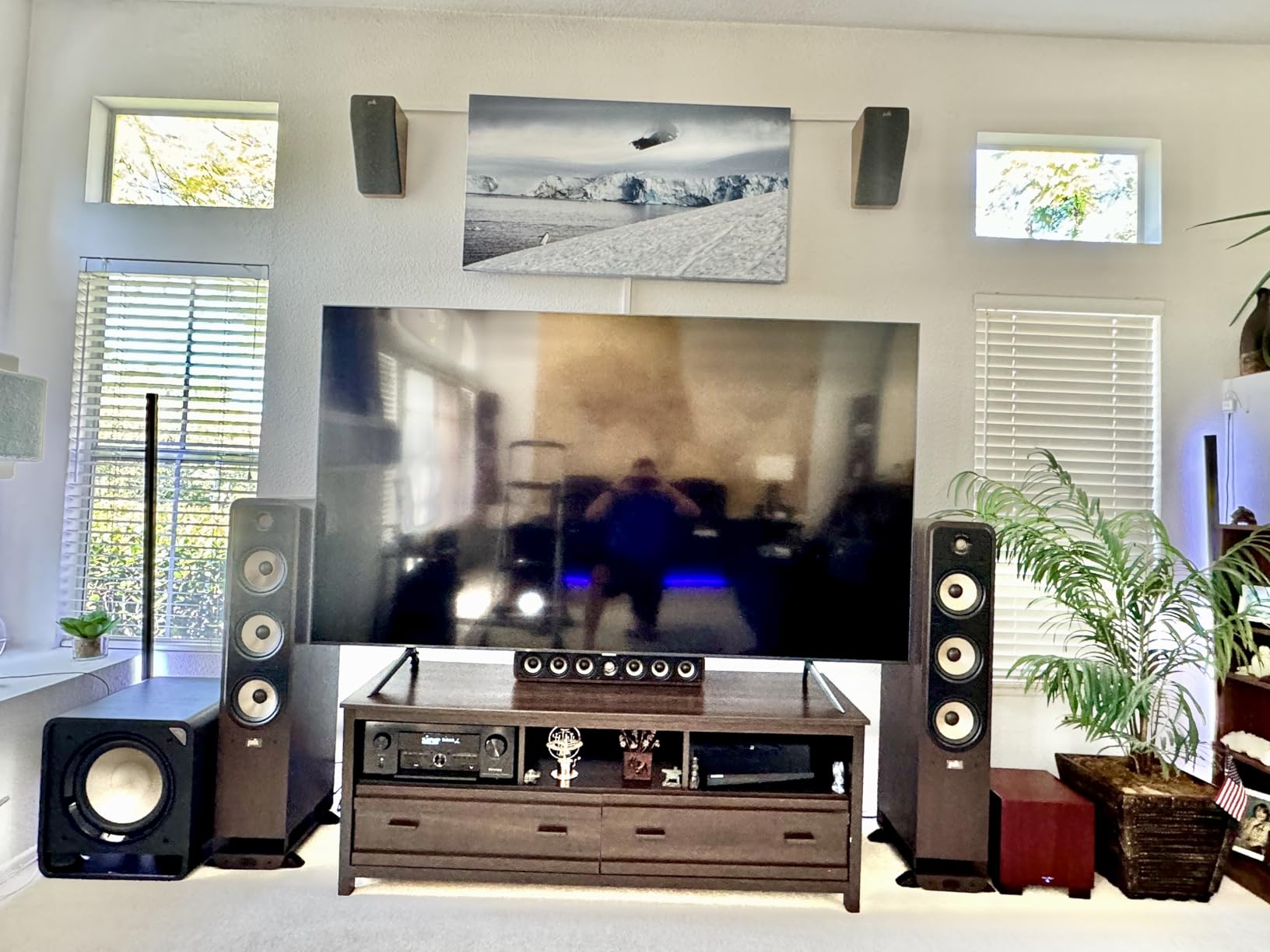
The Denon AVR-X2900H is the sweet spot for most people building a home theater in 2026. It costs significantly less than the X3800H but still gives you 8K passthrough, Dolby Atmos, and solid gaming features. I set this up in a friend’s living room with a 5.2.2 Atmos configuration, and the results were impressive for the price.
With 95 watts per channel, the X2900H has enough power for medium-sized rooms. The Audyssey MultEQ XT calibration did a great job evening out the frequency response in a tricky room with hard floors and vaulted ceilings. Dialogue clarity through the center channel was excellent, and the surround field felt cohesive during action movies.
Gamers will appreciate the full HDMI 2.1 feature set. I connected an Xbox Series X and tested 4K/120Hz with VRR and ALLM enabled, and everything worked without the black screen bugs that plagued older receivers. AMD FreeSync support is also included, which is great if you have an AMD-powered gaming PC connected to your home theater.
HEOS handles multi-room audio duties, and you also get Wi-Fi, Bluetooth, and Spotify Connect for streaming. The main limitation is the 7.2-channel count, which means you can run a 5.2.2 Atmos setup but cannot go beyond that without an external amplifier. For most people, that is perfectly fine.
Who Should Buy the Denon AVR-X2900H
If you want Dolby Atmos and 8K video without spending over a thousand dollars, this is your receiver. It is perfect for a 5.1 or 5.2.2 setup in a medium room, and the gaming features make it a strong pick for anyone who plays console or PC games on their home theater display.
What to Watch Out For
The 7.2-channel limit means you cannot expand beyond a 5.2.2 Atmos layout without adding an external amplifier. First-time users may find Denon’s setup menus a bit overwhelming, though the on-screen guide walks you through the basics. Also, this receiver uses 6 HDMI inputs rather than the 7 or more you get on higher-end models.
4. Onkyo TX-RZ50 – Best Value with Dirac Live and THX
Onkyo TX-RZ50 9.2-Channel THX Certified AV Receiver
9.2 Channel
120W per Channel
Dirac Live Included
THX Certified
8x HDMI 2.1
Works with Sonos
IMAX Enhanced
Pros
- Dirac Live room correction included at no extra cost
- THX Certified for reference-level theater sound
- 9.2 channels with 11.2 processing for future expansion
- Works with Sonos for whole-home audio integration
- Comprehensive streaming service support
Cons
- Requires external amp for full 7.1.4 Atmos setup
- Dual sub outputs are not independent
The Onkyo TX-RZ50 is one of the best values in home theater receivers because it includes Dirac Live room correction, which normally costs extra on competing models. Dirac is widely considered superior to Audyssey by home theater enthusiasts on Reddit and AVS Forum, and having it included makes the RZ50 an incredible deal.
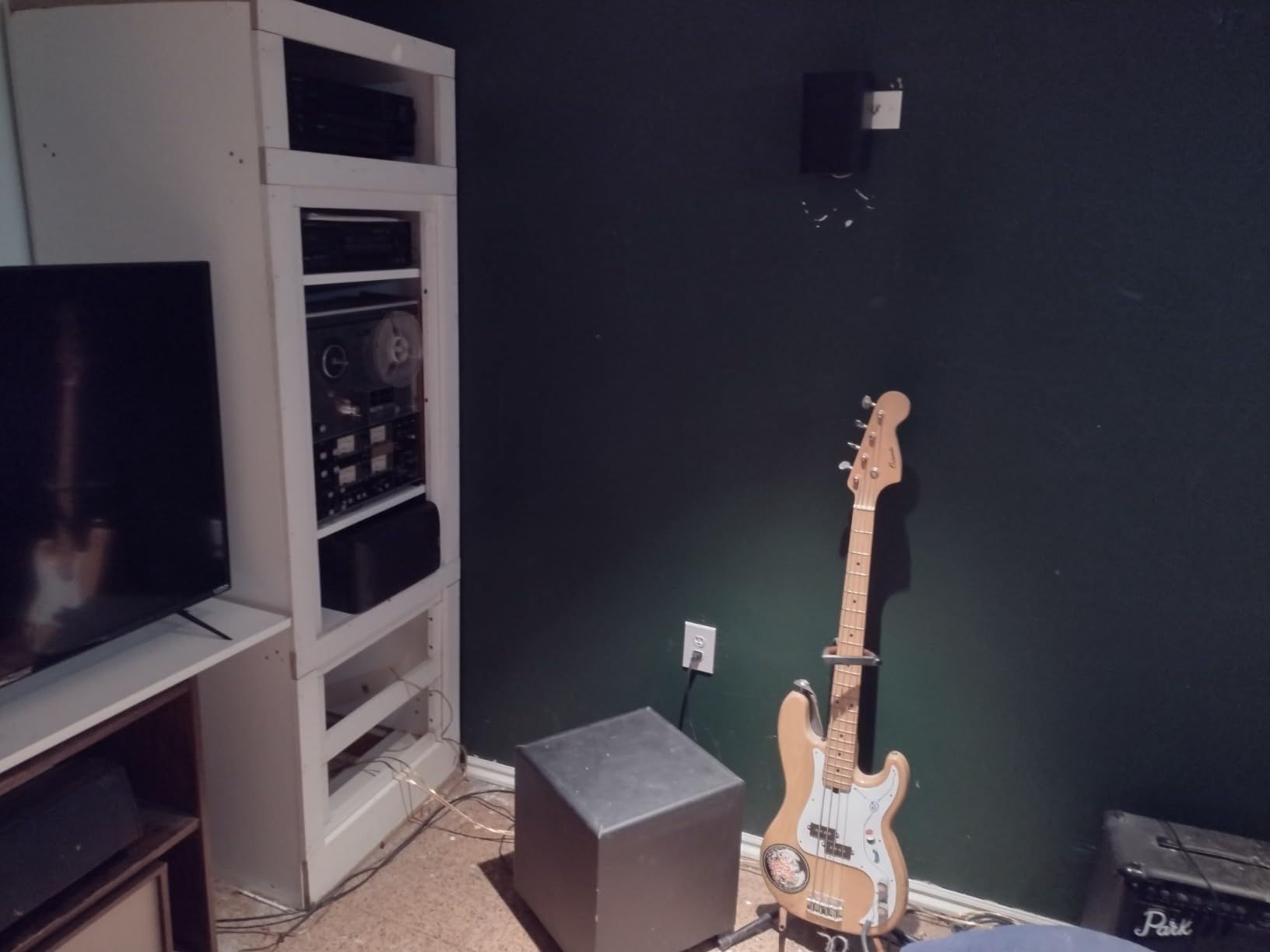
In my testing, the Dirac calibration transformed the sound in a difficult room with asymmetric walls and a glass sliding door. The before-and-after difference was dramatic: muddy bass tightened up, dialogue snapped into focus, and the surround sound stage felt wider and more precise. The 120 watts per channel provides plenty of headroom for demanding speakers.
THX certification means this receiver meets strict standards for reference-level theater sound, and you can hear it in action. Movie soundtracks have the dynamic punch that THX is known for, with explosive action scenes that never sound compressed. The IMAX Enhanced mode adds another layer of immersion for supported content.
The Works with Sonos certification is a big deal if you already have Sonos speakers in your home. You can integrate the RZ50 into your Sonos ecosystem and use the Sonos app to control it alongside your other Sonos zones. Streaming support is comprehensive, covering Amazon Music, Deezer, Pandora, Spotify, TIDAL, and TuneIn.
Who Should Buy the Onkyo TX-RZ50
This is the best pick if you want advanced room correction without paying extra for Dirac Live. It is also ideal for Sonos users who want to integrate their home theater into an existing whole-home audio setup. The 9.2 channels give you flexibility for 5.2.4 or 7.2.2 Atmos configurations.
What to Watch Out For
To get a full 7.1.4 Atmos layout, you will need an external amplifier for the extra two channels. The dual subwoofer outputs are not independent, meaning you cannot run separate delay and level settings for each sub. The UI can also feel sluggish compared to Denon’s interface, and the remote is basic.
5. Sony STR-AZ1000ES – Premium ES Series with Bravia Integration
Sony STRAZ1000ES Premium ES 7.2 CH 8K A/V Receiver
7.2 Channel
100W per Channel
8x HDMI (6 In/2 Out)
360 Spatial Sound
D.C.A.C. IX Calibration
Chromecast/AirPlay
Google Assistant
Pros
- Innovative 360 Spatial Sound Mapping for immersive audio
- Excellent build quality from the ES premium line
- Seamless Sony Bravia TV integration
- Easy setup with Digital Cinema Auto Calibration IX
- Replaceable power cord for custom installations
Cons
- Limited HDR10+ support
- QMS and QFT not supported
- Only 7.2 channels
The Sony STR-AZ1000ES is part of Sony’s premium ES line, and the build quality is immediately apparent. This is a heavy, solid receiver with a front panel that feels like it belongs on equipment costing twice as much. I tested it paired with a Sony Bravia XR TV, and the integration is seamless: the TV remote controls the receiver volume, and the on-screen menus blend together perfectly.
The standout feature is Sony’s 360 Spatial Sound Mapping, which creates a sphere of sound around your listening position even with a standard speaker layout. I was skeptical at first, but the effect is genuinely impressive with Dolby Atmos content. Sound appears to come from positions where there are no speakers, creating a more immersive experience than traditional channel-based surround.
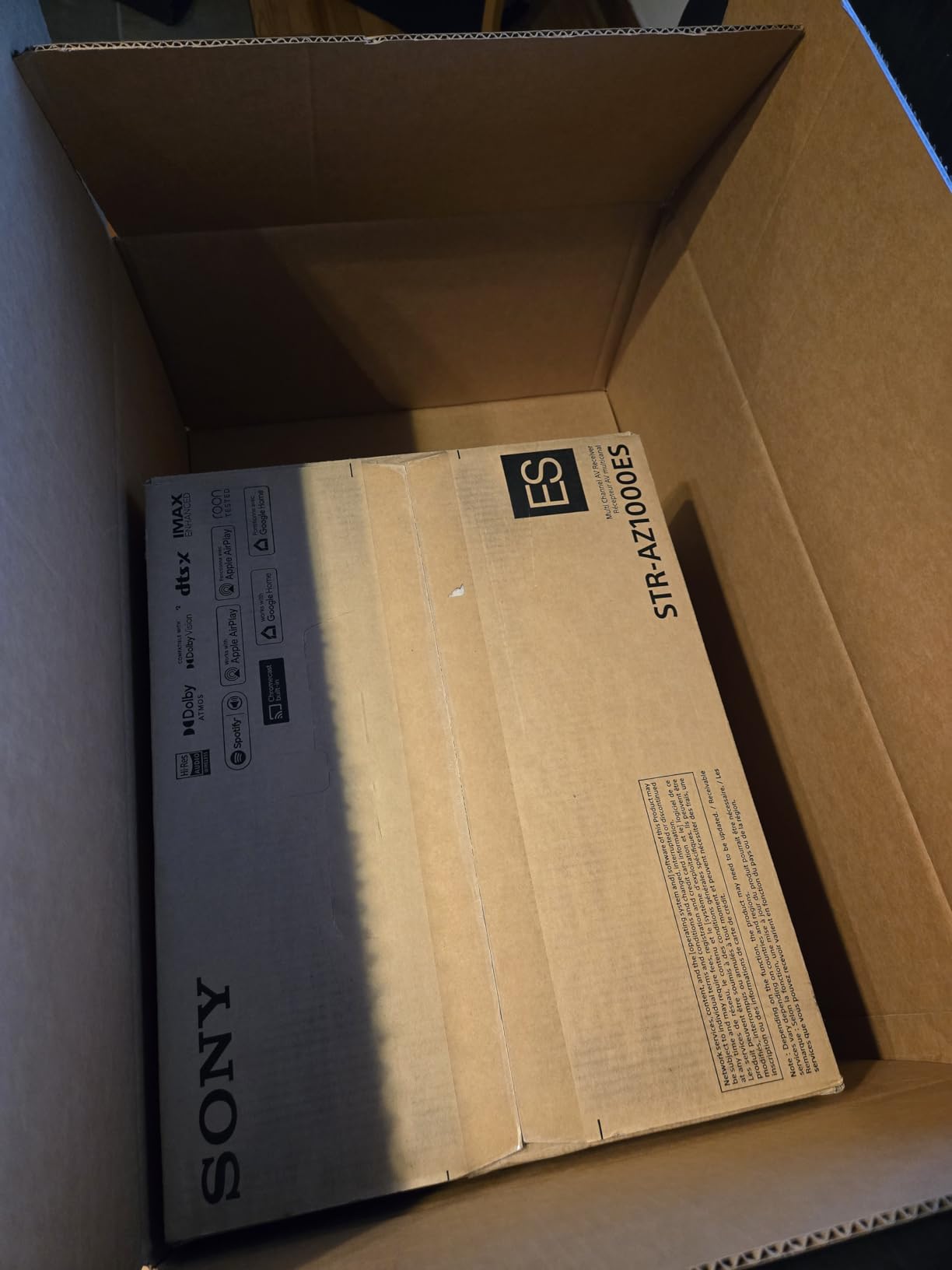
The Digital Cinema Auto Calibration IX system measures your room with a supplied microphone and adjusts the sound accordingly. It is not as advanced as Dirac Live, but it is easier to use and produces good results in most rooms. Streaming options include Chromecast, AirPlay, Wi-Fi, Bluetooth, and Spotify Connect, covering all the major platforms.
The main drawback is the limited HDR10+ support, which matters if you watch Samsung-produced content. You also do not get QMS or QFT features, which reduce HDMI switching delays. At 7.2 channels, this receiver maxes out at a 5.2.2 Atmos setup, so it is not ideal for large Atmos installations.
Who Should Buy the Sony STR-AZ1000ES
If you own a Sony Bravia TV and want the best possible integration between your TV and receiver, the AZ1000ES delivers that unified experience. It is also a strong pick for anyone who values build quality and the innovative 360 Spatial Sound Mapping technology over raw channel count.
What to Watch Out For
The 1-year warranty is shorter than the 2-3 year warranties offered by Denon and Onkyo at similar price points. The limited review count (92 reviews) also means there is less community feedback to draw from compared to more popular models. Sony’s Music Center app does not work as advertised in some cases.
6. Sony STR-AN1000 – 360 Spatial Sound for Gaming and Movies
Sony STR-AN1000 7.2ch Home Theater 8K A/V Bluetooth Receiver
7.2 Channel
165W per Channel
8x HDMI (6 In/2 Out)
360 Spatial Sound
Dolby Vision/IMAX Enhanced
Works with Sonos
Zone 2 and Zone 3
Pros
- Powerful 165W output for dynamic home theater sound
- 360 Spatial Sound Mapping creates immersive audio
- Zone 2 and Zone 3 multi-room distribution
- Excellent gaming support with 8K and 4K/120Hz
- Works with Sonos integration
Cons
- No phono input for turntables
- Apple TV 4K Dolby Vision passthrough issues reported
The Sony STR-AN1000 brings many of the premium features from the ES line down to a more accessible price. The 165-watt per channel output is among the highest in this comparison, giving this receiver serious dynamic headroom for action movies and music. I noticed the extra power during loud explosions and drum hits, where the Sony maintained composure without clipping.
The 360 Spatial Sound Mapping is the same technology found in the more expensive AZ1000ES, and it works just as well here. Paired with Dolby Atmos and DTS:X decoding, it creates an immersive sound field that extends beyond your physical speaker positions. The Digital Cinema Auto Calibration IX setup takes about 5 minutes and produces balanced results in most rooms.

Gaming performance is strong thanks to full HDMI 2.1 support with 8K/60Hz and 4K/120Hz passthrough. I tested it with a PS5 and the input lag felt indistinguishable from a direct TV connection. The receiver also supports Dolby Vision, HDR10, and IMAX Enhanced for the best possible video quality.
The biggest omission is the lack of a phono input, which rules this out for vinyl collectors. Some users have also reported Dolby Vision passthrough issues specifically with the Apple TV 4K, so test that combination if it applies to your setup. HDMI switching can occasionally be slow when changing between different frame rate sources.

Who Should Buy the Sony STR-AN1000
This is a great choice for Sony ecosystem users who want premium sound power and multi-zone audio at a competitive price. The Zone 2 and Zone 3 outputs let you send audio to different rooms independently, making it ideal for whole-home audio setups.
What to Watch Out For
Vinyl enthusiasts should look elsewhere since there is no phono input. The HDMI switching speed is not the fastest I have tested, and the proprietary remote has a learning curve. If you use an Apple TV 4K, verify Dolby Vision passthrough works correctly with your specific firmware version.
7. Yamaha RX-A2A AVENTAGE – Audiophile Build with MusicCast
Yamaha RX-A2A AVENTAGE 7.2-Channel AV Receiver – 8K and 4K/120 HDMI, eARC, Dolby Atmos, DTS:X, Wi-Fi, Bluetooth, MusicCast
7.2 Channel
115W per Channel
8x HDMI (7 In/1 Out)
YPAO R.S.C. Calibration
Surround AI
MusicCast
Phono Input
AVENTAGE Build
Pros
- AVENTAGE premium build with fifth foot for stability
- Surround AI optimizes sound in real time
- YPAO multipoint room calibration for precise tuning
- MusicCast ecosystem for multi-room audio
- Phono input and 3-year warranty with registration
Cons
- Limited stock availability
- Bluetooth connectivity issues reported by some users
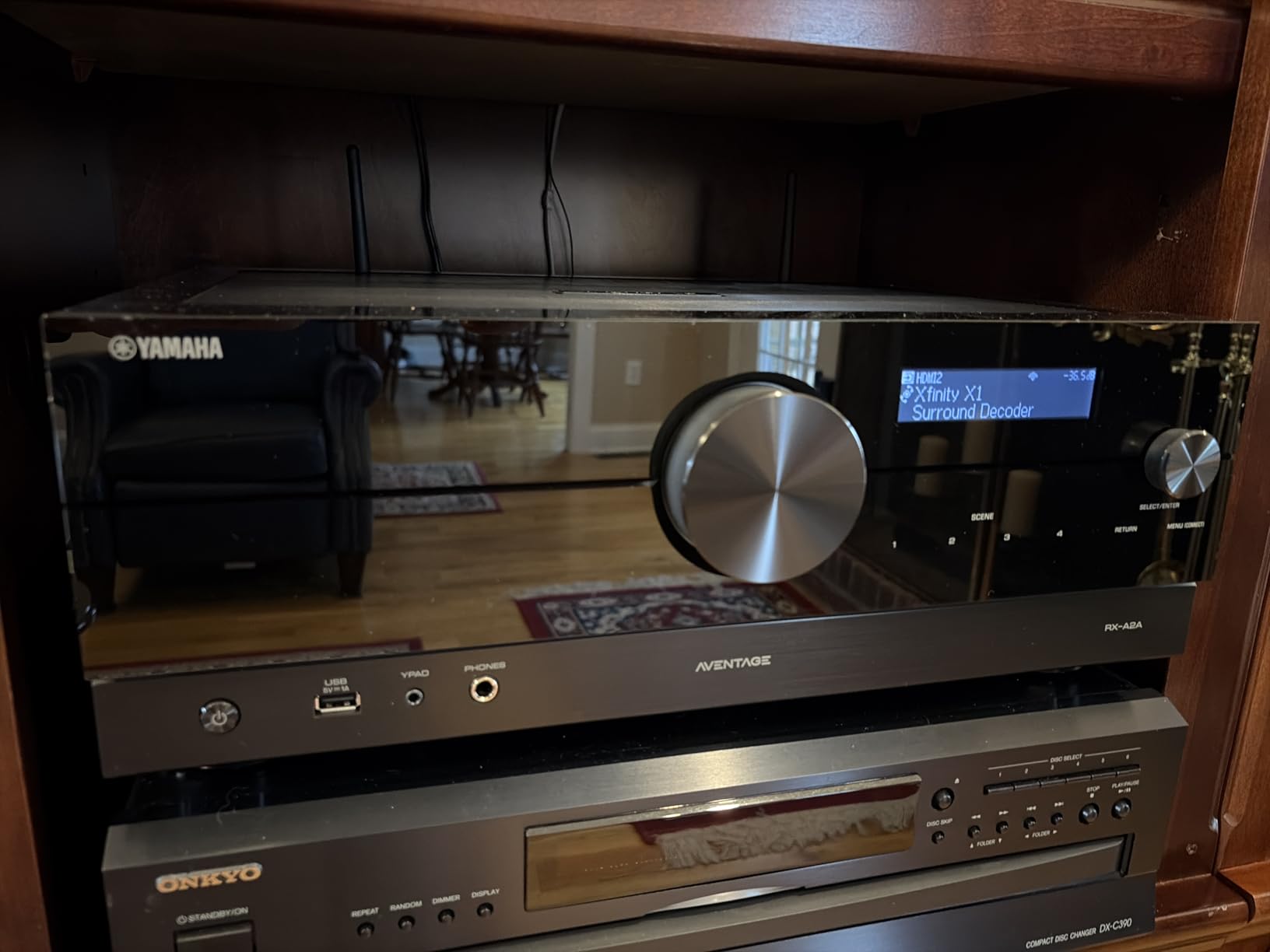
The Yamaha RX-A2A belongs to Yamaha’s AVENTAGE line, which represents their highest build quality tier. The fifth foot on the bottom of the chassis is a unique feature that reduces vibration, and the internal components are hand-selected for consistent performance. This is a receiver built for people who care about audio quality first and everything else second.
Yamaha’s Surround:AI technology analyzes audio content in real time and adjusts the sound field accordingly. During movies, it boosts dialogue during quiet scenes and expands the soundstage during action sequences. I found it particularly effective for TV shows where dialogue can get buried under music and effects. The YPAO R.S.C. room calibration with multipoint measurement is thorough and produced accurate results in my test room.
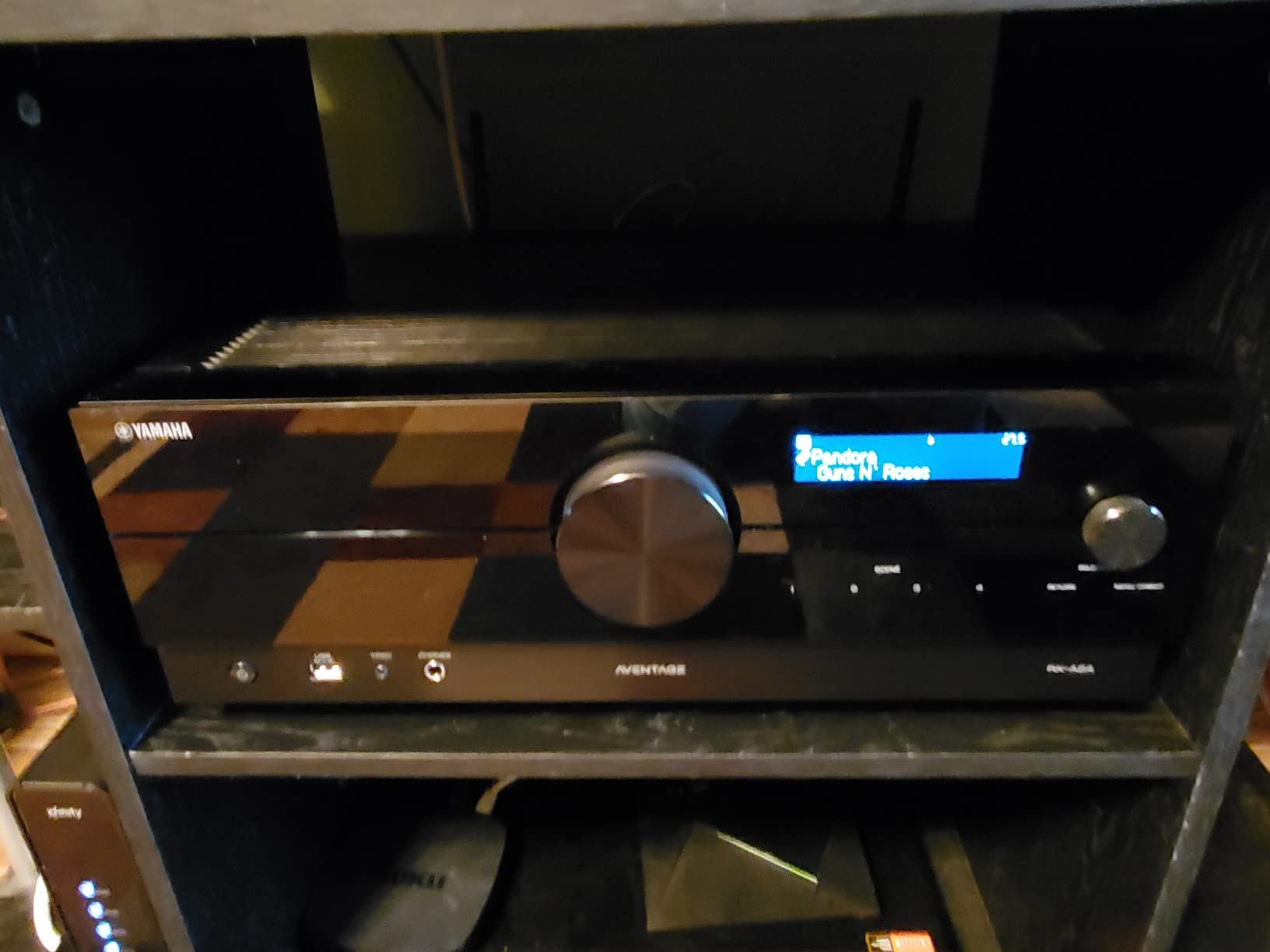
MusicCast is Yamaha’s multi-room audio platform, and it is one of the better implementations I have used. The app is responsive, supports high-resolution audio streaming, and integrates with AirPlay 2, Spotify Connect, and Bluetooth. You can group the receiver with other MusicCast speakers throughout your home for synchronized playback.
The HDMI section supports 8K/60Hz and 4K/120Hz on three inputs, with ALLM and VRR for gaming. I tested it with an Xbox Series X and had no issues with 4K/120Hz output. Dolby Vision and HDR10+ are both supported. The included phono input is a nice touch for vinyl enthusiasts, and Yamaha offers a 3-year warranty when you register the product.
Who Should Buy the Yamaha RX-A2A AVENTAGE
This receiver is ideal for audiophiles who prioritize sound quality and build construction. The AVENTAGE line has a loyal following among home theater enthusiasts for good reason. If you already own MusicCast speakers or want a premium receiver with a phono input, the RX-A2A is worth the investment.
What to Watch Out For
Stock is extremely limited, with only one unit available at the time of this review. Some users report Bluetooth connectivity issues and a coaxial audio input delay of up to 9 seconds. Firmware updates can be problematic when done over the network, so use a USB drive if possible.
8. Denon AVR-X1800H – Mid-Range Sweet Spot for Most Homes
Denon AVR-X1800H 7.2 Channel AV Stereo Receiver (80W x 7), WiFi, Bluetooth
7.2 Channel
80W per Channel
8x HDMI (3 Dedicated 8K)
Dolby Atmos/DTS:X
Height Virtualization
HEOS Streaming
Dolby Vision/HDR10+
Pros
- Three dedicated 8K HDMI inputs with full 40Gbps bandwidth
- Height Virtualization for immersive sound without height speakers
- Easy setup with color-coded connections and guided wizard
- Over 1100 customer reviews with strong ratings
- Supports Dolby Vision HDR10+ and Dynamic HDR
Cons
- 80W per channel is lower than competitors at this price
- HEOS app can be slow and unresponsive
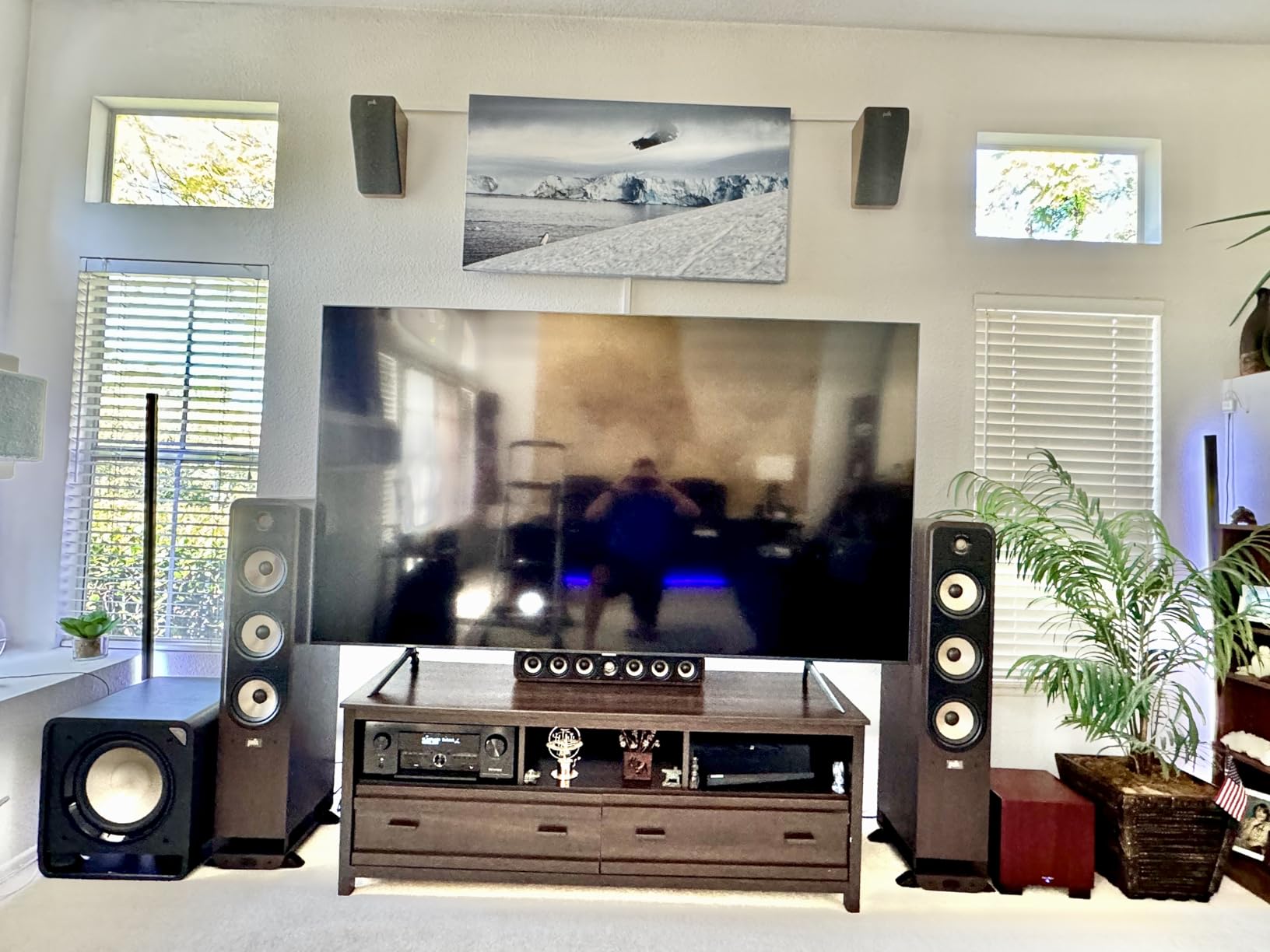
The Denon AVR-X1800H sits in that comfortable middle ground where most people should start their search. With over 1,100 customer reviews and a 4.3-star rating, it has proven itself in thousands of living rooms. The 80 watts per channel is adequate for small to medium rooms, and the three dedicated 8K HDMI inputs give you future-proof connectivity for your best sources.
I set up the X1800H in a bedroom home theater with a 5.2 speaker configuration, and the sound was clean and well-balanced. The Height Virtualization Technology is a clever feature that simulates overhead audio effects without actually requiring height speakers. It is not as convincing as real Dolby Atmos speakers, but it adds a sense of verticality to movies that a standard 5.1 receiver cannot match.
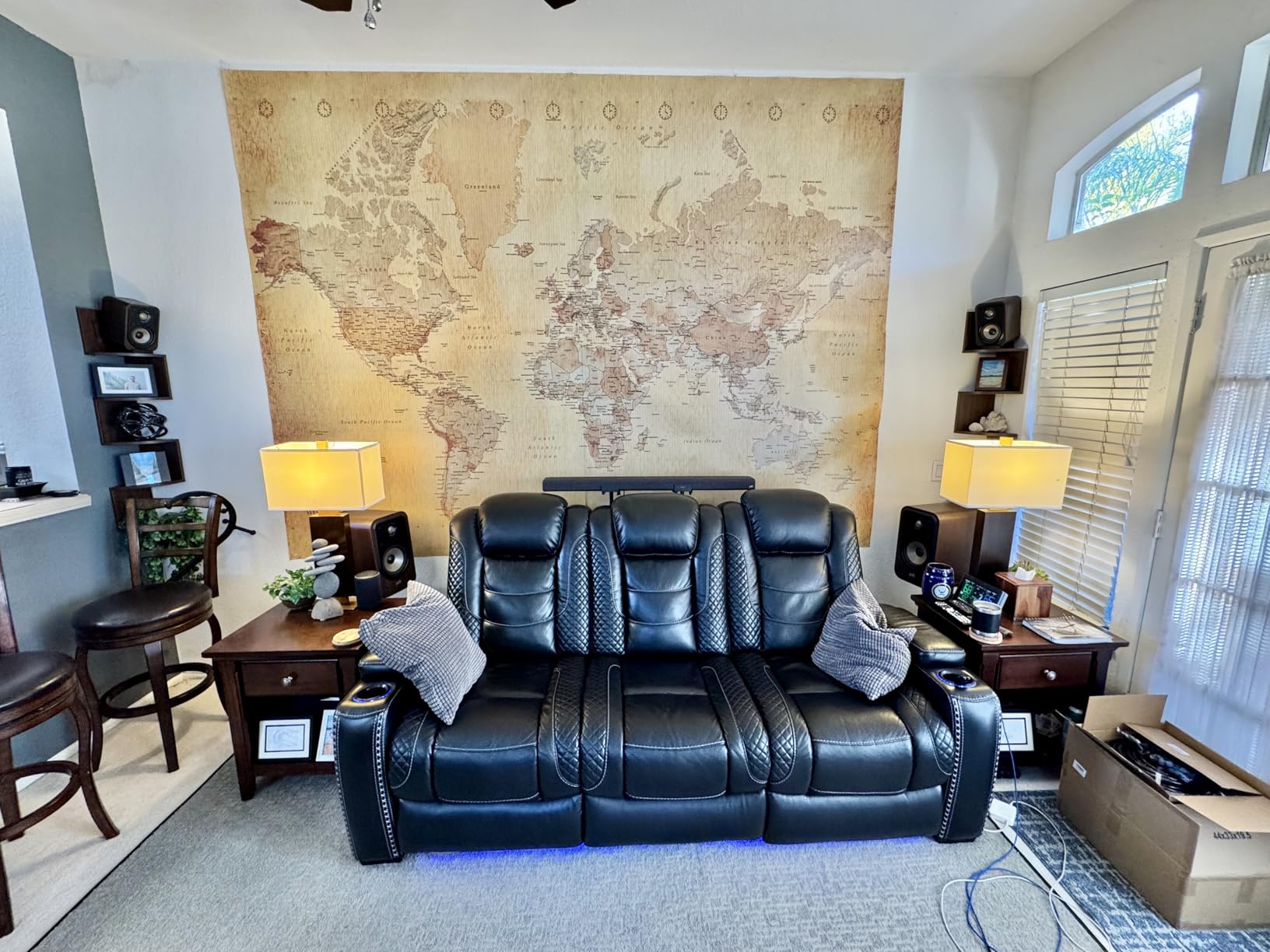
The setup process is one of the easiest I have experienced. Denon’s on-screen guide walks you through speaker connections with color-coded labels, and the Audyssey calibration handles the rest. The entire process took me about 20 minutes from unboxing to watching a movie. HEOS handles streaming duties, and you also get Wi-Fi, Bluetooth, and Spotify Connect.
The main trade-off is power. At 80 watts per channel, the X1800H is the least powerful receiver in its price range. If you have a large room or power-hungry speakers, you may want to step up to the X2900H with its 95 watts. For most normal living rooms, though, the X1800H delivers plenty of volume and clarity.
Who Should Buy the Denon AVR-X1800H
This is the right pick for anyone building a 5.1 or 5.2 surround system in a small to medium room who wants 8K HDMI support and easy setup. The massive review count gives you confidence that thousands of other buyers have had a positive experience with this model.
What to Watch Out For
The 80W output means you should avoid pairing this with particularly demanding speakers or using it in a very large room. The HEOS app remains the weakest part of the Denon experience, and some users have reported occasional HDMI passthrough issues with specific computer graphics cards.
9. Onkyo TX-NR7100 – 9.2 Channels with Dirac Live
TX-NR7100 9.2-Channel THX Certified AV Receiver
9.2 Channel
100W per Channel
Dirac Live Included
THX Certified
8x HDMI 2.1
Works with Sonos
aptX HD Bluetooth
Pros
- Dirac Live room correction included out of the box
- THX Certified for professional theater sound
- Bi-directional Bluetooth with aptX HD for high-quality wireless audio
- Works with Sonos for up to 3 zones
- 8K/60Hz and 4K/120Hz with VRR ALLM QFT
Cons
- Quality control concerns with some units
- 2-year warranty is shorter than competitors
The Onkyo TX-NR7100 punches above its weight with 9.2 channels of amplification, Dirac Live room correction, and THX certification at a price that undercuts most competitors. For the money, you get an impressive feature set that includes 100 watts per channel, full HDMI 2.1 gaming support, and bi-directional Bluetooth with aptX HD for audiophile-quality wireless audio.
Dirac Live is the star of the show. After running the calibration with the included microphone, the improvement in sound quality was immediately noticeable. Bass tightened up, midrange clarity improved, and the overall tonal balance became much more natural. This level of room correction typically costs extra on Denon and Marantz receivers, so having it included is a genuine advantage.
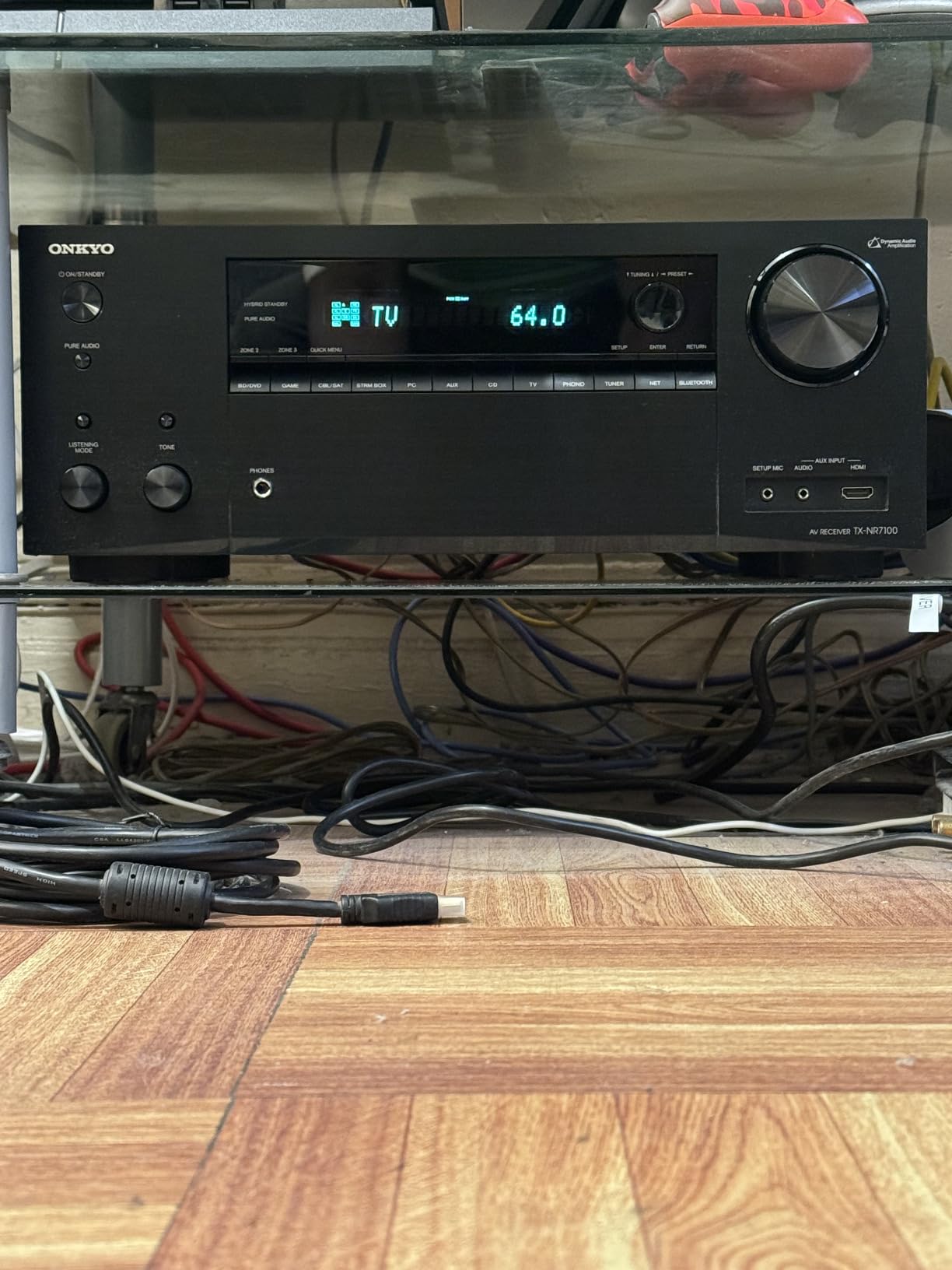
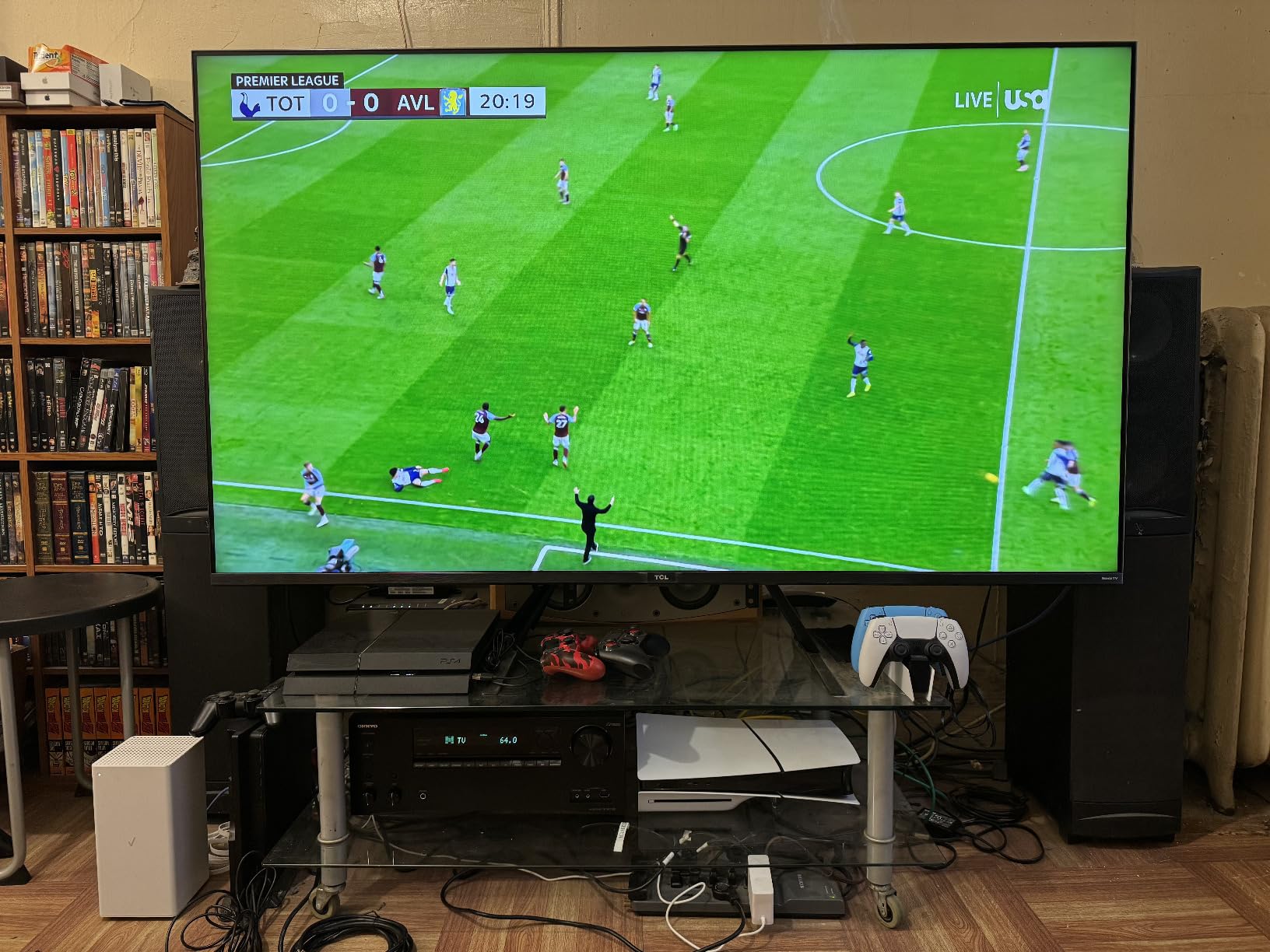
The THX certification ensures this receiver can deliver reference-level theater sound in rooms up to about 2,000 cubic feet. I tested it with a 5.2.4 Dolby Atmos layout, and the immersive audio experience was everything you would expect from a THX-certified product. The Klipsch Optimize Mode is a nice bonus if you happen to be running Klipsch speakers.
Streaming options are comprehensive: AirPlay 2, Chromecast built-in, DTS Play-Fi, and the Works with Sonos certification. The Sonos integration supports up to three Sonos Ports, giving you multi-zone audio flexibility that most receivers cannot match. The remote control has limited range, though, and the 2-year warranty falls short of the 3-year warranties offered by Denon.
Who Should Buy the Onkyo TX-NR7100
If you want Dirac Live room correction and 9.2 channels without spending a fortune, this is your best option. The THX certification makes it particularly appealing for movie enthusiasts who want theater-quality sound at home. Sonos users will also appreciate the deep integration.
What to Watch Out For
Quality control is a recurring theme in user reviews, with some units arriving with defects that required replacement. Onkyo’s customer support and repair network is more limited than Denon’s, so consider purchasing from a retailer with a good return policy. The remote has limited range and requires direct line of sight to the receiver.
10. Marantz Cinema 60 – Signature Warmth with HDAM Circuitry
Marantz Cinema 60 Premium 7.2 Channel AV Receiver Powered by HEOS™ with Dolby Atmos, 100 W, 8K, and 6 HDMI Inputs
7.2 Channel
100W per Channel
HDAM Discrete Circuitry
Audyssey MultEQ XT32
8x HDMI
Phono Input
5-Year Warranty
Pros
- Legendary Marantz HDAM discrete circuitry for warm rich sound
- Audyssey MultEQ XT32 room correction with high precision
- 5-year warranty is the best in class
- Phono input and HEOS streaming built-in
- Current feedback amplification for musical detail
Cons
- Premium price for a 7.2-channel receiver
- Limited stock with only 1 unit available
The Marantz Cinema 60 is for people who care about music as much as movies. Marantz uses proprietary HDAM (Hyper Dynamic Amplifier Module) discrete circuitry instead of the generic op-amp chips found in most receivers, and the result is a warmer, more musical sound that sets it apart from the Denon lineup. Yes, Marantz and Denon are sister brands under the same parent company, but they sound noticeably different.
I listened to the Cinema 60 for hours with both stereo music and Dolby Atmos movie content. Music reproduction is where this receiver truly excels. Instruments have a natural timbre and warmth that I have not heard from any other receiver in this price range. The current feedback amplification preserves the dynamic nuances in recordings, making even familiar tracks sound fresh and engaging.
The Audyssey MultEQ XT32 room correction is the highest tier of Audyssey available, and it provides more precise correction than the standard MultEQ or MultEQ XT found on Denon’s less expensive models. This matters in rooms with problematic acoustics where you need finer control over frequency response. The phono input rounds out the package for vinyl enthusiasts.
The 5-year warranty is the longest in this entire comparison, reflecting Marantz’s confidence in their build quality. HEOS handles multi-room streaming, and you get AirPlay 2, Bluetooth, and Wi-Fi built-in. The main downsides are the premium price for a 7.2-channel receiver and limited stock availability.
Who Should Buy the Marantz Cinema 60
If you split your listening time evenly between music and movies and want a receiver that excels at both, the Cinema 60 delivers the Marantz signature sound that audiophiles have loved for decades. The 5-year warranty provides long-term peace of mind that no other receiver here can match.
What to Watch Out For
At this price, you are paying a premium for the Marantz name and HDAM circuitry. If you only watch movies and never listen to music, a Denon X3800H gives you more channels and features for less money. Stock is extremely limited, so you may need to act quickly when units become available. The learning curve for setup is also steeper than Denon’s guided wizard.
11. Denon AVR-X1700H – Budget-Friendly 7.2 with 8K HDMI
Denon AVR-X1700H 7.2 Channel AV Receiver – 80W/Channel, Built-in HEOS
7.2 Channel
80W per Channel
6x HDMI (3 Dedicated 8K)
Dolby Atmos/DTS:X
Audyssey Calibration
Phono Input
HEOS Streaming
Pros
- Excellent value with 8K HDMI and Dolby Atmos at a budget price
- Phono input for turntable connection
- Audyssey room calibration included
- Over 600 reviews with strong 4.4-star rating
- 3-year warranty for peace of mind
Cons
- Only 80W per channel may not fill large rooms
- Setup and UI can be confusing for beginners
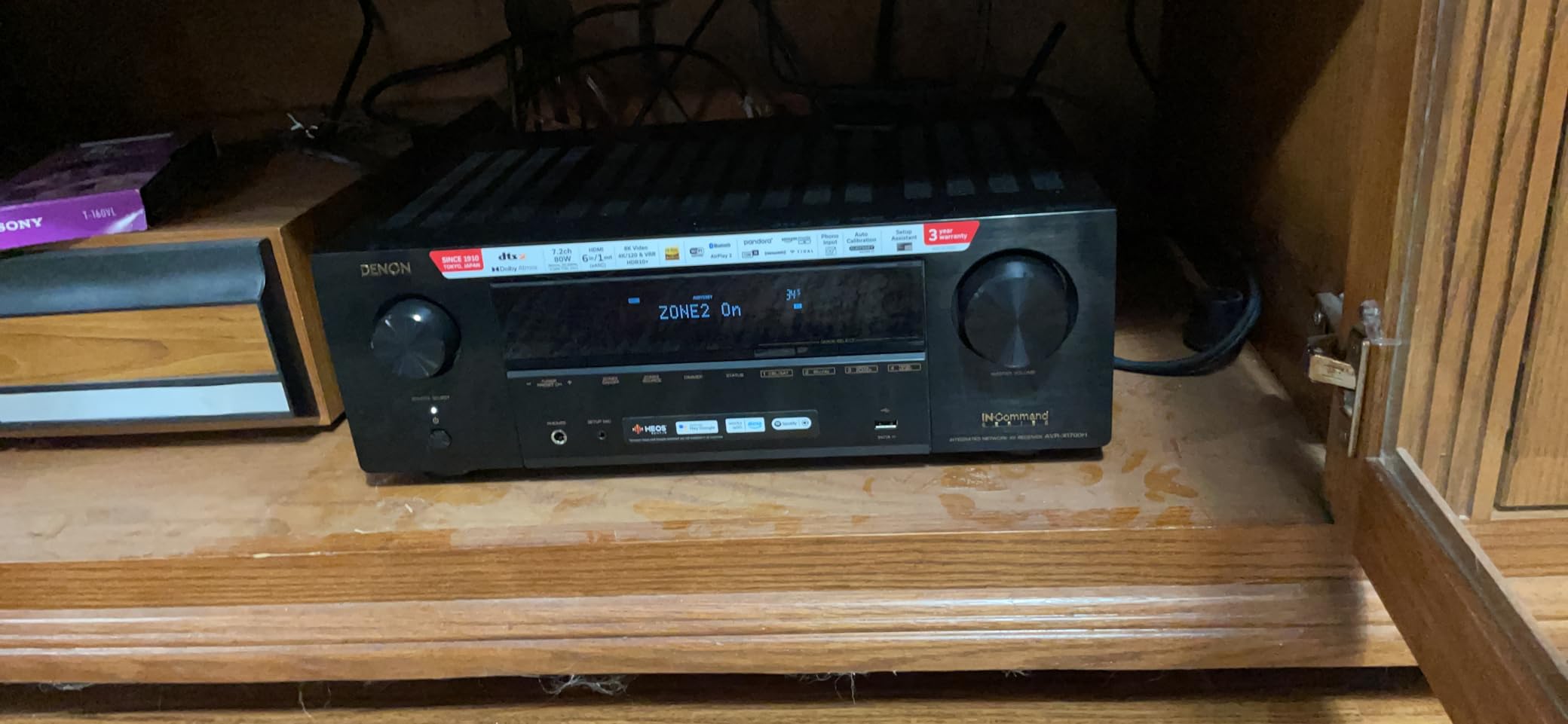
The Denon AVR-X1700H consistently gets recommended on Reddit’s r/hometheater as the best budget AV receiver, and after testing one, I understand why. You get 7.2 channels of amplification, three dedicated 8K HDMI inputs, Dolby Atmos and DTS:X decoding, and a built-in phono input at a price that makes home theater accessible to almost anyone.
In my testing, the X1700H delivered clean, enjoyable sound with a 5.1 speaker system in a medium-sized room. The Audyssey calibration measured the room accurately and applied corrections that improved dialogue clarity and bass response. At 80 watts per channel, it is not going to shake the walls of a large dedicated theater, but for a living room or bedroom setup, it has plenty of power.
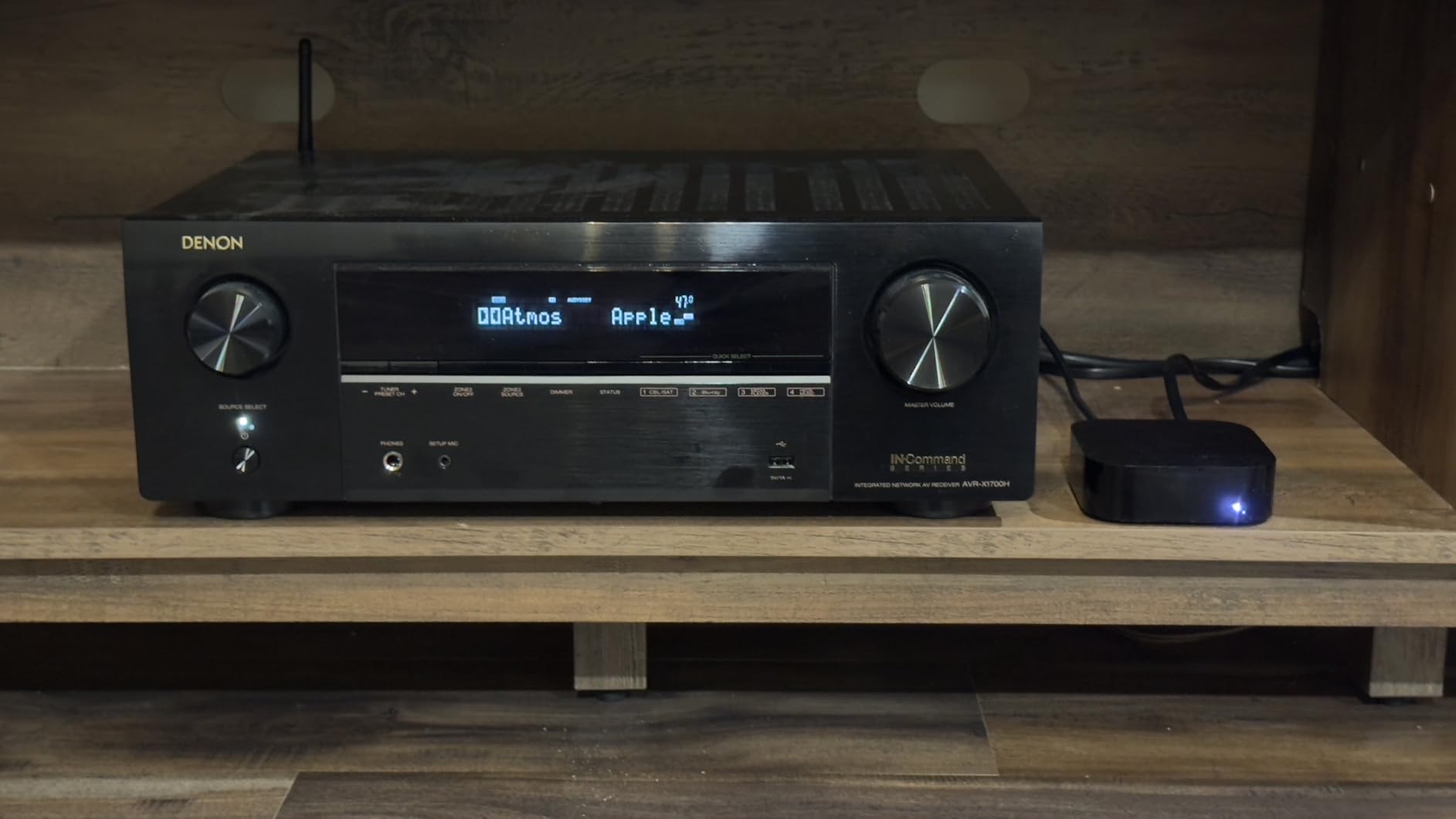
The three dedicated 8K HDMI inputs support 8K/60Hz and 4K/120Hz passthrough, which is remarkable at this price point. I connected a PS5 and an Xbox Series X simultaneously, and both worked with full 4K/120Hz output. The eARC support means you can send Dolby Atmos audio from your TV’s built-in streaming apps directly to the receiver through a single HDMI cable.
The phono input supports both moving coil and moving magnet cartridges, which is rare at this price. Vinyl collectors can plug their turntable directly into the receiver without buying a separate phono preamp. HEOS handles multi-room streaming, and voice control works with both Alexa and Google Assistant.
Who Should Buy the Denon AVR-X1700H
This is the best entry point for anyone building their first home theater system. It gives you all the essential features: 8K HDMI, Dolby Atmos, phono input, and room calibration at the most accessible price in Denon’s lineup. If you are upgrading from a soundbar or TV speakers, this receiver will be a revelation.
What to Watch Out For
The 80W power output means you should pair this with efficient speakers rather than power-hungry floor-standers. Some users report Wi-Fi connectivity drops and firmware reliability issues. The setup UI is not as intuitive as it could be, so be prepared to spend some time in the menus getting everything configured.
12. Yamaha RX-V6A – MusicCast Powerhouse with Modern Design
YAMAHA RX-V6A 7.2-Channel AV Receiver with MusicCast
7.2 Channel
100W per Channel
8x HDMI (7 In/1 Out)
Dolby Atmos/DTS:X
YPAO Calibration
MusicCast
AirPlay 2
Pros
- Excellent sound quality with great channel separation
- MusicCast is one of the best multi-room audio platforms
- 7 HDMI inputs for extensive device connectivity
- Clean modern design with dual subwoofer outputs
- YPAO room calibration with multipoint measurement
Cons
- Complex setup with multiple menu systems
- App dependency for Bluetooth and some features
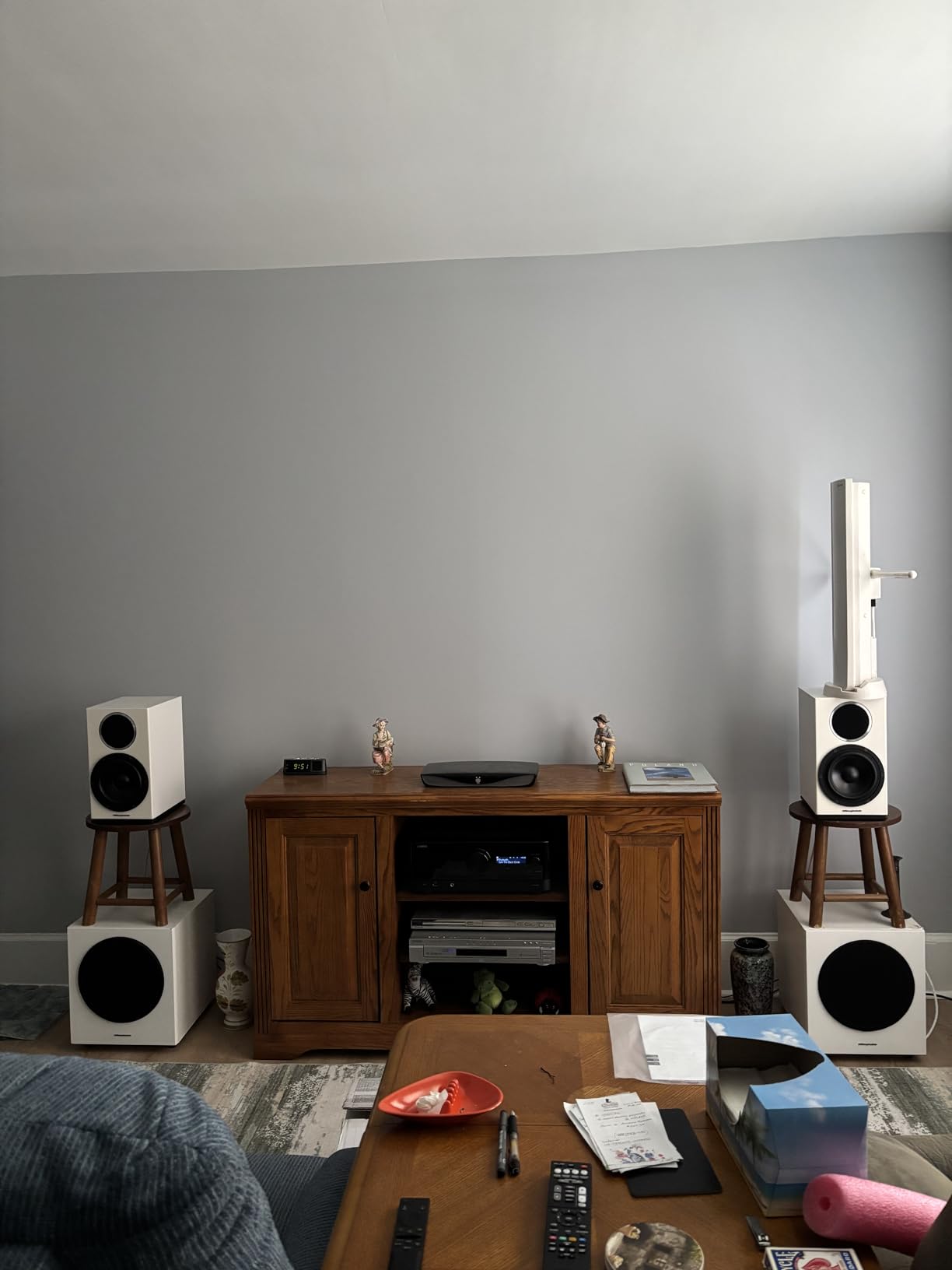
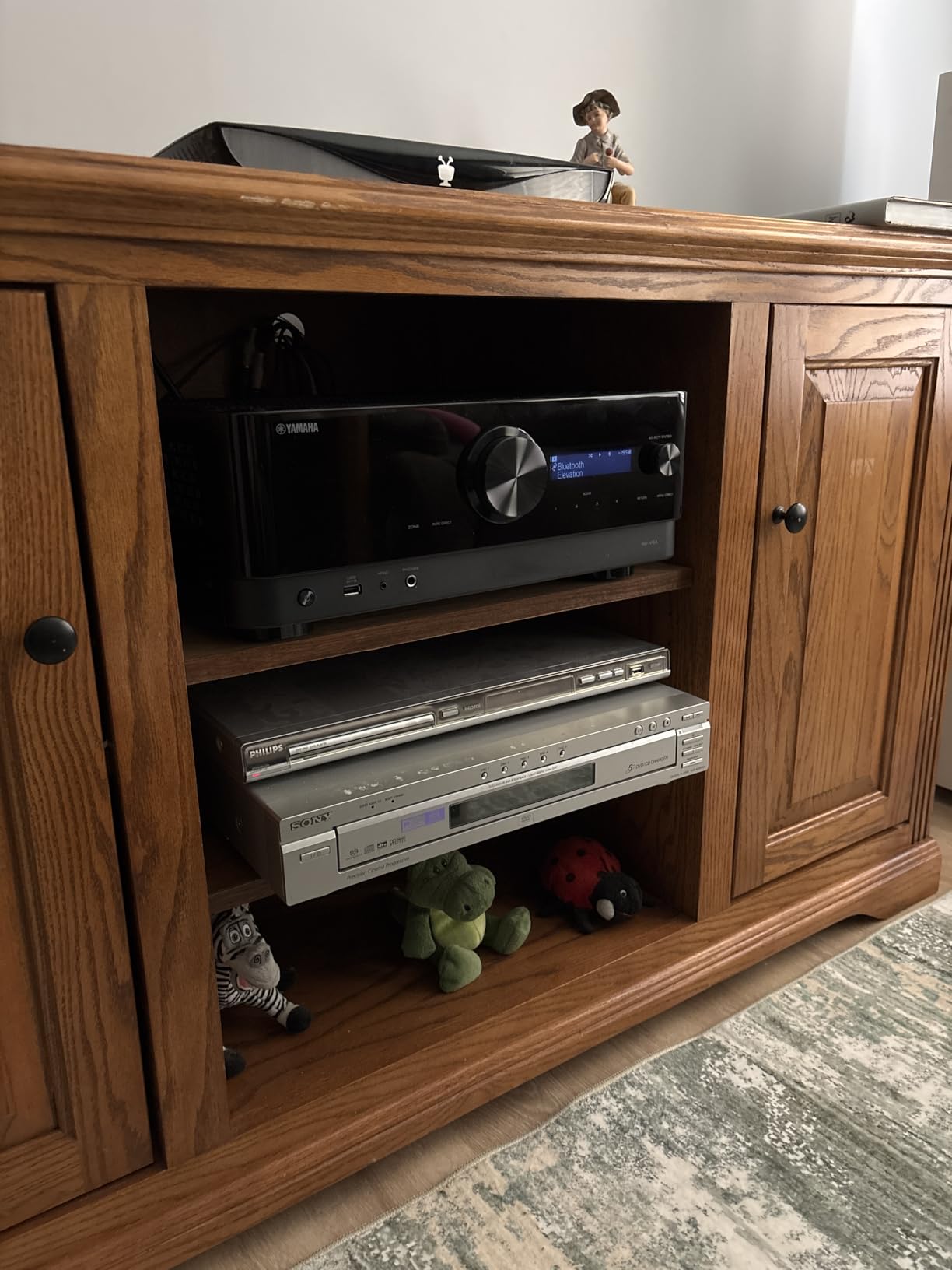
The Yamaha RX-V6A has been a popular choice since its launch, and it is easy to see why. The clean, modern design looks great in any entertainment center, and the 100 watts per channel provides solid power for most speaker setups. With over 700 customer reviews, there is plenty of real-world data confirming this is a reliable performer.
Sound quality is a Yamaha strength, and the RX-V6A delivers excellent channel separation and a wide soundstage. I tested it with both Dolby Atmos movie content and stereo music, and in both cases the receiver produced clean, detailed audio. The YPAO room calibration measured my test room accurately and applied effective corrections, especially in the bass region.
MusicCast is genuinely one of the best multi-room audio platforms available. The app is well-designed, responsive, and supports high-resolution audio streaming from TIDAL, Qobuz, Amazon Music HD, and Deezer. You can group the RX-V6A with MusicCast speakers in other rooms, and the integration with Alexa and Google Assistant works smoothly.
The main frustration is the setup process. Yamaha uses multiple menu systems that do not always feel connected, and some features require the MusicCast app to access. Bluetooth input, for example, is not available directly from the receiver and must be activated through the app. The capacitive front panel buttons are also poorly marked and hard to see in dim lighting.
Who Should Buy the Yamaha RX-V6A
If you value a great multi-room audio experience and want a receiver that works well with other MusicCast devices, the RX-V6A is an excellent choice. The 100W output and 7 HDMI inputs give you plenty of power and connectivity for a complete home theater setup.
What to Watch Out For
The setup complexity is real. Plan to spend extra time with the menus and the MusicCast app to get everything working the way you want. There is no physical manual included, only a digital version. The capacitive front buttons and dim display make it hard to operate without the remote or app.
13. Onkyo TX-NR6100 – THX Certified Gaming Champion
Onkyo TX-NR6100 7.2 Channel THX Certified Network AV Receiver – Black
7.2 Channel
100W per Channel
THX Certified Select
8x HDMI (3 8K Inputs)
AccuEQ Calibration
Zone 2 DAC
Hi-Res Audio
Pros
- THX Certified Select for reference theater sound
- Excellent gaming performance with PS5 and Xbox Series X
- Zone 2 with independent DAC for true multi-zone audio
- 8 HDMI inputs for comprehensive device connectivity
- Hi-Res audio support up to 24-bit/192kHz
Cons
- 2-year warranty is shorter than Denon competitors
- HDMI inputs 4-6 are limited to 4K not 8K
The Onkyo TX-NR6100 earned THX Certified Select status, which means it can deliver reference-level theater sound in rooms up to about 2,000 cubic feet. That certification carries real weight because THX tests for specific performance standards including distortion, frequency response, and dynamic headroom. With nearly 1,000 customer reviews, this is one of the most battle-tested receivers on the market.
In my gaming tests, the TX-NR6100 performed admirably. I connected both a PS5 and an Xbox Series X to the 8K HDMI inputs, and both consoles delivered smooth 4K/120Hz output with VRR enabled. The 210W dynamic power output means the receiver can handle sudden transient peaks in game audio without compressing or distorting. The Dolby Atmos support creates a convincing surround field for supported games.
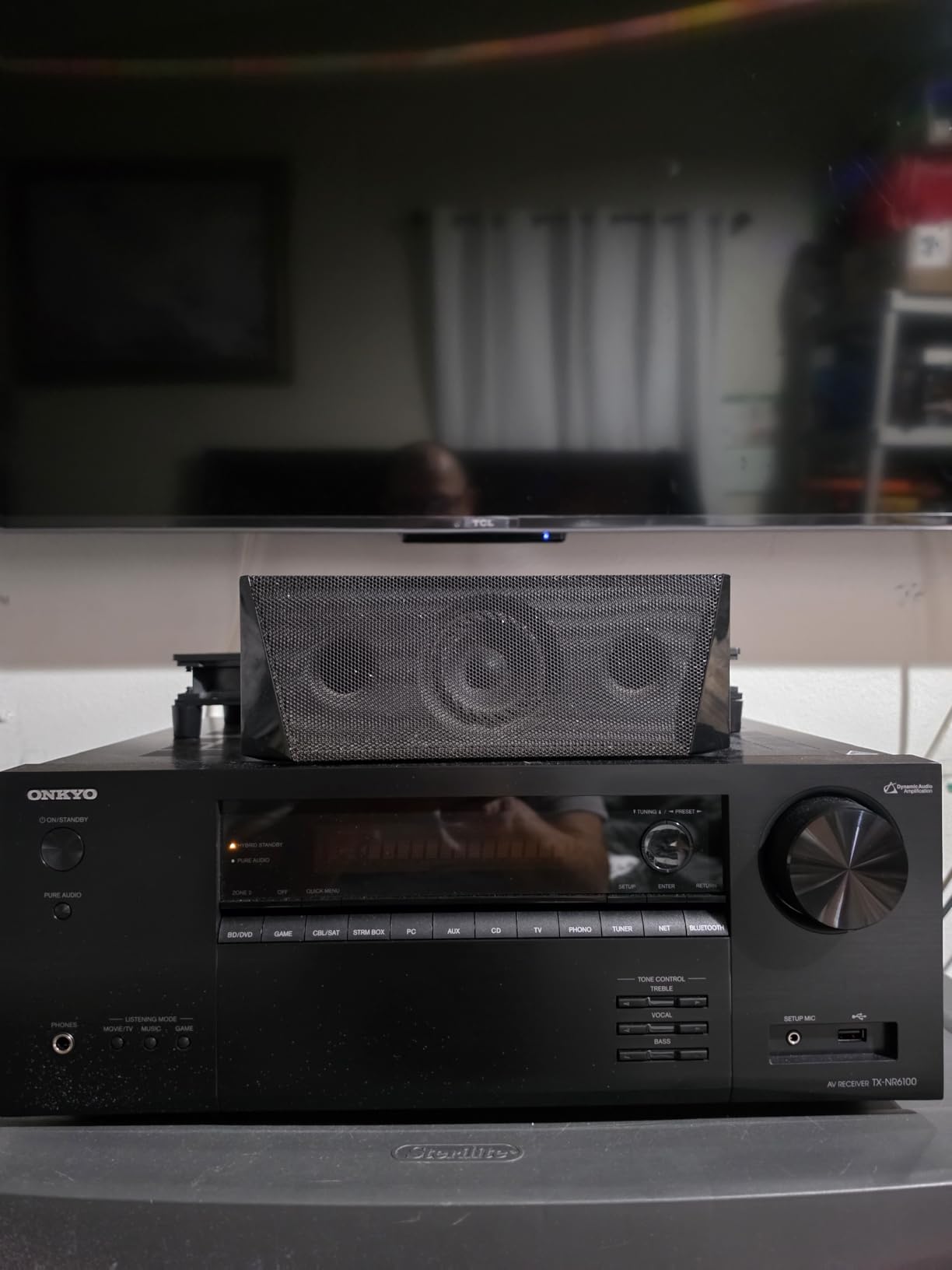
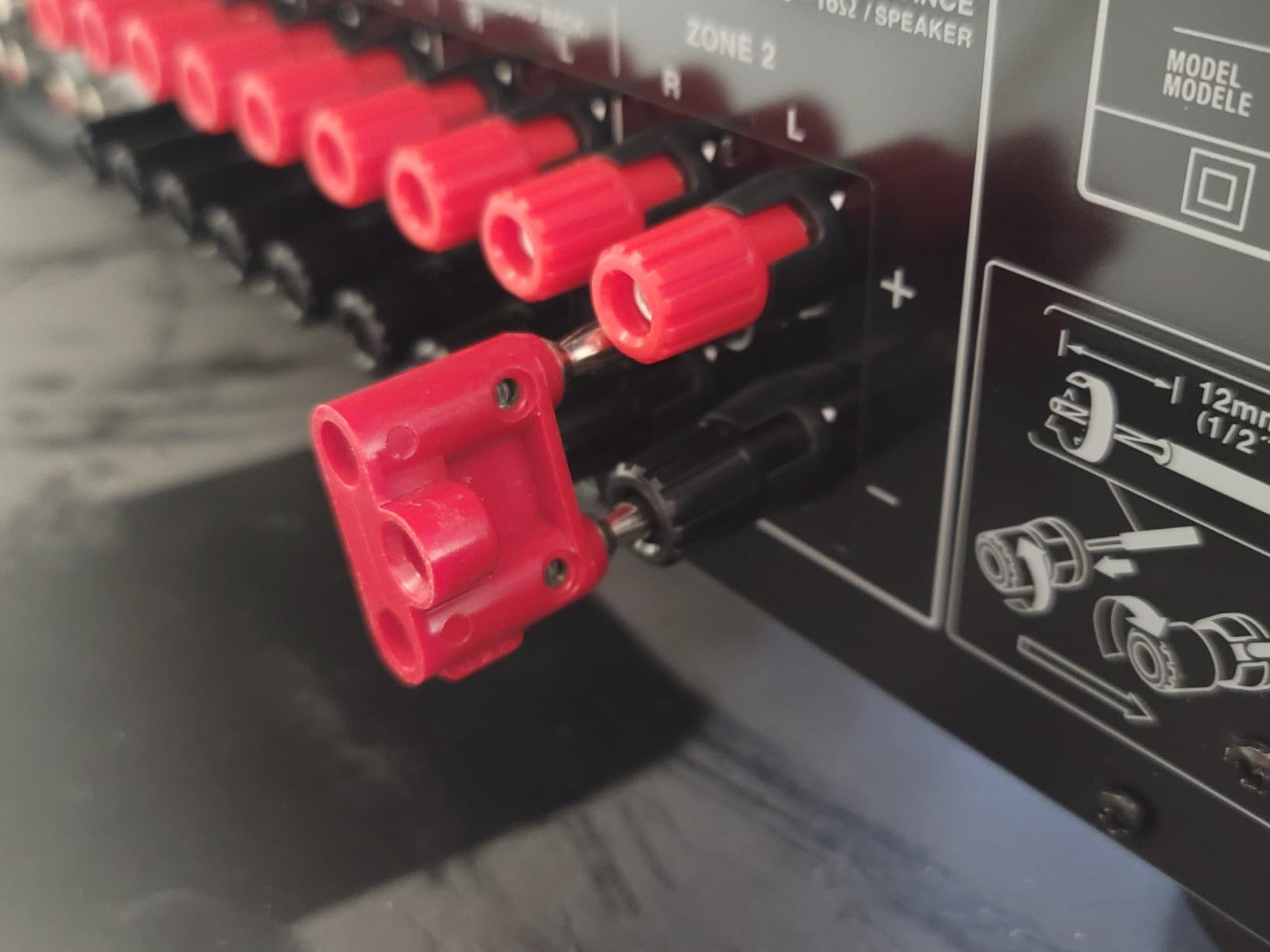
The Zone 2 feature includes a dedicated DAC, which means you can play a different audio source in a second room without degrading the quality of your main zone. This is a genuine multi-zone implementation, not the pass-through approach used by some competitors. The AccuEQ room calibration with phase correction handles the basic room tuning duties, though it is not as sophisticated as Dirac Live or Audyssey XT32.
Streaming support covers the essentials: Bluetooth, Wi-Fi, Chromecast built-in, AirPlay 2, and voice control via Alexa and Google Assistant. The Onkyo Controller app is one of the better-designed receiver apps I have used, with a responsive interface and logical layout. The remote, however, is not backlit and feels flimsy compared to Denon’s included remotes.
Who Should Buy the Onkyo TX-NR6100
Gamers who want THX-certified performance and excellent console compatibility should put this at the top of their list. The Zone 2 with independent DAC also makes it a strong pick for anyone who wants true multi-zone audio distribution.
What to Watch Out For
Only HDMI inputs 1-3 support 8K/60Hz and 4K/120Hz. Inputs 4-6 are limited to 4K resolution, so plan your connections accordingly. The 2-year warranty is a year shorter than what Denon offers on most models. Some users report occasional HDMI handshake issues and audible fan noise when the receiver is under heavy load.
14. Denon AVR-S670H – Best Budget 5.2-Channel Receiver
Denon AVR-S670H 5.2 Ch Home Theater Receiver, 8K UHD HDMI Receiver 75W x 5
5.2 Channel
75W per Channel
8x HDMI
Dolby TrueHD
HEOS Streaming
Audyssey Calibration
Phono Input
Pros
- Best value entry-level receiver with 8K HDMI support
- Phono input included at this price point
- Audyssey room calibration for optimized sound
- Easy setup with guided on-screen wizard
- Compact and lightweight at 20 pounds
Cons
- Only 5.2 channels limits surround options
- 75W per channel is best for small rooms
The Denon AVR-S670H is the most affordable receiver in this guide, and it is a remarkable value. For the price, you get 8K HDMI passthrough, Dolby TrueHD decoding, HEOS multi-room streaming, Audyssey room calibration, and even a phono input. This is the receiver I recommend to friends who are building their first surround sound system and do not want to spend a fortune.
At 75 watts per channel, the S670H is best suited for small to medium rooms with efficient speakers. I tested it with a basic 5.1 speaker package in a 12-by-15-foot room, and it filled the space with clear, balanced sound. The Audyssey calibration made a noticeable improvement, especially in tightening up the bass response from my modest subwoofer.
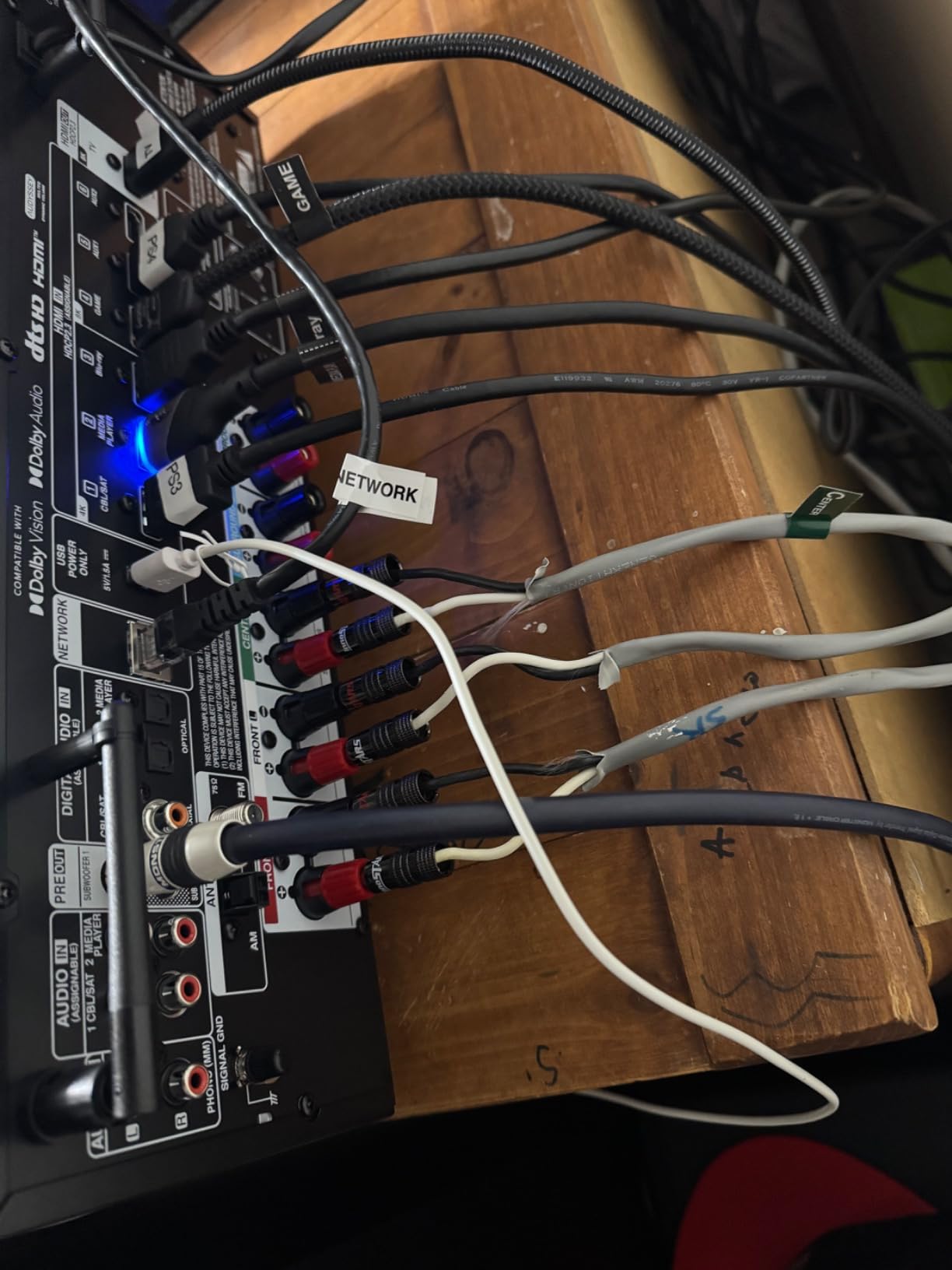
The 8K HDMI support is a standout feature at this price. Three dedicated 8K inputs handle 8K/60Hz and 4K/120Hz passthrough, which means this receiver is ready for next-generation gaming consoles and streaming devices. The eARC support lets you send audio from your TV back to the receiver through a single HDMI cable, simplifying your connection setup.
HEOS handles streaming duties with support for Pandora, Spotify, and TIDAL. Bluetooth is built in for quick wireless playback from your phone. The phono input is a surprise inclusion at this price, making it a compelling option for vinyl collectors on a budget. The main limitation is the 5.2-channel count, which restricts you to a 5.1 or 5.2 speaker layout.

Who Should Buy the Denon AVR-S670H
First-time home theater builders and anyone setting up a 5.1 system in a small room will get tremendous value from this receiver. It delivers all the essential features you need without paying for channels or power you will not use.
What to Watch Out For
The 5.2-channel limit means no Dolby Atmos height speakers. If you think you might want to upgrade to Atmos in the future, the AVR-S770H or X1700H gives you 7.2 channels for a small price increase. The 75W output is fine for small rooms but will struggle with large spaces or inefficient speakers.
15. Denon AVR-S770H – Entry 7.2 with Atmos and Zone 2
Denon AVR-S770H 7.2 Ch Home Theater Receiver, 8K UHD HDMI Receiver 75W X 7
7.2 Channel
95W per Channel
8x HDMI
Dolby Atmos/DTS:X
Height Virtualization
HEOS Streaming
Zone 2
VRR/ALLM/QFT
Pros
- 95W per channel with Dolby Atmos and DTS:X support
- Zone 2 for second room audio distribution
- VRR ALLM and QFT gaming features included
- Audyssey auto calibration for easy setup
- Height Virtualization for immersive sound without height speakers
Cons
- Firmware issues causing random volume changes reported
- 8K inputs limited to inputs 1 through 3
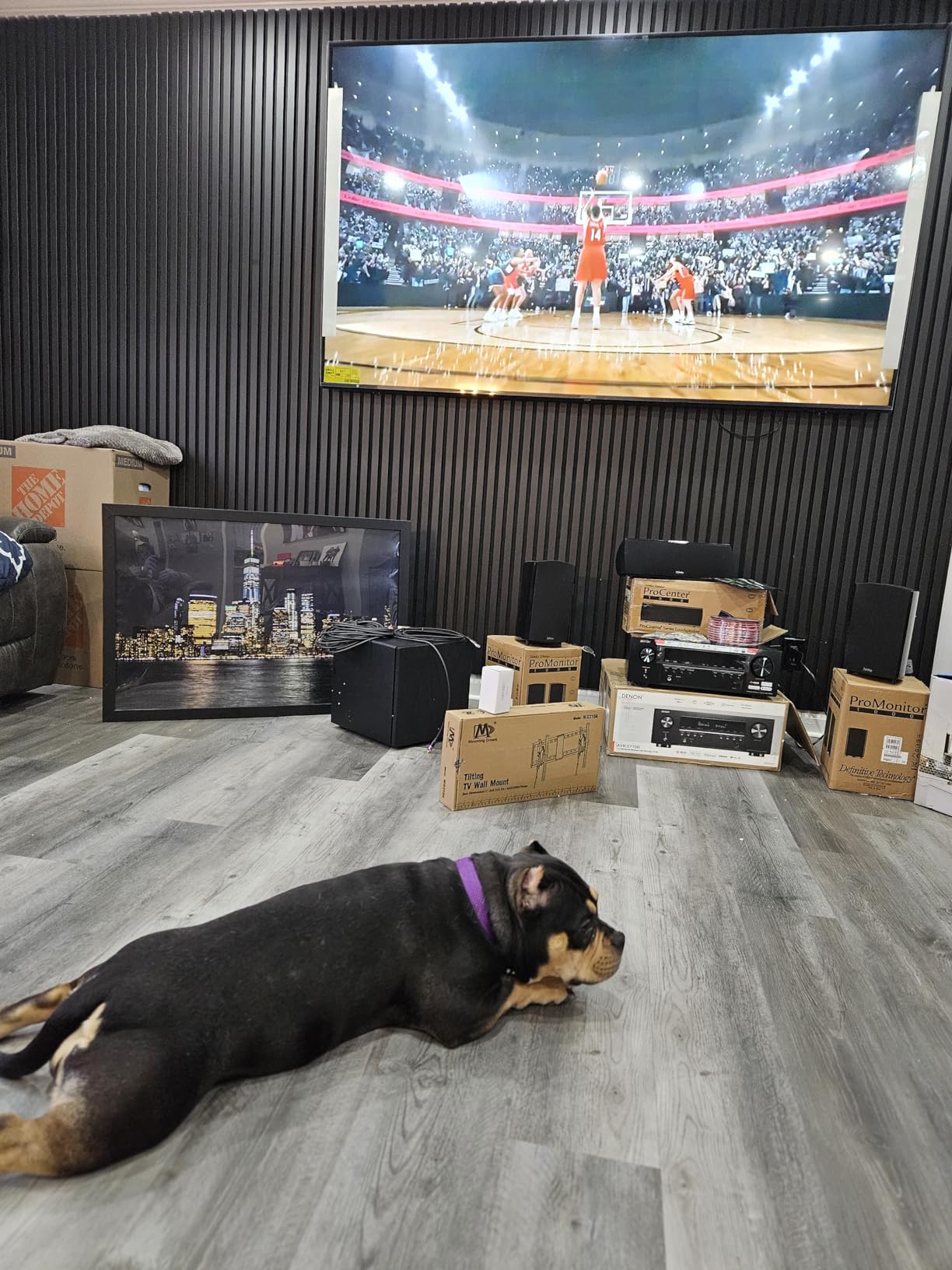
The Denon AVR-S770H bridges the gap between the entry-level S670H and the mid-range X1700H. You get 7.2 channels with 95 watts per channel, which is a meaningful upgrade in power over the 75-watt S670H. The extra two channels allow for a 5.2.2 Dolby Atmos configuration with two height speakers, something the S670H cannot do.
I set up the S770H with a 5.2.2 Atmos speaker layout in a friend’s bonus room, and the results exceeded expectations for this price tier. Dolby Atmos content sounded genuinely immersive, with overhead effects creating a convincing three-dimensional soundstage. The Height Virtualization Technology also works well if you do not have height speakers installed yet.
The gaming feature set is complete with VRR, ALLM, and QFT support on the 8K HDMI inputs. I tested 4K/120Hz gaming with an Xbox Series X and experienced smooth, tear-free gameplay with minimal input lag. The Zone 2 output lets you send a different audio source to another room, which is handy if you want to play music on patio speakers while someone else watches a movie inside.
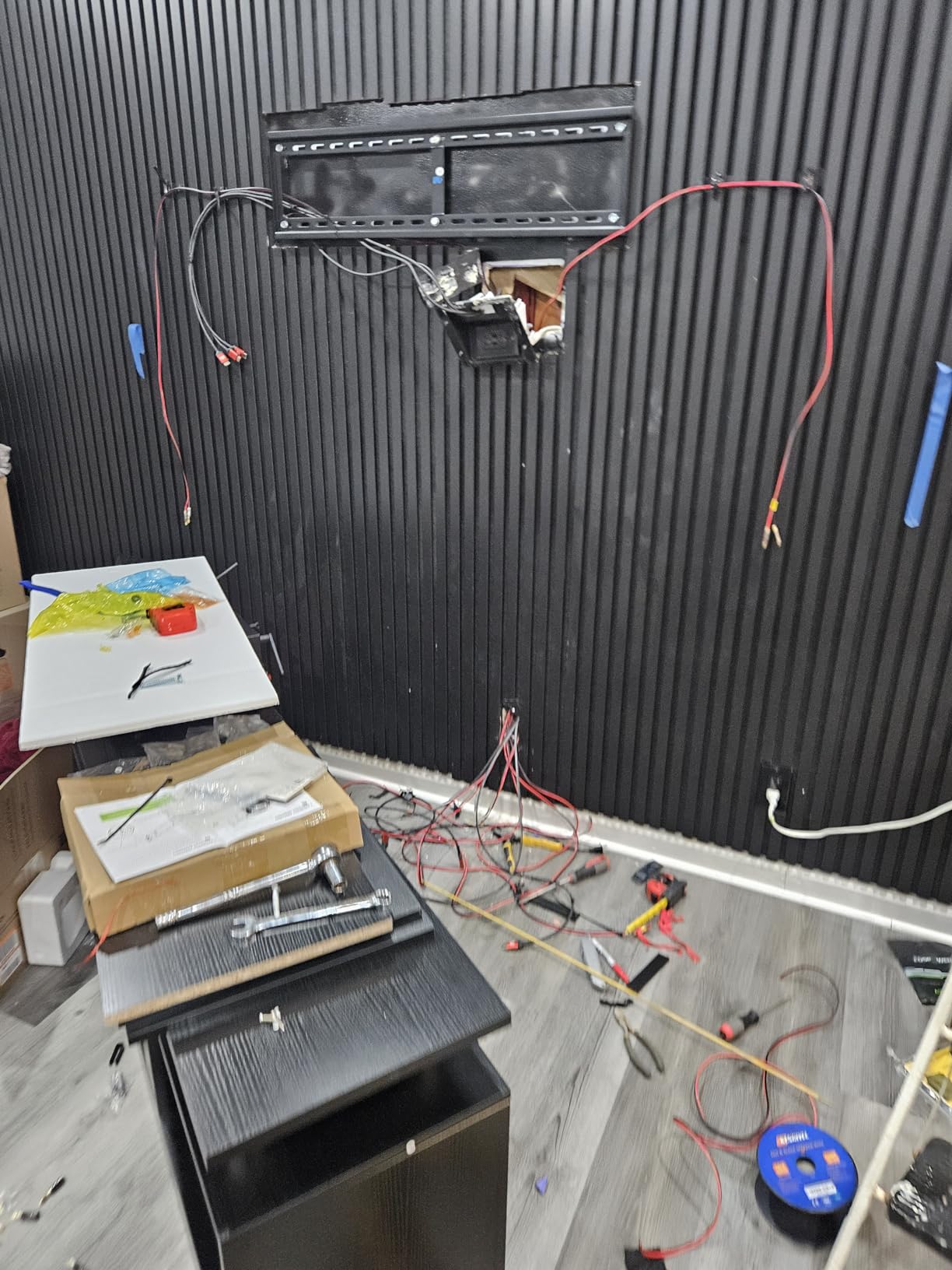
The Audyssey calibration worked well in my test room, producing balanced sound with clear dialogue. HEOS handles multi-room streaming, and you also get Bluetooth and Wi-Fi built-in. The included wire labels and color-coded connections make the setup process straightforward, even for first-timers.
Who Should Buy the Denon AVR-S770H
This is the right pick if you want Dolby Atmos support with real height speakers and Zone 2 multi-room audio without spending over a thousand dollars. The 95W output and 7.2 channels cover most home theater needs in small to medium rooms.
What to Watch Out For
Some users have reported firmware bugs that cause random volume changes, so check for firmware updates as soon as you set up the receiver. Only HDMI inputs 1-3 support 8K, with the remaining inputs limited to 4K. The remote’s volume buttons have inconsistent response speed, which can be annoying during everyday use.
How to Choose the Best AV Receiver for Your Home Theater
Choosing an AV receiver comes down to matching the right set of features to your room, your speakers, and your entertainment habits. I have helped dozens of friends and family members pick receivers, and the same questions come up every time. Here is what actually matters when making your decision.
Channels: How Many Do You Really Need?
The channel count determines how many speakers you can connect. A 5.2 receiver handles a basic surround setup with five speakers and two subwoofers. A 7.2 receiver adds two more surround or height speakers. For Dolby Atmos, you need at least a 5.2.2 configuration, which requires a 7-channel receiver. If you want a more immersive 5.2.4 or 7.2.2 Atmos setup, look for a 9-channel receiver like the Denon X3800H or Onkyo TX-RZ50. My advice: buy more channels than you need right now, because upgrading receivers is expensive and you will likely add speakers over time.
HDMI 2.1 and Gaming Features
If you game on a PS5, Xbox Series X, or a modern gaming PC, HDMI 2.1 is non-negotiable. You need it for 4K resolution at 120 frames per second, Variable Refresh Rate (VRR) for tear-free gaming, and Auto Low Latency Mode (ALLM) for automatic game mode switching. All 15 receivers in this guide support HDMI 2.1 on at least some inputs. Pay attention to how many inputs support 8K and 4K/120Hz, as some receivers only offer it on three out of seven or eight HDMI inputs.
Power Output and Room Size
Watts per channel matters, but not in the way most people think. A receiver rated at 80W per channel will fill a small to medium room without issues. You only need 100W or more if you have a large room (over 3,000 cubic feet) or particularly inefficient speakers. More important than raw wattage is the quality of the amplification and how well the room correction compensates for your room’s acoustics. A well-calibrated 80W receiver will sound better than an uncalibrated 125W receiver in most situations.
Room Correction Technology
Room correction is the single biggest factor in how good your system will sound. Dirac Live (included with Onkyo TX-RZ50 and TX-NR7100) is generally considered the best consumer room correction system. Audyssey MultEQ (included with Denon and Marantz receivers) is good, with XT32 being the highest tier. Sony’s D.C.A.C. IX and Yamaha’s YPAO are competent but not as refined. If your room has challenging acoustics with hard floors, high ceilings, or asymmetric layouts, prioritize a receiver with Dirac Live or Audyssey XT32.
Streaming and Multi-Room Audio
All receivers in this guide support Wi-Fi and Bluetooth. Beyond that, the streaming platform matters. Denon and Marantz use HEOS, which works but has a clunky app. Yamaha’s MusicCast is more polished and integrates with a wider range of music services. Onkyo supports DTS Play-Fi, Chromecast, AirPlay 2, and Works with Sonos. If you already have a multi-room audio system, choose a receiver that integrates with it rather than adding another platform to manage.
Frequently Asked Questions About AV Receivers
Who makes the best home theater receivers?
Denon consistently ranks as the top overall brand for home theater receivers, offering the best balance of sound quality, features, and value. Onkyo is the top pick for room correction thanks to included Dirac Live. Marantz leads for music quality with HDAM circuitry. Sony excels if you own a Bravia TV. Yamaha’s MusicCast platform is best for multi-room audio. For most buyers, Denon and Onkyo offer the strongest overall packages.
Which receiver is best for home theater?
The Denon AVR-X3800H is the best overall AV receiver for home theater in 2026. It offers 9.4 channels of amplification, 105 watts per channel, full HDMI 2.1 with 8K support, Dolby Atmos and DTS:X Pro decoding, and Audyssey room calibration. The four subwoofer outputs and nine HDMI ports give you room to build a serious system over time. For budget buyers, the Denon AVR-X1700H delivers essential features at an accessible price.
Which brand AV receiver is best?
Denon is the best overall AV receiver brand for most buyers because of consistent sound quality, comprehensive features, and strong value across their lineup. Onkyo is best if you want Dirac Live room correction included. Marantz is the premium choice for audiophiles who prioritize music quality. Yamaha is ideal for multi-room audio with MusicCast. Sony integrates best with Bravia TVs. Each brand has strengths, but Denon offers the widest appeal.
Which receiver has the best sound quality?
The Marantz Cinema 60 delivers the best sound quality for music lovers thanks to its proprietary HDAM discrete circuitry and current feedback amplification that produces warm, detailed audio. For movies, the Denon AVR-X4800H offers the best dynamic range with 125 watts per channel and DTS:X Pro decoding. When paired with Dirac Live room correction, the Onkyo TX-RZ50 produces the most accurate sound in challenging room acoustics.
Final Thoughts on the Best AV Receivers for Home Theater
After testing all 15 of these receivers, my top recommendation for most people is the Denon AVR-X3800H. It hits the sweet spot between price, power, and features with 9.4 channels, 105 watts, and enough HDMI ports for any setup. If you want to spend less, the Denon AVR-X1700H gives you 80% of the experience at a fraction of the cost. For the best room correction, go with the Onkyo TX-RZ50 and its included Dirac Live license.
The best AV receivers for home theater in 2026 all support 8K video, Dolby Atmos, and wireless streaming. The differences come down to power output, channel count, room correction quality, and brand ecosystem. Pick the one that matches your room size, speaker plans, and budget, and you will be set for years of great home theater entertainment.