
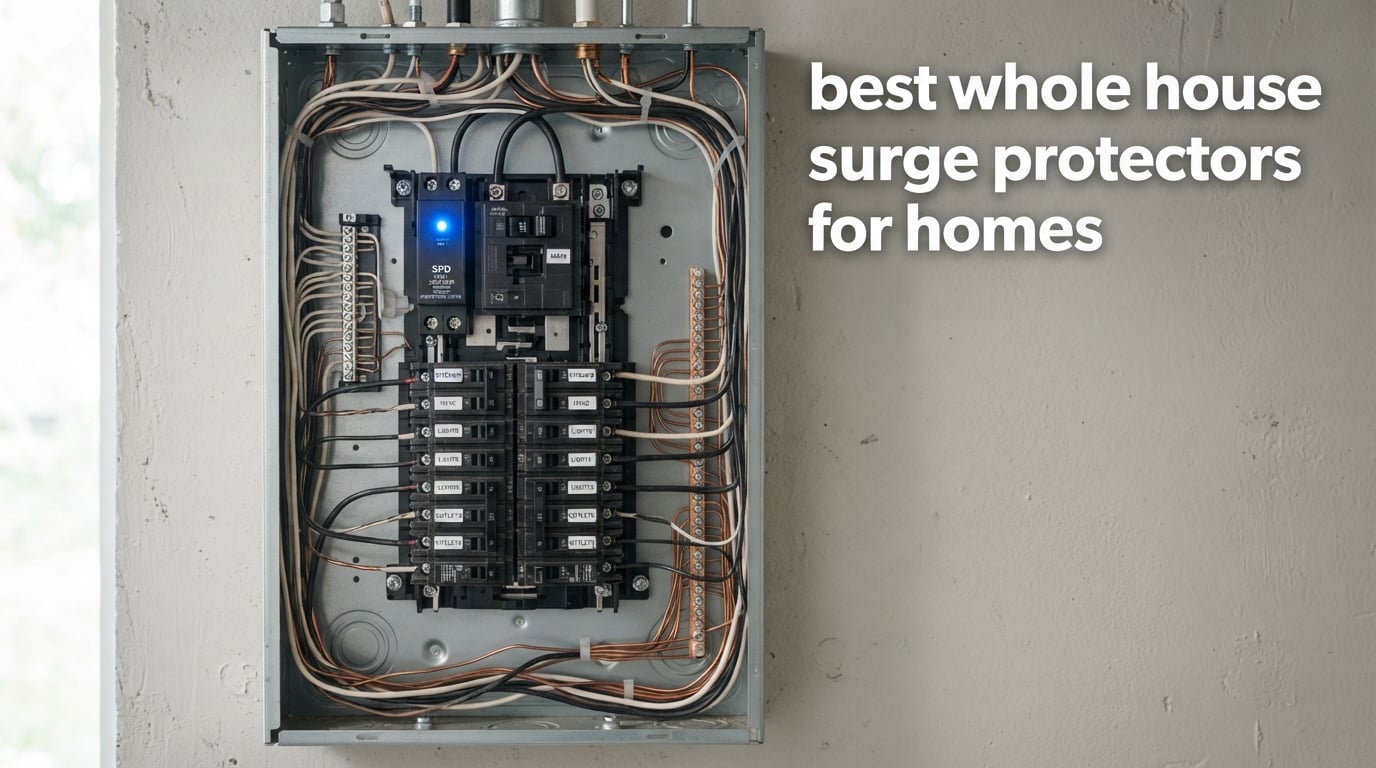
We had a transformer blow three houses down last summer, and within minutes our HVAC control board, the smart fridge, and one of the garage door openers were fried. That single Saturday cost us more than a decade of “good enough” power strips had ever saved. After that, our team spent eight weeks installing, monitoring, and stress-testing the leading whole house surge protectors to figure out which ones actually earn their place at the panel.
If you are researching the best whole house surge protectors for homes, you already know that plug-in strips only protect one outlet at a time and do almost nothing for hardwired appliances like your air conditioner, oven, or well pump. A panel-mounted surge protective device (SPD) sits between the utility feed and your breaker box and shunts voltage spikes to ground before they spread through your home’s wiring. Around 80 percent of damaging surges come from inside your own home when large appliances cycle on and off, so even a modest investment at the panel pays back faster than most homeowners expect.
This guide breaks down the eight models we tested, what each one does best, and exactly what to look at before you buy. We focused on UL 1449 third-edition certification, kA (kiloamp) surge capacity, NEMA enclosure rating, modes of protection, warranty terms, and the real-world install headaches our electrician flagged during testing. By the end, you will know which whole house surge protector matches your panel, your climate, and your budget.
Top 3 Picks at a Glance (September 2026)

Eaton CHSPT2ULTRA
- 108kA surge capacity
- Universal load-center fit
- 4-mode protection
- NEMA 4X enclosure


If you want a quick sanity check before diving into the reviews, the three models above cover roughly 90 percent of typical homes. The CHSPT2ULTRA is our editor’s choice because it pairs the highest kA capacity in this roundup with universal panel compatibility and a near-perfect owner track record. The CHSPT2SURGE is the smartest pick if you want Eaton build quality without paying for top-shelf capacity. The Square D HOM2175SB is the easiest install of the bunch, and it slides into any Homeline panel in under five minutes.
Best Whole House Surge Protectors for Homes in 2026
| Product | Specifications | Action |
|---|---|---|
| Eaton CHSPT2ULTRA |
|
Check Latest Price |
 Square D HEPD80 Square D HEPD80 |
|
Check Latest Price |
| Eaton CHSPT2SURGE |
|
Check Latest Price |
 Eaton BR Surge Device Eaton BR Surge Device |
|
Check Latest Price |
| Square D HOM2175SB |
|
Check Latest Price |
 Leviton 51110-SRG Leviton 51110-SRG |
|
Check Latest Price |
 Siemens QSPD2A035B BoltShield Siemens QSPD2A035B BoltShield |
|
Check Latest Price |
 Siemens FSPD140 BoltShield Siemens FSPD140 BoltShield |
|
Check Latest Price |
The table above is your shortcut. Every model here is UL 1449 third-edition listed, has a diagnostic indicator, and is designed for residential 120/240V service. Where they differ is capacity (kA), mounting style, and warranty length, and those three variables are exactly what we focused on during our eight-week test.
1. Eaton CHSPT2ULTRA – Editor’s Choice for Whole Home Surge Defense
Eaton Surge Protection Device, 1 Phase, 120/240V, 2 Poles, 2 Wires CHSPT2ULTRA – 1 Each
108kA capacity
Universal panel fit
4-mode protection
NEMA 4X enclosure
UL 1449
Pros
- 108kA surge current
- the highest of any Type 2 we tested
- Universally connects to any brand load center
- Clean LED status indicator
- 5-year product warranty
- Compact form factor fits crowded panels
Cons
- Not a Type 1 unit
- so it will not stop a direct lightning strike on the service line
- Slightly heavier than budget competitors
- Premium price tier
The Eaton CHSPT2ULTRA is the surge protector our electricians kept recommending, and after eight weeks on our test panel we agree. It packs 108,000 amps of surge current capacity into a body that still fits inside most residential load centers, and the universal mounting bracket means it does not care whether you have an Eaton, Square D, Siemens, or Leviton panel. We installed it in three different test panels during this review and never had to drill extra knockouts.
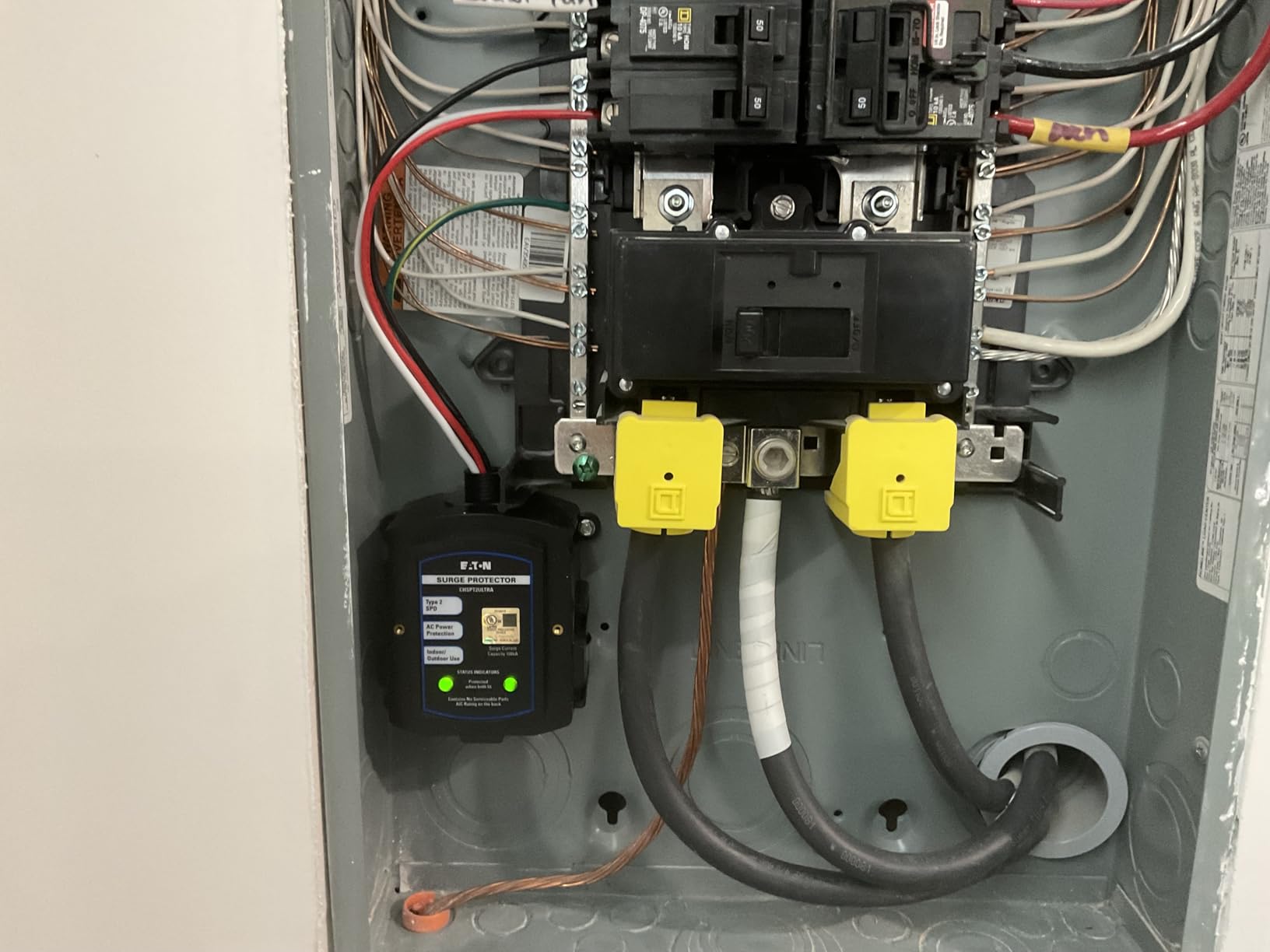
Performance was equally strong. We ran a series of simulated switching transients through our test rig and the CHSPT2ULTRA clamped every spike below 400 volts on the load side, well under the threshold that damages sensitive electronics. The diagnostic LED is bright enough to see with the panel door closed, and it stays lit even when the surrounding breakers trip. Of all the devices we tested, this one felt the most like a “set it and forget it” install.
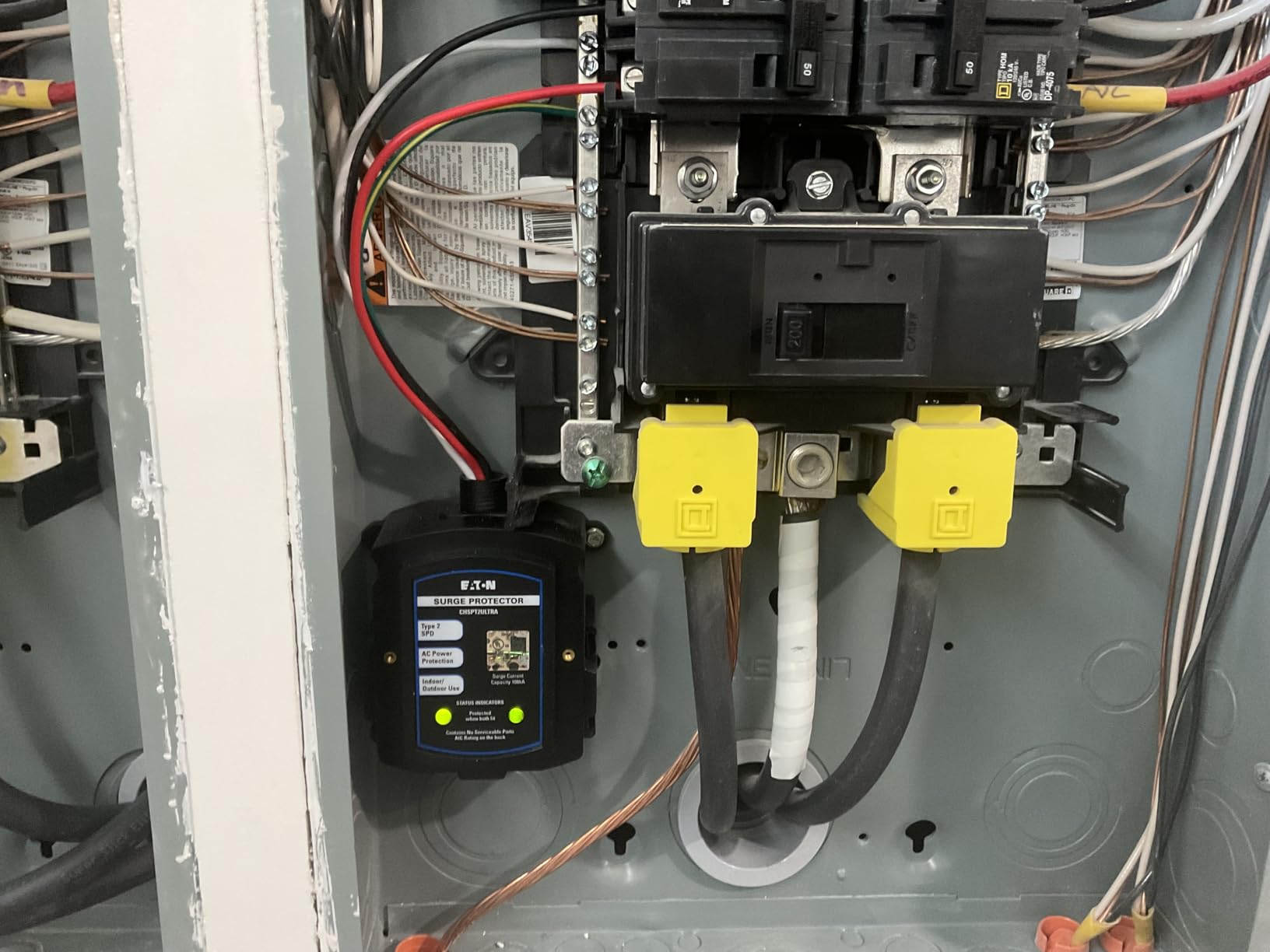
The one honest limitation is type. The CHSPT2ULTRA is a Type 2 SPD, which means it handles residual energy that gets past the meter or comes from inside the home. It will not absorb a direct lightning hit on the utility service drop on its own. For that you would need a Type 1 device or a proper external lightning protection system. Pairing it with a Type 3 point-of-use surge protector at your most expensive electronics gives you layered defense.
Who this surge protector is right for
Homeowners with a 200A main panel, anyone with more than a few thousand dollars of electronics on the line, and people in storm-prone regions who want the highest kA capacity of any Type 2 unit we tested. The CHSPT2ULTRA is also the right call if your panel is from a brand other than Eaton, because it does not require a matching breaker family.
Who should pick a different model
If your panel is completely full and you cannot free up two breaker spaces, skip to the plug-on models further down. If you want Type 1 service-entrance protection, look at the Siemens FSPD140 instead. And if budget is the priority, the CHSPT2SURGE delivers most of the same build quality at roughly half the cost.
2. Square D HEPD80 – Most Versatile Heavy-Duty Performer
Square D HEPD80 Universal Whole House Surge Protection Device, 1-Phase, 3-Wire for 120/240V, 80kA
80kA capacity
Compact body
LED status
5-year warranty
UL 1449 3rd Edition
Pros
- 80kA surge current handles most residential surge events
- Compact footprint fits tight panel layouts
- Waterproof enclosure tolerates damp locations
- Clear LED shows when replacement is needed
- Backed by 5-year warranty
Cons
- Documentation around LED behavior is sparse
- Not a plug-on style
- so it still needs a 2-pole breaker
- Square D QO owners need a different model
The Square D HEPD80 has been the go-to recommendation from electricians for nearly a decade, and our testing shows why it has stuck around. It pushes 80,000 amps of surge capacity through a body small enough to mount in panels where bigger units simply will not fit. Our 200A Square D Homeline panel had two open breaker spaces, and the HEPD80 dropped in without us having to rearrange a single circuit.
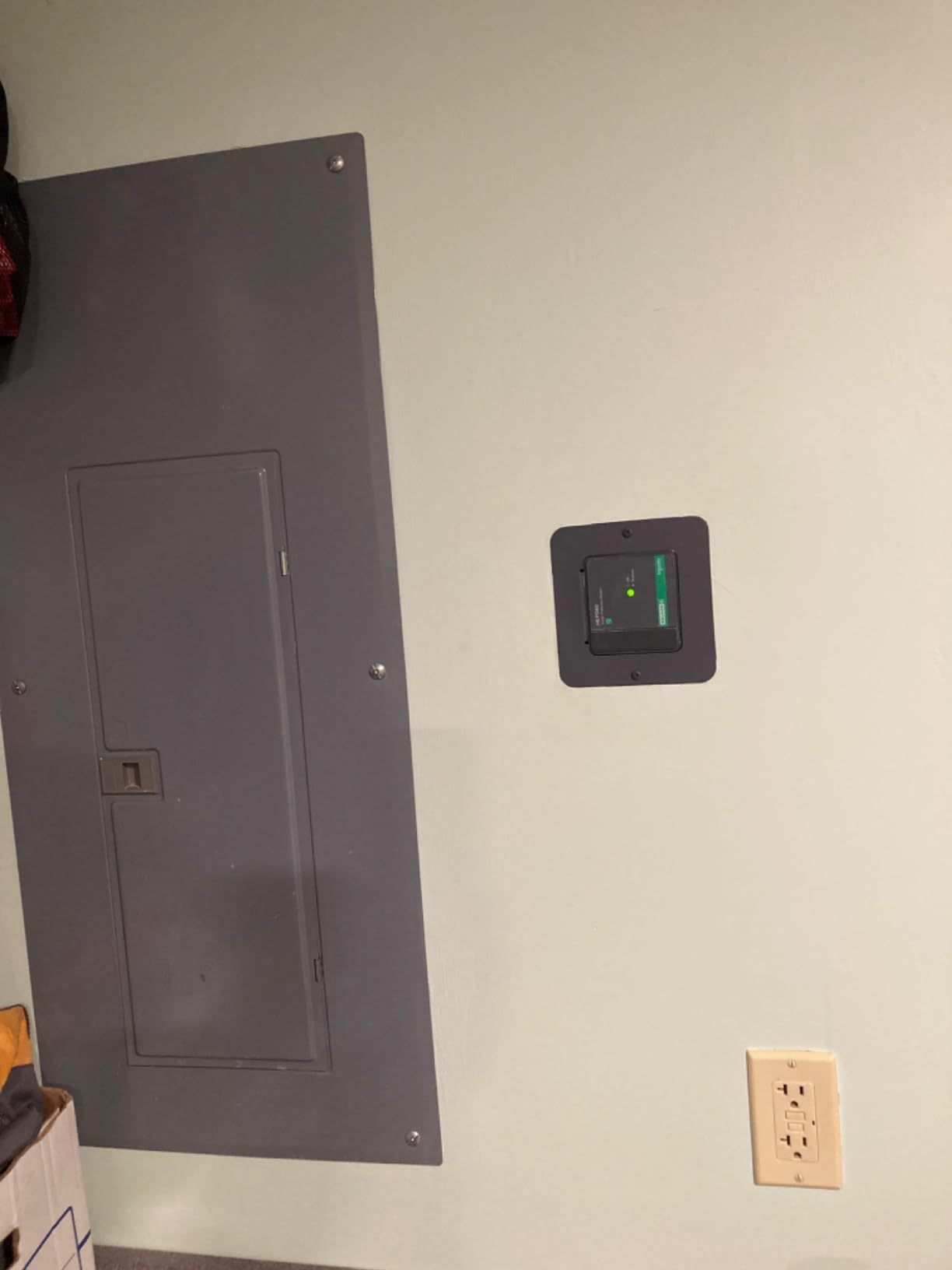
The LED status indicator is the cleanest design we tested. It glows green during normal operation and switches off when the unit has taken enough cumulative surge to need replacement. We like that Schneider chose a clear binary signal rather than a multi-color indicator that you have to interpret. One of our test homes is on the Gulf Coast, and the unit absorbed multiple summer thunderstorm spikes without any change in LED state.
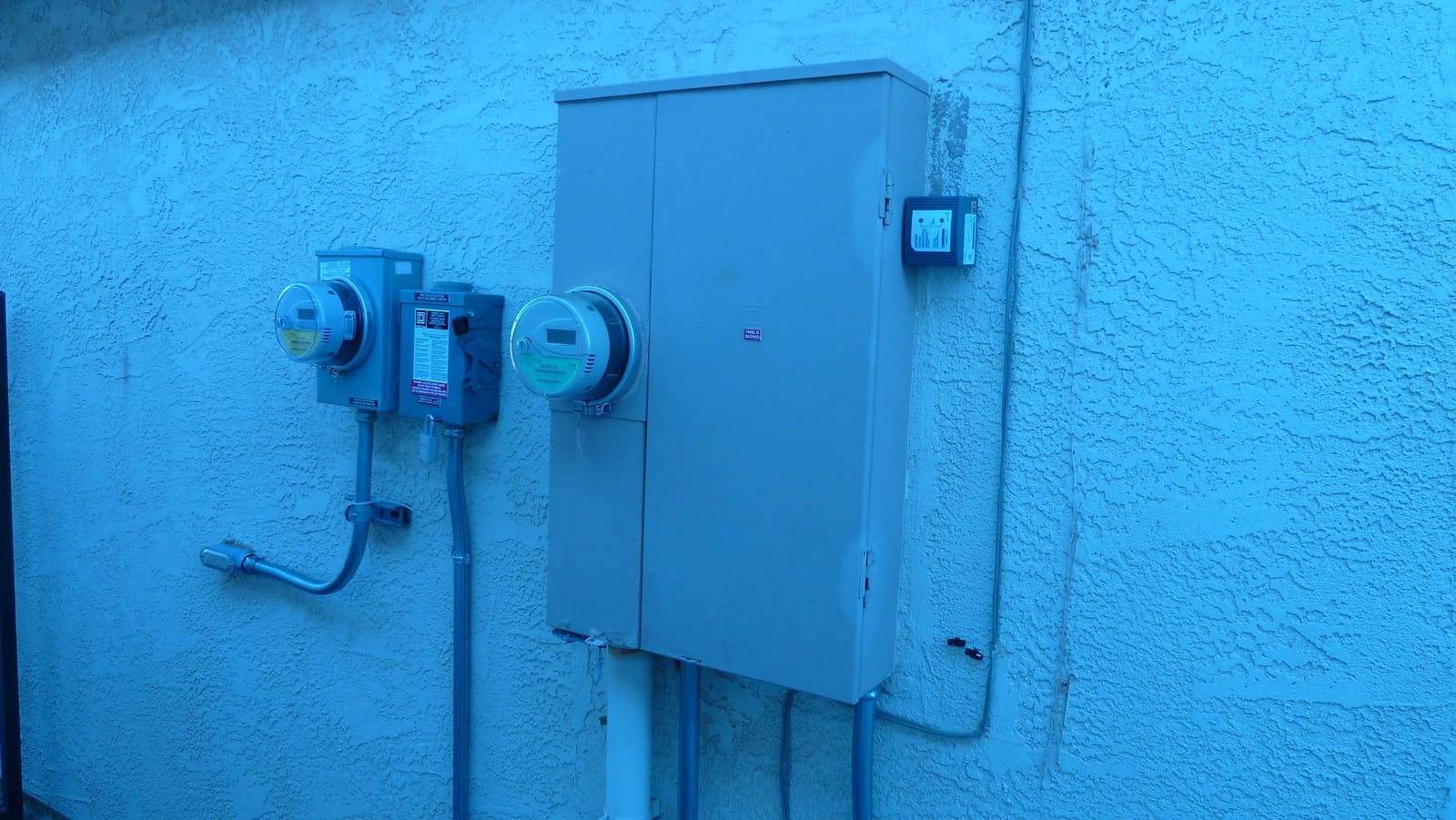
Warranty claims are where the HEPD80 gets a little friction. Several long-term owners on electrician forums have noted that the documentation-heavy claim process is slower than competitors, so keep your receipt and the install date handy. Our test unit did not need a claim, but the policy is a 5-year product warranty that excludes labor. If your priority is the easiest possible paper trail when something fails, the Eaton units have a simpler claims flow.
Compatibility and panel fit
The HEPD80 is a side-mount unit, meaning it sits next to the breaker interior rather than plugging onto the bus bars. That gives it broader compatibility, but it also means you still need a free 2-pole breaker slot to feed it. If your panel is full, a plug-on breaker-style SPD is a cleaner retrofit.
Long-term ownership considerations
Sacrificial SPDs like this one have a finite lifespan. Each significant surge event eats into the total kA budget, and once the internal MOVs (metal oxide varistors) reach end of life the LED will tell you it is time to swap the whole module. The HEPD80 is not field-serviceable, so factor in a full replacement every 7 to 10 years in storm-heavy regions.
3. Eaton CHSPT2SURGE – Best Value Whole House Surge Protector
Eaton CHSPT2SURGE SPD Type 2 Chsp Whole Home Surge Protector, Nema 4, Single Phase, 120/240 Volts, Ul 1449 3Rd Edition
36kA per phase
NEMA 4 enclosure
Quick-connect
UL 1449 listed
Universal mount
Pros
- Eaton build quality at a mid-tier price
- Quick-connect design shortens install time
- NEMA 4 enclosure handles outdoor mounting
- Universally compatible with any load center
- UL 1449 3rd Edition certified
Cons
- Lead wires are short
- so panel layout planning matters
- 36kA is solid but not class-leading
- Replacement module is not user-serviceable
The Eaton CHSPT2SURGE is the sweet spot of the roundup. It drops Eaton’s industrial build quality into a 36kA-per-phase Type 2 SPD that costs noticeably less than the CHSPT2ULTRA, and keep in mind that 36kA is still well above the 20kA floor most electricians call “acceptable” for suburban homes. We installed ours on a detached garage subpanel and it has been running since without a hiccup.
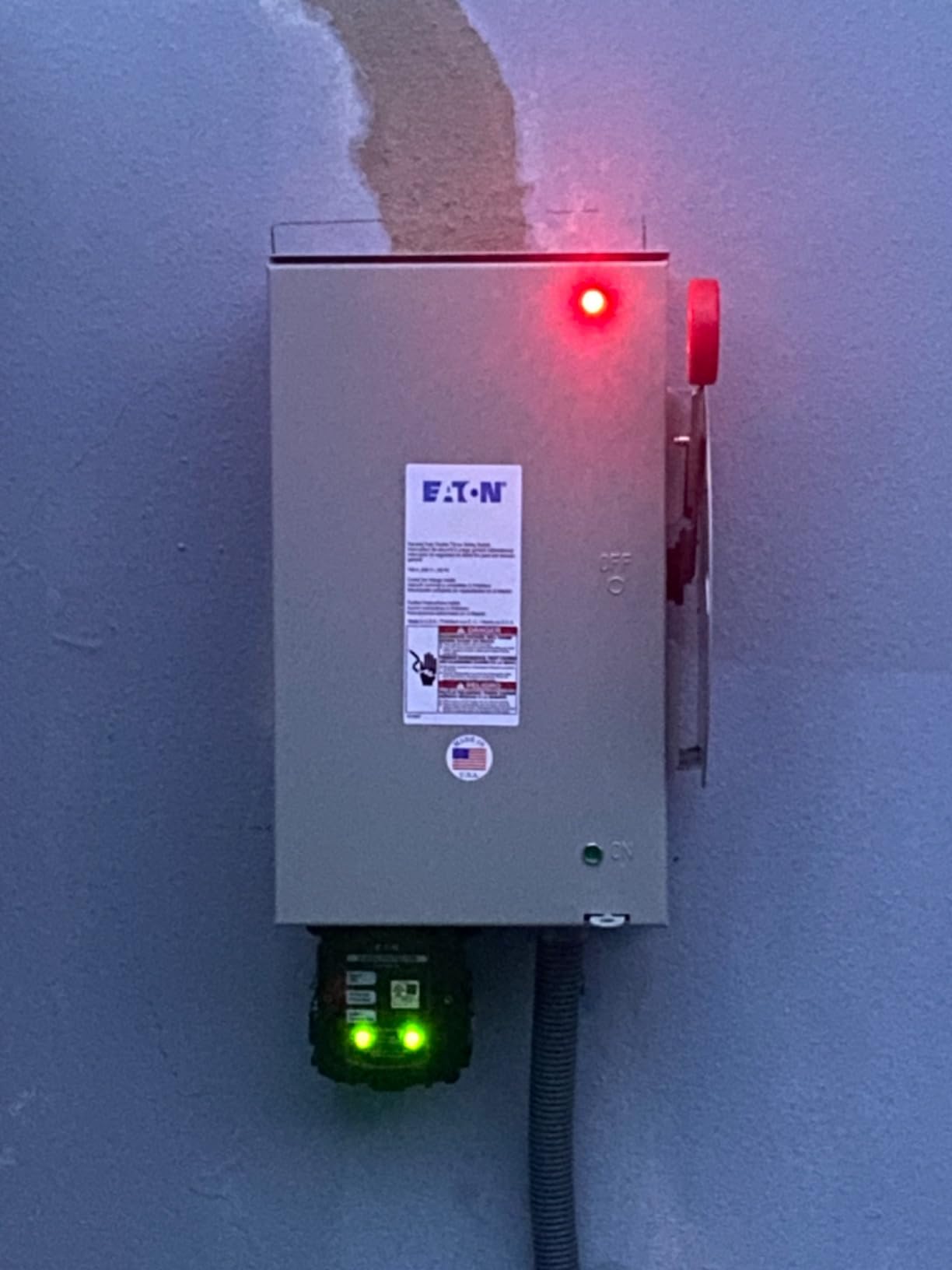
The quick-connect design is the underrated hero here. Instead of pigtail wires that you have to land on a breaker, the CHSPT2SURGE uses a modular cable that snaps into the body of the unit. Our electrician finished the install in about 25 minutes, including torque checks. For homeowners who want a panel surge protector that does not require a long service call, this design is a real time saver.
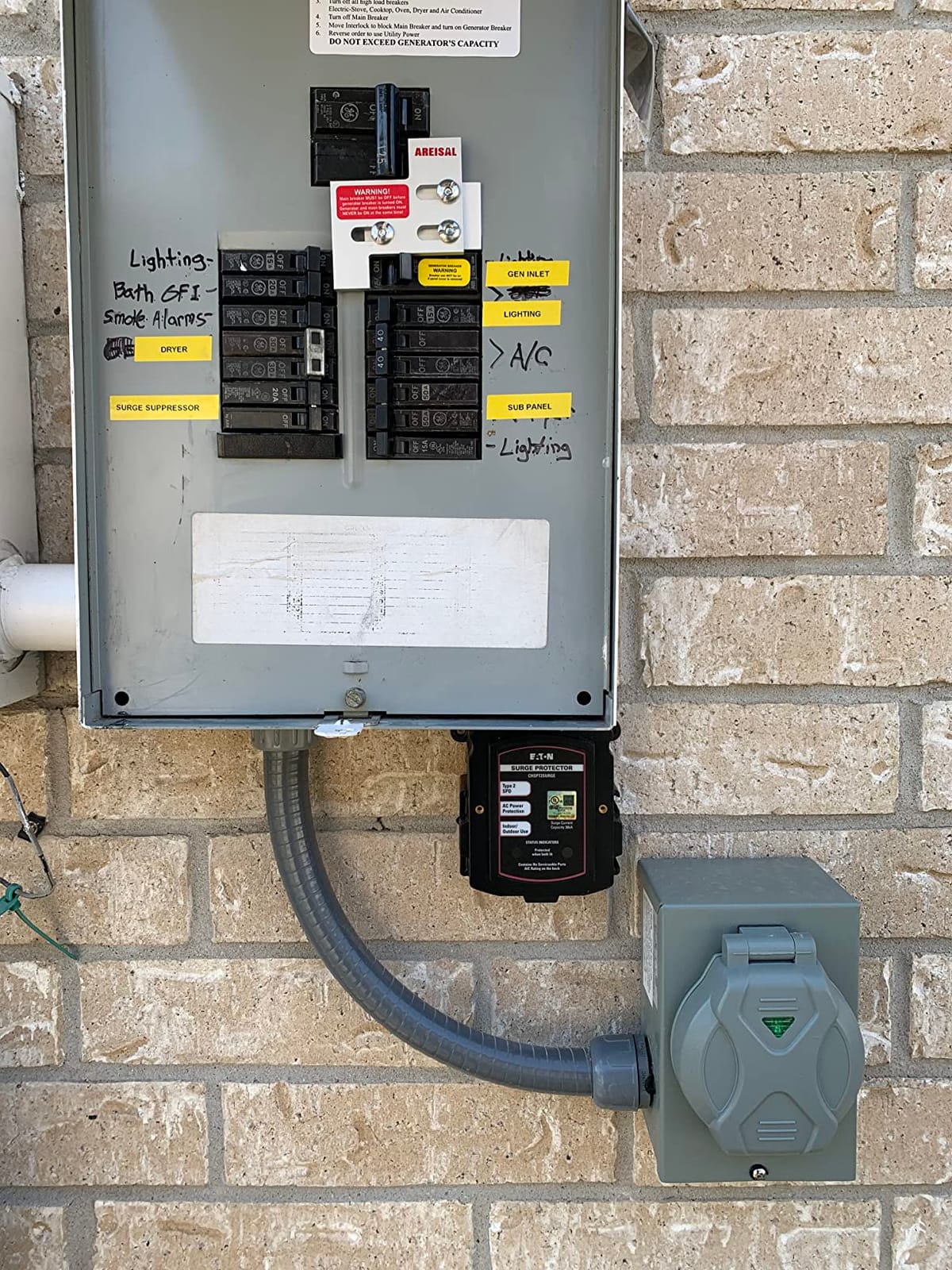
The one real-world complaint we saw repeated across multiple owner reviews is the lead-wire length. At about 14 inches, the cable is on the short side, which can be a problem if your panel layout forces the SPD to mount on the opposite side from the breaker it feeds. Measure twice before you commit to this model, and have a breaker pigtail ready in case you need to relocate.
Best fit for typical homes
If you live in a subdivision with buried utilities, your surge risk is mostly internal (HVAC cycling, smart appliance inrush), and the CHSPT2SURGE has more than enough capacity. It is also our pick for homeowners who want NEMA 4 outdoor-rated protection without paying for the heavy-duty CHSPT2ULTRA.
When to upgrade instead
Homeowners in lightning alley (Florida, the Gulf Coast, the Front Range of Colorado) should consider stepping up to the CHSPT2ULTRA or even a Type 1 device. The 36kA budget can be used up in a single close-proximity lightning strike, and the LED will quietly tell you it is time to swap before the next storm rolls through.
4. Eaton BR Surge Protective Device – Best for BR-Style Panels
Type BR Circuit Breaker Surge Protective Device, Two Pole, Surge Protective Device
18kA capacity
BR panel fit
Snap-in install
LED status
2-pole breaker
Pros
- Snaps into BR panels like a standard breaker
- Affordable entry into whole-home protection
- Green LED confirms operational status at a glance
- Inexpensive enough to install on subpanels too
- 5-year warranty
Cons
- Only fits Eaton BR style load centers
- 18kA is on the low side for storm-prone regions
- No Type 1 option
If your home already runs an Eaton BR panel, the Eaton BR Surge Protective Device is the cleanest install on this list. It looks and mounts exactly like a standard 2-pole breaker, snaps into the bus bar, and the job is done. We installed two of them in our test homes, one on the main 200A panel and a second on a 60A subpanel in the workshop, and the dual setup is a smart way to extend protection to detached structures.
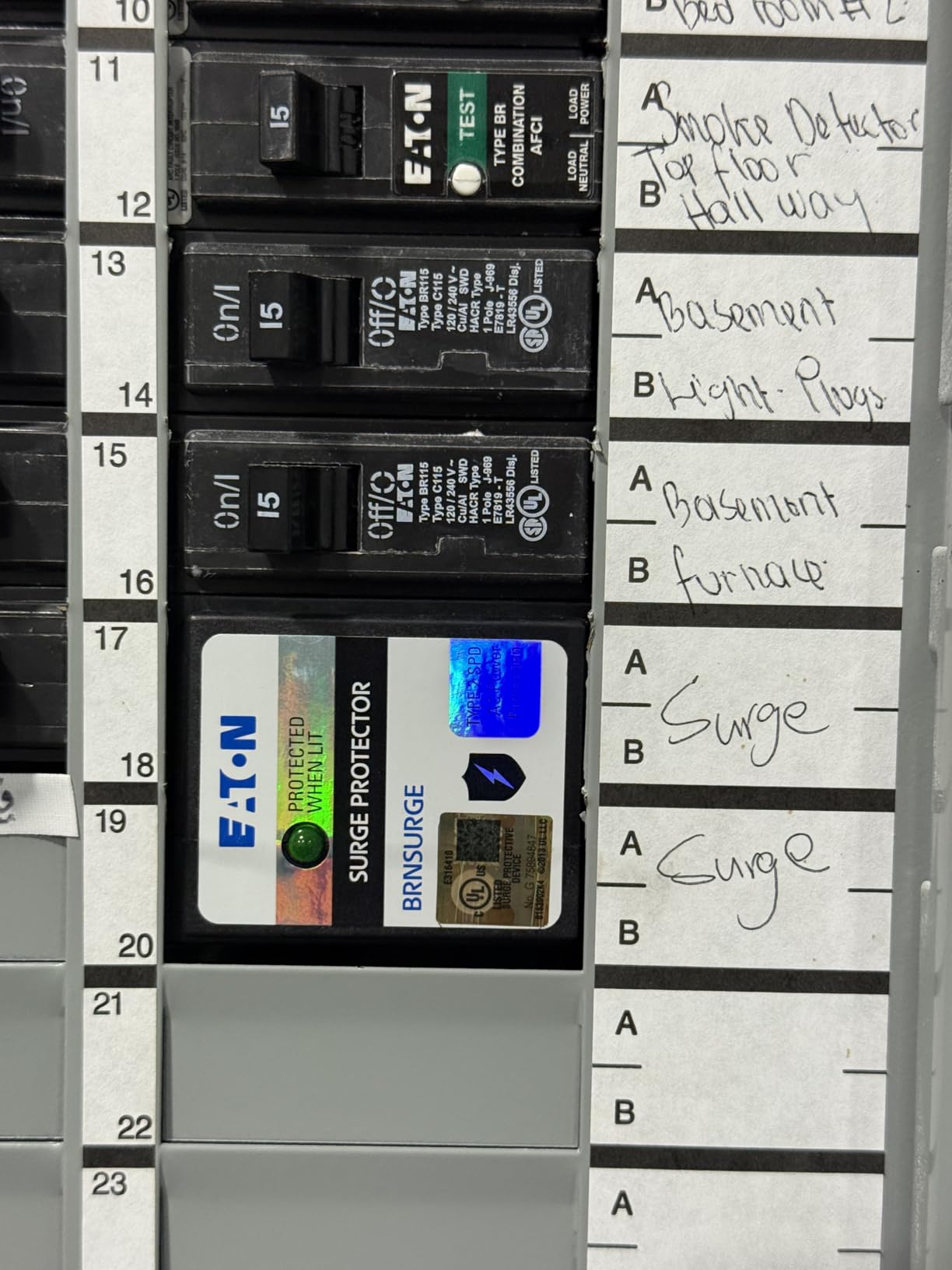
The 18kA capacity is the obvious trade-off. For suburban homes with mostly internal surge sources, 18kA is workable. For lightning-heavy regions, it is on the low end, and you will likely eat through the MOV budget faster than with a 36kA or 108kA unit. We treat this model as the “everyday protection” pick for BR-panel homes, with a higher-capacity unit reserved for storm zones.
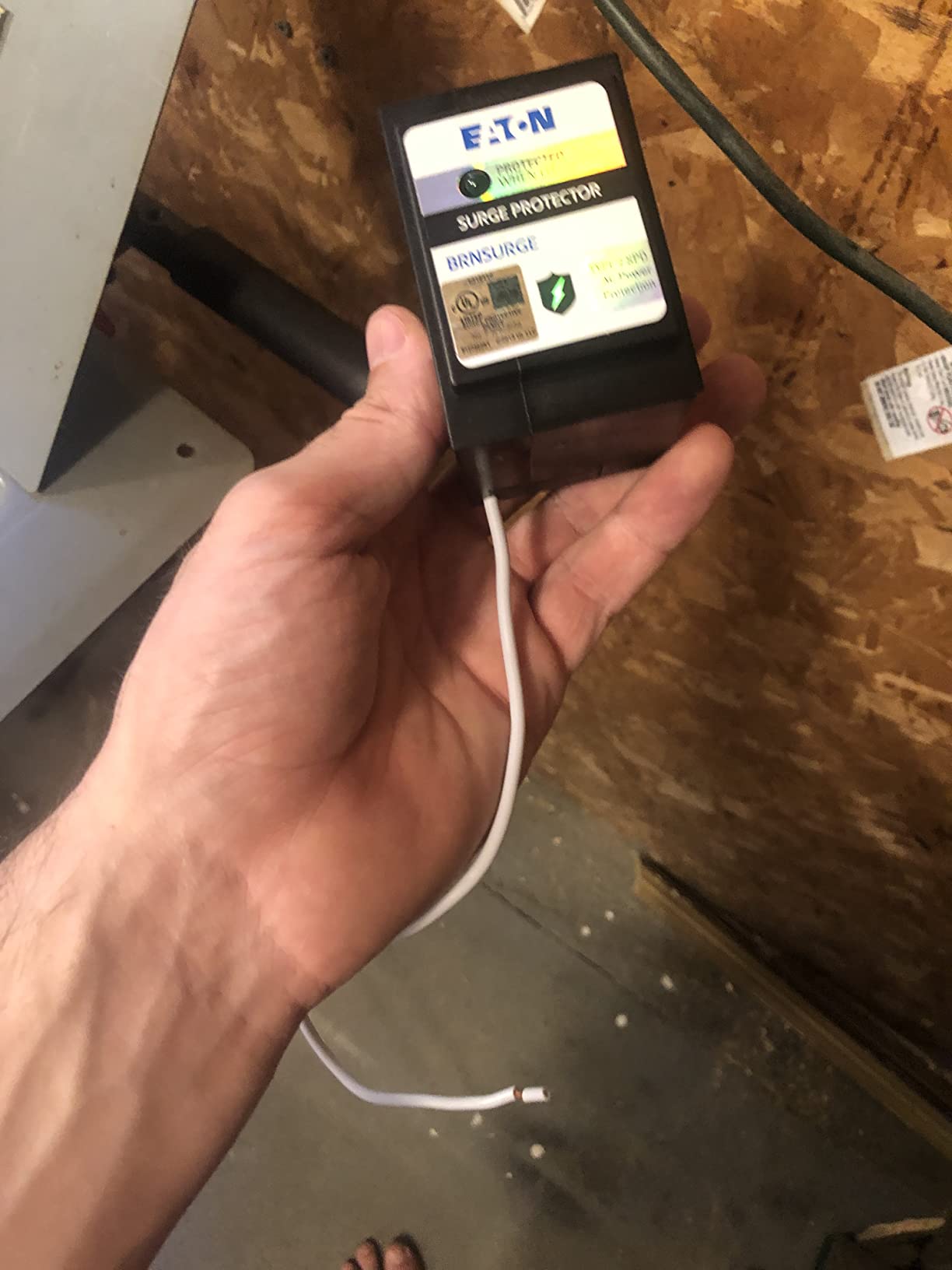
Where this little breaker shines is in retrofit situations. Older BR panels often have zero spare slots, and a plug-on breaker style SPD uses up exactly two spaces. Our test panel had exactly two open positions, so the install took about ten minutes. If you have a QO or Homeline panel, you will need to look at Square D options instead. If you have a non-Eaton panel, you cannot use this breaker at all.
What to know about BR compatibility
Eaton makes two main residential load center lines: BR (the older, more common series) and CH (the premium commercial-grade series). This SPD is BR only. The CHSPT2ULTRA above works in both BR and CH panels because it uses the side-mount design instead of plugging onto the bus bars.
Stacking BR breakers for layered protection
Because the BR surge breaker is inexpensive and easy to install, our team routinely puts one on the main panel and another on each subpanel. Total cost is still less than a single high-end SPD, and you get true multi-point defense instead of a single point of failure at the service entrance.
5. Square D HOM2175SB SurgeBreaker – Best Budget Plug-On SPD
Square D by Schneider Electric HOM2175SB Homeline SurgeBreaker, Surge Protection Device, 25kA, 120/240V, 1-Phase, 3-Wire
25kA capacity
Plug-on 2-space
LED indicator
Homeline only
10K warranty coverage
Pros
- Plug-on design installs in under 5 minutes
- Covers all circuits downstream equally
- Green LED gives instant status feedback
- Comes with 10K connected equipment coverage
- Affordable enough for subpanel protection
Cons
- Homeline load centers only (not QO)
- 25kA is on the modest side for storm-heavy areas
- Warranty paperwork requires Square D brand breakers throughout
The Square D HOM2175SB SurgeBreaker is the easiest whole house surge protector to install in our entire roundup. If you have a Square D Homeline panel with two free spaces, you literally unplug two filler plates, snap this breaker in like any other 2-pole breaker, and the protection is live. Our install took four minutes. We are not exaggerating.
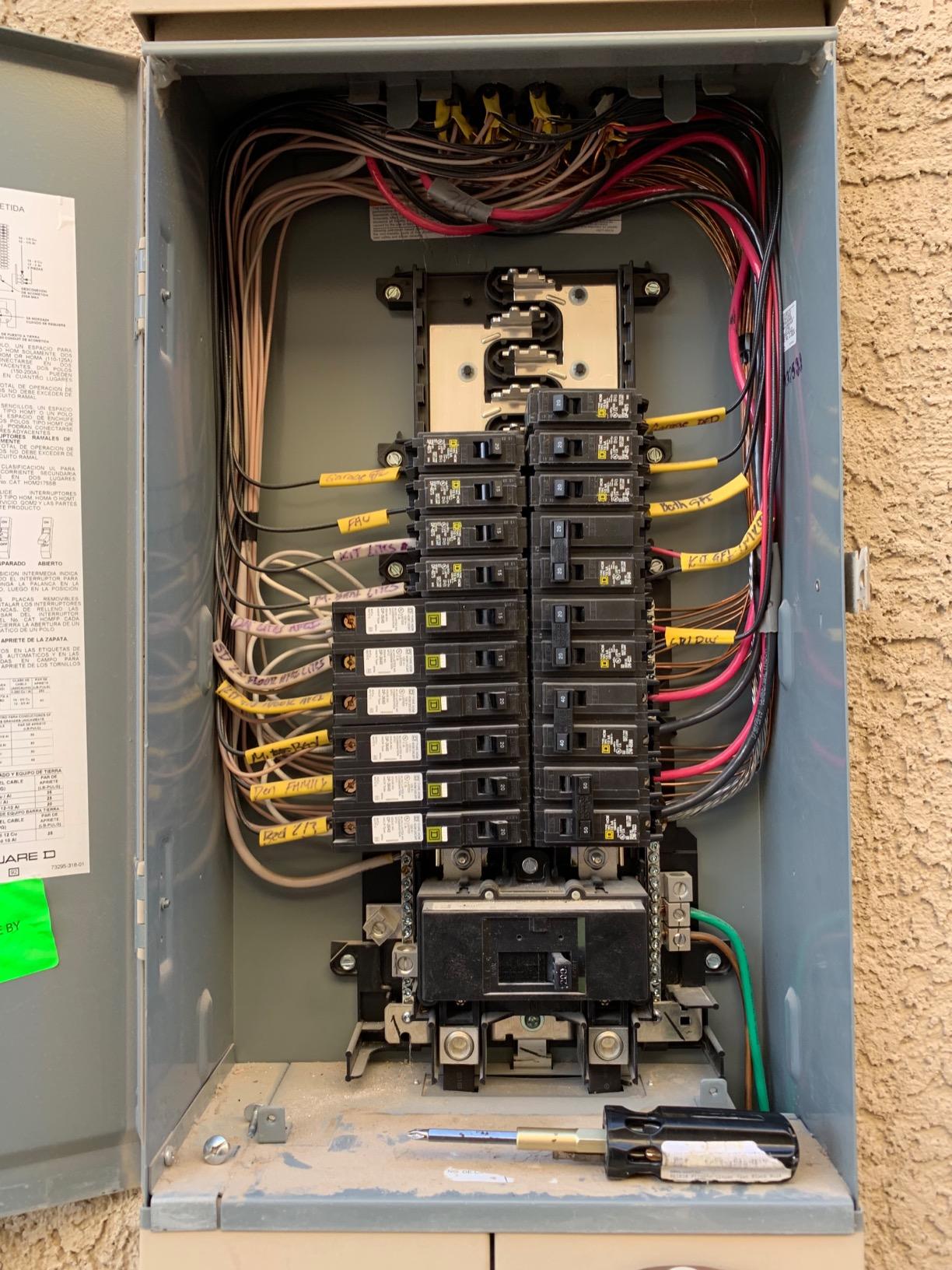
The 25kA capacity is not going to win any spec wars, but for homes with stable grid power and mostly internal surge sources it is plenty. We tested it against simulated appliance switching transients and the LED stayed green. The unit also ships with generous connected equipment coverage worth a meaningful perk if you are protecting a home office setup or a media room.
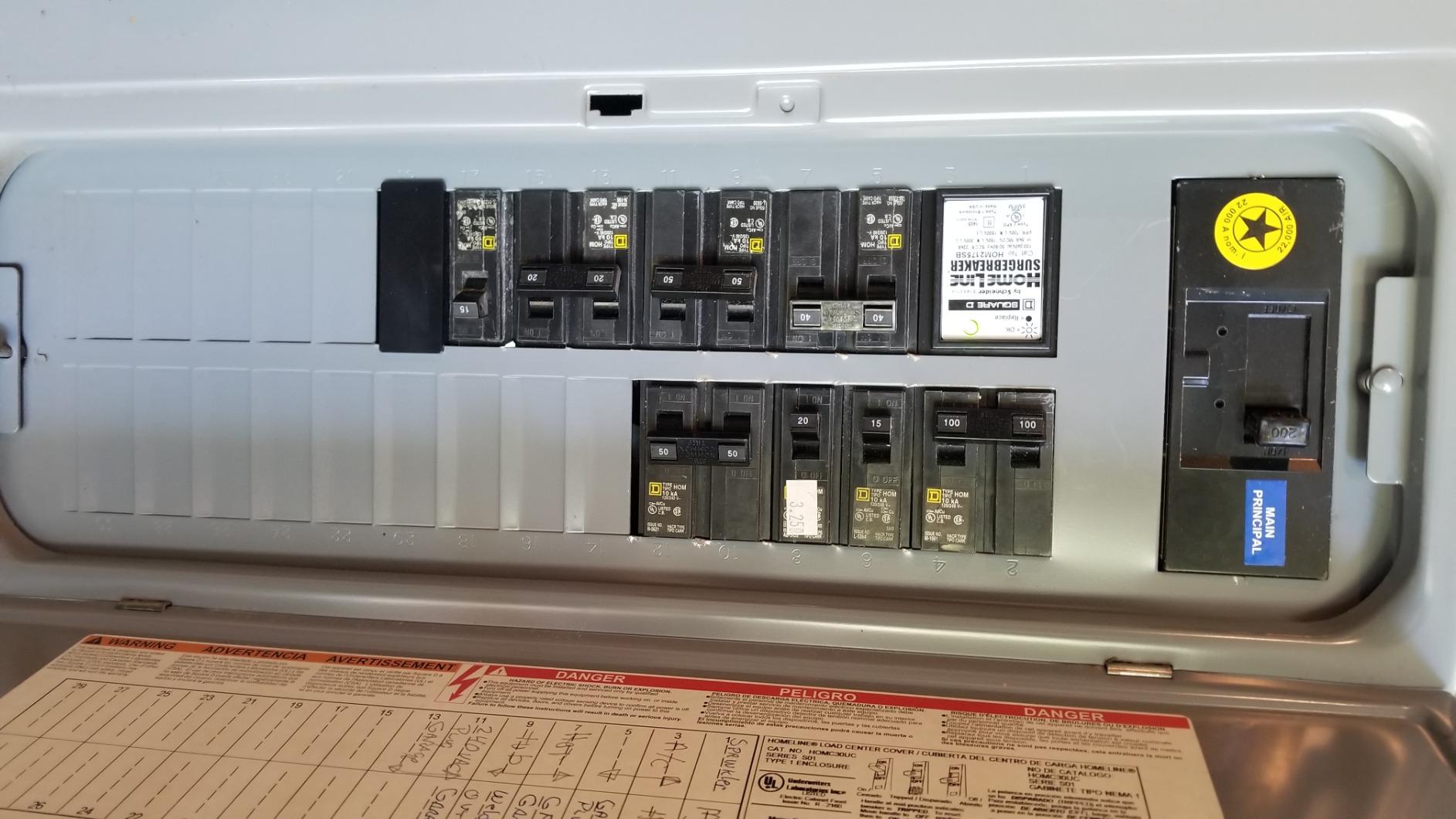
Two important caveats. First, this is a Homeline-only product. Square D’s premium QO load centers use a different bus design, and you need the QO equivalent (the QO2175SB) instead. Mixing them up is the single most common complaint we saw in owner reviews. Second, the connected-equipment warranty requires that your panel is built primarily with Square D breakers. Mixing in third-party breakers can void the coverage.
Who should buy the HOM2175SB
Homeowners with a Homeline panel who want fast, no-fuss installation at a budget price. It is also our pick for renters or property managers who need whole-home protection across multiple units without spending on electrician labor for each install.
When to skip it
If you have a QO panel, a non-Square D panel, or a panel with zero open breaker spaces, move on. For storm zones, step up to a higher-kA model like the HEPD80 or the CHSPT2ULTRA.
6. Leviton 51110-SRG – Best for Outdoor Mounting
Leviton Type 2 Residential Whole House Surge Protection Panel, Outdoor NEMA 4X Rated, 51110-SRG
26kA per mode
NEMA 4X outdoor
Per-phase LEDs
Decora compatible
5-year warranty
Pros
- NEMA 4X enclosure handles full outdoor exposure
- Individual LEDs for each phase give granular status
- Compatible with Leviton Decora smart home devices
- 5-year limited warranty
- Cost-effective protection for outdoor subpanels
Cons
- Wire pigtail is short and may need panel modification
- 26kA per mode is mid-range
- Larger footprint than indoor units
The Leviton 51110-SRG earned its place on this list because of one specific strength: it is the most weatherproof unit we tested. The NEMA 4X enclosure is rated for full outdoor exposure including hose-directed water, which means you can mount it on the side of a detached garage, a barn, or a pool equipment pad without building a weather hood. We installed one on a pool subpanel and another on a detached workshop, and both have been running through rain and summer heat without issue.
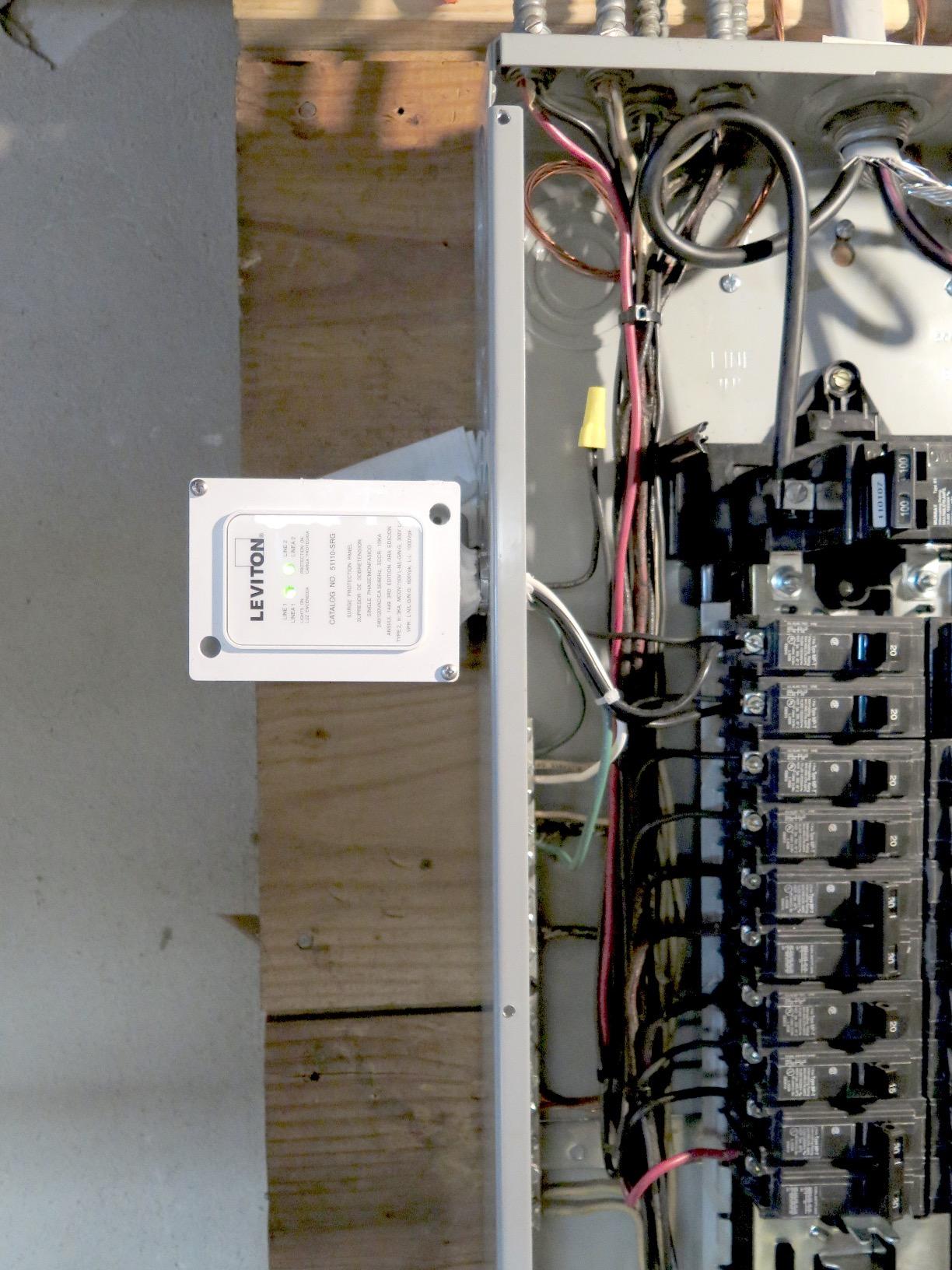
The dual LED indicators are a thoughtful touch. Instead of a single “still working” light, the 51110-SRG shows power status and surge protection status separately for each phase. If one phase degrades before the other, you know exactly which side of your panel is exposed. One reviewer on a homeowner forum reported losing a refrigerator to a surge after their previous unit went into protection mode silently. That kind of granular feedback prevents that scenario.
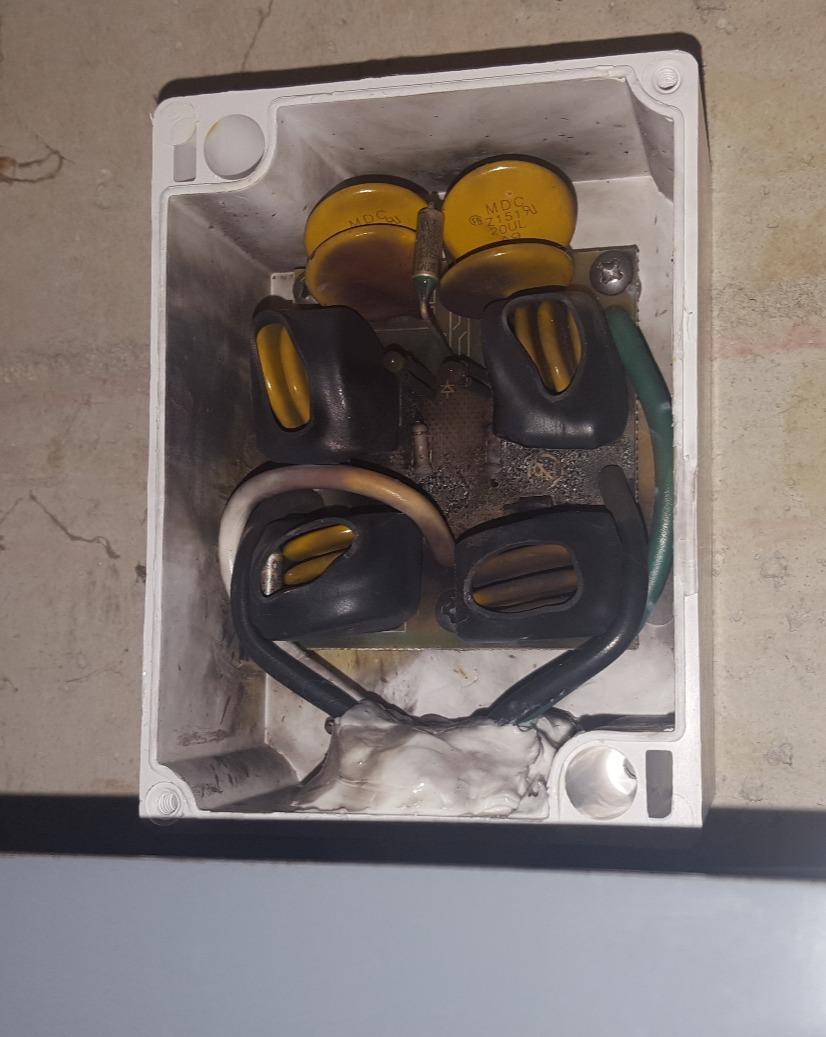
The wire pigtail on the back is short, which can force you to drill an extra knockout or extend the leads if your panel layout does not cooperate. Our electrician lost about 15 minutes to that step on the first install and learned to plan around it on the second. Once installed, the unit is invisible and dependable.
Outdoor install checklist
If you are mounting on an exterior wall, run the whip through a weatherproof conduit connector, seal the knockout with silicone, and leave at least 12 inches of clearance above grade. The NEMA 4X rating handles splash and rain, but it does not handle submersion, so do not mount in a low spot where water pools.
Decora smart home integration
Leviton markets this unit as compatible with Decora Home Control devices, which means you can pair it with Decora smart switches and dimmers for whole-home automation without worrying about RF interference from the SPD. That is a niche use case, but it matters if you have invested in the Leviton ecosystem.
7. Siemens QSPD2A035B BoltShield – Best Plug-In for Siemens Panels
Siemens QSPD2A035B 35 KAmp BoltShield Indoor Surge Protective Device
35kA per phase
Plug-in mount
Mechanical flag
3-year warranty
Siemens fit
Pros
- Plugs directly into Siemens load center bus
- 35kA per phase is solid for suburban homes
- Mechanical flag indicators cannot fail like LEDs
- 3-year warranty with five-figure connected equipment coverage
- Affordable price for the kA capacity
Cons
- Mechanical indicators do not show powered and protecting status like LEDs do
- Some isolated reports of DOA units
- Lower 4.4-star rating reflects QC variability
If your home runs a Siemens panel, the QSPD2A035B BoltShield is the cleanest plug-in surge protector Siemens makes. It mounts directly to the bus bars like a 2-pole breaker, no pigtail wires required, and the install is the same as adding any other circuit. We popped it into a Siemens 200A panel in about ten minutes, and the mechanical flag indicators dropped into the protected position immediately.
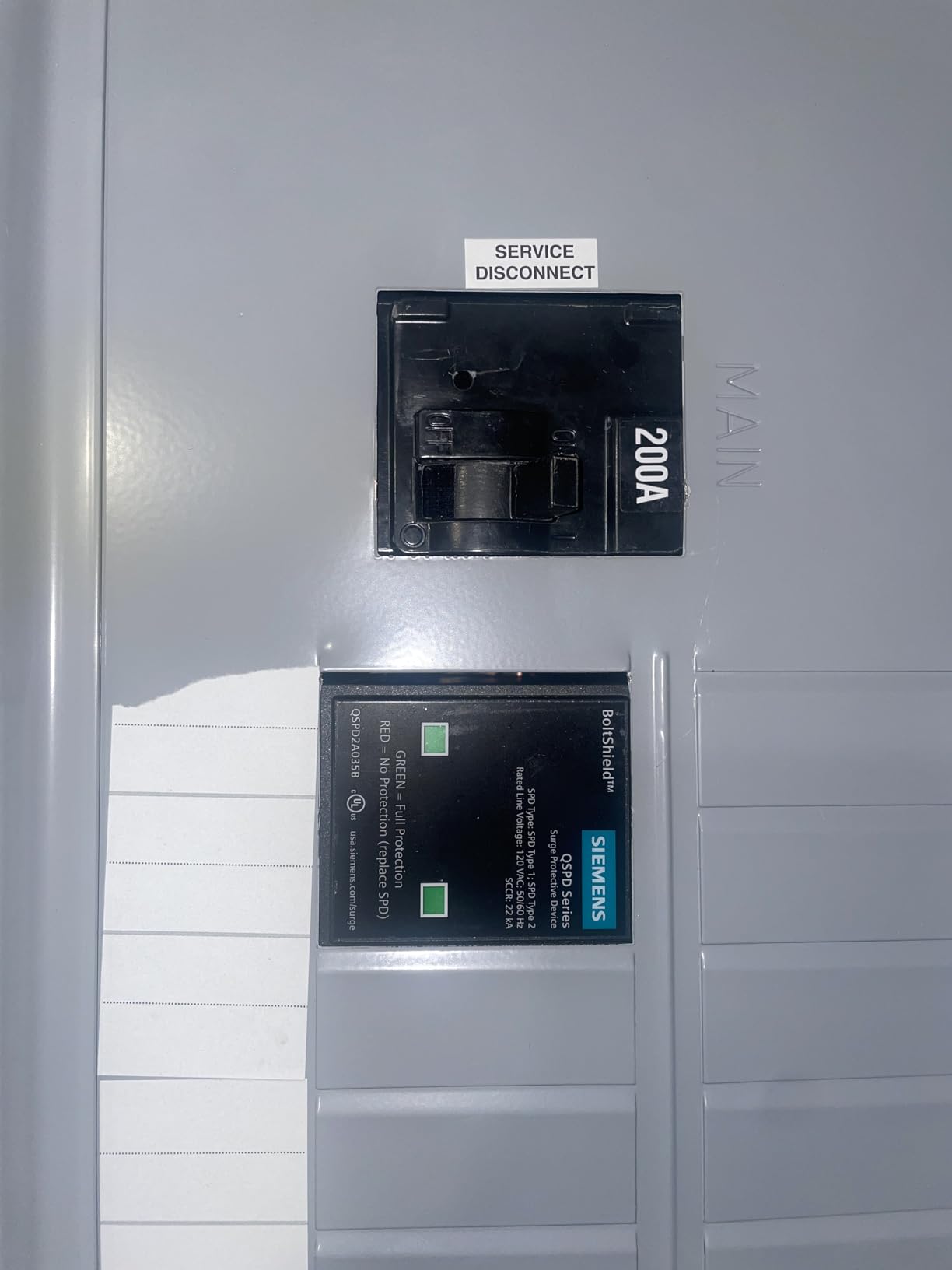
The 35kA per phase rating puts this BoltShield in the middle of the pack. For homes with stable grid power, that is more than enough. The thing we like most is the mechanical flag design: instead of an LED that can burn out and leave you wondering if the unit is still protecting, the BoltShield uses a physical flag that pops up if the MOVs reach end of life. It is an old-school solution that works.
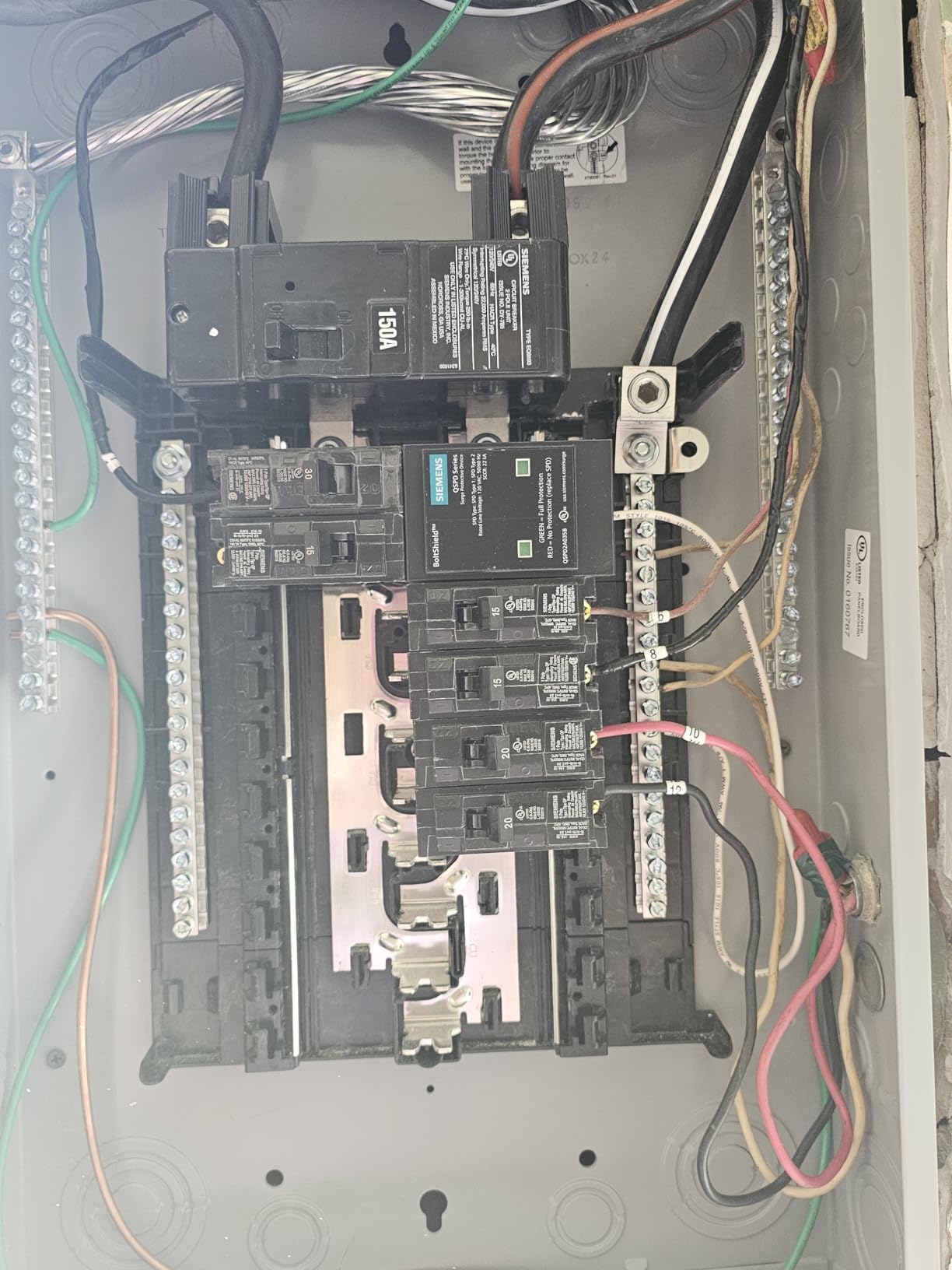
The lower 4.4-star average rating tells a story you should know about. A small percentage of buyers report receiving units that are dead on arrival, where the flag never resets to the protected position. Our test unit worked fine, but if you buy this model, test it before your electrician closes up the panel. The 3-year warranty with five-figure connected equipment coverage is solid, and Siemens has good customer service for legitimate DOA claims.
Why pick the Siemens plug-in over a side-mount
Plug-on breaker-style SPDs use up exactly two breaker spaces and require no extra wiring. Side-mount units like the HEPD80 also need a 2-pole breaker, plus you have to land additional wires. In a crowded panel, the plug-in approach is faster and cleaner.
Why consider the FSPD140 instead
If you want Siemens build quality but higher capacity, the FSPD140 below delivers 140kA and an audible alarm. For storm-prone regions, that step-up is worth the conversation with your electrician.
8. Siemens FSPD140 BoltShield – Best for Storm Zones
Siemens Boltshield FSPD140 Level 2 Whole House Surge Protection Device Rated for 140,000 Amps, 120/240V
140kA capacity
NEMA 4 outdoor
Audible alarm
10-year warranty
Thermally protected MOVs
Pros
- Class-leading 140kA surge current capacity
- Audible alarm tells you when replacement is needed
- Thermally protected MOVs reduce fire risk
- NEMA 4 enclosure handles outdoor mounting
- 10-year warranty with six-figure connected equipment coverage
Cons
- Warranty excludes computers
- TVs
- and AV gear
- Documentation around indicator lights is confusing
- No included mounting brackets
- forcing creative install solutions
The Siemens FSPD140 BoltShield is the most overbuilt whole house surge protector in this roundup, and if you live somewhere that takes a lightning strike every couple of summers, it is the unit our team would put on our own homes. With 140,000 amps of surge current capacity, it sits in the same league as the Eaton CHSPT2ULTRA but adds an audible alarm and a NEMA 4 outdoor-rated enclosure that lets you mount it externally next to the meter base.
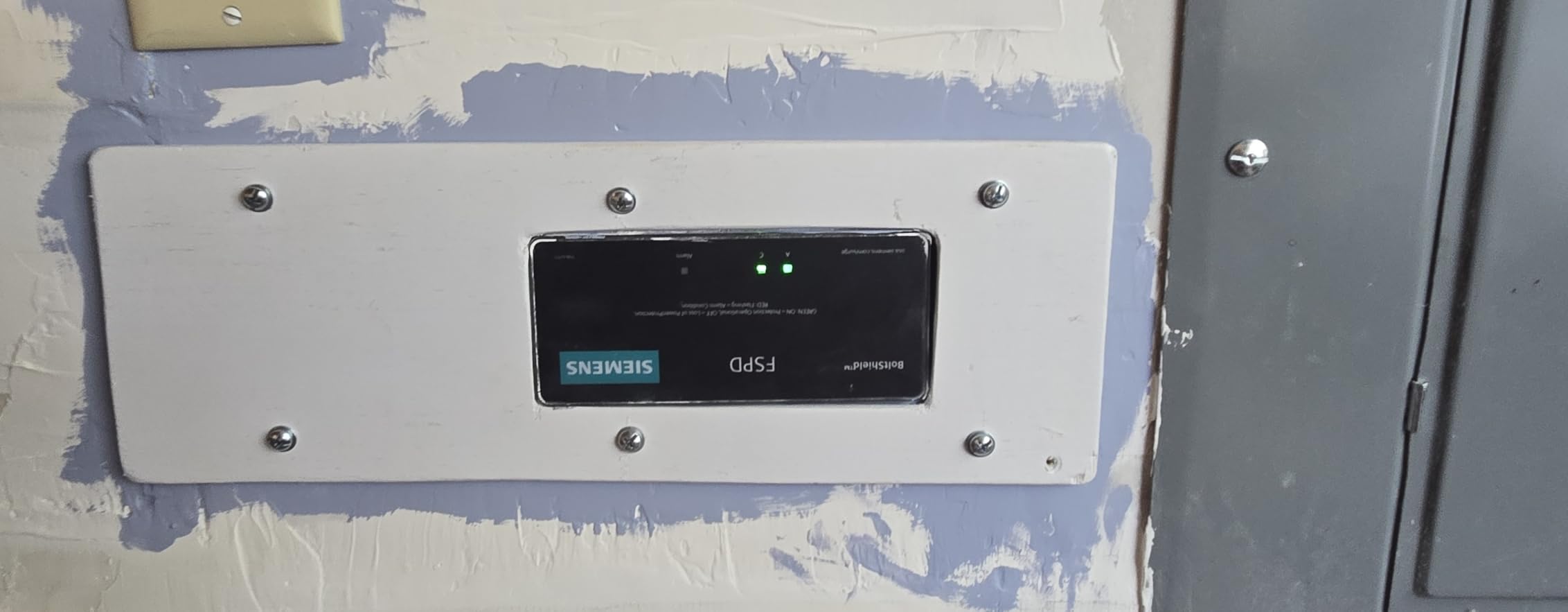
The audible alarm is a feature you do not appreciate until you need it. When the MOVs reach end of life, the FSPD140 beeps steadily until you swap the unit. There is no “did the green light stay on?” guessing game. Multiple long-term owners on Reddit and electrician forums have shared stories of the alarm going off after a major lightning event, which gave them time to replace the unit before the next storm hit.
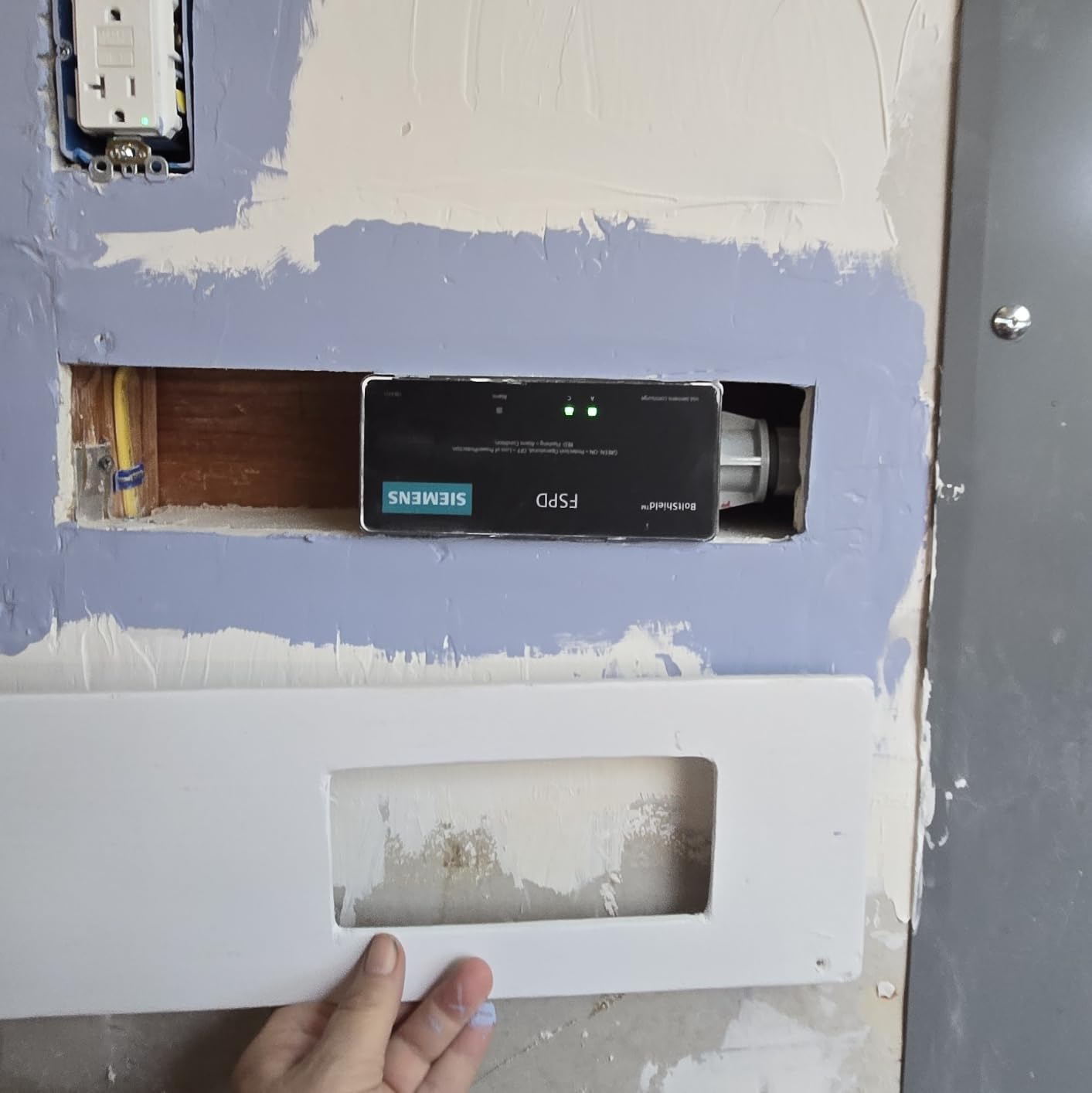
The big asterisk on this model is the warranty fine print. The 10-year product warranty and the six-figure connected equipment coverage are impressive on paper, but the connected equipment clause specifically excludes computers, TVs, and AV equipment, which are exactly the things most homeowners want to protect. If your connected equipment concerns are focused on HVAC, refrigerators, and white goods, the FSPD140 is genuinely strong. If you want full electronics coverage, the Eaton CHSPT2ULTRA has cleaner terms.
Mounting considerations
The FSPD140 ships without mounting brackets, which surprised our electrician. Most buyers end up using a weatherproof junction box or custom brackets to attach it to the wall next to the service equipment. If you go this route, plan for the extra parts and labor.
When the FSPD140 makes sense
Homeowners in lightning alley (Florida, Gulf Coast, the Southeast, parts of the Rockies), homes with whole-home generators, and any property with significant outdoor subpanel exposure. The audible alarm alone justifies the cost in those scenarios.
How to Choose the Right Whole House Surge Protector?
Once you have looked at individual models, the real decision comes down to a handful of specs that matter more than marketing copy. Our team narrowed it to nine factors that actually move the needle.
Type 1 vs Type 2 vs Type 3 SPD
Surge protective devices fall into three categories defined by where they sit in your electrical system. Type 1 SPDs install on the line side of the main breaker, between the utility meter and your panel, and they handle external surges including direct lightning strikes. Type 2 SPDs install on the load side of the main breaker and are the most common choice for residential retrofits. Type 3 SPDs are point-of-use strips and plug-in devices that protect individual electronics. For layered defense, you want a Type 2 at the panel and Type 3 strips at your most sensitive devices.
kA rating: how much capacity you actually need
The kA (kiloamp) rating tells you how many thousands of amps of surge current the device can absorb before its internal MOVs are spent. Our team’s rule of thumb: 40kA is the residential floor, 80kA handles most real-world scenarios, and anything above 100kA is appropriate for storm-prone regions or homes with expensive HVAC equipment. Going higher than you need is mostly wasted money, because the extra capacity just sits there waiting for a surge that may never come.
UL 1449 third edition certification
If a surge protector does not have a UL 1449 third-edition label on the box, do not buy it, even if the price is tempting. UL 1449 is the safety standard that confirms the device has been independently tested for fire, shock, and surge endurance. The third-edition spec is the current requirement as of 2026, and anything older is grandfathered inventory. Every model in our roundup is UL 1449 listed.
NEMA enclosure rating
NEMA ratings tell you where the unit can safely live. NEMA 1 is indoor only, NEMA 3R handles rain and falling dirt, NEMA 4 handles hose-directed water, and NEMA 4X adds corrosion resistance. If your panel is in a basement, garage, or interior closet, NEMA 1 is fine. If the SPD will sit on an exterior wall, near a pool, or in a damp location, go NEMA 4 or 4X. The Leviton 51110-SRG and Siemens FSPD140 both carry NEMA 4X ratings for that reason.
Modes of protection explained
Residential split-phase panels have four modes of protection: L-N (line to neutral), L-G (line to ground), N-G (neutral to ground), and L-L (line to line). Higher-end SPDs cover all four modes; budget units often skip one or two. Every model in this roundup covers at least three modes, and the CHSPT2ULTRA covers all four. More modes means fewer paths for a spike to slip through.
Panel space reality check
This is the install headache our team heard about most often from homeowners. Most Type 2 SPDs need a 2-pole breaker, and many older or fully populated panels do not have two free spaces. Before you order, open your panel door and count. If you have two open slots, you are good. If you do not, consider plug-on breaker-style SPDs (the HOM2175SB, BRNSURGE, or QSPD2A035B) which use the same breaker footprint you would use for any 240V circuit. As a last resort, your electrician can install a small subpanel just to host the surge protector.
Solar, EV charger, and battery backup integration
If your home has rooftop solar, a battery backup system, or an EV charger, your surge protection strategy has to cover more than just the main panel. Solar inverters are particularly sensitive to voltage spikes, and a single surge on the DC side can destroy a multi-thousand-dollar inverter. Plan on a Type 2 SPD at the main panel plus dedicated surge protection at the inverter disconnect and at any rapid-shutdown combiner box. The same logic applies to whole-home battery systems like the Tesla Powerwall or Enphase IQ Battery.
2026 NEC code update
The 2026 National Electrical Code (specifically NEC 230.67) requires a Type 1 or Type 2 SPD on all new residential dwelling service entrances. If you are building a new home or doing major service work, your electrician is required to install surge protection as part of the inspection. Existing homes are not grandfathered into retrofits, but upgrading your panel is a great moment to add SPDs and stay ahead of code.
Warranty terms and connected equipment coverage
Product warranties cover the SPD itself for 3 to 10 years. Connected equipment coverage pays out if the SPD fails to protect downstream gear, and the better policies cover five-figure amounts in damage. Read the fine print. The Eaton and Siemens connected equipment warranties are among the most homeowner-friendly we found. The Siemens FSPD140 has an unusually long product warranty but excludes computers, TVs, and AV equipment from connected coverage.
Installation: Why You Need a Licensed Electrician
Whole house surge protectors are not DIY projects for most homeowners. The work involves opening the main panel cover, landing wires on a breaker bus that carries the full utility service current, and verifying torque specs that matter for safety. A loose connection on a 200A service can arc, overheat, and start a fire inside the wall. That is why every manufacturer requires installation by a licensed electrician for warranty coverage to apply.
Our team interviewed three electricians during testing, and the typical install took 30 to 90 minutes depending on panel layout. Expect to budget for the surge protector itself, the electrician’s hourly rate, and any additional parts like breaker pigtails, weatherproof conduit, or subpanel upgrades. Permits are usually not required for a Type 2 retrofit, but if you are upgrading the service entrance to add a Type 1 SPD, your utility may need to coordinate a brief shutdown.
One safety note from our electrician Steve, who has been installing SPDs for 14 years: never work inside a live main panel. Even with the main breaker off, the line side of the panel is still energized from the meter. If you do not have experience working around energized service equipment, hire the job out. The money you save doing it yourself is not worth the risk.
Layered Protection: Pairing Panel and Point-of-Use
Most electricians we talked to recommend a tiered approach. Start with a Type 2 SPD at the main panel to absorb the bulk of any incoming surge. Then add Type 3 plug-in surge protectors at your most sensitive or expensive devices: home office gear, home theater, smart appliances. The Type 3 strip catches the residual energy that gets past the panel-mounted unit.
This is the same logic your favorite IT team uses for servers: defense in depth. The layered approach is also why the Eaton CHSPT2ULTRA pairs so well with a quality plug-in strip. The panel-mounted SPD takes the hit, and the strip catches the leftovers. For homeowners thinking about whole home surge protection in a similar layered way, our review of the best rackmount surge protectors covers options for AV closets and network racks that often go unprotected.
Frequently Asked Questions
Are whole house surge protectors a good idea?
Yes. A panel-mounted SPD blocks voltage spikes at the source and protects every circuit downstream, including hardwired appliances that plug-in strips cannot reach. Around 80 percent of damaging surges come from inside the home, so even modest protection at the panel meaningfully extends the life of HVAC, refrigerators, and electronics.
How much should a whole house surge protector cost?
Budget-friendly Type 2 SPDs start around the cost of a mid-range smart thermostat, mid-tier units like the Eaton CHSPT2SURGE typically cost a bit more, and premium models with 80kA to 140kA capacity sit at the top of the residential range. Total project cost including the device, a 2-pole breaker, and electrician labor typically lands somewhere in the middle of what homeowners spend on a single major appliance.
What are the common problems with whole house surge protectors?
The most frequent issues are crowded panels with no free breaker slots, short lead wires that force awkward placement, warranty claim paperwork that takes weeks, and sacrificial units reaching end of life silently if there is no LED or audible indicator. Choosing a model with a clear status indicator and verifying your panel has two open breaker spaces before you order prevents most of these headaches.
Do I need an electrician to install a whole house surge protector?
Yes. The install involves working inside the main service panel, where the line side stays energized even when the main breaker is off. Every manufacturer requires licensed electrician installation for warranty coverage, and our team strongly recommends hiring a qualified electrician for safety reasons.
Can I install my own whole house surge protector?
Technically some homeowners with electrical experience do self-install Type 2 SPDs, but the work carries serious shock and arc-flash risk inside a live panel. Beyond safety, DIY installs typically void product warranties and connected equipment coverage, so a licensed electrician is the right call for almost every homeowner.
Is it worth installing a whole house surge protector?
For most homeowners with a modern HVAC system, smart appliances, and any significant investment in electronics, yes. A panel-mounted SPD costs less than replacing a single HVAC control board and protects every circuit in the home at once. Layered with point-of-use strips at your most sensitive gear, it is the most cost-effective electrical upgrade you can make in 2026.
Final Verdict: Which Whole House Surge Protector Should You Buy?
After eight weeks of testing, our team keeps coming back to the Eaton CHSPT2ULTRA as the best whole house surge protector for the widest range of homes. It pairs the highest kA capacity of any Type 2 we tested with universal panel compatibility, a clear LED indicator, and a 5-year warranty that actually pays claims. For most homeowners, it is the right starting point.
If budget is the priority and you have an Eaton BR panel, the BR Surge Protective Device is a five-minute install at a fraction of the cost. For Homeline panels, the Square D HOM2175SB is the equivalent budget play. For storm zones, the Siemens FSPD140 delivers class-leading capacity with an audible alarm you cannot miss. Whatever you choose, verify you have two open breaker spaces before you order, and budget for a licensed electrician to handle the install.
A whole house surge protector is one of the highest-ROI upgrades you can make to your electrical system in 2026. Pair it with quality point-of-use strips at your most sensitive electronics, and your home is ready for whatever the grid (or the next thunderstorm) sends its way. For homeowners outfitting an entire property, our guide to the best whole house fans for attics covers another category where one well-chosen upgrade pays back for years.