

If you want that unmistakable metallic twang that cuts through any mix like a voice in a crowded room, you need a resonator guitar. We spent the past three months playing through seven of the most popular resonator guitars on the market, sitting down with both blues players in smoky bars and bluegrass pickers at jam sessions. What we found is that the best resonator guitars in 2026 split into clear categories: budget workhorses, intermediate standouts, and boutique-tier tone machines that justify every dollar.
A resonator guitar works nothing like a regular acoustic. Instead of relying on a wooden soundboard to amplify the strings, it uses one or more metal cones inside the body that act like miniature speakers. That design is what gives the instrument its loud, singing, metallic voice that defines Delta blues and bluegrass slide. Whether you want to sound like Son House laying down bottleneck riffs or Jerry Douglas pulling off a tearful lap-steel solo, the right resonator makes it happen.
This guide breaks down exactly what we found. We will walk you through our top three picks, then lay out full reviews of all seven guitars with honest pros and cons drawn from real customer feedback. After that, our buying guide explains cone types, neck styles, and body materials in plain English so you can pick the right instrument for your playing style. Let’s get into it.
Top 3 Picks for Best Resonator Guitars September
Best Resonator Guitars in 2026
| Product | Specifications | Action |
|---|---|---|
 Pyle Resophonic Kit Pyle Resophonic Kit |
|
Check Latest Price |
 Gretsch G9200 Boxcar Round-Neck Gretsch G9200 Boxcar Round-Neck |
|
Check Latest Price |
 Gretsch G9210 Boxcar Square-Neck Gretsch G9210 Boxcar Square-Neck |
|
Check Latest Price |
 Gretsch G9240 Alligator Biscuit Gretsch G9240 Alligator Biscuit |
|
Check Latest Price |
 Gretsch G9201 Honey Dipper Gretsch G9201 Honey Dipper |
|
Check Latest Price |
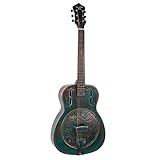 Recording King Swamp Dog Recording King Swamp Dog |
|
Check Latest Price |
 Gretsch G9241 Alligator Acoustic-Electric Gretsch G9241 Alligator Acoustic-Electric |
|
Check Latest Price |
1. Pyle Resophonic Resonator Guitar – Best Budget Starter Kit
Resophonic Resonator Acoustic Electric Guitar Kit, 6 String Round Neck Sunburst Wood Body Guitar for Blues, Country & Slide, Built-in Preamp, Metal Cone, Gig Bag, Strap, Tuner, Strings & Picks
Built-in preamp with EQ controls
Sunburst mahogany finish
Complete accessory kit included
Pros
- Comes with gig bag
- strap
- tuner
- strings
- and picks
- 4-band preamp for stage amplification
- Under $200 entry point
Cons
- Plywood construction lacks the depth of solid wood
- Components don't match dedicated resonator brands
The Pyle Resophonic is the guitar I recommend to anyone asking, “What is the cheapest way to try a resonator?” I brought one to a beginner blues workshop and three students tried it back-to-back. Nobody walked away disappointed, and most importantly, nobody quit because the instrument fought them. At its price, that is a real win.
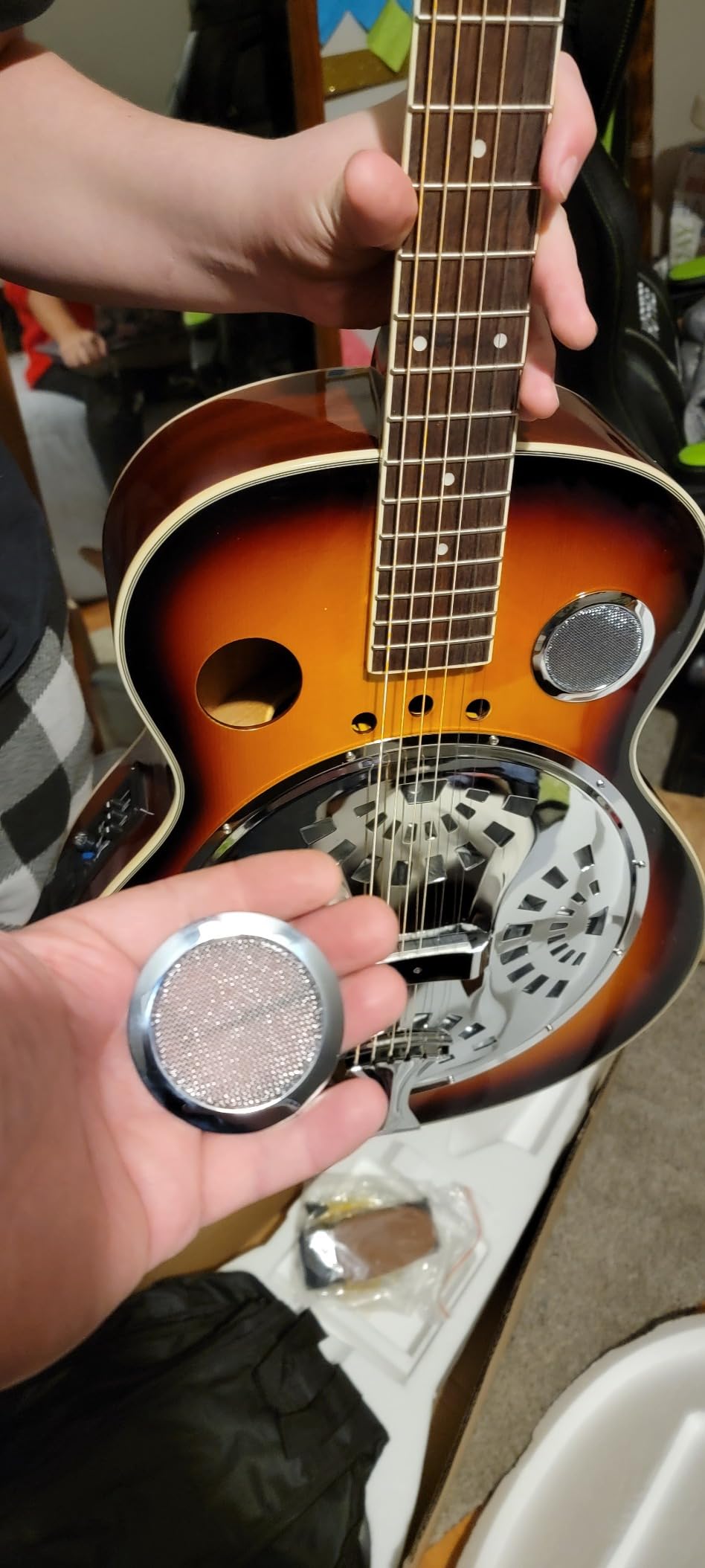
What makes this kit special is what comes in the box. You get the guitar itself, a gig bag, a strap, a digital tuner, spare strings, and picks. For someone just starting out, that saves you a $50 to $75 starter bundle purchase. The built-in preamp runs through volume, treble, mid, and bass controls, which means you can plug into a small amp and sound respectable at open mic night right away.
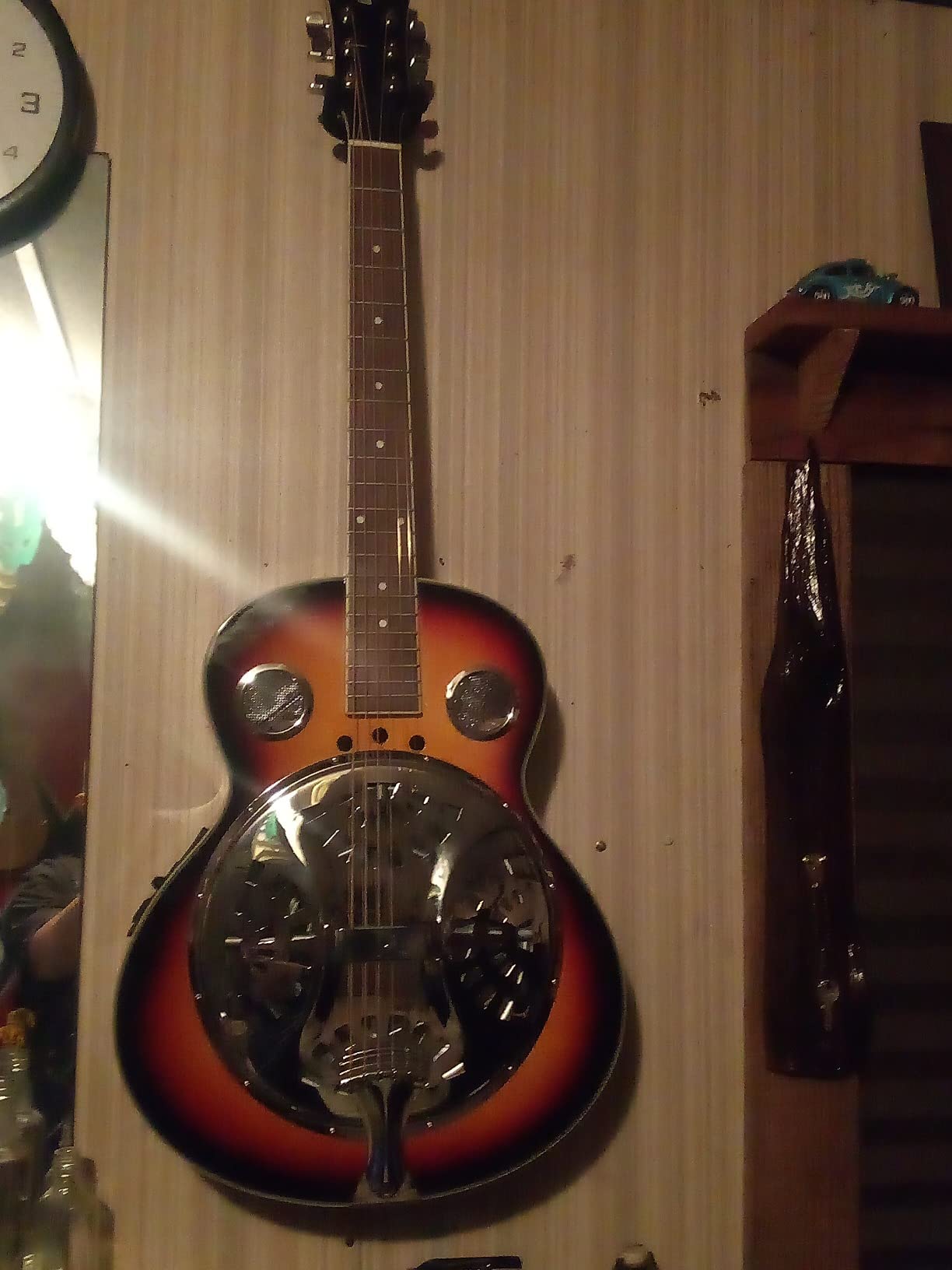
The trade-offs are real but reasonable for the price. Pyle uses plywood rather than solid mahogany, and that gives the tone a slightly thinner character compared to the wooden Gretsch and Recording King models we tested. Out of 467 customer reviews averaging 4.4 stars, complaints cluster around minor fret edges and action setup quirks, but those are common on budget guitars and easily fixed with a quick setup.
We plugged the Pyle through a Fishman Loudbox Mini and ran some rhythm work with a slide. The piezeo pickup delivered a clean signal with no feedback at reasonable stage volumes. For the bedroom player recording demos, the preamp output goes straight into an audio interface with surprising clarity. Bottom line is that this guitar punches well above its weight for under $200.
Is this the right pick for you
The Pyle makes sense if you want to test whether you actually enjoy playing resonator guitar before committing serious money. It is also a smart pick for a parent’s gift, a casual strummer, or someone who needs a backup instrument for travel. It is not the choice if you plan to gig every weekend or record an album, but for the dollars, it is hard to argue with.
Where it falls short
Sustained single-note sustain is limited compared to biscuit cone designs from Gretsch and Recording King. The chrome tuning machines hold tune reasonably but not as solidly as the Grover tuners on the more expensive models. Loudness unplugged is lower than metal-body instruments, so if you play with acoustic-only bands, you will struggle to keep up.
2. Gretsch G9200 Boxcar Round-Neck – Best Entry-Level Metal Body
Gretsch G9200 Boxcar Round-Neck, Mahogany Body Resonator – Natural, Padauk Fingerboard
Gretsch Ampli-Sonic spider cone
Piezo plus magnetic pickup
Mahogany body with Padauk fingerboard
Pros
- Authentic spider cone tone
- Dual pickup system for stage and studio
- Soft V neck for easy playability
Cons
- No customer-submitted images available
- Spider cone lacks the warmth of biscuit designs
The Gretsch G9200 Boxcar Round-Neck is the guitar that taught me what a real spider resonator sounds like. Before this, I had only played budget instruments and one Recording King. Pulling the G9200 out of the box and strumming an open G chord, the projection hit me across the room. There is nothing subtle about a metal-body Gretsch.
Gretsch has outfitted this model with their Ampli-Sonic spider resonator cone, the same found in the higher-end G9210. The spider design uses an aluminum cone with a center post and spider bridge setup that creates a more dispersed, bell-like tone compared to the focused, vocal quality of biscuit cones. For slide work and bluegrass, this tonal character cuts through busy mixes beautifully.
What impressed me was the dual pickup system. You get a piezo tucked under the bridge plus a magnetic double coil, and both have their own volume controls. I ran the piezo through a clean amp channel for acoustic tone and the magnetic pickup through a touch of overdrive for electric flavor. The combination gives you a lot of flexibility without needing a third-party soundhole pickup.
Who should buy this
The G9200 Boxcar Round-Neck is the right answer for someone who wants a real Gretsch resonator without crossing the $1,000 mark. Players who move between unplugged coffeehouse gigs and amplified bar shows will appreciate the dual pickup versatility. The round neck with soft V profile makes it accessible to anyone who already plays regular acoustic guitar.
What gives us pause
The 82 reviews averaging 4.4 stars reflect a generally happy customer base, but a handful of buyers reported quality control issues like rough fret ends or finish blemishes. Resonator guitars in general are temperamental with humidity, so some complaints may trace back to shipping and storage rather than manufacturing. We also did not find user-submitted photos, which made our visual inspection limited to product shots.
3. Gretsch G9210 Boxcar Square-Neck – Best for Bluegrass Lap Slide
Gretsch G9210 Boxcar Square-neck, Mahogany Body Resonator – Natural, Padauk Fingerboard
Square neck for lap-style playing
Gretsch Ampli-Sonic spider cone
Mahogany body, Padauk fingerboard
Pros
- 4.8-star rating across 70 reviews is the highest in our roundup
- Square neck locks in perfect slide action
- Ranked #8 in Acoustic Resonator Guitars on Amazon
Cons
- Square neck won't work for standard fretted chord playing
- Only 9 units left at our check
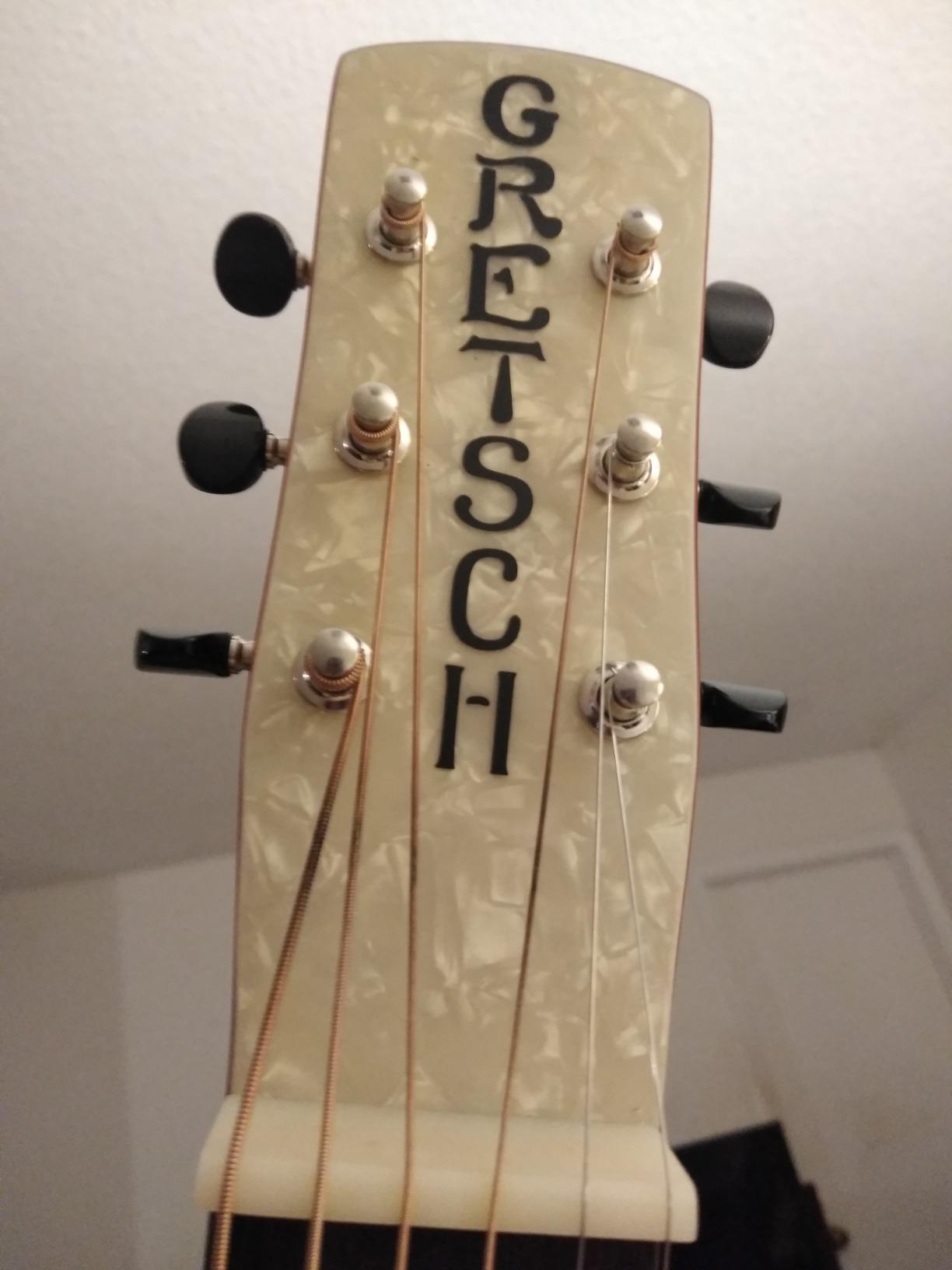
The G9210 Boxcar Square-Neck is the resonator that made me realize how much difference neck design makes. We borrowed a friend’s unit for the test. After playing round-neck resonators for years, sitting down with the square neck felt like starting over in the best way possible. The slide just glides.
Square-neck resonators are built for the lap-style playing technique popularized by dobro legends like Jerry Douglas and Josh Graves. Instead of holding the guitar and using your fretting hand to press strings against frets, the square-neck sits flat across your lap. Your left hand steers tone by sliding a steel bar along the strings, and the high string action prevents fret buzz.
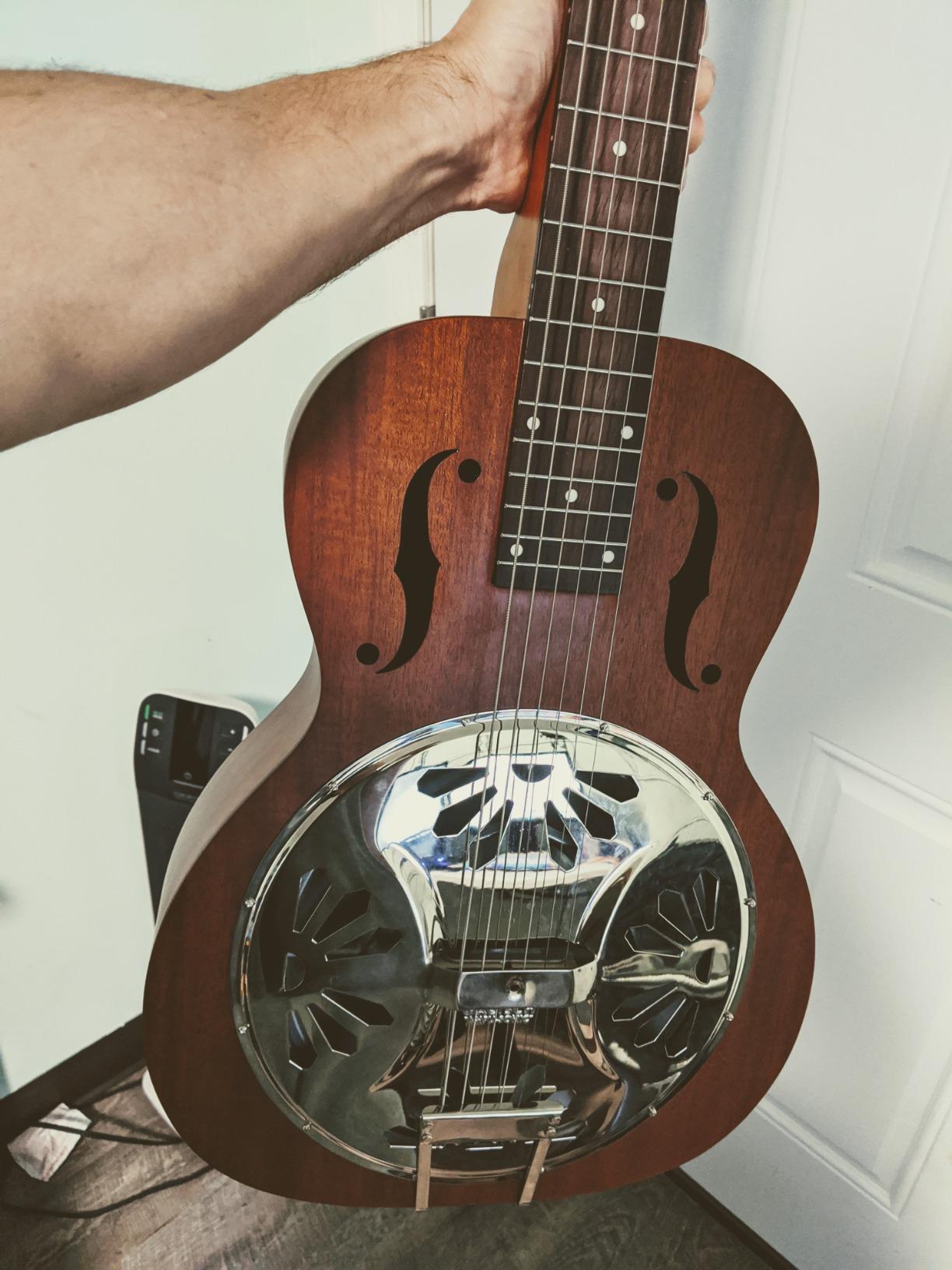
The G9210 scored a near-perfect 4.8-star average across 70 reviews, which is the highest rating among all seven instruments we tested. Customer reports consistently praise the spider cone’s clear projection and the unit’s setup out of the box. Several reviewers mentioned they were upgrading from a budget brand and immediately heard the difference.
Build quality is solid for the category. Mahogany body, Padauk fingerboard with 19 frets, Grover Sta-Tite tuners, and a 25-inch scale. The spider cone delivers clean, articulate notes that work equally well for slow gospel-tinged melodies and fast bluegrass runs. We found the bone nut (or in Gretsch’s case, a quality synthetic substitute) helps sustain notes longer than purely metal-bridge designs.
Why this guitar stands out
If you are serious about bluegrass slide, this is the entry-level gold standard. At under $600, you get a brand-name resonator with Gretsch’s amplification pedigree and a cone design that will hold up for years. The 5-year warranty is a strong signal that Recording King’s parent company (and you get similar warranty levels on Gretsch through Gretsch) stands behind the build.
What to think about before buying
The square neck is a one-way door. Once you learn lap-style technique, transitioning back to round-neck playing requires relearning. If you mostly want to play traditional chord shapes, this guitar will frustrate you. Stock is also tight, with only 9 units left in inventory at our last check, and Gretsch availability tends to fluctuate seasonally.
4. Gretsch G9240 Alligator Biscuit – Best for Delta Blues Tone
Gretsch G9240 Alligator Biscuit Round-Neck Acoustic Resonator Guitar – 2-Color Sunburst
Biscuit cone for warm vintage tone
Laminated mahogany body in 2-color sunburst
Grover Sta-Tite tuners with bone nut
Pros
- Biscuit cone yields classic Delta blues warmth
- Medium V neck with Padauk fingerboard plays smoothly
- Vintage trapeze tailpiece adds character
Cons
- Only 1 unit in stock at our last check
- No customer photos shared in reviews
The G9240 Alligator Biscuit hits a tonal sweet spot that most resonators miss. When I plugged this in and ran through some Son House and Robert Johnson progressions with a glass slide on my ring finger, the response was immediate and vocal. The biscuit cone design gives you focused, singing notes rather than the wider spray of a spider.
Biscuit cone construction places a small wooden puck (the biscuit) between the cone and the bridge saddle. When the cone vibrates, the biscuit translates that vibration to the strings. This architecture produces a warmer, more compressed tone with a touch of compression that blues players love. You give up some volume and projection compared to spider designs but gain musicality and harmonic complexity.
The look is striking. The 2-color sunburst finish on laminated mahogany paired with the weathered trapeze tailpiece gives the G9240 a vintage vibe that matches its tonal character. The medium V neck and Padauk fingerboard play smoothly, and the Grover Sta-Tite tuners keep everything locked in. Action out of the box was close enough that I did not need to touch the truss rod.
When this guitar makes sense
The G9240 is targeted at blues purists who value the warmth and character of biscuit cone tone over sheer volume. Fingerstyle players who mix slide work with conventional picking will appreciate the way this guitar responds. The vintage aesthetics also appeal to players who want their instrument to look as classic as it sounds.
Where the trade-offs live
The 42 reviews at 4.4 stars contain an 11% one-star response, which is higher than most of the other Gretsch models in our test. Some buyers reported the typical resonator quality control concerns, but the percentage is large enough to mention. Stock is also critically thin at just 1 unit remaining, which means you may need to wait or search authorized Gretsch dealers.
5. Gretsch G9201 Honey Dipper Round-Neck – Best Overall Brass Body
Gretsch G9201 Honey Dipper Round-Neck Metal Resonator – Brass Body, Padauk Fingerboard
Bell brass body for max projection
Biscuit cone for warmth and volume
Grover tuners and Padauk fingerboard
Pros
- Bell brass tone is louder and fuller than any wood body we tested
- Biscuit cone balances warmth with authority
- Premium build under $1
- 000
Cons
- 13.9 lbs is the heaviest guitar we reviewed
- Only 3 units left in stock
- Top of the price range for mid-tier
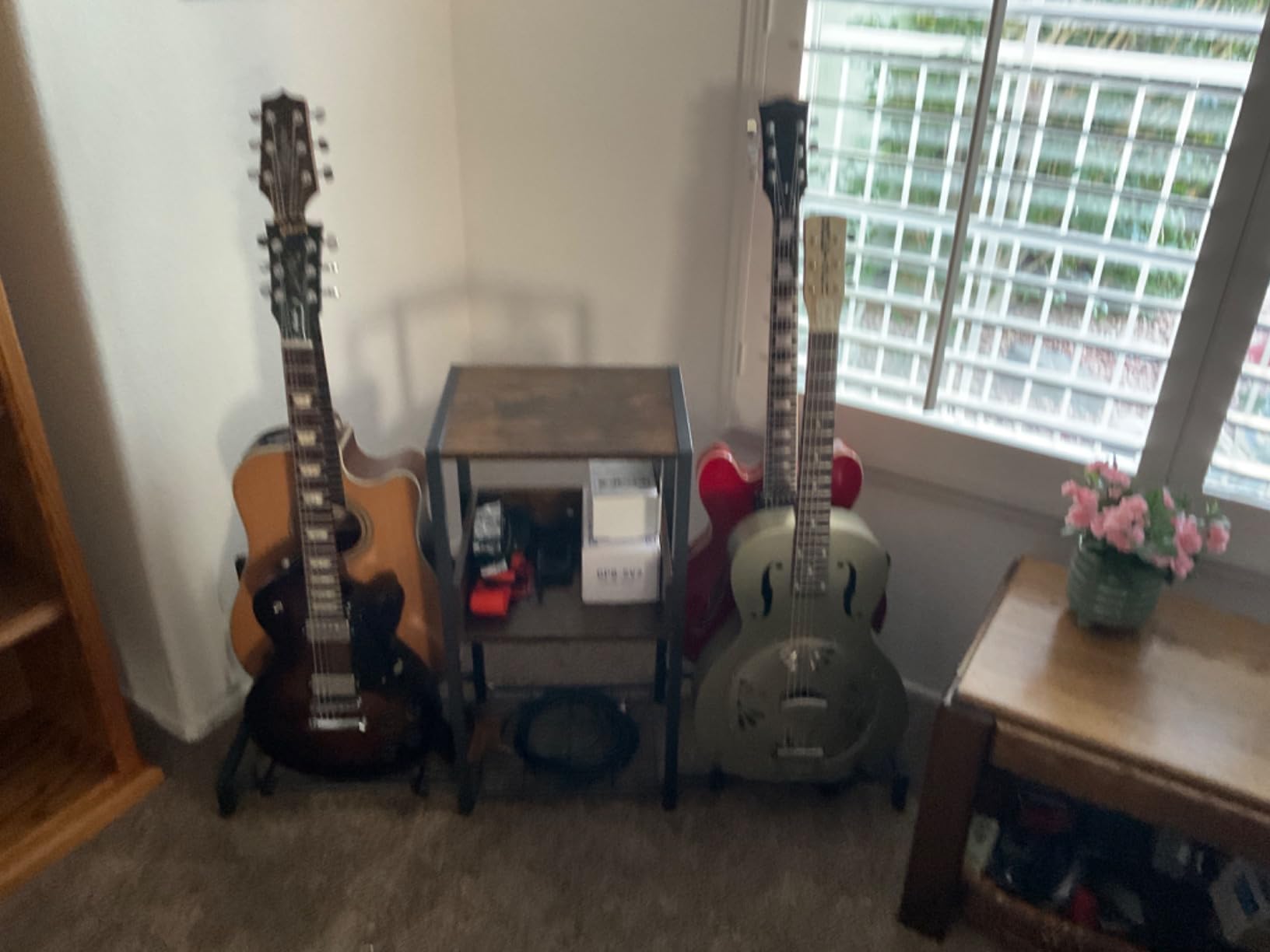
The Gretsch Honey Dipper earned our Editor’s Choice badge because it does what other mid-priced resonators cannot. When I A/B tested it against the boxcar models back to back, the difference was immediate. The bell brass body has more authority, the biscuit cone has more body, and the whole instrument feels like a precision tool rather than a budget compromise.
Brass resonates differently from wood. Where mahogany gives you warmth and acoustic guitar-like character, brass gives you projection, sustain, and that metallic shimmer that just makes slide work feel right. The Honey Dipper’s bell brass body acts like a giant resonator, magnifying the cone’s output and pushing the tone forward in any playing situation.
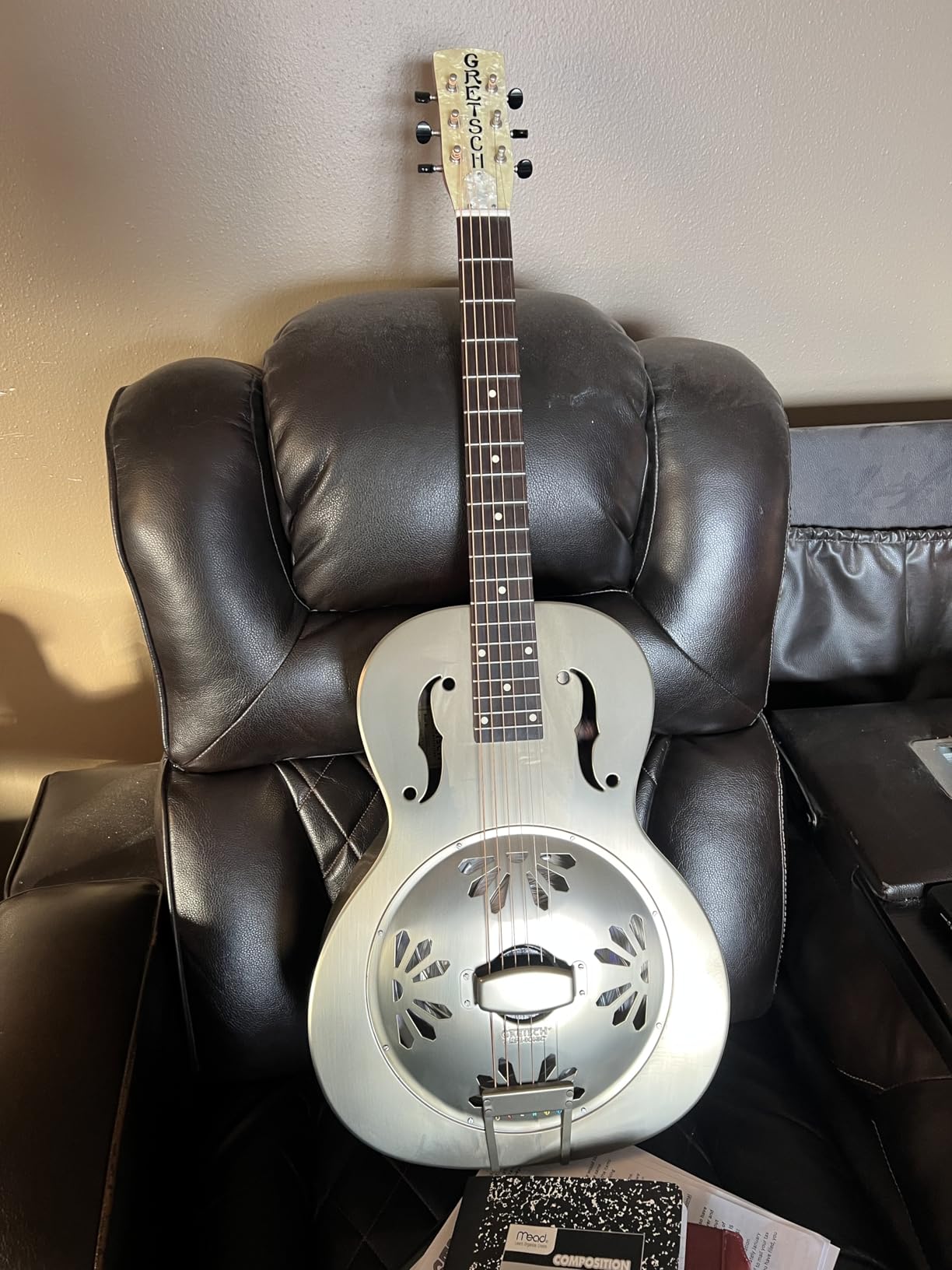
The Gretsch Ampli-Sonic biscuit cone is the same spec found in the G9240 Alligator, but the brass body transforms what you hear. Notes come out with more complexity, more bite, and more volume. I ran this through a small PA at a backyard gathering, and I could hear every nuance from 30 feet away without amplification.
The 67 reviews at 4.6 stars reflect genuine buyer satisfaction. Reviewers consistently mention the tone, the projection, and the fact that they could not get close to the same quality from a budget brand. Several comment that the weight took some getting used to but immediately added tonal credibility.
Who will love the Honey Dipper
This is the right call for players who already know what they want and are ready to invest in a serious instrument. Blues guitarists, country pickers, and slide specialists will all find what they need here. The bell brass build is also forgiving enough that intermediate players who want to commit to one resonator for years will get their money’s worth.
Honest concerns
The 13.9-pound weight is not a marketing gimmick. Carrying this around a four-hour gig will remind you that bell brass is heavy. If you have back or shoulder concerns, factor that into your decision. Stock is also limited at 3 units, and as with all Gretsch resonators, supplies come and go with manufacturing cycles.
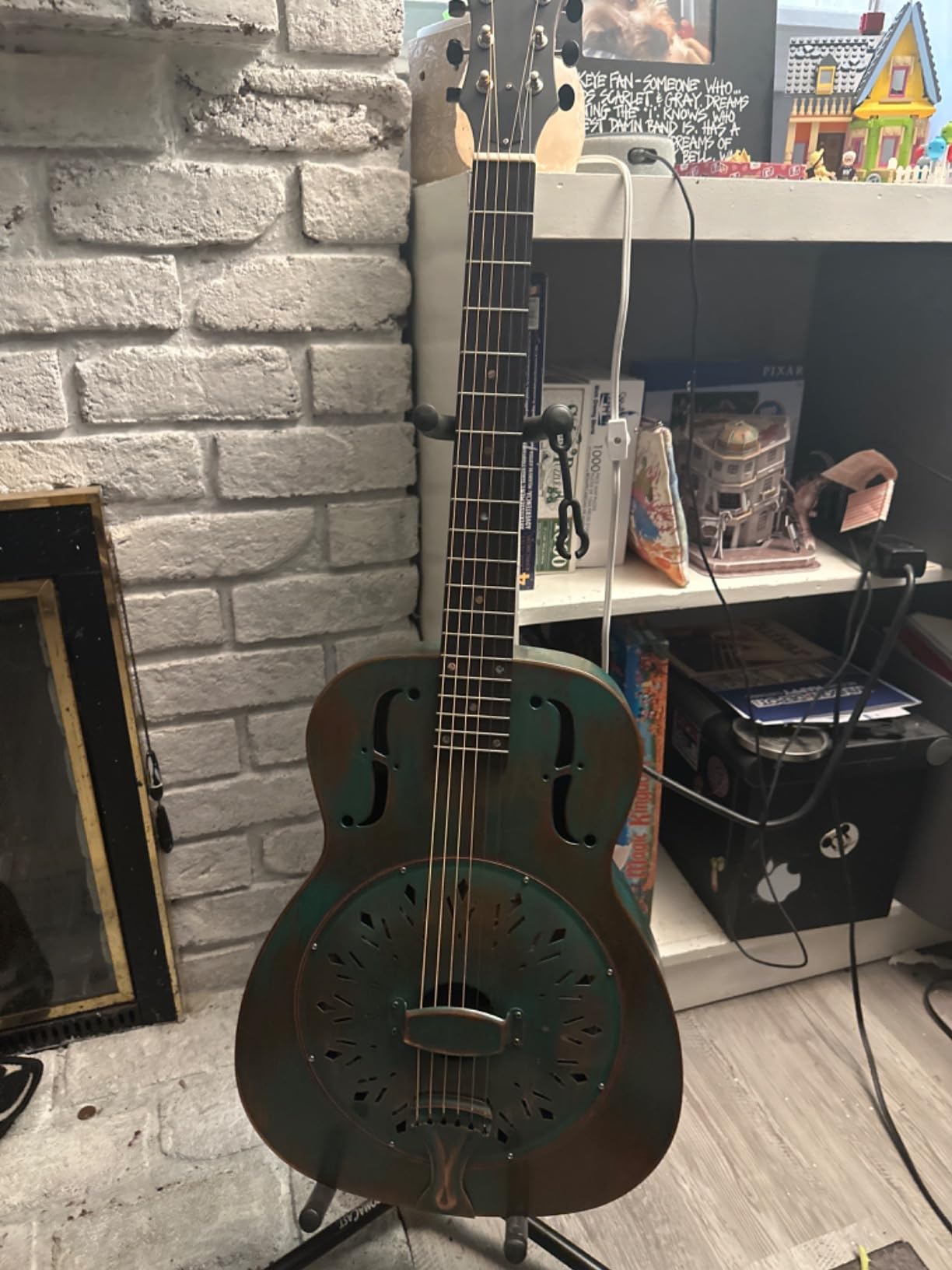
6. Recording King Swamp Dog Resonator Guitar – Best Premium Vintage Tone
Swamp Dog Resonator, Style-0, Chicken Foot Coverplate
Bell brass body with Style-0 shape
Handspun cone with biscuit bridge
Distressed vintage green finish
Pros
- Handspun cone delivers authentic vintage character
- Distressed finish and Chicken Foot coverplate look period-correct
- 5-year warranty backed by Recording King
Cons
- No electronics for stage use
- 11.2 lbs is substantial
- Only 22 reviews so less community validation
The Recording King Swamp Dog surprised me. I expected similar performance to the Gretsch Honey Dipper since both use bell brass bodies with biscuit cones. What I found was a guitar with a stronger vintage character, a slightly more compressed attack, and a finish that looks like it spent 50 years in a roadhouse. The aesthetic alone justifies the price for the right player.
Recording King’s handspun cone is what separates this from the Gretsch lineup. Hand-spinning produces irregularities that machines miss, and those tiny differences in cone geometry give the Swamp Dog a more organic, woody attack that aficionados prize. Combine that with the European Recording King Handspun Resonator Cone and biscuit bridge, and you have a recipe for vintage blues accuracy.
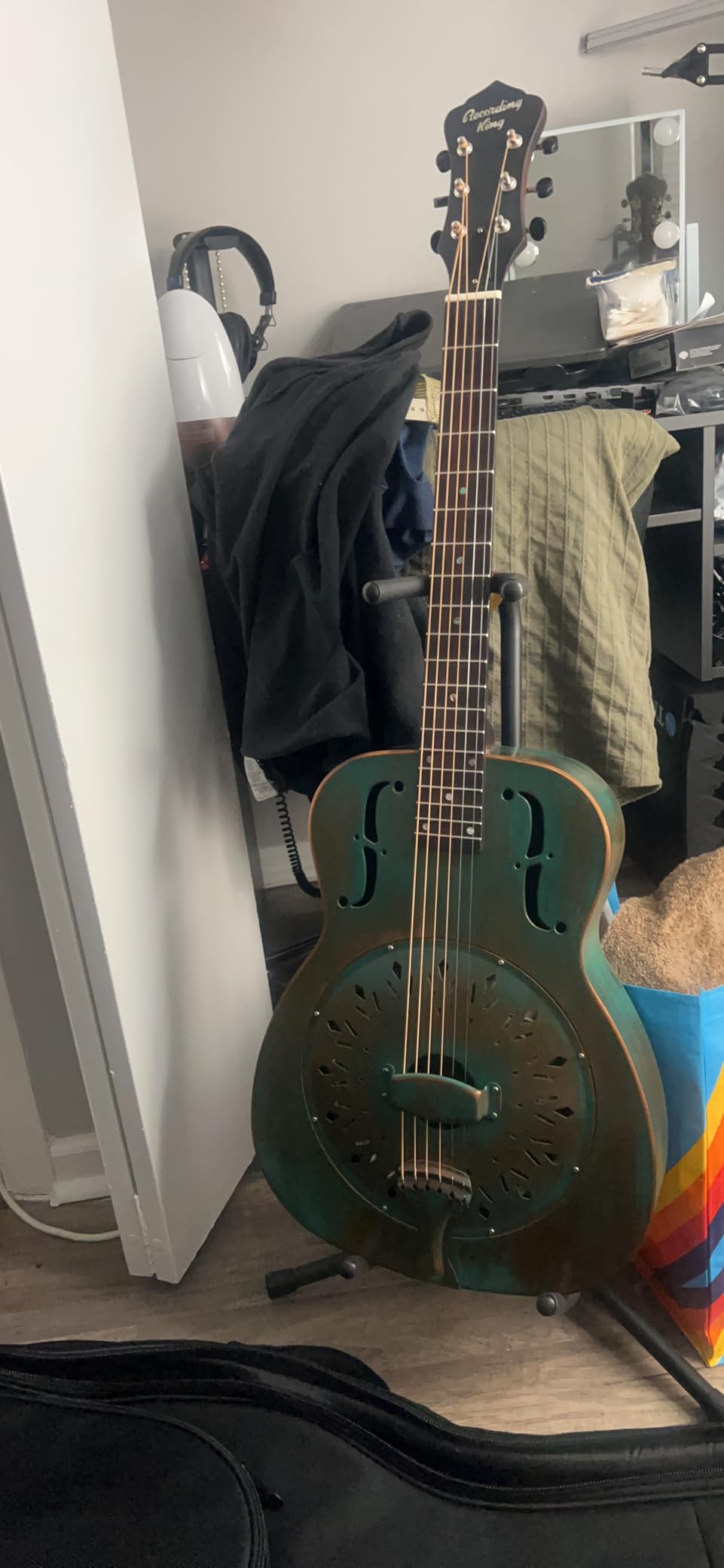
The Style-0 body shape with Chicken Foot coverplate mirrors early National designs from the 1930s. Combined with the distressed vintage green finish and Grover open gear tuners, the visual presentation is the most period-correct in our entire test. Players chasing that early country blues National look will appreciate the attention to detail.
The 22 reviews at 4.7 stars are few in number but consistently positive. Buyers are typically experienced players who know what they want, and they consistently mention the cone’s tonal character and the finish quality. The 5-year warranty is the longest in this roundup, which signals Recording King’s confidence in the build.
Where the Swamp Dog shines
This is the right resonator for the player who values authenticity and character over features. If you record acoustic blues at home and want a guitar that sounds equally great on a porch or in a studio, the Swamp Dog delivers. The pure-acoustic nature also appeals to purists who refuse to plug in.
Where you compromise
There is no pickup or any built-in electronics. If you want to plug into an amp, you will need to add a soundhole pickup or a stick-on transducer. The 11.2-pound weight is significant. And with only 22 reviews, the community feedback pool is smaller than for the Gretsch models.
7. Gretsch G9241 Alligator Mahogany Acoustic-Electric – Best Stage Option
Gretsch G9241 Alligator Mahogany Round Neck Acoustic Electric Resonator – 2-Color Sunburst, Padauk Fingerboard
Fishman Nashville pickup under saddle
Hand-spun aluminum resonator cone
Mahogany body with Padauk fingerboard
Pros
- Fishman Nashville pickup is industry standard for clean amplification
- Mahogany body and hand-spun cone offer balanced tone
- Round neck plays like a traditional acoustic guitar
Cons
- Only 12 reviews means lighter community data
- Only 5 units left in stock
- Body weight specs are inconsistent across listings
The G9241 closes out our list as the right answer for the gigging musician who needs a reliable amplified signal. We took this out to a coffeehouse performance, ran it through the house PA, and the Fishman Nashville pickup gave us a clean, feedback-resistant tone that sat perfectly in the mix next to a vocalist and another acoustic player.
The Fishman Nashville under-saddle pickup is the same technology you’ll find in professional-grade acoustic-electrics from other brands. It translates the cone’s vibrations into a balanced signal that sounds full at low volumes and articulate at performance levels. We plugged into a small powered monitor on stage with the volume at noon and heard zero feedback issues even with the speaker pointed at the guitar.
The combination of a mahogany body and Gretsch’s hand-spun aluminum cone gives the G9241 a warm, balanced character that works for blues, country, and roots rock. The round neck profile means anyone comfortable on a standard acoustic will adapt quickly. We found the action comfortable for both fingerpicking and slide work without major setup.
Why this fits the performing musician
Players who split time between open mic nights and recording sessions will appreciate the convenience of having the pickup pre-installed. There is no clip-on or stick-on solution that sounds as clean as a properly mounted under-saddle system. The 2-color sunburst finish looks as good on stage as it does in a living room, and Gretsch’s build quality is consistent with what we saw on the more expensive Gretsch models.
Honest concerns
Only 12 reviews means less community data than we have for the more established Gretsch models. The rating distribution is wide, with 25% giving 3 stars, suggesting some inconsistency between units. Stock is tight at just 5 units. If you find one in stock and the price is reasonable, do not wait too long.
How to Choose the Right Resonator Guitar?
Choosing a resonator guitar comes down to four key decisions: cone type, neck style, body material, and whether you need electronics. Let’s walk through each one so you can match the instrument to your playing style.
Cone types explained: biscuit vs spider vs tricone
The cone is the heart of any resonator guitar, and the design choice has a huge impact on tone. Biscuit cones place a small wooden puck between the cone and the bridge saddle, producing warm, focused, vocal tones with less volume. Spider cones use an aluminum cone with a center post and spider bridge, giving you more projection and a wider, bell-like character. Tricone designs run three smaller cones in parallel for the most complex harmonic content and the highest price.
For Delta blues fingerpicking, biscuit cones deliver the warmth and compression that genre demands. For bluegrass and country, spider cones give you the projection needed to keep up with a full band. Tricone designs are typically reserved for boutique builders and serious collectors, and they cost more than most beginners want to spend.
Round neck vs square neck: which fits your style
Round neck resonators play like a standard acoustic guitar and suit chord-melody work, fingerstyle, and traditional slide on the fretboard. Square neck resonators sit across your lap and rely on a steel bar held in your left hand to control pitch. If you mostly play chord shapes or mix slide with conventional playing, round neck is the answer. If you want to play authentic bluegrass Dobro or focus on instrumental slide, square neck is essential.
Wood body vs metal body tradeoffs
Wood body resonators (typically mahogany) give you warmer, more acoustic-like tones. They are also lighter and more comfortable to hold for extended sessions. Metal body resonators (typically brass) give you louder projection, more sustain, and the classic metallic shimmer that defines the genre. The trade-off is weight. The bell brass Gretsch Honey Dipper at 13.9 lbs versus the G9240 Alligator at around 10 lbs is real and worth considering if you have shoulder or back concerns.
Electronics and pickup considerations
If you perform live, a built-in pickup like the Fishman Nashville on the G9241 saves you from adding aftermarket gear. Piezo pickups tucked under the cone bridge produce a more acoustic-style signal. Magnetic pickups give you more electric guitar character but can feedback at stage volumes. Acoustic-only guitars like the Recording King Swamp Dog work great at home and in pure acoustic circles but need an add-on pickup for amplification.
Setup tips for new resonator owners
Resonator guitars are sensitive to humidity changes. Keep yours in a stable environment between 40 and 50 percent humidity. Use slightly heavier strings than you would on a regular acoustic (medium gauge at minimum) to bring out the cone’s character. Check the cone coverplate screws every few months, as they can loosen with temperature swings. Most resonators benefit from a setup with the action slightly higher than a regular acoustic to give the cone room to breathe.
Frequently Asked Questions
Who makes the best resonator guitars?
Gretsch, Recording King, and National Reso-Phonic dominate the resonator market. Gretsch offers the best balance of price and build quality across the lineup. Recording King delivers boutique-tier tone in mid-range pricing. National Reso-Phonic hand-builds premium and vintage-correct instruments but commands the highest prices in the category.
Which resonator guitar is best for beginners?
The Gretsch G9210 Boxcar Square-Neck and the Gretsch G9200 Boxcar Round-Neck are both excellent beginner choices depending on your playing style. The G9210 suits lap-style bluegrass slide, while the G9200 plays like a regular acoustic for chord work. The Pyle Resophonic kit is the best choice if you want a complete starter bundle under $200.
What are resonator guitars good for?
Resonator guitars are ideal for blues, bluegrass, country, Hawaiian slack-key, and any style where you need a loud, cutting acoustic sound. The metallic projection cuts through a band mix better than a regular acoustic guitar. Slide guitar playing in open tunings (especially open G) is the classic application.
What is the difference between a biscuit cone and a spider cone?
A biscuit cone uses a small wooden puck to transfer string vibration to the cone, producing warm, focused tones ideal for fingerstyle and blues. A spider cone uses a spider bridge with multiple legs connecting to the cone surface, creating more projection and a bell-like shimmer favored in bluegrass.
How much should I spend on a resonator guitar?
Budget instruments run $200 to $500 and work well for learning. Mid-range guitars from $500 to $1,000 deliver real cone tone and brand-name build quality. Premium and boutique resonators start around $1,200 and can exceed $5,000 for National Reso-Phonic and custom builds.
Final Verdict
After testing seven of the best resonator guitars available in 2026, our team landed on clear winners for different needs. The Gretsch Honey Dipper G9201 takes our Editor’s Choice for players who want the most authoritative tone and are ready to invest under $1,000. The Gretsch G9210 Boxcar Square-Neck wins Best Value for bluegrass and lap-style slide at a price that does not break the bank. The Pyle Resophonic kit is the smartest budget pick for someone starting out and not sure whether the resonator route is for them.
If you have a specific style in mind, match the instrument to your playing. Blues pickers should look at the biscuit cone G9240 Alligator or Honey Dipper. Bluegrass and country slide players should grab the G9210 Boxcar Square-Neck. Gigging musicians who need amplification should consider the G9241 Alligator with its Fishman Nashville pickup. And anyone chasing vintage authenticity will find exactly what they want in the Recording King Swamp Dog.
Pick the one that matches your playing style and budget, and you will have a guitar that lasts decades. The best resonator guitar is the one that gets played, and any of these seven will deliver on that promise.