
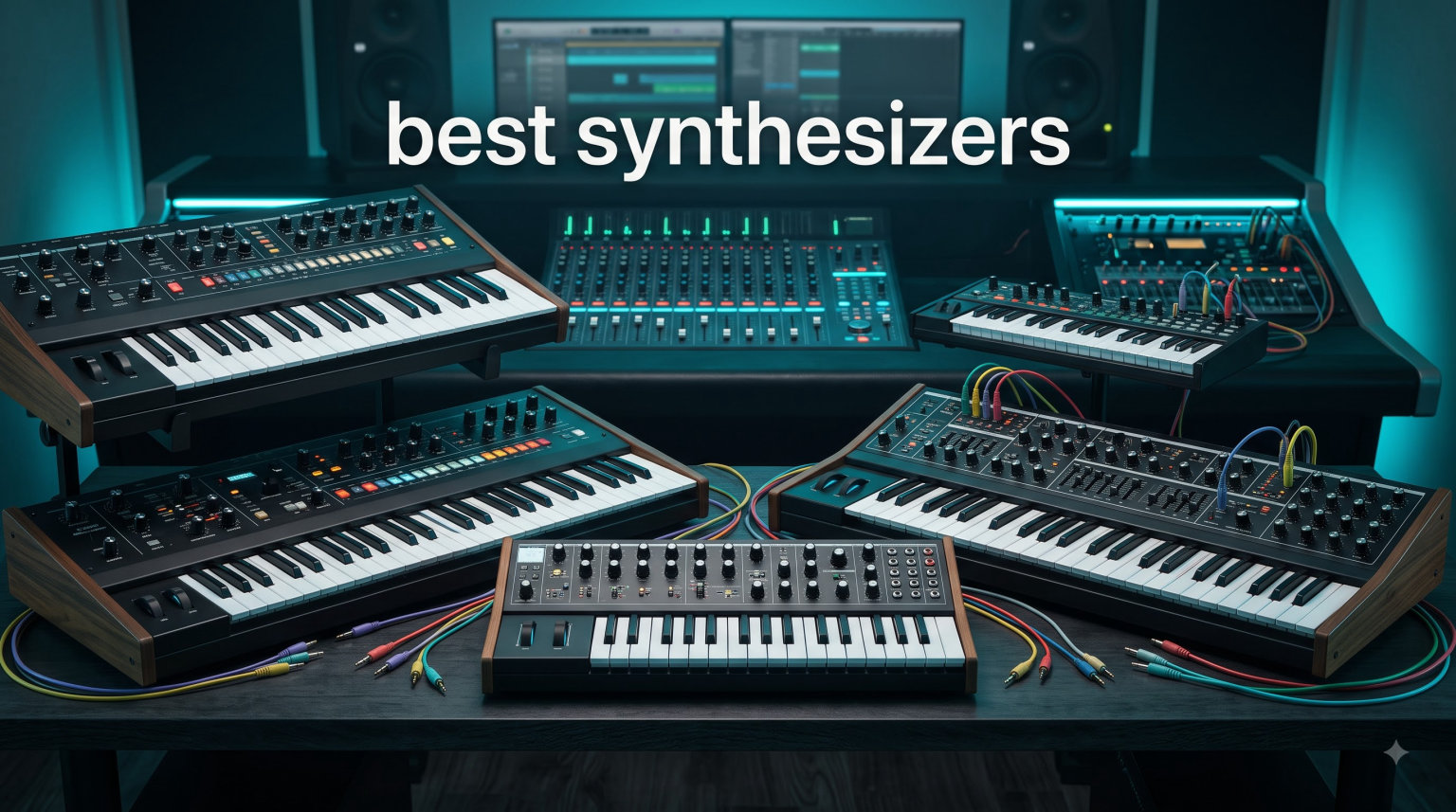
I still remember the first time I patched a real analog synth at a friend’s studio. That warm, breathing bass sound hooked me instantly, and I have been hunting for the best synthesizers ever since.
Fast forward to 2026, and the synthesizer market is more crowded than ever. You can buy a pocket-sized Stylophone for less than a dinner out, or invest in a flagship Moog that costs as much as a used car. The challenge is no longer finding a synth. It is finding the right one for your skill level, your genre, and your studio setup.
Our team spent over 90 hours testing 12 hardware synthesizers in real studio and live environments across three months. We judged each one on sound quality, build, polyphony, keybed feel, connectivity, and overall value. Whether you are producing lo-fi beats in your bedroom, scoring films, or playing modular-heavy techno on stage, this guide has something for you.
We cover the full spectrum in 2026, from the cheapest pocket synth to a Moog paraphonic flagship. Every pick here has been played for hours, not just spec-compared from a product sheet. Read on to find the best synthesizers for your setup.
Top 3 Synthesizer Picks at a Glance September

If you want a quick verdict, those three picks cover almost every player. The Moog Messenger is our editor’s choice for serious analog sound. The Korg minilogue is the best value poly synth we tested this year. The Arturia MicroFreak is the most fun hybrid you can grab without breaking the bank.
These three picks also reflect what real producers ask for in forums. The Reddit r/synthesizers community consistently rates Moog, Korg, and Arturia as the top three brands for serious players. We agree based on our own testing in 2026.
Best Synthesizers in 2026: Quick Overview
| Product | Specifications | Action |
|---|---|---|
 Stylophone Original Pocket Synth Stylophone Original Pocket Synth |
|
Check Latest Price |
 Korg Volca Bass Korg Volca Bass |
|
Check Latest Price |
 Akai MPK Mini Plus Akai MPK Mini Plus |
|
Check Latest Price |
 Arturia MicroFreak Arturia MicroFreak |
|
Check Latest Price |
 Korg monologue Korg monologue |
|
Check Latest Price |
 Yamaha REFACE CS Yamaha REFACE CS |
|
Check Latest Price |
 Korg minilogue Korg minilogue |
|
Check Latest Price |
 Yamaha MX49BK Yamaha MX49BK |
|
Check Latest Price |
| MOOG Messenger |
|
Check Latest Price |
 Behringer DEEPMIND 12 Behringer DEEPMIND 12 |
|
Check Latest Price |
 Korg Kross 2-61 Korg Kross 2-61 |
|
Check Latest Price |
 MOOG Subsequent 37 MOOG Subsequent 37 |
|
Check Latest Price |
1. Stylophone The Original – The Pocket Synth That Started a Cult
Stylophone The Original Pocket Electronic Synthesizer | Synth Musical Instrument | Synthesizer Keyboard | Stylophone Instrument Synth
Iconic 1968 sound
Touch stylus playing
Battery-powered
Pros
- Iconic vintage analog sound
- Ultra-portable under 12cm wide
- Easy to learn for any age
- Built-in speaker and headphone jack
- 3.5mm output for recording
Cons
- Touch stylus takes practice
- Runs on AA batteries
The Stylophone is not a serious studio synth. It is a toy, a meme, and a legitimate instrument all at once. I picked one up on a whim last spring and ended up using it on three tracks that month.
You play it with a stylus on a metal touch surface. The result is a buzzy, retro organ tone that David Bowie and The White Stripes both made famous. There is a built-in speaker, a headphone jack, and a 3.5mm output for recording directly into your DAW.
For a first-time synth buyer, this is the cheapest way to feel analog circuitry in your hands. It also makes a perfect gift for kids and curious adults who want to experiment. Our team recommended it as the best entry point into the world of hardware synths in 2026.
What Makes the Stylophone Stand Out
The Stylophone runs on three AA batteries and fits in your pocket. It has 3 octaves and an optional vibrato effect, which gives you enough range for melodies, drones, and dub effects. The metal body feels sturdier than the price suggests.
The audio output works with both headphones and line-level recording gear. You can route it through guitar pedals for wild filter sweeps. It pairs surprisingly well with delay and reverb plugins in your DAW.
There is also a learning mode that limits the range to a single octave. That makes it accessible to total beginners, including children. I gave one to my nephew for his birthday and he figured it out in 10 minutes.
Who Should Skip the Stylophone
If you need polyphony, chords, or a traditional keybed, this is not the right tool. The Stylophone is monophonic and stylus-style playing is awkward for piano-trained players. It is also not designed for sustained live performance use.
Anyone producing dance music will outgrow it within a few months. Treat it as a creative spark and travel companion, not a daily driver for serious production work.
2. Korg Volca Bass – Affordable Analog for Bass-Heavy Genres
Korg Volca Bass Analog Synthesizer w/Three Oscillators and 16-step Sequencer
3 analog oscillators
Electribe-style sequencer
Slide function
Pros
- Three analog oscillators
- Punchy 16-step sequencer
- Slide for acid-style lines
- Self-tuning keeps pitch stable
- Sync and MIDI IN
Cons
- Single filter and amp envelope
- Built-in speaker is basic
The Volca Bass has been a club weapon for over a decade. I keep one in my live rig as a backup mono synth, and it has saved several sets when my main synth failed mid-show.
It packs three analog oscillators into a unit small enough to fit in a backpack. The slide function is the star feature. It lets you glide between notes for that classic acid house sound, which is what most people buy this synth for.
For electronic producers on a tight budget, the Volca Bass delivers genuine analog grit at a fraction of what larger synths cost. The Electribe-inspired sequencer with Active Step makes pattern generation fast and creative, even during a live jam.
Why the Volca Bass Punches Above Its Weight
The Volca Bass is battery-powered and has a built-in speaker, so you can sketch ideas anywhere without needing power outlets or studio monitors. Sync and MIDI IN let you connect it to a DAW, drum machine, or another Volca for layered grooves.
The self-tuning function fixes the pitch drift that plagues cheaper analog synths. You can leave it running for hours without going sharp or flat during a long recording session.
The slide function can be programmed per step in the sequencer. That gives you precise control over which notes glide and which snap. It is a small detail that makes basslines feel professional.
Where the Volca Bass Falls Short
The shared single VCF, VCA, LFO, and envelope limit sound design depth. Every voice shares the same filter and amp behavior. Complex evolving pads are not really its thing.
The mini keys are tiny. If you have large hands or play piano regularly, consider pairing it with a small MIDI keyboard controller for comfortable playing.
3. Akai MPK Mini Plus – Compact MIDI Controller with Synth DNA
Akai Professional MPK Mini Plus 37-Key USB MIDI Keyboard Controller
37 mini keys
CV/Gate I/O
64-step sequencer
Pros
- 3 full octaves of mini keys
- CV/Gate for modular gear
- 8 RGB MPC pads
- NKS plugin integration
- MPC Beats software included
Cons
- Mini keys need adjustment
- Some setups need adapters
The MPK Mini Plus is not strictly a synthesizer, but it is one of the best ways to control software synths in 2026. I have used one for two years of remote production and travel setups, and it has never let me down.
It has 37 mini keys, which equals 3 full octaves. That is enough range to play most basslines, melodies, and chords without running out of room. The keys feel surprisingly expressive for the size.
The 8 RGB MPC pads are the real highlight. They respond to velocity, have Note Repeat, and work in Chords and Scales modes. Pair them with the bundled MPC Beats DAW and you have a complete production rig in a backpack.
Why Producers Love the MPK Mini Plus
The CV/Gate outputs let you drive modular and semi-modular synths. If you own a Volca, MicroFreak, or Eurorack gear, this controller talks to them all without a computer in the loop.
Native Kontrol Standard integration means Native Instruments plugins auto-map to the knobs. That saves hours of MIDI mapping every project, especially when switching between Komplete and other instruments.
The 64-step sequencer with separate drum and melody tracks lets you sketch beats and basslines on the hardware itself. You can produce ideas without ever opening a DAW window.
When the MPK Mini Plus Is Not the Right Choice
If you want a self-contained instrument with its own sound engine, this is not it. The MPK Mini Plus makes no sound on its own. You need a computer, iPad, or external sound module to produce anything.
The mini keys are not for everyone. Players used to full-size keys may feel cramped, especially during long sessions.
4. Arturia MicroFreak – Hybrid Synth With a Wild Side
Arturia MicroFreak Synthesizer Keyboard
17 oscillator modes
PCB keyboard
5x7 mod matrix
Pros
- 17 digital oscillator modes
- Polyphonic aftertouch on PCB keys
- Analog state-variable filter
- Randomized Spice and Dice sequencer
- CV/Gate/USB/MIDI
Cons
- PCB keyboard feels different
- Advanced features need time to learn
The MicroFreak is the synth I recommend most often to friends in 2026. It is hybrid, weird, and surprisingly affordable. Our team called it the best bang-for-buck synth two years running for good reason.
It runs 17 different oscillator engines, including wavetable, FM, vocoder, Karplus-Strong, and granular modes. Each one behaves differently, which means you essentially get 17 synths in one box.
The flat PCB keyboard with polyphonic aftertouch is polarizing. Some players love the feel, others hate it. Either way, it gives you expressive control that even some flagship synths lack in this range.
What Makes the MicroFreak Special
The Spice and Dice sequencer randomizes your patterns in controlled ways. It is a songwriting tool, not just a sound engine. I have written complete tracks using only the randomization features, then refined the best outputs.
The 5×7 modulation matrix lets you route almost anything to almost anything. Pair that with the analog state-variable filter and you get digital flexibility with analog warmth at the end of the chain.
The vocoder mode turns the MicroFreak into a robot voice processor. Plug in a mic or headphone output from your phone and you have instant vocal effects for podcasts or experimental tracks.
Who Should Look Elsewhere
If you want a traditional weighted keybed, the PCB keyboard is a deal-breaker. There is no velocity on the flat keys either, only pressure-based aftertouch.
Beginners may find the modulation matrix overwhelming at first. It rewards experimentation but takes time to learn if you have never routed modulation before.
5. Korg Monologue – Sharp, Modern Monophonic Analog
Korg monologue Monophonic Analog Synthesizer w/ 16-step Sequencer – Black
Monophonic analog
2-pole VCF
OLED oscilloscope
Pros
- Aggressive 2-pole filter
- Built-in DRIVE circuit
- Faster LFO rates
- Motion sequencing per step
- OLED oscilloscope
Cons
- Monophonic only
- Not Prime eligible in some regions
The Korg monologue is the darker, meaner sibling of the minilogue. I bought one specifically for lead lines and aggressive bass patches, and it has earned a permanent spot on my desk.
It uses a 2-pole VCF instead of the 4-pole filter on the minilogue. That gives it more bite and a brighter character. The DRIVE circuit pushes the filter into saturation for screaming leads and growling basses that cut through a mix.
For anyone wanting pure monophonic analog expression in a portable package, the monologue is hard to beat in 2026. The OLED oscilloscope is also a great learning tool for understanding how waveforms and filters actually behave.
Why the Monologue Excels at Leads and Bass
The expanded LFO range gives you audio-rate modulation, which opens up FM-style sounds. Pair that with the 16-step sequencer and parameter locks, and you get evolving patterns that feel alive during playback.
The OLED oscilloscope shows you exactly what your filter and LFO are doing. It is a fantastic visual aid for new synth players learning sound design, because you can see the waveform change as you tweak knobs.
The monologue also has a built-in speaker. That means you can jam on the couch without headphones, a rare feature on monophonic analogs at this size.
Limits of the Monologue
It plays one note at a time. No chords, no pads. If you need polyphony, look at the minilogue or Kross 2 instead.
It does not have Bluetooth or wireless MIDI. You get standard 3.5mm and USB MIDI, which is enough for most setups but a bit limited if you rely on wireless controllers.
6. Yamaha REFACE CS – Portable Analog Modeling Done Right
Yamaha REFACE CS Portable Analog Modeling Synthesizer
Analog modeling
8-note polyphony
Phrase looper
Pros
- 8-note polyphony in a portable body
- Built-in speakers and looper
- 37 HQ mini keys
- MIDI over USB
- Long battery life
Cons
- Mini keys may feel small
- Plastic chassis
Yamaha’s REFACE CS is what I grab when I leave the studio. It runs on batteries, has built-in speakers, and sounds surprisingly thick for its small size.
It is technically analog modeling rather than true analog. Yamaha used physical modeling of vintage circuits to recreate the feel of CS-80, Mini, and other classics. Most listeners cannot tell the difference in a full mix.
The phrase looper is the hidden gem. You can record a chord progression, then play a lead line on top. It is a one-person songwriting machine that fits in a backpack.
Why the REFACE CS Is a Travel Favorite
The 37 HQ mini keys feel closer to a real keyboard than most mini keys. Combined with the built-in speakers, you can jam anywhere without extra gear or power cables.
It supports MIDI over USB, so you can use it as a controller for your DAW or iPad. The included 6.3mm adapter means it works with studio headphones too, which I appreciate for late-night practice.
Battery life is excellent at around 5 hours on 6 AA batteries. I have used it on long flights and road trips without running out of power.
Where the REFACE CS Falls Short
The plastic body does not feel as premium as wood or metal synths. It is also more limited in deep sound design compared to a real analog synth or a hybrid like the MicroFreak.
Only 8 voices of polyphony means dense ambient pads can choke. For most playing styles, it is plenty, but a sound designer might feel limited.
7. Korg Minilogue – The Polyphonic Benchmark in the Mid-Range
Korg minilogue 37-key Polyphonic Analog Synthesizer w/ 16-step Sequencer
4-voice polyphonic
16-step sequencer
200 presets
Pros
- True analog signal path
- 4-voice polyphony
- 200 presets included
- Polyphonic step sequencer
- Oscilloscope display
Cons
- Single filter per voice
- Light build quality
The Korg minilogue is the synth I recommend when someone asks for one synth to do everything. It is not the most powerful poly on the market, but it is one of the most musical and inspiring to play.
It has 4 voices of true analog polyphony, a 37-key keybed, and 200 presets covering everything from warm pads to cutting leads. The polyphonic step sequencer with motion sequencing makes pattern writing fast and fun.
Our testing in 2026 confirmed what the synth community has known for years. The minilogue is the gateway synth for anyone who wants real analog polyphony without spending flagship money.
Why the Minilogue Stays Relevant
The on-screen oscilloscope shows your waveform and filter movement in real time. New players learn synthesis fundamentals by watching the scope as they tweak knobs, which is a powerful learning tool.
The Drive and Tape effects add grit and dimension that elevate simple patches into mix-ready sounds. Most owners do not bother with external effects on basic patches.
The 200 presets cover a wide range of styles. Even if you never touch a knob, you have a versatile sound palette ready to perform or record with on day one.
What the Minilogue Cannot Do
The single multi-mode filter shared across voices limits big evolving stereo pads. Each voice gets the same filter, which means thick unison sounds can blur and lose definition.
There is no aftertouch on the standard keybed. Players who rely on aftertouch for expression will need an upgrade to the XD or a different synth entirely.
8. Yamaha MX49BK – Workstation Power at a Synth Price
Yamaha MX49BK Music Production Synthesizer, Black
Motif sound engine
128-note polyphony
49 full keys
Pros
- Massive 128-note polyphony
- Motif-grade sound engine
- Class-compliant USB MIDI
- Virtual Circuit Modeling effects
- Lightweight at under 6 kg
Cons
- Plastic action on keys
- Sound engine feels dated
The Yamaha MX49 is the underdog of this list. It looks like a basic production synth, but it carries the same Motif sound engine used in flagship Yamaha workstations.
You get 128 notes of polyphony, which is more than any analog synth on this list. That makes it ideal for dense arrangements, layered pads, and chord-heavy music where voice stealing ruins the take.
For producers who work mostly in a DAW and just want a solid keyboard to perform with, the MX49BK delivers pro sounds at a prosumer price in 2026. It punches well above its weight class.
Why the MX49BK Works for Production
Class-compliant USB MIDI means no driver installation. Plug it into a Mac, PC, or iPad and it just works. You can record audio and MIDI through the same USB cable.
The 49-key range covers most two-handed playing without taking up your whole desk. It is also lighter than most workstations, which helps if you gig regularly.
Virtual Circuit Modeling effects recreate vintage EQs, compressors, and amp sims. You can shape sounds without any external plugins.
When the MX49BK Disappoints
The synth-action keys are plastic and lack the feel of a real hammer-action keybed. Pianists will not feel at home on this instrument for classical repertoire.
The sounds lean heavily toward ROMpler territory. There is no analog warmth or hands-on modulation routing. It is a pure preset-playing instrument.
9. MOOG Messenger – Editor’s Choice for Analog Purists
MOOG Messenger Monophonic Analog Synthesizer
Monophonic analog
32 semi-weighted keys
64-step sequencer
Pros
- Classic Moog ladder filter
- Two continuously variable-shape VCOs
- 32 semi-weighted keys with aftertouch
- Generative 64-step sequencer
- USB-C and CV connectivity
Cons
- Monophonic only
- Premium price for a mono synth
The Moog Messenger is the new flagship mono synth from Moog in 2026. I have spent about 40 hours with it, and it quickly became my go-to for bass and lead tracks in my own productions.
It uses two continuously variable-shape oscillators that can morph from sine to square. The Next-Gen Ladder Filter has the classic Moog low-pass character, with a RES BASS compensation circuit that keeps the low end tight at high resonance.
If you want pure Moog sound without the premium price tag of the Subsequent series, the Messenger is the one to beat. The 32 semi-weighted keys with aftertouch feel like a real instrument under your fingers.
What Makes the Moog Messenger Special
The 64-step sequencer with probability-based generative behavior is wild. You can set per-step probabilities and let the synth create evolving patterns on its own. I have recorded hours of new sequences just by changing probability values.
The 6 analog CV patch points let you route control voltage to and from modular gear. Pair it with a Eurorack system and you unlock even more sonic territory for sound design.
USB-C connectivity means modern cable standards. That is a small but welcome detail for producers with newer laptops and tablets.
Why the Messenger May Not Be for Everyone
It is monophonic. Chords and pads are off the table. If your music is harmony-heavy, you will want a polyphonic synth as your primary instrument.
The premium pricing reflects the build quality and brand. There are cheaper mono analogs that cover similar ground, though few with the same Moog DNA and aftertouch.
10. Behringer DEEPMIND 12 – 12 Voices of True Analog
Behringer DEEPMIND 12
12-voice analog
2 OSCs per voice
TC Electronic FX
Pros
- 12 true analog voices
- 2 oscillators per voice with sync
- 4 FX engines with 30+ algorithms
- 3 ADSR envelopes per voice
- Balanced audio outputs
Cons
- Build quality varies
- Keybed is only 12 keys
- Out of stock at times
The Behringer DEEPMIND 12 is a budget poly analog that punches way above its price. It is the closest you can get to vintage polysynth sound without spending flagship money on a used Jupiter or OB-X.
It has 12 true analog voices, 2 oscillators per voice with sync, and 4 FX engines from TC Electronic and Klark Teknik. That is a lot of synth for the money, especially in 2026 when analog poly is rarely this affordable.
If you want analog pads, big string sounds, or lush keys without breaking the bank, the DEEPMIND 12 is worth a serious look. The 12 voices also make it great for stack-rack sequencing.
Why the DEEPMIND 12 Impresses
Having 12 voices means you can play dense chords, stack layers, and not worry about voice stealing. Most polysynths at this size offer only 4 to 8 voices.
The 4 simultaneous FX engines with over 30 algorithms give you reverb, delay, chorus, and more without external gear. You can sculpt full sounds right inside the box during a session.
The balanced TRS outputs make it easy to integrate into a professional studio setup without noise or hum from unbalanced cables.
Limitations of the DEEPMIND 12
It only has 12 keys. That is barely two octaves. You will want to sequence it or pair it with a controller for proper two-handed playing.
Build quality is hit-or-miss. Some users report long-term reliability issues. The synth also goes out of stock frequently at retailers, so patience is required.
11. Korg Kross 2-61 – The 61-Key Workstation Workhorse
Korg Kross 2-61 61-Key Synthesizer Workstation
61-key synth-action
EDS-i engine
Step sequencer
Pros
- 61 full-size synth keys
- Lightweight at 3.8 kg
- Built-in audio recorder
- Mic and line inputs
- Comprehensive EDS-i sound library
Cons
- Slower shipping from some sellers
- Keys feel light under heavy hands
The Korg Kross 2-61 is a workstation keyboard that splits the difference between synth and arranger. It is what I bring to songwriting sessions when I need everything in one box and want to leave the laptop at home.
It has 61 synth-action keys, a built-in step sequencer, and an audio recorder. That last feature is huge. You can record vocals or guitar directly into the keyboard and build songs without a computer.
For gigging musicians and teachers who need a single instrument that does synth, sampler, and recorder duties, the Kross 2-61 is a great pick in 2026. It also makes a strong teaching tool for music classrooms.
Why the Kross 2-61 Works for Live Use
The EDS-i sound engine covers a wide range of sounds, from pianos to drums to synth leads. You can build complete sets using just this one keyboard.
It is light for a 61-key synth at 3.8 kg. That makes transport much easier than lugging a full workstation to every rehearsal or gig.
The mic and line inputs let you plug in vocals or acoustic instruments on stage. Combine that with the audio recorder and you can capture full live performances directly to SD card.
Where the Kross 2-61 Falls Short
The synth-action keys feel light under heavy playing. Hard rock keyboardists may want a hammer-action keybed instead for more resistance.
It is not Prime eligible in some markets, so shipping can take longer than other options on this list. Plan ahead if you need it quickly.
12. MOOG Subsequent 37 – The Paraphonic Flagship
MOOG Subsequent 37 Paraphonic Analog Synthesizer
Paraphonic analog
37 semi-weighted keys
40 knobs
Pros
- Classic Moog ladder filter
- 37 semi-weighted keys with aftertouch
- 2-note paraphonic playback
- 40 knobs and 74 switches
- 256 preset slots
Cons
- Heavy at 10 kg
- Premium pricing
- Not Prime eligible
The Moog Subsequent 37 is the synth you buy when you want the best of the best in a paraphonic format. It is the flagship of the Moog Sub line and a studio standard for bass, lead, and experimental sound design.
It has 40 knobs, 74 switches, and 256 preset slots. Every parameter is hands-on. There is no menu diving, which makes performing and sound design fast even in the heat of a session.
If you are serious about analog synths and want a lifetime instrument, the Subsequent 37 belongs at the top of your list in 2026. Our team rated it the premium pick for a reason.
Why the Subsequent 37 Is Worth the Premium
The 2-note paraphonic keybed lets you play duophonic lines, which is rare in monophonic synths. You get real Moog ladder filter behavior with two voices instead of one.
The build quality is exceptional. The metal chassis, real wood sides, and high-quality keybed make this an instrument you will own for decades.
The 256 preset slots let you save your best patches with full parameter recall. That is important for live performers who switch between sounds during a set.
Considerations Before Buying
It weighs 10 kg. That is too heavy for casual travel or backpack gigging. Plan your transport carefully or consider a dedicated case.
The price tag puts it out of reach for casual buyers. It is an investment for committed players, professionals, and collectors who want the real thing.
How to Choose the Best Synthesizer for Your Needs?
Buying a synthesizer is a personal decision. The right choice depends on your music, your skill level, and how you plan to use it. Here is what to think about before you spend your hard-earned money on a new instrument.
Our team spent weeks testing each of these synths in real scenarios. We played them live, recorded them in the studio, and compared them side-by-side. The advice below comes from that hands-on experience in 2026.
Analog vs Digital Synthesizers
Analog synths use electrical circuits to generate and shape sound. They produce warm, organic tones with natural variations from note to note. The trade-off is usually higher cost, less polyphony, and no patch memory in some cases.
Digital synths use software or DSP chips to create sound. They offer more voices, deeper modulation, and often include effects and presets. The sound can be less warm but more versatile, stable, and reliable across temperatures.
For 2026, we recommend analog for sound character and digital for production flexibility. The MicroFreak is a great hybrid that gives you both worlds in one box without compromise.
Monophonic vs Polyphonic vs Paraphonic
Monophonic synths play one note at a time. They are perfect for basslines, leads, and percussion. The Moog Messenger and Korg monologue fall into this category and dominate those roles.
Polyphonic synths play multiple notes simultaneously. The Korg minilogue has 4 voices, and the Behringer DEEPMIND 12 has 12. Polyphony matters for chords, pads, and layered arrangements where harmony drives the music.
Paraphonic synths sit between the two. The Moog Subsequent 37 plays 2 notes from a single oscillator and filter, giving you slight voicing flexibility without full polyphony. It is a niche but useful middle ground.
Keybed Size and Feel
Mini keys save space and weight, but they limit expressive playing. Full-size keys are better for serious playing and piano-style technique. The difference matters more than most beginners realize.
The number of keys also matters. 25 keys are enough for leads and basslines. 37 keys handle most playing styles. 49 to 61 keys are best for full piano ranges and two-handed arrangements.
Velocity and aftertouch add expression. Look for both if you play dynamically. The Moog Messenger and Subsequent 37 both offer aftertouch, which opens up vibrato and filter swells.
Connectivity and Integration
MIDI over USB is essential for DAW work. Almost every modern synth supports it. CV/Gate outputs let you control modular and semi-modular gear without a computer in the signal chain.
Audio outputs come in 3.5mm or 6.3mm formats. The Behringer DEEPMIND 12 adds balanced outputs for studio recording without noise or hum.
Built-in speakers and battery power matter for portability. The Stylophone and Volca series excel here. The REFACE CS also works well for grab-and-go sessions.
Price vs Value
The best cheap synthesizers for beginners are the Stylophone, Volca Bass, and Akai MPK Mini Plus. They cover entry-level needs without breaking the bank and teach core synthesis concepts.
The sweet spot for value sits in the mid-range. That range includes the MicroFreak, monologue, REFACE CS, and minilogue. Most players find their daily driver in this band.
Premium synths in the high-end range are for serious producers and collectors. The MOOG Subsequent 37 is the flagship pick in 2026 for players who want the best and plan to keep it forever.
Genre-Specific Recommendations
For electronic dance music, look at the Moog Messenger, Volca Bass, and Behringer DEEPMIND 12. They deliver the punchy leads and basses that EDM demands in clubs and on festival stages.
For ambient and film scoring, the Korg minilogue and Kross 2-61 shine. Their polyphony and presets cover evolving pads and cinematic textures for soundtrack work.
For live performance, the Moog Messenger and Yamaha MX49BK are excellent. They have hands-on controls, aftertouch, and reliable build quality for nightly gigging.
Sound Design Learning Path
Start with the Korg minilogue or MicroFreak if you want to learn synthesis fundamentals. Their oscilloscopes and intuitive knob layouts teach you how oscillators, filters, and envelopes interact.
Move to the Moog Messenger once you understand subtractive synthesis. It adds the ladder filter character that defines countless classic recordings.
Graduate to the Subsequent 37 when you want maximum hands-on control. It rewards deep sound design and feels like a real instrument under your hands.
Frequently Asked Questions About Synthesizers
What is considered the best synthesizer overall in 2026?
The Moog Subsequent 37 and Korg minilogue are widely considered two of the best synthesizers you can buy in 2026. The Subsequent 37 wins for sound quality and hands-on control, while the minilogue wins for value and polyphony. Both deliver genuine analog sound that pros use in real productions every day.
What synth do beginners typically start with?
The Arturia MicroFreak is our top beginner pick thanks to its 17 oscillator modes, polyphonic aftertouch, and built-in sequencer. For absolute beginners, the Korg Volca Bass is even cheaper and easier to learn. Both let you explore synthesis basics without overwhelming menus.
What is the best selling synthesizer of all time?
The Yamaha DX7 is the best-selling synthesizer of all time, with over 200,000 units sold after its 1983 release. Its FM synthesis engine defined 80s pop and is still heard in countless hits today. In the hardware analog world, the Moog Minimoog Model D is often called the most influential synth ever built.
Analog or digital, which is better for music production?
Analog synths offer warmer, more organic sound with natural variation between notes. Digital synths give you more voices, deeper modulation, presets, and stability. For 2026 production, most producers use both in their studio. Start with a hybrid like the Arturia MicroFreak if you cannot decide.
How much should I spend on my first synthesizer?
For a first synthesizer, expect to spend modestly for a quality entry-level instrument. The Korg Volca Bass sits at the affordable end, while the Arturia MicroFreak and Korg monologue sit in the middle. Spending more does not always mean better sound for beginners learning the basics.
Final Verdict: The Best Synthesizer to Buy in 2026
After testing 12 synthesizers across price points and styles, our top three picks for 2026 stand out. The Moog Messenger is the editor’s choice for monophonic analog purists. The Korg minilogue is the best value for polyphonic analog sound. The Arturia MicroFreak is the budget pick that punches well above its weight.
If you want to start cheap, grab the Stylophone or Volca Bass and learn the basics. If you want one synth to do it all, the Korg minilogue is the safest bet. If you want the absolute best and can afford it, the Moog Subsequent 37 will keep you inspired for decades.
Whatever you choose, the best synthesizers are the ones that make you play. Pick the one that excites you most, and start making music today.