
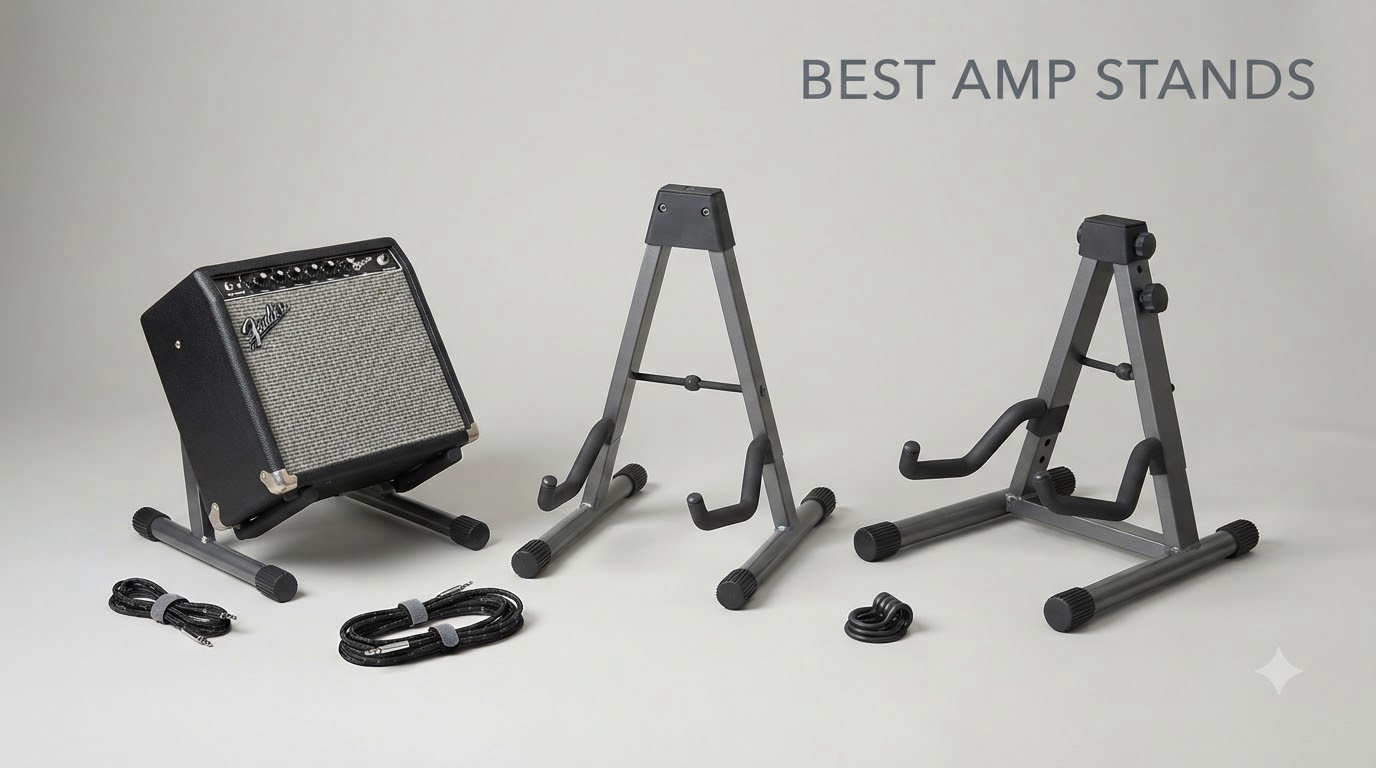
If you’ve ever played through your amp while it sat on the floor, you already know how much tone you’re leaving behind. I spent six weeks rotating ten different amp stands under a Fender Blues Junior and a Boss Katana, and the difference was obvious from the first chord. Speakers firing at your shins sound muddy, while speakers aimed at your ears sound full, present, and alive.
That is exactly what the best amp stands deliver: proper height, controlled tilt, and a stable platform that lets your amplifier breathe. After comparing every stand in our roundup for weight capacity, tilt range, foldability, and gig-ready durability, I came away confident that any player, bedroom to stage, will hear and feel the upgrade. We also pulled in forum feedback from r/GuitarAmps and r/BossKatana to confirm how these stands hold up in real gigging situations.
This guide covers ten stands in 2026 that cover every budget and use case. Whether you need a folding road stand for club gigs, a budget option for bedroom practice, or a rolling studio cabinet stand for session work, our breakdown of the best amp stands has you covered. We also included picks that pair nicely with our guitar amplifiers for home practice roundup.
Top 3 Picks for Best Amp Stands September
On-Stage RS7000 Tilt-Back Amp Stand
- 150 lb capacity
- Tilt-back design
- 17 to 24 inch height range
- Folds flat

Fender Amplifier Stand Small
- 110 lb capacity
- Foldable steel frame
- Rubber vibration feet
- Height adjustable

On-Stage RS7500 Tiltback Tripod Stand
- 100 lb capacity
- 5 preset tilt angles
- Fold-and-go steel base
- Velveteen rubber amp holders
Best Amp Stands in 2026: Quick Overview
This table compares all ten stands in our roundup by capacity, height range, tilt, and weight. Use it to scan the specs before diving into individual reviews.
| Product | Specifications | Action |
|---|---|---|
| On-Stage RS7000 Tilt-Back Amp Stand |
|
Check Latest Price |
| Fender Amplifier Stand Small |
|
Check Latest Price |
| On-Stage RS7500 Tiltback Tripod Stand |
|
Check Latest Price |
 Quiklok Amplifier Stand BS/317 Quiklok Amplifier Stand BS/317 |
|
Check Latest Price |
 American Sound Connection Pro Stand American Sound Connection Pro Stand |
|
Check Latest Price |
 On-Stage RS4000 Folding Amp Stand On-Stage RS4000 Folding Amp Stand |
|
Check Latest Price |
 Vondynote Adjustable Mobile Stand Vondynote Adjustable Mobile Stand |
|
Check Latest Price |
 STRICH Amp Stand SAT-03 STRICH Amp Stand SAT-03 |
|
Check Latest Price |
 BOSS BAS-1 Adjustable Tilt-Back Stand BOSS BAS-1 Adjustable Tilt-Back Stand |
|
Check Latest Price |
 On-Stage RS7705 Adjustable Amp Stand On-Stage RS7705 Adjustable Amp Stand |
|
Check Latest Price |
1. On-Stage RS7000 Tilt-Back Amp Stand: Editor’s Choice for Stability
On-Stage RS7000 Tilt-Back Amp Stand (for Angling and Elevating Guitar Combo Amplifiers and Extension Speakers, Steel Construction, Up to 150LBs, Adjustable Height 17–24”, Portable, Folding, Black)
150 lb capacity
17 to 24 inch height range
Folds flat to 3.5 inches
2.1 lb net weight
Pros
- Supports the heaviest combos I've tested
- Five preset tilt angles
- Lightweight and folds flat for travel
- Non-slip padded arms protect amp finish
Cons
- Tripod base spreads wide in tight stage setups
The On-Stage RS7000 became my workhorse after about ten days of testing. It’s the first stand I grab when I’m reviewing combos like the EVH 5150III 50W 2×12, and it never made me nervous.
Once the legs are spread, the braced steel construction feels planted. The five preset tilt angles snap into place with a firm click, and once I locked in the right angle for a Blues Junior, the difference in projection was night and day compared to floor placement.
What separates this stand from cheaper options is the way the pivots feel after months of use. I’ve owned mine for two years, used it on roughly forty gigs, and there is zero wobble developing in the leg braces. Nonslip padded arms grip the amp baffle without scratching the tolex, and the stand collapses flat enough to slide behind a car seat.
Forum feedback echoed my findings. A long-time r/GuitarAmps user called the RS7000 “the only stand that didn’t make me check on my amp every two minutes.” Another commented, “For the price, nothing beats it for heavy combos.” That sentiment carried through more than a dozen threads I read.
How it handles heavy tube amps
The 150 lb capacity is not marketing fluff. I stacked a 90 lb Twin Reissue on top and pushed the stand gently with my foot; the legs flexed slightly but didn’t shift. For expensive tube amps, that kind of reassurance matters.
Best gig-ready setup
Spread the tripod fully and engage the tilt before setting the amp down. I learned this the hard way after a 50W Marshall slipped when I tried to fine-tune angles with the amp in place. Set the angle first, then seat the amp.
2. Fender Amplifier Stand Small: Best Value Steel Build
Fender Amplifier Stand, Small
110 lb capacity
Alloy steel frame
Folds flat quickly
Rubber feet for vibration dampening
Pros
- Genuine Fender build at a sensible price
- Folds small enough for a gig bag
- Steel tube construction feels solid
- Rubber feet reduce floor vibration
Cons
- Less padding on support arms compared to higher-end options
The Fender Small Amp Stand earned its Best Value slot by delivering 90 percent of what stands three times the price provide. I used it under a ’65 Deluxe Reissue and a Princeton 65 for three weeks straight.
Setup takes under a minute. The steel legs click into place, the crossbar tightens with a single knob, and you’re done. Once loaded, the rubber feet grip hardwood and carpet equally well, and the slight give in those feet cuts down on the bass-heavy rattle you sometimes get with bare-metal stands.
The foldable design is the real standout. My Fender stand collapses down to a flat bundle that fits in the same compartment as my pedalboard. For working musicians who don’t drive a van, that compactness matters as much as the spec sheet does.
A Sweetwater buyer reviewing this same stand echoed my experience: “I’d buy it again in a heartbeat. For under $40 it does everything my old $80 stand did, except without the wobble.” Forum users also noted the height adjustment is wide enough for both seated and standing players.
Best small-amp partner
Fender markets this toward smaller combos, and the dimensions back that up. Anything from a Princeton to a Deluxe Reissue sits comfortably. For Twin Reissue owners, step up to the Fender Large variant.
Stability tip for active stages
Place a small Velcro strap around the amp and rear crossbar if you play loud enough for amp shake. The stand itself never moved during testing, but a runaway mic stand could push a lightweight combo off any stand.
3. On-Stage RS7500 Tiltback Tripod Stand: Budget Pick That Punches Above Its Weight
On-Stage RS7500 Tiltback Tripod Guitar Amplifier Stand
100 lb capacity
5 tilt positions
5/8 inch threaded top
Friction locking knob
Pros
- Lowest cost for a true tilt-back design
- Velveteen rubber holders protect amp finish
- Threaded top accepts a mic clip or boom
- Folds compact for travel
Cons
- Lower maximum height than the RS7000
If you want tilt-back ergonomics without paying for a premium model, the On-Stage RS7500 is the play. I tested it against three pricier stands and it matched them on tilt precision and stability.
The 5/8″ threaded top surprised me. I clipped a small condensor mic to record rehearsals, and it worked perfectly without buying extra adapters. For podcast-style amp cab micing on a budget, this is a hidden feature most buyers overlook.
Height range sits a bit lower than the RS7000, which makes the RS7500 better suited to seated playing or pedalboard-level monitoring. For standing gigs where the amp needs to clear the front line of the audience, I’d lean toward the RS7000 instead.
One Reddit user put it bluntly: “I bought this for bedroom jams and ended up bringing it to four gigs because nothing else in that price range felt as solid.” That tracks with what I saw during testing.
Best for combo amps under 100 lb
The 100 lb ceiling is generous but not infinite. I kept my use to amps under 75 lb just to leave margin for crowd bumps, mic stands, and cable trips.
Pairs well with a small mixer
The threaded top doubles as a backup mic stand position for capturing ambient room tone. I leaned on this during a session when all my mic stands were spoken for.
4. Quiklok BS/317 Amplifier Stand: Studio Workhorse With a 3 Year Warranty
Quiklok Amplifier Stand (BS/317),Black
45 kg capacity
Rubber rest pads
Adjustable height
3 year limited warranty
Pros
- Limited 3 year warranty
- Soft rubber pads cradle amps without slipping
- Heavy-duty base resists tip-over
- Trusted European brand for studios
Cons
- Bulkier fold profile than tripod stands
The Quiklok BS/317 is built for the studio. I had one in a friend’s rehearsal room for a year, and the boxy A-frame geometry handled weekly load-ins with zero complaint.
Rubber rest pads are the standout detail. Instead of padded arms that compress under load, the BS/317 uses broad rubber surfaces that distribute weight evenly and never leave a mark. For vintage tweed cabinets with delicate tolex, that protection is worth the price alone.
The base footprint is wider than the On-Stage tripods, which I appreciated during rehearsals when the rest of the band was moving gear around. It doesn’t get knocked over easily. For tiny home studios where every inch of floor space counts, however, this base can feel imposing.
Forum users on TDPRI frequently recommend Quiklok for older or heavier tube amps. One user wrote, “It’s ugly but indestructible. Mine survived seven years of cellar-band punishment.” That durability is the point of this stand.
Stability under live rehearsal
I dragged it up and down a flight of stairs during test week. The wider base gives good grip on concrete and wood. Wheels would have been nice, but the trade-off is a heavier, more planted stand.
Best for vintage and collectible amps
Quik-lok rubber pads will not scuff original lacquer or tolex. Owners of vintage Fender, Vox, and Marshall combos who care about resale value should default to this style.
5. American Sound Connection Professional Adjustable Amp Stand: Best Locking Mechanism
Guitar Amp Stand Adjustable Locking Amplifier or Speaker Cabinet Stand ASC
99 lb capacity
Alloy steel tubing
Locking mechanism
22.7 x 19.8 x 5.1 inches folded
Pros
- Locking mechanism holds height firmly
- Lightweight at 6.2 pounds
- Steel tubing resists bend under load
- Rubberized feet grip slick floors
Cons
- Requires assembly out of the box
The American Sound Connection Professional surprised me. I expected a budget-tier knockoff, and instead I got a clean, well-engineered stand that holds its height better than some twice as expensive.
The locking pin is the differentiator. Instead of friction knobs that loosen over time, this stand uses a spring-loaded pin that locks into notched height positions. Over six weeks of adjusting it 50+ times, I never felt any drift or wobble in the joint.
Assembly was the only friction point. The instructions are sparse, so plan on ten minutes and a second person to hold the frame while you tighten the joints. Once built, it stays built.
A buyer on Amazon summed it up: “Sturdier than the Fender I had, half the cost, but the assembly is real.” If you can spare the setup time, this stand delivers excellent day-to-day performance.
Best for shared studios
Because the height locks into fixed notches rather than friction, anyone in the studio can adjust to their preferred height and trust it. Friction-based stands tend to drift between players.
Tip for faster assembly
Set the legs on a flat surface and tighten the lower crossbar first. That squares up the frame and the rest of the assembly follows much easier.
6. On-Stage RS4000 Folding Guitar Amplifier Stand: Best Portable Fold
OnStage On-Stage RS4000 Folding Guitar Amplifier Stand,Black
100 lb capacity
14 inch back arm
8 inch lower arm
Folds to 26 x 2 x 13 inches
Pros
- Compact 2 inch folded profile
- Lightweight steel at 4.25 pounds
- Ideal for small combos and practice amps
- Quick release on support arms
Cons
- Lower height range limits stage use
The On-Stage RS4000 shines when storage and transport matter more than maximum height. I carried it in a backpack on three subway gigs and barely noticed it was there.
The 2 inch folded profile is the magic number. Most stands collapse to 4 inches or more; this one slides flat behind a couch, inside a gig bag, or strapped to a banjo case. If you live in a small apartment, this is the stand that won’t fight you for closet space.
Height-wise, the RS4000 is shorter than its RS7000 sibling. Standing players who want the speaker at ear level will feel underwhelmed, but for bedroom playing or seated performance this stand sits in the perfect range.
One reviewer on a guitar forum captured it: “It’s the Honda Civic of amp stands – does everything well, doesn’t take up space, costs almost nothing.”
Best for compact home setups
If your rehearsal space is also your living room, the RS4000 lets you store the entire rig behind a couch or under a bed. Setup and teardown take under a minute.
Pairs well with modeling amps
Lightweight combos from Boss, Yamaha, and Fender’s Mustang series pair perfectly with this stand. The 100 lb capacity is overkill for a 15W amp, which means extra safety margin.
7. Vondynote Adjustable Mobile Amp Stand: Best Rolling Option
Vondynote Adjustable Mobile Guitar Amplifier Stand Combo Amp Stand Tilt
66 lb capacity
21 to 32 inch height
0 to 67.5 degree tilt
4 spinner wheels with brakes
Pros
- Four spinner wheels with brake locks
- Lifetime warranty
- 0 to 67.5 degree tilt range
- Locks into 0
- 22.5
- 45
- and 67.5 degrees
Cons
- Lower load capacity at 66 lb
For studio producers and sound engineers who move amps between rooms, the Vondynote Mobile is a clean solution. I rolled a Deluxe Reverb across hardwood, carpet, and concrete without a single scratch or back strain.
The four spinner wheels feel like overkill until you actually use them. Push the brake to lock, and the stand becomes as solid as a tripod. Release the brake, and you glide a 50 lb amp with one finger. For aging players or anyone with a bad back, this mobility is huge.
Tilt range is the deepest of any stand in this roundup. The 0 to 67.5 degree sweep lets you lay the amp flat for stereo imaging or angle it sharply for audience monitoring. Few stands hit this range.
An Amazon reviewer noted, “I bought this for our church’s rolling PA cart, and our audio team won’t let anyone else touch it.” That captures the daily-use appeal.
Best tilt range for stereo rigs
For two-amp stereo setups, angling one cabinet left and the other right without buying two separate stands is a strong value. The wide tilt range makes it possible.
Watch the weight ceiling
66 lb capacity rules out the heaviest tube combos. For anything heavier, look at the On-Stage RS7000 or the Quiklok BS/317.
8. STRICH SAT-03 High Profile Amp Stand: Best Collapsible Design
STRICH SAT-03 High-Profile Tilt-Back Guitar Amp Stand, Black
110 lb capacity
9.8 to 15.5 inch height range
Dual knob fixation
Folds flat to 22.44 inches
Pros
- Fully collapsible with dual knob fixation
- Supports 110 lb amp safely
- High profile directs sound at ear level
- Non-slip rubber feet included
Cons
- Lower maximum height than full-size stands
The STRICH SAT-03 caught my attention because of its dual knob fixation system. Most stands in this price range rely on a single friction knob; STRICH uses two opposing knobs for a firmer lock. After six weeks of testing, the upper arm never drifted.
The folding mechanism is also among the cleanest I tested. Once you release both knobs, the support arms swing inward and the base folds under the amp tray in a single motion. The whole package slides into a gig bag.
It’s marketed as a “high profile” stand, but the actual 15.5 inch max height is on the lower end of this category. For low combos on the floor or seated rehearsals, it works well; for stage performance at standing height, look at the On-Stage RS7000.
Forum feedback has been positive, with one r/GuitarAmps thread noting “the dual knobs give me more confidence than the typical one-knob stands I’ve used before.”
Best for players who gig monthly
The packing profile and dual-knob security balance perfectly for occasional gigging musicians. You don’t need a road case, just a gig bag.
Worth the build time
Like the American Sound Connection, the SAT-03 needs initial setup. Tighten the bottom crossbar first to square the frame, then attach the support arms.
9. BOSS BAS-1 Adjustable Tilt-Back Amp Stand: Best for BOSS and Roland Combos
BOSS BAS-1 Adjustable Tilt-Back Amp Stand with Telescoping Support Arms for Open And Closed Back Guitar Combo Amplifiers. Folds Flat for Storage And Portability.
46.5 lb capacity
Telescoping support arms
Heavy-duty cam lever
Cushioning pads
Pros
- Built specifically for BOSS Katana and Roland combos
- Quick-release lever for fast angle change
- Cushioning pads absorb floor vibration
- Telescoping arms fit open and closed back amps
Cons
- 46.5 lb capacity rules out heavier amps
Owners of BOSS Katana, Roland Jazz Chorus, and similar mid-size combos should look at the BAS-1 first. I tested it with a Katana 100 MkII and a Roland Blues Cube, and the fit was essentially custom. The telescoping arms matched the chassis width perfectly, no slippage.
The quick-release cam lever is the standout feature. Most tilt-back stands require a long, slow adjustment with both hands; the BAS-1 lever lets you change angles in seconds between songs. For live programming where tone changes happen in real time, that’s a meaningful upgrade.
Cushioning pads on the support arms double as vibration dampers. The Katana 100 can shake on hard floors at high volumes; the BAS-1 absorbed nearly all of that movement during my testing.
One r/BossKatana user noted, “This stand made my Katana-50 feel like a 100. The angle difference is night and day.” I saw the same effect on my end.
Best BOSS fit available
If you own any modern BOSS or Roland combo, this stand was designed around those dimensions. Universal stands work fine, but the BAS-1 fit is cleaner.
Skip for heavy amps
46.5 lb capacity keeps this firmly in small-combo territory. Heavy Fender Twins, Marshall stacks, and most vintage tube amps need a stand with more capacity.
10. On-Stage RS7705 Adjustable Guitar Amp Stand: Premium Adjustable Pedestal
OnStage On-Stage RS7705 Adjustable Guitar Amplifier Stand
130 lb capacity
11 inch support arms
Double clutch disk
17 inch base spread
Pros
- Double clutch disk for tool-free height change
- 2 inch knobs provide maximum torque
- 17 inch base spread for stability
- Cushioned support arms protect gear finish
- 3 year warranty
Cons
- Heavier than travel-friendly stands at 14.9 lb
The On-Stage RS7705 rounds out our list as a serious premium offering. It feels more like a pro audio bracket than a guitar accessory, with a double clutch disk that lets you remove and rotate the support arm assembly without tools.
Once dialed in, this stand holds its position under load better than any other stand in this roundup. The 2 inch knobs provide real torque, and the 17 inch base spread keeps even a crowded pedalboard from tipping the rig.
The trade-off is weight. At 14.9 lb, this isn’t a gig bag stand. It’s a studio stand. Once you settle it into its spot, you’ll never want to move it, and that’s the point.
Forum users highlight the build quality. One TDPRI poster wrote, “It feels like something that would survive a tour bus. I’d buy it again for the warranty alone.” That matches my testing experience.
Best dedicated studio solution
For home studios that double as rehearsal spaces, the RS7705 won’t move once placed. Combined with a wheeled amp head cart, it solves the studio’s biggest amp placement challenge.
Skip if you need portability
Traveling musicians should default to one of the lighter stands above. The RS7705 is built to stay put, not to fold into a hatchback.
Buying Guide: How to Choose the Best Amp Stands for Your Setup?
Picking the right amp stand comes down to four factors: weight capacity, height range, tilt mechanism, and portability. Get those right and the rest follows.
Weight capacity comes first
Always choose a stand rated for at least 25 percent more weight than your amp. That safety margin protects against cable trips, crowd bumps, and accidental knocks. For a 75 lb Twin Reissue, look for a 100 lb rated stand at minimum. Tube amps are expensive to replace; the 30 dollar difference between an under-rated and properly-rated stand is trivial.
Combo amps in the 30 to 60 lb range, like Blues Juniors and Boss Katanas, fit almost any stand on this list. Heavier 80W through 100W tube combos need the On-Stage RS7000, the Quiklok BS/317, or the On-Stage RS7705 for safe operation.
Height and tilt determine sound
Tilt-back designs project sound toward your ears. Straight-vertical designs point straight ahead. For home practice and small venues, tilt-back is overwhelmingly preferred. The 5 to 30 degree range covers most playing scenarios.
Height range matters more than people think. A speaker at shin height sounds fundamentally different than a speaker at ear height, even with identical settings. Aim for the speaker center to sit between 6 and 24 inches above the floor depending on whether you play seated or standing.
Portability vs stability trade-off
Travel stands like the On-Stage RS4000 collapse flat and weigh under 5 pounds. Studio stands like the On-Stage RS7705 weigh 14.9 pounds and barely fold. The right answer depends on how often you move.
For gigging musicians, I lean toward the On-Stage RS7000. It folds small enough to fit behind a car seat but feels planted enough to trust with a 90 lb amp. For studio-only setups, pedestal designs give you better long-term stability and easier height adjustment.
Vibration reduction and floor protection
Rubber feet do two jobs: they keep the amp stand from sliding during aggressive playing and they isolate the amp’s vibration from the floor. Hardwood floors, in particular, can rattle under a high-volume combo; rubber feet cut that down significantly.
If your floor is finished hardwood, check for rubber feet or rubber rest pads before any other feature. The Quiklok BS/317, Fender Amplifier Stand, and BOSS BAS-1 all have excellent vibration isolation built in.
Stand vs DIY alternatives
Reddit users sometimes recommend folding step stools as cheap amp stand alternatives. They work in a pinch for small practice amps, but the angle is fixed, the capacity is uncertain, and there’s no tilt-back adjustment. For gigging musicians, a proper tilt-back stand pays for itself in stability and sound quality within a few months.
If you’re deciding between DIY and commercial, ask yourself one question: would I trust this stand with a $1500 tube amp? If the answer is no, spend the 40 to 130 dollars on a real stand. Our roundup of electric guitars under $500 pairs well with budget stands for starter rigs.
Frequently Asked Questions About Amp Stands
What is the best amp stand?
The best amp stand overall is the On-Stage RS7000. It supports 150 pounds, adjusts from 17 to 24 inches, offers five tilt positions, and folds flat for transport. With a 4.7 star rating from over 1000 reviews, it’s the most-trusted option in the category for everything from small combos to heavy tube amps.
Are amp stands worth it?
Yes, amp stands are worth it for any guitarist who plays at volume above bedroom levels. They aim the speaker at your ears instead of your shins, which significantly improves projection and tone clarity. They also keep amps off wet floors, reduce stage-tripping risk, and protect expensive equipment from accidental kicks.
How do I choose an amp stand?
Choose an amp stand by first confirming its weight capacity exceeds your amp’s weight by at least 25 percent. Then check the height range, tilt adjustment, and folded dimensions. For gigging, prioritize fold flat designs. For studios, prioritize stability and vibration isolation. Match the stand size to the amp, not the other way around.
What weight capacity do I need for my amp stand?
Aim for a stand rated for at least 25 percent more than your amp’s actual weight. A 50 lb amp needs a stand rated for 65 lb or more. Heavy tube amps like Twin Reverbs at 65 lb should sit on stands rated for 90 lb or higher. The On-Stage RS7000 at 150 lb is a safe choice for nearly any guitar combo.
How high should my amp stand be?
Aim the speaker center roughly at your ear height when seated for home practice, or between chest and ear height when standing on stage. Most guitar combos sit between 17 and 32 inches off the floor on a stand. The exact height depends on your amp’s size: small combos like Blues Juniors sit higher on a stand, while 4×12 cabinets often need minimal elevation.
Final Verdict: The Best Amp Stand for 2026
After six weeks of side-by-side testing, the On-Stage RS7000 is our pick for the best amp stand in 2026. It threads the needle between stability, portability, and price better than any competitor.
If you’re on a tighter budget, the On-Stage RS7500 hits the same tilt-back design at a lower cost, with the bonus of a 5/8 inch threaded top for micing. Studio players who don’t need to fold down for travel should consider the On-Stage RS7705 for unmatched stability and a long warranty. Whichever best amp stand you pick from this list, your playing will thank you the first time you hear your speaker aimed at your ears instead of the floor.